A mode-aware decision framework for students and teachers: learn what a particular match rewards, coordinate teammates without wasting time and choose strategies based on evidence rather than repeating generic gaming tips.
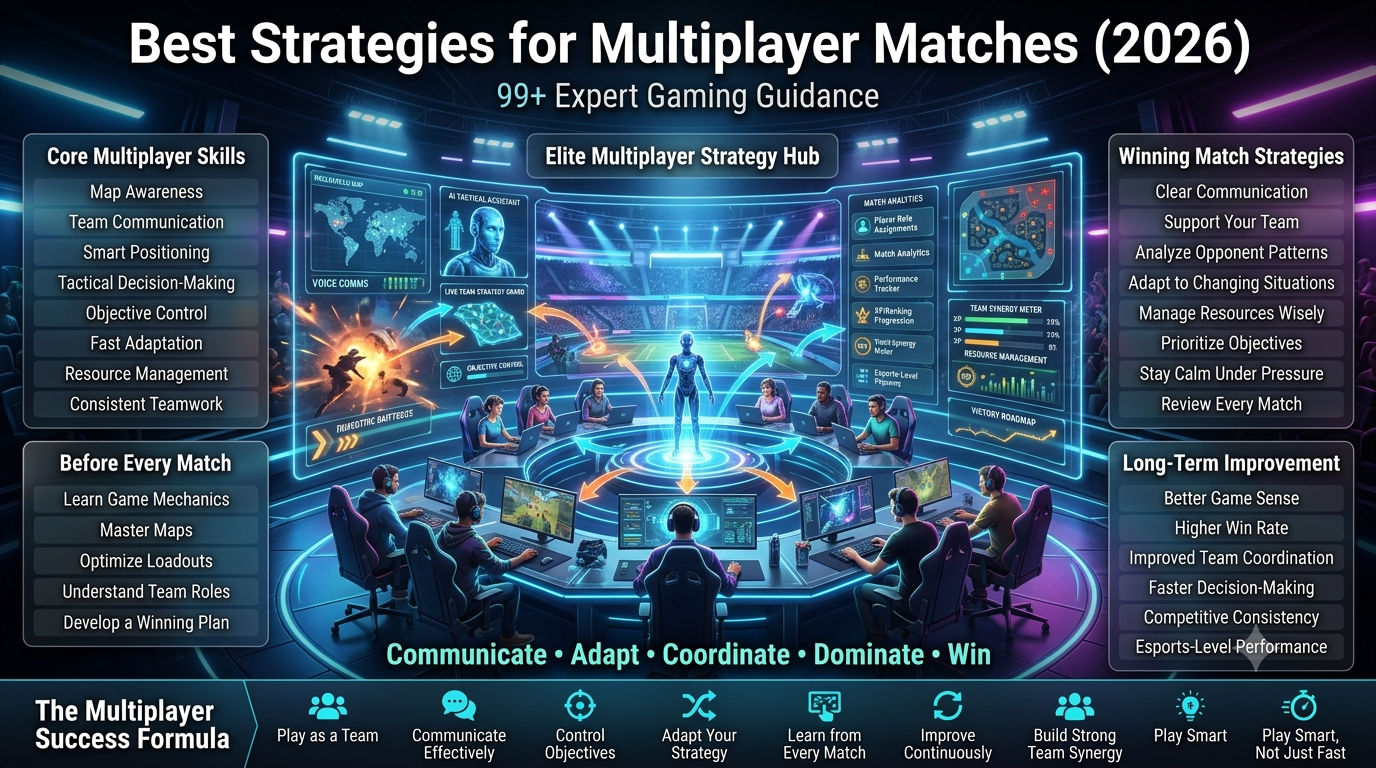
Quick answer: Before trying to win a Gimkit multiplayer match, identify the mode’s win condition, available resources and how team members can contribute. Assign clear communication responsibilities, avoid concentrating every decision in one player, reassess the objective after a setback and prioritize accurate responses when answering questions drives progression. No single tactic works for every mode.
Mode accuracy: Gimkit’s official mode picker guide explains that different modes emphasize different experiences. Review the actual mode rules before applying a tactic. A 2D cooperative task, a capture-the-flag activity and a classic answer-based match need different strategies.
1. Read the actual win condition
Many teams lose focus because they measure success using whatever number or animation is most visible. The first question should be: What exactly ends the game and determines the result? Some modes rely on a time goal, others on mode-specific objectives or progression. The teacher’s selected options also affect the match. Reread the actual rules if you are uncertain rather than assuming every mode uses the same scoring or purchasing system.
State the objective in a single sentence before the match begins. For example, “We need to complete the shared task while maintaining enough resources to keep moving” produces different decisions from “We need to defend our zone and coordinate attempts to score.” Translate the objective into two or three observable priorities so players know what to do when the action becomes confusing.
2. Build a role plan that serves the objective
A useful role plan is simple enough to remember during play. One teammate might watch the overall objective; another might relay new information; a third may handle a specific in-game task where the rules support it. Roles should be coordinated responsibilities, not invented in-game powers. Rotate them when someone becomes overloaded or when the match changes phase.
Be wary of placing a single high-performing student in charge of all decisions. That person may execute quickly but lose important information from the group. Give other players meaningful responsibilities and agree on a short communication format. For deeper educational discussion of roles and shared responsibility, see Team-Based Gameplay Explained.
3. Prioritize accurate answers when questions matter
Some Gimkit modes use questions to produce rewards or enable actions, and the relationship between answers and gameplay differs by mode. When that connection exists, accuracy is a strategic resource. Fast but poorly considered responses can slow meaningful progress, especially if teammates need additional actions to recover. Practice the most frequently misunderstood content before competing.
Do not memorize only a position or answer letter. A well-written Kit can change question order or phrasing. Students who understand the concept can adapt to unfamiliar items. When a question is ambiguous, raise the issue with the teacher rather than treating a possible authoring error as a reason to guess faster. Our question quality guide covers the content side of this problem.
4. Use short, high-signal communication
Constant shouting does not equal coordinated teamwork. Teams need messages that identify an observation and an action: “The objective changed; let’s regroup,” or “We need one person to monitor the next task.” When teammates speak over each other, important information becomes harder to interpret. Set a priority signal and use short updates only when the information changes a decision.
Make disagreement constructive. “Explain why” helps more than “You are wrong.” Keep competitive feedback about choices and evidence, not personal ability. During classroom games, the teacher’s conduct rules take precedence over any tactic that pressures or excludes students.
5. Adapt strategies to mode families rather than universal formulas
Mode situation
Primary strategy question
Common mistake
Shared/cooperative objective
What contribution is needed next?
Everyone pursuing the same subtask while another is ignored
Territory or objective control
Where does an action create the most useful change?
Chasing activity without protecting the objective
Question-driven progression
How do accurate answers translate into the relevant resource?
Buying or spending without understanding the chosen mode
Short timed match
Which decisions matter before the goal is reached?
Starting a long strategy too late
Mixed-ability classroom team
How can everyone contribute knowledge?
Confusing fast action with learning
The exact mechanics may be different from one specific Gimkit mode to another. Check the description in the mode picker and the teacher’s game options. The Gimkit Game Modes guide provides a wider catalog; this article focuses on choosing a strategy after the mode is known.
6. Manage the opening, middle and closing phases
Opening: Confirm the win condition, team members’ communication method and one immediate priority. Check whether progression depends on academic answers. Do not spend the entire opening on overly complicated planning; choose a simple plan that can be revised.
Middle: Monitor whether the current plan is working. If one objective stalls, determine whether the problem is a knowledge gap, a resource shortage or an unhelpful allocation of teammates. Change one variable at a time when possible so you can learn which adjustment improved the outcome.
Closing: Reassess the goal and remaining time or actions. Avoid starting expensive long-term plans when the match is nearly over. Communicate clearly about the next priority. In classrooms, finish with a reflection on strategic reasoning rather than presenting a last-minute victory as proof of learning.
7. Build resource discipline without inventing a universal economy
Only some modes involve cash, upgrades, energy or other mechanics. A resource plan is useful when those resources genuinely exist and connect to the goal. Before spending, ask what the purchase or action will enable, whether it is still relevant, and what the opportunity cost is. When the mechanics differ, adapt the questions instead of copying a “best upgrade” ranking from another mode.
Some students prefer a conservative approach, others an aggressive one. Neither is always correct. Compare the expected benefit of using a resource now with keeping it for the next objective. Teachers can turn this into a productive discussion about tradeoffs and decision-making without treating invented probability estimates as verified game mechanics.
8. Recover from an early setback
A lost objective or slow opening does not always justify resetting the match. Teams often improve when they identify what caused the problem and simplify the plan. Ask whether the group misunderstood the objective, missed important information, or attempted too many tasks simultaneously. Agree on the next observable action and evaluate it after a short interval.
Avoid blaming the teammate who made the last visible mistake. The error may have resulted from unclear instructions, a missed callout or an earlier decision. Constructive review makes recovery more likely and supports a healthier classroom culture.
9. A mode-specific decision assistant
Choose the situation that best matches your next match. These prompts are deliberately conditional because the same advice is not accurate in every mode.
We have a cooperative objective but teammates keep separating
Write down the shared task and its immediate subgoals. Assign one person to monitor whether each subgoal is covered. Communicate when circumstances change and regroup at a planned checkpoint. Avoid inventing roles the interface does not support; use ordinary team coordination.
We are making progress, but the other team controls the key objective
Identify the actual scoring or winning condition. Decide whether defense, objective completion or a coordinated attempt produces more value. Avoid chasing individual interactions that do not advance the shared outcome. Review the selected mode rules before copying specific map tactics.
We keep running out of resources
List which actions generate and use the resource in the current mode. Prioritize accuracy when correct answers are relevant. Spend only when a benefit connects to the objective. If resources differ by mode, abandon any fixed shopping list.
We win sometimes but cannot explain why
After the match, describe two decisions and their outcomes. Identify which were based on information and which were guesses. Next time change only one strategic priority and compare the result. Avoid treating one successful run as a guaranteed formula.
10. Three practice drills for teams
Drill A: ten-second objective brief
One player states the win condition and one next action in ten seconds. Another repeats it in their own words. The purpose is clarity, not speed for its own sake. If teammates disagree on the objective, return to the mode description before continuing.
Drill B: evidence-based decision
Present two plausible actions and ask the team to name the evidence supporting each. They must identify an opportunity cost, such as giving up time to pursue another task. This develops reasoning even if the exact mechanics vary between modes.
Drill C: constructive recovery
After an unsuccessful round, each person names one decision that was within the team’s control and one adjustment to test. No one may blame an individual teammate. The next round tests the adjustment, not an unverified promise of victory.
11. Practice safely and fairly
In school settings, winning is not a reason to harass peers, bypass account restrictions or pressure someone to reveal personal information. Students may need different ways to participate because of reading, motor, language or accessibility needs. A strategy that excludes a learner from the task is not a good educational strategy even if it produces a higher score.
Teachers should communicate the purpose of the activity and provide a separate learning check. A student can demonstrate progress through accurate explanations even when their team does not win. The multiplayer versus solo guide
12. Frequently asked questions
Is there one best strategy for every Gimkit multiplayer mode?
No. Modes have different objectives, controls and relationships between answers and gameplay. Review the specific rules first.
Should the fastest player always lead?
No. Good leadership depends on interpreting the objective, listening to teammates and sharing responsibilities, not only input speed.
Can a team recover from a weak opening?
Often, but it depends on the mode and remaining goal conditions. Diagnose the cause, simplify the next action and reassess progress.
Do higher scores prove better academic understanding?
Not necessarily. The teacher should use a separate explanation or application task to check knowledge beyond game performance.
Conclusion
Effective multiplayer strategy begins with the mode’s actual objective. Use precise communication, distribute responsibilities, understand the role of questions and resources, and change course when evidence shows the plan is not working. These are adaptable decision-making principles, not guaranteed exploits or universal win formulas.
Independent Gimkit strategy guide. Features depend on selected game mode; consult the official help documentation for product rules.