Independent educator field guide · Reviewed November 2026
A practical answer: what should a teacher configure first?
Begin with the learning objective and the question set, then decide which kind of competition is appropriate for the group. A well configured activity is one in which students can access the task, understand what counts as success, answer meaningful questions, and receive useful feedback afterward. The mode, room arrangement, duration, team structure, and display of rankings are adjustable means toward that purpose, not educational outcomes by themselves. If a class needs careful explanation of unfamiliar material, direct instruction or a low-pressure retrieval activity may be a better opening than a fast competitive round.
In Gimkit, the official Mode Picker documentation explains that modes have labels and descriptions to help hosts choose a suitable experience. The official game-options guide distinguishes standard options from mode-specific controls. Consequently, no universal menu of settings, energy amounts, team sizes, or timers applies to every mode. Check the actual settings visible in the host interface before promising students a particular rule.
This article focuses on decisions teachers can make, observable learning evidence, and ways to reduce unnecessary competitive pressure. The examples are classroom planning illustrations, not claims that a particular setting produces a guaranteed improvement in grades, retention, motivation, or accessibility. It is published by an independent informational site, not by Gimkit.
1. Match the competition format to the evidence you need
Teachers often begin by asking which game is the most exciting. A more reliable question is what students should demonstrate at the end of the lesson. If the objective is recognizing a recently taught term, a short question-based round can create opportunities for retrieval. If the objective is explaining why a scientific claim is correct, a multiple-choice response alone is insufficient; require an oral justification, written explanation, or worked example afterward. If the objective is collaborative reasoning, evaluate how teammates exchange ideas rather than assuming a shared score proves that everyone contributed.
For a formative check, choose questions that expose likely misconceptions. One item can present the correct answer beside a plausible distractor that reveals a common misunderstanding. After play, discuss the reasoning behind that distractor. For fluency practice, use familiar material where students already understand the method; speed may be observed but should not be confused with conceptual mastery. For an introductory activity, use a short diagnostic question set and avoid treating an initial low score as a negative judgment of a learner’s ability.
Before choosing the mode, write an evidence statement: “After this session, I will know whether students can distinguish renewable from nonrenewable resources and explain one example.” Then identify which questions address the distinction and which follow-up prompt tests the explanation. If the selected game experience demands substantial navigation, it may consume time that would otherwise support explanations. That is a legitimate reason to choose a simpler mode, even if the more complex one is popular.
For broader lesson integration beyond competition, see the site’s daily teaching integration guide. Keep this page’s purpose narrower: configuring a fair competitive session, not replacing the entire curriculum.
2. Conduct a five-minute host-side preflight
Open the Kit before class and read every question as a learner would. Verify the answer key, grammar, images, and level of background knowledge assumed. Remove ambiguous distractors that have two defensible answers. A competitive timer magnifies poorly written questions because students have less opportunity to seek clarification. If a question is central to the learning objective, prepare a one-sentence explanation of why the answer is correct. If a question tests peripheral trivia, consider removing it instead of relying on game excitement to justify its inclusion.
Next, open Play Live and inspect the Mode Picker and options screen. The official hosting instructions describe choosing a Kit, selecting a mode, configuring options, sharing the joining route, and starting the session. Check what is actually available to the account and class rather than relying on screenshots from another school year. If a chosen mode includes controls for question-to-action rewards, consider whether the activity currently rewards answering enough questions or primarily rewards movement and exploration.
Finally, test the presentation environment. Is the projection readable from the back of the room? Can the host reach the controls without exposing unrelated tabs or student information? Does the network support students joining? Are school devices charged? Do students know whether to use a code, link, or QR code? Reserve an alternative activity, such as printed retrieval cards, in case the connection fails. The preflight is complete only when the teacher has a fallback and a plan for reviewing answers.
3. Choose a meaningful game goal rather than a fashionable duration
Game goals are not interchangeable. A time limit, a question target, and a mode-specific objective can produce different patterns of participation. A short duration may support a quick retrieval check, but it can also make a student who reads carefully feel rushed. A long session may permit additional attempts, yet it may crowd out explanation or follow-up. Treat a time recommendation as a starting hypothesis to test in your classroom, not a universal scientific optimum.
For a forty-five-minute lesson, a possible structure is five minutes of retrieval and instructions, ten minutes of competitive play, ten minutes of evidence review, fifteen minutes of targeted practice, and five minutes of exit reflection. Those are example allocations, not Gimkit defaults. A class learning an unfamiliar concept might spend more time on teacher modeling and less on gameplay. A class revising familiar vocabulary might spend more time answering and discussing questions. The crucial decision is whether the final explanation stage survives when the game runs long.
When a mode allows an early end, establish a stopping condition before the session begins: for example, stop after a predetermined instructional window or when enough evidence has been collected. Do not extend a game only because the leaderboard is close. If a student needs extra processing time, use a mode or alternate response format that avoids making speed the main indicator of achievement. Ask learners afterward whether the pace allowed them to think, not merely whether the round felt exciting.
4. Understand the difference between standard and mode-specific options
The official game-options documentation describes standard controls, such as goals, joining late, and nickname management, while other controls depend on the selected mode. A setting visible in one 2D activity may not exist in another. The same principle applies to team arrangements: some experiences emphasize cooperation, some are individual, and some involve opposing sides. Teachers should not describe an option as a site-wide feature unless Gimkit documents it that way.
For 2D activities, consider the relationship between answering questions and performing game actions. Official examples include energy, bait, or other resources awarded for correct answers in certain modes. If students spend most of the time navigating while answering very few questions, the lesson may need a different balance or a different mode. If gameplay is constantly interrupted by questions, the class may lose the experience that makes that mode appealing. Observe both activities rather than assuming that more movement means more learning.
Use a two-column note during the first trial: “question practice observed” and “gameplay behavior observed.” Record whether students attempted the intended questions, whether misconceptions surfaced, and whether they could explain a correct answer afterward. On the gameplay side, record confusion with controls, time spent waiting, and interruptions. This simple distinction prevents a teacher from confusing the number of visible movements with the amount of successful retrieval. Adjust only one or two controls for the next session so changes remain interpretable.
5. Form teams without making ability groups permanent labels
Balanced teams do not necessarily mean matching students by a single test score. Consider familiarity with the content, confidence, reading support, device access, and willingness to speak. A team of highly confident players may dominate conversation even if its members are not consistently accurate. A quieter group may know the material but need a more structured opportunity to contribute. The aim is to design interaction in which each student has a legitimate role, not to engineer an artificial tie on the leaderboard.
For a small-group activity, try rotating the roles of question reader, reasoning explainer, evidence checker, and reflection reporter. Roles should rotate during subsequent sessions so no student becomes the permanent reader or the permanent “weak player.” In a large class, the teacher may use brief pair discussion before students answer independently. That approach creates room for reasoning without requiring every game mode to support an internal team feature. In any format, do not allow one confident student to take over another student’s device or submit answers for them.
Consider a classroom example: four groups are reviewing fractions. One team finishes first but repeatedly misidentifies equivalent fractions; another is slower but explains its reasoning accurately. The teacher should praise specific reasoning and address the shared misconception, not simply reward the fastest group. Rotate group composition after a few lessons, and watch whether previously quiet students gain opportunities to explain. For additional participation structures, consult the classroom participation strategies guide.
6. Protect learners who experience speed or social pressure differently
A competitive game may present barriers that are invisible on a scoreboard. Some students read slowly, use assistive technology, experience sensory overload, have limited motor control, or find public rankings stressful. Those factors are not evidence of weak understanding. Before class, identify whether the planned task requires rapid reading, fine motor navigation, audio cues, or quick transitions between screens. When a barrier is unrelated to the objective, consider reducing it through a different mode, longer thinking windows, alternative response methods, or a noncompetitive companion activity.
Do not promise that a particular game mode is accessible for every student without testing it with the tools and devices they actually use. A keyboard shortcut may help one learner and be unusable for another. Teachers should follow school accommodations, ask learners privately what helps, and avoid publicly announcing which students need modified participation. The goal is equivalent access to the learning objective, not necessarily identical interaction with the software.
For students who do not want a public competitive comparison, offer an individual accuracy goal or private reflection. For a learner who benefits from verbal processing, allow a brief partner explanation before a response when that aligns with the assessment purpose. For a learner whose device cannot reliably run a demanding 2D experience, provide a question-focused alternative so technological limitations do not become an academic penalty. Compare understanding through a common follow-up question rather than ranking every student by mode-specific game points.
7. Decide what the public leaderboard should and should not communicate
Leaderboards can provide a sense of progress, but they may combine question performance with strategy, timing, movement, resource spending, and mode objectives. A high rank is therefore not automatically evidence that a student has mastered the topic. Explain that distinction before play. Avoid announcing a winner as the person who “knows the most” unless the evidence actually supports such a claim. A class can celebrate effective teamwork, persistence, or improved explanations without treating every rank as an academic grade.
If a learner becomes visibly discouraged, use the next pause to reframe the task around a specific question or concept. For example, say that the goal of the next round is to explain why a denominator changes in an equivalent fraction, not to beat the top player. Some teachers choose not to project rankings continuously. Whether that is possible depends on the current mode and host interface, so verify the available controls rather than assuming a universal switch.
For student privacy, do not copy names and scores into an unrelated third-party tool without authorization. Use school-approved procedures when discussing individual performance. This article’s planner operates locally in the page and does not require names or accounts. If you need to document outcomes, record aggregate class patterns or anonymized question notes. Distinguish a student’s private learning record from a public celebratory game display, and follow your institution’s applicable student-data rules.
8. Use reports as a prompt for teaching, not a substitute for assessment judgment
Gimkit’s official game-report documentation describes views such as student overview, general overview, and question breakdown after eligible hosted games. Review the question-level patterns rather than relying only on the final rank. A repeatedly missed item might indicate a misconception, confusing wording, unfamiliar vocabulary, or a problem with the answer key. A correct response could reflect understanding, a successful guess, or repeated exposure. Neither should be interpreted without context.
After the session, choose two questions worth discussing. Ask students to explain their reasoning in their own words. If the misconception persists, reteach the concept with a different representation or worked example. Then use a fresh item to check whether the explanation transferred. If students can answer the original item after seeing it repeatedly but struggle with a new version, the evidence may reflect memorization of a prompt rather than flexible understanding.
For more detail on interpreting the available report types and planning next steps, see Assessment Reports Every Teacher Should Understand. A competitive classroom setup is only as useful as the decisions it enables afterward. It is acceptable to discover that a game was engaging but generated insufficient evidence. In that case, improve the questions or add a follow-up assessment rather than declaring the entire lesson a success or failure.
9. Teach respectful competition through explicit classroom routines
Rules such as “be kind” are too vague when students are excited and a timer is running. Define observable behaviors: keep hands on your own device, do not shout another student’s answer, speak about mistakes respectfully, follow the teacher’s pause signal, and avoid celebrating another group’s failure. Rehearse a brief pause-and-reset procedure before the first round. If someone is upset, stop the competitive activity long enough to restore the learning environment rather than treating the disruption as entertainment.
Consider using three short routines. Before play, students state the objective and one respectful behavior. During play, the teacher uses a consistent signal to pause for clarification or to reset volume. After play, each student identifies one useful question and one idea they want to revisit. The routine is more reliable than a motivational speech because it gives students specific actions to practice. If a class needs a calmer format, selecting a different mode is a legitimate instructional decision.
Be careful with public praise. “Your team used a clear explanation before answering” recognizes a transferable behavior; “You always beat the slow group” encourages comparison that can undermine participation. When competition becomes the dominant social event, reduce the public emphasis on rank and create a new shared goal. The teacher’s responsibility is to preserve a safe, academically meaningful classroom, even when that means ending a popular game early.
10. Build an explicit technology and joining contingency
Technical readiness includes more than having an internet connection. Test a student device with the school’s network, browser, audio policy, and any relevant filtering software. Check whether the intended game mode is practical on the available hardware. A classroom with older tablets may be better served by a simpler activity than by a demanding movement-based environment. The correct choice is the one that lets students participate in the intended learning task, not necessarily the most visually elaborate experience.
Official joining instructions describe using the host’s code, QR code, or join link, with different flows when Classes are in use. Before class, put a short joining instruction on the board, including where students should obtain the current code and whom to ask for help. Avoid posting reusable-looking codes in permanent course materials: a live code belongs to a specific session. Assign a helper to assist with navigation without taking over another student’s responses. Keep the teacher’s display clear of private account details.
Prepare a fallback that measures the same knowledge. For example, if a network outage prevents a vocabulary review, use pairs of printed prompt-and-answer cards followed by an individual explanation. If only a few students lose access, they should not be penalized for a technical failure. Offer an equivalent question task and bring their observations into the debrief. Record the failure as a device or infrastructure issue, not as an academic deficit.
11. Four worked classroom configurations
Scenario A: grade-five fraction retrieval
The class has already learned equivalent fractions. The teacher selects a concise Kit with visually clear items, chooses an available mode that students can navigate independently, and reserves time to discuss the two most common errors. The goal is to identify which representations remain confusing. Students first work individually; after play, partners explain why two fractions are equivalent. A high game score does not replace the explanation. If the class struggles with a diagram, the teacher models it using a number line.
Scenario B: middle-school science vocabulary
The goal is distinguishing related terms, such as evaporation and condensation. Students see a short series of questions, then write a new example of each process. The teacher avoids a very rapid pace because reading the examples is part of the skill. If a team format is selected, every student must contribute a verbal or written explanation. The class closes by comparing two answers that sound plausible but refer to different processes.
Scenario C: high-school historical interpretation
Students already know the chronology but must justify causal claims. A question game is used only for a brief retrieval warm-up; most of the period is devoted to source analysis and argument. The teacher does not pretend that selecting a date from four choices measures the quality of historical reasoning. The game identifies which events need review, and students subsequently write evidence-based claims. Competitive scoring is not entered as a final essay grade.
Scenario D: mixed-ability language practice
The teacher wants learners to retrieve familiar vocabulary and use it in a sentence. The activity begins with accessible prompts, and students can complete a separate low-pressure response route when needed. After the game, every learner produces a sentence and receives feedback. A student who cannot comfortably use a fast navigation mode still has a meaningful way to show the intended language skill. The teacher notes which words need another retrieval opportunity later in the week.
These are illustrative teaching plans rather than claims of measured effectiveness. For wider subject examples, the site’s subject-specific lesson planning guide provides additional context.
12. A realistic observation protocol during the round
Do not attempt to track every click or every student simultaneously. Choose three indicators that directly support the lesson objective. For a science review, these might be: whether students can distinguish the two target terms, whether incorrect answers cluster around a particular distractor, and whether students can explain the distinction afterward. A fourth optional observation is whether the game interface prevents students from reaching the questions. These indicators are more useful than an unstructured impression that the class looked busy.
During the first two minutes, check access: who has joined, who is stuck, and who needs an alternative route? During the middle, observe whether the question loop is actually occurring. In a 2D mode, notice whether learners are spending their time on movement, resource use, or answering. Near the end, note which question merits a shared explanation. If the class is noisy, use the established pause signal rather than talking over the game. After the round, ask for one short written explanation before declaring the activity complete.
Keep observation notes anonymous when possible. “Six students confused mass with weight” is often more actionable for planning than a list of names and public ranks. If individual support is necessary, use approved records and school privacy rules. Separate the evidence that a learner participated from evidence that the learner understood. A teacher can observe both without treating them as the same measure.
13. Evaluate fairness without requiring identical scores
Fairness does not mean everyone finishes with the same rank. It means the rules are understandable, the academic objective is accessible, and students have a reasonable opportunity to demonstrate the intended knowledge. A mode that rewards spatial navigation may disadvantage a learner who understands the subject but has difficulty with movement controls. That does not make the mode inherently unsuitable, but it does mean that final rank should not be treated as a pure measure of subject knowledge.
After a session, ask three questions: Were the intended questions accessible to every student? Did the game reward behaviors related to the learning objective? Could students who struggled still receive useful feedback and show understanding? If the answer to one is no, change the design before repeating the activity. You might select a simpler mode, modify the question set, add an explanation checkpoint, or provide a noncompetitive route to the same objective.
A fairness audit should include students who rarely volunteer, not only the most enthusiastic players. Observe who gets interrupted during team discussion and whose suggestions are adopted. Avoid assuming that a quiet student is disengaged; ask for a private response or a short written explanation. The aim is to make participation visible in several forms while maintaining reasonable classroom expectations for everyone.
14. Troubleshoot common competitive-session failures
Problem: Students answer very few questions. Check whether the mode’s gameplay mechanics are dominating the session. Review the current question-to-action balance, choose a simpler mode, or shorten the activity and add direct question practice. Do not automatically increase the timer if the core objective is not being addressed.
Problem: One group monopolizes discussion. Assign rotating explanation roles and ask each student to justify one answer. Consider individual responses before group discussion. Do not simply move the strongest player to a different team without examining why others are silent.
Problem: Students complain that the leaderboard is unfair. Explain what the mode rewards and distinguish game rank from academic evidence. Provide a private mastery check and celebrate improvement on specific concepts. A game outcome need not determine a classroom grade.
Problem: A student cannot join. Verify the current host code or link, device connectivity, and whether the game is accepting participants. Use the official joining instructions for the current workflow. Give the student an equivalent offline prompt if the problem cannot be solved promptly.
Problem: Students memorize answers without understanding. Replace repeated prompts with parallel examples and require explanations. For conceptual content, ask students to compare a correct and incorrect solution. Repeating a familiar multiple-choice item is not the same as demonstrating transfer to a new situation.
Problem: A game ends before the class can debrief. Reserve the debrief time in the lesson plan, use a visible stop signal, and shorten future rounds. A good game can be a poor lesson if no time remains to correct misconceptions.
15. Plan a responsible follow-up cycle
Use the immediate post-game discussion to identify what needs attention now. Within the next lesson or two, revisit a small number of concepts with fresh questions. Later, ask students to apply those concepts in a different context. This sequence distinguishes immediate recognition from more durable learning. The goal is not to produce a longer sequence of games; it is to use the information from one activity to choose the next appropriate instructional step.
When a misconception is widespread, reteach it to the whole class using a clear model and a new example. When only a few learners struggle, provide targeted support without announcing their names on the leaderboard. When most students show strong explanations, move forward and retain a short spaced review later. Do not make instructional decisions solely from a game score, particularly when the mode includes strategy or movement components unrelated to the subject.
A useful teacher record is a three-row table: “concept checked,” “evidence observed,” and “next instructional action.” For example, the concept might be equivalent fractions; the evidence might be confusion between multiplication of numerator and denominator; the action might be a visual model and a new exit question. This record is short enough to maintain and specific enough to inform teaching. For a broader perspective on blending game-based practice with explanation, see Combining Traditional Teaching With Gimkit.
16. A decision matrix for choosing the next session
Observation after play
Possible interpretation
Reasonable next action
High engagement, weak explanations
Enjoyment may exceed demonstrated understanding
Use modeling and a new written response
Strong accuracy, weak transfer
Students may know the familiar item format
Ask a novel application question
Frequent access problems
Device or network barriers may distort participation
Choose a lower-demand mode or alternate route
Uneven team participation
One voice may be dominating
Rotate roles and collect individual explanations
Strong explanations across groups
Students may be ready to progress
Move to a more complex task and revisit later
This matrix is a planning aid, not a validated scoring rubric. It helps teachers distinguish between observations and conclusions. An enthusiastic group may still need reteaching, and a quiet group may be learning well. Use multiple sources of evidence and invite students to describe what helped or hindered them. The strongest configuration is the one that produces useful information while keeping students respected and able to participate.
Interactive Competitive-Lesson Balance Planner
Enter a class period and desired instructional allocations. This calculator checks whether your plan leaves time for preparation, active questions, discussion, and an exit response. It is an independent, local planning aid; it does not connect to Gimkit, collect student identities, or change a live game.
A plan with sufficient total time can still be inappropriate if questions are inaccurate, access barriers remain, or the game mode does not match the learning objective. Use professional judgment and relevant accommodations.
17. Final preflight checklist for the teacher
The academic objective is specific and can be checked through a response or explanation.
The Kit’s answer keys and distractors have been reviewed for accuracy and ambiguity.
The chosen mode and its current options have been inspected in the live host interface.
The planned duration leaves time for meaningful feedback and a follow-up question.
Students know how to join and what to do if their device fails.
Classroom rules address respectful speech, ownership of devices, and response integrity.
Participation alternatives are available when the planned interface presents an access barrier.
Teachers will not equate game rank with subject mastery or publish student records casually.
The teacher knows which question patterns to examine after the game.
A non-digital fallback can meet the same learning objective if the network is unavailable.
Use this checklist as a preflight, not as proof that every student will benefit equally. After each session, update the one or two design choices that mattered most. Repeated small improvements based on observed evidence are more defensible than changing every option at once or claiming that one universally “best” configuration exists.
Introduction
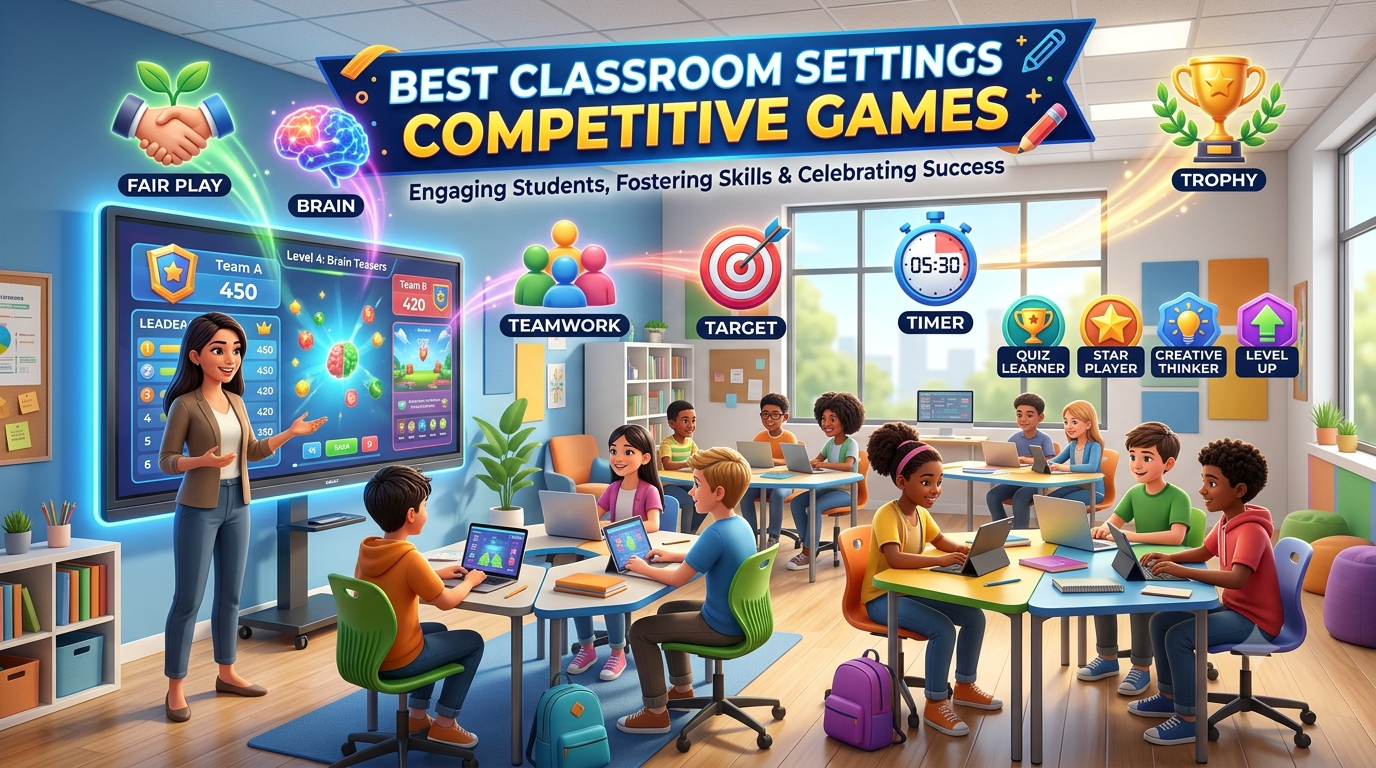
Competitive classroom settings are most effective when the learning environment encourages fair play, active participation, and meaningful engagement rather than simply rewarding speed or chance.
⚖️ Balance Challenge & Accessibility – Create a classroom environment where every student can participate while keeping the competition fun, fair, and educational.
🤝 Encourage Equal Participation – Ensure all students have opportunities to contribute, regardless of their skill level.
🎮 Keep Learning Enjoyable – Maintain a healthy competitive atmosphere that supports both engagement and education.
🧑🏫 Improve Classroom Management – Well-planned settings help teachers maintain better classroom control and minimize distractions.
🎯 Align with Learning Goals – Configure game settings to match specific educational objectives and desired learning outcomes.
🕹️ Choose the Right Game Setup – Whether using Gimkit, Kahoot, Blooket, Quizizz, or other educational game platforms, your classroom configuration plays a crucial role.
⏱️ Focus on Key Settings – Decisions such as team organization, time limits, question pacing, and classroom expectations directly influence gameplay.
🚀 Boost Student Motivation – Thoughtful settings increase engagement and encourage active participation.
🤝 Promote Collaboration – Well-structured games support teamwork and positive student interaction.
🧠 Improve Knowledge Retention – Effective classroom configurations help students better understand and remember what they learn.
📚 Suitable for All Education Levels – These recommendations can be applied in elementary, middle school, high school, and higher education classrooms.
Explore the latest classroom resources, expert tutorials, and educational technology insights on GimkitApp, your complete destination for everything related to Gimkit and modern learning tools.
Why Classroom Settings Matter in Competitive Learning
Classroom settings shape how students interact with educational games, their classmates, and the learning material. A carefully organized environment creates healthy competition that motivates students without causing unnecessary stress or frustration.
Instead of focusing only on winning, effective classroom settings encourage students to think critically, answer accurately, and collaborate respectfully. Teachers who establish clear expectations before launching a competitive game often experience better participation, fewer behavior issues, and improved lesson outcomes.
Competitive games become far more valuable when classroom management, instructional goals, and game mechanics work together. Direct Answer: The best classroom settings encourage fairness, participation, collaboration, and focused learning while minimizing distractions and maintaining an enjoyable competitive atmosphere.
Characteristics of an Effective Competitive Classroom
An effective competitive classroom is organized before gameplay begins. Students understand the rules, know the learning objectives, and feel comfortable participating regardless of their skill level.
Some of the most successful competitive classrooms share several common characteristics.
Classroom Element
Why It Matters
Recommended Practice
Clear Rules
Reduces confusion
Explain expectations before starting
Balanced Competition
Encourages participation
Mix ability levels when creating teams
Visible Timer
Maintains pacing
Keep rounds consistent
Classroom Layout
Reduces distractions
Ensure every student can view the screen
Positive Reinforcement
Improves motivation
Celebrate effort as well as achievement
Teacher Monitoring
Supports fairness
Observe gameplay throughout the session
These foundational elements help students remain focused on learning instead of becoming distracted by competition alone.
Align Game Settings With Learning Objectives
A premium educational illustration showcasing how teachers can optimize classroom settings to improve engagement, collaboration, fairness, and learning outcomes during competitive educational games.
Every competitive game should support a specific educational purpose rather than serving only as entertainment.
Before choosing classroom settings, teachers should identify what students are expected to learn during the activity. Review sessions, formative assessments, vocabulary practice, and concept reinforcement may each require different game configurations.
For example, a fast-paced science review may benefit from shorter rounds and quicker question timing, while a mathematics lesson involving multi-step problem solving often works better with extended response times.
Matching classroom settings to instructional goals ensures that competition strengthens learning instead of distracting from it.
Choose the Right Classroom Layout
The physical classroom environment influences communication, collaboration, and student focus during competitive games.
Traditional Rows
Rows help students concentrate individually and minimize off-task conversations. This arrangement is particularly effective for individual competitions or assessment-based review games.
Small Group Tables
Grouped seating encourages teamwork, discussion, and collaborative problem-solving. Team-based educational games often become more engaging when students can communicate naturally with their teammates.
U-Shaped Arrangement
A U-shaped classroom allows teachers to observe all participants easily while maintaining visibility of the main display.
Flexible Seating
Flexible learning environments can work well when classroom expectations are clearly established before gameplay begins.
💡 Pro Tip: Arrange seating before opening the game platform to avoid unnecessary interruptions once the competition begins.
Create Balanced Teams
Team composition significantly affects both classroom engagement and competitive fairness.
Rather than allowing students to form teams exclusively with close friends, teachers often achieve better results by creating balanced groups that include a variety of skill levels, learning styles, and personalities.
Balanced teams encourage peer learning while preventing one group from dominating every round.
Best Practices for Team Formation
Mix academic abilities.
Balance confident and quieter students.
Rotate teams regularly.
Avoid isolating struggling learners.
Encourage respectful communication.
Students frequently learn as much from discussing answers with teammates as they do from answering the questions themselves.
Establish Clear Rules Before the Game Begins
Competitive classrooms function more smoothly when expectations are communicated before gameplay starts.
Important classroom rules may include:
Respect all participants.
No shouting answers.
Stay focused on your own device.
Celebrate good sportsmanship.
Follow teacher instructions immediately.
Keep discussions respectful.
Accept both victories and losses positively.
Clear expectations reduce classroom management issues while helping students remain focused throughout the activity.
Set Appropriate Time Limits
Question timing influences both classroom energy and learning effectiveness.
Very short timers reward speed but may disadvantage thoughtful learners or students who require additional processing time.
Longer timers encourage careful thinking but can reduce excitement if they become excessive.
The ideal response time depends on:
Student age
Subject difficulty
Reading level
Classroom experience
Learning objective
Elementary classrooms generally benefit from slightly longer timers than advanced secondary classrooms, particularly when questions involve substantial reading.
Balance Competition With Collaboration
A premium educational illustration showcasing how balanced competition, collaboration, positive classroom culture, and thoughtful teaching practices create meaningful learning experiences during competitive educational games.
Healthy competition motivates students, but excessive emphasis on rankings can discourage participation.
Teachers often achieve stronger educational outcomes by combining competitive gameplay with collaborative learning opportunities.
For example:
Team discussions before answering.
Reflection after each round.
Class review of challenging questions.
Peer explanations of correct answers.
This balance helps transform competition into a meaningful learning experience.
⭐ Expert Insight: Students frequently remember concepts longer when they explain answers to classmates after a competitive round.
Encourage Positive Classroom Culture
The atmosphere surrounding competitive games influences student confidence just as much as game settings.
Teachers should consistently recognize:
Improvement
Persistence
Teamwork
Creative thinking
Problem-solving
Respectful behavior
Celebrating only first-place winners may unintentionally reduce motivation for other students. Recognizing multiple forms of success creates a more inclusive classroom environment.
Minimize Classroom Distractions
Even engaging educational games lose effectiveness when students become distracted.
Consider these strategies:
Silence unrelated devices.
Close unnecessary browser tabs.
Display only essential instructional materials.
Reduce classroom noise.
Position students for clear screen visibility.
A distraction-free environment allows students to focus their attention on both the game and the lesson objectives.
Adjust Difficulty to Match Student Ability
Competitive games are most effective when questions provide an appropriate level of challenge.
Questions that are too easy reduce engagement, while overly difficult questions may discourage participation.
Teachers can improve learning outcomes by gradually increasing difficulty throughout the session, allowing students to build confidence before tackling more advanced concepts.
This progressive approach supports learners with different skill levels while maintaining classroom interest.
Monitor Student Engagement Throughout the Game
Successful teachers actively observe classroom dynamics instead of focusing solely on the game dashboard.
Signs of healthy engagement include:
Active participation
Constructive discussions
Positive teamwork
Consistent attention
Respectful competition
If students appear frustrated, confused, or disengaged, adjusting pacing or pausing briefly for clarification can restore focus without interrupting learning momentum.
Use Post-Game Discussions to Reinforce Learning
The learning process should continue after the final leaderboard appears.
A short classroom discussion helps students reflect on:
Questions they found difficult.
Common misconceptions.
Effective problem-solving strategies.
Areas requiring additional practice.
These conversations often reveal valuable insights that traditional assessments might overlook while helping students connect gameplay with long-term understanding.
For the latest gaming news, expert reviews, and walkthroughs, readers can also visit , one of the world's leading gaming websites.
Common Mistakes to Avoid
Even experienced educators occasionally overlook classroom factors that reduce the effectiveness of competitive games.
Common Mistake
Potential Impact
Better Approach
Overemphasizing winning
Increased anxiety
Reward effort and improvement
Unbalanced teams
Unequal participation
Create mixed-ability groups
Poor instructions
Student confusion
Explain expectations first
Timers that are too short
Rushed responses
Match timing to question complexity
Ignoring classroom behavior
Reduced learning
Monitor participation continuously
Skipping review
Missed learning opportunities
Discuss key questions afterward
Avoiding these issues helps maintain both educational value and classroom enjoyment.
Professional Recommendations for Competitive Classrooms
Experienced educators consistently recommend viewing competitive games as instructional tools rather than standalone activities.
Some of the most effective practices include:
Begin with clear learning objectives.
Keep classroom expectations consistent.
Balance competition with collaboration.
Rotate team members periodically.
Encourage respectful communication.
Adjust settings based on student needs.
Review difficult questions after gameplay.
Focus on learning progress instead of leaderboard positions alone.
When these practices become part of regular classroom routines, competitive games can significantly improve student engagement while reinforcing meaningful learnings.
Expert Thoughts
The best classroom settings for competitive games are those that place learning at the center of every decision. Well-balanced teams, thoughtful game configurations, clear expectations, appropriate pacing, and a supportive classroom culture create an environment where students enjoy healthy competition while developing deeper understanding of the subject matter.
Rather than relying solely on excitement or leaderboards, effective teachers use competitive games as structured learning experiences that encourage collaboration, critical thinking, and continuous improvement. With careful planning and intentional classroom management, competitive educational games can become one of the most engaging and productive teaching strategies available today.
Choosing the Best Game Mode for Competitive Classrooms
A premium educational illustration highlighting how teachers can select the most effective game modes to match learning objectives, classroom activities, and student engagement.
Selecting the right game mode is just as important as choosing the right questions. Different classroom objectives require different competitive formats, and no single mode works best for every lesson. Teachers should match the game mode to the subject, available class time, student age, and desired learning outcome rather than simply using the default option.
For quick review sessions before a quiz, fast-paced individual competitions often keep students engaged and encourage rapid recall. When the goal is deeper understanding or collaborative problem-solving, team-based modes usually produce stronger discussions and allow students to learn from one another. Some game modes also introduce strategic elements, requiring students to make decisions in addition to answering questions correctly, which can increase engagement when used appropriately.
Recommended Game Modes for Different Classroom Goals
Classroom Goal
Recommended Competition Style
Why It Works
Lesson Review
Individual Competition
Encourages independent recall and identifies learning gaps.
Team Collaboration
Team-Based Games
Promotes discussion, communication, and peer learning.
Vocabulary Practice
Fast-Paced Modes
Reinforces quick recognition and memory.
Exam Preparation
Balanced Individual Play
Helps students practice under realistic conditions.
Mixed-Ability Classes
Cooperative Team Competition
Gives every student an opportunity to contribute.
End-of-Unit Review
Strategic Competitive Modes
Combines knowledge with decision-making to maintain engagement.
The best results come from rotating game modes throughout the school term. Variety keeps students interested while exposing them to different ways of learning and collaborating.
💡 Pro Tip: Avoid using the same competitive format every week. Rotating between individual, team, and strategy-focused modes helps maintain enthusiasm and prevents students from relying on a single gameplay approach.
Consider Student Experience Levels
Students who are new to competitive educational games may feel overwhelmed by complex mechanics or advanced strategies. Starting with straightforward game modes allows them to focus on learning the platform and understanding the content before introducing more competitive features.
As students become familiar with classroom routines, teachers can gradually incorporate game modes that require greater collaboration, strategic thinking, or resource management. This gradual progression builds confidence while keeping gameplay challenging and enjoyable.
Match Competition to Classroom Size
Class size also affects which settings work best. Smaller classrooms often allow for more discussion-based competitions where every student participates actively. Larger classes may benefit from structured individual competitions or organized teams that simplify classroom management while ensuring all students remain engaged.
Regardless of class size, the most effective competitive games maintain a balance between excitement and educational value. When the chosen game mode supports the lesson objective and classroom environment, students are more likely to stay focused, participate confidently, and retain what they learn long after the competition ends.
Managing Classroom Time During Competitive Games
Time management plays a major role in the success of competitive classroom games. Even the most engaging activity can lose its educational value if it runs too long, feels rushed, or interrupts the overall lesson plan. Teachers who allocate time strategically create a smoother experience that keeps students engaged while ensuring learning objectives remain the primary focus.
Instead of dedicating an entire lesson to gameplay, many educators divide competitive activities into smaller segments. A brief review before introducing new material, a mid-lesson knowledge check, or a closing challenge can reinforce learning without overwhelming students. This approach also provides opportunities to discuss answers, clarify misconceptions, and connect game results with classroom instruction.
Suggested Time Allocation for Competitive Lessons
Lesson Stage
Recommended Time
Purpose
Introduction and Rules
3–5 minutes
Explain objectives, expectations, and game mechanics.
Competitive Gameplay
10–20 minutes
Allow students to apply their knowledge through active participation.
Answer Review
5–10 minutes
Discuss difficult questions and correct misunderstandings.
Reflection and Feedback
3–5 minutes
Encourage students to evaluate their learning and teamwork.
While these time frames work well for many classrooms, teachers should adjust them based on student age, lesson complexity, and available class time.
Keep the Competition Moving
Long pauses between questions or technical delays can reduce excitement and make students lose focus. Preparing classroom technology, checking internet connectivity, and opening required materials before class helps maintain a steady pace once the competition begins.
Teachers should also monitor how quickly students are progressing. If most participants consistently finish early, the response time may be longer than necessary. Conversely, if many students struggle to answer before the timer expires, extending the time limit can improve both confidence and accuracy.
✅ Best Practice: Run a short practice question before the official competition starts. This gives students a chance to understand the controls and reduces confusion during the actual game.
Build Time for Learning, Not Just Playing
Competitive games should never end when the leaderboard appears. Some of the most valuable learning happens during the discussion that follows. Reviewing incorrect answers, explaining common mistakes, and inviting students to share their reasoning reinforces key concepts and helps transform competition into lasting understanding.
Teachers may also ask students to reflect on questions they found challenging or identify topics they want to review further. These conversations provide useful feedback for future lesson planning while encouraging students to think critically about their own learning progress.
Remain Flexible Throughout the Lesson
Every classroom responds differently to competition. Some groups may move quickly through questions, while others need additional discussion or encouragement. Effective teachers remain flexible, adjusting game length, pacing, or review time based on how students are responding rather than following a rigid schedule.
By managing classroom time thoughtfully, educators can maintain high levels of engagement, prevent fatigue, and ensure that competitive games remain a productive part of the overall learning experience rather than simply an entertaining activity.
Professional Recommendation & Expert Reviews
Best Classroom Settings for Competitive Games begin with clear learning objectives before students start playing.
Best Classroom Settings for Competitive Games encourage balanced competition that supports learning rather than pressure.
Best Classroom Settings for Competitive Games help teachers choose appropriate game durations for their lessons.
Best Classroom Settings for Competitive Games support fair participation by giving every student equal opportunities.
Best Classroom Settings for Competitive Games encourage age-appropriate rules for different grade levels.
Best Classroom Settings for Competitive Games help maintain classroom focus throughout the activity.
Best Classroom Settings for Competitive Games support shorter rounds when reviewing simple topics.
Best Classroom Settings for Competitive Games encourage longer response times for complex questions.
Best Classroom Settings for Competitive Games help reduce unnecessary classroom distractions.
Best Classroom Settings for Competitive Games support smooth classroom management during gameplay.
Best Classroom Settings for Competitive Games encourage students to prioritize accuracy over speed.
Best Classroom Settings for Competitive Games help create a positive and respectful classroom atmosphere.
Best Classroom Settings for Competitive Games support flexible game settings based on lesson objectives.
Best Classroom Settings for Competitive Games encourage healthy competition between individuals and teams.
Best Classroom Settings for Competitive Games help teachers monitor student participation more effectively.
Best Classroom Settings for Competitive Games support fair scoring throughout every activity.
Best Classroom Settings for Competitive Games encourage clear classroom expectations before each game begins.
Best Classroom Settings for Competitive Games help students remain focused on educational goals.
Best Classroom Settings for Competitive Games support appropriate pacing for different subjects.
Best Classroom Settings for Competitive Games encourage thoughtful decision-making during gameplay.
Best Classroom Settings for Competitive Games help maintain student motivation throughout the lesson.
Best Classroom Settings for Competitive Games support consistent classroom routines.
Best Classroom Settings for Competitive Games encourage meaningful review after every game session.
Best Classroom Settings for Competitive Games help teachers adjust difficulty levels when needed.
Best Classroom Settings for Competitive Games support balanced participation from every learner.
Best Classroom Settings for Competitive Games encourage teamwork when collaborative learning is appropriate.
Best Classroom Settings for Competitive Games help reduce classroom anxiety through supportive competition.
Best Classroom Settings for Competitive Games support interactive learning without overwhelming students.
Best Classroom Settings for Competitive Games encourage fair play and respectful behavior.
Best Classroom Settings for Competitive Games help improve classroom engagement through organized activities.
Best Classroom Settings for Competitive Games support flexible timing for different lesson plans.
Best Classroom Settings for Competitive Games encourage students to remain actively involved throughout the activity.
Best Classroom Settings for Competitive Games help reinforce classroom learning objectives.
Best Classroom Settings for Competitive Games support structured review before competitive sessions.
Best Classroom Settings for Competitive Games encourage consistent participation from all students.
Best Classroom Settings for Competitive Games help create organized and efficient classroom experiences.
Best Classroom Settings for Competitive Games support adapting game rules to classroom needs.
Best Classroom Settings for Competitive Games encourage positive classroom energy without unnecessary pressure.
Best Classroom Settings for Competitive Games help improve lesson flow through thoughtful planning.
Best Classroom Settings for Competitive Games support maintaining classroom discipline during exciting activities.
Best Classroom Settings for Competitive Games encourage students to focus on learning rather than simply winning.
Best Classroom Settings for Competitive Games help teachers manage classroom time effectively.
Best Classroom Settings for Competitive Games support meaningful educational competition.
Best Classroom Settings for Competitive Games encourage reviewing important concepts before gameplay begins.
Best Classroom Settings for Competitive Games help improve classroom collaboration when team modes are used.
Best Classroom Settings for Competitive Games support adjusting settings for different learning abilities.
Best Classroom Settings for Competitive Games encourage students to participate with confidence.
Best Classroom Settings for Competitive Games help create enjoyable educational experiences.
Best Classroom Settings for Competitive Games support active learning through structured competition.
Best Classroom Settings for Competitive Games encourage balanced gameplay that benefits every student.
Frequently Asked Questions
1. What are the best classroom settings for creating fair and competitive educational games?
The best classroom settings combine fairness, organization, and clear learning objectives. Teachers should establish game rules before starting, create balanced teams or assign individual play based on lesson goals, adjust question timers to suit the students' age and subject difficulty, and ensure everyone has equal access to devices and the classroom display. It's also important to reward participation, teamwork, and improvement rather than focusing only on the highest scores. A well-prepared classroom creates a positive competitive environment where students remain motivated while learning effectively.
2. Should teachers choose individual competition or team-based competition?
The right choice depends on the lesson objective. Individual competition works well for quizzes, formative assessments, and measuring each student's understanding because everyone answers independently. Team-based competition, however, encourages communication, collaboration, and peer learning, making it ideal for reviewing complex topics or practicing problem-solving skills. Many experienced educators alternate between both formats throughout the school year to keep students engaged while developing both independent learning and teamwork abilities.
3. How long should a competitive classroom game last for maximum student engagement?
Some teachers begin with 10 to 20 minutes as a planning example, but no universal optimal duration has been established, although the ideal duration depends on student age, lesson complexity, and class length. Younger students generally benefit from shorter activities with frequent interaction, while older students can stay engaged during longer review sessions. Teachers should also reserve additional time for introducing the activity, reviewing difficult questions, and discussing key learning points after the game. A balanced schedule prevents fatigue while ensuring competition supports meaningful learning rather than becoming a distraction.
4. How can teachers keep competitive games fun without creating too much pressure?
Healthy classroom competition focuses on learning rather than simply winning. Teachers can reduce unnecessary pressure by celebrating effort, improvement, teamwork, and problem-solving alongside leaderboard results. Rotating teams, encouraging respectful behavior, and reminding students that mistakes are valuable learning opportunities also help create a positive atmosphere. Avoiding constant comparisons between students and using competition as a tool for engagement instead of evaluation allows learners of different abilities to participate confidently and enjoy the experience.
5. What common mistakes should teachers avoid when setting up competitive classroom games?
Several avoidable mistakes can reduce the educational value of competitive games. Common issues include creating unbalanced teams, using timers that are too short for thoughtful responses, failing to explain classroom expectations before the game begins, emphasizing winning over learning, and skipping the post-game discussion. Teachers should also avoid using the same game format repeatedly, as variety helps maintain long-term engagement. Reviewing challenging questions, adapting settings to student needs, and encouraging respectful competition ensure that classroom games remain both enjoyable and academically meaningful.