Gimkit Questions: Complete Guide to Writing Better Questions and Answers
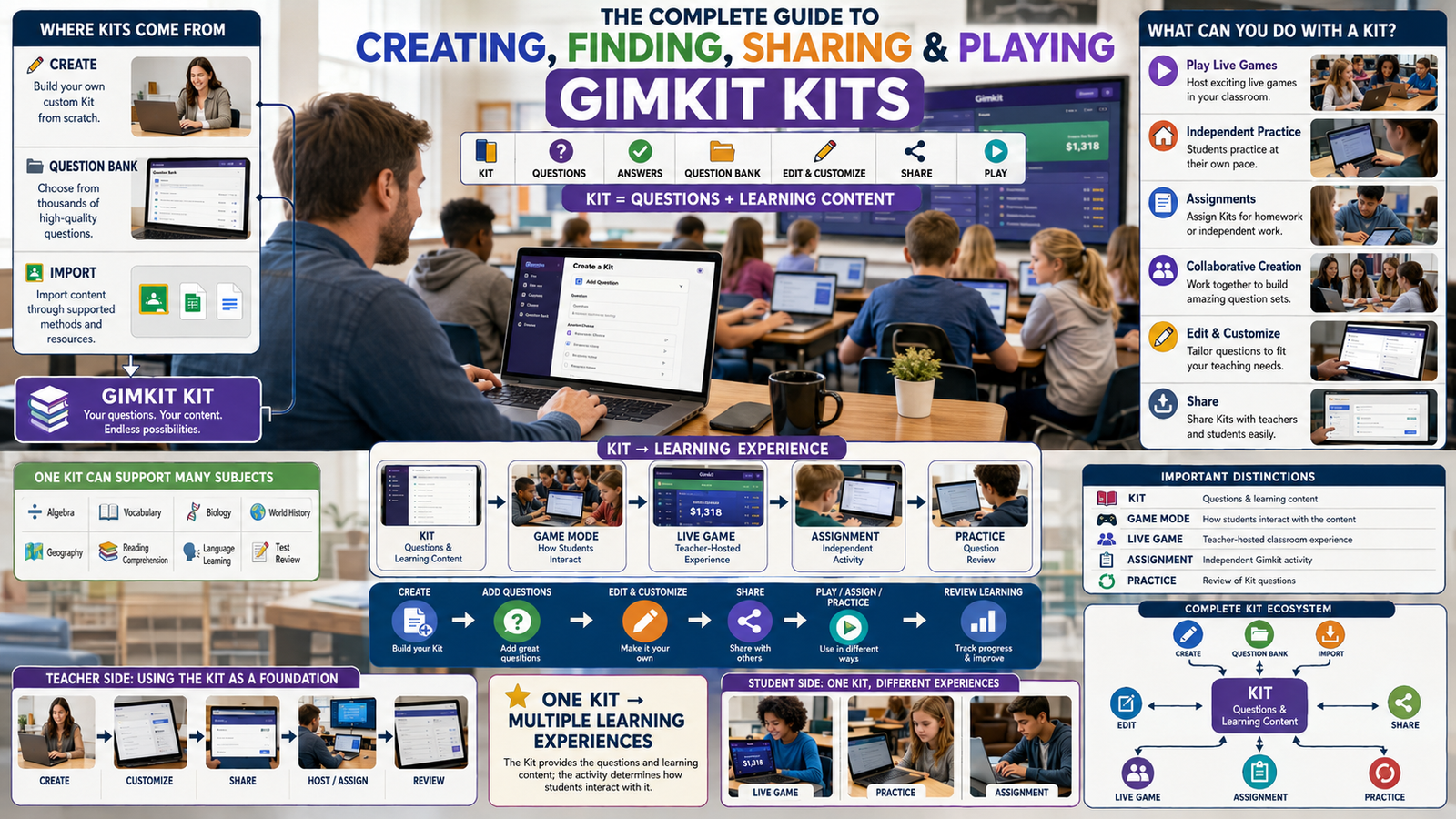
Gimkit questions are the instructional foundation of a Kit. Teachers can use multiple-choice questions with correct and incorrect answer choices or Text Input questions that ask students to type an answer.
A well-designed question should test the intended learning objective, have defensible correct answers, avoid accidental clues and use incorrect choices that reveal meaningful misconceptions rather than random guesses.
Explore the actual Gimkit editor rules, question formats, media limitations and revision workflow. Then use the exclusive Question Quality & Distractor Audit Lab to examine drafted questions before adding them to a real Kit.
Inspect distractors
Check plausibility, misconceptions and unintended clues.
📋
Review before publication
Resolve warnings, then test the real Kit in Gimkit.
Direct Answer
What types of questions can you create in Gimkit?
Gimkit's documented question editor supports multiple-choice questions and Text Input questions. A multiple-choice question includes a prompt and answer options, with the teacher marking the correct choices. A Text Input question asks the learner to type an answer rather than choose from displayed options.
The official Create a Kit from Scratch documentation, updated April 29, 2025, confirms that teachers can provide multiple correct answers for a question. This means an editor audit should not automatically treat more than one correct choice as a mistake.
The Text Input Questions guide explains how an educator changes a new or existing question to Text Input using the question-type control in the editor.
Gimkit also supports content enhancements, including mathematical equations, pictures and audio. These features have important restrictions. Audio questions and uploaded images are paid capabilities according to the official documentation. Mathematical equation answers are available with multiple-choice questions but not as Text Input answers, because the equation system treats those answers as images.
The official Kit editor supports changing individual questions, copying them, deleting selected questions and turning selected questions into Text Input questions. A teacher must own a Kit to edit it directly; a Kit created by another educator needs to be copied first.
Gimkit's Question Bank also allows educators to find questions from public Kits and add them to their own Kits. However, the presence of a question in a public Kit does not establish its academic accuracy. Teachers remain responsible for evaluating the answer key, language and instructional purpose.
The Question Quality & Distractor Audit Lab below focuses on this review responsibility. It checks question structure, duplicate options, correct-answer selection, unclear stems, likely answer clues and the relationship between distractors and documented misconceptions.
It also records the learning objective for each question and highlights repeated stems across a local draft collection. These are editorial checks, not actual student performance measurements or official Gimkit validation results.
Product rule: The official Gimkit Kit editor is the place to create and save real questions. The Lab on this page is an independent, local quality-checking application and does not publish, import or edit your Gimkit account content.
01 / QUESTION FORMAT
Multiple Choice
Review prompts, correct choice markings, incorrect answers and the explanatory purpose of each distractor.
02 / RESPONSE FORMAT
Text Input
Evaluate precise wording, expected responses, possible synonyms and the risk of unintended answer variants.
03 / ITEM QUALITY
Editorial Audit
Identify structural problems and review points before transferring the validated question into the real editor.
Exclusive Interactive Question Review Application
Question Quality & Distractor Audit Lab
Write a question draft, mark the correct answers, document why incorrect choices are plausible, and receive structural and editorial warnings. Compare multiple drafts, identify duplicate questions and inspect which learning objectives have been represented.
The Lab is a drafting and review environment. Its warnings are heuristics. It does not certify academic validity, predict student results or reproduce Gimkit's exact answer-grading engine.
1. Describe the question's instructional purpose
Describe the knowledge or reasoning this question should assess.
A teacher-entered classification, not a psychometric measurement.
This does not upload or render official Gimkit media.
2. Answer choices and distractor diagnosis
Enter up to four options. Mark every correct choice deliberately. Multiple correct answers are documented in Gimkit, so the audit checks their validity without assuming there must be exactly one.
A
B
C
D
Distractor rationale: Record why a learner might select a wrong answer. These notes are for teacher review. This tool does not claim that Gimkit automatically displays such explanations to students.
2. Text Input answer analysis
Verify which answers the actual Gimkit editor can accept before publishing.
Important: The local tool does not reproduce Gimkit's Text Input matching behaviour. Case changes, punctuation, spaces, synonyms and spelling variations must be checked in the actual product. Equation-image answers are not compatible with Text Input under the documented math editor rules.
3. Save this draft for auditing
Question drafts are not sent to Gimkit. Review and enter validated questions into the official Kit editor separately.
0Draft questions
0Drafts with critical flags
0Teacher-reviewed drafts
0Distinct objectives
4. Filter the question quality audit
Audit scope: Automated checks detect structural patterns and possible issues. A question passing them is not automatically correct, fair, curriculum-aligned or psychometrically reliable. The teacher must validate content and trial the question in Gimkit.
5. Learning-objective coverage
Group your saved drafts by the objective you wrote. Coverage counts show what is represented in this local draft set; they do not prove that every curriculum objective has been adequately tested.
6. Question-format and cognitive-demand mix
Review dimension
Draft count
Interpretation
A balanced collection does not require identical counts in every category. The appropriate combination depends on the instructional objective and the learners.
7. Content-quality review questions
Does each item measure the intended knowledge?
An apparently clear question can still measure something different from the stated learning objective. Compare its required reasoning with the actual lesson outcome.
Could a learner defend another answer?
Review synonyms, alternative interpretations, missing assumptions and reasonable explanations that might make an allegedly wrong response valid.
Do distractors identify meaningful misunderstandings?
Random unrelated wrong answers may be easy to reject. Plausible alternatives help teachers identify where conceptual confusion could arise.
Would accessibility needs change the answer experience?
Consider language complexity, visual dependence, audio requirements, reading support, media permissions and time available to process the prompt.
8. Export a question-quality review report
CSV exports describe the independent audit, not Gimkit's official spreadsheet-import template. Do not assume they can be uploaded directly into the Gimkit Kit editor.
How the Question Quality & Distractor Audit Lab works
The application begins with the instructional purpose rather than the list of answer choices. This helps teachers consider what a question is meant to test before deciding on the response format. The objective, topic and thinking-demand fields are local review labels, not metadata automatically written into Gimkit.
Multiple-choice drafts contain up to four answer choices. Each can be independently marked correct, reflecting Gimkit's documented support for multiple correct answers. The application identifies a missing answer key, too few populated choices and duplicate answer text as structural problems.
Incorrect options also have an optional misconception rationale. A teacher can record why a learner might find that response plausible. Missing rationales are flagged for review because a distractor without a clear purpose may not reveal much about the student's understanding.
The Text Input path asks for an intended answer and allows a list of possible alternative expressions. These are editorial notes; the application does not assert that Gimkit will automatically accept all variants or match them with a particular case or punctuation rule.
The media selector identifies planned questions involving an image, audio or equation. The audit warns about paid feature restrictions and the documented incompatibility between equation-image answers and Text Input responses.
The collection-wide audit identifies exactly repeated stems after basic normalization. It also warns about patterns that deserve human attention, including answers that are obviously longer than competing options, options such as All of the above, and prompts that may accidentally disclose an answer.
None of these warnings constitute proof of an error. For example, a long correct answer can be perfectly valid, and an exact term can legitimately appear within the stem when the question asks something different about that term. The warnings indicate where a teacher should inspect the item.
A manual review checkbox keeps editorial judgment separate from automated checks. A teacher may flag an academically accurate item as requiring improvement even if the structural audit reports no problems.
The Objective Coverage view groups drafts by their stated outcomes and summarizes question types and thinking-demand categories. These summaries can help identify repeated factual recall questions or learning objectives with only a single draft item.
Saved drafts remain in local browser storage where available. The application includes editing, copying, deletion, undo, fictional examples and exports. It does not connect to the real Kit editor or process any official question submissions.
What the Lab does not measure: Student item difficulty, discrimination indices, reliable answer frequencies, actual misconceptions among students, question-specific XP rates or any real Gimkit report data. Those require appropriate responses, context and analysis beyond static question text.
Part One — Supported Formats
Gimkit multiple-choice and Text Input question types
1. Every question begins with a prompt and an answer relationship
The essential structure of a Gimkit question is straightforward: a prompt asks the learner to respond, and the answer information defines what should count as correct. The challenge for an educator is to ensure that those elements genuinely measure the intended learning objective.
A question can be technically valid but educationally weak. For example, it might ask for an obscure fact that was not part of the lesson, use wording that confuses fluent readers or include wrong choices so implausible that students can guess the correct response without understanding the concept.
A strong drafting process therefore starts by defining the outcome the student should demonstrate. The Question Quality Lab records that objective and checks whether the draft supplies a usable answer structure. The final educational judgment remains with the teacher.
2. Multiple-choice questions use selectable answer options
Multiple-choice questions present a stem and a collection of possible answers. The teacher specifies which choices are correct through the question editor. Incorrect choices are commonly called distractors.
The format works well when the intended evidence involves identifying a fact, recognizing a valid example, applying a concept to a short situation or comparing alternatives. It can also support higher-order reasoning when the prompt requires analysis rather than recall.
However, the presence of several options does not automatically make a question demanding. If the wrong choices are obviously unrelated, the task may reduce to eliminating absurd answers. The Lab therefore asks teachers to explain the reasoning behind distractors instead of merely filling four boxes.
3. Gimkit documents support for multiple correct choices
The official Create a Kit from Scratch guide says that the editor allows the teacher to mark more than one correct answer. It describes using a check control to change an answer's correct or incorrect status and states that multiple correct answers are supported.
This is an important distinction from assessment systems that always enforce a single correct choice. A third-party audit should not automatically reject a multiple-choice question solely because two valid answers are marked correct.
Nevertheless, the teacher must review the intended response behaviour in the actual product. The Lab verifies the answer-key selections structurally but does not invent the precise student-facing interaction or partial-credit mechanics for every possible combination.
4. Correctness must be established by content, not appearance
A visually polished answer option is not necessarily a correct one. The teacher must evaluate whether the statement follows from the relevant subject knowledge, source material and assumptions given in the stem.
For example, a science question might have an answer that is correct only under ordinary classroom conditions but not universally valid. If the prompt omits that context, the answer key may become ambiguous for a knowledgeable learner.
The Lab includes an answer-verification source field so the author can note whether the answer has been checked against course material, a curriculum standard or another authoritative source. This field is a record of the teacher's reported verification, not a substitute for checking the content.
5. Text Input changes the nature of the response
A Text Input question requires a learner to enter an answer rather than select from visible alternatives. The official Text Input Questions guide describes choosing that format from the question-type selector in the Kit editor.
This can reduce the visual cues provided by multiple-choice options, but it also introduces new challenges. The teacher needs a sufficiently precise expected answer, and reasonable alternative wording may need to be considered before the item is published.
A question with a vague prompt may accept several defensible answers even if only one was initially entered. The Lab's Text Input review encourages the teacher to identify alternatives and examine whether the wording needs refinement.
6. Text Input questions are not automatically essay questions
The official Text Input feature is a question type within a Gimkit Kit. It should not be confused with a general essay-assessment system that evaluates extended arguments, research citations and complex written responses.
A short factual term or concise answer may be suitable for a typed-response question, provided that the expected response can be stated clearly and the teacher has verified the applicable product behaviour.
Long explanatory prompts can create uncertainty about which phrasing should count as correct. Before choosing Text Input for an extended answer, the educator should check how the official editor and student interface handle that response.
The Lab intentionally performs no automatic semantic grading of long passages because doing so would create unsupported claims about Gimkit's actual marking rules.
7. The same learning objective may support different formats
An educator might assess the meaning of evaporation through a multiple-choice item asking students to distinguish it from condensation, freezing and melting. A Text Input version could instead ask students to supply the term associated with a clearly described process.
Both can target the same underlying concept, but they collect different kinds of response evidence. The multiple-choice version can reveal which distractor a learner selects, while the typed version removes visible answer options.
The teacher should choose the format that best matches the desired learning outcome. The Lab includes objective labels and a format summary to help reviewers notice when several drafts are testing essentially the same concept in an unnecessarily repetitive manner.
8. More response complexity does not automatically improve an item
It can be tempting to make every question longer, include more answer choices or require an elaborate written response in the belief that complexity always represents stronger assessment.
In practice, the best format depends on the knowledge being tested. A short, unambiguous identification question can be valuable when factual recall is the intended outcome. A longer case-based question is appropriate when applying or comparing ideas is necessary.
Unnecessary reading load may interfere with assessing the intended subject knowledge, particularly when language proficiency is not the skill under examination.
The Lab flags unusually short or long stems only as a review prompt. It does not assign automatic academic superiority to either extreme.
Part Two — Question Prompts
How to write clear Gimkit question stems
9. Start with the exact learning outcome
A question stem should be written after the teacher knows what understanding it is intended to reveal. This avoids building a question around an entertaining fact that has little connection to the lesson.
For example, the objective Identify how a plant absorbs water suggests a different prompt from Analyse why a plant wilts despite moist soil. The first emphasizes identifying a process, while the second may require application of several concepts.
The Lab records a learning objective for every draft and groups questions by those labels. This is not a formal curriculum alignment engine, but it gives educators a way to inspect whether a collection represents the intended outcomes rather than simply covering a broad topic name.
10. Make the task understandable before showing the options
A multiple-choice stem is clearer when a learner can understand what is being asked without relying on the answer options to reconstruct the question.
A prompt such as Which statement best explains why water evaporates? communicates a more specific task than Water evaporation? The former identifies the required reasoning, while the latter leaves the learner to infer what kind of response is expected.
This does not mean every prompt must become a complete paragraph. Concision is useful when it preserves the essential context. The teacher should remove unnecessary details but retain the conditions needed to make the correct answer defensible.
11. Avoid accidental clues in the wording
A stem can unintentionally reveal the answer through repeated words, matching grammatical structure or information that appears only in one option.
For example, if one choice uses the same technical phrase that appears in the stem while the others use unrelated everyday vocabulary, the correct response may stand out even to someone unfamiliar with the subject.
An automated tool can detect some obvious repetitions, but it cannot determine whether a repeated phrase is a legitimate part of the question. A teacher should inspect the item from the perspective of a student trying to guess without knowing the material.
The Lab treats potential answer leakage as an editorial warning rather than automatically declaring the question invalid.
12. State assumptions when the answer depends on them
Some questions have different valid answers under different conditions. Mathematical calculations may require a specified unit or rounding convention. Science questions may depend on temperature, pressure or whether an idealized model is being used.
A question that omits a necessary condition can penalize a learner who recognizes the ambiguity rather than simply guessing the teacher's assumption.
When writing such an item, the educator should identify the minimum information needed to reach the intended answer. That may involve adding a short scenario, naming an assumption or specifying an expected level of precision.
The Lab includes a context field where teachers can record those checks before transferring the final stem into the official editor.
13. Use language appropriate to the learners
Question quality is partly about accessibility. A prompt should use terminology that students have been taught or can reasonably infer from the instructional material.
Unfamiliar idioms, unnecessarily complex sentence structures and irrelevant cultural references can distract from the intended assessment. This matters especially in multilingual classrooms where students may understand the underlying academic concept but need additional time to process unfamiliar phrasing.
Simplifying language should not remove important disciplinary vocabulary. Instead, teachers can distinguish essential terms from wording that adds no instructional value.
The Lab provides reminders for linguistic review but does not attempt to assign a universal reading-grade score to every question.
14. A negative question requires particular care
A negative stem asks students to identify what is not true, not correct or not an example. Such questions can be useful when the lesson genuinely involves recognizing exceptions, but they create an additional reading demand.
A learner may understand the subject yet overlook the negative word and answer the opposite question. That error can reflect attention to wording rather than misunderstanding of the concept.
If negative wording is essential, it should be clear and unambiguous. If it is not essential, a positive question may provide more direct evidence of understanding.
The Lab flags common negative wording for teacher review, but it does not automatically reject all questions containing the word not.
15. Avoid combining unrelated concepts into one answer
A question can become difficult to interpret when it asks students to evaluate several independent claims through a single answer choice.
For example, a stem asking which statement best describes the causes, consequences and policy responses to a historical event may require several separate judgments. An incorrect response then gives limited information about which part of the content the learner misunderstood.
A clearer assessment may separate those purposes or create a focused application problem in which the required reasoning is explicit.
The Lab encourages one identifiable learning objective per item and lets reviewers flag broad or mixed objectives. It does not automatically split questions or invent new curriculum content.
16. A useful prompt can demand more than memorization
A question does not need to be long to assess thinking beyond recall. A brief scenario can ask learners to predict an outcome, identify an error or apply a rule to a new example.
For instance, a mathematics item might describe a student using an incorrect operation and ask which correction is appropriate. That requires recognizing how a principle applies to an actual mistake rather than repeating a definition.
The Lab's thinking-demand labels distinguish recall, interpretation, application and analysis. These are teacher-selected descriptions, not automatically verified cognitive classifications.
A reviewer should inspect the reasoning genuinely required to answer the item, rather than assuming a particular action verb guarantees higher-order thinking.
17. Context should support the answer rather than decorate the question
Real-world scenarios can make questions meaningful, but extra story details do not necessarily improve assessment quality.
An item about calculating distance might need a speed and time. Details about the vehicle's color, the driver's clothing or unrelated weather may add reading time without contributing to the problem.
On the other hand, a detail that changes the conditions of the problem may be essential. The task for the question writer is to distinguish relevant information from unnecessary background.
The Lab's context field supports that review, but a human subject expert must decide whether each detail affects the correct answer.
18. Editing a stem can change which answers are correct
A small wording change may alter the answer relationship even when the topic stays the same.
Changing Which organelle produces ATP in cellular respiration? to Which organelle stores genetic information? creates a different question requiring a different answer. Likewise, changing always to usually can transform the truth of an answer choice.
Whenever a stem is edited, the teacher should check the complete answer key and every distractor again. It is not enough to assume that previously validated choices remain appropriate.
The Lab's editing workflow clears the manual review confirmation when substantive text or answer information changes, encouraging a fresh human review before publication.
Part Three — Distractor Quality
Designing plausible incorrect answers in Gimkit
19. A distractor should represent a believable error
A distractor is an incorrect answer option. Its role is not simply to fill empty space in the multiple-choice editor but to offer an alternative that could be attractive to someone with an incomplete understanding.
In a fraction question, a distractor might represent adding denominators when the task requires finding a common denominator. In a science question, another option might describe a related process that students commonly confuse with the correct one.
Such distractors can make incorrect responses more informative during later instructional review. The Lab asks teachers to record a misconception or reasoning error for each distractor. Those notes help reveal whether the option serves a meaningful instructional purpose.
20. Completely unrelated wrong answers are usually weak
An answer option that is obviously disconnected from the question may be easy to eliminate without subject knowledge.
For example, when asking which process converts liquid water into vapor, options such as multiplication or democracy are not plausible alternatives. The student can reject them even without understanding evaporation, condensation, freezing or sublimation.
A more useful set of options would compare processes that share enough characteristics to be reasonably confused by a learner.
The Lab cannot understand every discipline well enough to judge plausibility automatically. Its rationale field instead asks the teacher to explain why a wrong option is related to the objective and what misunderstanding it represents.
21. Distractors should be incorrect under the stated conditions
A distractor that is sometimes correct creates an ambiguity problem when the stem does not specify the context that makes it wrong.
Consider a question about which factor increases reaction rate. If several factors can affect the rate under different conditions, an option may be defensible even when it was intended as a distractor.
The teacher needs to verify both the answer key and the context that rules out alternatives. Merely marking an option incorrect in the editor does not establish that it is scientifically or historically false.
The Lab records the teacher's answer markings but does not independently validate subject matter. Its report explicitly reminds reviewers to check possible alternative correct answers.
A multiple-choice question should not present the same answer twice under different option letters unless there is a compelling and carefully reviewed purpose.
Duplicated text can confuse the response task, particularly if the two options have different correct-answer markings. Even if both are marked correct, repeating the same content generally adds no new evidence about student understanding.
Duplicates may arise accidentally when a question has been copied, revised or assembled from different source materials.
The Lab normalizes basic whitespace and case before comparing option text. It flags exact duplicates as structural problems. More subtle semantic duplicates still require a teacher's review.
23. A visibly longer correct answer may become a clue
Some multiple-choice questions accidentally make the correct answer much longer, more qualified or more precise than every distractor.
This can happen because teachers spend more time explaining the correct statement while leaving wrong choices as short fragments. A test-wise student may learn to select the most detailed option without understanding the content.
Different option lengths are not automatically wrong. Some correct answers genuinely require more explanation, and some distractors should be brief.
The Lab uses a large length difference only as a potential warning. The teacher should determine whether the option stands out for a legitimate academic reason or because of avoidable drafting habits.
24. Grammatical consistency matters across options
When the stem begins a sentence that must be completed by an answer option, each choice should fit grammatically unless the linguistic structure itself is what the question assesses.
A single grammatically consistent choice can reveal the intended answer to students who recognize the wording pattern, even if they do not know the underlying topic.
This is particularly relevant when a stem ends with a preposition, article or incomplete clause. A better approach may be to rewrite the stem as a complete question and provide options of similar grammatical form.
The Lab does not promise a full grammar analysis, so teachers should include grammatical consistency in their manual distractor review.
25. All of the above can hide weak individual options
Options such as All of the above and None of the above may sometimes be used deliberately, but they deserve scrutiny because their correctness can depend on understanding every other option.
For example, recognizing that two statements are true may allow a student to infer All of the above without evaluating the remaining statement carefully. Another learner may be penalized by one ambiguous option.
These response structures can therefore change the reasoning required and reduce the clarity of diagnostic information.
The Lab flags common all/none patterns for review rather than declaring them universally forbidden. The teacher should determine whether a more specific set of alternatives would better assess the intended knowledge.
26. Avoid joke options that undermine the question's purpose
Humor can support engagement, but obviously silly answer choices may weaken assessment if they make the correct option trivial to identify.
A teacher can still write lively prompts, choose familiar examples and maintain an encouraging tone. The issue is whether the incorrect options remain meaningful alternatives.
For serious diagnostic practice, a distractor should usually reflect a likely misconception, an incorrect procedure or a related concept that students have been taught.
The Lab encourages the teacher to document the misconception attached to each wrong choice. If no meaningful explanation exists, that option may need rewriting rather than relying on humor alone.
27. Distinguish conceptual errors from calculation slips
In mathematics and quantitative science, a wrong answer can arise from several different kinds of mistakes.
A student might apply the wrong formula, substitute values incorrectly, confuse units, make an arithmetic error or misunderstand the phenomenon entirely. Those errors are not pedagogically equivalent.
A strong distractor set can distinguish a common conceptual misunderstanding from a familiar procedural slip. That makes the student's selected response more informative when results are reviewed.
The Lab's rationale field supports this diagnostic thinking. It does not assign an error category automatically, because the explanation depends on the actual mathematical or scientific reasoning behind the item.
28. Distractor quality should match the learners' prior instruction
An option may be highly plausible to someone with limited knowledge yet irrelevant to students who have already studied the subject in depth.
The intended audience matters. Younger learners might confuse familiar everyday words, while advanced students may struggle with distinctions between related technical definitions or competing models.
Teachers should therefore design distractors in relation to what students have encountered, not simply what the author personally considers difficult.
This is why the Lab emphasizes objective and misconception notes over an invented universal distractor difficulty score. Without student responses and appropriate analysis, it cannot accurately measure how often a particular wrong option will attract learners.
29. Multiple correct options need a defensible key
When a teacher deliberately marks several answers correct, each correct choice must satisfy the question as written.
A common problem is mixing answers that are fully correct with statements that are only partly correct or depend on additional assumptions. The existence of multiple selected checkmarks does not remove the need to justify each one.
The teacher should also confirm how the intended student-facing interaction presents and evaluates multiple correct choices in the actual Gimkit interface.
The Lab allows multiple correct markings because the official creation guide supports them, but it never guesses partial-credit rules or promises how many choices a student must select to receive credit.
30. Distractor analysis should lead to revision
Writing a misconception note is useful only if the teacher acts on what it reveals. If an incorrect option is confusing for the wrong reason, it should be revised.
For example, a distractor might be factually false but unrelated to the learning objective. Another could be plausible yet too close to the correct answer because of imprecise wording.
A practical revision cycle examines the stem, checks the correct answers, explains the intended misconception behind each distractor and reads the item as a complete task.
The Lab supports saving, editing and re-auditing those drafts. A local draft is not automatically published, allowing teachers to revise without pretending changes have been made in the official Kit.
Part Four — Text Input
Writing better Gimkit Text Input questions
31. The expected answer must be sufficiently specific
A Text Input item works best when the prompt makes the intended response clear enough for the learner to provide a concise answer.
A question such as Name the process by which a liquid changes into a gas is more constrained than Explain everything about water. The first has an identifiable concept, while the second can invite a wide range of reasonable explanations.
The teacher should decide whether the expected response is a term, number, short phrase or another narrowly defined expression. That decision should influence the wording of the stem.
The Lab records an intended answer and a precision category so reviewers can identify whether the response expectations match the question's wording.
32. Synonyms can create legitimate alternative responses
Two phrases may refer to the same concept even when their wording differs. In some contexts, a scientific term and its common-language equivalent may both be educationally acceptable.
A teacher designing a typed-response item should consider whether such alternatives exist and whether they should be accepted for that lesson.
However, deciding that two expressions are semantically equivalent is different from proving that the Gimkit grading system will accept both. Official documentation does not establish universal semantic matching for arbitrary synonyms.
The Lab allows alternative wording to be recorded as an editorial note. It does not automatically treat those entries as accepted answer variants in the actual product.
33. Spelling can influence typed-response interpretation
A learner may understand a concept but make a spelling mistake while entering the response. The instructional significance of that mistake depends on what the question is intended to assess.
In a spelling lesson, precise spelling may be central to the learning objective. In a science review, the educator may care more about recognizing the correct concept than reproducing its exact spelling.
The question writer should decide what accuracy means for the activity and inspect the official product's actual handling of typed responses.
The Lab does not claim to implement Gimkit's spelling tolerance. It prompts teachers to review possible variants and avoid assuming that approximate answers are automatically accepted.
34. Numeric responses may require units and rounding rules
When the expected response is a number, the teacher should specify whether units are required and what rounding precision is acceptable.
A question asking for the area of a rectangle might have an answer of 12, but the expected response could be 12 square centimeters depending on the context. If that distinction matters, it should be clear in the prompt.
Likewise, approximate calculations may produce several mathematically reasonable values depending on rounding.
The Lab includes a numeric precision category and a context field. These support editorial review but do not simulate official numerical tolerance or unit conversion in the Gimkit answer engine.
35. Long responses are harder to evaluate automatically
A complex explanation can be expressed through many combinations of words. Two students may understand the same process yet describe it differently.
A short-answer system designed around expected answers may not offer the same assessment flexibility as a human-marked essay or explanatory response. It is therefore important to understand the intended product format before relying on it for extended writing.
Teachers can often improve the item by asking for a narrower piece of evidence, such as a technical term, identified cause or stated numerical result.
The Lab warns when the answer or stem is unusually broad, but it does not pretend to evaluate open-ended reasoning with an official semantic rubric.
36. Text Input can reduce visible answer cues
Multiple-choice questions display possible responses. This allows the teacher to create meaningful distractors, but it can also help students recognize the answer without generating it independently.
Text Input removes that visible selection list and instead asks the student to produce a response. This can be useful when recall is the intended objective.
However, a typed-response item introduces challenges around wording, acceptable alternatives and accessibility that should be considered before selecting the format.
The Lab treats format selection as an instructional choice. It does not describe one format as universally superior or assign a higher quality score merely because an answer must be typed.
37. A multiple-choice question can be converted to Text Input
Gimkit's official Text Input Questions article explains that teachers can create new Text Input questions or change existing questions to that type.
The Edit a Kit documentation also describes bulk-converting selected questions to Text Input within the editor.
This makes it possible to revise the response format when a teacher decides that typed recall better fits the lesson.
However, the revised question still needs editorial review. A multiple-choice stem may rely on answer options for context, and simply removing those options can make the resulting Text Input question unclear. The Lab lets teachers switch the local draft type but requires the relevant answer information to be checked again.
38. Text Input answer rules must be checked in the real game
The Lab intentionally does not claim that it can predict which punctuation, case, spacing, synonyms or misspellings Gimkit accepts for a specific Text Input question.
Its purpose is to help teachers identify possible alternative expressions and create a clear target answer before entering the question into the official editor.
The educator should test the actual question through supported Gimkit preview or Practice features to confirm the experience.
That final product-specific check matters because an independent browser application's simplified string comparison could differ from the platform's grading behaviour and mislead the author about what students will encounter.
Part Five — Media and Mathematics
Images, audio, equations and accessible Gimkit questions
39. Images can provide essential information in a question
An image may be necessary when the student must identify a structure, interpret a graph or compare visual evidence. In other situations, an image merely decorates the prompt.
The teacher should consider whether the image contributes information that the student needs to answer the question. If it does, the image must be clear, relevant and appropriately legible on devices used by the class.
The official Add an Image to a Question article describes using Add Photo in the editor. It also states that image uploads are available to paying subscribers.
The Lab records planned media but does not upload images, choose official image sources or claim that an independent preview guarantees the same experience in Gimkit.
40. Audio questions are a paid capability
Gimkit's Create a Kit from Scratch guide states that audio questions are available to paid members. The official Account FAQ also lists audio questions among Pro features.
Audio can be useful for listening comprehension, pronunciation practice and situations where hearing information is essential to the learning objective.
However, an audio question should be designed carefully. Background noise, unfamiliar accents, playback conditions and device audio access can influence the student experience.
The Lab flags audio as a feature requiring entitlement review. It does not record, generate or embed audio into an official Kit, and it does not claim that every account can use the same paid features.
41. Gimkit provides a built-in equation editor
The official Add Equations guide explains that the Kit editor supports adding mathematical expressions to questions and answers through its equation controls.
This is important because mathematical notation can become ambiguous when written only as plain text. Fractions, exponents and specialized symbols may require formatting that accurately represents the intended expression.
A teacher should check the displayed equation for mathematical correctness and ensure that students can distinguish every variable, operator and unit.
The Lab records whether a question is expected to use an equation, but it does not replace Gimkit's math editor or attempt to convert independent text into the product's native equation format.
42. Equation answers cannot be used as Text Input answers
Gimkit's Add Equations documentation explains that equations function as images in its editor. Consequently, equation answers are supported for multiple-choice questions, not for Text Input answer fields.
This is a concrete product limitation that a question-quality review can detect before a teacher attempts to publish an incompatible draft.
A mathematics teacher may still create a Text Input question whose expected answer is plain text or a suitable number, subject to the editor's actual capabilities.
The Lab flags the specific combination of Text Input and equation-answer media as a critical compatibility issue. It does not treat every mathematical question as unsupported in Text Input.
43. Equation and image placement have documented restrictions
The official equation guide states that equations occupy the image position for questions and answers. A question cannot use both an equation and an ordinary image in the same question media position.
It also explains that equation answers displace ordinary text or image content in that particular answer slot.
These restrictions matter when designing visually complex questions. The educator may need to decide whether the mathematical expression or the separate image is essential and how to present the information within the supported editor.
The Lab's media field is a planning cue rather than a full reproduction of every editor combination. The actual media layout must be checked in Gimkit.
44. Read to Me is separate from question audio
Gimkit's official Read to Me help article describes an accessibility-oriented feature that reads question and answer text aloud during gameplay.
It is different from an author attaching audio as part of a question. The latter is a content-creation capability, while Read to Me is a student-facing reading support described in the official Live interface.
The documentation says students enable Read to Me through their own settings and that it is not permanently carried over between games. The feature also has limits on which interface content it reads.
The Lab reminds teachers to consider accessibility but does not promise to reproduce Gimkit's spoken output or settings persistence.
45. Text alternatives and visual clarity deserve separate attention
A question that relies on a diagram can disadvantage a student who cannot perceive the necessary information, especially if the activity has no appropriate alternative presentation.
Teachers should consider the needs of their learners, the capabilities of the actual platform and whether equivalent information can be provided without compromising the learning objective.
Visual accessibility is not solved merely by increasing image size. Labels, color contrast, information organization and the meaning of the image all matter.
The Lab cannot inspect uploaded images because it does not request them. It treats media suitability as a human review responsibility and avoids issuing false accessibility certification.
46. Use media because it contributes evidence
An image, audio clip or equation should help the student understand the task or provide information required for the response.
When an added media element is unrelated to the answer, it can increase loading requirements and distract attention without improving the educational value.
A teacher can ask whether the question would still measure the same objective if the media were removed. If it would, the visual or audio content may be optional decoration rather than essential evidence.
The Lab's planning notes support that decision, but the actual performance and accessibility of media must be tested in the official editor and the devices students will use.
Part Six — Reviewing Questions in Gimkit
How teachers edit, copy, delete and verify questions
47. Editing requires ownership of the Kit
The official Edit a Kit article states that an educator must own a Kit to edit it directly. If the Kit belongs to someone else, the teacher needs to make a copy first.
This rule matters when reusing questions discovered in the public question ecosystem. Finding a useful Kit does not automatically grant permission to change the original owner's work.
A copied Kit provides an editable version under the educator's own account. The teacher can then review the contents, correct mistakes and align questions with the intended class.
The independent Lab does not access or copy Gimkit Kits. Its drafts must be transferred through the official editor, and the appropriate ownership requirements still apply.
48. The editor supports individual and bulk actions
Gimkit documents adding questions, editing individual questions and using some bulk actions on selected questions.
The Edit a Kit article specifically describes selecting questions to delete them or convert them to Text Input. It also says questions can be copied or edited using individual controls rather than every operation being available in bulk.
This distinction helps teachers plan revision work. Converting several questions can be efficient, but substantive answer review may still require examining one item at a time.
The Lab focuses on individual draft quality and provides separate controls for editing, copying and deleting its own local records. These are not direct Gimkit editor operations.
49. Autosave does not replace content verification
The official Edit a Kit documentation explains that the editor saves changes automatically and shows an All changes saved indication when the connection is working.
This is helpful for avoiding lost work, but a saved question is not necessarily an accurate or instructionally effective question.
An educator can save an ambiguous prompt, a duplicate answer choice or an incorrect answer key just as easily as a well-written item.
The Lab separates persistence from validation for that reason. A draft being stored locally means only that its data was recorded. It does not mean an automated audit or human review found the item acceptable.
50. The Question Bank is a source of drafts, not automatic correctness
Gimkit's Question Bank allows teachers to search public Kits and add selected questions to their own Kits. It can reduce the time required to assemble question content.
However, the reliability of a public question depends on the quality of its original authoring and whether it fits the new teacher's objective.
A question that works in one course may be too easy, overly advanced or inaccurately phrased for another. The teacher should review the answer key and any assumptions before adopting it.
The Lab helps with that editorial process. It does not search the live Question Bank or imply that copied public content has passed independent accuracy checks.
51. Similar questions can create unnecessary repetition
A Kit may contain several questions that ask essentially the same thing with only minor wording changes.
Some repetition can be pedagogically useful, particularly when learners need practice retrieving important information in different contexts. However, repeating the exact same prompt multiple times may narrow the evidence collected about understanding.
A teacher should distinguish deliberate spaced or varied practice from accidental duplication during question creation.
The Lab detects exact normalized stem duplicates across local drafts. It does not claim to recognize every semantic duplicate, nor does it automatically decide that all repeated concepts should be removed.
52. Smart Repetition changes how questions recur during play
Gimkit's official Smart Repetition article states that questions appear at an individual player's pace. After the player has seen each question once, questions begin to repeat.
The system prioritizes questions missed on the first encounter, using a student-specific selection process. This feature is documented as active in both live games and assignments, without requiring a separate switch.
This makes initial question quality particularly important. A poorly written or ambiguous item may be repeated for a learner because they missed it, even when the source of the difficulty was the question itself rather than the underlying concept.
The Lab does not recreate Smart Repetition. It examines content before that content enters the gameplay system.
53. Practice Mode can help verify the learner-facing question
Gimkit's Practice Mode allows users to preview a Kit's questions and answers in a simpler environment without the broader gameplay mechanics, due dates or reporting of an Assignment.
This offers a useful final check after a question has been entered into the actual Kit. Teachers can inspect whether wording, answers and supported media appear as expected.
A preview does not substitute for subject-matter verification, but it can reveal display issues that an external drafting worksheet cannot.
The Lab recommends product-side review after its own audit. It does not embed the official Practice experience or present an independent quiz interface as equivalent to it.
54. Question revisions should be documented when they matter
When a teacher changes a stem or answer key, it can be useful to understand why the revision was made. A distractor might have been ambiguous, a scientific statement might have become outdated or the learning objective may have changed.
A concise revision rationale can help maintain quality when a collection is reused across classes or terms.
The Lab supports updated drafts and a manual review flag. Its export report captures the current version of each saved item, but it is not a full version-control service for the official Kit.
For institutional review requirements, teachers should use an approved document or curriculum process in addition to the local tool where necessary.
Part Seven — Quality Assurance
A complete question-review method before publishing
55. Start with structural validity
Before examining deeper instructional quality, the teacher should confirm that the question contains the elements required for its chosen response format.
For multiple choice, that means a recognizable prompt, enough usable answer options and at least one correct answer marking. For Text Input, it means a clear prompt and a stated intended answer.
Missing structural elements make an item difficult or impossible to interpret, regardless of how important the subject is.
The Lab labels these issues as critical structural flags. This terminology describes the local draft's readiness for review, not an authenticated error message from Gimkit.
56. Follow structural checks with factual verification
A structurally complete question can still contain a false statement or an incorrect answer key.
Teachers should verify important claims against reliable course materials, subject references or curriculum standards. The appropriate source depends on the discipline and the age of the learners.
This step is especially important for topics where knowledge, standards or definitions can change over time. A historical date or technical requirement may need verification from an authoritative source.
The Lab records a reported evidence source but does not look up the answer automatically or certify that a source supports the claim.
57. Review the item for alternate interpretations
A question may appear clear to the teacher because they know the intended answer, while students may reasonably interpret the wording in another way.
Peer review can help identify such ambiguities. Another educator can read the prompt without seeing the answer key and describe what they believe it asks.
If the reviewer identifies a second defensible interpretation, the teacher can revise the stem or answer options before students encounter the item.
The Lab does not declare an answer unambiguous merely because its text is unique. Human content review remains essential.
58. Check the relationship between question and objective
A learning objective might ask students to apply a formula, but the corresponding question could merely ask them to recognize the formula's name.
Both tasks concern the same topic, yet they do not assess the same capability. Topic similarity should not be confused with instructional alignment.
A quality review should identify the reasoning a learner must perform to reach the answer and compare that with the stated objective.
The Lab provides objective and cognitive-demand fields so this mismatch is easier to notice, but the classification depends on the teacher's judgment.
59. Inspect each wrong option for plausible reasoning
The teacher should be able to explain why a student might choose each incorrect answer.
That explanation might involve confusing related terminology, overlooking an important condition, applying an invalid procedure or carrying a misconception from earlier learning.
If the teacher cannot identify a realistic reason, the option may be arbitrary rather than diagnostic.
The Lab flags missing distractor rationales as review points. A rationale is not proof that students will actually select the option, but it demonstrates that the author has considered its instructional purpose.
60. Review question coverage across the whole collection
Individual questions can be well written while the collection as a whole remains unbalanced. A Kit might contain many questions about one narrow fact and very few about other objectives that were equally important in the lesson.
A coverage review can help teachers identify which outcomes have been represented and where additional questions may be needed.
The Lab groups drafts by their objective labels and summarizes response formats and thinking-demand choices.
It does not compare the collection with a complete external curriculum map. Teachers must supply and validate the relevant objectives themselves.
61. Separate editorial quality from item statistics
A question that looks well written may turn out to be unexpectedly difficult or easy for a particular group of learners.
Understanding that behaviour requires actual response data and an appropriate analysis of the teaching context. It cannot be determined reliably from the question text alone.
Similarly, a distractor that seems plausible to a teacher may rarely be selected by students, while another may attract many responses for reasons that need investigation.
The Lab reports structural and editorial findings only. It intentionally avoids fabricating item discrimination, reliability coefficients or student performance statistics.
62. Automated warnings should guide, not replace, teacher judgment
A short stem may be perfectly clear, especially when it asks for a direct fact. A longer correct answer may be appropriate when precision is essential.
Therefore, mechanical rules such as word count or answer length are useful as prompts for inspection rather than absolute measures of quality.
The Lab distinguishes critical structural issues from softer editorial warnings. This helps teachers prioritize missing answer keys and exact duplicates without treating every stylistic difference as a defect.
The final review status is manually controlled because no combination of automated checks can guarantee that an assessment item is academically appropriate.
63. Recheck questions after moving them into Gimkit
A local draft may use a different arrangement from the official editor, particularly when media, equations or multiple correct answers are involved.
After transferring the question, the teacher should inspect the actual saved prompt and answer key. This confirms that formatting, option markings and supported features match the intended design.
The official Kit editor provides the relevant save status, and Practice Mode can help inspect the learner-facing question experience.
The Lab's local Saved Draft message does not establish that the question has been published or tested in Gimkit.
64. Question quality is an ongoing editorial process
A question may be appropriate when first created but need revision later because the curriculum, available evidence or learners' prior knowledge has changed.
Teachers can review the answer key, update wording, replace weak distractors and reconsider whether the item still aligns with the instructional objective.
The strongest practice is not to assume that a question remains correct forever merely because it previously appeared in a Kit.
The Lab is intended to support repeated review. It provides a local audit collection and exports for reference, while the official Kit remains the place where educators implement real content changes.
Part Eight — Worked Examples
Examples of Gimkit question problems and improvements
65. Science example: distinguishing related biological structures
Suppose a teacher asks which cell structure produces most ATP through aerobic cellular respiration in a typical eukaryotic cell. A clear expected answer is the mitochondrion, with appropriate biological context.
Useful distractors might include chloroplast, ribosome and nucleus because these are actual cellular structures that students may confuse with the intended one.
The teacher can then write a misconception rationale for each alternative: the chloroplast relates to photosynthesis, the ribosome to protein synthesis and the nucleus to genetic information.
The resulting item is more diagnostically meaningful than a question whose wrong choices are unrelated objects. The Lab's fictional example demonstrates this pattern without claiming that its draft has been published in Gimkit.
66. Mathematics example: checking the required operation
Consider a question asking a student to calculate the area of a rectangle with specified dimensions. The correct solution requires multiplying length by width.
Useful distractors might reflect adding the dimensions, confusing area with perimeter or making a familiar multiplication error.
The teacher should also specify the units. A numeric value alone may not communicate whether the intended response is a length or an area.
The Lab can preserve the answer choices and misconception notes, but it does not verify the arithmetic through an external symbolic mathematics engine. The educator must ensure that the correct answer and every distractor are mathematically defensible.
67. History example: separating evidence from interpretation
A question asking for the date of a historical event tests factual recall. A question asking which source best supports a claim about that event requires the learner to examine evidence and reasoning.
Both can be valuable, but the teacher should be clear about which capability the lesson intends to measure.
A weak interpretation question may include three obviously unrelated sources, making the selection trivial. Stronger alternatives would require comparison of relevant evidence and attention to the actual claim.
The Lab's thinking-demand label and objective field can help teachers notice when a question described as analysis is really only testing recognition.
68. Language example: handling legitimate alternative answers
A language-learning Text Input question might ask the student to supply an appropriate translation of a familiar word.
Some vocabulary has more than one valid translation depending on context, grammatical role or regional usage. If the prompt does not specify the intended meaning, a single answer may be unfairly restrictive.
The teacher can improve the item by placing the word in a sentence or defining the required context. They can also record alternative valid expressions for later verification.
The Lab supports those review notes but does not promise that the official Text Input engine automatically recognizes every synonym.
A geography question might ask for the largest river, the highest mountain or the most populated city without defining the measurement.
Terms such as largest can depend on length, area, discharge, population or another criterion. Data may also change over time.
A better question names the relevant measurement and, where appropriate, the reference year or source. This makes the correct answer more defensible.
The Lab cannot detect every ambiguous superlative or check current geographical statistics automatically. Its purpose is to remind teachers to review assumptions and evidence, particularly when the answer depends on changing information.
70. Text Input example: units versus answer format
A question asks for the speed of an object after giving distance and time. The mathematical calculation may be straightforward, but the expected answer format could remain unclear.
Should the student enter only a number, include meters per second or round to two decimal places? If the prompt does not specify those details, several responses may be reasonable.
A stronger draft clarifies the expected unit and precision in the stem. The teacher should then test the real Text Input behaviour before relying on its marking.
The Lab records unit requirements and possible answer expressions without pretending that it has verified Gimkit's accepted formatting.
Suppose a teacher asks which statements describe renewable energy sources. Depending on the answer choices, more than one statement may be valid.
Gimkit's creation documentation supports marking multiple answers as correct, so the teacher can model this structure where it is appropriate.
The important quality check is whether each marked statement is actually true under the wording of the question and whether the student-facing interaction behaves as intended.
The Lab allows multiple correct markings but does not invent a particular partial-credit rule, multi-selection interface or scoring formula for the official game.
A teacher copies an existing question and revises the distractors. During editing, two options accidentally become the same phrase with different capitalization.
The repeated text offers no useful difference for the learner and could create a confusing relationship with the answer key.
The Lab detects identical choices after basic normalization and flags the draft for correction. The teacher can then replace one option with a distinct misconception-based distractor.
This is a structural check rather than a content-authoring feature. It does not write a new distractor automatically, because doing so without subject-specific evidence could introduce incorrect or misleading educational content.
73. Editorial example: a correct answer that reveals itself
An item has four choices, with three answers consisting of one or two words and a correct answer containing a detailed sentence.
The unusually different length may attract students who recognize a common test-taking pattern instead of understanding the underlying concept.
A teacher can revise the options into more comparable grammatical and informational forms, provided this does not sacrifice accuracy.
The Lab flags a large length difference for review but does not declare the longest option wrong. The appropriate revision depends on the actual question and why the answer needs its level of detail.
74. Editorial example: repeated objectives across a draft collection
A teacher prepares twenty questions and later notices that half of them test the same vocabulary definition while another important learning objective has only one question.
The individual items may be accurate, but the collection may not represent the lesson as intended.
The Lab's Objective Coverage view groups the local drafts by the teacher's stated objectives and shows their counts. This provides a practical reminder to inspect overrepresented and underrepresented areas.
The teacher must still decide whether the distribution is appropriate. Some essential concepts deserve more practice than others, and equal counts are not automatically the best instructional design.
Question Design Quick Reference
Gimkit question features and editorial checks
Feature
Officially documented behaviour
Teacher review responsibility
Multiple Choice
Correct and incorrect answer choices in the Kit editor.
Verify every answer and distractor.
Multiple correct answers
The editor can mark more than one answer correct.
Check each marked choice and actual student-facing behaviour.
Text Input
A separate supported question type.
Clarify expected response and possible alternatives.
Question image
Images can be added; uploads require paid access.
Review accuracy, clarity and accessibility.
Audio questions
Paid membership feature.
Check sound quality and learning necessity.
Equations
Supported through the mathematics editor.
Check notation and editor layout restrictions.
Equation answer with Text Input
Not supported under documented equation-answer rules.
Use a compatible format or revise the response design.
Question Bank
Questions from public Kits can be added to Kits.
Verify the source question's quality and accuracy.
Kit editing
Requires ownership or making an editable copy.
Recheck answer keys after every substantive edit.
Practice Mode
Preview questions and answers without game mechanics.
Test actual display and answer behaviour.
Smart Repetition
Missed questions are prioritized for repetition.
Resolve ambiguity before students encounter repeated items.
Frequently Asked Questions
Gimkit Questions FAQs
What types of questions does Gimkit support?
The official Kit editor documents multiple-choice questions and Text Input questions.
Can Gimkit have more than one correct answer?
Yes. Gimkit's Create a Kit from Scratch guide explicitly describes allowing multiple correct answers in a question.
How do I mark an answer correct?
In the official question editor, the teacher uses the check control associated with the answer choice.
Can I create a Text Input question?
Yes. Choose Text Input as the question type when creating or editing a question in a Kit.
Can I convert an existing question to Text Input?
Yes. Gimkit documents changing existing questions to Text Input, including supported bulk conversion of selected questions.
Can Text Input use mathematical equation images as answers?
No. Gimkit's Add Equations guide says equation-image answers are available for multiple-choice questions, not Text Input answers.
Can I include equations in a question?
Yes. Gimkit provides an equation editor for supported question and answer content.
Can I add pictures to Gimkit questions?
Yes. The official Add Photo workflow supports question images, while image uploads are a paid feature.
Are audio questions free?
Gimkit documentation identifies audio questions as a paid membership capability.
What is a distractor?
A distractor is an incorrect multiple-choice option intended to be a plausible alternative to the correct answer.
What makes a strong distractor?
A strong distractor typically reflects a reasonable misconception or common error related to the learning objective.
Should every multiple-choice question have four options?
The independent Lab provides four option fields, but the actual editor's supported configuration should be checked. The teaching priority is meaningful, distinct choices rather than filling a fixed number with implausible answers.
Is a longer correct answer always a problem?
No. It is a possible clue worth reviewing, not proof that an answer is invalid.
Can I use All of the above?
It may be used in some question designs, but educators should check whether it changes the intended reasoning or introduces ambiguity.
Should distractors be random wrong answers?
Usually not. Related, plausible alternatives can provide more useful evidence about student misconceptions.
How do I know whether a question is ambiguous?
Review its assumptions, wording, sources and possible alternative valid answers. A subject expert or colleague can help identify unintended interpretations.
Can I import questions from the Question Bank?
Yes. Gimkit's Question Bank lets educators search public Kits and add selected questions to their own Kits.
Are public Question Bank answers always correct?
Public availability does not establish accuracy. Teachers should independently verify answer keys and suitability.
Can I edit a Kit created by another teacher?
Gimkit says you must own a Kit to edit it directly. Copy the Kit first if it belongs to someone else.
Can I delete several questions at once?
Yes. The official Kit editor supports selecting questions for bulk deletion.
Does Gimkit automatically save question edits?
The official Edit a Kit article says the editor autosaves changes and displays a confirmation when changes have been saved.
How can I preview Gimkit questions?
Open the Kit and use its Practice feature to preview the question and answer experience.
Does Practice Mode include homework deadlines?
No. Gimkit describes Practice Mode as a simplified question-and-answer experience without due dates, game mechanics or assignment reporting.
Does Gimkit repeat questions that students miss?
Yes. Its Smart Repetition feature prioritizes questions missed on the first encounter after the player has seen the question collection once.
Can a teacher turn off Smart Repetition?
The official help article says Smart Repetition operates automatically in live games and assignments, without a separate setting to change.
Does a correct answer always award the same game resource?
No universal rule applies across all modes. Gimkit documents mode-specific balance settings such as bait, energy or snowballs.
Are those game resources the same as XP?
No. Mode-specific rewards should not be confused with account-level cosmetic XP progression.
What is the Question Quality & Distractor Audit Lab?
It is an independent application for reviewing drafted prompts, answer keys, distractors, objectives and structural question problems.
Does the Lab create questions in my real Gimkit Kit?
No. It saves independent local drafts only. Real question creation must occur in the official Kit editor.
Can the Lab check multiple correct answer choices?
Yes. It supports several manually marked correct choices and checks for missing keys, duplicate text and other structural issues.
Does it determine whether an academic answer is factually correct?
No. Teachers must verify content against reliable sources. The Lab cannot certify subject-matter correctness.
Does it detect duplicate questions?
It detects exact normalized stem duplicates in the local collection, but not every semantic duplication or paraphrase.
Does it identify weak distractors?
It flags patterns such as duplicate options, missing misconception notes and unusually different answer lengths for human review.
What is a misconception rationale?
A teacher-written explanation of why a learner might choose a particular incorrect answer.
Can it calculate actual student item difficulty?
No. Actual difficulty requires appropriate student response data rather than question text alone.
Can it calculate an official question quality score?
No. The tool reports structural and editorial warnings, not a certified quality or validity score.
What does a critical flag mean?
It means the local draft has a serious structural or compatibility issue, such as a missing correct answer or duplicate choice.
Does no warning mean the question is perfect?
No. Automated checks cannot establish that the question is accurate, fair, accessible or aligned with the intended objective.
What does Teacher Reviewed mean?
It is a manually selected local review status. It is not an official Gimkit approval.
What is objective coverage?
It summarizes how many drafted questions have been assigned to each teacher-entered learning objective.
Can the Lab measure Bloom's Taxonomy levels automatically?
No. The teacher selects a thinking-demand label, which remains an editorial classification rather than an automatically verified cognitive measure.
Can the Lab import questions into Gimkit by CSV?
No. Its CSV is an independent audit export, not Gimkit's official import template. Use Gimkit's documented Import from Spreadsheet workflow and templates for actual Kit imports.
Can I export the audit report?
Yes. The Lab provides copy, TXT, audit CSV, JSON backup and print options.
Does the Lab autosave?
It attempts to store saved drafts locally in your browser. Clearing browser data can remove that storage.
Can I restore a JSON backup?
Yes. The tool validates its own backup format before restoring local question drafts.
Does the Lab upload student responses?
No. It does not connect to official Gimkit reports or collect student answer histories.
Are sample questions real Gimkit questions?
The demonstration questions are local educational examples. They are not claimed to belong to a live public Kit.
Is GimkitApp.com affiliated with Gimkit?
No. GimkitApp.com is an independent informational website and is not operated or endorsed by Gimkit.
Related Specialist Resources
Where question quality fits in the Gimkit workflow
The Gimkit Create guide focuses on content preparation and creation pathways, while the Gimkit Kits guide explains the broader Kit concept. This Questions page focuses on the narrower work of validating individual question stems, correct answers and distractors.
For how those questions are used in a finished independent homework activity, the separate Gimkit Assignment guide covers goals and completion evidence. Those topics are deliberately kept apart to avoid repeating the same primary workflow across articles.
Official and Educational Sources
Primary references supporting this guide
Gimkit-specific feature descriptions are based on its Help Center. General item-writing advice also draws on established university teaching guidance. Editorial recommendations should not be confused with guarantees about how Gimkit's proprietary grading system works.
Independent tool notice: The Question Quality & Distractor Audit Lab does not connect to Gimkit, certify academic validity, measure student item statistics, publish Kit content or reproduce the official question grading system.
Feature availability: Audio questions and image uploads require paid access under official documentation. Equation-answer images are incompatible with Text Input answers. Always verify the current editor before publication.
Clear questions create better opportunities to learn.
Verify the answer, inspect the distractors, align the objective and check the real question in Gimkit before students begin.