Gimkit Quiz: Play the Ultimate 60-Question Knowledge Challenge
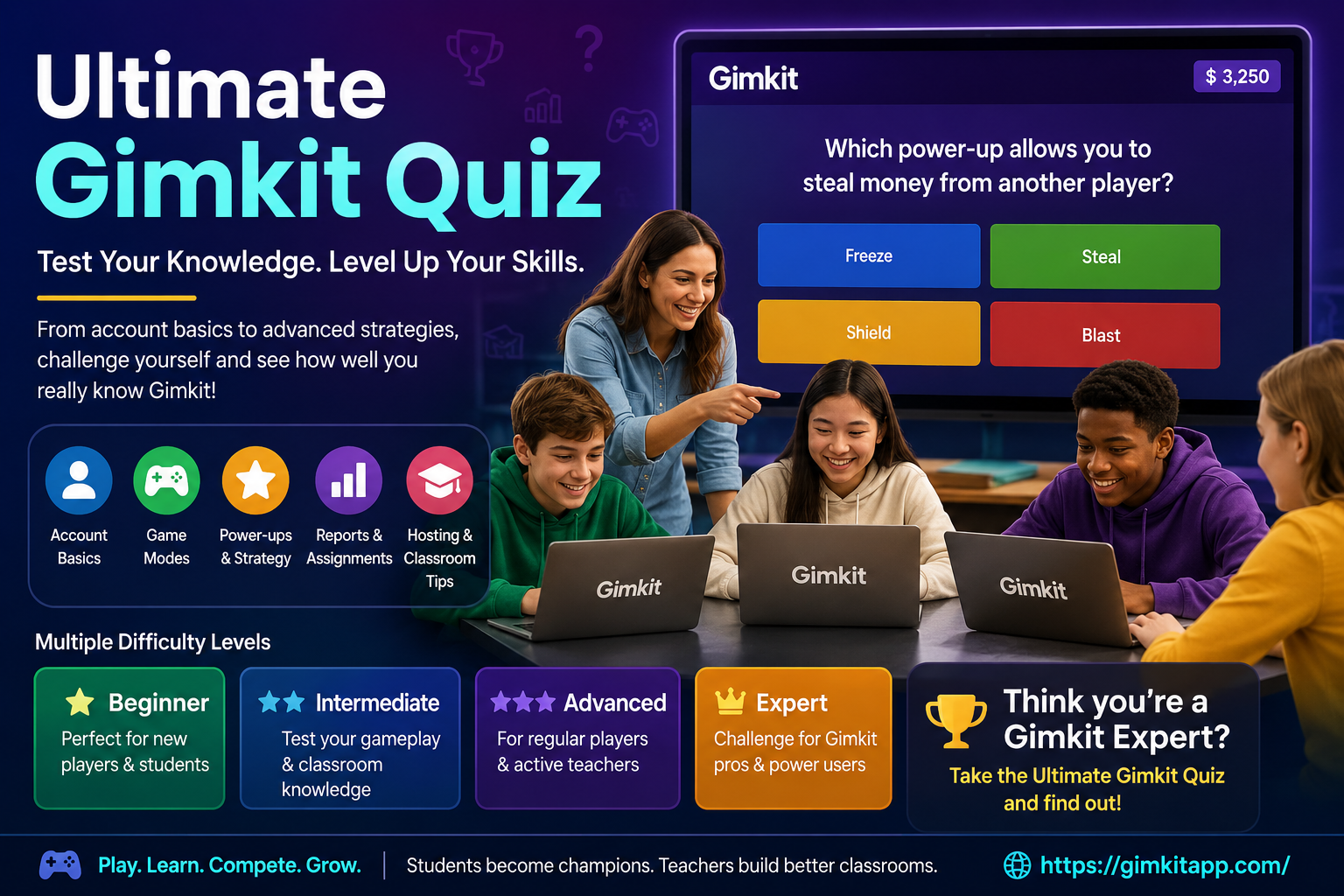
Think you know Gimkit? Test your understanding through 60 original questions covering Kits, joining live games, Classroom features, Basic and Pro access, Assignments, reports, Practice Mode and real-world teaching decisions.
Choose a quick challenge or work through the complete Gimkit knowledge test. Every question includes four answer options, automatic grading and an explanation. Optional per-question timing adds difficulty without changing the accuracy-based score.
After completing a round, review incorrect answers, identify the topics you missed and replay those exact questions. Your attempts stay in this browser when local storage is available.
60 original questionsSix knowledge categoriesThree difficulty levelsTimed or untimedInstant answer explanationsMistake replay
Your knowledge test, your challenge
Independent quiz experience—not an official Gimkit live game.
10
Quick Round
A short cross-topic knowledge check
20
Standard Round
More questions for deeper practice
60
Ultimate Round
Entire question bank across six categories
↺
Missed-Question Replay
Try the questions you previously missed
What You Can Play Here
What is the Gimkit Quiz on this page?
This Gimkit Quiz is an independent interactive knowledge assessment about the Gimkit platform. It helps visitors discover what they understand about using Gimkit, how its official features fit together and where they may need to review documentation.
Unlike a collection of questions with the correct answer printed immediately below each item, this quiz requires a choice before showing the explanation. The application checks the response, preserves the result and advances through a selected set of questions.
The original article introduced Beginner, Intermediate, Advanced, Teacher Knowledge, True or False and scenario-based challenges. Those themes remain in the upgraded experience, but the scoring now follows the actual number of questions in the selected round.
A ten-question challenge is graded out of ten. A twenty-question challenge is graded out of twenty. The full knowledge assessment can include all sixty questions. There is no misleading award threshold that assumes every visitor completed seventy or more questions when the selected round contained fewer.
The quiz uses a curated bank of Gimkit knowledge questions, not a live connection to a private Kit. It is not a replacement for the official Kit editor, Class membership system, host controls, Practice links or game reports.
Its answer explanations are based on official Help Center information wherever a question concerns product functionality. Questions about good teaching practice distinguish professional reasoning from hard platform rules.
Important distinction: Gimkit's official Practice Mode lets learners work through questions in an existing Kit. The independent quiz below instead tests knowledge about Gimkit itself and produces its own local score. It does not sync with any Gimkit account.
01 / ACTIVE QUIZ
Play rather than read an answer list
Answer actual multiple-choice questions, receive immediate feedback and progress through a selected round.
02 / EXPLANATIONS
Understand every result
Review the correct answer and the reason it is correct rather than memorising answer letters.
03 / REVIEW
Learn from missed questions
Replay the questions that caused difficulty and see topic-level patterns within your attempt.
Exclusive Interactive Knowledge Application
Ultimate Gimkit Knowledge Challenge
Select your topic, difficulty and round length. Answer each question, inspect explanations and finish with a scored knowledge report. You can also practise only previously missed questions.
60-QUESTION INTERACTIVE QUIZ ENGINE
Test knowledge. Learn the correct answer. Improve your next attempt.
An original quiz about Gimkit. No login, student account, school information, real game code or purchase is required.
1. Configure your knowledge challenge
Filtering may reduce the size of the selected round.
The full bank contains 60 questions. Select a round to begin.
2. How your attempt will be scored
Each correct answer earns one correct response and 100 independent quiz points. Incorrect answers, skips and timeouts earn zero. Your percentage is the number correct divided by the questions in the selected round.
Timed mode limits the time available for each question. It does not create extra points for fast guessing, and the timer cannot change Gimkit's official gameplay resources.
There is no paid subscription, account signup, official Gimkit XP award or prize. This is a self-contained knowledge assessment.
Question 1 / 10
Gimkit Fundamentals
Beginner
Untimed
Choose the best answer
Keyboard: keys 1–4 choose an option. After answering, Enter moves to the next question. In timed mode, unanswered questions expire automatically.
0Correct
0Incorrect
0Skipped / Timed out
0Quiz points
Round Completed
Your Quiz Result
0/0Correct answers
0%Accuracy
0Independent quiz points
0Missed or unanswered
Knowledge performance by category
Each percentage uses only the questions from that category appearing in the selected round. Small samples should be interpreted cautiously.
Review your answers and explanations
Export this attempt
Recent attempts saved in this browser
Up to eight completed attempts are retained locally when browser storage is available. Selecting an attempt opens its answer review.
What makes this a functional quiz rather than a static answer list?
The quiz keeps the correct answer hidden until the player selects an option, skips or runs out of time. After the question is resolved, the application shows the correct choice with an explanation. The same question cannot be scored twice within one attempt.
Players may select an untimed round for careful learning or a timed round for an additional challenge. The timer is tracked against real elapsed time, so switching tabs does not deliberately pause a question. Timing changes the opportunity to answer but does not award more points for speed.
The question bank supports several levels and topics, including beginner understanding of Gimkit terminology and more advanced decisions about official features. Category and difficulty filters genuinely change which items are eligible for selection.
A complete attempt generates a topic breakdown, answer-by-answer review and a list of missed items. The missed-question replay uses those questions specifically rather than choosing another random set and calling it revision.
Scores, answer reviews and attempt history are generated solely within this independent application. They are not Gimkit game reports, Gradebook results, student learning records or official XP.
Part One — Understanding the Quiz
How the Gimkit Quiz challenge works
1. A quiz is a knowledge check, not necessarily a live game
The word quiz can describe several related experiences. An educator may create a question set, a student may practise answers independently, or a group may participate in a live Gimkit game. These situations share question-based learning but involve different tools and rules.
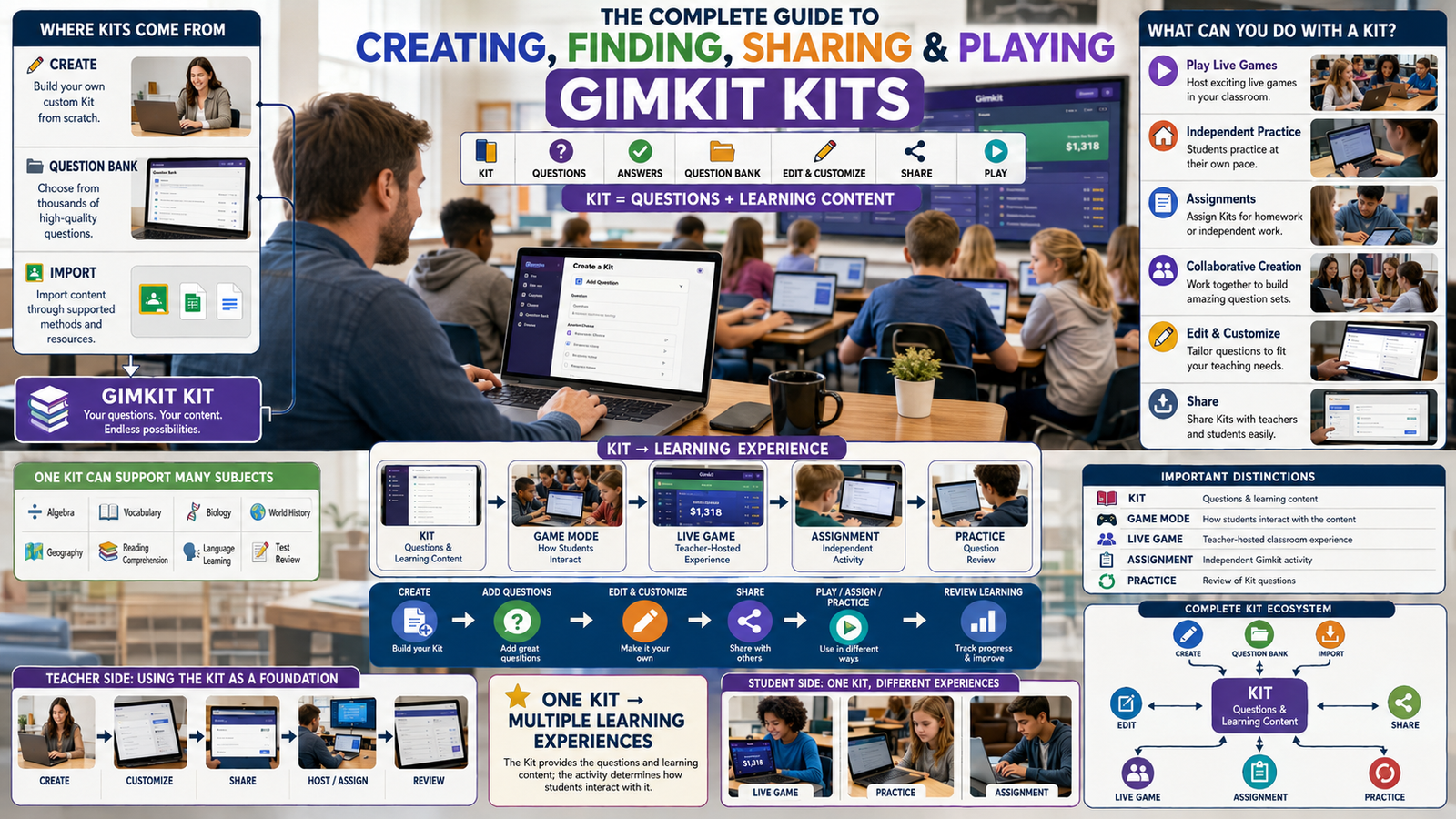
Gimkit's official terminology calls a collection of questions a Kit. A live game uses a selected Kit with a gameplay mode, host options and a session joining process. Practice Mode offers a simpler question-and-answer experience without the normal live-game mechanics.
The interactive Gimkit Quiz on this page is a fourth, independent experience: a curated test about the platform itself. Its purpose is to help readers determine whether they understand important Gimkit concepts rather than to host a school session.
Keeping these experiences distinct matters because an independent knowledge score should not be confused with in-game cash, player progress or a teacher's official reports. Each serves its own function.
2. The original quiz questions now form an active challenge
The previous version of this article presented many questions under Beginner, Intermediate, Advanced and Teacher Knowledge headings. Readers could scroll through the material and find answers printed directly after each question.
That format offered general reference value but made it difficult to test knowledge without seeing the answer beforehand. It also required readers to count correct responses themselves and compare them with score scales that were not always consistent with the number of questions.
The upgraded quiz solves those problems by withholding explanations until each choice is complete and grading the actual selected round automatically.
It retains the broad purpose of the original guide—checking Gimkit knowledge across several experience levels—while offering a more reliable and interactive method of practice.
3. The question bank is organised into six categories
The quiz contains sixty curated multiple-choice questions. They are organised into six categories: Gimkit Fundamentals, Live Games and Joining, Kits and Practice, Classes and Assignments, Basic and Pro Knowledge, and Reports and Teaching Judgment.
Each category represents a different area of practical understanding. The Fundamentals category focuses on core terms. Joining focuses on entry methods and session distinctions. Kits and Practice examines content and independent question review.
Classes and Assignments addresses persistent groups and paid homework workflows. Basic and Pro explores subscription feature boundaries without calculating their prices. The final category tests report interpretation and responsible instructional reasoning.
These categories are a quiz taxonomy used by this independent website. They are not presented as official certification domains or categories created by Gimkit.
4. Beginner questions test core terminology
Beginner questions focus on important distinctions a visitor should understand before attempting more involved tasks. A reader may be asked to identify a Kit, recognise the correct live-game joining destination or distinguish a simple Practice link from an official hosted session.
This level is designed for people who are still becoming familiar with the terminology. The aim is not to make the questions trivial but to confirm a reliable foundation.
A beginner who misses several questions may benefit from reading the official Help Center articles linked at the end of the page before continuing to more difficult material.
The score is intended to guide review within this question bank. It does not establish that a person lacks the ability to participate successfully in an actual Gimkit classroom activity.
5. Intermediate questions test process understanding
Intermediate questions ask readers to distinguish related features and their practical consequences. A teacher might need to identify what changes when Class Auto-Accept is disabled, while a learner might need to recognise that an official Assignment is different from ordinary Kit Practice.
These questions require more than recognising a single feature name. The correct answer often depends on understanding what the feature does and what it does not do.
This distinction helps reduce common mistakes caused by assuming that every Gimkit activity shares identical joining, scoring or management rules.
The intermediate level does not simulate the real administrative interface. It tests the reader's understanding of the documented process through concise scenarios and carefully differentiated answer options.
6. Expert questions test distinctions and judgment
Expert questions may ask why a game report cannot automatically prove conceptual mastery, why subscription access should not be confused with technical player limits or how a teacher should interpret a mismatch between the intended Class and actual membership.
Some questions are factual and can be supported directly by product documentation. Others concern interpretation, where the most defensible answer is based on sound instructional reasoning.
The quiz identifies these topics through explanations. It does not create a false implication that Gimkit officially certifies teachers as experts after completing the challenge.
An expert-level question is simply more demanding within this independent test. A high score demonstrates strong performance on these curated questions, not universal expertise in every mode or future platform update.
7. Quick rounds use a smaller sample
The Quick Round selects up to ten eligible questions. It is useful when someone wants a short introduction or a fast review of what they already know.
When the category and difficulty are both set to All, the selection can sample the wider question bank. Narrower filters may leave fewer questions available, in which case the application uses only the eligible items rather than inventing more.
A ten-question result should be interpreted as a sample. Even a perfect score does not demonstrate knowledge of all sixty questions, especially when the round uses random selection.
The exported review identifies the actual questions answered so the visitor can revisit those items rather than relying only on the final percentage.
8. Standard rounds balance time and coverage
A Standard Round includes up to twenty questions. For many readers, that provides a broader test without requiring completion of the entire knowledge bank.
The additional items may expose areas of uncertainty that a shorter sample misses. For example, a player who knows how to join a game may be less confident about Classes, Assignments or what a report measures.
The actual coverage still depends on selected filters and random order. A score from a twenty-question mixed round should not be interpreted as directly equivalent to the score from a different narrow-topic round.
The application gives each round its own correct-answer count, percentage and category breakdown to make that limitation visible.
9. Ultimate rounds cover all eligible questions
With all categories and difficulties selected, the Ultimate Round can include the full set of sixty questions. This is the most comprehensive assessment offered by the page.
A full round requires sustained attention because it covers several kinds of knowledge. A visitor must recognise terms, understand practical workflows, distinguish paid features and interpret educational scenarios.
The full round is not intended to represent every fact about Gimkit. Official documentation contains many more articles covering individual game modes, feature settings, troubleshooting and technical requirements.
The challenge is comprehensive within its own defined bank. The results describe performance on that bank and should not be presented as an official Gimkit assessment.
10. Question shuffling changes exposure, not the answer
Randomising question order can make repeated attempts less predictable. It reduces the tendency to memorise the sequence of questions rather than understanding the content.
The quiz can also shuffle the four answer options. The underlying correct choice remains associated with its original answer text, so changing the displayed letter does not change which answer is graded as correct.
This is an important implementation detail. A poorly designed quiz that only shuffles visible text while keeping the correct letter fixed may grade the wrong response.
The application maps each displayed option back to the original answer index, allowing its score and explanation to remain consistent after shuffling.
11. Timed questions introduce pressure without speed bonuses
Visitors can choose fifteen, thirty, forty-five or sixty seconds per question, or leave timing disabled. A question left unanswered after its timer expires is recorded as a timeout.
The timer is based on elapsed time rather than an estimated number of animation frames. This matters because a browser tab may not update its visual countdown continuously while it is in the background.
The quiz does not reward rapid guesses with extra points. One correct response always counts as one correct answer in this independent scoring system.
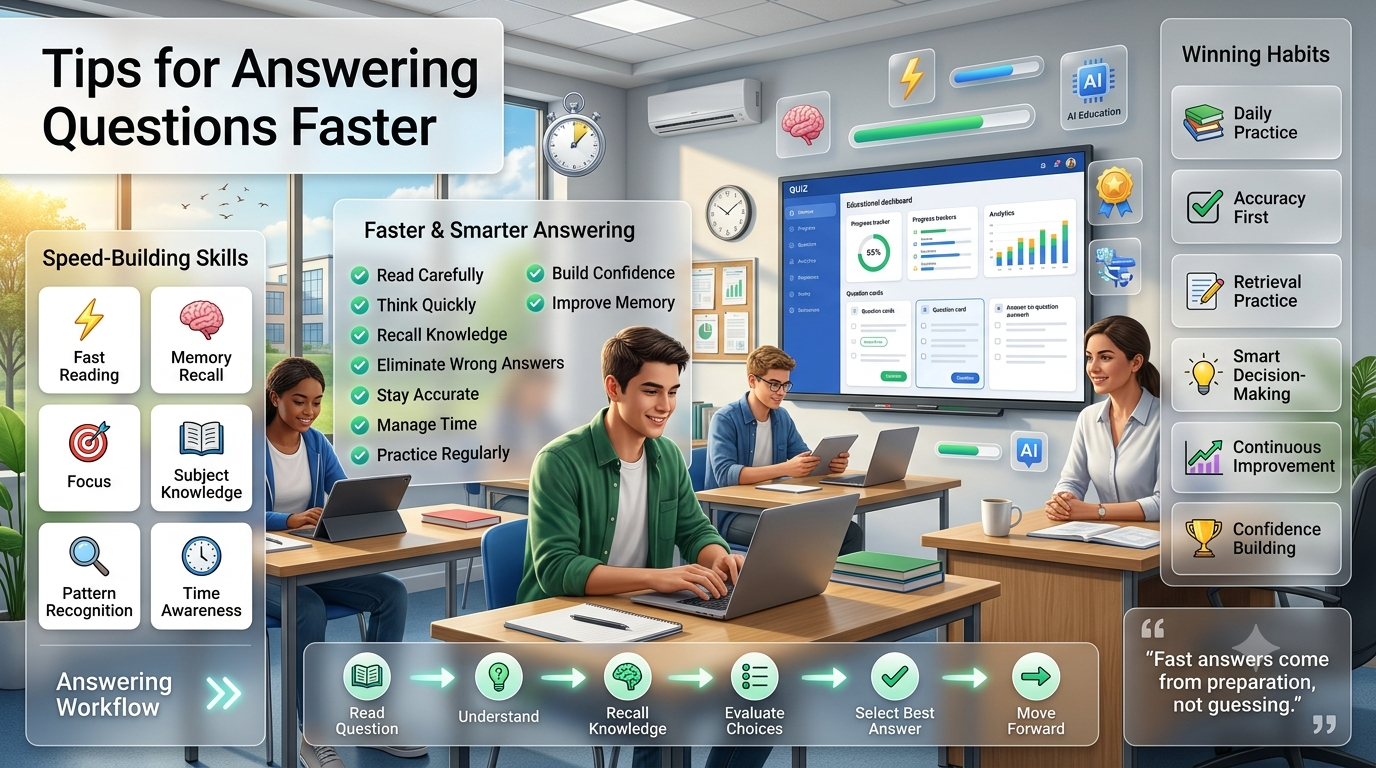
An untimed attempt is the better choice for readers who want to investigate explanations and learn carefully. Timed attempts provide a different challenge but should not be mistaken for a superior measurement of understanding.
12. Skipping a question is recorded transparently
A visitor may decide not to answer a question. Instead of requiring a random choice, the quiz provides a Skip control.
A skipped question receives zero correct-answer credit and appears in the answer review. Its explanation is still displayed so the reader can learn the relevant point.
This is different from an incorrect selection. In one case the reader attempted an answer that was wrong; in the other, no answer was selected.
The result distinguishes incorrect responses from skips and timeouts while including all selected-round questions in the final score denominator.
Part Two — What the Questions Test
Gimkit knowledge topics explained before you play
13. Understanding the difference between a Kit and a game
Gimkit calls a question collection a Kit. Educators can create and edit Kits through the official Dashboard. A Kit contains content that can be used in different supported activities.
A live game is the hosted experience that uses that content with a selected game mode and configuration. Treating these as identical can create confusion when deciding whether to edit questions or change gameplay settings.
The knowledge quiz includes questions that test this distinction. A correct response requires recognising which object contains the question material and which process turns that material into a hosted activity.
The quiz itself does not create Kits. Its bank is embedded in the independent page code, and the answers are assessed entirely inside this application.
14. Correct answers are defined in Kit content
Gimkit's Create a Kit from Scratch article explains that educators add a question, specify correct and incorrect answers and save the item to the Kit.
The documentation also describes allowing more than one correct answer where appropriate. That detail matters because a real Kit may have a more flexible answer structure than a simple four-option single-answer demonstration.
This independent quiz intentionally uses four-option single-best-answer items to make scoring clear and consistent. Its format is a design choice for testing Gimkit knowledge, not a statement that all official Gimkit questions must use one correct response.
Knowing that difference is part of understanding how question-based educational software works beyond a basic demonstration.
15. Hosting starts with a Kit and a mode
Gimkit's official hosting guide describes selecting a Kit, choosing a game mode and configuring the options before opening the lobby for players.
The sequence is important because a host needs question content as well as a supported format. Having a Kit in the Dashboard does not mean a live game has already started.
The quiz can test whether a reader understands the relationship between preparation, mode selection and the actual start of a session.
It deliberately avoids turning those factual questions into a simulated hosting dashboard. The dedicated Host and Game Modes pages own the detailed live-session workflows.
16. Live joining supports several methods
Gimkit documents joining a live game through the code on the host's screen, a join link or a QR code. The official joining destination is gimkit.com/join.
Depending on the selected Class configuration and account state, students can sometimes join through the Class-connected experience rather than manually entering a code.
This means a knowledge question stating that every player must always type a code would be too broad. The correct interpretation needs to consider the documented alternative joining methods.
The quiz includes these distinctions without generating a live code or claiming to validate current sessions.
17. A code identifies a particular live session
The displayed game code helps students reach the correct hosted game. It is not a subscription key, a permanent account password or a way to unlock every future session.
A teacher can display the code in the lobby and share a supported join link. Students should use the current information supplied by their host.
The quiz tests this basic purpose because understanding what the code represents can prevent confusion between live-session entry and other Gimkit account functions.
It does not attempt to guess code lengths, code expiration periods or any hidden validation API. Those are not required to understand the documented joining process.
18. QR codes and join links are entry alternatives
Gimkit's official QR Code article describes how the host can reveal a QR code by hovering over the game code. It also describes a control for copying a direct join link.
These options provide different ways to reach the same live session, potentially reducing the need to type a displayed code manually.
Their existence is useful in a knowledge test because it corrects the assumption that the numerical or textual code is the only possible route.
The independent quiz asks readers to recognise what these methods do, but it does not generate a QR code for a private game or request a genuine link from the visitor.
19. A Class is different from a temporary game lobby
Gimkit Classes provide an ongoing student grouping and identity context. A live-game lobby is the temporary place where participants gather for a specific hosted session.
Students may belong to a Class over a longer period while participating in many separate games. The Class does not have to be recreated for each new question activity.
A quiz question can test whether a reader understands this persistent-versus-temporary distinction without asking them to perform administrative changes.
The site's Classroom guide owns the Class roster process. The knowledge challenge simply checks whether the distinction is understood.
20. Practice Mode removes many game mechanics
The official Practice Mode article describes a simple way to preview and work through questions from a Kit using a shareable Practice link.
It explicitly distinguishes Practice from regular modes and from paid Assignments. Practice has questions and correct or incorrect responses without normal gameplay mechanics or assignment management.
This makes Practice useful as a factual quiz topic. It tests whether the reader recognises a simpler question experience rather than assuming that every Gimkit link represents an active multiplayer game.
The independent knowledge challenge has its own score and timers; these are features of this website's application, not claims about Gimkit's official Practice Mode.
21. Assignments are not simply renamed Practice links
Gimkit identifies Assignments as a paid Pro feature. An Assignment uses a supported game mode and configured goal so a student can complete the activity independently.
A Practice link is a simpler form of question review without the same due dates, reporting or mode mechanics.
The knowledge quiz includes questions about this difference because it matters to educators deciding which official feature they are describing.
A correct answer depends on understanding the feature boundary, not on deciding which subscription to buy. Financial comparisons and entitlement lifecycle calculations belong to separate pages.
22. Classes are available under Basic
Gimkit's Pro FAQ describes Classes as part of the free Basic offering. This means the existence of a Class should not automatically be used as evidence that its educator has an active Pro subscription.
Assignments are different because they are explicitly identified as a Pro-only educator capability. The two features can interact, but that relationship does not erase the difference in access.
The quiz contains questions designed to catch precisely this type of overgeneralisation.
Learning these distinctions is more useful than memorising a long list of marketing labels without knowing what each documented feature does.
23. Basic includes reports, not just live-game entry
Gimkit's official Pro FAQ confirms that Basic educators can collect game reports. The dedicated Game Reports documentation describes student, general and question-focused views.
A quiz answer claiming that every report requires a Pro subscription would therefore be incorrect under the documented plan structure.
The knowledge challenge tests whether readers understand that reporting is part of the free educator offering, while recognising that a report does not automatically prove learning.
The tool does not request, import or replicate actual reports. Its result is only a record of the visitor's answers to the independent Gimkit knowledge questions.
24. Pro adds specific educator capabilities
Gimkit Pro provides unrestricted access to Pro-exclusive modes and includes additional functions such as Assignments, audio questions and uploaded images in question content.
Those capabilities should be distinguished from ordinary Kit creation or free reporting. Describing every useful Gimkit function as Pro-only would be misleading.
The quiz asks readers to identify documented paid features and to reject overly broad assumptions.
It does not calculate billing costs, recommend a subscription or verify whether the visitor's real account has an active paid entitlement.
25. The featured-mode selection can rotate
Gimkit's Pro FAQ describes a rotating selection of Featured modes available to Basic educators, generally around three at a time.
A mode that was available in one period may not have the same Featured status later. A quiz should therefore avoid treating a fixed historical list of named modes as permanently free.
Questions in this challenge focus on the principle of rotating availability rather than asking the visitor to memorise a time-sensitive catalogue.
Checking which individual mode is currently available remains a task for the official Mode Picker, not an offline question bank.
26. A subscription does not erase technical limits
Gimkit publishes live-game player maximums and separate restrictions for particular game types. These are not identical to the distinction between Basic and Pro.
A person can understand the subscription feature list while still needing to check whether the desired live activity supports the intended participant count.
The knowledge quiz tests the principle that an access entitlement and a technical capacity rule answer different questions.
It avoids simulating detailed mode-specific limits because that belongs to the site's dedicated game-mode and capacity references.
27. Official game reports have multiple views
Gimkit's Game Reports guide describes student-level information, general overview information and question breakdowns.
These views can help an educator explore different aspects of an activity. A question breakdown may highlight content that caused difficulty, while other views provide broader performance context.
The quiz tests whether a reader knows why a question-level analysis can be relevant after a game.
It does not reproduce the report interface or claim that an independent quiz attempt contains authentic student performance data.
28. Game outcomes and academic understanding are not identical
Many Gimkit game modes involve mechanics beyond answering academic questions. A player's visible outcome may depend partly on those additional gameplay rules.
A strong teacher should therefore distinguish the result of a game from direct evidence about a learning objective. A question-level response may be useful, but it does not automatically show that a student can explain or transfer an idea.
The expert question bank includes scenarios that test this distinction.
It is possible to enjoy a game, accumulate a strong game outcome and still need additional learning support. The quiz treats that as a reasoning issue rather than a defect in the player's character or motivation.
Part Three — Results and Learning From Errors
Gimkit Quiz scoring, accuracy and mistake review
29. One correct answer receives one unit of accuracy
The knowledge challenge uses a transparent rule: each question has one best answer, and each correct response counts once.
A round with eight correct answers out of ten earns an accuracy of eighty percent. A round with sixteen correct answers out of twenty also earns eighty percent. The score denominator always follows the number of questions selected for that attempt.
This prevents an incorrect comparison with a fixed scale intended for a different quiz length.
The application also awards one hundred internal points per correct response, but these are simply another representation of the local score and are not Gimkit cash, XP or official rewards.
30. Incorrect responses are learning opportunities
An incorrect answer can show where a reader's understanding differs from a documented feature or a defensible instructional principle.
The quiz therefore displays more than a red indicator. It shows the correct response and explains why the chosen interpretation is incomplete or inaccurate.
A useful review focuses on what the explanation adds. The visitor might learn that a Practice link lacks official assignment tracking, that Classes are available on Basic or that the QR code is another joining route.
The purpose is to improve understanding of Gimkit terminology and workflows rather than to encourage repeated guessing until an answer happens to be correct.
31. A timeout is not the same as proof of ignorance
A timed question can expire before a visitor chooses an answer. That result may reflect reading speed, distraction, unfamiliarity with the wording or genuine uncertainty.
The application counts the question as unanswered for scoring purposes and identifies it as a timeout in the answer review.
However, it does not interpret the timeout as a diagnosis of the visitor's ability.
A person using the quiz primarily to learn may prefer untimed mode, where they can think carefully and use the explanations without the additional constraint of a countdown.
32. Percentage-based interpretation is relative to the attempt
A high percentage indicates strong performance on the questions included in that particular attempt. It does not guarantee equal performance on a different category, a harder level or a newly revised question bank.
For example, ten correct beginner questions provide evidence of success on a beginner sample. They do not establish that the visitor understands every advanced assignment or reporting distinction.
The result therefore uses descriptive labels such as Strong Foundation, Developing Understanding and Excellent Round rather than claiming an official Gimkit certification.
The category breakdown helps a visitor see what was actually tested rather than relying on the percentage alone.
33. Reviewing only missed questions can improve efficiency
After finishing a round, the quiz identifies every incorrectly answered, skipped or timed-out question. The visitor can start another round containing only those items.
This creates a focused review experience. Someone who understands Kits but misses several Class and Assignment questions can concentrate on the specific items that caused difficulty.
The replay is not a promise of long-term learning. The visitor may remember an answer from the explanation immediately after the first round.
For deeper understanding, the reader should explain the relevant concept in their own words and return to the documentation when necessary.
34. Marking a question is different from answering it
The knowledge challenge includes a Mark for Review action. This allows a visitor to identify an item that deserves later attention even if the correct answer was selected.
A guessed correct answer might still represent uncertainty. Conversely, a challenging question may be answered correctly after careful reasoning but still be worth reviewing.
The flag is stored as part of the local attempt. At the end, the answer review can be filtered to show marked items.
A flag does not change the score or create a learning record in the official Gimkit service.
35. A category breakdown exposes uneven knowledge
An overall result can hide substantial differences between topics. A reader might understand how live joining works but struggle to distinguish paid Assignments from Practice links.
The application calculates a separate proportion correct for each category included in the round. This makes the review more specific.
The percentages should still be interpreted carefully. In a short random round, a category may be represented by only one or two questions. Such a small sample cannot support a broad conclusion.
The result therefore displays both the count correct and the number of questions tested within each category.
36. Repeating a question can change familiarity
A missed-question replay uses the exact previously missed items, but the visitor has already seen their explanations.
Improvement on the immediate replay may partly reflect memory of those answers. That can be useful for short-term revision while still providing limited evidence of independent long-term understanding.
Readers who want a stronger self-check can revisit the same ideas later, use another difficulty level or explain the answer without looking at the choices.
The knowledge challenge does not pretend that repeating the identical item is a scientifically validated measure of durable mastery.
37. A complete result should preserve the reasoning
A final score is more informative when the visitor can see which questions were answered, what the correct responses were and why those answers matter.
The exported quiz brief includes the round settings, correct-answer count, percentage and individual explanations. This allows a visitor to use the result for self-review rather than relying on a single badge.
The export does not contain real student records or account credentials. It is a local independent knowledge-test result.
It should not be substituted for a teacher's authenticated Gimkit Game Report or treated as a school grading record without suitable independent assessment procedures.
38. Attempt history is a private browser convenience
Where local storage is available, the application keeps a limited history of completed attempts in the current browser.
The visitor can review a previous attempt and see the selected questions and their results. This makes it possible to return to a missed question without repeating the entire quiz immediately.
The history is not synchronised between devices and is not stored in a Gimkit account. Clearing the browser's storage may erase it.
The application includes a Clear Local Attempt History action so the visitor can remove stored quiz results directly.
39. Fast answers receive no artificial bonus
The timed challenge may be more demanding because the reader has less time to consider the options. However, the application does not award a higher score for a faster correct answer.
This scoring approach protects the meaning of the result. The percentage describes answer correctness under the selected constraints rather than combining knowledge with an undocumented speed formula.
Someone who receives eighty percent in a timed round and another who receives eighty percent untimed have the same proportion correct but completed different kinds of challenge.
The exported result records the selected timer so that this context is not lost.
40. Ending early keeps unanswered questions visible
A visitor may stop an attempt before reaching the final item. The application offers a Finish Early action for that situation.
The scheduled questions not reached are recorded as unanswered rather than disappearing from the denominator. This avoids inflating the score by omitting the questions that were not completed.
The final review distinguishes answered questions from skipped or unreached items. The result can therefore be interpreted with appropriate caution.
A partial attempt may still be useful for study, but it should not be represented as a complete performance on all selected questions.
Part Four — Using Quiz Questions Responsibly
How students and teachers can learn from a Gimkit knowledge quiz
41. Students can test their understanding of the platform
A new student may know that Gimkit involves answering questions without understanding the differences among a live game, a Kit, a Class and an Assignment.
A short knowledge challenge can introduce that terminology before the learner needs to navigate the real service.
The reader should still follow instructions from their teacher for actual participation. A knowledge quiz on an independent website cannot verify a current game code or establish whether a student has joined the correct Class.
The quiz is best used as a supplementary introduction and review rather than as a substitute for the official joining process.
42. Teachers can check familiarity with documented workflows
An educator may be comfortable preparing questions but less familiar with the subscription distinction for Assignments or the reports available after a live game.
The challenge provides a low-stakes way to test that knowledge. Answer explanations can direct the educator toward the correct Help Center concept without requiring a real classroom session.
The result should not be treated as proof of teaching competence. Understanding software terminology is only one part of using a platform effectively.
The teacher remains responsible for selecting appropriate content, respecting school policies and interpreting actual student evidence.
43. Accurate product facts should not be mixed with unsupported claims
A knowledge quiz is only useful if its answers are defensible. Product details can change, and broad third-party descriptions sometimes simplify features beyond what official documentation supports.
This quiz avoids claims such as every live game requiring manual code entry, every report being paid-only or every mode using the same mechanics.
Instead, its factual explanations refer to documented general rules and identify where current platform conditions must be checked separately.
Readers should revisit official documentation when an answer affects a consequential account, billing or school-management decision.
44. A quiz explanation should teach the distinction
Simply displaying the correct letter provides limited educational value. The visitor may remember that Option C was right without knowing why.
The knowledge challenge therefore explains the feature or reasoning behind the chosen answer. The explanation is intended to connect the correct response with a concept such as persistent Class membership or the difference between Practice and Assignments.
For factual questions, that concept is grounded in Gimkit documentation. For educational scenarios, the explanation identifies the relevant professional reasoning.
Understanding that distinction is more valuable than memorising the original ordering of the options, which may change when answers are shuffled.
45. Scenario questions test decisions rather than button locations
A scenario might describe a teacher noticing that students repeatedly miss one concept, or an educator assuming a Practice link supplies assignment tracking.
The strongest answer requires identifying the appropriate next step or correcting the mistaken assumption.
These questions are not intended to recreate every control in Gimkit. They test whether the reader can apply a principle to a plausible situation.
An educator may still need the actual official interface to complete the corresponding real-world process. The quiz teaches understanding, not authenticated account actions.
46. Competition should not overwhelm comprehension
A quiz can motivate participation, especially when users want to improve their previous score. However, the score itself should not become more important than understanding the questions.
A visitor who guesses quickly and happens to earn a high result may have learned less than someone who answers more slowly, studies explanations and revisits the concepts.
This independent challenge therefore provides untimed practice and does not penalise slow correct answers when no timer is selected.
The optional timed format is an additional challenge rather than the assumed standard for every learner.
47. The quiz should not imitate official Gimkit rewards
Gimkit has game-specific resources, progression systems and rewards that depend on the actual platform experience.
An independent quiz cannot grant those rewards or affect the visitor's official account simply because it displays a score.
This page therefore labels its numerical rewards as independent quiz points. They exist only to make the local challenge easier to read.
The application does not ask for login credentials, attempt to connect to account progression or promise skins, cosmetics or other official benefits.
48. Teachers should review real official reports separately
The question breakdown from this website records how well one visitor answered a knowledge test. It is not an assessment of students who participated in a real Gimkit session.
Gimkit's official Game Reports feature provides a different information source associated with hosted activities. Teachers can access those reports through the supported account interface.
The distinction matters because an independent score should not be treated as a classroom data export.
The knowledge challenge is a learning resource about the service, while official reports document activity results within the service itself.
Part Five — Applying Knowledge
Common Gimkit quiz situations and how to reason through them
49. A student thinks the Class link starts today's game
A learner has been given a Gimkit Class link and expects it to function as the live code for every game the teacher hosts.
The key misunderstanding is the difference between persistent membership and temporary session entry. The Class link is used to join the ongoing educator group; a live game has its own hosting and joining process.
The knowledge quiz tests whether the reader recognises that distinction. It does not instruct the student to invent a game code or use an unofficial link.
The appropriate practical action is to follow the teacher's current instructions and the official joining options for the actual session.
50. A teacher mistakes Practice Mode for an Assignment
An educator shares a Kit Practice link and assumes it will provide the same due-date management and assignment reporting as a paid Gimkit Assignment.
The official Practice Mode documentation states that Practice is a simpler question-and-answer experience without those assignment features.
The knowledge quiz asks readers to recognise the correct distinction before making similar assumptions in real teaching.
The right lesson is not that Practice lacks educational value. It is that Practice and Assignments serve different purposes and should be described accurately.
51. A teacher thinks Basic cannot provide reports
An educator has heard that all meaningful Gimkit reporting requires a subscription upgrade.
Gimkit's Pro FAQ explicitly says Basic educators can collect reports. The mistake comes from treating all paid features as if they include every aspect of the reporting experience.
A quiz question about this distinction tests the reader's familiarity with the actual Basic offering.
The detailed interpretation of real report content remains a different task, but knowing that ordinary reports are available on Basic is an important factual foundation.
52. A player assumes typing a code is always mandatory
A student believes the only documented way to join a live Gimkit game is to type the displayed code manually.
Official joining guidance also describes QR codes, join links and supported Class-connected entry. The correct knowledge statement must include these alternatives.
The quiz tests this point because the distinction can help visitors understand host instructions accurately.
It does not guarantee that every entry method is available in every circumstance. The actual method depends on the host's session and configuration.
53. An educator sees a high game score and assumes mastery
A class performs well in a live Gimkit activity, but the educator has not checked whether learners can explain the relevant content in another format.
The important reasoning issue is that the final game outcome may be influenced by mechanics beyond academic accuracy. A question-level report and an additional explanation or recheck can provide useful context.
The quiz tests whether the reader prefers meaningful evidence over treating the leaderboard as the complete assessment.
This does not mean game scores are meaningless. It means their interpretation should reflect what they actually measure.
54. A visitor performs well on one topic but poorly on another
Someone may answer almost every joining question correctly while missing several questions about reports or Class-connected Assignments.
A single overall percentage could conceal that difference. The quiz's category breakdown makes the uneven coverage visible within the selected round.
The appropriate next step is to revisit the weaker topic, consult an official source and then try a focused round.
The result does not claim that one category score establishes an enduring skill level. It describes performance on the questions that appeared in that attempt.
55. An expert question exposes a subtle wording problem
A question might ask whether Pro provides all game modes without any restriction whatsoever. The wording is broader than the documented feature entitlement because technical activity limits can still exist.
A careful reader should distinguish unrestricted Pro-exclusive mode access from a promise that every technical condition disappears.
The quiz's advanced questions include such distinctions to reward precise understanding rather than broad slogans.
This also demonstrates why well-written knowledge questions should avoid absolute words when official documentation supports a more qualified statement.
56. Replaying mistakes should encourage explanation
A reader misses a question, reads the explanation and immediately answers the same question correctly during replay.
That is a useful improvement in immediate recall, but it is not necessarily evidence of long-term understanding.
A stronger study habit is to restate the reason in one's own words, compare it with a related concept and return to the material after a delay.
The quiz provides the replay mechanism. The visitor is responsible for using it as a learning opportunity rather than as a way to collect a flattering score.
Quick Knowledge Reference
Gimkit quiz concepts worth knowing
Concept
What it means
Common misconception
Kit
A collection of questions used in supported Gimkit experiences.
Thinking a Kit is already a running live game.
Live game
A hosted activity using a Kit, mode and game options.
Assuming opening a Kit starts the session automatically.
Game code
One route for participants to access a current hosted session.
Confusing the code with a permanent account password.
Join link or QR code
Alternative documented entry methods for a live session.
Claiming every player must type the code.
Practice Mode
Simple Kit question review without normal game mechanics or assignments.
Assuming it provides paid Assignment reporting.
Class
An ongoing educator-student grouping.
Confusing Class membership with joining one game.
Assignment
A Pro-only independent activity using supported modes and goals.
Assuming every Practice link is an Assignment.
Basic
The continuing free Gimkit educator offering.
Thinking all reporting and Classes are paid-only.
Pro
Additional educator capabilities and broader mode access.
Assuming payment removes all technical restrictions.
Game Report
Official post-game response and performance information.
Treating a leaderboard as complete academic evidence.
Frequently Asked Questions
Gimkit Quiz questions answered
What is the Ultimate Gimkit Quiz?
It is an independent playable knowledge test about Gimkit, containing sixty original multiple-choice questions across six categories with immediate grading and answer explanations.
Is this an official Gimkit game?
No. The quiz operates on GimkitApp.com and is not created, managed or endorsed by Gimkit. It does not connect to live Gimkit sessions.
Can I play the Gimkit Quiz for free?
Yes. The knowledge challenge on this page does not require a subscription or payment.
How many questions are available?
The application contains sixty questions distributed across six knowledge categories.
Can I play only ten questions?
Yes. Select Quick Round for up to ten eligible questions.
Can I play twenty questions?
Yes. Standard Round includes up to twenty eligible questions.
Can I play all sixty questions?
Yes. Select Ultimate Round with all categories and difficulty levels to use the full question bank.
Why does a filtered round sometimes have fewer questions?
The application only includes questions matching the selected category and difficulty. It does not create duplicate questions to fill an oversized round.
Does every question have four answers?
Yes. This independent challenge uses four choices with one best answer per question.
Can a real Gimkit Kit question have multiple correct answers?
Yes. Gimkit's official Kit creation documentation describes the ability to define more than one correct answer where appropriate. This page uses single-best-answer questions for its own quiz format.
Are answers shown before I select an option?
No. The correct response and explanation appear after you answer, skip or time out.
Can I use the quiz without a timer?
Yes. Untimed mode is selected by default and supports thoughtful learning.
What timer options are available?
You can choose fifteen, thirty, forty-five or sixty seconds per question, or disable timing.
Do faster answers earn more points?
No. Every correct answer earns the same independent quiz credit. The timer adds a challenge but no speed bonus.
What happens when time runs out?
The question is recorded as timed out, the correct answer and explanation are shown, and the visitor can continue.
Can I skip a question?
Yes. Skipped questions receive no correct-answer credit and remain visible in the review.
How is the final score calculated?
Correct answers are divided by the total number of questions in the selected round. The percentage is then displayed alongside the raw score.
What are independent quiz points?
The page awards one hundred local points for each correct answer. They are not Gimkit in-game cash, XP, grades or official rewards.
Can I review incorrect answers?
Yes. Every completed attempt includes a question-by-question answer review with explanations.
Can I replay only my missed questions?
Yes. Use Replay Missed Questions after a completed attempt. The new round contains the incorrectly answered, skipped or timed-out items from that attempt.
Can I mark a question for review?
Yes. The Mark for Review control flags the current question without changing its score.
Does the quiz shuffle the answer order?
Yes. The answer choices are shuffled while retaining the correct grading relationship.
Can I select only expert questions?
Yes. Use the Difficulty filter to select the Expert level.
Can I practise only Gimkit joining questions?
Yes. Select Live Games & Joining from the category menu.
Does the quiz teach how to create Kits?
It tests conceptual knowledge about Kits, but actual Kit creation and editing belong to Gimkit's official editor and the site's separate Gimkit Create guide.
Is Practice Mode the same as an Assignment?
No. Gimkit describes Practice Mode as simple question review without ordinary game mechanics or assignment features. Official Assignments are Pro-only.
Do students always need to enter a game code?
No. Official Gimkit documentation also supports QR codes, join links and certain Class-connected joining flows.
Can teachers collect game reports on Basic?
Yes. The Gimkit Pro FAQ identifies reporting as part of the free educator offering.
Can this quiz create a real Gimkit Assignment?
No. It does not access Gimkit accounts or create official Assignments.
Can I receive official Gimkit XP from this quiz?
No. Any score displayed here is local to this independent application.
Can this quiz unlock skins or cosmetics?
No. It has no connection to official account progression, cosmetics or purchases.
Are my attempts saved?
The application attempts to store up to eight completed attempts in the current browser. Storage may be unavailable or cleared by browser settings.
Can I clear the saved history?
Yes. The application provides a Clear Local Attempt History control.
Can I download my quiz results?
Yes. TXT, CSV and JSON exports are provided, along with copy and print actions.
Can the JSON result be imported into official Gimkit?
No. The exported format belongs to this independent quiz and is not an official Gimkit Kit, game or report format.
Does a perfect score mean I am officially Gimkit certified?
No. A perfect score reflects performance on this curated question bank and does not provide an official certification.
Can teachers use the questions for discussion?
Yes. Teachers may use the ideas and explanations to introduce key platform distinctions. The local score is not an official classroom assessment or authenticated game report.
Why are some questions about teaching decisions?
Understanding Gimkit includes knowing how to interpret reports and use activities responsibly. Those questions test professional reasoning rather than platform button locations.
What should I do after a low score?
Review the missed questions, read their explanations and consult the relevant official Help Center material before trying again.
Is the question bank guaranteed never to change?
No. Product features can evolve, and the independent question bank may need editorial updates when Gimkit changes its documented behaviour.
Further Question-Based Learning
Continue beyond the Gimkit knowledge challenge
This page tests what you know about Gimkit. For a different educational question—how teachers use short checks and response patterns to make instructional decisions—see the site's guide to using Gimkit as a formative assessment tool.
That topic concerns classroom assessment practice rather than this page's sixty-question interactive knowledge test. The two resources serve different search intents and do not duplicate one another's application.
Official Reference Material
Sources used to verify Gimkit Quiz answers
The quiz questions about Gimkit functionality are based on official Help Center descriptions of Kits, Practice Mode, hosting, joining, Classes, Assignments, Basic and Pro features, and reports. Explanations about teaching judgment are identified as general educational reasoning rather than official product guarantees.
Feature accuracy: Actual Gimkit gameplay rules depend on the official mode and current product options. The independent Quiz Challenge tests general product knowledge; it is not a live-mode emulator or account verification service.
Independence: GimkitApp.com is not operated, authorised or endorsed by Gimkit. The quiz contains original questions and local scores. It neither accesses accounts nor awards official prizes, XP, cosmetics or grades.
Take the challenge. Review every mistake. Understand Gimkit better.
Sixty focused questions, transparent scoring and practical explanations make this quiz a way to test your knowledge rather than simply scroll past an answer key.