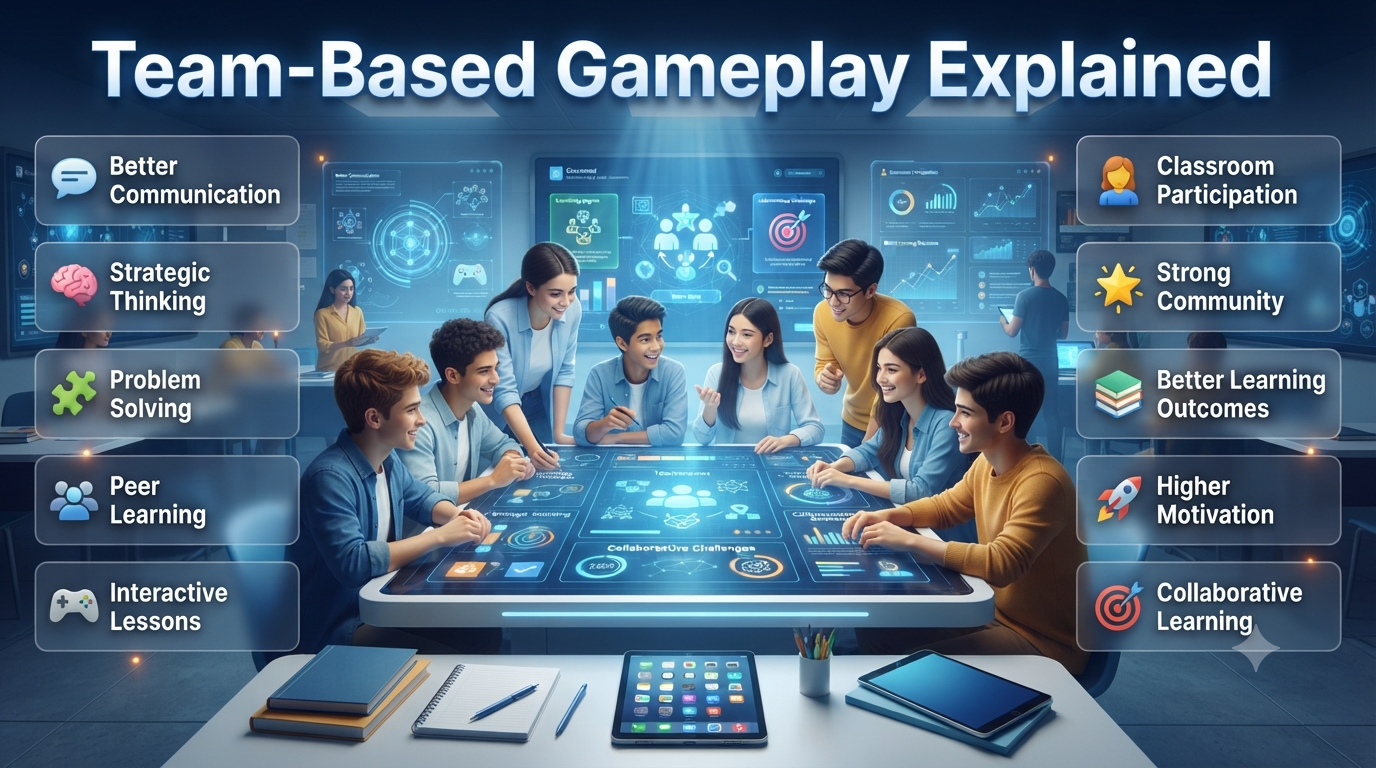
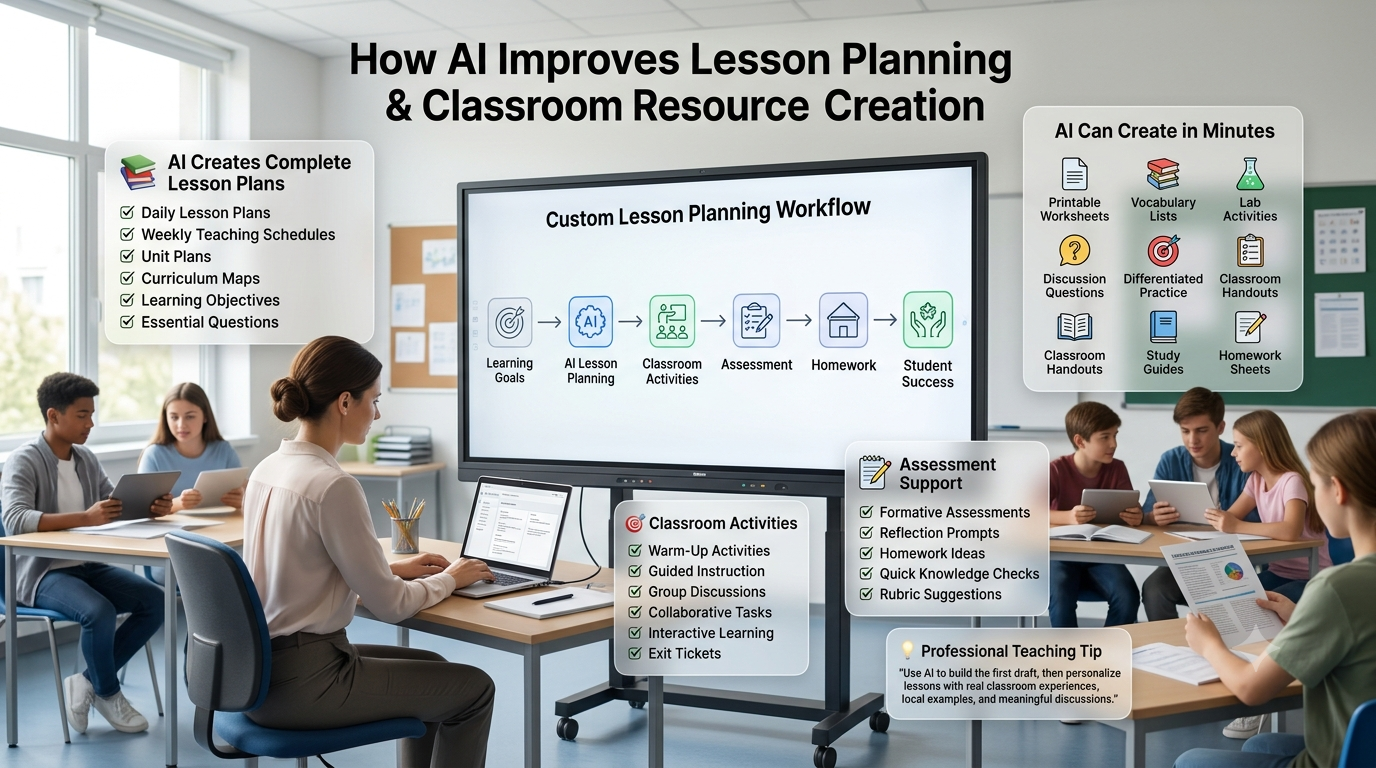
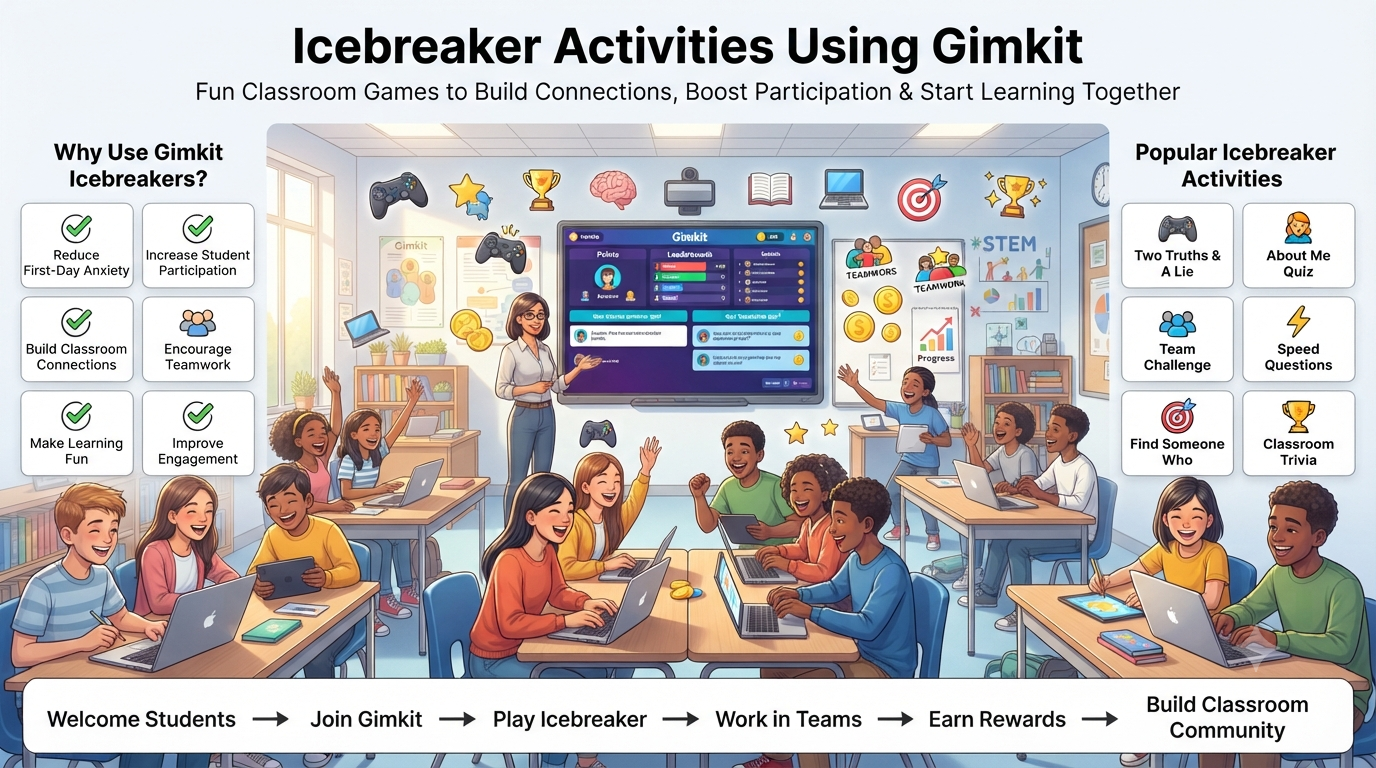
Team based gameplay is a way of organizing a game around a shared objective rather than treating every participant as an entirely independent competitor. In an educational setting, students may contribute knowledge, coordinate actions, make decisions, or complete different responsibilities while working toward an outcome that belongs to the group.
However, putting students on the same team does not automatically create collaborative learning. A game can display team scores while most students continue working independently. A group may also contain one highly active player and several learners who contribute very little. Effective classroom team based gameplay requires a clearer connection between the game objective, student interaction, individual responsibility, and the learning that should take place.
This guide explains the underlying mechanics of team based gameplay, how educators can structure meaningful participation, what collaboration looks like in different types of games, and how to evaluate whether students are actually learning. Gimkit provides several relevant multiplayer examples, but the principles also apply to other educational games and classroom activities.
The central distinction is simple: a shared scoreboard creates a team result; a well-designed shared task creates a reason to learn together.
What Is Team Based Gameplay?
Team based gameplay is a game structure in which two or more participants contribute toward a collective objective, result, or challenge. That objective might involve completing a mission, accumulating shared points, defending a location, solving a problem, or outperforming another team.
In some games, individual scores are simply added together. In others, participants must coordinate their actions to achieve something that no single player could accomplish as effectively alone. These arrangements may look similar on a leaderboard but require different kinds of cooperation.
Educational team based gameplay adds a second purpose. The activity is not only meant to produce a game result; it should give learners opportunities to retrieve knowledge, explain reasoning, identify misconceptions, practice communication, or apply ideas to a shared challenge.
A well-designed classroom experience therefore connects three elements:
Game objective: What are participants trying to accomplish?
Collaborative process: How does each participant contribute?
Learning objective: What should each student understand afterward?
If the third element is missing, the activity may still be entertaining, but its instructional value becomes difficult to judge.
Team Based Gameplay Is Not the Same as Group Work
Group work describes a social arrangement: students have been placed together.
Team based gameplay describes an activity structure: the participants have some shared game-related responsibility or outcome.
Collaborative learning goes further by requiring productive intellectual interaction. Students may need to explain concepts, compare evidence, evaluate alternatives, or correct misunderstandings. A group can complete a task without much genuine collaboration if one person performs all the thinking.
Consider two four-student groups reviewing fractions.
In the first group, the fastest learner answers every question while the others watch. The team earns points, but the activity provides limited evidence that all four students understand equivalent fractions.
In the second group, students first choose an answer privately, discuss differing responses, explain the mathematical reasoning, and then complete the game action. The shared objective now creates an opportunity to clarify understanding.
Both groups are participating in team based gameplay. Only the second has a deliberately structured collaborative-learning process.
The defining characteristics
Team based gameplay commonly involves some combination of shared outcomes, coordinated action, collective consequences, interdependence, and group identity.
Not every game contains all five. Some activities award one score to a team without requiring players to communicate. Others require constant cooperation because a mission cannot be completed unless several participants perform complementary actions.
For teachers, identifying the actual collaboration mechanism is more useful than assuming that a mode labeled “team” will automatically produce discussion.
The Five Systems That Make Team Based Gameplay Work
Educational team based gameplay becomes easier to design when it is understood as several connected systems rather than a collection of motivational features.
System
Essential question
Classroom implication
Shared objective
What outcome belongs to the group?
Establish a goal students can explain
Contribution
What can each participant do?
Prevent passive team membership
Coordination
When must participants work together?
Create purposeful communication
Feedback
How do players know what happened?
Connect actions with understanding
Accountability
What evidence exists for each learner?
Avoid treating a team score as an individual grade
These systems influence one another. A well-defined goal cannot compensate for a task that allows one learner to do everything. Likewise, allocating roles does not guarantee understanding if students receive no meaningful feedback about their answers.
Shared objectives create direction
In team based gameplay, the shared objective tells participants what successful completion means.
A competitive objective might be to finish with more points than another team. A cooperative objective might require everyone to reach a destination or complete a sequence of challenges.
The classroom learning objective should remain separate. Winning a game is a performance outcome within that game. Understanding a historical source, identifying a chemical reaction, or explaining a mathematical relationship is an instructional outcome.
A useful teacher explanation is:
“Our game objective is to complete the challenge together. Our learning objective is for each person to explain how the answer was reached.”
That distinction prevents the scoreboard from becoming the only definition of success.
Contributions must be meaningful
In team based gameplay, a participant contributes meaningfully when their action helps the group make progress and gives them an opportunity to think.
A contribution might involve answering a question, interpreting a diagram, checking a calculation, explaining a concept, identifying an alternative, or helping coordinate a game objective.
Not all contributions have equal visibility. A student who asks a critical question may improve the group’s understanding without earning any additional game points. Another learner may recognize an error before the team submits its response.
Teachers should therefore avoid defining participation only through speed, score, or the number of visible actions.
Coordination creates real interdependence
Interdependence in team based gameplay means that the team’s success is meaningfully connected to the contributions of its members.
Resource interdependence occurs when participants control different resources or pieces of information.
Task interdependence occurs when the outcome requires complementary responsibilities.
Goal interdependence occurs when everyone is working toward an outcome that belongs to the whole group.
Information interdependence occurs when participants must combine observations, evidence, or explanations.
These forms can overlap, but they should not be confused. A shared score is a form of collective outcome; it does not necessarily mean students must collaborate to produce each answer.
Feedback turns action into information
Team based gameplay can provide immediate feedback through scores, movement, progress indicators, resource changes, or completion states.
That information is useful for understanding what occurred in the game. It does not always explain why a response was right or wrong.
For learning, students may need additional feedback about the underlying concept.
If a team answers a science question incorrectly, a teacher can ask which observation contradicted the chosen explanation. If students complete a mission but misunderstand the content questions, the game outcome alone will not reveal the problem.
The strongest feedback connects the game event to the reasoning behind it.
Accountability protects individual learning
Individual accountability in team based gameplay means that each participant remains responsible for developing and demonstrating understanding, even when the group shares a result.
This does not require turning every cooperative task into an individual test. A brief explanation, independent response, or follow-up question may be sufficient.
The central principle is that students should not be able to rely entirely on teammates without ever engaging with the subject matter.
A team may complete its objective successfully while one member still holds a misconception. A separate opportunity to explain or apply the concept helps the teacher recognize that difference.
Four Forms of Team Based Gameplay
Not every team based gameplay activity is collaborative in the same way. Recognizing the underlying structure helps educators avoid making assumptions about what students will actually do.
1. Aggregated team competition
Players answer questions or perform tasks independently, while their results contribute to a collective score.
The team benefits from individual performance, but direct cooperation may be optional.
This format can create group identity and mutual encouragement. However, it may not naturally require participants to discuss answers or combine knowledge.
To support collaborative learning, a teacher can introduce a brief reasoning activity before or after a round. The instructional conversation exists alongside the digital game rather than being automatically generated by its scoring rules.
2. Coordinated team competition
Participants belong to a team competing against another team, and the result depends partly on how members coordinate their actions.
In a territory-control or team-sport environment, participants may need to recognize changing objectives, communicate priorities, or avoid interfering with teammates.
The game requires situational awareness as well as individual execution.
Educational value still depends on the questions, tasks, and teacher guidance surrounding the activity. Strong tactical coordination is not evidence by itself that students have mastered the subject content.
3. Shared-mission cooperation
Participants work toward a common objective without necessarily being divided into opposing teams.
Progress may depend on exploring, unlocking objectives, supporting others, or reaching a shared completion state.
This format can encourage helping behavior because the group succeeds or fails together.
It can also create a problem: confident participants may move ahead while others become observers. Teachers need to ensure that all learners have access to the required information and opportunities to participate.
4. Structured academic collaboration
The game provides a shared goal, but the educator deliberately adds learning responsibilities.
Students may compare independent answers, evaluate evidence, explain competing interpretations, or reach a justified group decision.
This structure can be applied to digital games, tabletop challenges, classroom quizzes, and problem-solving activities.
It is particularly useful when the instructional goal requires reasoning rather than simply recalling an isolated fact.
Gameplay form
Main interaction
Main design risk
Aggregated competition
Independent contributions to team totals
Little genuine interaction
Coordinated competition
Shared tactical decisions
Game tactics overshadow learning
Shared mission
Collective progress and mutual support
Unequal participation
Academic collaboration
Discussion and reasoned decisions
Excessive discussion without clear progress
These categories are an independent educational classification, not an official set of Gimkit game-mode labels.
How Team Based Gameplay Appears in Gimkit
Gimkit uses different game modes with different objectives. Some emphasize individual progression, some involve opposing teams, and others require a group to work toward a shared mission.
The selected mode matters because the same instructional goal can produce very different student experiences.
A teacher should not assume that every Gimkit activity provides a shared answer screen, allows students to debate each question within the interface, or uses the same rules for teams.
Blastball: a team-sport example
Gimkit’s official Blastball documentation describes it as a team-sport game with two opposing sides. For game-specific controls and mechanics, see our Gimkit Blastball guide. Players answer questions to earn blasts, which they use to move a ball toward the opposing goal.
This is a useful illustration of how academic question answering can support a separate collective game objective.
Individual question responses generate an opportunity to act. The group result depends on what players do with those actions.
The educational distinction is important: accurately answering a question and effectively coordinating a team objective are two different performances.
A player might understand the subject content but struggle with spatial coordination. Another might contribute heavily to the game objective while answering fewer questions correctly.
Teachers should not interpret those differences as straightforward rankings of academic ability.
One Way Out: a shared-mission example
Gimkit’s official One Way Out documentation describes it as a collaborative 2D experience in which participants attempt to escape a spaceship together. Our Gimkit One Way Out guide covers the mode-specific gameplay rather than the broader teamwork principles discussed here.
Students answer questions to earn energy for movement and complete mission objectives that lead toward the escape pods. The official description makes the collective outcome explicit: the group must escape.
This illustrates cooperation organized around a shared mission rather than a conventional contest between opposing teams.
The learning opportunity comes from how teachers connect the academic questions to the activity and how students support one another’s participation.
A successful escape demonstrates completion of the game’s challenge. Whether individual students understood the questions requires separate attention.
Labels such as Collaborative, Strategic, or Calming can help identify the type of activity a teacher wants.
However, educators should inspect the actual mode description instead of making assumptions from the label alone.
A game can be highly engaging without supporting the particular form of discussion required by a lesson.
The selection process should begin with the intended interaction: independent retrieval, group coordination, peer explanation, or a shared mission.
A teacher who wants sustained academic discussion may need to add a structured classroom routine even when the digital mode already includes teams.
Digital collaboration and classroom collaboration are not identical
A game may support multiple players acting together inside a virtual environment. Classroom collaboration involves students exchanging ideas, explaining concepts, and taking responsibility for shared academic work.
Those processes can complement each other, but neither automatically guarantees the other.
For example, students can complete a brief team explanation task after a game segment. The question might be: “Which piece of evidence helped your group reject the most tempting wrong answer?”
The game creates motivation and context. The discussion gives the teacher access to students’ reasoning.
Why Teachers Use Team Based Gameplay
Educators often choose team based gameplay activities because they want students to interact with content and with one another.
The possible benefits include richer discussion, shared problem solving, improved opportunities for explanation, and a learning environment in which students can contribute in different ways.
Evidence on collaborative learning supports carefully structured group work, but results vary with the task, teaching context, age group, subject, and quality of implementation.
It is more accurate to ask what a specific activity makes possible than to claim that team based gameplay activities automatically increase grades or retention.
Peer explanation can reveal understanding
Explaining an answer requires students to organize their ideas into language another person can follow.
This often makes reasoning more visible.
A student who can select the correct option may still struggle to explain why it is correct. A discussion can expose that gap before the misconception becomes established.
Teachers can encourage explanations by asking what evidence supports a response or why an alternative is incorrect.
Shared problems expose different perspectives
Students do not always approach a question in the same way.
One learner may notice a mathematical pattern. Another may identify an exception. A third may interpret the question’s wording more carefully.
When the task genuinely requires comparison, those differences become useful resources.
The process is less valuable when one student simply announces an answer and the others agree without thinking.
Group belonging can support participation
For some students, a supportive team can make participation feel more approachable than performing alone before the whole class.
This depends heavily on group culture.
A learner who experiences ridicule, pressure, or exclusion may find team competition more intimidating, not less.
Teachers should observe how students respond rather than assuming the social arrangement will benefit everyone equally.
Competition can increase urgency
Competition may give a group a reason to coordinate and pay attention.
Yet an excessive emphasis on winning can shift attention away from understanding, particularly when students receive recognition only for speed or the final ranking.
A practical balance is to celebrate accurate explanations, constructive contributions, and improvement alongside the game outcome.
These behaviors should be recognized through ordinary classroom feedback, not represented as digital features unless the platform actually provides them.
What Research Says About Collaborative Learning
The research base relevant to team based gameplay is helpful, but its conclusions need careful interpretation.
The Education Endowment Foundation’s Teaching and Learning Toolkit reports positive average effects for collaborative learning approaches while classifying the evidence security as low.
Its analysis emphasizes that pupils need support, appropriate task design, and structured participation. Simply placing students in groups is not enough.
The review also identifies groups of approximately three to five pupils as promising for many collaborative-learning activities.
These are findings about educational approaches across different contexts. They do not prove that one particular Gimkit mode causes a specific improvement in achievement.
Why study design matters
A research finding about collaborative learning is not automatically a finding about digital game-based learning.
The intervention may involve structured discussion, group problem solving, peer teaching, or a combination of techniques. Its effectiveness may depend on the teacher’s implementation rather than the presence of a game.
Digital environments introduce further variables, including screen attention, interface familiarity, time pressure, device access, and the relationship between question answering and gameplay.
Consequently, teachers should use the evidence to guide instructional design, not to promise identical results from every team based gameplay activity.
What the evidence supports in practice
The strongest practical interpretation is that group activities should be planned around meaningful tasks and participation.
Students need reasons to interact, sufficient knowledge to contribute, and support when they become stuck.
The teacher should also monitor whether confident learners are doing most of the intellectual work.
These principles are directly relevant when educational games include shared objectives, but they are not platform-specific performance guarantees.
What the evidence does not establish
General collaborative-learning research cannot establish that every team based gameplay activity improves retention, motivation, examination performance, or classroom behavior.
It also cannot determine that teams are always superior to individual practice.
A student may benefit from private thinking before discussion. An independent task may reveal understanding that was hidden during a group game.
Rather than treating collaboration as a replacement for individual learning, educators can use it as one component of a deliberately designed instructional sequence.
Start With the Learning Objective
The most important design decision in team based gameplay should happen before students join a team.
Teachers need to identify the knowledge or reasoning students should practice.
A vague goal such as “make revision more engaging” does not tell the teacher which learning behavior should be encouraged.
A more precise objective could be:
“Students will distinguish examples of physical change from chemical change and justify their classifications using observable evidence.”
This statement identifies both the content and the thinking students should demonstrate.
The game can then provide opportunities to retrieve or apply that knowledge. In Gimkit, a Kit supplies reusable question content, while the selected mode defines the gameplay experience. The collaborative routine can require students to justify their decisions rather than merely submit answers.
Recall questions ask students to retrieve information, terminology, dates, or definitions.
Application questions ask learners to use a known rule or concept in a new situation.
Interpretation questions require students to understand evidence, diagrams, written material, or data.
Evaluation questions require judgments supported by reasons.
Team discussion is not equally useful for every type.
A straightforward vocabulary item may need only a brief response. A question with several plausible interpretations may benefit from comparing evidence before reaching a decision.
Teachers can use that difference to determine how much collaboration is necessary.
Match interaction to the objective
If the objective is rapid retrieval of well-practiced information, prolonged discussion after every item may reduce the value of the activity.
If the objective is to explain reasoning, fast individual responses may provide insufficient evidence.
The group structure should support the type of thinking required.
For a lesson on interpreting scientific graphs, students might independently identify a trend before comparing their explanations.
For language learning, they might evaluate which sentence best expresses a particular meaning.
For mathematics, the group could compare different solution methods after completing a short game segment.
Decide what success will look like
Before the activity, determine what evidence would show that the learning objective was achieved.
Possible indicators include accurate explanations, corrected misconceptions, successful application to a new problem, and the ability to justify a conclusion independently.
A high score might be encouraging, but it is not sufficient evidence for every instructional objective.
In team based gameplay, the teacher should be able to identify the learning evidence without relying entirely on the leaderboard.
Design a Task That Actually Requires Collaboration
Not every question in team based gameplay becomes more educational when students answer it together.
A poorly designed collaborative task may create unnecessary conversation around something students could understand independently in a few seconds.
A better task creates a productive reason to exchange information.
Make the contribution visible
Each student should have an opportunity to contribute an idea that can influence the group.
This might involve presenting a solution, identifying an error, supporting a claim with evidence, asking a clarifying question, or connecting the problem to previous learning.
Meaningful contributions do not have to be identical.
Some learners contribute through precise observations. Others may be effective at organizing ideas or spotting inconsistencies.
The teacher’s responsibility is to ensure that these different contributions still involve intellectual engagement.
Create a point of genuine uncertainty
Discussion is often most valuable when students have something substantive to resolve.
For example, a team might examine two explanations for the same scientific observation.
Both explanations initially appear plausible. Students must compare them against the available evidence.
The game question becomes a starting point, but the reasoning task makes the interaction academically useful.
Teachers should avoid inventing ambiguity where the subject matter is actually clear. Productive uncertainty means students need to think, not that the question is confusing or poorly written.
Require an explainable decision
A team should be able to explain the reasoning behind an important answer.
For a mathematics problem, this may involve describing a calculation or identifying why a formula applies.
For history, it may involve connecting a claim to a specific source.
For grammar, students might explain why a particular structure fits the context.
The explanation can be brief. Its purpose is to make thinking available for feedback rather than create unnecessary additional work.
Make disagreement constructive
Different initial answers can provide a valuable opportunity for reasoning.
But disagreement is productive only when students know how to respond respectfully.
Useful expectations include listening without interruption, challenging ideas rather than people, asking for evidence, and acknowledging when another explanation is stronger.
Teachers should model these behaviors before expecting students to use them in a competitive environment.
How to Choose an Effective Team Size
Team size in team based gameplay depends on the task, classroom conditions, available devices, and intended interaction.
Research on structured collaborative learning often favors relatively small groups, particularly around three to five participants.
That is a useful starting point, not an absolute rule for every digital game.
Pairs
Pairs can simplify turn-taking because both students have frequent opportunities to contribute.
They may be appropriate for comparing explanations, checking a calculation, or completing a short reasoning exercise.
However, a pair can become unbalanced when one participant is much more confident or controls the device continuously.
Teachers should monitor whether both students are thinking rather than merely sharing equipment.
Groups of three
Three-person groups provide additional perspectives while keeping discussion manageable.
They can work well when students need to reach agreement after generating independent answers.
The group should still have clear participation expectations.
For example, each person might provide an initial interpretation, after which the group evaluates the available evidence.
Groups of four or five
These sizes can support more diverse contributions and complementary responsibilities.
They are often suitable for longer collaborative challenges, multi-stage investigations, and activities involving several sources of information.
The main risk is that some participants may become less active.
Teachers should prevent one student from becoming the permanent decision maker while others remain silent.
Larger groups
Larger teams may be necessary because of classroom numbers or the design of a game mode.
However, a large team does not automatically create a large collaborative conversation.
An educator may divide a larger game team into smaller discussion groups for an academic task. The students can remain members of the same digital team while completing brief, structured reasoning activities in smaller units.
This arrangement is an instructional adaptation, not necessarily a built-in feature of the game.
Practical grouping decisions
Classroom condition
Grouping consideration
Students are new to collaboration
Begin with pairs or small groups
Task requires several perspectives
Use a manageable group with clear contributions
Discussion time is limited
Prefer fewer participants per discussion
Students have uneven prior knowledge
Provide supports rather than relying on stronger members
Devices are shared
Rotate meaningful interaction with the device
Digital game assigns large teams
Organize smaller academic discussion groups separately
Group size matters, but task design and classroom culture matter more than achieving a particular number.
Create Roles Without Turning Students Into Passive Assistants
Roles in team based gameplay can make responsibilities clearer, particularly when students have little experience working together.
However, roles should support thinking rather than replace it.
A student who only keeps time may complete that duty successfully while learning very little about the academic content.
An effective role therefore combines a practical responsibility with participation in the learning task.
Discussion facilitator
The facilitator helps the group hear different ideas and move toward a decision.
This student can invite quieter participants to speak, request clarification, and keep discussion relevant.
The facilitator should not automatically decide which answer is correct.
Evidence checker
The evidence checker asks whether the group’s explanation is supported by the text, diagram, data, or rule being used.
This role encourages students to justify claims rather than depend on confidence.
It does not require the checker to possess greater subject knowledge than teammates.
Explanation builder
The explanation builder summarizes the group’s reasoning.
A good summary includes the chosen answer and the main reason supporting it.
The role becomes more valuable when the student represents contributions from several members rather than repeating the first confident response.
Participation observer
The participation observer checks whether the group has heard from everyone.
This is not a disciplinary role.
Its purpose is to notice when students are being overlooked and help create space for additional contributions.
Rotating responsibilities
Roles should rotate across activities so students develop different skills.
A student who usually facilitates can practice checking evidence. A quiet student may gain confidence through a manageable explanation responsibility.
Rotation also prevents roles from becoming permanent labels associated with ability, personality, or perceived status.
In fast-paced gameplay, elaborate roles may become distracting. Teachers can use fewer responsibilities or assign roles only during discussion breaks.
Teach a Short Collaborative Decision Routine
Students in team based gameplay often need a repeatable routine for academic discussion.
Without one, the fastest or loudest response may become the group’s answer by default.
The following five-stage routine is an independent classroom technique. It is not a Gimkit interface feature. It reflects the broader emphasis on making reasoning explicit in the EEF’s metacognition and self-regulation guidance.
Stage 1: Think privately
Each student considers the question before hearing teammates’ answers.
This protects independent reasoning and reduces the tendency to copy the first opinion offered.
For simple retrieval questions, the stage may be brief.
For a complex interpretation, students may need additional thinking time or a visual support.
Stage 2: State the proposed answer
Each participant communicates an initial position.
The goal is to reveal the range of responses, not immediately determine who is correct.
A teacher may ask students to use a sentence such as “My answer is ___ because ___.”
This makes the proposed reasoning more useful than an unsupported letter or number.
Stage 3: Compare reasons
When answers differ, participants examine their supporting evidence.
They should consider whether the problem contains information that supports one explanation or contradicts another.
Students can also explain why a tempting alternative might be incorrect.
The teacher may need to model this process when learners are unfamiliar with evaluating competing ideas.
Stage 4: Reach a justified decision
The group identifies its strongest supported conclusion.
Agreement is useful when it follows reasoning, but forced consensus should not hide unresolved confusion.
If students remain uncertain, the group can identify which part of the problem needs further clarification.
That uncertainty can become valuable information for the teacher.
Stage 5: Check individual understanding
After the group decision, a different student explains the reasoning or applies the concept to a related example.
This provides a quick check that understanding is not limited to the person who originally supplied the answer.
Stage
Student action
Learning purpose
Private thinking
Form an initial response
Protect independent reasoning
Initial sharing
Communicate an idea
Make different perspectives visible
Reason comparison
Evaluate explanations
Develop evidence-based discussion
Group decision
Reach a supported conclusion
Coordinate understanding
Individual check
Explain or apply independently
Verify personal learning
The routine can be adapted to fit the pace of an activity. It should not be imposed mechanically on every question.
Design Positive Interdependence Without Creating Dependence
Positive interdependence in team based gameplay exists when group members have a meaningful reason to support one another.
It is distinct from dependence in which one student waits for someone else to provide every answer.
The distinction matters because a team can appear cooperative while actually functioning through unequal effort.
Shared goals with individual contributions
A group objective gives participants a common direction.
To support learning, every student should also have an opportunity to contribute relevant understanding.
For example, a group investigating a historical event might assign different students to examine causes, consequences, primary sources, and competing interpretations.
Their contributions are then combined into a reasoned explanation.
The same principle can be used alongside game-based practice, provided the activity allows enough time and appropriate subject content.
Complementary knowledge
Sometimes students possess different pieces of information.
Collaboration becomes necessary because no one participant has the complete picture.
An educator might provide separate evidence cards or data extracts and ask students to combine them.
This requires careful planning. Information should be distributed to create purposeful interaction, not to make the task artificially difficult.
Shared consequences
A game may reward the group for reaching an objective or impose consequences when a mission fails.
Shared consequences can encourage mutual support, but they can also generate blame.
Teachers should make clear that a group setback is an opportunity to revise the approach rather than identify a student to punish.
A respectful climate is especially important when some learners are still developing foundational skills.
Mutual support without answer substitution
Helping a teammate does not always mean telling them the answer.
A useful prompt might be, “Which information in the diagram supports your choice?”
Another might be, “Can you explain the first step before we continue?”
These questions encourage the learner to perform the reasoning.
Support becomes less educational when a confident student repeatedly supplies correct answers while others simply imitate.
Balance Competition and Collaboration
Competition and cooperation in team based gameplay are not necessarily opposites.
A group can cooperate internally while competing against another team.
The educational question is whether the competitive structure supports the intended learning or distracts from it.
When competition supports the task
A clear, limited contest can provide energy and a visible reason for players to coordinate.
Students may become more attentive to the group objective and more willing to help teammates participate.
However, motivation is not uniform. Some students enjoy public rankings, while others find them stressful.
Teachers should observe the classroom rather than assume that competition is universally beneficial.
When winning begins to dominate
An activity can drift away from learning when students prioritize speed, game tactics, or team rankings at the expense of thinking.
Warning signs include rushing without reading, copying answers, excluding weaker participants, blaming teammates, and treating the scoreboard as the only important outcome.
A teacher can respond by making explanations visible, introducing short reflection breaks, or changing the activity’s emphasis.
The goal is not necessarily to remove competition. It is to ensure that competitive pressure does not override the academic objective.
Avoid making accuracy a social penalty
Students should not be publicly blamed for a team’s poor result.
Errors are often an important part of learning.
A student who is uncertain may be more willing to participate when the class treats incorrect answers as information to examine rather than proof of inadequacy.
Teachers can normalize phrases such as “Let’s check the reasoning” and “Which assumption should we revisit?”
These responses encourage revision without making individual students responsible for group embarrassment.
Support Students With Different Learning Needs
Equal participation in team based gameplay does not mean every student must contribute in exactly the same way.
Students differ in reading fluency, language proficiency, prior knowledge, processing speed, mobility, sensory needs, and comfort with public discussion.
A useful team structure allows meaningful participation without treating these differences as personal shortcomings.
Provide thinking time
A timed game can create pressure that interferes with careful reading or reasoning.
Teachers should consider whether the selected activity allows enough time for the intended academic task.
When sustained discussion is important, it may be better to separate a discussion stage from a fast-moving game segment.
The teacher should verify available game settings rather than assume every mode includes the same timing controls.
Make instructions accessible
Students need to understand both the academic task and the collaborative expectations.
Instructions should use clear language and define unfamiliar terms.
Visual examples can help explain what a completed response should look like.
When necessary, teachers can provide printed directions or other approved classroom supports alongside the digital activity.
Support multilingual learners
Multilingual students may understand a concept while needing additional time to express an explanation in English.
Useful supports include sentence starters, relevant vocabulary, visual references, and opportunities to prepare a response before speaking. For inclusive lesson design, CAST’s Universal Design for Learning Guidelines offer additional approaches to engagement, representation, and expression.
These supports should preserve the intellectual challenge rather than reduce participation to copying.
A student can contribute an important idea even when their explanation is not grammatically perfect.
Avoid assigning roles by stereotypes
A teacher should not automatically make the strongest reader the permanent evidence checker or the most confident speaker the permanent leader.
These arrangements may unintentionally limit other students’ opportunities.
Responsibilities can be adapted and rotated while providing appropriate support.
The purpose is to expand participation, not reinforce existing classroom hierarchies.
Respect device and access limitations
Shared devices may be necessary in some classrooms.
The student holding the device should not become the only participant who can make decisions.
Teachers can introduce brief turns for reading, explanation, input, and review.
For students with accessibility requirements, the activity should be checked for practical compatibility with their available supports and the school’s accessibility expectations.
Manage Unequal Participation
One of the most common problems in team based gameplay is an imbalance between highly active and less active participants.
This can occur even in academically strong groups.
The teacher should diagnose why participation is unequal before choosing an intervention.
The fastest student dominates
A confident student may answer immediately, preventing others from thinking.
This can be addressed with private response time and a requirement to hear alternative explanations.
The purpose is not to punish an advanced learner for knowing the answer.
Instead, the group should create opportunities for several learners to demonstrate understanding.
A student remains silent
Silence can have different meanings.
The learner may be confused, anxious, disengaged, uncertain about expectations, or simply processing information.
Teachers should avoid treating every quiet student as unmotivated.
A low-pressure prompt, preparation time, or smaller discussion group may help clarify the underlying issue.
One student handles every game action
When students share a device or coordinate movement, one participant may become the permanent operator.
That arrangement can create unequal opportunities to interact.
Teachers can rotate appropriate responsibilities or provide a parallel academic contribution for students who are not using the controls.
The classroom activity should not depend on unsupported assumptions about in-game control sharing.
A learner relies on teammates
A student may appear to participate while repeatedly accepting answers supplied by others.
Brief independent explanations can reveal whether the learner understands the content.
The response should be instructional: identify the missing knowledge and provide support.
The teacher should not conclude that the student is unwilling to work solely because their initial answer was incorrect.
A group excludes someone
Exclusion requires a more direct response.
The teacher may need to interrupt the activity, restore appropriate participation expectations, or change the group arrangement.
Academic collaboration cannot function productively when a learner is prevented from contributing.
The classroom’s behavior and safeguarding policies remain more important than finishing a game.
Use Communication That Improves Reasoning
Productive communication in team based gameplay is more specific than talking frequently.
Students can exchange many words without making progress on a learning task.
Effective discussion helps the group clarify claims, examine evidence, and make better-supported decisions.
Ask for the reason
A question such as “Why does that answer fit?” invites explanation.
It is more useful than simply asking who selected a particular option.
The teacher can model how to connect a claim with evidence.
For instance, “The graph supports that interpretation because the measured value increases across the specified interval.”
Request clarification
Students should be comfortable asking teammates to explain unfamiliar reasoning.
A clarification request can reveal missing steps that the original speaker had taken for granted.
It also encourages the speaker to organize the explanation more carefully.
Useful prompts include “Which part of the question led you there?” and “Can you show the step that connects those ideas?”
Compare alternatives
When the group has several possible answers, students should examine what distinguishes them.
This approach is particularly valuable when incorrect options reflect common misconceptions.
Rather than immediately identifying the correct answer, the group can consider the conditions under which each alternative would be valid.
Summarize before moving on
A brief summary helps establish what the group has learned.
It might identify the correct interpretation, the evidence supporting it, and one mistake to avoid.
Summaries are most valuable after challenging questions rather than after every simple item.
Use respectful correction
Students should be encouraged to challenge reasoning without attacking the person offering it.
A response such as “I interpreted the data differently because…” keeps the discussion focused on evidence.
Teachers can demonstrate this language before students encounter disagreements during competitive play.
Connect Game Feedback to Academic Feedback
In team based gameplay, game feedback and learning feedback serve related but different purposes.
A game may show that a player earned points, lost a resource, advanced to another area, or completed an objective.
Those changes explain what happened inside the game.
Academic feedback should help the learner understand the quality of the underlying response or strategy. The EEF’s feedback guidance emphasizes specific information that learners can use to improve.
Immediate feedback
Immediate feedback can help students recognize an error while the question is still familiar.
However, the usefulness depends on what the feedback actually communicates.
A simple correct-or-incorrect indicator identifies the result. It may not explain the misconception.
Teachers can follow important errors with a short explanation or a question that directs students back to the relevant evidence.
Delayed feedback
In some activities, interrupting gameplay after every answer may disrupt the experience.
A teacher may instead note recurring errors and address them during a planned pause.
Delayed feedback can be useful when students need time to reconsider a pattern of responses.
The appropriate timing depends on the complexity of the content and the instructional goal.
Process feedback
Process feedback focuses on how students approached the problem.
It may address whether they examined evidence, compared alternatives, or revised an unsupported conclusion.
Feedback should identify specific actions.
“Your group checked the scale before interpreting the graph” provides clearer information than a general statement such as “Great teamwork.”
Feedback that protects confidence
Correction should communicate that understanding can improve.
Avoid labeling teams as naturally smart or weak.
It is more useful to identify a concrete next step, such as rereading a condition, checking a calculation, or explaining a concept in another way.
This approach keeps attention on the learning process rather than fixed judgments about students.
Prevent Social Loafing Without Excessive Monitoring
In team based gameplay, social loafing describes a situation in which individuals contribute less effort because responsibility is distributed across a group.
It is a potential risk in collaborative activities, not a diagnosis that should be applied casually to individual students.
A student may contribute less because they lack confidence or understanding, not because they are intentionally avoiding work.
Make expectations explicit
Students should know what meaningful participation involves.
Expectations may include preparing an answer, providing a reason, listening to alternatives, and being able to explain the final decision.
These expectations are more useful than simply telling everyone to participate.
Use frequent but proportionate checks
Teachers can ask occasional students to explain a group decision independently.
The check should be brief and linked to the learning goal.
Constant monitoring may interfere with discussion and make students more concerned about surveillance than learning.
Build accountability into the task
A task requiring distinct information or contributions can reduce opportunities for passive participation.
For example, students may analyze different pieces of evidence before combining them into a conclusion.
Such structures work best when every contribution is academically relevant.
Assigning one student a meaningless duty merely to ensure they have a role does not solve the learning problem.
Respond to patterns rather than isolated moments
Participation naturally changes during an activity.
A learner may listen carefully during one question and make a substantial contribution during the next.
Teachers should look for repeated patterns of exclusion, dependence, or disengagement rather than interpreting every quiet moment as failure.
Understand the Difference Between Team Performance and Learning
In team based gameplay, a team result is an outcome produced by a group under particular game conditions.
It may reflect several factors, including content knowledge, experience with the interface, strategic choices, reaction speed, coordination, and the specific rules of the game.
Because these factors interact, the result cannot always be interpreted as a direct measure of academic understanding.
Why the highest-scoring team may not understand the most
A team may perform well because a few students answer accurately or because its members are familiar with the gameplay mechanics.
Another group may spend more time discussing difficult concepts and achieve a lower game result.
The second group might demonstrate important learning processes that are not represented in the ranking.
This does not mean game results have no value. They provide information about game performance.
The mistake is treating that information as a complete academic judgment.
Distinguish outcome from process
The outcome describes what the group accomplished.
The process describes how the group worked toward that outcome.
Teachers may observe whether students exchanged reasons, responded to disagreements, supported participation, or revised misconceptions.
Those observations can provide useful formative information.
However, they remain different from evidence that every student has mastered the underlying curriculum objective. Observations and conclusions must be distinguished before assessment decisions are made.
Use independent demonstrations when needed
When the teacher needs to evaluate individual understanding, students should have an opportunity to respond independently.
This may be a brief explanation, a new example, a short written response, or a targeted question.
A single follow-up can sometimes reveal more about a learner’s understanding than an impressive group score.
High-stakes academic judgments should not depend solely on team results without appropriate evidence and assessment design.
Build a Practical Classroom Observation System
Teachers cannot observe every interaction during team based gameplay in a busy classroom.
A useful observation approach should therefore be focused rather than exhaustive.
Start with one or two behaviors connected to the instructional objective.
For a reasoning lesson, a teacher may observe whether students support answers with evidence.
For a communication lesson, the focus may be whether students listen and respond constructively.
Separate observable behavior from interpretation
Teachers should record what happened before deciding what it means.
“Student explained the calculation to a teammate” is an observable event.
“Student has mastered all related mathematical concepts” is a much broader conclusion that the observation alone cannot establish.
Keeping these separate improves the reliability of classroom decisions.
A compact observation guide
Observation
What it may indicate
What it does not prove
Student gives an evidence-based explanation
Visible reasoning
Complete topic mastery
Group revises an answer after discussion
Willingness to reconsider
Every member now understands
Student asks a clarification question
Active engagement with uncertainty
The misconception is resolved
Team completes the mission
Successful game outcome
Individual academic proficiency
Quiet student contributes a reason
Participation in the task
Consistent confidence in all settings
Keep notes actionable
Observation records should help the teacher decide what to do next.
Useful outcomes might include revisiting a concept, providing a clearer example, adjusting group expectations, or offering additional independent practice.
Avoid collecting large quantities of participation data without a defined instructional use.
The purpose of observation in team based gameplay is to improve teaching and learning, not to create an unnecessary record of every student action.
Designing Team Based Gameplay Across a Lesson
Team based gameplay should fit into the instructional sequence rather than function as an isolated reward.
A teacher can use it after initial teaching, during guided practice, or as part of a review.
The appropriate placement depends on what students already know.
Before gameplay: establish the knowledge foundation
Students need enough prior understanding to participate meaningfully.
A group activity cannot reliably repair a complete absence of foundational knowledge merely by placing inexperienced students with confident peers.
Teachers should introduce essential concepts and check that students understand the task.
A brief example can clarify what kind of reasoning will be expected.
During gameplay: protect the learning purpose
The teacher can monitor whether the activity remains aligned with the objective.
If students begin concentrating entirely on points, a short pause may help redirect attention.
If one student makes every decision, the group may need a clearer contribution routine.
If the academic content is too difficult, students may require additional explanation before continuing.
After gameplay: capture what changed
A debrief should focus on the most important learning evidence.
Rather than asking only who won, teachers can ask which misconception was corrected, which explanation was most useful, or what students can now do independently.
A follow-up question can determine whether understanding transfers beyond the exact game item.
This closes the gap between participating in the activity and demonstrating learning.
Example: A Science Classification Activity
Consider team based gameplay in a hypothetical middle-school science lesson on chemical and physical changes.
The teacher wants students to identify examples and justify classifications using observable evidence.
A team based gameplay activity can provide engaging question practice, but the instructional value depends on what students do with the content.
The initial challenge
Students encounter situations involving melting, dissolving, burning, and other changes.
Some examples are straightforward. Others require more careful interpretation.
Rather than asking teams to guess rapidly, the teacher selects a few questions that reveal common misconceptions.
The collaborative task
Students first identify a classification independently.
They then explain which observation supports the decision.
If responses differ, the group compares the evidence before reaching a conclusion.
The teacher may ask a member who did not originally propose the answer to explain the final reasoning.
The follow-up
After the game segment, each student receives a new example.
They must classify it and explain the evidence without relying on teammates.
This provides individual learning information that the shared game result cannot supply.
What the teacher learns
The team discussion reveals common points of confusion.
The independent follow-up reveals which learners can apply the distinction themselves.
Together, these sources provide a more useful instructional picture than the game score alone.
This scenario illustrates a possible lesson design, not a claim about a tested classroom outcome.
Example: Mathematical Error Analysis
Team based gameplay in mathematics provides opportunities for students to compare methods rather than merely agree on an answer.
Suppose the objective is to identify and correct errors in multi-step calculations.
Start with a plausible error
The teacher prepares a worked example containing a deliberate mistake.
Students examine the calculation individually.
Each learner identifies where the error may have occurred and what rule should apply.
Compare interpretations
Group members explain their reasoning.
One student may notice an arithmetic error, while another identifies an incorrect use of an operation.
The group must determine which explanation is supported by the actual steps.
Connect to game practice
A digital game may provide repeated opportunities to retrieve the relevant mathematical rules.
The teacher can then use a structured discussion pause for the more complex error-analysis task.
This avoids assuming that the game itself provides a dedicated collaborative calculation interface.
Verify transfer
Students receive a second problem with a different error pattern.
They explain the mistake independently.
This helps determine whether the earlier group discussion improved understanding of the underlying procedure.
When Team Based Gameplay Is Not the Right Activity
Team based gameplay activities should be selected because they help achieve a learning goal, not because collaboration is assumed to be universally superior.
Individual understanding must be measured
When the teacher needs an independent measure of each student’s knowledge, shared outcomes are insufficient.
Students may collaborate during practice and then complete an individual assessment.
The assessment design should reflect the required degree of independence.
Students lack essential background knowledge
A difficult group task may become frustrating if learners have not encountered the necessary concepts.
Initial instruction or guided examples may be more effective.
Collaboration can follow once students have enough knowledge to make useful contributions.
The task does not benefit from discussion
Some short retrieval tasks require little negotiation.
Adding a long discussion process may create unnecessary cognitive and time demands.
Teachers can allow students to practice individually or use shorter peer checks.
Competition creates significant distress
If the game environment produces persistent anxiety, exclusion, or harmful social interactions, the teacher should reconsider the format.
Changing group arrangements may help, but the overall activity may also need replacing.
Student welfare takes priority over maintaining an exciting game.
Accessibility barriers remain unresolved
An activity should not require students to participate through an interface they cannot reasonably access.
Teachers may need an accessible alternative or a different format.
A team arrangement should not be used to conceal the fact that an individual learner cannot access the task.
Common Problems and Their Causes
Understanding a problem’s likely cause during team based gameplay helps teachers make a proportionate adjustment.
Problem
Possible underlying cause
Appropriate response
One learner answers everything
No protected thinking time
Require independent initial responses
Teams rush without reasoning
Speed dominates the task
Introduce selected discussion pauses
Students blame teammates
Excessive social pressure
Reestablish respectful feedback expectations
Group score is high but learning is uncertain
Collective outcome hides individual differences
Use independent follow-up questions
Discussion becomes unrelated
Task lacks a clear decision
Provide a specific academic prompt
Quiet learners are overlooked
Participation expectations are unclear
Use smaller groups or supported speaking turns
Students focus on movement rather than questions
Gameplay demands dominate attention
Reassess mode suitability and instructional sequencing
Teams cannot resolve disagreements
Limited evidence-evaluation skills
Model a reasoning process and provide prompts
For example, silence might indicate confusion, reflection, discomfort, or a temporary lack of opportunity.
Teachers should investigate before making assumptions about motivation or effort.
Diagnose Whether a Team Based Gameplay Activity Is Working
A team based gameplay activity should be evaluated using criteria established before gameplay begins.
Relying on excitement alone can produce misleading conclusions.
Students may be animated and enthusiastic while learning relatively little about the intended topic.
Conversely, a quieter group may be engaged in careful reasoning.
Check the quality of participation
Look for evidence that several learners have contributed meaningfully.
This might involve explanations, questions, analysis, or responses to teammates.
Counting spoken turns alone is insufficient, because the content of the contribution matters.
Check the relevance of discussion
Listen for whether students are discussing the academic problem or only the game outcome.
Some tactical conversation may be part of the chosen activity.
The important question is whether the overall lesson still provides adequate opportunities to address the learning objective.
Check conceptual accuracy
Identify whether students can explain the central ideas.
A correct answer without a reason may be a useful starting point but does not always establish understanding.
A teacher can ask for justification or application to a related example.
Check individual transfer
After collaboration, can students use the concept independently?
A new question can reveal whether knowledge is portable beyond the original team interaction.
This is especially important when the group contains students with markedly different levels of prior understanding.
Check the social environment
Observe whether students are being included, supported, and treated respectfully.
A highly competitive team that consistently excludes certain learners is not meeting an important condition for productive collaboration.
Teachers should address harmful dynamics rather than allowing a successful score to excuse them.
A Complete Classroom Implementation Blueprint
The following framework combines team based gameplay principles into an adaptable planning sequence.
It can be applied to a suitable Gimkit activity or another learning game.
Before the session
Step 1: State the learning outcome. Identify the knowledge or reasoning students should demonstrate.
Step 2: Identify the role of the game. Decide whether it will support recall, application, collaborative problem solving, or another specific purpose.
Step 3: Inspect the selected mode. Confirm the actual gameplay mechanics and available options instead of assuming all modes behave alike. The technical steps for starting a session are a separate hosting topic.
Step 4: Organize participation. Determine group size, device arrangements, accessibility supports, and how students will contribute.
Step 5: Prepare one accountability check. Choose a brief task that can reveal individual understanding after collaboration.
During the session
Step 6: Explain the group goal and learning goal separately. Students should understand what counts as success in each.
Step 7: Model one productive interaction. Show how students can offer a reason, disagree respectfully, and reach a supported conclusion.
Step 8: Observe a small number of meaningful behaviors. Focus on participation, reasoning, and the relationship between gameplay and learning.
Step 9: Intervene selectively. Use a short prompt or discussion pause when students need guidance.
After the session
Step 10: Review the important concepts. Address misconceptions that appeared during the activity.
Step 11: Check individual learning. Use an appropriate independent response or application task.
Step 12: Adjust the next activity. Make changes based on observed barriers and learning evidence.
This sequence should be adapted to the instructional context rather than followed as an inflexible checklist.
Team Participation Balance Lab: A Teacher-Only Reflection Tool
A team can win while one learner does nearly all the explaining. This simple, local calculator helps a teacher reflect on whether a four-person group’s observable academic contributions were reasonably distributed. It is not a Gimkit feature, a surveillance tool, or a student grade. Use anonymous counts, such as the number of occasions each learner offered a reason, asked a relevant question, checked an answer, or helped a teammate explain an idea. Do not enter names or identifiable student information.
How to use: During a short, teacher-observed discussion window, tally only meaningful contributions rather than every spoken word. Enter four counts below. The calculator shows each person’s share and the largest-to-smallest gap. If a group has fewer than four learners, use the same number of slots as learners and leave unused slots at zero; interpret the results with that limitation in mind. A zero count can reflect a barrier to participation, a role that did not invite speech, or a learner who needed additional thinking time—not a lack of effort.
Counts are processed in your browser only. Nothing is uploaded, saved, or linked to a Gimkit account. The calculation describes an observation; it does not diagnose motivation, learning, or fairness.
Interpret the numbers without overinterpreting them
An even distribution can be encouraging, but equal speaking frequency is not always desirable. A student acting as a recorder may contribute through a written explanation, while a multilingual learner may require longer preparation time before speaking. A group that includes a learner using assistive technology may also need a different definition of a meaningful contribution. Before changing team roles, ask whether everyone had an accessible way to demonstrate thinking and whether the task genuinely required multiple perspectives.
If one person dominates, consider a short silent-think interval, a round-robin explanation in which everyone can pass and return later, or a two-stage task that requires each learner to produce a private answer before the team decides. For repeated sessions, rotate facilitator, evidence-checker, summarizer, and questioner responsibilities so that a role does not permanently determine who speaks. These are teacher-created roles, not official Gimkit game mechanics.
If the counts are similar but answers remain inaccurate, improve the question quality or provide targeted feedback instead of merely redistributing speaking time. If the group collaborates well but individual exit responses are weak, use a brief independent explanation to locate misconceptions. See the assessment-report interpretation guide for ways to connect classroom observations with evidence from question-level responses. Official Gimkit documentation explains the Mode Picker and why mode choice should follow the learning goal.
Two-minute reflection after a team activity
Ask each learner to finish three short statements: “One idea I explained was…”, “One idea I changed after hearing a teammate was…”, and “One question I still have is…”. Compare these reflections with the lesson objective. The activity should not be judged solely by the game score or the calculator. The educational aim is to make individual understanding visible while preserving the benefits of collaboration.
Frequently Asked Questions
1. What is the main purpose of team based gameplay in education?
The purpose is to connect a shared game objective with meaningful participation and learning. Students may coordinate actions, exchange explanations, solve problems, and support a collective outcome. The educational value depends on how the teacher structures the task, not merely on the presence of team scores.
2. Does team based gameplay automatically improve learning outcomes?
No. Research on structured collaborative learning suggests potential benefits, but those findings do not guarantee improvements from every educational game. Task quality, prior knowledge, participation, teacher support, and individual accountability all influence the result.
3. Can students participate in a team based gameplay activity without directly discussing every answer?
Yes. Some team formats combine independent question answering with shared scoring or coordinated gameplay actions. Direct discussion may not be part of the digital mechanics. Teachers can add appropriate academic reflection or peer explanation when that supports the lesson objective.
4. What is a practical team size for classroom collaboration?
Small groups are generally easier to manage for sustained discussion. Research on collaborative learning identifies groups of approximately three to five as promising in many settings. The actual choice should consider the task, students’ needs, available space, and the specific game format.
5. How can teachers prevent one student from doing all the work?
Provide individual thinking time, make participation expectations explicit, rotate meaningful responsibilities, and occasionally ask different students to explain the group’s reasoning. If participation remains unequal, investigate whether the cause is confidence, access, prior knowledge, social pressure, or task design.
6. Is a high team score enough to prove that every student understands the lesson?
No. A collective game result may reflect the performance of several students, strategic coordination, or familiarity with game mechanics. Teachers should use appropriate individual questions or explanations when they need evidence of each learner’s understanding.
7. How is team based gameplay different from Gimkit Team Mode?
Team based gameplay is a broad concept describing games organized around collective objectives or results. Gimkit Team Mode refers to a specific named gameplay context. Other Gimkit experiences, including certain collaborative missions and opposing-team experiences, can also illustrate forms of group participation. Their exact mechanics should be checked in the relevant official mode documentation.
Conclusion
Team based gameplay becomes educationally valuable when a shared game objective creates opportunities for meaningful thinking, contribution, and interaction.
The strongest designs combine clear learning goals, purposeful collaboration, respectful communication, appropriately structured tasks, useful feedback, and individual accountability.
For a teacher planning the next team based gameplay activity, the most useful question is not simply whether students will enjoy playing together. It is what each learner will understand, explain, or be able to do after the team has finished playing.