GIMKITAPP RESEARCH LIBRARY / MOTIVATIONAL PSYCHOLOGY
Intrinsic Motivation in Educational Settings:
The Science of Autonomy, Competence and Relatedness
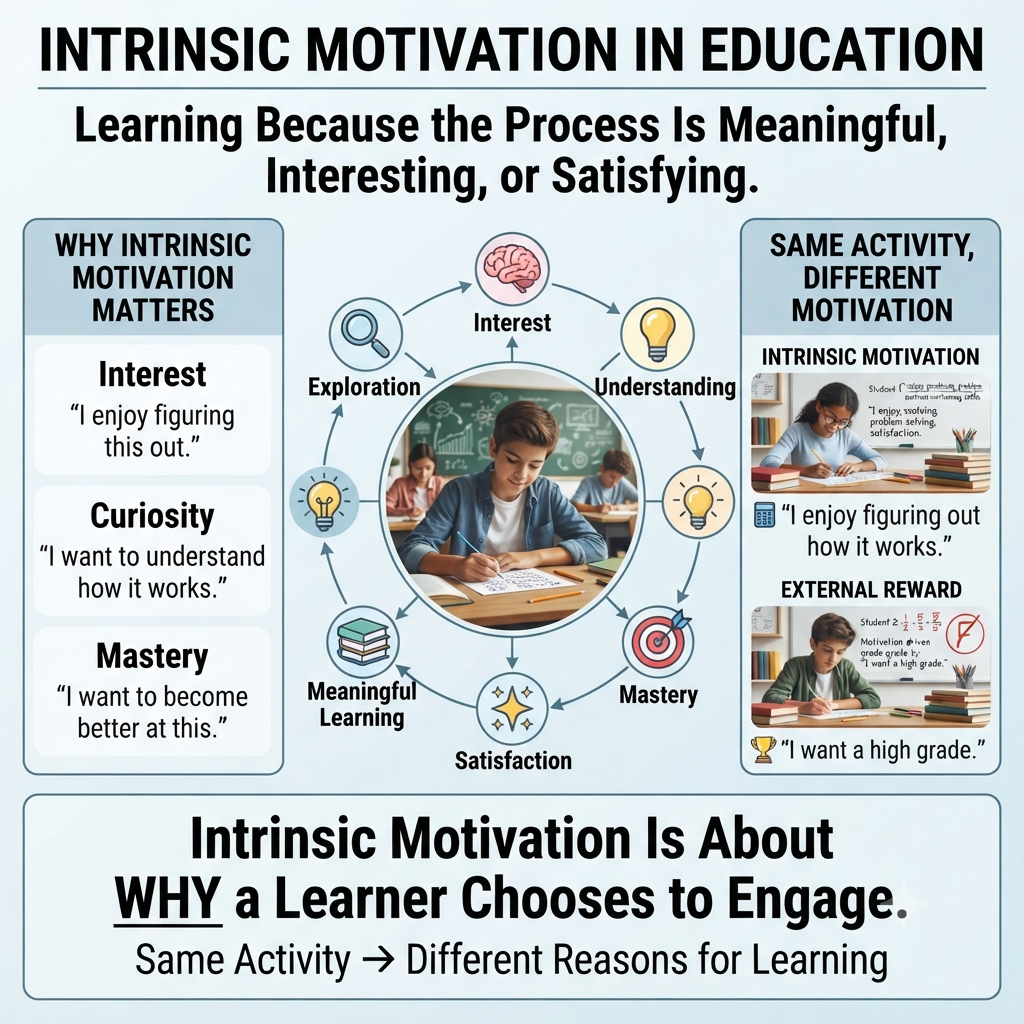
Intrinsic motivation in educational settings refers to
engaging in learning activities because the activity itself
is interesting, enjoyable or satisfying, rather than
solely because of a separate external consequence.
Self-Determination Theory provides an influential
framework for understanding how autonomy, competence
and relatedness shape the quality of students'
motivational experiences.
Motivation is more complicated than making lessons entertaining.
A student may willingly undertake a difficult but uninteresting
task because they personally endorse its importance.
Another may enjoy a game while feeling pressured to participate.
These experiences involve different reasons for action, and
their differences matter when teachers design classroom
expectations, feedback, choices and relationships.
This research publication explains motivational regulation,
psychological need support and frustration, autonomy-supportive
teaching, controlling language, student voice, ethical limits
and the conditions under which classroom strategies can help
or hinder personally endorsed engagement. Its exclusive
Motivation Conditions & Autonomy Studio lets you inspect
two alternative teaching arrangements without inventing
a student's inner psychological state.
THREE BASIC PSYCHOLOGICAL NEEDS
Research framework · Not a student diagnostic model
↗
Autonomy
Experiencing meaningful volition and ownership of action
◎
Competence
Experiencing effectiveness and opportunity to develop capability
♡
Relatedness
Experiencing belonging, care and respectful connection
These three constructs come from Self-Determination Theory.
The diagram does not indicate that psychological needs
can be measured from a classroom checklist.
DIRECT RESEARCH ANSWER
What makes motivation intrinsic in a classroom?
Intrinsic motivation in educational settings is present
when a learner engages in an educational activity for
its inherent interest or satisfaction. The reason for
participation is found within doing the activity itself.
A student might investigate a surprising scientific
phenomenon because understanding it feels rewarding,
or practise a musical passage because developing
the performance is personally enjoyable.
This should be distinguished from autonomous extrinsic
motivation. A student may not enjoy revising a technical
report but may still undertake the work willingly
because they value becoming a competent researcher.
The task remains instrumental to another goal,
yet the learner has personally endorsed its value.
Self-Determination Theory treats this distinction
as important rather than assuming that all motivation
outside pure intrinsic interest is undesirable.
The original theoretical work of Ryan and Deci and
later educational research emphasize the quality
of motivational regulation rather than participation
alone. Classroom conditions can support or undermine
psychological needs, but a teacher cannot guarantee
that every student will find every activity inherently
interesting. The
official Self-Determination Theory resource
explains the theoretical foundations, including
the major motivational mini-theories.
01 / INHERENT INTEREST
Intrinsic motivation
A learner participates because the activity itself
is experienced as interesting or satisfying.
02 / PERSONAL VALUE
Autonomous extrinsic motivation
A learner willingly undertakes a task because
its personally endorsed consequences matter.
03 / EXPERIENCED PRESSURE
Controlled motivation
Participation is driven chiefly by external demands,
rewards, sanctions, guilt or internal pressure.
Find a motivational concept inside this research article
Search the explanations, case studies and FAQs on this page without mixing them with other website articles. Results open the matching passage directly.
Enter at least two characters to search the article.
Non-overlap boundary:
This page investigates psychological motivation and
the social conditions that support voluntary engagement.
It does not attempt to establish learning retention,
which belongs to
effective learning
,
or evaluate game-derived reward systems, which belong to
gamification science
.
PART I / THE PSYCHOLOGY OF MOTIVATIONAL REGULATION
Understanding intrinsic motivation through Self-Determination Theory
1. Intrinsic motivation describes a reason for acting
The defining feature of intrinsic motivation is the
reason a person undertakes an activity. Two students
may complete the same task, earn identical grades
and work for the same amount of time while having
different motivational experiences. One may be
absorbed in solving a difficult problem. The other
may work primarily to avoid criticism. Their
observable behavior is similar, but their
reasons for participating are different.
Intrinsic motivation in educational settings therefore
cannot be identified simply by watching who works
the hardest. A student's visible effort does not
reveal whether the task is inherently interesting,
personally valuable, socially pressured or compulsory.
Learners may experience several motives simultaneously.
A researcher needs appropriate evidence before
describing the quality of those motives.
This distinction is useful because classroom design
can alter the meaning of an activity without altering
its academic content. An invitation to explore a
mathematical question may be experienced differently
from a threat to complete the same problem. Still,
the presence of inviting language does not prove
that the learner has become intrinsically motivated.
Motivation remains an experienced psychological state,
not a property automatically bestowed by a lesson plan.
2. Enjoyment, interest and intrinsic motivation are related but not identical
Students frequently describe enjoyable learning as
fun, yet enjoyment alone is too broad to explain
motivation. A learner may enjoy the music, social
interaction or animation surrounding an assignment
without being interested in the intellectual activity.
Another learner may find the central challenge
demanding and occasionally frustrating while remaining
absorbed in understanding how it works.
Intrinsic motivation in educational settings concerns
engagement with the activity because that activity
itself is rewarding or satisfying. This may involve
curiosity, exploration, discovery, creative construction
or the satisfaction of developing a capability.
It does not require continuous amusement or emotional
excitement. Some intrinsically motivated activities
are quiet, slow and cognitively demanding.
An educator should therefore ask a more precise
question than whether the classroom looks lively.
What part of the task seems to invite curiosity?
Does the learner want to investigate the problem,
or mainly to finish the entertainment surrounding it?
These questions can help educators reflect on their
design, but an observed behavior is not sufficient
on its own to determine a student's motivation.
3. Self-Determination Theory distinguishes different kinds of motivation
Self-Determination Theory, commonly abbreviated SDT,
is associated with the research of Edward Deci,
Richard Ryan and colleagues. The theory examines
how social environments influence motivation,
psychological functioning and well-being through
the satisfaction or frustration of basic
psychological needs. It distinguishes forms of
motivation according to the degree to which
behavior is experienced as self-endorsed.
Intrinsic motivation in educational settings is
one part of this larger theoretical framework.
SDT also explains why a student can willingly
complete an activity that is not inherently
interesting. The important distinction is
between doing something out of interest,
acting because one has endorsed its value,
and acting because of external or internal pressure.
The theory is not a simple assertion that
freedom is good and rules are bad. Effective
teaching may involve clear expectations,
challenging work, explicit instruction and
necessary restrictions. The motivational
question concerns whether those requirements
are communicated and experienced in ways
that respect the learner's perspective and
support meaningful ownership where possible.
4. Intrinsic and extrinsic motivation are not two completely opposed boxes
A common oversimplification places intrinsic
motivation on the good side and extrinsic
motivation on the bad side. Education, however,
contains many important tasks that are not
inherently enjoyable for every student.
Practising a necessary procedure, revising
an essay or learning a technical convention
may be undertaken for reasons the learner
finds personally meaningful.
Intrinsic motivation in educational settings
should therefore be discussed alongside
autonomous forms of extrinsic motivation.
An extrinsically motivated action is directed
toward a separable outcome, but its regulation
can become increasingly internalized. A
student who studies statistics because
they value conducting reliable investigations
may be autonomously motivated even if
the calculations themselves are not enjoyable.
This distinction prevents teachers from
trying to convert every academic requirement
into entertainment. The more sustainable
question is whether students can understand,
accept and sometimes personally endorse
the educational purpose of necessary work.
That is not the same as intrinsic interest,
but it may be a valuable form of
self-determined educational engagement.
5. External regulation involves external consequences or demands
External regulation describes behavior primarily
organized around consequences such as receiving
a reward, avoiding a penalty or satisfying an
external demand. In a classroom, a student may
complete a task because the teacher requires
it or because failure will produce an
unwanted consequence. The activity itself
need not be personally interesting.
Intrinsic motivation in educational settings
can coexist with external structures,
but an external requirement should not
be mistaken for an intrinsic reason.
A learner may enjoy a reading activity
while also knowing it is graded.
The motives are not mutually exclusive
and may change as the situation develops.
Schools cannot simply remove all expectations
or consequences. Safety, attendance,
qualification requirements and fairness
still matter. The practical implication
is to avoid relying exclusively on
external control when more respectful
explanations and opportunities for
ownership are available. The presence
of a requirement does not automatically
make the teaching controlling.
6. Introjected regulation involves pressure from within
Introjected regulation occurs when an
external expectation has been taken
in but remains experienced as
internal pressure. A learner may
work mainly to avoid guilt,
shame or damage to self-worth.
This can create substantial effort
without necessarily creating
a strong sense of personal
endorsement.
Intrinsic motivation in educational settings
is distinct from a student telling
themselves that they must earn
the highest grade to be a worthwhile
person. The behavior may look
self-directed because no teacher
is issuing an immediate order,
yet the motivational experience
can still be controlling.
Teachers should be cautious with
language that makes belonging,
worth or identity conditional
on academic success. Statements
that a student is a failure
unless they perform perfectly
may foster pressure rather than
constructive commitment. Supporting
responsibility means helping
learners understand consequences
without making their personal
value depend on compliance.
Identified regulation describes an
extrinsically motivated behavior
that a person willingly undertakes
because they recognize and endorse
its importance. The activity
may still be a means to an end.
A future engineer might practise
technical writing because clear
communication matters to the
professional role they have chosen.
Intrinsic motivation in educational settings
should not absorb identified regulation
into its definition. The student
may not love writing a technical
report; they may value its role.
That difference is theoretically
important because autonomous
motivation includes more than
inherent enjoyment.
Teachers can support internalization
by explaining purposes, showing
respect for the learner's perspective
and connecting required activities
to meaningful values without
manufacturing false relevance.
A rationale is most useful when
it clarifies a genuine educational
reason. It should not be a
manipulative story designed
to disguise arbitrary control.
8. Integrated regulation concerns coherence with personal values
Integrated regulation is a more
fully internalized form of
extrinsic motivation in which
the value of an activity
fits coherently with other
personal values and commitments.
The action remains instrumental
to a separable result,
so it is not identical
to intrinsic motivation.
Intrinsic motivation in educational settings
can accompany integrated regulation,
but the concepts should remain
distinct. A learner may value
scientific research as part
of their identity and willingly
complete necessary administrative
work even when the administration
itself is not interesting.
The distinction matters particularly
for older learners and
professional education, where
the purposes of demanding work
may connect to personally
chosen roles. Educators should
avoid assigning identity to
students or deciding on
their behalf what they
must value. Internalization
involves the learner's
own endorsement rather
than a teacher-imposed label.
9. Amotivation is different from reluctant participation
Amotivation describes a lack
of intention or motivation
to act. A student might
not see a purpose in
the task, doubt that
their actions can make
a difference or experience
other barriers to engagement.
That condition should
not be confused automatically
with open disagreement
about a classroom rule.
Intrinsic motivation in educational settings
can be undermined when learners
find no inherent interest,
but amotivation may also
reflect doubts about competence
or the meaningfulness of
participation. A student
who questions the value
of an assignment may
still be actively reasoning
about their educational
experience rather than
being generally unmotivated.
A teacher should not infer
a stable psychological
condition from one refusal,
missed assignment or
silent classroom session.
The student may face
access barriers, competing
responsibilities or
personal circumstances
that are not visible.
A respectful conversation
is more informative
than an immediate
motivational diagnosis.
Regulation
Illustrative reason
Conceptual distinction
External
“I must finish to avoid a penalty.”
External consequence regulates behavior.
Introjected
“I would feel worthless if I did not succeed.”
Internal pressure or contingent self-worth.
Identified
“This matters for a goal I value.”
Personally endorsed purpose.
Integrated
“This fits my broader commitments.”
Value integrated with other commitments.
Intrinsic
“I enjoy investigating this question.”
Inherent satisfaction of the activity.
The examples above are editorial illustrations,
not validated questionnaire items. Different
forms of regulation can coexist and change.
For an authoritative overview of their theoretical
distinctions, consult Ryan and Deci's
2020 review of intrinsic and extrinsic motivation
.
PART II / AUTONOMY, COMPETENCE AND RELATEDNESS
Psychological need support and motivational quality
10. Autonomy means experienced volition, not unrestricted freedom
Autonomy is often misinterpreted
as the freedom to do
whatever one wants.
Within Self-Determination Theory,
autonomy concerns experiencing
one's action as volitional
and personally endorsed.
A learner can experience
autonomy while following
a necessary rule if
the purpose is understood
and the requirement is
not communicated
through unnecessary pressure.
Intrinsic motivation in educational settings
is more likely to be
supported by conditions
that respect the learner's
perspective and allow
genuine ownership of
appropriate decisions.
However, autonomy does
not mean abandoning
instruction, ignoring
professional standards
or giving learners choices
that undermine their
educational opportunities.
A science teacher can require
safe handling of laboratory
equipment while inviting
students to choose between
two legitimate investigative
approaches. The safety
boundary remains firm,
but the teacher has
identified a meaningful
area for agency.
This is fundamentally
different from giving
a meaningless choice
between two colors
while controlling
every consequential
aspect of the work.
11. Competence concerns experienced effectiveness and growth
Competence is the experience
of being effective in
interaction with activities
and challenges. It is
not merely having high
grades or being better
than peers. Learners
can experience growing
competence when they
understand a previously
confusing problem,
develop a strategy
or see that thoughtful
effort is becoming
more effective.
Intrinsic motivation in educational settings
may be strengthened when
activities allow learners
to explore interesting
challenges with sufficient
support to experience
meaningful progress.
Tasks that are far
too easy can lack
challenge; tasks that
are impossibly difficult
may weaken the sense
that useful action
is possible.
Competence support does
not require giving
every student praise
after every attempt.
Informative guidance
can identify what
is working, what
needs adjustment and
which next action
could be productive.
Praise becomes less
helpful when it
is vague, controlling
or makes a student's
worth dependent on
being superior
to others.
12. Relatedness involves feeling respected, connected and valued
Relatedness concerns the
experience of connection,
care and belonging
with significant others.
In schools, this may
include trustworthy
teacher-student relationships,
respectful peer interactions
and opportunities to
participate without
unnecessary humiliation.
Relatedness does not
mean that every task
must be collaborative
or socially entertaining.
Intrinsic motivation in educational settings
can be supported when
students feel that
their questions matter
and their participation
is welcome. A learner
who anticipates ridicule
may avoid exploring
uncertain ideas even
when the subject
is potentially interesting.
A respectful environment
can make such exploration
more psychologically viable.
Individual differences
also matter. Some learners
prefer quiet independent
work, and compulsory
public participation
may be alienating.
Respecting relatedness
means fostering authentic
connection rather than
demanding identical
social expression.
Teachers should
avoid treating
extroversion as evidence
of stronger motivation.
13. Need satisfaction and need frustration are not simple opposites
Experiencing little support
is not necessarily identical
to experiencing active
psychological need frustration.
A teacher may provide
few choices because
a lesson is tightly
structured. That differs
from humiliating students
when they express a
reasonable preference.
Likewise, limited
informational feedback
is not equivalent to
actively communicating
that a learner is incapable.
Intrinsic motivation in educational settings
should be discussed with
this distinction in mind.
Need-supportive behaviors
may create opportunities
for autonomy, competence
and relatedness.
Need-thwarting behaviors
may actively undermine
those experiences
through coercion,
rejection or
competence-undermining
treatment.
Howard, Slemp and Wang's
meta-analysis of need
support and need thwarting
in student populations
examines these distinct
categories and their
associations with
student outcomes.
Its findings do not
mean that a short
classroom checklist
can diagnose a learner's
psychological needs.
See the
published meta-analysis
.
14. The three needs interact without becoming interchangeable
An activity may offer
meaningful choices
while failing to
provide sufficient
instruction for
successful participation.
Another may give
excellent technical
feedback but use
a humiliating classroom
tone. A third may
create warm relationships
while allowing almost
no student voice.
These arrangements
are not equivalent
simply because one
positive feature
is present.
Intrinsic motivation in educational settings
is best considered
through the distinctive
functions of autonomy,
competence and relatedness.
Autonomy concerns volition.
Competence concerns
effectiveness.
Relatedness concerns
connection and belonging.
Support for one
dimension does not
guarantee that the
others are supported.
The practical consequence
is to avoid a single
overall “supportiveness”
score generated by
arbitrary weights.
A classroom may
need different
kinds of improvement.
The Studio therefore
reports specific
conditions and
possible sources
of friction rather
than summing those
dimensions into
a fictitious measure
of psychological
health.
15. Autonomy support can coexist with demanding expectations
Some teachers worry that
supporting autonomy
requires abandoning
discipline, academic
standards or explicit
instruction. This
misunderstands the
construct. A teacher
can maintain high
expectations while
explaining the
purpose of a task,
acknowledging difficulty
and permitting
appropriate choice
in how students
work toward the
required standard.
Intrinsic motivation in educational settings
does not require
a classroom without
boundaries. A demanding
assignment may be
experienced as
personally meaningful
when students understand
its rationale and
have genuine agency
within the requirements.
The same assignment
may feel controlling
if the teacher
relies on threats
and ignores reasonable
student concerns.
A well-designed
learning task can
provide clear goals,
appropriate scaffolding
and timely information
while still giving
students space to
think, ask questions
and propose approaches.
Structure can support
competence rather
than undermine autonomy.
The important issue
is how that structure
is enacted and
experienced.
16. The research points toward conditional support, not a motivation formula
Recent research synthesizes
substantial evidence
about associations
between autonomy support,
psychological needs
and educational outcomes.
A 2023 meta-analytic
review examined perceived
autonomy support and
positive learning outcomes,
while a 2024 review
considered SDT-based
educational interventions.
The studies differ
in design, participants,
measures and
implementation.
Intrinsic motivation in educational settings
cannot be guaranteed
by copying one phrase
or selecting one
choice option.
A teacher may
intend a behavior
as autonomy-supportive
while a learner
interprets it
differently.
The context,
relationship,
task and learner
perspective matter.
The 2024 intervention
review by Wang and
colleagues reported
positive findings
for intrinsic motivation,
autonomy and competence
across its reviewed
interventions, but
such evidence does
not validate every
independent classroom
tool or promise
the same result
in every setting.
Read the
research review
for its stated scope.
PART III / TEACHER MOTIVATIONAL STYLE
Designing autonomy-supportive instruction without surrendering structure
17. Begin by taking the student's perspective seriously
An autonomy-supportive teacher
tries to understand how
learners experience
a task rather than
assuming that the
teacher's intention
is the only relevant
perspective. Students
may view an activity
as confusing,
irrelevant, threatening,
interesting or
unnecessarily repetitive.
Their interpretations
provide important
information about
the motivational
conditions surrounding
the activity.
Intrinsic motivation in educational settings
can be affected by
whether students
feel heard when
they describe
these experiences.
Listening does not
require agreeing
with every objection
or eliminating all
unwelcome work.
It allows the
teacher to distinguish
legitimate concerns
from misunderstandings
and to explain
constraints honestly.
A useful teaching
question is:
“What is the learner
experiencing that
my lesson plan
does not reveal?”
This question shifts
attention away from
forcing compliance
and toward understanding
the meaning of the
task for its participants.
The teacher can
then adjust wording,
support or choices
while maintaining
the agreed educational
purpose.
18. Offer genuine choices within consequential boundaries
Choice can support
autonomy when learners
understand the options
and those options
give them meaningful
influence over
their work. Choosing
a research question,
selecting an appropriate
representation or
deciding which
example to investigate
may be consequential.
Choosing between
two identical worksheets
with different
decoration may not be.
Intrinsic motivation in educational settings
is not mechanically
produced by increasing
the number of options.
Too many choices
can create confusion,
and choices that
affect required
learning goals
may be unsuitable.
The important
quality is
whether options
are understandable,
legitimate and
aligned with the
task's purpose.
Consider a literature
assignment requiring
evidence-based
interpretation.
Students might choose
between several
approved texts
or response formats,
provided each allows
the intended reasoning
to be demonstrated.
The teacher preserves
the academic requirement
while giving learners
appropriate ownership
of the process.
19. Explain the rationale behind necessary but uninteresting work
Not every valuable
educational task
is inherently
interesting to
every learner.
Practising basic
procedures, correcting
technical errors
and learning
disciplinary conventions
may sometimes
feel tedious.
A meaningful
rationale helps
students understand
why the activity
deserves effort.
Intrinsic motivation in educational settings
should be distinguished
from the process
of internalizing
a task's value.
An appropriate
rationale may
support identified
regulation without
turning the task
itself into
a source of
intrinsic enjoyment.
This is not
a failure of
the approach.
The rationale should
be truthful.
Telling students
that every exercise
will transform
their future
career may
sound manipulative.
A narrower explanation
can be more credible:
“This convention helps
a reader understand
your evidence.”
Students may
still dislike
the task,
but can better
understand its
purpose and
possible value.
20. Acknowledge negative feelings without making them the curriculum
Students may find
some activities
boring, difficult
or frustrating.
An autonomy-supportive
response recognizes
the experience
without assuming
that every complaint
requires abandoning
the task.
A teacher might
say that the work
can feel repetitive
and then explain
why a limited
amount of practice
is necessary.
Intrinsic motivation in educational settings
does not require
that learners
always feel
positive emotions.
Acknowledging resistance
may reduce unnecessary
conflict and
communicate respect,
but it is
not a guarantee
that resistance
will disappear.
A student can
still find an
assignment difficult
or uninteresting
after hearing
an appropriate
rationale.
Respectful acknowledgment
also helps distinguish
a motivational concern
from a barrier
that needs action.
If a task is
inaccessible,
humiliating or
far beyond
available support,
a sympathetic
sentence is not
an adequate solution.
The instructional
conditions themselves
may need change.
21. Use informational feedback rather than identity-based pressure
Feedback can communicate
useful information
about a learner's
current approach.
It can identify
what was successful,
why a response
needs revision
and what strategy
could be tried next.
Such feedback
may support
the experience
of competence
when it is
understandable
and relevant.
Intrinsic motivation in educational settings
can be undermined
when feedback
is mainly used
to control,
humiliate or
rank students
as people.
A statement
that a student
has misunderstood
a particular
concept is different
from declaring
that the student
is incapable.
The former
addresses work;
the latter
attacks identity.
This does not imply
that every piece
of praise is
harmful or
that corrective
feedback must
always be gentle.
Information may
need to be
clear and direct.
What matters
is whether
the communication
supports understanding
and effective
action rather
than relying
on avoidable
psychological pressure.
22. Provide clear goals and navigable challenge
Learners need
to understand
what they are
trying to do
and what counts
as progress.
An unstructured
activity can
feel arbitrary,
especially when
its difficulty
exceeds current
knowledge.
Appropriate
guidance and
manageable challenge
can support
competence without
eliminating the
learner's active
role.
Intrinsic motivation in educational settings
may be supported
when students
can pursue
an interesting
challenge while
receiving enough
information to
act effectively.
This does not
mean reducing
every task
to an easy
sequence of
small steps.
Challenge can
be meaningful
when it is
understandable
and the learner
can make
productive attempts.
A teacher can
maintain a demanding
goal while providing
optional explanations,
worked examples
or opportunities
for revision.
The support
should be related
to the task,
not conditioned
on public obedience
or social ranking.
The Studio
treats such
design decisions
as possible
competence-support
conditions, not
as measured
student motivation.
R03 / EXCLUSIVE MOTIVATIONAL DESIGN APPLICATION
Motivation Conditions & Autonomy Studio
Compare two classroom teaching arrangements, examine
how their documented conditions might support or
frustrate autonomy, competence and relatedness, and
develop a less controlling version of a teacher's
message. The tool produces transparent design
observations—not a student's motivation score,
a psychological diagnosis or an empirical prediction.
TWO-CONDITION MOTIVATIONAL DESIGN WORKBENCH
Same educational task. Different motivational conditions.
Choose the classroom arrangements you want to compare.
Each finding is derived from the selected design rules
and must be interpreted with relevant teacher and
learner perspectives.
1. Define the activity and its non-negotiable purpose
Avoid student names or sensitive personal information.
Data stays within this page session until exported.
2. Compare two different motivational arrangements
You may use Condition A for an existing approach
and Condition B for a proposed alternative.
The categories describe teaching-design choices,
not the verified psychological experience of learners.
A
Condition A
B
Condition B
3. Inspect the conditions and their implications
0Distinct support features
0Potential friction flags
0Differences between arrangements
Configure two classroom arrangements, then compare their
documented motivational conditions.
Scientific limitation:
A support feature is only a documented design choice.
It is not proof that students felt autonomous, competent
or connected. The tool reports no motivational percentage
and makes no claim about individual psychological health.
4. Motivational Language Workshop
Create an alternative to a controlling classroom message.
The output uses a transparent language template rather
than an AI psychological analysis. Review every suggestion
to ensure it is accurate, respectful and appropriate
to your actual requirement.
Enter a message and choose a communication purpose
to receive a transparent illustrative alternative.
5. Export or restore your design comparison
These exports are independent editorial design records.
They cannot diagnose students, authenticate into Gimkit,
or restore data to an official education platform.
Why this Studio is specific to motivational psychology
The application does not score the quality of an educational
game or estimate learning retention. It compares classroom
arrangements through documented conditions associated
conceptually with autonomy, competence and relatedness.
A condition might offer meaningful student voice, provide
a credible rationale, make progress information available
or rely on public pressure. The output names those
design characteristics and explains why a reviewer
might want to investigate their effects.
Intrinsic motivation in educational settings cannot be
validated by this application alone. It provides no
psychometric scale, validated survey or student self-report
measure. Conditions are selected by the user, and the
resulting findings follow explicit editorial rules.
They are prompts for a professional design conversation.
They do not establish causal effects or diagnose
individual student motivation.
The language workshop likewise produces an alternative
communication template, not a guaranteed motivational
intervention. A respectful sentence does not compensate
for an unfair requirement or harmful classroom practice.
Teachers must examine the actual activity, permitted
choices and learner experience rather than assume
that changing words automatically changes motivation.
PART IV / COMMUNICATION AND EXPERIENCED CONTROL
How teacher language can communicate support or pressure
23. Commands can carry different meanings depending on context
A teacher may need to
give a direct instruction
during a practical activity.
The wording alone
does not determine
whether the interaction
is controlling.
A safety command
in an emergency
is different from
using threats to
suppress reasonable
questions during
an ordinary assignment.
Purpose and context
are essential.
Intrinsic motivation in educational settings
may be affected by
patterns of communication
that leave students
feeling respected
or pressured.
Repeated unnecessary
orders, contemptuous
remarks and dismissive
responses may
communicate control.
Clear instructions
with meaningful
explanations may
support structure
without the same
motivational implication.
An educator should
not mechanically
replace every
“must” with
“you may.”
Sometimes a requirement
is real and should
be stated honestly.
The better question
is whether the
requirement is
legitimate, the
reason is clear
and the interaction
avoids unnecessary
humiliation or
coercion.
24. Informative language focuses on the work rather than personal worth
A message such as
“Your explanation
identifies the main
cause but leaves
out the supporting
observation” directs
attention toward
an actionable feature
of the work.
A message such
as “Only weak
students make
this mistake”
instead creates
an identity judgment
that offers little
useful guidance.
Intrinsic motivation in educational settings
can be affected
by how competence
is communicated.
An informative
response can make
improvement understandable,
while an identity-based
message can create
avoidable pressure
or shame.
The actual impact
depends on context
and interpretation.
A teacher should
not soften academic
standards to avoid
clarity. Honest
feedback can be
direct and demanding.
The important
distinction is
between describing
the quality of
an answer and
making the student's
value contingent
on that answer.
A useful correction
provides a path
toward improvement.
25. Invitations to participate must respect legitimate refusal and alternatives
Student voice is
not meaningful
when every disagreement
is punished.
A teacher might
ask students to
suggest examples,
raise concerns
or select an
appropriate method.
If only one
answer is accepted,
the apparent invitation
can feel deceptive.
Intrinsic motivation in educational settings
may benefit from
honest opportunities
for participation,
but students also
differ in how
comfortable they
feel speaking
publicly. Some
may prefer writing
a question or
discussing it
privately rather
than addressing
the whole class.
A respectful
participation
design can offer
more than one
legitimate channel
without making
the learning
goal optional.
The teacher
should explain
which decisions
are open to
student influence
and which are
already constrained
by curriculum,
time or safety.
Such honesty
is preferable
to a false
promise of unlimited
choice.
26. Public comparison can change the social meaning of achievement
Comparing students
publicly may direct
attention toward
status, embarrassment
or the fear
of appearing
inferior. It
can also create
pressure to
protect self-worth.
These experiences
are distinct
from curiosity
about the subject
or personally
endorsed improvement.
Intrinsic motivation in educational settings
should therefore
be considered
separately from
public competition
and ranking.
A student may
enjoy a competitive
activity; another
may find the
same arrangement
discouraging.
No single
motivational response
should be presumed
for every learner.
Game mechanics,
rankings and
reward contingencies
require a fuller
discussion of
incentive design.
That research
belongs to
gamification science
.
Here the central
concern is
whether social
comparison becomes
a controlling
feature of the
teaching relationship
and whether
students have
respectful ways
to participate.
27. Private correction and public recognition serve different social purposes
Correcting mistakes
in front of peers
can be appropriate
in some instructional
contexts, particularly
when discussing
a shared anonymous
example. Publicly
identifying a student
as incompetent,
however, can
damage trust
and make future
risk-taking feel
unsafe.
Intrinsic motivation in educational settings
may be supported
when students
can explore
ideas without
assuming that
every mistake
will expose
them to
ridicule.
Relatedness support
does not require
concealing all
errors; it
requires treating
learners with
respect while
addressing the
work honestly.
Teachers can
distinguish between
sharing a useful
learning process
and publicly
judging a
person's worth.
They may also
ask learners
how they prefer
to receive
certain forms
of feedback,
within reasonable
practical boundaries.
Consent and
professional judgment
matter more
than a universal
script.
28. Language templates cannot replace ethical classroom design
It is tempting
to think that
a controlling
instruction can
be repaired
simply by
inserting a
polite opening
phrase. But
students notice
when the underlying
arrangement remains
unfair, arbitrary
or punitive.
Words that
promise choice
while allowing
no actual influence
may reduce trust.
Intrinsic motivation in educational settings
depends on
experiences that
extend beyond
teacher vocabulary.
A classroom
rule, feedback
process or
assessment practice
may need
structural revision
rather than
cosmetic rewriting.
The language
workshop on
this page
is deliberately
limited to
generating
an illustrative
alternative.
A useful review
asks whether
the proposed
sentence is
truthful.
Does it
describe real
choices?
Does the
rationale reflect
an actual
educational purpose?
Does the teacher
intend to
honor student
input?
If the answer
is no,
the practice
must change
before the
wording can
be considered
credible.
PART V / PRACTICAL APPLICATION WITHOUT REPEATING GAME DESIGN
Supporting motivational quality across different educational situations
29. Interest can develop without being present at the beginning
Students do not
necessarily arrive
at a lesson
with strong
interest in
its subject.
Sometimes an
unexpected question,
a puzzling observation
or an understandable
challenge invites
curiosity. A
learner who
initially sees
little value
may discover
that the work
is more
interesting than
expected.
Intrinsic motivation in educational settings
can therefore
be considered
a dynamic experience,
not a fixed
personal trait.
Teachers may
create opportunities
for investigation
without demanding
that students
announce enthusiasm.
Interest can
develop gradually
through meaningful
encounters with
the material.
Still, not every
student will
find every
topic intrinsically
interesting.
A responsible
teacher can
support personally
endorsed reasons
for necessary
tasks when
inherent interest
does not emerge.
The aim is
high-quality
engagement, not
forcing everyone
to report
the same emotion.
30. Student voice must influence something real
Teachers sometimes
collect student
opinions but
never explain
whether the
responses affected
a decision.
Repeated consultation
without meaningful
follow-through
can become
symbolic rather
than participatory.
Students may
learn that
their voice
is being
requested without
being taken
seriously.
Intrinsic motivation in educational settings
may be supported
when learners
can see
the boundaries
and consequences
of their participation.
A teacher
might invite
suggestions about
discussion questions,
the order of
approved examples
or optional
ways to
demonstrate
understanding.
The teacher should
also say when
a suggestion
cannot be
adopted and
why. A
clear explanation
preserves honesty
and helps
students understand
that agency
operates within
real constraints.
Meaningful voice
is not the
same as
a guarantee
that every
preference will
be fulfilled.
31. Supporting competence requires more than reducing difficulty
A common response
to low confidence
is making
the task
easier. Sometimes
that is appropriate,
particularly when
foundational knowledge
is missing.
But removing
all challenge
can make
the activity
less meaningful
and provide
little opportunity
for development.
Intrinsic motivation in educational settings
may be supported
through achievable,
informative challenge.
Learners benefit
from understanding
what they are
attempting and
having access
to strategies
that make
progress possible.
This may involve
examples, staged
practice or
responsive feedback.
The point is
not to calculate
a perfect
difficulty level
from arbitrary
numbers. A
teacher needs
subject knowledge
and information
about the
actual learners.
A challenging
task may be
supportive
for one group
and inaccessible
for another.
The conditions
should be
reviewed rather
than treated
as universally
effective.
32. Belonging is not the same as compulsory group work
A sense of
relatedness can
be supported
through respectful
relationships,
trust and
being recognized
as a legitimate
member of
the learning
community.
It does
not require
that students
work in
groups for
every activity.
A learner
may feel
connected while
working independently.
Intrinsic motivation in educational settings
can be undermined
when a student
is forced
into public
social interaction
that is
unnecessarily
uncomfortable or
exclusionary.
Thoughtful teachers
may offer
structured collaborative
opportunities
alongside appropriate
independent or
private participation.
The distinction
matters because
group work
can create
both support
and pressure.
Students may
help one
another and
develop trust,
or they
may experience
social comparison
and unequal
participation.
The presence
of groups
is not
a valid
standalone
measure of
relatedness
satisfaction.
33. Teachers' own working conditions can affect their motivational style
Teachers operate
within institutional
constraints such
as large classes,
limited preparation
time, examinations,
administrative demands
and school policies.
A teacher
who wants
to support
autonomy may
still experience
pressure to
use rigid
control when
resources or
time are
restricted.
Intrinsic motivation in educational settings
is therefore
not exclusively
a matter
of individual
teacher personality.
The surrounding
institution can
shape which
practices feel
possible and
which demands
are emphasized.
This does
not remove
professional
responsibility,
but it
broadens the
implementation
question.
The study of
learning-environment
components includes
infrastructure,
communication and
organizational routines.
Those operational
systems belong
in our
learning-environment research guide
.
Here their
relevance is
limited to
how institutional
conditions may
support or
constrain a
teacher's motivational
interactions.
34. Digital classrooms introduce motivational possibilities and constraints
Digital activities
can offer
choice, accessible
information,
individual pacing
and different
ways to
participate.
They may
also impose
rigid pathways,
automated reminders
or visible
social comparison.
The motivational
meaning depends
on how the
technology is
used and
experienced.
Intrinsic motivation in educational settings
should not be
assumed simply
because an
activity includes
animation,
interactive questions
or game mechanics.
A learner
might enjoy
the technology
while feeling
little curiosity
about the
subject matter.
Conversely,
a quiet
digital research
task might
support genuine
interest.
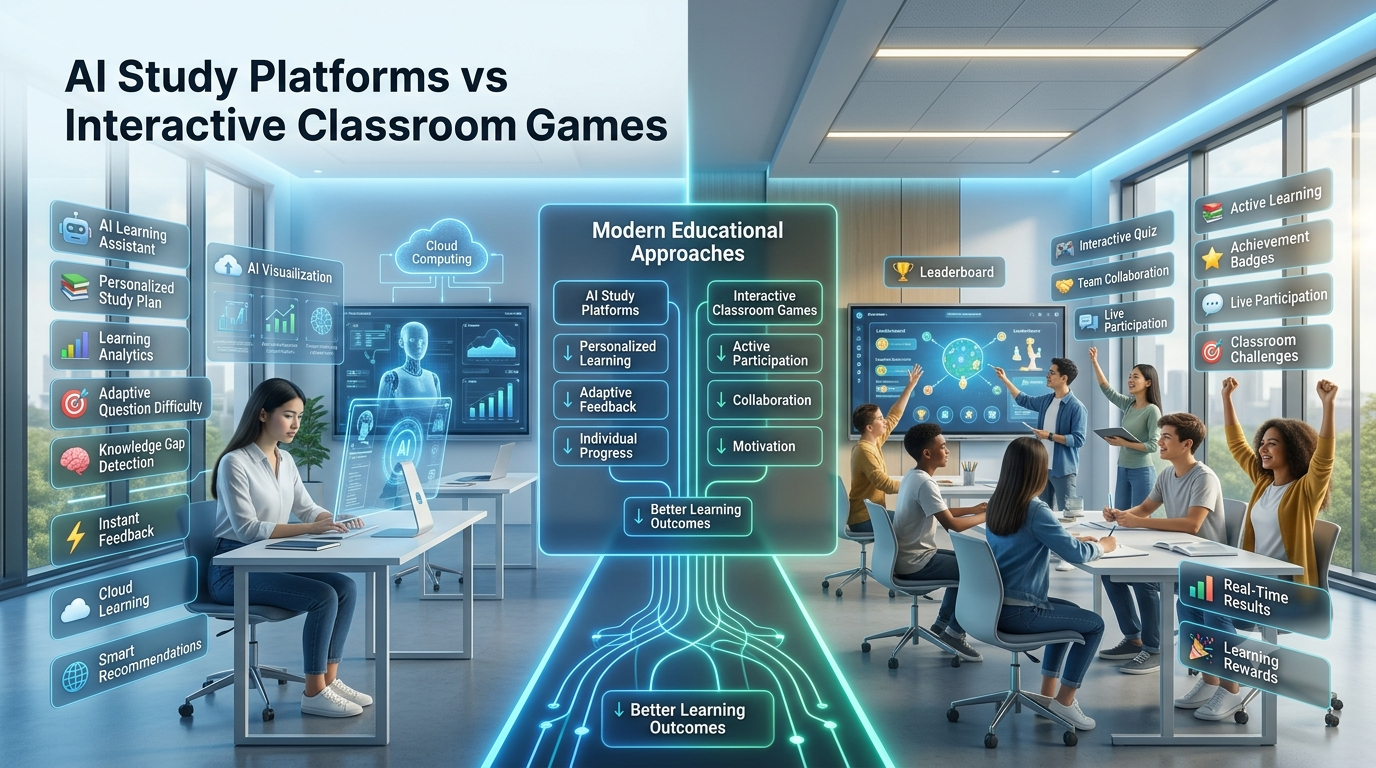
For platform-specific
workflows, consult
the dedicated
Gimkit Game Modes guide
and
Gimkit Creative guide
.
These articles
own game
functionality
and mechanics.
The current
research examines
motivational
interpretations,
not how to
build or
configure an
official game.
35. The same classroom choice may be interpreted differently by learners
A teacher offers
two options,
intending to
support autonomy.
One student
welcomes the
choice because
it connects
to personal
interest.
Another may
prefer a
clear recommendation,
particularly when
both options
are unfamiliar.
A third
may perceive
the choice
as meaningless
because the
final requirements
remain unchanged.
Intrinsic motivation in educational settings
requires attention
to students'
experiences rather
than simply
counting how
many options
a teacher
provides. Choice
is a
design opportunity,
not a guaranteed
psychological effect.
Its usefulness
depends on
clarity,
consequence
and context.
A teacher can
support autonomy
by explaining
the options,
providing guidance
when requested,
and allowing
students to
express which
arrangement
makes sense.
Respecting
individual differences
does not mean
writing a
different curriculum
for every student.
It means
remaining responsive
within legitimate
educational boundaries.
36. Motivation quality should not be inferred from a single behavior
A student who
asks many
questions may
be curious,
confused,
worried about
grades or
required to
participate.
A learner
who remains
quiet may
be disinterested,
concentrating deeply
or reluctant
to speak
publicly.
Behavior alone
rarely identifies
the entire
motivational reason.
Intrinsic motivation in educational settings
cannot be measured
by a simple
count of
raised hands,
voluntary clicks
or time
spent on
an activity.
Research may
use multiple
methods,
including
validated self-report
measures and
observations,
but the
interpretation
depends on
the method
and its
limitations.
The Studio accordingly
does not
accept student
behavior counts
and translate
them into
a motivational
score. It
examines selected
conditions of
teaching design.
Actual student
motivation would
require appropriate
research procedures
and ethical
consideration,
not an
unvalidated
web calculator.
PART VI / WHAT RESEARCH CAN AND CANNOT SUPPORT
Interpreting research on intrinsic motivation without overclaiming
37. Associations are informative but do not automatically establish causation
A study may
find that
students who
perceive greater
teacher autonomy
support also
report stronger
autonomous motivation.
Such an
association can
be theoretically
meaningful, but
it does not
by itself
establish exactly
which behavior
caused the
difference or
whether other
factors contributed.
Intrinsic motivation in educational settings
has been examined
through observational,
experimental and
intervention research.
Each design
supports different
claims. A
correlational study
can describe
relationships;
a well-designed
intervention may
offer stronger
evidence about
particular changes
under its
tested conditions.
Neither should
be described
as a universal
law.
A meta-analysis
can synthesize
relationships across
studies, yet
different measures,
populations and
settings remain
relevant. Formal
methods of
study selection,
bias review
and synthesis
belong in
research synthesis in educational technology
.
This article
focuses on
what the
findings mean
for motivational
interpretation.
A teacher may
report that
they provide
choice and
supportive feedback.
Students may
experience those
same practices
differently.
That gap
is not
necessarily evidence
of dishonesty.
Intentions and
perceptions are
different kinds
of information,
and both
can help
understand a
learning situation.
Intrinsic motivation in educational settings
is concerned
with how
a person
experiences
their reasons
for action.
A review
of teacher
design alone
cannot establish
that experience.
Similarly,
an isolated
student statement
may need
interpretation in
relation to
context and
method.
The application
invites educators
to compare
proposed motivational
conditions without
claiming to
know student
perception.
It can
identify a
possible need
for a
meaningful rationale
or respectful
feedback.
The next
professional step
may involve
speaking with
learners rather
than trusting
an automated
label.
39. Cultural context and learner development require careful interpretation
Students differ
in prior
experiences,
family expectations,
developmental stages,
institutional settings
and cultural
understandings
of authority.
The way
a request
is interpreted
can therefore
vary. A
teacher should
not assume
that one
communication style
produces the
same experience
for every
group.
Intrinsic motivation in educational settings
is studied
within the
broader SDT
research framework,
which proposes
basic psychological
needs while
recognizing varied
social expressions
and contexts.
Neither cultural
difference nor
theory should
be used
to stereotype
individual learners.
An appropriate
design review
asks what
learners understand
about the
task,
how legitimate
choices are
communicated,
whether support
is accessible
and whether
relationships
remain respectful.
Those questions
can be
adapted to
local conditions
without declaring
that all
students should
behave identically.
40. Motivation and achievement should remain distinct outcomes
A student can
be interested
in a
subject while
using an
ineffective study
strategy.
Another may
perform well
through disciplined
preparation without
experiencing intrinsic
interest in
the activity.
Motivation and
achievement are
related educational
constructs,
not synonyms.
Intrinsic motivation in educational settings
may support
productive engagement
under relevant
conditions, but
it does not
replace effective
instruction,
suitable materials
or appropriate
learning opportunities.
The quality
of students'
actual learning
must be
investigated through
its own
evidence.
Questions about
learning persistence,
retention and
transfer are
examined in
our Effective Learning guide
.
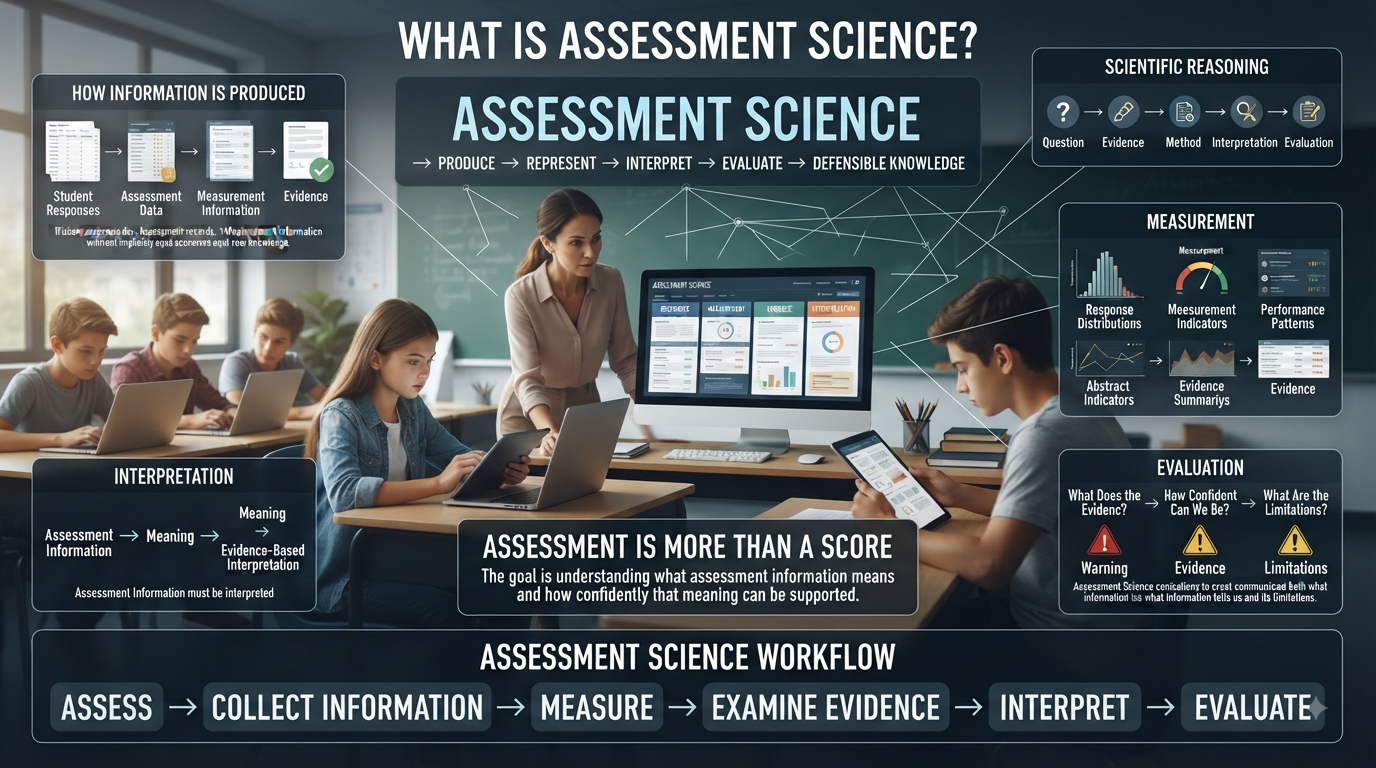
Validity of
assessment interpretations
belongs in
Assessment Science
.
This division
protects each
article from
becoming a
generic account
of all
educational psychology.
41. Educational ethics prohibit reducing learners to motivational labels
Describing a
student as
“unmotivated”
may sound
efficient, but
the label
can conceal
many different
situations:
unclear requirements,
fear of
embarrassment,
limited access,
competing obligations
or genuine
disinterest.
Those explanations
have different
implications.
Intrinsic motivation in educational settings
should not
be used
as a
moral ranking
of students.
A person
is not
less worthy
because they
do not
find a
particular subject
inherently interesting.
Nor should
teachers manipulate
students into
reporting enjoyment
that they
do not
experience.
An ethical
approach respects
the learner's
perspective while
maintaining necessary
educational responsibilities.
It distinguishes
support from
surveillance,
inquiry from
diagnosis,
and professional
judgment from
unsupported certainty.
The best
motivational design
invites honest
participation rather
than requiring
a performance
of enthusiasm.
PART VII / ORIGINAL CLASSROOM MOTIVATION CASEBOOK
Ten distinct motivational conditions in practice
The following cases are fictional educational-design
illustrations, not empirical reports of real classrooms.
Each examines a different motivational question
without assigning psychological scores or inventing
student outcomes.
Case 1 — The mandatory laboratory safety procedure
A science teacher requires students
to follow a fixed equipment-handling
procedure. The rule is non-negotiable
because unsafe behavior could harm
participants. A controlling approach
might frame the requirement only
as punishment avoidance. An
autonomy-supportive approach can
explain the actual safety purpose,
acknowledge the need for care
and allow appropriate decisions
within the safe procedure.
Intrinsic motivation in educational settings
does not require making safety
optional. The relevant distinction
is whether legitimate boundaries
are communicated through respect
and understandable reasons rather
than avoidable coercion.
Case 2 — The learner who dislikes technical writing
A fictional student enjoys engineering
design but does not enjoy
writing reports. A teacher
explains that clear documentation
helps others evaluate and
reproduce the proposed design.
The student may choose
to undertake the writing
because that purpose matters,
even if the activity never
becomes intrinsically interesting.
Intrinsic motivation in educational settings
should not be stretched to
describe every willingly completed
task. This case illustrates
identified regulation and
the importance of personally
endorsed educational value.
A teacher cannot assume
the student has adopted
that value simply because
the rationale was explained.
Case 3 — A choice between two genuinely different investigations
A geography class must explain
a common spatial relationship.
Students can choose between
investigating a local transport
pattern or a land-use question.
Both require the same target
reasoning, but students can
select a context they find
meaningful. This is a
plausible autonomy-supportive design
because the choice changes
the learner's inquiry.
Intrinsic motivation in educational settings
cannot be inferred merely
because the options exist.
The teacher must still
consider whether each route
is accessible, whether the
choices are understandable
and how students experience
the opportunity.
Case 4 — The public correction that reduces willingness to ask questions
A teacher publicly identifies a
learner as incapable after
an incorrect explanation.
A different approach would
describe the specific reasoning
problem, preserve the learner's
dignity and offer an actionable
next step. Both may communicate
that the answer needs correction,
but their interpersonal meanings
are different. Intrinsic motivation
in educational settings can be
examined through competence and
relatedness support without
assuming that a single
incident proves a persistent
psychological effect. A
responsible intervention would
change the communication practice,
not simply append a polite
sentence to the criticism.
Case 5 — A student questions the relevance of an assignment
A learner asks why a particular
analytical convention matters.
The teacher can interpret
the question as defiance
or as an opportunity
to clarify educational purpose.
An autonomy-supportive response
acknowledges the question
and supplies a credible rationale
for the requirement. This
does not guarantee that
the student will agree
or become interested.
Intrinsic motivation in educational settings
is not synonymous with
obedience after explanation.
The valuable difference
is that the learner's
perspective is treated
as legitimate while
the academic standard
remains explicit.
Case 6 — Quiet participation in a discussion-heavy classroom
A student follows the material
closely but rarely volunteers
to speak in front of
the class. The teacher
should avoid assuming that
quiet behavior proves low
motivation. A written question
channel or small-group option
may allow more comfortable
participation while preserving
the educational purpose.
Intrinsic motivation in educational settings
involves the learner's experience,
not a teacher's preferred
display of enthusiasm.
This case illustrates
how relatedness and
autonomy can be considered
without treating public
speaking frequency as
a psychological measure.
Case 7 — A digital quiz with an unpopular public ranking
A fictional class uses a
digital review activity
with a public ranking.
Some participants appear
to enjoy competition,
while others express
concerns about embarrassment.
The teacher considers
whether the ranking
is essential to
the academic objective
and whether another
arrangement can support
participation. Intrinsic motivation
in educational settings
cannot be diagnosed from
the leaderboard position.
The present case examines
the social meaning
of the teaching condition;
the separate gamification
article owns detailed
incentive-mechanism analysis.
Case 8 — Competence support for an initially overwhelmed novice
A beginner encounters a
complex programming problem
without useful guidance.
A teacher might wrongly
assume that autonomous
learning requires removing
all support. Instead,
the teacher introduces
a clear initial example,
explains the task and
offers a manageable
challenge while retaining
a genuine opportunity
for student decisions.
Intrinsic motivation in educational settings
may be supported when
autonomy and competence
are considered together.
The correct amount of
guidance remains dependent
on the learner,
the task and
the instructional context.
Case 9 — A high-achieving learner motivated by fear of failure
A student consistently produces
excellent work but describes
intense pressure to avoid
disappointing others.
Achievement alone does not
show that the learning
is intrinsically motivated.
A teacher can avoid
praising the learner's
worth conditionally
on ranking and instead
discuss learning purposes,
progress and realistic
expectations. Intrinsic motivation
in educational settings
must be distinguished
from introjected pressure.
No diagnosis should
be made from a fictional
description or one
comment; the case
illustrates an important
theoretical difference.
Case 10 — Institutional demands limit teacher autonomy support
A teacher faces a narrow
schedule and compulsory
standardized preparation.
They cannot remove the
requirements, but can
review which tasks
have meaningful rationales,
where learners can
exercise appropriate voice
and whether feedback
is informational or
needlessly threatening.
Intrinsic motivation in educational settings
does not depend on
pretending institutional
constraints do not exist.
The case highlights
professional agency
within real limits
and the need to
consider conditions
experienced by teachers
as well as students.
PART VIII / RESPONSIBLE IMPLEMENTATION
A practical method for reviewing motivational conditions
42. Begin with a real classroom purpose rather than an engagement target
Before changing a teaching
arrangement, state what
students actually need
to accomplish and
why it matters.
An activity designed
only to maximize
excitement may
fail to serve
the intended
educational purpose.
Motivational support
should be compatible
with that purpose.
Intrinsic motivation in educational settings
can be invited through
interesting questions,
meaningful choices and
appropriate challenge,
but not every
academic goal requires
pure intrinsic interest.
Some essential tasks
will instead depend
on personally endorsed
value. A design review
should therefore distinguish
the motivational quality
being supported from
the work students
must reasonably do.
Use the Studio's
activity brief
to identify the
non-negotiable purpose.
This reduces the
risk of treating
supportive language
as a substitute
for clarity.
The objective
also helps
the teacher
determine which
choices are
genuinely available
and which
boundaries require
a transparent
explanation.
43. Review specific conditions instead of ranking students or teachers
A motivational review
can focus on
features such as
the presence
of a rationale,
opportunities for
voice, feedback
quality and
the treatment
of student
concerns.
These are
practical conditions
that teachers
can discuss
and potentially
modify.
Intrinsic motivation in educational settings
cannot be reduced
to a score
that declares
one teacher
good and
another bad.
Two arrangements
may differ
in several
ways, and
the actual
effect depends
on learners,
context and
implementation.
A descriptive
comparison is
more defensible
than an invented
percentage of
psychological need
satisfaction.
The Studio's
side-by-side
review is
intended to
support such
a conversation.
Users can
identify which
design decision
they want
to change
and why.
The next
step is
to inspect
the real
classroom experience,
not to
assume that
the software's
recommendation
has already
produced an
outcome.
44. Preserve uncertainty when reviewing student responses
After a teaching
change, students
may participate
more, ask
new questions
or offer
different kinds
of feedback.
Those observations
may be useful,
but no
single behavior
proves an
internal motivational
state. Other
conditions may
have changed
at the
same time.
Intrinsic motivation in educational settings
requires careful
interpretation when
teachers move
from design
to conclusions.
A supportive
plan is
not identical
to experienced
autonomy,
and reported
enthusiasm is
not identical
to demonstrated
learning.
The question
being investigated
should remain
explicit.
Readers seeking
the broader
principles of
supporting claims
with evidence
can consult
educational evidence
.
The present
article's narrower
objective is
to identify
motivational conditions
and theoretical
distinctions
without borrowing
another specialist
page's full
evaluation method.
45. Revise teaching practices while respecting learner autonomy
A teacher might
replace a
public ranking
with private
feedback,
provide a
better explanation
for required
practice or
give students
a genuine
choice of
investigation.
These changes
are plausible
design hypotheses,
not guaranteed
interventions.
The actual
classroom response
needs to
be understood
rather than
assumed.
Intrinsic motivation in educational settings
is most responsibly
supported through
repeated respectful
interactions rather
than a single
dramatic motivational
technique.
Trust can
be weakened
when a
teacher promises
voice but
ignores it,
or praises
autonomy while
punishing reasonable
questions.
Consistency
matters.
The practical
standard is
not perfect
student enthusiasm.
It is
a defensible
educational
environment where
learners can
understand requirements,
experience appropriate
agency, develop
competence and
be treated
with dignity.
This aspiration
does not eliminate
the importance
of explicit
teaching,
fair boundaries
and professional
accountability.
PART IX / ADVANCED MOTIVATIONAL DESIGN AND RESEARCH BOUNDARIES
Advanced questions about autonomy, motivation and educational responsibility
The distinctions above establish why motivation cannot be inferred from compliance or from a cheerful classroom appearance. The following advanced chapters address more difficult questions: the structure of Self-Determination Theory, the experience of constrained choice, differences between motivational outcomes, and how teachers can design conditions without claiming to control another person's experience.
46. Cognitive Evaluation Theory explains why context changes the meaning of a task
Cognitive Evaluation Theory, or CET, is a part of Self-Determination Theory concerned especially with factors that facilitate or undermine intrinsic motivation. Its relevance to schools lies in the functional meaning of events. The same classroom action may communicate useful information about developing competence, or it may communicate surveillance and pressure. A teacher's intention alone does not determine which meaning students experience. The social context and the learner's interpretation matter.
Consider a student experimenting with an unfamiliar musical composition. After a difficult attempt, an instructor might identify two passages where the rhythm became more consistent and invite the learner to try a contrasting technique. Such information can contribute to the experience of competence while leaving ownership of the exploration with the student. A different response might demand that the learner repeat the composition solely to avoid losing their place in a performance group. The technical challenge has not changed, but the instructional message has. The contrast concerns motivational significance, not simply whether feedback is positive or negative.
CET does not imply that every external structure reduces intrinsic interest. Formal requirements, evaluation and informational feedback can function differently across contexts. A deadline may be a necessary organizational boundary, while intensive monitoring and conditional approval can introduce a more controlling experience. Even where a teacher chooses careful wording, only students' experiences can clarify how an intervention was received.
The responsible teaching implication is to distinguish three questions before altering a lesson: what information does this event provide, what pressure might it communicate, and what legitimate room for personal agency remains? A supportive intention is not a measured motivational outcome. Teachers should also avoid interpreting immediate enthusiasm as evidence that the deeper motivational meaning has changed.
47. Organismic Integration Theory explains personally endorsed necessary work
Organismic Integration Theory, or OIT, addresses how externally motivated behavior can become more self-endorsed. In education this is essential because many worthwhile activities are not intrinsically interesting to every learner. Working through a difficult translation, formatting laboratory observations or preparing required documentation may serve a personally valuable purpose without offering continuous pleasure. A student can endorse the purpose of the work even while wishing it were easier or shorter.
Internalization should not be described as persuading students to enjoy everything. The relevant distinctions concern external regulation, introjection, identification and integration. External regulation focuses on contingent consequences. Introjection can maintain pressure through shame or contingent self-worth. Identification involves acknowledging genuine importance, while integration means that value fits with other personal commitments. These are theoretical categories for understanding reasons for action; they are not personality ranks.
For example, a learner preparing to help interpret family medical information might decide that careful reading of numerical tables is important. The learner's reason could become deeply personal even if the exercises feel tedious. An educator who offers a truthful explanation and an opportunity to discuss the task can support understanding, but cannot dictate the learner's values or require them to adopt a prescribed identity.
Good educational rationales explain what a task is for and acknowledge its cost honestly. They should allow students to raise legitimate objections. A manufactured story about why everyone must love the activity turns internalization into another form of control. OIT therefore supports a distinction between autonomy and intrinsic interest: both are relevant, but autonomous participation does not require inherently enjoyable work.
48. Causality orientations are not classroom personality labels
Another SDT perspective considers characteristic ways people orient toward social contexts and the perceived causes of behavior. Some learners may be especially sensitive to approval, external incentives or perceived lack of control. Others may more readily search for personally meaningful choices and self-endorsed reasons for action. These orientations should not become fixed labels attached to individual children. A classroom observation is too narrow to establish a stable psychological orientation.
Suppose two students encounter an assignment with the same instructions. One asks immediately what grade it receives; the other asks how the subject connects to an independent project. The questions suggest different immediate concerns, but they do not prove permanent motivational types. Prior experience, anxiety, family expectations, teacher relationships and a recent difficult encounter may all change the meaning of the response. Motives can coexist and fluctuate as the task unfolds.
Teachers sometimes try to divide learners into groups such as intrinsically motivated, externally motivated or unmotivated. Such categories may feel efficient for planning, yet they can quickly become self-fulfilling assumptions. A learner who is assigned the label unmotivated may receive fewer opportunities to make meaningful choices, while an apparently independent learner may receive less needed support. The labeling practice itself can alter the environment being investigated.
A stronger response is to describe observable conditions and invite private discussion: What about this activity is confusing? What feels worth pursuing? Which choices are real? Which constraints cannot be changed? Such questions preserve the learner as an active source of information rather than treating teacher inference as a psychological assessment.
49. The meaning of choice changes when learners carry unequal costs
A choice is meaningful only when the alternatives are genuinely available. Offering two project formats may look autonomy-supportive on paper, yet one option might require paid software, private space at home or reliable internet access. The teacher may sincerely intend to provide agency, but students with fewer resources could experience the arrangement as exclusion rather than choice. This issue concerns the psychological authenticity of options, not merely a checklist of resources.
For instance, an instructor may invite learners to submit either a live presentation or a recorded explanation. A student sharing a crowded living space might find recording substantially harder, while another may experience live speaking as especially stressful. Neither route is automatically the more autonomous option. The educator should explain the learning standard, provide reasonable alternatives where possible and avoid penalizing students for constraints unrelated to that standard.
Choice should also be distinguished from excessive decision burden. Presenting fifteen similar options to a novice can consume attention that would be better devoted to understanding the task. At other times, requiring everyone to follow one rigid approach may deny learners useful ownership. Good motivational judgment involves the significance and accessibility of the available choices, not the number listed on a worksheet.
An authenticity check therefore asks whether each option is feasible, whether students understand its implications, whether selecting a less popular route carries a hidden social penalty, and whether teachers will honor the choice. The Studio on this page can document the proposed arrangement but cannot decide how a specific learner will experience it. Students' perspectives remain necessary.
50. Autonomy and competence can pull in different directions during open-ended projects
Open-ended inquiry can allow students to choose questions, resources or methods. Yet unlimited freedom may be frustrating when learners lack the knowledge needed to make those decisions. A novice may feel responsible for a task while being unable to identify a workable starting point. In motivational terms, a design that appears strong on autonomy may be weak on competence support. SDT does not require teachers to maximize one need while neglecting the others.
A teacher introducing archaeological evidence could begin with two carefully chosen artifacts and a shared interpretation question rather than asking beginners to create a complete investigation without guidance. Students may choose which artifact to examine first or which plausible interpretation to test. Clear examples and access to feedback make the choices usable. As their knowledge develops, the teacher can open further decisions about evidence and methods.
The reverse problem is also possible. An instructor may provide such a detailed procedure that success becomes easy to reproduce but students feel no meaningful ownership of the intellectual process. Competence-supportive structure is not merely the presence of step-by-step directions; students need to understand the goal, experience the usefulness of guidance and retain appropriate scope for thinking independently.
The practical review should examine which decisions students are ready to take, which forms of guidance remain necessary and when responsibility can change. A one-time lesson plan may not answer all these questions. Teachers can invite student explanations of where autonomy felt empowering and where it felt like abandonment, while maintaining appropriate instructional standards.
51. Family expectations and homework can produce mixed motivational experiences
Homework often sits between school requirements and family routines. A student may complete a reading task because the story is fascinating, because finishing supports a personally valued objective, because a parent expects compliance, or because the learner feels guilty when work is unfinished. These reasons are not mutually exclusive. A single homework completion record cannot distinguish them. The quality of motivational regulation depends on the experience behind the behavior.
Teachers can make the purpose and boundaries of home practice transparent without implying that families must reproduce classroom teaching styles. A task designed to help students notice patterns in a language may include a short explanation of why noticing matters and a realistic way to complete it without specialized equipment. Parents can offer practical encouragement and reasonable structure, but pressure that makes a child's worth depend on results can change the emotional meaning of the work.
In some households, students carry care responsibilities, share devices or have limited private time. Failure to complete an assignment may reflect those demands rather than a lack of curiosity or commitment. Teachers should not use household participation as an informal measure of intrinsic motivation. They can instead ask whether the task was accessible and whether the learner had a meaningful opportunity to begin.
Researchers have examined how autonomy support from teachers and parents relates to student need satisfaction and motivational regulation, but sources of support do not have identical associations across studies. Bureau and colleagues' meta-analysis of pathways to student motivation illustrates the importance of distinguishing those relationships rather than treating family support and teacher support as interchangeable. The focus here is psychological meaning; wider household conditions require their own contextual understanding.
52. Automated educational nudges can feel informative or controlling
Digital learning systems can remind students to return to unfinished work, recommend the next activity or display a sequence of suggested actions. These prompts may help organize attention and reduce confusion, but they can also create a feeling of constant surveillance. The motivational issue is not whether the interface contains a notification. It is what the learner understands the notification to mean and whether the system preserves honest opportunities for choice.
A message that identifies a missed opportunity and offers a realistic way to resume can function as usable information. A system that repeatedly announces that a student is disappointing the class by failing to maintain a streak communicates a very different social meaning. Whether one design actually changes intrinsic motivation would require appropriate research; a designer cannot establish the effect from the interface alone.
Some systems personalize messages based on interaction histories. This creates further responsibility to distinguish behavioral patterns from psychological conclusions. A long pause may indicate confusion, device problems, fatigue, collaboration or thoughtful work. Labeling the learner unmotivated from response latency is an unjustified inference. The teacher and learner should be able to understand which automated suggestions are optional and which represent actual academic requirements.
An autonomy-oriented review of nudges can examine four design elements: factual language, frequency, learner control and transparency. Can a learner dismiss a nonessential message? Is the rationale honest? Does a reminder permit a different valid route? Is the learner told how information is used? This is a motivational interpretation of interface communication, not a technical analytics dashboard or reward-system optimization guide.
53. High-stakes requirements call for honest rationales rather than simulated freedom
Schools sometimes operate within examinations, licensing requirements, safeguarding rules and institutional policies that teachers cannot change. In such contexts, promising unrestricted learner choice is misleading. Autonomy support remains possible because experiencing volition does not require the absence of constraints. It requires truthful communication and opportunities for meaningful participation within legitimate boundaries.
A teacher preparing students for a compulsory professional demonstration might explain which procedures are fixed by safety requirements and which explanations, preparatory activities or practice orders can be chosen. Students may dislike a requirement and still understand its rationale. The instructor can acknowledge that frustration without suggesting the safety rule is negotiable. That differs from framing mandatory compliance as a freely chosen activity.
Pressure becomes particularly concerning when a teacher links the outcome to the learner's dignity. A required examination can have serious consequences without implying that a low score makes the person unworthy of belonging. Informational feedback and respectful discussion help maintain this distinction. Clear boundaries should be paired with supportive ways to understand expectations and request accommodations where appropriate.
When the institution imposes a rule that appears arbitrary, the teacher should not invent a noble justification to increase compliance. A more credible explanation distinguishes what the rule is, where it came from, what can be revised and how learners can express concerns. In this way, motivational support involves institutional honesty as well as individual communication style.
54. A 2025 STEM teaching intervention provides a useful caution about expected outcomes
A published 2025 pilot intervention examined a program intended to help secondary STEM teachers adopt a more autonomy-supportive teaching style. The study involved teachers from three Singapore secondary schools, with teacher groups assigned to an intervention or comparison condition. Researchers examined students' reported experiences and motivational regulations across the intervention period. This is more directly informative about changes in teaching practice than an isolated classroom anecdote, although it remains bounded by its sample, setting and implementation.
The important finding is not simply that the intervention worked or did not work. The reported pattern included gains in students' identified regulation and behavioral engagement, alongside improvements in some perceptions of autonomy support. The researchers did not find a corresponding increase in students' intrinsic motivation in the way a sweeping promotional claim might imply. Identified regulation means students may more strongly endorse why a task matters, even when they do not experience the activity itself as inherently interesting.
This distinction illustrates why the outcome must be named precisely. Greater participation should not automatically be relabeled increased curiosity, just as more personally endorsed academic purpose should not be relabeled intrinsic enjoyment. Teachers can make progress by improving the motivational quality of necessary work without converting every task into an intrinsically enjoyable activity. That is a substantial educational goal in its own right.
The study should not be generalized as proof that all autonomy-supportive teaching fails to improve intrinsic motivation. Other interventions, populations and contexts may show different findings. The responsible reading is narrower: specific improvements were observed under specific conditions, and claims about intrinsic change require their own evidence. The study's methods and limitations can be consulted in Wang and colleagues' 2025 STEM intervention article.
55. Meta-analytic pathways do not reveal the motives of one identifiable student
Bureau and colleagues' meta-analysis synthesized research on pathways to students' autonomous and controlled motivation, drawing on 144 studies and more than 79,000 students. Their analysis considered relations among teacher autonomy support, parental autonomy support, the three psychological needs and different forms of regulation. This broad research base helps identify which theoretical relationships recur across samples, but a statistical association across groups is not a diagnosis of an individual learner.
In that analysis, competence emerged as an especially strong positive predictor of self-determined motivation, followed by autonomy and relatedness; teacher autonomy support also had substantial relevance. The findings should not be turned into a universal three-number classroom score. Measures, samples and study designs differ, and the meaning of a coefficient depends on the analysis that produced it. The paper examines statistical patterns, not an official calculation that schools can perform by selecting eight drop-down items.
A practical educator may reasonably use the research to ask whether students receive achievable challenges, useful feedback, genuine voice and respectful relationships. The educator should not infer that a student's low participation proves one need is frustrated, or that improving one condition guarantees any particular amount of intrinsic motivation. Individual circumstances, subject interest, previous experience and personal values remain relevant.
This is why the Studio uses descriptive categories and a side-by-side design comparison. Its flags identify aspects of a proposed classroom arrangement that deserve review. They are not motivational measurements, clinical classifications or causal predictions. For the source methodology and findings, see Bureau et al., Pathways to Student Motivation.
56. Feedback on autonomy should include the learners who speak least
Classroom feedback about learning conditions can be biased toward students who find it easiest to speak publicly. A confident student may report that a new discussion format is engaging, while another learner with a similar interest in the subject may find the public format discouraging. When teachers gather suggestions only from the most vocal participants, they risk mistaking the preferences of one group for the experiences of the whole class.
Providing different ways to express a perspective can be an autonomy-supportive practice. Options might include private conversation, a short written reflection or a quiet opportunity to clarify task constraints. The purpose is not to collect psychological profiles but to ask whether students found the choices accessible, the feedback usable and the expectations honestly communicated. Learners should not feel compelled to disclose personal difficulties merely to justify a different participation route.
Interpreting the feedback also requires humility. A student saying that an activity was boring is giving important information about their experience, but does not necessarily mean that the learning goal was inappropriate. A student reporting high enjoyment may still feel pressured about grades or peer comparison. More than one motivational explanation can fit the same visible behavior, and the educator should not demand a single simplistic interpretation.
Teachers can use private questions about classroom conditions and then communicate which changes are feasible. Showing that concerns were heard helps preserve credibility even when the requested change cannot be made. This approach differs from surveying learners to rank them by motivation. Its purpose is to understand how an educational arrangement is encountered by the people who must participate in it.
57. What should an autonomy-supportive review document over time?
Motivational experiences can change during a unit. At the introduction of a subject, students may be uncertain about its purpose; later they may understand why some activities matter even if those activities remain difficult. An autonomy-supportive review can therefore document what was offered, what explanations were given, how students were invited to contribute and which feedback routes were available. It should not attempt to produce a precise personal motivation percentage from those arrangements.
A defensible record might include the compulsory academic objective, legitimate safety limits, choices made available, reasons for those choices, forms of support offered and unresolved concerns. It may also document whether students had a private way to request clarification or an alternate valid participation route. These records describe teaching-design conditions. They are distinct from evidence that any named student experienced need satisfaction or became intrinsically motivated.
Over several lessons, an educator might compare two ways of communicating a necessary requirement. The comparison should identify what changed in the teacher's behavior and what remained constant, such as the learning goal. If student comments are collected, they should be treated as reported experiences, with appropriate consent and privacy. Any causal claim about the change would require stronger evidence than the mere fact that one lesson seemed more pleasant.
Revision should preserve the difference between two aims: improving educational conditions and asserting psychological outcomes. Teachers have genuine agency over explanations, fairness, assistance, boundaries and participation routes. They do not have direct control over each learner's motives. The ethical goal is to make educational participation more respectful and potentially supportive, while leaving room for students to interpret the work differently.
Research reading: distinguish evidence type from the claim
The original 2020 Ryan–Deci review establishes important theoretical distinctions; Bureau and colleagues' 2022 review examines meta-analytic relationships across many student samples; Howard, Slemp and Wang published their need-support/need-thwarting analysis online in 2024 and in a 2025 journal issue; and the 2025 Singapore STEM intervention provides an example of change assessed under a defined teaching program. These references inform different questions. A definition, a pooled association and a context-specific intervention finding are not interchangeable forms of evidence.
In particular, the Singapore study demonstrates why identifying a change in personally endorsed importance is not the same as claiming a change in intrinsic interest. The comparison Studio intentionally avoids psychometric scales and invented predictions. To apply this research responsibly, describe what was changed in teaching, listen to learners, and reserve claims about actual motivational effects for appropriately supported observations and studies.
Frequently asked questions about intrinsic motivation in education
1. What is intrinsic motivation in educational settings?
Intrinsic motivation in educational settings refers to
undertaking a learning activity because the activity
itself is inherently interesting or satisfying.
It differs from working only for an external reward
or to avoid a penalty. A learner may experience
intrinsic motivation alongside other reasons for
participating, and those reasons can change
across situations.
2. What are the three basic psychological needs in SDT?
Self-Determination Theory identifies autonomy,
competence and relatedness. Autonomy concerns
experienced volition, competence concerns
effectiveness and growth, and relatedness
concerns connection and belonging. These
constructs are distinct and should not
be collapsed into a single informal score.
3. Is autonomy the same as letting students do anything they want?
No. Autonomy concerns self-endorsed action,
not the absence of all rules. A teacher
can maintain necessary safety and academic
requirements while offering meaningful choices,
understandable rationales and respectful
opportunities for student voice.
4. Can students be autonomously motivated by activities they dislike?
Yes. A learner can willingly undertake
a task because its purpose is personally
important even if the task itself is
not enjoyable. SDT calls this an
autonomous form of extrinsic motivation,
distinct from intrinsic interest.
5. Does intrinsic motivation guarantee stronger achievement?
No. Intrinsic motivation in educational settings
does not guarantee academic success. Learning
also depends on instructional quality,
prior knowledge, opportunities for practice,
materials and other contextual factors.
Research associations should not be
turned into universal causal promises.
6. What is the difference between identified and introjected regulation?
Identified regulation involves personally
endorsing the importance of an activity.
Introjected regulation involves internal
pressure such as guilt, shame or
contingent self-worth. Both can lead
to participation, but they represent
different motivational experiences.
7. Is every classroom reward psychologically harmful?
No universal claim of that kind is justified.
The meaning and effects of rewards depend
on their characteristics, the task and
how they are experienced. Detailed incentive
mechanisms belong to gamification research.
An SDT-based discussion focuses on
whether experiences are controlling
or informational and how they relate
to psychological needs.
8. How can teachers support competence without excessive praise?
Teachers can provide clear goals, appropriate
challenge, explanations and actionable
feedback. Acknowledging genuine progress
is different from using praise to pressure
students or making their personal value
dependent on outperforming peers.
9. Does relatedness mean students must always work in groups?
No. Relatedness concerns connection and
being respected. A student can feel
belonging while working independently.
Compulsory collaboration is not an
automatic measure of relatedness support
and may be unsuitable in some contexts.
10. Can teacher language influence motivational experience?
Language can communicate respect, purpose,
pressure or dismissal, but its meaning
depends on the actual situation.
Polite wording cannot make an unfair
practice autonomy-supportive. Teachers
should examine both their communication
and the real choices and constraints
within an activity.
11. What is psychological need frustration?
Need frustration concerns experiences
that actively undermine autonomy,
competence or relatedness. It is not
necessarily equivalent to a simple
lack of support. A humiliating
interaction, for example, differs
from an activity that merely
offers few choices.
12. Can a quiet student be intrinsically motivated?
Yes. Intrinsic motivation in educational settings
cannot be inferred reliably from the
amount of public participation. A
quiet learner may be deeply interested,
while an outspoken learner may be
motivated by external expectations.
The reasons for engagement require
appropriate interpretation.
13. Should teachers remove all difficult requirements to support autonomy?
No. Meaningful requirements and
challenging work can coexist with
autonomy-supportive teaching.
Teachers can explain purposes,
acknowledge difficulty and provide
legitimate choices while preserving
necessary educational standards.
14. How is intrinsic motivation different from student engagement?
Motivation concerns reasons for
acting, while engagement describes
aspects of participation and involvement.
Students can be highly engaged
for controlled reasons or show
limited visible participation
despite genuine interest.
The constructs are related
but not interchangeable.
15. Can the Motivation Conditions Studio measure student motivation?
No. The Studio compares user-entered
teaching-design conditions and
flags potentially supportive or
controlling arrangements. It does
not administer a validated psychological
scale, examine students' private
experiences or calculate a
motivational percentage.
16. Why does the Studio compare two conditions?
The purpose is to make concrete
design differences visible. Comparing
two versions of the same activity
helps educators identify which
choices, rationales, feedback and
participation practices have changed.
The comparison does not predict
which version will improve motivation.
17. Does autonomy-supportive teaching mean there should be no exams?
No. Examinations may be necessary
within educational systems.
Motivational support can involve
explaining legitimate requirements,
avoiding unnecessary identity-based
pressure and giving students
appropriate preparation and agency.
Formal examination validity
is a separate discipline.
18. What is the biggest misconception about intrinsic motivation?
One major misconception is that
teachers must make every activity
fun to produce intrinsic motivation.
In reality, intrinsic interest
is only one form of motivation.
Personally valued but uninteresting
work can still be autonomously
undertaken, and high-quality teaching
does not depend on constant entertainment.
RESEARCH SOURCES AND TRANSPARENCY
Academic foundations and research references
The sources below support the theoretical distinctions,
the discussion of psychological needs and the cautious
interpretation of autonomy-supportive teaching research.
The Studio is an independent editorial application.
None of the researchers or organizations listed
here endorses this website or validates the
tool's rule-based findings.
Research accuracy:
The presence of a study, theoretical model or
meta-analysis does not establish that every
classroom activity will produce the same
motivational effect. Study designs, participants,
measurements and contexts matter. Application
examples on this page are hypothetical and are
not presented as measured research findings.
FINAL RESEARCH SYNTHESIS
Motivation is not something a teacher can simply switch on
Intrinsic motivation in educational settings is best
understood through the learner's reasons for engaging
and the conditions surrounding that engagement.
Autonomy, competence and relatedness offer distinct
ways of examining how teaching practices may support
or frustrate psychological needs. Intrinsic interest
also needs to be distinguished from personally endorsed
extrinsic purposes, because not every necessary
educational task is inherently enjoyable.
The practical aim is not a classroom without rules,
difficulty, assessment or responsibility. It is
a classroom in which meaningful expectations are
communicated honestly, students have appropriate
voice, feedback helps them understand progress,
and relationships preserve their dignity.
These practices deserve thoughtful evaluation
rather than guaranteed motivational claims.
Use Motivation Conditions & Autonomy Studio to
compare the arrangements you can actually change,
identify potential sources of pressure and review
your communication. Then listen to learners and
apply professional judgment. A well-designed
motivational environment invites engagement;
it does not manufacture an individual's feelings.