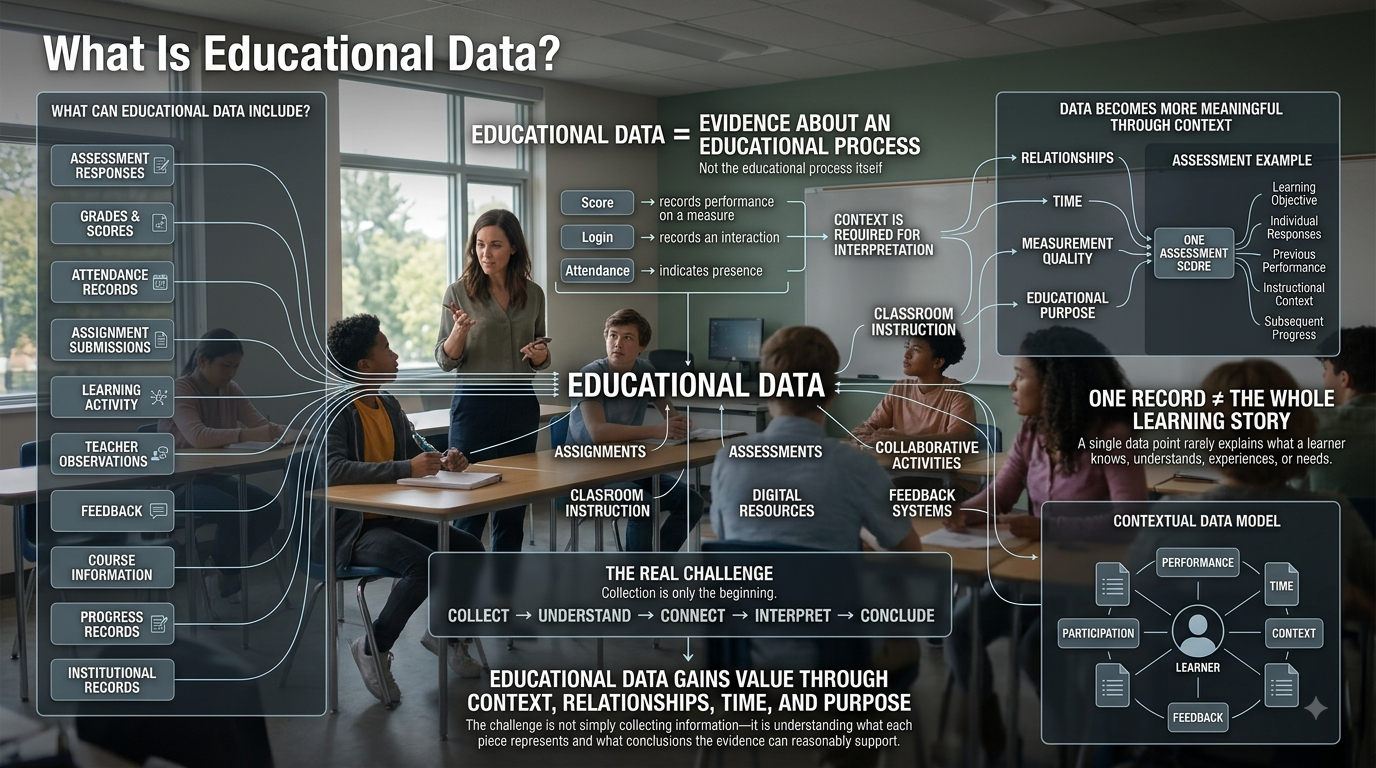
Introduction
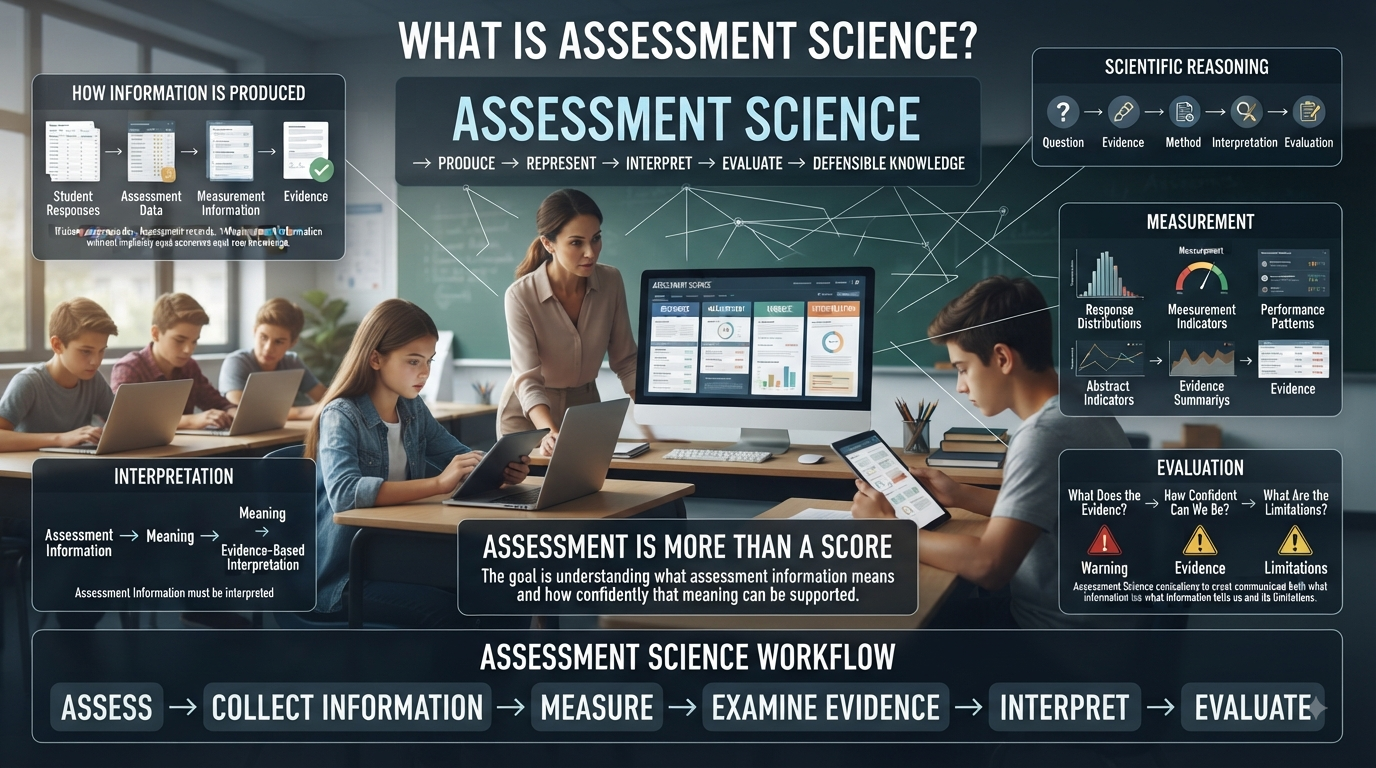
What Is Assessment Science? Assessment Science is the systematic field of knowledge concerned with understanding how assessment information is produced, represented, interpreted, and evaluated as a source of defensible knowledge. It brings together scientific reasoning, measurement concepts, evidence-based inquiry, and methodological thinking to examine what assessment information means, how confidently that meaning can be supported, and where its limitations lie.
The defining feature of Assessment Science is not the existence of a test, score, rubric, observation, or other assessment instrument. Its central concern is the scientific study of assessment itself: its concepts, assumptions, methods, information, interpretations, and the reasoning connecting them.
Looking for comprehensive classroom resources and educational technology insights? Explore GimkitApp for expert guides, teaching strategies, game modes, and the latest updates to enhance student engagement.
1. A Precise Definition of Assessment Science
A useful working definition is:
Assessment Science is the systematic study of the theories, principles, methods, evidence, measurement, interpretation, and reasoning used to establish and evaluate the meaning and quality of assessment information.
This definition contains several important ideas.
| Element | What it means within Assessment Science |
|---|---|
| Systematic study | Assessment is examined through organized concepts, methods, and reasoning rather than intuition alone. |
| Theories | Formal explanations that describe how assessment-related phenomena can be understood. |
| Principles | Foundational ideas used to determine whether assessment reasoning is appropriate and defensible. |
| Methods | Structured approaches used to investigate, construct, analyze, or interpret assessment information. |
| Evidence | Information that supports or challenges claims made from assessment information. |
| Measurement | Scientific representation and examination of characteristics through appropriate measurement concepts. |
| Interpretation | The process of establishing what assessment information can reasonably mean. |
| Reasoning | The logical connection between information, assumptions, interpretations, and conclusions. |
| Quality | The extent to which assessment information and its interpretation meet appropriate standards of rigor and defensibility. |
The important point is that Assessment Science is not defined by one tool or one procedure. It is defined by the scientific knowledge used to understand assessment information.
2. What Makes Assessment Science a Science?
The word science is significant.
Assessment becomes a scientific field when its concepts and claims are examined systematically rather than accepted simply because an assessment produced a result.
Scientific assessment thinking asks questions such as:
- What exactly does this information represent?
- What assumptions are required to interpret it?
- What evidence supports the interpretation?
- How consistent is the information?
- What sources of uncertainty exist?
- How strong is the reasoning connecting the observation to the conclusion?
- What limitations should be acknowledged?
- Can the interpretation be examined or challenged using systematic evidence?
This creates a distinction between having assessment information and having scientifically defensible knowledge about what that information means.
A number on a report, for example, is information. Assessment Science is concerned with the scientific reasoning required to determine what that number represents, how it was obtained, what assumptions surround it, and how confidently it can be interpreted.
That distinction is fundamental to the identity of the field.
3. Assessment Science Is a Field of Knowledge, Not Just a Collection of Tools
One of the most important boundaries is understanding what Assessment Science actually represents.
Assessment Science is not simply a collection of tests, questionnaires, rubrics, scoring systems, examinations, or software tools.
Those may be objects through which assessment occurs, but the science exists at a deeper conceptual level.
Consider the difference:
| Surface-Level Object | Assessment Science Concern |
|---|---|
| Test | What scientific principles support the meaning of its results? |
| Score | What does the score represent and how can that representation be justified? |
| Rating | What supports the interpretation of the rating? |
| Observation | What can legitimately be inferred from the observation? |
| Rubric | What makes the resulting information meaningful and defensible? |
| Measurement | How should the resulting representation be understood and evaluated? |
| Assessment result | What claims can reasonably be supported by the information? |
This is why Assessment Science cannot be reduced to a particular assessment format.
A test can change.
A scoring system can change.
Technology can change.
Educational environments can change.
But the scientific questions surrounding meaning, evidence, interpretation, measurement, uncertainty, and defensibility remain central.
4. The Core Identity of Assessment Science
Assessment Science can be understood through five closely connected dimensions:
1. Assessment as an Object of Scientific Study
Assessment itself becomes the subject being examined.
The field asks how assessment information is generated, represented, interpreted, and evaluated.
2. Assessment Information as Scientific Material
Assessment produces information that requires systematic examination.
The science is concerned with the characteristics and quality of that information rather than treating every result as automatically meaningful.
3. Interpretation as a Reasoned Activity
Assessment information does not interpret itself.
Meaning is attached through reasoning, assumptions, evidence, and conceptual frameworks.
Assessment Science studies that process of meaning-making at a scientific level.
4. Claims as Something That Require Support
A conclusion derived from assessment information is a claim.
Assessment Science examines whether the available information provides an adequate basis for that claim.
5. Uncertainty as Part of Scientific Knowledge
Assessment information has boundaries.
A scientifically responsible approach therefore considers uncertainty, error, limitations, and the conditions under which an interpretation remains defensible.
Together, these dimensions establish the intellectual identity of Assessment Science.
5. What Falls Within the Scope of Assessment Science?
The scope of Assessment Science is broad, but it is not unlimited.
Its central territory includes the scientific study of:
- Assessment concepts
- Assessment theories
- Assessment methodology
- Measurement foundations
- Assessment information
- Evidence supporting assessment interpretations
- Interpretation and inference
- Assessment-related reasoning
- Measurement error and uncertainty
- Reliability and consistency
- Validity-related reasoning
- Quality of assessment information
- Fairness and defensibility
- Scientific assumptions
- Methodological limitations
- Standards of evidence
- Statistical and analytical foundations
- Relationships among assessment concepts
- Conditions affecting interpretation
- The scientific basis for assessment claims
These areas are connected by one underlying question:
How can assessment information become scientifically meaningful and defensible knowledge?
That question provides a useful boundary for understanding the field.
6. What Is Outside the Core Scope?
Understanding the boundaries is just as important as understanding the contents.
Assessment Science should not be confused with every activity that happens to involve assessment.
For example, the following are not themselves the complete definition of Assessment Science:
- Giving a test
- Recording a score
- Creating a classroom quiz
- Selecting a particular question format
- Grading an assignment
- Using assessment software
- Publishing assessment results
- Designing a single assessment instrument
- Making a classroom activity competitive
- Choosing a particular educational platform
These activities may involve assessment, but Assessment Science concerns the scientific knowledge and reasoning that explain and evaluate assessment.
This distinction prevents the field from becoming so broad that the term loses its meaning.
For the latest gaming news, expert reviews, and walkthroughs, readers can also visit IGN, one of the world’s leading gaming websites.
7. Assessment Science Has an Interdisciplinary Character
Assessment Science does not exist in isolation from other fields.
Its knowledge base intersects with several disciplines because assessment involves complex questions about human characteristics, information, measurement, interpretation, and decision-related reasoning.
| Related Field | Contribution to Assessment Science |
|---|---|
| Psychology | Understanding characteristics, cognition, behavior, and individual differences relevant to assessment. |
| Statistics | Quantitative analysis, uncertainty, variation, relationships, and interpretation of numerical information. |
| Measurement Theory | Scientific foundations for representing and examining measurable characteristics. |
| Education | The educational meaning and application of assessment-related knowledge. |
| Research Methodology | Systematic approaches for investigating assessment questions. |
| Data Science | Analytical approaches for examining complex assessment information. |
| Philosophy of Science | Questions concerning knowledge, evidence, assumptions, inference, and scientific justification. |
The interdisciplinary nature of Assessment Science does not mean that the field is simply a mixture of unrelated subjects.
Instead, these disciplines contribute specialized knowledge to a common scientific problem: understanding the quality, meaning, and defensibility of assessment information.
8. Assessment Science and the Concept of Measurement
Measurement is closely associated with Assessment Science, but the two terms should not be treated as identical.
Measurement concerns the systematic representation of characteristics according to defined principles.
Assessment Science has a broader intellectual scope because it examines not only measurement but also the interpretation, evidence, reasoning, assumptions, uncertainty, and methodological quality surrounding assessment information.
A useful distinction is:
Measurement asks:
How can a characteristic be represented systematically?
Assessment Science asks more broadly:
What does assessment information represent, how is that representation established, how can it be interpreted, and how defensible is the resulting knowledge?
Measurement is therefore an important part of the scientific foundation of assessment, but it does not exhaust the meaning of Assessment Science.
9. Assessment Science and the Meaning of Assessment Information
Assessment information becomes scientifically important because it can be used to support statements about something beyond the immediate observation.
Suppose an assessment produces:
Observation → Response → Score
The score itself is only the observable output.
Assessment Science examines the conceptual chain behind it:
Observation → Representation → Interpretation → Inference
Each transition introduces a question.
| Stage | Scientific Question |
|---|---|
| Observation | What was actually observed? |
| Representation | How was the observation represented? |
| Interpretation | What does the resulting information mean? |
| Inference | What broader claim can reasonably be supported? |
This framework illustrates why Assessment Science goes beyond the mechanical production of results.
The scientific challenge lies in understanding whether the movement from observed information toward interpreted knowledge is justified.
10. The Role of Assumptions
Every assessment interpretation rests on assumptions, whether those assumptions are explicitly stated or not.
An assumption is an underlying condition accepted as reasonable for a particular interpretation or method.
Assessment Science makes these assumptions visible and open to examination.
For example, an assessment interpretation may implicitly assume that:
- the information represents the intended characteristic;
- the method is appropriate for the intended interpretation;
- the observed performance is relevant to the characteristic being considered;
- the measurement process has acceptable limitations;
- the available information is sufficient for the claim being made.
The scientific value of identifying assumptions is that they can then be examined rather than remaining invisible.
A strong assessment framework does not simply produce information. It makes clear what must be true for that information to support its intended interpretation.
11. Assessment Science and Defensibility
A central concept within Assessment Science is defensibility.
An assessment interpretation is defensible when the reasoning behind it can be supported through appropriate evidence, methodology, conceptual coherence, and scientific justification.
Defensibility does not mean that an assessment must be perfect.
It means that its interpretations should have a reasonable scientific basis.
This creates an important distinction:
A result can exist without being sufficiently defensible as evidence for a particular claim.
Assessment Science therefore examines not only whether information has been produced, but whether the conclusions attached to that information can withstand systematic scrutiny.
12. Assessment Science Is Concerned With Boundaries
Scientific disciplines become useful partly because they establish boundaries around what can reasonably be claimed.
Assessment Science therefore pays close attention to the difference between:
What the information shows
and
What someone wants the information to prove.
Those two things are not automatically identical.
An assessment result may provide useful information about a defined characteristic under defined conditions without providing complete knowledge about every aspect of a person, performance, or capability.
Recognizing this boundary is a major part of scientific assessment reasoning.
It protects assessment from overinterpretation.
13. A Conceptual Map of Assessment Science
The field can be represented as a connected knowledge structure:
                 ASSESSMENT SCIENCE
                         │
          ┌──────────────┼──────────────┐
          │              │              │
      Concepts       Methodology     Measurement
          │              │              │
          └──────────────┼──────────────┘
                         │
                      Evidence
                         │
                    Interpretation
                         │
                      Inference
                         │
              Scientific Judgment
                         │
          ┌──────────────┴──────────────┐
          │                             │
      Defensibility                 Limitations
          │                             │
          └──────────────┬──────────────┘
                         │
                Trustworthy Knowledge
This is not a step-by-step assessment procedure. It is a conceptual representation of the field itself.
The important relationship is that Assessment Science brings these knowledge elements together to examine how assessment information can support defensible understanding.
14. The Simplest Way to Understand Assessment Science
If the entire concept needs to be reduced to one idea, it is this:
Assessment Science is the science of understanding assessment information and determining how scientifically justified the meanings and claims derived from that information are.
It is concerned with the foundations underneath assessment rather than merely the visible assessment activity.
That is what gives the field its distinct identity.
The Scientific Knowledge System Behind Assessment Science
Assessment Science becomes a distinct scientific discipline because it does more than describe assessment activities. It provides a structured way to examine the knowledge, reasoning, assumptions, evidence, measurement, interpretation, and limitations associated with assessment information.
Part 1 established what Assessment Science is and where its conceptual boundaries lie. This part goes deeper into the scientific knowledge system that gives the field its intellectual structure.
The central question remains:
How can assessment information be examined scientifically so that the knowledge derived from it is meaningful, reasoned, and defensible?
1. Assessment Science Begins With Systematic Inquiry
The foundation of any scientific field is systematic inquiry.
Within Assessment Science, systematic inquiry means that assessment-related questions are approached through clearly defined concepts, observable information, methodological reasoning, evidence, and analytical examination rather than personal intuition alone.
A scientific approach does not simply accept an assessment result because it appears reasonable.
Instead, it asks:
- What is being examined?
- What information is available?
- How was that information produced?
- What assumptions are involved?
- What interpretation is being proposed?
- What supports that interpretation?
- What limitations affect the conclusion?
This creates a disciplined relationship between information and knowledge.
The distinction is important:
Information is what has been obtained.
Knowledge is what can reasonably be understood from that information after appropriate examination.
Assessment Science is primarily concerned with the second level.
2. The Assessment Science Knowledge Chain
A useful way to understand the scientific structure of the field is to view assessment knowledge as a connected system.
Concept
   ↓
Construct
   ↓
Observation
   ↓
Representation
   ↓
Measurement
   ↓
Assessment Information
   ↓
Interpretation
   ↓
Inference
   ↓
Scientific Claim
   ↓
Evaluation of Defensibility
Each level represents a different intellectual function.
| Level | Central Question |
|---|---|
| Concept | What idea is being discussed? |
| Construct | What defined characteristic or theoretical attribute is being represented? |
| Observation | What can actually be observed or recorded? |
| Representation | How is the observed information represented? |
| Measurement | What systematic principles govern that representation? |
| Assessment Information | What information has been generated? |
| Interpretation | What does the information reasonably mean? |
| Inference | What can be concluded from it? |
| Scientific Claim | What statement is being supported? |
| Defensibility | How well does the available basis support that statement? |
This chain illustrates why Assessment Science is a knowledge discipline.
The field is interested in the relationships between these levels, not merely in any one of them.
3. Concepts Are the Building Blocks of Assessment Science
Scientific disciplines require precise concepts.
Assessment Science therefore depends on carefully distinguishing terms that may appear similar in ordinary educational language.
Words such as:
- assessment
- measurement
- evidence
- score
- interpretation
- inference
- reliability
- validity
- error
- uncertainty
- construct
- observation
- evaluation
cannot simply be treated as interchangeable.
Each carries a particular meaning within assessment scholarship.
Conceptual precision matters because unclear terminology creates unclear reasoning.
If two different ideas are described with the same term, or if one term is used to represent several unrelated ideas, it becomes difficult to determine what an assessment claim actually means.
This is why conceptual clarity is itself part of scientific quality.
4. Constructs and the Representation of What Is Being Assessed
A construct is a theoretically defined characteristic or attribute that assessment attempts to represent.
The importance of constructs within Assessment Science is that many things of interest are not directly visible in their complete form.
An assessment may observe responses, performances, behaviors, or other manifestations, while the underlying characteristic is represented through those observations.
This creates an important scientific relationship:
Underlying Construct
        ↓
Observable Manifestation
        ↓
Assessment Information
        ↓
Interpretation
The scientific issue is not simply whether something was observed.
The deeper question is whether the observed information provides an appropriate basis for representing the intended construct.
Assessment Science therefore pays attention to the relationship between theoretical meaning and observable information.
5. Observation Is Not the Same as Meaning
One of the most important principles in Assessment Science is the distinction between observation and interpretation.
An observation is something that has been recorded or identified.
An interpretation assigns meaning to that observation.
These are different intellectual operations.
For example:
| Observation | Possible Interpretation |
|---|---|
| A response was correct | The response demonstrates a particular form of knowledge under the assessment conditions. |
| A task was completed | The observed performance provides information relevant to a defined characteristic. |
| A numerical result was produced | The result represents an assessed characteristic according to the underlying measurement framework. |
The observation itself does not automatically establish the broader interpretation.
That additional meaning requires reasoning.
Assessment Science studies this relationship carefully because many assessment errors occur when observed information is treated as if its interpretation were automatically established.
6. Measurement Provides Structured Representation
Measurement gives Assessment Science a formal way to represent information about characteristics.
Its role is not simply to attach numbers to observations.
Scientific measurement requires consideration of what is being represented, how the representation is constructed, what the numerical or categorical information means, and what limitations accompany that representation.
A measurement result therefore has meaning within a defined framework.
For example, the difference between two numerical results cannot automatically be interpreted in any possible way merely because both results are numbers.
The scientific meaning of a measurement depends on:
- the characteristic being represented;
- the measurement framework;
- the properties of the scale or representation;
- the assumptions involved;
- the quality of the underlying information;
- the intended interpretation.
This is why Assessment Science treats measurement as a scientific representation problem, not merely a numerical operation.
7. Evidence Supports Scientific Interpretation
Assessment information becomes useful for scientific interpretation when there is an appropriate evidentiary basis connecting the information to the meaning being claimed.
Assessment Science therefore asks whether the available information provides reasonable support for the proposed interpretation.
This involves examining relationships such as:
Observed Information
        ↓
Relevant Evidence
        ↓
Interpretive Reasoning
        ↓
Supported Meaning
The important point is that evidence does not exist merely because information has been collected.
Information becomes relevant evidence for a particular claim when its relationship to that claim can be scientifically justified.
Therefore:
Information ≠ automatically sufficient evidence
and:
Evidence ≠ automatically sufficient for every possible interpretation.
This distinction helps maintain precision in assessment reasoning.
8. Interpretation Is a Scientific Argument
Interpretation can be understood as a reasoned argument about what assessment information means.
A scientific interpretation therefore has several components:
| Component | Function |
|---|---|
| Information | Provides the observable or recorded basis. |
| Conceptual framework | Defines what the information is intended to represent. |
| Evidence | Supports the relationship between information and interpretation. |
| Assumptions | Identifies conditions required for the interpretation. |
| Reasoning | Connects the available information to the proposed meaning. |
| Limitations | Establishes where the interpretation should not be extended. |
This makes interpretation more than simply “reading a score.”
It is a structured claim about meaning.
Assessment Science examines whether the argument supporting that claim is coherent and defensible.
9. Inference Extends Beyond Direct Observation
Inference occurs when assessment information is used to reach a conclusion that extends beyond the immediate observation.
This extension is a critical scientific boundary.
For example:
Observed Performance
        ↓
Assessment Result
        ↓
Interpretation
        ↓
Broader Inference
Each additional level potentially introduces uncertainty.
The farther a claim moves from direct observation, the more carefully its scientific basis must be considered.
Assessment Science therefore examines the reasoning that connects observed information with broader conclusions.
This does not mean that inference is inherently unreliable.
It means that inference must be proportionate to the strength and relevance of the available basis.
10. Scientific Claims Must Match Their Evidence
A central rule within Assessment Science is:
The strength of an assessment claim should not exceed the strength of the information and reasoning supporting it.
This principle protects against overinterpretation.
Consider the difference:
Narrow claim:
“The assessment provides information about performance on the assessed tasks.”
Broader claim:
“The assessment completely represents the person’s overall capability.”
The second statement makes a substantially broader claim and therefore requires a substantially stronger scientific basis.
Assessment Science examines such differences in scope.
The question is not simply whether a claim sounds plausible.
The question is:
Does the available assessment information justify that level of conclusion?
11. Reliability and Consistency in the Scientific Knowledge System
Reliability is concerned broadly with the consistency and dependability of assessment-related information under relevant conditions.
Within Assessment Science, reliability matters because unstable or highly inconsistent information can weaken the confidence that can reasonably be placed in an interpretation.
However, reliability should not be misunderstood as meaning that an assessment is automatically scientifically appropriate simply because its results are consistent.
A measurement can be highly consistent while still representing the wrong characteristic or supporting an inappropriate interpretation.
This creates an important distinction:
Consistency contributes to assessment quality, but consistency alone does not establish meaning.
Assessment Science therefore considers reliability as one component of a larger scientific framework rather than treating it as the entire basis of assessment quality.
12. Validity as a Question of Meaning and Interpretation
Validity is fundamentally connected to the defensibility of interpretations made from assessment information.
The central scientific concern is not simply whether an assessment is “valid” as an isolated object.
The more precise question is whether the interpretations and uses made from its results are supported by appropriate evidence and reasoning.
This distinction is essential.
A particular assessment result may be appropriate for one interpretation while being insufficient for a substantially broader interpretation.
Therefore, Assessment Science examines:
- what interpretation is intended;
- what evidence supports it;
- what assumptions are required;
- what limitations apply;
- whether the interpretation remains appropriate within its intended scope.
Validity is consequently connected to the meaning assigned to assessment information rather than being merely a permanent label attached to an instrument.
13. Error and Uncertainty Are Scientific Variables
No assessment information should automatically be treated as perfectly precise.
Assessment Science recognizes that information can contain error and uncertainty.
A useful conceptual representation is:
Observed Result
      =
Underlying Information
      +
Relevant Sources of Error
      +
Uncertainty
This does not mean that every result is unreliable.
It means that scientific interpretation requires awareness of the limits surrounding the information.
Sources of uncertainty may arise from characteristics of:
- the measurement process;
- the assessment conditions;
- the information itself;
- the method of representation;
- the interpretation;
- the assumptions used.
Recognizing uncertainty allows conclusions to be expressed more responsibly.
14. Scientific Rigor Requires Explicit Assumptions
Assessment reasoning becomes stronger when its assumptions are visible.
An implicit assumption can influence interpretation without being recognized by the person using the information.
Assessment Science therefore values the explicit identification of assumptions.
For example:
| Assumption Type | Scientific Question |
|---|---|
| Representational | Does the information appropriately represent the intended characteristic? |
| Methodological | Is the method suitable for the intended interpretation? |
| Measurement | Are the measurement properties appropriate? |
| Interpretive | Does the evidence support the proposed meaning? |
| Contextual | Do relevant conditions affect the interpretation? |
Making assumptions explicit allows them to be examined, challenged, supported, or revised.
That is a defining characteristic of scientific reasoning.
15. Defensibility Is Built Through Multiple Layers
Assessment Science does not generally treat quality as the result of one isolated property.
A scientifically defensible interpretation may depend on several connected layers:
Conceptual Clarity
       ↓
Appropriate Representation
       ↓
Quality of Information
       ↓
Relevant Evidence
       ↓
Sound Reasoning
       ↓
Appropriate Interpretation
       ↓
Proportionate Inference
       ↓
Defensible Claim
A weakness at an earlier layer can affect the strength of later conclusions.
For example, if the intended construct is poorly defined, even technically sophisticated analysis may not solve the underlying conceptual problem.
Likewise, strong information does not automatically justify a broader interpretation than the information can support.
This layered structure is one reason Assessment Science requires interdisciplinary and systematic thinking.
16. Quality Is Multidimensional
Assessment quality cannot be reduced to one characteristic.
A scientifically informed examination may consider:
| Dimension | Core Concern |
|---|---|
| Conceptual quality | Are the central concepts clearly defined? |
| Measurement quality | Is the representation scientifically appropriate? |
| Evidence quality | Is the supporting information relevant and sufficient? |
| Interpretive quality | Does the proposed meaning follow reasonably from the information? |
| Consistency | Is the information sufficiently dependable for its intended interpretation? |
| Fairness | Are irrelevant influences prevented from distorting meaning? |
| Transparency | Are assumptions and limitations sufficiently clear? |
| Methodological rigor | Are appropriate scientific methods used? |
| Defensibility | Can the resulting claims withstand reasonable scrutiny? |
These dimensions are interconnected.
Strong assessment knowledge emerges when the different parts of the system work coherently rather than when one characteristic is optimized in isolation.
17. Fairness Within the Scientific Scope of Assessment Science
Fairness has a specific place within Assessment Science.
At the scientific level, fairness concerns whether irrelevant characteristics or conditions introduce systematic distortions into assessment information or its interpretation.
The field therefore asks whether the meaning assigned to assessment information remains appropriate across relevant groups and conditions.
This is not simply a question of whether everyone receives identical treatment.
Scientific fairness requires attention to whether the assessment process produces comparable and defensible meaning without inappropriate sources of bias.
Fairness is therefore connected to the scientific quality of assessment information and interpretation.
18. Transparency Strengthens Scientific Reasoning
Scientific knowledge becomes easier to evaluate when the reasoning behind it is visible.
Assessment Science therefore values transparency concerning:
- definitions;
- assumptions;
- methods;
- evidence;
- interpretations;
- limitations;
- sources of uncertainty;
- boundaries of conclusions.
Transparency allows other professionals and researchers to understand how an assessment claim was constructed.
Without transparency, even a potentially useful result can become difficult to evaluate because the reasoning behind its interpretation remains unclear.
19. The Relationship Between Information, Evidence, and Knowledge
These three terms are closely related but should not be treated as identical.
| Concept | Basic Meaning |
|---|---|
| Information | Recorded or obtained assessment-related material. |
| Evidence | Information that has relevance and support for a particular claim or interpretation. |
| Knowledge | Understanding established through appropriate interpretation, reasoning, and support. |
The relationship can be represented as:
Information
    ↓
Examination
    ↓
Relevant Evidence
    ↓
Reasoned Interpretation
    ↓
Supported Knowledge
Not every piece of information becomes useful evidence.
Not every piece of evidence supports every claim.
And not every interpretation automatically becomes reliable knowledge.
This distinction is central to the scientific identity of Assessment Science.
20. Assessment Science as a Self-Correcting Discipline
A mature science must be capable of examining and correcting its own assumptions and methods.
Assessment Science therefore includes critical examination of established practices.
New research can challenge:
- existing interpretations;
- measurement assumptions;
- methodological approaches;
- statistical techniques;
- definitions;
- theoretical models;
- accepted practices.
When stronger evidence becomes available, scientific understanding can change.
This is not a weakness.
It is a defining characteristic of science.
Assessment Science remains useful precisely because its principles and methods can be examined, tested, refined, and improved rather than treated as permanently unquestionable.
21. A Unified Framework for Assessment Science
The major ideas discussed in this part can be brought together into one framework:
                  ASSESSMENT SCIENCE
                          │
        ┌─────────────────┼─────────────────┐
        │                 │                 │
     Concepts          Methods          Measurement
        │                 │                 │
        └─────────────────┼─────────────────┘
                          │
                    Assessment Data
                          │
                    Information
                          │
                     Evidence
                          │
                  Interpretation
                          │
                     Inference
                          │
              Scientific Reasoning
                          │
          ┌───────────────┼───────────────┐
          │               │               │
      Reliability      Validity       Uncertainty
          │               │               │
          └───────────────┼───────────────┘
                          │
                    Defensibility
                          │
                 Assessment Knowledge
This framework shows the field as an interconnected scientific system.
No individual component completely defines Assessment Science.
Its identity comes from the relationships among these components and the scientific reasoning that connects them.
22. What Makes This Knowledge System Distinctive?
The distinctive feature of Assessment Science is its concern with justification.
It does not merely ask:
“What result did the assessment produce?”
It asks:
“What does that result represent?”
Then:
“What supports that interpretation?”
And finally:
“How confidently can the resulting claim be defended?”
That sequence captures the deeper intellectual character of the field.
Assessment Science is therefore concerned with the movement from observed information toward justified knowledge, while remaining conscious of assumptions, uncertainty, methodological limitations, and the boundaries of interpretation.
23. Advanced Insight: Assessment Information Is Not Self-Interpreting
One of the most important ideas in Assessment Science is that assessment information does not carry unlimited meaning by itself.
A result receives meaning through a combination of:
construct definition + measurement representation + evidence + assumptions + interpretation + reasoning
Change one of these elements, and the meaning or strength of the resulting claim may also change.
This is why the same numerical result can potentially support different interpretations depending on the scientific framework in which it is understood.
The number is observable.
Its meaning is constructed through scientific reasoning.
That distinction sits near the center of Assessment Science.
What Is Assessment Science? — Final Part: Advanced Understanding, Boundaries, FAQs & Conclusion
Assessment Science becomes much easier to understand when its boundaries, relationships, terminology, and scientific characteristics are viewed as one connected field rather than as isolated concepts. The deeper purpose of the discipline is to establish a rigorous way of understanding what assessment information means, how that meaning is supported, how trustworthy the resulting knowledge is, and where its interpretation must stop.
This final part brings the subject together into a complete conceptual framework while keeping the focus strictly on Assessment Science itself.
Assessment Science at a Glance
| Dimension | Assessment Science Focus |
|---|---|
| Subject | Assessment as a scientific field of inquiry |
| Primary concern | Meaning and quality of assessment information |
| Foundation | Systematic inquiry, evidence, measurement, reasoning, and methodology |
| Key intellectual problem | Determining what assessment information can legitimately represent |
| Scientific concern | Whether interpretations and claims are adequately supported |
| Quality concern | Accuracy, consistency, defensibility, fairness, transparency, and appropriate limitations |
| Analytical focus | Relationships among observations, representations, evidence, interpretations, and claims |
| Role of measurement | Provides scientific principles for representing characteristics |
| Role of evidence | Provides support for interpretations and claims |
| Role of uncertainty | Defines the limits of confidence that can reasonably be placed in information |
| Ultimate knowledge goal | Defensible understanding derived from assessment information |
This table captures an important distinction: Assessment Science is not one technique inside assessment. It is the scientific knowledge system used to understand assessment itself.
The Conceptual Architecture of Assessment Science
The discipline can be understood as a network rather than a straight procedure.
                         ASSESSMENT SCIENCE
                                │
        ┌───────────────────────┼───────────────────────┐
        │                       │                       │
    Concepts                 Theory                 Methodology
        │                       │                       │
        └───────────────────────┼───────────────────────┘
                                │
                         Scientific Inquiry
                                │
              ┌─────────────────┼─────────────────┐
              │                 │                 │
          Observation       Measurement        Evidence
              │                 │                 │
              └─────────────────┼─────────────────┘
                                │
                         Assessment Information
                                │
                         Interpretation
                                │
                            Inference
                                │
                       Scientific Reasoning
                                │
                 ┌──────────────┼──────────────┐
                 │              │              │
             Reliability     Validity      Uncertainty
                 │              │              │
                 └──────────────┼──────────────┘
                                │
                         Defensible Meaning
                                │
                         Assessment Knowledge
The important feature of this architecture is that no individual component represents the entire field.
Assessment Science exists through the relationships among these components.
For example, measurement without interpretation does not explain meaning. Evidence without a defined claim cannot establish what it supports. Interpretation without appropriate evidence can become speculation. A result without an understanding of uncertainty can be presented with more confidence than it deserves.
The scientific discipline exists in examining these relationships systematically.
The Central Questions of Assessment Science
A useful way to recognize whether a question genuinely belongs to Assessment Science is to examine the type of question being asked.
| Question | Assessment Science Relevance |
|---|---|
| What does an assessment result represent? | Core |
| What makes an assessment interpretation defensible? | Core |
| How should assessment information be scientifically understood? | Core |
| What assumptions affect an interpretation? | Core |
| What is the relationship between measurement and assessment? | Core |
| How does uncertainty affect assessment information? | Core |
| What evidence supports a particular interpretation? | Core |
| How should assessment concepts be defined? | Core |
| What makes assessment information trustworthy? | Core |
| What are the boundaries of an assessment claim? | Core |
| How should a particular classroom activity be conducted? | Outside the central definition |
| Which educational game is most engaging? | Outside the central definition |
| How should a teacher organize a particular lesson? | Outside the central definition |
| Which software platform should be selected? | Outside the central definition |
This boundary is important for topical authority.
A genuinely authoritative explanation does not try to make one page responsible for every subject remotely connected to assessment. It establishes the complete meaning of its own topic while preserving clear conceptual boundaries around neighboring subjects.
Assessment Science Is Broader Than Testing
Testing is one recognizable form of assessment, but Assessment Science is substantially broader than the concept of a test.
A test is an instrument or structured method used to obtain information.
Assessment Science examines the scientific knowledge required to understand what that information means and how defensibly it can support particular interpretations.
| Testing | Assessment Science |
|---|---|
| Focuses on a particular assessment instrument or procedure | Studies assessment as a scientific field |
| Produces assessment information | Examines the meaning and quality of assessment information |
| May generate scores or responses | Examines what those results can legitimately represent |
| Can be standardized or informal | Provides broader scientific principles |
| Is an assessment mechanism | Is a knowledge discipline |
Therefore, saying “Assessment Science is the science of tests” is too narrow.
A better description is that testing can be one object of study within the broader scientific discipline of assessment.
Assessment Science Is Broader Than Measurement
Measurement is another closely related concept that should not be confused with the complete field.
Measurement focuses on the systematic representation of characteristics.
Assessment Science incorporates measurement but extends into questions concerning:
- meaning;
- interpretation;
- evidence;
- inference;
- assumptions;
- uncertainty;
- methodological quality;
- defensibility;
- fairness;
- scientific reasoning.
A useful conceptual distinction is:
Measurement
     │
     └── Scientific representation
                │
                ↓
        Assessment Science
                │
     ┌──────────┼──────────┐
     ↓          ↓          ↓
 Interpretation Evidence  Reasoning
     ↓          ↓          ↓
          Defensible Knowledge
Measurement is therefore an essential part of the intellectual landscape, but Assessment Science cannot be reduced to measurement alone.
Assessment Science Is Not the Same as Evaluation
The word evaluation can also create confusion because it is sometimes used broadly in educational and professional contexts.
Assessment Science is concerned with the scientific foundations through which assessment information acquires meaning and can support defensible knowledge.
Evaluation, by contrast, commonly involves determining the value, quality, effectiveness, or worth of something according to specified criteria.
The two areas can intersect, but they should not be treated as synonyms.
| Assessment Science | Evaluation |
|---|---|
| Studies scientific foundations of assessment | Commonly determines value, quality, effectiveness, or worth |
| Examines assessment information and its meaning | Often applies information against criteria or standards |
| Concerned with interpretation, measurement, evidence, and defensibility | Concerned with judgments about the object being evaluated |
| Functions as a scientific knowledge domain | Can function as an applied analytical activity |
The distinction protects the definition of Assessment Science from becoming unnecessarily broad.
What Assessment Science Adds to Educational Knowledge
The value of Assessment Science lies in the scientific discipline it brings to assessment-related knowledge.
Without a scientific framework, assessment information can easily be treated as self-explanatory.
Assessment Science challenges that assumption.
It asks readers, researchers, practitioners, and measurement specialists to distinguish among:
what was observed
what was measured
what the information represents
what interpretation is proposed
what evidence supports that interpretation
what conclusion can reasonably follow
where uncertainty remains
This way of thinking improves the precision of assessment knowledge because it prevents conclusions from automatically becoming broader than their evidentiary foundation.
The Most Important Distinctions in Assessment Science
A strong understanding of Assessment Science depends on keeping several concepts separate.
| Do Not Automatically Equate | Better Distinction |
|---|---|
| Assessment = Test | A test is one form through which assessment information may be obtained. |
| Score = Knowledge | A score is information whose meaning depends on an appropriate interpretive framework. |
| Information = Evidence | Information becomes relevant evidence in relation to a specific claim or interpretation. |
| Measurement = Assessment Science | Measurement is an important component of the broader scientific field. |
| Reliability = Validity | Consistency and interpretive justification are related but different concepts. |
| Result = Conclusion | A conclusion requires interpretation and reasoning beyond the immediate result. |
| Precision = Truth | Greater numerical precision does not automatically establish a correct interpretation. |
| Data = Meaning | Data require conceptual and scientific interpretation. |
| Consistency = Accuracy | Consistent information can still represent something incorrectly. |
| Scientific = Perfect | Scientific assessment recognizes uncertainty, error, limitations, and revision. |
These distinctions are not merely terminology preferences. They prevent fundamental reasoning errors.
The Scientific Vocabulary of Assessment Science
Understanding the vocabulary makes the field easier to navigate.
Assessment
A systematic process through which information relevant to a defined purpose or interpretation is obtained and examined.
Assessment Science
The systematic scientific study of the theories, principles, methods, evidence, measurement, interpretation, and reasoning underlying assessment information and its defensible meaning.
Measurement
The systematic representation of characteristics according to defined measurement principles.
Construct
A theoretically defined characteristic or attribute that assessment seeks to represent.
Observation
Information obtained through an observable response, behavior, performance, or other defined source.
Evidence
Information that provides support for or against a particular interpretation or claim.
Interpretation
The assignment of scientifically reasoned meaning to assessment information.
Inference
A conclusion extending beyond the immediate information or observation.
Reliability
The degree to which assessment-related information demonstrates appropriate consistency or dependability under relevant conditions.
Validity
The degree to which evidence and reasoning support the intended interpretations of assessment information.
Error
Variation or influence that prevents observed assessment information from perfectly representing the intended characteristic.
Uncertainty
The limits on confidence associated with assessment information or its interpretation.
Defensibility
The extent to which an interpretation or claim can be supported through appropriate evidence, reasoning, methodology, and scientific justification.
Characteristics of Strong Assessment Science
A mature Assessment Science framework generally demonstrates these characteristics:
- Systematic — concepts and methods are organized rather than arbitrary.
- Evidence-informed — important claims have an appropriate evidentiary foundation.
- Conceptually precise — terminology is defined and used consistently.
- Methodologically rigorous — scientific methods are selected and examined carefully.
- Interpretively responsible — conclusions remain connected to their supporting information.
- Transparent — assumptions and limitations can be identified.
- Critical — established ideas can be examined rather than accepted automatically.
- Uncertainty-aware — limitations are recognized instead of hidden.
- Fair — irrelevant influences on assessment meaning are taken seriously.
- Self-correcting — new evidence can refine existing understanding.
- Defensible — conclusions can withstand appropriate scrutiny.
Together, these characteristics distinguish a scientific discipline from an informal collection of assessment practices.
Common Misconceptions About Assessment Science
“Assessment Science is just testing.”
No. Testing can be studied within Assessment Science, but the field is concerned with the broader scientific foundations of assessment information, measurement, interpretation, evidence, and reasoning.
“Assessment Science only deals with numbers.”
No. Quantitative measurement is important, but the field also concerns concepts, interpretations, evidence, assumptions, methodology, uncertainty, and scientific reasoning.
“A reliable assessment is automatically valid.”
No. Consistency and interpretive justification address different scientific questions.
“A score is an objective fact with unlimited meaning.”
No. A score is assessment information whose interpretation depends on the measurement framework, evidence, assumptions, and intended meaning.
“More data automatically means better assessment knowledge.”
No. The scientific value of information depends on its relevance, quality, interpretation, and relationship to the claim being made.
“Scientific assessment means assessment is perfectly accurate.”
No. Scientific assessment explicitly recognizes error, uncertainty, limitations, and the possibility of revision.
“Assessment Science is only useful for researchers.”
No. Its scientific principles help anyone who needs to understand what assessment information means and how confidently it can support a claim.
Advanced Insight: The Difference Between a Result and Knowledge
One of the deepest ideas within Assessment Science is the distinction between obtaining a result and establishing knowledge.
A result can be generated mechanically.
Knowledge requires interpretation.
The relationship can be represented as:
Result
  ↓
Meaning
  ↓
Evidence
  ↓
Reasoning
  ↓
Interpretation
  ↓
Defensible Knowledge
This distinction explains why sophisticated assessment is not simply a matter of collecting more results.
The scientific challenge is determining what those results legitimately allow us to know.
That is one of the defining questions of Assessment Science.
Advanced Insight: Scientific Restraint Is Part of Scientific Quality
Good Assessment Science is not only about establishing what can be claimed.
It is equally concerned with establishing what cannot reasonably be claimed.
This is an important form of scientific restraint.
If available information supports a narrow interpretation, extending that interpretation into a much broader claim without sufficient support weakens the scientific quality of the conclusion.
Therefore, a strong assessment interpretation has two boundaries:
Supported Meaning
       │
       ├── What the evidence reasonably supports
       │
       └── What the evidence does not establish
Recognizing both boundaries creates more trustworthy assessment knowledge.
Advanced Insight: Assessment Science Is Dynamic
Assessment Science is not a finished collection of permanent rules.
Its theories, methods, measurement models, analytical techniques, and interpretations can evolve as scientific knowledge improves.
This means the discipline has a dynamic relationship with research.
New evidence can:
- strengthen an established interpretation;
- reveal limitations;
- challenge an assumption;
- improve a measurement model;
- refine terminology;
- identify previously overlooked sources of error;
- improve scientific methods.
This ability to revise knowledge is part of what makes Assessment Science genuinely scientific.
Where Assessment Science Draws Its Boundary
A concise boundary map makes the scope clear:
| Topic | Relationship to Assessment Science |
|---|---|
| Assessment theory | Foundational |
| Measurement theory | Closely integrated |
| Psychometrics | Major scientific contributor |
| Evidence and inference | Central to interpretation |
| Validity and reliability | Core quality concepts |
| Statistical reasoning | Important analytical foundation |
| Assessment methodology | Part of the scientific framework |
| Educational assessment | Major domain of application |
| Testing | One assessment mechanism studied within the field |
| Evaluation | Related but conceptually distinct |
| Classroom activities | Application territory rather than the definition of the science |
| Educational software | Tool/application territory rather than the science itself |
This boundary prevents semantic dilution while still establishing strong connections across the knowledge ecosystem.
Assessment Science Knowledge Map
The complete topic can now be condensed into a knowledge map:
                     ASSESSMENT SCIENCE
                              │
       ┌──────────────────────┼──────────────────────┐
       │                      │                      │
   Conceptual              Scientific            Methodological
   Foundations              Inquiry              Foundations
       │                      │                      │
       └──────────────────────┼──────────────────────┘
                              │
                     Assessment Information
                              │
              ┌───────────────┼───────────────┐
              │               │               │
         Measurement       Evidence       Observation
              │               │               │
              └───────────────┼───────────────┘
                              │
                       Interpretation
                              │
                          Inference
                              │
                    Scientific Reasoning
                              │
        ┌─────────────────────┼─────────────────────┐
        │                     │                     │
    Reliability            Validity             Uncertainty
        │                     │                     │
        └─────────────────────┼─────────────────────┘
                              │
                       Defensibility
                              │
                       Assessment Knowledge
This map represents the semantic structure of the topic itself, not a procedure that readers must follow.
Frequently Asked Questions
What is Assessment Science in simple words?
Assessment Science is the systematic study of how assessment information is created, measured, interpreted, and scientifically evaluated so that conclusions drawn from it are meaningful and defensible.
Why is it called Assessment Science?
It is called a science because assessment is examined through systematic concepts, evidence, measurement, methodology, analysis, reasoning, and critical evaluation rather than intuition alone.
Is Assessment Science the same as educational assessment?
No. Educational assessment is a major domain in which assessment takes place, while Assessment Science is the broader scientific knowledge framework used to understand the foundations, meaning, quality, and interpretation of assessment.
Is Assessment Science the same as psychometrics?
No. Psychometrics is a major scientific area closely associated with measurement and psychological assessment. Assessment Science has a broader conceptual scope that includes measurement alongside interpretation, evidence, reasoning, methodology, uncertainty, and defensibility.
Is Assessment Science only about quantitative scores?
No. Quantitative scores are important, but Assessment Science also examines concepts, observations, evidence, interpretations, assumptions, methodological reasoning, uncertainty, and qualitative forms of assessment information.
What is the central question of Assessment Science?
The central question can be expressed as:
What can assessment information legitimately tell us, why should that interpretation be trusted, and what are the limits of the knowledge it provides?
Why are evidence and interpretation important in Assessment Science?
Because assessment information does not automatically explain itself. Evidence and scientific reasoning establish the relationship between observed information and the meaning or claim attached to it.
Why does Assessment Science care about uncertainty?
Because assessment information is rarely perfect. Recognizing uncertainty prevents conclusions from being expressed with greater confidence than the available information justifies.
What is the difference between reliability and validity?
Reliability concerns the consistency or dependability of assessment-related information, while validity concerns the degree to which evidence and reasoning support the intended interpretation of that information.
Can an assessment result be useful but still have limitations?
Yes. Scientific assessment does not require perfection. An assessment result can provide useful information while still having defined limitations concerning its precision, interpretation, generalizability, or appropriate scope.
What makes assessment information scientifically defensible?
Defensible assessment information is supported by appropriate concepts, methodology, evidence, measurement principles, interpretation, reasoning, and acknowledgment of relevant uncertainty and limitations.
Why is conceptual clarity important?
Because scientific reasoning depends on precise meanings. If terms such as assessment, measurement, evidence, interpretation, reliability, and validity are used interchangeably, the reasoning built on them can become unclear or misleading.
Does Assessment Science change over time?
Yes. Like other scientific disciplines, Assessment Science develops as new research, evidence, analytical methods, theoretical models, and measurement approaches improve existing knowledge.
Who needs to understand Assessment Science?
Anyone working seriously with assessment information can benefit from understanding its scientific foundations, particularly researchers, assessment specialists, measurement professionals, educators, policy professionals, and others who need to interpret assessment information responsibly.
Final Conclusion
Assessment Science is best understood as the scientific knowledge system devoted to understanding assessment information, its measurement, evidence, interpretation, reasoning, quality, uncertainty, and defensibility.
Its importance comes from a simple but powerful distinction:
Producing assessment information is not the same as establishing what that information means.
Assessment Science occupies the intellectual space between those two points.
It examines how concepts are defined, how characteristics are represented, how information is obtained and analyzed, how evidence supports interpretation, how assumptions influence meaning, how uncertainty limits confidence, and how conclusions can be defended scientifically.
Its scope is therefore broader than testing, broader than scores, and broader than measurement alone. At the same time, it has clear boundaries: it does not become every educational activity simply because assessment happens to be involved.
The deepest principle of Assessment Science is responsible meaning-making. Assessment information should not be granted more meaning, certainty, or scope than its scientific foundation can support.
In its most concise form:
Assessment Science is the systematic study of how assessment information becomes scientifically meaningful, interpretable, and defensible knowledge.
That definition captures the identity of the field while preserving the conceptual boundaries that distinguish Assessment Science from the many neighboring subjects within the wider assessment ecosystem.
What Is Assessment Science? — Final Part: Advanced Understanding, Boundaries, FAQs & Conclusion
Assessment Science becomes much easier to understand when its boundaries, relationships, terminology, and scientific characteristics are viewed as one connected field rather than as isolated concepts. The deeper purpose of the discipline is to establish a rigorous way of understanding what assessment information means, how that meaning is supported, how trustworthy the resulting knowledge is, and where its interpretation must stop.
This final part brings the subject together into a complete conceptual framework while keeping the focus strictly on Assessment Science itself.
Assessment Science at a Glance
| Dimension | Assessment Science Focus |
|---|---|
| Subject | Assessment as a scientific field of inquiry |
| Primary concern | Meaning and quality of assessment information |
| Foundation | Systematic inquiry, evidence, measurement, reasoning, and methodology |
| Key intellectual problem | Determining what assessment information can legitimately represent |
| Scientific concern | Whether interpretations and claims are adequately supported |
| Quality concern | Accuracy, consistency, defensibility, fairness, transparency, and appropriate limitations |
| Analytical focus | Relationships among observations, representations, evidence, interpretations, and claims |
| Role of measurement | Provides scientific principles for representing characteristics |
| Role of evidence | Provides support for interpretations and claims |
| Role of uncertainty | Defines the limits of confidence that can reasonably be placed in information |
| Ultimate knowledge goal | Defensible understanding derived from assessment information |
This table captures an important distinction: Assessment Science is not one technique inside assessment. It is the scientific knowledge system used to understand assessment itself.
The Conceptual Architecture of Assessment Science
The discipline can be understood as a network rather than a straight procedure.
                         ASSESSMENT SCIENCE
                                │
        ┌───────────────────────┼───────────────────────┐
        │                       │                       │
    Concepts                 Theory                 Methodology
        │                       │                       │
        └───────────────────────┼───────────────────────┘
                                │
                         Scientific Inquiry
                                │
              ┌─────────────────┼─────────────────┐
              │                 │                 │
          Observation       Measurement        Evidence
              │                 │                 │
              └─────────────────┼─────────────────┘
                                │
                         Assessment Information
                                │
                         Interpretation
                                │
                            Inference
                                │
                       Scientific Reasoning
                                │
                 ┌──────────────┼──────────────┐
                 │              │              │
             Reliability     Validity      Uncertainty
                 │              │              │
                 └──────────────┼──────────────┘
                                │
                         Defensible Meaning
                                │
                         Assessment Knowledge
The important feature of this architecture is that no individual component represents the entire field.
Assessment Science exists through the relationships among these components.
For example, measurement without interpretation does not explain meaning. Evidence without a defined claim cannot establish what it supports. Interpretation without appropriate evidence can become speculation. A result without an understanding of uncertainty can be presented with more confidence than it deserves.
The scientific discipline exists in examining these relationships systematically.
The Central Questions of Assessment Science
A useful way to recognize whether a question genuinely belongs to Assessment Science is to examine the type of question being asked.
| Question | Assessment Science Relevance |
|---|---|
| What does an assessment result represent? | Core |
| What makes an assessment interpretation defensible? | Core |
| How should assessment information be scientifically understood? | Core |
| What assumptions affect an interpretation? | Core |
| What is the relationship between measurement and assessment? | Core |
| How does uncertainty affect assessment information? | Core |
| What evidence supports a particular interpretation? | Core |
| How should assessment concepts be defined? | Core |
| What makes assessment information trustworthy? | Core |
| What are the boundaries of an assessment claim? | Core |
| How should a particular classroom activity be conducted? | Outside the central definition |
| Which educational game is most engaging? | Outside the central definition |
| How should a teacher organize a particular lesson? | Outside the central definition |
| Which software platform should be selected? | Outside the central definition |
This boundary is important for topical authority.
A genuinely authoritative explanation does not try to make one page responsible for every subject remotely connected to assessment. It establishes the complete meaning of its own topic while preserving clear conceptual boundaries around neighboring subjects.
Assessment Science Is Broader Than Testing
Testing is one recognizable form of assessment, but Assessment Science is substantially broader than the concept of a test.
A test is an instrument or structured method used to obtain information.
Assessment Science examines the scientific knowledge required to understand what that information means and how defensibly it can support particular interpretations.
| Testing | Assessment Science |
|---|---|
| Focuses on a particular assessment instrument or procedure | Studies assessment as a scientific field |
| Produces assessment information | Examines the meaning and quality of assessment information |
| May generate scores or responses | Examines what those results can legitimately represent |
| Can be standardized or informal | Provides broader scientific principles |
| Is an assessment mechanism | Is a knowledge discipline |
Therefore, saying “Assessment Science is the science of tests” is too narrow.
A better description is that testing can be one object of study within the broader scientific discipline of assessment.
Assessment Science Is Broader Than Measurement
Measurement is another closely related concept that should not be confused with the complete field.
Measurement focuses on the systematic representation of characteristics.
Assessment Science incorporates measurement but extends into questions concerning:
- meaning;
- interpretation;
- evidence;
- inference;
- assumptions;
- uncertainty;
- methodological quality;
- defensibility;
- fairness;
- scientific reasoning.
A useful conceptual distinction is:
Measurement
     │
     └── Scientific representation
                │
                ↓
        Assessment Science
                │
     ┌──────────┼──────────┐
     ↓          ↓          ↓
 Interpretation Evidence  Reasoning
     ↓          ↓          ↓
          Defensible Knowledge
Measurement is therefore an essential part of the intellectual landscape, but Assessment Science cannot be reduced to measurement alone.
Assessment Science Is Not the Same as Evaluation
The word evaluation can also create confusion because it is sometimes used broadly in educational and professional contexts.
Assessment Science is concerned with the scientific foundations through which assessment information acquires meaning and can support defensible knowledge.
Evaluation, by contrast, commonly involves determining the value, quality, effectiveness, or worth of something according to specified criteria.
The two areas can intersect, but they should not be treated as synonyms.
| Assessment Science | Evaluation |
|---|---|
| Studies scientific foundations of assessment | Commonly determines value, quality, effectiveness, or worth |
| Examines assessment information and its meaning | Often applies information against criteria or standards |
| Concerned with interpretation, measurement, evidence, and defensibility | Concerned with judgments about the object being evaluated |
| Functions as a scientific knowledge domain | Can function as an applied analytical activity |
The distinction protects the definition of Assessment Science from becoming unnecessarily broad.
What Assessment Science Adds to Educational Knowledge
The value of Assessment Science lies in the scientific discipline it brings to assessment-related knowledge.
Without a scientific framework, assessment information can easily be treated as self-explanatory.
Assessment Science challenges that assumption.
It asks readers, researchers, practitioners, and measurement specialists to distinguish among:
what was observed
what was measured
what the information represents
what interpretation is proposed
what evidence supports that interpretation
what conclusion can reasonably follow
where uncertainty remains
This way of thinking improves the precision of assessment knowledge because it prevents conclusions from automatically becoming broader than their evidentiary foundation.
The Most Important Distinctions in Assessment Science
A strong understanding of Assessment Science depends on keeping several concepts separate.
| Do Not Automatically Equate | Better Distinction |
|---|---|
| Assessment = Test | A test is one form through which assessment information may be obtained. |
| Score = Knowledge | A score is information whose meaning depends on an appropriate interpretive framework. |
| Information = Evidence | Information becomes relevant evidence in relation to a specific claim or interpretation. |
| Measurement = Assessment Science | Measurement is an important component of the broader scientific field. |
| Reliability = Validity | Consistency and interpretive justification are related but different concepts. |
| Result = Conclusion | A conclusion requires interpretation and reasoning beyond the immediate result. |
| Precision = Truth | Greater numerical precision does not automatically establish a correct interpretation. |
| Data = Meaning | Data require conceptual and scientific interpretation. |
| Consistency = Accuracy | Consistent information can still represent something incorrectly. |
| Scientific = Perfect | Scientific assessment recognizes uncertainty, error, limitations, and revision. |
These distinctions are not merely terminology preferences. They prevent fundamental reasoning errors.
The Scientific Vocabulary of Assessment Science
Understanding the vocabulary makes the field easier to navigate.
Assessment
A systematic process through which information relevant to a defined purpose or interpretation is obtained and examined.
Assessment Science
The systematic scientific study of the theories, principles, methods, evidence, measurement, interpretation, and reasoning underlying assessment information and its defensible meaning.
Measurement
The systematic representation of characteristics according to defined measurement principles.
Construct
A theoretically defined characteristic or attribute that assessment seeks to represent.
Observation
Information obtained through an observable response, behavior, performance, or other defined source.
Evidence
Information that provides support for or against a particular interpretation or claim.
Interpretation
The assignment of scientifically reasoned meaning to assessment information.
Inference
A conclusion extending beyond the immediate information or observation.
Reliability
The degree to which assessment-related information demonstrates appropriate consistency or dependability under relevant conditions.
Validity
The degree to which evidence and reasoning support the intended interpretations of assessment information.
Error
Variation or influence that prevents observed assessment information from perfectly representing the intended characteristic.
Uncertainty
The limits on confidence associated with assessment information or its interpretation.
Defensibility
The extent to which an interpretation or claim can be supported through appropriate evidence, reasoning, methodology, and scientific justification.
Characteristics of Strong Assessment Science
A mature Assessment Science framework generally demonstrates these characteristics:
- Systematic — concepts and methods are organized rather than arbitrary.
- Evidence-informed — important claims have an appropriate evidentiary foundation.
- Conceptually precise — terminology is defined and used consistently.
- Methodologically rigorous — scientific methods are selected and examined carefully.
- Interpretively responsible — conclusions remain connected to their supporting information.
- Transparent — assumptions and limitations can be identified.
- Critical — established ideas can be examined rather than accepted automatically.
- Uncertainty-aware — limitations are recognized instead of hidden.
- Fair — irrelevant influences on assessment meaning are taken seriously.
- Self-correcting — new evidence can refine existing understanding.
- Defensible — conclusions can withstand appropriate scrutiny.
Together, these characteristics distinguish a scientific discipline from an informal collection of assessment practices.
Common Misconceptions About Assessment Science
“Assessment Science is just testing.”
No. Testing can be studied within Assessment Science, but the field is concerned with the broader scientific foundations of assessment information, measurement, interpretation, evidence, and reasoning.
“Assessment Science only deals with numbers.”
No. Quantitative measurement is important, but the field also concerns concepts, interpretations, evidence, assumptions, methodology, uncertainty, and scientific reasoning.
“A reliable assessment is automatically valid.”
No. Consistency and interpretive justification address different scientific questions.
“A score is an objective fact with unlimited meaning.”
No. A score is assessment information whose interpretation depends on the measurement framework, evidence, assumptions, and intended meaning.
“More data automatically means better assessment knowledge.”
No. The scientific value of information depends on its relevance, quality, interpretation, and relationship to the claim being made.
“Scientific assessment means assessment is perfectly accurate.”
No. Scientific assessment explicitly recognizes error, uncertainty, limitations, and the possibility of revision.
“Assessment Science is only useful for researchers.”
No. Its scientific principles help anyone who needs to understand what assessment information means and how confidently it can support a claim.
Advanced Insight: The Difference Between a Result and Knowledge
One of the deepest ideas within Assessment Science is the distinction between obtaining a result and establishing knowledge.
A result can be generated mechanically.
Knowledge requires interpretation.
The relationship can be represented as:
Result
  ↓
Meaning
  ↓
Evidence
  ↓
Reasoning
  ↓
Interpretation
  ↓
Defensible Knowledge
This distinction explains why sophisticated assessment is not simply a matter of collecting more results.
The scientific challenge is determining what those results legitimately allow us to know.
That is one of the defining questions of Assessment Science.
Advanced Insight: Scientific Restraint Is Part of Scientific Quality
Good Assessment Science is not only about establishing what can be claimed.
It is equally concerned with establishing what cannot reasonably be claimed.
This is an important form of scientific restraint.
If available information supports a narrow interpretation, extending that interpretation into a much broader claim without sufficient support weakens the scientific quality of the conclusion.
Therefore, a strong assessment interpretation has two boundaries:
Supported Meaning
       │
       ├── What the evidence reasonably supports
       │
       └── What the evidence does not establish
Recognizing both boundaries creates more trustworthy assessment knowledge.
Advanced Insight: Assessment Science Is Dynamic
Assessment Science is not a finished collection of permanent rules.
Its theories, methods, measurement models, analytical techniques, and interpretations can evolve as scientific knowledge improves.
This means the discipline has a dynamic relationship with research.
New evidence can:
- strengthen an established interpretation;
- reveal limitations;
- challenge an assumption;
- improve a measurement model;
- refine terminology;
- identify previously overlooked sources of error;
- improve scientific methods.
This ability to revise knowledge is part of what makes Assessment Science genuinely scientific.
Where Assessment Science Draws Its Boundary
A concise boundary map makes the scope clear:
| Topic | Relationship to Assessment Science |
|---|---|
| Assessment theory | Foundational |
| Measurement theory | Closely integrated |
| Psychometrics | Major scientific contributor |
| Evidence and inference | Central to interpretation |
| Validity and reliability | Core quality concepts |
| Statistical reasoning | Important analytical foundation |
| Assessment methodology | Part of the scientific framework |
| Educational assessment | Major domain of application |
| Testing | One assessment mechanism studied within the field |
| Evaluation | Related but conceptually distinct |
| Classroom activities | Application territory rather than the definition of the science |
| Educational software | Tool/application territory rather than the science itself |
This boundary prevents semantic dilution while still establishing strong connections across the knowledge ecosystem.
Assessment Science Knowledge Map
The complete topic can now be condensed into a knowledge map:
                     ASSESSMENT SCIENCE
                              │
       ┌──────────────────────┼──────────────────────┐
       │                      │                      │
   Conceptual              Scientific            Methodological
   Foundations              Inquiry              Foundations
       │                      │                      │
       └──────────────────────┼──────────────────────┘
                              │
                     Assessment Information
                              │
              ┌───────────────┼───────────────┐
              │               │               │
         Measurement       Evidence       Observation
              │               │               │
              └───────────────┼───────────────┘
                              │
                       Interpretation
                              │
                          Inference
                              │
                    Scientific Reasoning
                              │
        ┌─────────────────────┼─────────────────────┐
        │                     │                     │
    Reliability            Validity             Uncertainty
        │                     │                     │
        └─────────────────────┼─────────────────────┘
                              │
                       Defensibility
                              │
                       Assessment Knowledge
This map represents the semantic structure of the topic itself, not a procedure that readers must follow.
Professional Recommendations & Expert Reviews for your Interest
FAQs About Assessment Science
1. What is Assessment Science in simple words?
Assessment Science is the systematic study of how assessment information is collected, measured, interpreted, and evaluated so that decisions based on it are accurate, meaningful, and defensible. It goes beyond simply producing a score; it asks what the information actually represents, what evidence supports that interpretation, and what limitations should be considered.
In practice, Assessment Science brings together measurement principles, evidence, methodology, reasoning, and interpretation to improve the quality of assessment decisions.
It focuses on:
- How assessment information is produced.
- How evidence supports interpretations.
- How measurement quality is evaluated.
- How uncertainty affects conclusions.
- How assessment results should be interpreted responsibly.
2. What is the central question of Assessment Science?
The central question is: What can assessment information legitimately tell us, how strong is the evidence supporting that conclusion, and where are its limits? This question is important because an assessment score does not automatically provide a complete picture of a learner, skill, ability, or performance.
Assessment Science therefore examines the connection between what is observed and the claim being made from that observation. A scientifically defensible interpretation requires appropriate evidence, sound methodology, and careful reasoning.
A strong assessment interpretation considers:
- What was actually measured.
- What evidence supports the conclusion.
- Whether the assessment matches its intended purpose.
- How much uncertainty exists.
- What conclusions cannot reasonably be made.
3. What is the difference between reliability and validity?
Reliability concerns the consistency and dependability of assessment information, while validity concerns whether the available evidence and reasoning support the intended interpretation and use of that information. They are related but not interchangeable.
An assessment can produce highly consistent results and still fail to support the intended interpretation. For example, a measurement can be very consistent but consistently measure the wrong characteristic. This is why scientific assessment requires evidence about both measurement consistency and the meaning of the resulting information.
Remember the distinction:
- Reliability: How consistently does the assessment produce information?
- Validity: How well does the evidence support the intended interpretation and use?
- Reliability contributes to assessment quality but does not establish validity by itself.
- Validity is evaluated in relation to a specific interpretation and use.
4. Why are evidence and uncertainty important in Assessment Science?
Assessment information is never automatically meaningful simply because it has been converted into a score or result. Evidence establishes why a particular interpretation is reasonable, while recognizing uncertainty prevents educators, researchers, and decision-makers from expressing conclusions with more confidence than the information justifies.
This is particularly important when assessment results influence significant decisions. Understanding uncertainty encourages responsible interpretation and helps users distinguish between what the assessment supports strongly and what remains uncertain or outside its appropriate scope.
Scientific assessment therefore asks:
- What evidence supports the conclusion?
- How strong is that evidence?
- What sources of uncertainty exist?
- How precise is the information?
- Can the result be generalized?
- What limitations should accompany the interpretation?
5. What makes assessment information scientifically defensible?
Assessment information becomes scientifically defensible when the concepts, methods, evidence, measurements, interpretations, and decisions are appropriately connected and transparently justified. A defensible assessment does not need to be perfect; it needs to provide sufficient evidence for the intended interpretation and use while clearly acknowledging relevant limitations.
This means assessment quality should be judged according to its purpose. A method appropriate for classroom feedback may not automatically be appropriate for high-stakes selection or policy decisions.
A defensible assessment should have:
- Clear assessment purposes.
- Appropriate methodology.
- Relevant and sufficient evidence.
- Sound measurement principles.
- Justified interpretations.
- Transparent limitations and uncertainty.
Final Conclusion
Assessment Science is best understood as the scientific knowledge system devoted to understanding assessment information, its measurement, evidence, interpretation, reasoning, quality, uncertainty, and defensibility.
Its importance comes from a simple but powerful distinction:
Producing assessment information is not the same as establishing what that information means.
Assessment Science occupies the intellectual space between those two points.
It examines how concepts are defined, how characteristics are represented, how information is obtained and analyzed, how evidence supports interpretation, how assumptions influence meaning, how uncertainty limits confidence, and how conclusions can be defended scientifically.
Its scope is therefore broader than testing, broader than scores, and broader than measurement alone. At the same time, it has clear boundaries: it does not become every educational activity simply because assessment happens to be involved.
The deepest principle of Assessment Science is responsible meaning-making. Assessment information should not be granted more meaning, certainty, or scope than its scientific foundation can support.
In its most concise form:
Assessment Science is the systematic study of how assessment information becomes scientifically meaningful, interpretable, and defensible knowledge.
That definition captures the identity of the field while preserving the conceptual boundaries that distinguish Assessment Science from the many neighboring subjects within the wider assessment ecosystem.