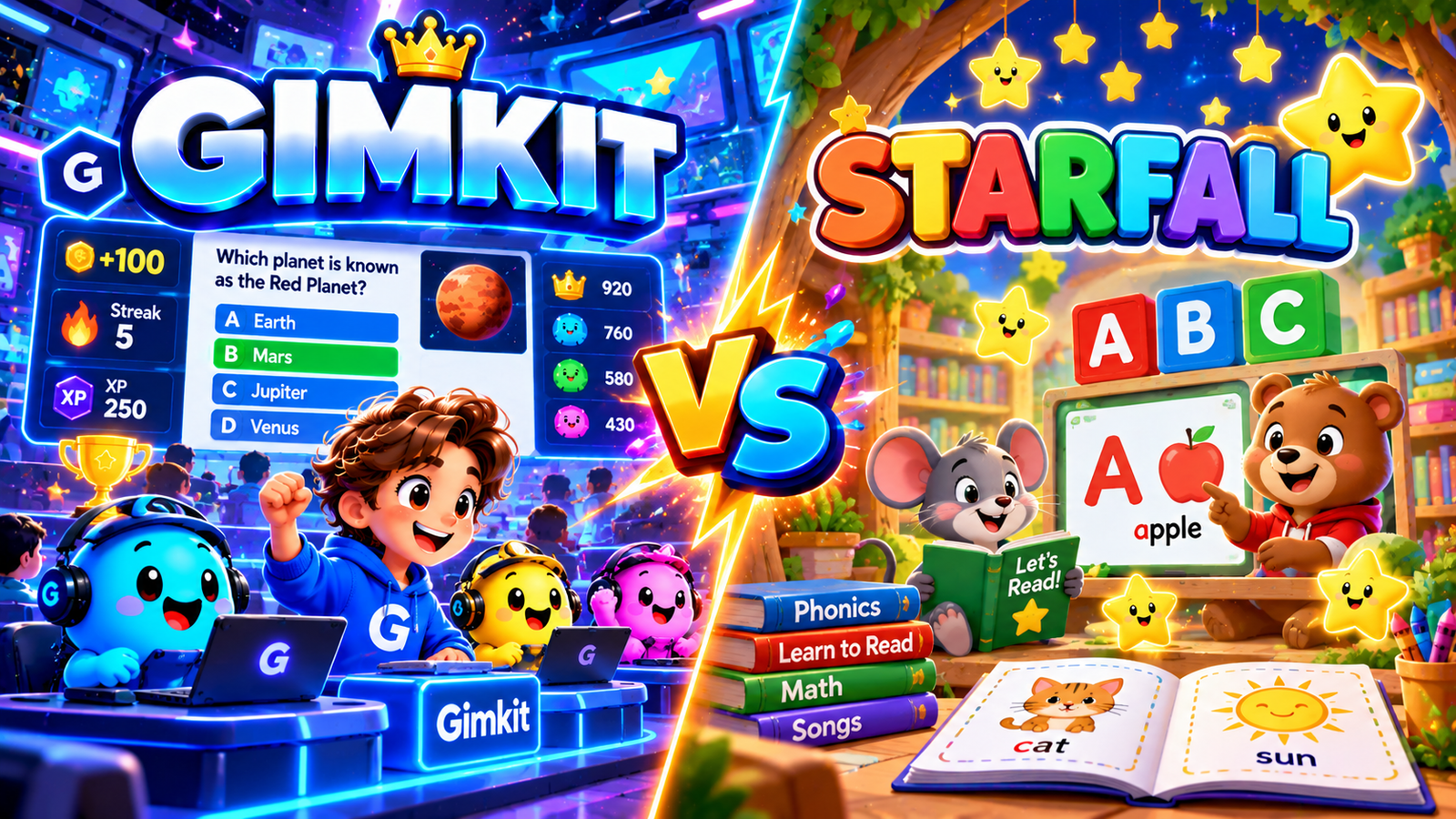
Gimkit vs Starfall
Foundational Reading
or Game-Based Review?
Gimkit vs Starfall
compares distinct educational experiences.
Starfall's free four-step Learn-to-Read
program introduces letters, phonics,
early reading and supported fluency
through interactive books, songs
and activities.
Gimkit hosts question Kits inside
selectable game modes, where responses
influence game-specific participation
and progression.
A phonics lesson that requires
hearing and blending sounds is not
interchangeable with a question-based
classroom game.
Learn when to select a developmentally
appropriate reading activity,
when a Gimkit Kit can support later review,
how current Starfall free access
and membership work,
and why sounding out an unfamiliar word
is different from recognizing
a memorized answer.
Use the exclusive
Decodable Reading Transfer
& Sound-to-Print Workshop
to rehearse teacher-guided word probes,
inspect explicit grapheme tiles
and record independent versus
prompted reading separately.
Independent educational guide.
GimkitApp.com is not affiliated with
Starfall Education Foundation or Gimkit.
This workshop does not access
official books, student accounts,
audio, assignments or reading
assessment reports.
All practice words and observations
are locally created or teacher-entered.
SOUND → PRINT → MEANING
cat✓
Word first. Sentence next.
The cat sat.
Decoding a single word and
reading it in connected text
provide different evidence.
The sentence is illustrative,
not a guaranteed fully decodable
passage for every learner.
STARFALL: READING PATHWAY
GIMKIT: GAME REVIEW
The Real Decision
Starfall for foundational reading;
Gimkit for supported question-based review.
Both can be engaging.
Only one is organized around a documented
four-step learn-to-read sequence,
and only one asks a teacher to host
a question Kit inside a game mode.
🔤
Choose Starfall for emerging readers
Starfall's free reading sequence moves
from ABCs to Learn to Read,
It's Fun to Read and I'm Reading.
The activities emphasize letter–sound
knowledge, phonics patterns,
interactive books, vocabulary
and supported fluency.
A child who needs explicit sound-to-print
practice benefits from tasks designed
for that learning stage.
Current Starfall also offers wider
Pre-K–Grade 5 material with free
and member content.
Do not equate the full site
with only preschool phonics.
🎮
Choose Gimkit for a suitable review objective
Gimkit starts with a question Kit,
a mode picker, host options,
a joining route and live play.
Academic questions remain central,
but the mode's mechanics affect
the experience.
A learner who can already decode
printed words may be able to practise
vocabulary, comprehension or facts
through age-appropriate questions.
Gimkit should not be described
as a structured replacement
for beginner phonics instruction,
explicit sound modelling or
supported reading of connected text.
2026 product update:
Starfall's current website describes
Learn to Read as free and lists
activity coverage through Grade 5.
Its membership fees and
app-store subscription prices differ,
and home membership is not permitted
for school use.
These conditions should be verified
on official pages before purchasing.
Four-Step Reading Pathway
Understand the four stages
before selecting a game.
The official Starfall learning-to-read
sequence is a progression of different
tasks, not merely a list of random
educational activities.
🔡
1. ABCs
Children explore alphabet names,
shapes, sounds and letter recognition.
It is more appropriate to check
the relationship between a letter
and its sound than to demand
complex reading from a child
still learning the alphabet.
🧩
2. Learn to Read
The phonics pathway includes short-vowel
CVC words, word families, sight words,
vowel teams and additional
sound–spelling patterns.
Decoding requires attending
to printed graphemes and
blending their sounds.
🎨
3. It's Fun to Read
Art, music, poetry, rhymes
and related experiences support
vocabulary and language exploration
as beginners become more comfortable
with reading activities.
4. I'm Reading
Fiction and nonfiction texts provide
opportunities for fluency
and comprehension, supported
by accessible scaffolding.
Reading connected text requires
more than decoding a word displayed
in isolation.
Activities should complement
direct instruction, read-aloud
conversation and appropriate
offline print exposure.
Unique Functional Reading Application
Decodable Reading Transfer
& Sound-to-Print Workshop
Create a local phonics micro-sequence,
reveal teacher-authored grapheme–sound tiles,
collect separate word and sentence
observations, review transfer gaps
and export a short printable
practice strip.
This is a reading-task rehearsal,
not an official Starfall activity
or automatic fluency assessment.
No automatic speech or reading recognition:
A caregiver or teacher must model sounds,
listen to the reader and mark the observation.
The visible grapheme mapping is
instructional content, not a guaranteed
pronunciation engine.
Sample sentences can contain irregular words;
check that each text fits the child's
taught code before presenting it
as decodable.
Choose the phonics code—
not a grade label alone
Select a family of example words,
specify the learning objective
and edit the actual sequence.
Each preset stores explicit graphemes
and printed sound hints.
Teacher-authored words require
manually entered sound segments
so the app never invents
phoneme segmentation.
Custom teacher-authored word card
The tool does not synthesize new
phonemes or check whether every
word in a sentence is decodable.
For digraphs, one grapheme tile
can contain multiple letters
(for example sh).
Sound hints are display labels only.
Check the local spelling system
and the child's taught correspondences.
Current probe sequence
Listen to isolated-word decoding
The adult chooses a word,
asks the reader to try it,
optionally reveals segmented
sound hints, and records
how independently the child
reads it.
A reveal may provide assistance;
do not mark a prompted answer
independent.
cat
Manual isolated-word observation
Independent = read the word without
assistance.
Prompted = adult modelling or hints
were needed.
Revisit = word reading not demonstrated.
Unobserved = no evidence.
These local labels are descriptive,
not standardized reading scores.
Check transfer into connected print
A reader may decode a word in isolation
but hesitate within a sentence.
Check the entire sentence for language
and decoding demands before using it.
Enter what you noticed, then mark
the sentence observation independently
of the word.
Teacher-reviewed sentence ·
Not automatically verified decodable
Manual connected-text observation
Word-to-sentence transfer review
Printable practice strip and audit log
Generate a short list of teacher-selected
words and linked sentences, or export
a local summary of manually marked attempts.
The format belongs to this independent
website; no Starfall or Gimkit content
has been scraped, and no official
student records are involved.
Initializing workshop…
01 · Independent Teaching Analysis
The educational job behind each platform
Comparing Gimkit and Starfall begins with
the learner rather than the software interface.
A beginning reader may not yet know the
connections between printed letters and spoken
sounds. Such a learner needs explicit
demonstrations, opportunities to notice
individual sound–spelling relationships,
and short tasks where each new relationship
can be practised. Starfall's free four-step
Learn-to-Read program is organized around
that foundational progression. The content
is not merely a collection of colorful
pictures; the sequence starts with alphabet
understanding and moves into decoding,
supported reading, and comprehension.
A product's suitability should therefore
be judged by whether it provides the
particular learning experience needed
at this stage.
Gimkit begins with different assumptions.
A teacher selects a question Kit and
chooses an available game mode.
Learners participate through their devices,
answering the questions as part of
game-specific interaction. This can
provide enjoyable review once the
question text and response choices
are accessible. A student who cannot
yet decode the questions may require
oral presentation or accessible support,
and a game mode does not automatically
teach phonemic awareness or blending.
The instructional task must be selected
first; a score or game victory should
never stand in for evidence that
a child can read a novel word.
The independent reading workshop
on this page addresses the boundary
between these situations. It does
not attempt to reproduce Starfall
stories or Gimkit modes. Instead,
it makes the reading demand visible:
identify the printed graphemes,
connect them to appropriate speech sounds,
blend into a word, and attempt the
same word in a teacher-reviewed sentence.
Adults explicitly record how much
help was provided. These observations
are useful for a focused discussion
about practice, but they are not
standardized diagnoses or official
vendor reports.
02 · Independent Teaching Analysis
Why Starfall's four reading stages
are not four game levels
Starfall presents ABCs, Learn to Read,
It's Fun to Read, and I'm Reading
as a four-step route through
foundational literacy. The stages
organize different reading experiences.
ABCs gives children opportunities
to explore letter identity and early
sound associations. Learn to Read
emphasizes phonics patterns and
beginning books, including
consonant–vowel–consonant words and
more complex spelling relationships.
It's Fun to Read adds varied language,
art, music and poetry. I'm Reading
brings supported fiction and nonfiction
texts into the experience. This is
more specific than an undifferentiated
recommendation to play a reading game.
The stages should not be interpreted
as a lockstep promise that one digital
activity certifies a child for the next.
Learners can benefit from revisiting
earlier correspondences while reading
more connected text, and they may
bring different strengths to decoding,
language comprehension, vocabulary and
fluency. An educator must pay attention
to the actual task, the texts being used,
and what the learner demonstrates.
The teacher's understanding of the child
and relevant curriculum remains more
important than counting clicks or
activity completions.
Gimkit can be chosen for a later
complementary purpose, such as recalling
vocabulary or answering comprehension
questions about a story already taught.
That later review is not the same event
as learning to map letters to sounds.
This comparison separates foundational
reading acquisition from subsequent
question practice, because combining
them into a single “which game is
more fun?” judgment would hide the
most consequential difference for
emerging readers.
03 · Independent Teaching Analysis
Letters, sounds and phonemic awareness
A letter is a visual symbol;
a phoneme is an individual sound
in spoken language. Early reading
instruction connects these domains,
but a reader can recognize a letter
name without reliably identifying
the sound it represents. Phonemic
awareness additionally involves
listening for and manipulating
sounds in spoken words, which
is conceptually distinguishable
from seeing print. A child
might hear that sat and sun
begin with the same sound
before knowing the spelling letter s.
The teacher should know whether
a given task is about listening,
identifying print, or connecting
the two.
Starfall's early sequence uses
interactive presentations of letters,
sounds, songs and beginning words.
The official teacher materials position
alphabet work as an early starting
point, with systematic phonics
introduced through the Learn to Read
materials. An activity can reinforce
a correspondence the teacher has
introduced, but watching an animation
is not by itself evidence that
a child can apply the relationship
independently. A learner needs
opportunities to respond, receive
feedback and try with new examples.
The sound-tile view in our workshop
shows manually defined written segments
and teacher-authored sound hints.
It intentionally does not generate
a phoneme transcription from arbitrary
typed English words: English spelling
is too irregular for a simplistic
character-by-character conversion
to be trustworthy. When the teacher
adds a custom word, they specify
the segments explicitly. The adult
then models or checks the sounds
and observes the child's attempt
rather than relying on synthetic
labels as a formal assessment.
04 · Independent Teaching Analysis
Consonant–vowel–consonant decoding
Consonant–vowel–consonant, often
abbreviated CVC, words provide
a useful early structure for practising
consistent letter–sound correspondences.
Words such as cat, map and sun
can be segmented into a beginning
consonant, short vowel and final
consonant. A learner who knows
the correspondences can practise
attending to all parts of the
word and blending the sounds
in order. The teacher should avoid
turning every CVC attempt into
guessing from a picture or
memorizing the whole printed shape.
Starfall's official Learn to Read
materials specifically use early CVC
patterns and related word families.
The first accessible steps include
books and activities around patterns
such as -at and -an.
These are appropriate examples
of why phonics can be more
than question selection: the child
has to connect a sequence of written
units with spoken language.
The same letters can reappear
in new words, supporting transfer
beyond a rehearsed single item.
The independent workshop includes
a short-vowel CVC preset with
grapheme tiles and explicit sound hints.
The teacher can reveal the hints
after hearing an attempt and record
whether the word was read independently,
read after prompting or not demonstrated.
A later sentence presents a different
demand because even a simple sentence
can introduce untaught high-frequency
words, punctuation and meaning.
The adult must inspect the sentence
rather than assuming every printed
line is fully controlled.
05 · Independent Teaching Analysis
What happens after a short vowel
Once students have begun using
consistent short-vowel correspondences,
they encounter spelling patterns
that cannot always be represented
accurately by one letter per sound.
English words include consonant digraphs,
vowel teams, long-vowel patterns,
and r-controlled spellings.
For instance, the letters sh
commonly function as one grapheme
for a single consonant sound
in a word such as ship.
In another word, two vowel letters
may work together to represent
one vowel sound. Explicit instruction
makes the pattern visible instead
of asking the child to infer
an entire system from disconnected
guesses.
Starfall's official Learn to Read
sequence includes short-vowel materials,
digraphs such as sh, th and ch,
and later vowel patterns.
The specific sequence and the
individual learner's previously taught
code matter. Presenting an advanced
word before its correspondence
has been introduced can make
an otherwise well-meaning game
frustrating or encourage reliance
on context and picture guessing.
Our workshop groups examples
by short-vowel CVC, consonant digraph
and vowel-team families.
Each preset contains an explicit list
of written graphemes and a corresponding
list of sound hints. The teacher
may select a family and build
a short sequence instead of displaying
every possible word at once.
The application does not claim
that its example set duplicates
the vendor's ordered curriculum
or the teacher's local phonics scope.
It provides a transparent, editable
micro-probe for reviewing known
correspondences.
06 · Independent Teaching Analysis
Why recognizing a word
is not the same as decoding a new one
A learner can recognize a familiar
written word through repeated exposure
even while struggling to decode
a novel word containing the same
correspondence. Recognition can be
useful in fluent reading, but an early
check that shows only previously
memorized vocabulary may fail
to reveal whether the child can apply
the alphabetic principle.
A teacher trying to examine decoding
should sometimes present unfamiliar
but appropriate words and ask
the child to work through their parts.
Nonwords may be used in specialized
assessments, but their administration
and interpretation should follow
appropriate validated procedures.
Digital platforms make repeated practice
convenient. Starfall provides interactive
reading activities with print, sound
and pictures. Gimkit can present questions
about vocabulary or word meaning
inside game modes. Yet a correct
selection from a multiple-choice list
might result from recognizing the context
or eliminating other answers.
It does not necessarily prove
that the student independently
read every letter sequence
in the prompt.
That distinction explains the workshop's
explicit word observation. A teacher
presents a selected word and notes
what happened before offering assistance.
If sound hints are displayed
or the word is modelled,
the result can still be valuable
teaching practice, but it is recorded
as prompted rather than independent.
Preserving assistance conditions gives
the next adult more meaningful information
than awarding an undifferentiated success
point every time a correct word
is eventually spoken.
07 · Independent Teaching Analysis
Sounding out and blending
as different actions
Segmenting print into graphemes
and blending associated sounds
into a spoken word are related
but not identical tasks.
A learner may name each consonant
and vowel sound individually yet
struggle to combine them fluidly.
Another learner may say a familiar
whole word quickly without demonstrating
the ability to identify its grapheme
sequence. A useful teaching check
can therefore first show the printed
word alone, allow an independent attempt,
and then optionally provide segmented
hints to support the next instructional step.
The workshop separates the unassisted
attempt from the hint-reveal operation.
Its sound tiles can expose a teacher-entered
sound hint when selected.
The tool does not speak the phoneme,
and it does not detect speech
from the microphone. That is deliberate:
browser text-to-speech may pronounce
isolated letters as their names rather
than the intended phonemes, and automatic
voice recognition can introduce errors
in early readers' speech.
An adult needs to model and observe
the target sound correspondence.
If a learner cannot blend a word,
the follow-up should be matched
to the actual difficulty: revisit
a grapheme, model continuous blending,
reduce the number of segments
or return to a familiar pattern.
Repeatedly selecting an incorrect
multiple-choice answer inside a game
does not inherently deliver that kind
of focused phonics support.
Game-based review is most useful
when the intended reading operation
is already accessible to the learner.
08 · Independent Teaching Analysis
Word families and controlled variation
Word-family practice can help
a beginning reader notice that familiar
spelling patterns appear in new
combinations. A small set such as
cat, mat and sat allows attention
to the -at ending while changing
the initial consonant. A separate
set such as map and tap gives
practice with the -ap pattern.
These examples can support careful
comparisons, but it is important
not to encourage guessing a word
from its first letter and a picture.
The child should attend to each
relevant grapheme.
Controlled variation is valuable
because it makes the instructional
demand more predictable.
Too many simultaneous new correspondences
can obscure which relationship
the child is actually struggling with.
An adult can choose three or four
words that share a taught pattern,
model one, then invite independent
attempts at the others.
A new word or short phrase
may help show whether the pattern
has transferred beyond a memorized
example.
The app can add a preset family
of examples and reorder the current deck.
Removing one unsuitable item does not
erase the other observations.
It also supports custom words
with explicit teacher-authored segments,
which makes it adaptable to a local
sequence without pretending it knows
a school's curriculum.
This specificity is one reason
the tool differs from a generic quiz,
scoreboard or digital flashcard collection.
Its data model tracks both the written
segments and the amount of help provided.
09 · Independent Teaching Analysis
From isolated word to connected text
A child who can decode cat
when the word appears by itself
may hesitate when the same word
appears within a sentence.
Connected text introduces additional demands:
eye movement, spacing, syntax,
punctuation, other word spellings,
and meaning. The learner must hold
the decoded word within a larger
language structure. A teacher should
examine these demands before treating
one short sentence as a standardized
measure of fluency or comprehension.
The workshop associates each word probe
with a teacher-reviewed practice sentence.
It can display the sentence after
the isolated word observation and collect
an independent status for the connected-text
attempt. This allows a concrete
transfer question: did the learner
read the target word independently
when it was embedded in an appropriate
context, or did it require adult prompting?
The tool does not claim that a sentence
is decodable merely because one target
word is decodable. Irregular words
and untaught spellings must be reviewed
by the adult.
A word-independent/sentence-prompted pattern
does not prove a broad reading problem.
The learner might have struggled
with a different word, punctuation,
attention or comprehension.
The adult observation note is therefore
just as important as the summary badge.
The practical next step is to adjust
the sentence, choose an appropriate text
and listen again. The application reports
the contrast without assigning a clinical
or developmental diagnosis.
10 · Independent Teaching Analysis
Why an unfamiliar sentence matters
Reading the same text repeatedly
can develop confidence and fluency,
but it may not independently demonstrate
that every underlying decoding pattern
is secure. A learner may memorize
a familiar sentence after hearing
it several times. When the teacher
wants to know whether learning transfers,
they can choose a new but appropriately
controlled line with correspondences
the student has already learned.
The new context should not add
an excessive number of new challenges
all at once.
This is relevant to both reading
activities and question games.
In Starfall, books and interactive
activities can give useful exposure
to print, but the teacher must still
assess what the child can read
without a model. In Gimkit,
questions may revisit previously taught
words and meanings, but repeated
correct selections may not reveal
the process the student used
to understand the written prompt.
Neither activity's completion badge
certifies independent decoding
of new connected text.
The teacher-authored sentence field
offers a simple way to introduce
a fresh line after word work.
Because the workshop has no verified
curriculum database, it cannot certify
complete decodability or generate
a reliable measure of oral reading
fluency. Its role is to keep
the word attempt, sentence attempt
and anecdotal observation separate.
This is more defensible than converting
a single correct click into a claim
of mastery.
11 · Independent Teaching Analysis
Comprehension begins with language
and meaning
Decoding provides access to print,
but reading comprehension also depends
on understanding the language, concepts
and relationships expressed in a text.
A student might accurately pronounce
all the words in a sentence without
knowing what it means. Another learner
may understand a story read aloud
yet not be able to read the printed
story independently. These differences
are especially important in early
elementary education, where oral language
and word recognition are developing together.
Starfall's official reading pathway
progresses beyond initial word patterns
toward stories, poetry, fiction
and nonfiction. The I'm Reading stage
is described in relation to fluency
and comprehension. Its value should
be evaluated with questions that genuinely
examine what the child understood,
not only how quickly an animation
was completed. A teacher can ask
the reader to explain a character's
action, identify a simple relationship,
or retell a key event
in suitable language.
Gimkit can play a complementary role
when students already have reasonable
access to the relevant print and content.
A reviewed Kit might ask comprehension
questions about a story taught previously.
Still, choosing one correct response
is not the same as independently
constructing an explanation. Teachers
should match the response format
to the learning objective, and they
should not confuse decoding, language
comprehension and gameplay progression
as if they were the same measure.
12 · Independent Teaching Analysis
Reading fluency is more than racing
Reading fluency involves accuracy,
appropriate expression and efficient
recognition of words within meaningful text.
Speed can be one observation,
but pushing beginning readers to race
before they can accurately connect
graphemes to sounds may encourage guessing.
A teacher should consider whether
a particular digital activity supports
thoughtful reading or rewards
quick response selection. The intended
lesson may require modelling a phrase,
rereading a short passage or discussing
punctuation rather than competing
on a leaderboard.
Starfall's reading materials include
supported stories and reading activities
where sound and print can be experienced
together. Gimkit's gameplay can be highly
motivating for students who can access
the questions independently, but
the chosen mode's incentives are not
automatically aligned with oral reading
fluency. A game's points or victory
condition should not be presented
as a verified reading-rate measurement.
The local workshop deliberately omits
words-per-minute scoring. Its inputs
capture whether an attempt was independent,
prompted or needed another teaching opportunity,
and they keep short observations attached
to the chosen word or sentence.
This is not a substitute for validated
fluency assessment. It is a structured
conversation aid for preparing
an age-appropriate reading task
and deciding whether to model,
revisit or advance.
13 · Independent Teaching Analysis
Starfall's free literacy pathway
Starfall's current homepage describes
a free Learn-to-Read route that starts
with ABCs and continues through phonics,
language exploration and supported reading.
The organization states that this reading
pathway is free for every child.
This matters to families and teachers
because access to the free literacy
sequence should not be inaccurately
equated with purchasing a membership.
A person can visit the official website
to identify available free activities
without subscribing.
At the same time, not every activity
on Starfall is necessarily included
in its free offering. The site promotes
additional member content across subjects
and grades. The correct comparison
is therefore between a defined
free pathway and the separately
expanded membership library,
rather than calling the entire platform
universally free. App-store subscriptions
are also a different payment route
from memberships purchased directly
from Starfall.
Gimkit has its own Basic and Pro arrangements.
Official Gimkit support currently describes
Basic as free with rotating featured
game modes, while Pro provides unrestricted
mode access and Assignments.
These structures are unlike Starfall's
free phonics program and nonprofit memberships.
A teacher should identify the precise
task they need before comparing subscription
prices that cover different types
of educational content.
14 · Independent Teaching Analysis
Starfall memberships and correct
license selection
Starfall's official membership catalog
publishes separate annual prices
and permissions. A Home Membership
is listed at $35 per year for a single
family household and is not valid
for schools, businesses or other organizations.
A Teacher's Membership is listed
at $70 per year and serves one teacher
and enrolled students through
the supported classroom access system.
Larger Classroom and School memberships
are listed at $195 and $355 per year
respectively, according to the provider's
current descriptions.
These distinctions matter more than
simply finding the cheapest advertised
number. A teacher using Starfall
with a class should not purchase
a home-only license under the assumption
that any paid account grants school
usage rights. Likewise, a family
looking for home reading support
may not need a school membership.
Group Access and other membership
features should be verified
in the current official account
and terms before deployment.
The independent comparison does not
sell Starfall access or calculate
regional tax or discounts.
It cites the current published
baseline prices while acknowledging
that vendors may revise them.
Its reading tool needs no vendor
subscription because the teacher-authored
sample deck runs entirely within this page;
however, it also does not unlock
any Starfall premium activities.
That separation prevents readers
from mistaking an independent phonics
practice aid for a purchased license
or official curriculum product.
15 · Independent Teaching Analysis
Starfall mobile apps versus
direct memberships
Starfall's official app catalog
explains two primary routes to fuller access.
One is a membership acquired through
Starfall's website, with home, teacher,
classroom and school tiers. Another
is a recurring subscription purchased
through supported mobile app stores
for home use. The catalog currently
advertises app subscriptions at
$5.99 per month, which differs substantially
from the annual Home Membership price
if maintained for a full year.
Teachers and families should check
platform compatibility before buying.
Apple and Google subscription rules,
family-sharing behavior and account
access can differ. A Starfall website
membership is not the same purchase
as a subscription managed by
an app-store billing account.
Where a school requires official
group access, use the appropriate
educational membership rather than
assuming a personal mobile subscription
provides the same rights.
Gimkit's main experience is also delivered
through supported web access,
but its educational model is quite different.
Its account plan controls available
live modes and assignment functionality.
Comparing Gimkit Pro to the Starfall
app-store monthly charge without identifying
the classroom purpose would mix
unlike purchases. Evaluate reading resources
and game-hosting requirements separately,
then verify the total cost for
the actual users and devices.
16 · Independent Teaching Analysis
Starfall now extends beyond Grade 3
Older Starfall descriptions often call
it a Pre-K through third-grade learning
platform. That historically useful shorthand
is now incomplete. The current official
Starfall and Parent-Teacher Center pages
list content through fifth grade,
including Grade 4 and Grade 5 language
arts and mathematics. Those upper-grade
materials extend the website's reach
beyond early phonics, although
the free four-step Learn-to-Read program
remains a distinctive and important
part of its identity.
The app help documentation describes
Grades 4 and 5 as a newer branch
available to members and subscribers,
with some free guest previews.
It also describes grade-level display
controls that differ across the Android
and iOS app versions. This is a good
example of why information about
a platform can become outdated
even when the brand name stays
the same. Teachers should inspect
the current content for the specific
grade and device rather than rely
on a broad age label.
The comparison still identifies Starfall
as particularly strong in foundational
literacy because that is the focus
of the independent reading workshop.
It would be inaccurate, however,
to claim that Starfall teaches only
alphabet names or is unusable
after kindergarten. Its wider grade
coverage includes mathematics,
grammar, spelling and reading activities.
The best platform choice must be based
on the exact learning need,
not a simplified historical description.
17 · Independent Teaching Analysis
Early mathematics does not make
the platforms equivalent
Starfall offers more than reading.
Official grade guides describe early
counting, addition, subtraction,
number concepts and later mathematics
topics across its expanded grade levels.
These activities can use visual interaction
and age-appropriate exploration.
A child working with quantities
and basic operations may need
concrete representations and explanations
before rapid symbolic practice
becomes meaningful.
Gimkit can present questions
involving mathematics within a Kit
and game mode. For learners who
already know the underlying concepts,
a reviewed set may create opportunities
for retrieval and practice.
Yet a game that asks students
to select answers is not equivalent
to an interactive lesson about quantity,
number relationships or mathematical
representations. The mode's progress
indicator may also reflect strategic
gameplay decisions, not just
numerical understanding.
This page stays specific to reading
transfer because a math calculator
or generic multi-subject quiz would
overlap with the site's other comparisons.
Families selecting Starfall for foundational
literacy and mathematics can consult
its official grade-specific guides.
Teachers selecting Gimkit should review
the Kit's actual questions and determine
whether the game helps practise
a concept already taught.
Educational alignment matters more
than a platform's total number
of advertised activities.
18 · Independent Teaching Analysis
Developmental appropriateness and attention
Young learners differ in reading development,
language exposure, attention and familiarity
with digital devices. An activity
with sophisticated game mechanics may
be enjoyable but inappropriate if the child
spends most of the time trying to read
unfamiliar menu text or understand
the controls. Developmentally appropriate
instruction reduces unnecessary barriers
so that the intended skill remains visible.
For a beginner learning letter–sound
correspondences, short and supported
word-level tasks may be more informative
than a long competitive session.
Starfall's early literacy experiences
use songs, stories, animation and interaction
as supports for foundational concepts.
They can be useful supplements,
but a child still benefits from conversation,
shared reading, physical letters, drawing
and teacher or caregiver feedback.
Educational screen time is best considered
in relation to the learning activity
and the rest of the day,
rather than treated as beneficial merely
because the software has an educational label.
Gimkit's modes may be suitable for older
or more confident readers who can navigate
instructions and interpret question text.
Even then, teachers should preview game
conditions and consider accessibility needs.
The independent reading workshop uses
a compact task sequence instead of
a full game world. It gives the adult
control over the amount of practice
and support, reducing the risk
that a reading probe turns into
an unrelated test of gaming ability.
19 · Independent Teaching Analysis
Accessibility and diverse readers
Reading development occurs within diverse
language, sensory and learning contexts.
A child may need visual enlargement,
a different presentation of sounds,
a quieter environment, or school-approved
accommodations. An activity that depends
on audio should be tested for volume
and accessibility, while a text-heavy game
may impose an unnecessary decoding demand
when the teacher intends to check
another subject. Accessibility is part
of instructional validity, not merely
an optional design preference.
Starfall's official website and app resources
offer supported accessibility information,
but specific feature availability should
be checked on the device and in
the activity actually used. Gimkit also
has its own supported browser and
game behavior. Teachers should verify
current documentation rather than
promise universal compatibility
or automatic accessibility across
every mode.
The workshop does not collect identifying
information about disabilities or make
inferences about learners.
It displays sizeable word tiles
and clear written sound hints,
supports keyboard-operable buttons
and avoids imposing time limits.
However, it is not a speech-language
screening instrument, nor is its rubric
a validated diagnostic assessment.
For a learner with persistent reading
concerns, appropriate teacher-led
assessment and institutional support
are essential.
20 · Independent Teaching Analysis
When to reveal sound hints
Support should be intentional.
If an adult immediately provides
the word and sound breakdown,
the student has less opportunity
to demonstrate independent decoding.
If the learner struggles, however,
withholding all help can turn practice
into frustration. An effective micro-probe
distinguishes the first unaided attempt
from the subsequent teaching step.
The teacher can observe, reveal
or model a grapheme and let
the child blend again.
The tool supports revealing sound hints
one tile at a time or displaying
all hints. This gives the adult
a practical visual cue for the
next scaffold. The interface does not
assume the hints were heard accurately,
and it cannot observe how the learner
pronounced a word. The observation buttons
require a teacher or caregiver
to record what happened in
the real interaction.
After hints are used, prompted success
can be celebrated as progress
in supported practice. It should not
be silently changed into an independent
record. A later attempt on a different
but comparable word can provide
another useful observation.
This approach avoids the misleading
shortcut of treating a digitally
revealed answer as evidence that
the child would have produced
it unaided.
21 · Independent Teaching Analysis
Why a game score is not a decoding score
In a game-based question activity,
the visible final outcome can reflect
how successfully a learner met
the chosen mode's objective.
In Gimkit, those objectives and mechanics
vary across modes. A student may answer
many questions while making decisions
about resources, movement or team strategy.
For an academic question involving reading,
a correct selection does not automatically
reveal whether the student decoded
each word, recognized the answer
from context or received help
from a peer.
Starfall's reading activities provide
a more direct environment for encountering
print and sound, yet completing
a digital book or activity is still
not a comprehensive, independent
reading assessment. The teacher should
identify the precise performance being
observed and check it using suitable methods.
A standardized score requires validated
administration and interpretation;
neither a casual game result
nor the independent workshop produces that.
The workshop's counters show only
the number of locally marked independent,
prompted, revisit and unobserved tasks.
They are not converted into a universal
reading age, percentile or mastery diagnosis.
The primary question is narrower:
on this word or sentence,
under these conditions, was reading
demonstrated without prompting?
That is a defensible observation
when an adult records it accurately
and keeps the context in view.
22 · Independent Teaching Analysis
Using Gimkit after reading instruction
Gimkit can complement literacy instruction
when the learners can understand
the question format and the selected
activity is appropriate. For example,
after a story has been read and discussed,
a Kit can contain reviewed vocabulary
or comprehension questions.
Students can revisit the content
through an available game mode.
The teacher should make sure
the wording is accessible and
the question choices are academically sound.
An appropriate Kit might ask about
an explicit detail or a vocabulary meaning
already introduced. It should not be used
as a substitute for a lesson about
a new grapheme correspondence
or as a way to establish whether
a child has independently blended
an unfamiliar word. Those tasks require
more direct observation of sound–print
processing. The game layer may engage
students, but it can also introduce
navigation, speed or strategic demands
unrelated to the reading objective.
A coherent sequence can begin with
explicit instruction and suitable Starfall
activities, continue with teacher-guided
practice using real text, and later
use selected Gimkit questions for review.
The two products remain separate services.
This page does not claim automatic
conversion of Starfall books into Gimkit
Kits or synchronization of achievement records.
Educators remain responsible for the
teaching content, the learning conditions
and the interpretation of any
observed responses.
23 · Independent Teaching Analysis
What parents can do offline
Parents can reinforce foundational reading
beyond a website. Listening to stories,
talking about characters, noticing environmental
print, using letter tiles and sharing
age-appropriate books are ways to connect
spoken language with print.
A child learning CVC patterns may enjoy
building three-letter words with physical
tiles and reading them aloud.
Short, positive practice sessions
can provide another chance to apply
a correspondence introduced by the teacher.
Starfall's official Parent-Teacher Center
offers printable books and companion
resources in addition to the main
interactive activities. Adults should review
usage terms for printed materials
and select items appropriate to
the learner's stage. A family membership
and a school membership have different
permissions, so parents and teachers
should use the product in a way
that matches the current account
and licensing rules.
The workshop can generate a short
practice strip to accompany hands-on activity.
The printable output contains the
teacher-selected target words and sentences,
not copyrighted Starfall story text.
An adult can print it, use physical
letter tiles, read the words aloud
and record notes privately.
The application does not replace
a teacher or parent, nor does
it claim that sending a worksheet
home will guarantee any particular
literacy outcome.
24 · Independent Teaching Analysis
What teachers can do in a learning center
An early literacy learning center
can combine explicit instruction,
supported digital activities and hands-on work.
One part of the room might provide
teacher-led phonics modelling,
another might offer an appropriate
Starfall interactive reading activity,
and a third might involve books
or magnetic letters. The rotation
should be designed for the children
present rather than copied
from a generic timetable.
Device access, supervision and the need
for adult feedback matter.
It is tempting to call a center
effective because children stay engaged.
Engagement is helpful, but the teacher
should still know which skill
each activity practises and whether
the learner can apply it beyond
the activity's familiar display.
A short independent reading probe
after supported practice can reveal
different information from the software
completion screen. Observations should
remain specific and should not be used
to create permanent labels.
Our workshop helps prepare one narrow
part of such a center:
the adult-controlled word and sentence check.
Its sequence can be adjusted
to a taught phonics family,
and the adult can decide
when to reveal sounds, when to move
to a sentence and which examples
should be removed. The same session
can end with a printable summary
for planning, without implying
any connection to the school's official
assessment or Starfall activity history.
25 · Independent Teaching Analysis
Comparing teacher preparation
Starfall and Gimkit demand different
forms of preparation. Starfall provides
an existing body of reading and educational
activities that adults choose according
to the child's needs. Teachers may also
use its Parent-Teacher Center to locate
supporting materials. The main planning
challenge is selecting the correct stage
and connecting the interactive experience
to the explicit instruction and books
used in the classroom.
Gimkit's official host instructions begin
with selecting a Kit, choosing a game mode,
adjusting game options and sharing
a code or link. Preparation includes
reviewing the academic questions and
understanding the game's rules.
A game mode can produce a different
experience using the same Kit,
so the teacher needs to consider
whether its objectives support
the learning task. Students also need
appropriate device access
and joining instructions.
The independent workshop has a third
type of preparation: select a specific
grapheme family, write or review
the example words, check the printed
sound hints and sentences, and decide
how to record independent versus
prompted attempts. This preparation
is deliberately modest and specific.
It does not ask teachers to rebuild
Starfall content or to make a fake
Gimkit game. Its functionality is useful
precisely because it stays within
the boundary of a manual
phonics transfer probe.
26 · Independent Teaching Analysis
Interpreting the word-to-sentence
transfer gap
A word-to-sentence transfer gap
in this workshop means that the adult
marked an isolated word as read
independently but marked its linked
sentence as prompted or needing a revisit.
That pattern could be worth investigating,
because reading a word inside connected
text places additional demands on recognition,
language and attention. However,
the pattern does not identify
the cause of difficulty
or establish a broader diagnosis.
The child may have stumbled
over another word in the sentence,
needed help with an irregular spelling,
misunderstood the instruction
or been distracted. The teacher should
review the sentence itself before
treating the contrast as evidence
about the target word.
If the sentence contains untaught patterns,
a poor connected-text result cannot
fairly be attributed to failure
of the target phonics correspondence alone.
The application intentionally shows
the transfer gap alongside an adult
observation note. It can highlight
the paired states, but it cannot detect
which printed word caused a pause
or whether the spoken answer was accurate.
A useful next action is to choose
a better-controlled sentence,
provide appropriate support and conduct
another independent attempt after instruction.
That is a more responsible use
of the data than turning a badge
into a fixed ability judgment.
27 · Independent Teaching Analysis
Preserving original words and copyright
Using a provider's reading curriculum
responsibly also means respecting
its materials. Starfall publishes interactive
stories, songs, graphics and printable
resources under its own rights
and usage rules. An independent site
should not reproduce proprietary pages,
branded character art or entire books
without appropriate permission.
A comparison can describe a product
and link to its official resources
while creating genuinely original
educational examples.
This workshop uses a small original
set of common practice words and
teacher-authored sample sentences.
None is presented as an extracted
Starfall book or an official
vendor assignment. Custom cards
allow an educator to enter appropriate
examples from their own curriculum
and are stored locally in the browser.
The app does not scrape Starfall
or Gimkit, connect to their APIs
or copy premium activities.
If an adult wishes to use official
Starfall books or printables,
the correct route is to access
the official website and follow
the stated usage permissions.
If they wish to make a Gimkit Kit,
they should use the official creation
or hosting workflow and ensure
content rights and classroom policies
are respected. This separation
protects both accuracy and
the integrity of the original resources.
28 · Independent Teaching Analysis
What independent reading evidence
can support
Teacher-recorded reading observations
can be valuable when they are accurate,
specific and repeated across suitable tasks.
If a learner reads a taught CVC
word independently, that is evidence
about that attempt. If they needed
a sound hint, the supported attempt
can guide what to practise next.
A short sequence can show whether
the child begins to use the correspondence
across more than one example.
Such evidence does not automatically
yield a validated reading level,
developmental age or prediction
about future achievement.
The number and difficulty of items,
how the adult helped, whether sentences
contained untaught words and the learner's
conditions all influence interpretation.
Formal educational decisions should rely
on appropriate school assessments
and professional judgment.
The local workshop is intended
to document a small practice event
rather than replace those systems.
The export handoff lists the chosen words,
grapheme mapping and manually entered
word and sentence states.
An educator can read the summary
and decide which correspondence
to model again. The tool does not
produce a hidden weighted score
or fabricate growth from one session.
When evidence is missing,
it says “unobserved.”
When a word is prompted,
it remains prompted.
This transparency is central
to an independent literacy-oriented comparison.
29 · Independent Teaching Analysis
Choosing a lesson for multilingual learners
Multilingual learners may know
the intended meaning of a word
while still becoming familiar
with its English spelling and pronunciation.
Others may be confident in a home
language's print system but encounter
different sound–spelling relationships
in English. Teachers should understand
the child's language background
and instructional context without making
assumptions about capability.
An early phonics activity and
a vocabulary comprehension task
may serve different needs.
For a learner encountering a new
English vowel correspondence,
teacher modelling and careful contrasts
can be helpful. A simple game question
that demands fluent reading may obscure
whether the difficulty concerns word recognition,
language comprehension or the game instructions.
Conversely, a learner already comfortable
with the written words may benefit
from suitably challenging story questions
or collaborative review.
The workshop allows an adult
to write custom example words
and explanatory sound hints.
It is not an automatic multilingual
phonetic transcription system,
and its sound labels should be adjusted
to the pronunciation model being taught.
The teacher should avoid interpreting
one unsuccessful English decoding task
as a global judgment of literacy
or intelligence. The purpose is
to make the specific instructional
barrier more visible.
30 · Independent Teaching Analysis
Selecting age-appropriate question text
in Gimkit
If a teacher uses Gimkit with younger
readers, the wording and length
of questions matter. Students must
be able to access both the prompt
and the possible answers before
the gameplay can fairly reflect
the intended subject knowledge.
A student who knows a science fact
orally might struggle when a game
asks them to read a long passage
under time or navigation pressure.
The adult should distinguish reading
demand from the target academic skill.
Gimkit's official Pro FAQ describes
additional audio and image question
functionality under paid entitlements.
These capabilities can be relevant
to accessibility and content design,
but actual availability must be checked
for the account, question type
and game mode used.
Adding an image or audio element
does not automatically make an activity
an appropriate phonics lesson.
It remains a question-based game
unless the activity has been intentionally
designed and reviewed for that
instructional purpose.
For reading acquisition, it is often
more direct to use materials
that explicitly teach the desired
letter–sound relationships.
Gimkit can then support later practice
when learners are ready for the interface.
The workshop demonstrates why this sequencing
matters: the same word can be inspected
as a printed grapheme sequence,
read alone, then attempted inside
a sentence. A generic game score
would not expose those separate
reading demands.
31 · Independent Teaching Analysis
A practical school adoption decision
Schools considering either product
should begin with a list
of instructional jobs rather than
a broad popularity ranking.
For early literacy, the relevant questions
include whether the resource helps
deliver appropriate explicit phonics,
supplies accessible texts, connects
to classroom teaching and fits
the learners' language needs.
For question-game review, the questions
involve Kit quality, available modes,
device readiness, participation conditions
and reports. These are different
procurement and lesson-planning requirements.
Starfall membership pricing is organized
around home, teacher, classroom and school
usage. Schools should not substitute
a home-only account for an educational
license. Gimkit's Basic and Pro feature
boundaries should be checked
for the intended activities.
Neither provider should be declared
universally cheaper simply because
one annual amount is lower.
An organization may use the tools
for entirely different learners
and purposes.
A pilot should allow teachers
to review actual activities,
check current accessibility and privacy rules,
and observe whether the resource supports
the specific objective. The reading workshop
on this page can help prepare
a very small phonics observation
but does not replace product demonstrations
or purchasing advice. A sensible decision
can even include both products
for different stages of the curriculum,
provided the school understands the limits
and avoids overlapping claims.
32 · Independent Teaching Analysis
Common errors in Gimkit vs Starfall comparisons
One error is describing Starfall
as only a preschool alphabet app.
Its official current materials include
a free four-step reading journey
and additional educational content
up to Grade 5.
A second error is claiming
that every Starfall activity is free,
when expanded membership resources
and app-store subscriptions have distinct
access conditions.
A third error is recommending
the $35 home membership for
a teacher's school-wide use
despite the provider's explicit restriction
on organizational use.
Another error is treating Gimkit
as though it automatically teaches
phonemic awareness or sounding out
unfamiliar words. Gimkit can present
reading-related questions, but its main
live workflow involves Kits and selectable
game modes. Correct game answers
do not isolate the process of decoding.
Conversely, a Starfall activity
is not automatically a verified
learning assessment simply because
it has audio, print and animation.
Both require adults to understand
what the learner is doing.
Finally, a comparison should not invent
reading scores, promise fixed improvement
or pretend a third-party tool
is officially integrated with either vendor.
The local reading workshop uses no account
data or copyrighted story content.
Its evidence is entered by an adult,
its text is inspectable and its results
retain unobserved and prompted states.
These choices keep the comparison
focused on genuine instructional differences
rather than unsupported rankings.
33 · Final Verdict
Foundations first, meaningful review afterward
Choose Starfall when the immediate priority
is early literacy: letter names,
sound–spelling correspondences, phonics,
beginning words, supported reading
and meaningful stories.
Its free reading sequence and expanded
educational materials make it especially
relevant to families and teachers
working with emerging readers.
The current service also includes
upper elementary activities,
so the selection should be tied
to a specific learning goal
rather than one fixed grade label.
Choose Gimkit when the intended learners
can access suitable Kit questions
and benefit from extended,
mode-driven review. The game context
can support repeated exposure
to vocabulary or comprehension questions,
but its final objective is not
an independent decoding assessment.
Teachers should preview the selected mode
and question text, ensure appropriate
device access and read game reports
in context. Competition, movement
or rewards should reinforce the lesson
rather than replace it.
The strongest practical sequence
is not to declare a universal winner.
Establish the foundational correspondence
with explicit teaching, use appropriate
Starfall or other supported literacy activities,
check decoding on teacher-selected print,
and introduce question-based game review
when learners are ready.
The independent workshop gives adults
a way to document the word-to-sentence
transition without confusing prompted attempts,
classroom gameplay and formal reading assessment.
These distinct purposes are the reason
both platforms can be useful
without being interchangeable.
Starfall is particularly appropriate
for building reading foundations.
Gimkit is appropriate for reviewed
questions within a supported game mode.
A child first needs access to the print
and learning task before a correct
game response can be meaningfully interpreted.
Frequently Asked Questions
Gimkit vs Starfall:
answers for families and teachers
These independent answers preserve
the difference between verified vendor
features and the workshop's
teacher-entered reading observations.
What is the main difference
between Gimkit and Starfall?
Starfall has a documented free four-step
reading pathway and additional educational
activities; Gimkit hosts teacher-selected
question Kits in different live game modes.
Beginning decoding and game review
are distinct instructional tasks.
Is Starfall only for preschool children?
No. Its current official grade guides
and product pages include resources
through Grade 5. Its free
Learn-to-Read program remains especially
relevant to beginning readers.
What are the four steps of Starfall reading?
ABCs, Learn to Read, It's Fun to Read
and I'm Reading. They move from alphabet
foundations through phonics and supported
text toward fluency and comprehension.
Is Starfall Learn to Read free?
Starfall currently describes its four-step
Learn-to-Read program as free
for every child. Many additional grade
and subject activities require a qualifying
membership or subscription.
How much is a Starfall Home Membership?
The official store currently lists
$35 per year for a single family household.
It specifically states this tier
is not valid for schools,
businesses or other organizations.
How much is a Starfall Teacher Membership?
The official store currently lists
$70 per year for one teacher
and their enrolled students,
including supported Group Access.
Check current licensing terms.
Is the Starfall app subscription
the same as a membership?
No. The app catalog distinguishes
recurring app-store subscriptions
from annual memberships purchased
on Starfall.com.
Currently it lists $5.99 per month
for supported app-store
home subscriptions.
Does Starfall have activities
for fourth and fifth grade?
Yes. Its current official pages list
Grades 4 and 5; availability
and grade-display controls depend
on account and app platform.
Some free guest previews may be available.
Can Gimkit directly teach children
how to blend sounds?
Gimkit can present academic questions,
but its core Kit-and-game workflow
is not a systematic early phonics sequence.
Teachers should use explicit decoding
instruction where the target
is learning sound–print correspondences.
Does a correct Gimkit answer prove
a child can decode a word?
No. A correct selection may result
from various forms of knowledge and help.
To examine decoding, the adult needs
an appropriate independent reading attempt
with controlled print.
What is a consonant–vowel–consonant word?
A CVC word such as cat or sun
has a consonant, a short vowel
and a final consonant
in its written spelling.
These simple patterns can support
early blending practice.
What is a consonant digraph?
A consonant digraph uses two letters
to represent a sound,
as sh can do in ship.
It should not be automatically split
into two independently pronounced letters.
What is the word-to-sentence transfer gap?
In this local workshop it means
the adult marked an isolated
word independent but its linked sentence
prompted or needing revisit.
The cause may involve other words
or context and should be investigated,
not diagnosed automatically.
Does the workshop automatically
recognize spoken reading?
No. It uses no microphone,
automatic speech recognition
or phoneme-to-text model.
An adult listens and enters
each observation.
Can the workshop invent sound segments
for a custom word?
No. Custom cards require explicit
written grapheme segments
and corresponding sound hints.
Teachers are responsible for accuracy
and suitability of the sound mapping.
Are the example sentences guaranteed
fully decodable?
No. The adult must inspect every word
and confirm that the chosen sentence
fits the learner's taught correspondences,
including irregular high-frequency words.
Are the observations standardized
assessment results?
No. Independent, prompted, revisit
and unobserved are local descriptive states,
not validated reading levels,
diagnoses or learning-outcome guarantees.
Can I create a custom word card?
Yes. Enter its printed form,
matching lists of grapheme segments
and sound hints separated by vertical bars,
plus a teacher-reviewed sentence.
The app checks that segment counts match.
Can I print a reading strip?
Yes. The workshop creates a local
practice strip with selected words,
associated sentences and grapheme hints.
You can print or export it,
but it is not official Starfall
curriculum material.
Does the page import official
Starfall or Gimkit data?
No. The data remain local
to the workshop and are manually authored.
JSON import restores only this app's own
validated data format.
What does Gimkit Basic include?
Current Gimkit documentation describes
Basic as free, with rotating featured modes,
classes and reports.
Pro extends mode access
and offers Assignments
under its current terms.
Which should a teacher use
for a child beginning phonics?
Choose appropriate explicit phonics
instruction and foundational reading
materials; Starfall's free reading
path can supplement them.
Consider Gimkit only when the questions
and game demands match the learner's
reading access and objective.
Official Documentation
Research the two platforms
using their own sources
Vendor facts are drawn from current
official descriptions.
The reading probe and educational
analysis remain independent.
Reviewed October 2026.
Product features, prices, license permissions
and mobile app settings may change.
Follow the provider's current terms
and institutional privacy practices.
This website is not endorsed
by Gimkit or Starfall Education Foundation.
Teach the sounds.
Check the transfer.
Then choose the game.
Preserve the difference between
an independent reading attempt,
a prompted attempt and successful
question-based gameplay.