What Is Gimkit?
Features, Benefits & Classroom Uses
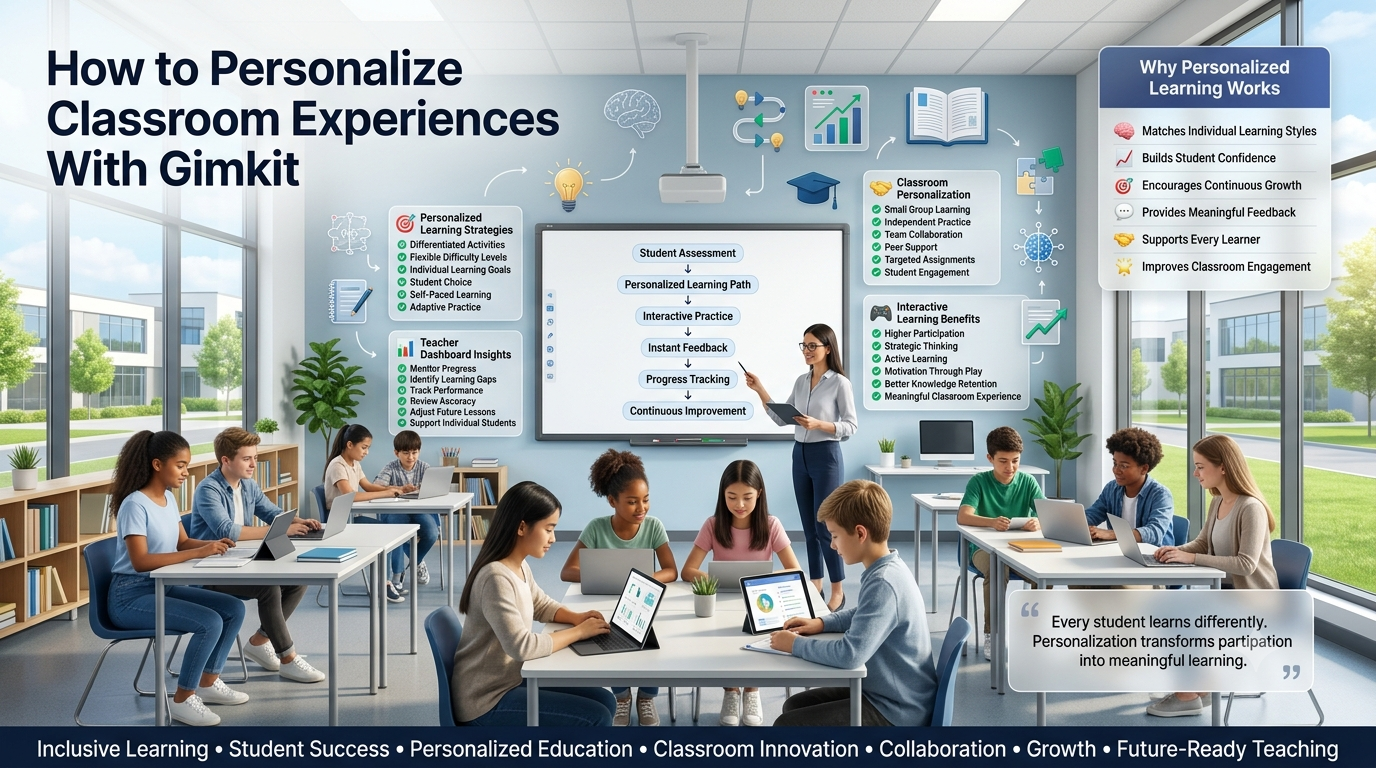
Gimkit is a game-based learning platform that turns
educational question sets into interactive classroom
experiences. Teachers prepare learning content, choose
a game experience and use it for structured review;
students answer questions while participating in
mode-specific activities.
This independent guide explains what Gimkit actually
does, why it feels different from a conventional quiz,
which benefits are plausible, which limitations matter,
and how educators can evaluate its fit for real lessons
without confusing engagement with proven learning gains.
Official documentation checkedPractical teaching examplesIndependent evaluation tool
Editorial distinction: GimkitApp.com is independent and
is not the official Gimkit service. This page does not
host Gimkit games or connect to private student records.
Platform at a glance
From questions to meaningful practice
Four concepts that explain the platform without replacing dedicated tutorials.
📚Question-based content
🎮Interactive modes
👥Class participation
📈Learning evidence
Core principle: a more exciting learning activity is
useful when students actually practise the intended
knowledge—not merely when the game feels entertaining.
The essential definition
What exactly is Gimkit?
Gimkit is an online educational game platform used by
teachers and students for question-based review, retrieval
practice and interactive classroom activities. Instead of
treating every question as an isolated multiple-choice
exercise, Gimkit places question answering inside game
experiences with their own goals, mechanics and pacing.
The platform's reusable question collections are called
Kits. A teacher can use a Kit as the
academic content for an eligible live game, and in
supported circumstances for an assignment.
The central distinction is between the knowledge being
practised and the activity used to practise it. A Kit
describes what learners need to answer. A game mode
describes the rules under which students interact with
that content. This separation makes Gimkit different
from a plain worksheet: it can change the surrounding
experience without necessarily requiring a completely
different set of academic questions.
During live use, a teacher hosts a game and participants
join using the invitation provided for that session.
Some experiences involve strategic decisions, earning
game resources or cooperating with other players.
Supported 2D modes can place movable characters called
Gims inside an interactive environment. The precise
mechanics depend on the selected mode, so it would be
inaccurate to describe every Gimkit game as a currency
race, a team contest or a character-navigation challenge.
Gimkit also includes educator-facing tools beyond the
game screen. Teachers can organise question content,
select activities, manage relevant Classes and inspect
eligible reports. These features make the platform
potentially useful as one component of a teaching
sequence, although it does not replace curriculum
design, teaching explanations or professional assessment
judgment.
Learning contentReusable Kits contain questions and intended answers.
Activity structureDifferent modes create different ways to participate.
Instructional purposeEducators can connect practice with lesson objectives.
Verified platform foundation:
Gimkit's official Help Center documents creating Kits,
hosting a live game, selecting modes, game options,
student joining and game reports. This article uses
those published behaviours as its product baseline.
See the primary-source links at the end of this guide.
Product differentiation
What makes Gimkit different from an ordinary classroom quiz?
The difference is not simply that questions appear on
screens. Gimkit can place academic retrieval inside a
continually changing game environment. This creates
possibilities for engagement, but the value depends on
how well the activity supports learning.
🧠
Questions remain the academic foundation
A conventional classroom quiz often ends with an
answer and a score. Gimkit can reuse the same
questions inside an extended activity, creating
additional opportunities for recall. Those repeated
opportunities are only valuable when students attend
to the question and understand the response.
🎯
Gameplay introduces goals and choices
Depending on the mode, players may make strategic
decisions, navigate environments or collaborate
on a task. The game supplies a reason to continue,
but a well-designed lesson must still ensure that
students have enough opportunities to practise
the intended knowledge.
📊
Teachers can examine some results
Eligible reports provide information about student
and question performance. That information may help
identify misconceptions or topics requiring further
review. It does not automatically establish that a
student has mastered a concept outside the game.
Game-based learning is more than digital entertainment
Gamification and game-based learning are related but
not identical ideas. Gamification typically describes
the use of selected game elements—such as progress,
points or achievements—in an activity. Game-based
learning places instruction inside a playable
experience with rules and objectives. Gimkit contains
elements of both, depending on the activity being
described.
A language teacher might use rapid retrieval questions
to reinforce a set of words. A science teacher might
use carefully designed alternatives to expose common
conceptual misunderstandings. A history teacher could
ask learners to distinguish causes from consequences.
The educational content is not defined by the game
engine; it is chosen by the educator. This is why
question quality remains essential even when the
visual game experience is sophisticated.
Why strategy can help—and sometimes distract
Strategic decisions can give a learner a sense of
agency. Students may feel that they are choosing how
to pursue an objective rather than following a fixed
series of questions. For some learners, this creates
motivation to continue participating. For others,
additional choices may increase cognitive demands,
especially when the subject is new or when the game
pace is fast.
A teacher should therefore ask two separate questions:
did students enjoy the experience, and did they
demonstrate understanding of the intended content?
The first is an engagement question. The second is
a learning question. Neither answer should be
substituted for the other.
Why different modes matter
A competitive experience may appeal to students who
enjoy clear rankings and fast decisions. A calmer
activity may better support a group that benefits from
additional processing time. A collaborative activity
can introduce shared objectives, provided that the
learning task is designed so that all learners
participate. Gimkit's official Mode Picker describes
activities and provides labels that teachers can use
to select an appropriate experience.
These are principles of selecting an activity, not
instructions for operating the Mode Picker. Detailed
selection workflows belong to the separate
Gimkit Game Modes guide.
The learning interaction
Four stages that connect gameplay with knowledge
The sequence below is an educational interpretation
of a useful practice cycle. It is not a claim that
Gimkit's private software architecture uses these
exact stages.
01
Encounter a question
A learner sees a prompt that tests a specific
fact, connection, rule or concept. The question
needs to be readable, relevant and appropriately
difficult.
02
Retrieve an answer
The learner attempts to produce or identify
the correct response. This retrieval opportunity
can be useful when the task requires meaningful
recall rather than random selection.
03
Receive feedback
The response is evaluated. A teacher can use
incorrect answers as signals for explanation,
correction and future practice.
04
Continue or adapt
Students return to the activity while the
teacher later considers whether the evidence
supports reteaching, further practice or
a different instructional approach.
Understanding the relationship between repetition and retention
Repetition by itself is not a guarantee of durable
learning. Repeating the same answer without
understanding may improve familiarity with that
particular item but fail to support transfer to
a different context. Effective practice varies
with the subject, learner's prior knowledge,
feedback quality and opportunities to use the
knowledge elsewhere.
Consider a mathematics activity containing
multiplication facts. Quick repeated retrieval
might be appropriate when the instructional goal
is automaticity. The same format would be less
sufficient when the goal is to explain why
multiplication distributes over addition.
The second objective requires conceptual
explanation, examples and possibly written
reasoning in addition to game practice.
In science, repeated questions can help students
distinguish closely related concepts, but misconceptions
often need explicit explanation. In language learning,
a word-choice question can test recognition without
demonstrating that a learner can use that word in
a conversation. Thus the nature of the academic
objective determines how strongly the game activity
aligns with it.
A practical principle is to choose a narrow objective
that can be rehearsed meaningfully through short
questions. Then use a second assessment method when
the objective also requires written work, sustained
reasoning, physical performance or creative production.
Original interactive application
Gimkit Classroom Fit & Evidence Lab
Is Gimkit a good choice for a particular learning
situation? Evaluate the instructional goal, available
devices, internet connection, accessibility needs and
classroom conditions. Then record observations and
generate an evidence-aware teaching brief.
This is a standalone educational decision-support tool
built by GimkitApp—not an official Gimkit product,
diagnostic assessment, automated mode selector or
connection to a school's student data.
✦ Classroom Fit & Evidence Lab
Evaluate → Observe → Export your decision brief
LOCAL • NO ACCOUNT
Describe your teaching context
The analysis uses transparent editorial rules:
learning suitability, infrastructure readiness,
participation conditions and safeguards. It does
not generate a fabricated scientific effectiveness score.
Your inputs stay in this browser session. The
evaluator does not request student identities
or transmit a classroom roster.
Evaluation results
Select a context or run an analysis to see the recommendation.
Record evidence after a trial activity
Enter optional, anonymous classroom-level observations.
This workspace describes what was observed; it cannot
establish that Gimkit caused a change in achievement.
Evidence summary
Enter anonymised numbers to generate a descriptive review.
Decision brief for your records
Combine the classroom-fit findings and optional
observation data into a concise written brief.
Use it as an internal discussion aid, not
a formal effectiveness certification.
Your decision brief
Run an evaluation to generate a report.
Method: transparent conditional rules, not machine-learning
predictions or a validated scoring instrument. All
observations remain local. Actual platform availability
and mode entitlements must be checked on Gimkit.
Benefits with appropriate evidence
Potential benefits of Gimkit for teaching and learning
A high-quality review of Gimkit should describe possible
advantages without presenting every benefit as a guaranteed
result. Educational value emerges from a combination of
the activity design, the learner, the teaching context
and the follow-up instruction.
🙋
1. More opportunities for participation
In a whole-class oral review, only one or a few
students may answer at a time. A digital question-based
activity can give more learners simultaneous
opportunities to respond. That is a meaningful
design advantage when the devices are accessible,
the instructions are clear and students are
genuinely answering rather than guessing rapidly.
Participation should still be checked rather than
assumed. A student can be technically connected to
a session but distracted from the academic task.
A teacher may compare the number of active learners,
observe classroom behaviour and ask a small sample
of students to explain their answers afterward.
🔁
2. Practice through repeated retrieval
When learners repeatedly recall relevant information,
they may strengthen access to previously studied
knowledge. A game can make further practice feel
purposeful because each answer contributes to
progress within an experience. This can be useful
for terminology, facts, conceptual distinctions
and some procedural knowledge.
The limitation is equally important: recalling a
definition does not automatically show that a student
can explain, apply or evaluate it. Pair the game
activity with a task requiring the level of thinking
described in the actual learning objective.
💬
3. Openings for meaningful feedback
Question responses can give learners and educators
information about what appears correct and what
needs revisiting. This can be especially useful
when common errors are tied to recognisable
misconceptions. Teachers can pause subsequent
instruction, model the relevant reasoning and
provide another opportunity to practise.
Research on educational feedback does not imply
that any instant right-or-wrong indicator is
sufficient. Useful feedback explains what needs
improvement and helps the learner move toward
the goal. The Education Endowment Foundation
emphasises task-related and actionable guidance.
🧭
4. Variety in classroom practice
Teachers sometimes need different activity formats
for different groups or lesson phases. Gimkit's
mode-based structure offers a range of experiences,
from more intense competitive activity to approaches
with calmer or collaborative characteristics.
This flexibility is meaningful when the educator
selects a mode for a reason other than novelty.
A shorter, simpler experience may be more suitable
for a group unfamiliar with the academic content.
A group with established knowledge may handle
more complex gameplay. The best choice changes
with the learning objective rather than with
the popularity of a particular game.
📈
5. Information for further teaching
Eligible Gimkit reports include views such as
Student Overview, General Overview and Question
Breakdown. These may help the teacher notice
whether an item was widely misunderstood or
whether certain content should receive more attention.
Such reports are descriptive classroom evidence.
They do not establish causes by themselves. Question
difficulty, guessing, repeated exposure and unequal
opportunities to participate can all affect what
a score means. Teachers should interpret results
alongside explanations, classroom observations
and independent work.
🌱
6. Motivation and learner agency
Some learners respond positively to short goals,
visible progression and opportunities to choose
actions. These design elements can make a review
activity feel less repetitive. For the right
class, game mechanics can support persistence
and interest during practice.
Motivation is not uniform. Learners who dislike
public competition, fast decisions or sensory
intensity may respond less positively. The
educator should offer reasonable adjustments,
select appropriate formats and avoid interpreting
visible excitement as a universal measure of success.
What the research actually allows us to conclude
The broader research on formative feedback, retrieval
practice and instructional engagement provides reasons
to design practice thoughtfully. It does not justify
claiming that one named educational platform always
produces superior academic outcomes. To establish a
product-specific causal effect, a study would need
an appropriate comparison, outcome measures,
sufficient participants and attention to other
explanations for differences in results.
A more defensible statement is that Gimkit provides
a feature set capable of supporting relevant
learning activities. Whether those activities
improve a particular class's understanding depends
on implementation and evidence. This distinction
protects teachers from purchasing or adopting
technology on the strength of excitement alone.
A lesson that combines clear questions, active
recall and subsequent explanation has a plausible
educational rationale. But the presence of
leaderboards, points or colourful visuals should
not be treated as independent proof that learning
has occurred.
Practical teaching applications
Realistic Gimkit classroom use cases by learning objective
The examples below are illustrative classroom
scenarios—not invented testimonials or claims
that a particular school achieved these results.
Each one identifies a suitable objective, a
reasonable approach and evidence a teacher could
collect afterward.
Languages • Retrieval
Vocabulary recognition after instruction
A language teacher has introduced a small set
of expressions through reading and conversation.
Students understand the meanings but need additional
retrieval practice. A short question-based activity
can ask learners to recognise the correct expression
in a sentence or choose a meaning from closely
related alternatives.
The teacher should avoid testing only isolated
word translation if the ultimate goal is contextual
language use. After gameplay, ask students to write
or speak original sentences with selected words.
Compare performance on an independent follow-up
task to see whether recognition transferred.
Evidence to collect:
Correct use of vocabulary in new sentences and common confusion pairs.
Science • Conceptual distinctions
Identifying misunderstood science concepts
Students studying physical or biological science
may confuse two related processes, units or terms.
The teacher can design short questions containing
distractors that reflect plausible incorrect ideas.
The purpose of the activity is not simply
to reward the fastest student.
After reviewing response patterns, the educator
selects one misconception and demonstrates why
it is incorrect. Learners then explain the concept
in their own words and answer a new application
question. This approach connects game responses
to an explicit instructional decision.
Evidence to collect:
Which incorrect concepts persisted after explanation and whether independent reasoning improved.
Mathematics • Fluency
Practising previously taught procedures
Students may already understand a procedure but
need opportunities to recall it efficiently.
A teacher could use an activity to practise
multiplication facts, fraction equivalences
or simple algebraic relationships. Items should
be calibrated to the learner's knowledge so that
speed pressure does not replace thinking.
The game is less appropriate as the sole method
for teaching a new multi-step derivation. Afterward,
use a few non-game questions to determine whether
the learner can solve unfamiliar variations and
explain the reasoning. Fluency and conceptual
understanding are related but different outcomes.
Evidence to collect:
Independent accuracy, explanation quality and errors on unfamiliar problem formats.
History • Knowledge organisation
Reviewing chronology and cause-and-effect
In a history unit, students may need to distinguish
events, individuals, causes and consequences.
Questions can ask learners to select which development
preceded another, identify an event's significance
or recognise a plausible causal relationship.
The teacher should be careful not to reduce historical
interpretation to a set of disconnected dates.
A productive follow-up asks learners to write a
short explanation connecting evidence and causes.
The game then serves as preparation for discussion
rather than a substitute for disciplinary thinking.
Evidence to collect:
Accuracy of an independent timeline and clarity of written causal explanations.
Cross-curricular • Entry check
Finding what a class remembers
At the start of a new unit, the teacher wants
to know which prerequisite ideas are familiar.
A brief review game using accessible questions
can provide a preliminary signal about prior
knowledge. The content should be selected to
answer a specific planning question: what needs
revisiting before the next lesson?
This approach is less defensible when the activity
introduces so much unfamiliar gameplay that mistakes
may reflect interface confusion rather than knowledge.
A non-game question or short discussion helps verify
whether the initial patterns are real.
Evidence to collect:
Topics requiring reteaching, independent explanations and number of students who could not access the activity.
Inclusive teaching • Adaptation
Supporting different participation needs
A mixed-ability class may include learners who
process information at different speeds, prefer
quieter activities or need reading and sensory
accommodations. An educator can consider a
less intense format, shorten the activity and
preview the question language beforehand.
A digital game should not become a barrier to
students who need a different mode of participation.
Teachers should check practical accessibility
with the actual device, browser and learners.
If suitable accommodations are unavailable,
an alternative teaching activity is preferable
to requiring inaccessible participation.
Evidence to collect:
Participation coverage, reported barriers and whether accommodations supported meaningful involvement.
Review • Spaced revisiting
Returning to knowledge after a delay
A teacher can revisit concepts introduced earlier
in the term rather than restricting review to
the end of a unit. Previously studied material
can be sampled through short retrieval prompts,
helping the educator discover what students
can still recall after time has passed.
Repeated play of the same items may create
item familiarity, so some questions should
present knowledge in fresh forms. The key outcome
is durable, transferable understanding,
not accumulated game currency or a high
short-term score.
Evidence to collect:
Delayed recall, performance on new examples and concepts requiring additional review.
Discussion • Evidence gathering
Preparing students for an explanatory discussion
In subjects where learners must justify a position,
a short multiple-choice activity can surface
disagreements or common assumptions. The teacher
then selects a question where responses suggest
competing ideas and invites students to explain
the reasoning behind their answers.
The goal is not to make the game itself a debate.
Instead, question results identify useful starting
points for discussion. The educator should
invite explanations from students with different
views, provide accurate information and conclude
with a clearer shared understanding.
Evidence to collect:
Quality of explanations, willingness to revise ideas and reasoning on a new question.
What these classroom cases have in common
Each starts with an educational question rather than
a game choice. The teacher identifies what learners
should know or do, selects suitable practice
questions, considers whether the group can access
the activity and determines what evidence will
count as success. The game is a means to an
instructional end.
The examples also distinguish low-level recognition
from deeper understanding. Recognising a scientific
definition, solving a familiar algebraic problem
and explaining why a procedure works are different
achievements. Gimkit may contribute to each
sequence, but teachers must choose methods that
match the required level of thinking.
A dedicated operational guide explains how to
prepare and run a session; this article deliberately
focuses on why a classroom might—or might not—choose
the platform. For the detailed teacher-side process,
visit the
Gimkit Host guide.
Balanced product evaluation
Gimkit limitations, trade-offs and responsible use
Gimkit is not a universally appropriate teaching
method. Successful implementation requires practical
infrastructure, suitable content and thoughtful
instructional decisions.
Consideration
Potential concern
Responsible response
Internet and devices
Students may lack suitable devices, connectivity or browser access.
Test access, prepare an alternative activity and avoid penalising students for infrastructure barriers.
Learning versus entertainment
Some learners may pay more attention to game progress than subject understanding.
Use a narrow objective and verify understanding outside the game.
Competitive pressure
Fast pace or public comparison may reduce confidence for some learners.
Review format suitability and choose a calmer or noncompetitive alternative where appropriate.
Accessibility
Reading, sensory, motor or device requirements may create barriers.
Check actual accessibility needs before class and provide reasonable alternatives.
Question validity
Poorly written questions can reward guessing or teach incorrect information.
Review wording, correct responses, distractors and curriculum alignment.
Assessment interpretation
A gameplay score may be affected by strategy, repeated exposure or guessing.
Use reports as formative signals, then confirm learning through other tasks.
Subscription access
Some modes and educator features require paid access.
Verify current account entitlements before depending on a feature.
School policy and privacy
Institutions may require approval for external education platforms.
Follow applicable safeguarding, data protection and institutional procedures.
The challenge of equitable access
An activity is not inclusive merely because it is
available online. Some students may have older
devices, restricted access, slow internet or
assistive-technology requirements. Others may
need additional reading time or a quieter
environment. Teachers should test these conditions
in advance rather than discovering them while
the activity is underway.
Shared devices can sometimes support participation,
but they change what individual game results
mean. If two learners jointly answer questions,
an individual performance report cannot be
interpreted in the same way as a report from
a fully independent attempt. The instructional
arrangement must be considered when interpreting
the evidence.
Why engagement does not equal achievement
Students may be enthusiastic about a game while
continuing to hold misconceptions. They may
remember the visual experience more strongly
than the related content, or focus on maximising
game resources. These possibilities do not
make game-based practice ineffective; they
show why teaching goals and follow-up matter.
For example, students might repeatedly choose
the correct term from a set of answers but fail
to explain that term without options. A teacher
can discover this difference through a short
written response or discussion. That comparison
adds more instructional value than a leaderboard
alone.
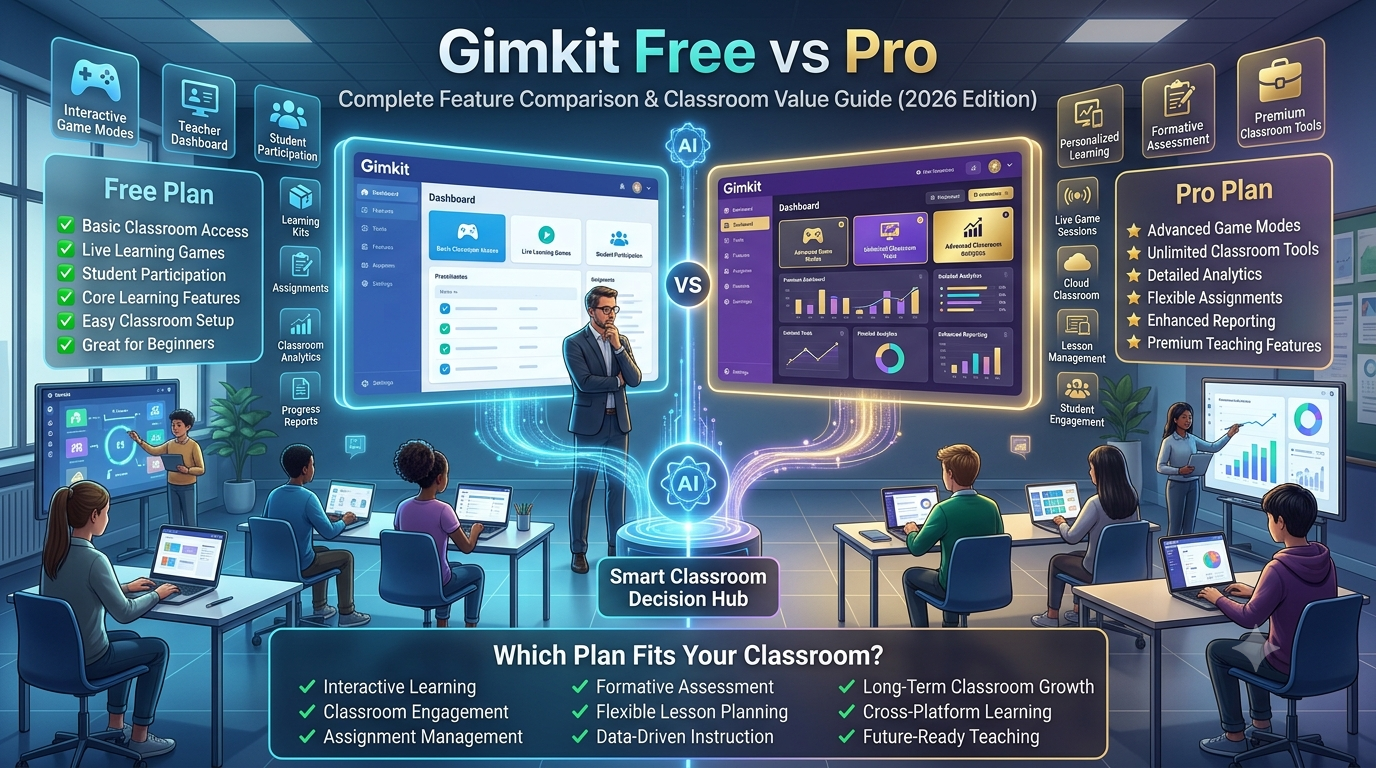
Account access and subscription boundaries
Gimkit documents free educator accounts under
the Basic tier as well as a paid Pro offering.
According to its Help Center, free educators
can use core features, while Pro provides
additional capabilities including Pro-exclusive
modes and assignments. Available details may
change, so current plan comparisons should
be checked before a teacher commits to a
particular classroom activity.
This article does not reproduce a pricing calculator
or feature-by-feature subscription comparison.
Those belong to the
Gimkit Pricing guide.
Safeguarding, supervision and sensible controls
A teacher should check whether the school permits
the platform, understand what data is collected,
and follow local policies when creating or managing
student accounts. Learners should receive only
the information needed to enter the activity.
Unnecessary personal details should not appear
in classroom nicknames or publicly shared results.
The way a Class is configured can influence
student identity and participation management.
This should be handled through approved
educator procedures rather than improvising
outside the school's policies. Teachers should
also have a plan for inappropriate names,
unexpected participants and interruptions.
When Gimkit is the wrong choice
A game-based quiz may be a poor primary activity
when students have not yet received an explanation,
when the assessment requires extensive writing,
when a practical physical skill must be demonstrated,
or when access barriers cannot be resolved.
It may also be inappropriate when the available
time is too short for a meaningful learning
opportunity or when competition creates avoidable
stress.
The appropriate response is not to force the
platform into every lesson. Use discussion,
demonstration, written work, accessible oral
questioning or another activity when those
better match the goal. A strong technology
decision includes being willing not to use
the technology.
Evidence-based classroom decisions
How educators can judge whether Gimkit is helping
A reasonable evaluation of a learning platform
begins before the activity and continues after
it. The teacher should decide which learning
outcome matters, how it will be measured and
what other factors could affect the result.
A single engaging session can be worthwhile,
but it is not sufficient evidence for broad
claims about achievement.
A useful starting point is a narrow question:
“After this practice activity, can students
accurately distinguish these two concepts
on a different question?” This is more
informative than a vague aim such as
“Make students enjoy science more.”
Both enjoyment and understanding can matter,
but they require different evidence.
🎯
Define the target
Write a measurable statement about the knowledge or skill students should demonstrate.
🧾
Collect a baseline
Use a relevant question or task before the activity where practical.
👀
Observe participation
Notice access problems, off-task behaviour and opportunities to answer.
🔎
Check transfer
Use a fresh follow-up question to see whether knowledge generalises beyond familiar items.
What participation data can and cannot show
The proportion of students who joined a learning
activity can describe access and participation.
It may be useful when comparing classroom
logistics across different teaching formats.
However, being present in a game does not
necessarily mean that every student answered
meaningfully or understood the material.
Teachers should avoid turning raw participation
counts into a learning-quality score. Instead,
look for a combination of observations: who
had access, whether learners engaged with the
academic questions and whether they could
explain their responses afterward.
How to interpret before-and-after accuracy
A before-and-after comparison can be useful
when the questions assess similar content
at an appropriate level of difficulty. If
accuracy changes from 60% to 72%, the
descriptive difference is 12 percentage
points. It does not follow automatically
that the game caused a 12-point improvement.
Students might have received additional
explanation, become familiar with the test,
or encountered differently difficult questions.
A stronger evaluation uses comparable tasks
and records relevant changes in instruction.
For causal conclusions, a suitable comparison
design is needed.
What makes an observation worth saving?
An actionable note identifies a specific
misconception or barrier. “Several students
confused mass and weight when answering
application questions” points toward a
teachable issue. “The game was fun” is
a legitimate impression, but not by itself
a clear instruction for the next lesson.
The Classroom Fit & Evidence Lab above
encourages anonymous summaries rather
than individual student records. Its
descriptive outputs can support discussion,
but they should not be used to assign grades,
diagnose learning conditions or make high-stakes
decisions about students.
Using feedback without creating excessive workload
Not every wrong answer requires an immediate
individual response. Teachers can first
identify one or two high-value misconceptions,
provide a clear explanation, and ask learners
to attempt a new related task. This limits
unnecessary administration while connecting
information to practical teaching decisions.
For broader conceptual research about reliable
educational findings, see our
Educational Evidence reference article.
The evidence framework here is intentionally
limited to evaluating the appropriateness
of using Gimkit in a lesson.
Understanding feature boundaries
What Gimkit can do—and what belongs to other teaching tools
Educational need
Where Gimkit may contribute
Where another method may be needed
Remembering terminology
Question-based retrieval and review practice
Using vocabulary accurately in original speaking or writing
Checking misconceptions
Selected questions and eligible report patterns
Discussion, explanation and alternative assessment tasks
Explaining reasoning
Prompting prior knowledge and revealing disagreements
Extended writing, oral explanation and worked examples
Group participation
Supported collaborative or group-oriented gameplay
Direct observation of teamwork and equitable contribution
Tracking understanding
Eligible response reports
Independent assessments and longer-term evidence
Demonstrating practical skills
Reviewing foundational knowledge before practice
Authentic physical performance or practical demonstration
Is Gimkit primarily a learning platform or a game?
It is useful to describe Gimkit as an educational
platform delivering game-based question activities.
The academic questions have a teaching purpose,
while the game mechanics shape participation.
Treating it as only an entertainment game ignores
the educator's role in choosing content. Treating
it as a complete instructional system overstates
what one digital application can accomplish.
The distinction matters for school evaluation.
An educator considering Gimkit should examine
content relevance, access, the available game
experience, reports and how the activity will
fit into lessons. The decision should not rest
solely on marketing descriptions or screenshots.
Can learners use Gimkit without a teacher?
Student participation depends on the relevant
workflow. Gimkit's account guidance says students
generally do not need their own accounts to
participate in ordinary live games. A live
session still requires an active hosted
invitation. Pro-enabled assignments can
support independent work from a shared link.
This should not be confused with unlimited
public access to arbitrary active game codes.
Students seeking the actual joining procedure
can use the dedicated
Gimkit Join resource.
We keep the student-entry instructions separate
from this platform evaluation to protect
the primary search intent of each article.
How important is the quality of the question Kit?
Question quality is foundational. If answers
are incorrect, options are ambiguous or
important topics are missing, polished gameplay
cannot repair the academic content. Educators
should inspect questions for factual accuracy,
clear wording, appropriate difficulty
and alignment with the expected learning.
A question requiring only recognition may
be appropriate for identifying terminology,
but insufficient for evaluating a student's
ability to defend a conclusion. The teacher
must judge not only whether a question has
a correct answer but whether answering it
provides useful evidence about the desired
skill. Our
Gimkit Questions article
owns the deeper question-quality topic.
Where do teaching and the platform meet?
Teachers still decide what students need
to learn, how much prior explanation is
necessary, which misconceptions matter
and how to respond afterward. Gimkit can
supply a structured practice activity,
but its educational value depends on
choices made before and after gameplay.
An effective lesson may include an initial
explanation, a short interactive practice,
a review of common mistakes and an
independent task. Other lessons may benefit
from discussion or demonstration instead.
Educational technology becomes more useful
when it expands good instructional choices
rather than replacing them.
A considered conclusion
When is Gimkit worth using in a classroom?
✅
Strong potential fit
The class has appropriate access, the institution
has approved use, questions are accurate and
the goal involves knowledge that benefits from
question-based practice. The teacher has a
meaningful way to check learning afterward.
🟡
Conditional fit
Questions need further preparation, some students
may find the activity inaccessible or the
gameplay style requires adjustment. A small,
low-stakes pilot can help determine whether
those barriers are manageable.
⛔
Not ready yet
The institution has not approved the platform,
the class has no usable connectivity or
important accessibility barriers remain
unresolved. Resolve those issues or use
another learning method first.
The bottom line
Gimkit's distinctive value comes from combining
question-based academic content with varied
interactive game experiences. It offers
opportunities for retrieval practice,
classroom participation and review of
eligible response data. Those capabilities
explain why a teacher might consider the
platform for selected parts of a lesson.
The strongest argument for use is not that
students will always be more excited or
automatically learn faster. It is that
a well-chosen game experience can provide
additional opportunities to work with
carefully selected knowledge. The actual
outcomes still need to be judged.
Gimkit should be evaluated as one educational
option in a wider instructional toolkit.
Where the objective, access and student
needs align, it may be worth testing.
Where they do not, choosing a different
activity can be the better educational
decision.
What Is Gimkit FAQ
Frequently asked questions
Short, direct answers followed by context
help teachers, students and parents understand
the platform without confusing it with
the official game service.
What is Gimkit in simple terms?
Gimkit is an educational game platform in which questions are used inside interactive activities. Teachers choose academic content and suitable gameplay, while students practise knowledge through questions and game objectives.
Is Gimkit a quiz website or a learning game?
It combines aspects of both. Kits supply questions and answers, while game modes supply different ways of participating. Calling it a game-based learning platform describes the combination more accurately than either label alone.
What makes Gimkit different from a traditional quiz?
Its game modes may incorporate ongoing decisions, goals and player interaction around the question content. These mechanics change the experience, although the learning value still depends on instructional design.
Who is Gimkit designed for?
Gimkit provides educator and student account types. Teachers use educator tools to prepare and host learning activities; students participate in the eligible experiences made available to them.
Can Gimkit support real classroom learning?
It can support retrieval practice, formative checks and topic review when questions and gameplay align with the lesson. Evidence of meaningful learning should come from appropriate follow-up tasks, not only game participation.
What are the main educational benefits of Gimkit?
Potential benefits include more opportunities for learners to answer questions, varied practice formats, engaging goals and access to eligible performance reports. Results vary by classroom context, content quality and implementation.
Does Gimkit automatically improve test scores?
No. There is no sound basis for guaranteeing improvement from using one platform. Learning outcomes depend on the questions, teaching, learners, available support and how achievement is measured.
Can Gimkit help teachers find misconceptions?
Well-designed questions and eligible reports can reveal patterns that deserve attention. A teacher still needs to interpret errors, ask explanatory questions and decide on appropriate next steps.
Is Gimkit only useful for younger students?
No single age group defines all possible use cases. The appropriate audience depends on question content, gameplay demands, accessibility, student preferences and institutional policies. Educators should evaluate suitability for their own learners.
Can Gimkit be used for maths and science?
Yes, the question-based format can support suitable knowledge review in mathematics and science. It does not replace the extended reasoning, explanation, experimentation or demonstrations those subjects may require.
Can Gimkit be used for language learning?
It can provide relevant opportunities for vocabulary and concept recognition, especially when the questions are contextually meaningful. Written and spoken language tasks remain important for checking productive fluency.
Does Gimkit require internet access?
Gimkit is an online platform. A usable internet connection and suitable access are important for its normal digital gameplay. Teachers should check school connectivity and have an alternative when access is unreliable.
Do students need accounts to participate?
Official Gimkit account guidance indicates that students can generally join ordinary live games without creating an account. Certain account-based workflows have additional requirements.
Are there free and paid Gimkit options?
Yes. Gimkit Basic is the free educator tier, and Gimkit Pro is a paid option with additional capabilities. The exact current entitlements should be confirmed in official documentation.
Can teachers use Gimkit for homework?
Official documentation describes assignments for eligible Gimkit Pro educators. These allow supported independent activities, but they are a separate workflow from ordinary live game hosting.
What is the difference between a Kit and a game mode?
A Kit contains the academic question content. A game mode defines a playable experience around that content. They serve different functions even when used together.
Can a teacher assess understanding through Gimkit?
Gimkit can contribute formative evidence through responses and eligible reports. It should not be treated as a complete assessment system for every learning outcome, particularly where written reasoning or practical performance is required.
What are the drawbacks of using Gimkit?
Possible drawbacks include device and connectivity requirements, accessibility barriers, competition-related stress, distracting gameplay and limitations in interpreting game scores. These should be evaluated in context rather than assumed to affect every class.
How long should a Gimkit learning activity last?
There is no universal ideal duration. Choose a length that allows meaningful practice and sufficient lesson time for explanation and follow-up. Short activities can be useful when the goal is narrow.
Should teachers use Gimkit in every lesson?
No. The choice should follow the learning objective. A lesson requiring a practical demonstration, extended written argument or new concept explanation may be better served by another method.
Does Gimkit offer reports?
Official documentation describes eligible live-game reports with student, general and question-level views. Their availability and interpretation depend on the supported activity and teacher account context.
How is Gimkit different from an ordinary worksheet?
Gimkit adds interactive game objectives and digital participation around question content. A worksheet may be more appropriate for some extended reasoning, written explanation and offline practice tasks.
Is Gimkit appropriate for every learning style?
No educational method suits all learners in exactly the same way. Teachers should evaluate accessibility needs, pace, competitive pressure and alternative participation methods instead of relying on fixed learning-style categories.
Is Gimkit banned in schools?
There is no universal school ban. Individual institutions may restrict external websites or require prior approval. Teachers and students should follow their specific school or district policies.
Is GimkitApp.com the official Gimkit website?
No. GimkitApp.com is an independent educational resource. Official accounts, live games, payments and platform services are operated through Gimkit's own websites.
Continue learning by intent
Specialist resources for specific Gimkit questions
This article owns the overall platform evaluation.
The following related resources own distinct
deeper tasks. Each is linked once here rather than
placing long lists of repetitive keywords in the article.
Official product documentation and research references
Feature descriptions in this guide are based on
published Gimkit documentation. Educational research
references explain general teaching principles;
they are not evidence that Gimkit itself produced
any particular academic improvement.
Editorial method: Product statements are
distinguished from pedagogical analysis. Illustrative
classroom examples are clearly described as examples.
The interactive decision-support tool does not claim
to predict student achievement or access Gimkit
user data. Feature availability may change.