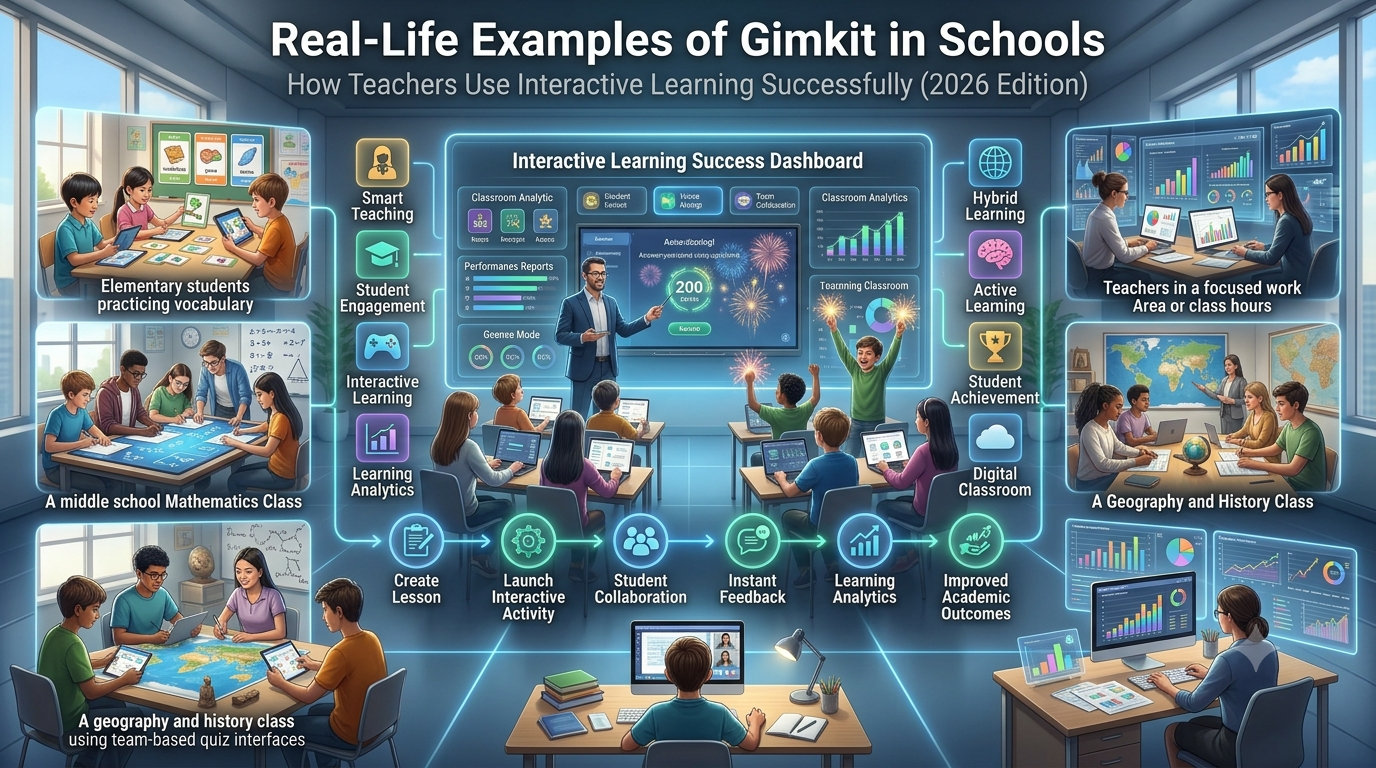
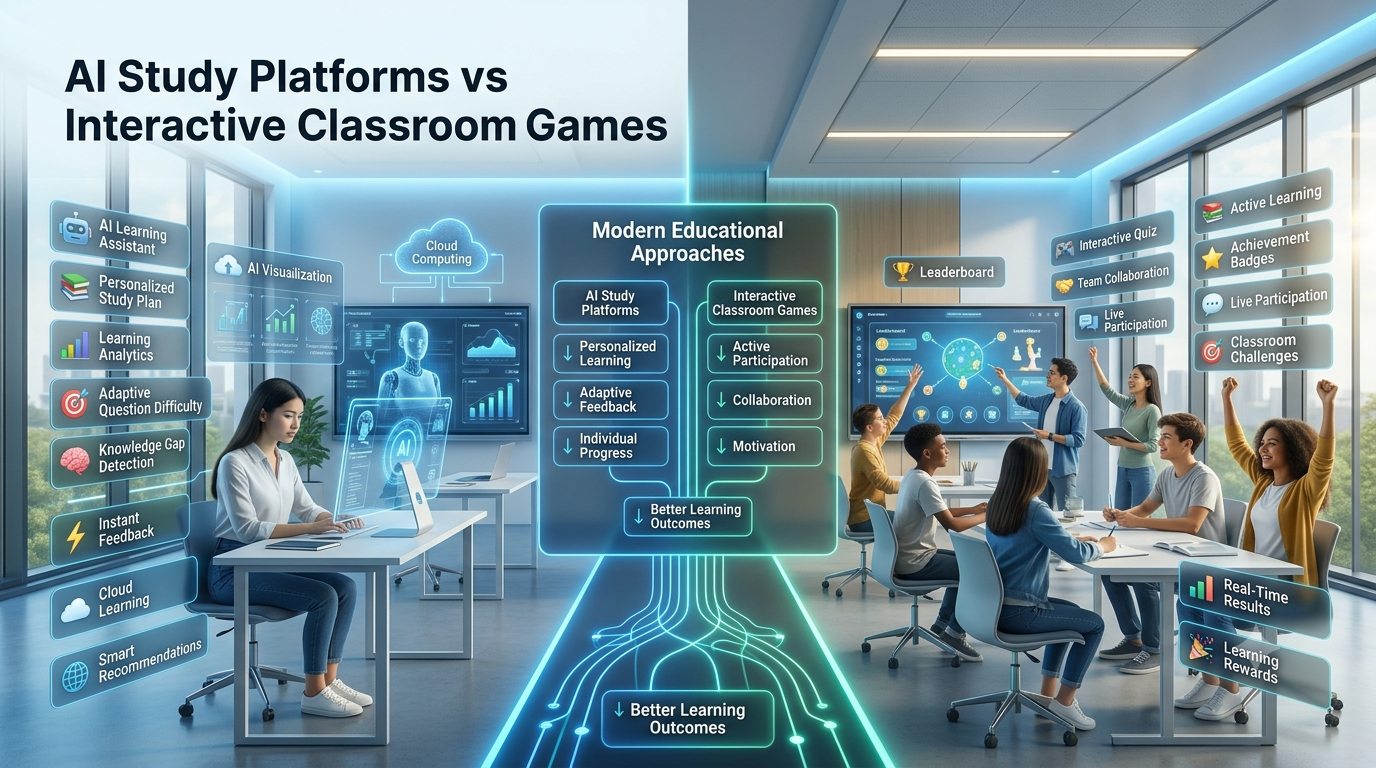
Integrating Gimkit Into Daily Teaching | Keeping students consistently engaged throughout the school day is one of the biggest challenges teachers face.
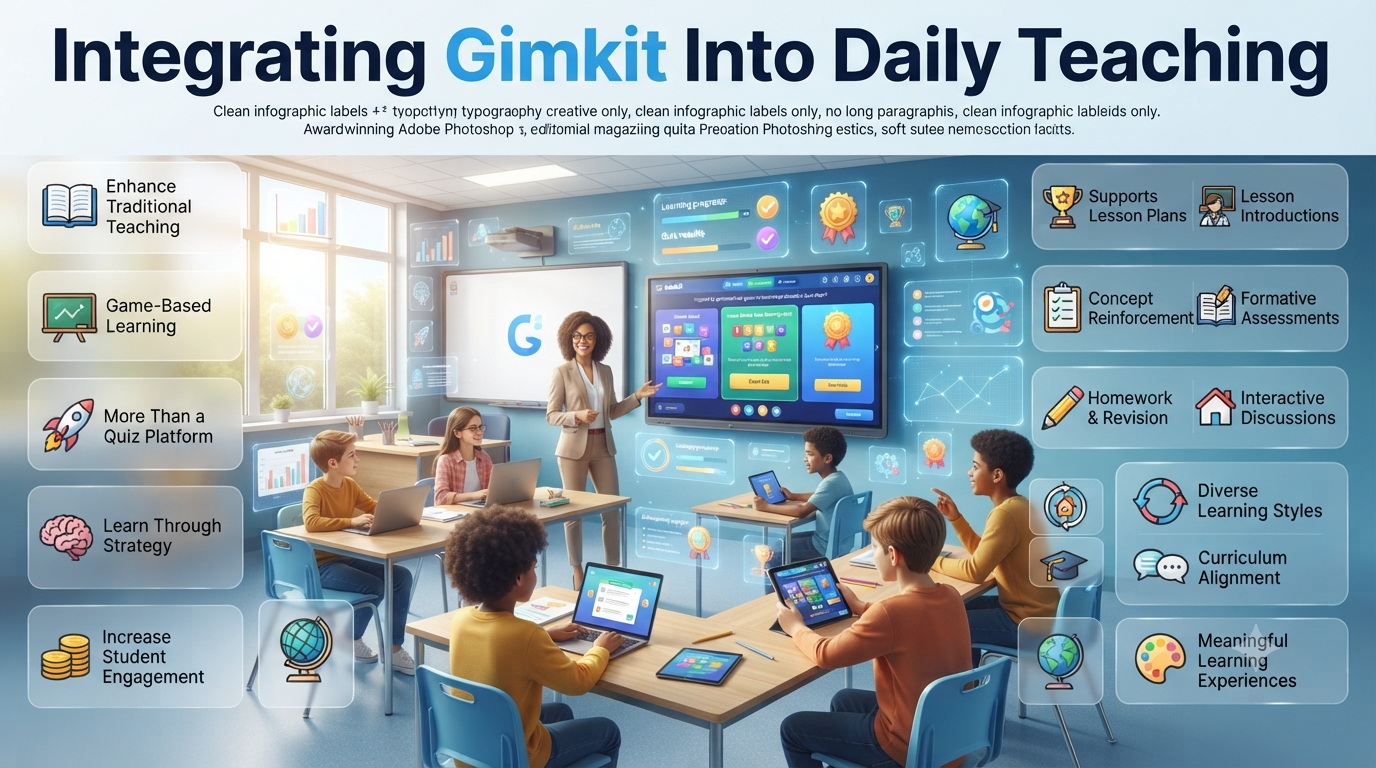
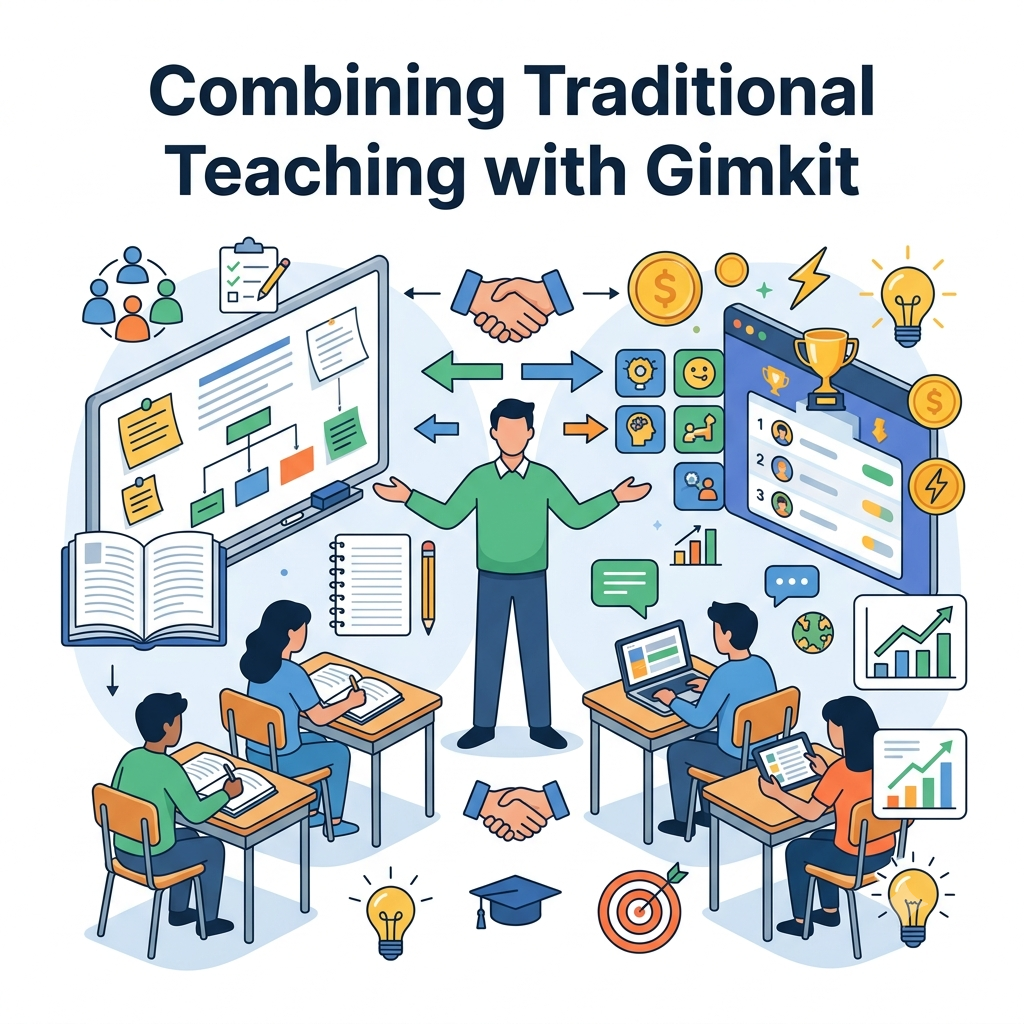
📚 Enhance Traditional Teaching: Traditional teaching methods are still highly effective, but keeping students engaged, encouraging active participation, and assessing understanding in real time often requires more interactive learning strategies.
🚀 Why Teachers Choose Gimkit: Gimkit has become a popular classroom tool because it transforms everyday lessons into exciting, game-based learning experiences that capture students’ attention.
🧠 More Than a Quiz Platform: Unlike many classroom quiz tools, Gimkit combines knowledge retrieval with engaging game mechanics, making learning both educational and enjoyable.
💰 Learn Through Strategy: Instead of simply earning points for correct answers, students collect virtual currency, make strategic decisions, and remain actively involved throughout each activity.
🌟 Increase Student Engagement: The combination of competition, rewards, and strategy creates a classroom environment where students stay motivated and excited to learn.
🏫 Support, Don’t Replace, Lesson Plans: Integrating Gimkit doesn’t mean replacing traditional teaching methods. It works as a flexible instructional tool that enhances existing lesson plans.
🎯 Use Across Every Stage of Learning: Teachers can use Gimkit for:
🚀 Lesson introductions
📖 Concept reinforcement
📝 Formative assessments
🏠 Homework assignments
🔄 Revision sessions
💬 Interactive classroom discussions
🎨 Adapt to Different Learning Needs: Gimkit supports diverse learning styles by providing interactive, student-centred activities that keep learners actively involved.
📊 Stay Aligned with Curriculum: Every Gimkit activity can be designed to reinforce curriculum objectives while helping teachers monitor student progress effectively.
🌍 Create Meaningful Learning Experiences: When thoughtfully integrated into daily instruction, Gimkit helps build a collaborative, engaging, and enjoyable classroom where students learn with confidence and enthusiasm.
Why Teachers Are Integrating Gimkit Into Daily Teaching
Daily integration allows Gimkit to become part of the learning process instead of serving as an occasional reward. Used intentionally, it can reinforce concepts, identify misconceptions, and increase classroom participation without disrupting instructional goals.
Several factors contribute to its growing adoption.
Active Participation
Many traditional review sessions involve only a few students volunteering answers. Gimkit encourages participation from the entire class because every student interacts with the questions simultaneously.
Instead of passively observing, learners continually make decisions, answer questions, and adjust their strategies throughout the activity.
💡 Pro Tip: Reserve short Gimkit sessions for the beginning or end of lessons to maximise engagement without reducing instructional time.
Immediate Feedback
One of Gimkit’s strengths is providing instant feedback. Students quickly recognise incorrect answers and have opportunities to improve through repeated exposure to the same concepts.
Teachers also benefit from immediate insight into areas where the class may need additional explanation.
For example, if many students struggle with a particular science concept during a live game, the teacher can pause briefly and clarify the misunderstanding before continuing.
Increased Motivation
Game mechanics naturally increase motivation when used appropriately.
Instead of working through repetitive worksheets, students experience:
Immediate rewards
Friendly competition
Personal progress
Strategic decision-making
Continuous engagement
Importantly, the learning objectives remain central. The game elements simply make practice more engaging.
Efficient Formative Assessment
Formative assessment helps teachers understand student learning before high-stakes testing.
Because Gimkit records student responses automatically, teachers can quickly identify:
Frequently missed questions
Individual learning gaps
Class-wide misconceptions
Students needing additional support
Concepts ready for extension
This information helps teachers make informed instructional decisions without spending hours grading.
How Gimkit Supports Daily Classroom Instruction
Integrating Gimkit successfully means viewing it as a teaching tool rather than merely an educational game.
It can support almost every stage of a lesson.
1. Lesson Starters
Beginning a lesson with a short Gimkit activity activates prior knowledge.
Students recall previously learned material while teachers gauge existing understanding before introducing new concepts.
Example:
A history teacher begins a lesson on the Industrial Revolution with a five-minute Gimkit reviewing inventions studied the previous week.
This approach creates a natural bridge between old and new learning.
2. Concept Reinforcement
After teaching a new topic, students benefit from immediate practice.
Rather than assigning repetitive review questions, teachers can use Gimkit to reinforce:
Vocabulary
Mathematical procedures
Scientific terminology
Historical facts
Grammar rules
Foreign language phrases
The interactive format encourages repeated retrieval, which supports long-term memory.
3. Mid-Lesson Knowledge Checks
Teachers do not need to wait until the end of a lesson to determine whether students understand the material.
A brief Gimkit activity midway through instruction can reveal misconceptions early.
If many students answer incorrectly, the lesson can be adjusted immediately.
This flexibility leads to more responsive teaching.
4. End-of-Lesson Reviews
Five to ten minutes of Gimkit at the end of class helps consolidate learning before students leave.
These sessions allow teachers to:
Review key concepts
Address common mistakes
Reinforce essential vocabulary
Increase retention
Students leave with the material fresh in their minds.
5. Homework Assignments
Gimkit’s assignment mode enables students to complete activities independently outside the classroom.
Unlike traditional homework, assignments include interactive elements that encourage completion while providing teachers with detailed progress reports.
This approach supports both in-person and blended learning environments.
Educational Benefits of Integrating Gimkit Daily
When implemented thoughtfully, daily use offers advantages extending beyond classroom engagement.
Improved Knowledge Retention
Educational research consistently shows that retrieval practice strengthens memory.
Every correctly answered question helps reinforce neural pathways associated with the learned concept.
Repeated exposure over several days increases long-term retention more effectively than one large review session.
Higher Student Engagement
Engagement involves more than enjoyment.
Effective engagement means students remain cognitively involved throughout instruction.
Because Gimkit requires continuous responses, students spend more time actively processing information rather than passively listening.
Better Classroom Participation
Some students hesitate to answer questions publicly.
Gimkit provides a lower-pressure environment where everyone contributes simultaneously.
This can increase confidence, especially among quieter learners who may be reluctant to speak during whole-class discussions.
Data-Driven Teaching
Every completed activity generates useful classroom data.
Teachers can review:
Data Available
Classroom Benefit
Student Accuracy
Identifies learning gaps
Question Difficulty
Improves future assessments
Completion Rates
Measures participation
Individual Progress
Supports intervention planning
Class Performance
Guides lesson adjustments
Using this information regularly creates a more personalised learning experience.
Preparing Your Classroom Before Using Gimkit Daily
Successful implementation begins with thoughtful planning.
Teachers should consider both technical and instructional requirements.
Define Clear Learning Objectives
Every Gimkit activity should support a specific educational goal.
Ask yourself:
What should students learn?
Which skills are being practised?
How will success be measured?
What misconceptions should the activity reveal?
Games should reinforce instruction rather than replace it.
Choose the Appropriate Game Mode
Different learning objectives benefit from different gameplay experiences.
Consider factors such as:
Class size
Available time
Student age
Subject complexity
Collaboration requirements
Rotating game modes throughout the week helps maintain interest and prevents routine fatigue.
Prepare High-Quality Questions
The effectiveness of Gimkit depends heavily on question quality.
Well-designed questions should:
Match curriculum standards
Use clear language
Avoid ambiguity
Encourage thinking rather than guessing
Include plausible distractors for multiple-choice items
⭐ Expert Insight: A smaller set of carefully written questions often produces better learning outcomes than a large collection of repetitive or overly simple items.
Establish Classroom Expectations
Students should understand that Gimkit is part of learning, not simply entertainment.
Set expectations for:
Respectful competition
Academic honesty
Appropriate device use
Staying focused on learning goals
Supporting classmates during collaborative activities
Clear expectations help maintain a productive classroom atmosphere.
Teaching Models That Work Well with Gimkit
One of Gimkit’s greatest strengths is its flexibility across different instructional approaches.
Traditional Teacher-Led Instruction
Teachers can incorporate short Gimkit sessions before lectures, after demonstrations, or during revision periods.
This complements direct instruction without replacing it.
Blended Learning
In blended classrooms, Gimkit serves as one learning station while students rotate through independent practice, small-group instruction, and collaborative activities.
This approach maximises instructional time and accommodates diverse learning preferences.
Flipped Classrooms
Students learn new concepts through videos or reading assignments at home.
Classroom time then focuses on applying knowledge through discussion, collaborative problem-solving, and Gimkit-based review activities.
Project-Based Learning
Even in inquiry-driven classrooms, Gimkit can reinforce essential vocabulary, background knowledge, and key concepts before students begin larger projects.
This ensures learners have the foundational understanding needed for more complex tasks.
Common Mistakes to Avoid When Using Gimkit Every Day
Daily integration is most effective when balanced with other teaching strategies.
Avoid these common pitfalls:
⚠ Using Gimkit as a replacement for instruction Game-based learning should reinforce teaching, not substitute for direct explanation, discussion, or guided practice.
⚠ Repeating the same question sets too often Students may begin memorising answers instead of understanding concepts. Refresh and expand your question banks regularly.
⚠ Overemphasising competition While competition can motivate some learners, it may discourage others. Mix competitive and collaborative game modes to create an inclusive classroom environment.
⚠ Ignoring performance data The reports generated after each session provide valuable insights. Reviewing them helps identify learning gaps and informs future lesson planning.
⚠ Making every session too long Short, focused activities—typically 5 to 15 minutes—are often more effective than extended gameplay that can reduce attention and instructional time.
Choosing the right learning platform can significantly improve classroom outcomes. Compare leading educational tools in Gimkit Comparisons & Alternatives to find the best solution for your teaching style.
Interactive learning becomes more effective when students experience different gameplay formats. Discover engaging classroom activities in Gimkit Features & Game Modes and keep every lesson fresh.
Whether you’re a beginner or an experienced educator, practical guidance makes implementation easier. Follow our Gimkit Guides & Tutorials for step-by-step instructions and classroom best practices.
Every teacher benefits from proven instructional ideas that increase participation and motivation. Explore Gimkit Resources for Teachers for practical classroom-ready solutions.
Understanding pricing and premium features helps educators make informed decisions. Read detailed comparisons and expert evaluations in Gimkit Reviews & Pricing before selecting a subscription.
Small instructional improvements often lead to better classroom results. Discover practical teaching methods and winning techniques in Gimkit Tips & Strategies to maximize student engagement.
Expand your knowledge with a wide variety of educational content by browsing our General Articles, covering technology, learning, and classroom innovation.
Stay informed about the newest platform improvements, educational trends, and feature releases through Games Updates so you never miss important changes.
Strengthen learning with engaging assessments and interactive activities available in our Quiz Resources collection, designed for teachers and students alike.
If you experience sign-in problems or game access issues, visit Gimkit Login, Join & Troubleshooting for reliable solutions and step-by-step troubleshooting guides.
Step-by-Step Guide to Integrating Gimkit Into Daily Teaching
Successfully integrating Gimkit into daily teaching requires more than launching a game at the end of a lesson. The most effective classrooms use the platform as a structured instructional tool that aligns with curriculum goals, reinforces learning at the right moments, and provides meaningful assessment data.
Rather than asking, “When can I play Gimkit?” experienced educators ask, “Where does Gimkit improve today’s learning objective?”
This shift in mindset transforms Gimkit from a classroom activity into an integral part of daily instruction.
A Practical Daily Gimkit Workflow
One of the easiest ways to build consistency is by following a repeatable workflow. The example below demonstrates how Gimkit can support every phase of a lesson without dominating instructional time.
Lesson Stage
Teacher Action
Gimkit’s Role
Lesson Opening
Activate prior knowledge
Quick review game
New Instruction
Teach new concepts
No gameplay required
Guided Practice
Clarify understanding
Short knowledge check
Independent Practice
Reinforce skills
Assignment or practice mode
Lesson Closure
Review key learning
Live recap game
Assessment
Analyse reports
Identify learning gaps
Following a consistent routine helps students understand when and why Gimkit is used, making each session purposeful rather than unpredictable.
Step 1: Start with Your Learning Objective
Every successful Gimkit activity begins with a clearly defined educational objective.
Instead of creating a game first, identify what students should know or be able to do by the end of the lesson.
For example:
Mathematics
Learning objective:
Students will solve two-step equations accurately.
Gimkit questions may include:
Solving equations
Identifying mistakes
Selecting correct solution methods
Simplifying expressions
Science
Learning objective:
Students will explain the process of photosynthesis.
Questions may focus on:
Vocabulary
Chemical equation components
Plant structures
Environmental factors
English Language Arts
Learning objective:
Students will identify figurative language in written passages.
Question examples include:
Similes
Metaphors
Personification
Hyperbole
Context interpretation
Because every question connects directly to the learning objective, gameplay reinforces meaningful understanding rather than isolated facts.
✅ Best Practice
Design the lesson first.
Build the Gimkit activity second.
Avoid allowing the game to dictate what students learn.
Step 2: Create High-Quality Question Sets
The quality of your Gimkit session depends largely on the quality of the questions.
Effective questions encourage thinking rather than memorisation.
Good questions should:
Match curriculum standards
Be written clearly
Avoid unnecessary complexity
Focus on one concept at a time
Include realistic distractors
Challenge students appropriately
Instead of asking:
“What is 8 × 9?”
Consider:
“A classroom has 8 rows with 9 desks in each row. How many desks are there altogether?”
The second question encourages students to apply mathematical reasoning within a familiar context.
⭐ Expert Insight
Mix different question types throughout the same kit.
Include:
Recall questions
Application questions
Problem-solving questions
Vocabulary questions
Scenario-based questions
Variety promotes deeper learning.
Step 3: Introduce Gimkit Naturally Within the Lesson
One common mistake is treating Gimkit as a reward after students finish their work.
Instead, integrate it where it naturally supports learning.
A lesson may look like this:
First 5 Minutes
Students complete a quick Gimkit reviewing yesterday’s topic.
Teacher identifies misconceptions.
Next 20 Minutes
Direct instruction introduces today’s new concept.
Midway Check
Students answer five targeted Gimkit questions.
Teacher immediately sees which ideas require further explanation.
Independent Practice
Students complete written work.
Teacher supports individuals.
Final Review
Class finishes with another short Gimkit covering the day’s key concepts.
Students leave feeling confident about what they learned.
This workflow keeps gameplay purposeful instead of distracting.
Step 4: Use Reports to Guide Tomorrow’s Lesson
Many teachers stop using Gimkit once the game ends.
The most valuable teaching begins afterwards.
Review student reports to identify:
Frequently missed questions
Difficult concepts
Individual learning needs
Class-wide misunderstandings
Students ready for enrichment
For example:
If 70% of students miss questions involving fractions, tomorrow’s lesson can begin with a targeted review before introducing new material.
This makes assessment immediate and actionable.
📌 Quick Note
Gimkit reports are most useful when reviewed shortly after class while the lesson is still fresh.
Weekly Lesson Planning Using Gimkit
Daily integration becomes easier when planned across the entire week instead of deciding spontaneously each morning.
Below is one practical workflow.
Day
Gimkit Purpose
Monday
Activate prior knowledge
Tuesday
Reinforce new learning
Wednesday
Mid-week formative assessment
Thursday
Collaborative review
Friday
Weekly revision and reflection
Each day’s activity supports a different instructional goal, preventing repetition.
Monday: Activate Prior Knowledge
Begin the week by reviewing concepts students learned previously.
Objectives include:
Refreshing memory
Building confidence
Identifying forgotten concepts
Connecting old learning with new topics
Example:
Before beginning fractions, review multiplication and division facts.
Students enter the new unit with stronger foundational knowledge.
Tuesday: Reinforce New Concepts
Students have now encountered new material.
Use Gimkit for guided practice.
Questions should focus on:
Core vocabulary
Basic procedures
Key definitions
Foundational understanding
Keep sessions short so students remain focused.
Wednesday: Midweek Formative Assessment
Rather than waiting until Friday, check understanding halfway through the week.
Teachers can identify:
Students needing intervention
Topics requiring reteaching
Skills already mastered
This reduces surprises during formal assessments.
Thursday: Collaborative Learning
Choose team-based gameplay.
Students explain ideas to one another while solving problems together.
Collaboration develops:
Communication
Leadership
Problem-solving
Shared responsibility
The emphasis shifts from individual competition to collective success.
Friday: Weekly Review
End the week with comprehensive review.
Questions should cover everything taught during the week.
Students revisit concepts several times before moving to the next unit.
The discussion following gameplay often produces as much learning as the game itself.
Professional Teaching Workflow
Experienced teachers often follow this sequence:
Learning Objective
        ↓
Direct Instruction
        ↓
Guided Practice
        ↓
Gimkit Knowledge Check
        ↓
Clarification
        ↓
Independent Practice
        ↓
Final Review
        ↓
Performance Analysis
        ↓
Next Lesson Planning
Notice that Gimkit supports instruction throughout the process rather than replacing any essential teaching stage.
Using Gimkit for Formative and Summative Assessment
Assessment is one of the most valuable aspects of integrating Gimkit into daily teaching. While many educators initially adopt the platform to increase engagement, they often discover that its greatest strength lies in helping them monitor learning continuously. Instead of waiting until the end of a unit to identify misunderstandings, teachers can gather meaningful evidence throughout the learning process and adjust instruction before students fall behind.
The key is understanding when Gimkit should support formative assessment and when it can contribute to summative assessment.
Understanding Formative Assessment in Gimkit
Formative assessment is an ongoing process that helps teachers monitor student understanding during learning. The primary goal is not assigning grades but identifying strengths, misconceptions, and areas requiring additional instruction.
Gimkit naturally supports this approach because it provides immediate responses from every student rather than relying on a handful of volunteers.
For example, after introducing equivalent fractions, a teacher can launch a brief Gimkit activity with ten carefully designed questions. Within minutes, the teacher can identify whether the class is ready to progress or whether another explanation is needed.
This real-time insight allows instruction to remain flexible and responsive.
Benefits of Formative Assessment with Gimkit
Using Gimkit as a formative assessment tool provides several instructional advantages.
Benefit
Classroom Impact
Immediate feedback
Students correct misconceptions quickly
Whole-class participation
Every student contributes answers
Progress monitoring
Teachers track understanding over time
Reduced grading workload
Automatic data collection saves time
Instructional flexibility
Lessons can be adjusted immediately
Student confidence
Learners receive regular opportunities to improve
Unlike traditional quizzes that may take days to grade, Gimkit enables teachers to respond during the lesson itself.
Can Gimkit Be Used for Summative Assessment?
The answer is yes—but with careful planning.
Summative assessments measure learning at the end of a unit or instructional period. While Gimkit can support review before these assessments, teachers should consider school policies and assessment requirements before using it as the sole grading tool.
For many classrooms, Gimkit works best when used alongside traditional assessments such as written tests, essays, practical demonstrations, or projects.
A balanced assessment strategy might include:
Daily Gimkit knowledge checks
Weekly quizzes
Unit projects
Written examinations
Student presentations
This combination provides a more complete picture of student achievement.
⭐ Expert Insight
Use Gimkit to prepare students for summative assessments rather than replacing every formal assessment. Regular low-stakes practice often improves confidence and performance when students complete traditional tests.
Designing Effective Assessment Questions
Not every question measures meaningful learning.
Strong assessment questions encourage students to think, apply knowledge, and demonstrate understanding rather than simply recalling isolated facts.
A balanced Gimkit kit should include multiple levels of cognitive challenge.
Knowledge Recall
Example:
“What is the capital of Canada?”
Useful for reviewing essential facts.
Conceptual Understanding
Example:
“Why does increasing temperature affect the rate of a chemical reaction?”
Students explain relationships between concepts.
Application
Example:
“A student mixes two substances that produce gas bubbles. Which type of evidence does this demonstrate?”
Students apply scientific knowledge to a realistic scenario.
Analysis
Example:
“Which solution best explains why the experiment produced unexpected results?”
Students evaluate multiple possibilities before selecting the strongest answer.
Aligning Questions with Curriculum Standards
Every Gimkit activity should connect directly to curriculum outcomes rather than random review questions.
This sequence ensures that every activity supports measurable learning.
Using Assessment Data to Improve Teaching
The game itself lasts only a few minutes.
The real value comes from analysing the results afterwards.
Experienced teachers review performance data before planning the next lesson.
Key questions include:
Which questions had the lowest accuracy?
Which students consistently struggled?
Which concepts were mastered?
Are misunderstandings individual or class-wide?
Does tomorrow’s lesson need adjustment?
Instead of guessing what students know, teachers make evidence-based instructional decisions.
Identifying Learning Gaps
Suppose a mathematics teacher notices that nearly every student correctly solved one-step equations but struggled with equations involving brackets.
Rather than continuing to the next topic, the teacher spends the first ten minutes of the following lesson reviewing distributive property.
This small adjustment prevents future misconceptions from becoming larger learning barriers.
Tracking Individual Progress
Assessment reports also help teachers monitor individual development over time.
For example:
Student A may struggle during the first week but steadily improve after additional support.
Student B may perform well initially before experiencing difficulties with more advanced concepts.
These patterns often remain hidden without consistent formative assessment.
📌 Quick Note
Look for trends rather than focusing on a single game. One low score does not necessarily indicate a long-term learning problem.
Differentiating Instruction Based on Assessment Results
Assessment becomes significantly more valuable when it informs differentiation.
After reviewing reports, teachers can organise follow-up activities based on student needs.
Student Group
Suggested Strategy
Students needing support
Guided small-group instruction
Students approaching mastery
Additional independent practice
Students demonstrating mastery
Extension activities and enrichment
Mixed-ability groups
Collaborative peer learning
This approach helps ensure that every learner receives appropriate support.
Advanced Classroom Management Strategies
As teachers become more comfortable using Gimkit, classroom management shifts from controlling behaviour to maximising learning opportunities.
Several professional strategies can improve both engagement and instructional effectiveness.
Establish Consistent Classroom Routines
Students perform best when they know what to expect.
For example:
Monday:
Five-minute review.
Wednesday:
Mid-week assessment.
Friday:
Weekly revision challenge.
Consistent routines reduce transition time and increase instructional efficiency.
Set Clear Academic Expectations
Before each activity, explain:
The learning objective
Expected behaviour
Time limits
Collaboration rules
Device expectations
When students understand that Gimkit supports learning rather than free play, classroom focus improves significantly.
Encourage Productive Competition
Competition motivates many students, but excessive emphasis on leaderboards can discourage others.
Balance competitive activities with collaborative modes where teams solve problems together.
This promotes:
Communication
Leadership
Shared responsibility
Mutual support
The emphasis remains on learning rather than simply winning.
💡 Pro Tip
Celebrate improvement, effort, and participation—not just first place. Recognising growth encourages students at every ability level.
Supporting Different Learning Preferences
Although learning styles are more accurately understood as preferences rather than fixed categories, varying instructional approaches helps maintain engagement.
Gimkit complements multiple learning preferences.
Learning Preference
Classroom Application
Visual
Image-based questions, diagrams, graphs
Auditory
Teacher discussion before and after gameplay
Reading/Writing
Vocabulary review, written reflections
Kinaesthetic
Learning stations combined with Gimkit activities
Combining several instructional methods creates a richer learning experience than relying on one approach alone.
Integrating Gimkit with Other Teaching Strategies
Gimkit becomes even more powerful when paired with complementary instructional methods.
Direct Instruction
Teach new content first.
Use Gimkit afterwards to reinforce understanding.
Cooperative Learning
Students discuss challenging questions after gameplay.
Group discussion deepens understanding.
Inquiry-Based Learning
Introduce an investigation.
Use Gimkit to review prerequisite knowledge before students begin exploring independently.
Project-Based Learning
Review essential concepts before launching larger projects.
Students begin projects with stronger foundational knowledge.
Retrieval Practice
Educational research consistently shows that retrieving information strengthens long-term retention.
Because Gimkit encourages repeated retrieval, it fits naturally within evidence-informed teaching practices.
Common Challenges When Integrating Gimkit Daily
Even experienced teachers encounter implementation challenges.
Fortunately, most are easy to solve with thoughtful planning.
Challenge 1: Students Focus More on Winning Than Learning
Symptoms
Excessive excitement
Rushing through questions
Guessing answers
Frustration when losing
Solution
Pause periodically.
Discuss difficult questions.
Highlight learning progress rather than rankings.
Remind students that understanding concepts is the primary goal.
Challenge 2: Repetitive Question Banks
Using identical kits repeatedly reduces engagement.
Solution
Update question banks regularly.
Include:
New scenarios
Current examples
Different wording
Higher-order thinking questions
Students remain challenged while reinforcing the same concepts.
Challenge 3: Technical Difficulties
Technology occasionally presents challenges.
Possible issues include:
Internet interruptions
Device compatibility
Login difficulties
Slow loading times
Prevention Checklist
✅ Test activities before class.
✅ Prepare a backup review activity.
✅ Ensure devices are charged.
✅ Verify classroom internet access.
Being prepared minimises disruption if technical issues arise.
Challenge 4: Limited Lesson Time
Teachers often worry that gameplay will consume valuable instructional time.
Solution
Keep most daily sessions between 5 and 10 minutes.
Short, focused activities generally produce stronger learning outcomes than lengthy games.
Best Practices for Long-Term Success
Teachers who integrate Gimkit successfully throughout the school year tend to follow several consistent practices.
Align Every Activity with Learning Goals
Never use Gimkit simply because students enjoy it.
Each activity should reinforce a clearly defined objective.
Vary Game Modes
Rotating game formats prevents routine fatigue and maintains curiosity.
Students remain motivated when classroom experiences change regularly.
Use Data Regularly
Assessment reports should influence future instruction.
Without reviewing reports, valuable teaching insights may be missed.
Encourage Reflection
After each activity, ask questions such as:
Which questions were most difficult?
Why were they challenging?
What strategies helped?
Which concepts need additional practice?
Reflection transforms gameplay into deeper learning.
Combine Digital and Traditional Learning
Balance technology with:
Classroom discussion
Written practice
Hands-on activities
Collaborative projects
Teacher explanation
Technology supports effective teaching—it does not replace it.
⭐ Expert Insight
The most successful Gimkit classrooms use the platform consistently but selectively. Teachers integrate it where it strengthens learning outcomes while continuing to use a variety of instructional methods.
Professional Recommendations for Daily Integration
Teachers considering long-term implementation should approach Gimkit as part of a broader instructional strategy.
A sustainable approach includes:
Planning activities alongside lesson objectives.
Reviewing assessment data after every significant session.
Refreshing question banks throughout the term.
Balancing competitive and collaborative experiences.
Combining Gimkit with direct instruction, discussion, and practical activities.
Encouraging students to reflect on mistakes as learning opportunities.
Monitoring progress over weeks rather than individual games.
This balanced approach supports engagement while maintaining academic rigour.
Preparing for the Future of Game-Based Learning
Educational technology continues to evolve, with increasing emphasis on personalised learning, adaptive assessment, and real-time instructional feedback.
Game-based learning platforms are likely to play an increasingly important role by helping teachers:
Personalise instruction using assessment data.
Increase student participation through interactive experiences.
Support hybrid and remote learning environments.
Provide more frequent opportunities for low-stakes practice.
Monitor progress continuously rather than relying solely on end-of-unit assessments.
Regardless of future developments, effective teaching will continue to depend on thoughtful lesson design, clear learning objectives, and meaningful teacher-student interaction. Digital tools such as Gimkit are most effective when they enhance these foundations rather than replace them.
Professional Recommendations & Expert Reviews
Integrating Gimkit Into Daily Teaching helps make classroom lessons more interactive and engaging.
Integrating Gimkit Into Daily Teaching supports consistent student participation throughout the week.
Integrating Gimkit Into Daily Teaching encourages active learning during everyday lessons.
Integrating Gimkit Into Daily Teaching helps reinforce important classroom concepts through regular practice.
Integrating Gimkit Into Daily Teaching supports meaningful lesson reviews before assessments.
Integrating Gimkit Into Daily Teaching encourages students to participate with confidence.
Integrating Gimkit Into Daily Teaching helps teachers monitor classroom understanding more effectively.
Integrating Gimkit Into Daily Teaching supports flexible instruction across different subjects.
Integrating Gimkit Into Daily Teaching encourages collaborative learning through classroom activities.
Integrating Gimkit Into Daily Teaching helps improve student motivation every day.
Integrating Gimkit Into Daily Teaching supports better knowledge retention through repetition.
Integrating Gimkit Into Daily Teaching encourages students to apply learning in engaging ways.
Integrating Gimkit Into Daily Teaching helps organize classroom review sessions efficiently.
Integrating Gimkit Into Daily Teaching supports differentiated learning for diverse classrooms.
Integrating Gimkit Into Daily Teaching encourages meaningful participation from every learner.
Integrating Gimkit Into Daily Teaching helps strengthen classroom discussions after each activity.
Integrating Gimkit Into Daily Teaching supports effective lesson transitions.
Integrating Gimkit Into Daily Teaching encourages regular formative assessment during instruction.
Integrating Gimkit Into Daily Teaching helps create enjoyable educational experiences.
Integrating Gimkit Into Daily Teaching supports active classroom engagement throughout the school year.
Integrating Gimkit Into Daily Teaching encourages students to remain focused on learning objectives.
Integrating Gimkit Into Daily Teaching helps teachers reinforce difficult concepts through practice.
Integrating Gimkit Into Daily Teaching supports organized lesson planning with interactive activities.
Integrating Gimkit Into Daily Teaching encourages continuous academic improvement.
Integrating Gimkit Into Daily Teaching helps build stronger classroom routines.
Integrating Gimkit Into Daily Teaching supports interactive learning without unnecessary complexity.
Integrating Gimkit Into Daily Teaching encourages students to review lessons consistently.
Integrating Gimkit Into Daily Teaching helps increase classroom participation naturally.
Integrating Gimkit Into Daily Teaching supports meaningful collaboration during learning activities.
Integrating Gimkit Into Daily Teaching encourages creative lesson delivery across subjects.
Integrating Gimkit Into Daily Teaching helps teachers identify learning gaps more quickly.
Integrating Gimkit Into Daily Teaching supports balanced classroom instruction and review.
Integrating Gimkit Into Daily Teaching encourages students to develop positive learning habits.
Integrating Gimkit Into Daily Teaching helps improve lesson variety throughout the week.
Integrating Gimkit Into Daily Teaching supports stronger communication between teachers and students.
Integrating Gimkit Into Daily Teaching encourages students to participate actively in every lesson.
Integrating Gimkit Into Daily Teaching helps reinforce classroom objectives with engaging activities.
Integrating Gimkit Into Daily Teaching supports efficient use of classroom time.
Integrating Gimkit Into Daily Teaching encourages teamwork through interactive challenges.
Integrating Gimkit Into Daily Teaching helps create memorable classroom experiences.
Integrating Gimkit Into Daily Teaching supports consistent review of essential topics.
Integrating Gimkit Into Daily Teaching encourages thoughtful classroom participation.
Integrating Gimkit Into Daily Teaching helps improve student confidence through regular practice.
Integrating Gimkit Into Daily Teaching supports flexible teaching methods for different learners.
Integrating Gimkit Into Daily Teaching encourages engaging discussions after each learning activity.
Integrating Gimkit Into Daily Teaching helps teachers maintain student interest throughout lessons.
Integrating Gimkit Into Daily Teaching supports stronger classroom collaboration.
Integrating Gimkit Into Daily Teaching encourages students to think critically while learning.
Integrating Gimkit Into Daily Teaching helps improve academic consistency over time.
Integrating Gimkit Into Daily Teaching supports structured learning with interactive reinforcement.
Integrating Gimkit Into Daily Teaching encourages students to practice important skills regularly.
Integrating Gimkit Into Daily Teaching helps strengthen understanding through repeated engagement.
Integrating Gimkit Into Daily Teaching supports effective classroom management during activities.
Integrating Gimkit Into Daily Teaching encourages teachers to adapt lessons to student needs.
Integrating Gimkit Into Daily Teaching helps create productive and enjoyable learning environments.
Integrating Gimkit Into Daily Teaching supports continuous assessment without interrupting instruction.
Integrating Gimkit Into Daily Teaching encourages students to remain motivated throughout the learning process.
Integrating Gimkit Into Daily Teaching helps improve lesson effectiveness through interactive practice.
Integrating Gimkit Into Daily Teaching supports long-term knowledge retention with frequent reinforcement.
Integrating Gimkit Into Daily Teaching demonstrates that regular interactive learning improves engagement, participation, and classroom success.
Integrating Gimkit Into Daily Teaching ultimately helps teachers combine daily instruction, interactive practice, meaningful review, and continuous assessment to create engaging lessons that support stronger learning outcomes and long-term student success.
Most Frequently Asked Faqs
1. What is the best way to integrate Gimkit into daily teaching without reducing instructional time?
The most effective way to integrate Gimkit into daily teaching is to use it as a purposeful instructional tool rather than treating it as a reward or a standalone classroom activity. Instead of replacing direct teaching, Gimkit should support different stages of the lesson, such as activating prior knowledge, checking understanding, reinforcing newly taught concepts, or reviewing key learning before students leave the classroom. Most teachers find that short, focused sessions lasting between five and ten minutes provide the greatest educational value while keeping lessons on schedule.
Successful daily integration also depends on aligning every Gimkit activity with a specific learning objective. When each game reinforces curriculum standards and lesson outcomes, students remain engaged while practising meaningful academic content rather than simply playing for entertainment.
Key Points
Use Gimkit to support lessons, not replace instruction.
Keep daily sessions short and purposeful.
Align every game with a clear learning objective.
Incorporate it at different stages of the lesson.
Review student performance after each activity to guide future teaching.
2. Why is Gimkit considered an effective tool for improving student engagement?
Gimkit increases student engagement because it combines active learning with game-based motivation. Instead of passively listening to explanations or completing repetitive worksheets, students participate continuously by answering questions, making strategic decisions, and receiving immediate feedback. This active involvement encourages greater concentration and helps learners stay focused throughout the activity.
Another important advantage is that every student participates simultaneously. In a traditional classroom discussion, only a few students may answer questions, whereas Gimkit encourages the entire class to engage with the lesson. The interactive format creates an inclusive learning environment where students can build confidence while strengthening their understanding of the subject.
Key Points
Encourages active participation from every student.
Provides immediate feedback that supports learning.
Makes revision more enjoyable without sacrificing educational value.
Promotes healthy classroom motivation through interactive gameplay.
Helps quieter students participate more confidently.
3. Can Gimkit be used for formative assessment in the classroom?
Yes, Gimkit is highly effective for formative assessment because it provides teachers with immediate insight into student understanding while learning is taking place. Instead of waiting until the end of a unit to discover misconceptions, teachers can identify learning gaps during the lesson and adjust instruction accordingly. This makes teaching more responsive and helps prevent students from falling behind.
The platform also generates detailed reports showing question accuracy, individual performance, and class-wide trends. These reports allow teachers to identify concepts that require reteaching, recognise students who need additional support, and determine whether the class is ready to move on to the next topic.
Key Points
Measures understanding during the learning process.
Identifies misconceptions before formal assessments.
Provides real-time classroom performance data.
Supports evidence-based lesson planning.
Reduces the time spent grading routine quizzes.
4. How can teachers create effective Gimkit question sets that improve learning outcomes?
An effective Gimkit question set is built around curriculum objectives rather than random facts. Every question should reinforce an important concept, encourage critical thinking, and match the learning level of the students. While simple recall questions are useful for reviewing vocabulary or definitions, combining them with application-based and scenario-based questions encourages deeper understanding and improves long-term retention.
Teachers should also review and update their question banks regularly. Introducing new examples, real-world situations, and varied question formats keeps activities engaging while preventing students from memorising answers instead of understanding concepts.
Key Points
Base questions on curriculum standards and lesson goals.
Use a mixture of recall and higher-order thinking questions.
Write clear, age-appropriate questions.
Update question banks regularly.
Include real-world examples whenever possible.
5. What are the biggest mistakes teachers should avoid when using Gimkit every day?
One of the most common mistakes is using Gimkit as a substitute for teaching instead of using it to reinforce instruction. Students still need clear explanations, guided practice, and meaningful classroom discussions before game-based review becomes effective. Another frequent mistake is relying on the same question sets every week, which can reduce engagement and encourage memorisation rather than genuine understanding.
Teachers should also avoid placing too much emphasis on competition. While leaderboards can motivate many students, some learners may become discouraged if winning becomes the primary focus. Creating a balance between competitive and collaborative activities helps maintain an inclusive and supportive classroom environment where learning remains the priority.
Key Points
Do not replace direct instruction with gameplay.
Avoid repeating identical question banks too often.
Focus on learning rather than competition alone.
Analyse performance reports after each activity.
Combine Gimkit with a variety of teaching strategies.
Conclusion
Integrating Gimkit into daily teaching is about far more than introducing a game into the classroom—it’s about creating a learning environment where students participate actively, receive immediate feedback, and strengthen their understanding through consistent retrieval practice. When used with clear instructional goals, Gimkit becomes a practical teaching tool that complements traditional instruction rather than replacing it.
The most successful teachers use Gimkit strategically throughout the learning process. Whether it is introducing a new topic, checking for understanding, reinforcing difficult concepts, assigning meaningful homework, or reviewing content before an assessment, every activity should be connected to specific curriculum objectives. This purposeful approach helps students remain engaged while giving teachers valuable insights into individual and whole-class progress.
Another key advantage of daily integration is the ability to make evidence-based teaching decisions. The performance reports generated after each activity allow educators to identify misconceptions early, provide targeted support, and adapt future lessons according to student needs. Instead of relying on assumptions, teachers can respond with confidence using real classroom data.
It is equally important to maintain balance. Gimkit works best when combined with direct instruction, classroom discussions, collaborative learning, written practice, and hands-on activities. A varied teaching approach ensures that students develop not only factual knowledge but also critical thinking, communication, and problem-solving skills.
As classrooms continue to embrace digital learning and student-centred instruction, game-based learning platforms like Gimkit will remain valuable educational resources. However, technology alone does not create meaningful learning experiences. The greatest impact comes from thoughtful lesson planning, high-quality questions, and teachers who use technology to enhance—not replace—effective teaching practices.
Ultimately, integrating Gimkit into daily teaching is not about making lessons more entertaining; it is about making learning more interactive, more measurable, and more effective. When implemented consistently and purposefully, it can improve student engagement, strengthen knowledge retention, support formative assessment, and help create a classroom where every learner has the opportunity to participate, grow, and succeed.