Subject-Specific Lesson Planning Ideas | Every classroom has its own rhythm. A lesson that works exceptionally well in a mathematics class may be ineffective in an art studio, while a science investigation may require a completely different structure than a language lesson.
🎯 Recognise Every Subject is Different: While the core principles of effective teaching remain the same, every subject has unique learning objectives, teaching methods, assessment styles, and classroom experiences.
📝 Understand Subject-Specific Lesson Planning: Subject-specific lesson planning involves designing lessons that reflect the unique nature and requirements of an individual subject rather than using a one-size-fits-all lesson plan.
🎨 Move Beyond Generic Templates: Instead of relying on standard lesson plans, teachers customise instructional strategies, classroom activities, learning resources, assessments, and engagement techniques to suit each subject.
🧮 Mathematics Focus: Maths lessons typically emphasise:
🔢 Logical reasoning
🧩 Problem-solving
✍️ Guided practice
📈 Analytical thinking
🔬 Science Focus: Science lessons encourage students to:
🧪 Conduct experiments
👀 Make observations
❓ Ask questions
🔍 Develop inquiry-based learning skills
📖 Language Arts Focus: Language Arts promotes:
🗣️ Communication skills
✍️ Creative writing
📚 Reading comprehension
💭 Interpretation and critical expression
🌍 Social Studies Focus: Social Studies helps students develop:
💬 Meaningful discussions
🧠 Critical thinking
📜 Historical understanding
🌎 Social and cultural awareness
🌟 Adapt Lessons to Subject Needs: Since every subject develops different knowledge and skills, lesson planning should be tailored to support the specific learning outcomes of each discipline.
🎓 Meet Modern Educational Expectations: Today’s teachers are expected to create lesson plans that are:
✅ Curriculum-aligned
🎮 Engaging
🤝 Inclusive
🔄 Flexible
🌈 Adaptable to different learning styles
🚀 Improve Classroom Learning: Well-designed subject-specific lesson plans help teachers deliver more meaningful, organised, and enjoyable learning experiences while improving student participation and achievement.
💡 Apply Practical Teaching Strategies: This guide provides practical lesson planning ideas, subject-based teaching strategies, classroom-ready examples, professional recommendations, and proven best practices that educators can implement immediately.
What Are Subject-Specific Lesson Planning Ideas?
Subject-specific lesson planning ideas are instructional strategies, classroom activities, teaching methods, and assessment approaches designed specifically for the learning objectives of a particular subject. Rather than using the same teaching structure for every class, educators adapt their lesson plans to suit the knowledge, skills, and thinking processes required by each discipline.
For example:
Subject
Primary Learning Focus
Typical Classroom Activities
Mathematics
Problem-solving and logical reasoning
Practice questions, puzzles, guided examples
Science
Investigation and experimentation
Laboratory work, observations, experiments
English Language Arts
Communication and literacy
Reading, writing, discussion, storytelling
Social Studies
Critical thinking and analysis
Debates, timelines, source analysis
Art
Creativity and expression
Drawing, designing, visual projects
Physical Education
Physical skills and teamwork
Games, movement activities, skill drills
Although every lesson should include learning objectives, instruction, practice, and assessment, the methods used to achieve these goals naturally differ from one subject to another.
Why Subject-Specific Lesson Planning Matters
Effective lesson planning goes beyond organising classroom activities. It directly influences student understanding, participation, confidence, and long-term academic success.
When teachers design lessons specifically for the subject they teach, they create learning experiences that align with how students best develop subject-related knowledge and skills.
Some of the most important benefits include:
Greater student engagement
Improved knowledge retention
Better classroom organisation
Stronger curriculum alignment
More meaningful assessment opportunities
Increased student participation
Enhanced critical thinking
Improved differentiation for diverse learners
Better classroom management
Higher teaching confidence
Instead of adapting students to a lesson, subject-specific planning adapts the lesson to the way students naturally learn within each discipline.
The Difference Between General and Subject-Specific Lesson Planning
Many beginning teachers rely on a single lesson planning format for every class. While this may simplify preparation, it often overlooks the distinct instructional needs of different subjects.
General Lesson Planning
Subject-Specific Lesson Planning
Same structure for every subject
Tailored to each discipline
Limited instructional variety
Uses subject-appropriate teaching methods
Generic classroom activities
Activities designed around learning goals
Broad assessments
Subject-specific assessment strategies
Minimal adaptation
Flexible and responsive planning
For example, asking students to complete worksheets may be appropriate for practising grammar or mathematics, but it may not effectively teach scientific inquiry or artistic creativity. Subject-specific planning encourages teachers to choose methods that genuinely support learning outcomes.
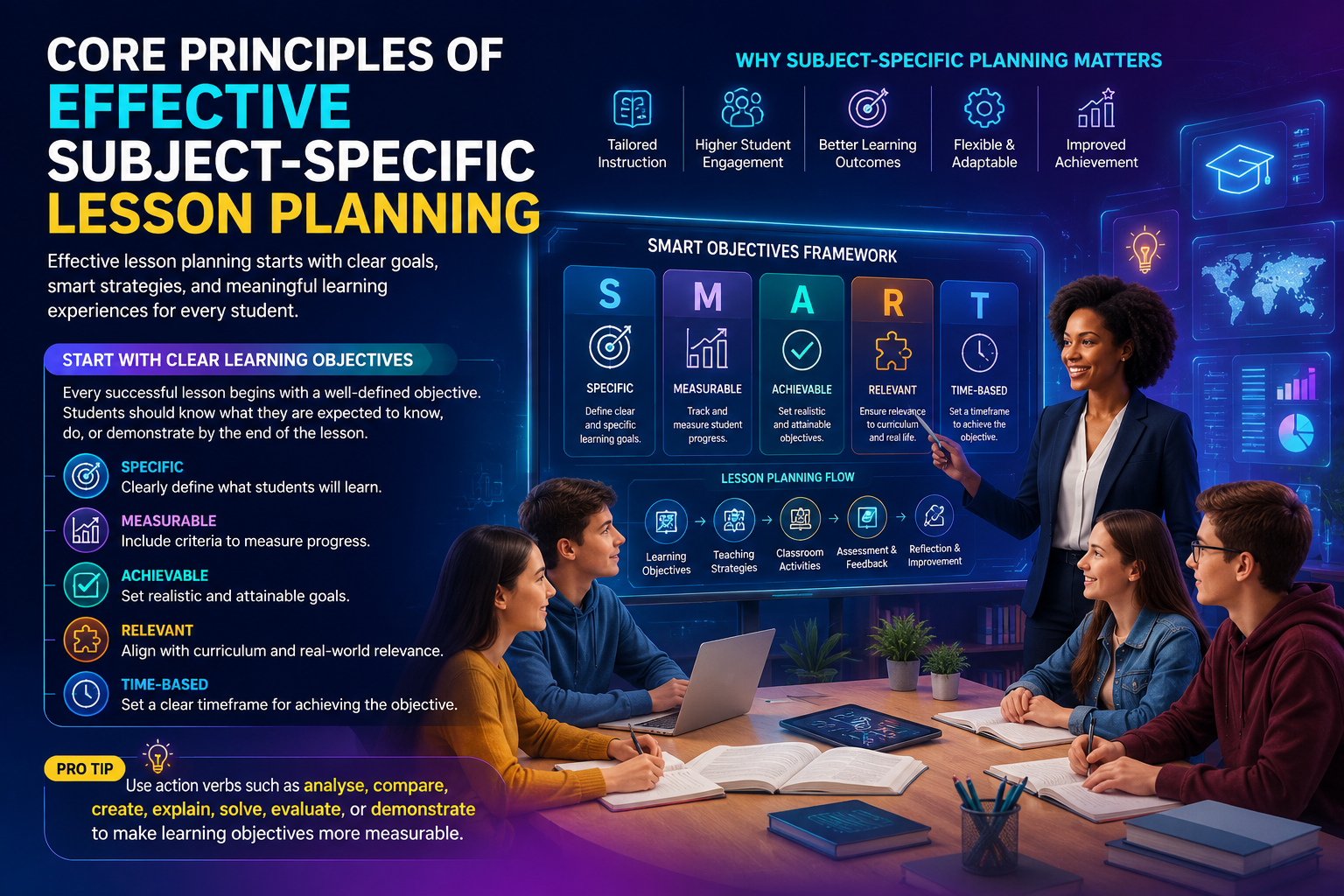
Core Principles of Effective Subject-Specific Lesson Planning
Build stronger lessons with SMART learning objectives, measurable outcomes, and subject-specific planning strategies that improve student engagement and classroom success.
Although every subject requires different instructional approaches, several principles remain universal across high-quality lesson planning.
Start with Clear Learning Objectives
Every successful lesson begins with a well-defined objective. Students should understand what they are expected to know, do, or demonstrate by the end of the lesson.
Effective learning objectives are:
Specific
Measurable
Achievable
Relevant
Time-based when appropriate
For example:
Instead of:
Students will learn fractions.
A stronger objective is:
Students will compare and simplify equivalent fractions using visual models and mathematical reasoning.
The second objective clearly identifies the expected skill and provides a basis for assessment.
💡 Pro Tip: Use action verbs such as analyse, compare, create, explain, solve, evaluate, or demonstrate to make learning objectives more measurable.
Align Lessons with Curriculum Standards
Subject-specific planning should always support curriculum requirements while remaining flexible enough to meet students’ needs.
Curriculum alignment ensures that:
Essential concepts are covered systematically.
Learning builds progressively throughout the academic year.
Teachers should regularly review curriculum documents to ensure lessons remain aligned with current educational expectations.
Understand the Nature of the Subject
Every subject develops different thinking skills.
For example:
Subject
Thinking Skills Developed
Mathematics
Logical reasoning, computation
Science
Observation, investigation
English
Interpretation, communication
History
Analysis, evidence evaluation
Geography
Spatial reasoning
Art
Creativity and visual thinking
Music
Rhythm, listening, expression
Recognising these differences helps teachers choose instructional methods that naturally support learning.
Plan Around Student Learning
Subject knowledge alone does not guarantee effective teaching.
Teachers should also consider:
Students’ prior knowledge
Common misconceptions
Learning preferences
Individual strengths
Areas requiring additional support
Classroom diversity
Planning with students in mind creates lessons that are more inclusive and accessible.
Balance Teacher Instruction with Student Participation
Students learn most effectively when they actively participate rather than passively receive information.
A balanced lesson might include:
Teacher explanation
Guided practice
Collaborative learning
Independent application
Reflection
Assessment
This structure promotes deeper understanding while maintaining engagement throughout the lesson.
Essential Components of Every Subject-Specific Lesson Plan
Regardless of the subject, every lesson plan should include several key components.
Component
Purpose
Learning Objectives
Define expected outcomes
Materials
Identify required resources
Introduction
Capture interest and activate prior knowledge
Instruction
Present new concepts
Guided Practice
Support skill development
Independent Practice
Encourage application
Assessment
Measure understanding
Reflection
Evaluate lesson effectiveness
Each component contributes to a logical learning progression that supports student success.
A Practical Framework for Designing Subject-Specific Lessons
Experienced educators often follow a structured workflow that simplifies planning while allowing flexibility.
Step 1: Identify the Learning Goal
Ask:
What should students know?
What should they be able to do?
Why is this important?
These questions establish the lesson’s purpose.
Step 2: Analyse Student Needs
Consider:
Existing knowledge
Skill levels
Potential misconceptions
Classroom diversity
Available learning supports
Understanding students helps teachers anticipate challenges before instruction begins.
Step 3: Select Appropriate Teaching Strategies
Different subjects benefit from different instructional approaches.
Examples include:
Teaching Strategy
Best Used For
Direct Instruction
Mathematics
Inquiry-Based Learning
Science
Storytelling
Language Arts
Discussion
Social Studies
Demonstration
Art and Design
Cooperative Learning
Multiple subjects
Choosing strategies that align with the subject enhances learning effectiveness.
Step 4: Plan Meaningful Learning Activities
Activities should reinforce lesson objectives rather than simply occupy class time.
High-quality activities encourage students to:
Think critically
Solve problems
Apply concepts
Collaborate
Reflect on learning
Meaningful engagement leads to stronger understanding and retention.
Step 5: Integrate Assessment Naturally
Assessment should be embedded throughout the lesson, not reserved solely for the end.
Effective assessment methods include:
Classroom questioning
Exit tickets
Observations
Peer assessment
Quizzes
Practical demonstrations
Projects
Written reflections
Frequent formative assessment allows teachers to adjust instruction based on student understanding.
Step 6: Reflect After Teaching
Professional growth depends on continuous reflection.
After each lesson, consider:
Which activities were most effective?
Where did students struggle?
Were learning objectives achieved?
What changes would improve future lessons?
Regular reflection transforms lesson planning into an ongoing process of improvement.
⭐ Expert Insight: Many experienced educators maintain a teaching journal or digital planning log. Recording observations immediately after a lesson helps identify patterns over time, making future planning more efficient and responsive to student needs.
Characteristics of High-Quality Subject-Specific Lesson Plans
Not every lesson plan leads to meaningful learning. High-quality plans share several common characteristics that support effective teaching across different subjects.
A strong subject-specific lesson plan should be:
Student-centred rather than teacher-centred.
Focused on clear and measurable learning outcomes.
Flexible enough to adapt to classroom needs.
Aligned with curriculum standards.
Appropriate for the subject being taught.
Inclusive of diverse learning abilities.
Supported by purposeful assessment.
Structured with a logical flow from introduction to reflection.
These characteristics help ensure lessons remain engaging, organised, and educationally valuable.
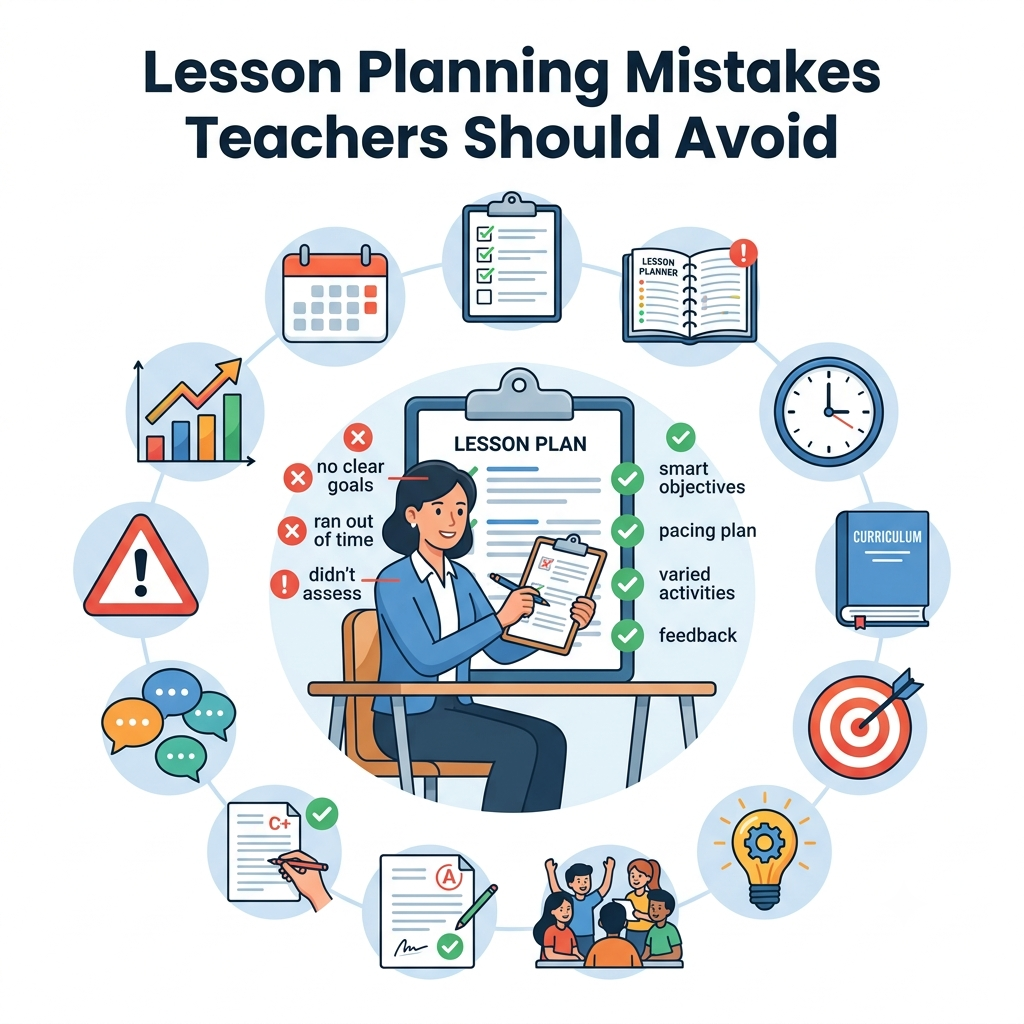
Common Mistakes to Avoid
Even well-prepared teachers can encounter challenges when lesson planning. Being aware of common pitfalls helps improve lesson quality over time.
Common Mistake
Better Practice
Using the same lesson format for every subject
Adapt planning to the subject’s unique requirements
Writing vague objectives
Define specific, measurable outcomes
Overloading one lesson with content
Focus on achievable learning goals
Relying only on lectures
Include interactive and student-centred activities
Assessing only at the end
Use ongoing formative assessment throughout the lesson
Ignoring prior knowledge
Begin by activating existing understanding
⚠ Common Mistake: Trying to cover too many concepts in a single lesson often results in shallow understanding. Prioritise depth over breadth so students have time to practise, ask questions, and consolidate learning.
Choosing the right learning platform can significantly improve classroom outcomes. Compare leading educational tools in Gimkit Comparisons & Alternatives to find the best solution for your teaching style.
Interactive learning becomes more effective when students experience different gameplay formats. Discover engaging classroom activities in Gimkit Features & Game Modes and keep every lesson fresh.
Whether you’re a beginner or an experienced educator, practical guidance makes implementation easier. Follow our Gimkit Guides & Tutorials for step-by-step instructions and classroom best practices.
Every teacher benefits from proven instructional ideas that increase participation and motivation. Explore Gimkit Resources for Teachers for practical classroom-ready solutions.
Understanding pricing and premium features helps educators make informed decisions. Read detailed comparisons and expert evaluations in Gimkit Reviews & Pricing before selecting a subscription.
Small instructional improvements often lead to better classroom results. Discover practical teaching methods and winning techniques in Gimkit Tips & Strategies to maximize student engagement.
Expand your knowledge with a wide variety of educational content by browsing our General Articles, covering technology, learning, and classroom innovation.
Stay informed about the newest platform improvements, educational trends, and feature releases through Games Updates so you never miss important changes.
Strengthen learning with engaging assessments and interactive activities available in our Quiz Resources collection, designed for teachers and students alike.
If you experience sign-in problems or game access issues, visit Gimkit Login, Join & Troubleshooting for reliable solutions and step-by-step troubleshooting guides.
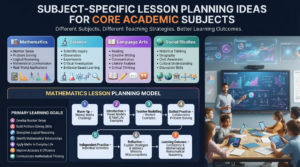
Subject-Specific Lesson Planning Ideas for Core Academic Subjects
Explore practical subject-specific lesson planning strategies that help teachers design engaging mathematics, science, language arts, and social studies lessons for meaningful student learning.
Every subject encourages students to think, solve problems, and apply knowledge in different ways. A lesson plan that inspires deep mathematical reasoning may not effectively develop scientific inquiry or literary analysis. Successful teachers recognise these differences and design lessons that reflect the unique goals, skills, and learning experiences of each discipline.
The following subject-specific planning ideas provide practical strategies, classroom examples, assessment methods, and professional recommendations that can be adapted across different grade levels.
Mathematics Lesson Planning Ideas
Mathematics lesson plans should help students understand concepts, recognise patterns, and apply logical reasoning to solve problems. While procedural fluency remains important, modern mathematics instruction also emphasises conceptual understanding, mathematical communication, and real-world application.
Instead of focusing only on finding the correct answer, effective mathematics lessons encourage students to explain their thinking, compare different solution methods, and justify their reasoning.
Primary Learning Goals
A mathematics lesson may aim to help students:
Develop number sense.
Build problem-solving skills.
Strengthen logical reasoning.
Identify mathematical relationships.
Apply concepts to everyday situations.
Improve accuracy and efficiency.
Communicate mathematical thinking.
Recommended Lesson Structure
Lesson Stage
Suggested Activities
Warm-up
Mental maths challenge, number talks, review questions
Introduction
Introduce the new concept using visual models or real-life examples
This gradual release model allows students to build confidence before working independently.
Classroom Activity Ideas
Effective mathematics activities include:
Problem-solving stations
Maths escape rooms
Logic puzzles
Fraction card games
Geometry scavenger hunts
Measurement investigations
Data collection projects
Interactive whiteboard activities
Digital quizzes
Real-world budgeting exercises
These activities promote active participation while reinforcing mathematical concepts.
Example Lesson
Topic: Equivalent Fractions
Objective
Students will identify and simplify equivalent fractions using visual representations and mathematical reasoning.
Introduction
Present two pizzas divided differently but showing the same amount eaten. Ask students whether the fractions represent equal quantities.
Guided Activity
Students use fraction strips or circles to compare different fractions.
Independent Task
Complete a worksheet involving visual models and fraction simplification.
Assessment
Students explain one example using mathematical vocabulary.
💡 Pro Tip
Encourage students to explain why an answer is correct rather than simply stating the answer. Mathematical discussions often reveal misconceptions that written work alone may not identify.
Science Lesson Planning Ideas
Science education is built around curiosity, investigation, and evidence. Rather than memorising facts, students should actively explore scientific concepts through observation, questioning, experimentation, and analysis.
A well-designed science lesson balances theoretical knowledge with practical investigation.
Primary Learning Goals
Science lessons often focus on helping students:
Ask meaningful questions.
Conduct investigations safely.
Observe carefully.
Collect and interpret data.
Draw evidence-based conclusions.
Understand scientific processes.
Apply scientific thinking to everyday life.
Recommended Lesson Structure
Lesson Stage
Activities
Engagement
Demonstration or thought-provoking question
Exploration
Hands-on investigation
Explanation
Discuss observations and scientific concepts
Elaboration
Apply learning to new situations
Evaluation
Quiz, practical assessment, or discussion
This inquiry-based model keeps students actively involved throughout the lesson.
Classroom Activity Ideas
Science teachers can incorporate:
Laboratory experiments
STEM design challenges
Nature observations
Scientific investigations
Engineering projects
Weather monitoring
Plant growth journals
Model building
Virtual simulations
Data analysis exercises
These experiences encourage students to learn by doing rather than simply listening.
Example Lesson
Topic: States of Matter
Objective
Students will compare solids, liquids, and gases through observation and experimentation.
Starter Activity
Show an ice cube, a glass of water, and steam from warm water.
Ask:
What differences do you notice?
How are these connected?
Investigation
Students observe how ice melts over time and record changes.
Discussion
Connect observations to particle theory.
Assessment
Students classify everyday objects according to their state of matter.
⭐ Expert Insight
Science lessons become significantly more memorable when students predict outcomes before conducting experiments. Making predictions encourages deeper thinking and creates meaningful discussions when results differ from expectations.
English Language Arts Lesson Planning Ideas
English Language Arts develops communication, reading comprehension, writing, speaking, and critical analysis. Strong lesson planning should encourage students to interact with language rather than simply consume it.
Reading, writing, listening, and speaking should be integrated whenever possible.
Primary Learning Goals
Students should learn to:
Read critically.
Analyse texts.
Expand vocabulary.
Improve writing skills.
Communicate ideas clearly.
Interpret meaning.
Develop creativity.
Recommended Lesson Structure
Lesson Stage
Activities
Hook
Short story, quotation, image, or discussion
Reading
Guided reading or shared text
Analysis
Vocabulary, themes, characters, language techniques
Writing
Individual or collaborative writing task
Reflection
Peer review or class discussion
Classroom Activity Ideas
Highly engaging English activities include:
Literature circles
Creative writing workshops
Story mapping
Debate sessions
Poetry performances
Reader’s theatre
Character interviews
Vocabulary games
Book reviews
Digital storytelling
These activities help students build confidence while strengthening literacy skills.
Example Lesson
Topic: Character Development
Objective
Students will analyse how a character changes throughout a story using textual evidence.
Hook
Display an illustration of the main character.
Ask:
“What kind of person do you think this character is?”
Reading
Read selected passages together.
Discussion
Identify actions, dialogue, and motivations.
Writing Activity
Students write a paragraph explaining how the character changes.
Assessment
Exit ticket summarising one important lesson the character learned.
✅ Best Practice
Encourage students to support every interpretation with evidence from the text. This habit strengthens reading comprehension and analytical writing.
Social Studies Lesson Planning Ideas
Social studies helps students understand societies, cultures, geography, economics, civics, and history. Effective lesson planning encourages investigation, discussion, and thoughtful analysis rather than memorisation alone.
Students should learn to evaluate evidence, consider multiple perspectives, and connect historical events to modern issues.
Primary Learning Goals
Students develop:
Historical thinking
Critical analysis
Civic understanding
Geographic knowledge
Research skills
Decision-making abilities
Cultural awareness
Recommended Lesson Structure
Lesson Stage
Activities
Introduction
Historical image, political cartoon, map, or question
Context Building
Background information
Source Analysis
Primary or secondary sources
Discussion
Group debate or collaborative analysis
Reflection
Written response or classroom discussion
Classroom Activity Ideas
Popular activities include:
Historical debates
Timeline creation
Map investigations
Mock elections
Role-playing historical events
Case study analysis
Current events discussions
Research projects
Documentary analysis
Community investigations
These approaches help students connect classroom learning with real-world issues.
Example Lesson
Topic: Ancient Civilisations
Objective
Students will compare two ancient civilisations by examining geography, government, culture, and technological achievements.
Starter
Display photographs of ancient monuments.
Students predict which civilisation created each structure.
Main Activity
Groups analyse different information sources.
Comparison Task
Students complete a comparison chart.
Assessment
Each group presents one significant contribution made by their assigned civilisation.
📌 Quick Note
Historical inquiry becomes more meaningful when students examine authentic maps, artefacts, photographs, letters, or historical documents instead of relying solely on textbook summaries.
Comparing Lesson Planning Across Core Subjects
Although every lesson includes objectives, instruction, practice, and assessment, each subject emphasises different teaching approaches.
Projects, debates, research tasks, source analysis
Understanding these differences helps teachers select strategies that align naturally with the subject rather than applying a one-size-fits-all approach.
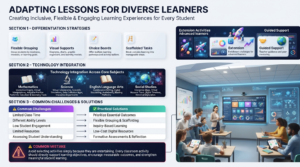
Adapting Lessons for Diverse Learners
Discover practical differentiation strategies, educational technology tools, and classroom solutions that help teachers create inclusive, engaging, and effective learning experiences for every student.
Every classroom includes students with different abilities, interests, and learning preferences. Subject-specific planning should incorporate differentiation so that all learners can access the curriculum and demonstrate understanding.
Some effective differentiation strategies include:
Strategy
Classroom Application
Flexible Grouping
Organise students by readiness, interest, or learning goal
Visual Supports
Use diagrams, charts, graphic organisers, and models
Choice Boards
Allow students to select from multiple learning activities
Scaffolded Tasks
Break complex tasks into manageable steps
Extension Activities
Provide enrichment challenges for advanced learners
Guided Support
Offer additional teacher assistance or peer mentoring
Differentiation does not mean creating a completely different lesson for every student. Instead, it involves providing varied pathways that help learners achieve the same educational objectives while respecting individual needs.
Integrating Educational Technology into Core Subject Lessons
Technology can strengthen subject-specific instruction when it supports learning objectives rather than replacing effective teaching practices.
Examples include:
Subject
Technology Integration Ideas
Mathematics
Interactive graphing tools, virtual manipulatives, adaptive practice platforms
Science
Virtual labs, simulations, data collection apps
English Language Arts
Collaborative writing tools, digital storytelling, audiobook resources
Social Studies
Interactive maps, virtual museum tours, timeline creators
Digital resources should complement hands-on learning, classroom discussion, and teacher guidance to create balanced and engaging lessons.
Common Challenges in Subject-Specific Planning
Even experienced educators encounter planning challenges. Recognising these issues early allows teachers to make informed adjustments.
Challenge
Practical Solution
Limited class time
Prioritise essential learning outcomes and streamline activities
Varying student ability levels
Differentiate instruction using flexible grouping and scaffolded tasks
Low student engagement
Incorporate interactive, inquiry-based, and collaborative activities
Resource limitations
Use low-cost materials, digital alternatives, or project-based learning
Assessing understanding effectively
Combine formative assessments with practical demonstrations and reflective tasks
⚠ Common Mistake
Avoid choosing activities simply because they are entertaining. Every activity should have a clear instructional purpose that directly supports the lesson objectives and contributes to measurable learning outcomes.
Subject-Specific Lesson Planning Ideas for Creative, Practical, and Specialised Subjects
While core academic subjects often receive the most attention, creative and practical subjects are equally important in developing well-rounded learners. Art encourages imagination, music strengthens expression and listening skills, physical education promotes health and teamwork, technology prepares students for a digital world, and specialised programmes ensure that every learner receives meaningful educational opportunities.
Effective lesson planning for these subjects requires flexibility, creativity, and a clear understanding of the skills students are expected to develop.
Art Lesson Planning Ideas
Art education encourages creativity, experimentation, observation, and self-expression. A successful art lesson should focus on the creative process as much as the final product, allowing students to explore different materials, techniques, and artistic styles.
Primary Learning Goals
Art lessons help students:
Develop creative thinking.
Explore artistic techniques.
Improve visual communication.
Understand colour, texture, and composition.
Appreciate different cultures and artistic traditions.
Build confidence through creative expression.
Recommended Lesson Structure
Lesson Stage
Suggested Activities
Inspiration
Introduce an artist, artwork, or visual theme
Demonstration
Model the artistic technique
Guided Practice
Experiment with materials and methods
Independent Creation
Produce original artwork
Reflection
Share artwork and discuss creative choices
Classroom Activity Ideas
Nature sketching
Collage design
Clay modelling
Watercolour painting
Digital illustration
Perspective drawing
Cultural art projects
Collaborative murals
Mixed-media artwork
Recycled material sculptures
Example Lesson
Topic: Colour Theory
Objective
Students will create artwork demonstrating complementary and analogous colour schemes.
Starter
Display famous paintings and ask students to identify colour combinations.
Activity
Students experiment with paint mixing before creating their own artwork.
Assessment
Students explain why they selected specific colour combinations.
💡 Pro Tip
Allow students multiple opportunities to revise and improve their artwork. Reflection often develops artistic understanding more effectively than grading the finished piece alone.
Music Lesson Planning Ideas
Music education develops listening, rhythm, creativity, collaboration, and cultural appreciation. Lessons should balance theory with active participation.
Learning Objectives
Students should learn to:
Recognise rhythm and tempo.
Read basic musical notation.
Perform individually and collaboratively.
Appreciate different musical traditions.
Express emotions through music.
Lesson Structure
Lesson Stage
Activities
Warm-Up
Rhythm games or vocal exercises
Introduction
New musical concept
Guided Practice
Singing or instrument practice
Performance
Individual or group performance
Reflection
Self and peer feedback
Activity Ideas
Rhythm challenges
Instrument exploration
Song composition
Listening journals
Musical storytelling
Choir rehearsals
Digital music creation
Cultural music appreciation
⭐ Expert Insight
Students become more engaged when music lessons connect with songs, traditions, or instruments from different cultures. This broadens musical understanding while promoting inclusivity.
A successful PE lesson keeps students active while promoting safe participation and skill development.
Learning Goals
Students should develop:
Motor skills
Coordination
Teamwork
Leadership
Sportsmanship
Physical fitness
Healthy lifestyle habits
Lesson Structure
Lesson Stage
Activities
Warm-Up
Stretching and movement
Skill Instruction
Teacher demonstration
Guided Practice
Skill drills
Game Application
Team-based activities
Cool Down
Stretching and reflection
Classroom Activity Ideas
Relay races
Obstacle courses
Ball control challenges
Team sports
Fitness circuits
Cooperative games
Yoga sessions
Dance activities
✅ Best Practice
Focus assessment on effort, skill improvement, teamwork, and participation rather than athletic ability alone. This encourages all students to engage confidently.
Technology and Computer Science Lesson Planning Ideas
Technology education equips students with digital literacy, computational thinking, problem-solving, and responsible technology use.
Lessons should combine conceptual understanding with practical application.
Learning Goals
Students learn to:
Use digital tools effectively.
Understand basic programming concepts.
Develop digital citizenship.
Solve problems using technology.
Collaborate through digital platforms.
Activity Ideas
Coding challenges
Website creation
Presentation design
Robotics projects
Digital storytelling
Spreadsheet investigations
Cybersecurity discussions
Multimedia production
Example Lesson
Topic: Internet Safety
Students evaluate different online scenarios and identify safe, responsible digital behaviours before creating classroom internet safety guidelines.
📌 Quick Note
Technology changes rapidly. Teachers should periodically review lesson resources and software to ensure they remain current and relevant.
Foreign Language Lesson Planning Ideas
Language learning depends on regular communication and meaningful practice rather than memorising vocabulary lists.
Effective lessons integrate speaking, listening, reading, and writing.
Learning Objectives
Students should:
Build vocabulary.
Improve pronunciation.
Understand grammar in context.
Develop conversational confidence.
Appreciate different cultures.
Classroom Activities
Role-playing conversations
Vocabulary games
Picture descriptions
Story sequencing
Listening exercises
Interactive dialogues
Cultural presentations
Language learning apps
💡 Pro Tip
Create opportunities for students to use the target language throughout the lesson rather than limiting speaking activities to isolated exercises.
Preschool Lesson Planning Ideas
Early childhood education focuses on exploration, play, and foundational skill development.
Young learners benefit from short, varied, and highly interactive activities.
Learning Priorities
Language development
Early mathematics
Social skills
Motor development
Creativity
Curiosity
Emotional growth
Activity Ideas
Story time
Sensory bins
Building blocks
Singing
Movement games
Nature exploration
Painting
Pretend play
Example Daily Structure
Time
Activity
Morning Circle
Greeting and calendar
Literacy
Storytelling
Mathematics
Counting activities
Creative Play
Art or construction
Outdoor Learning
Physical play
Reflection
Sharing experiences
⭐ Expert Insight
Young children often learn best through repetition embedded within playful experiences. Revisiting familiar routines builds confidence while introducing new concepts gradually.
Special Education Lesson Planning Ideas
Special education planning focuses on accessibility, inclusion, and individual student progress.
Successful lessons accommodate different abilities while maintaining meaningful learning expectations.
Important Considerations
Teachers should plan for:
Individual learning goals
Assistive technology
Flexible pacing
Visual supports
Multi-sensory instruction
Frequent feedback
Positive reinforcement
Effective Classroom Strategies
Graphic organisers
Picture schedules
Hands-on learning
Peer support
Small-group instruction
Scaffolded activities
Clear routines
Chunked instructions
⚠ Common Mistake
Avoid assuming that every student with additional learning needs requires the same support. Individual strengths, interests, and learning profiles should guide lesson planning decisions.
Cross-Curricular Lesson Planning
Cross-curricular planning connects multiple subjects within a single learning experience.
For example, a lesson about environmental sustainability could include:
Subject
Learning Activity
Science
Investigate recycling processes
Mathematics
Analyse waste collection data
English
Write persuasive environmental speeches
Geography
Study global waste management
Art
Design recycling awareness posters
Technology
Create digital presentations
This integrated approach helps students recognise how knowledge from different disciplines connects in real-world contexts.
Using Project-Based Learning Across Subjects
Project-Based Learning (PBL) encourages students to investigate authentic problems while applying knowledge from multiple disciplines.
Benefits
Encourages collaboration.
Develops critical thinking.
Improves communication.
Promotes creativity.
Builds research skills.
Connects classroom learning to real life.
Example Project
Driving Question
“How can our school reduce plastic waste?”
Students might:
Investigate waste (Science)
Analyse survey data (Mathematics)
Write campaign materials (English)
Design awareness posters (Art)
Present recommendations (Technology)
Assessment Strategies for Different Subjects
Assessment should align with each subject’s learning goals.
Subject
Effective Assessment Methods
Mathematics
Problem-solving tasks, quizzes
Science
Practical investigations, lab reports
English
Essays, presentations, discussions
Social Studies
Projects, debates, research
Art
Portfolios, exhibitions
Music
Performances, listening journals
Physical Education
Skill demonstrations, participation
Technology
Digital projects, coding tasks
Languages
Conversations, writing activities
Using a combination of formative and summative assessments provides a more complete picture of student progress.
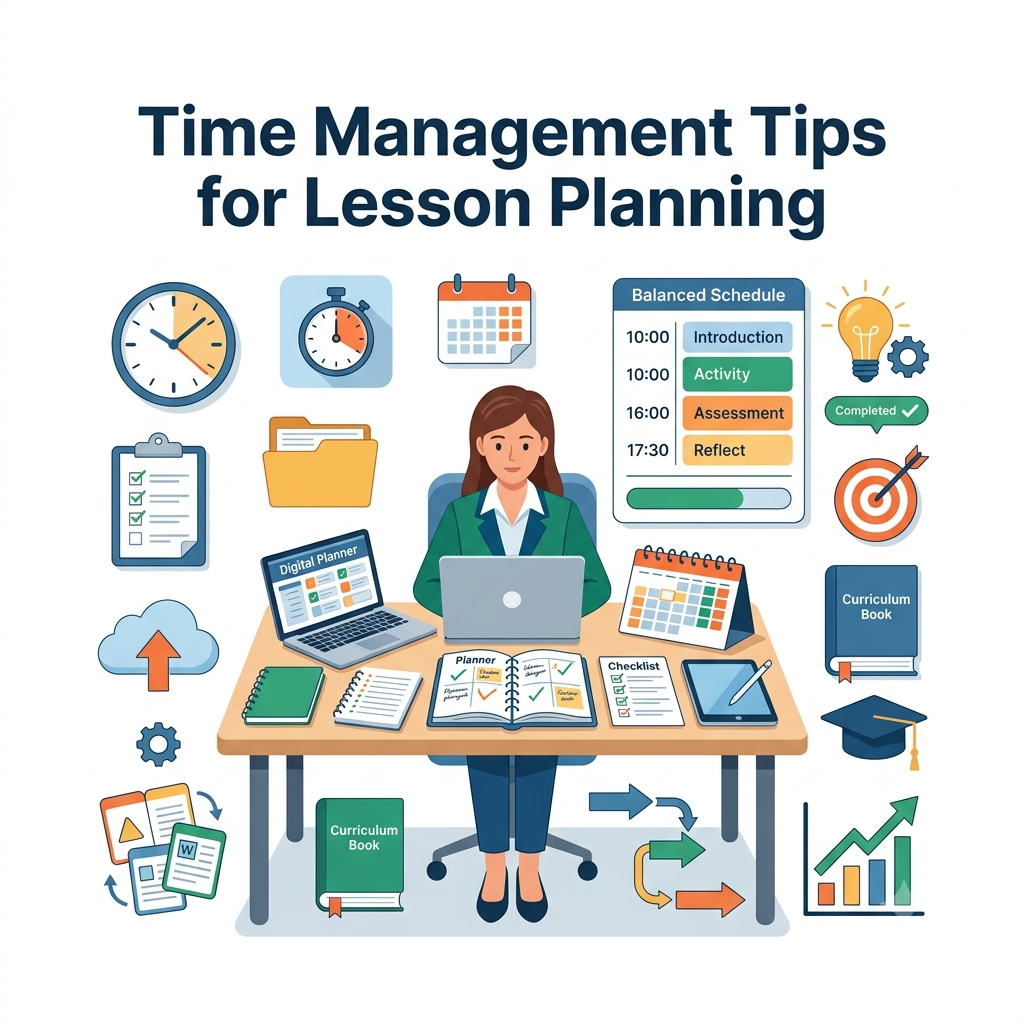
Professional Lesson Planning Tips
Experienced educators often refine their planning through reflection and collaboration. Consider these strategies:
Plan with the end learning goal in mind.
Prepare alternative activities in case lessons finish early or technology fails.
Build opportunities for student voice and choice.
Use formative assessment to guide instructional decisions.
Collaborate with colleagues to share ideas and resources.
Review lesson effectiveness after each class.
Update lesson plans based on student feedback and performance.
Common Lesson Planning Challenges and Solutions
Challenge
Solution
Limited preparation time
Develop reusable planning templates and resource banks
Diverse learning needs
Differentiate instruction and provide flexible learning pathways
Low student engagement
Incorporate inquiry, games, and collaborative learning
Technology issues
Prepare offline alternatives
Curriculum pressure
Prioritise essential learning outcomes while integrating subjects where appropriate
Addressing these challenges proactively helps create smoother, more effective learning experiences.
Future Trends in Subject-Specific Lesson Planning
Education continues to evolve as technology, research, and classroom expectations change. Teachers who stay informed about emerging trends can adapt their lesson planning to better support student success.
Key developments include:
Greater use of blended and hybrid learning models.
Increased integration of artificial intelligence to support planning and personalised learning.
Expanded emphasis on social-emotional learning.
Competency-based assessment approaches.
Universal Design for Learning (UDL) principles.
Data-informed instructional planning.
Collaborative digital learning environments.
Greater focus on interdisciplinary and project-based learning.
These trends do not replace effective teaching; they enhance it by providing additional tools and strategies for meeting diverse student needs.
Best Practices Checklist
Before delivering a lesson, review the following checklist:
✅ Learning objectives are specific and measurable.
✅ Activities align with subject outcomes.
✅ Resources are prepared and tested.
✅ Lessons accommodate diverse learners.
✅ Student participation is encouraged throughout.
✅ Formative assessment opportunities are included.
✅ Time allocations are realistic.
✅ Reflection opportunities are planned.
✅ Follow-up learning is identified where appropriate.
A consistent review process helps improve lesson quality and classroom confidence.
Subject-Specific Lesson Planning Ideas help teachers align activities with curriculum objectives.
Subject-Specific Lesson Planning Ideas support organized instruction across different academic subjects.
Subject-Specific Lesson Planning Ideas show that careful planning, engaging activities, and clear learning goals create successful lessons across every academic subject.
Frequently Asked Questions (FAQs)
1. Is Gimkit worth using after a full semester of classroom teaching?
After using Gimkit consistently for an entire semester, many teachers find that it becomes more than just a quiz platform. When integrated thoughtfully into regular instruction, it can improve student engagement, encourage active participation, and make review sessions feel less repetitive. Students often stay motivated because of the game’s interactive mechanics, while teachers benefit from instant performance data that highlights learning gaps.
That said, Gimkit works best as a supplement to quality teaching rather than a replacement. It is particularly effective for reinforcing previously taught concepts, practising vocabulary, reviewing key ideas before assessments, and increasing classroom participation. Its long-term value depends on how well it aligns with your lesson objectives and teaching style.
Key Takeaways:
Encourages consistent student engagement.
Makes revision sessions more interactive.
Provides immediate feedback for teachers.
Supports both individual and collaborative learning.
Delivers the best results when combined with other instructional methods.
2. What are the biggest advantages and limitations of using Gimkit in the classroom?
One of Gimkit’s greatest strengths is its ability to transform routine review activities into engaging learning experiences. Students answer questions, earn in-game currency, and make strategic decisions while reinforcing academic content. This combination of learning and gameplay often increases motivation, especially among learners who may not respond well to traditional review methods.
However, no educational platform is perfect. Some students may become more focused on game mechanics than the learning objectives if activities are not carefully managed. Teachers also need to spend time creating high-quality question sets that accurately reflect curriculum standards. Understanding both the benefits and limitations allows educators to use the platform more effectively.
Advantages:
High student participation.
Immediate formative assessment.
Easy progress monitoring.
Supports remote, hybrid, and in-person learning.
Flexible across different subjects and grade levels.
3. Does Gimkit improve student learning outcomes or mainly increase engagement?
Gimkit is designed to improve engagement, but its educational value extends beyond keeping students interested. When teachers use it strategically, it supports retrieval practice, repeated exposure to key concepts, and immediate feedback—all instructional practices commonly associated with stronger knowledge retention.
Students often remember information more effectively because they repeatedly interact with important concepts in an enjoyable environment. Nevertheless, lasting academic improvement still depends on lesson quality, classroom discussion, guided instruction, and opportunities to apply learning beyond game-based activities. Gimkit should therefore be viewed as one component of a balanced instructional approach.
Why it can support learning:
Reinforces long-term memory through repeated practice.
Encourages active participation instead of passive review.
Identifies misconceptions quickly.
Builds confidence before formal assessments.
Complements traditional teaching strategies.
4. Which teachers benefit the most from using Gimkit throughout the school year?
Gimkit is versatile enough to support a wide range of educators, but it is especially valuable for teachers who regularly review concepts, monitor student understanding, or want to increase classroom participation. Mathematics, science, languages, social studies, and English teachers frequently use it for revision, while elementary teachers often integrate it into daily practice activities.
The platform is equally useful for experienced educators seeking more dynamic review methods and for newer teachers looking to incorporate interactive learning without completely redesigning their curriculum. Success depends less on the subject being taught and more on thoughtful lesson integration.
Ideal users include:
Elementary classroom teachers.
Middle and secondary school educators.
Language and vocabulary instructors.
STEM teachers.
Teachers using blended or hybrid learning models.
Educators who value ongoing formative assessment.
5. Would teachers continue using Gimkit after a full semester, or is it only a short-term classroom trend?
For many educators, Gimkit remains useful well beyond the initial excitement because it continues to provide value in classroom review, assessment, and student engagement. The novelty of any educational technology naturally decreases over time, but a platform becomes sustainable when it consistently supports learning goals and saves teachers time.
Teachers who vary game modes, refresh question sets, and integrate Gimkit with broader instructional strategies are more likely to maintain student interest throughout the academic year. Rather than relying on it every day, many educators achieve the best results by using it at key points in a unit, such as review sessions, formative assessments, or exam preparation.
Professional Recommendation:
Rotate different game modes regularly.
Update question banks to match current lessons.
Combine gameplay with classroom discussion.
Use performance reports to guide future instruction.
Treat Gimkit as a teaching support tool, not the entire lesson.
Conclusion
Using Gimkit consistently over a full semester provides a much clearer perspective than judging it after only a few classroom sessions. While its engaging game mechanics immediately capture students’ attention, its real value lies in how it supports meaningful learning through retrieval practice, instant feedback, formative assessment, and increased classroom participation. When aligned with clear learning objectives, Gimkit becomes a practical teaching resource that reinforces concepts rather than simply entertaining students.
Like any educational platform, Gimkit is not a complete instructional solution. The most effective classrooms use it alongside direct instruction, collaborative learning, discussions, hands-on activities, and authentic assessments. Teachers who regularly update question sets, vary game modes, and use the performance data to guide future lessons often see the greatest long-term benefits.
Ultimately, an honest semester-long review shows that Gimkit is more than a classroom game—it is a flexible learning platform that can enhance student motivation, improve knowledge retention, and simplify formative assessment when used with purpose. For educators seeking an interactive way to review content, monitor progress, and create a more engaging learning environment, Gimkit remains a valuable addition to a balanced teaching strategy rather than a replacement for effective instruction.