Real-Life Examples of Gimkit in Schools-You Should must know !
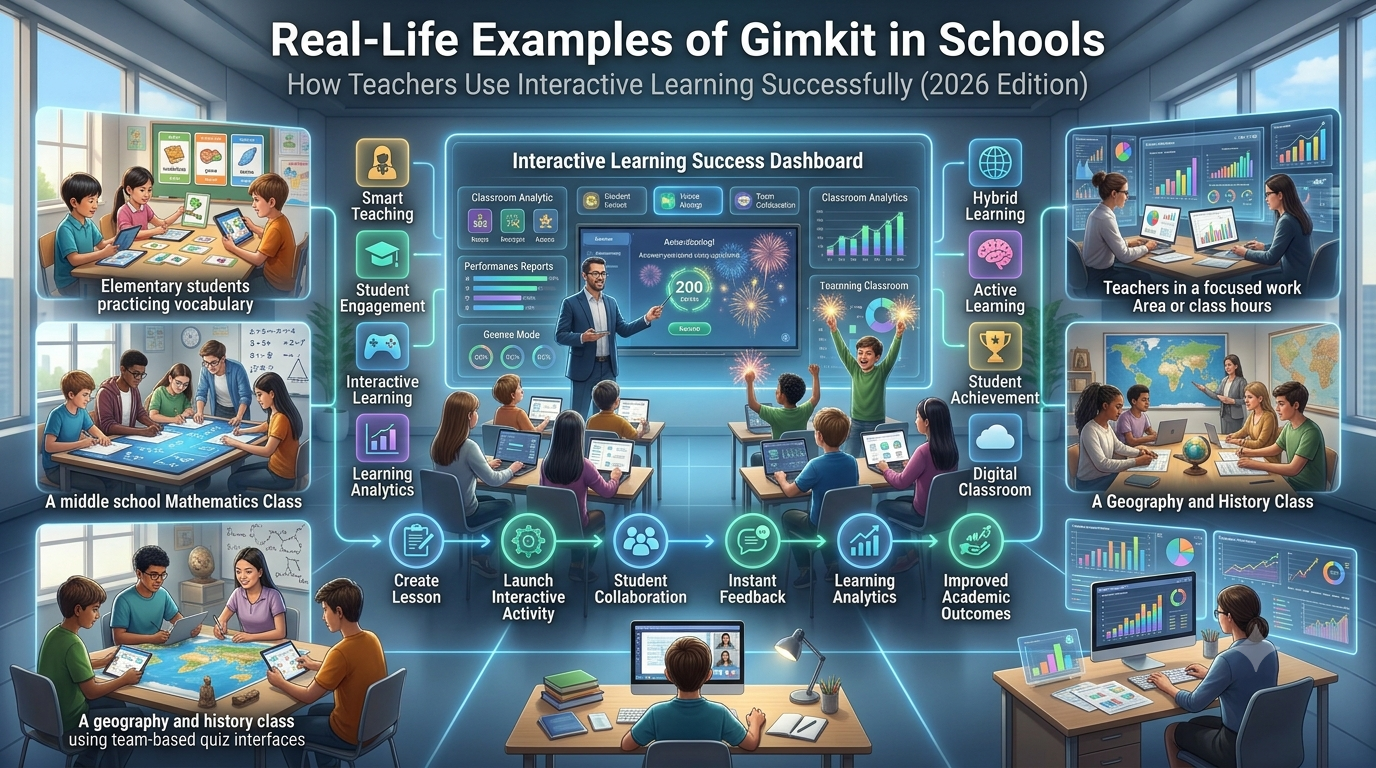
Eight practical classroom use cases that show where a Gimkit activity can fit into a lesson, how a teacher can adapt it, what evidence to collect and when a simpler non-game format may be more appropriate.
Evidence and transparency: The eight cases below are illustrative teaching scenarios, not documented interviews, named-school case studies or measured pilot results. They show plausible classroom plans supported by Gimkit’s official product features. No fabricated teacher quotes, school names, test-score improvements or verified outcomes are claimed.
Quick answer: Gimkit can be used for low-stakes retrieval practice, vocabulary review, mathematics misconceptions, scientific concept checks, language application, classroom discussion, differentiated practice and end-of-lesson reflection. The right use depends on the learning target and available mode, not on the assumption that every game produces higher achievement. Teachers should follow official setup steps and collect independent evidence of understanding alongside gameplay results.
1. The essentials: what Gimkit provides and what teachers design
Gimkit is an educational game-based platform in which educators create or select question sets called Kits and host experiences in different game modes. According to the official Host a Live Game guide, the host selects a Kit and mode, configures options, shares the join information and starts the game. This provides a structure for practice, but the teacher still owns the decisions about content quality, classroom accessibility, assessment and instructional follow-up.
Some classrooms may use a fast-paced game to make retrieval practice engaging; another might use a calmer question-focused format because the goal is to diagnose confusion. The same Kit may support different lessons, but results from one class should not be assumed to generalize to another. A teacher should ask what students must learn, not which visual game is most impressive.
Most important, a student might become skilled at the game without demonstrating independent mastery of the subject. Use a short independent explanation or application question after a session to see whether the learning target was met. That distinction is especially useful when describing classroom examples responsibly.
2. Scenario 1: vocabulary retrieval in an elementary classroom
Setting: A teacher is reviewing ten curriculum vocabulary terms after direct instruction. The desired result is for students to recognize meanings and then use words correctly in new sentences. A Kit is prepared with short prompts and plausible answer choices. Before the game begins, the teacher models two words and explains what a successful response looks like.
During the session: The teacher chooses a mode appropriate for students’ experience and device access, explains its basic objective and allows students to practice. If learners are new to the game, the teacher avoids teaching complex game mechanics and difficult vocabulary at exactly the same moment. After a short segment, students explain why one tempting distractor was incorrect.
Independent check: Students write or say a new sentence with a target word. A correct game selection is only one sign of recognition; appropriate use in context provides more useful evidence. The teacher reviews sentence quality and plans practice for words that remain confused.
Adaptation: For a learner who needs reading or language support, a preview of vocabulary or an accessible response route can be provided. The purpose remains understanding the word rather than competing on speed.
3. Scenario 2: fraction comparisons in middle-school mathematics
Setting: A class has recently learned to compare fractions with unlike denominators. Many students can remember procedures but struggle with magnitude. The teacher creates questions that reveal common misconceptions—for example, assuming a larger denominator always indicates a larger fraction.
Before play: Students answer one comparison independently and show a number-line or benchmark explanation. This gives the teacher a baseline. The Gimkit session then provides further practice, but the teacher does not use gameplay rank as the mathematical measure.
After play: Students receive a new pair of fractions and explain their relative size. If errors cluster around the meaning of denominator, the teacher uses a visual model before offering another game. The example illustrates using a game as part of a learning sequence rather than treating it as a replacement for instruction.
For teachers designing such items, our Gimkit Questions reference discusses how question wording and distractors influence interpretation.
4. Scenario 3: science misconceptions before a new unit
Setting: A teacher wants to learn which misconceptions students bring to a unit about matter and changes of state. Students are shown questions that contrast melting, evaporation and condensation. The teacher designs distractors around misunderstandings likely to appear in everyday language.
Instructional choice: A low-stakes game can make students comfortable responding, but the teacher first assures them that errors are information for teaching, not grounds for public embarrassment. When the game ends, the teacher examines selected questions and asks learners to explain a new physical example.
Next step: If students confuse evaporation with boiling, the next lesson demonstrates the distinction and revisits it with different contexts. The outcome of the hypothetical example is a planned instructional response, not an assertion that a named school achieved measured gains from this activity.
5. Scenario 4: language learning and sentence meaning
Setting: Students practice using synonyms appropriately in context. A Kit that only asks for direct definition matches may reward recognition but miss deeper vocabulary understanding. The teacher includes sentences where two nearby words differ in tone or usage.
During play: Students select answers and then discuss which contextual clue matters most. Learners who need more time can prepare their explanation privately before contributing in a supported format. The teacher does not insist that fast answering is the measure of fluency.
Afterward: Students write a new sentence with a target word and justify their choice. This independent task reveals whether the learner can apply a word rather than selecting it from familiar choices. The teacher corrects misconceptions and provides targeted vocabulary practice as needed.
6. Scenario 5: cooperative group reasoning
Setting: A social-studies class is working with claims and evidence. The teacher plans a short discussion around selected questions and uses an appropriate game mode as one part of the activity. Students are assigned academic roles such as claim checker, evidence finder and reflection reporter. These are teacher-created responsibilities, not necessarily controls built into the game.
Learning aim: The goal is for students to support a conclusion with evidence and revise reasoning when a teammate presents a valid objection. The teacher gives individuals thinking time before group discussion so a confident speaker does not supply every answer.
Evidence: At the end, each learner selects new evidence for a different claim. Team cooperation can be constructive, but group completion alone does not show every student’s independent understanding. For a deeper look at the distinction, read Team-Based Gameplay Explained.
7. Scenario 6: independent homework practice
Setting: A teacher wants students to practice previously taught content on their own schedules. If the account has access to Assignments and the intended mode is eligible, the teacher can create an assignment linked to a suitable Kit. The official Gimkit Assignments guide describes choosing a Kit, eligible mode and options, then sharing the assignment link.
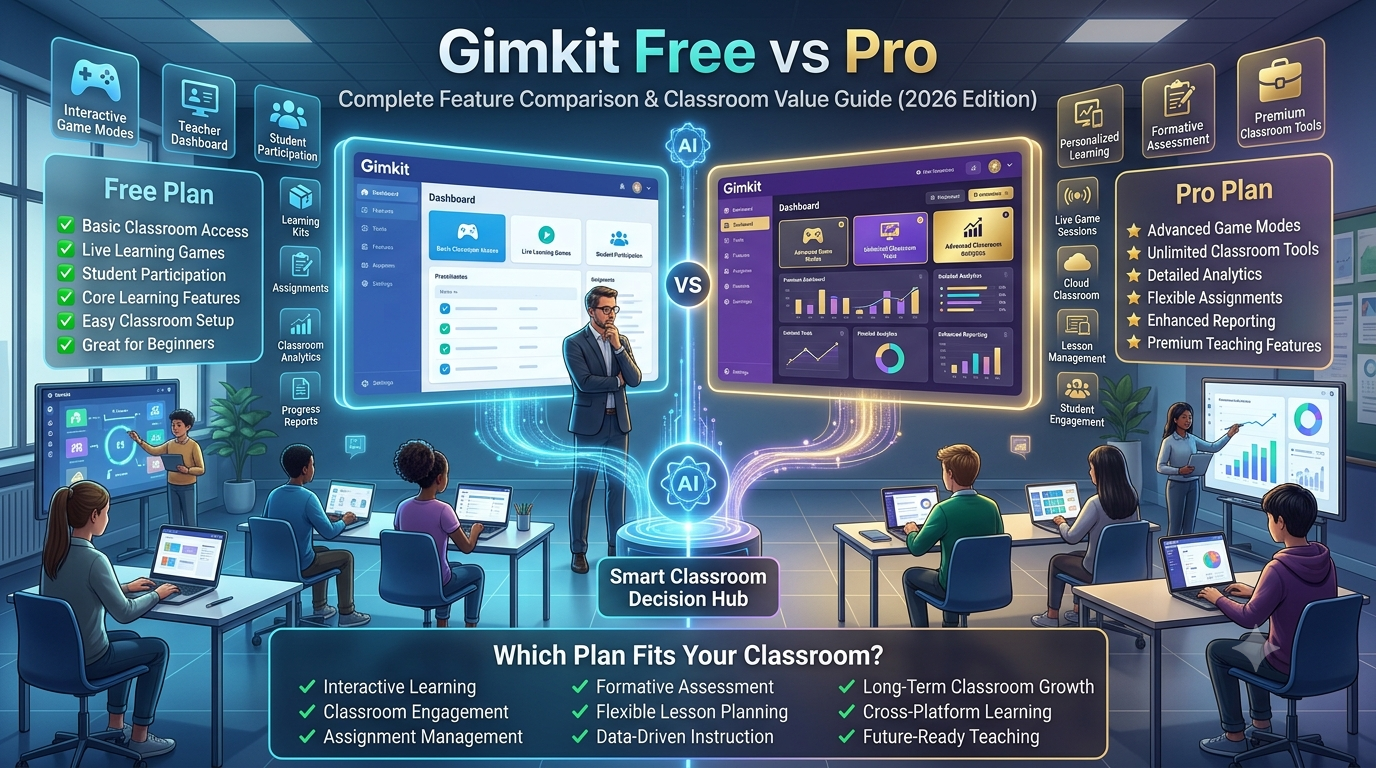
Practical constraints: Official account guidance describes Assignments as a Gimkit Pro feature. The teacher checks current access rather than promising every free account can schedule them. Device access at home is considered, and a school-approved alternative is offered when students cannot complete digital homework.
Follow-up: The teacher reviews available completion and question information, then asks students to explain a representative answer in class. Completion does not automatically demonstrate mastery. More setup details are available in the assignment-management tutorial.
8. Scenario 7: exam revision across multiple units
Setting: An upper-secondary teacher plans retrieval practice across recent units. Rather than uploading hundreds of uncurated questions, the teacher selects representative concepts and balances easy retrieval with application. Students complete a short initial diagnostic to identify topics requiring further explanation.
Mode selection: The teacher uses the official mode picker guidance to identify a suitable activity, avoiding a highly demanding interface when the core goal is thoughtful answer analysis. After playing, students sort missed questions into topics and create a revision plan.
Independent outcome: A subsequent short quiz uses different questions to check transfer. Results inform which concepts need review. This is an illustrative exam-preparation workflow rather than a statement that Gimkit guarantees higher exam scores.
9. Scenario 8: an exit-ticket lesson review
Setting: A teacher ends a lesson with a brief game to revisit the key idea. Students are enthusiastic and participation is visible, but the teacher still wants to know whether the lesson objective was understood.
Procedure: After a short session, students answer one new application prompt individually. The teacher collects responses, identifies the most frequent misconception and uses the next lesson’s first five minutes to address it. This prevents the common mistake of treating the final leaderboard as an assessment report.
11. Match the activity to available devices and access
A classroom plan should account for device availability, stable internet access, browser policy, student accommodations and teacher supervision. If some learners cannot access the digital activity, the teacher should provide a parallel version of the same questions rather than replacing the learning objective. Students should not be instructed to bypass school filtering or reveal account credentials.
Students joining a live game can use the host’s code, link or QR process as described by official Help. The teacher should test a representative device before class and share the current session information through the school’s approved channel. Different classes may need different levels of preparation even when the Kit is identical.
12. Use real evidence responsibly
There are several kinds of evidence that should not be confused. A teacher’s observation that students were engaged is evidence about visible behavior in that lesson. A game report may document responses or completion. A student’s independent explanation provides information about understanding. Controlled research on a broader teaching approach can inform planning but does not prove a particular game’s effect in every context.
For broader educational context, the Education Endowment Foundation Teaching and Learning Toolkit summarizes evidence about feedback, collaborative learning and metacognition. Those topics offer useful instructional principles. Do not transplant their estimated effects directly onto Gimkit as if the platform itself had been evaluated in the same studies.
If this site later publishes verified school case studies, each should identify its source, permission, context, methods, limitations and exactly what outcomes were observed. Until that evidence is available, hypothetical lesson designs should always be labeled illustrative.
13. Classroom scenario selector
Open your current teaching situation for a compact planning route. The panels are interactive but remain self-contained, with no student data collected.
I need a fast review before tomorrow’s quiz
Select a small representative Kit covering the highest-priority concepts. Begin with one independent diagnostic question. Choose a mode that will not overwhelm the target content. After the activity, assign short practice focused on actual errors rather than repeating the entire game.
Students enjoy the game but cannot explain answers
Stop using rank as the main success criterion. Ask students to justify two responses and apply the idea in a new situation. Review whether existing questions are too easy or can be answered through superficial pattern recognition.
I have students with different reading or accessibility needs
Preview vocabulary and instructions, provide approved accommodations, and offer alternative response routes. Choose a mode whose controls are appropriate for the group. Do not equate slow navigation with low academic ability.
I need evidence of individual understanding
Use an independent starting prompt, allow game practice where appropriate, and finish with a related transfer question. Treat game results as supplementary evidence, especially in cooperative modes.
My class cannot access the platform reliably
Keep the same academic questions available through school-approved paper or projected practice. Test a single representative device and consult school IT when restrictions are involved. Do not spend the entire lesson restarting sessions.
14. Six-point lesson planning checklist
15. Questions teachers ask about school use
Is Gimkit effective for all grades?
Suitability depends on the objective, language demands, student access and chosen mode. There is no credible universal guarantee for every class or grade.
Can a live game replace direct teaching?
It can support practice, engagement or feedback, but students often need clear explanation, worked examples and discussion before a game adds value.
Can I use Gimkit to assess students?
Game reports can support formative decisions, but independent explanations, item quality and the chosen mode’s effects must be considered. A game score should not be treated as a complete measure of understanding.
Are these eight examples verified reports from named schools?
No. They are clearly identified as illustrative scenarios intended to help teachers plan lessons responsibly.
How do I choose the right mode for a classroom example?
Read the official mode picker and identify the educational objective, interaction level, device demands and available controls of that specific mode.
What if I need homework rather than a live lesson?
Check whether your account can create Assignments and whether the intended mode is eligible. Official account guidance identifies Assignments as a Pro feature.
Conclusion
Useful classroom examples make the teaching choices visible: a precise objective, an accurate Kit, a mode suited to the task, a meaningful student contribution and a way to check learning outside the game. Gimkit provides tools for a variety of lesson structures, but the teacher designs the instruction and interprets the evidence. These illustrative cases offer starting points, not invented success stories or ranking guarantees.
Editorial transparency: illustrative lesson scenarios, no direct interviews or measured school outcomes claimed. Independent guide not endorsed by Gimkit.