Gimkit Pricing 2026: Compare Plans, Costs & School Licenses
Understand Gimkit pricing for its continuing free Basic offering, individual Pro monthly and annual subscriptions, Department group licenses and School licenses. Compare actual published amounts, teacher coverage rules and financial trade-offs before considering a purchase.
This updated review also explains automatic renewal, institutional purchasing, annual-price discrepancies, Pay For Me upgrades, receipts, cancellation and the distinction between subscription cost and access to classroom features.
Use the independent Gimkit Pricing & License Economics Lab to model how many paid months are needed, calculate precise break-even points and compare institutional license costs without relying on vague promotional claims.
Prices are informational, published USD figures. Final checkout or institutional quote controls what is payable.
How much does Gimkit cost in 2026?
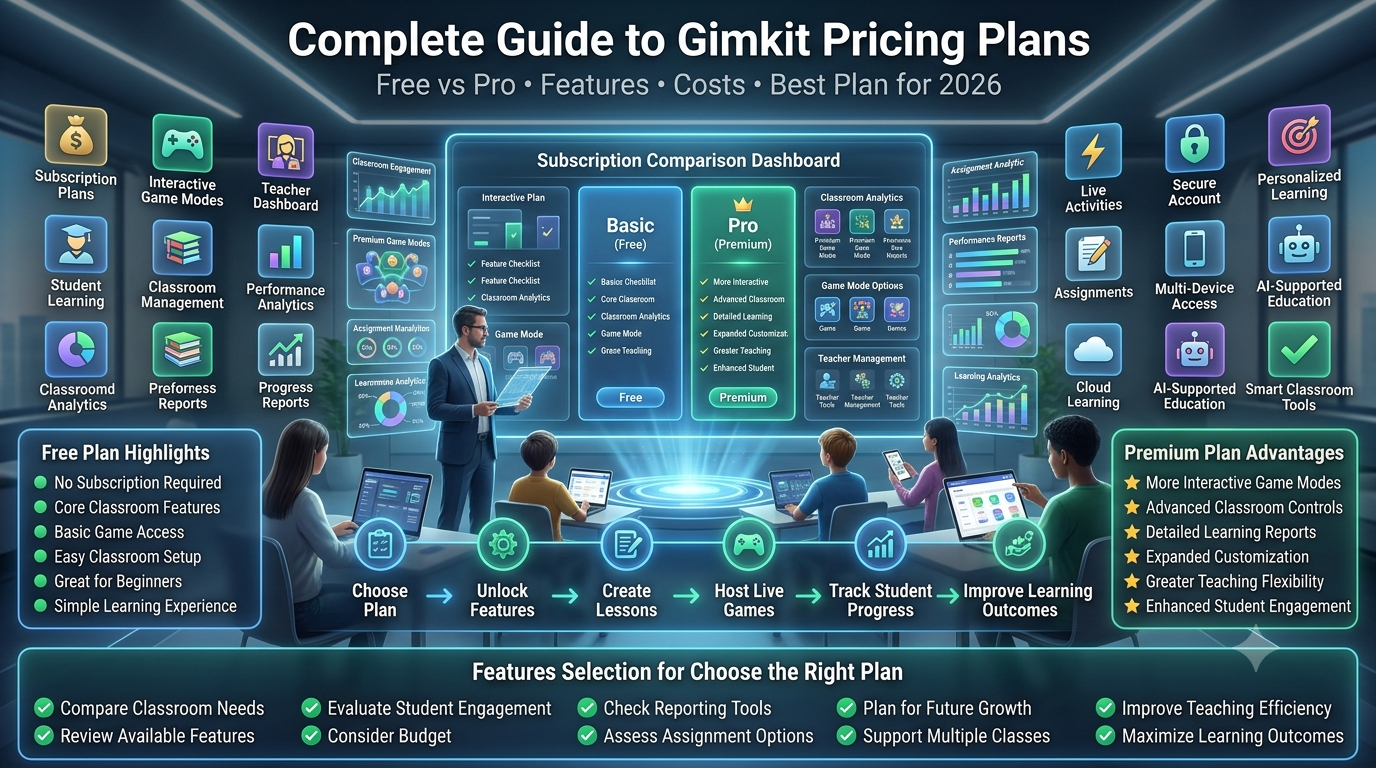
Gimkit Basic is free. The May 20, 2026 official Pro FAQ lists Gimkit Pro at $14.99 per month or $59.88 per year. Gimkit Groups documentation lists Department licenses at $650 per year for up to twenty teachers and School licenses at $1,000 per year, subject to coverage conditions.
Those prices describe different purchasing arrangements. Gimkit Basic is a free educator tier. Individual Pro monthly and annual subscriptions give one educator the published Pro capabilities. Gimkit Groups provides institutional licensing intended for multiple teachers who are added as members of an active group.
The first economic decision is often whether to pay monthly for only the months in which Pro is needed or pay an annual amount for a full year. Using the documented $14.99 monthly rate and $59.88 annual amount, four monthly payments total $59.96. That makes the stated annual amount cheaper by eight cents at four paid months.
The same official FAQ introduces a discrepancy by using $59.98 in its worked annual comparison. Under that alternative amount, four monthly payments at $59.96 are cheaper by two cents; annual becomes cheaper once five monthly payments are required. The difference is small financially but important for factual accuracy and calculations.
Institutional comparisons require another dimension: how many educators are actually intended to receive Pro. A Department group license can cover up to twenty teachers. A School license covers teachers in one physical school building, or up to one hundred across multiple buildings, under the current documentation.
A comparison that simply selects the lowest advertised price without checking educator count and building coverage may suggest an ineligible license. The Economics Lab therefore validates the scenario before displaying an eligible group option.
Compare paid months
Calculate monthly spending, annual commitment, exact crossover points and total costs across a chosen period.
Check eligible group options
Compare educator-seat costs while respecting Department capacity and School geographic limits.
See the assumptions
Distinguish published price references from editable scenarios, renewal decisions, taxes and official checkout amounts.
Understanding Gimkit's available plans and payment models
1. Gimkit Basic has no subscription price
The free Gimkit tier is officially called Gimkit Basic. It provides continuing educator access to ordinary supported functions without a monthly subscription charge. This is a meaningful financial option because not every teacher requires the particular features reserved for Pro.
Basic educators can create Kits, host currently Featured modes, use Classes and collect supported game reports. The number of Featured modes can rotate, and real-game participation limits still apply. These rules describe available functions but do not create a direct monetary cost for holding the Basic tier.
When comparing prices, a zero-dollar baseline helps clarify the difference between a subscription expense and other costs associated with classroom implementation. Devices, internet access and teacher preparation time are separate considerations. They are not Gimkit subscription fees and should not be silently included in the advertised Basic price.
The pricing calculator treats Basic as a zero-dollar subscription option. It does not conclude that every teaching objective is achievable on Basic, since certain paid capabilities have different entitlement rules.
2. Individual Gimkit Pro Monthly is billed at $14.99
Gimkit's May 2026 Pro FAQ lists the individual Pro monthly subscription at $14.99 with automatic monthly billing. This arrangement supplies the documented Pro educator capabilities while the relevant subscription period is active.
Monthly billing is especially relevant when educators anticipate needing the paid feature set for a limited period. For example, a short review project may require one or two paid months without creating the same full-year commitment as an annual purchase. However, the real subscription still follows Gimkit's billing and cancellation rules.
The financial model uses complete paid months. It does not assume prorated daily access, refunds for unused days or that a billing month has a fixed thirty-day length. Those claims would require terms not established by the basic published price.
The calculator allows the visitor to change the monthly rate as an explicit planning assumption. Changing that input does not change Gimkit's real checkout or establish that a special discount exists.
3. Gimkit Pro Annual is listed at $59.88
The official subscription-options section lists Pro Annual at $59.88, billed automatically once a year. That price provides an annual access period under Gimkit's published subscription arrangement, rather than a pay-per-game or pay-per-student charge.
An annual subscription can cost less than multiple monthly payments when the educator expects to use the paid features across enough months. However, it may still create a larger upfront expense than a single monthly payment, especially when the educator only needs Pro briefly.
The correct evaluation compares the actual required paid months with the total annual commitment. A teacher needing Pro for one month would compare $14.99 against $59.88, not divide the annual amount by twelve and treat the resulting average as the amount payable for one month.
The Economics Lab displays both the full annual commitment and the effective annual cost per calendar month. These are different numbers serving different purposes.
4. The second annual figure in the official FAQ is inconsistent
In its separate break-even example, Gimkit's Pro FAQ uses $59.98 instead of the $59.88 stated in its subscription list. The example also says annual becomes a better financial deal from four paid months, even though four monthly payments total $59.96.
Using $59.98 for annual would make those four monthly payments two cents cheaper. That means the exact equality and comparison statements in the official example cannot all be true simultaneously.
An independent financial article should neither silently rewrite the official source nor present an inconsistent calculation as mathematically correct. Both figures should be acknowledged and the final price verified through official checkout.
The calculator provides a selectable annual-price reference: the primary $59.88 listing, the conflicting $59.98 worked example or a custom entered amount. Every calculation uses the selected value consistently.
5. Gimkit Groups is a different kind of purchase
Gimkit Groups provides institutional licensing for departments and schools. Rather than buying an individual Pro subscription independently for each teacher, an organisation can purchase a license intended to cover a defined population of educators.
Group purchases are managed through Gimkit's official Groups system. The organisation creates a quote, makes a purchase and adds eligible Educator accounts as members. The central price therefore describes a group license, not a student activity or a package of game sessions.
Economic comparisons involving Groups need to include the actual number of teachers who will receive access. A license can appear attractive as a flat number but have a very different cost per educator depending on how many people use it.
The lab compares group totals with individual subscription totals for the same declared number of educators and reports coverage limitations rather than treating every institutional product as universally eligible.
6. Department licensing is listed at $650 per year
The official Gimkit Groups documentation lists the Department license at $650 per year for up to twenty teachers. The number twenty is a seat limit for educators, not a game participant limit.
The annual total remains the listed $650 whether the organisation has only a few teachers or nearly the full supported number in its department group. Therefore, the effective cost per teacher changes with the number of occupied seats.
With ten teachers, the base license expense works out to $65 per teacher for the year. With twenty teachers, the same $650 total corresponds to $32.50 per teacher. These are simple average-cost calculations, not quoted individual subscription prices.
The calculator validates the twenty-teacher cap before including Department in a cost comparison. For a scenario involving twenty-one or more teachers, it does not pretend that one Department license is sufficient.
7. School licensing is listed at $1,000 per year
The official Groups documentation lists the School license at $1,000 per year. It describes coverage for the teachers in one physical school building, or up to one hundred teachers across multiple buildings.
That geographic distinction is important. A comparison must know whether the requested coverage is within one physical building or spans several. For multiple buildings, the documented upper limit becomes relevant.
The $1,000 figure is the license-level annual amount. It should not be confused with the cost for one educator. The average per-teacher expense depends on how many teachers are covered by the same valid license.
The lab supports both single-building and multiple-building scenarios. Where the supplied scenario exceeds the documented multi-building condition, the School option is flagged as ineligible rather than ranked as a cheap solution.
8. There is no separate charge per student in these prices
The subscription figures addressed here concern educators and institutional educator licensing. They are not described as fees that every student must pay to join a teacher's game.
This matters because schools often compare software using student-seat terminology. A product with educator subscriptions can have a different pricing structure from a product that charges per enrolled learner. A numerical comparison between those models needs to use equivalent assumptions.
The Gimkit Pro FAQ discusses Basic and Pro as educator access levels, while Groups documentation discusses teacher capacity. Neither establishes a per-student subscription bill for ordinary participation in the ways implied by the older article.
The calculator therefore asks for educator count, not student count, when modelling institutional licenses. Technical live-game caps remain a separate gameplay question.
9. Subscription access should not be mistaken for unlimited hosting capacity
The older pricing article used language suggesting that paid subscriptions support unlimited students without qualification. Gimkit's separate Player Maximums documentation establishes real live-game limits, including a general hard cap of five hundred and a sixty-player cap for 2D modes.
Those limits matter even when a teacher has paid for Pro. An annual subscription is an access arrangement for the teacher; it is not permission to ignore every technical hosting boundary.
A pricing page should acknowledge this distinction without attempting to calculate mode-specific participant eligibility. That calculation belongs to the separate Game Modes subject.
The Economics Lab therefore concentrates on the monetary consequences of educator subscriptions and group coverage. It does not multiply the advertised Pro price by student count or claim that payment removes the published live-game caps.
10. A feature comparison does not replace a price comparison
Gimkit Pro includes paid educator capabilities such as Assignments, image uploads, audio questions and broader game-mode access. Basic retains core functionality including Classes and reports. These are important distinctions, but they answer which capabilities an educator can use rather than how much different purchase arrangements cost.
For an accurate financial analysis, the relevant question is how the published charges accumulate under a realistic period of use. A person paying monthly for two months has a different total from someone retaining a monthly subscription for a full year.
Similarly, an institution buying one Department license has a different cost structure from a school buying a broader School license. The number of eligible educators changes the economic interpretation.
This page therefore focuses on financial comparisons, while the separate Gimkit Pro page owns entitlement changes and the Free guide owns the educational use of Basic.
Gimkit monthly vs annual: calculating the real cost
11. One month of Pro has a straightforward published cost
Using the official $14.99 monthly reference, a teacher who requires one full paid monthly billing period would compare $14.99 against the stated $59.88 annual amount. Under those assumptions, a single monthly period costs less.
That statement does not mean the monthly plan is inherently better for every educator. It means the declared use period is shorter than the financial crossover point of the two price structures.
A subscription decision should also consider whether the educator will actually stop paying after that month. A monthly subscription described as automatically renewing can continue producing charges if it remains active.
The calculator models a deliberate number of paid months, assuming the educator actively manages start, cancellation and re-subscription as needed. It does not predict or perform those account actions.
12. Two paid months cost $29.98 at the published rate
Two complete monthly periods at $14.99 each total $29.98. That is below the stated annual price of $59.88, meaning the monthly structure has a lower total under this limited-use assumption.
The difference is relevant for an educator who uses paid features during a short unit or a limited-term project. If the teacher knows that no other paid capability will be needed later in the year, the annual commitment may not offer a monetary advantage for those two months.
However, uncertainty about future use changes the planning context. An educator may initially anticipate only two months but later discover that the subscription remains useful over several additional periods.
A cost comparison should therefore be paired with an explicit expected-use assumption rather than treated as a universal recommendation for short-term users.
13. Three paid months cost $44.97
At the official monthly reference, three paid billing periods total $44.97. This is still below the stated $59.88 annual amount, a difference of $14.91 before any separate charges.
A teacher who only needs paid capabilities during a defined three-month interval can see a clear arithmetic distinction between the two purchasing approaches. The annual option covers a longer access period, but the comparison is about the money committed for the required use.
The value of unused months should not be automatically counted as savings. An annual subscription can provide access during months when a teacher does not expect to use Pro, but that potential future availability is not the same as a realised financial benefit.
The model treats the supplied paid months as the anticipated actual use and reports both totals transparently.
14. Four paid months expose the official annual-price discrepancy
Four monthly payments of $14.99 equal $59.96. That figure is eight cents higher than the stated $59.88 annual amount, so annual is marginally less expensive under the primary official listing.
If the annual amount were instead $59.98, as Gimkit's own example also says, four monthly payments would be two cents cheaper. The direction of the result changes, even though the difference is very small.
This discrepancy illustrates why a financial calculator should preserve the source price used in its calculations. A comparison cannot use $59.88 for one result and $59.98 for another without explaining the difference.
The Economics Lab lets the user switch between these two official-source figures. It recalculates the crossover month and total difference immediately, without presenting either number as a confirmed checkout amount.
15. Five paid months make annual cheaper under both figures
Five monthly payments at $14.99 total $74.95. That exceeds both annual amounts mentioned in the official FAQ, $59.88 and $59.98.
For an educator expecting to need Pro during five distinct full monthly billing periods within the relevant annual comparison, annual therefore has the lower simple subscription expense under either published figure.
This is an arithmetic conclusion, not a command to buy annual. A teacher may value smaller short-term payments, face budget restrictions or need to verify whether all the expected months will actually require paid capabilities.
The calculator provides a cost comparison and leaves those financial preferences to the user. It does not claim that annual access automatically improves student learning outcomes.
16. Twelve monthly payments cost $179.88
At the published $14.99 rate, paying for twelve complete monthly periods results in $179.88. Compared with the stated $59.88 annual amount, the difference is exactly $120.00.
This example highlights the effect of maintaining a monthly subscription throughout an entire year when the official annual product is priced much lower. The calculation does not require speculation about teaching effectiveness or classroom engagement.
The outcome changes if only some months are paid. A subscription that is cancelled for months not needed produces a different total from one that remains active continuously.
The Economics Lab therefore asks for the number of paid months rather than assuming every monthly subscriber pays for all twelve months. This is necessary to avoid overstating the cost of deliberate short-term monthly use.
17. Break-even is determined by multiplication, not a slogan
For a given monthly price and annual price, the relevant question is how many complete monthly payments are needed before the cumulative monthly total exceeds the annual amount.
With the primary official values, the calculation is $14.99 multiplied by the paid-month count and compared against $59.88. At three months, monthly remains cheaper. At four months, annual becomes cheaper by eight cents.
The calculator performs these comparisons in integer cents. This prevents floating-point rounding effects from creating false one-cent differences in cases where exact monetary comparisons matter.
If the annual amount equals the cumulative monthly cost exactly, the tool identifies parity instead of declaring an artificial winner. The first month at which annual is strictly less expensive is calculated separately.
18. The annual effective monthly average is not a monthly bill
Dividing $59.88 by twelve gives $4.99 as an annualised monthly average. This is a useful economic ratio, but it does not mean the educator can purchase one month of the annual subscription for $4.99.
The actual annual arrangement is billed as an annual subscription under the published terms. The average simply spreads the twelve-month expense across calendar months for comparison.
Confusing an average with the payment amount can produce misleading budget advice. A teacher with enough money for one monthly payment may not have the same immediate amount available for the annual subscription.
The lab therefore displays total commitment and average monthly equivalent as separate values. Neither is used to suggest that Gimkit offers an undocumented discounted monthly plan.
19. Longer financial horizons change total commitment
An educator may want to model one year of use or examine a multi-year planning period. Multiplying the same annual reference by two or more years provides a simple projection of costs if the advertised prices remain unchanged.
Such a projection is not a promise that future prices will remain fixed. Gimkit controls its commercial terms and can change them. Renewal may also depend on whether the user retains a valid subscription and a supported payment method.
The lab can compare one to five years using the same editable reference rates. The output clearly identifies these values as constant-price scenarios rather than future invoices.
This gives educators and institutions a way to understand the scale of repeated expenses without manufacturing a guaranteed multi-year agreement.
20. Partial-month use is not automatically prorated
A teacher may need Pro for only a few days but still face the cost of a complete monthly billing period. The official price information describes monthly subscriptions rather than a universal daily-pay model.
The calculator therefore uses whole paid months. Entering one month represents one full monthly subscription payment, not a prediction of a proportional charge for seven or ten days.
Similarly, selecting three paid months within one year assumes the educator can manage subscriptions around those periods. It does not prove that Gimkit automatically pauses billing when a teacher stops using the platform.
This distinction prevents the model from overstating the flexibility of the underlying subscription. The official cancellation and billing controls determine the actual financial result.
Gimkit Groups: Department vs School pricing
21. A group license is purchased for educators, not individual games
Gimkit Groups is designed for departments and schools that want to provide Pro access to multiple teachers. The licensing cost is not charged each time a game is hosted, nor is it described as a separate fee per student joining an activity.
This structure changes how financial efficiency should be measured. The relevant quantity is how many educator accounts will be covered during the licensed year.
A school that needs Pro for only two teachers may face very different costs from one that needs it for thirty. A flat institutional price can be attractive at scale, but it can be unnecessarily expensive when only a small number of educators require the paid entitlement.
The calculator therefore uses teacher count as its central institutional input and compares valid group options with buying equivalent individual subscriptions.
22. Department group value depends on seat utilisation
The Department license provides up to twenty educator upgrades for a $650 annual base price. Average cost per teacher falls as more teachers use the same valid license.
For example, five teachers would correspond to an average of $130 per teacher if the full license expense were allocated equally. Twenty teachers would correspond to $32.50 each. These are mathematical allocations rather than official per-seat invoices.
The distinction is important because an educator may compare a personal annual subscription with a whole Department purchase and reach the wrong conclusion if the total is not divided across the actual covered educators.
The lab calculates the occupied-seat average while retaining the full group commitment in its results. It also shows unused capacity within the documented twenty-teacher cap.
23. Department coverage cannot exceed twenty teachers under one license
The official Department license limit is twenty teachers. An institution with twenty-one intended members cannot simply model one Department purchase as covering everyone.
A comparison that ignores the limit may produce a total of $650 for an ineligible scenario and make that plan appear artificially cheaper than all alternatives.
The lab explicitly marks a single Department license as not eligible when the declared educator count exceeds twenty. It does not invent a combined package of multiple Department licenses or assume that separate purchases can be arranged without verifying the institutional licensing rules.
For larger groups, the School option may be relevant, subject to its own building-coverage conditions and the real official quote.
24. The School license uses geographical coverage rules
Gimkit's Groups documentation says the School license covers teachers at one physical school building. It also describes a limit of one hundred teachers when the covered educators are spread across multiple buildings.
Those statements require more than a single teacher-count input. A model needs to know whether the intended group occupies one physical building or several.
A scenario involving thirty teachers in one building and another involving thirty teachers across multiple buildings both fall within the documented rules, but a scenario involving more than one hundred teachers across buildings would not qualify under the stated multi-building coverage.
The calculator therefore asks for the number of physical buildings. It uses that information to check the appropriate School license condition before including the option in eligible comparisons.
25. The $1,000 School cost can have different average values
A School license with twenty-five covered educators has an average base cost of $40 per teacher for the year. With fifty covered educators, the average falls to $20 per teacher.
These amounts reflect the same $1,000 group commitment divided among different teacher counts. They do not establish that Gimkit bills each teacher individually at those effective prices.
The average can help school administrators compare group licensing with separate individual annual subscriptions. However, an average alone is insufficient if some teachers are not actually eligible for the same institutional license.
The lab computes this ratio only after checking the entered building conditions and documented coverage rules.
26. Group licenses last 365 days and do not auto-renew
The official Gimkit Groups article states that group licenses become active when purchased, run for 365 days and do not automatically renew. This differs from individual monthly and annual Pro subscriptions, which are described as automatically billed.
This distinction matters for institutional budget planning. A school may need to authorise a new purchase or renewal process before an existing group term expires, rather than relying on the automatic renewal associated with individual paid plans.
The calculator treats each planned group year as a new full group-license expense. It does not claim that Gimkit offers a guaranteed discounted multi-year contract.
Real renewal dates and payment records must be confirmed in the official group management interface.
27. Institutional quotes have their own validity period
Gimkit's Groups documentation explains that quotes can be created online and that a quote link remains valid for three months. The quote is a purchasing document, not automatically an active group license.
An institution comparing costs should therefore distinguish the act of generating a quote from actually buying and activating access for teachers.
A historical quote may no longer be valid by the time a purchase decision is made. Commercial terms should be confirmed when the organisation is ready to proceed.
The Economics Lab does not generate official quotes. It provides scenario calculations using documented baseline figures and user-adjusted assumptions. Any purchasing decision should continue through Gimkit's current Groups process.
28. Group licenses can be purchased with purchase orders
Gimkit's Pro FAQ says purchase orders are accepted for Group licenses, not ordinary individual subscriptions. The Groups purchasing documentation also explains the institutional purchase-order workflow.
For schools that require procurement approval, this commercial distinction can matter as much as the numerical cost. A group purchase may fit institutional purchasing processes that are not supported for a personal monthly subscription.
However, a purchase order is not a discount by itself. It changes how the institution authorises and processes payment. The published license amount should not be reduced merely because a purchase order is used.
The lab therefore focuses on price comparisons and flags procurement differences separately in the explanatory guide.
29. Purchase-order group licenses use NET45 terms
Gimkit's official purchase documentation states that group licenses bought with a purchase order receive an invoice with NET45 terms. It also describes consequences if payment remains outstanding beyond the documented period.
This matters because a group license can become active before the institution's invoice has been fully processed. A school should not confuse immediate access with having no payment obligation.
Procurement planning should therefore include the institution's approval, invoicing and payment timetable. The calculator does not forecast cash collection dates or act as a billing ledger.
Its group totals represent base licensing expense under the selected prices. The official invoice remains authoritative for the actual amount due and payment status.
30. Institutional pricing is not automatically best for a small team
A Department license may cost more than buying individual annual Pro subscriptions for a very small number of teachers. For example, three annual subscriptions at the stated $59.88 rate total $179.64, well below the $650 Department base price.
As educator count increases, the total for individual licenses rises while the group base remains fixed within its eligibility conditions. At some point, the institutional option becomes less expensive under the simple reference-price comparison.
The crossover depends on the number of educators, annual price used and actual coverage. A fixed statement that “schools always save money with Groups” would therefore be incorrect.
The calculator evaluates each eligible approach using the same declared teacher count and shows the monetary difference without assigning an unsupported universal winner.
Gimkit Pricing & License Economics Lab
Compare individual Gimkit Pro monthly and annual spending, test the two conflicting published annual-price figures and calculate Department or School license economics using actual educator counts and coverage rules.
Real arithmetic. Transparent assumptions. No fake checkout.
The lab calculates illustrative USD costs using Gimkit's published reference prices. It does not connect to a subscription, issue a quote, initiate payment or verify a current promotional offer.
1. Set individual subscription assumptions
2. Individual plan comparison
Individual pricing result
3. Monthly-payment sensitivity table
The table recalculates each possible count of paid months against one annual payment. The selected paid-month scenario is highlighted.
1. Define institutional coverage
2. Eligible institutional and individual options
3. Group eligibility and financial interpretation
Your combined financial comparison brief
This report contains the individual subscription model, institutional options, eligibility checks, calculation assumptions and the published source-price discrepancy.
Why this calculator has a separate search intent
The Gimkit Pro Entitlement Lab examines whether a teacher can use particular Pro-only features during a declared access state. That is an access problem. The Gimkit Pricing & License Economics Lab examines actual expenses across billing strategies and teacher-license arrangements. That is a financial comparison problem.
A price model needs complete monetary values, use periods, educator counts and institutional eligibility conditions. Those inputs do not belong in a Mode Picker, Kit editor, classroom roster workflow or learning-evidence tool.
The outputs are similarly distinct. This application calculates cost differences, annual crossovers, expense per covered teacher, group eligibility and unoccupied Department seats. It does not suggest that a cheaper subscription automatically provides more educational value.
The ability to change assumptions is important because published prices may be updated and because real institutional circumstances differ. The model never silently changes the documented source reference; instead, it preserves the user's selected annual-price interpretation in the exported financial brief.
How the pricing calculator computes and compares costs
31. Individual monthly total uses paid months, not calendar months
The individual monthly scenario multiplies the selected monthly rate by the number of complete paid billing periods expected during a year. A teacher who pays for only three monthly periods should not automatically be charged for twelve periods in the comparison.
The model assumes that the educator manages cancellation and re-subscription when necessary. It cannot verify how a real billing cycle overlaps with school holidays or the user's planned teaching dates.
For a multi-year illustration, the same paid-month assumption is applied to each modeled year. This is a constant-usage projection, not a prediction of future behaviour.
The report lists both the selected number of months and the total amount so the user can see exactly which assumption produced the result.
32. Annual total models complete annual subscriptions
The annual strategy multiplies the selected annual subscription amount by the number of years in the planning horizon. It assumes an annual subscription is purchased for each year being compared.
This model avoids pretending that unused annual months can be refunded proportionally. The official Pro FAQ describes annual automatic billing rather than an unrestricted daily-refund arrangement.
The annual model can therefore have a higher total than monthly when the educator needs only a few periods of paid access. It can have a lower total when the number of paid monthly periods is sufficiently large.
Every conclusion is conditional on the entered prices and expected use. A future change in official commercial terms requires rechecking those assumptions.
33. The model calculates a strict annual-cheaper threshold
A break-even comparison should identify exactly when the annual payment becomes less expensive than the cumulative monthly payments. Equality should be reported as equality rather than silently attributed to one option.
The calculator checks each count from one through twelve complete monthly periods and finds the first point where annual expense is strictly lower. This respects the permitted annual comparison interval.
Using $14.99 monthly and $59.88 annual, that point is four paid months. Using $59.98 annual instead, the first strictly annual-cheaper point is five months.
If an entered custom annual price is never lower than the monthly expense during twelve periods, the calculator reports no annual-cheaper month in that range.
34. Monetary arithmetic uses integer cents
JavaScript floating-point arithmetic can create tiny rounding errors with decimal values. Financial comparisons involving only a few cents, such as the conflicting Gimkit annual amounts, should avoid letting such effects decide the displayed outcome.
The Economics Lab converts each supported price input into integer cents before multiplying and comparing totals. The resulting amounts are formatted back into two-decimal USD values.
This method supports precise arithmetic for the included price comparisons. It does not calculate tax law, process refunds or model every possible billing adjustment.
The currency label is USD because that is how the official Help Center presents the reference prices. No live foreign-exchange conversion is implied.
35. Department eligibility is a hard coverage condition
The Department calculation uses the published twenty-teacher limit. If the entered educator count is between one and twenty, the model can compare a single Department license against individual subscriptions.
If the educator count exceeds twenty, the model does not include one Department license as a valid way to cover all those teachers. It identifies the reason instead of allowing the apparent low total to distort the financial comparison.
This is different from choosing a personal preference. Coverage rules affect whether the option satisfies the stated purchase requirement at all.
The calculator does not automatically combine multiple Department licenses, since the official description does not establish that such a combination is appropriate for every institutional scenario.
36. School eligibility depends on building structure
The School calculation checks whether the proposed educators are located in one physical building or distributed across multiple buildings. For a multi-building scenario, the published one-hundred-teacher rule is applied.
The purpose is to avoid recommending the $1,000 School figure for a situation that falls outside the documented coverage description.
A scenario that fails the modeled coverage check is excluded from the eligible price ranking. It may still be useful to contact Gimkit or examine institutional options, but the calculator cannot invent a special license or quote.
The results explain the relevant assumption and encourage official verification before procurement.
37. Effective per-teacher cost is an average, not a billed seat fee
When a valid group license covers several educators, dividing the total license expense by the number of covered teachers produces an average cost per educator.
This can help a school compare institutional procurement with separate individual Pro subscriptions. However, the resulting amount is an internal financial allocation, not the price Gimkit charges each teacher.
The model displays total commitment and average cost separately because both matter. A low per-teacher average may coexist with a relatively high upfront institutional expense.
Real budget approval should consider the full quoted group amount rather than only the attractive average.
38. The lowest modeled price is not a universal recommendation
A financial model can identify the lowest base cost among eligible scenarios, but other constraints remain relevant. An institution may require a purchase order, a particular management structure or verified licensing coverage.
An educator might also prefer a different billing arrangement because of uncertainty about future use or limits on immediate cash availability.
The Economics Lab therefore calls its result the lowest eligible modeled total rather than the guaranteed best commercial choice.
Actual quotes, payment rules, renewal dates, membership and eligibility still need to be confirmed through Gimkit.
39. Taxes and currency conversion are intentionally excluded
Gimkit publishes its reference prices in USD. A user in another country might face foreign-exchange effects, card conversion charges or taxes that depend on the actual purchasing context.
The documentation reviewed here does not establish one universal tax or conversion rate that should be applied to every purchase. A calculator that silently adds a guessed percentage would create misleading certainty.
The lab therefore reports base USD amounts only. The user can compare those amounts with the official checkout or institutional quote, which may contain additional applicable charges.
This limitation is disclosed in the exported brief so that the calculated figure cannot easily be mistaken for an official final invoice.
40. The calculator is not connected to official billing
The application runs entirely in the visitor's browser. It reads the values entered into its input fields, performs arithmetic and displays explanations. It does not authenticate a Gimkit account or retrieve private subscription information.
Saving a local scenario does not change an official plan. Opening the calculator does not initiate a purchase, request a credit card or create a Group quote.
TXT, CSV and JSON exports are planning records generated by this website. The JSON format can restore the same scenario locally but cannot be imported into Gimkit's billing system.
These boundaries are central to the tool's accuracy. Financial calculations can be genuinely functional without pretending to control a commercial platform.
Gimkit payments, cancellation, receipts and procurement
41. Individual monthly and annual subscriptions auto-renew
Gimkit's official Pro FAQ describes the monthly and annual plans as automatically billed at their respective intervals. This distinction matters when comparing a deliberately limited number of paid months with leaving a subscription active continuously.
A teacher who intends to use Pro for only a short interval must consider the actual renewal schedule and cancellation process. Simply stopping gameplay is not documented as a cancellation method.
The calculator assumes the user actively manages paid periods when entering fewer than twelve monthly payments. It does not issue renewal reminders or verify whether a subscription has already been cancelled.
The real account's Plan and Billing section is the appropriate location for checking charges and subscription state.
42. Cancelling does not end Pro immediately
Gimkit's Cancel Your Subscription article says paid Pro access continues through the already-purchased period after cancellation. The account is not automatically stripped of paid capabilities at the instant the cancellation request is confirmed.
This distinction affects financial interpretation. Cancellation stops future recurring charges under the documented terms; it does not mean the earlier payment is reversed or that the remaining paid time disappears.
The calculator counts complete billed periods rather than assuming immediate cancellation generates a refund for unused days.
Users should confirm the exact expiration date and resulting status in their official Gimkit account rather than relying on an independent estimate.
43. Subscription cancellation is not account deletion
Ending a paid subscription and deleting an educator account are fundamentally different operations. Gimkit documents that created resources remain after a paid subscription ends, while account deletion carries separate permanent consequences.
A teacher planning to reduce expenses should therefore not interpret account deletion as the ordinary method for stopping automatic Pro charges.
The correct commercial process is to use official subscription management. This page does not provide an imitation Cancel button or attempt to change the account on the user's behalf.
The pricing model can help examine the expense consequences of shorter versus longer paid periods, but the actual cancellation action remains on Gimkit.
44. Receipts are available in Plan and Billing
Gimkit's official Receipts guide says users can access charges and receipt documents from Settings, then Plan and Billing. The documentation describes options to view, download or print past charges.
A school administrator may need these records for reimbursement or financial reconciliation. The total from an independent calculator cannot replace an issued commercial receipt.
The financial model uses published reference rates and editable assumptions. The actual receipt documents the amount the account was charged under the relevant transaction.
A discrepancy between a model and a real receipt should be resolved using the official billing information, applicable charges and the purchase conditions.
45. Purchase orders belong to the Groups workflow
Gimkit's official Pro FAQ states that purchase orders are accepted for Group licenses. The individual paid subscription workflow is not described as having the same purchase-order option.
This matters for schools whose procurement policies require an approved purchase order. A group license may be commercially appropriate even before considering the average cost per teacher.
However, purchase-order eligibility does not establish that every group type fits the institution's teacher count or geography. Coverage requirements still need to be checked.
The Economics Lab treats purchasing methods as contextual constraints and keeps its numerical comparison separate from the official procurement system.
46. Group renewal differs from individual automatic billing
Official Groups documentation says institutional licenses do not auto-renew. Managers use the documented renewal process to obtain continued coverage, with real expiry dates controlled by the service.
A multi-year group budget can still be calculated by multiplying the annual reference by the number of planned license years. This is useful for internal projections but not proof that renewal will occur automatically.
The lab assumes a full new group expense for each modeled year, while the report explains that actual renewal terms and prices must be confirmed before each purchase.
This prevents a five-year illustrative total from being mistaken for a signed five-year contract.
47. Pay For Me provides a separately documented purchase route
Gimkit's Pay For Me Link documentation describes a way for another person or institution to pay for an individual educator's annual Pro upgrade using a dedicated link.
This arrangement differs from a standard automatically renewing individual subscription. The official Help article states that Pay For Me upgrades expire after one year and do not automatically renew.
It also describes Pay For Me as an annual upgrade arrangement rather than a general monthly third-party payment method.
The Economics Lab does not generate Pay For Me links or alter the amount to be paid. The feature is relevant to procurement choices but must be used through Gimkit's official account interface.
48. Buying a Group license does not automatically enroll every teacher
Gimkit's Group membership documentation explains that educators receive Pro when their actual Educator accounts join the relevant active Group license.
An institution may therefore budget for a group purchase without every intended teacher immediately having Pro. Cost coverage and account-level membership are related but distinct matters.
This distinction belongs in a complete pricing analysis because the organisation should consider how the purchased capacity will be allocated and administered.
The calculator uses intended educator count as a financial assumption. It cannot verify individual memberships, issue invitations or calculate the true number of currently occupied license seats from Gimkit's private records.
Realistic Gimkit pricing scenarios for teachers and schools
49. An educator needs Pro for only one short project
A teacher is preparing a unit that depends on a paid feature for approximately one monthly billing period. The published individual monthly reference is $14.99, while the annual reference is $59.88.
Under the assumption that one complete paid month is sufficient and renewal is properly managed, the monthly arrangement has the lower monetary commitment.
The educator should not assume that one month means an exact thirty-day usage window or that unused days will be refunded. Actual billing dates belong to the official subscription.
The calculator can represent one paid month and display the monetary difference without asserting that monthly is always the correct choice for the teacher's wider needs.
50. A teacher expects Pro throughout the academic year
Another educator expects to use paid capabilities across most of the year. At twelve monthly payments of $14.99, the annualised monthly strategy totals $179.88.
The stated annual reference of $59.88 is far lower in that constant-price illustration. The difference is $120.00, before any additional applicable commercial charges.
The teacher still needs to consider actual billing renewal and personal budget timing, but the financial advantage of the annual structure under these assumptions is clear.
The calculator can show this at the selected horizon and preserve the exact annual reference used in the comparison.
51. A five-teacher team compares individual and Department costs
Five individual annual subscriptions at the stated $59.88 reference would total $299.40. The Department license is listed at $650 for up to twenty teachers.
If the team needs only five educators and no other institutional considerations change the decision, the individual annual total is lower under the simple base-cost comparison.
This example illustrates why purchasing a group license solely because the organisation is called a department can be financially misleading.
The calculator uses actual educator count instead of an institutional label to determine the expense difference.
52. An eighteen-teacher department evaluates Group access
Eighteen individual annual Pro subscriptions at $59.88 each total $1,077.84. The published Department license costs $650 and is eligible for up to twenty teachers.
Under those assumptions, the Department base price is $427.84 lower than buying eighteen individual annual subscriptions. The average Department cost becomes approximately $36.11 per educator, with two documented seats unoccupied.
These calculations do not establish a guaranteed final procurement total or prove that every teacher has joined the Group license.
The Economics Lab reproduces this comparison with coverage validation and allows an administrator to change the intended teacher count.
53. A school with forty educators considers School licensing
Forty individual annual subscriptions at the $59.88 reference would cost $2,395.20. A documented School license has a base price of $1,000 if the intended educators meet its coverage conditions.
That comparison suggests a substantial base-cost difference. However, the School option must still be appropriate for the number of physical school buildings and participating educators.
The calculator checks those conditions before ranking the School option among eligible financial scenarios.
The institution should confirm its actual scope and obtain a current Gimkit quote before treating the base-price calculation as a purchasing decision.
54. A multi-building institution exceeds the published School limit
An institution wants a single School license for one hundred and twenty educators spread across several physical buildings. Gimkit's documentation identifies a one-hundred-teacher limit for School coverage across multiple buildings.
A single $1,000 School license therefore cannot be treated as a verified way to cover that entire scenario under the published condition.
The calculator marks School as ineligible rather than displaying it as the lowest valid cost. A Department license is also insufficient when the intended educator count exceeds twenty.
The institution would need to examine suitable official arrangements instead of relying on an invented universal school-license option.
55. A school needs a purchase order and a current quote
An administrator has selected a potential Group license but must follow institutional procurement procedures. Gimkit supports purchase orders for Groups and allows official quotes to be generated through its Group pricing workflow.
The independent cost calculation helps with preliminary budget discussions, but it is not itself a formal quote. The official quote and purchase process establish the actual commercial document.
The administrator should also consider the validity period of the quote and the NET45 invoice terms described in official documentation.
The calculator does not ask for purchase-order numbers, upload procurement files or pretend to authorise a license.
56. An educator compares the conflicting annual figures
A teacher expects to need exactly four months of paid Pro. Four monthly payments total $59.96. The primary official annual listing gives $59.88, while another paragraph in the same FAQ gives $59.98.
Switching the calculator's annual source changes the outcome from a small annual advantage to a small monthly advantage. The tool reveals that the difference is only a few cents.
Rather than treating the small discrepancy as evidence that the entire product is incorrectly priced, the appropriate response is to check the official checkout amount.
The model preserves both documented figures and their precise arithmetic consequences so the visitor can see the uncertainty instead of receiving a fabricated definitive quote.
Gimkit pricing questions answered
Is Gimkit free in 2026?
Yes. Gimkit Basic is the continuing free educator plan. Gimkit Pro is an optional paid upgrade, and the two have different documented feature entitlements.
How much is Gimkit Pro per month?
The official Pro FAQ updated May 20, 2026 lists $14.99 monthly, with automatic monthly billing. Actual checkout terms should be verified before purchasing.
How much is Gimkit Pro annually?
The official subscription list states $59.88 per year. Another worked example in the same FAQ uses $59.98. Verify the actual checkout price because those figures conflict.
Why are there two annual prices in the official FAQ?
The published documentation contains an internal discrepancy. This independent article reports both figures rather than claiming which amount will appear at checkout.
Which Gimkit Pro plan is cheaper for four months?
Four monthly payments total $59.96. Annual at $59.88 is eight cents cheaper; annual at $59.98 is two cents more expensive. The result depends on which annual amount applies.
At how many months does annual Pro become cheaper?
At four paid months using $59.88 annual and $14.99 monthly. At five paid months using the alternative $59.98 annual figure. The calculator supports both cases.
How much is twelve months of monthly Pro?
Twelve payments at $14.99 total $179.88, assuming the rate remains unchanged and all twelve monthly periods are billed.
What is the effective monthly cost of $59.88 annually?
It is $4.99 when the annual expense is divided by twelve. This is an average, not an available $4.99 one-month subscription offer.
Does Gimkit charge each student for joining a game?
The prices addressed here concern educator Pro subscriptions and institutional educator licensing, not a separate subscription charge imposed on every student for ordinary participation.
Is Gimkit Basic limited to five students?
No. The documented five-player Basic restriction concerns Pro-exclusive modes. General live games and 2D modes have their own hard participation limits.
Do I need Pro to create Kits?
No. Standard Kit authoring is available with a free Educator account. Some enhanced question features require Pro.
Are Assignments included with Basic?
No. Gimkit's official Assignments Explained documentation identifies Assignments as a paid Pro capability.
Can Basic users access reports?
Yes. The official Pro FAQ describes collecting game reports as a Basic educator capability.
How much is a Gimkit Department license?
The published Gimkit Groups price is $650 per year for up to twenty teachers.
How much is a Gimkit School license?
The published base price is $1,000 per year. Coverage must satisfy the official School license conditions.
How many teachers can one Department license cover?
Up to twenty teachers, according to Gimkit's official Groups documentation.
Can a School license cover more than one building?
Yes, but the documentation describes a limit of one hundred teachers when coverage spans multiple physical buildings.
Does a single-building School license have the same 100-teacher rule?
The official documentation describes one-school-building coverage separately from the up-to-one-hundred condition for multiple buildings. Confirm your intended institutional scope with Gimkit before purchasing.
Is a Department license always cheaper than individual Pro?
No. It depends on how many educators are covered. For a small team, buying individual annual subscriptions may cost less than a $650 group license.
How do I calculate Department cost per teacher?
Divide the $650 annual base amount by the number of actual covered educators. This produces an average allocation, not an official individual subscription price.
How do I calculate School cost per teacher?
Divide the School license's annual price by the actual number of covered educators, provided the chosen coverage scenario is eligible.
Can a group license be purchased with a purchase order?
Yes. Gimkit officially supports purchase orders for Group licenses. Individual subscriptions use separate supported payment methods.
How long does a Gimkit Group license last?
Gimkit documents a 365-day group term. Group licenses do not automatically renew.
Do individual Gimkit Pro subscriptions renew automatically?
The official Pro FAQ describes both individual monthly and annual subscriptions as automatically billed at their respective intervals.
Does cancellation stop Pro immediately?
No. Gimkit documents continued Pro access through the already-paid period after cancellation.
Does cancellation delete my Kits?
No. Gimkit says created resources remain after a subscription ends. Account deletion is a separate operation with different consequences.
Where are Gimkit receipts?
Official Gimkit documentation directs users to Settings, then Plan and Billing, where relevant charges and receipts can be viewed and downloaded.
What is Gimkit Pay For Me?
It is an official way for another person to pay for an Educator's annual Pro upgrade through a dedicated link. The documentation describes this upgrade as non-auto-renewing.
Can Pay For Me be used for monthly Pro?
The official Pay For Me documentation identifies the feature as an annual upgrade arrangement rather than a monthly third-party purchase method.
How do Gimkit Group quotes work?
The official Groups workflow allows an institution to create and share a quote, then proceed to purchase through supported payment methods. The Help Center states quotes expire after three months.
What does NET45 mean for a Gimkit Group purchase order?
It means the invoice uses payment terms associated with forty-five days, as described in Gimkit's institutional purchasing documentation. The actual invoice controls the obligation.
Can the Pricing Lab issue a genuine Gimkit quote?
No. The calculator is independent and provides illustrative financial scenarios. Official quotes are produced through Gimkit's Groups purchasing workflow.
Does the calculator include tax?
No. It calculates base USD amounts. Any applicable tax, card fee or currency conversion must be verified through the real checkout or quote.
Can I change the monthly or annual price in the calculator?
Yes. Editable prices let users test assumptions. A custom amount is not a claim that Gimkit officially offers that price.
How does the calculator handle the annual discrepancy?
Users can select $59.88, the primary official subscription listing; $59.98, the conflicting example; or a custom rate. Every calculation uses the selected amount.
Does the calculator work for multiple years?
Yes. It models one to five years using constant entered prices. It does not guarantee that future official renewal prices will remain unchanged.
Can I save or export the pricing comparison?
Yes. The lab supports browser persistence, copy, TXT, CSV, JSON, print and JSON restoration. Those are independent planning records, not official invoices.
Can the calculator buy Gimkit Pro for me?
No. Payment, real subscription changes and institutional purchases must take place through Gimkit's official service.
Which pricing option should a school choose?
Compare actual educator count, geographic coverage, permitted procurement methods and base price, then confirm the official quote. The lowest calculated amount is only one part of a valid purchasing decision.
Pricing decisions and free teaching are different topics
An educator can compare subscription costs without assuming that paid access is necessary for every lesson. The site's separate Gimkit Free teaching guide examines whether meaningful instruction can be built around Basic features, ordinary Kits and currently Featured live modes.
This Pricing page retains exclusive ownership of the monetary comparison: monthly spending, annual commitments, group-license economics and published financial conditions. It does not duplicate the free teaching application, Pro entitlement lifecycle or Dashboard navigation simulator.
Where the Gimkit pricing figures and rules come from
The following Gimkit Help Center references support the price listings, subscription conditions, educator licensing limits, institutional purchasing methods and billing guidance discussed above.
Compare the real expense before making a commitment.
Gimkit Basic has no subscription cost. Paid Pro and Groups offer different purchasing structures. The right financial comparison depends on paid months, educator count, geographical coverage and the prices verified at checkout.
Return to Pricing Calculator ↑