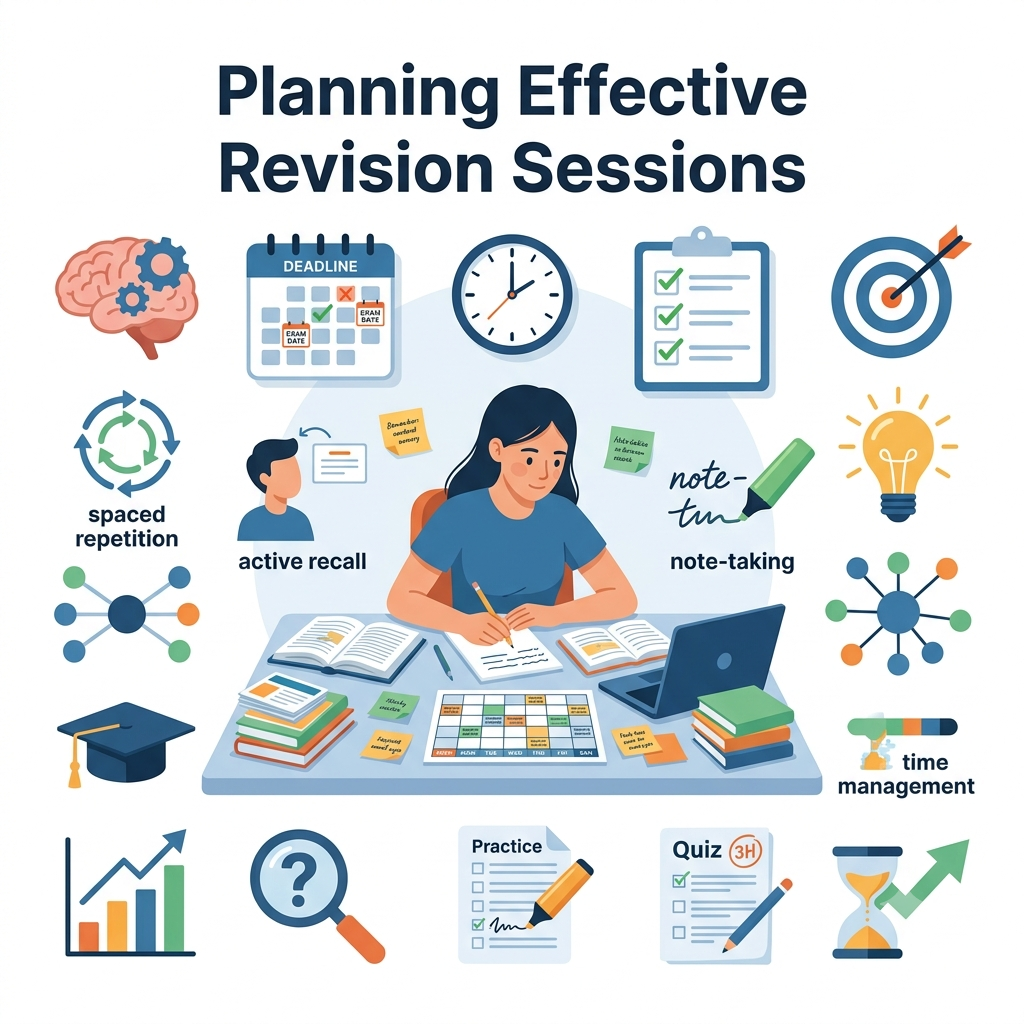
Planning Effective Revision Sessions | Revision is one of the most important stages of the learning process, yet it is also one of the most misunderstood.
🧠 Understand What Revision Really Means: Revision is much more than rereading textbooks or highlighting notes before an exam. It is a structured learning process that strengthens understanding, improves long-term memory, and builds confidence.
🎯 Set Clear Revision Goals: Every revision session should have specific objectives so you know exactly what topics or skills you want to improve.
🗂️ Organise Study Materials: Gather textbooks, class notes, past papers, flashcards, and other resources before starting to create a smooth and focused revision session.
📖 Choose Effective Revision Techniques: Select study methods that match your learning style, such as:
📝 Active recall
💡 Flashcards
🗺️ Mind maps
❓ Practice questions
📚 Summarisation
🎯 Spaced repetition
⏰ Manage Your Time Wisely: Create a realistic revision timetable that balances study sessions, regular breaks, and sufficient rest to maximise productivity.
🌟 Create a Distraction-Free Study Environment: Study in a quiet, organised space that helps you stay focused and motivated throughout each revision session.
🎓 Prepare for Different Types of Exams: A structured revision plan is valuable whether you’re studying for:
🏫 School assessments
🎓 University examinations
📜 Professional certifications
🏆 Competitive entrance exams
🔄 Revise Regularly Instead of Cramming: Successful students make revision part of their routine by reviewing topics consistently instead of relying on last-minute cramming.
🔍 Identify and Improve Weak Areas: Regularly assess your understanding, focus on difficult topics, and spend extra time strengthening areas that need improvement.
🚀 Use Active Learning Strategies: Engage with the material by solving problems, answering questions, teaching concepts to others, and testing yourself frequently.
📊 Track Your Progress: Monitor your improvement throughout the revision period to measure learning, adjust your study plan, and stay motivated.
💪 Reduce Stress and Build Confidence: A well-planned revision strategy improves academic performance, lowers exam anxiety, and creates a more balanced and enjoyable learning experience.
✅ Avoid Common Revision Mistakes: Stay away from ineffective habits like passive reading, procrastination, and last-minute studying by following a consistent and organised revision routine.
🌈 Build Long-Term Learning Habits: Sustainable revision practices not only help you succeed in exams but also develop lifelong study skills that support future academic and professional success.
What Is Planning Effective Revision Sessions?
Planning effective revision sessions is the process of organising study time, learning resources, and revision activities to maximise knowledge retention and exam readiness. Rather than studying randomly or revising only before examinations, learners create a structured schedule that prioritises important topics, balances workload, and uses evidence-based revision techniques.
An effective revision plan answers several important questions before each study session:
What topics need revision?
Which subjects require additional attention?
What learning objectives should be achieved today?
Which revision method is most suitable?
How will progress be measured?
By answering these questions in advance, students spend more time learning and less time deciding what to study next.
Why Revision Planning Is Different from Regular Studying
Learning new material and revising existing knowledge are different educational processes.
Learning New Content
Revision Sessions
Introduces new concepts
Reinforces previously learned material
Focuses on understanding
Focuses on remembering and applying
Often teacher-led
Usually self-directed
Builds initial knowledge
Strengthens long-term retention
Covers broad content
Targets key concepts and weak areas
Understanding this distinction allows students to choose appropriate revision strategies instead of treating revision like another classroom lesson.
Why Planning Revision Sessions Matters
Students often underestimate how quickly information fades when it is not reviewed. Without regular revision, much of what is learned during lessons gradually becomes harder to recall. Planned revision interrupts this forgetting process by revisiting information at the right intervals.
A structured revision plan provides several educational advantages:
Improves long-term memory retention
Reduces exam anxiety through preparation
Prevents last-minute cramming
Encourages consistent learning habits
Identifies learning gaps early
Makes revision more efficient
Improves confidence before assessments
Instead of feeling overwhelmed by large amounts of content, learners break subjects into manageable sections that can be reviewed systematically.
Practical Classroom Example
Imagine two students preparing for the same science examination.
Student A studies only during the final weekend before the exam. They spend long hours rereading the textbook but struggle to remember definitions and scientific processes during the test.
Student B begins revising four weeks earlier. Each revision session focuses on one topic, includes self-testing, reviews previous material, and ends with practice questions. By exam day, the information has been reinforced multiple times, making recall much easier.
The difference is not necessarily intelligence—it is the effectiveness of the revision plan.
💡 Pro Tip: Revision should begin while learning is still taking place, not after all teaching has finished. Short, regular review sessions are generally more effective than intensive last-minute study.
The Goals of Effective Revision Sessions
Every revision session should have a clear purpose. Studying without specific goals often leads to passive reading and wasted time.
Well-planned revision sessions typically aim to:
Refresh previously learned knowledge
Strengthen understanding of difficult topics
Improve memory recall
Practise applying knowledge
Prepare for assessments
Build confidence
Monitor learning progress
Having defined objectives allows students to evaluate whether each session has been productive.
For example, instead of writing:
“Revise Mathematics”
A better objective would be:
“Complete twenty algebra questions, review quadratic equations, and identify areas requiring further practice.”
Specific goals create measurable progress and increase motivation.
Characteristics of an Effective Revision Session
Not every study session produces meaningful learning. Productive revision combines planning, focus, and active engagement.
An effective revision session usually includes the following elements:
Clear Objectives
Students know exactly what they intend to achieve before beginning.
Organised Learning Materials
Books, notes, flashcards, past papers, and digital resources are prepared in advance to minimise interruptions.
Active Learning
Learners actively retrieve information through quizzes, practice questions, summarising, teaching others, or solving problems rather than simply rereading notes.
Time Management
Study time is divided into manageable periods with planned breaks that maintain concentration.
Progress Evaluation
Students finish each session by checking what they have learned and identifying any remaining difficulties.
These elements transform revision from passive review into purposeful learning.
Benefits of Planning Revision Sessions
Well-organised revision offers advantages that extend beyond examination performance.
Better Knowledge Retention
Repeated retrieval strengthens memory pathways, making information easier to recall over time.
Instead of memorising facts temporarily, students develop lasting understanding that supports future learning.
Improved Time Management
Planning prevents learners from spending excessive time on topics they already understand while neglecting more challenging subjects.
Balanced scheduling ensures that all important topics receive appropriate attention.
Reduced Stress and Anxiety
One of the most common causes of examination stress is uncertainty.
Students often worry because they are unsure whether they have revised enough.
A revision plan replaces uncertainty with structure.
Knowing what has already been completed and what remains helps learners feel more prepared and in control.
Increased Motivation
Completing small revision goals creates visible progress.
Checking completed tasks off a revision timetable provides positive reinforcement and encourages continued effort.
Instead of facing an overwhelming syllabus, students experience a series of achievable milestones.
Stronger Academic Performance
Research in educational psychology consistently supports active retrieval, spaced practice, and organised revision as effective methods for improving learning outcomes.
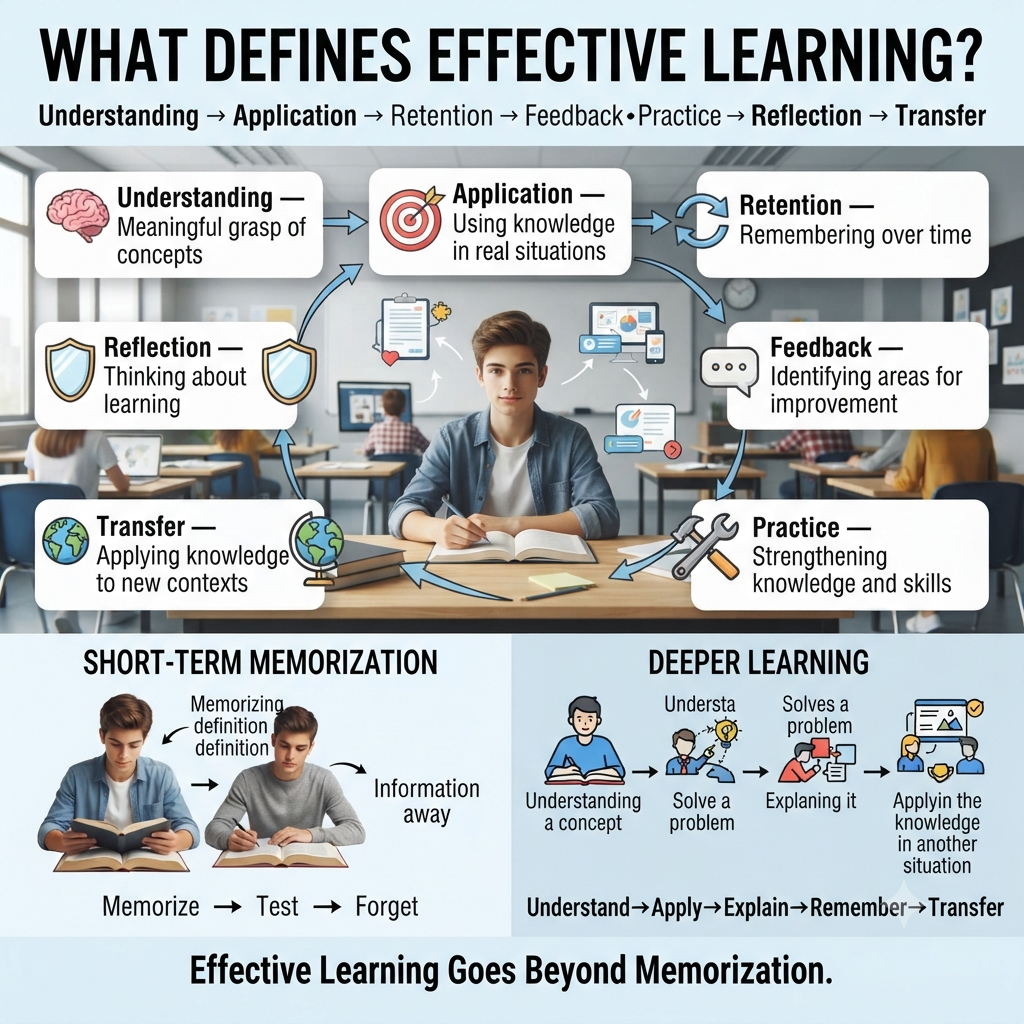
Students who revise strategically often perform better than those who rely solely on repeated reading or memorisation.
Understanding How Memory Affects Revision
Effective revision is closely connected to how the brain stores and retrieves information.
Learning typically follows three stages:
Encoding new information
Storing information in long-term memory
Retrieving information when needed
Revision strengthens each of these stages.
When students repeatedly retrieve information rather than simply rereading it, memory becomes more durable and easier to access during examinations.
This explains why practice questions, flashcards, and self-testing are often more effective than passive reading.
Example
Reading a biology definition five times may create familiarity.
Explaining that definition from memory or answering exam questions about it strengthens actual recall.
Revision should therefore focus on retrieval rather than recognition.
⭐ Expert Insight: If revision feels slightly challenging, it is often more effective. The effort required to retrieve information helps reinforce long-term memory.
Setting Clear Learning Objectives Before Every Revision Session
One of the biggest mistakes students make is beginning revision without deciding exactly what they hope to achieve.
Clear objectives improve concentration and make revision more purposeful.
Good learning objectives are:
Specific
Measurable
Achievable
Relevant
Time-bound
For example:
Weak Objective
Strong Objective
Study History
Revise the causes of World War I and complete two past-paper questions
Revise English
Analyse one poem, memorise key quotations, and answer one exam-style question
Learn Chemistry
Practise balancing chemical equations and complete fifteen related exercises
Specific objectives provide direction and make it easier to evaluate progress.
Prioritising Topics for Maximum Improvement
Not every topic requires the same amount of revision.
Effective planning begins by identifying priorities.
Students can divide topics into three categories:
Priority Level
Description
Revision Frequency
High Priority
Weak understanding or high exam importance
Most frequent
Medium Priority
Moderate confidence
Regular review
Low Priority
Strong understanding
Occasional revision
This approach ensures revision time is allocated where it will have the greatest impact.
For example, if a student consistently struggles with algebra but performs well in geometry, additional revision sessions should focus on algebra while still briefly reviewing geometry to maintain confidence.
📌 Quick Note: Prioritising difficult topics does not mean ignoring strengths. Regular review of well-understood material helps maintain accuracy and confidence while preventing knowledge loss.
Building the Right Revision Mindset
Successful revision is not only about techniques; it also depends on mindset. Students who approach revision with curiosity, consistency, and realistic expectations are more likely to maintain motivation throughout the study period.
A productive revision mindset includes:
Viewing mistakes as opportunities to improve rather than failures.
Focusing on steady progress instead of perfection.
Accepting that difficult topics often require multiple revision sessions.
Celebrating small achievements to maintain momentum.
Remaining flexible and adjusting the revision plan when priorities change.
Revision is rarely perfect from the beginning. Effective learners regularly evaluate their progress, refine their strategies, and continue building understanding over time.
Choosing the right learning platform can significantly improve classroom outcomes. Compare leading educational tools in Gimkit Comparisons & Alternatives to find the best solution for your teaching style.
Interactive learning becomes more effective when students experience different gameplay formats. Discover engaging classroom activities in Gimkit Features & Game Modes and keep every lesson fresh.
Whether you’re a beginner or an experienced educator, practical guidance makes implementation easier. Follow our Gimkit Guides & Tutorials for step-by-step instructions and classroom best practices.
Every teacher benefits from proven instructional ideas that increase participation and motivation. Explore Gimkit Resources for Teachers for practical classroom-ready solutions.
Understanding pricing and premium features helps educators make informed decisions. Read detailed comparisons and expert evaluations in Gimkit Reviews & Pricing before selecting a subscription.
Small instructional improvements often lead to better classroom results. Discover practical teaching methods and winning techniques in Gimkit Tips & Strategies to maximize student engagement.
Expand your knowledge with a wide variety of educational content by browsing our General Articles, covering technology, learning, and classroom innovation.
Stay informed about the newest platform improvements, educational trends, and feature releases through Games Updates so you never miss important changes.
Strengthen learning with engaging assessments and interactive activities available in our Quiz Resources collection, designed for teachers and students alike.
If you experience sign-in problems or game access issues, visit Gimkit Login, Join & Troubleshooting for reliable solutions and step-by-step troubleshooting guides.
How to Plan an Effective Revision Session Step by Step
A successful revision session starts long before you open a textbook. Good planning eliminates unnecessary decisions during study time, allowing you to focus entirely on learning.
Follow this structured workflow to make every revision session productive.
Step 1: Define Your Revision Goal
Every revision session should have one clear objective.
Instead of saying:
“I’ll study Physics today.”
Choose a measurable goal such as:
Complete one chapter on Electricity.
Answer 20 past-paper questions.
Review formulas and solve numerical problems.
Memorise key definitions using flashcards.
Having one primary goal prevents distraction and gives your session a clear direction.
Why It Matters
Without a defined objective, students often jump between topics, spend too much time on easy material, and finish the session unsure of what they actually achieved.
Step 2: Identify High-Priority Topics
Not every chapter deserves equal attention.
Before planning your schedule, divide topics into categories based on:
Difficulty level
Exam weight
Personal confidence
Time remaining before the exam
Example Priority Matrix
Topic
Difficulty
Exam Importance
Priority
Algebra
High
High
⭐⭐⭐ High
Geometry
Medium
Medium
⭐⭐ Medium
Statistics
Low
Medium
⭐ Low
Probability
High
High
⭐⭐⭐ High
This approach ensures that your revision time is invested where it can have the greatest impact.
💡 Pro Tip: Start each study day with the most challenging topic while your concentration is at its highest.
Step 3: Gather All Study Materials Before Starting
Interruptions reduce concentration and waste valuable study time.
Before beginning, prepare everything you need:
Class notes
Textbooks
Revision guides
Flashcards
Highlighters
Practice papers
Calculator (if required)
Laptop or tablet
Water bottle
Notebook for mistakes
Creating a distraction-free workspace allows you to remain focused throughout the session.
Step 4: Break Large Topics into Smaller Tasks
One of the biggest reasons students procrastinate is that topics appear overwhelming.
Instead of revising:
Biology Chapter 8
Break it into manageable sections:
Cell structure
Cell division
DNA
Genetics
Practice questions
Summary review
Completing several small tasks feels more achievable than tackling one large chapter.
Step 5: Decide Which Revision Method to Use
Different subjects require different revision strategies.
Examples
Subject
Best Revision Method
Mathematics
Problem-solving practice
Science
Diagrams, formulas, quizzes
History
Timelines, essays, flashcards
Geography
Maps and case studies
Languages
Vocabulary recall and speaking practice
Literature
Quote recall and essay planning
Matching the revision technique to the subject improves both efficiency and understanding.
Choosing the Most Effective Revision Techniques
Not every revision method produces the same results.
Educational research consistently shows that active learning methods outperform passive reading.
Below are some of the most effective approaches.
Active Recall
Active recall involves retrieving information from memory without looking at your notes.
Examples include:
Answering questions
Writing everything remembered about a topic
Using flashcards
Explaining concepts aloud
Instead of recognising information, students practise recalling it independently.
Why It Works
Retrieving information strengthens memory pathways, making recall easier during examinations.
Spaced Repetition
Rather than revising a topic once, spaced repetition reviews it several times over increasing intervals.
Example schedule:
Day 1
Day 3
Day 7
Day 14
Day 30
This method helps prevent forgetting and improves long-term retention.
⭐ Expert Insight: Short, repeated revision sessions are usually more effective than one long study marathon.
Practice Testing
Testing yourself is one of the most reliable ways to identify learning gaps.
Examples include:
Past papers
Online quizzes
Mock exams
Teacher worksheets
Self-made questions
Practice testing also improves exam confidence by simulating real assessment conditions.
The Feynman Technique
This technique involves explaining a topic using simple language.
Steps:
Learn the concept.
Explain it as if teaching someone else.
Identify parts you cannot explain clearly.
Review those areas.
Repeat.
Teaching exposes misunderstandings that passive reading often hides.
Mind Mapping
Mind maps organise related ideas visually.
They work particularly well for:
Biology
History
Business Studies
Psychology
Geography
Instead of memorising isolated facts, students understand relationships between concepts.
Time Management Strategies for Revision Success
Good revision depends on quality, not just quantity.
Studying for six unfocused hours is often less effective than two well-planned hours.
The Pomodoro Technique
One popular method divides study into focused intervals.
Example:
Study for 25 minutes.
Take a 5-minute break.
Repeat four cycles.
Take a longer 20–30 minute break.
Benefits include:
Better concentration
Reduced mental fatigue
Improved motivation
Easier task management
Time Blocking
Assign each revision task a dedicated time slot.
Example
Time
Activity
9:00–9:45
Mathematics
9:45–10:00
Break
10:00–10:45
Biology
10:45–11:00
Review mistakes
11:00–11:30
Flashcards
Time blocking prevents indecision and creates a structured daily routine.
The 80/20 Principle
Sometimes called the Pareto Principle, this approach suggests focusing on the topics that deliver the greatest improvement.
For many students, a relatively small number of challenging concepts account for most mistakes in exams.
Identifying and improving those weak areas often leads to significant score increases.
⚠ Common Mistake: Spending hours revising favourite topics while avoiding difficult ones creates a false sense of progress.
Creating a Weekly Revision Timetable
A revision timetable provides structure while ensuring all subjects receive appropriate attention.
Example Weekly Schedule
Day
Main Focus
Secondary Review
Monday
Mathematics
Flashcards
Tuesday
Biology
Previous topics
Wednesday
English
Vocabulary
Thursday
Chemistry
Practice questions
Friday
Physics
Formula review
Saturday
Mixed revision
Past paper
Sunday
Weekly review
Planning next week
A timetable should remain flexible enough to accommodate unexpected challenges without causing unnecessary stress.
How to Balance Multiple Subjects
Students often struggle when preparing for several examinations simultaneously.
Instead of completing one subject before starting another, rotate subjects throughout the week.
Example Rotation
Morning:
Mathematics
Afternoon:
Biology
Evening:
English Literature
This variation reduces boredom while improving long-term retention.
Creating Monthly Revision Plans
Monthly planning helps students prepare gradually rather than rushing before exams.
Month One
Complete first revision of all subjects.
Identify weak topics.
Organise notes.
Month Two
Focus on weak areas.
Complete topic-based practice questions.
Begin timed exercises.
Month Three
Complete full mock examinations.
Analyse mistakes.
Improve exam technique.
Review summaries.
Long-term planning prevents revision from becoming overwhelming.
How Long Should a Revision Session Be?
There is no universal answer because concentration varies between individuals and tasks.
However, many learners benefit from:
Learner
Recommended Session Length
Primary students
20–30 minutes
Secondary students
30–50 minutes
College students
45–60 minutes
University students
60–90 minutes
Long sessions should always include regular breaks to maintain focus and prevent mental fatigue.
📌 Quick Note: The quality of concentration matters far more than the total number of hours studied.
Individual Revision vs Group Revision
Both approaches have advantages when used appropriately.
Individual Revision
Group Revision
Better concentration
Encourages discussion
Flexible schedule
Shared knowledge
Personal pace
Motivation from peers
Fewer distractions
Opportunity to teach others
When Individual Revision Is Better
Memorising content
Solving mathematical problems
Writing essays
Completing practice papers
When Group Revision Works Best
Discussing complex concepts
Quiz competitions
Explaining topics
Reviewing case studies
Sharing revision strategies
The most effective study plans often combine both methods.
Tracking Your Revision Progress
Without monitoring progress, students may overestimate how much they have learned.
Consider maintaining a revision tracker with columns such as:
Topic
Revised
Tested
Confidence Level
Algebra
✔
✔
High
Genetics
✔
✘
Medium
Electricity
✘
✘
Low
Regular reviews help identify which topics need additional attention before the exam.
Staying Motivated Throughout Your Revision Plan
Motivation naturally rises and falls during long revision periods. The key is to rely on consistent habits rather than waiting to feel inspired.
Practical ways to stay motivated include:
Breaking large goals into smaller milestones.
Rewarding yourself after completing revision targets.
Studying at the same time each day to build a routine.
Tracking completed sessions to see your progress.
Revisiting your long-term goals, such as achieving a target grade or gaining admission to your preferred course.
Consistency is more valuable than occasional bursts of intense study.
Best Practices for Every Revision Session
Use this checklist before each study session:
✅ Set one clear objective.
✅ Remove distractions from your workspace.
✅ Gather all study materials beforehand.
✅ Start with the most challenging topic.
✅ Use active recall instead of passive reading.
✅ Include short breaks to maintain focus.
✅ End by testing your understanding.
✅ Record any weak areas for future revision.
Following the same routine each time helps create effective study habits and reduces decision fatigue.
Advanced Revision Strategies That Improve Long-Term Learning
As students become more familiar with revision techniques, they can combine multiple strategies to create a more effective learning system. Rather than relying on a single method, experienced learners often alternate between active recall, practice testing, spaced repetition, and exam-style questions.
This layered approach encourages deeper understanding while improving the ability to apply knowledge under exam conditions.
An Effective Revision Cycle
Read and understand the topic.
Summarise the key concepts in your own words.
Test yourself without using notes.
Review incorrect answers.
Complete practice questions.
Return to the topic after several days using spaced repetition.
Repeating this cycle over several weeks strengthens both confidence and memory retention.
💡 Pro Tip: Avoid spending an entire day revising a single subject. Rotating subjects keeps the brain engaged and reduces mental fatigue.
Subject-Specific Revision Strategies
Every subject requires a slightly different revision approach. Adapting your study methods to the nature of the subject makes revision more efficient.
Mathematics
Mathematics is best learned through consistent practice rather than passive reading.
Effective Strategies
Solve problems daily.
Review common formulas.
Analyse incorrect answers.
Practise timed exam questions.
Keep an error log to track repeated mistakes.
Science
Science subjects combine theory, diagrams, calculations, and practical understanding.
Effective Strategies
Draw labelled diagrams from memory.
Memorise scientific terminology.
Explain processes aloud.
Solve calculation-based questions.
Practise interpreting graphs and experimental results.
History
History requires both factual recall and analytical thinking.
Effective Strategies
Create timelines.
Compare historical events.
Memorise important dates only within context.
Practise essay planning.
Use flashcards for key people and events.
English Literature
Revision should focus on understanding themes rather than memorising entire essays.
Effective Strategies
Learn important quotations.
Analyse literary techniques.
Compare characters.
Plan essay structures.
Review examiner expectations.
Geography
Geography combines theoretical knowledge with real-world case studies.
Effective Strategies
Revise maps.
Study diagrams.
Memorise key statistics where required.
Compare case studies.
Practise extended-answer questions.
Using Digital Tools to Support Revision
Technology can make revision more interactive, organised, and flexible when used appropriately. Digital tools should complement learning rather than replace active thinking.
Useful categories include:
Flashcard applications for spaced repetition.
Digital note-taking platforms.
Online quiz generators.
Past-paper repositories.
Mind-mapping software.
Calendar and study-planning applications.
Timer apps for focused study sessions.
The most effective tools encourage active participation instead of passive scrolling.
⭐ Expert Insight: Technology is valuable only when it supports meaningful learning. Spending excessive time organising digital notes without testing your knowledge often provides little academic benefit.
Creating a Productive Revision Environment
Your study environment has a direct impact on concentration and learning quality.
An effective revision space should include:
Good lighting.
A comfortable chair.
A tidy desk.
Minimal distractions.
Reliable internet access only when required.
Easy access to learning materials.
Water to stay hydrated.
Small environmental improvements often lead to noticeable increases in productivity.
How to Stay Focused During Revision
Maintaining concentration is one of the biggest challenges students face.
Practical techniques include:
Turning off unnecessary notifications.
Studying in short focused sessions.
Using website blockers when needed.
Keeping your phone out of reach.
Setting clear objectives before each session.
Taking regular movement breaks.
Sleeping adequately each night.
Concentration is easier to maintain when the brain receives regular rest.
Common Revision Mistakes to Avoid
Many students work hard but still achieve disappointing results because their revision methods are ineffective.
Understanding these common mistakes helps improve both efficiency and learning outcomes.
Passive Reading
Simply rereading textbooks creates familiarity but does not guarantee understanding or recall.
Better Alternative: Test yourself regularly using questions and flashcards.
Highlighting Everything
Highlighting entire pages makes it difficult to identify genuinely important information.
Better Alternative: Highlight only essential concepts after understanding the material.
Cramming Before Exams
Last-minute study may improve short-term recall but rarely supports deep understanding.
Better Alternative: Begin revising weeks in advance using spaced repetition.
Ignoring Weak Topics
Students often avoid difficult subjects because they feel uncomfortable.
Unfortunately, these topics usually have the greatest potential for improvement.
Better Alternative: Prioritise weaker areas while continuing to review strengths.
Studying Without Breaks
Long, uninterrupted study sessions reduce concentration and increase mental fatigue.
Better Alternative: Schedule regular breaks to maintain focus and motivation.
⚠ Common Mistake: Measuring success by hours studied rather than what you actually learned.
Troubleshooting Common Revision Problems
Even with a good plan, students may encounter challenges. Recognising problems early allows you to adjust your strategy before they affect performance.
Problem
Possible Cause
Practical Solution
Forgetting information quickly
Lack of spaced repetition
Review topics regularly over time
Feeling overwhelmed
Large workload
Break subjects into smaller tasks
Poor concentration
Distractions or fatigue
Study in shorter focused sessions
Running out of time
Unrealistic timetable
Prioritise high-value topics
Low motivation
Goals are too broad
Set smaller daily objectives
Exam anxiety
Lack of practice
Complete timed mock exams
Rather than abandoning your revision plan, make small adjustments and continue consistently.
Building Healthy Revision Habits
Academic success depends on sustainable habits rather than occasional intensive effort.
Healthy revision habits include:
Revising regularly instead of cramming.
Getting sufficient sleep.
Eating balanced meals.
Staying physically active.
Drinking enough water.
Reflecting on progress each week.
Adjusting your timetable when necessary.
Looking after your physical and mental well-being supports better learning and concentration.
Final Revision Checklist Before Exams
Use this checklist during the final stages of exam preparation.
Before the Exam
✅ Review all major topics.
✅ Complete multiple past papers.
✅ Analyse recurring mistakes.
✅ Revise key definitions and formulas.
✅ Organise stationery and required materials.
✅ Confirm the exam timetable.
The Night Before
✅ Avoid learning entirely new topics.
✅ Review summaries only.
✅ Prepare everything needed for the exam.
✅ Get enough sleep.
On Exam Day
✅ Eat a balanced meal.
✅ Arrive early.
✅ Read every question carefully.
✅ Manage your time wisely.
✅ Stay calm and focus on one question at a time.
Expert Recommendations for Long-Term Revision Success
Experienced educators consistently recommend building revision into everyday learning rather than treating it as a separate activity before examinations.
Some of the most effective long-term practices include:
Review class notes within 24 hours of each lesson.
Schedule weekly revision sessions for previously covered topics.
Keep a notebook of common mistakes and revisit it regularly.
Use practice questions to measure understanding instead of relying on familiarity.
Revise difficult topics more frequently than easier ones.
Reflect on each revision session and adjust your plan where necessary.
Revision is most effective when it becomes a continuous habit rather than a temporary response to upcoming exams.
📌 Quick Note: Consistency almost always outperforms intensity. Thirty minutes of focused revision each day often produces better results than several hours of last-minute study.
Professional recommendations & Expert Reviews
Planning Effective Revision Sessions begins with identifying the most important learning objectives.
Planning Effective Revision Sessions helps students review concepts in a structured way.
Planning Effective Revision Sessions encourages consistent preparation before assessments.
Planning Effective Revision Sessions helps students approach assessments with confidence.
Frequently Asked Questions
1. What is the best way to plan effective revision sessions?
The best way to plan effective revision sessions is to create a structured study plan that includes clear learning objectives, realistic time blocks, and a balanced revision schedule. Rather than studying randomly, divide your syllabus into smaller, manageable topics and prioritise them based on difficulty, exam weight, and your current level of understanding. Every revision session should have a specific purpose, such as mastering a concept, completing practice questions, or reviewing previously learned material.
A successful revision plan also incorporates proven learning techniques like active recall, spaced repetition, practice testing, and self-assessment. These methods encourage your brain to retrieve information instead of simply recognising it, which significantly improves long-term memory retention. At the end of each study session, spend a few minutes reviewing what you achieved, identifying any weak areas, and updating your revision schedule accordingly.
Planning ahead also reduces exam stress because you know exactly what needs to be studied each day instead of making last-minute decisions. Students who consistently follow a structured revision timetable usually experience better organisation, increased confidence, and improved academic performance.
Key Points
Define clear learning objectives before every session.
Divide large subjects into smaller, achievable tasks.
Prioritise topics based on difficulty and exam importance.
Use active learning strategies instead of passive reading.
Include regular review sessions to strengthen memory.
Leave flexibility in your timetable for unexpected challenges.
Monitor your progress and adjust your revision plan when necessary.
Finish every session by reviewing what you learned and planning the next one.
2. How long should a revision session last?
There is no single revision session length that works for everyone because concentration levels vary depending on age, subject difficulty, and individual learning preferences. However, educational research suggests that focused study sessions lasting between 30 and 60 minutes are effective for most secondary school and college students. University students or learners working on complex subjects may benefit from slightly longer sessions of 60 to 90 minutes, provided they include regular breaks.
One of the most popular approaches is the Pomodoro Technique, where students study for 25 minutes, take a 5-minute break, and repeat the cycle several times before taking a longer break. Short breaks help restore concentration, reduce mental fatigue, and improve information retention. Rather than measuring success by the number of hours studied, focus on how effectively you understand and recall the material.
The quality of your revision is far more important than the total time spent at your desk. A focused 45-minute revision session without distractions is often more productive than several hours of unfocused studying.
Key Points
Most students benefit from sessions lasting 30–60 minutes.
Advanced learners may study effectively for 60–90 minutes.
Take short breaks every 25–60 minutes to maintain concentration.
Use techniques like the Pomodoro Method to stay productive.
Avoid marathon study sessions without rest.
Study when your energy and focus are highest.
Review key concepts before ending each session.
Prioritise quality of learning over the number of hours studied.
3. Which revision techniques are most effective?
The most effective revision techniques are those that require you to actively retrieve and apply information rather than simply rereading notes. Educational psychologists consistently recommend methods such as active recall, spaced repetition, practice testing, and the Feynman Technique because they strengthen long-term memory and improve exam performance.
Active recall involves testing yourself without looking at your notes, forcing your brain to retrieve information from memory. Spaced repetition reviews the same topic multiple times over increasing intervals, helping prevent forgetting. Practice testing with past papers or quizzes familiarises students with exam formats while identifying knowledge gaps. The Feynman Technique encourages students to explain concepts in simple language, making it easier to identify misunderstandings and reinforce learning.
Different subjects may also benefit from specialised techniques. Mathematics requires regular problem-solving, history benefits from timelines and essay planning, while science often involves diagrams, formula practice, and explaining processes.
Combining several revision methods is usually more effective than relying on just one. For example, a revision session could begin with reviewing notes, continue with active recall, and finish with exam-style questions.
Key Points
Practise active recall instead of passive rereading.
Use spaced repetition to improve long-term memory.
Complete past papers under timed conditions.
Explain topics aloud using the Feynman Technique.
Create flashcards for key facts and definitions.
Use mind maps to connect related ideas.
Adapt revision methods to suit different subjects.
Combine multiple techniques for the best results.
4. How can students stay motivated during revision?
Staying motivated throughout a long revision period can be challenging, especially when preparing for multiple examinations. The most effective way to maintain motivation is to build consistent study habits instead of relying solely on inspiration. Motivation naturally changes from day to day, but a well-established routine helps you continue making progress even when you do not feel particularly motivated.
Start by setting realistic daily and weekly goals that are specific and achievable. Breaking large topics into smaller milestones makes revision feel less overwhelming and allows you to celebrate regular achievements. Tracking completed tasks using a revision checklist or study planner also creates a sense of accomplishment and highlights your progress over time.
It is equally important to maintain a healthy balance between studying and personal well-being. Adequate sleep, regular exercise, nutritious meals, and scheduled breaks all contribute to better concentration and sustained motivation. Avoid comparing your progress with other students, as everyone learns at a different pace. Instead, focus on continuous improvement and recognise that steady progress leads to lasting success.
When motivation decreases, remind yourself of your long-term goals, whether that means achieving a particular grade, entering your preferred university, or qualifying for a future career.
Key Points
Set realistic daily and weekly revision targets.
Break large topics into manageable tasks.
Track your progress using a revision planner.
Reward yourself after completing important milestones.
Follow a consistent study routine.
Take regular breaks to avoid burnout.
Maintain healthy sleep, nutrition, and exercise habits.
Focus on your own progress rather than comparing yourself with others.
5. What are the biggest revision mistakes students should avoid?
Many students spend a significant amount of time revising but achieve disappointing results because they rely on ineffective study habits. One of the most common mistakes is passive learning, such as repeatedly reading textbooks or highlighting large sections of notes without testing understanding. Although these activities create a sense of familiarity, they often fail to strengthen long-term memory or improve exam performance.
Another major mistake is last-minute cramming, where students attempt to learn large amounts of information shortly before an exam. While cramming may help with short-term recall, it rarely supports deep understanding and usually increases stress and anxiety. Students should instead revise consistently over several weeks using spaced repetition and active recall.
Ignoring weaker subjects is another common problem. Many learners naturally prefer revising topics they already understand because it feels more rewarding, but this limits improvement. Effective revision focuses on strengthening weak areas while maintaining knowledge of stronger topics.
Other mistakes include studying for long periods without breaks, failing to complete past papers, not reviewing incorrect answers, creating unrealistic revision timetables, and measuring success by hours studied rather than actual learning outcomes. Successful revision is built on consistency, reflection, and continuous improvement.
Key Points
Avoid passive reading as your primary revision method.
Do not rely on last-minute cramming before exams.
Prioritise weaker subjects instead of avoiding them.
Complete past papers and analyse your mistakes.
Include regular breaks to maintain concentration.
Create a realistic and flexible revision timetable.
Review incorrect answers to prevent repeating mistakes.
Measure success by understanding and recall, not simply by study hours.
Conclusion
Planning effective revision sessions is one of the most valuable academic skills students can develop because it transforms studying from a stressful, last-minute activity into a structured and purposeful learning process. Rather than relying on cramming or repeatedly reading textbooks, a well-designed revision plan helps learners organise their time, focus on high-priority topics, and use proven techniques that strengthen long-term memory and improve exam performance. Consistent revision not only increases knowledge retention but also builds confidence, reduces anxiety, and allows students to approach assessments with greater preparation and clarity.
The most successful revision strategies are those that combine clear learning objectives, realistic study schedules, active recall, spaced repetition, practice testing, and regular progress reviews. Equally important is maintaining a healthy balance between focused study, adequate rest, physical well-being, and personal motivation. Small, consistent revision sessions completed over weeks are far more effective than long periods of unfocused study immediately before an examination. By regularly evaluating strengths and weaknesses, students can continuously improve their learning strategy and make every revision session more productive.
Ultimately, effective revision is not measured by the number of hours spent studying but by how well knowledge can be understood, remembered, and applied when it matters most. Whether preparing for school examinations, university assessments, professional certifications, or competitive entrance tests, a thoughtful revision plan provides a reliable pathway to stronger academic performance and lifelong learning success. Students who develop organised revision habits today gain skills that will continue to support their education, careers, and personal growth for years to come.