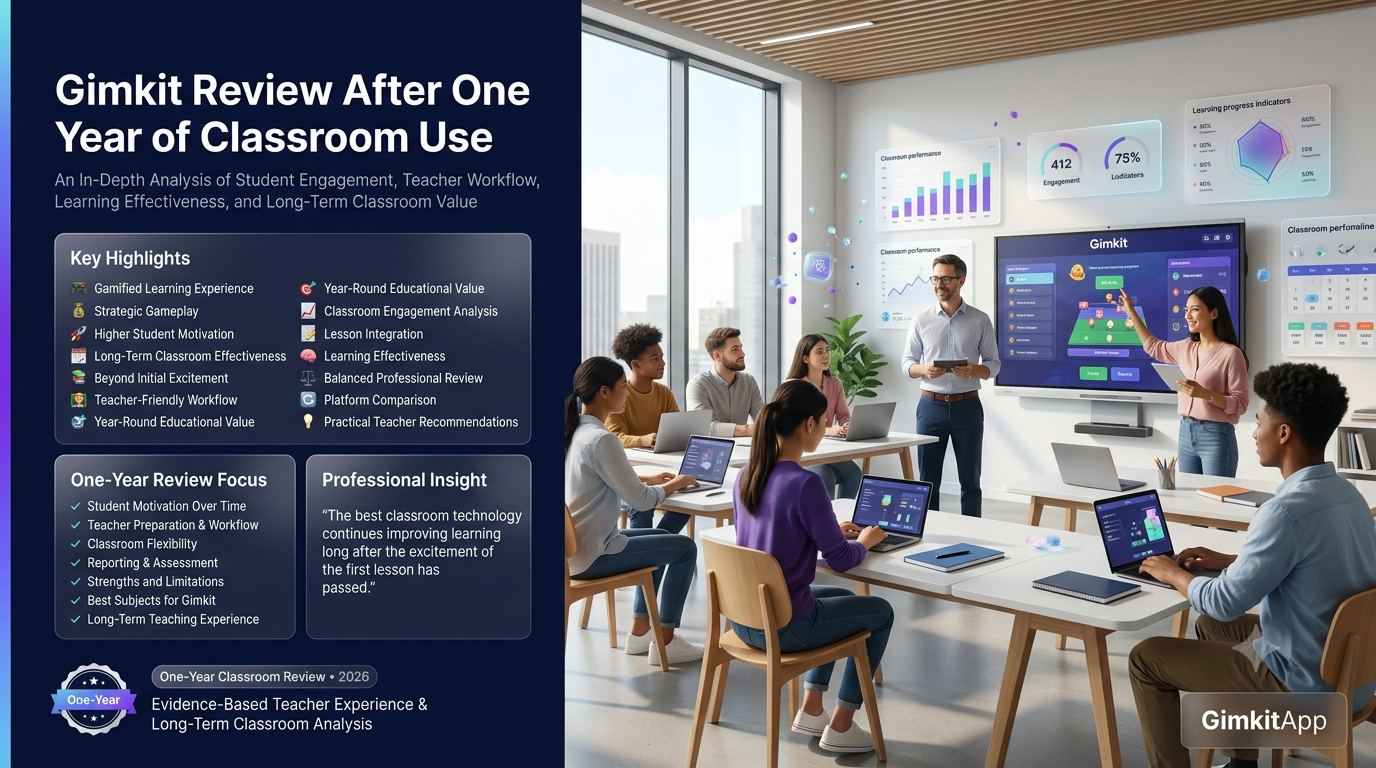
Gimkit Review After One Year of Classroom Use: Keeping students engaged has become one of the biggest challenges in modern classrooms. Whether teaching elementary learners, high school students, or university classes, educators constantly look for ways to make lessons more interactive without sacrificing learning outcomes. Digital learning platforms have transformed classroom instruction, but not every educational tool maintains student interest beyond the first few uses.
Key Highlights
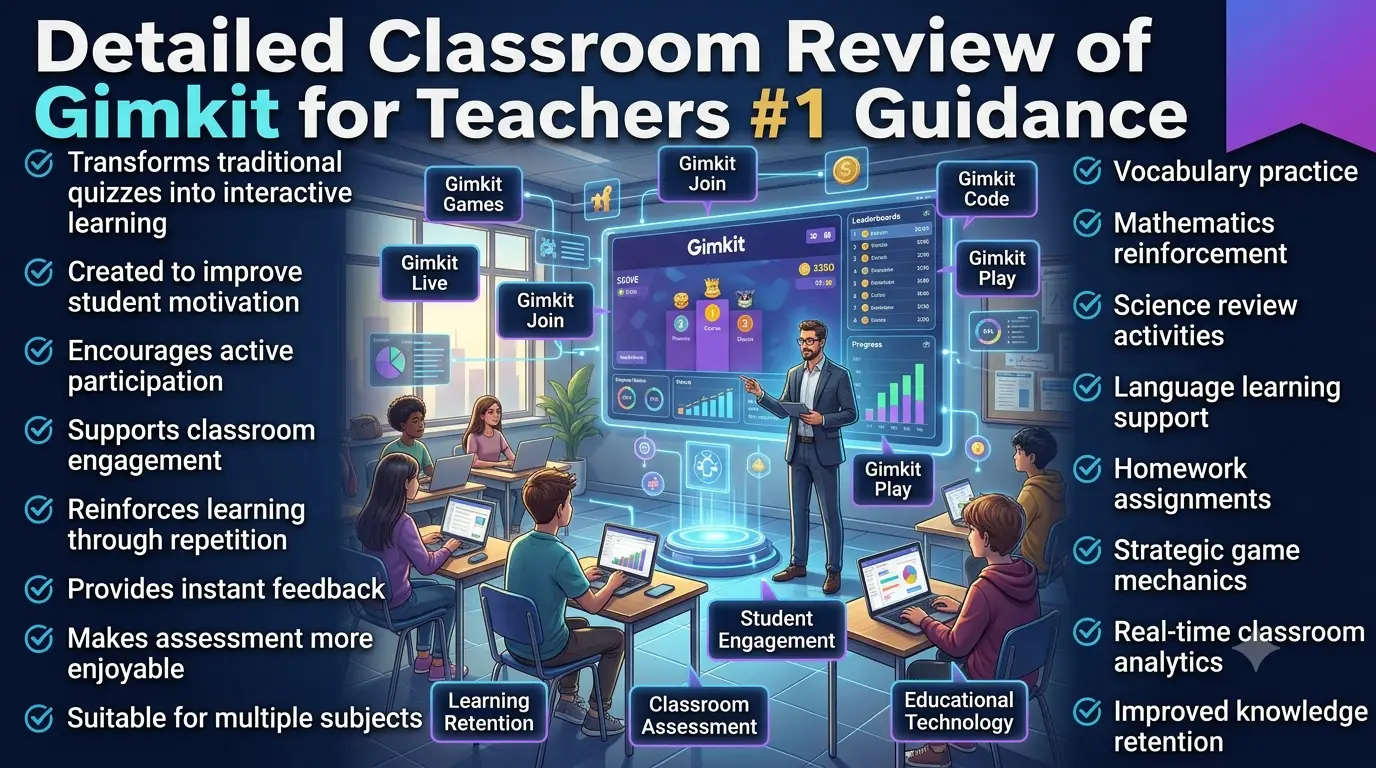
🎮 Gamified Learning Experience — Combines education with engaging game mechanics that encourage active participation instead of passive quiz-taking.
💰 Strategic Gameplay — Students earn virtual currency, unlock upgrades, and compete in challenges, making learning more interactive.
🚀 Higher Student Motivation — Transforms routine review sessions into activities that students genuinely enjoy and anticipate.
📅 Long-Term Effectiveness — Examines whether Gimkit maintains student interest and educational value after months of regular classroom use.
📚 Beyond Initial Excitement — Evaluates if the platform avoids the common decline in engagement seen with many educational tools.
👨🏫 Teacher-Friendly Workflow — Considers whether Gimkit saves preparation time and adapts to different teaching styles.
🎯 Year-Round Educational Value — Assesses its ability to support consistent learning throughout an academic year.
📈 Classroom Engagement Analysis — Reviews how effectively Gimkit keeps students involved over the long term.
📝 Lesson Integration — Explores how easily the platform fits into everyday classroom instruction.
🧠 Learning Effectiveness — Measures its impact on knowledge retention, practice, and student understanding.
⚖️ Balanced Review — Highlights both Gimkit’s strengths and its limitations for realistic expectations.
🔄 Platform Comparison — Identifies situations where alternative learning platforms may be more suitable.
⭐ Practical Recommendations — Provides strategies for teachers to maximize Gimkit’s long-term educational impact.
Whether you’re considering Gimkit for the first time or deciding if it’s worth using throughout an entire school year, this guide provides the context needed to make an informed decision.
Explore the latest classroom resources, expert tutorials, and educational technology insights on GimkitApp, your complete destination for everything related to Gimkit and modern learning tools.
What This One-Year Classroom Review Covers
Direct Answer: This review examines Gimkit beyond first impressions by focusing on how the platform performs after regular classroom use over an extended period.
Many reviews evaluate educational software after only a few lessons, highlighting attractive features without discussing how those features hold up over time. Long-term classroom use reveals different strengths and challenges, including student engagement, teacher preparation time, lesson flexibility, reporting capabilities, and whether gameplay continues supporting meaningful learning.
Instead of asking, “Is Gimkit enjoyable?”, this review answers more practical questions such as:
Does student motivation remain high after months of use?
Does the platform become repetitive?
Is it worth the preparation time?
Which subjects benefit most?
What limitations become noticeable over time?
How well does Gimkit support different teaching styles?
Is it suitable for both beginners and experienced educators?
Throughout this guide, each topic is explored from the perspective of long-term classroom implementation rather than short-term excitement.
Professional Insight: Sustainable classroom technology should improve learning without creating additional workload for teachers. Long-term usability often matters more than impressive first impressions.
How This Review Was Evaluated
Direct Answer: The evaluation focuses on educational effectiveness, classroom practicality, student engagement, teacher experience, and long-term instructional value rather than entertainment alone.
A classroom platform should never be judged solely by how enjoyable it feels during a single lesson. Effective educational technology supports curriculum goals, simplifies lesson delivery, and encourages meaningful participation while remaining manageable for educators.
The review considers multiple evaluation areas, including:
Evaluation Area
Why It Matters
Student Engagement
Determines whether motivation remains consistent throughout the school year.
Ease of Use
Measures how quickly teachers and students become comfortable using the platform.
Lesson Integration
Evaluates how naturally Gimkit fits into daily teaching routines.
Assessment Value
Examines whether game results provide meaningful instructional insights.
Classroom Management
Considers how well teachers maintain focus during gameplay.
Long-Term Motivation
Assesses whether repeated use continues benefiting student learning.
Flexibility
Reviews compatibility across subjects, grade levels, and teaching approaches.
Looking at multiple factors creates a more balanced picture than simply reviewing gameplay or visual design.
Why Gimkit Has Become Popular in Schools
Discover why teachers worldwide use Gimkit to increase classroom participation, support multiple learning styles, reinforce curriculum, and make review sessions more engaging.
Direct Answer: Gimkit has gained popularity because it combines active learning with engaging game mechanics while giving teachers flexible ways to reinforce classroom content.
Many educational platforms rely on competition alone to motivate students. Gimkit takes a different approach by allowing learners to make decisions during gameplay, earn in-game resources, and develop strategies while continuing to answer academic questions correctly.
Several factors contribute to its growing adoption across classrooms:
Encourages Active Participation
Students answer significantly more questions during a typical Gimkit session than during many traditional classroom review activities because gameplay rewards continuous participation instead of occasional responses.
Supports Different Learning Styles
Visual learners benefit from colorful game environments, while students who enjoy competition appreciate leaderboards and progression systems. Collaborative modes also support teamwork and communication.
Flexible Across Subjects
Teachers use Gimkit for:
Mathematics
Science
English Language Arts
History
Geography
Foreign Languages
Business Education
Test Preparation
Vocabulary Development
Because question sets are customizable, the platform adapts to nearly any curriculum rather than limiting teachers to predefined content.
Balances Learning and Motivation
Rather than interrupting learning with unrelated entertainment, Gimkit keeps academic questions at the center of gameplay. Progress depends on understanding classroom material rather than relying solely on game skills.
Who Should Use Gimkit?
Direct Answer: Gimkit is best suited for teachers who want to increase classroom participation, reinforce previously taught concepts, and create interactive review experiences across multiple subjects.
Although almost any educator can use the platform, certain teaching situations benefit more than others.
Teachers
Teachers can use Gimkit to:
Review completed lessons.
Check student understanding.
Increase participation.
Encourage healthy classroom competition.
Support formative assessment.
Assign independent practice.
Students
Students benefit by:
Receiving immediate feedback.
Practicing concepts repeatedly.
Learning through active participation.
Staying motivated during review sessions.
Building confidence before assessments.
Schools
Schools often value platforms that work across departments. Because teachers can adapt question sets for different grade levels and subjects, Gimkit offers flexibility for broader educational use without requiring separate tools for each discipline.
Classroom Environments Where Gimkit Performs Best
Direct Answer: Gimkit performs particularly well in classrooms that emphasize participation, review, collaborative learning, and regular formative assessment.
The platform is especially effective in environments where teachers already encourage discussion and student interaction.
Examples include:
Classroom Type
Suitability
Elementary Classrooms
Excellent for vocabulary, math facts, and reading review.
Middle School
Highly effective for engagement and collaborative learning.
High School
Strong for revision sessions and exam preparation.
College Foundations
Useful for introductory concepts and review activities.
Hybrid Learning
Supports both live and assigned activities.
Remote Learning
Works well when students have reliable internet access.
While Gimkit adapts well to many educational settings, it should complement broader teaching strategies rather than replace direct instruction, discussion, projects, or hands-on learning experiences.
One-Year Review Criteria
Direct Answer: Long-term classroom success depends on consistency, adaptability, educational value, and ease of classroom implementation rather than novelty.
Throughout this review, Gimkit is evaluated using several practical questions:
Does engagement remain high after repeated use?
Can teachers easily incorporate it into lesson planning?
Does gameplay reinforce learning objectives?
Are reports useful for instructional decisions?
Does the platform support diverse classroom needs?
Can teachers balance entertainment with academic rigor?
Is it sustainable across an entire academic year?
These questions provide a clearer picture of long-term effectiveness than short demonstrations or feature lists.
Common Mistake: Using Gimkit for every lesson can reduce its novelty and impact. Many experienced educators achieve better results by integrating it strategically with discussions, projects, worksheets, presentations, and other instructional methods.
First Impressions vs Long-Term Experience
Direct Answer: Initial excitement often centers on gameplay, while long-term value depends on instructional flexibility, student engagement, and classroom integration.
During the first few weeks, students are usually drawn to Gimkit because of its competitive and interactive nature. Teachers often appreciate how quickly the platform captures attention and encourages participation from learners who may be less active during traditional review sessions.
Over time, however, the focus shifts. Educators begin evaluating whether Gimkit continues to support curriculum goals, whether game modes remain engaging without becoming repetitive, and whether preparing activities fits comfortably into regular lesson planning. Long-term success depends less on novelty and more on how effectively the platform adapts to different topics, learning objectives, and classroom routines.
This distinction is important because educational technology should deliver lasting instructional value rather than relying solely on first impressions.
Student Engagement After One Year: Does Gimkit Still Keep Learners Interested?
Direct Answer: Yes—but not automatically. After a year of classroom use, Gimkit continues to engage students when teachers vary game modes, rotate activities, and align each session with clear learning objectives. When the same format is repeated too often, enthusiasm naturally begins to decline.
The biggest surprise after long-term use is that students rarely lose interest in the platform itself. Instead, they lose interest in predictable classroom routines. Classes that used Gimkit only for weekly reviews or end-of-unit revision generally maintained stronger participation than those where it became a daily activity. Moderation played a bigger role than the software alone.
Initial Excitement vs Long-Term Motivation
During the first few weeks, students are usually excited simply because the learning experience feels different from traditional quizzes. After several months, however, that novelty fades, and the quality of each session becomes more important than the platform itself.
At this stage, engagement depends on factors such as:
Whether different game modes are rotated.
Whether question sets remain fresh.
Whether games match current lessons.
Whether students feel challenged instead of repeating identical content.
A well-planned review session continues to generate strong participation even after a year because students focus on solving problems rather than repeating familiar questions.
Professional Observation: Long-term engagement comes from thoughtful lesson design—not from repeatedly launching the same game.
Does Gimkit Become Repetitive After One Year?
Direct Answer: It can, but repetition is usually caused by teaching habits rather than the platform itself.
One pattern becomes clear over extended classroom use: students recognize repeated question sets very quickly. If identical quizzes are reused every few weeks, many learners begin relying on memory instead of understanding the material. Participation may remain high, but the educational value gradually decreases.
Teachers who regularly refreshed questions, adjusted difficulty levels, or connected games to recently taught concepts generally maintained stronger classroom interest throughout the academic year.
Simple changes often made a noticeable difference:
Updating examples instead of rewriting entire quizzes.
Mixing easy, moderate, and challenging questions.
Introducing new review topics instead of recycling old ones.
Rotating between competitive and collaborative gameplay.
These small adjustments kept review sessions feeling purposeful rather than predictable.
How Classroom Participation Changed Over Time
Direct Answer: Classroom participation remained consistently high, particularly among students who were usually quiet during traditional lessons.
One of the strongest long-term benefits was its ability to encourage involvement from learners who rarely volunteered answers in regular classroom discussions. Because every student answers independently, participation becomes more evenly distributed instead of being dominated by a small group of confident learners.
Over time, teachers often notice that:
More students complete review activities.
Hesitant learners participate without fear of speaking publicly.
Fast learners stay engaged through additional challenges.
Review sessions become more energetic without losing academic focus.
Rather than replacing classroom discussion, Gimkit works best as a way to involve every student before or after whole-class instruction.
Best Practice: Follow each Gimkit session with a short discussion about the most frequently missed questions. This reinforces learning while helping students understand their mistakes.
Which Gimkit Features Continued to Be Useful After One Year?
Direct Answer: Not every feature receives equal use over time. A few become part of regular classroom routines, while others are used only occasionally for variety.
After extended classroom use, teachers often return to the features that save preparation time and fit naturally into existing lesson plans.
The features that usually provide lasting value include:
Feature
Long-Term Classroom Value
Live Games
Excellent for lesson reviews and revision sessions.
Assignments
Useful for homework and independent practice.
Automatic Question Checking
Saves marking time and provides immediate feedback.
Performance Reports
Helps identify concepts that require additional teaching.
Multiple Game Modes
Keeps review sessions from feeling repetitive.
Some creative or special-event modes remain enjoyable but are generally used less frequently than core classroom activities. Over time, practicality becomes more important than novelty.
Teacher Workflow After One Academic Year
Discover how Gimkit fits into long-term teaching workflows, the challenges teachers notice after one year, and which core features continue delivering real classroom value.
Direct Answer: Once teachers become familiar with Gimkit, lesson preparation becomes noticeably faster and more predictable.
The first few lessons usually involve learning how to create question sets, organize games, and manage classroom settings. After several months, however, most teachers spend less time learning the platform and more time adapting content for different lessons.
A typical workflow often becomes:
Finish teaching a topic.
Create or update a related question set.
Schedule a review session.
Analyze student performance.
Revisit weak concepts during the next lesson.
This routine integrates smoothly into weekly planning without significantly increasing workload.
One practical advantage is that existing quizzes can often be refined instead of recreated from scratch, making long-term classroom use more efficient.
Challenges That Became More Noticeable Over Time
Direct Answer: Long-term use also highlights limitations that may not be obvious during the first few classroom sessions.
One common challenge is balancing gameplay with learning objectives. Students can become highly focused on winning, which sometimes shifts attention away from understanding the content. This is more likely when games are used too frequently or without follow-up discussion.
Other long-term considerations include:
Reusing identical question banks too often.
Allowing competition to overshadow learning goals.
Depending on Gimkit as the primary review method.
Assuming high participation always reflects deep understanding.
These challenges are manageable when Gimkit is treated as one part of a broader instructional strategy rather than the entire learning experience.
Common Mistake: Measuring success only by student excitement. High energy is valuable, but long-term effectiveness should also be judged by knowledge retention, classroom discussion, and assessment results.
One-Year Verdict on Daily Classroom Use
Direct Answer: After a full year, Gimkit proves to be most effective as a recurring review tool rather than an everyday teaching platform.
Its strongest contribution is maintaining student participation during revision, formative assessment, and practice activities. The platform remains enjoyable because it transforms review into an active learning experience, but its long-term success depends on how thoughtfully it is integrated into classroom instruction.
Teachers who varied activities, refreshed question sets, and connected each game to clear learning outcomes generally experienced the greatest long-term value. Those who relied on the same routine every week were more likely to see engagement level off over time.
For that reason, the platform performs best when it supports teaching—not when it replaces it.
Core Features After One Year: Which Ones Still Deliver Real Classroom Value?
Direct Answer: After a full year of classroom use, the most valuable Gimkit features are not necessarily the newest or most eye-catching ones. The features that consistently save teachers time, encourage student participation, and support lesson objectives are the ones that become part of regular classroom routines.
Instead of trying every available option, many educators naturally settle into a smaller set of tools that fit their teaching style. This section focuses on how those core features hold up over extended use rather than simply listing what Gimkit offers.
Live Game Modes: Still the Biggest Reason to Use Gimkit?
Direct Answer: Yes. Live games remain Gimkit’s strongest feature because they consistently encourage active participation, especially during lesson reviews and exam preparation.
After months of regular use, live sessions continue to create an energetic classroom atmosphere without requiring students to learn new rules each time. Once students understand the gameplay, teachers can focus entirely on reviewing lesson content instead of explaining the platform.
What makes live games effective over time is their flexibility. They can be used for:
End-of-lesson reviews.
Weekly revision sessions.
Pre-test practice.
Quick knowledge checks.
Class competitions before major assessments.
The feature continues to feel useful because its educational value depends on the quality of the questions rather than the novelty of the game itself.
Professional Tip: Keep live sessions focused on one learning objective. Smaller, topic-specific games often produce better learning outcomes than long quizzes covering multiple unrelated concepts.
Assignments: Do They Stay Useful Beyond the Classroom?
Direct Answer: Yes, but their effectiveness depends on how they’re integrated into the learning process rather than simply being assigned as extra work.
Over the course of a school year, assignments become one of the most practical features for extending learning beyond classroom hours. They work particularly well for revision, homework, and independent practice because students can complete them at their own pace.
Teachers may also use assignments to:
Reinforce recently taught topics.
Prepare students before introducing a new lesson.
Provide additional practice for students who need extra support.
Replace traditional homework with more interactive review.
However, assigning too many similar activities can reduce student motivation. Like classroom games, assignments are most effective when used purposefully rather than routinely.
Performance Reports: Helpful or Just Extra Data?
Direct Answer: After one year, performance reports become more valuable because teachers learn how to interpret them instead of simply viewing scores.
Early on, reports may seem like basic summaries of correct and incorrect answers. With continued use, they become more useful for identifying learning patterns and deciding which topics require additional explanation.
Rather than asking, “Who scored the highest?”, teachers can use reports to answer more meaningful questions:
Which concepts confused the majority of the class?
Which questions were consistently answered incorrectly?
Are mistakes caused by misunderstanding or carelessness?
Which topics need another review session?
This shift transforms reports from simple assessment tools into practical lesson-planning resources.
Question Sets: Do They Require Constant Updates?
Direct Answer: Yes—but only to a reasonable extent. Question sets benefit from regular refinement, not complete replacement.
One lesson that becomes clear after long-term use is that students quickly recognize repeated questions. Familiarity isn’t always a problem, especially during revision, but relying on identical quizzes throughout the year limits the platform’s educational value.
A better long-term approach is to:
Replace outdated examples.
Add a few new questions each term.
Remove questions that are consistently too easy or too difficult.
Update content to reflect current classroom progress.
Small improvements over time keep question banks relevant without creating unnecessary preparation work.
Best Practice: Treat question sets as living resources that improve each semester rather than as one-time activities.
Classroom Management During Gameplay
Direct Answer: Classroom management becomes easier after students understand both the platform and the teacher’s expectations.
During the first few sessions, excitement can sometimes make classrooms feel louder or more competitive than usual. After several months, however, most classes naturally develop routines for starting games, staying focused, and transitioning back to instruction.
Teachers often find that success depends less on the software and more on establishing simple classroom expectations, such as:
Playing respectfully.
Staying focused on learning.
Avoiding unnecessary distractions.
Discussing incorrect answers after the game ends.
When expectations remain consistent, Gimkit fits smoothly into normal classroom management rather than disrupting it.
Stay updated with the latest video game news, expert reviews, walkthroughs, and industry coverage by visiting IGN, one of the world’s leading gaming and entertainment websites.
Does Gimkit Continue Saving Teachers Time?
Direct Answer: Yes, especially after the initial learning period.
Creating the first few activities requires some preparation, but over time, teachers often build a reusable library of question sets that can be updated instead of recreated. This gradually reduces planning time while making lesson preparation more consistent.
The time-saving benefits become most noticeable when teachers:
Reuse existing quizzes with small improvements.
Organize question sets by unit or topic.
Schedule review activities in advance.
Use reports to identify areas that need reteaching.
Instead of increasing workload, Gimkit becomes another resource that supports regular lesson planning.
Which Features Lose Importance Over Time?
Direct Answer: Features that rely mainly on novelty tend to be used less frequently after the first few months.
As teachers become more familiar with the platform, they naturally prioritize tools that directly support learning objectives. Features designed primarily for variety still have value, but they are often reserved for special review sessions or occasional classroom events rather than everyday instruction.
This doesn’t mean those features are ineffective—it simply reflects how long-term classroom use shifts attention toward consistency, efficiency, and educational outcomes.
Pros and Cons After One Year
Pros
Cons
Keeps review sessions engaging over the long term.
Can feel repetitive if the same question sets are reused.
Encourages participation from most students.
Requires occasional updates to maintain interest.
Fits naturally into lesson reviews and test preparation.
Competition may distract some learners if not managed well.
Reports help identify learning gaps.
Benefits depend heavily on lesson planning and question quality.
Builds a reusable library of classroom activities over time.
Should complement, not replace, broader teaching methods.
Feature Verdict After One Year
Direct Answer: Gimkit’s long-term value comes from its practical classroom features rather than short-term entertainment.
After a year of use, the platform proves most effective when teachers rely on its core strengths: engaging review sessions, flexible assignments, reusable question sets, and meaningful performance insights. While some features naturally receive less attention over time, the essentials continue to support classroom learning without adding unnecessary complexity.
The overall experience suggests that Gimkit remains valuable not because it constantly introduces something new, but because its strongest tools continue to solve everyday classroom needs in a simple and reliable way.
Where Gimkit Performs Best After One Year
See where Gimkit delivers the greatest classroom value after one year, understand its long-term limitations, and discover why teachers continue using it for review-based learning.
Direct Answer: After a full year of classroom use, Gimkit delivers its greatest value during review-based lessons rather than initial instruction. It consistently performs best when students already have a basic understanding of the topic and need structured practice to strengthen recall and confidence.
Teachers often discover that Gimkit is most effective at reinforcing knowledge rather than introducing completely new concepts. Students can focus on applying what they have already learned, making review sessions more active without interrupting the flow of instruction.
The platform proved especially effective for:
End-of-unit revision.
Weekly knowledge checks.
Pre-exam review sessions.
Vocabulary reinforcement.
Concept recap after completing a lesson.
Instead of replacing teaching, Gimkit became a reliable way to confirm understanding before moving to the next topic.
Professional Insight: The strongest classroom results came from using Gimkit after teaching—not instead of teaching.
Where Gimkit Falls Short After Extended Use
Direct Answer: While Gimkit remains engaging after one year, it is not equally effective for every teaching situation. Some limitations become more noticeable only after regular, long-term use.
One recurring challenge is that gameplay can sometimes shift students’ attention toward earning in-game rewards instead of carefully thinking through each question. Most students remain focused, but highly competitive classes occasionally prioritize speed over accuracy.
Another limitation is that Gimkit works best with objective question formats. Lessons that require extended writing, detailed explanations, or complex problem-solving often need additional teaching strategies beyond game-based review.
Teachers may also notice that:
Long sessions can reduce concentration.
Repeated question banks lose effectiveness over time.
Some lessons simply don’t benefit from a game-based format.
Not every class responds equally to competitive activities.
These limitations do not reduce Gimkit’s overall value, but they highlight the importance of using the platform where it fits naturally rather than forcing it into every lesson.
Does Gimkit Still Feel Worth Using After One Year?
Direct Answer: Yes. The platform continues to justify its place in the classroom because its educational value extends beyond its initial novelty.
Many digital classroom tools create excitement for a few weeks before gradually being replaced by something new. Gimkit avoids this problem because its usefulness comes from supporting everyday teaching rather than relying entirely on entertainment.
After a year, its value is less about the excitement of the platform itself and more about practical benefits such as:
Faster classroom reviews.
Higher student participation.
Easier formative assessment.
Flexible lesson integration.
Consistent opportunities for practice.
As long as teachers continue refreshing question sets and varying classroom activities, Gimkit remains a dependable part of the instructional toolkit.
Is Gimkit Worth the Time Teachers Invest?
Direct Answer: For most educators, the preparation time becomes worthwhile because it creates reusable classroom resources that continue delivering value throughout the school year.
The first few activities naturally require more effort while teachers become familiar with the platform. After that learning phase, preparation becomes much more efficient.
Instead of creating every activity from the beginning, teachers can:
Update existing question sets.
Adjust quizzes for different classes.
Reuse materials during revision periods.
Build an organized question library for future terms.
Over time, this reduces lesson preparation while maintaining consistent review quality.
Who Will Benefit Most from Using Gimkit Long-Term?
Direct Answer: Gimkit offers the greatest long-term value to educators who regularly incorporate formative assessment and interactive review into their teaching routine.
It is particularly well suited for teachers who:
Review concepts before quizzes or exams.
Want every student to participate.
Prefer interactive revision over paper-based review.
Frequently check understanding throughout a unit.
Teach subjects that rely on repeated practice.
On the other hand, teachers whose lessons depend heavily on essays, debates, laboratory work, or extended projects may use Gimkit less frequently because those activities require different instructional approaches.
Final Rating After One Year
Rather than assigning a score based only on entertainment, it’s more useful to evaluate Gimkit across the areas that matter most in everyday teaching.
Evaluation Area
One-Year Assessment
Student Engagement
Excellent
Classroom Participation
Excellent
Ease of Learning
Excellent
Lesson Integration
Very Good
Teacher Preparation
Very Good
Long-Term Classroom Value
Excellent
Assessment Support
Very Good
Variety Over Time
Good
Suitability for Daily Use
Moderate (best when used strategically)
Overall Classroom Experience
Excellent
This balanced assessment reflects how the platform performs after sustained use rather than during a short trial period.
Our Verdict: Is Gimkit Still Recommended After One Year?
Direct Answer: Yes. Gimkit remains one of the strongest options for interactive classroom review when used with clear learning objectives and thoughtful lesson planning.
Its long-term success is not based on constantly introducing new features. Instead, it comes from consistently helping teachers reinforce learning, increase participation, and make review sessions more engaging without adding unnecessary complexity.
At the same time, the platform works best as part of a balanced teaching strategy. It should support direct instruction, discussion, projects, and other classroom activities—not replace them.
For educators looking for a dependable review tool that continues delivering value throughout an academic year, Gimkit remains a worthwhile choice.
Professional Recommendations & Expert Reviews
Expert Recommendation: Use Gimkit intentionally rather than frequently. Strategic use keeps student engagement high and preserves the platform’s effectiveness over the long term.
Gimkit Review After One Year of Classroom Use shows how consistent use can support long-term student engagement.
Gimkit Review After One Year of Classroom Use demonstrates that regular gameplay remains enjoyable when used in moderation.
Gimkit Review After One Year of Classroom Use helps teachers maintain student motivation through interactive review sessions.
Gimkit Review After One Year of Classroom Use supports active learning by encouraging continuous classroom participation.
Gimkit Review After One Year of Classroom Use reveals that students often become more confident with repeated practice.
Gimkit Review After One Year of Classroom Use helps transform routine revision into an engaging classroom activity.
Gimkit Review After One Year of Classroom Use supports reinforcing important concepts throughout the academic year.
Gimkit Review After One Year of Classroom Use demonstrates consistent value when integrated with regular lesson plans.
Gimkit Review After One Year of Classroom Use encourages healthy classroom competition without replacing traditional instruction.
Gimkit Review After One Year of Classroom Use helps teachers identify learning gaps through ongoing classroom performance.
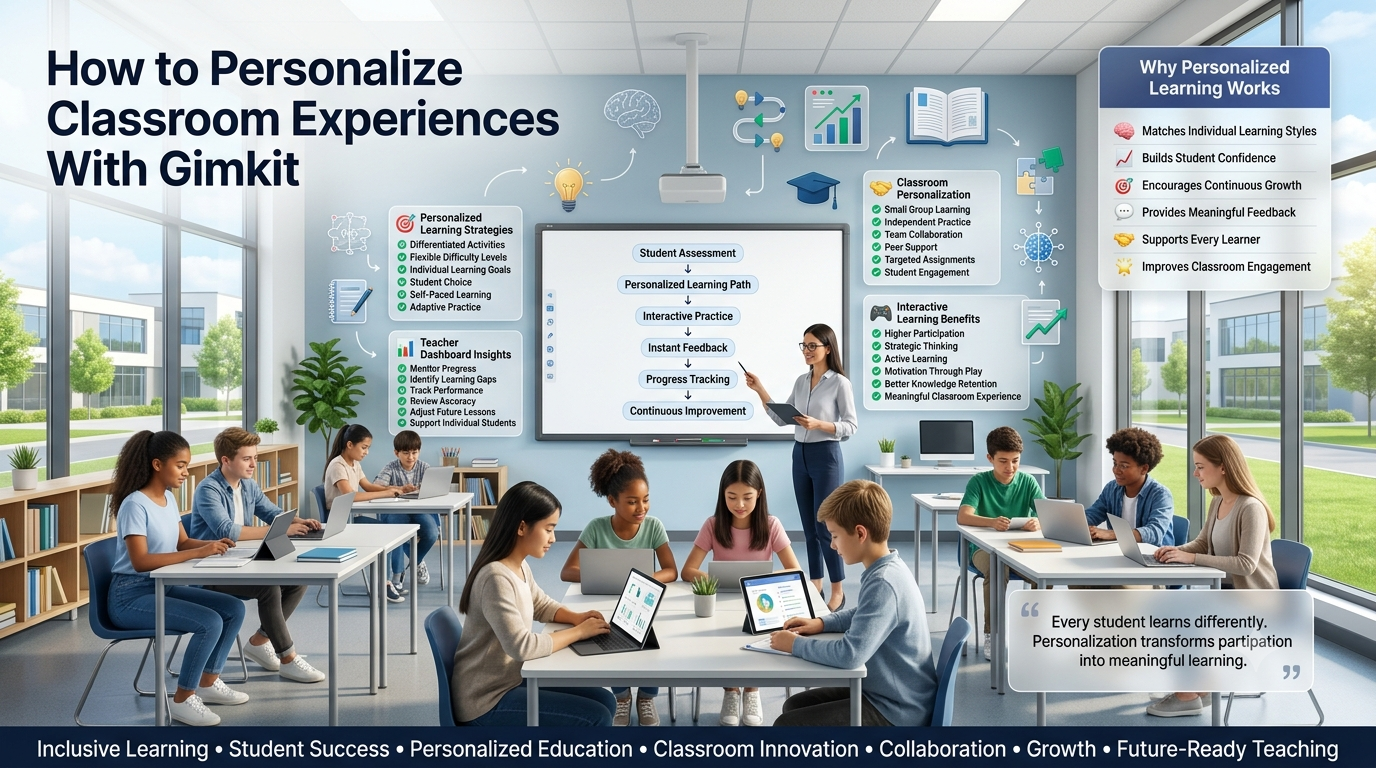
Gimkit Review After One Year of Classroom Use supports personalized review sessions for different learning levels.
Gimkit Review After One Year of Classroom Use shows that students remain interested when game modes are varied.
Gimkit Review After One Year of Classroom Use encourages teachers to balance gameplay with other instructional methods.
Gimkit Review After One Year of Classroom Use supports regular formative assessment throughout the school year.
Gimkit Review After One Year of Classroom Use demonstrates stronger classroom participation during review activities.
Gimkit Review After One Year of Classroom Use helps maintain student focus through interactive lesson reinforcement.
Gimkit Review After One Year of Classroom Use supports collaborative learning with classroom-friendly game formats.
Gimkit Review After One Year of Classroom Use encourages students to practice concepts repeatedly without losing interest.
Gimkit Review After One Year of Classroom Use shows that consistent use can strengthen knowledge retention.
Gimkit Review After One Year of Classroom Use supports flexible lesson planning across multiple subjects.
Gimkit Review After One Year of Classroom Use helps teachers adapt activities to different classroom needs.
Gimkit Review After One Year of Classroom Use encourages positive classroom interactions through shared learning experiences.
Gimkit Review After One Year of Classroom Use supports quick review sessions before quizzes and tests.
Gimkit Review After One Year of Classroom Use demonstrates that interactive learning can reduce classroom boredom.
Gimkit Review After One Year of Classroom Use helps students stay engaged during revision periods.
Gimkit Review After One Year of Classroom Use supports regular classroom routines with minimal preparation time.
Gimkit Review After One Year of Classroom Use encourages teachers to refresh question sets throughout the year.
Gimkit Review After One Year of Classroom Use helps maintain classroom excitement through different game experiences.
Gimkit Review After One Year of Classroom Use supports independent learning alongside teacher-led instruction.
Gimkit Review After One Year of Classroom Use demonstrates improved classroom energy during review lessons.
Gimkit Review After One Year of Classroom Use encourages meaningful participation from students with different learning styles.
Gimkit Review After One Year of Classroom Use supports active recall through repeated educational practice.
Gimkit Review After One Year of Classroom Use helps reinforce daily learning objectives consistently.
Gimkit Review After One Year of Classroom Use supports engaging classroom discussions after gameplay.
Gimkit Review After One Year of Classroom Use encourages students to remain involved throughout longer review sessions.
Gimkit Review After One Year of Classroom Use helps teachers monitor classroom progress more efficiently.
Gimkit Review After One Year of Classroom Use supports balanced instruction by combining games with traditional teaching.
Gimkit Review After One Year of Classroom Use demonstrates continued classroom value beyond the initial excitement.
Gimkit Review After One Year of Classroom Use encourages thoughtful lesson planning instead of relying only on games.
Gimkit Review After One Year of Classroom Use supports stronger student confidence through regular success experiences.
Gimkit Review After One Year of Classroom Use helps create a more interactive classroom culture.
Gimkit Review After One Year of Classroom Use supports teachers who prefer flexible educational technology.
Gimkit Review After One Year of Classroom Use demonstrates reliable performance during routine classroom activities.
Gimkit Review After One Year of Classroom Use encourages students to approach revision with greater enthusiasm.
Gimkit Review After One Year of Classroom Use supports meaningful practice without making learning feel repetitive.
Gimkit Review After One Year of Classroom Use helps classrooms maintain consistent engagement across different subjects.
Gimkit Review After One Year of Classroom Use supports teachers seeking interactive alternatives to worksheets.
Gimkit Review After One Year of Classroom Use encourages long-term participation through varied classroom activities.
Gimkit Review After One Year of Classroom Use demonstrates that educational games remain effective when used purposefully.
Gimkit Review After One Year of Classroom Use supports stronger classroom relationships through enjoyable shared experiences.
Gimkit Review After One Year of Classroom Use helps teachers deliver engaging review sessions with greater consistency.
Gimkit Review After One Year of Classroom Use supports continuous improvement by adapting activities to student needs.
Gimkit Review After One Year of Classroom Use demonstrates that thoughtful implementation produces better long-term educational results.
Gimkit Review After One Year of Classroom Use encourages educators to use the platform as one part of a balanced teaching strategy.
Gimkit Review After One Year of Classroom Use shows that rotating different game modes helps maintain student interest over long periods.
Gimkit Review After One Year of Classroom Use encourages teachers to use student performance data to improve future lesson planning.
Gimkit Review After One Year of Classroom Use demonstrates that regular review sessions become more effective when paired with classroom discussions.
Gimkit Review After One Year of Classroom Use helps students develop stronger confidence by practicing important concepts throughout the year.
Gimkit Review After One Year of Classroom Use supports maintaining a positive classroom atmosphere through enjoyable educational activities.
Gimkit Review After One Year of Classroom Use encourages educators to combine digital learning with traditional teaching methods for better results.
Gimkit Review After One Year of Classroom Use demonstrates that thoughtful scheduling prevents game-based learning from becoming repetitive.
Gimkit Review After One Year of Classroom Use supports long-term academic growth by reinforcing lessons through consistent interactive practice.
Most Frequently Asked Faqs
1. Is Gimkit still worth using after one year of classroom use?
Yes—Gimkit can remain a valuable instructional tool after a full school year when it is used strategically rather than as a daily routine. Teachers who achieve the best long-term results treat Gimkit as one component of a broader teaching strategy, using it for formative assessment, retrieval practice, vocabulary review, exam preparation, and collaborative learning. Regular updates, varied game modes, and customizable quizzes also help keep lessons fresh throughout the year.
Its long-term value depends less on the platform itself and more on how teachers integrate it with classroom instruction. When paired with discussions, projects, and traditional learning activities, Gimkit continues to support engagement and knowledge retention without becoming repetitive.
Why it remains effective:
Reinforces long-term learning.
Supports regular formative assessment.
Encourages active participation.
Adapts to multiple subjects.
Offers varied game experiences.
Complements traditional instruction.
2. Does Gimkit remain engaging for students throughout an entire school year?
For most classrooms, the answer is yes—provided teachers vary how and when they use it. Students are more likely to stay engaged when different game modes, fresh question sets, collaborative challenges, and curriculum-based activities are introduced throughout the year. Using the same format repeatedly can reduce excitement, while rotating activities keeps participation high.
Engagement also increases when gameplay has a clear academic purpose rather than being used simply as entertainment. Connecting each session to current lessons helps students see Gimkit as a meaningful learning tool.
Ways to maintain engagement:
Rotate game modes regularly.
Update question banks frequently.
Use seasonal or themed activities.
Mix individual and team challenges.
Align games with lesson objectives.
Limit unnecessary repetition.
3. What are the biggest advantages and drawbacks of using Gimkit long-term?
Long-term use offers several educational benefits, including improved student engagement, immediate feedback, retrieval practice, differentiated learning, and data-driven instruction. Teachers can quickly identify learning gaps while students remain motivated through interactive gameplay and regular review.
However, relying too heavily on Gimkit may reduce its novelty and limit opportunities for other instructional approaches. The most effective classrooms balance digital learning with discussions, hands-on activities, writing assignments, and collaborative projects.
Long-term advantages:
Higher student engagement.
Better knowledge retention.
Instant learning feedback.
Easy progress monitoring.
Flexible across subjects.
Supports differentiated instruction.
Potential drawbacks:
Overuse may reduce motivation.
Limited deep discussion during gameplay.
Requires reliable internet access.
Should not replace varied teaching methods.
4. How often should teachers use Gimkit to keep students interested?
Most education professionals recommend using Gimkit as a supplemental learning activity rather than an everyday classroom routine. For many classes, incorporating it once or twice per week provides enough variety to maintain excitement while preventing students from becoming overly familiar with the format. Teachers may increase or decrease usage depending on curriculum goals, assessment schedules, and student needs.
Alternating Gimkit with other instructional strategies creates a balanced learning environment that keeps participation high throughout the academic year.
Recommended usage:
Once or twice each week.
Before quizzes and exams.
For vocabulary review.
During revision lessons.
As formative assessment.
Occasionally for homework practice.
5. Is Gimkit a better long-term classroom tool than other quiz-based learning platforms?
Gimkit stands out because it combines academic review with interactive game mechanics such as in-game currency, upgrades, strategy, and multiple game modes. These features often encourage longer student engagement than traditional quiz platforms. However, no single platform is ideal for every classroom or lesson objective.
Many experienced educators combine Gimkit with other instructional technologies, collaborative activities, and traditional assessments to create a balanced learning experience. The best platform is the one that aligns with your teaching goals, student needs, and curriculum requirements.
Why many teachers choose Gimkit long-term:
Interactive game-based learning.
Strong student motivation.
Flexible classroom integration.
Frequent feature updates.
Supports collaborative learning.
Valuable assessment insights.
One-Year Gimkit Review Lab: A Transparent 12-Month Evaluation Framework
A genuine year-long review should do more than report that students liked a game in September and still recognized it in June. It should ask whether the tool remained useful for specific instructional goals, how much preparation teachers invested, what participation barriers appeared, and whether game responses led to better teaching decisions. The following framework is designed for educators who want to evaluate their own use of Gimkit over a full academic cycle. It does not invent survey data, student achievement gains, or classroom observations that were never collected.
To interpret any claim about long-term value, distinguish three kinds of evidence. Product documentation establishes what the platform currently offers. Classroom records show what happened in a particular setting, such as how often a class used the tool or which questions were answered incorrectly. Learning evidence requires independent checks of understanding, preferably across different formats. None of those categories automatically proves that Gimkit caused improvement. A class may become more confident because of instruction, additional practice, improved attendance, or other changes that occurred during the same year.
1. Start the year with a baseline, not a leaderboard
Before the first live game, choose a narrow instructional target and collect a small baseline sample. For example, in a sixth-grade science unit, ask students to explain the difference between physical and chemical change in one or two sentences. In mathematics, use a short problem requiring a worked solution. In a language lesson, ask students to apply vocabulary in a new sentence rather than merely recognize the correct option. Keep the baseline task short enough to repeat later without dominating the lesson.
Record only the information necessary for instruction and follow your school’s privacy and retention policies. A class-level tally of common misconceptions may be enough; you do not always need to export individual game data. If you do use individual results, ensure that the teacher has a legitimate educational reason to view and retain them. Avoid posting identifiable leaderboards, student scores, or screenshots to public websites. A review should evaluate the tool’s instructional usefulness, not turn student participation into marketing evidence.
Define success before gameplay begins. Success might mean that more students can explain a concept accurately, that the teacher can identify misconceptions faster, or that a previously quiet group participates through a supported format. “The class was excited” is a legitimate observation about engagement, but it is not the same as demonstrated mastery. Keep these dimensions separate in the review notes so that an energetic session does not receive an inflated academic rating.
2. Review the first month: setup friction and first-use enthusiasm
During the first four weeks, measure the time needed to find or create a Kit, check the questions, configure a game, distribute the join link, and resolve common device issues. New tools often feel exciting because they change the classroom routine. That novelty can help establish a positive learning atmosphere, but the evaluation should not assume the effect will persist. Ask whether students understand the purpose of the activity and whether the teacher can launch it without sacrificing too much teaching time.
Make one deliberate choice about game format. Gimkit’s official Mode Picker guide describes labels that help teachers choose modes for different group needs. A fast-paced format may fit a short review; a calmer format may be better for students who need time to process questions. The key test is whether the selected mode supports the planned task. Avoid concluding that a mode is universally effective simply because the first class enjoyed it.
Document friction honestly. If five minutes of a 30-minute lesson disappear because devices cannot join, that matters. If students are unfamiliar with controls, a first-session delay may be normal and should not be treated as a permanent defect. If the same difficulty recurs across several weeks, investigate network settings, accessibility needs, or the choice of mode. A balanced review records both initial learning curves and persistent problems.
3. At three months, separate repeated practice from repeated mistakes
By the end of a quarter, the teacher should know which Kits remain useful and which questions need revision. Gimkit’s Smart Repetition documentation explains that questions missed earlier can be repeated more frequently for an individual player. That feature may create additional opportunities for retrieval, but it does not guarantee conceptual understanding. A student can learn to recognize an answer through repetition without being able to explain the underlying principle in a new situation.
Check transfer with an independent task. After a vocabulary review, ask learners to use words in an unfamiliar passage. After a science review, present a new scenario and request a short explanation. After a mathematics review, require students to show steps for a similar but not identical problem. If students perform well in the game but struggle outside it, the teacher may need to revise question quality, provide explicit instruction, or reduce the emphasis on speed. The appropriate response is not always “play more.”
Use the same learning target across several activity formats when feasible. For example, compare student explanations after a teacher-led discussion, a short Gimkit session, and independent practice, while recognizing that these activities may occur at different points in instruction. The purpose is to identify which combination of methods supports learning in your context. A one-year review becomes credible when it acknowledges competing explanations and does not treat a single tool as the cause of every improvement.
4. At six months, examine participation equity
Midyear is a useful point to ask who is benefiting and who may be left behind. Some students enjoy visible competition, while others find timers or public rankings distracting. Some students can navigate movement-heavy 2D modes comfortably, while others need a different interaction method. Students with limited home connectivity may be unable to complete optional activities outside class. A fair review should report these barriers alongside any positive participation observations.
Offer multiple ways to demonstrate the same learning objective. A student might answer through a live game, explain a solution orally to a partner, complete a short written task, or work through a teacher-approved alternative. Avoid penalizing a learner because their device cannot support a particular visual mode. For a group with varied reading fluency, preview essential terms and provide sufficient processing time. In team play, rotate roles so that one confident player does not dominate the decisions while others become spectators.
Use anonymous feedback where appropriate. Ask students which part of the activity helped them remember or explain something, which part made participation difficult, and what they would change. Avoid leading questions such as “Wasn’t Gimkit more fun than regular lessons?” The response should inform teaching choices, not prove a predetermined conclusion. If a class consistently requests calmer formats, that is useful information even if the teacher personally prefers energetic games.
5. At nine months, measure teacher workload and sustainability
Long-term adoption depends on preparation cost as much as enthusiasm. Track how many Kits were reused, how often questions required correction, whether colleagues could share approved materials, and whether reports changed instructional decisions. A tool that requires extensive manual setup every week may be difficult to sustain. Conversely, a small set of carefully maintained question banks can become more valuable over time as teachers identify recurring misconceptions and improve distractors.
Review your use of assignments and practice links accurately. Gimkit’s Practice Mode guide says shared practice links allow students to work through questions without game mechanics, due dates, or reporting. Its Assignments guide describes a different workflow that is available to Pro subscribers and supports individual work outside live class sessions. These are not interchangeable features. A teacher on Gimkit Basic should not plan a year-long homework process around a paid-only assignment feature without checking current eligibility.
Assess whether the free plan already meets your needs. Gimkit’s official Pro FAQ says Basic supports featured modes, classes, and reports, while Pro expands access to modes and provides assignments and additional question-media features. Do not assume every classroom needs a paid subscription. The right decision depends on the modes used, the value of independent assignments, the school’s budget, and how frequently teachers actually use the additional capabilities. Product terms can change, so consult current official information rather than relying on an old screenshot.
6. At the end of the year, evaluate learning evidence responsibly
Gimkit’s game-report documentation describes student and question-level report views for hosted games. These can help teachers identify items that deserve reteaching. However, response accuracy within a game is affected by question difficulty, prior familiarity, repetition, and the mode’s pace. A leaderboard measures success within a particular game format; it is not a standardized achievement measure. Compare the reports with independent assessments and student work before drawing conclusions.
A useful end-of-year summary answers five questions: What learning goals were supported? What did students demonstrate outside the game? Which students faced barriers? How much teacher time was required? Which practices would you repeat or change next year? Include negative findings where relevant. If the tool improved participation but did not change understanding on an independent check, report both facts. If a class used Gimkit only twice, do not frame the results as a year-long intervention. A review should describe actual exposure, not merely the passage of time.
For a subject-level example, imagine a teacher who used ten-minute review sessions twice a month. At the end of the year, the teacher notices that students remember vocabulary well but still struggle to justify scientific explanations. The appropriate conclusion is that the tool may have supported vocabulary retrieval while explanation tasks need additional teaching. This is an illustrative scenario, not a reported study. It shows how an evidence-based review can lead to a specific instructional improvement instead of a generic recommendation to increase gameplay.
7. A twelve-month evaluation calendar
Period
Review question
Useful evidence
Decision to make
Month 1
Can everyone access and understand the activity?
Setup time, device barriers, orientation notes
Keep, simplify, or replace the mode
Months 2–3
Are question sets targeting real misconceptions?
Question analysis and independent explanations
Revise questions or instruction
Months 4–6
Who participates and who is excluded?
Anonymous feedback and accessibility observations
Provide alternative participation routes
Months 7–9
Is the workflow sustainable?
Planning minutes, reuse, maintenance effort
Streamline Kits and review paid features
Months 10–12
What learning can students demonstrate independently?
Transfer tasks and representative student work
Continue, modify, or reduce usage
The calendar is deliberately flexible. A school on a trimester schedule can adapt it to three checkpoints, and a teacher who uses Gimkit occasionally can collect fewer observations. The essential principle is to define what will be measured before seeing the results. If the review question changes every month, the teacher cannot reliably tell whether the practice improved. A simple, consistent record is more useful than a large dashboard that nobody interprets.
8. Interactive teacher evaluation scorecard
Choose a rating from 1 (major problem) to 5 (strong fit) for each dimension. This tool calculates a transparent average of your own judgments; it does not access school records, generate an official Gimkit score, or claim measured student gains. Keep the scores with a short written explanation so that future decisions are not based on a number alone.
Select ratings and calculate your local evaluation score.
9. Interpret the score rather than worshiping it
An average of four out of five is not proof that Gimkit improved learning by 80 percent. The five dimensions have equal weight in this simple calculator, which may not match a school’s priorities. For an accessibility-sensitive setting, an inclusion rating of one could outweigh several strong ratings elsewhere. For a teacher who only needs a quick live review, the absence of Pro assignments may be irrelevant. The score is a conversation starter that helps identify trade-offs, not a universal ranking or purchasing recommendation.
Review the lowest dimension first. If the weakest area is learning evidence, improve question design and add independent exit tasks. If it is accessibility, test alternate formats and devices. If it is teacher workload, reuse well-checked Kits and simplify the hosting routine. If it is budget, compare Basic with Pro features actually needed. If it is report usefulness, set aside time after the game to interpret the question breakdown rather than treating reports as an automatic intervention.
Consider sharing the rubric with a teaching team, but avoid collecting identifiable student information in the form. Each teacher can record a rating and one example. When colleagues disagree, ask which class conditions explain the difference: grade level, subject, device availability, school policy, or teaching goal. The disagreement may reveal that a platform works well for one instructional context and less well for another. A careful review respects that variation instead of turning a subjective score into a claim of universal effectiveness.
10. Distinct questions for elementary, middle, and high school
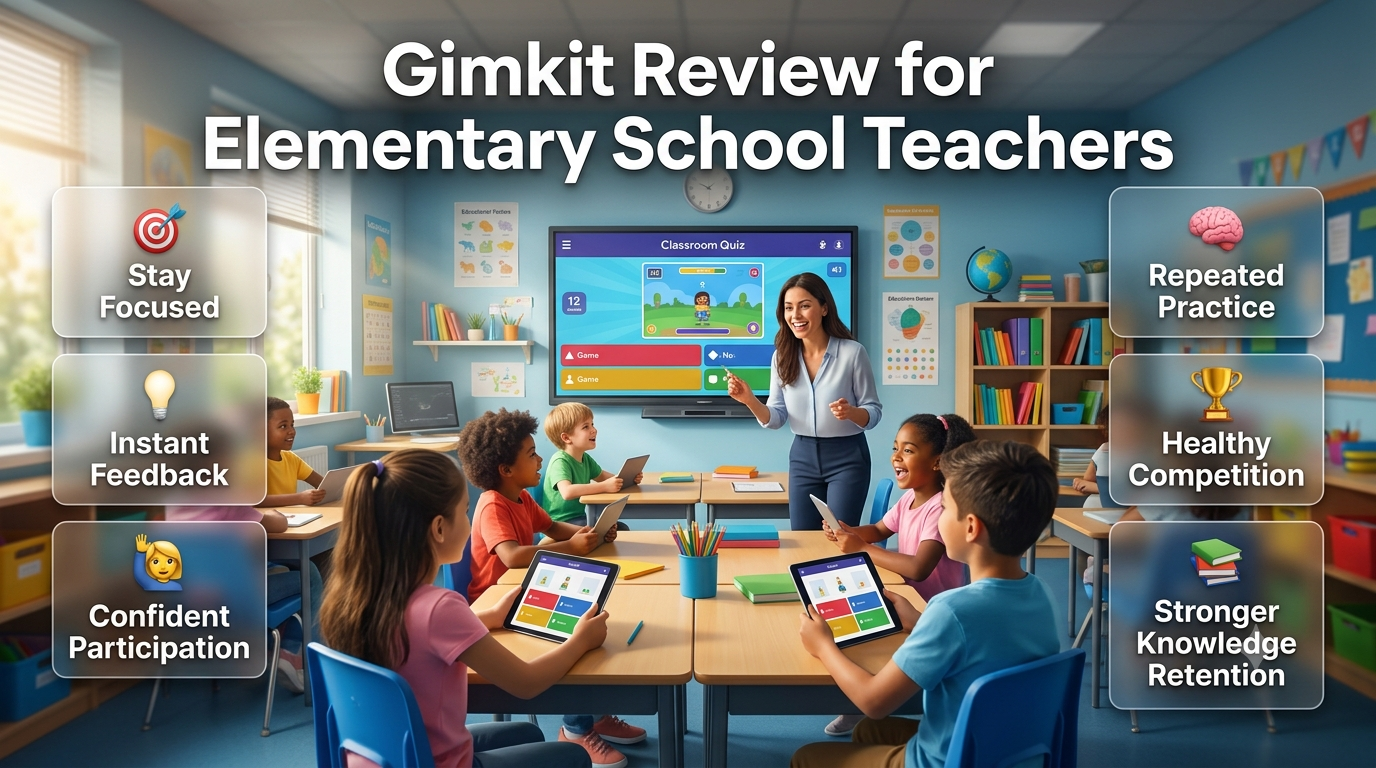
Elementary teachers may prioritize reading load, classroom transitions, visual clarity, and whether a mode allows younger learners to focus on the intended skill. Our elementary classroom review addresses those age-specific concerns. A middle school review should also examine peer competition, equitable roles in team play, and the relationship between speed and careful reasoning. Our middle school guide explores those trade-offs without assuming all adolescents respond in the same way.
At high school level, teachers may place more emphasis on sophisticated question design, transfer to unfamiliar problems, and the opportunity cost of game time. A fast review can support retrieval of terminology, but an advanced mathematics or literature objective may require written argument and extended explanation. Our high school evaluation examines how to use games without replacing deeper disciplinary work. The year-long framework here applies across levels, but the evidence collected should match the developmental and academic expectations of the learners.
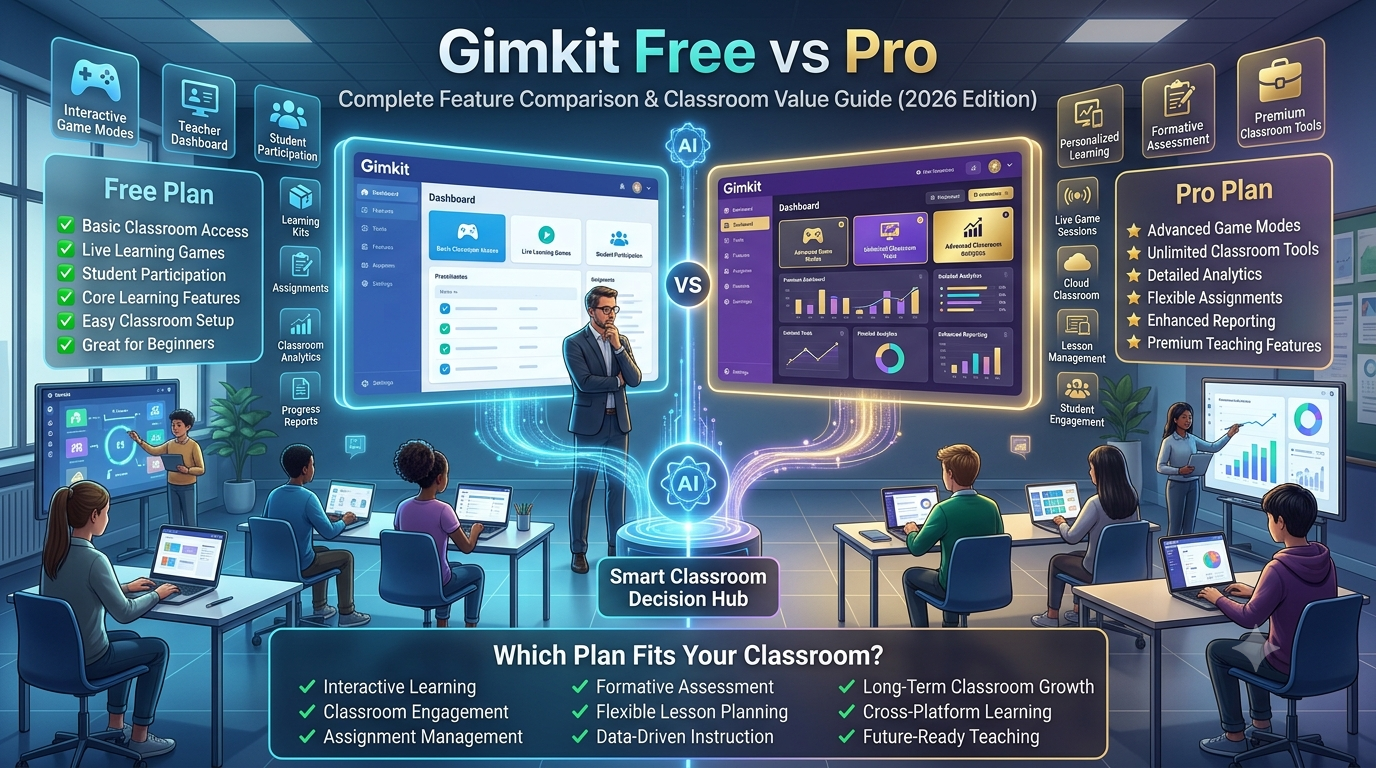
Schools making a subscription decision should distinguish a teacher’s positive experience from a district-wide procurement case. A single class may have excellent results while other classrooms face accessibility, scheduling, or network constraints. Compare current licensing requirements, privacy review, and teacher training needs before committing institutional funds. Our free-versus-Pro guide provides a separate feature comparison; this retrospective concentrates on sustained instructional value rather than repeating pricing tables.
11. Example of a balanced year-end recommendation
A defensible recommendation might read: “Continue using Gimkit for short retrieval-practice sessions in units where questions can be checked for accuracy, and keep a non-game exit task to assess explanation quality. Use calmer or alternative activities for students who find the selected mode distracting. Revisit the Pro subscription only if the class consistently needs the additional assignment workflow.” This recommendation does not claim a measured increase in test scores, does not imply the platform is required for effective teaching, and identifies the conditions under which the choice should be reviewed.
Another teacher might reach a different conclusion: “Reduce live-game frequency during project-based units because extended explanation and discussion need more time, but retain a small number of reusable Kits for end-of-unit retrieval.” That is not a failure. It is a decision based on instructional fit. The purpose of a one-year review is to refine practice, not to defend a tool at any cost. A strong educational technology strategy makes it possible to choose when not to use a product.
For any retrospective, state the observation period, frequency of use, number of classes, question types, independent assessment method, and important limitations. If those details are missing, describe the piece as an editorial guide rather than a field study. Do not invent teacher testimonials or present illustrative scenarios as collected evidence. When product details change, defer to Gimkit’s official Help Center. This guide was checked against official product documentation on November 1, 2026, but account entitlements and interface details can evolve.