Editorial transparency, updated November 2026: This article contains illustrative scenarios and general teaching guidance. It does not present verified interviews with named students, independently documented school outcomes, or a controlled evaluation of Gimkit. Any classroom success claim should be supported by authentic observations and appropriate privacy safeguards.
Introduction
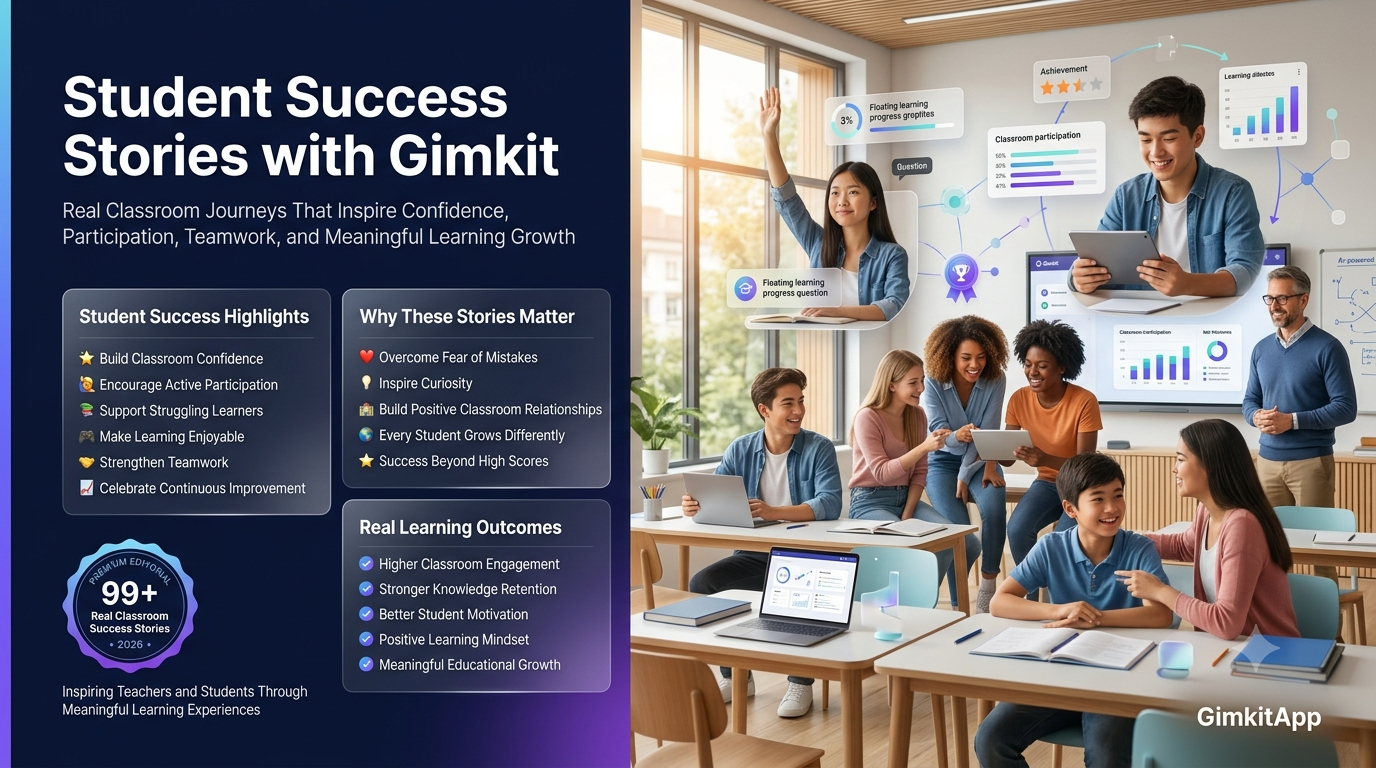
Student Success Stories with Gimkit : Student success with Gimkit is often built through small learning victories rather than dramatic achievements. Every classroom has students who improve in different ways—some become more confident when answering questions, some participate more actively for the first time, while others discover that reviewing lessons can actually be enjoyable. These illustrative scenarios examine how teachers could support learning, participation, and classroom growth while measuring results cautiously. Each story highlights a different journey, offering fresh perspectives on how consistent participation, curiosity, and classroom engagement can create lasting learning success with Gimkit.
🎓 Every classroom creates memorable learning moments that reflect real student growth and progress.
💯 Success isn’t about high scores—it’s about building confidence, participation, and consistent improvement.
🙋 Some quieter students may become more confident, volunteering answers and participating in classroom discussions.
📚 Learners who need additional support may gain confidence by practicing difficult topics in an engaging environment.
🎮 Interactive gameplay can make some review sessions into enjoyable learning experiences that students look forward to.
🤝 Students can practise teamwork skills while collaborating and learning alongside classmates.
💡 Game-based learning can encourage regular practice, helping students improve over time without fear of failure.
👨🏫 Teachers may observe higher classroom engagement, improved energy, and more effective review sessions.
📈 Learning becomes more student-centered, supporting educational goals instead of replacing traditional instruction.
🌍 Every student’s success looks different, making each learning journey unique and valuable.
❤️ Many students overcome the fear of making mistakes, creating a more positive learning mindset.
🔍 Previously challenging subjects become more approachable through interactive classroom activities.
🏫 Positive classroom relationships grow stronger as students encourage and support one another.
⭐ Success is built through consistent participation, curiosity, and continuous improvement rather than perfection.
📖 These stories provide realistic classroom examples that teachers, students, and schools can easily relate to.
🚀 The collection inspires both educators and learners to create more engaging and motivating learning experiences.
🌱 Educational success develops through many small victories, each encouraging students to continue learning and growing.
Explore the latest classroom resources, expert tutorials, and educational technology insights on GimkitApp, your complete destination for everything related to Gimkit and modern learning tools.
Understanding Student Success with Gimkit
Student success is about more than grades or test scores—it also includes confidence, participation, curiosity, and continuous improvement. Student Success Stories with Gimkit highlight how interactive classroom experiences help students build stronger learning habits, become more engaged, and gain confidence over time. Whether a student participates more, enjoys review sessions, or collaborates better with classmates, these small achievements contribute to meaningful academic and personal growth throughout the school year.
What Student Success Really Means
Student success is not limited to earning the highest score in every classroom activity. Instead, it reflects meaningful improvement that helps learners become more confident, curious, responsible, and engaged in their education. Success looks different for every student because every learner begins their journey from a different starting point.
Key Characteristics of Student Success
Building confidence through regular participation.
Developing stronger learning habits over time.
Becoming more willing to ask and answer questions.
Showing curiosity beyond classroom requirements.
Working effectively with classmates.
Learning from mistakes instead of fearing them.
Remaining motivated throughout the academic year.
Celebrating continuous improvement rather than perfection.
Why Success Stories Matter in Modern Classrooms
Success stories help students and teachers recognize that educational progress is achievable in many different ways. Instead of focusing only on final results, they encourage learners to appreciate everyday improvements that build confidence and long-term growth. For educators, these stories provide practical inspiration by demonstrating how positive classroom experiences can influence participation, motivation, and student engagement.
Why These Stories Are Valuable
They inspire students to believe in their own progress.
They encourage teachers to celebrate growth as well as achievement.
They promote positive classroom attitudes.
They demonstrate that learning is a continuous journey.
They support a more inclusive educational environment.
They highlight realistic classroom experiences.
They encourage persistence during challenging lessons.
They create motivation for lifelong learning.
Different Ways Students Experience Success
Student success is not experienced in the same way by everyone. Some learners become more confident during discussions, while others improve their teamwork, communication, or independent thinking. Recognizing these different forms of success helps teachers create classrooms where every learner has an opportunity to grow according to their individual strengths and learning needs.
Success Area
What It Represents
Long-Term Benefit
Classroom Confidence
Speaking and participating more often
Greater self-belief
Learning Motivation
Developing enthusiasm for learning
Consistent engagement
Academic Growth
Better understanding of classroom topics
Improved educational performance
Collaboration
Working successfully with classmates
Stronger teamwork skills
Independent Learning
Taking responsibility for learning
Lifelong learning habits
Communication
Sharing ideas with confidence
Better classroom interaction
How Small Classroom Wins Lead to Bigger Success
Many of the most inspiring educational journeys begin with small moments that may seem ordinary at first. A student who answers one additional question, volunteers during a discussion, helps a classmate, or remains engaged throughout a lesson is already making meaningful progress. These everyday achievements gradually build confidence, strengthen learning habits, and encourage students to continue challenging themselves. Over time, these small victories often become the foundation for greater academic success, stronger classroom relationships, and a lifelong appreciation for learning.
Small Wins That Create Lasting Growth
Answering a question with greater confidence.
Participating more actively in classroom discussions.
Completing review activities with enthusiasm.
Helping classmates during learning activities.
Staying motivated during challenging lessons.
Becoming more curious about new topics.
Showing consistent improvement over time.
Building confidence one classroom experience at a time.
Student success is not created by one perfect classroom moment. It grows through consistent participation, meaningful learning experiences, and the confidence to keep improving every day.
Exploring Every Success Story Behind Gimkit
Every successful classroom has its own story, and no two learning journeys are exactly the same. While every student experiences progress differently, teachers also discover new ways to inspire learning, classrooms develop stronger collaboration, and schools build more engaging educational environments over time. Together, these experiences create a complete picture of what Student Success Stories with Gimkit truly represent. Rather than focusing on one achievement, this collection explores the many ways success can develop through confidence, participation, teamwork, creativity, and consistent learning.
The following success areas represent the most meaningful educational journeys connected with Gimkit. Each one highlights a unique perspective of classroom success and serves as a gateway to a dedicated collection of inspiring stories that explore these topics in greater depth.
Celebrate inspiring student success stories that showcase confidence, perseverance, classroom participation, and meaningful academic growth through interactive learning with Gimkit.
Every student’s learning journey is unique. Some learners gain confidence by participating more often, while others discover new motivation, improve their study habits, or overcome challenges that once limited their classroom performance. Student success stories celebrate these everyday achievements, demonstrating how consistent participation and positive learning experiences can gradually build lasting confidence and academic growth.
Explore inspiring teacher success stories that demonstrate creative classroom leadership, stronger student engagement, and meaningful learning experiences through Gimkit.
Behind every successful classroom is a teacher who creates opportunities for students to learn, participate, and grow. Teacher success stories explore how educators introduce engaging review experiences, strengthen classroom relationships, and encourage every learner to become more involved in the educational process. These stories recognize the important role teachers play in helping students experience meaningful success.
Discover inspiring classroom success stories that showcase teamwork, communication, inclusion, and active participation through engaging learning experiences with Gimkit.
A classroom becomes successful when students learn together, respect one another, and actively participate in every lesson. Classroom success stories highlight positive learning environments where teamwork, communication, and collaboration help every student feel included. These experiences demonstrate how a supportive classroom culture encourages stronger engagement and more enjoyable learning.
Explore inspiring academic success stories that demonstrate stronger knowledge retention, subject mastery, confidence, and continuous educational development through engaging classroom learning.
Academic growth is built through continuous learning rather than one outstanding result. Academic success stories explore how students strengthen their understanding of different subjects, improve classroom performance, and develop stronger learning habits through consistent review and meaningful educational experiences. These stories celebrate progress across a wide range of academic goals.
Discover inspiring school success stories that showcase collaborative learning, positive school culture, teacher-student partnerships, and long-term educational improvement with Gimkit.
Educational success extends beyond individual classrooms. Many schools create inspiring learning communities where teachers, students, and school leaders work together to encourage participation and continuous improvement. School success stories explore how positive educational practices contribute to stronger school culture, greater collaboration, and shared learning achievements across the entire school community.
Explore inspiring learning skills success stories that demonstrate critical thinking, creativity, communication, collaboration, and lifelong learning through engaging classroom experiences with Gimkit.
Education is about developing lifelong skills as much as academic knowledge. Learning skills success stories focus on how students strengthen communication, critical thinking, creativity, collaboration, and independent learning. These abilities continue supporting learners long after individual classroom activities have ended.
Discover inspiring engagement and participation success stories that showcase active learning, stronger motivation, classroom collaboration, and meaningful educational experiences with Gimkit.
One of the clearest signs of a successful classroom is active participation. These stories highlight learners who became more involved in discussions, classroom reviews, and collaborative activities after developing greater confidence and motivation. Increased engagement often leads to stronger understanding, better classroom relationships, and a more enjoyable educational experience.
Active classroom participation.
Increased student motivation.
Positive learning attitudes.
Better classroom interaction.
Stronger lesson engagement.
Continuous participation throughout the school year.
Explore inspiring inclusive learning success stories that celebrate equal opportunities, diverse learners, classroom confidence, and meaningful educational growth through Gimkit.
Every student deserves opportunities to succeed regardless of their background, learning style, or confidence level. Inclusive learning success stories celebrate classrooms where educators create welcoming environments that encourage every learner to participate, contribute, and experience meaningful educational growth. These stories demonstrate how inclusive education benefits the entire classroom community.
Discover inspiring technology integration success stories that demonstrate how Gimkit and modern educational technology strengthen classroom engagement, collaboration, and meaningful learning.
Technology becomes truly valuable when it strengthens teaching and learning rather than replacing them. Technology integration success stories explore how interactive digital learning supports classroom participation, collaboration, and educational engagement while helping teachers create meaningful learning experiences for students of all ability levels.
Explore inspiring long-term growth success stories that celebrate continuous improvement, lifelong learning, lasting confidence, and sustainable educational success through Gimkit.
The most inspiring educational journeys are often measured over months and years rather than individual lessons. Long-term growth success stories celebrate continuous improvement, stronger confidence, lifelong learning habits, and the lasting impact that positive classroom experiences can have on students, teachers, and schools. These stories remind readers that meaningful success is built through consistent effort and continuous progress.
What You’ll Discover
Continuous personal growth.
Lasting classroom confidence.
Lifelong learning journeys.
Sustainable academic improvement.
Long-term educational success.
Future-ready learning experiences.
Student Success Story Roadmap
Success Collection
Main Focus
Why It Matters
Student Success Stories
Personal growth and confidence
Inspires every learner to improve
Teacher Success Stories
Teaching excellence
Encourages stronger classroom leadership
Classroom Success Stories
Positive learning culture
Builds teamwork and participation
Academic Success Stories
Educational achievement
Supports meaningful learning progress
School Success Stories
School-wide improvement
Creates stronger learning communities
Learning Skills Success Stories
Essential life skills
Prepares students beyond the classroom
Engagement & Participation Success Stories
Active involvement
Makes learning more enjoyable
Inclusive Learning Success Stories
Equal opportunities
Helps every student succeed
Technology Integration Success Stories
Modern education
Enhances teaching and learning
Long-Term Growth Success Stories
Continuous development
Encourages lifelong educational success
Together, these ten success collections create a complete roadmap for understanding how meaningful educational progress can develop through confidence, participation, collaboration, and continuous learning with Gimkit.
Every Success Story Begins with One Positive Learning Experience
Student success is never created by a single lesson, one classroom activity, or a perfect score. It develops through consistent participation, meaningful practice, supportive teaching, and a learning environment where students feel encouraged to improve every day. The most inspiring Student Success Stories with Gimkit demonstrate that educational growth is built through many small moments that gradually shape confident learners, collaborative classrooms, and stronger school communities. Whether the success involves a single student overcoming self-doubt or an entire classroom becoming more engaged, every story reflects the power of positive learning experiences.
As classrooms continue embracing interactive learning, success stories also continue evolving. New students discover confidence, teachers develop fresh instructional ideas, and schools create more engaging educational environments that encourage curiosity, creativity, and lifelong learning. These experiences remind us that meaningful education is not measured only by academic achievement but also by the confidence, communication, resilience, and enthusiasm students develop throughout their learning journey.
Stay updated with the latest video game news, expert reviews, walkthroughs, and industry coverage by visiting IGN, one of the world’s leading gaming and entertainment websites.
Common Qualities Found in Every Success Story
Although every classroom experience is different, the most meaningful Gimkit success stories often share several characteristics. These qualities help create learning environments where students feel motivated to participate, teachers feel inspired to innovate, and classrooms become places where every learner has opportunities to succeed.
Shared Characteristics
Continuous improvement instead of instant perfection.
Active participation throughout classroom learning.
Positive relationships between students and teachers.
Confidence built through regular practice.
Curiosity that encourages deeper understanding.
Collaboration that strengthens classroom learning.
Inclusive experiences for learners of all abilities.
Growth that continues beyond individual lessons.
How Success Stories Inspire Students and Teachers
Every success story has the ability to encourage someone else. Students often gain confidence after reading about learners who faced similar challenges, while teachers discover new ideas for creating engaging classroom experiences. These stories create a positive cycle where inspiration leads to participation, participation leads to growth, and growth encourages even more educational success. Their greatest value lies in showing that progress is possible for every learner, regardless of where the journey begins.
Educational success feels achievable for everyone.
Small achievements inspire bigger goals.
Student Success Is a Journey, Not a Destination
Learning does not end after one successful classroom activity. Every new lesson provides another opportunity to build confidence, strengthen understanding, and develop valuable life skills. The best success stories remind us that education is an ongoing journey where every positive experience contributes to future growth. Students who continue learning with curiosity and determination often discover that their greatest achievements come from consistent effort rather than one extraordinary moment.
Building Success Every Day
Every lesson creates new learning opportunities.
Small progress leads to meaningful achievement.
Confidence grows through consistent participation.
Learning habits become stronger over time.
Challenges encourage resilience and determination.
Curiosity supports lifelong education.
Every student follows a unique path to success.
Growth continues beyond the classroom.
A Quick Guide to Every Success Story Collection
Success Collection
Main Focus
Explore More
Student Success Stories
Personal confidence and growth
Discover inspiring student journeys
Teacher Success Stories
Innovative teaching experiences
Learn from successful educators
Classroom Success Stories
Positive classroom transformation
Explore collaborative learning
Academic Success Stories
Subject learning and achievement
See educational progress in action
School Success Stories
Whole-school educational success
Understand community-wide impact
Learning Skills Success Stories
Essential lifelong skills
Build abilities beyond academics
Engagement & Participation Success Stories
Active classroom involvement
Encourage meaningful participation
Inclusive Learning Success Stories
Success for every learner
Celebrate diverse educational journeys
Technology Integration Success Stories
Modern interactive learning
Experience digital classroom success
Long-Term Growth Success Stories
Continuous educational development
Follow lasting learning journeys
The Future of Student Success with Gimkit
Education continues to evolve, but one principle remains unchanged: every student deserves the opportunity to succeed. As interactive learning becomes a larger part of modern classrooms, success stories will continue inspiring students, supporting teachers, and strengthening schools around the world. The journeys shared throughout this collection demonstrate that meaningful progress is built through confidence, participation, collaboration, and continuous learning rather than perfect results.
No matter where a student’s educational journey begins, every positive classroom experience has the potential to become the start of an inspiring success story. That is what makes Student Success Stories with Gimkit more than a collection of classroom experiences—it becomes a source of encouragement for students, teachers, parents, and schools that believe every learner has the ability to grow, improve, and succeed.
Every great learning journey begins with one positive classroom experience. Student Success Stories with Gimkit celebrate those moments, reminding us that confidence, curiosity, and continuous growth are the true foundations of educational success.
Professional Recommendations & Expert Reviews
Editorial note: A student-success example should describe its starting point, the instruction actually provided, a comparable independent follow-up, and limitations. Repeated claims that a game necessarily improves motivation or achievement are not substitutes for observed evidence. The sixteen scenarios below show how teachers can evaluate such claims without inventing testimonials.
Frequently Asked Questions (FAQs)
What are Student Success Stories with Gimkit?
Student Success Stories with Gimkit are illustrative and relatable examples of how interactive classroom learning can positively influence students, teachers, and learning environments. These stories are not limited to higher grades or winning classroom games. Instead, they focus on meaningful educational progress such as increased confidence, better participation, stronger teamwork, improved communication, and greater enthusiasm for learning. Every classroom experiences success differently, which is why these stories celebrate personal growth, consistent improvement, and positive learning experiences that inspire students to continue developing both academically and personally.
Can every student experience success with Gimkit?
Yes. One of the greatest strengths of Gimkit is that success is not limited to a specific type of learner. Every student begins from a different starting point, with unique strengths, interests, and challenges. Some students may become more confident speaking in class, while others improve their understanding of difficult topics, participate more actively, or develop better study habits. Success should never be measured only by classroom rankings. Instead, meaningful progress occurs whenever students become more engaged, motivated, and willing to continue learning through consistent participation and practice.
Why are success stories important for teachers?
Success stories provide teachers with practical inspiration rather than theoretical ideas. They demonstrate how positive classroom experiences can encourage participation, strengthen student confidence, and improve the overall learning environment. Reading about different classroom journeys also helps educators discover new perspectives on student engagement and classroom culture. Instead of focusing only on academic achievement, these stories highlight the broader impact that supportive teaching, meaningful participation, and interactive learning can have on every learner throughout the school year.
How do Student Success Stories help parents understand their child’s learning progress?
Parents often see grades and report cards as the primary indicators of academic success, but classroom growth includes much more than test results. Student Success Stories help parents recognize important improvements such as greater confidence, stronger communication skills, increased curiosity, better teamwork, and a more positive attitude toward learning. Understanding these smaller achievements allows families to celebrate continuous progress and encourage children to appreciate learning as an ongoing journey rather than a series of individual results.
What types of success are explored in Student Success Stories with Gimkit?
Student Success Stories cover a wide variety of educational experiences because every classroom develops in different ways. They may include stories about confident learners, inspiring teachers, collaborative classrooms, stronger academic performance, improved classroom participation, inclusive learning environments, technology-supported education, and long-term personal growth. Together, these experiences demonstrate that success extends beyond grades and reflects the many ways students, teachers, and schools continue growing through meaningful educational experiences.
Are these success stories only about students with high academic performance?
No. In fact, many of the most inspiring success stories involve students who simply made meaningful progress compared with where they started. A learner who begins participating in discussions, becomes more willing to ask questions, develops stronger study habits, or gains confidence after previously struggling has achieved an important form of success. These stories celebrate improvement at every level, making them relevant and encouraging for learners with different abilities, backgrounds, and educational goals.
What can educators learn from Student Success Stories with Gimkit?
Educators can discover valuable ideas for creating more engaging and supportive classrooms. These stories demonstrate how positive learning environments encourage participation, collaboration, curiosity, and confidence while helping students develop stronger academic habits. They also remind teachers that every learner progresses differently and that recognizing small achievements can have a lasting impact on student motivation. By understanding these experiences, educators can continue building classrooms where every student has opportunities to grow and succeed.
How can schools benefit from collecting and sharing success stories?
Schools that celebrate educational success create stronger learning communities where students, teachers, and families feel connected through shared achievements. Success stories encourage collaboration, recognize continuous improvement, and demonstrate the positive outcomes of engaging classroom practices. They also help schools showcase meaningful educational progress beyond examination results, highlighting how confidence, participation, teamwork, and lifelong learning contribute to a healthy academic culture. Sharing these experiences inspires both current and future learners while strengthening the school’s commitment to quality education.
Why is long-term educational growth more valuable than short-term achievement?
Short-term achievements are encouraging, but lasting educational success develops through continuous learning and consistent improvement over time. Students who gradually build confidence, strengthen study habits, develop curiosity, and enjoy participating in classroom activities often achieve more sustainable progress throughout their educational journey. Long-term growth prepares learners not only for future academic challenges but also for lifelong learning, problem-solving, communication, and personal development, making it one of the most meaningful measures of success.
What makes Student Success Stories with Gimkit different from ordinary classroom success stories?
Student Success Stories with Gimkit focus on the complete learning journey rather than isolated classroom moments. They explore how interactive learning supports confidence, participation, collaboration, academic improvement, and positive classroom culture over time. Instead of highlighting only outstanding achievements, these stories celebrate realistic progress that teachers, students, parents, and schools can relate to. Their purpose is to inspire continuous growth, encourage meaningful participation, and demonstrate that every learner has the potential to create their own unique success story through consistent learning and perseverance.
Sixteen illustrative student-success situations and how a teacher could evaluate them
Each case below is a deliberately hypothetical instructional scenario. It identifies a baseline, a plausible activity design, evidence that would actually matter, and a limitation that prevents overclaiming. The examples cover distinct learner needs and subjects rather than inventing testimonials. Use them to design a fair classroom reflection, not as proof of results that were never measured.
Illustrative case 1: A quiet learner begins contributing in a history review
Starting point and baseline
Imagine a student who answers accurately in written exercises but rarely speaks during whole-class discussion. The teacher’s baseline is not a vague label such as shy; it is a two-week tally of voluntary explanations, written response quality, and opportunities offered. A short Gimkit review could provide a lower-stakes entry point, but participation in a game alone would not show that the student feels comfortable speaking.
Instructional design
The teacher chooses eight curriculum-aligned historical-causation questions, previews the answer wording, and lets students first think privately. After each cluster, pairs compare which evidence supports an explanation. Students may contribute verbally, by typing, or through a brief written note. The teacher avoids displaying an individual ranking as the primary measure of success and gives everyone an equal chance to explain.
What would count as evidence
During the next three lessons, the teacher records whether the learner attempts a reasoned explanation, distinguishes cause from coincidence, and revises an earlier response. A useful story might show movement from zero volunteered explanations to two supported contributions, alongside an unchanged or improving written rubric. It should report the actual counts and observation dates, not just that the student seemed more engaged.
Alternative explanations and next step
The improvement might reflect familiarity with classmates, a better question prompt, or increased teacher attention rather than Gimkit itself. The teacher therefore compares similar non-game discussion opportunities and asks the learner which participation route feels useful. The next action is to keep the accessible response options while gradually increasing the intellectual demand of explanations.
Illustrative case 2: Fractions: enthusiasm is not the same as understanding
Starting point and baseline
Consider a grade-six group that eagerly completes fraction questions yet continues confusing a larger denominator with a larger quantity. Before introducing the game, the teacher uses a five-item independent check requiring diagrams, numerical comparisons, and a short explanation. The baseline reveals that many students can select familiar answers but cannot justify why three quarters exceeds three fifths.
Instructional design
The teacher builds a compact Kit with visual representations, equivalent-fraction comparisons, and plausible distractors. Students complete a short game, then explain one disputed question using number lines. The teacher intentionally separates the game score from the learning target: correct reasoning about fraction magnitude. Learners who need more time receive it through a complementary untimed activity.
What would count as evidence
The evidence record includes the original five-item check, two anonymous question patterns from the session, and a parallel exit check with different numbers. A meaningful result would be more accurate explanations on the parallel check, not simply more virtual currency. The teacher records which misconceptions persisted and whether a student could explain a correct answer without being shown the options.
Alternative explanations and next step
Repeated exposure can improve familiarity with question format, and a different difficulty level can inflate apparent progress. The teacher therefore uses comparable tasks, keeps the rubric stable, and does not infer lasting mastery from one class period. A later spaced check determines whether the improvement persists, and the story is described as a classroom observation rather than proof of causation.
Illustrative case 3: English-language learners practise scientific vocabulary with meaning
Starting point and baseline
A mixed-language science class may recognize terms such as evaporation, condensation, and precipitation without being able to explain the processes. The teacher begins with a concept map and a short oral or written explanation in the learner’s preferred supported response format. The baseline distinguishes difficulty with English phrasing from difficulty understanding the scientific process itself.
Instructional design
The activity uses carefully edited questions with diagrams and short language, and the teacher introduces essential terms before the game. Students work with a peer to connect each term to an observable example. Instead of racing through unfamiliar vocabulary, they pause to explain how water changes state and why temperature matters. Translation or additional language support is used where school policy permits.
What would count as evidence
The teacher looks for improved accuracy on new examples and stronger explanations using the target vocabulary in context. A success record might contain an anonymized before-and-after concept map and a rubric showing greater precision in causal language. It should not equate a higher game rank with English proficiency or use a single language-heavy quiz as the sole measure of scientific understanding.
Alternative explanations and next step
Language exposure, teacher modeling, and peer discussion all contribute to any observed change. The next lesson asks learners to apply the terms to an unfamiliar weather diagram, so the outcome tests transfer rather than recall of the same answers. The teacher records both content learning and communication access, avoiding claims that one platform solved language barriers.
Illustrative case 4: A student who dislikes competition finds a safer participation route
Starting point and baseline
Imagine a student who knows the material but withdraws when a public leaderboard appears. A previous activity produced visible anxiety and few completed explanations, yet an independent worksheet showed adequate understanding. The teacher treats this as an access and classroom-climate issue, not a lack of effort. The baseline includes student feedback and observations made without attaching a public label to the learner.
Instructional design
The teacher chooses a calmer available mode using the official Mode Picker descriptions and avoids making public rank the instructional goal. The learner can work with a supportive partner or complete an alternative practice task without penalty. The teacher announces that the class will discuss reasoning after the activity and that opting for another response route is a legitimate way to participate.
What would count as evidence
The evidence is whether the student completes meaningful questions, explains at least one decision, and reports a tolerable level of pressure. A teacher might record improved participation across three comparable sessions while also documenting the chosen accommodations. A success story should include the fact that a different activity format, not necessarily more gameplay, helped the student access learning.
Alternative explanations and next step
The teacher checks whether changes persist when the novelty fades and invites the learner to describe which design choices matter. A more competitive format is not reintroduced simply to test resilience. The follow-up maintains choice, monitors the class climate, and ensures that participation data never becomes a public ranking of students’ confidence or emotional state.
Illustrative case 5: An absent learner reconnects with a unit without being singled out
Starting point and baseline
A learner returns after several days away during a geography unit. The class has moved from identifying climate zones to explaining how temperature and rainfall affect ecosystems. The teacher first checks which prerequisites the learner remembers, rather than assuming that a game will automatically close the gap. The baseline consists of a short map task and a conversation about missing instructional steps.
Instructional design
The teacher shares an appropriate practice pathway using the official Kit practice feature when it fits the task. Practice mode provides questions and answer feedback without live game mechanics or due dates. The learner also receives a concise explanation sheet and an opportunity to ask questions privately. If a graded assignment is used instead, the teacher verifies current plan eligibility and access requirements.
What would count as evidence
After practice, the learner completes a new map interpretation and explains one climate-ecosystem relationship. The teacher compares this with the baseline and documents which prerequisite concepts remain uncertain. A useful success story would show that the learner regained access to the ongoing lesson, not merely that a practice link was opened or that an assignment was marked complete.
Alternative explanations and next step
Other supports, including direct instruction and a classmate’s notes, may explain improvement. The teacher does not attribute the outcome exclusively to Gimkit and avoids publishing details that identify the student’s absence or circumstances. The next step is a brief follow-up check in the regular lesson, with a different route available if the student still needs targeted instruction.
Illustrative case 6: A fast player learns to justify an answer instead of guessing
Starting point and baseline
A student regularly finishes near the top of a timed activity but struggles to explain why a chosen answer is correct. The teacher records a baseline of rapid responses and an independent explanation rubric. This makes the problem concrete: performance in a particular game is strong, while reasoning in the subject remains inconsistent. Neither the leaderboard nor the teacher’s impression alone is sufficient evidence.
Instructional design
The teacher inserts planned explanation pauses after a small set of questions. Students must defend one answer with evidence, describe why a distractor is wrong, or show a worked calculation. The game remains a retrieval opportunity, but the lesson’s success criterion is a clear explanation. The teacher models the difference between remembering an option and understanding a concept.
What would count as evidence
Across three lessons, the teacher samples written explanations from the same student and checks whether the reasoning transfers to unfamiliar items. A meaningful outcome would be a higher proportion of complete explanations without a collapse in independent accuracy. The teacher records the rubric and task conditions rather than celebrating a lower or higher final game rank as a direct measure of growth.
Alternative explanations and next step
More teacher feedback and extra thinking time could account for progress. The follow-up therefore uses an ordinary non-game question with the same reasoning demand. If the student can explain the new example, the evidence is stronger; if not, the teacher reteaches the underlying concept and treats the game result as a prompt for inquiry.
Illustrative case 7: A group score hides unequal participation
Starting point and baseline
Four students share a team result, but observation shows that one student makes nearly every decision. The group wins, creating an attractive headline for a classroom success story, yet individual understanding is unclear. The teacher’s baseline records who explains, who asks questions, and whether each student can solve a related problem independently. A team victory is not counted as four separate learning gains.
Instructional design
The teacher assigns rotating responsibilities: question reader, evidence checker, explainer, and summarizer. Roles change after a short interval, and every learner completes a private response before group discussion. The teacher checks that the game mode actually supports the intended collaboration and does not claim that all modes contain identical team mechanics.
What would count as evidence
The evidence combines individual exit responses with observations of contributions during discussion. A better story might show that each member supplied at least one justified explanation and that the team corrected a misconception together. The teacher records both the collaborative process and the individual learning result, because one can improve while the other remains weak.
Alternative explanations and next step
Role assignment can create superficial compliance if students simply read a scripted line. The teacher listens for substantive reasoning, not just speaking time. The next lesson removes some scaffolding and checks whether balanced participation continues. Any published example uses fictional names or aggregate descriptions and never identifies a student as the group’s weak link.
Illustrative case 8: A learner using assistive technology participates without extra barriers
Starting point and baseline
An accessible classroom activity starts with the learner’s established support plan and the school’s technology policies. Imagine a student who uses keyboard navigation and requires extra time to process dense text. The teacher first checks whether the selected activity can be accessed using the actual device and assistive setup. No general claim about universal platform accessibility substitutes for this individual test.
Instructional design
The teacher previews the question wording, offers an equivalent non-game response option, and confirms that instructions are understandable before the session. If the selected mode creates an inaccessible interaction, the teacher changes the mode or uses a different activity. The aim is participation in the same learning objective, not forcing every student through identical controls.
What would count as evidence
The teacher compares the quality of the student’s subject responses under accessible conditions, records any navigation obstacles, and asks whether the activity felt usable. A success story can describe a barrier that was removed and a concept that was demonstrated, but it should not disclose a diagnosis, device configuration, or private accommodation details.
Alternative explanations and next step
Improved results may come from the accessibility adjustment rather than the game itself; that distinction is important. The teacher repeats the access check after major device or interface changes and keeps an alternative available. The strongest conclusion is that thoughtful lesson design improved opportunity to demonstrate knowledge, not that one digital tool guarantees inclusion.
Illustrative case 9: Spaced retrieval supports a more durable vocabulary gain
Starting point and baseline
A language arts class recalls newly introduced literary terms immediately after instruction but forgets several one week later. The teacher uses two equivalent short checks to establish that initial recognition is not the same as durable recall. The baseline records both correct definitions and the ability to apply a term to a new sentence.
Instructional design
The teacher plans brief question practice across several dates instead of one long competitive session. A Gimkit Kit can supply retrieval prompts, while the teacher alternates these with paper examples, sentence writing, and discussion. Each return to a term asks for a slightly different application. The schedule is a teacher-designed instructional plan, not an automatic platform guarantee.
What would count as evidence
Evidence includes performance on new examples after several days and a delayed check after another interval. The teacher notes which terms remained secure and which required reteaching. A meaningful success account describes improved retention on comparable items and reports the time span, rather than claiming that a lively review proved permanent memory.
Alternative explanations and next step
Practice effects, homework, and classroom reading may also contribute. The teacher avoids overstating causality and checks whether the student can use the vocabulary in an original paragraph. If transfer remains weak, the next step is more contextual reading and explanation rather than simply repeating the same multiple-choice prompts.
Illustrative case 10: A mathematics class moves from recognition to worked solutions
Starting point and baseline
Students in an introductory algebra unit can identify the correct answer to a linear equation but often skip essential steps when solving independently. The teacher collects baseline work on three equations with different structures. A game score may show answer recognition, but the teacher wants evidence of equivalent transformations and error checking.
Instructional design
The teacher uses short question rounds to surface common misconceptions, then pauses for a board demonstration of the corresponding algebraic steps. Learners solve a fresh problem without answer options and compare methods with a partner. The teacher deliberately treats Gimkit as a diagnostic entry point, not a replacement for written mathematical reasoning.
What would count as evidence
Success is measured with a consistent step-by-step rubric on new equations. The teacher tracks whether learners isolate the variable correctly, justify operations, and check solutions by substitution. An illustrative record could show that independent explanations improved after the combined sequence; it must not suggest the game alone taught all the procedures.
Alternative explanations and next step
The improvement could result from explicit worked examples or peer discussion. The teacher reports the whole instructional sequence and follows up with a transfer task containing a negative coefficient or fractional solution. If students still struggle, the next lesson targets the specific algebraic operation rather than increasing game difficulty.
Illustrative case 11: A science misconception becomes visible through answer patterns
Starting point and baseline
A biology teacher suspects that students confuse photosynthesis with cellular respiration. Before the activity, a short written prompt asks learners to explain where energy enters a food web. Several answers mix up the two processes. The teacher has a clear baseline and a misconception to investigate, rather than a general desire for higher participation.
Instructional design
The teacher creates questions that distinguish energy capture, glucose production, and energy release, using plausible but not misleading distractors. After the game, students explain one answer using a diagram. The teacher checks current Gimkit reporting features for the chosen activity and does not assume every mode yields identical question-level data.
What would count as evidence
The teacher looks for repeated wrong-answer patterns and compares an independent explanation with the baseline. A success story would document that students can now distinguish the processes in a novel plant-and-animal scenario. The teacher uses aggregate classroom patterns for planning and avoids publishing identifiable response histories.
Alternative explanations and next step
Correct choices can result from elimination rather than understanding. The next task therefore asks students to explain the energy pathway without multiple-choice cues. If the misconception persists, the teacher changes the representation or provides targeted instruction. The record credits the diagnostic and follow-up process, not merely the presence of a digital game.
Illustrative case 12: A geography team learns to disagree with evidence
Starting point and baseline
During a geography review, students offer different explanations for why two coastal regions have distinct climates. The teacher’s baseline shows that discussion tends to end with the loudest voice rather than a comparison of evidence. The learning objective is to justify an inference using latitude, currents, prevailing winds, and topography.
Instructional design
The teacher uses a small set of retrieval questions, then gives groups a map and a structured evidence protocol. Each student states a claim, names one supporting observation, and identifies an alternative explanation. The game provides a common question set; the actual collaborative learning occurs during the reasoning exchange.
What would count as evidence
Evidence is collected through short group explanations and an individual map-based exit response. A meaningful account might show more students citing map features and fewer unsupported assertions. The teacher compares explanations using the same rubric before and after the sequence, and records whether participation is distributed across group members.
Alternative explanations and next step
Students might improve because the map is clearer or the teacher modeled stronger reasoning. The teacher acknowledges these supports and repeats the protocol with a new region. The next action is to ask students to evaluate the limits of their evidence, moving from a successful review activity toward more independent geographic reasoning.
Illustrative case 13: A learner builds self-monitoring instead of chasing rank
Starting point and baseline
A student frequently changes answers impulsively and cannot identify which topics need review. The teacher begins with a private reflection: which question types feel difficult, which errors repeat, and what strategy the learner uses when uncertain. The baseline focuses on metacognitive awareness rather than a personality judgment.
Instructional design
After a brief question activity, the learner selects two missed concepts and writes a specific next step for each. The teacher models a simple routine: notice the error, explain the cause, choose a practice method, and check again later. Game feedback is one input, while a learning journal provides a durable record of decisions.
What would count as evidence
The evidence is whether the student can predict likely difficulties, choose relevant practice, and correct errors on a later independent task. The teacher might compare the specificity of reflections across four weeks. A useful success story highlights better self-regulation even if the learner never reaches the top of a leaderboard.
Alternative explanations and next step
Reflection quality can improve through teacher prompting alone, so the teacher gradually reduces scaffolding and checks for independent use. The next step is to apply the routine in a different subject. Personal reflections remain private, and a public account uses only permissioned, anonymized, or fictional examples.
Illustrative case 14: A classroom with unreliable connectivity needs a fallback plan
Starting point and baseline
A teacher in a room with intermittent connectivity notices that several students cannot finish digital activities. The initial evidence is not low ability but unequal access: some devices disconnect, and some learners spend time reconnecting. The teacher records the access problem separately from subject accuracy to avoid confusing technical disruption with academic weakness.
Instructional design
The teacher prepares a paper question set and a partner explanation task that use the same learning objective as the planned Gimkit session. A short connection check happens before class, and students can move to the alternative without penalty. The teacher avoids claiming that a mode will run reliably on every network.
What would count as evidence
The evidence compares completed reasoning tasks across both pathways, not just game participation. A successful account might show that more learners produced explanations after the fallback was introduced, even though fewer minutes were spent in the digital game. The teacher records the proportion of students with a usable response opportunity.
Alternative explanations and next step
Any improvement reflects better contingency planning, not an inherent platform feature. The next lesson repeats the access check, adjusts the amount of live gameplay, and asks whether the paper option met the same intellectual standard. A credible success story makes the equity decision visible rather than hiding the connection failures.
Illustrative case 15: A teacher checks whether engagement survives the novelty effect
Starting point and baseline
A class reacts enthusiastically to its first interactive review, but the teacher wants to know whether the approach supports sustained learning. The baseline includes a brief independent quiz, a participation observation, and a student survey about the clarity of instructions. These measures are gathered before introducing a new activity format.
Instructional design
The teacher uses a four-week schedule with modest, purposeful game sessions and ordinary instruction between them. Question sets are matched to the unit, and each week includes a comparable independent task. The teacher records preparation time as well as student results, because an activity that consumes disproportionate teaching time may not be sustainable.
What would count as evidence
At the end of four weeks, the teacher compares accuracy, explanation quality, participation opportunities, and time cost. A nuanced story could report that enthusiasm declined slightly while independent explanations improved, or that participation rose without a clear learning gain. Both findings are useful for choosing the next teaching strategy.
Alternative explanations and next step
The class is not a randomized experiment, and other lessons influence the outcome. The teacher therefore avoids claiming a proven platform effect. The next action is to retain the components that helped learning, reduce unnecessary game time, and review results again after a longer interval.
Illustrative case 16: A student transfers knowledge beyond the original question set
Starting point and baseline
After several successful geography games, a learner recognizes every repeated question but struggles with a new scenario. The teacher realizes that familiarity with a Kit can create the appearance of mastery. The baseline includes both rehearsed questions and an unfamiliar task that tests the same concept in a different context.
Instructional design
The teacher revises the practice sequence to include new examples, explanatory prompts, and comparisons between cases. After a short game, students apply the underlying principle to a different map or dataset without seeing the earlier answer choices. The instructional target is flexible understanding, not memorization of the original question order.
What would count as evidence
Evidence is a stronger response to the unfamiliar transfer task, supported by an explanation of why the principle applies. The teacher records the difference between practiced-item accuracy and transfer-item accuracy. A credible success story can celebrate the learner’s ability to generalize while acknowledging that the earlier high game score was incomplete evidence.
Alternative explanations and next step
Task difficulty and prior knowledge can affect the comparison. The teacher checks that the new task is appropriate and uses more than one example before concluding that transfer improved. The next step is a delayed application in a later unit, with a record of which reasoning habits remain useful.
How to document a student success story without overstating the evidence
These sixteen classroom scenarios are hypothetical teaching examples, not interviews, testimonials, school case studies, or independently verified student outcomes. They illustrate how an educator could evaluate an instructional change. They must not be presented as proof that Gimkit produces a specific effect for every learner. A publishable real-world case would require permission, an accurate description of what happened, appropriate privacy protection, and a fair account of other factors that could explain the change.
Start with a learning question that matters: Can a learner explain a concept independently? Can the student apply it to an unfamiliar example? Can more learners contribute useful reasoning during discussion? Record the starting point before the activity. An impression such as “everyone loved the game” is not a learning baseline. A short rubric, an independent response, or an observation of who had an opportunity to explain is more informative.
Describe the complete instructional sequence rather than attributing everything to a digital product. Include direct teaching, question design, discussion, feedback, practice intervals, accessibility supports, and the activity itself. A reader should be able to distinguish what the teacher deliberately changed from what the platform actually provides. For example, Gimkit documents how to host a live game, how to select a mode, and how Kit practice works. Those sources verify product workflows; they do not establish an educational effect in an individual classroom.
Use a comparable independent follow-up task. If the original task asked learners to choose among four answers, a later explanation or transfer problem may reveal whether they understood the concept rather than memorized the options. Record the dates and time between checks. Keep a separate note for participation, academic accuracy, explanation quality, and student experience; they are related but not interchangeable. A competitive score can also reflect game mechanics and should not be treated as a validated achievement score.
Interpret the outcome cautiously. A change may coincide with different questions, extra teaching, student familiarity, a quieter room, more accessible materials, or simple measurement variation. Without an appropriate comparison, avoid causal claims such as “the game raised achievement by twenty percent.” A narrower statement like “more students correctly explained the process on the follow-up task” is both more informative and more defensible, provided the observation was actually recorded.
Protect privacy throughout. Do not put student names, grades, disability information, attendance details, account identifiers, or identifiable screenshots into a public case study without the required permissions and safeguards. For internal reflection, prefer aggregate counts and anonymous examples. Check school policy before collecting or sharing anything. Students should never have to disclose a personal difficulty publicly to make a story compelling.
Enter only aggregate numbers, never names or individual student records. This calculator compares the share of correct independent responses across two checks; it does not establish causation or prove that the tasks were equivalent.
Select Compare to calculate.
Interpretation: even a positive percentage-point change should be checked against task difficulty, student participation, other instruction, and delayed independent performance. No inputs are sent to a server by this tool.
What a defensible success summary should say
A concise report can name the learning target, the starting evidence, the instruction provided, the follow-up measure, and the uncertainty. For example: “After three lessons combining question practice, peer explanation, and independent feedback, more learners gave complete explanations on a new task. The activities occurred together, so the contribution of any single tool cannot be isolated.” This is more credible than asserting that every learner improved because they played a game. Keep actual student records private and use anonymous aggregates where permitted.
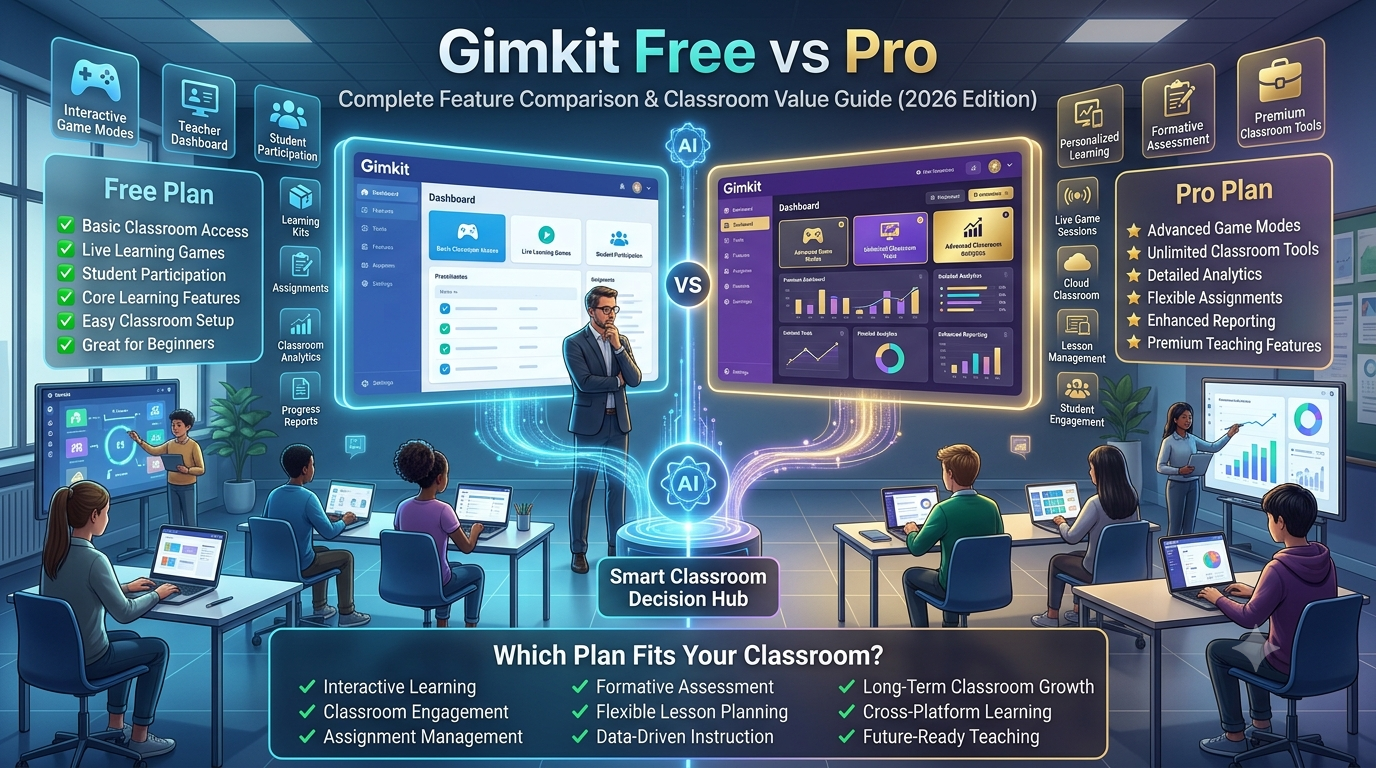
Teachers can review Gimkit’s official assignment documentation for current independent-work access and limits. Assignments are a paid Pro feature according to the official documentation, while practice links offer a different, simpler route. Verify availability before planning a lesson. The cases above do not require a particular subscription and can be adapted to non-digital tasks.