A practical, privacy-aware guide to recording accuracy, finding persistent misconceptions and judging improvement without treating Gimkit rewards or one fast game as proof of academic mastery.
Quick answer: Track progress against a clearly defined learning goal. Record the number of correct answers out of questions attempted on comparable tasks, identify recurring errors, and periodically solve a new application question without hints. A teacher may also use Gimkit’s official reports for hosted Kits, but students should not be told that their personal account automatically includes every teacher report. Cosmetic XP, GimBucks and game rank reflect other forms of activity, not standardized academic assessment.
Primary official references: Gimkit’s Game Reports documentation describes report views available to teachers after hosting a Kit they own; Practice Mode documentation explains simple question-answer practice; and XP and Leveling Up describes the separate cosmetics reward system. This article does not pretend these systems measure the same thing.
1. Decide what “personal progress” means for your goal
Progress is useful only when a student understands what is being improved. “Get a higher score” sounds measurable but may hide several unrelated factors: a different game mode, an easier Kit, additional time, more familiar questions or a teammate’s assistance. A more meaningful academic goal names a specific skill, such as recognizing the main idea of a paragraph, comparing fractions accurately or applying a vocabulary word in a new context.
Write the skill down in one sentence before collecting numbers. If you want to know whether you can solve two-step equations, your tracking questions should actually require that process. The number of coins, the final match position and cosmetic items may be interesting, but they cannot substitute for correct, explainable solutions.
Use a time window long enough for meaningful practice. One result may reflect distraction, guessing or a particularly challenging set of questions. Several comparable opportunities give a better picture of a trend. Be willing to recognize a flat or declining result as information about what needs to change rather than as a personal judgment.
2. Separate four types of progress evidence
Indicator
What it can show
Limitation
Best follow-up
Question accuracy
Fraction of attempted items answered correctly
Depends on item difficulty and comparability
Explain selected answers and use new examples
Misconception log
Which ideas repeatedly cause mistakes
Errors may reflect wording or access barriers
Clarify the concept with evidence and a new question
Independent transfer
Whether knowledge applies in an unfamiliar setting
One question samples only a small part of learning
Repeat later with another representative application
Game rank or in-mode rewards
Performance within a particular game system
Influenced by mechanics, teammate actions and familiarity
Keep separate from the academic record
XP and cosmetics
Progress toward account rewards where applicable
Not an academic achievement measure
Track for enjoyment, not grading
The most defensible personal record combines an academic indicator with a brief explanation of what you learned from errors. A rising accuracy percentage without any improvement on unfamiliar questions may reflect growing familiarity with the same Kit rather than transferable understanding.
3. Track accuracy using correct answers and attempted questions
The basic calculation is correct answers divided by attempted questions, multiplied by 100. For example, if a learner answers 15 out of 20 questions correctly, the observed accuracy is 75%. If a later comparable session produces 18 correct out of 20, the observed accuracy is 90%. The change is 15 percentage points, not 15 percent relative improvement. Percentage-point change and relative-percent change have different meanings.
Accuracy must be interpreted alongside the number of attempts and the question set. A result of 100% on five easy questions is not necessarily stronger evidence than 85% on twenty carefully selected application items. Record the topic, date and general difficulty so future comparisons have context. Do not combine unrelated topics into one number when doing so would hide a particular weakness.
If an assignment allows repeated attempts, check how the teacher’s report handles them. The official Assignment Reports guide notes that only the first response appears in the report, even when learners can replay. A personal practice log may therefore differ from the teacher’s recorded assessment evidence.
4. Interactive personal accuracy and improvement calculator
Enter results from two comparable practice opportunities. The calculator computes the observed accuracy on each and the change in percentage points; it does not connect to Gimkit, store student names or send anything to a server. Your numbers remain in the browser’s current page session. If the calculator cannot run because a school policy disables scripts, use the printed formula immediately below it.
Personal practice comparison tool
Example: 12/20 = 60% and 16/20 = 80%. The observed change is +20 percentage points. These values are illustrative, not connected to any account.
For meaningful interpretation, compare sessions testing the same skill at roughly comparable difficulty. A change in percentage points alone does not prove improvement in long-term retention.
The manual formula is accuracy (%) = 100 × correct ÷ attempted. To calculate the percentage-point change, subtract the earlier accuracy from the later accuracy. For example, 80% minus 60% gives +20 percentage points. If the tool returns an error, check that attempts are greater than zero and that correct answers do not exceed attempts.
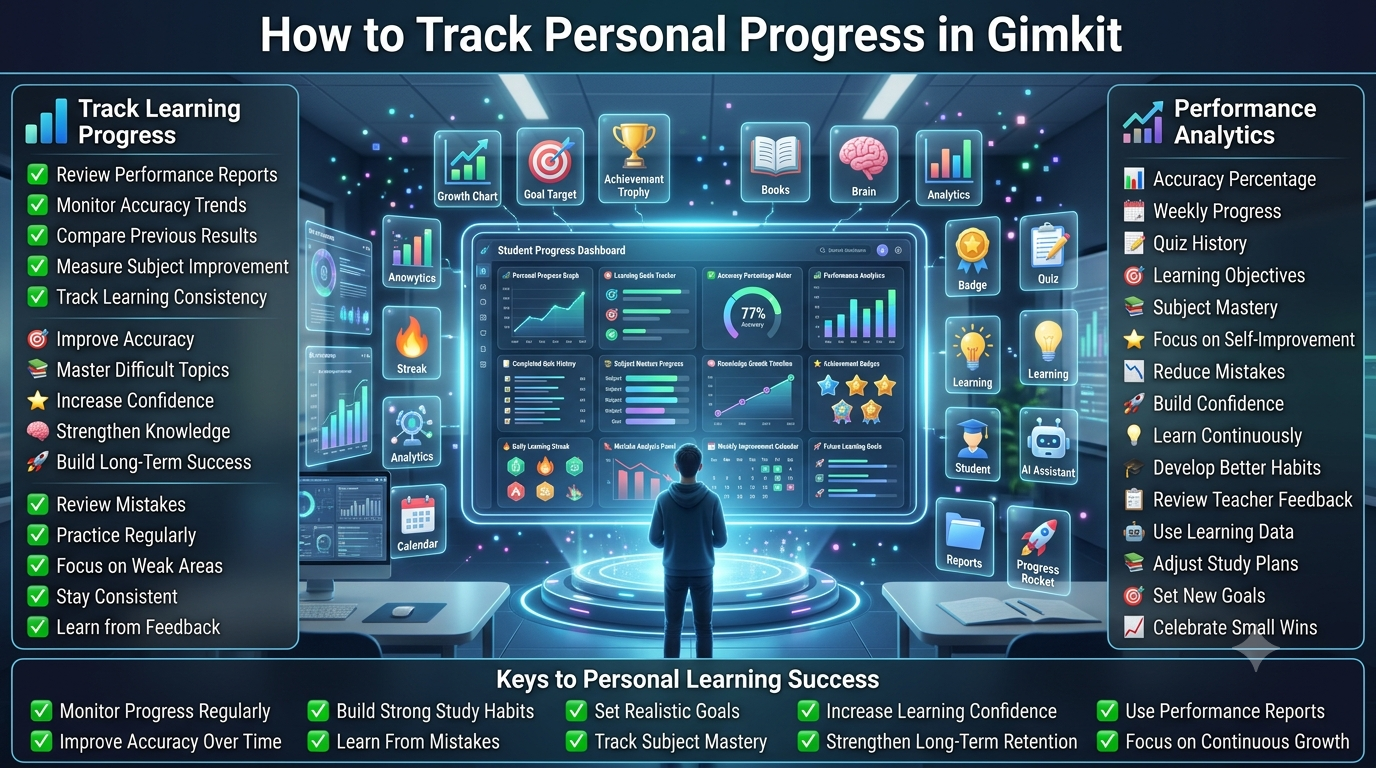
5. A small progress log beats an overwhelming dashboard
You do not need complicated analytics to understand your own learning. A paper notebook or school-approved spreadsheet can contain the date, skill, question type, correct answers, attempted questions, one misconception and the next planned action. Keep the log brief enough to maintain consistently. A tracking system that takes more time than learning is unlikely to help.
Date
Skill
Result
Misconception
Next action
Monday
Fraction magnitude
6/10
Confused denominator with fraction size
Review number-line models
Wednesday
Fraction magnitude
8/10
Still uncertain near one-half
Compare two examples with benchmarks
Friday
Transfer question
Explanation check
Justification incomplete
Practice a new comparison with written reasons
This example is hypothetical, not an actual Gimkit report. Its purpose is to show how a small record can connect a number with a learning decision. Some useful logs include very few numbers but still identify what a student can now explain.
6. Where teacher reports fit into a personal record
Gimkit’s current official Game Reports guide describes three main views after a teacher hosts a Kit they own: Student Overview, General Overview and Question Breakdown. Teachers can review completed reports from their dashboard. These are teacher-facing reporting functions, and students should not be promised direct access to every one of them from an ordinary student login.
A teacher can use the Question Breakdown to identify difficult items and then discuss the underlying concepts with the class. If the teacher shares appropriate feedback privately with a student, that student can add a general misconception to their own log without needing a copy of all peer data. A student should not attempt to use another person’s dashboard, credentials or personal records.
Report interpretation still requires judgment. A high game score can reflect many factors, and question-level accuracy can be affected by time pressure or ambiguous item wording. The teacher can use independent checks to confirm what the learner actually understands. For the broader assessment workflow, see Formative Assessment Strategies with Gimkit.
7. Practice Mode provides a simpler context for checking knowledge
According to the official Practice Mode guide, a Kit can be shared through a practice link that presents the questions and correct/incorrect answers without live game modes or game mechanics. This simpler format can be useful when a learner wants to focus on subject accuracy without worrying about navigation, cosmetic rewards or competition.
A student should still be cautious about judging mastery from repeated exposure to exactly the same questions. Once the answers are familiar, ask for a new example or a fresh explanation. When practice is available only on school-approved devices, a printed or written version of the same concepts may be used with teacher permission.
For learners who experience accessibility challenges in live games, the simpler practice route may offer a better fit, but it should not be assumed to solve every accessibility need. Use established accommodations and an alternative response format where necessary.
8. Why XP is not the same as academic performance
The official Gimkit XP and leveling guide describes earning XP in 2D modes through actions including correct answers and using levels to gain GimBucks for cosmetic items. XP can be enjoyable and motivating, but it is a reward-system metric. It does not directly establish a learner’s reading comprehension, scientific reasoning or problem-solving ability.
It is reasonable to track XP separately if cosmetics are part of a student’s recreational interest. Do not combine it with academic accuracy in a single “mastery score.” The two measurements describe different phenomena, have different limits, and can change for different reasons. If a learner feels pressure to maximize XP at the expense of learning, encourage a healthier focus on a meaningful academic goal.
Our Gimkit XP guide covers that separate reward system in more detail. This article is about keeping a personal academic progress record without mixing incompatible metrics.
9. Track misconceptions by concept instead of only by question number
When students review errors, the most helpful information is often the reason behind a response rather than the question number. For a fraction question, the misconception might be “I assume the bigger denominator means a bigger fraction.” For a science question, it might be “I think evaporation only happens when water boils.” These statements can guide targeted practice and reveal when understanding changes.
A helpful error log contains the incorrect idea, a corrected explanation, one new example and a date for rechecking. Avoid writing “I am bad at math” or “I never understand science” as if those describe permanent ability. They do not identify an actionable concept. A teacher can show a learner how to convert an unhelpful self-judgment into a precise next task.
Keep the log manageable. If an item was missed because its wording was ambiguous or because the device disconnected, note that context rather than pretending every wrong response represents a misconception. Evidence quality matters more than the number of entries.
10. Make comparisons fair across modes and question sets
Comparing scores from different game modes can be misleading because objectives, rewards and time conditions differ. Comparing accuracy on different Kits may also be misleading if one set is much harder than another. Before calling a trend meaningful, ask whether the learning target, difficulty, question formats, degree of support and time available were sufficiently similar.
For example, a student might achieve 90% on ten definition questions and 70% on ten unfamiliar application problems. That does not necessarily mean the student became worse. It may mean the task became more demanding. Record the difference and use it to decide whether the learner should practice applying concepts. Do not hide difficulty differences just to produce an attractive progress chart.
When a student is absent, changes devices or uses an accommodation, the context also matters. A fair progress log describes what was attempted and which supports were available. It is not a competitive ranking of different learners.
11. Use a delayed check to understand retention
Immediate practice can show that a learner is familiar with a question, but long-term retention requires later recall. Try revisiting the concept after some time has passed with a slightly different item. Ask for a reasoned explanation before showing choices, where that is appropriate for the subject. A student who can explain the concept later and in a new example has more convincing evidence of transferable learning.
A delayed check does not have to be a major exam. It might be an exit question the next day, a short retrieval task the following week or a brief application in another lesson. The important point is to avoid treating one high-scoring session as permanent evidence of mastery.
At the end of a week, review the skill name, the accuracy pattern and the misconceptions. Choose one next action. If accuracy is increasing and transfer explanations are strong, select a more challenging context. If accuracy is rising but explanations are weak, focus on understanding rather than further repeated questions. If performance is erratic, check whether task difficulty or access changed. If the same misconception persists, ask for explicit reteaching or a worked example.
Do not attempt to optimize every variable at once. A small plan is easier to test: “This week I will explain why each of these three fraction comparisons is correct, and I will check the idea with one unfamiliar pair on Friday.” This goal is more informative than “Get 10,000 more points.”
Weekly reflection prompt:
Which concept can I now explain more clearly than last week?
What was my most common wrong idea?
Did I see the same error on a new example?
Which teaching explanation or practice action helped?
What one thing will I change next week?
13. A realistic science example
A learner answers questions about states of matter. Their first practice set shows 6 correct answers out of 10. The student notices they confuse evaporation with boiling. After studying the particle model and watching a teacher demonstration, they answer 8 out of 10 on a related set. An improvement in observed accuracy is encouraging, but the student should still explain a different real-world example without multiple-choice options.
Suppose the new example asks why clothes dry on a cool day. If the learner can explain evaporation without asserting that the water must boil, their reasoning supplies a more meaningful measure of understanding than the change in game score alone. The learner records that successful explanation and schedules another later check.
14. A realistic reading example
A student consistently chooses the main idea when the wording closely matches the passage, but struggles with inference questions. A single combined accuracy rate hides this difference. The student creates two columns in the log: “explicit main idea” and “inference from evidence.” After targeted practice, the learner answers an unfamiliar inference question and identifies the passage detail supporting it.
The tracking change is not about adding more numbers. It is about selecting categories that map to the actual learning goals. The student can now tell the teacher which skill needs support instead of saying that their overall Gimkit score is low.
15. A realistic mathematics example
A class practices percentages. One learner is confident converting fractions to percentages but makes repeated errors when applying percentages to word problems. Their personal log separates calculation fluency from interpretation. They record accurate conversions and mark word-problem interpretation as the next target. The teacher provides a worked example, followed by an unfamiliar application.
After several opportunities, the learner compares results on similar application questions. Even if the new task has fewer points or a different mode than the previous game, the explanation quality can reveal genuine progress. Tracking the skill helps avoid a false comparison between incompatible game rewards.
16. Privacy and student-data safeguards
Progress tracking can involve sensitive learning information. Students should not publish their full names, personal email addresses, identifiable class reports or private performance histories on a public blog. Teachers should follow school rules on record retention and parent communication. A student’s personal notebook or school-approved learning system is generally a more suitable location for individual results than an open webpage.
The calculator on this page is a standalone numerical tool and does not ask for names or connect to an account. Do not enter another student’s private results without permission. If a teacher shares feedback, ask for the conceptual patterns you need to improve rather than demanding access to records about classmates.
17. Avoid common errors in progress tracking
Tracking one score only
Add context: skill, question type, number of attempts and explanation quality.
Mixing XP with subject results
Keep cosmetic rewards separate from academic evidence.
Comparing unequal tasks
Record difficulty changes before interpreting a percentage trend.
Reusing identical questions
Add unfamiliar examples to check transfer rather than memorization.
Publicly comparing students
Use private, individual learning goals and teacher-approved feedback.
Ignoring persistent misconceptions
Record the underlying idea and request targeted explanation.
18. Personal learning progress checklist
19. Frequently asked questions about Gimkit progress
Can students view the same reports teachers see?
Do not assume that. Official Game Reports documentation describes reports for teachers after hosting Kits they own. Ask the teacher for appropriate feedback rather than expecting full report access from a student account.
How do I calculate accuracy?
Divide correct answers by attempted questions and multiply by 100. For example, 15 out of 20 equals 75%.
What does an increase of 10 percentage points mean?
It means the later accuracy percentage is ten points higher—for example, 70% to 80%. It does not by itself prove durable learning, especially if difficulty changed.
Does earning XP mean my knowledge improved?
No. XP is part of Gimkit’s cosmetic reward system in 2D modes. Use independent subject responses to judge academic progress.
Can I use Practice Mode to track progress?
Practice Mode supplies simple questions and correct/incorrect responses. You can record your own observations, but do not claim the practice link itself provides a full personal progress dashboard.
Why does my score change across game modes?
Modes can have different objectives and rewards. Compare learning evidence that addresses the same subject skill rather than treating different scores as directly equivalent.
How many questions are enough to prove mastery?
There is no universally sufficient count. Choose representative questions, examine reasoning and check a related new task later. A small set can guide next steps without proving complete mastery.
Can a teacher report include results from repeated assignment attempts?
Official Assignment Reports guidance says only the first response appears in the report when students replay. Check the current product guidance and interpret the data accordingly.
Should I keep a public progress chart?
A public chart of identifiable student results is generally inappropriate. Use a private, school-approved log and avoid unnecessary personal details.
Conclusion: progress means knowing more, not merely earning more
Tracking personal progress in Gimkit works best when numbers are tied to specific academic goals. Record comparable accuracy results, identify misconceptions and check transfer through independent tasks. Teacher reports, gameplay rewards and cosmetic XP can provide context, but each has limitations. Use a small private log, constructive feedback and a clear next action so the record actually helps you learn.
Independent education guide; not affiliated with Gimkit. Calculator results are illustrative and not verified account data. Product features can change; consult current official documentation.