Editorial scope: This guide addresses sustainable classroom practice over a term or school year. The examples are illustrative teaching designs, not reports of observed schools or guaranteed outcomes. Platform-specific claims are linked to official Gimkit Help articles; teachers should check current entitlements and their own school policies.
Existing teaching guidance and foundational recommendations
Introduction
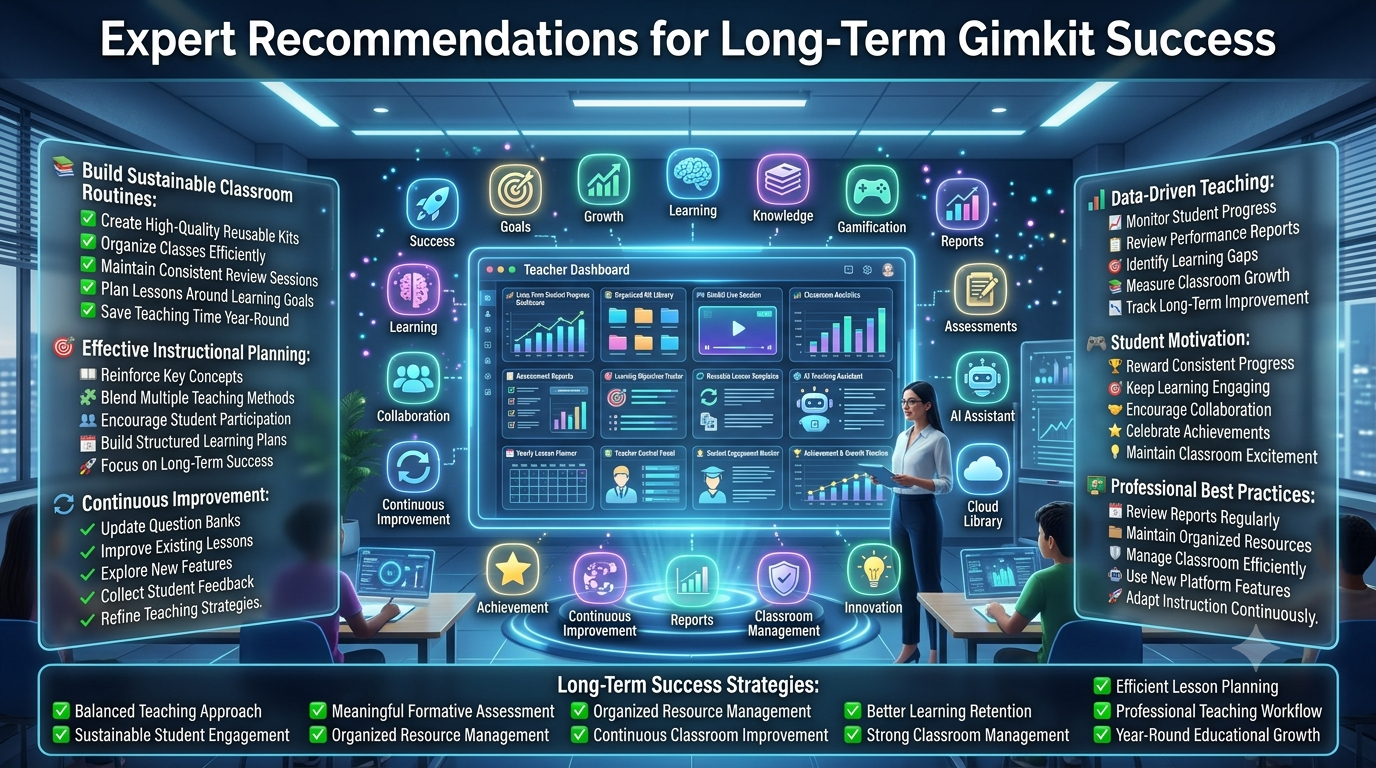
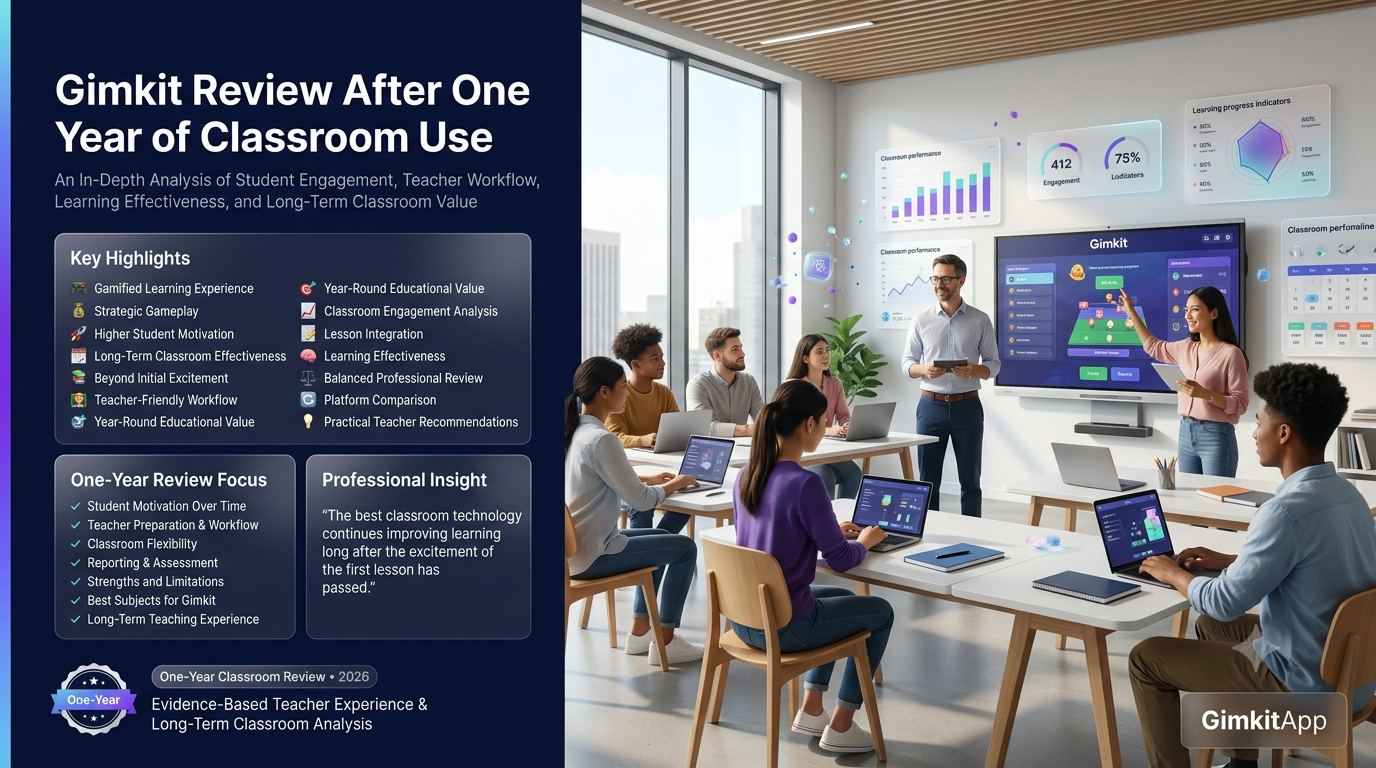
Expert Recommendations for Long-Term Gimkit Success-The most effective educators use the platform as part of a balanced instructional strategy that combines engaging review, meaningful assessment, and data-informed teaching. While Gimkit’s gamified environment motivates students, sustained academic growth depends on thoughtful planning, varied activities, and continuous refinement of classroom practices.
Teachers who successfully integrate Gimkit throughout the school year understand that consistency is more important than novelty alone. Features available through Gimkit Live, Gimkit Join and the Gimkit App allow educators to build organized classrooms, reuse high-quality Kits, monitor learning progress, and adapt instruction based on real classroom data. These practices help maintain student engagement without allowing gameplay to become repetitive.
Another important factor is balancing game-based learning with other instructional approaches. Gimkit works best when it reinforces concepts introduced through direct instruction, collaborative learning, projects, discussions, and hands-on activities. This blended model strengthens long-term retention while preventing students from viewing review games as the only learning experience.
Experienced educators also recognize the importance of continuous improvement. Reviewing reports, updating question banks, collecting student feedback, and exploring new platform features help teachers refine lessons throughout the academic year. Small adjustments made consistently often produce greater long-term benefits than major instructional changes.
This guide presents Expert Recommendations for Long-Term Gimkit Success, covering sustainable classroom routines, effective assessment practices, student motivation, instructional planning, classroom management, and professional strategies that help teachers maximize Gimkit’s educational value over many months of teaching.
Build Sustainable Classroom Routines
Successful long-term implementation depends on consistent routines rather than constant novelty.
Teachers should establish predictable schedules for review activities, assignment completion, and classroom discussions. Students benefit from knowing when and how Gimkit will be used while still experiencing enough variation to remain engaged. Consistent routines reduce confusion and create smoother classroom management throughout the year.
Routine Development
Strategy
Educational Benefit
Weekly Review Schedule
Consistent reinforcement
Predictable Lesson Structure
Better classroom management
Balanced Activity Rotation
Reduced student fatigue
Clear Expectations
Improved participation
Regular Reflection
Stronger understanding
Structured Planning
Long-term success
Well-designed routines create stability without sacrificing engagement.
Continuously Improve Question Quality
High-quality questions have a greater impact on learning than simply increasing the number of activities.
Experienced teachers regularly review their Kits, improve unclear wording, add higher-order thinking questions, update outdated content, and align materials with current curriculum standards. Strong question design encourages deeper thinking while making formative assessment more meaningful.
Reports should influence future lessons rather than simply documenting previous performance.
By reviewing student progress, question accuracy, participation trends, and recurring misconceptions, teachers can identify areas requiring additional instruction. Data-driven planning allows educators to personalize review sessions and address learning gaps before they become larger academic challenges.
Data-Informed Teaching
Report Type
Teaching Benefit
Student Progress
Monitor growth
Question Analysis
Identify misconceptions
Class Trends
Adjust instruction
Assignment Results
Guide intervention
Participation Data
Improve engagement
Historical Performance
Long-term planning
Regular analysis transforms classroom data into better instructional decisions.
Maintain Student Motivation Throughout the Year
Keeping students engaged for an entire academic year requires more than competitive gameplay.
Teachers should rotate game modes, vary instructional approaches, celebrate individual improvement, encourage collaboration, and connect activities directly to classroom learning objectives. Long-term motivation grows when students recognize that success reflects genuine understanding rather than luck or repetition.
Motivation Strategies
Strategy
Classroom Benefit
Rotate Activities
Prevent boredom
Celebrate Progress
Build confidence
Encourage Teamwork
Increase collaboration
Connect to Curriculum
Meaningful learning
Offer Variety
Maintain interest
Provide Constructive Feedback
Support improvement
Meaningful engagement creates more durable learning than entertainment alone.
Prevent Student Burnout Through Instructional Variety
Long-term success with Gimkit depends on maintaining student interest without allowing gameplay to become predictable. Even highly engaging platforms can lose their impact if they are used in exactly the same way every week. Experienced teachers rotate game modes, alternate between digital and offline learning activities, and vary instructional formats to keep review sessions fresh. A balanced classroom approach encourages sustained motivation while supporting deeper understanding across different access needs and learning conditions.
Burnout Prevention
Strategy
Long-Term Benefit
Rotate Game Modes
Maintains engagement
Alternate Digital & Offline Lessons
Better instructional balance
Use Collaborative Activities
Stronger participation
Limit Repetitive Review
Prevents fatigue
Refresh Question Sets
New learning experiences
Collect Student Feedback
Continuous improvement
Instructional variety keeps students motivated throughout the school year.
Build Reusable Teaching Systems
Highly effective teachers focus on creating systems rather than repeating individual tasks. Instead of designing every activity from the beginning, they develop organized Kit libraries, reusable assignments, consistent lesson templates, and structured classroom workflows. These systems reduce preparation time while ensuring instructional quality remains high across multiple classes and academic years.
Sustainable Teaching Workflow
Workflow
Professional Benefit
Reusable Kits
Faster lesson preparation
Organized Resource Library
Easy content management
Lesson Templates
Consistent instruction
Standard Naming System
Better organization
Archived Materials
Future reuse
Regular Resource Updates
Current curriculum alignment
Well-designed systems improve both efficiency and instructional consistency.
Continue Professional Learning
Educational technology evolves continuously, making ongoing professional development essential for experienced teachers. Exploring new Gimkit features, reviewing platform updates, exchanging ideas with colleagues, and experimenting with instructional strategies help educators improve classroom practices over time. Small improvements made consistently often produce greater long-term results than major changes implemented all at once.
Professional Growth
Activity
Teaching Advantage
Learn New Features
Expanded instructional options
Attend Professional Development
Better teaching practices
Share Ideas With Colleagues
Collaborative improvement
Reflect After Lessons
Continuous refinement
Test New Strategies
Increased engagement
Stay Current With Updates
Better classroom efficiency
Continuous learning strengthens both teaching confidence and classroom effectiveness.
Review Classroom Performance Regularly
Long-term improvement requires consistent reflection. Rather than evaluating performance only at the end of a semester, experienced teachers regularly review classroom reports, assignment results, participation trends, and student feedback. These insights help identify successful practices and areas needing adjustment before problems become significant.
Technology is most effective when it enhances teaching rather than replacing it. Gimkit works best alongside direct instruction, collaborative discussion, project-based learning, written activities, and practical classroom experiences. This balanced approach develops both academic knowledge and critical thinking while ensuring technology remains a meaningful instructional tool rather than the center of every lesson.
Practical Recommendations for Sustained Classroom Use
Long-term success with Gimkit comes from consistency, thoughtful planning, and continuous improvement rather than simply playing more games. Experienced educators build sustainable routines that keep students engaged while supporting measurable academic growth.
Classroom Planning
Create a yearly review schedule.
Organize Kits by subject and unit.
Align every activity with learning objectives.
Plan review sessions before major assessments.
Update instructional resources each term.
Student Engagement
Rotate different game modes regularly.
Celebrate improvement instead of only high scores.
Encourage healthy classroom competition.
Mix individual and team activities.
Collect student feedback throughout the year.
Question Design
Improve weak questions after every unit.
Include higher-order thinking questions.
Balance easy, medium, and challenging content.
Remove outdated material.
Keep Kits curriculum-aligned.
Assessment
Review reports after every major activity.
Identify misconceptions early.
Monitor long-term student progress.
Compare performance across units.
Use classroom data to adjust future lessons.
Professional Workflow
Maintain a reusable Kit library.
Archive older instructional materials.
Organize digital resources consistently.
Review classroom settings regularly.
Explore new platform features when released.
Continuous Improvement
Reflect after important lessons.
Improve one workflow at a time.
Balance technology with traditional instruction.
Continue professional learning throughout the year.
Focus on student understanding rather than game results alone.
Best Practices
✔ Maintain consistent classroom routines.
✔ Keep instructional resources organized.
✔ Use reports to guide teaching decisions.
✔ Prevent burnout by varying activities.
✔ Treat Gimkit as one part of a balanced instructional strategy.
Small improvements made consistently create significant long-term classroom success.
Common Long-Term Mistakes Teachers Should Avoid
Even experienced educators can reduce Gimkit’s effectiveness by relying too heavily on familiar routines. Reviewing classroom practices regularly helps maintain student engagement while supporting stronger instructional outcomes.
Frequent Mistakes
Mistake
Better Practice
Using the same game mode repeatedly
Rotate activities regularly
Ignoring classroom analytics
Review reports after each unit
Rarely updating Kits
Improve questions continuously
Overusing review games
Balance with other teaching methods
Organizing resources inconsistently
Maintain structured digital libraries
Waiting until year-end to evaluate
Reflect throughout the school year
Professional Recommendations
✔ Refresh classroom resources regularly.
✔ Monitor long-term student growth.
✔ Keep lessons aligned with curriculum goals.
✔ Balance engagement with academic rigor.
✔ Continue refining instructional systems.
Long-term success depends on consistent improvement rather than occasional major changes.
Coaching protocols that make a yearlong routine more reliable
Protocol A: A two-minute target check before class
Before opening a Kit, write the concept in one sentence and identify the thinking the question should reveal. A lesson on ecosystems might require students to predict the consequence of removing a producer, not merely name producers. Review the selected questions against that target. If most questions ask for isolated definitions, remove some or add a separate explanation prompt. The teacher should be able to state what a wrong answer would suggest about reasoning. This short preflight prevents a familiar Kit from becoming an automatic activity disconnected from the lesson.
Protocol B: A misconception conversation after play
Choose one question that divided the class and ask learners to explain why an incorrect option might seem plausible. Invite multiple interpretations without naming students who missed it. Show a counterexample or a visual representation, then ask for a revised explanation. Record whether the confusion came from content, language, or question design. A teacher who merely announces the correct answer misses an opportunity to understand the source of error. Repeat the idea later with different wording so students cannot rely on recognition of the original item.
Protocol C: A quiet participation audit
After a session, ask who actually had opportunities to think aloud, ask for clarification, or contribute an explanation. A high number of logged responses does not prove that every learner felt included. Compare the visible energy of the room with anonymous feedback and teacher observation. If the same students dominate, adjust discussion structures or allow private written reasoning. Consider students who used a paper alternative or lost connectivity; do not treat missing game records as a lack of motivation. A participation audit is an instructional reflection, not a public student ranking.
Protocol D: A five-minute Kit correction meeting
When colleagues share resources, spend five minutes reviewing one confusing item instead of debating broad platform preferences. Show the original question, identify the curricular target, and explain which distractor produced a misleading pattern. Invite a second teacher to check the revised answer key. Record the date and reason for the change. If the same Kit is used in several classes, note that later scores may not be directly comparable after editing. This small practice strengthens quality control without creating a burdensome formal review process.
Protocol E: A delayed transfer checkpoint
After students appear confident in a game, schedule a brief independent task several lessons later. Use new examples that require the same principle in a different context. A student who can identify a proportional relationship in a multiple-choice game should also explain a unit-rate comparison in a written problem. When delayed performance is weaker, provide additional modeling and retrieval opportunities. Avoid assuming that the platform caused improvement or decline; ordinary instruction, practice, and changing question difficulty also matter. The checkpoint makes long-term learning visible beyond the game screen.
Protocol F: A low-tech continuity rehearsal
Once each term, practice how the lesson would proceed if the game could not load. Keep a short paper set, mini-whiteboard questions, or partner explanation task aligned with the same objective. Tell students the fallback routine before a technical problem occurs. If a connection fails, move to the alternative without collecting personal login details or repeatedly restarting the class. Later, note whether the backup preserved the intended evidence of understanding. This rehearsal is particularly useful in classrooms with shared devices or inconsistent home access.
Protocol G: A student reflection that avoids score fixation
Ask students to complete three prompts: “One idea I can explain,” “One answer I would change,” and “One question I still have.” A learner who won the game may still have a misconception; a learner with a low score may offer a sophisticated explanation. Encourage specific examples rather than general statements about being good or bad at the subject. Use the reflections to choose a reteaching example or a new question. Keep personal reflections private unless students choose to share, and avoid posting identifiable academic information on a leaderboard.
Protocol H: A term-end continue-or-change decision
Review several independent indicators before deciding whether the routine should continue. Look at question quality, classroom participation, time spent setting up, delayed checks, and teacher workload. Write one paragraph describing what helped and one describing what remained uncertain. A routine may be worth keeping because it efficiently surfaces misconceptions even when it does not produce dramatic score changes. It may need replacing if it consistently excludes students or consumes more time than the resulting feedback justifies. Set a review date and assign a person to maintain the Kit library.
Frequently Asked Questions
1. How Do I Prevent Student Burnout Over a Long School Year?
Keeping Gimkit engaging throughout the year requires intentional variety rather than increasing the number of games. Students remain motivated when teachers rotate game modes, alternate between live sessions and assignments, combine Gimkit with discussions, projects, and hands-on activities, and periodically refresh question sets. Celebrating improvement instead of only leaderboard positions also helps sustain enthusiasm. Current instructional practice recommends using game-based learning as one component of a balanced teaching strategy instead of relying on it for every review session.
Best practices:
Rotate different game modes.
Mix Gimkit with offline activities.
Refresh Kits regularly.
Celebrate progress, not just winners.
Schedule review sessions strategically.
2. How Can I Tell Whether Students Retained What They Practiced?
Use a delayed, independent check with new examples rather than relying only on a leaderboard or repeated game questions. Ask students to explain their reasoning, apply a principle in a different context, and identify a common error. Compare these responses with the intended learning target and with earlier independent work where appropriate. If students remember the answer pattern but cannot justify it, plan modeling and another opportunity to retrieve the concept. Do not treat one game session as proof of durable mastery or as evidence that a particular platform caused a change.
Keep the follow-up short enough to use routinely. A three-question check plus one explanation prompt can reveal more about transfer than an additional round of familiar questions. Record what you will teach differently next week and revisit the idea later.
3. How Do I Stop Students From Rushing and Guessing Answers?
Students often rush because they focus on game rewards rather than learning objectives. Teachers can reduce random guessing by emphasizing accuracy over speed, reviewing difficult questions after games, explaining that incorrect answers slow long-term progress, and using reports to discuss common mistakes. Creating a classroom culture that values understanding instead of simply winning encourages more thoughtful participation. Recent educational research continues to support formative feedback as a powerful method for improving learning behaviors.
Helpful strategies:
Reward accurate answers.
Discuss misconceptions after games.
Explain the value of careful thinking.
Review performance reports together.
Reinforce learning goals before competition.
4. How Can I Use Gimkit to Foster Student-Led Collaboration?
Gimkit supports collaboration most effectively when students work toward shared learning goals instead of focusing only on individual competition. Teachers can organize team-based activities, encourage students to explain problem-solving strategies, assign peer mentors, and include post-game reflection discussions. Allowing students to review challenging questions together promotes communication, critical thinking, and collective responsibility for learning. Collaborative learning strengthens both academic understanding and classroom relationships.
Collaboration ideas:
Use team-oriented game modes.
Encourage peer explanations.
Assign collaborative review tasks.
Discuss strategies after games.
Celebrate team improvement.
5. What Is the Best Way to Handle Mixed-Ability Classrooms?
Mixed-ability classrooms benefit from flexible instruction that allows every student to participate at an appropriate level. Teachers can differentiate learning by using varied question difficulty, offering additional support for struggling learners, encouraging peer collaboration, and reviewing classroom reports to identify individual needs. Combining Gimkit with targeted instruction ensures advanced students remain challenged while other learners receive the reinforcement they need. Differentiation creates a more inclusive and supportive classroom environment.
Differentiation strategies:
Include varied question difficulty.
Monitor individual progress.
Provide targeted support.
Encourage peer learning.
Use assessment data to guide instruction.
Final Verdict
Achieving Expert Recommendations for Long-Term Gimkit Success requires more than frequent gameplay. Sustainable results come from organized planning, high-quality question design, balanced instruction, continuous reflection, and thoughtful use of classroom data. Teachers who consistently refine their instructional systems create learning experiences that remain engaging, efficient, and academically meaningful throughout the school year.
Conclusion
Gimkit delivers its greatest educational value when it is integrated into a long-term teaching strategy rather than used as an occasional classroom game. By maintaining organized resources, updating Kits regularly, balancing technology with traditional instruction, analyzing student performance, and embracing continuous professional growth, educators can build a sustainable digital learning environment that supports engagement, retention, and lasting academic success year after year.
Extended implementation framework: applying the recommendations over time
1. Start with a learning target rather than a game schedule
A durable Gimkit routine begins with an instructional decision: what should students be able to explain, retrieve, distinguish, or apply after the lesson? A teacher reviewing fractions might choose equivalent representations rather than the vague objective “practice math.” In a history lesson, the target might be distinguishing primary from secondary evidence. When the target is explicit, the teacher can reject attractive questions that do not test it. This is especially important when a public Kit contains entertaining trivia beside useful curriculum content. The platform is the delivery environment, not the curriculum.
Write the target in language a student could repeat. Decide whether a correct response alone would show mastery or whether the student must justify a choice afterward. For a vocabulary lesson, rapid recognition may be appropriate; for scientific causation, a multiple-choice answer should lead into a written explanation. Prepare an exit prompt before opening the game. Then choose a short set of questions whose distractors reveal specific misconceptions. If the target cannot be checked with the available question types, use a complementary paper, oral, or practical assessment rather than stretching the game beyond its strengths.
At the end, record three observations: which concepts most students retrieved confidently, which errors were common, and which learners need a different representation. Do not interpret a high game score as proof of transfer to new problems. Ask students to solve a novel example or explain why an incorrect answer is tempting. If that follow-up is weak, the next lesson should include modeling or guided practice before another competitive session. A recurring activity is successful when it improves the next instructional choice, not merely when it fills the first ten minutes.
A monthly review can compare planned targets against the questions actually played. Teachers sometimes discover that an engaging Kit repeatedly tests definitions while their unit assessment requires explanations or multi-step reasoning. Correcting that mismatch early is more valuable than adding another game. Keep a simple alignment note beside each Kit: target, grade, prerequisite, likely misconception, and suitable non-game follow-up. That note turns a one-time activity into a reusable instructional asset.
2. Design a repeatable weekly rhythm without overusing games
A reliable weekly rhythm lowers planning time while protecting instructional variety. One possible sequence is a Monday retrieval warm-up, a midweek targeted check, and a Friday reflection on the most difficult items. That is an illustrative pattern, not a required Gimkit feature or evidence-backed universal frequency. Some classes benefit from one brief session every two weeks; others need several short checks during an intensive revision unit. Choose frequency according to the cognitive demand of the subject, access to devices, and the quality of information gathered.
Build a predictable start: state the purpose, check that the right Kit is selected, display joining instructions, establish expectations for respectful play, and identify a fallback for students without devices. Reserve a few minutes afterward to discuss one error. A class that plays for fifteen minutes and never examines its mistakes may become fast at the interface without becoming more precise in the subject. In a forty-minute lesson, a five-minute review can be more defensible than a lengthy session if the remaining time supports modeling and application.
Rotate the form of retrieval rather than relying on novelty in game modes. Students might first answer independently, then discuss two disputed questions in pairs, and later produce their own explanation. A teacher can use a paper mini-quiz on a different day to check whether students remember material without game cues. The contrast provides useful evidence about learning conditions. For younger students, establish a quiet routine for device setup; for older students, require an evidence-based correction rather than simply repeating an incorrect item until it feels familiar.
Review the rhythm every four weeks with two questions: did it produce actionable information, and did it crowd out other worthwhile activities? If students complain of fatigue, shorten sessions or replace one with a discussion. If device setup consumes most of the available time, use a projected teacher-led prompt or a non-digital alternative. Sustainability means the routine survives timetable disruptions and still serves the target, not that the same schedule continues regardless of evidence.
3. Create a question-quality review system
Question banks are convenient but not self-validating. Gimkit’s official Question Bank allows teachers to search public Kits and add questions to their own Kits; it does not guarantee that a borrowed item is accurate, aligned, or appropriate for a particular group. Review wording, answer keys, distractors, reading load, cultural assumptions, and whether images are accessible. In mathematics, check units and rounding; in science, check whether a simplified statement is still true; in history, verify chronology and avoid presenting contested interpretations as unquestioned facts.
Use a four-pass editing method. First, match each question to a specific learning objective. Second, solve it independently without looking at the stored answer. Third, inspect wrong options: they should diagnose plausible reasoning errors, not rely on tricks or grammatical clues. Fourth, check the reading burden. If the skill is solving linear equations, avoid making the challenge an unnecessarily dense paragraph. A question that is technically correct but confusing can distort both student confidence and the teacher’s interpretation of a report.
When students repeatedly miss an item, separate content difficulty from item defect. Read it aloud, invite an explanation of how someone could interpret the wording, and compare it with an equivalent question. If the second question is answered correctly, revise the first before reteaching the whole concept. Keep a small change log recording the original issue, revision, and date. Do not silently change a Kit just before comparing results across classes; version notes help explain why apparent performance shifted.
A practical maintenance cycle is to audit a few questions after each use, not to rebuild every Kit every week. Flag items with unexpectedly high error rates, ambiguous language, outdated references, or weak distractors. For important assessments, have a colleague check the answer key. The official documentation on Question Bank explains the import workflow, while the teacher remains responsible for curricular validity.
4. Interpret reports as evidence, not verdicts
Gimkit’s official Game Reports documentation describes student, general, and question-level views for eligible hosted Kits. These can help identify patterns worth investigating, but a report is a record of responses under particular conditions, not a direct measure of long-term understanding. Speed, guessing, reading difficulty, prior exposure, game mechanics, and device issues may influence performance. A teacher should avoid ranking students’ intelligence or effort from a single session.
Begin with the question breakdown rather than the leaderboard. Select two items that many students missed and ask what thinking they required. Compare the errors with what you observed in discussion or independent work. If a question is wrong because the class confused numerator and denominator, a visual model may help. If students can explain the idea orally but struggle with the wording, the appropriate response may be language support. If responses were rushed, change the pacing and retest with an unfamiliar item.
Record a modest action statement: “Several students selected a distractor that treats mass as volume; tomorrow we will compare two containers and explain the distinction.” Avoid broad statements such as “the class failed science.” Revisit the same underlying concept with a new representation after instruction. The most useful comparison is between a misconception and its later correction, not between two unrelated cash totals from different modes. Document which students received support without publishing names in shared slides.
For longer-term analysis, look for converging evidence across several formats: game questions, notebook work, short oral explanations, and applied tasks. If they disagree, investigate rather than averaging them mechanically. A teacher can read the assessment-report interpretation guide for a separate, more detailed workflow. Reports become valuable when they inform a small, observable teaching change.
5. Plan retrieval spacing across a unit
Retrieval practice is more than repeating the same Kit on consecutive days. A useful unit plan revisits earlier concepts after intervening instruction, mixes related but distinguishable ideas, and asks learners to retrieve without immediately displaying the answer. For example, a language teacher might revisit irregular past-tense forms after a writing task, then ask students to use them in an original sentence. The game can provide quick recognition practice, but production and transfer still require other activities.
Gimkit’s Smart Repetition prioritizes questions a student initially missed during live games and assignments. That is an in-session, student-specific behavior; it is not a replacement for a teacher-designed multiweek spacing schedule. Avoid claiming that the feature automatically guarantees retention after several months. The teacher still needs to decide when old material should return and whether it appears in a sufficiently different context to test flexible understanding.
Build a simple retrieval calendar with a small number of anchor concepts. At the end of a unit, select two foundational ideas and one persistent misconception for later revisits. Schedule a brief check after a few lessons and again when the concept becomes relevant in a new topic. Students should see why the material matters: proportional reasoning reappears in chemistry, maps, and financial literacy; evidence evaluation reappears in literature and social studies. This cross-context practice can reveal brittle memorization.
Evaluate spacing with short independent tasks rather than only repeated game accuracy. A student who answers a familiar multiple-choice question correctly might still struggle to explain the rule or apply it to a novel example. Ask for a one-sentence justification or a worked solution. When retrieval fails, provide feedback and a new opportunity rather than treating forgetting as misbehavior. The purpose of a sustainable schedule is durable learning, not continuous competition.
6. Differentiate access without fixing students into labels
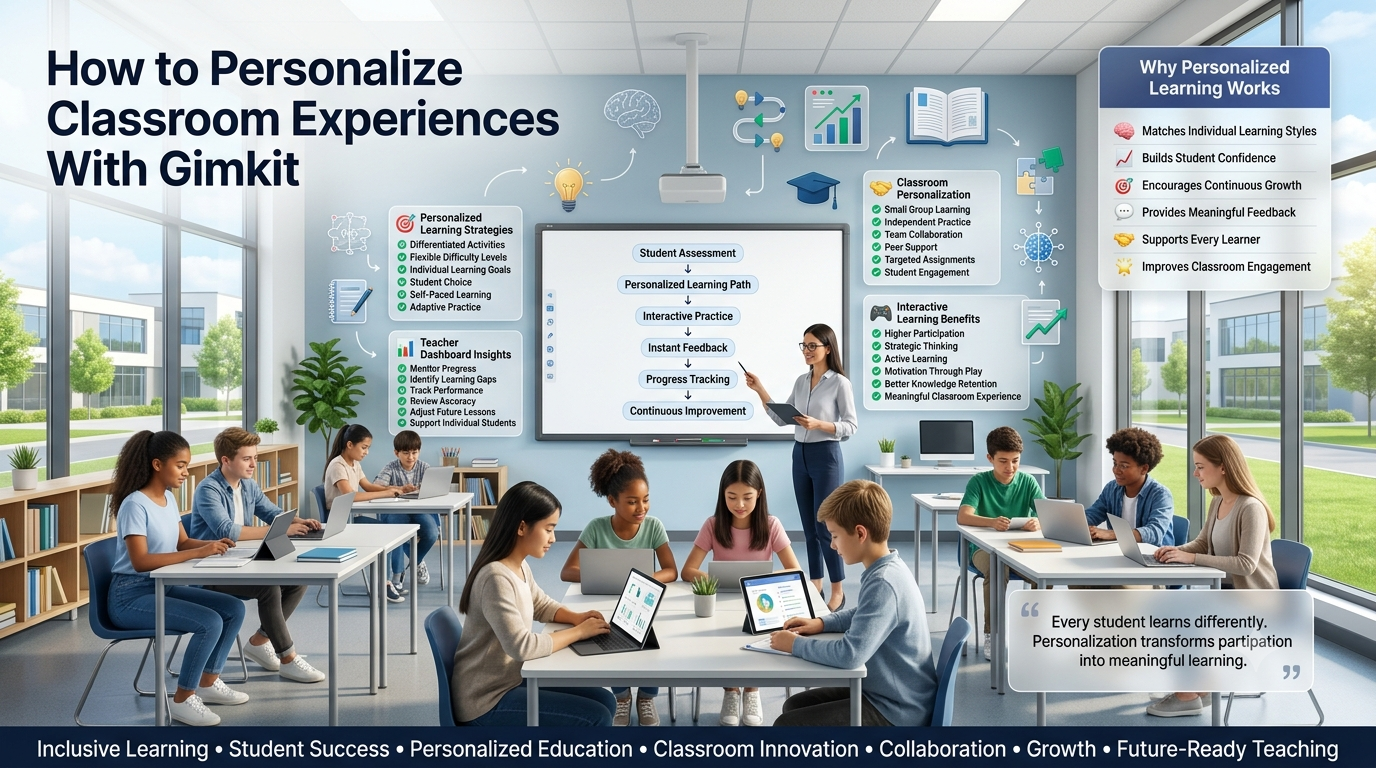
A class can contain confident readers, students learning the language of instruction, learners with processing or motor needs, and students who are anxious about public ranking. Equal access does not always mean identical participation conditions. Before a live game, inspect text size, device compatibility, question length, audio needs, and whether a student requires a non-digital route. Ask learners privately about barriers instead of assuming that a low score reflects limited ability.
Offer multiple ways to demonstrate the target. A student may join the game, complete a short parallel response sheet, or discuss a reasoning prompt with the teacher. When students work in teams, assign rotating responsibilities such as reader, evidence checker, and explanation reporter; avoid permanently placing the same student in a passive role. If competition increases distress, use a less public format or pause the leaderboard discussion. Mode-specific options differ, so check the current host screen instead of promising that every mode has identical controls.
Differentiate question demand as well as access. A foundational group might compare concrete examples, while another explores exceptions or explains a general rule. Keep the underlying objective coherent so that groups can later discuss their reasoning together. Do not use public team names that identify “weak” or “strong” learners. The goal is to remove unnecessary barriers and gather interpretable evidence, not to hide differences behind a superficially equal score display.
After the session, compare who participated, who could explain an answer, and who still needed help. If the same students are routinely silent, redesign the activity rather than concluding that they dislike learning games. A quick anonymous comfort check can surface problems that score reports miss. Teachers should follow their school accessibility, safeguarding, and data-handling policies when collecting feedback. The most successful long-term routine is one that learners can enter safely and meaningfully.
7. Use assignments and practice with precise expectations
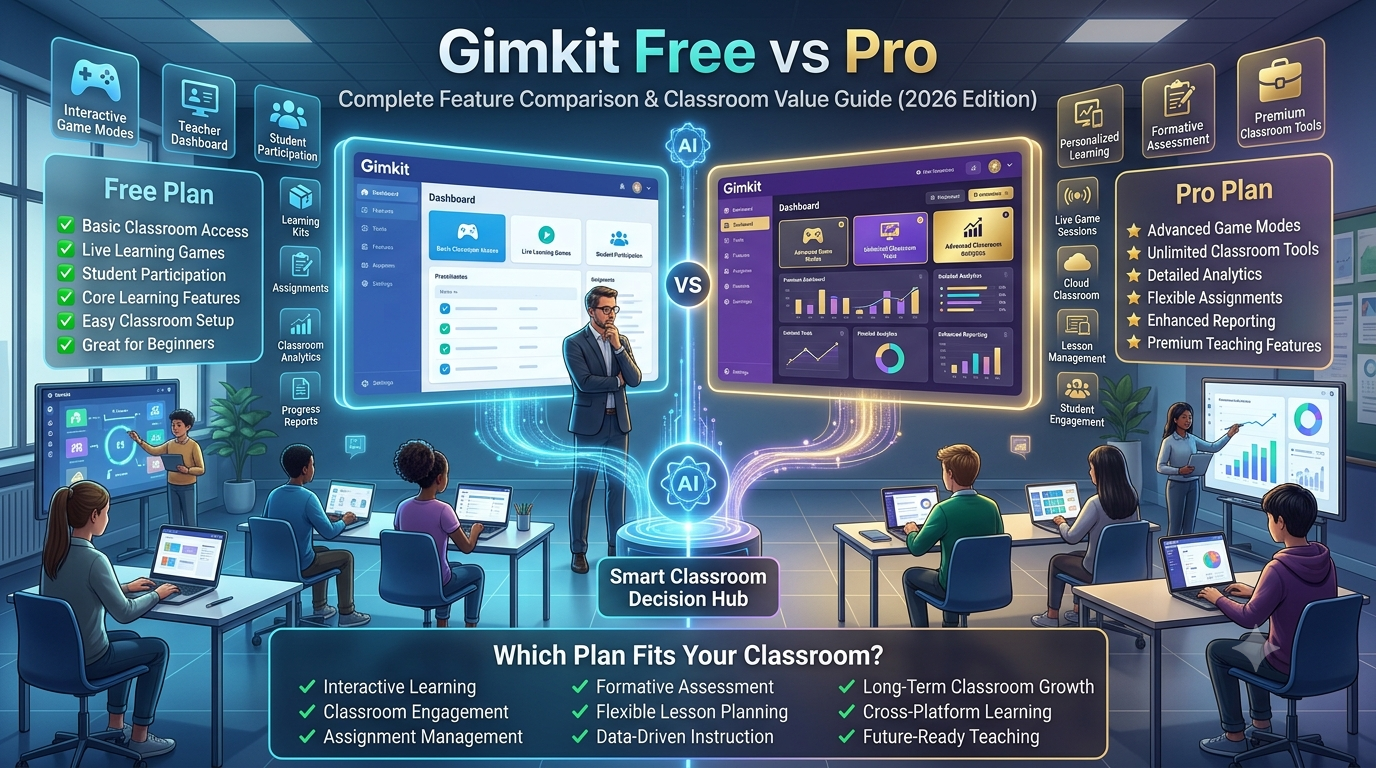
Gimkit’s official Assignments Explained documentation states that assignments are a Pro feature and that assignments use eligible 2D modes without team-dependent play. This distinction matters when planning a yearlong homework routine: do not promise the same functionality to every free account or suggest that all live modes can be assigned. Check current plan entitlements and mode availability before giving students instructions. A free practice link may be sufficient when the objective is low-stakes rehearsal.
For independent work, communicate what success means. Is the goal to attempt a set of questions, correct misunderstandings, or show a worked explanation afterward? A cash or question target is an assignment completion mechanism, not automatically an academic mastery threshold. Provide a realistic completion window and an alternative for students with unreliable home access. Avoid turning every homework activity into a race; some students need time to revisit the source material.
Official Assignment Results guidance distinguishes the results view from report behavior. The results interface can record a limited number of attempts, while the assignment report focuses on first responses. Teachers should read the specific documentation before interpreting repeated play as multiple independent mastery measures. If students replay to improve, celebrate practice while using a separate unfamiliar question to check whether their reasoning improved.
At the end of a homework cycle, identify which questions deserve a whole-class explanation and which require individual follow-up. Ask students to submit a correction note describing one mistake and how they fixed it. If completion is low, investigate access, workload, unclear instructions, and timing before attributing it to motivation. A sustainable assignment policy makes practice supportive and feedback actionable rather than creating a growing pile of digital tasks.
8. Keep competition ethical and instructionally proportionate
Competition can create energy, but it can also distort attention when the visible goal is winning rather than understanding. Set a norm that correct reasoning, respectful behavior, and willingness to revise matter more than leaderboard position. Explain the game’s mechanics before the first round so that students know what is being rewarded. A fast responder may gain advantages that do not reflect deeper conceptual understanding. Use competition as one motivational structure among many.
Before hosting, decide whether the class should compete individually, in teams, or against a collective goal. Team activities can support discussion if each member has a real role; they can also allow one confident student to dominate. Require occasional explanation pauses and rotate who reports a team’s reasoning. If the game mode makes these pauses difficult, hold a discussion before or after play. No platform feature can substitute for a classroom culture that treats mistakes as information.
Watch for three warning signals: students guessing to move faster, repeated public embarrassment, and disengagement by learners who believe they cannot catch up. Respond with shorter rounds, different grouping, an unscored follow-up, or a quieter retrieval activity. Do not use the leaderboard as a public gradebook. Where individual results are needed, discuss them privately and according to school policy. A competition that damages participation is not a successful lesson merely because the top scores are high.
Evaluate the trade-off explicitly. Ask whether the competitive format improved the amount of useful practice, the quality of discussion, or the teacher’s ability to spot misconceptions. If the answer is no, change the format. This keeps the program flexible and avoids an escalating search for more intense modes. Teachers can consult the competitive-classroom settings guide for a separate configuration-focused treatment.
9. Create a sustainable Kit library and ownership policy
A large collection of Kits is not necessarily a useful collection. Without consistent naming, teachers may replay outdated questions, duplicate work, or accidentally select a Kit designed for a different grade. Establish a small naming convention that includes subject, unit, learning target, and revision date. For example, “Grade 7 | Ratios | Unit Rate | Reviewed Oct 2026” communicates more than “Fun Math Review.” Keep a short note identifying who maintains the Kit and what source was used for factual content.
When reusing public material, review accuracy and privacy settings. Gimkit’s Share a Kit guidance explains that public Kits can be viewed and discovered; a private Kit is a different sharing decision. Do not place confidential student information, assessment answers that must remain secure, or identifying anecdotes in public question text. Before collaborating with colleagues, agree on which Kits are suitable for public reuse and which should stay restricted.
Organize maintenance around the teaching calendar. Before a unit begins, review the core Kit; after the first session, note confusing questions; at the end of the unit, archive lessons learned. A colleague taking over the class should be able to identify the intended target and recent edits without guessing. If a shared Kit changes substantially, label the revision so later report comparisons are not interpreted as if students answered identical questions. Small documentation habits prevent costly confusion.
Set a deletion and retirement rule as well. Outdated Kits may contain old curriculum standards, inaccessible images, or terminology that is no longer preferred. Do not keep them indefinitely because they once generated high engagement. Maintain a small set of high-quality evergreen items and a separate experimental area. The teacher’s time is better spent improving a dependable library than continuously searching for novelty.
10. Support professional collaboration without losing accountability
Teacher collaboration can reduce workload when responsibility is clear. A department might agree on a shared target, divide the work of checking questions, and compare misconceptions after using similar prompts. The discussion should focus on student thinking, not which teacher’s class won. A science teacher may notice that a distractor exposes a vocabulary misunderstanding, while a language-support colleague can suggest a clearer formulation. Cross-disciplinary review can improve question quality and accessibility.
Gimkit’s KitCollab lets participants submit questions for approval; this is a content collaboration workflow, not a substitute for teacher editorial review. Establish a reviewer for submitted questions, especially when students contribute. Check factual correctness, appropriateness, and whether the correct answer can be defended. Student-authored questions can prompt valuable discussion, but they should not be published without review.
Use a fifteen-minute team meeting to examine one specific teaching problem. Bring an anonymized question pattern, two student explanations, and a proposed adjustment. Agree on an experiment such as rewriting a distractor or changing the timing of feedback. Meet again after the next cycle to compare what happened. Avoid turning the meeting into a presentation of leaderboard screenshots. The strongest collaboration creates a traceable change in instruction.
Keep sensitive data within authorized systems. Do not email identifiable student report exports casually or place them in shared public documents. Where colleagues need examples, redact names and focus on aggregated patterns. Record who owns each Kit, who can edit it, and when the next review is due. Professional learning becomes sustainable when good ideas are easy to retrieve and responsibilities do not depend on one enthusiastic teacher.
11. Build a credible improvement evaluation
Teachers need a way to distinguish a pleasant activity from a helpful one. Before introducing a new routine, define an outcome that can be observed independently of the game: correct explanation of a concept, performance on a transfer problem, improved completeness of written reasoning, or increased participation among previously quiet students. Choose a manageable baseline rather than a complicated experimental design. For example, use three comparable questions before a unit and three parallel questions afterward.
Do not claim causal proof from a simple before-and-after increase. Students may improve because of normal instruction, extra practice, peer support, or the passage of time. If feasible, compare the routine with a similar class activity and keep the same curricular target. When a controlled comparison is impractical, describe the result as a classroom observation rather than evidence that Gimkit caused a specific percentage gain. Be transparent about small samples and missing responses.
Track more than average accuracy. Averages can hide learners who are falling behind. Review the spread of responses, the proportion of students who can explain their answer, and whether participation is equitable. Use a small rubric with categories such as “retrieves correctly,” “explains reasoning,” and “transfers to a new example.” Reassess after a delay to see whether learning persists. The purpose is to decide whether to continue, revise, or replace the routine.
Share conclusions with appropriate caution. “After three weeks, more students explained equivalent fractions correctly on our independent check” is a defensible local observation. “This game guarantees mastery” is not. Note what changed, what remained difficult, and what you will test next. A realistic evaluation protects the credibility of the teacher and prevents a useful tool from becoming an unsupported marketing claim.
12. Prepare for device, network, and schedule failures
Long-term success requires a backup plan because classrooms operate under constraints. Devices can be unavailable, browsers can behave differently, internet service can fail, and school schedules can change without warning. Design the lesson so the learning target survives these interruptions. Print a small set of representative questions, prepare a partner discussion prompt, or keep a board-based response method ready. A fallback should preserve the reasoning task rather than simply entertain students while technology recovers.
Before class, open the correct Kit and confirm that the intended game mode and options are available. Test one student joining path when possible. Explain what students should do if they cannot enter the lobby or lose their connection. Avoid asking them to share passwords or personal account details in public. The host should know how to pause the lesson and shift to a non-digital check without blaming students for technical problems.
If a game fails halfway through, do not treat partial results as a complete assessment. Ask learners to answer two or three key questions on paper, then review the answers together. Record the disruption in your planning notes so later comparisons are not misleading. If repeated technical problems affect a subgroup, investigate device access and school network policies before changing the academic expectations for those learners.
Build a low-tech version of each important review routine. A card sort can replace a classification Kit; mini-whiteboards can replace a short multiple-choice check; partner explanations can replace a leaderboard. Teachers who can switch formats confidently spend less time troubleshooting and more time teaching. The platform should enhance a resilient lesson, not be the single point of failure.
13. Make feedback specific enough to change reasoning
A correct/incorrect signal is useful but often insufficient. After a question, students may need to understand why a distractor was wrong, what principle applies, and how to recognize the same issue in a different context. Prepare brief explanations for the most consequential misconceptions before the game begins. When a pattern appears, stop and ask students to justify a response rather than announcing the correct letter. Feedback should target the reasoning process, not the student’s character.
Consider a geography question about climate and weather. If many students choose a statement describing one rainy afternoon as evidence of long-term climate, ask them to distinguish an event from a multiyear pattern. Show two contrasting examples and invite students to explain which evidence would support a climate claim. The follow-up converts a game error into conceptual learning. Replaying the same question without discussion might increase familiarity but leave the misconception intact.
Use peer explanation carefully. Ask one student to describe a method, then invite another to identify its assumptions. Do not repeatedly call on the fastest student or use public mistakes as entertainment. For learners who need processing time, offer a written response or a quiet pair discussion before whole-class sharing. If a question was ambiguous, acknowledge the problem and correct the Kit rather than forcing students to accept a flawed answer.
Close the feedback loop with a new prompt. It should test the same idea without copying the original wording. If students now succeed, note the improvement but continue to revisit the concept later. If confusion remains, change the representation: a diagram, physical demonstration, worked example, or short reading may be more useful than another game round. Effective feedback is measured by what learners can do next.
14. Protect motivation through autonomy and visible progress
Student motivation can decline when every lesson repeats the same mechanics or when public rankings make improvement feel unattainable. Offer limited, meaningful choices: which topic to review first, whether to explain an answer verbally or in writing, or which misconception to investigate after a session. Choices should serve the learning target rather than allowing students to avoid difficult material. A class may enjoy choosing between two equivalent retrieval formats while the teacher maintains consistent expectations.
Make progress visible in terms of learning. A student who previously confused two grammatical forms but now explains the distinction has made a valuable gain even if they never top a leaderboard. Use private reflection notes or individual feedback to recognize that change. Avoid treating cash totals, in-game purchases, or cosmetic rewards as interchangeable with academic achievement. They may motivate participation, but the teacher must separately check knowledge and reasoning.
Invite students to evaluate the routine periodically. Ask what helped them remember, which question was confusing, whether the pace was manageable, and what they would change. Do not rely only on the loudest students’ preferences. An anonymous two-question pulse check can reveal that some learners feel rushed or excluded. Use the responses to adjust timing, grouping, or question design while explaining that not every preference can override the curricular objective.
When interest drops, resist the urge to add more competition automatically. Try a collaborative correction challenge, a student-authored question review, a low-stakes independent retrieval check, or a discussion of an authentic problem. The long-term aim is to help students see themselves becoming more capable. A platform is most sustainable when it supports that identity rather than demanding constant novelty.
15. Conduct an end-of-term editorial and teaching audit
An end-of-term audit should answer whether the Gimkit routine remains accurate, equitable, manageable, and useful. Review the Kits used most often, identify items with ambiguous wording, and retire questions tied to outdated facts or curriculum standards. Check that official documentation still supports any statements you make about modes, assignments, or account features. Platforms evolve, so screenshots and tutorials may become stale even when the underlying instructional principle remains sound.
Review the workload. Count how much time teachers spend selecting, cleaning, and running Kits compared with the instructional value gained. If preparing a ten-minute game requires an hour of editing every week, simplify the library or reduce frequency. Reuse high-quality questions, distribute review duties among colleagues, and protect time for lesson planning outside the platform. A sustainable digital routine should save or justify time over the semester.
Look for participation and access gaps. Which learners rarely completed the activity? Did home connectivity affect assignment completion? Were public rankings discouraging some students? What happened when the teacher offered a non-game alternative? Discuss patterns without exposing identifiable records. Choose one accessibility improvement and one content-quality improvement for the next term, rather than attempting to solve every issue at once.
Finally, write a brief decision memo: continue unchanged, continue with modifications, pause, or replace. State the evidence, the uncertainty, and the next review date. The decision may vary by subject and grade. A mature teaching practice does not defend a tool at all costs; it selects the best available method for the learning task. That willingness to revise is the strongest recommendation for long-term success.
Worked classroom decision cases: from observation to adjustment
The following twelve cases are hypothetical planning examples. Each separates the presenting problem, the activity, the independent check, and the decision that follows. They are not testimonials, case-study data, or claims that a particular school achieved a measured improvement.
Case 1: Grade 4 multiplication facts
Starting observation: Students know repeated addition but rush unfamiliar products.
Teaching move: Use eight short items mixing known facts and two carefully chosen misconceptions. Pair each with a visual array during debrief.
Independent evidence: On a separate card, students draw an array for a new product and explain its factors.
Next decision: If speed rises without explanation, slow the activity and model the array rather than celebrating only the highest cash total.
Case 2: Grade 7 proportional reasoning
Starting observation: Learners correctly identify ratios in familiar wording but confuse unit rates.
Teaching move: Compare price-per-item and distance-per-hour examples; ask which unit belongs in the denominator.
Independent evidence: Give a new real-world comparison without the game interface and request a sentence justifying the choice.
Next decision: If the same denominator error persists, use a table and double number line before the next retrieval check.
Case 3: Grade 9 biology vocabulary
Starting observation: Students can recall cell-part names yet cannot connect structure with function.
Teaching move: Include distractors that mix organelle labels with plausible but incorrect functions.
Independent evidence: Ask for a labeled sketch and a short explanation of what would happen if one component failed.
Next decision: Revise overly obvious distractors if game accuracy is high but transfer explanations remain shallow.
Case 4: Middle-school historical evidence
Starting observation: A class treats every first-person statement as reliable evidence.
Teaching move: Present short source descriptions with context, authorship, and intended audience.
Independent evidence: Ask students to explain one limitation of a source and what corroborating evidence they would seek.
Next decision: Use an annotated primary source next time rather than repeating the same definition question.
Case 5: Secondary language learning
Starting observation: Learners recognize vocabulary but struggle to use words appropriately.
Teaching move: Use retrieval questions for meaning, then pause for sentence-building in pairs.
Independent evidence: Collect one original sentence per learner and check grammatical fit, not just translation.
Next decision: If recognition is strong but production weak, shift more class time to speaking and writing.
Case 6: Mixed-device classroom
Starting observation: A few students cannot access the game reliably.
Teaching move: Prepare paper equivalents of the essential questions and use partner explanation where appropriate.
Independent evidence: Compare reasoning on the same target across digital and non-digital responses.
Next decision: Do not classify access-related noncompletion as low effort; revise the joining routine and provide a backup.
Case 7: Large class with uneven participation
Starting observation: A visible leaderboard is dominated by a small group.
Teaching move: Try rotating discussion partners and short explanation pauses, with a noncompetitive alternative.
Independent evidence: Count how many different learners contribute reasoning during the debrief.
Next decision: If participation remains concentrated, replace the game with structured small-group response routines.
Case 8: Exam revision across three units
Starting observation: Students remember the newest chapter but forget earlier foundations.
Teaching move: Interleave a limited number of anchor questions from each unit and label the underlying concepts.
Independent evidence: Use a delayed independent quiz with new items to see which ideas persist.
Next decision: Allocate reteaching to recurring misconceptions rather than repeating all three chapters equally.
Case 9: Teacher team sharing a Kit
Starting observation: Different teachers use one Kit but change questions without recording revisions.
Teaching move: Assign an editor, a fact checker, and a version date; review proposed changes before sharing.
Independent evidence: Compare reports only where the question set and learning conditions are sufficiently similar.
Next decision: If revisions changed difficulty, record the difference instead of claiming that scores prove improvement.
Case 10: Student-generated questions
Starting observation: Learners submit clever questions that sometimes contain ambiguous answer keys.
Teaching move: Use a teacher moderation checklist before incorporating any submission.
Independent evidence: Ask the author to defend the correct answer and explain why each distractor is incorrect.
Next decision: Revise or reject questions that reward tricks rather than the target concept.
Case 11: Low-stakes homework practice
Starting observation: Students replay an assignment and assume the last score proves mastery.
Teaching move: Explain the difference between completion, practice, and independent transfer.
Independent evidence: Give a novel exit prompt the following day, then compare reasoning rather than only attempts.
Next decision: If completion is low, investigate access and workload before imposing penalties.
Case 12: End-of-term planning
Starting observation: Teachers have many Kits but little evidence about which ones help.
Teaching move: Audit the five most-used Kits for accuracy, accessibility, objective alignment, and follow-up quality.
Independent evidence: Review anonymized patterns across reports and independent tasks.
Next decision: Retire weak items, preserve strong ones, and schedule a specific review date next term.
Interactive four-week learning-evidence planner
This local calculator compares class-level correct responses at two checkpoints. It is a planning aid, not a test of statistical significance or proof of causation. Enter only aggregate counts, not student names or identifiers. Use comparable independent questions at both checkpoints and review the underlying reasoning.
Enter two comparable class-level checkpoints, then calculate.
Interpretation guide: a positive difference suggests that the group answered more of the sampled questions correctly at follow-up. It does not show that the game caused the difference. If the question sets were not comparable, the result should not be interpreted as progress. Review misconceptions, missing responses, and delayed transfer before deciding what to teach next.
Related instructional guides and official documentation
Official Gimkit documentation cited throughout includes Game Reports, Smart Repetition, Question Bank, KitCollab, Assignments Explained, Assignment Results, and Share a Kit. Features and subscription requirements can change; verify current documentation before planning an activity around a particular control.