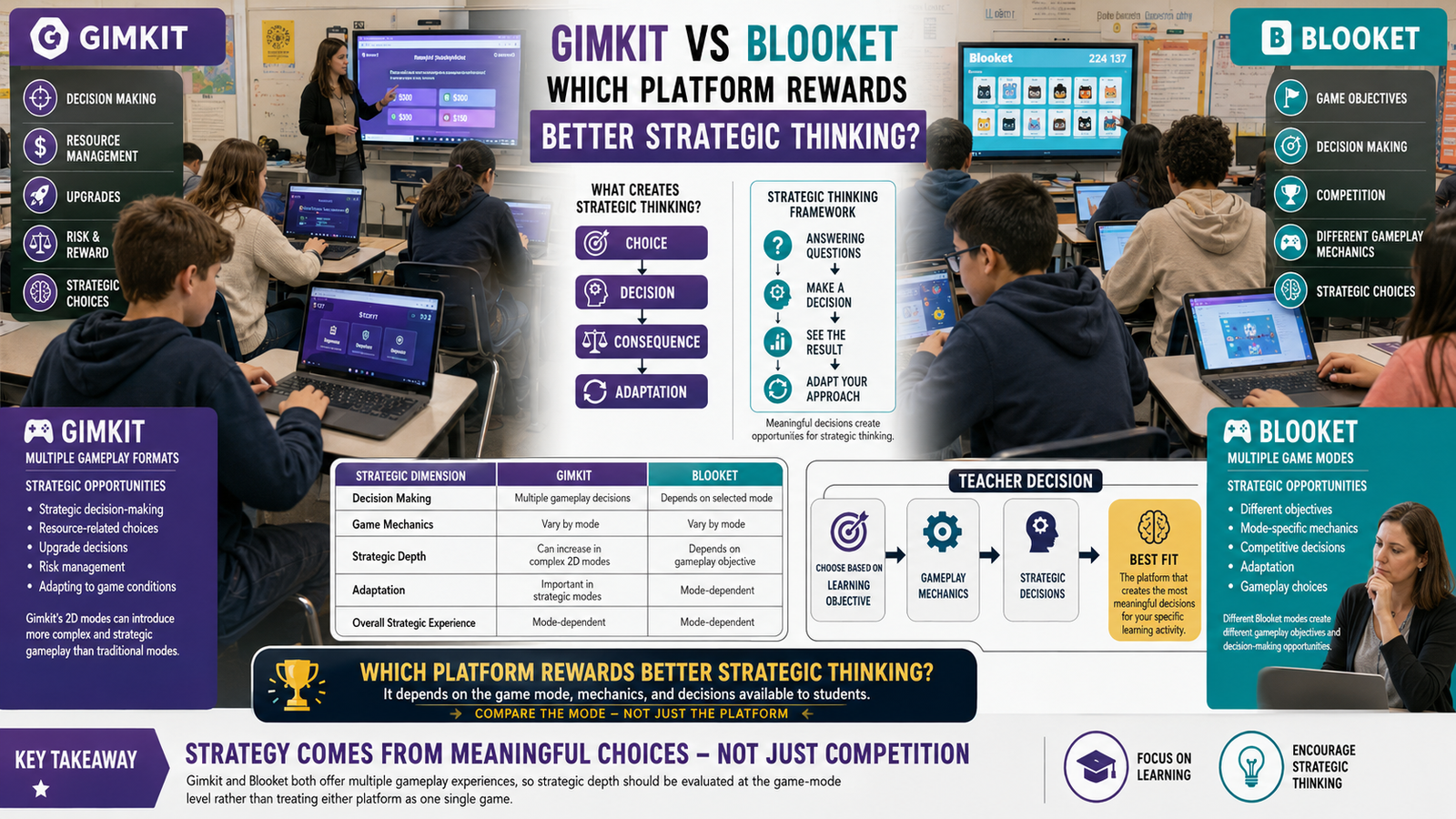
Gimkit vs Blooket
Which Rewards Better Strategic Thinking?
Is strategic learning about earning more points, planning several
decisions ahead, protecting limited resources, coordinating with
teammates or adapting when a game changes? Gimkit and Blooket both
combine educational questions with games, but their different modes
create very different opportunities for those decisions.
This independent comparison examines strategic thinking through
meaningful choices, planning horizons, trade-offs, uncertainty and
adaptation. It compares named, documented game experiences rather
than declaring one entire platform universally more strategic.
GimkitApp.com is an independent educational website and is not
affiliated with Gimkit or Blooket. This article does not represent
product endorsements or validated learning-outcome research.
STRATEGIC DECISION ARCHITECTURE✦
One decision. Several possible futures.
🧠 Make a meaningful strategic choice
↙ ↘
🛡️ Prepare & Protect
Build resilience, retain flexibility and learn
about possible threats.
⚡ Advance & Commit
Make quicker progress while accepting greater
exposure and opportunity cost.
🔄 Observe → Adapt → Choose again
Conceptual diagram — not an official game interface
Direct Answer
Is Gimkit or Blooket better for strategic thinking?
The better choice depends on the specific game mode and the
kind of strategic decision the learner must make.
🎮
GIMKIT'S STRATEGIC STRENGTH
Spatial and collaborative decisions.
Gimkit's official documentation describes 2D modes as potentially
more complex and strategic than traditional modes. One Way Out,
for example, involves exploration, equipment, keys, progression
and cooperation to escape a spaceship.
Students may need to consider where to move, whether to upgrade,
when to help others and how current decisions influence later
opportunities. These experiences can create multiple kinds of
strategic choices around the academic question activity.
This makes selected Gimkit modes particularly relevant when
the learning activity intentionally includes collaborative
problem-solving and navigation within an ongoing game world.
🏰
BLOOKET'S STRATEGIC STRENGTH
Structured investment and defense.
Blooket's official Game Mode Previews describe Tower Defense
and Tower Defense 2 as strategic activities involving tower
construction and defensive upgrades. Factory emphasizes
unlocking and upgrading productive Blooks, while Blook Rush
involves taking or defending Blooks against other players.
These experiences create resource choices, defensive priorities,
investment sequences and trade-offs. A learner may need to
choose between immediate progress and preparation for future
challenges.
Blooket can therefore be particularly relevant when a teacher
wants to discuss investment decisions, defensive planning
or adapting a strategy over repeated rounds.
Five dimensions that make a game decision strategic.
Strategic thinking is not automatically created by a timer,
leaderboard, difficult question or complex interface.
It involves choices whose consequences matter beyond the
current instant.
♟️
Decision Quality
Are there meaningful alternatives with different consequences,
rather than one obviously dominant option?
🗺️
Future Planning
Does a choice now change which choices become available later?
⚖️
Trade-offs
Must the learner give up one advantage to obtain another?
🌦️
Adaptation
Can changing circumstances require a revised plan
rather than repetition of one action?
🤝
Interaction
Do teammates, opponents or environmental changes
influence the value of a decision?
This five-dimension model is an independent analytical framework
for comparing classroom game decisions. It is not an official
diagnostic scale for either platform.
Documented Game Experiences
Five strategic environments worth examining.
These mode examples were selected because their documented
mechanics create identifiable choices. Their full rules
remain specific to the official games.
🚀
Gimkit One Way Out
Collaborative escape, route decisions, gadgets,
upgrades and shared progress.
🚩
Gimkit Capture the Flag
An opposing-team objective involving movement,
timing and defensive considerations.
🏰
Blooket Tower Defense 2
Construct and upgrade defensive towers
while responding to waves of enemies.
🏭
Blooket Factory
Unlock and upgrade productive Blooks,
emphasizing investment choices over time.
🛡️
Blooket Blook Rush
Decide when to take Blooks from rivals
and when to protect existing resources.
Exclusive Interactive Application
Strategic Decision Systems Studio
Build two alternative planning paths. Allocate limited
hypothetical resources, select decisions, observe their
future consequences and compare strategic priorities.
Explore why a plan that looks attractive under one
condition may become less suitable when uncertainty,
pressure or objectives change.
How this studio works: Select a Gimkit scenario
on the left and a Blooket scenario on the right. Each decision
consumes illustrative planning credits and modifies a
hypothetical state. Actions represent strategic concepts
inspired by documented mode themes, not official in-game
transactions, resource amounts or score formulas.
STRATEGY BRANCH A
🎮 Gimkit Planning Path
Shared escape decisions
Select Your Next Strategic Decision
Each action has an opportunity cost.
Consider your available credits and future needs.
Decision Sequence
0 / 5 decisions
STRATEGY BRANCH B
🏰 Blooket Planning Path
Placement, upgrades and preparation
Select Your Next Strategic Decision
Different actions change preparation,
progress, information and exposure.
Decision Sequence
0 / 5 decisions
CONDITIONAL STRATEGY ANALYSIS
What changed when you chose differently?
Protect the plan under changing conditions
Inspect Both Decision Pathways
Select decisions or load the example strategy paths to begin.
Illustrative educational simulation only.
No official game scores are calculated.
Local browser save available
Feature-Based Comparison
Where strategic thinking appears in each platform.
These comparisons concern specific documented modes and design
characteristics. They are not claims that every game on either
platform uses the same mechanics.
Strategic Dimension
Gimkit Example
Blooket Example
What to Examine
Planning horizon
One Way Out exploration, upgrades and escape coordination.
Factory investment and Tower Defense preparation.
Whether current choices affect later opportunities.
Resource allocation
Mode-specific resources, equipment and progression.
Tower upgrades, productive Blooks and defensive choices.
Opportunity costs of one resource use over another.
Opponent interaction
Selected competitive 2D team experiences.
Blook Rush taking or defending Blooks.
Whether other players change the best available action.
Collaboration
One Way Out's shared escape objective.
Team-based formats where supported.
Need for coordination and shared decision timing.
Uncertainty
Exploration, environmental threats and other player actions.
Changing waves, opponent decisions and game events.
How incomplete information influences preparation.
Risk management
Balancing safety, movement and forward progress.
Balancing defense, investment and offensive action.
Which risks can be reduced and at what cost.
Academic interpretation
Game decisions occur alongside question responses.
Game decisions occur alongside question responses.
Whether the game actually provides evidence of the target skill.
The Central Strategic Question
Why strategic thinking is more than answering correctly.
The phrase strategic thinking is frequently used to describe
educational games that involve competition, progression or
difficult gameplay. That usage is understandable, but it can
make the term less precise. A student may answer a difficult
mathematics question correctly without making any strategic
game decision. Another student may use a simple academic
question to earn a resource and then make a complicated
decision about how to use that resource. The academic
challenge and the strategic challenge are therefore
related but not identical.
A useful working definition of strategic thinking is the
ability to select and revise actions while considering
objectives, constraints, competing alternatives and
possible future consequences. This involves more than
deciding what to do immediately. It involves understanding
why one option may be better under particular conditions
and accepting that the best option can change when those
conditions change.
A simple game can support meaningful strategic decisions.
For example, choosing whether to protect an existing
advantage or pursue additional progress can be strategically
significant when each option carries a different risk.
Conversely, a visually complex game may require considerable
coordination and reaction speed without offering many
meaningful planning choices. Visual complexity alone
cannot establish strategic depth.
This distinction matters for Gimkit and Blooket because
both platforms include multiple game experiences.
Gimkit's 2D ecosystem can place students inside interactive
worlds where movement, resources and shared objectives
matter. Blooket's mode library includes structured
strategy games such as Tower Defense 2 and Factory.
These are not simply two versions of an identical
classroom quiz.
A fair comparison begins by naming the selected mode.
Comparing Gimkit One Way Out with Blooket Tower Defense 2
can reveal interesting differences between collaborative
exploration and defensive planning. Comparing One Way Out
with Blooket Factory creates another question about
cooperation and investment sequences. Comparing Gimkit
Capture the Flag with Blook Rush creates still another
question about opponents, timing and protection.
Different pairings illuminate different strategic skills.
The central problem is therefore not which company
deserves a permanent label as the more strategic platform.
It is which actual experience asks learners to make
decisions that fit a defined instructional purpose.
If the purpose is interpreting alternatives under uncertainty,
the teacher should look for a mode that makes uncertainty
meaningful. If the purpose is understanding resource
allocation, the teacher should look for consequential
investment choices. If the purpose is collaboration,
the teacher should inspect how coordination affects
success rather than assuming every multiplayer
activity teaches teamwork.
The word rewards also needs clarification. A game can
reward a decision with progress, virtual currency,
protection, survival or another outcome. That is not
necessarily the same as rewarding strategic thinking
as an educational skill. To claim the latter, one must
show that the decision genuinely required planning
and that the learner's performance provides useful
evidence of the skill. Game rewards by themselves
are insufficient.
This article uses the phrase strategic opportunity to
describe the presence of meaningful decisions.
That phrasing deliberately avoids claiming that
the selected activity has been proven to improve
strategy skills. Opportunities can be designed
into a game; whether students develop transferable
skills through those opportunities is an empirical
question requiring appropriate evidence.
Gimkit Strategic Systems
How Gimkit creates planning opportunities inside 2D worlds.
Gimkit's official description of its 2D modes emphasizes
that students explore two-dimensional environments
using player characters called Gims. These environments
can be more complex or strategic than traditional modes,
although their actual difficulty and purpose vary
considerably. One mode may emphasize exploration;
another may emphasize teamwork, movement, competition
or a specific physical objective.
One Way Out provides a particularly useful example
because its official instructions describe several
connected stages of play. Students answer questions
to gain energy for movement. They explore a spaceship
occupied by hostile plants, defeat enemies, obtain
important items, upgrade equipment and attempt to
reach escape pods. The shared objective requires
the group to escape, not merely one student to
achieve a high individual score.
This creates multiple decisions that are not reducible
to answering correctly. A learner might choose whether
to explore an unfamiliar route, cooperate with another
player, use an upgrade immediately or preserve a
resource for a later encounter. The group may need
to decide whether additional preparation is worth
its cost in time or effort. These are examples of
strategic relationships suggested by the documented
mechanics; the exact possible actions depend on
the real game state and official rules.
Planning in a collaborative environment is also
different from planning alone. A decision can
appear advantageous for one participant while
imposing a cost on the team. A player who advances
quickly without considering teammates may create
additional coordination problems. Conversely,
a group that spends too much time preparing
may postpone the shared objective unnecessarily.
The strategic problem involves aligning
individual choices with group requirements.
In a team-based competitive mode, the strategic
relationship changes. A capture-the-flag objective
introduces conflicting priorities such as defending
an existing position, attempting an advance,
observing opponents or coordinating the timing
of an attack. The value of one choice depends
partly on what the other team may do.
That interaction means a plan cannot always
be evaluated before the game begins. A defensive
strategy may work well until the opposing team
shifts its approach. An aggressive strategy
may create early progress but leave an
important position vulnerable. Students
may need to notice changing conditions
and adapt their behavior.
Gimkit's game options add another layer of
control for hosts. Its official documentation
describes balance settings for supported 2D
modes, including adjustments to resources
awarded for correct answers. Such options
alter the relationship between question
practice and gameplay. They are host settings,
not proof that every learner will encounter
the same level of strategic complexity.
For a fair comparison with Blooket, the important
question is whether the chosen Gimkit mode
gives the students consequential alternatives.
If all that matters in a particular moment
is moving quickly in one obvious direction,
the decision may be less strategic than
it appears. If students must choose between
protecting teammates, preserving resources,
exploring unknown territory and advancing
toward an objective, the mode provides a
richer planning problem.
The classroom value of this strategic layer
depends on the instructional goal. The extra
choices can make the activity interesting
and support discussion about planning,
but they can also add demands that distract
from a different academic objective.
An educator reviewing vocabulary recall
may not need a complicated exploration
challenge. An educator deliberately
discussing teamwork or decision-making
may find such a challenge useful.
Blooket Strategic Systems
Why Blooket's strategic depth depends on the selected mode.
Blooket's game library contains experiences with
substantially different demands. Its official
Game Mode Previews describe some modes in terms
of speed, others in terms of accuracy, and others
in terms of strategy. This makes it misleading
to treat Blooket as a single uniform game.
The appropriate strategic comparison begins
with the objectives and mechanics of a
named mode.
Tower Defense 2 offers an especially clear
example of a structured strategic system.
Blooket describes it as an activity where
students answer questions, build towers
and upgrade defenses to stop waves of
hostile Blooks. The presence of construction
and upgrades creates potential choices
about preparation and allocation.
Players must consider how to use
available opportunities to respond
to future threats.
A defensive choice involves uncertainty
because the value of a particular investment
depends on the challenges that follow.
Concentrating resources in one area may
create strong local protection while
leaving another weakness. Spreading
resources broadly may reduce that weakness
but limit the strength of any one defense.
This type of trade-off is central to
many planning problems.
Factory introduces a different strategic
structure. Blooket describes this mode
as involving the unlocking and upgrading
of productive Blooks. Investment decisions
can create a planning problem because
committing resources early may influence
what becomes possible later. Choosing
between immediate production and
longer-term development is a recognizable
strategic question.
The value of an investment cannot be
established simply by looking at the
largest number on the screen. A costly
upgrade may create a long-term advantage
only if enough opportunities remain
to benefit from it. If the activity
is close to ending, an immediate
improvement may be more relevant.
The planning horizon therefore
changes how a choice should
be evaluated.
Blook Rush presents yet another kind
of decision. Its official description
involves taking Blooks from other
players or defending one's own.
The important strategic distinction
is the relationship between offense
and protection. An aggressive attempt
may create progress but can also
expose an existing advantage.
Defending may preserve the current
position while limiting opportunities
for additional gains.
These choices depend partly on opponents.
A strategy that works against a cautious
opponent may be less effective when
another player changes behavior.
Repeatedly selecting the same action
without observing the changing
situation can become less valuable.
Adaptation is therefore a meaningful
part of the strategic opportunity.
Blooket's variety is relevant, but a
larger number of modes is not equivalent
to deeper strategic thinking in every
activity. Some modes intentionally
emphasize speed or chance rather
than longer-term planning. Gold Quest,
for example, is described by Blooket
in terms that emphasize speed
and luck. Calling every Blooket
activity equally strategic would
contradict the platform's own
differentiation among modes.
The practical conclusion is that
Blooket contains modes with
meaningful strategic structures,
especially when they involve
upgrades, defense, production
or competitive resource choices.
Whether one of those experiences
is a stronger fit than a Gimkit
mode depends on the strategic
behavior the educator actually
wants learners to examine.
Strategic Mechanisms
Four types of decisions that change future possibilities.
A strong strategic decision contains meaningful alternatives.
These examples show why two game actions that appear equally
exciting can have very different cognitive demands.
🛡️
Preparation versus immediate progress
A player can devote resources to protection or attempt
to advance immediately. Preparation may reduce exposure
to later threats but delay the objective.
This choice becomes meaningful when both alternatives
carry real consequences. If preparation is always
superior, there is little reason to compare options.
🔍
Information versus commitment
A player may inspect the environment before choosing
a route or investment. Gathering information can
reduce uncertainty but may require time or resources.
The strategic value depends on whether the
information can change a future decision.
🤝
Individual advantage versus coordination
A move that benefits one player may create problems
for teammates. Collaboration requires understanding
shared goals and the timing of individual actions.
Team membership alone does not prove meaningful
collaborative strategy. The decisions must actually
depend on other participants.
🔄
Fixed plan versus adaptive response
A plan that works under one condition may fail
after an opponent changes tactics or a new
environmental constraint appears.
Adapting strategically means evaluating new
evidence instead of continuing automatically
with the original decision.
Planning Horizons
Short-term tactics and long-term strategy are different.
A tactical decision concerns an immediate problem.
A student might need to avoid an obstacle, defend
against an opponent or select the next available
upgrade. A strategic decision considers how
that action affects a broader objective.
The difference is not always absolute,
but it provides a useful distinction
for comparing classroom games.
Consider a Tower Defense 2 scenario. Placing
a defense in the current moment may solve
an immediate threat. Planning several waves
ahead involves considering whether resources
should be committed now or preserved for
later developments. A decision that looks
strong in the next few seconds could
weaken the player's future flexibility.
Factory introduces a similar distinction
through investment. An upgrade may promise
more production over time, but that benefit
depends on how long the production opportunity
continues. If the relevant horizon is short,
the decision may not produce enough future
value to justify its immediate cost.
If the horizon is long, the same
investment could become more attractive.
One Way Out creates a different planning
problem. Students pursuing a shared
escape objective may need to consider
whether exploring an unfamiliar route
is worthwhile, whether equipment is
sufficient and whether the group is
prepared to progress. The significance
of a decision can extend beyond
one player's immediate action.
The Strategic Decision Systems Studio
models this concept using a selectable
horizon from three to eight hypothetical
decisions. Extending the horizon allows
visitors to explore how early investments,
protection and information can influence
later choices. Shortening the horizon
removes opportunities that might
otherwise justify an expensive action.
These planning credits are not Gimkit
energy, Blooket currency or official
point values. They are illustrative
units designed to make opportunity
costs visible. Their purpose is
educational comparison rather than
recreating proprietary mechanics.
The numbers should never be used
to predict an actual game's winner.
The horizon also helps explain why
a universal answer to the comparison
is unreliable. A teacher who wants
students to reason about long-term
investment may prefer a game that
makes upgrade sequencing visible.
A teacher who wants collaborative
route planning may prefer a game
where actions affect shared progress.
Both can involve strategy while
emphasizing different aspects
of future-oriented thinking.
A final distinction concerns the
difference between experienced
players and beginners. A decision
that appears complicated to a
new player may become routine
with familiarity. If experienced
learners can identify an obviously
dominant choice without much
analysis, the decision may provide
less strategic challenge than
its interface suggests.
Teaching context and player
familiarity therefore influence
the relevant level of complexity.
Opportunity Cost
Why having more choices is not automatically better strategy.
Strategic decision-making requires alternatives,
but the number of alternatives is only one
consideration. A menu containing many actions
can still be strategically shallow if one
option is clearly superior in every situation.
In contrast, three well-balanced alternatives
can create a difficult problem when each
supports a different goal or exposes the
player to a different risk.
Opportunity cost describes what a decision
gives up. Investing resources in an upgrade
may prevent the player from buying another
improvement. Spending time exploring
an unfamiliar route may delay immediate
progress. Defending a position may
reduce the chance of loss while
sacrificing an opportunity to advance.
The alternatives matter because
the player cannot freely choose
every desirable outcome at once.
This is especially relevant when comparing
Gimkit's collaborative worlds with
Blooket's investment and defense modes.
A cooperative escape may require deciding
between exploring, helping teammates
and progressing toward the objective.
A defensive game may require deciding
between upgrading existing protection,
distributing resources or taking
a calculated risk.
The underlying form of the decision
can be similar even when the visible
game looks completely different.
Both involve constrained resources,
future consequences and uncertainty.
This similarity is one reason
that superficial comparisons
based only on graphics or game
themes can miss strategically
important relationships.
The absence of opportunity cost can
make a decision trivial. If exploring
carries no cost, gives information
immediately and never creates
a disadvantage, it is often
rational to explore first.
If upgrading has no cost and
always improves performance,
the upgrade is not a meaningful
strategic alternative.
The decision becomes interesting
when a benefit must be weighed
against something else.
However, opportunity cost by itself
does not establish the educational
quality of an activity. A player
might repeatedly make meaningful
game decisions without understanding
the academic content associated
with those decisions. A teacher
interested in strategic thinking
should consider whether learners
can explain their choices and
evaluate alternative outcomes.
One useful instructional method
is to ask students what they
would do differently under
changed conditions. Would an
aggressive action still be
appropriate if the group had
fewer resources? Would a large
upgrade still be attractive
if only one round remained?
Would a defensive investment
still make sense after the
opponent shifted tactics?
Such questions reveal the
logic behind a choice.
The studio's counterfactual function
supports this reasoning by translating
an existing planning intention into
approximate choices in another mode
archetype. The translation is not
a claim that the modes share
identical mechanics. It is
a way to ask whether the
same strategic intention has
a different practical expression
in a different system.
Uncertainty and Adaptation
Strategy becomes deeper when the best decision can change.
Uncertainty is central to many strategic problems.
A player may lack complete information about
an environment, a future challenge, another
player's intentions or the consequence of
an investment. The decision must be made
using available information rather than
perfect knowledge.
In a collaborative exploration game, uncertainty
may concern the route ahead, the team's readiness
or the consequences of moving into an unfamiliar
area. A defensive strategy game can create
uncertainty through future enemy waves or
the suitability of a particular investment.
A competitive resource game adds uncertainty
through the intentions and actions
of opposing players.
These are different forms of uncertainty,
and they may require different responses.
Some uncertainty can be reduced by gathering
information. Some can be managed by maintaining
reserves or flexible plans. Other uncertainty
cannot be eliminated and must be accepted
as part of the activity.
Preparing for every possible problem is not
always optimal. Excessive protection can
consume resources that might be needed
for progress. An overly cautious player
can lose opportunities even while reducing
exposure to individual threats.
A thoughtful strategy considers
which risks matter most and
how costly they are to manage.
The opposite extreme can be equally problematic.
A player who always pursues rapid progress
may succeed under favorable conditions
but struggle when a new obstacle or
opponent action changes the situation.
This makes robust planning distinct
from simply choosing whichever action
produces the largest immediate gain.
The studio models these ideas using
optional pressure events. After every
second selected decision, the model
introduces a hypothetical change in
exposure. The pressure effect depends
on the chosen uncertainty level,
and sufficiently prepared states
can reduce the impact.
These events are deliberate teaching
constructs rather than actual
game events. The model does not
claim that Tower Defense 2,
Factory, One Way Out or
Blook Rush uses the same event
frequency, pressure level or
numerical formula. The purpose
is to expose the difference
between a fragile plan
and a flexible plan.
Teachers can use this distinction
to ask deeper questions about
classroom activity design.
Does the selected game create
opportunities to revise a plan?
Can students identify why
their original choice no longer
fits the situation? Are they
encouraged to respond to
evidence, or do they simply
repeat whichever tactic
worked previously?
Adaptation is most educationally
interesting when learners
can explain it. A student
might say that a defensive
strategy became necessary
because a route was exposed.
Another might explain
that an expensive investment
was abandoned because
insufficient time remained.
These explanations give
educators more information
about strategic reasoning
than the final game
outcome alone.
Collaboration and Opponent Pressure
Strategy changes when other people can change the outcome.
Strategic thinking in multiplayer games
can involve more than choosing
a good individual action.
A player's decision may affect
teammates or provoke a response
from an opponent. Those
interactions can change
which choice makes sense.
In a collaborative escape activity
such as One Way Out,
successful participation may require
individuals to work toward
a common destination.
Movement and resource decisions
cannot always be evaluated
solely by personal progress.
A choice that helps one
participant immediately
may be less useful if
teammates are not ready
to continue.
Coordination becomes meaningful
when participants depend on one
another. A team may need
to determine who explores,
who prepares and when
the group should advance.
These are illustrative
coordination questions
inspired by the documented
collaborative objective,
not a claim about
mandatory player roles.
In a competitive environment,
the strategic problem changes.
A player must consider
how an opponent might
respond. Blook Rush,
for example, explicitly
involves taking Blooks
from other players or
defending existing ones.
That creates competing
incentives for offense
and protection.
An aggressive player may
try to gain an advantage
before the opponent
can defend. A cautious
player may preserve
resources and wait
for a more favorable
opportunity. Both plans
have possible weaknesses.
Their value depends
on the current situation
and the other player's
behavior.
This creates an important
distinction between social
activity and collaborative
strategy. Simply placing
students on a team
does not necessarily
require them to reason
collectively. Some
team-based games allow
individuals to operate
largely independently.
Genuine collaborative
strategy involves
meaningful shared
decisions or dependencies.
Teachers interested in
collaboration should
therefore evaluate
the interactions
required by the
selected mode.
Can students
coordinate a plan?
Must they respond
to a teammate's
actions? Can
one participant
explain how the
group adjusted
after new information
appeared?
An instructional discussion
after gameplay can
make those choices
more visible.
Students may compare
different plans,
explain trade-offs
and describe why
their actions changed.
That can support
reflection on
strategic reasoning,
although the
effectiveness of
the discussion
depends on its
design and evidence.
Neither Gimkit nor Blooket
should automatically be
labeled better
for teamwork based
only on the presence
of multiplayer modes.
The actual objective,
player dependence,
rules and opportunities
for explanation
determine what
kinds of collaborative
reasoning can emerge.
Classroom Decision Examples
Three situations where strategic choices matter.
These examples illustrate decision structures, not measured
advantages of one product over another.
🧪
SCENARIO 01
Resource allocation
A class is studying the difference between immediate
benefits and long-term investment. Students compare
options in a hypothetical defensive system.
They must consider whether to build another defense,
upgrade an existing one or retain a resource
for an uncertain future challenge.
The valuable educational activity is explaining
why a choice fits the current constraints,
not merely achieving the highest final
game number.
🗺️
SCENARIO 02
Collaborative planning
Students consider how to achieve a shared objective
while participants possess different information
and readiness levels.
They evaluate whether it is better to explore,
prepare or move together. A revised plan
may become necessary after new information
appears.
This discussion is particularly relevant to
cooperative game structures in which the
group's progress matters more than
isolated individual advancement.
⚖️
SCENARIO 03
Risk and adaptation
A player has an early advantage but faces
uncertain opponent behavior. The available
alternatives include defending the advantage
or trying to increase it.
Students can identify what might go wrong
and explain which new information would
justify changing the plan.
The reasoning is meaningful when neither
option is always correct and the
conditions influence the best choice.
Academic Strategy Versus Game Strategy
Does making good game decisions prove better learning?
One of the most important limitations
in comparing educational games
is the distinction between
game performance and
academic performance.
A student may be highly
effective at navigating
a game world,
selecting upgrades
or responding to
opponents without
understanding every
educational question.
The opposite is also possible.
A student may understand
the subject well
but perform less effectively
in a game because
the controls are unfamiliar,
the environment is distracting
or the strategic objective
requires additional skills.
The resulting game position
should not be treated
as a direct measure
of subject competence.
This distinction is especially
important when the educational
goal is strategic thinking
itself. The teacher needs
to identify the
particular skill
of interest.
Is the goal
identifying trade-offs?
Explaining opportunity
costs? Coordinating
group decisions?
Adapting after
new information?
Evaluating uncertainty?
Different skills require
different kinds
of evidence.
A student who
chooses an appropriate
defensive option
may have reasoned
carefully about risk.
Another may simply
be repeating
a familiar tactic
learned from
earlier gameplay.
The action alone
does not necessarily
reveal which process
occurred.
Asking students
to explain their
decisions can
provide additional
information.
A useful explanation
identifies the
objective, the
alternatives,
the relevant
constraint and
the expected
consequences.
It may also
identify uncertainty
and describe
what would justify
changing the plan.
However, explanation quality
still needs to be
evaluated carefully.
A plausible explanation
given after success
does not prove
that the same
reasoning guided
the original
decision.
Learners can
sometimes reconstruct
their reasons
after observing
the outcome.
This is one
reason why
systematic observation
and structured
reflection can
be more informative
than a final
leaderboard.
Game outcomes also
contain noise.
Random events,
opponent actions,
timing, experience
and chance can
influence results.
Blooket's own mode
descriptions distinguish
modes emphasizing
strategy from
those emphasizing
speed or luck.
This supports
the principle
that winning
does not always
represent the
same underlying
ability.
A teacher seeking
evidence of transferable
planning might
ask students
to reason about
a new scenario
after the game.
If the student
can identify
comparable trade-offs
in a different
context, that
provides more
relevant information
about transfer
than repeating
one successful
game tactic.
The independent studio
is designed
to support this
type of reasoning.
Its state values
are transparent
and hypothetical,
allowing visitors
to examine why
changing a
priority or
uncertainty level
changes the
evaluation.
It does not
attempt to
measure a learner's
intelligence,
strategy aptitude
or predicted
real-world game success.
Mode-Specific Comparative Analysis
Comparing One Way Out with Tower Defense 2.
One Way Out and Tower Defense 2
offer a useful comparison because
each involves planning,
but their objectives
and strategic environments
differ substantially.
One Way Out is
a collaborative escape
experience in an
explorable world.
Tower Defense 2
is a structured
defensive experience
involving construction
and upgrades
against enemy waves.
In One Way Out,
group coordination
can become central
to the activity.
Individual progress
is linked to
the wider task
of escaping
with the group.
Decisions may concern
exploration,
preparation,
equipment and
movement through
the environment.
The game objective
creates a long-term
planning problem.
Students can
encounter situations
in which the
next immediate
action must be
considered alongside
later requirements.
A route that
appears convenient
may not
be the most
appropriate choice
under every
set of conditions.
In Tower Defense 2,
the planning
structure centers
more visibly
on preparation
for future
threats.
Constructing and
upgrading defenses
creates alternatives
involving current
protection and
resource commitment.
The effectiveness
of a decision
can depend on
later challenges.
This is a different
kind of planning
from group
navigation.
A defensive
investment may
be evaluated
in terms of
what it protects,
how much it costs
and whether
it remains useful
over subsequent
waves.
The consequences
may be expressed
through a structured
progression rather
than spatial
team movement.
Which is more
strategic?
The question
cannot be answered
by noting that
both offer several
choices.
The correct
comparison depends
on the desired
strategic task.
A lesson
about shared
planning and
communication
may find
One Way Out
more directly
relevant.
A lesson about
resource allocation,
defensive investment
and preparation
for future
challenges may
find Tower Defense 2
more directly
relevant.
Both judgments
concern instructional
fit, not
verified superiority
in learning outcomes.
Teachers should
avoid transferring
conclusions
automatically
to other modes.
A different
Gimkit or
Blooket activity
may emphasize
speed, chance,
recall or
another interaction.
The strategic
analysis should
follow the
real mechanics
of the
selected experience.
Investment Versus Exploration
Comparing Gimkit's spatial decisions with Blooket Factory.
Factory provides a valuable comparison
because its official description
emphasizes unlocking and upgrading
productive Blooks. This creates
a different strategic structure
from the exploration and
collaboration emphasized
by selected Gimkit 2D modes.
The value of a decision
is connected to a
sequence of investments
and future returns.
Investment strategy often
requires deciding
when to commit
resources.
An early commitment
may create
additional opportunities
later, but
it can also
restrict other
actions.
A delayed commitment
preserves flexibility
while potentially
sacrificing the
benefits of
earlier development.
The relevant
planning problem
is therefore
not simply
whether upgrades
are available.
It is whether
the timing,
cost and
expected duration
of an investment
create meaningful
alternatives.
A mode
can support
strategic thinking
when learners
must weigh
those alternatives.
Gimkit's 2D
experiences
introduce different
forms of
future-oriented
planning.
Rather than
concentrating
mainly on
production upgrades,
a player
may need
to account
for locations,
teammates,
movement,
environmental
constraints or
objective progression.
The planning
problem may
be spatial
and collaborative
rather than
primarily
economic.
These systems
should not
be placed
on one
universal
strategy scale.
Investment planning
and spatial
coordination
are different
skills,
even though
both involve
evaluating
future consequences.
The platform
whose mode
better reflects
the intended
educational
objective
may be
the stronger
practical choice.
For example,
a teacher
discussing
opportunity costs
could ask
students to
explain why
preserving a
limited resource
might sometimes
be more valuable
than spending
it immediately.
A Factory-style
investment scenario
can make
that distinction
concrete.
A teacher
discussing
coordination
under uncertainty
might instead
ask a group
to explain
why it
changed
an exploration
plan after
receiving
new information.
A cooperative
2D environment
can provide
a different
setting for
such reflection.
The central
comparison
is the
nature of
the choice,
not the
visual theme.
An animated
factory and
a navigable
spaceship
can both
offer valuable
decisions
without
requiring
identical
reasoning processes.
Competition and Defense
Comparing competitive positioning with Blook Rush.
Blook Rush creates a strategic comparison
centered on taking or defending
resources against other participants.
Its official description
explicitly identifies
speed and strategy
as important characteristics.
The central opportunity
is choosing when
to act aggressively
and when
to protect
an existing position.
Opponents introduce
a form of
uncertainty
different from
static environmental
obstacles.
Another player
can deliberately
respond to
your behavior.
A decision
that appears
favorable
may become
less effective
when the
opponent
anticipates
it.
This is
a reason
why repeated
decisions
matter.
A player
may try
a defensive
strategy,
observe
the opponent's
behavior
and then
revise
the next
action.
The process
involves
interpreting
a changing
competitive
situation.
Competitive
Gimkit modes
can also
introduce
positioning,
movement
and opponent
pressure.
Capture-the-flag
structures
offer an
understandable
example:
the team
must consider
its own
objective
while
responding
to the
opposing side.
However,
the strategic
conditions
differ
between modes.
Blook Rush
focuses
on taking
and defending
Blooks,
while
capture-the-flag
experiences
use spatial
team objectives.
One system
should not
be treated
as an
exact simulation
of the other.
The more
useful
comparison
concerns
strategic intention.
In both
cases,
a player
may confront
the question
of whether
to defend
an existing
advantage
or pursue
a new one.
That abstract
relationship
can support
discussion
even when
the official
mechanics
are different.
The studio's
alternative-intention
function
is based
on this
principle.
It translates
choices
into approximate
planning intentions,
not literal
actions
shared by
both platforms.
A defensive
intention
might appear
as guarding
a position
in one
environment
and strengthening
protection
in another.
Teachers
can use
this
to ask
students
how the
same broad
strategy
changes
when the
rules,
objectives
or available
resources
change.
That comparison
is potentially
more instructive
than simply
announcing
which game
produced
the highest
score.
Strategy and Classroom Assessment
How educators can examine strategic reasoning responsibly.
A strategic game can provide opportunities
for planning, but the opportunity
does not automatically create
a reliable measure
of strategic thinking.
Educational assessment
requires clarity
about the
intended construct,
the evidence
being collected
and the
interpretation
drawn from it.
If the objective
is resource
allocation,
the teacher
may ask
students to
compare
competing
investments.
A useful
explanation
identifies
the cost
of each
alternative
and describes
the conditions
under which
the preferred
decision
would change.
If the objective
is collaboration,
the evidence
should concern
group planning
rather than
simply
whether
the team
won.
Students
might
explain
what information
they shared,
why roles
changed
or how
they handled
competing priorities.
If the objective
is adaptation,
the teacher
should look
for evidence
that new
information
affected
a decision.
Merely repeating
a successful
tactic
does not
show that
the learner
evaluated
changed
circumstances.
A useful
instructional
reflection
can therefore
ask students
to state
their original
plan,
explain
the available
alternatives,
identify
a relevant
uncertainty,
describe
the decision
made and
evaluate
what changed.
Such reflections
should remain
proportionate
to the
lesson.
A teacher
does not
need to
conduct
a formal
research study
after every
game.
But educators
should avoid
claiming
that victory,
points or
enthusiasm
alone
prove
a complex
cognitive skill.
The distinction
also protects
fairness.
Students
can have
different levels
of familiarity
with the
controls,
genre,
devices
and social
demands
of a game.
Those differences
may influence
performance
independently
of their
ability
to reason
strategically
about the
academic
topic.
When strategic
reasoning
is the
educational
target,
students
should have
reasonable
opportunities
to demonstrate
that reasoning.
A verbal
explanation,
written
justification,
diagram
or novel
scenario
may sometimes
provide
clearer
evidence
than the
game result.
This approach
does not
diminish
the value
of playful
learning.
It clarifies
which claims
are supported.
Games can
create
interesting
contexts
for thinking;
educators
must still
examine
what students
understood
and whether
that understanding
extends beyond
a familiar
game situation.
Instructional Fit
When Gimkit is a better strategic choice for a lesson.
Gimkit can be a strong fit when
the educator intentionally
wants students
to make decisions
in a shared,
interactive environment.
The platform's
selected 2D modes
can combine
movement,
exploration,
collaboration
and resource-based
objectives.
Those elements
provide
opportunities
for planning
that differ
from a
fixed sequence
of question
screens.
One Way Out
is especially
relevant when
the activity
aims to
include
collaborative
objectives.
The official
description
establishes
that the
group must
reach
the escape
pods together.
This creates
a natural
reason
to consider
other participants
rather than
only
personal progress.
A teacher
who wants
to explore
group planning
can use
the experience
as a
discussion
context.
Students
might consider
why they
chose
one route,
how they
managed
preparation
or what
happened
when a
teammate
needed
assistance.
These are
reflective
questions
rather than
claims
that the
software
automatically
assesses teamwork.
Other Gimkit
modes may
provide
different
strategic
opportunities.
A competitive
team activity
can emphasize
positioning
and opponent
response.
An environment
requiring
careful
movement
may emphasize
timing
and spatial
decisions.
The selected
mode's
actual
rules
determine
what matters.
These characteristics
do not
mean
Gimkit
is always
the better
classroom
tool.
A teacher
with limited
time or
a class
that struggles
with additional
game controls
may prefer
a simpler
activity.
Strategic
complexity
is valuable
only when
it serves
the intended
purpose
and remains
accessible.
The educator
should also
distinguish
game strategy
from academic
reasoning.
If the
lesson
is about
identifying
correct scientific
terminology,
complex
navigation
may not
add useful
evidence
about
that target.
If the
lesson
includes
planning
under uncertainty,
the additional
decisions
may be
directly
relevant.
Gimkit's
strategic
strength
is therefore
conditional:
selected
modes
can provide
rich
spatial
and collaborative
decision environments.
Teachers
should
choose
those modes
when their
particular
decision
structures
support
the lesson's
goals.
Instructional Fit
When Blooket is a better strategic choice for a lesson.
Blooket can be
a strong
fit when
the teacher
wants students
to examine
structured
investments,
defensive
trade-offs
or competitive
resource decisions.
Tower Defense 2,
Factory and
Blook Rush
offer
different
examples
of those
systems.
Tower Defense 2
is relevant
when the
planned
activity
concerns
preparation
for future
challenges.
The officially
documented
tower construction
and upgrades
provide
a context
for considering
how resources
should be
distributed
and when
defensive
investments
are worthwhile.
Factory
provides
a different
setting
for discussing
investment
timing.
Unlocking
and upgrading
productive
Blooks
can introduce
questions
about
immediate
gains,
longer-term
development
and the
opportunity
cost
of commitments.
Blook Rush
is relevant
when the
teacher
wants to
examine
offensive
and defensive
choices
under
opponent pressure.
Players
may
need to
consider
when to
take
resources
and when
to protect
what
they already
possess.
These examples
show why
Blooket
should not
be dismissed
as a
collection
of simple
quiz wrappers.
Its
official
mode documentation
identifies
distinct
gameplay
skills
and even
labels
certain
modes
as strategically
complex.
Nevertheless,
a strategic
Blooket mode
is not
necessarily
the best
activity
for every
class.
A group
whose
objective
is
collaborative
spatial
planning
may find
a different
environment
more suitable.
Other learners
may need
a less
complicated
activity
to focus
on the
intended
academic
questions.
The strongest
conclusion
is not
that
Blooket
is universally
more strategic.
Rather,
its
documented
modes
include
recognizable
strategy
structures
that may
align
particularly
well with
resource
allocation,
upgrades,
preparation
and competition.
Evidence Boundaries
Four claims this comparison deliberately avoids.
Avoiding unsupported claims is part of producing
a trustworthy educational comparison.
01
No universal claim that one platform
develops strategic thinking better
for every learner.
02
No invented official game scores,
resource formulas or proprietary
success probabilities.
03
No assumption that a leaderboard
directly measures planning,
reasoning or academic mastery.
04
No transfer of rules from
one mode to every other
experience on the platform.
The studio's planning indicators are transparent, user-configured
illustrative values. They must not be interpreted as research
findings, official game performance measurements or product rankings.
Responsible Evaluation
How to compare strategy without creating a misleading score.
A platform comparison
can be tempting
to reduce
to a
numerical
score.
A page
might assign
points for
strategy,
collaboration,
engagement
and difficulty,
then announce
an overall
winner.
Such a
result
can look
precise
while
concealing
major
assumptions.
The problem
is that
these categories
are not
necessarily
comparable.
More modes
do not
automatically
imply
greater
strategic
depth.
More difficult
controls
do not
automatically
require
better planning.
More
collaboration
does not
automatically
produce
stronger
academic
outcomes.
A reliable
evaluation
begins
with
a defined
target.
If the
objective
is
evaluating
trade-offs,
the comparison
should examine
whether
trade-offs
are present
and meaningful.
If the
objective
is adaptation,
the comparison
should examine
opportunities
to revise
decisions
after
conditions
change.
Next,
the selected
modes
should
be identified.
A comparison
between
Gimkit
One Way Out
and Blooket
Factory
is not
equivalent
to a comparison
between
Gimkit
Capture the Flag
and Blooket
Blook Rush.
Different
pairings
create
different
analytical
questions.
Product
documentation
can then
be used
to establish
the
actual
mechanics.
Official
Gimkit
guidance
describes
particular
collaborative
and 2D
behaviors.
Official
Blooket
guidance
describes
particular
modes
and their
gameplay
emphases.
These sources
support
statements
about
the
products,
not automatic
educational
effect sizes.
The educational
interpretation
should
follow
separately.
A teacher
can reasonably
conclude
that
an experience
provides
opportunities
for certain
decisions.
Claiming
that
the experience
improves
strategic
reasoning
requires
additional
evidence
and an
appropriate
method
of assessment.
This page's
interactive
studio
follows
that distinction.
Its numerical
states
help
visitors
reason
about
opportunity
cost,
resilience
and planning
horizons.
The
calculations
use
openly
defined
hypothetical
values
rather
than
hidden
product
estimates.
The purpose
is not
to produce
a winning
percentage.
It is
to make
visible
how a
strategic
conclusion
depends
on
the
selected
objective
and the
sequence
of decisions.
A plan
optimized
for
rapid
progress
may
look
different
from
a plan
optimized
for
resilience
under
uncertainty.
That distinction
is much
more
useful
than
declaring
a permanent
winner.
It gives
readers
a framework
for
evaluating
any future
game mode
as products
continue
to evolve.
Final Strategic Verdict
Gimkit vs Blooket: the strongest conclusion for strategic thinking.
Both Gimkit and Blooket
provide meaningful
opportunities
for strategic
decisions,
but those
opportunities
differ
according
to the
selected
experiences.
Neither
platform
can be
accurately
summarized
by one
broad
strategy
score.
Gimkit's
documented
2D experiences
offer
particularly
relevant
examples
of spatial
planning,
collaboration,
resource
decisions
and
game-world
objectives.
One Way Out
illustrates
how
a shared
escape
challenge
can require
multiple
kinds
of coordination
and preparation.
Blooket's
documented
strategy modes
offer
strong
examples
of structured
investment,
defensive
planning
and
competing
choices.
Tower Defense 2
emphasizes
defenses
and upgrades,
Factory
emphasizes
production
investments,
and
Blook Rush
emphasizes
taking
or defending
Blooks.
Choose
a selected
Gimkit
experience
when
the educational
activity
specifically
calls
for
collaborative
navigation,
spatial
objectives
or
shared
planning
in an
interactive
world.
Choose
a selected
Blooket
experience
when
the activity
calls
for
defensive
investment,
production
decisions
or
structured
offensive-versus-defensive
trade-offs.
These
are
feature-fit
conclusions.
They
do not
establish
that
one
company
produces
better
students,
higher
achievement
or
transferable
planning
skills
in all
circumstances.
Such
claims
require
evidence
beyond
the existence
of
gameplay
mechanics.
The
strongest
practical
method
is to
select
a specific
strategic
objective,
examine
the mode's
documented
decisions,
test
classroom
suitability,
and
evaluate
learner
reasoning
with
appropriate
evidence.
This
method
remains
useful
even
when
new
game modes
are released
or
existing
settings
change.
Gimkit can offer particularly rich collaborative and spatial
strategy. Blooket can offer particularly clear investment,
defense and competitive trade-offs. The better educational
fit depends on the decision-making skill the lesson targets.
Frequently Asked Questions
Common strategic-thinking questions answered.
These answers focus on strategic decisions and mode-specific
comparisons rather than unrelated account or subscription topics.
Is Gimkit more strategic than Blooket?
Not universally. Gimkit's selected 2D modes can emphasize
spatial planning and collaboration, while Blooket has
strategy-oriented modes involving defense, investments
and opponent interaction. Compare named experiences.
Which Gimkit mode is useful for collaborative strategy?
One Way Out is a documented collaborative escape experience.
Students explore, use equipment and work toward a shared
objective. Its value depends on the intended activity.
Which Blooket mode emphasizes defensive planning?
Tower Defense and Tower Defense 2 include tower construction
and upgrades for protection against enemy waves.
What makes Blooket Factory strategic?
Factory involves unlocking and upgrading productive
Blooks, creating opportunities to evaluate
investment choices and their future consequences.
What kinds of strategic choices appear in Blook Rush?
Blook Rush includes taking Blooks from other players
and defending existing ones. The central decision
concerns offensive opportunity versus protection.
Does winning a game demonstrate strategic thinking?
Not by itself. Game results can depend on familiarity,
timing, luck, other players and specific mechanics.
Evidence of strategy should include appropriate
reasoning about decisions and alternatives.
What is the difference between tactics and strategy?
Tactics concern immediate actions, while strategy
considers broader objectives, constraints and
future consequences. The two can interact.
Does a harder game always require better strategy?
No. Difficulty can arise from controls, movement,
reaction speed or academic questions rather
than meaningful strategic trade-offs.
Can strategic thinking improve through game discussions?
Discussions can create opportunities to explain
choices, compare alternatives and examine
consequences. Improvement requires suitable
instructional design and evidence.
Is the Strategic Decision Systems Studio an official game?
No. It is an independent educational planning
simulation with transparent hypothetical
numerical states and conceptual actions.
Can the studio predict real Gimkit or Blooket scores?
No. Its planning credits, uncertainty events
and indicators are not proprietary game rules,
official scoring calculations or predictions.
Why are different game modes compared separately?
Modes can emphasize different objectives and skills.
Generalizing one mode's mechanics to every
experience on a platform would be misleading.
Official Product References
Verify the documented game mechanics.
These primary sources support descriptions of current
product mechanics. The independent educational interpretation,
simulations and strategic comparisons on this page
are not official findings from either company.
Editorial methodology:
Product statements are grounded in the named official
documentation. The five-dimensional strategic framework
and Strategic Decision Systems Studio are independent
explanatory models. Changes to game modes, interfaces,
subscriptions or rules should be checked directly
with the relevant platform.
Compare decisions, not just game graphics.
Explore the planning paths, test different priorities,
and evaluate how game mechanics relate to
meaningful strategic choices.