Gimkit vs Kahoot! : Choosing between Gimkit and Kahoot! can look like a simple choice between two classroom quiz platforms. Both let teachers turn questions into interactive activities, both can create competition, and both are designed to make review more engaging than a traditional worksheet.
The real difference is where the interactivity comes from.
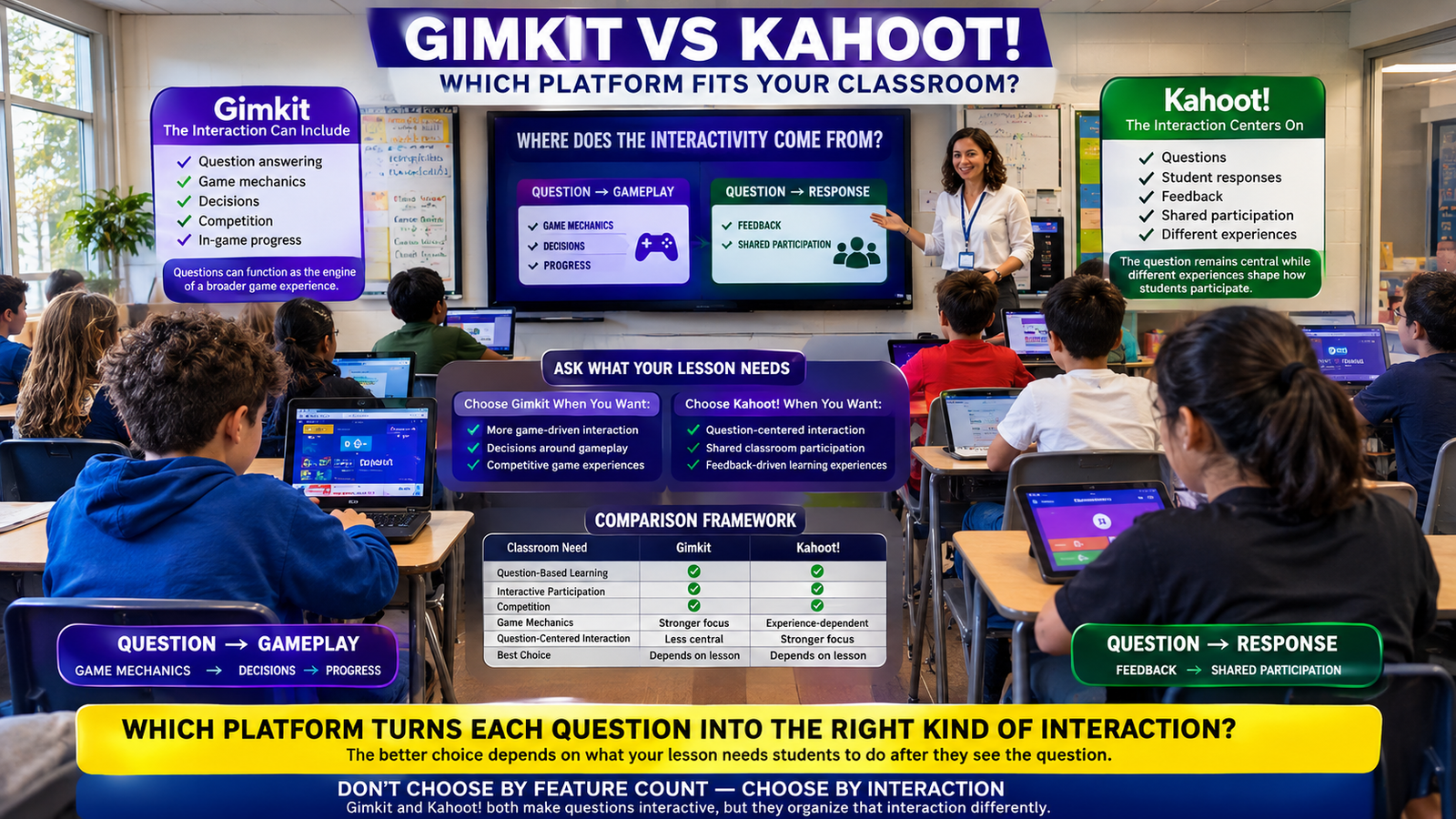
With Gimkit, the question often acts as the engine of a larger game. Students answer questions to earn in-game progress, make decisions, compete, or interact with game mechanics. With Kahoot!, the question itself remains much more central: students respond, receive feedback, and participate in a shared learning experience, with different current experiences changing how that interaction works.
So this is not simply a matter of asking “Which platform has more features?” A better question is:
Which platform turns each question into the kind of interaction your lesson actually needs?
That distinction is what separates Gimkit from Kahoot! and makes the comparison worth looking at more closely.
Looking for comprehensive classroom resources and educational technology insights? Explore GimkitApp for expert guides, teaching strategies, game modes, and the latest updates to enhance student engagement.
Gimkit vs Kahoot! at a Glance
Before getting into the details, here is the quickest way to understand the difference.
This table is a starting point rather than a declaration of an overall winner. Both platforms contain multiple experiences, and the actual classroom experience can change substantially depending on the mode, plan, and teaching objective. Kahoot!, for example, currently offers different live and solo experiences, while Gimkit’s game modes range from simpler quiz-driven activities to more strategic 2D experiences.
The Fundamental Difference Between Gimkit and Kahoot!
The easiest way to understand the two platforms is to follow what happens after a student answers a question.
In a typical Gimkit experience:
Question → Answer → Game consequence → Strategy/progression → Next question
The answer can affect what happens inside the game. Depending on the selected mode, students may use what they earn, make decisions, compete with others, or work toward an objective beyond simply having the highest quiz score.
In a typical Kahoot! experience:
Question → Answer → Feedback/result → Next question
The question remains much more visible as the learning unit. The experience can still be highly competitive and interactive, but the activity does not necessarily need a larger game world to make each response meaningful.
That difference sounds small, but it changes the feel of the entire lesson.
Gimkit tends to make the question part of a game. Kahoot! tends to make the question itself the center of the interactive experience.
Neither approach is inherently more educational. They simply create different kinds of student interaction.
What Makes a Question Feel “Interactive”?
This is the most important concept in the comparison.
A question is not automatically interactive because it has buttons, animations, points, or a leaderboard.
A genuinely interactive question can make students:
retrieve information
make a decision
respond under a particular condition
receive meaningful feedback
adjust their next action
compete or collaborate
repeat the skill
see a consequence of their answer
The two platforms emphasize different parts of this process.
Type of interaction
Gimkit
Kahoot!
Immediate response
✓
✓
Instant feedback
✓
✓
Competition
✓
✓
Repeated practice
✓
✓
Strategic decisions
Strong
Experience dependent
Game-world consequences
Strong
Experience dependent
Accuracy-focused interaction
Mode dependent
Strong option
Shared classroom participation
Strong
Strong
Independent study
Strong in selected workflows
Broad ecosystem
The important point is that interactivity has more than one dimension. A platform can be highly interactive without being highly strategic, and a strategic game can be engaging without necessarily producing better learning.
That is why simply counting features is a poor way to compare Gimkit and Kahoot!.
How Gimkit Turns Questions Into Gameplay
Gimkit’s distinctive strength is the connection between answering and playing.
Instead of treating every question as an isolated quiz item, many Gimkit experiences place those questions inside a larger game loop. The student is not simply trying to finish a list of questions; their responses can help them progress within the selected game.
Gimkit’s current game-mode documentation includes different types of experiences, including more strategic 2D modes. The platform itself describes these modes as offering more complex gameplay and strategy than simpler quiz experiences.
That creates a different psychological rhythm:
Answer → gain something → decide what to do → continue playing
For a teacher running a review session, this can be particularly useful when the objective requires repetition.
A student might otherwise lose interest after answering the same type of question several times. A game mechanic can provide an additional reason to continue practicing.
Example
Imagine a teacher reviewing vocabulary before an exam.
Answer vocabulary question → earn resources → make a gameplay decision → answer another question → build progress.
The questions remain educationally important, but they are now embedded in a larger activity.
The trade-off
More gameplay also means more variables.
If the game mechanic becomes more interesting than the content, students may start optimizing for the game rather than thinking carefully about the question.
That makes mode selection important.
💡 Pro Tip: The most engaging Gimkit mode is not automatically the best mode for every lesson. Choose the mechanic that reinforces the behavior you want students to practice.
How Kahoot! Makes Questions Interactive
Kahoot!’s strength is different.
Its familiar classroom model turns answering a question into a shared event. Students respond, see the outcome, receive feedback, and continue through the activity.
That makes Kahoot! particularly effective for situations where the teacher wants the class to focus on the same question at the same time.
But it would be inaccurate to describe modern Kahoot! as only a speed-based quiz platform.
Its current experience library includes different ways to structure participation, including Classic, Accuracy, Confidence, Team, and other game experiences. Kahoot! also provides independent learning experiences such as Flashcards, Learn, Test, and Study Groups, depending on the available experience and plan.
That matters because teachers can change the type of interaction without abandoning the platform.
For example:
A teacher may want students to:
Answer quickly → use a speed-oriented experience.
Focus on correctness → use Accuracy.
Work together → use a team-based experience.
Study independently → use one of the available self-study formats.
Kahoot!’s Accuracy experience is particularly relevant to this comparison because it is designed to make correctness, rather than response speed, the basis of scoring.
So Kahoot!’s modern advantage is not simply “fast quizzes.”
It is the ability to adapt the question experience to different learning situations.
Gimkit vs Kahoot!: Where Does the Interaction Actually Happen?
This is where the distinction becomes clearer.
Interaction layer
Gimkit
Kahoot!
The question
Important
Central
The answer
Drives progress
Determines result/feedback
Game mechanics
Deeply integrated in selected modes
Varies by experience
Strategy
Major component in some modes
More experience dependent
Feedback
Connected to gameplay
Strongly connected to the question experience
Competition
Often embedded into the game
Often directly visible through the quiz experience
Progression
Strong in game-driven modes
Experience dependent
Learning workflow
Game → practice
Question/activity → practice
This leads to a useful distinction:
Gimkit asks:
“What should happen in the game because you answered this question?”
Kahoot! asks:
“How should this question be experienced?”
That is not a difference in quality. It is a difference in design philosophy.
Is More Game Interaction Automatically Better?
No—and this is an important distinction for educators.
A more sophisticated game can increase attention without necessarily improving understanding.
Likewise, a simpler quiz can produce excellent learning if the questions are well designed and the teacher uses the responses effectively.
The educational value of either platform depends on factors such as:
question quality
retrieval practice
feedback
repetition
difficulty
lesson alignment
student participation
teacher follow-up
A useful way to think about it is:
Platform → creates the activity
Questions → create the cognitive task
Teacher → turns the responses into learning
That means Gimkit’s richer gameplay should not be treated as automatic evidence that it produces better learning, just as Kahoot!’s simpler question flow should not be interpreted as less educational.
Gimkit vs Kahoot!: Which One Feels More Like a Game?
If the goal is specifically to make students feel that they are playing a game while answering questions, Gimkit generally has the stronger fit.
Its gameplay can extend beyond the question itself, particularly in its more strategic modes. The platform’s current documentation describes 2D modes with additional mechanics and strategic elements.
Kahoot! can certainly feel game-like, especially through competition, points, teams, themed experiences, and other interactive formats. But the question usually remains more visible as the core unit of the experience.
What you want students to feel
Better fit
“I’m playing a game.”
Gimkit
“I’m competing in a live quiz.”
Kahoot!
“My answers affect gameplay.”
Gimkit
“The whole class is responding together.”
Kahoot!
“I need to make strategic choices.”
Gimkit
“I want quick feedback on my answers.”
Kahoot!
This is one of the clearest differences between the platforms.
For the latest gaming news, expert reviews, and walkthroughs, readers can also visit IGN, one of the world’s leading gaming websites.
Which Platform Makes Every Question More Interactive?
The answer depends on what kind of interaction you want to create.
If “interactive” means strategy, progression, consequences, and gameplay, Gimkit has the stronger design.
If “interactive” means immediate participation, feedback, classroom energy, and flexible question experiences, Kahoot! has the stronger fit.
The simplest comparison:
If interaction means…
Better fit
Strategy
Gimkit
Game progression
Gimkit
Gameplay consequences
Gimkit
Video-game feel
Gimkit
Fast classroom participation
Kahoot!
Question-centered interaction
Kahoot!
Accuracy-focused play
Kahoot!
Flexible study experiences
Kahoot!
So there is no honest reason to declare one platform the universal winner.
Gimkit makes the answer more consequential inside the game. Kahoot! makes the question more central to the interactive learning experience.
That difference sets up the next part of the comparison: how these design choices affect teachers, students, classroom workflows, homework, practice, and assessment.
Gimkit vs Kahoot!: Classroom Experience, Students, Practice & Teaching Use Cases
The biggest difference between Gimkit and Kahoot! becomes easier to judge once you move beyond individual questions and look at what actually happens during a lesson.
A platform can look impressive in a feature list but feel very different when a teacher has 25 students waiting for the next question, several students are struggling with the same concept, or the class needs a quick review before an assessment.
For that reason, the better comparison is not simply which platform has more game features. It is which platform fits the teacher’s workflow, the students’ needs, and the purpose of the activity.
Gimkit vs Kahoot! for Teachers
For teachers, the two platforms solve slightly different problems.
Kahoot! is particularly convenient when the teacher wants to organize a structured question-based activity. The class moves through an experience together, and the teacher can use responses as a quick way to gauge understanding.
Gimkit becomes more attractive when the teacher wants the activity itself to sustain gameplay and repeated practice. The selected game mode can give students another layer of interaction beyond simply moving from one question to the next.
Teacher workflow comparison
Teacher need
Gimkit
Kahoot!
Quick review
Excellent
Excellent
Whole-class activity
Excellent
Excellent
Game-based practice
Excellent
Strong
Strategic gameplay
Strong
Experience dependent
Accuracy-focused activity
Mode dependent
Strong
Repeated practice
Strong
Strong
Self-study activities
Strong
Very broad
Different activity formats
Strong
Very broad
Longer game sessions
Strong
Strong
Simple question-led lesson
Strong
Excellent
The practical distinction is simple:
Kahoot! can fit naturally into a lesson that already has a clear question-and-feedback structure. Gimkit is especially useful when the game itself is meant to become part of the lesson structure.
Gimkit vs Kahoot! for Students
Students don’t experience these platforms the way teachers do.
Some students become more motivated when a question is attached to a larger game objective. Others prefer a straightforward question, immediate feedback, and a clear sense of whether they got the answer right.
Student preference matrix
Student preference
Gimkit
Kahoot!
Likes video-game mechanics
⭐⭐⭐⭐⭐
⭐⭐⭐⭐
Enjoys strategy
⭐⭐⭐⭐⭐
⭐⭐⭐
Likes competition
⭐⭐⭐⭐⭐
⭐⭐⭐⭐⭐
Wants quick question cycles
⭐⭐⭐⭐
⭐⭐⭐⭐⭐
Enjoys progression
⭐⭐⭐⭐⭐
⭐⭐⭐⭐
Prefers accuracy-focused play
⭐⭐⭐⭐
⭐⭐⭐⭐⭐
Likes independent study
⭐⭐⭐⭐
⭐⭐⭐⭐⭐
Wants different study formats
⭐⭐⭐⭐
⭐⭐⭐⭐⭐
Enjoys team activities
⭐⭐⭐⭐⭐
⭐⭐⭐⭐⭐
Wants a game-first experience
⭐⭐⭐⭐⭐
⭐⭐⭐⭐
These ratings are fit indicators, not measurements of student learning or satisfaction. The selected mode and individual student’s preferences can change the experience substantially.
A useful classroom observation
Students who enjoy games may respond strongly to Gimkit’s additional mechanics, but teachers should watch whether those mechanics are helping students think about the content or simply helping them chase the next reward.
With Kahoot!, the interaction is often easier to keep tied directly to the question because the question remains the obvious center of attention.
Neither is automatically better. The teacher’s design choices still matter.
Which Is Better for Quick Classroom Review?
For a short review session, Kahoot! often has the more natural fit.
Suppose a teacher has five minutes before the end of class and wants to answer three questions:
Did students understand today’s concept?
Which question caused the most difficulty?
Does the class need another explanation?
A direct question-based activity can answer those questions efficiently.
Kahoot!’s live experiences are well suited to this kind of whole-class interaction, and its current range of experiences gives teachers options beyond the traditional speed-oriented format.
Gimkit can also handle quick reviews, but its strengths become more noticeable when the teacher wants gameplay to continue beyond a few rapid questions.
Quick-review decision
Situation
Better fit
5–10 minute recap
Kahoot!
Exit-style review
Kahoot!
Fast whole-class check
Kahoot!
Short competitive quiz
Either
Extended game-based review
Gimkit
Repeated practice inside gameplay
Gimkit
Which Is Better for Longer Game Sessions?
This is where Gimkit starts to separate itself.
A longer activity needs something to sustain attention after the novelty of the first few questions disappears.
Gimkit’s game-oriented structure can provide that additional layer. Students can have reasons to continue playing beyond simply answering the next question, depending on the mode being used.
That makes it a natural fit for:
review sessions
practice periods
game-based stations
longer competitive activities
repeated question exposure
Kahoot! can also support longer activities, particularly through its different game experiences, but the teacher should choose the format carefully. A long sequence of rapid-fire questions is not automatically more effective simply because students remain engaged.
Longer does not mean better.
The ideal session length is the one that gives students enough practice without allowing the game mechanic to overwhelm the instructional purpose.
Gimkit vs Kahoot! for Strategy
This is one of the clearest areas of differentiation.
Gimkit can make decision-making part of the learning activity.
Students may need to think about more than:
“What is the correct answer?”
They may also need to think about:
“What should I do with what I earned?”
That second layer creates strategic interaction.
Kahoot! can certainly include competition and different game mechanics, but its traditional question flow generally places less emphasis on a persistent strategy layer.
Strategy comparison
Strategic element
Gimkit
Kahoot!
Answer questions
✓
✓
Compete
✓
✓
Make in-game decisions
Strong in selected modes
Experience dependent
Manage game resources
Strong in selected modes
Less central
Build a game strategy
Strong
Experience dependent
Game progression
Strong
Experience dependent
This is why a teacher who wants strategy to be part of the lesson will often find Gimkit more suitable.
But strategy should have a purpose.
If students spend more mental effort deciding how to optimize a game mechanic than understanding the material, the additional complexity has stopped helping the lesson.
Which Platform Is Better for Accuracy?
This question deserves special attention because speed and accuracy are not the same thing.
A student who answers first is not necessarily the student who understands the material best.
Kahoot!’s current Accuracy experience addresses this directly by making correctness the basis of scoring rather than rewarding faster answers.
That can be useful when the teacher wants students to slow down and think.
Accuracy vs speed
Classroom priority
Better fit
Fast competitive responses
Kahoot! speed-oriented experience
Correctness over speed
Kahoot! Accuracy
Strategic game performance
Gimkit, depending on mode
Repeated practice
Both
Careful question solving
Kahoot! Accuracy
This is more than a feature difference.
It represents a teaching decision:
Do you want students to optimize for speed, correctness, strategy, or some combination of these?
The answer should determine the experience—not the other way around.
Gimkit vs Kahoot! for Homework
Homework changes the equation because the teacher is no longer controlling the room in real time.
Students may be working:
at different speeds
on different devices
at different times
with different levels of motivation
Gimkit is particularly interesting when the goal is to turn independent practice into a game-based assignment. Its current documentation describes Assignments as a way for teachers to give students independent game-based activities, with the feature available through Pro.
Kahoot! takes a broader approach to independent learning. Its current ecosystem includes self-study formats such as Flashcards, Learn, Test, and Study Groups, giving students more than one way to practice outside a live session.
Homework comparison
Homework goal
Better fit
Make practice feel like a game
Gimkit
Repeat content through gameplay
Gimkit
Independent game assignment
Gimkit
Flashcard-style review
Kahoot!
Test-style practice
Kahoot!
Multiple study formats
Kahoot!
Broader self-study workflow
Kahoot!
So the distinction is not simply “which one has homework?”
Both can support independent learning in different ways.
The real question is whether homework should feel more like game-based practice or structured independent study.
Gimkit vs Kahoot! for Formative Assessment
Formative assessment is another area where teachers need to be careful.
A platform can tell you that a student selected an incorrect answer. That is useful—but it does not automatically explain why the student was wrong.
For formative assessment, the strongest workflow is:
Question → Response → Identify misconception → Discuss → Correct → Practice again
Both Gimkit and Kahoot! can contribute to that process.
Kahoot! can be particularly convenient when the teacher wants to use question responses as a quick snapshot of classroom understanding. Its Accuracy experience can also help when the teacher wants scoring to emphasize correctness rather than speed.
Gimkit can be useful when formative checking is combined with repeated practice inside a game.
Assessment fit
Assessment purpose
Better fit
Quick knowledge check
Both
Identify difficult questions
Both
Accuracy-focused review
Kahoot!
Repeated practice after checking
Gimkit
Competitive review
Both
Follow-up discussion
Both
High-stakes assessment
Neither should automatically replace a dedicated assessment system
That last point matters.
These platforms are primarily designed around interactive learning and review experiences. A game score should not automatically be treated as equivalent to a formal assessment score.
Which Platform Is Better for Different Teaching Situations?
Instead of asking which platform wins overall, match the platform to the situation.
Teaching situation
Better fit
Why
Five-minute lesson recap
Kahoot!
Fast question-centered interaction
End-of-class knowledge check
Kahoot!
Direct response and feedback
Strategy-heavy review
Gimkit
Gameplay adds decision-making
Extended review activity
Gimkit
Stronger game loop
Accuracy-focused practice
Kahoot!
Dedicated Accuracy experience
Game-based homework
Gimkit
Independent gameplay workflow
Self-study variety
Kahoot!
Multiple study experiences
Repeated practice
Both
Different approaches to repetition
Team competition
Both
Both support collaborative/competitive experiences
Traditional quiz-style review
Kahoot!
Question remains central
Video-game-style review
Gimkit
Gameplay is more deeply integrated
This is a better way to choose between the platforms than asking which one has the longer feature list.
The Learning Question: Engagement vs Actual Learning
This is where a comparison article should avoid overselling either product.
A more exciting game is not automatically a better learning tool.
Gimkit’s game mechanics may encourage students to keep participating, but engagement alone does not prove that students have mastered the content.
Kahoot!’s fast feedback can create an energetic classroom, but a high score does not necessarily mean deep understanding.
The actual learning value depends heavily on what happens around the platform.
Stronger instructional workflow
Stage
Teacher action
1. Prepare
Write questions aligned with the lesson objective
2. Play
Let students respond
3. Observe
Look for patterns in responses
4. Diagnose
Identify misconceptions
5. Explain
Address the difficult concepts
6. Re-practice
Give students another opportunity
7. Verify
Check whether understanding improved
This is where an experienced teacher can make either platform substantially more valuable.
The software creates the interaction.
Instruction determines what that interaction is worth.
A Practical Decision Matrix: Gimkit or Kahoot!?
If you’re still unsure, use this quick decision framework.
Your priority
Choose
Questions should drive a larger game
Gimkit
Students should make strategic decisions
Gimkit
Review should feel strongly game-like
Gimkit
You want repeated practice inside gameplay
Gimkit
You need a quick live review
Kahoot!
You want accuracy to matter more than speed
Kahoot!
You want several self-study formats
Kahoot!
You want questions to remain the center
Kahoot!
You need a flexible mix of learning experiences
Kahoot!
You want competitive classroom participation
Either
The pattern is now fairly clear: Gimkit is strongest when gameplay itself is part of the teaching strategy, while Kahoot! is strongest when the teacher wants flexible, question-centered interaction across different learning situations.
That leads to the final question: which platform should a teacher actually choose—and are there situations where using both makes more sense than choosing one?
Gimkit vs Kahoot!: Which Platform Should You Actually Choose?
By this point, the difference is less about which platform has the bigger feature list and more about what you want students to do with each question.
Gimkit is the stronger choice when the activity needs a meaningful game layer—strategy, progression, rewards, or gameplay consequences. Kahoot! is the stronger choice when the question itself should remain the center of the experience, especially when the teacher wants flexible live or independent learning formats.
Neither platform is the universal winner. The better choice depends on the job you need the platform to perform.
Gimkit vs Kahoot!: Final Head-to-Head Comparison
Category
Gimkit
Kahoot!
Better fit
Core philosophy
Game-driven learning
Question-driven interactive learning
Depends
Game-like experience
Very strong
Strong
Gimkit
Strategic gameplay
Strong in selected modes
Experience dependent
Gimkit
Quick live review
Excellent
Excellent
Tie
Question-centered activity
Strong
Excellent
Kahoot!
Accuracy-focused play
Available depending on experience
Dedicated Accuracy experience
Kahoot!
Repeated practice
Excellent
Excellent
Depends
Game-based homework
Strong
Strong independent-study options
Depends
Independent study variety
Good
Very broad
Kahoot!
Classroom competition
Strong
Strong
Tie
Team-based activities
Strong
Strong
Tie
Long game sessions
Strong fit
Strong, experience dependent
Gimkit
Strategic decision-making
Strong
Less central
Gimkit
Flexible study experiences
Strong
Strong
Kahoot!
Best overall audience
Game-oriented classrooms
Broad interactive learning use
Depends
Kahoot!’s current ecosystem includes multiple live and self-study experiences, while Gimkit offers multiple game modes with different levels of gameplay complexity. Because both platforms continue to evolve, the exact options available can depend on the current product experience and plan.
When Gimkit Is the Better Choice
Gimkit makes the most sense when the game is supposed to be part of the learning experience, rather than simply a layer placed on top of a quiz.
Choose Gimkit when you want students to:
keep practicing through a longer game session
make strategic decisions
connect correct answers with gameplay progress
experience stronger game mechanics
repeat questions without the activity feeling like a conventional quiz
participate in game-based assignments
compete within a more game-oriented environment
Its current collection of game modes gives teachers different ways to structure that experience, including modes with additional strategic and 2D gameplay elements.
Best Gimkit scenario
Imagine a teacher has already introduced a topic and now wants students to spend 20–30 minutes practicing it.
The goal isn’t simply:
“Let’s see who knows the answers.”
The goal is closer to:
“Let’s get students practicing repeatedly while giving them reasons to stay involved.”
That is where Gimkit’s design becomes particularly useful.
But there is a limit
Don’t choose Gimkit merely because it looks more like a video game.
If the lesson requires students to slow down, carefully interpret a question, discuss reasoning, or focus heavily on accuracy, a more elaborate game mechanic may not be the best fit.
Use the game when it supports the learning objective—not because the game is entertaining by itself.
When Kahoot! Is the Better Choice
Kahoot! is often the stronger choice when the teacher wants questions to remain the obvious center of the activity.
That makes it especially useful for:
quick classroom reviews
knowledge checks
live participation
accuracy-focused activities
team experiences
structured question practice
independent study
different study formats
Its current experience ecosystem is broader than the traditional live quiz many people associate with Kahoot!. Depending on the experience and plan, learners can use formats such as Accuracy, Flashcards, Learn, Test, and Study Groups.
Best Kahoot! scenario
A teacher finishes explaining a concept and wants to know:
“Did the class actually understand this?”
A short interactive session can expose which concepts students understand and which ones need another explanation.
In this situation, adding a complex game layer may not improve the lesson.
The question itself is enough.
That is one of Kahoot!’s enduring strengths.
Who Should Choose Gimkit?
Gimkit is a strong fit for teachers who:
want review to feel like a game
enjoy strategy-based classroom activities
want gameplay to continue between questions
want students to practice repeatedly
plan longer interactive review sessions
want game mechanics to influence student decisions
are comfortable selecting different game modes for different objectives
Gimkit may be less suitable when:
the activity needs to stay extremely question-focused
speed or accuracy needs to be isolated from game mechanics
the game layer could distract from the lesson
the teacher only needs a very short knowledge check
The key is not whether students enjoy Gimkit.
The key is whether its gameplay mechanics reinforce the behavior you want students to practice.
Who Should Choose Kahoot!?
Kahoot! is a strong fit for teachers who:
want quick interactive classroom reviews
prefer question-centered activities
want multiple live experiences
need accuracy-focused options
want students to study independently
use different formats for different learning situations
want a familiar whole-class interaction model
Kahoot! may be less suitable when:
the main objective is deep game strategy
the teacher wants gameplay to become the central activity
students need a stronger persistent game loop
the lesson specifically benefits from game-world decision-making
Again, this isn’t a weakness in the platform itself.
It is simply a different design priority.
Can You Use Gimkit and Kahoot! Together?
Yes—and for some teachers, this is actually more useful than choosing one platform permanently.
The two tools can have different jobs within the same instructional workflow.
For example:
Lesson stage
Possible platform
Purpose
Introduction
Kahoot!
Quick prior-knowledge check
Teaching
—
Explanation/discussion
Immediate review
Kahoot!
Check understanding
Extended practice
Gimkit
Repetition + gameplay
Homework
Gimkit or Kahoot!
Independent practice
Next lesson
Kahoot!
Recheck difficult concepts
This approach prevents the platforms from competing for the same role.
Instead:
Kahoot! → diagnose and check
Gimkit → practice and reinforce
That isn’t a universal formula, but it demonstrates a useful principle:
Don’t choose a platform because you prefer its brand. Choose the experience that matches the instructional stage.
Which Is Better for Teachers: Gimkit or Kahoot!?
There isn’t one answer for every teacher.
The better choice depends on how much of your lesson you want the platform to control.
Choose Gimkit if:
Gameplay is part of your teaching strategy.
You want questions to trigger actions, progress, competition, or decisions inside a larger game.
Choose Kahoot! if:
The questions are the main teaching interaction.
You want students responding, receiving feedback, discussing results, and moving through a flexible interactive experience.
Choose both if:
Different parts of your teaching workflow require different kinds of interaction.
That’s arguably the most practical conclusion for teachers who use both types of activities.
The Real Winner: The Platform That Matches the Question
This comparison started with one question:
Which platform makes every question feel more interactive?
The most accurate answer is:
Gimkit makes questions feel more interactive when interaction means gameplay, strategy, progression, and consequences.
Kahoot! makes questions feel more interactive when interaction means participation, immediate feedback, competition, accuracy, and flexible learning experiences.
So the winner changes with the definition of interactive.
If you want every question to feel like…
Better choice
Part of a video game
Gimkit
A strategic decision
Gimkit
A path toward game progress
Gimkit
A competitive classroom moment
Kahoot!
A quick knowledge check
Kahoot!
An accuracy-focused challenge
Kahoot!
A flexible study activity
Kahoot!
Repeated practice inside gameplay
Gimkit
A simple, engaging classroom interaction
Kahoot!
A deeper game-oriented review session
Gimkit
Final Verdict: Gimkit vs Kahoot!
Gimkit is the better choice when gameplay is the point. Kahoot! is the better choice when questions and learning interaction are the point.
That is the cleanest distinction between them.
Gimkit has an advantage for teachers who want students to play around the questions—answering, earning, deciding, progressing, and competing within a game structure.
Kahoot! has an advantage for teachers who want students to interact through the questions—responding, receiving feedback, competing, practicing accuracy, and moving through different learning experiences.
Neither platform should be selected simply because it has more features.
The stronger choice is the one whose interaction model supports the lesson objective.
The shortest possible decision:
Want a stronger game? Choose Gimkit. Want a more flexible question-centered learning experience? Choose Kahoot!. Want both types of interaction? Use each where it fits best.
And that is ultimately why the Gimkit vs Kahoot! comparison is not really about finding one universal winner.
It is about deciding what you want to happen after a student answers the question.
If the answer should lead to strategy and gameplay, Gimkit has the edge.
If it should lead to feedback, participation, accuracy, or the next learning activity, Kahoot! often has the edge.
Frequently Asked Questions
1. Is Gimkit better than Kahoot!?
Neither is objectively better for every classroom. Gimkit is generally the stronger fit for game-driven practice, strategy, and longer gameplay experiences, while Kahoot! is generally stronger for flexible, question-centered interaction, quick reviews, and accuracy-focused experiences. The right choice depends on the lesson objective rather than the number of features each platform offers.
2. Is Gimkit more interactive than Kahoot!?
It can be, if you define interactivity as gameplay and strategy. Gimkit can connect answers to game progression, rewards, decisions, and other mechanics depending on the selected mode. Kahoot! is also highly interactive, but its interaction is more often organized around the question, response, feedback, competition, and selected learning experience. So Gimkit tends to provide deeper game interaction, while Kahoot! provides broader question-centered interaction.
3. Which is better for classroom review, Gimkit or Kahoot!?
For a short, focused classroom review, Kahoot! is often the easier fit because the teacher can keep attention directly on the questions and responses. For longer practice sessions where students need repeated exposure and a stronger game loop, Gimkit can be more effective. The deciding factor should be whether the review needs quick checking or extended game-based practice.
4. Can Gimkit and Kahoot! be used together?
Yes. Using both can make sense when they serve different purposes. For example, a teacher might use Kahoot! to check prior knowledge or identify misconceptions, then use Gimkit for extended practice. The advantage is not simply having two platforms; it is assigning each one a different instructional role rather than duplicating the same activity.
5. Which is better for homework: Gimkit or Kahoot!?
It depends on what you mean by homework. Gimkit is a strong choice when independent practice should feel like a game, while Kahoot! offers a broader range of self-study experiences, including formats designed around studying and testing. If the priority is motivation through gameplay, Gimkit may have the advantage; if students need different study formats, Kahoot! may be the more flexible option.
6. Does Gimkit or Kahoot! help students learn better?
Neither platform automatically produces better learning simply because it is more engaging. Learning quality depends heavily on the questions, feedback, repetition, lesson alignment, and what the teacher does with the results. Gimkit’s gameplay can support repeated practice and sustained participation, while Kahoot!’s question-centered experiences can make checking understanding and responding to feedback straightforward. The platform is the delivery mechanism; the instructional design determines much of the learning value.
7. Should a teacher choose Gimkit or Kahoot! in 2026?
There is no single 2026 winner. Both platforms continue to develop their experiences, so the most useful decision is based on the current needs of your classroom rather than an old reputation of either product. Choose Gimkit when game mechanics and strategy are central to the activity; choose Kahoot! when you need flexible, question-centered interaction and study experiences. Before making a plan-specific decision, verify the latest features and availability on the platforms’ official product documentation because these can change over time.