How to Find Blooket Question Sets | Finding the right Blooket question set is usually the fastest way to prepare a review game without writing every question from scratch. Blooket provides access to question sets that can be searched and selected based on the topic you want to teach, making it easier to find ready-to-use material for classroom practice, revision, or assessment activities.
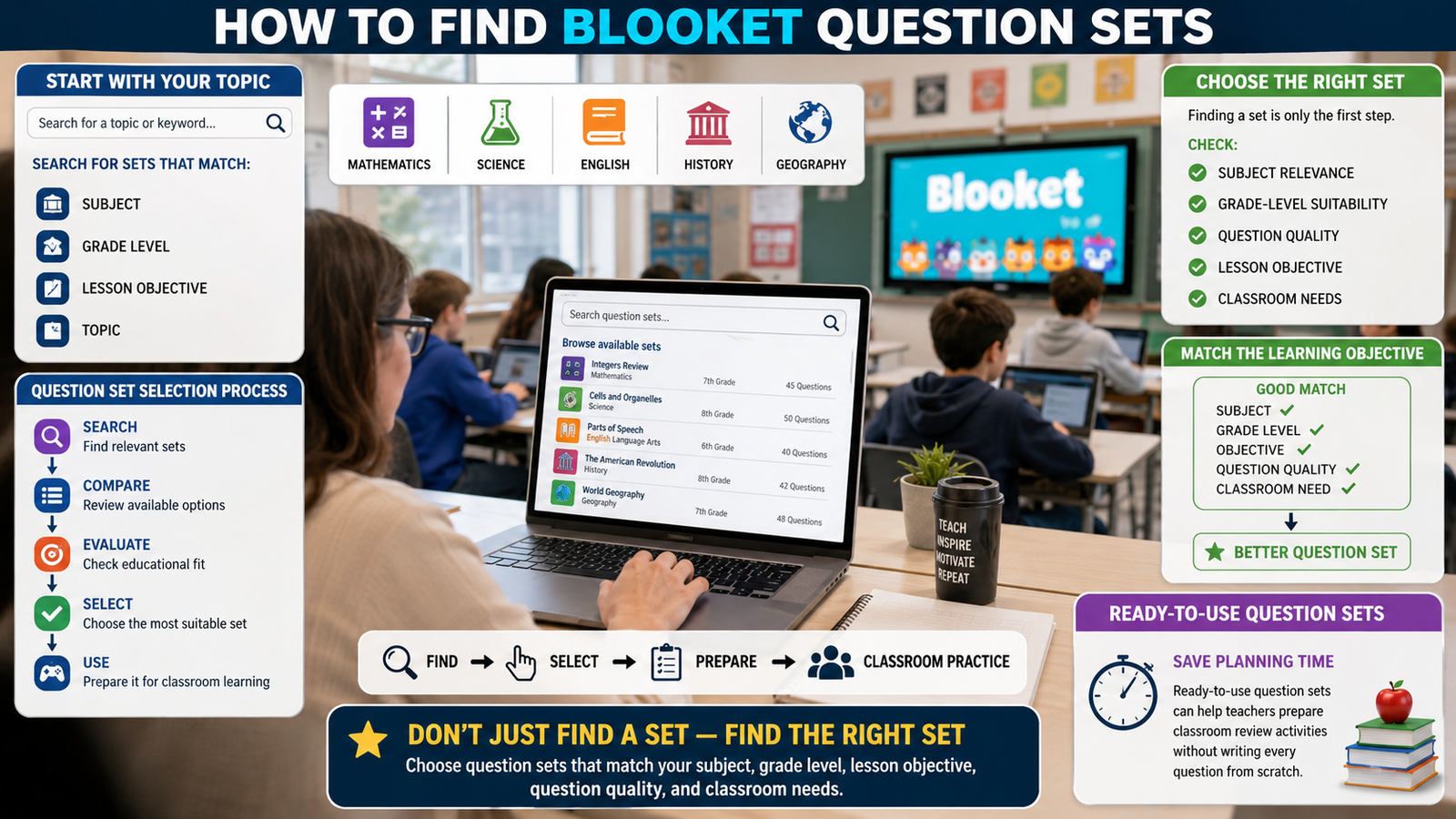
The key is not simply finding a Blooket question set. You want one that matches your subject, grade level, lesson objective, question quality, and classroom needs.
Looking for comprehensive classroom resources and educational technology insights? Explore GimkitApp for expert guides, teaching strategies, game modes, and the latest updates to enhance student engagement.
Where to Find Blooket Question Sets
Start from Blooket’s Question Sets area rather than searching randomly across the web. The platform’s set-discovery experience is designed to help teachers locate existing question sets that can be used in Blooket activities.
When searching, think about the lesson rather than using only a broad term. For example, instead of searching for a general subject such as “math,” use a more specific concept such as:
Fractions
Multiplication facts
Algebra equations
Ancient civilizations
Parts of speech
Science vocabulary
States and capitals
Spanish vocabulary
A specific search term generally makes it easier to identify sets that are actually useful for the lesson you are preparing.
Search for a Topic, Not Just a Subject
One of the most effective ways to find a relevant Blooket question set is to search using the specific learning concept students need to practice.
For example, a teacher preparing a lesson on fractions may get more useful results by searching for equivalent fractions or adding fractions with unlike denominators rather than simply searching for “math.”
This approach helps connect the question set to the actual learning objective.
💡 Pro Tip: Before searching Blooket, write down the exact skill students need to practice. Then use that skill, concept, vocabulary term, or unit name as your starting search phrase.
Narrow Your Search by Context
A useful Blooket question set should match more than the general topic. Consider the context in which students will use it.
Check whether the set is appropriate for:
Factor
What to Look For
Subject
The correct academic subject or topic
Grade level
Appropriate difficulty for your students
Learning objective
Questions actually practice the intended skill
Question type
Suitable format for the activity
Difficulty
Not excessively easy or advanced
Coverage
Enough questions for the planned session
Accuracy
Correct answers and reliable information
Classroom purpose
Review, practice, revision, or assessment
This matters because two question sets can appear relevant in search results while serving completely different classroom needs.
Open the Question Set Before Choosing It
Do not immediately select the first result that looks relevant. Open the question set and inspect its contents first.
Look at the questions, answer choices, topic coverage, and overall difficulty. A set may have an appropriate title but still contain questions that are too easy, too difficult, outdated, or unrelated to the exact lesson.
For example, a search for “photosynthesis” might return sets covering basic vocabulary, detailed biological processes, exam preparation, or mixed science questions. The best choice depends on what your students are expected to learn.
This quick review step can prevent a common classroom problem: discovering after the game has started that the question set does not match the lesson.
Match the Set to Your Learning Objective
The strongest question set is not necessarily the longest or most popular-looking one. It is the set that supports the outcome you want students to achieve.
Ask:
What should students know or be able to do after this activity?
Does the question set directly practice that skill?
Is the difficulty appropriate for the class?
Does the set contain enough relevant questions?
Will the questions work well in the type of Blooket activity I am planning?
If the answer to these questions is yes, the set is much more likely to work effectively in the classroom.
⭐ Expert Insight: Treat a Blooket question set as a teaching resource, not simply a collection of questions. Relevance to the learning objective is more important than choosing a set because it appears first in the results.
Check the Set Before Using It
A final review is especially important when using a question set created by someone else. Check for obvious errors, ambiguous wording, incorrect answers, duplicate questions, and content that does not fit your students.
If the set is mostly useful but contains a few unsuitable questions, determine whether you can adjust the content before using it. This is often better than abandoning an otherwise strong resource.
The goal is simple: find a question set that is ready for your particular classroom, not merely one that matches your search phrase.
Once you know how to discover and evaluate existing sets, the next step is learning how to choose the best Blooket question set from several relevant results.
How to Choose the Best Blooket Question Set From Search Results
Finding several relevant Blooket question sets is only the first step. The harder decision is choosing the one that will actually work for your students. A strong set should align with the lesson objective, student level, question quality, and amount of practice you need.
Instead of choosing based only on the title, evaluate each candidate using the content itself.
Compare Relevant Question Sets Before Selecting One
If several Blooket sets appear relevant, compare them using the factors that matter most for your lesson.
Selection Factor
What to Check
Why It Matters
Topic relevance
Questions match the exact concept
Prevents off-topic practice
Difficulty
Appropriate for the class
Keeps students challenged without unnecessary frustration
Question quality
Clear wording and useful distractors
Improves learning value
Answer accuracy
Correct answers are identified
Prevents students from learning incorrect information
Coverage
Key parts of the lesson are represented
Provides more complete practice
Question count
Enough questions for your activity
Reduces the need to switch sets
Grade suitability
Content matches student ability
Makes the activity more effective
A set that scores well across several of these areas is generally a stronger choice than one that simply has a more attractive title.
Check Question Quality, Not Just Quantity
A large question set is not automatically a better question set.
For classroom use, examine whether the questions actually test understanding. Good questions should be understandable, relevant, and appropriate for the intended learners.
Watch for:
Repeated questions
Unclear wording
Multiple potentially correct answers
Incorrect answer keys
Questions unrelated to the stated topic
Excessively difficult vocabulary
Very easy questions that provide little practice
Distractors that are obviously wrong
A smaller set with well-designed questions can be more useful than a much larger set filled with repetitive or low-value content.
Consider the Students Who Will Use the Set
The same Blooket question set can work well for one class and poorly for another.
For younger students, vocabulary, reading level, and question complexity may be especially important. Older students may need more detailed questions, application-based problems, or exam-style practice.
Before selecting a set, consider:
Student age and grade
Existing knowledge
Reading ability
Subject familiarity
Expected difficulty
Whether students are learning or reviewing the topic
This prevents the common mistake of selecting a set based entirely on the teacher’s intended topic while ignoring the students’ actual readiness.
Decide Whether the Set Fits the Activity
The purpose of the activity also affects which question set is appropriate.
A short warm-up may only require a small selection of straightforward questions. A full-class review session may benefit from broader topic coverage. A revision activity before an assessment may require questions that reflect the skills students are expected to demonstrate.
Think about the intended use:
Warm-up: quick, focused questions
Lesson review: coverage of recently taught concepts
Practice: repeated opportunities to apply a skill
Revision: broader coverage of important material
Assessment preparation: questions that resemble the expected knowledge or skills
The best set is therefore determined by purpose + content + learner level, not by search relevance alone.
Use a Simple Question Set Selection Test
When you have multiple candidates, use this quick evaluation:
Topic match → Student match → Question quality → Coverage → Classroom purpose
If a set fails at the first two stages, there is usually little reason to continue evaluating it.
If it passes those checks, inspect the questions more carefully before using it.
📌 Quick Note: Search relevance tells you that a set might be useful. Reviewing the actual questions tells you whether it is useful.
Be Careful With Broad or Mixed Sets
Broad question sets can be useful when you want general review, but they can become inefficient when your lesson focuses on one specific skill.
For example, a general “Grade 6 Science” set might include several unrelated units. If your students are reviewing only ecosystems, a focused ecosystems set may provide more meaningful practice.
Mixed sets are more appropriate when your goal is comprehensive revision rather than targeted instruction.
Watch for Outdated or Context-Specific Content
Some question sets may have been created for a particular curriculum, classroom, textbook, or academic year. That does not automatically make them unsuitable, but you should check whether the information still fits your students and curriculum.
This is particularly important for:
Current events
Technology topics
Changing terminology
Curriculum-specific material
Standards-based instruction
Questions involving dates or changing information
For stable subjects such as basic arithmetic or established vocabulary, this concern is usually smaller.
Know When to Skip a Question Set
Do not force a poor match simply because it appears in the search results.
Consider looking for another set when:
Most questions are unrelated to your lesson.
The difficulty is clearly inappropriate.
Several answers appear incorrect.
The wording is confusing.
Important parts of the topic are missing.
The set is too short for your planned activity.
Students would need substantial explanation before answering the questions.
⚠ Common Mistake: Choosing the first question set that contains the right keyword. A keyword match does not guarantee instructional relevance.
A Practical Teacher Workflow
A simple workflow can make question-set discovery much faster:
Define the learning objective
↓ Search using the specific topic or skill
↓ Review relevant results
↓ Open promising sets
↓ Check questions and answers
↓ Compare difficulty and coverage
↓ Choose the strongest match
↓ Prepare it for the planned Blooket activity
This approach avoids wasting classroom time searching while students are waiting to begin.
When No Perfect Question Set Exists
Sometimes you will find a set that covers most of your topic but does not perfectly match your lesson. That does not necessarily mean the search failed.
Evaluate whether the useful questions are enough for your purpose. If they are, the set may still work after appropriate review or adjustment. If too much of the content is unsuitable, continuing the search—or preparing your own questions—may be more efficient.
The important distinction is between a usable starting resource and a genuinely suitable classroom resource.
Finding Blooket Question Sets: Final Checks Before You Use One
By this point, the goal is no longer simply to find a Blooket question set with the right title. The best choice is the set that matches the topic, learning objective, student level, question quality, and purpose of the activity. A few final checks can save significant preparation time and prevent students from working through unsuitable content.
Before using a selected set, quickly verify that:
The questions match the lesson or review topic.
The difficulty is appropriate for the students.
The answers appear accurate.
Important parts of the topic are covered.
Questions are clearly written.
There is little unnecessary repetition.
The set is suitable for the planned classroom activity.
Any time-sensitive or curriculum-specific information still makes sense for your students.
What If Blooket Search Results Are Too Broad?
If your first search produces too many unrelated question sets, make the search more specific rather than manually opening every result.
Move from a broad subject to a narrower concept:
Subject → Unit → Topic → Skill → Specific concept
For example, instead of searching only for science, narrow the search toward the exact concept students are studying. This makes the discovery process more efficient and increases the likelihood that the results will match the lesson.
The same principle works across mathematics, science, language arts, social studies, vocabulary, languages, and other subjects.
What If You Cannot Find a Perfect Question Set?
A perfect match is not always available. If a set covers most of the required material but contains a small amount of unsuitable content, review whether it can still serve as a useful starting point.
However, if the majority of the questions are unrelated, inaccurate, or inappropriate for the students, continuing to search is usually better than compromising the quality of the activity.
The purpose of using ready-made Blooket sets is to reduce preparation without reducing instructional quality.
💡 Pro Tip: Do not measure a question set only by how much preparation it saves. Measure it by how much useful learning it delivers for the time students spend using it.
Quick Blooket Question Set Selection Checklist
Before committing to a set, run through this short checklist:
Correct subject and topic
Matches the learning objective
Appropriate student level
Questions are clear
Answers are accurate
Difficulty is suitable
Important concepts are represented
Limited unnecessary repetition
Appropriate for the planned activity
No obvious outdated or unsuitable information
If a set passes these checks, it is much more likely to be a practical classroom resource.
For the latest gaming news, expert reviews, and walkthroughs, readers can also visit IGN, one of the world’s leading gaming websites.
FAQs About Finding Blooket Question Sets
1. How do I find Blooket question sets?
You can use Blooket’s question-set discovery area to search for material related to a specific subject, topic, skill, unit, or concept. The most effective approach is to search with focused terms rather than choosing the first broad result you see.
Once you find potential sets, review their actual questions before using them. A relevant title does not necessarily guarantee that the content matches your students or learning objective.
For better results:
Search for the exact concept or skill.
Compare multiple question sets.
Check the questions and answers.
Consider student level and difficulty.
Match the set to your lesson objective.
2. Can I find ready-made Blooket question sets?
Yes. Blooket provides discoverable question sets that teachers can use as ready-made classroom resources. These can save preparation time, especially when a suitable set already covers the topic students need to practice.
However, ready-made does not automatically mean ready for your classroom. Teachers should inspect the content for accuracy, relevance, difficulty, wording, and curriculum alignment before using it.
Before selecting a ready-made set, check:
Topic coverage.
Question accuracy.
Answer quality.
Difficulty level.
Reading level.
Relevance to your objective.
3. How do I choose the best Blooket question set?
The best question set is the one that most closely matches your learning objective and students, not necessarily the one with the most questions or the most attractive title.
Consider whether the questions actually measure the knowledge or skill you want students to practice. A smaller, focused set can be considerably more useful than a large set containing unrelated or repetitive questions.
Evaluate each set for:
Learning-objective alignment.
Student readiness.
Question quality.
Appropriate difficulty.
Topic coverage.
Accuracy.
Amount of repetition.
4. Should I check a Blooket question set before using it?
Yes. Reviewing a question set before classroom use is one of the most important steps in using ready-made educational content effectively. Even a seemingly relevant set can contain incorrect answers, ambiguous wording, outdated information, excessive repetition, or questions that are too easy or difficult for your students.
A quick review also allows teachers to determine whether the set supports the intended lesson rather than simply providing entertaining gameplay.
Look for:
Incorrect answers.
Unclear questions.
Irrelevant content.
Repetitive questions.
Inappropriate difficulty.
Mismatched grade level.
Content that does not support the lesson goal.
5. Are longer Blooket question sets better?
No. Question quality and relevance matter more than question count. The ideal size depends on the activity, available classroom time, student level, and learning objective.
A concise set containing carefully selected questions can provide stronger practice than a very large set filled with repetitive or unrelated material. Teachers should choose enough questions to provide meaningful practice without creating unnecessary repetition or fatigue.
The same principle applies when using one set across different classes: if students have different readiness levels or instructional needs, the teacher should confirm that the content remains appropriate for each group.
Conclusion
Finding Blooket question sets is most effective when you treat the process as resource selection rather than simple searching. Start with the exact learning objective, search using a focused topic or skill, review promising results, and evaluate each set for accuracy, difficulty, coverage, and student suitability.
The strongest workflow is simple: search specifically, inspect carefully, compare intelligently, and choose based on instructional value. That approach helps teachers save preparation time while ensuring that the Blooket question set actually supports what students are expected to learn.