99math classroom strategies should begin with one principle: competition is useful only when it improves the quality of math practice.
A live math game can create energy almost instantly. Students see a shared activity, know that classmates are playing too, and often become more willing to attempt another round. But excitement and learning are not automatically the same thing.
A classroom can become extremely competitive while students rush, guess, focus only on rank, and stop thinking carefully about mathematics.
The stronger approach is to use 99math’s game structure intentionally.
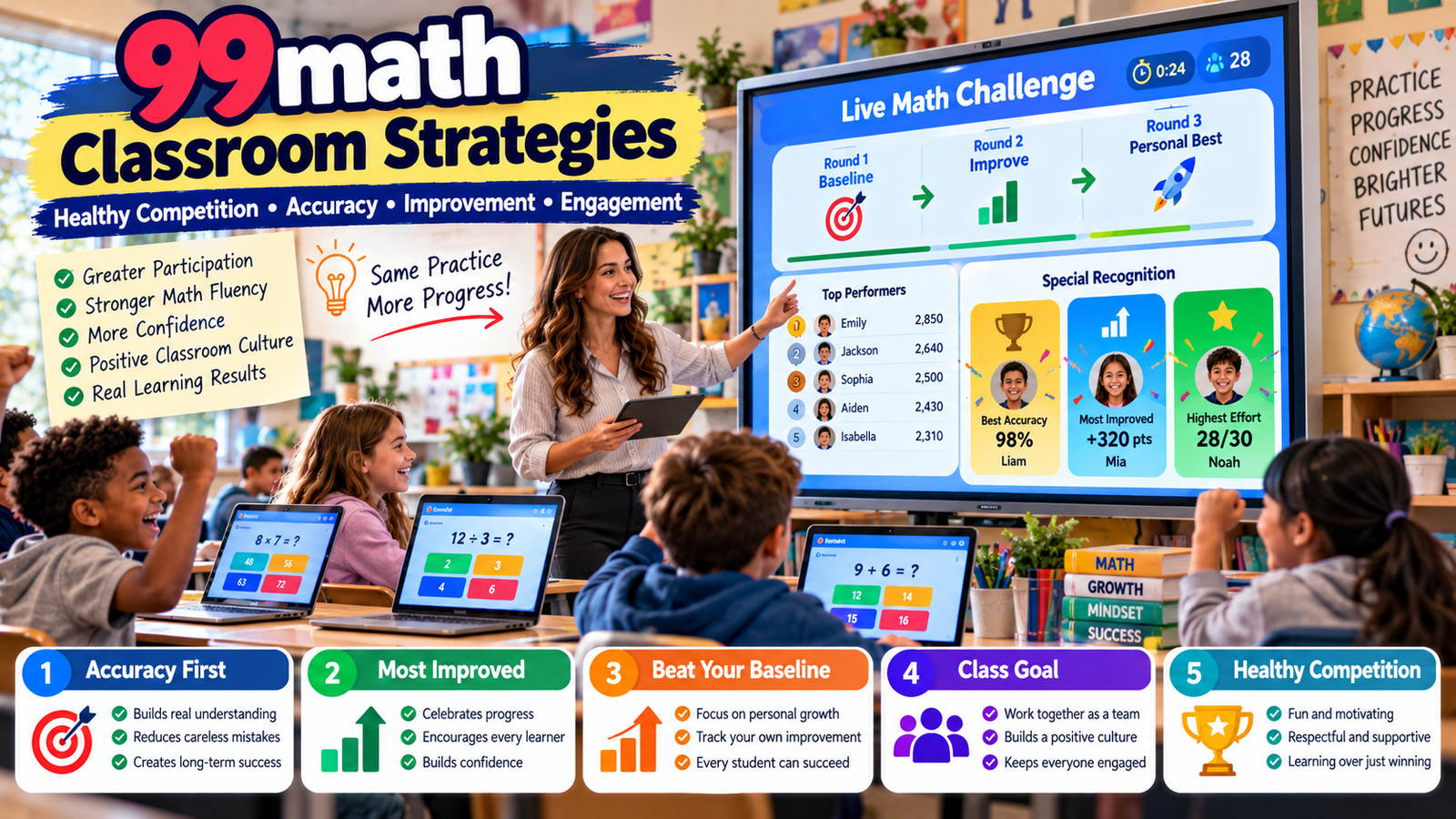
99math currently allows teachers to choose a math skill, configure rounds and time, launch a live group activity, monitor performance, and start additional rounds. Its official group-game guidance specifically recommends examining accuracy changes and common mistakes between rounds. At the end of a session, the current podium highlights Top 5 players, Most Improved, and Best Accuracy. 99math blog
Those three forms of recognition create an important opportunity.
A teacher does not have to define success only as:
Who finished first?
A class can also value:
accuracy;
improvement;
consistency;
personal growth;
recovery after mistakes;
collective progress.
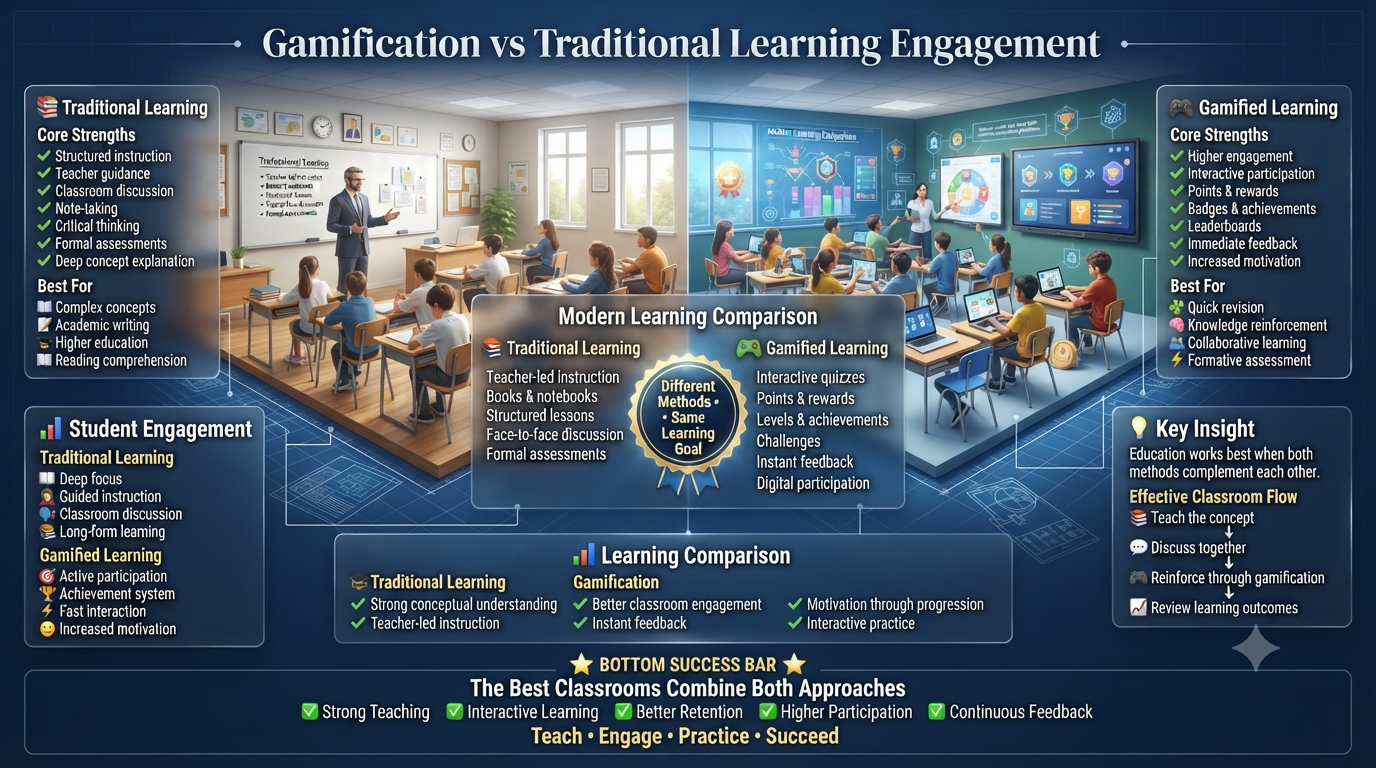
That is especially important because educational gamification research shows that game elements can help motivation and learning, but results depend heavily on implementation. A 2026 systematic review and meta-analysis of mathematics gamification found a small-to-moderate positive effect on motivation and specifically recommended balancing competition with mastery and cooperation rather than relying on excessive social comparison. Springer
A broader meta-analysis of gamified learning also found positive average effects on learning outcomes, while qualitative evidence identified anxiety and jealousy among reasons some learners dislike gamified environments. ScienceDirect
The goal, therefore, is not to remove competition.
It is to design competition so that mathematics remains more important than the leaderboard.
Gimkit App offers practical guides, resources, and tips for teachers and students exploring interactive learning and educational games.
What Makes a Good 99math Classroom Strategy?
A strong classroom strategy protects four things at the same time.
Priority
What the teacher wants to protect
Accuracy
Students solve correctly rather than guessing
Fluency
Familiar skills become faster and more automatic
Improvement
Students can measure growth against their own previous performance
Participation
More students remain willing to engage
Competition is valuable when it supports these priorities.
It becomes counterproductive when it replaces them.
Imagine two different classrooms.
In the first, students hear:
“Whoever gets first place wins.”
In the second, students hear:
“Today we’re looking for strong accuracy, improvement between rounds, and focused practice.”
The platform may be identical.
The classroom experience is not.
Teacher framing changes what students believe the activity is asking them to achieve.
Strategy 1: Give Every 99math Session One Clear Purpose
Do not begin a live activity simply because students enjoy it.
Start by deciding what the game is supposed to accomplish.
A session might target:
accurate recall;
smoother fluency;
reduced hesitation;
review after instruction;
improvement across rounds;
increased willingness to practice;
a quick classroom reset;
confidence with already-taught material.
Then state that purpose clearly.
Instead of:
“We’re playing 99math.”
say:
“Today we’re trying to improve our accuracy from the first round to the last.”
Or:
“Today speed is secondary. Our goal is fewer errors.”
Or:
“Today you’re competing against your own first-round performance.”
This small change turns an entertaining activity into deliberate practice.
Strategy 2: Define Success Before Students Start
Students naturally optimize for whatever the teacher appears to value.
If every celebration goes to first place, students learn that rank is the real goal.
If the teacher repeatedly highlights accurate performance and improvement, the class receives a different message.
Before starting, tell students which result matters most that day.
Accuracy day
“The strongest performance today is the most accurate one.”
Improvement day
“Your goal is to beat your own first round.”
Fluency day
“Stay accurate and see whether you can solve familiar problems more efficiently.”
Class-goal day
“We’re trying to improve together.”
99math’s current live-game podium already distinguishes between Top 5, Most Improved, and Best Accuracy, so teachers can reinforce several legitimate forms of success rather than creating artificial categories disconnected from the platform. 99math blog
Strategy 3: Use a Three-Round Teaching Structure
99math allows teachers to configure multiple rounds. 99math Support
That does not mean every round should simply be another identical race.
Do not overload students with strategy before the first attempt.
Let them perform naturally.
You are looking for patterns such as:
rushing;
hesitation;
repeated mistakes;
strong accuracy;
uneven participation.
The first round is not the final judgment.
It is the starting point.
Between Rounds: Teach One Thing
99math’s own group-game guide recommends looking at accuracy changes and common mistakes between rounds. 99math blog
This is where the teacher can make a short instructional move.
The important word is short.
You might say:
“A lot of us are missing the operation sign. Before every answer, identify whether you’re multiplying or dividing.”
Or:
“We’re getting the calculation right but entering answers too quickly. Next round, protect accuracy.”
Or:
“Remember the pattern we just practiced.”
Then stop.
Do not turn the gap between rounds into another full lesson.
One correction is easier to apply than six.
Round 2: Apply the Feedback
Now students have a specific mission.
The question is no longer:
Who won?
It becomes:
Did the correction change our performance?
Students immediately test the advice.
This is what makes the second round instructionally valuable.
Round 3: Personal Best or Mastery Target
The third round should have a clear final purpose.
Students might aim to:
improve accuracy again;
beat their first round;
maintain accuracy while responding more efficiently;
eliminate one repeated error;
help the class reach a shared goal.
Now the three rounds form an instructional arc rather than three isolated competitions.
Three-Round Strategy at a Glance
Stage
Main purpose
Teacher role
Round 1
Establish baseline
Observe
Pause
Identify one high-value issue
Teach briefly
Round 2
Apply feedback
Monitor change
Pause
Reinforce successful adjustment
Refocus
Round 3
Reach personal/class goal
Consolidate
This structure is teacher-created.
It does not require a special 99math mode.
The platform supplies the rounds.
The teacher supplies the pedagogy.
Strategy 4: Rotate What Counts as Winning
One of the easiest ways to make competition healthier is to stop using the same definition of success every time.
If the fastest students always receive all attention, other students may eventually decide that the game is not really for them.
Rotate the target.
Possible session themes include:
Best Accuracy
Most Improved
Personal Best
Strongest Consistency
Whole-Class Improvement
99math’s own podium already recognizes Most Improved and Best Accuracy in addition to top players. 99math blog
That creates a natural foundation for a broader recognition system.
The point is not to make everyone a winner regardless of performance.
The point is to recognize mathematically meaningful forms of success.
Strategy 5: Make Accuracy the Classroom Default
Students often assume that a digital competition means:
Answer as fast as possible.
The teacher should explicitly correct that assumption.
Useful classroom language includes:
“Fast and wrong does not help us.”
“Accuracy comes first.”
“Speed matters only when the math remains correct.”
“Do not guess just to answer more questions.”
This is especially important in fluency practice.
Fluency means efficient and dependable performance, not random speed.
99math’s current public site itself presents student performance through both accuracy and speed, showing that these are distinct dimensions rather than one combined idea. 99math
Teachers should preserve that distinction in classroom language.
Strategy 6: Use Most Improved as a Serious Achievement
“Most improved” should not feel like a consolation prize.
If students sense that improvement is only mentioned after all “real winners” have been celebrated, it loses motivational value.
Instead, give improvement equal status.
For example:
Today’s recognition
Best Accuracy
Most Improved
Strong Overall Performance
No category needs to be presented as the “real” one.
This works particularly well in mixed-ability classrooms.
A student who is far from the highest raw score can still pursue a demanding target:
Can I improve from my own baseline?
That creates a competitive pathway that remains meaningful even when students begin at different performance levels.
Strategy 7: Build Personal-Best Competition
Personal-best competition keeps the challenge while reducing direct social comparison.
The student competes against:
first-round accuracy;
first-round score;
previous hesitation;
previous error rate;
a personal target.
Teacher language might be:
“You are not trying to beat the person beside you. You’re trying to beat your Round 1 performance.”
This works especially well for:
mixed-ability classes;
competition-sensitive students;
students who become discouraged by rankings;
students who already perform highly and still need a challenge.
A highly fluent student can still improve.
Their challenge might be maintaining excellent accuracy rather than simply staying at the top of the leaderboard.
Strategy 8: Use Class-vs-Baseline Challenges
Competition does not always require opposing students.
A class can compete against its earlier performance.
For example:
Round 1
Establish the class baseline.
Teacher intervention
Give one short correction.
Final round
Challenge the entire class to improve.
This changes the social structure.
Instead of:
student vs. student
the structure becomes:
class vs. previous class performance
This can preserve excitement while encouraging cooperation.
The latest mathematics-focused gamification review specifically recommends balancing competitive mechanics with mastery and cooperative structures. Springer
A class-baseline challenge fits that philosophy well.
Strategy 9: Do Not Make the Leaderboard the Entire Lesson
A leaderboard can motivate some students.
It can also dominate attention.
Research does not suggest that rankings affect every learner identically. The broader gamification literature consistently emphasizes that design, learner characteristics, and social comparison matter. Springer
Teachers can choose how much attention a ranking receives.
After a round, you might say:
“The important thing I noticed is that our accuracy improved.”
Instead of:
“Let’s read every rank from first to last.”
Sometimes the leaderboard deserves attention.
Sometimes it does not.
Use it as information, not as the automatic center of every discussion.
Strategy 10: Separate Recognition From Material Rewards
Students do not need a prize after every successful game.
Recognition can be enough.
Recognize:
accurate work;
personal improvement;
focused effort;
successful application of feedback;
class cooperation.
Material rewards can become problematic when students begin asking:
“What do I get?”
instead of:
“What did I learn?”
Gamification research has identified external reward structures and social comparison among factors associated with negative responses in some learners. Springer
That does not mean rewards are always harmful.
It means they should not become the entire motivational system.
Strategy 11: Use Competitive Practice in Short Bursts
Competition has an intensity cost.
A short live challenge can energize the room.
An extended sequence of repetitive rounds can create:
fatigue;
careless errors;
frustration;
noise;
declining mathematical quality.
99math currently presents its live group experience as a short classroom practice format, with its public site describing whole-class rounds that can fit into a brief time window. 99math
That makes live competition particularly suitable for:
warm-ups;
quick review;
mid-lesson practice;
lesson closers.
It does not need to occupy the entire math period.
Strategy 12: Stop Before Engagement Turns Into Carelessness
More rounds are not automatically better.
Watch for the point where:
students begin guessing;
accuracy declines;
students become focused only on rank;
noise starts replacing concentration;
another round would add little instructional value.
That is often the right time to stop.
Ending while students still want another round can preserve enthusiasm for the next session.
A strong classroom strategy values quality of practice over volume of play.
Strategy 13: Protect Accurate but Slower Students
Some students process more slowly but correctly.
They may understand the mathematics very well.
If classroom culture constantly equates speed with intelligence, those students can receive a false message about their mathematical ability.
99math’s own public performance visualization separates students who are fast and accurate, accurate but slow, fast but inaccurate, and slow and inaccurate. 99math
That distinction is instructionally useful.
An accurate-but-slower student may need fluency development.
They do not necessarily need conceptual remediation.
Treat their profile accordingly.
Strategy 14: Redirect Fast but Inaccurate Students
Some students are naturally quick.
Their challenge is control.
Instead of telling them:
“You’re careless.”
try:
“Your speed is already strong. Now make that speed reliable.”
This frames the next goal positively.
A useful challenge might be:
Maintain your speed while raising your accuracy.
That protects the student’s strength while redirecting the behavior that is limiting performance.
Strategy 15: Give Different Students Different Competitive Targets
A single class may include students who need very different motivational conditions.
Student profile
Better competitive target
High-performing
Maintain accuracy while increasing efficiency
Accurate but slow
Beat personal response baseline
Fast but inaccurate
Reach an accuracy target
Low-confidence
Improve one round privately
Highly competitive
Compete within accuracy rules
Competition-sensitive
Personal-best or class goal
Easily distracted
Small, clear round objective
The platform does not need to change for each student.
The teacher changes the goal attached to participation.
That is one of the most powerful forms of differentiation available in a live game.
Strategy 16: Give Competition-Sensitive Students Private Goals
Some students become less accurate when they know they are publicly ranked.
Research on gamification has documented anxiety as one reason certain learners dislike gamified environments. ScienceDirect
A teacher can keep those students inside the shared activity without making rank their main goal.
Examples of private targets:
reach 90% accuracy;
make fewer errors than Round 1;
complete one round without guessing;
improve one specific type of problem;
stay calm after a wrong answer.
This keeps participation inclusive without removing challenge.
Strategy 17: Praise Behaviors, Not Fixed Ability
The language used after competition matters.
Avoid:
“You’re the smartest.”
“You’re a genius.”
“You’re always the best.”
These labels turn performance into identity.
Prefer:
“You kept your accuracy high.”
“You improved between rounds.”
“You applied the correction we discussed.”
“You recovered well after a difficult start.”
These statements describe controllable behaviors.
They tell students what can be repeated.
Strategy 18: Never Use Low Rank as Public Entertainment
A low leaderboard position should never become a joke.
No:
mocking;
class chants;
sarcastic commentary;
forced public explanations;
nicknames based on losing.
Competitive learning works only when students are willing to participate again.
If students believe a mistake will become social embarrassment, some will protect themselves by disengaging.
A healthy competitive culture requires psychological safety.
Strategy 19: Establish a No-Guessing Norm
Random input creates the appearance of participation without meaningful practice.
Establish a class norm:
“If you don’t know the answer instantly, think. Do not gamble.”
Students should understand that thoughtful delay is preferable to meaningless speed.
If guessing becomes widespread, pause the activity.
The objective is mathematical fluency.
Not maximum clicking.
Strategy 20: Use One Correction Between Rounds
Teachers often notice several problems at once.
Do not address all of them.
Choose the error with the highest instructional value.
For example:
Round 1 observation
Many students are missing negative signs.
Between-round instruction
“Before answering, check whether the number is positive or negative.”
Round 2 target
Reduce sign errors.
That creates a very clean feedback loop.
Problem → correction → immediate new attempt
The official 99math group-game guide explicitly encourages teachers to use the between-round period to examine accuracy and common mistakes. 99math blog
Strategy 21: Do Not Teach Entirely New Mathematics Through Competition
99math identifies itself as a fluency-focused platform. 99math
That matters.
Fluency practice works best when students have enough underlying understanding to engage meaningfully.
Suppose students have never understood fraction equivalence.
A timed competition is unlikely to substitute for conceptual instruction.
Teach the concept.
Then practice.
The game is strongest as a tool for:
retrieval;
repetition;
fluency;
application;
reinforcement.
It should not automatically replace explanation, modeling, discussion, or problem solving.
Strategy 22: Use Competition After Instruction
A good sequence is:
Explain → practice → compete → reflect
not:
compete → hope students figure it out
Once students understand the mathematical idea, competition can create a reason to retrieve and apply it repeatedly.
This distinction prevents a common gamification mistake:
mistaking activity for instruction.
Students can be very active while learning very little if they do not understand what they are doing.
Strategy 23: Give Every New Round a Mission
Students become bored when every round feels identical.
Give the next round a different objective.
Examples:
Round 2
“Reduce errors.”
Round 3
“Beat your personal baseline.”
Final challenge
“Can the whole class reach our accuracy target?”
The mathematical content may remain similar.
But the purpose of the practice changes.
That makes repetition feel intentional.
Strategy 24: Use Mystery Recognition Occasionally
You do not always need to reveal the recognition category before the round.
Occasionally tell the class:
“I’m watching for one special type of performance this round.”
At the end, recognize something meaningful such as:
strongest accuracy;
largest improvement;
most consistent performance;
strongest recovery.
This prevents students from optimizing only one visible metric.
It also creates curiosity without requiring material prizes.
This is a teacher-created classroom strategy, not a named 99math feature.
Strategy 25: Create Cooperative Competition Without Inventing Platform Features
Teachers can add cooperative structures around a normal live session.
Examples:
Table goal
Each table group tries to improve its own collective accuracy.
Class goal
The whole class tries to beat yesterday’s baseline.
Shared improvement challenge
The class tries to reduce a specific error.
These are instructional overlays.
Do not describe them as built-in 99math modes unless the product actually provides such a mode.
That distinction keeps your teaching practice creative without misrepresenting the software.
Strategy 26: Use Cross-Class Competition Carefully
A cross-class challenge can create memorable excitement.
But it should be occasional.
If two classes compete:
use comparable content;
make expectations identical;
avoid humiliating the losing group;
recognize improvement;
keep the activity educational;
end with sportsmanship.
The event should feel special.
If every lesson becomes Class A vs. Class B, competition can start overshadowing mathematics.
Strategy 27: Never Compare Different Difficulty Levels as If They Are Equivalent
Raw scores have meaning only in context.
If one student is solving more difficult work than another, direct comparison can be unfair.
This is particularly relevant in:
intervention settings;
mixed-grade groups;
differentiated instruction;
special education support.
Use:
personal improvement;
accuracy;
within-level comparisons;
class goals.
Do not imply that every raw number represents the same level of challenge.
The detailed process for matching 99math skills to student readiness belongs to Article #4.
Strategy 28: Do Not Turn Game Results Into Ability Labels
A live session captures performance under one set of conditions.
It should not define a student.
Avoid:
“You’re bad at multiplication.”
Use:
“Multiplication still needs more practice.”
Avoid:
“You’re always slow.”
Use:
“You’re accurate; now we’re building fluency.”
Avoid:
“You’re our best math student.”
Use:
“Your performance was very strong on this skill.”
Language should leave room for growth.
Strategy 29: Establish Sportsmanship Rules Before Competition
Healthy competition needs explicit norms.
A simple classroom code could be:
Winners do not mock.
Students congratulate improvement.
Losing one round is normal.
Accuracy matters.
We do not comment negatively on another person’s rank.
One game does not define anyone.
We finish ready to learn again.
Teach these rules before the emotional intensity rises.
Culture is easier to establish early than repair later.
Strategy 30: Separate Excitement From Classroom Disorder
A high-energy activity does not require chaos.
Decide ahead of time:
whether students may cheer;
when voices need to stop;
how devices should be positioned;
what happens after a round;
how attention returns to the teacher.
A predictable structure lets students enjoy competition without losing classroom control.
Strategy 31: Use a Consistent Reset Signal
After a round, students may still be emotionally engaged with the results.
Use one predictable signal that means:
Stop → look up → listen
It could be:
a countdown;
a hand signal;
a phrase;
a visual cue.
Once students learn the routine, the teacher gains a clean instructional window between rounds.
That is especially useful for the one-correction strategy.
Strategy 32: Design Around Mastery, Not Social Status
A competitive target can be based on a standard rather than another student.
Examples:
90% accuracy;
no repeated sign errors;
improve by five percentage points;
class reaches a shared target;
maintain accuracy across three rounds.
These goals still create challenge.
But success does not require another student to fail.
This aligns with current mathematics gamification research recommending mastery-oriented and cooperative designs alongside competition. Springer
Strategy 33: Use Weekly Goals Carefully
Weekly goals can help create routine.
But the goal should represent meaningful practice.
A weekly goal becomes weak when students simply try to “finish the minutes.”
A better weekly target combines:
consistency;
appropriate skill practice;
accuracy;
genuine participation.
The purpose is habit formation.
Not clock accumulation.
Strategy 34: Time on Task Is Not the Same as Quality
A student can spend twenty minutes clicking without producing meaningful learning.
Another can spend eight focused minutes correcting a real weakness.
Therefore, avoid evaluating practice only by duration.
Look for:
thoughtful attempts;
accurate work;
correction;
persistence;
improvement.
Time supports learning.
It does not prove learning.
Strategy 35: Use Live Games Primarily as Low-Stakes Practice
A competitive session can provide valuable classroom information.
But teachers should be cautious about automatically converting game results into formal grades.
Performance can be influenced by:
speed pressure;
device familiarity;
connectivity;
emotional response;
temporary distraction;
competition sensitivity.
That does not mean game data is useless.
It means the purpose should be clear.
For everyday use, a low-stakes formative approach often keeps students more willing to take risks and improve.
Formal grading decisions should follow school policy and broader assessment principles.
Strategy 36: Use the Game to Start Reflection
After a session, ask students:
“What changed between Round 1 and Round 3?”
Or:
“What helped you become more accurate?”
Or:
“What mistake did you stop making?”
Possible answers might include:
“I stopped rushing.”
“I looked at the sign first.”
“I remembered the pattern.”
“I stayed calmer.”
“I checked my answer.”
That reflection helps students connect performance to strategy.
The game creates experience.
Reflection turns experience into learning awareness.
Strategy 37: Ask Students Which Competition Style Helps Them
Teachers can gather useful feedback directly from students.
Occasionally ask:
Did ranking motivate you or distract you?
Was personal best more helpful?
Did the timer help you focus?
Which type of recognition mattered?
What made you want to try again?
Student feedback is not a substitute for formal evidence.
But it is valuable classroom evidence.
One group may thrive on direct competition.
Another may perform better with class-shared goals.
Teaching should respond to the actual learners present.
Strategy 38: Vary Competitive Intensity
Not every session needs maximum energy.
You can deliberately vary intensity.
Low competition
Personal accuracy target.
Moderate competition
Most Improved.
Higher competition
Occasional leaderboard-focused challenge.
Cooperative
Class-vs-baseline.
This variation prevents any one competitive structure from becoming stale.
It also lets teachers choose the emotional intensity appropriate for that day’s lesson.
Strategy 39: Use Competition as a Diagnostic Stress Test
Once students have learned a skill, mild time pressure can reveal whether performance remains stable when attention demands rise.
A student may know a fact during slow practice but lose accuracy when responding quickly.
That can reveal that fluency is not yet secure.
However, the teacher should interpret this carefully.
A low result under pressure does not automatically mean the student lacks conceptual understanding.
It may reflect:
fluency;
attention;
competition sensitivity;
processing speed.
Detailed interpretation belongs to Article #5.
The strategic point is that competition can reveal a different side of performance than quiet untimed work.
Strategy 40: Know When Not to Use a Competitive Round
Sometimes the best 99math classroom strategy is not playing a live competition.
Avoid or reduce competition when:
students are learning a concept for the first time;
the class is emotionally dysregulated;
technical problems are dominating;
the activity would interrupt deeper reasoning;
public ranking is harming participation;
another instructional format fits the objective better.
A strong teacher does not ask:
“How can I fit 99math into every lesson?”
The stronger question is:
“When does this format genuinely improve practice?”
Ready-to-Use 99math Classroom Formats
Format 1: Accuracy First
Best for: classes that rush.
Round 1
Normal baseline.
Teacher cue
“Next round, correct answers matter more than quantity.”
Round 2
Accuracy challenge.
Recognition
Best Accuracy.
This uses an existing 99math recognition category. 99math blog
Format 2: Most Improved
Best for: mixed-ability groups.
Round 1
Baseline.
Pause
One short correction.
Round 2
Beat your first performance.
Recognition
Most Improved.
Again, this aligns with the current podium structure. 99math blog
Format 3: Personal Best
Best for: students who dislike public ranking.
Each student focuses on beating their own earlier performance.
The teacher can minimize public leaderboard emphasis.
Format 4: Class Goal
Best for: cooperation.
The entire class aims to improve a shared outcome.
This is teacher-created rather than a named platform mode.
Format 5: Final Mastery Round
Best for: lesson closure.
Round 1 reveals the starting point.
A brief correction follows.
The final round asks students to meet one clearly defined mastery target.
Strategy Matrix
Classroom problem
Best response
Avoid
Students guess
Accuracy challenge
Rewarding raw speed
Same students always dominate
Most Improved
Only top-rank recognition
Students feel anxious
Private goals
Forced ranking emphasis
Mixed readiness
Personal growth
Comparing unequal difficulty
Class lacks energy
Short live challenge
Long repetitive sessions
Repeated misconception
One correction between rounds
Replaying without teaching
Game gets chaotic
Reset signal
Improvised discipline
Motivation becomes stale
Rotate competition type
Same structure daily
Students chase prizes
Mastery recognition
Reward after every round
Rivalry becomes unhealthy
Class-shared goal
Humiliation and taunting
How to Tell Whether the Strategy Is Working
Do not judge success by noise or excitement alone.
Look for evidence such as:
more students willing to participate;
fewer random guesses;
better accuracy in later rounds;
students talking about improvement;
students responding productively to errors;
broader recognition across the class;
less fixation on only first place;
students able to explain what helped them improve.
If excitement goes up while mathematical quality goes down, redesign the activity.
If competition reduces participation, reduce social comparison.
If the same structure becomes stale, change the challenge.
The game should serve the classroom.
Not the other way around.
A Quick Teacher Decision Tree
Do students understand the skill already?
No: teach the concept first.
Yes: live practice may be appropriate.
Are students rushing?
Use an accuracy-first challenge.
Do the same students always win?
Use Most Improved or personal best.
Are some students anxious?
Use private targets.
Is the class disengaged?
Use a short, focused competitive burst.
Is the same mistake appearing repeatedly?
Pause and teach one correction.
Are later rounds getting sloppier?
Stop.
That decision tree keeps competition responsive rather than mechanical.
Frequently Asked Questions About 99math Classroom Strategies
Is competition in 99math actually good for learning?
Competition can support learning when it encourages students to practice carefully and persist, but it is not automatically beneficial. A recent mathematics-focused systematic review and meta-analysis found a small-to-moderate positive effect of gamification on motivation while emphasizing that competition should be balanced with mastery and cooperation. Springer
The practical implication is that teachers should not measure a successful 99math session only by excitement or leaderboard intensity. Use competition to increase meaningful practice. Recognize accuracy and improvement alongside high performance. Reduce social comparison when it begins discouraging students. The design of the activity matters as much as the presence of game elements.
What should I do if students answer randomly just to be fast?
Change the classroom success condition immediately. Tell students that the round will be judged primarily by accuracy, not raw response volume. 99math’s current end-of-game podium includes a Best Accuracy category, so the platform already provides a natural way to reinforce this expectation. 99math blog
If guessing continues, stop the activity briefly rather than letting students practice poor habits. Remind them that fluency means reliable performance, not uncontrolled speed. You can then restart with an accuracy target such as maintaining a particular percentage or making fewer careless errors than the previous round.
How do I keep the same top students from dominating every session?
Rotate what success means. On some days, emphasize Best Accuracy. On others, use Most Improved or a personal-best challenge. 99math already recognizes top performers, Most Improved, and Best Accuracy separately. 99math blog
This does not require reducing expectations for high-performing students. Give them a different challenge, such as maintaining excellent accuracy while becoming more efficient. Meanwhile, students who are not yet at the top can compete against their previous performance. A broader recognition structure keeps competition meaningful without creating a permanent classroom hierarchy in which only the same few students can realistically succeed.
What is the best number of rounds?
There is no universal number that fits every class. 99math currently allows teachers to choose the number of rounds and time per round. 99math Support
A useful instructional structure is three rounds: baseline, application after feedback, and final personal-best or mastery round. However, younger students, more difficult content, shorter lessons, or declining attention may justify fewer rounds. The key is to stop before additional rounds become repetitive or careless. More gameplay does not automatically create more learning. Use enough repetition for students to respond to feedback, then transition while the practice still has instructional value.
Should I show rankings after every game?
No. Rankings are optional instructional information, not a required classroom ritual. Some students find public comparison energizing, while others may become distracted or anxious. Research on gamification shows that learner responses differ and that excessive competition and social comparison can reduce motivation for some students. Springer
You can emphasize different results after different sessions. One day, discuss accuracy. Another day, discuss improvement. On another day, use a whole-class goal. Even when the podium appears, the teacher still controls the conversation. The most important information is the information that supports the learning objective of that session.
What should I do for students who dislike competition?
Give them a goal that does not depend on beating classmates. A private personal-best target works well. The student might try to improve accuracy, reduce one kind of error, or perform better than the first round.
This keeps the student participating in the same class activity without forcing public rank to become the main motivational mechanism. Research on gamification has documented anxiety among possible negative reactions to competitive environments, so teachers should not assume every learner is motivated by the same structure. ScienceDirect
A healthy classroom can contain both competitive students and students whose main challenge is personal growth.
Can a 99math game be cooperative rather than individual?
Teachers can create cooperative structures around the live game even when the underlying activity is individual. For example, the class can try to improve its overall baseline or reduce a particular shared error.
These should be described as teacher-designed classroom strategies rather than as built-in modes unless the platform specifically provides that mode.
This approach is supported by the broader evidence base. The latest mathematics gamification review recommends balancing competition with mastery and cooperative tasks because highly performance-oriented designs can reduce engagement for some learners. Springer
A shared class goal allows every student’s improvement to contribute to success.
Is 99math appropriate for mixed-ability classes?
Yes, but teachers should be careful about comparisons. Students working at different difficulty levels should not automatically be ranked as though their raw scores represent identical challenges.
For mixed-readiness classes, personal improvement, accuracy, or within-level goals may be more meaningful than one universal public ranking. The teacher can also structure different groups around appropriate mathematical content.
The detailed process for choosing 99math skills by grade, difficulty, and mathematical need belongs to the next article in this cluster. The classroom-strategy principle here is simply: do not confuse raw score with comparable performance when students are solving different levels of work.
Should winners receive prizes?
A prize is optional, not necessary. Recognition can be powerful without adding an external reward every time. Teachers can recognize Best Accuracy, Most Improved, strong persistence, or successful application of feedback.
Gamification research suggests that rewards can help in some contexts, but excessive reliance on external rewards and social comparison can also contribute to negative experiences. Springer
If you occasionally use a prize, keep it secondary to the mathematics. Students should not begin to believe that practice is worthwhile only when something tangible is available. The stronger long-term message is that improvement itself matters.
Can I grade students using live 99math results?
A teacher can use game performance as one source of formative information, but a live competitive result should not automatically become a formal grade. Timed conditions, device familiarity, competition response, connectivity, and processing speed can influence performance.
A live session may reveal useful patterns, but those patterns should be interpreted alongside other evidence of learning. The detailed use of 99math reports, accuracy, speed, weak-skill identification, and progress data is intentionally reserved for Article #5.
For classroom strategy, the safest default is to keep most competitive practice low stakes unless your school’s assessment policy and your instructional design clearly justify another approach.
When should I stop using competition during a lesson?
Stop when the competitive structure begins reducing the quality of practice. Warning signs include repeated guessing, falling accuracy, visible anxiety, escalating classroom behavior, or additional rounds producing no useful learning.
Competition should also be avoided when students are encountering a concept for the first time and still need explanation, modeling, or discussion. 99math is currently presented as a fluency-focused math platform, so it is best used where repeated practice makes instructional sense. 99math
The strongest strategy is not using the game more often. It is using it at the moment when the format genuinely supports the lesson.
Final Takeaway
The strongest 99math classroom strategies are built around purposeful competition.
Do not make first place the only meaningful result.
Use accuracy.
Use improvement.
Use personal-best goals.
Use class-wide challenges.
Use short bursts rather than endless rounds.
Use the space between rounds to correct one important mistake.
Give accurate-but-slower students a legitimate route to success.
Challenge fast-but-inaccurate students to make their speed dependable.
Protect students who do not respond well to public comparison.
And remember that excitement is not proof of learning.
99math currently gives teachers a live structure with configurable rounds, real-time classroom participation, and recognition that includes Top 5 players, Most Improved, and Best Accuracy. 99math blog
The teacher’s job is to decide what those mechanics mean in the classroom.
When competition serves accuracy, improvement, confidence, and meaningful repetition, the game can become a useful practice environment.
When ranking replaces mathematics, the strategy needs to change.