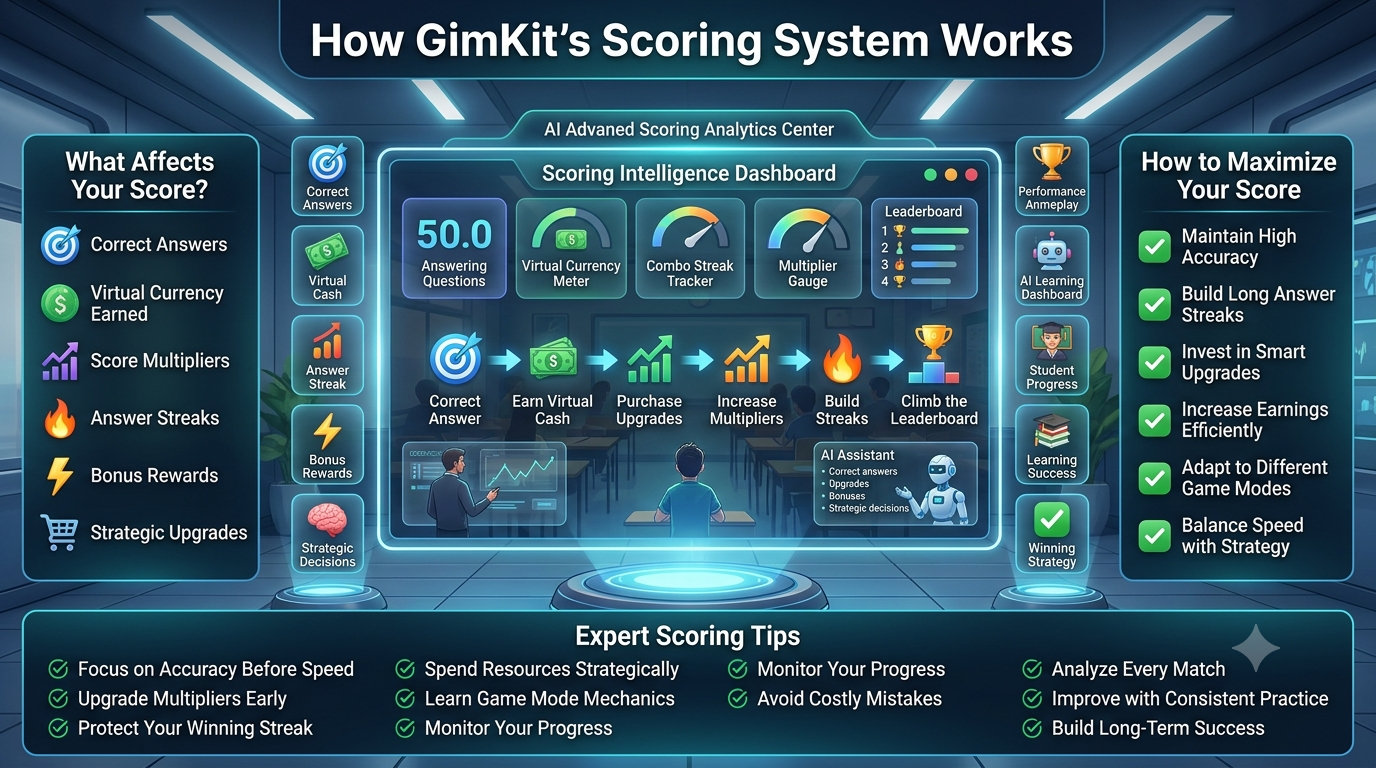
Understanding How Gimkit’s Scoring System Really Works can dramatically improve your performance, whether you’re a student aiming for the top of the leaderboard or a teacher designing balanced classroom competitions. Many players assume that answering the most questions automatically guarantees victory, but Gimkit uses several mechanics that influence final scores depending on the game mode, upgrades, bonuses, streaks, and strategic decisions made throughout the session.
Unlike traditional quiz platforms where every correct answer awards a fixed number of points, Gimkit introduces an economy that rewards decision-making as much as knowledge. Players continuously earn virtual cash, invest it in upgrades, unlock multipliers, activate power-ups, and adapt to changing game conditions. These systems create a dynamic scoring model that rewards both accuracy and efficient resource management.
This guide explains every major aspect of Gimkit’s scoring mechanics, from the basic earning formula to advanced optimization strategies. Along the way, you’ll also discover how different game modes affect scoring, common misconceptions, factors that influence rankings, and practical techniques used by experienced players. Whether you’re exploring Gimkit Games, ( Gimkit Live Learning show ) hosting competitive classroom sessions, or improving your own performance, understanding the scoring system helps you make smarter decisions every time you play.
What Determines Your Score in Gimkit?
Many new players think the leaderboard only measures how many questions they answer correctly. In reality, the score shown during most Gimkit sessions reflects a combination of knowledge, timing, upgrade choices, and the specific rules of the selected game mode.
Several systems work together throughout every match.
Scoring Factor
Influence on Final Performance
Correct answers
Primary source of earnings
Incorrect answers
Can reduce efficiency or trigger penalties
Upgrade purchases
Increase future earnings
Multipliers
Boost income over time
Power-ups
Temporary scoring advantages
Game mode rules
Change how points or money are calculated
Answer streaks
Often increase earning potential
Strategic timing
Determines long-term resource growth
Rather than rewarding speed alone, Gimkit encourages players to think about both learning and resource management.
The Foundation: Correct Answers Generate Income
Every correct answer starts the scoring cycle.
Instead of receiving static points, players usually earn in-game cash. That cash becomes the foundation for everything else because it allows upgrades that generate even greater earnings later in the game.
The faster a player builds their economy, the larger their overall score becomes during longer matches.
This is why experienced players focus on sustainable growth rather than immediate leaderboard positions.
Wrong Answers Have More Impact Than You Think
Incorrect answers do more than simply interrupt momentum.
Depending on the selected mode, wrong answers may:
Reduce cash earnings
Break answer streaks
Delay upgrade purchases
Lower long-term earning efficiency
Allow competitors to build larger economic advantages
One mistake early in a long game may have a much greater impact than the same mistake near the end.
Understanding the Difference Between Cash and Score
One of the biggest sources of confusion is the difference between earned cash and displayed rankings.
In many Gimkit modes, players spend earned money on upgrades instead of keeping it permanently. Although spending temporarily lowers available cash, those purchases often increase future earnings substantially.
Think of upgrades as investments rather than expenses.
Experienced players rarely try to keep the largest cash balance. Instead, they continuously reinvest their earnings.
How Upgrades Multiply Future Earnings
One of Gimkit’s most distinctive mechanics is its upgrade system.
Instead of simply collecting rewards, players improve how much future questions are worth.
Common upgrade categories include:
Income multipliers
Answer rewards
Insurance-style protection
Bonus earnings
Efficiency improvements
Each upgrade changes the earning curve for the remainder of the game.
Example Progression
Stage
Earnings per Correct Answer
Beginning
Low income
After several upgrades
Moderate income
Mid-game investments
High income
Late-game optimized build
Very high income
This exponential growth explains why players who invest wisely often overtake early leaders.
Why Accuracy Is More Valuable Than Pure Speed
Fast answering helps, but accuracy usually delivers greater long-term value.
Incorrect answers interrupt earning opportunities while consuming valuable time.
Professional players develop a rhythm that balances both qualities.
Efficient strategy includes:
Reading every question carefully
Avoiding unnecessary guesses
Maintaining answer streaks
Minimizing interruptions
Building consistent upgrade momentum
In longer sessions, consistent accuracy generally outperforms rushed gameplay.
How Multipliers Influence Leaderboard Rankings
Multipliers are one of the strongest scoring mechanics in Gimkit.
Rather than increasing only one reward, multipliers affect future earning potential across many questions.
For example:
Multiplier Level
Relative Earnings
Base
Standard reward
Small multiplier
Higher earnings
Medium multiplier
Significant improvement
High multiplier
Rapid economic growth
Because multipliers compound over time, purchasing them early often produces greater overall returns than waiting until later.
The Importance of Early Investment
Many beginners save large amounts of cash before making purchases.
Experienced players often do the opposite.
Early investments provide more opportunities for upgrades to generate additional value throughout the remainder of the match.
Professional recommendation
Instead of asking:
“How much money do I have?”
Ask:
“How much additional income will this upgrade generate over the next several minutes?”
That mindset usually leads to stronger overall scores.
How Different Gimkit Modes Change Scoring
Not every Gimkit experience uses identical scoring rules.
Some modes emphasize economic growth, while others prioritize objectives, exploration, teamwork, or survival.
Game Style
Primary Focus
Classic economy
Cash generation and upgrades
Team-based modes
Shared objectives
Adventure modes
Progress and exploration
Competitive events
Strategy and timing
Creative experiences
Mode-specific mechanics
Because each mode has unique rules, the best scoring strategy changes accordingly. Learning those differences is essential for consistently strong performance across Gimkit Mode experiences.
How Answer Streaks Influence Overall Scoring
Consistently answering questions correctly is one of the easiest ways to improve your results. While many players focus only on earning money from individual questions, uninterrupted accuracy creates momentum that leads to faster upgrades and stronger long-term performance.
An answer streak keeps your earning cycle moving without unnecessary interruptions. Every incorrect response forces you to recover instead of continuing to build your economy. Even when a game mode does not display a visible streak bonus, maintaining accuracy often produces better overall results because your upgrade path stays on schedule.
Consistent Accuracy
Frequent Mistakes
Stable income growth
Interrupted earnings
Faster upgrade progression
Delayed purchases
Better multiplier scaling
Slower economic growth
Strong leaderboard potential
Difficult recovery
Best practices for maintaining streaks
Read every question before selecting an answer.
Avoid rushing difficult questions.
Practice frequently used Gimkit Quiz topics.
Stay focused instead of watching the leaderboard constantly.
Prioritize accuracy over random guessing.
Why Upgrade Timing Matters More Than Upgrade Quantity
Buying every available upgrade immediately is not always the smartest strategy. Successful players think about timing as much as they think about the upgrade itself.
For example, purchasing an income multiplier early usually creates greater long-term value than buying a luxury upgrade during the final minute of the match. The earlier an earning upgrade becomes active, the more questions it can influence before the game ends.
Professional Recommendation
Evaluate every purchase by asking two questions:
Will this increase future earnings?
Will there be enough time left in the game to benefit from it?
This approach helps avoid spending resources on upgrades that cannot generate meaningful returns.
Understanding the Compounding Effect of Smart Investments
One reason experienced players often climb the leaderboard late in a match is the compounding effect of reinvestment.
Instead of saving large cash balances, they continuously improve their earning potential.
A simplified progression looks like this:
Stage
Player A (Saves Cash)
Player B (Reinvests Early)
Early Game
High cash reserve
Lower cash after upgrades
Mid Game
Moderate earnings
Significantly higher earnings
Late Game
Limited growth
Rapid income generation
Final Result
Stable finish
Often finishes ahead
This illustrates why temporary spending can produce a stronger final score than holding onto cash.
How Power-Ups Can Change Scoring Momentum
Power-ups introduce temporary advantages that can influence scoring in many Gimkit Games. While their exact effects vary depending on the mode, they generally provide opportunities to increase earnings, protect resources, or slow opponents.
Using a power-up at the right moment often creates more value than activating it as soon as it becomes available.
Situations where timing matters
During periods of high earning potential.
When protecting a valuable lead.
Before purchasing major upgrades.
During intense leaderboard competition.
Near important game objectives.
Strategic use usually produces better results than frequent use.
The Relationship Between Speed and Efficiency
Many beginners believe the fastest player automatically wins.
In reality, efficiency combines multiple skills:
Reading quickly.
Answering accurately.
Purchasing upgrades intelligently.
Avoiding unnecessary mistakes.
Maintaining steady progress.
A player who answers slightly fewer questions but makes significantly fewer mistakes often outperforms someone who rushes through every prompt.
Expert Insight
Think of each question as an investment opportunity rather than simply a race against the clock.
How Game Length Changes Your Scoring Strategy
Short and long matches reward different approaches.
Match Length
Recommended Strategy
Very Short
Focus on immediate earnings
Short
Buy only high-value upgrades
Medium
Balance upgrades and income
Long
Invest heavily in multipliers early
Extended Sessions
Prioritize scalable earning strategies
Understanding match duration helps determine whether immediate rewards or long-term investments will produce the highest score.
Teacher Settings Can Affect Final Scores
Players sometimes compare scores across different classrooms without realizing that teachers can customize many aspects of a game.
Depending on the session configuration, teachers may adjust:
Starting cash.
Upgrade availability.
Time limits.
Question pools.
Game objectives.
Power-up availability.
Team settings.
As a result, scores from different Gimkit Classroom sessions are not always directly comparable.
How Different Objectives Influence Scoring Decisions
Not every game rewards identical behavior.
Some modes encourage maximizing earnings, while others reward survival, territory control, exploration, or completing objectives.
For example:
Objective Type
Player Priority
Economy
Build income rapidly
Team Competition
Support teammates
Survival
Protect resources
Collection
Gather objectives efficiently
Exploration
Balance movement and answering
Recognizing the primary objective prevents players from using strategies that are effective in one mode but inefficient in another.
Common Scoring Mistakes That Limit Progress
Even knowledgeable players can lose valuable earning opportunities through avoidable habits.
Frequent mistakes include
Waiting too long before buying upgrades.
Ignoring multiplier improvements.
Guessing instead of thinking.
Watching competitors instead of focusing on questions.
Spending resources without a plan.
Forgetting to adapt to different game modes.
Chasing temporary leaderboard positions instead of long-term growth.
Avoiding these habits often improves results without requiring faster answering.
How Experienced Players Recover After Falling Behind
Being behind early in a match does not necessarily mean the game is lost.
Strong players typically respond by:
Returning to consistent accuracy.
Purchasing upgrades that improve long-term income.
Avoiding risky decisions.
Staying focused on efficient play.
Capitalizing on opportunities created later in the match.
Many leaderboard comebacks happen because one player maintains disciplined decision-making while others become impatient.
Recovery Checklist
✔ Continue answering accurately.
✔ Upgrade income before luxury purchases.
✔ Ignore short-term leaderboard fluctuations.
✔ Stay calm after mistakes.
✔ Focus on sustainable growth instead of immediate gains.
Practical Habits That Consistently Improve Scores
Building strong habits is more effective than relying on luck.
Some of the most reliable habits include:
Reviewing common question topics before playing.
Learning the strengths of each Gimkit Mode.
Developing a consistent upgrade routine.
Practicing efficient navigation in movement-based modes.
Monitoring resource spending throughout the match.
Adjusting strategy based on game length.
Staying engaged until the final seconds, as late-game upgrades can significantly change leaderboard positions.
These habits create steady improvement across many different types of Gimkit Play, regardless of the specific classroom activity or competition.
How Gimkit’s Scoring System Really Works begins with understanding that performance is influenced by more than simply answering questions correctly. Different game modes, upgrade decisions, and match objectives all contribute to overall results.
How Gimkit’s Scoring System Really Works rewards consistent participation throughout the game. Players who remain active and continue answering questions regularly generally achieve stronger long-term performance than those with inconsistent engagement.
How Gimkit’s Scoring System Really Works encourages players to recognize that every correct answer contributes to long-term progress, making consistency throughout the match more valuable than brief periods of exceptional performance.
How Gimkit’s Scoring System Really Works highlights that experienced players focus on improving their overall efficiency by reducing mistakes, making smarter upgrade choices, and maintaining steady progress from start to finish.
How Gimkit’s Scoring System Really Works demonstrates that understanding the objectives of each game mode allows players to allocate their time and in-game resources more effectively, leading to stronger overall results.
How Gimkit’s Scoring System Really Works recommends avoiding unnecessary distractions during gameplay because maintaining concentration directly supports faster decision-making and more accurate responses.
How Gimkit’s Scoring System Really Works emphasizes that reviewing completed matches helps players identify patterns in their performance, making it easier to refine future scoring strategies and eliminate recurring mistakes.
How Gimkit’s Scoring System Really Works encourages teachers to use scoring data as a formative assessment tool, helping identify student strengths, learning gaps, and concepts that require additional classroom review.
How Gimkit’s Scoring System Really Works demonstrates that players who balance speed, accuracy, and strategic planning generally maintain stronger performance throughout longer and more competitive matches.
How Gimkit’s Scoring System Really Works highlights that improving subject knowledge outside the game naturally leads to higher answer accuracy, which remains one of the most reliable contributors to better overall scoring.
How Gimkit’s Scoring System Really Works recommends approaching every match with a clear strategy, adapting decisions based on game progress instead of reacting impulsively to temporary leaderboard changes.
How Gimkit’s Scoring System Really Works ultimately confirms that consistent success is built through accurate answers, smart resource allocation, timely upgrades, continuous adaptation, disciplined gameplay, and regular performance analysis. Players who understand these scoring principles can improve both their competitive results and their educational outcomes while developing stronger critical thinking and decision-making skills.
How Gimkit’s Scoring System Really Works emphasizes that correct answers form the foundation of progress, making subject knowledge and careful reading essential for success.
How Gimkit’s Scoring System Really Works demonstrates that answer accuracy often has a greater long-term impact than rushing through questions and making frequent mistakes.
How Gimkit’s Scoring System Really Works highlights that individual game modes use different mechanics, so scoring strategies should be adapted according to each mode’s objectives.
How Gimkit’s Scoring System Really Works encourages players to understand game rules before focusing on leaderboard positions, as different modes reward different types of gameplay.
How Gimkit’s Scoring System Really Works shows that strategic upgrade choices can significantly influence earning potential during many gameplay modes.
How Gimkit’s Scoring System Really Works recommends balancing resource generation with thoughtful investment to improve scoring efficiency throughout the match.
How Gimkit’s Scoring System Really Works demonstrates that maintaining a steady pace often produces better overall results than alternating between very fast and very slow performance.
How Gimkit’s Scoring System Really Works highlights the importance of minimizing incorrect answers because repeated mistakes reduce overall efficiency and interrupt momentum.
How Gimkit’s Scoring System Really Works encourages players to remain focused until the match ends since final moments can still influence overall standings.
How Gimkit’s Scoring System Really Works explains that classroom objectives may differ from competitive objectives, meaning teachers sometimes prioritize learning outcomes over leaderboard rankings.
How Gimkit’s Scoring System Really Works recommends reviewing post-game performance to identify strengths, weaknesses, and opportunities for future improvement.
How Gimkit’s Scoring System Really Works highlights that experienced players adjust their strategies according to current match conditions instead of following identical approaches every game.
How Gimkit’s Scoring System Really Works rewards players who combine consistent accuracy with smart decision-making throughout the entire match rather than relying on quick bursts of performance.
How Gimkit’s Scoring System Really Works encourages players to build momentum early, as steady progress creates more opportunities for effective upgrades later in the game.
How Gimkit’s Scoring System Really Works demonstrates that avoiding unnecessary mistakes is often more valuable than simply answering questions as quickly as possible.
How Gimkit’s Scoring System Really Works highlights that every upgrade should support your scoring strategy and improve long-term earning potential.
How Gimkit’s Scoring System Really Works shows that experienced players adjust their gameplay according to the objectives of each game mode instead of following a single strategy.
How Gimkit’s Scoring System Really Works emphasizes that regular practice improves both subject knowledge and familiarity with the platform’s scoring mechanics.
How Gimkit’s Scoring System Really Works encourages players to monitor their progress during the match and adapt their decisions as competitive conditions change.
How Gimkit’s Scoring System Really Works demonstrates that maintaining focus until the final seconds of the game can significantly influence your final standing.
How Gimkit’s Scoring System Really Works highlights that strategic resource management directly supports higher scoring potential throughout competitive matches.
How Gimkit’s Scoring System Really Works recommends reviewing post-game results to identify successful strategies and areas that require improvement.
How Gimkit’s Scoring System Really Works encourages players to value consistent improvement over individual victories, leading to stronger long-term performance.
How Gimkit’s Scoring System Really Works demonstrates that careful planning and disciplined gameplay consistently outperform random decision-making.
How Gimkit’s Scoring System Really Works highlights that classroom success should always remain the primary objective, with higher scores reflecting stronger learning and preparation.
How Gimkit’s Scoring System Really Works recommends combining effective study habits with strategic gameplay to maximize both academic understanding and competitive performance.
How Gimkit’s Scoring System Really Works ultimately proves that sustained success comes from balancing answer accuracy, smart upgrades, resource management, adaptability, and continuous learning, creating consistent results across every Gimkit game mode.
How Gimkit’s Scoring System Really Works demonstrates that thoughtful decision-making consistently outperforms random gameplay over extended sessions.
How Gimkit’s Scoring System Really Works encourages players to combine academic preparation with strategic gameplay, creating stronger overall performance.
How Gimkit’s Scoring System Really Works emphasizes that different classroom settings may influence scoring priorities depending on teacher-selected objectives and learning activities.
How Gimkit’s Scoring System Really Works highlights that maintaining a continuous streak of correct answers often contributes to stronger overall performance by preserving momentum and reducing interruptions caused by incorrect responses.
How Gimkit’s Scoring System Really Works demonstrates that players who make thoughtful upgrade decisions at appropriate times generally outperform those who spend resources without considering long-term scoring efficiency.
How Gimkit’s Scoring System Really Works encourages players to understand that leaderboard positions can change rapidly, making consistent gameplay more valuable than focusing only on short-term rankings.
How Gimkit’s Scoring System Really Works recommends analyzing scoring patterns after each match to identify which gameplay habits, upgrade paths, and decision-making strategies consistently produce the best results.
How Gimkit’s Scoring System Really Works emphasizes that efficient resource management directly supports scoring potential by allowing players to invest in upgrades that improve long-term earning capacity.
How Gimkit’s Scoring System Really Works demonstrates that experienced players remain flexible, adjusting their strategy according to match objectives, available upgrades, and changing game conditions instead of relying on a single approach.
How Gimkit’s Scoring System Really Works highlights that educational success should remain the primary objective, with high scores serving as a reflection of strong subject knowledge, careful planning, and consistent participation rather than luck alone.
How Gimkit’s Scoring System Really Works encourages teachers to explain scoring mechanics before classroom games begin so students understand how strategic choices, participation, and answer accuracy influence overall performance.
How Gimkit’s Scoring System Really Works shows that long-term improvement comes from combining regular practice, curriculum-focused preparation, thoughtful gameplay decisions, and careful review of previous performance instead of relying solely on competitive instincts.
How Gimkit’s Scoring System Really Works ultimately proves that mastering the scoring system requires much more than answering questions correctly. Players who consistently combine academic knowledge, strategic upgrade planning, disciplined resource management, adaptive decision-making, and sustained focus throughout every match are far more likely to achieve reliable success across different game modes while building stronger learning habits and improving overall classroom performance.
How Gimkit’s Scoring System Really Works highlights that regular practice improves both subject knowledge and familiarity with scoring mechanics over time.
How Gimkit’s Scoring System Really Works recommends learning how upgrades, timing, and game objectives interact before attempting advanced competitive strategies.
How Gimkit’s Scoring System Really Works demonstrates that consistent improvement comes from analyzing previous matches rather than focusing only on individual victories.
How Gimkit’s Scoring System Really Works encourages players to treat every game as both a learning opportunity and a chance to refine strategic decision-making.
How Gimkit’s Scoring System Really Works highlights that maintaining concentration throughout the session prevents avoidable mistakes that may reduce overall performance.
How Gimkit’s Scoring System Really Works recommends evaluating personal progress using answer accuracy, consistency, and learning improvement instead of relying exclusively on leaderboard position.
How Gimkit’s Scoring System Really Works demonstrates that successful players balance educational objectives with competitive gameplay, ensuring knowledge retention remains the primary focus.
How Gimkit’s Scoring System Really Works ultimately shows that strong performance is achieved through consistent answer accuracy, smart resource management, strategic upgrade decisions, careful adaptation to different game modes, and continuous learning from previous matches. Players who understand the relationship between scoring mechanics, gameplay strategy, and subject knowledge consistently achieve better results while strengthening both academic performance and long-term game awareness.
Most Frequently Asked Faqs
What Is the Exact Mathematical Formula Used to Calculate Earnings Per Question?
One of the most common questions advanced players ask is whether Gimkit uses a published mathematical formula to calculate exactly how much money each correct answer earns. The short answer is no. The developers have not released an official equation that explains the complete earning calculation, and the exact internal logic is proprietary.
What players can observe through gameplay is that earnings are influenced by several interacting variables rather than a single fixed formula. A correct answer typically begins with a base reward, which is then modified by upgrades, multipliers, temporary effects, and the rules of the current game mode. Because these variables change continuously throughout a match, the reward for answering the same question correctly at different points in the game may not be identical.
A simplified conceptual model looks like this:
Component
Purpose
Base reward
Starting amount awarded for a correct answer
Income upgrades
Permanently increase future earnings during the match
Multipliers
Multiply the value of earned cash
Temporary bonuses
Add or multiply rewards for a limited time
Mode modifiers
Adjust calculations according to the selected game mode
Event effects
Special mechanics that may increase or reduce earnings
Conceptually, the earning process can be represented as:
Estimated Earnings = Base Reward × Income Multipliers × Upgrade Effects ± Temporary Modifiers
This is not an official Gimkit formula. It is a simplified explanation based on observable gameplay mechanics.
It is also important to understand that different game modes may apply additional calculations. Some modes reward objectives, collections, or other activities alongside answering questions, meaning identical answers can produce different outcomes depending on the mode.
Professional players therefore focus less on calculating every individual reward and more on maximizing the variables they can control—answer accuracy, efficient upgrade purchases, and smart timing.
Exactly How Many Consecutive Correct Answers Are Required to Trigger the “Clean Streak”?
At present, Gimkit has not publicly documented an official “Clean Streak” mechanic with a fixed numerical threshold.
Many players use the phrase “Clean Streak” informally to describe answering multiple questions correctly without making a mistake. However, there is no official developer documentation stating that a specific number of consecutive correct answers—such as 5, 10, or 20—automatically activates a universal Clean Streak bonus across all game modes.
This misunderstanding usually comes from three sources:
Community discussions.
Older gameplay observations.
Mode-specific mechanics that reward consistent accuracy.
Because Gimkit regularly updates game mechanics and introduces new modes, streak-related effects may vary depending on the activity being played.
Here’s what is known with confidence:
Statement
Accuracy
Correct answers improve earning momentum
✔ Confirmed
Incorrect answers interrupt progress
✔ Confirmed
Every mode uses identical streak mechanics
✘ Incorrect
Official fixed Clean Streak number published
✘ No
Instead of chasing an undocumented streak threshold, experienced players aim to maintain uninterrupted accuracy throughout the match. Continuous correct answers naturally improve earning efficiency because they prevent delays, allow faster upgrades, and keep income growing steadily.
If a particular game mode introduces its own streak mechanic, its rules apply only within that mode and should not be assumed to represent Gimkit as a whole.
Why Does My Final Leaderboard Score Sometimes Look Lower Than the Total Money I Earned?
This is one of the most confusing aspects of Gimkit for newer players.
Many assume the leaderboard simply displays the total amount of money they have earned during the game. In reality, the number shown on the leaderboard depends on the rules of the specific game mode and may not represent your lifetime earnings throughout the match.
Several factors can explain the difference.
1. Money Spent on Upgrades
In many economy-based modes, players continuously spend earned money on upgrades. Your available balance decreases when you make purchases, even though those upgrades increase your future earning potential.
For example:
Action
Cash Balance
Earn cash
Increases
Buy upgrade
Decreases
Earn with upgraded income
Increases again
Seeing a smaller balance after purchasing upgrades does not necessarily mean you earned less overall.
2. Mode-Specific Scoring
Some modes rank players using objectives rather than raw money.
Examples include:
Team contributions.
Collected items.
Territory control.
Survival progress.
Mission completion.
In these cases, leaderboard rankings reflect the mode’s primary objective instead of total earnings.
3. Temporary Score Changes
Certain mechanics temporarily increase or decrease visible scores during gameplay. Defensive items, penalties, or special events can all influence the displayed total.
4. Displayed Value vs. Lifetime Economy
The leaderboard often displays your current competitive value, not a historical record of every coin earned since the match began.
For this reason, two players may have earned similar amounts throughout the game while finishing with different displayed scores because they invested their money differently.
How Does the Scoring System Handle Tiebreakers at the End of a Match?
Gimkit does not publish official documentation describing a universal tiebreaker algorithm that applies to every game mode.
Because of this, it is not possible to state with certainty that ties are always resolved using one specific rule.
What players observe is that exact ties are relatively uncommon because scores are updated continuously throughout gameplay. When players appear to finish with identical totals, several possibilities exist depending on the mode:
Possible Factor
Officially Confirmed?
Internal decimal precision
Not publicly confirmed
Final scoring timestamp
Not publicly confirmed
Mode-specific ranking logic
Possible
Additional hidden calculations
Not publicly documented
It is also possible that the displayed leaderboard rounds values for readability while the game internally stores more precise numbers. If so, two visible scores may appear identical even though the underlying values differ slightly. However, this has not been officially documented by Gimkit.
Because the developers have not disclosed the exact ranking algorithm, any detailed explanation beyond these observations would be speculative.
For competitive play, the practical advice is simple: aim to finish clearly ahead rather than relying on a potential tiebreaker.
How Are In-Game Scores Converted into Seasonal Profile XP and GimBucks?
This is another area where players often expect a fixed conversion formula.
Currently, Gimkit has not published an official mathematical conversion rate between in-game scores, Profile XP, and GimBucks.
Profile progression is designed separately from individual match scoring. While participating in games contributes to account progression, the exact amount of XP or GimBucks awarded can depend on factors such as the activity completed, participation, progression systems, and any current platform updates.
There is no officially documented rule stating, for example:
1,000 cash = 100 XP
10,000 points = 50 GimBucks
No such public conversion chart exists.
Instead, players should think of the systems as serving different purposes:
System
Purpose
Match Score
Determines performance within a specific game
Profile XP
Supports long-term account progression
GimBucks
Used for unlocking cosmetic or profile-related content, when available through the platform
Because these progression systems may change as Gimkit introduces new features, seasonal updates, or reward structures, relying on unofficial conversion charts from community sources can be misleading.
Expert Recommendation
Treat each system independently:
Focus on efficient gameplay to maximize match performance.
View Profile XP as long-term progression rather than a direct reflection of one game’s score.
Earn GimBucks through the platform’s intended progression methods instead of expecting a fixed score-to-currency exchange rate.
This approach aligns with the information publicly available and avoids assumptions about internal calculations that the developers have not disclosed.