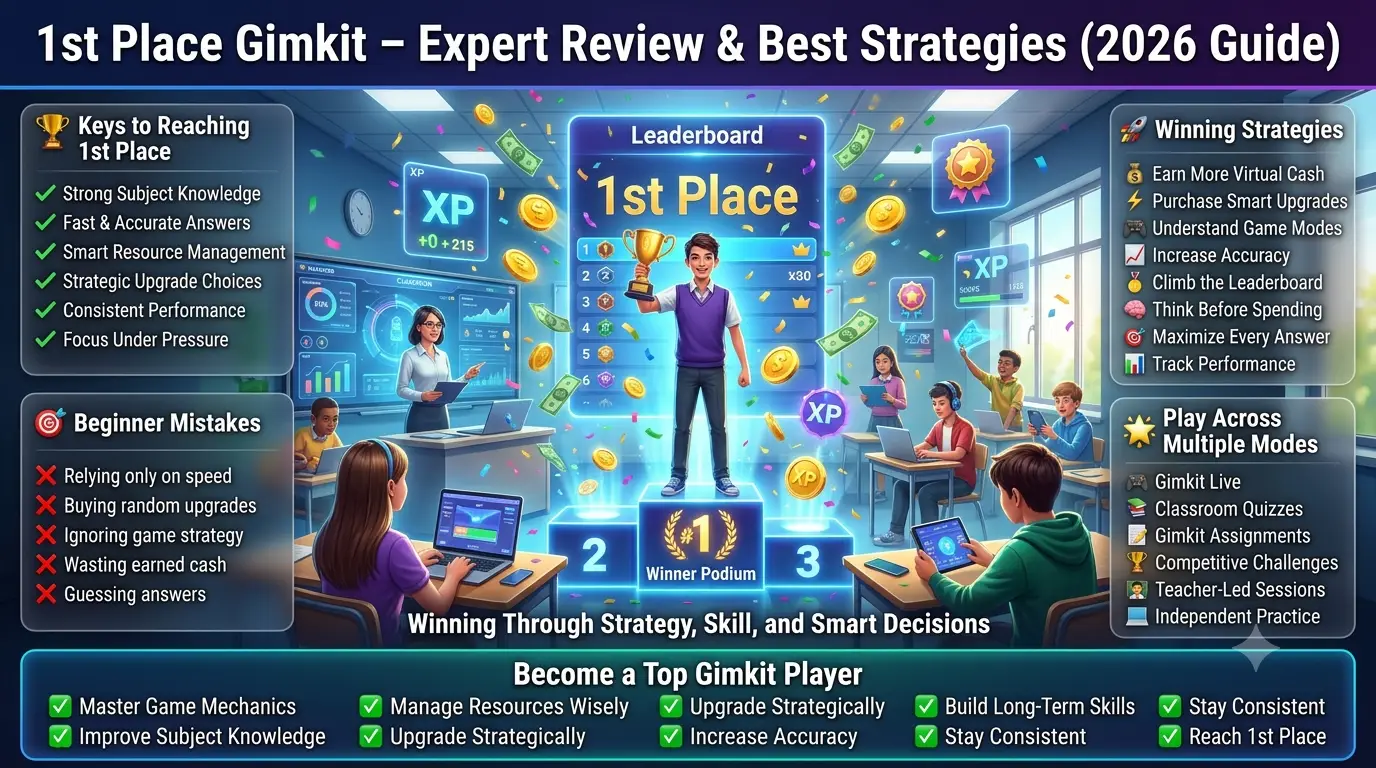
Complete Winning Blueprint for Gimkit Players — Winning consistently in Gimkit is about much more than answering questions correctly. Every successful player develops a strategy that matches the game mode, manages resources wisely, adapts to opponents, and makes smart decisions throughout each match. While knowledge remains important, experienced players know that timing, upgrades, risk management, and understanding game mechanics often separate the winners from everyone else.
Whether you’re a beginner trying to improve your first few matches or an experienced player looking to dominate every Gimkit Games session, having a structured approach makes a noticeable difference. Different game modes reward different styles of play, so learning flexible strategies is far more valuable than relying on luck or speed alone.
This guide explores practical methods used by successful players, explains how to adapt your tactics in every Gimkit Mode, highlights common mistakes, and shares expert recommendations that help maximize performance across classrooms and competitive matches. Along the way, you’ll also discover strategies that benefit both Gimkit Students and Gimkit Teachers who want more engaging and rewarding gameplay.
Understand the Objective Before the Game Starts
Many players immediately focus on answering questions without fully understanding the objective of the current game mode. This often results in wasted opportunities and poor resource management.
Each game type rewards different behaviors. Some prioritize earning the highest amount of virtual cash, while others reward survival, teamwork, territory control, or long-term planning. Reading the game rules carefully before the match begins allows players to build a strategy that aligns with the victory condition rather than simply answering as many questions as possible.
Different Goals Require Different Strategies
Game Objective
Best Strategy
Highest Money
Invest in upgrades early
Team Victory
Support teammates consistently
Survival
Avoid unnecessary risks
Territory Control
Focus on expansion timing
Collection-Based Modes
Prioritize efficiency over speed
Before Every Match, Check
Win condition
Available upgrades
Game timer
Special abilities
Team or solo format
Map mechanics
Resource limitations
Expert Insight
Professional players never enter a match without understanding how victory is calculated. The strongest strategy always begins with knowing exactly what the game rewards.
Build a Strong Opening Strategy
The first few minutes often determine how successful the rest of the match will be. Players who establish momentum early typically enjoy better upgrade opportunities later.
Instead of rushing to purchase expensive upgrades immediately, focus on building a reliable income source. Consistent earnings provide flexibility throughout the match and reduce the impact of mistakes.
Recommended Early Priorities
Priority
Why It Matters
Correct Answers
Creates steady income
Income Upgrade
Improves long-term earnings
Accuracy
Prevents unnecessary losses
Observation
Understand opponent behavior
Common Opening Mistakes
Buying expensive upgrades too early
Ignoring passive income
Guessing answers randomly
Chasing opponents immediately
Spending all available currency
Master the Upgrade Economy When the Mode Offers Upgrades
One of the biggest differences between average and advanced players is how they spend their resources. Every purchase should support a long-term objective rather than provide only short-term satisfaction.
In many Gimkit Games, income-generating upgrades outperform flashy offensive upgrades during the early and middle stages of the game.
Smart Investment Strategy (for modes with an upgrade economy)
Stage
Best Investment
Early Game
Income boosts
Mid Game
Balanced upgrades
Late Game
High-impact abilities
Professional Recommendation
Think of upgrades as investments rather than purchases. Every upgrade should help generate more value before the match ends.
Adapt Your Strategy to Different Gimkit Modes
Not every strategy works across every game mode. Successful players quickly identify what type of match they’re playing and adjust accordingly.
Strategy Comparison
Game Style
Recommended Focus
Solo
Personal efficiency
Team
Communication
Competitive
Risk management
Fast-Paced
Decision speed
Long Matches
Economy building
For example, aggressive play may work well in one Gimkit Mode, while careful planning may dominate another. Flexibility consistently outperforms rigid strategies.
Adapt Faster by Watching
Timer changes
Scoreboard movement
Upgrade trends
Opponent positioning
Team performance
Resource availability
Balance Speed with Accuracy
Many players believe answering quickly guarantees victory. In reality, accuracy usually generates more value over the course of an entire match.
Incorrect answers waste valuable time, reduce earning opportunities, and delay important upgrades. A slightly slower but highly accurate player frequently outperforms someone rushing through every question.
Speed vs Accuracy
Approach
Long-Term Result
Fast but inaccurate
Unstable progress
Moderate and accurate
Consistent growth
Extremely slow
Missed opportunities
Balanced
Best overall performance
Improve Both Skills
Read questions completely.
Avoid unnecessary guessing.
Practice common topics.
Learn from previous mistakes.
Build confidence through repetition.
Observe Your Opponents Like a Strategist
Winning isn’t only about your own performance. Watching how other players behave provides valuable information that helps you make better decisions.
Notice whether competitors are saving resources, purchasing upgrades aggressively, or focusing on answering questions quickly. These patterns often reveal their overall strategy.
Signs to Watch
Behavior
Possible Strategy
Frequent upgrades
Economy focus
Constant movement
Objective hunting
Rapid scoring
Strong knowledge base
Minimal spending
Saving for expensive upgrades
Understanding these habits allows you to react intelligently rather than relying solely on your own plan.
Winning Tips Checklist
✔ Learn every game’s objective before starting.
✔ Build income before expensive upgrades.
✔ Spend resources with a long-term mindset.
✔ Adapt to each Gimkit Mode instead of repeating one strategy.
✔ Prioritize accuracy over reckless speed.
✔ Study opponent behavior throughout the match.
✔ Review previous games to identify improvement opportunities.
✔ Stay flexible as conditions change.
Advanced Mid-Game Decision Making That Separates Average and Expert Players
The middle stage of a match is where most games are won or lost. By this point, nearly every player has unlocked upgrades, earned a steady income, and settled into a preferred strategy. Continuing with the same approach from the opening phase often leads to slower progress because the game’s economy and competition have changed.
Experienced players constantly evaluate their position instead of following a fixed plan. They monitor their earnings, compare progress with competitors, and adjust investments based on the current situation. This adaptability creates a stronger advantage than simply answering questions faster.
Mid-Game Decision Priorities
Situation
Best Response
Why It Works
Strong income but low score
Invest in scoring upgrades
Converts economy into points
Leading comfortably
Protect momentum
Reduces unnecessary risks
Falling behind
Increase earning efficiency first
Builds a stronger comeback foundation
Close competition
Upgrade strategically instead of randomly
Maximizes long-term value
Professional Recommendation
Avoid spending resources immediately after earning them. Waiting briefly to compare available upgrades often leads to smarter investments and better overall performance.
Build a Flexible Strategy Instead of Following One Playstyle
Many players lose because they rely on a single strategy regardless of the match conditions. Competitive gameplay rewards flexibility far more than predictability.
A flexible player knows when to prioritize rapid earnings, when to strengthen passive income, and when to focus entirely on maintaining a lead. This ability to shift strategies allows consistent success across different Gimkit Mode experiences.
Signs You Should Change Your Strategy
Your upgrades no longer generate meaningful value.
Opponents begin progressing much faster.
The remaining game time becomes limited.
Team objectives change unexpectedly.
New opportunities appear on the map.
Your current approach stops producing results.
Understanding the Economy in Modes That Include Upgrades
Every successful Gimkit Guide emphasizes that virtual money is a resource, not the final objective. Players who spend efficiently throughout the match usually outperform those who simply collect the most currency.
Think of every purchase as an investment expected to generate future returns. Some upgrades improve immediate performance, while others continue producing benefits for the remainder of the game.
Upgrade Evaluation Framework
Upgrade Type
Early Value
Mid Value
Late Value
Passive Income
Excellent
Good
Limited
Accuracy Bonuses
Good
Excellent
Excellent
High-Cost Boosts
Low
Good
Excellent
Utility Upgrades
Moderate
High
High
Expert Insight
Instead of asking, “Can I afford this upgrade?” ask, “Will this upgrade earn back its cost before the game ends?” This simple mindset dramatically improves long-term decision-making.
Risk vs Reward: Knowing When Aggressive Play Makes Sense
Aggressive decisions can create huge advantages, but poor timing often causes players to lose momentum. Understanding risk management is one of the most overlooked skills in competitive Gimkit Games.
Not every opportunity deserves immediate action. Evaluate whether the potential reward justifies the resources or time required.
Risk Assessment Table
Decision
Risk Level
Potential Reward
Saving for expensive upgrades
Medium
High
Constant small upgrades
Low
Moderate
Ignoring passive income
High
Low
Balanced investment strategy
Low
High
Before Taking a Risk, Consider
Remaining match duration
Current leaderboard position
Upgrade availability
Opponent progression
Team objectives
Resource reserves
Reading the Leaderboard Like a Competitive Player
The leaderboard provides valuable strategic information rather than simply showing rankings. Successful players interpret trends instead of focusing only on positions.
Rapid movement may indicate that another player has unlocked powerful upgrades. Stable rankings often suggest balanced gameplay, while sudden jumps reveal changing momentum.
What Leaderboard Patterns Reveal
Observation
Possible Meaning
One player climbing rapidly
Strong economy or high accuracy
Several players grouped closely
Opportunity to gain an advantage
Frequent position changes
Highly competitive match
Large score gap
Leader likely invested efficiently early
Monitoring these trends helps determine whether you should maintain your strategy or adapt before it’s too late.
Manage Time as Carefully as Resources
Time is one of the few resources that cannot be recovered. Every unnecessary pause reduces the number of questions answered and limits upgrade opportunities.
Elite players create efficient routines that minimize hesitation. They move smoothly between answering questions, purchasing upgrades, and evaluating the game without unnecessary delays.
Time Management Checklist
Read questions carefully without overthinking.
Purchase upgrades during natural pauses.
Avoid repeatedly opening menus.
Stay focused on the current objective.
Limit distractions during gameplay.
Plan your next upgrade before you can afford it.
Develop Pattern Recognition for Faster Decisions
Pattern recognition allows experienced players to make accurate decisions more quickly because they recognize familiar situations.
After many matches, players begin identifying common upgrade paths, scoring trends, and opponent behaviors. Recognizing these patterns reduces decision fatigue and improves consistency.
Common Gameplay Patterns
Pattern
Recommended Response
Early economy-focused opponents
Prepare for stronger late-game competition
Fast scoring with few upgrades
Invest in sustainable growth
Slow but steady progression
Expect consistent improvement
Frequent aggressive spending
Watch for temporary momentum swings
Recover Quickly After Falling Behind
Every competitive player experiences difficult matches. The difference between average and advanced players is how they respond after losing momentum.
Instead of making desperate decisions, rebuild your economy carefully and identify opportunities where competitors become inefficient. Many matches are won through disciplined recoveries rather than perfect starts.
Recovery Workflow
Stop making emotional upgrade purchases.
Rebuild reliable income.
Focus on high-value questions.
Compare your progress with the leaderboard.
Upgrade only when the investment creates measurable value.
Continue improving steadily instead of chasing quick results.
Recovery Priority Table
Problem
First Solution
Low income
Improve earning efficiency
Poor accuracy
Slow down slightly
Weak upgrades
Invest strategically
Lost momentum
Focus on consistency
Large score deficit
Avoid unnecessary risks
Winning Team Games Through Coordination Instead of Individual Performance
Success in team-based Gimkit Classroom activities depends on coordination more than individual brilliance. Teams that communicate effectively often outperform groups with stronger individual players.
Assigning informal roles, sharing observations, and supporting teammates creates a more balanced strategy throughout the match.
Effective Team Habits
Encourage consistent communication.
Avoid duplicating responsibilities.
Share useful observations.
Adapt when teammates struggle.
Focus on collective success instead of individual rankings.
Maintain positive teamwork throughout the game.
Team Strategy Comparison
Team Habit
Match Impact
Clear communication
Faster decisions
Shared objectives
Better coordination
Balanced participation
Stable progress
Positive encouragement
Improved consistency
Master Every Gimkit Game Mode with the Right Strategy
One of the biggest reasons players experience inconsistent results is treating every game mode the same. Each mode changes the flow of gameplay, scoring opportunities, upgrade priorities, and player interactions. Learning how objectives influence decision-making helps you perform well regardless of which Gimkit Games session you join.
Rather than memorizing one strategy, develop a framework that adapts to different mechanics. This approach builds long-term skill and prepares you for new modes released in future updates.
Strategy Priorities by Game Style
Game Style
Primary Focus
Secondary Focus
Common Mistake
Economy-Based
Passive income
Upgrade timing
Spending too early
Team-Based
Coordination
Balanced roles
Playing individually
Survival
Resource conservation
Smart movement
Taking unnecessary risks
Objective-Based
Mission completion
Efficient scoring
Ignoring objectives
Competitive Race
Consistency
Speed with accuracy
Guessing answers
Professional Recommendation
Before each match starts, spend a few seconds identifying what the game rewards most. Your entire strategy should revolve around that objective.
Develop an Upgrade Path Only When Purchases Are Available
Top-performing players rarely purchase upgrades simply because they become available. They follow a structured progression that maximizes value from the beginning of the game until the final seconds.
An organized upgrade path creates stronger income growth, more efficient scoring, and fewer wasted resources.
Example Upgrade Progression
Match Phase
Priority
Opening Minutes
Income generation
Early Mid Game
Balanced earnings and scoring
Mid Game
Efficiency improvements
Late Mid Game
High-value upgrades
Final Stage
Maximum scoring potential
Smart Upgrade Principles
Buy upgrades that continue producing value.
Avoid emotional purchases after losing points.
Compare upgrade costs with expected returns.
Think several purchases ahead instead of one.
Save resources when a stronger upgrade is close.
Improve Decision-Making Under Time Pressure
Many players know the correct strategy but struggle to apply it while the game is moving quickly. Strong decision-making comes from simplifying choices before the pressure begins.
Create personal rules that reduce hesitation. Instead of evaluating every option from scratch, rely on a consistent decision process.
Fast Decision Checklist
✔ Is this upgrade worth its cost?
✔ Will it help before the game ends?
✔ Does it match the current objective?
✔ Am I reacting emotionally or strategically?
✔ Is there a better investment available soon?
Following a repeatable checklist helps eliminate rushed decisions that often reduce overall performance.
Learn How Momentum Changes the Outcome of a Match
Momentum is one of the most important yet least discussed aspects of competitive gameplay. Players who establish positive momentum often maintain control because each successful decision creates additional opportunities.
Likewise, poor decisions can trigger negative momentum, making recovery more difficult.
Positive Momentum Indicators
Indicator
Meaning
Frequent upgrade purchases
Strong economy
Consistent correct answers
Reliable scoring
Stable leaderboard climb
Efficient strategy
Growing resource balance
Long-term advantage
Protect Your Momentum
Continue using strategies that are working.
Avoid unnecessary risks while leading.
Upgrade consistently instead of impulsively.
Stay focused during the final minutes.
Advanced Resource Allocation Techniques
Resources include more than virtual money. Time, attention, upgrade opportunities, and question accuracy all contribute to overall success.
Elite players distribute these resources carefully throughout the match rather than exhausting them too early.
Resource Management Matrix
Resource
Best Use
Money
High-return upgrades
Time
Efficient answering
Attention
Monitoring objectives
Accuracy
Sustainable earnings
Opportunities
Strategic investments
Expert Insight
Players often concentrate only on earning more currency. High-level gameplay focuses equally on protecting every resource that contributes to winning.
Use Performance Analysis After Every Match
Improvement happens between games, not only during them. Reviewing completed matches allows you to identify recurring habits and make meaningful adjustments.
Instead of asking why you lost, examine which decisions produced the biggest impact.
Post-Match Review Questions
Which upgrades delivered the most value?
Where did resources get wasted?
Did I adapt to changing conditions?
Were incorrect answers caused by rushing?
Did I follow my planned strategy?
What would I repeat next game?
What should I change immediately?
Keeping a simple review routine accelerates improvement over time.
Avoid Strategic Mistakes That Experienced Players Never Make
Many losses result from preventable habits rather than difficult competition. Eliminating common mistakes is often easier than learning advanced techniques.
Frequent Strategic Errors
Mistake
Better Alternative
Constant upgrade switching
Commit to a structured plan
Ignoring passive income
Build sustainable growth
Playing too aggressively
Balance risk and reward
Watching only your score
Monitor the entire leaderboard
Buying upgrades impulsively
Evaluate long-term value
Best Practice Checklist
Stay patient during slow starts.
Invest consistently.
Track overall match progress.
Adapt when necessary.
Learn from every completed game.
Build Long-Term Skills Instead of Searching for Shortcuts
Players often search for instant success through Gimkit Hacks, but lasting improvement comes from developing transferable skills. Strong game awareness, efficient decision-making, and disciplined resource management remain valuable across every update and future game mode.
The most successful players focus on improvement rather than shortcuts because core skills continue producing results even when game mechanics evolve.
Skills That Continue Paying Off
Critical thinking
Strategic planning
Reading game situations
Adaptability
Focus management
Time efficiency
Resource optimization
Team communication
Consistent practice
Self-analysis
Create a Personal Improvement Routine
Consistent improvement rarely happens by accident. Establishing a repeatable routine helps transform occasional success into reliable performance across every Gimkit Play session.
Weekly Improvement Plan
Practice Area
Goal
Accuracy
Reduce avoidable mistakes
Upgrade Decisions
Improve investment timing
Game Awareness
Read leaderboard more often
Adaptability
Adjust strategy each match
Review
Analyze completed games
Daily Practice Habits
Play with a specific improvement goal.
Focus on one weakness at a time.
Review successful strategies.
Practice different game modes.
Experiment with upgrade sequences.
Avoid repeating ineffective habits.
Expert Workflow for Consistent Winning Performance
Professional-level consistency comes from following a structured workflow before, during, and after every match.
Pre-Match
Understand the objective.
Review the game mode.
Set a strategy.
Eliminate distractions.
During the Match
Build economy efficiently.
Monitor competitors.
Upgrade strategically.
Stay adaptable.
Protect momentum.
After the Match
Review performance.
Identify mistakes.
Record lessons learned.
Apply improvements in the next game.
Expert Reviews for you to understant advance experience
Complete Winning Blueprint for Gimkit Players begins with mastering the subject material before focusing on advanced gameplay strategies. Strong academic knowledge remains the foundation of consistent success in every game mode.
Complete Winning Blueprint for Gimkit Players encourages players to understand the rules and objectives of each game mode before the match begins. A clear strategy is always more effective than reacting randomly.
Complete Winning Blueprint for Gimkit Players emphasizes prioritizing answer accuracy over raw speed. Consistently correct answers generate better long-term results than rushing and making avoidable mistakes.
Complete Winning Blueprint for Gimkit Players recommends establishing an upgrade strategy early in the match instead of purchasing items impulsively. Planned progression creates stronger momentum throughout the game.
Complete Winning Blueprint for Gimkit Players highlights the importance of managing in-game resources carefully, ensuring every investment supports your overall gameplay objectives.
Complete Winning Blueprint for Gimkit Players encourages players to remain focused from the first question until the match ends because every correct answer contributes to long-term success.
Complete Winning Blueprint for Gimkit Players demonstrates that experienced players adapt their tactics according to the current game mode, classroom settings, and match objectives.
Complete Winning Blueprint for Gimkit Players recommends learning from previous matches by reviewing mistakes, identifying successful strategies, and refining future gameplay decisions.
Complete Winning Blueprint for Gimkit Players emphasizes maintaining consistent participation rather than relying on occasional high-scoring moments that are difficult to sustain.
Complete Winning Blueprint for Gimkit Players encourages players to build confidence gradually through regular practice and continuous improvement instead of expecting immediate mastery.
Complete Winning Blueprint for Gimkit Players highlights that efficient resource management creates opportunities for stronger upgrades and improved scoring throughout the match.
Complete Winning Blueprint for Gimkit Players recommends balancing competitive gameplay with educational goals, ensuring knowledge retention remains the highest priority.
Complete Winning Blueprint for Gimkit Players demonstrates that strategic patience often produces better outcomes than aggressive decision-making during the early stages of a match.
Complete Winning Blueprint for Gimkit Players encourages players to remain calm after incorrect answers, quickly refocusing on the next opportunity instead of becoming distracted.
Complete Winning Blueprint for Gimkit Players highlights the importance of recognizing gameplay patterns, allowing experienced players to make faster and more informed strategic decisions.
Complete Winning Blueprint for Gimkit Players recommends maintaining an organized study routine outside gameplay because stronger subject knowledge naturally improves in-game performance.
Complete Winning Blueprint for Gimkit Players demonstrates that adapting to changing leaderboard positions is more effective than chasing competitors through unnecessary risks.
Complete Winning Blueprint for Gimkit Players encourages players to strengthen weaker academic areas through repeated practice, creating more consistent performance across every subject.
Complete Winning Blueprint for Gimkit Players highlights that reviewing classroom feedback and performance reports helps identify opportunities for continued improvement.
Complete Winning Blueprint for Gimkit Players recommends minimizing distractions during gameplay so concentration remains focused on answering questions accurately and making strategic decisions.
Complete Winning Blueprint for Gimkit Players demonstrates that long-term success is achieved through disciplined practice, thoughtful planning, and continuous adaptation rather than relying on luck.
Complete Winning Blueprint for Gimkit Players encourages players to develop efficient gameplay habits that improve consistency across both short classroom activities and longer competitive sessions.
Complete Winning Blueprint for Gimkit Players highlights that flexibility is one of the defining characteristics of highly successful players, allowing them to adjust strategies whenever game conditions change.
Complete Winning Blueprint for Gimkit Players recommends treating every match as both a learning opportunity and a chance to improve strategic thinking, resource management, and decision-making.
Complete Winning Blueprint for Gimkit Players ultimately demonstrates that becoming a consistently successful player requires far more than answering questions correctly. By combining strong academic preparation, accurate responses, disciplined resource management, strategic upgrades, continuous self-evaluation, adaptability across different game modes, and a commitment to steady improvement, players can maximize both their classroom performance and their long-term success in Gimkit.
Most Frequently Asked Faqs
What Is the Optimal Phase-by-Phase Blueprint for a Standard 10-Minute Match?
Most competitive Gimkit Games follow a predictable rhythm. Dividing a 10-minute match into phases helps you make better decisions instead of reacting randomly. While individual Gimkit Mode mechanics vary, this blueprint works well for economy-focused and scoring-based matches.
Complete 10-Minute Match Blueprint
Match Phase
Time
Primary Objective
Secondary Objective
Biggest Mistake
Phase 1
0–2 Minutes
Build initial economy
Maintain high accuracy
Buying expensive upgrades too soon
Phase 2
2–4 Minutes
Increase passive earnings
Unlock efficient upgrades
Ignoring return on investment
Phase 3
4–7 Minutes
Convert economy into scoring power
Watch leaderboard trends
Following the same strategy without adapting
Phase 4
7–9 Minutes
Maximize scoring efficiency
Reduce downtime
Saving currency unnecessarily
Final Push
Last Minute
Spend remaining resources wisely
Protect your lead or make a comeback
Holding cash after the match ends
Phase 1: Build a Strong Foundation
The opening minutes determine your earning potential for the rest of the game. Prioritize accuracy and upgrades that improve long-term income rather than immediate rewards.
Objectives
Maintain near-perfect accuracy.
Buy high-value economy upgrades.
Avoid risky decisions.
Observe how quickly opponents progress.
Phase 2: Accelerate Your Economy
Your focus shifts from simply earning money to increasing the rate at which future earnings grow.
Checklist
Upgrade income consistently.
Eliminate unnecessary spending.
Prepare for stronger scoring upgrades.
Watch the leaderboard every 30–60 seconds.
Phase 3: Transition Into Winning Position
This is the phase where experienced players separate themselves from the field.
Instead of endlessly collecting money, begin converting your economic advantage into points and objective progress.
Decision Matrix
If You’re…
Best Action
Leading
Maintain efficiency and avoid unnecessary risks
Close Behind
Increase scoring upgrades
Far Behind
Improve economy before chasing points
Playing Teams
Support the team objective over individual ranking
Phase 4: Push for Maximum Efficiency
With only a few minutes remaining, passive upgrades become less valuable. Shift toward upgrades that provide immediate benefits.
Final Minute Strategy
Spend remaining currency.
Eliminate hesitation.
Focus on accuracy.
Ignore distractions.
Finish every possible question before time expires.
What Physical Setup and Hotkey Mechanics Do Pro Players Use to Maximize Speed?
Many players concentrate only on strategy while overlooking their physical setup. Small ergonomic improvements reduce reaction time, improve comfort, and help maintain consistent performance during long Gimkit Play sessions.
Recommended Gaming Setup
Component
Best Practice
Monitor
Eye level with minimal glare
Keyboard
Comfortable wrist position
Mouse
Easy reach with adjustable sensitivity
Chair
Upright posture with back support
Lighting
Bright enough to reduce eye strain
Keyboard Position
Professional players keep both hands relaxed instead of constantly reaching across the keyboard.
Recommended habits include:
Keep your dominant hand ready for navigation.
Position your non-dominant hand comfortably for shortcuts.
Avoid excessive mouse movement.
Keep your desk free from clutter.
Useful Workflow Habits
Although Gimkit itself doesn’t rely on complex built-in hotkey systems, experienced players improve speed through efficient computer use.
Speed Optimization Checklist
✔ Close unnecessary browser tabs.
✔ Disable distracting notifications.
✔ Use full-screen mode.
✔ Maintain a stable internet connection.
✔ Use a responsive keyboard.
✔ Reduce background applications.
✔ Keep browser zoom comfortable.
✔ Practice consistent cursor movement.
Expert Insight
Consistency is more valuable than raw speed. Smooth, repeatable movements outperform frantic clicking over an entire match.
How Do I Incorporate the Gimkit Item Shop Cosmetics Into My Strategy?
The Gimkit Item Shop Cosmetics are primarily visual customization options. They allow players to personalize their appearance but generally do not provide gameplay advantages.
However, they can still influence your overall experience and long-term engagement.
Strategic Value of Cosmetics
Cosmetic Benefit
Gameplay Impact
Personal identity
Improves player engagement
Motivation
Encourages regular participation
Recognition
Makes teammates identify you more easily
Collection goals
Adds long-term progression
Smart Cosmetic Strategy
Prioritize gameplay improvements over cosmetic collecting.
Purchase cosmetics because you enjoy them—not because you expect a competitive advantage.
Avoid sacrificing useful gameplay opportunities simply to unlock appearance items.
Professional Recommendation
Treat cosmetics as rewards for progress rather than investments for winning. Strong strategy, accurate answers, and smart upgrade decisions always have a greater impact on match outcomes.
What Is the Ultimate Tactical Blueprint for Winning Co-op or Team-Based Modes?
Team-based Gimkit Classroom sessions reward coordination more than individual performance. Even highly skilled players struggle if every teammate pursues different objectives.
The strongest teams establish simple roles before the match begins.
Example Team Structure
Team Role
Primary Responsibility
Economy Builder
Generate consistent resources
Objective Specialist
Complete map objectives
Support Player
Assist teammates when needed
Flexible Player
Adapt to changing situations
Team Communication Framework
Before the match:
Agree on priorities.
Understand the objective.
Identify player strengths.
During the match:
Share useful observations.
Avoid duplicate tasks.
Help teammates recover.
Communicate changing conditions.
After the match:
Discuss improvements.
Review successful strategies.
Adjust roles for the next game.
Team Coordination Checklist
✔ Stay focused on the shared objective.
✔ Don’t chase individual statistics.
✔ Adapt roles when necessary.
✔ Encourage struggling teammates.
✔ Monitor overall team progress.
✔ Remain flexible throughout the match.
Common Team Mistakes
Mistake
Better Solution
Everyone follows the same task
Divide responsibilities
Poor communication
Share important updates
Ignoring objectives
Prioritize win conditions
Competing with teammates
Support collective success
How Do I Adjust My Blueprint If a Teacher Sets a “Target Cash” Goal Instead of a Time Limit?
A target-cash game changes the entire pacing of a match. Instead of racing against the clock, players compete to reach a financial milestone first. This shifts the emphasis from speed to efficiency and sustainable growth.
In these matches, every upgrade should contribute toward reaching the cash target faster.
Time-Limit vs Target-Cash Strategy
Time-Limit Match
Target-Cash Match
Speed becomes increasingly important
Long-term efficiency becomes more valuable
Late-game upgrades have immediate value
Passive income retains value longer
Spend aggressively near the end
Plan investments carefully throughout
Final-minute sprint
Consistent progression wins
Target Cash Blueprint
Early Stage
Focus almost entirely on building income.
Middle Stage
Increase earning efficiency while avoiding unnecessary purchases.
Late Stage
Spend only when upgrades accelerate progress toward the target.
Decision Priorities
Situation
Recommended Choice
Far from target
Improve economy
Close to target
Increase immediate earning efficiency
Opponents catching up
Balance growth with scoring
Comfortable lead
Avoid risky investments
Expert Strategy
Players often become impatient in target-cash games and start buying upgrades that feel powerful but offer little long-term value. Instead, evaluate each purchase by asking a single question:
“Will this upgrade help me reach the target cash sooner than saving for the next one?”
That mindset consistently leads to stronger resource management and better results.
Professional Blueprint Summary
Elite Gimkit Guide strategies combine mechanical efficiency, economic planning, teamwork, and adaptability rather than relying on a single trick. Whether you’re entering through Gimkit Join, using a Gimkit Code, competing in Gimkit Live, organizing games as a Gimkit Host, reviewing progress in the Gimkit Dashboard, creating a Gimkit Kit, or exploring new Gimkit Activities, the most successful players follow structured phase-based plans, optimize their physical setup, ignore cosmetic distractions during competitive play, coordinate effectively with teammates, and adjust their economy to match the game’s win condition. This systems-based approach creates consistent victories across virtually every type of match.
A mode-specific winning framework that respects the actual rules
The following field examples explain how to make decisions without pretending every Gimkit mode uses the same scoring, upgrade, or movement system. They are educational scenarios, not guaranteed winning formulas. The official mode descriptions and the host’s current settings take priority over any static strategy article.
First identify what winning actually means
A winning plan begins by reading the selected mode’s objective rather than importing habits from another mode. In a question-and-cash activity, a player might care about earning opportunities, purchase timing and the remaining game duration. In a team sport, the scoreboard reflects collective objectives and cooperation. In a platforming challenge, movement, timing and the route through the environment may matter as much as answer accuracy. These are not interchangeable definitions of success. Before play, inspect the Mode Picker description, then ask three questions: What ends the match? What actions create progress? Which decisions can reverse progress? The answers establish a decision hierarchy.
For a short live session, write a one-sentence objective in plain language: ‘We need to reach the goal before time expires while answering enough questions to support movement.’ For a cooperative session, the sentence may instead be ‘We must help everyone reach the exit.’ Avoid copying a universal upgrade order from a video if the selected mode does not have that economy. The teacher’s configured options may change incentives, and some modes have no cash-upgrade path at all. Official Gimkit instructions describe a Mode Picker with descriptive labels and a separate Game Options screen. Treat those screens as the current source of truth for what is available, not an old screenshot.
During the opening minute, observe whether the intended plan actually produces progress. If progress is slower than expected, diagnose the cause before changing everything: unanswered questions, unfamiliar controls, weak communication, or a misunderstood objective require different fixes. This small diagnostic habit prevents the most common strategic mistake: optimizing a number that does not determine the outcome. Winning is a mode-dependent outcome; classroom learning is a separate goal that deserves its own evidence.
Build a reliable answer process before chasing speed
Fast clicking can look impressive while concealing repeated errors. For a learner, the useful sequence is read, retrieve, check the alternatives, commit, and learn from the result. Start by reading the full stem, especially words such as ‘not’, ‘except’, ‘most likely’ and ‘best supported’. If the question includes a unit or time period, keep it visible while comparing answers. Guessing instantly may save seconds on one attempt but creates avoidable losses when incorrect answers carry a cost or interrupt the game loop.
Consider two hypothetical players answering twenty questions. Player A takes four seconds per question with 70 percent accuracy; Player B takes five seconds with 90 percent accuracy. Their raw question throughput differs, but their expected correct answers are fourteen and eighteen. That comparison does not predict a match winner, because the selected mode may reward other actions, yet it demonstrates why speed alone is a poor proxy for productive progress. If the game includes an accuracy penalty, the advantage of careful answering can grow. If there is no penalty and questions are familiar, a quicker approach may be reasonable. The actual trade-off must be observed rather than asserted universally.
A practical drill is to review three recent errors and classify them: knowledge gap, reading slip, or rushed response. A knowledge gap calls for studying the concept; a reading slip calls for slower parsing; a rushed response calls for a deliberate pause before submission. Ask the student to explain one correct answer in their own words. This is more educationally valuable than treating a high score as proof of durable mastery. A useful strategy can support both performance and learning without confusing the two.
Use expected value only where a mode has a real economy
Some Gimkit experiences involve resources, upgrades or purchases; others do not. Where an upgrade is genuinely offered, compare its cost with the expected benefit during the remaining time. A simple hypothetical model is break-even attempts = purchase cost divided by extra expected earnings per successful attempt. Suppose an upgrade costs 120 fictional credits and yields 8 extra credits for each correct response. At 80 percent accuracy, the expected extra earnings per attempt are 6.4 credits, so the break-even point is about nineteen attempts. If the player expects only ten more attempts, the purchase may not recover its cost.
This is a teaching model, not a claim about Gimkit’s current prices or formulas. Actual mode rules, multipliers, penalties, resource caps and purchasing conditions may be different. A model becomes useful when a student can state its assumptions and recognize when those assumptions fail. If an upgrade changes movement, survival, access or team support rather than cash, a simple earnings equation is not sufficient. The benefit may be strategic, qualitative, or contingent on another player’s actions. In those situations, compare scenarios instead of inventing a numerical conversion.
Players should distinguish sunk cost from a new decision. Once a purchase has been made, the money already spent cannot be recovered by stubbornly continuing a failing plan. Ask what the next unit of time or resource can accomplish from this point forward. A player who is behind can still improve by changing how future opportunities are used, but not by pretending earlier spending never happened. For further mode-specific calculations, the site’s guide to upgrade order and break-even decisions examines this narrower question.
Plan for the final third instead of repeating the opening
The value of an action can change as the match approaches its endpoint. An investment that is sensible with fifteen minutes remaining may be unhelpful with ninety seconds remaining. A team that needs one final objective should prioritize coordination over collecting optional resources. A platforming player near a checkpoint may need precision rather than reckless speed. This is why a complete blueprint includes a transition rule, not just a strong start.
Use three phases as a planning aid: establish the objective, build sustainable progress, and close toward the actual finish condition. The phases need not have equal durations. In a ten-minute session, a teacher might ask students to observe the first two minutes, reassess around the middle, and focus on completion near the end. Those times are illustrative, not official Gimkit rules. Players can make the transition based on what they see: the countdown, distance to a goal, remaining resources, or team status. Avoid switching to aggressive play merely because another player’s score is visible; the leaderboard may not capture all relevant information.
A good late-game question is: ‘What action has the highest probability of helping us meet the objective before the match ends?’ Sometimes that means answering more carefully, sometimes helping a teammate, sometimes avoiding a risky shortcut. The answer is specific to the current mode. The related guide on adapting strategy during a live game explores the moment-by-moment diagnostic process in greater detail.
Fishtopia: separate the question loop from fishing decisions
Fishtopia is a useful example of a mode where the question loop supports other actions. The official Game Options guidance describes bait earned per correct question as one adjustable balance setting. This means a player should understand the connection between answering and the next fishing opportunity. However, an answer does not automatically translate into a fixed amount of progress in every session: host settings and current mode behavior matter. Before using a detailed fishing tactic, check what the game actually rewards and how the current session ends.
Imagine a player with limited time who has accumulated enough bait for several attempts. The immediate decision is not simply ‘answer as many questions as possible’; it may be whether to use existing bait, obtain more, or move toward another location. An efficient plan considers the opportunity cost of each action. A novice who spends most of the session wandering without understanding the objective can lose valuable practice time, while a player who only answers questions may neglect the mode’s actual finish condition. Neither behavior is universally optimal. The correct choice depends on the visible rules and remaining time.
Teachers can use this example to ask students to articulate a resource flow: question response, earned opportunity, chosen action, observed outcome. This turns a game mechanic into a discussion of decisions under constraints. It does not make fishing performance an academic assessment. The site’s Fishtopia topic guide provides the broader mode context, while the official 2D Game Balance documentation explains why host settings can change the pace of question-supported play.
Snowbrawl: understand the cost of an action before using it
Snowbrawl has a different objective from a cash-economy game. Gimkit’s official mode instructions describe answering questions to earn snowballs and using projectile controls to knock out other players. They also describe items such as Shield Cans and Med Packs within that mode. A sensible strategy therefore includes two distinct skills: maintaining access to the question-supported resource and making purposeful decisions about when to use it. Neither skill alone guarantees a win.
A player who fires every available projectile without aiming may exhaust opportunities and need to return to answering questions. Another player may hoard projectiles so long that the match ends before they use them. The productive middle ground depends on positioning, accuracy, the current score and remaining time. Students can practice asking: Is there a realistic target? Would repositioning help? Is it better to replenish now? Are we making progress toward the actual knockout objective? These are game-specific questions, not universal advice to attack aggressively.
For a classroom, competition should remain respectful. Teachers should clarify expectations about language, frustration and sportsmanship before the session. If a mode’s intensity is not appropriate for a particular group, the Mode Picker provides other experiences with different labels and pacing. Students who struggle with fine motor controls may need an alternative participation route. The strategy discussion should never imply that every student must demonstrate identical motor speed to be a successful learner.
One Way Out: coordinate an entire group, not a single star
One Way Out is officially described as a collaborative spaceship escape. Players answer questions to earn energy, explore, collect items, confront obstacles and work together toward the escape pods. Its key strategic lesson is that a strong individual run does not replace the group’s shared completion requirement. If one teammate is lost or unable to progress, the team should identify what support is possible rather than simply accelerating the fastest player.
A practical communication pattern is ‘location, obstacle, needed help, next action’. One player might report that a gate requires a key, another that a route is blocked, and another that they can assist. Short, concrete updates are more useful than simultaneous shouting. Teachers can assign rotating communication roles, but these are independent classroom facilitation suggestions, not built-in Gimkit role settings. A navigator might describe the route, a checker might confirm instructions, and a supporter might notice who has fallen behind. Rotate roles so that quieter students are not permanently relegated to observation.
The group should stop periodically to ask whether everyone understands the objective and controls. A student who has never used the movement keys may need a short demonstration, not a more elaborate strategic plan. In an instructional setting, the teacher can observe teamwork separately from content accuracy. One Way Out is an excellent illustration of why a leaderboard or finish time cannot by itself measure each student’s conceptual understanding. The official mode guide provides the current gameplay description and host options.
Don’t Look Down: manage precision and checkpoints
Don’t Look Down is a platforming experience with a climb toward the top. The official guide describes movement, jumping, the risk of falling and the relationship between answering questions and the energy needed to move. It also notes that checkpoints are off by default in the documented setup. A player who assumes the game behaves like a standard cash-and-upgrade loop will miss the actual performance constraints.
A strong practice routine separates movement mechanics from academic questions. First, understand the controls and the shape of a jump. Then practice reaching a stable platform without unnecessary risk. Finally, use question-supported energy intentionally, keeping enough attention available for accurate answers. When a player falls, the useful question is not ‘How do I go faster?’ but ‘Which decision or movement failed, and can I change that single element?’ The response might involve a different approach angle, a better-timed jump or more patient movement. The precise action depends on the current map and control scheme.
Teachers should avoid treating platforming proficiency as evidence of subject knowledge. Two students can answer the same questions equally well and finish at different heights because of movement experience or accessibility needs. If the purpose of the lesson is retrieval practice rather than motor skill, consider a less movement-intensive mode. This is a concrete example of aligning the mode with the learning objective rather than rewarding the most visually dramatic outcome.
Team play: make coordination observable and fair
Team strategy requires more than telling players to cooperate. It works when everyone knows the shared goal, the communication channel and what contribution looks like. In Blastball, for example, Gimkit’s official instructions describe two teams trying to move a ball toward the opponent’s goal using blasts earned through questions. The team may need offense, defense and awareness of positioning. Those functions can emerge dynamically; they are not proof that the platform has fixed classroom role controls.
Before a team match, agree on two concise communication norms: report useful information and avoid blaming individuals for mistakes. During play, one teammate can call out an open path while another checks the team’s defensive position. In the classroom, the teacher should monitor whether the same confident students dominate all decisions. A simple observation sheet can record who made a suggestion, who responded constructively and who had a chance to participate. It is not a psychological diagnosis or a validated collaboration scale; it is a practical prompt for reflection.
Afterward, ask every student to describe one contribution and one moment when they changed course after hearing a teammate. The answers can reveal collaboration patterns that the final score conceals. For additional detail on cooperation rather than pure scoring, see team-based gameplay and shared objectives. If students are anxious about competition, offer a collaborative or calming experience instead of assuming that all learners respond positively to head-to-head play.
Use the leaderboard carefully rather than worshipping it
A leaderboard is a compact summary of performance within a particular activity. It is not a complete model of knowledge, fairness or effort. In a mode with movement, upgrades, random events or cooperation, ranking can reflect multiple influences. A student who answers carefully but moves slowly may appear behind a faster player. A teammate who provides essential support may have less visible individual credit. The sensible response is to interpret the displayed numbers in context.
If the leader has a large advantage, ask what is actually causing it. A higher score could reflect more completed objectives, better use of a resource, greater familiarity with controls or a strong start. The visible rank rarely identifies the cause by itself. Avoid claiming that a specific player must have purchased a particular upgrade or found a secret mechanic. Instead, compare your own measurable choices over time: number of accurate responses, repeated errors, time spent idle, or whether the team’s goal moved closer. Keep the measures simple enough to support decisions during play.
For teachers, use the official Game Reports view where available rather than relying only on the leaderboard. Gimkit documents Student Overview, General Overview and Question Breakdown in reports after a hosted kit. These views support more careful follow-up, but they still require interpretation. A class discussion or short independent explanation can test understanding beyond the game. The site’s guide to reading Gimkit reports covers that instructional purpose.
Troubleshoot a bad match without blaming the learner
Sometimes a poor result comes from conditions outside strategy. A device may lag, a network may drop, the controls may be unfamiliar or a student may join late. A player who repeatedly loses time to connectivity issues should not be told to ‘practice harder’ before the technical problem is addressed. Check whether the game is responsive, whether other sites are loading normally and whether the participant understands the selected mode’s input requirements. If a problem affects several players, the host may need to adjust the activity rather than treating each learner as an individual failure.
A sensible recovery sequence is to pause the competitive interpretation, identify the symptom, try a minimal safe correction and resume only when the participant can act normally. Examples include closing unnecessary browser tabs, confirming a stable connection or selecting a less demanding activity. Do not suggest bypassing school security filters, changing protected network settings or installing unverified software. If a session must continue while one student cannot participate, provide an alternative practice opportunity so the learner is not penalized for access constraints.
When reviewing results, distinguish ‘did not know the answer’ from ‘could not access the question’. A teacher who uses the report as a diagnostic aid should document any interruption that may explain missing or low-quality evidence. This protects the fairness of feedback and keeps the focus on learning. A strategy blueprint that ignores the reliability of the environment is incomplete, no matter how sophisticated its calculations appear.
Turn one session into a repeatable improvement cycle
The most useful long-term habit is a short review that produces one specific next action. Immediately after play, ask what the objective was, which decision helped, which decision failed and what evidence supports those judgments. Avoid long lists of vague lessons such as ‘try harder’ or ‘be smarter’. A precise action might be ‘read negative question stems twice’, ‘check the objective before buying resources’ or ‘tell teammates when I find a blocked route’. Each action is observable in the next session.
Keep a compact personal log with four columns: date and mode, intended decision, observed result, and next experiment. Do not collect other students’ private information. After several sessions, look for a repeated pattern. If accuracy improves but ranking does not, the issue may be mode mechanics rather than knowledge. If a player repeatedly misses the same concept, more game time may not solve it; targeted explanation and practice may be needed. The log is a self-reflection aid, not a formal assessment instrument.
A teacher can adapt the same cycle for the class by selecting one frequently missed question and asking learners to explain the correct reasoning. Then choose a different practice opportunity to see whether understanding transfers. This prevents a winning blueprint from becoming a narrow pursuit of points. It also provides a meaningful bridge between the excitement of the game and the educational objective that justified using it in the first place.
Ethical competition, inclusion and healthy boundaries
Winning is a legitimate game objective, but a classroom has additional responsibilities. Every student should have a reasonable opportunity to participate, including those who read more slowly, use accessibility accommodations, have limited device familiarity or prefer less intense competition. Teachers should check the Mode Picker for appropriate labels, adjust available options and consider whether an alternative activity would serve the lesson better. No single game mode is suitable for every group or every learning objective.
Set expectations that players will not ridicule mistakes, share personal information or pressure classmates to disclose scores. Avoid creating a permanent public ranking of students based on one match. If a learner is distressed, it is appropriate to change the activity or offer another way to demonstrate knowledge. Participation should not require exposing private account credentials. Gimkit’s official Account FAQ says students can join live games without creating an account; the host can share the approved joining route. Classroom privacy policies still apply.
A helpful closing question is whether the activity produced evidence worth discussing. A high-energy game can be enjoyable without proving that students learned more than they would through another method. Conversely, a calm session with thoughtful answers may achieve an excellent learning purpose without a dramatic leaderboard. Keep performance goals and instructional goals visible side by side, and judge each with appropriate evidence.
Interactive expected-value sandbox for hypothetical upgrade decisions
This local calculator illustrates a break-even idea only for an activity with a genuine per-correct-answer earning mechanic. It does not connect to Gimkit or know the rules of the current mode. A result cannot predict your position on a leaderboard, and the assumptions should be checked against the actual game.