What Is a Gimkit Ontology | Gimkit is easier to understand when it is viewed as more than a collection of classroom games.
A teacher may create a Kit, organize questions and answers, select a Game Mode, host a live game, connect students through Classes, assign independent work, and later review results through reports. Students, meanwhile, interact with questions through activities that have their own rules, goals, and learning context.
These are not completely separate pieces.
They are connected parts of a larger educational system.
This is where the idea of an ontology becomes useful.
In knowledge representation, an ontology provides a structured way to describe the important concepts within a domain, the characteristics associated with those concepts, and the relationships between them. Formal ontology technologies such as the W3C Web Ontology Language (OWL) work with concepts such as classes, individuals, properties, and relationships.
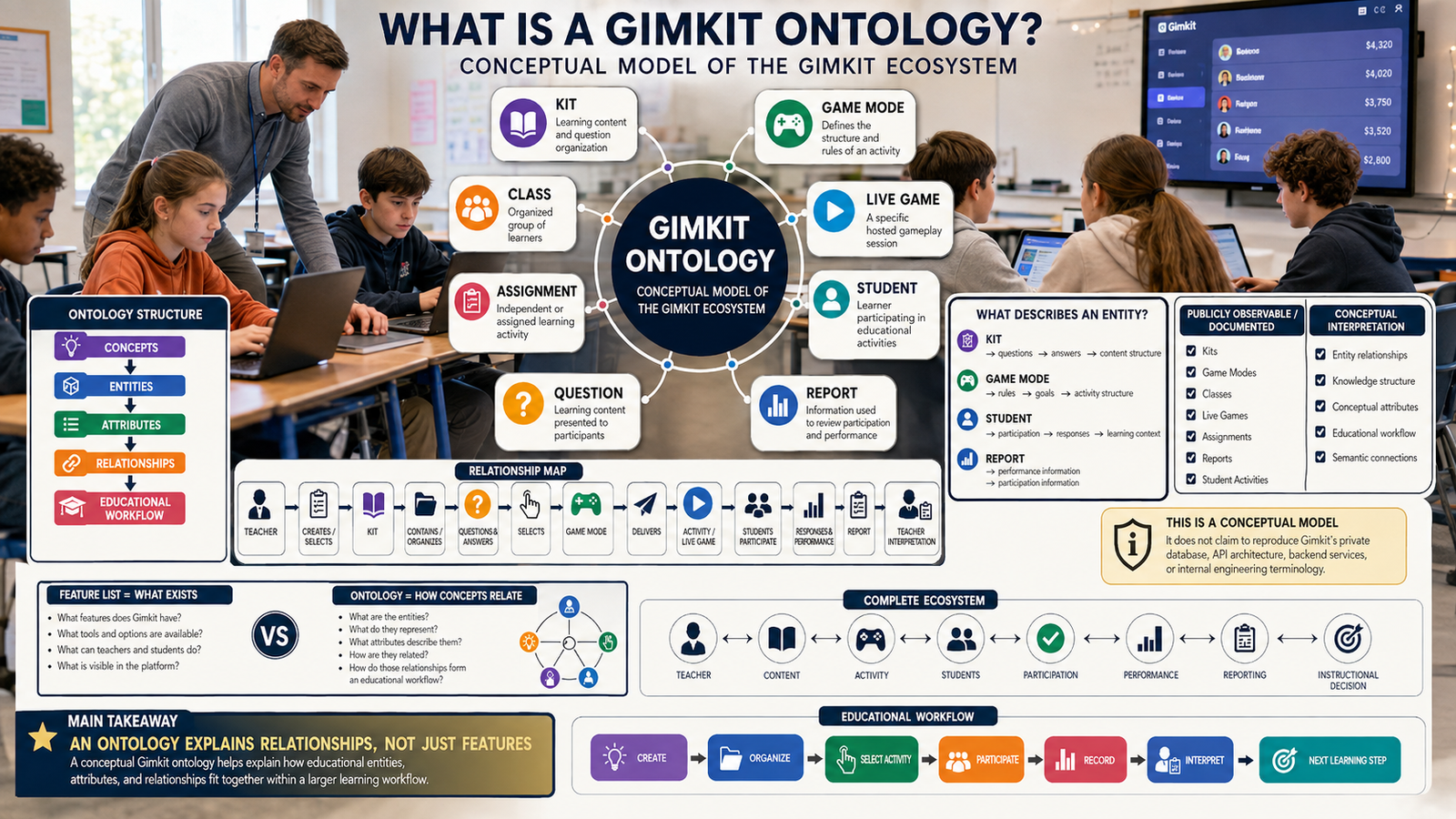
A Gimkit ontology, as used in this article, is best understood as a conceptual model of the Gimkit ecosystem. It identifies the major entities that can be observed in Gimkit’s educational workflows, describes their roles and attributes, and maps the relationships that connect them.
There is an important boundary, however.
This article does not claim that Gimkit has publicly released an official ontology, nor does it claim that the model below reproduces Gimkit’s private database, API architecture, backend services, or internal engineering terminology.
Instead, it provides an evidence-aware conceptual representation based on publicly observable Gimkit functionality and documentation.
That distinction matters.
A feature list tells you what Gimkit has.
An ontology asks a deeper set of questions:
What are the important entities?
What does each entity represent?
What properties describe those entities?
How are the entities related?
Which relationships are directly documented?
Which relationships are conceptual interpretations?
How do those relationships form an educational workflow?
The result is a much richer way of understanding Gimkit as an interconnected educational platform.
Looking for comprehensive classroom resources and educational technology insights? Explore GimkitApp for expert guides, teaching strategies, game modes, and the latest updates to enhance student engagement.
What Is an Ontology?
An ontology is a structured representation of knowledge about a particular domain.
At a basic level, an ontology can identify:
Concepts or classes
Individual entities or instances
Attributes and properties
Relationships
Hierarchies
Constraints or semantic rules
The W3C description of OWL explains that ontologies can define classes and properties, describe individuals, and represent relationships and facts about those individuals. Properties are particularly important because they allow a model to express connections rather than merely categorize objects.
Consider a simple educational example:
Teacher → creates → Quiz
Here:
Teacher can represent a class or concept.
Quiz can represent another class or concept.
A particular teacher and a particular quiz can represent individual entities.
Creates represents the relationship connecting them.
That relationship is what makes an ontology more informative than a simple list.
A list might contain:
Teacher, Quiz, Student, Classroom.
An ontology asks:
What is a Teacher? What is a Quiz? Who creates the Quiz? Which students use it? What classroom context does the activity belong to?
The second approach captures the meaning and structure of the domain.
Ontology Is About Relationships, Not Just Names
Suppose an educational platform contains:
Kits
Questions
Students
Games
Classes
Assignments
Results
Reports
Simply listing these objects does not tell us how the system works.
Now consider:
Kit → contains → Questions
Game → uses → Kit
Student → participates in → Game
Class → organizes → Students
Assignment → uses → Kit
Assignment → produces → Results
Results → support → Reports
The system immediately becomes easier to understand.
The entities are no longer isolated labels. They form a network of meaningful relationships.
That relationship-centered perspective is fundamental to ontology-based knowledge representation. In formal ontology systems such as OWL, properties are used to express relationships between individuals or characteristics associated with them.
What Is a Gimkit Ontology?
A Gimkit ontology can be understood as a conceptual knowledge model that organizes the important entities, attributes, and relationships within the Gimkit ecosystem.
Rather than viewing Gimkit as a collection of unrelated features, the ontology connects its major components into a coherent educational structure.
A simplified model looks like this:
Educator
↓
Kit
↓
Questions
↓
Game or Assignment
↓
Game Mode and Options
↓
Student Interaction
↓
Results
↓
Reports and Progress
This is a conceptual representation, not a technical diagram of Gimkit’s internal software.
Gimkit’s current public help documentation describes Kits as content used in gameplay, Game Modes as different ways to play, Classes as tools for organizing students and tracking assignment activity, Assignments as independent student activities, and Game Reports as places to review game data.
The ontology connects those publicly observable concepts.
Why Call It a Conceptual Model?
Because observing a platform’s public functionality is not the same as knowing how its software is engineered internally.
For example, official documentation can establish that an assignment uses a selected Kit and Game Mode. It cannot, by itself, establish the exact database tables, API objects, backend services, or internal data relationships that implement that functionality.
Therefore, a responsible Gimkit ontology should distinguish between:
Documented functionality
What Gimkit publicly states or demonstrates.
Conceptual relationships
Relationships created to explain how documented features fit together.
Internal implementation
Private technical details that should not be presented as known without direct evidence.
This evidence boundary is one of the most important characteristics of a trustworthy ontology.
The Core Entities in a Gimkit Ontology
A useful conceptual model begins by identifying the major entities that participate in Gimkit’s educational workflows.
These can be organized into several conceptual layers.
Layer
Core entities
Purpose
People and Identity
Educator, Student, Account
Represents participants and identity
Learning Content
Kit, Question, Answer
Represents instructional material
Gameplay
Game, Game Mode, Game Options
Represents interactive activity
Classroom Organization
Class
Represents learner organization and context
Assigned Learning
Assignment, Goals
Represents independent assigned activity
Evidence and Reporting
Results, Reports, Progress
Represents performance information
These layers are conceptual categories, not an official Gimkit technical taxonomy.
Their purpose is to make the relationships between major entities easier to understand.
People and Identity
Every educational platform needs concepts representing the people who participate in learning activities.
For a Gimkit ontology, the most important roles include:
Educator
Student
Account
The exact technical implementation of identity is outside the scope of a public conceptual model. What matters here is the role these concepts play in the educational workflow.
A simplified relationship structure is:
Educator → manages → Class
Class → organizes → Students
Student → has → Account
Classes are particularly important because Gimkit’s current documentation describes them as a way to organize students, track assignment progress, review multiple assignment completions, and preserve assignment progress.
The relationship between people and educational content is therefore more meaningful than simply saying that “teachers and students use Gimkit.”
The ontology asks how they participate.
An educator can create or select content and organize learning activities.
A student interacts with that content through games or assignments.
A Class can provide organizational context for those learners and activities.
Kits: The Content Layer
The Kit is one of the central content entities in the Gimkit ecosystem.
A Kit organizes question content that can be used in Gimkit activities.
Conceptually:
Kit → contains → Question
The exact attributes available can change over time, but Gimkit’s documented Kit-creation workflow includes information such as the Kit name, language, subject, cover information, and question content.
The important ontology distinction is between the container and the content inside it.
A Kit is not simply one question.
It is a higher-level content entity that organizes questions for later use in educational activities.
That gives us a more useful model:
Kit
↓
Question
↓
Answer
The relationship provides information that a simple feature list cannot.
Instead of saying:
Gimkit has Kits.
we can say:
A Kit functions as a content entity that organizes questions which can subsequently be used within Gimkit activities.
That places the Kit inside the larger ecosystem.
Questions and Answers
Questions represent instructional items that learners encounter.
Answers represent the response structure associated with those questions.
A simplified relationship is:
Kit → contains → Question
Question → has → Answer
A Kit could contain questions about:
Photosynthesis
Cell structure
Energy transfer
Ecosystems
From an ontology perspective, these are not merely pieces of text. They are individual content entities associated with a larger content structure.
A richer conceptual model could potentially represent properties such as:
Subject
Topic
Difficulty
Answer type
Language
Media
Correctness or response status
However, those properties should only be treated as part of the model when the platform exposes them or when they are explicitly introduced as conceptual extensions.
This is an important ontology principle:
Do not confuse a possible property with a confirmed platform property.
The model should describe what is supported rather than inventing technical detail.
Game, Game Mode, and Game Options
A Kit explains the content.
It does not, by itself, explain the complete experience through which students interact with that content.
That is where Game, Game Mode, and Game Options become important.
Gimkit’s documentation explains that different Game Modes provide different gameplay experiences, while Game Options can customize a live game and may include standard and mode-specific settings.
Conceptually:
Game → uses → Kit
Game → uses → Game Mode
Game → configured by → Game Options
These relationships reveal an important distinction.
A Kit answers:
What content is being used?
A Game Mode helps answer:
How is that content experienced?
Game Options then provide additional configuration around the activity.
This is why Kit and Game Mode should not be treated as interchangeable concepts.
They occupy different positions in the educational model.
Content and Activity Are Different Layers
One of the strongest ideas in a Gimkit ontology is the separation between content and activity.
This model explains why the same educational content can participate in different activities.
The content itself is one layer.
The activity through which students experience that content is another.
The learner interaction is another.
The resulting evidence is another.
This separation makes the overall platform much easier to reason about.
Classes: Connecting Learners to Context
A Class adds organizational context to the ontology.
Gimkit’s current documentation describes Classes as supporting live-game name management, assignment progress tracking, multiple assignment completion results, and saved assignment progress.
A conceptual model can therefore represent:
Educator → manages → Class
Class → organizes → Students
Class → connects with → Assignment
Student → participates in → Game / Assignment
This is important because educational evidence usually needs context.
Knowing that an activity produced a result is useful.
Knowing which student produced the result, within which assignment or class context, provides much more meaning.
The ontology therefore treats Student, Class, Assignment, and Result as related concepts rather than isolated objects.
Assignments: Independent Learning as a Distinct Activity
Assignments demonstrate particularly well why relationships matter.
Gimkit describes Assignments as a way for students to play independently rather than only participating in a teacher-hosted live session. Its documented creation workflow involves selecting a Kit, selecting a Game Mode, and configuring assignment options; assignments can also be connected to Classes.
Conceptually:
Educator → creates → Assignment
Assignment → uses → Kit
Assignment → uses → Game Mode
Assignment → has → Goals / Options
Assignment → assigned to → Student / Class
Student → completes → Assignment
Assignment → produces → Results
This chain tells us much more than:
Gimkit has Assignments.
It explains where an Assignment sits in the learning system.
The educator selects content.
The activity is configured.
Learners receive or access the activity.
Students complete it.
The resulting evidence can then be reviewed.
That is exactly the kind of structure an ontology is intended to represent.
Results and Reports: The Evidence Layer
Educational activity becomes especially meaningful when it produces evidence.
Gimkit’s current Game Reports documentation states that reports provide class and individual data after a hosted Kit game and can be viewed in different ways, including Student Overview, General Overview, and Question Breakdown.
This supports a conceptual evidence chain:
Game / Assignment → produces → Results
Results → support → Reports
Reports → support → Review / Interpretation
The ontology does not claim that these are the exact internal data objects used by Gimkit.
Instead, it describes the observable relationship between an educational activity and the information available afterward.
This distinction matters because a result is not meaningful only because a number exists.
Its meaning depends on context.
A score, completion, response pattern, or other performance information becomes more informative when it is connected to:
A learner
An activity
Content
A Game Mode
A class or assignment context
A time or completion context
The ontology helps represent those connections.
Entity, Attribute, and Relationship
Three concepts should remain separate when building a Gimkit ontology:
Entity
Attribute
Relationship
Entity
An entity is a distinct concept or object being represented.
Examples include:
Educator
Student
Class
Kit
Question
Game
Game Mode
Assignment
Result
Report
Attribute
An attribute describes a characteristic of an entity.
For example, a Kit may conceptually have attributes such as:
Name
Subject
Language
Cover information
Question content
A Student may have identity-related properties.
An Assignment may have goals, options, or a due date.
A Game may have a selected Game Mode and configuration.
The important point is that attributes describe characteristics, while relationships connect entities.
Relationship
A relationship explains how two entities connect.
Examples:
Kit → contains → Question
Game → uses → Kit
Game → uses → Game Mode
Class → organizes → Student
Assignment → uses → Kit
Student → completes → Assignment
The relationship is what transforms a collection of entities into a knowledge model.
Gimkit Ontology Hierarchy
A hierarchy organizes related concepts into broader conceptual groups.
This is a conceptual hierarchy, not an official Gimkit taxonomy.
Its purpose is to show that different entities have different roles.
A Kit belongs conceptually to the content layer.
A Game belongs to the activity layer.
A Class belongs to the organizational layer.
A Report belongs to the evidence layer.
The hierarchy gives the model structure, while the relationships give it meaning.
Gimkit Ontology vs Taxonomy
Ontology and taxonomy are related, but they are not the same.
A taxonomy primarily organizes concepts into categories and hierarchical relationships.
For example:
Educational Platform → Content → Kit → Question
An ontology can go further.
It can describe:
Educator → creates → Kit
Kit → contains → Question
Question → has → Answer
Game → uses → Kit
Student → participates in → Game
The taxonomy tells us where concepts belong.
The ontology also tells us how concepts interact.
That difference is important for Gimkit because the educational experience depends heavily on interactions among content, learners, activities, classroom context, and evidence.
Gimkit Ontology vs Database
An ontology and a database may describe some of the same domain objects, but they solve different problems.
A database primarily focuses on storing, organizing, and retrieving data.
An ontology focuses on representing the meaning and relationships of concepts within a domain.
A database might contain records corresponding to:
Student
Class
Kit
Assignment
Result
An ontology asks:
What is a Student?
What is a Class?
How is a Student related to a Class?
What is an Assignment?
What content does it use?
What does a Result represent?
This distinction is critical.
A database schema may change as software evolves.
The conceptual meaning of an entity or relationship can remain useful even when the underlying implementation changes.
Therefore, a conceptual Gimkit ontology should never be described as Gimkit’s database schema without direct technical evidence.
Gimkit Ontology vs Knowledge Graph
An ontology and a knowledge graph are also closely related, but they are not synonyms.
An ontology defines or organizes the concepts and relationships that give a domain structure.
A knowledge graph can then represent actual entities and facts using those concepts and relationships.
For example, an ontology might define:
Student → completes → Assignment
A knowledge graph could represent a particular fact:
Student A → completed → Assignment 27
The ontology provides the conceptual vocabulary.
The knowledge graph represents specific connected knowledge.
This distinction is important for semantic search, data integration, AI systems, and knowledge representation.
The ontology describes what a relationship means.
The graph can represent particular instances of that relationship.
W3C’s OWL documentation similarly distinguishes classes, individuals, properties, and relationships as fundamental components of formal ontology representation.
Why Ontologies Matter in Educational Platforms
Educational platforms are not merely repositories of questions.
They contain relationships between:
Learners
Educators
Content
Activities
Classes
Assignments
Responses
Results
Reports
Learning context
Those relationships can provide much more meaning than isolated data points.
For example:
Student scored 85%.
is relatively limited.
A more contextual representation could be:
A particular student completed a particular activity using particular learning content and produced a particular performance result.
The second statement contains more semantic context.
That does not mean an ontology performs the analytics itself.
Analytics still requires appropriate data collection, processing, metrics, interpretation, and privacy practices.
The ontology’s role is to clarify what the data represents and how different pieces of information relate.
Semantic Consistency
One of the most important benefits of ontology thinking is semantic consistency.
Consider these concepts:
Kit
Question
Game
Assignment
Class
Result
They should not be treated as interchangeable.
A Kit represents content.
A Question represents an instructional item.
A Game represents an interactive activity.
An Assignment represents assigned independent activity.
A Class represents learner organization and context.
A Result represents evidence produced by an activity.
Once these distinctions are explicit, the platform becomes easier to analyze.
This is particularly useful when documentation, search systems, educational analytics, or data models need to refer to the same concepts consistently.
Ontologies and Data Integration
Educational technology increasingly exists within broader digital ecosystems.
Information may need to move between:
Learning platforms
Classroom systems
Assessment systems
Analytics tools
Learning-management environments
Other educational services
Different systems may use different terminology or internal structures.
One system might use the term Quiz.
Another might use Assessment.
Another might use Activity.
These terms may overlap, but they are not automatically identical.
A conceptual ontology can help identify:
Equivalent concepts
Related concepts
Broader and narrower concepts
Mappable data
Important semantic differences
An ontology does not automatically make two systems interoperable.
But it can provide part of the semantic foundation needed to understand how concepts in one system correspond to concepts in another.
This aligns with the broader direction of educational technology toward interoperability and open standards. UNESCO’s 2026 Charter for Public Digital Learning Platforms identifies openness, interoperability, and open standards among its principles for digital learning infrastructure.
That broader principle is relevant to ontology work even though it does not establish anything about Gimkit’s private technical implementation.
Ontologies and Educational Analytics
Analytics becomes more meaningful when data is connected to the entities and activities it describes.
Consider:
Student → completes → Assignment
Assignment → uses → Kit
Kit → contains → Questions
Assignment → produces → Results
Now a result has context.
It is no longer simply an isolated number.
A conceptual ontology can help answer questions such as:
Which learner produced the result?
Which activity produced it?
Which content was involved?
Which Game Mode was used?
Which classroom or assignment context was involved?
What kind of evidence does the result represent?
Again, the ontology does not perform the analysis.
It creates a semantic structure in which analysis can be understood.
Ontologies and Personalized Learning
Personalized learning depends on relationships between learners, content, activities, and evidence.
A richer educational ontology might conceptually represent:
Student → completes → Assignment
Assignment → uses → Kit
Kit → contains → Questions
Question → relates to → Topic
Question → supports → Learning Objective
Student → produces → Performance Evidence
This can provide a conceptual foundation for personalization.
However, there is an important distinction:
This does not establish that Gimkit currently implements such a personalized-learning ontology internally.
These relationships demonstrate how ontology could support personalization as a broader educational technology concept.
A trustworthy article should never turn a conceptual possibility into a claim about Gimkit’s current architecture.
Ontologies and Semantic Search
Traditional search often begins with words.
Semantic systems can go further by considering relationships and meaning.
Suppose someone wants information about assignment performance.
Instead of treating each word as independent, the system can conceptually understand that these entities participate in the same workflow.
This can help organize information and potentially improve retrieval, classification, and discovery.
The broader principle is:
Meaning becomes richer when concepts are connected by well-defined relationships.
That principle applies beyond Gimkit to educational search, knowledge bases, data systems, and AI-assisted information retrieval.
Ontologies and AI Systems
AI systems often work with large amounts of connected information.
A conceptual ontology can provide clearer semantic context by defining what entities are and how they relate.
For example:
Teacher → creates → Assignment
Assignment → uses → Kit
Assignment → uses → Game Mode
Student → completes → Assignment
Assignment → produces → Result
The word Assignment becomes more meaningful because its surrounding relationships provide context.
Such structures can potentially support:
Semantic search
Classification
Recommendation
Knowledge retrieval
Entity resolution
Relationship mapping
Structured reasoning
However, the existence of a conceptual Gimkit ontology does not prove that Gimkit’s AI systems use such a model.
Without authoritative technical evidence, that claim should not be made.
The correct statement is that ontology provides one possible conceptual foundation for organizing educational knowledge in ways that can be useful to computational systems.
For the latest gaming news, expert reviews, and walkthroughs, readers can also visit IGN, one of the world’s leading gaming websites.
A Practical Gimkit Ontology Workflow
The easiest way to understand the model is to follow a realistic educational workflow.
Step 1: Content Creation
An educator begins with learning material.
Educator → creates/selects → Kit
Kit → contains → Questions
Question → has → Answer
Step 2: Activity Selection
The content becomes part of an educational activity.
Kit → used in → Game / Assignment
Step 3: Activity Configuration
The educator chooses the way students will experience the activity.
Game / Assignment → uses → Game Mode
Game / Assignment → configured by → Options / Goals
Gimkit’s public documentation confirms that Game Modes are selected through the Mode Picker and that Game Options can customize activities.
Step 4: Learner Participation
Students interact with the activity.
Student → participates in → Game
or
Student → completes → Assignment
Step 5: Classroom Context
Where applicable:
Class → organizes → Students
Class → connects with → Assignment
Step 6: Evidence
The activity produces information about what happened.
Game / Assignment → produces → Results
Step 7: Reporting
The resulting information can be reviewed.
Results → support → Reports
This produces a complete conceptual chain:
Content → Activity → Learner → Evidence
That is the central structure of a Gimkit ontology.
Live Games and Assignments as Different Workflows
A strong ontology should be able to represent more than one workflow.
Live Game
A simplified model is:
Educator → hosts → Game
Game → uses → Kit
Game → uses → Game Mode
Student → participates in → Game
Game → produces → Results
Independent Assignment
A simplified model is:
Educator → creates → Assignment
Assignment → uses → Kit
Assignment → uses → Game Mode
Student → completes → Assignment
Assignment → produces → Results
Gimkit’s documentation distinguishes live gameplay from independent Assignments and describes the Kit → Game Mode → options sequence used when creating assignments.
The ontology is useful because the same core entities can appear in different workflows without being treated as identical activities.
How to Validate a Gimkit Ontology
A conceptual ontology becomes more trustworthy when it can be tested against real workflows.
A practical validation process is:
Identify a real workflow.
List the entities involved.
Identify the relationships connecting them.
Check the relationship against public documentation.
Separate documented facts from conceptual interpretations.
Remove unnecessary entities.
Test the model against another workflow.
Check whether the same concepts retain consistent meanings.
For example, an assignment workflow can be represented as:
Educator → creates → Assignment
Assignment → uses → Kit
Assignment → uses → Game Mode
Assignment → has → Goals
Assignment → assigned to → Student/Class
Student → completes → Assignment
Assignment → produces → Results
Gimkit’s documented assignment workflow supports the core sequence involving a Kit, Game Mode, options, goals, and sharing or connecting the assignment with students or Classes.
If the conceptual ontology can explain this workflow without inventing unsupported technical details, it passes an important practical test.
Three Levels of Ontology Evidence
Not every relationship should have the same level of certainty.
A useful evidence framework has three levels.
1. Directly Documented
The official platform documentation explicitly describes the relationship.
Example:
Assignment → uses → Kit
Gimkit’s assignment documentation directly describes selecting a Kit when creating an assignment.
2. Strong Conceptual Interpretation
The relationship follows naturally from documented functionality but is expressed as an ontology relationship for analytical purposes.
For example:
Results → support → Performance Review
The documentation may describe results and reports without calling the relationship an ontology property.
The relationship is therefore useful as a conceptual interpretation rather than a claim about internal implementation.
3. Unsupported Internal Assumption
These include claims about:
Private database tables
Internal API schemas
Proprietary backend services
Hidden analytics pipelines
Undocumented machine-learning systems
Internal ontology engineering
These should not be presented as established facts.
The rule is simple:
When the evidence ends, the certainty of the wording should end too.
That principle protects the accuracy of the entire model.
Common Mistakes When Describing a Gimkit Ontology
Mistake 1: Calling a Feature List an Ontology
Listing:
Kit, Game, Class, Assignment, Report
does not create an ontology.
The relationships between those concepts must also be represented.
Mistake 2: Claiming Access to Gimkit’s Internal Architecture
Public documentation does not reveal every database relationship, API object, backend service, or engineering decision.
A conceptual model should never be presented as proprietary technical documentation.
Mistake 3: Confusing Ontology With Knowledge Graph
An ontology defines or organizes conceptual meaning.
A knowledge graph can represent actual connected entities and facts using that conceptual structure.
They are related, but they are not interchangeable.
Mistake 4: Treating Every Conceptual Relationship as Official
Some relationships are directly documented.
Others are reasonable interpretations.
The difference should remain visible.
Mistake 5: Making the Ontology Too General
An article about Gimkit ontology should remain focused on Gimkit’s conceptual structure.
It should not become a generic tutorial covering every Gimkit feature, troubleshooting procedure, gameplay strategy, or account setting.
Those topics belong in their own guides.
Mistake 6: Making the Ontology Too Detailed
Adding every button, interface label, temporary setting, and minor feature does not necessarily make the ontology better.
The purpose is to model the concepts that matter to understanding the educational system.
Common Ontology Design Problems
Overloading One Entity
A Kit should not be treated as if it represents the entire learning activity.
A Kit, Game, Assignment, Student, Class, and Report have different conceptual roles.
Keeping those roles separate creates a cleaner model.
Treating Relationships as Entities
Consider:
Student → completes → Assignment
Here:
Student is an entity.
Assignment is an entity.
Completes is the relationship.
Keeping these categories separate prevents unnecessary complexity.
Using Vague Relationships
Compare:
Student → related to → Game
with:
Student → participates in → Game
The second is more informative.
Good ontology design favors specific semantic relationships over vague connections.
Creating Unsupported Complexity
A model should not introduce relationships merely because they sound technically interesting.
For example, a conceptual relationship such as:
Question → relates to → Learning Objective
may be useful in a broader educational ontology.
But it should not automatically be presented as a confirmed Gimkit relationship unless evidence supports it.
Ontology should clarify reality, not manufacture it.
The Gimkit Ontology Relationship Map
The core model can be summarized as follows:
Entity
Relationship
Related Entity
Meaning
Educator
creates/manages
Kit
Educator works with learning content
Kit
contains
Question
Questions form the Kit’s content
Question
has
Answer
Answers form the response structure
Educator
manages
Class
Educator organizes classroom context
Class
organizes
Student
Students are grouped within a class context
Game
uses
Kit
Game uses educational content
Game
uses
Game Mode
Mode shapes the gameplay experience
Game
configured by
Game Options
Options customize the activity
Assignment
uses
Kit
Assignment uses selected content
Assignment
uses
Game Mode
Assignment uses a selected mode
Assignment
assigned to
Student/Class
Learners receive the activity
Student
participates in
Game
Student interacts with a live activity
Student
completes
Assignment
Student completes independent activity
Game/Assignment
produces
Results
Activity produces performance evidence
Results
support
Reports
Results can be reviewed through reporting
This is a conceptual relationship map, not a published Gimkit technical schema.
Its value comes from making the platform’s educational relationships visible.
A More Complete Conceptual Gimkit Knowledge Model
The entire model can be represented at a high level like this:
Again, this should be interpreted as a conceptual knowledge map.
It does not claim to reproduce Gimkit’s private software architecture.
Its purpose is to answer one central question:
How do the major concepts of Gimkit fit together as an educational system?
Why Relationship Quality Matters More Than Entity Count
A larger ontology is not automatically a better ontology.
Consider two models.
Model A
Kit
Question
Student
Game
Class
Assignment
Report
This identifies important concepts.
But it does not explain how they interact.
Model B
Kit → contains → Question
Game → uses → Kit
Student → participates in → Game
Student → belongs to → Class
Assignment → uses → Kit
Student → completes → Assignment
Assignment → produces → Result
Result → supports → Report
Model B provides substantially more information.
The difference comes from the relationships.
For an educational platform, this is especially important because learning activity is inherently relational.
A learner interacts with content through an activity, within a particular context, producing evidence that can later be interpreted.
Why This Model Is Useful for Teachers
Teachers do not normally need ontology terminology.
They think in practical questions.
What content should I use?
This maps to:
Kit → Questions
How should students experience it?
This maps to:
Game / Assignment → Game Mode → Options
Which students should complete it?
This maps to:
Class → Students → Assignment
How will I know what happened?
This maps to:
Activity → Results → Reports
The ontology therefore provides a useful mental model:
Content → Activity → Learner → Evidence
That structure can make a complex educational platform easier to understand.
Why This Model Is Useful for Students
Students experience Gimkit differently from educators.
Their workflow is closer to:
Student
↓
Join / Access Activity
↓
Encounter Questions
↓
Respond
↓
Progress
↓
Complete Activity
↓
Performance Evidence
The student does not need to understand ontology terminology.
The value lies in understanding that a Kit, Game, Game Mode, Assignment, and Result are different parts of the same broader system.
A Kit represents content.
The Game or Assignment represents the activity.
The Game Mode helps determine how the activity works.
The student’s participation produces evidence.
That distinction makes the overall experience easier to conceptualize.
Why This Model Is Useful for Educational Technology Professionals
For researchers, instructional designers, developers, and education-technology professionals, ontology provides a systematic way to analyze a platform.
Instead of asking only:
What features does this platform have?
they can ask:
What are the primary entities?
What does each entity represent?
Which entities depend on one another?
Which relationships represent educational activity?
Which objects represent content?
Which objects represent learners?
Where does evidence originate?
How is classroom context represented?
Which concepts might map to broader educational models?
Which relationships are documented?
Which relationships are conceptual?
Where does uncertainty remain?
These questions move the analysis from feature documentation toward knowledge modeling.
That is where ontology becomes especially valuable.
How Ontology Can Improve Educational Platform Design
Ontology is useful not only for analyzing an existing platform.
Conceptual modeling can also help designers think about how educational systems should be structured.
When designers explicitly identify:
Learners
Educators
Content
Activities
Classes
Assignments
Assessments
Results
Learning context
they can better see where information needs to connect.
For example, a question might initially be treated as nothing more than quiz content.
A richer educational model could conceptually connect that question with:
Kit
Topic
Learning Objective
Student Response
Assessment Activity
Performance Evidence
That creates a richer representation of educational content.
But again, those additional relationships should only be attributed to Gimkit when supported by evidence.
A conceptual model should clarify the domain rather than invent an undocumented product architecture.
Ontology and Interoperability
Interoperability is one of the broader reasons semantic modeling matters.
Different educational systems may represent similar concepts using different structures.
For example:
Quiz
Assessment
Activity
may refer to related but non-identical concepts depending on the platform.
A shared conceptual model can help determine:
Which concepts are equivalent
Which are related
Which are broader or narrower
Which data can be mapped
Where semantic differences exist
An ontology does not solve interoperability by itself.
Technical interoperability still requires compatible standards, interfaces, data formats, governance, privacy controls, and implementation.
But semantic modeling can provide an important conceptual layer.
This broader role is consistent with UNESCO’s 2026 guidance, which identifies open standards and interoperability as important principles for public digital learning platforms.
That is a broader educational technology principle—not evidence that Gimkit itself implements a particular ontology or interoperability architecture.
Ontology and Knowledge Reuse
Another benefit of structured concepts is reuse.
Suppose a Kit is represented only as a block of content.
It becomes harder to understand how that content relates to other educational objects.
With a richer model:
Kit → contains → Questions
Question → relates to → Topic
Question → used in → Activity
Student → responds to → Question
Response → contributes to → Result
the same underlying concepts can participate in multiple workflows.
This is one reason semantic modeling becomes increasingly valuable as educational systems grow more complex.
The goal is not merely to store more information.
The goal is to make the relationships between information meaningful and reusable.
Ontology and AI-Ready Educational Data
Modern AI systems increasingly work with large amounts of connected information.
A well-defined conceptual model can make information easier to interpret because relationships are explicit rather than dependent entirely on ambiguous labels.
Consider the concept:
Assignment
Without context, the word is broad.
A structured model can instead represent:
Assignment → uses → Kit
Assignment → uses → Game Mode
Assignment → assigned to → Student
Assignment → has → Goal
Assignment → produces → Result
Now the concept has context.
That context can be valuable for semantic retrieval, classification, recommendation, and knowledge-based reasoning.
But an important boundary remains:
A conceptual ontology is not evidence that a particular AI system uses that ontology.
For Gimkit, any claim about internal AI infrastructure would require direct authoritative evidence.
How a Strong Gimkit Ontology Should Be Built
A useful ontology should not begin by collecting every possible feature.
It should begin with the most important concepts in the educational workflow.
A practical process is:
1. Identify Core Entities
Start with entities that repeatedly appear in the workflow:
Educator
Student
Class
Kit
Question
Game
Game Mode
Assignment
Result
Report
2. Define Each Entity
Give every concept a clear and consistent meaning.
For example:
Kit: a content entity that organizes questions for use in Gimkit activities.
3. Identify Attributes
Determine which characteristics describe each entity.
For a Kit, these may include publicly exposed content or descriptive fields.
4. Identify Relationships
Ask how each entity connects to another.
Examples:
Kit → contains → Question
Game → uses → Kit
Assignment → uses → Kit
Student → completes → Assignment
5. Establish Conceptual Hierarchy
Group related entities into layers such as:
People
Content
Activities
Classroom Organization
Evidence
6. Validate Against Evidence
Check whether a relationship is:
Directly documented
A reasonable conceptual interpretation
Unsupported
7. Test Against Real Workflows
A good ontology should be able to explain more than one scenario.
If it works for a live game, an assignment, and classroom organization without constantly changing definitions, the model is structurally stronger.
What Makes a Gimkit Ontology Trustworthy?
A trustworthy conceptual ontology should have five major characteristics.
1. Clear Definitions
Every major concept should have a consistent meaning.
2. Evidence-Based Relationships
Documented relationships should be distinguished from analytical interpretations.
3. Appropriate Granularity
The model should be detailed enough to be useful without pretending to reproduce every internal technical component.
4. Explicit Limitations
Unknown architecture should remain unknown.
5. Practical Relevance
The model should explain real educational workflows rather than exist only as an abstract diagram.
These characteristics make an ontology useful to both technical and non-technical readers.
What a Gimkit Ontology Should Not Claim
A responsible conceptual model should clearly state what it does not establish.
This model does not establish that:
Gimkit has publicly released an official ontology.
Gimkit internally uses OWL.
Gimkit’s database follows this exact structure.
Gimkit’s APIs expose these exact relationships.
Gimkit’s backend uses the entities exactly as represented here.
Gimkit’s AI systems depend on this model.
Every conceptual relationship shown here exists as a technical backend relationship.
Future Gimkit features will follow the same structure.
Those claims would require direct technical evidence from Gimkit.
The model is instead a:
Public-information-based conceptual representation of the Gimkit ecosystem.
That limitation does not weaken the model.
It makes it more trustworthy.
A good knowledge model should distinguish what is known from what is inferred.
Where the Gimkit Ontology Has Limits
A conceptual ontology based on public information cannot reliably establish:
Private database architecture
Internal API schemas
Proprietary backend services
Undocumented data relationships
Private analytics pipelines
Internal machine-learning systems
Unpublished engineering terminology
Future product architecture
It also cannot prove that Gimkit’s engineering team uses the term ontology internally.
The purpose of this model is not to guess.
Its purpose is to provide a structured representation of publicly understandable concepts and relationships.
That boundary is essential for accuracy.
When a Gimkit Ontology Is Most Useful
For Teachers
It clarifies:
Content → Activity → Students → Evidence
For Students
It helps distinguish:
Kit → Game → Game Mode → Assignment → Result
For Instructional Designers
It separates learning content from the activities through which students experience that content.
For Educational Researchers
It provides a framework for examining entities, relationships, workflows, and evidence.
For Developers and Data Professionals
It provides conceptual vocabulary before technical implementation or data mapping.
For AI and Search Systems
It demonstrates how explicit entity relationships can provide semantic context for information retrieval and knowledge representation.
A Practical Checklist for Understanding Gimkit Through Ontology
When analyzing Gimkit or another educational platform, ask:
What are the core entities?
What does each entity represent?
Which attributes describe each entity?
What relationships connect those entities?
Which concepts belong to the same conceptual layer?
Which relationships are directly documented?
Which relationships are conceptual interpretations?
How does content become an activity?
How does the learner interact with that activity?
What evidence does the activity produce?
How is classroom context represented?
How are results connected to reporting?
Where might interoperability become relevant?
Which assumptions should not be presented as facts?
This checklist is useful beyond Gimkit because the same ontology principles can be applied to other educational platforms.
The Broader Lesson for Educational Technology
The deeper value of ontology is not the terminology.
It is the ability to see an educational platform as a network of meaningful concepts.
A modern learning platform may contain thousands of pieces of information.
But information becomes more useful when relationships are clear.
Content explains what students encounter.
Activities explain how they interact with that content.
Learners explain who participates.
Classes provide organizational context.
Assignments connect content and activity to independent learning situations.
Results provide evidence of what happened.
Reports make that evidence easier to review and interpret.
The ontology connects these layers into one conceptual system.
That is why ontology matters.
Gimkit Ontology in One Simple Model
If the entire concept had to be reduced to one structure, it would be:
The relationships between these layers are what make the model meaningful.
Gimkit is not simply:
Kit + Game + Class + Assignment + Report
It is a system in which these concepts interact.
Frequently Asked Questions
Is Gimkit Ontology an official Gimkit feature?
No.
Gimkit ontology, as used in this article, is a conceptual model rather than a publicly documented official Gimkit feature.
It provides a structured way to describe important Gimkit concepts and the relationships between them.
Gimkit’s official help center documents features such as Kits, Game Modes, Classes, Assignments, and Reports, but that documentation does not establish that Gimkit has publicly released a formal ontology representing its internal architecture.
The distinction is important:
Gimkit ontology means:
A conceptual model of the Gimkit ecosystem
A way to organize important platform concepts
A description of meaningful relationships
A framework for understanding educational workflows
Not a confirmed proprietary Gimkit data model
What is the main purpose of a Gimkit ontology?
The main purpose is to explain how important Gimkit concepts connect.
Instead of treating Kits, Questions, Games, Students, Classes, Assignments, and Results as isolated features, the ontology describes their roles and relationships.
For example:
Kit → contains → Questions
Game → uses → Kit
Student → participates in → Game
Assignment → uses → Kit
Assignment → produces → Results
This provides a system-level understanding that a simple feature list cannot provide.
Is a Gimkit ontology the same as a knowledge graph or database?
No.
They are related but different.
Ontology: Defines or organizes concepts and meaningful relationships.
Knowledge graph: Represents connected entities and facts using conceptual structures.
Database: Stores and retrieves structured data.
For example:
Kit → contains → Question
can be understood as a conceptual relationship in an ontology.
A knowledge graph could represent a specific Kit and specific Question connected by that relationship.
A database could store records representing those objects and their connection.
These systems can work together, but they should not be treated as interchangeable.
Can an ontology help AI systems understand educational data?
Yes, conceptually.
A well-designed ontology can provide explicit semantic relationships between entities.
For example:
Assignment → uses → Kit
Assignment → uses → Game Mode
Assignment → assigned to → Student
Assignment → produces → Result
Such relationships can provide useful context for systems involved in:
Semantic search
Classification
Recommendation
Knowledge retrieval
Entity mapping
Structured reasoning
However, this does not prove that Gimkit’s current AI systems use a formal ontology.
The model described here is a conceptual foundation, not evidence of a particular Gimkit implementation.
Why are relationships so important in a Gimkit ontology?
Because isolated entities provide limited meaning.
Knowing that Gimkit has a Kit tells us little.
Knowing that:
Kit → contains → Questions
and:
Game → uses → Kit
and:
Student → participates in → Game
tells us much more.
Relationships show how the platform actually functions as a connected educational system.
That is the central value of ontology.
What are the most important entities in a Gimkit ontology?
A useful high-level model includes:
Educator
Student
Account
Class
Kit
Question
Answer
Game
Game Mode
Game Options
Assignment
Goals
Results
Reports
Progress
Not every possible Gimkit feature needs to become an ontology entity.
The goal is to represent the concepts that matter most to the educational workflow.
What is the difference between a Kit and a Game?
A Kit represents learning content.
A Game represents an activity through which that content can be experienced.
Conceptually:
Kit → provides/contains → Content
Game → uses → Kit
This distinction is important because content and activity are different layers of the educational system.
What is the difference between a Game and an Assignment?
Both can involve a Kit and a Game Mode, but they represent different activity contexts.
A live Game is associated with hosted gameplay.
An Assignment is designed for students to complete independently.
Gimkit’s documentation specifically describes Assignments as independent gameplay and documents the process of selecting a Kit, Game Mode, and options for an assignment.
Conceptually:
Game → live activity
Assignment → independent assigned activity
The exact capabilities and availability of these features can change over time, so current Gimkit documentation should be used when making product-specific claims.
What role does a Class play in the ontology?
A Class provides organizational context for learners.
Conceptually:
Educator → manages → Class
Class → organizes → Students
Gimkit’s current Classes documentation also describes assignment progress tracking, multiple completion results, and saved assignment progress.
Therefore, Class is not merely an administrative label.
It connects learners and activities within a classroom-oriented context.
What role do Results and Reports play?
Results represent evidence produced by an activity.
Reports provide ways to review and interpret that evidence.
Conceptually:
Game / Assignment → produces → Results
Results → support → Reports
Gimkit’s current Game Reports documentation describes student-level, general, and question-level report views for hosted games.
The conceptual model therefore places Results and Reports in an evidence layer rather than treating them as unrelated features.
Does this ontology describe Gimkit’s private database?
No.
It deliberately does not.
The model is based on publicly understandable concepts and documented workflows.
It should not be interpreted as:
Gimkit’s database schema
Gimkit’s API schema
Gimkit’s backend architecture
Gimkit’s internal ontology
Gimkit’s private analytics architecture
Those would require direct technical evidence.
Can this ontology change over time?
Yes.
Gimkit is an evolving platform.
Features, terminology, workflows, Game Modes, account capabilities, reporting functions, and other relationships can change.
Therefore, a strong conceptual ontology should be treated as a maintainable knowledge model, not a permanent technical specification.
The safest approach is to periodically compare the conceptual model against current official documentation and update relationships when the documented platform changes.
Conclusion
A Gimkit ontology provides a useful conceptual lens for understanding Gimkit as an interconnected educational platform rather than a collection of independent features.
The strength of this model does not come from simply naming more Gimkit features.
It comes from explaining how those concepts relate to one another.
A Kit represents content.
Questions form that content.
A Game or Assignment turns content into an educational activity.
A Game Mode shapes how that activity operates.
Classes provide organizational context for learners.
Students participate in or complete activities.
Those activities produce evidence.
Reports provide a way to examine that evidence.
Together, these relationships create a useful conceptual picture of Gimkit as an educational ecosystem.
At the same time, accuracy requires a firm boundary.
This model is not a claim about Gimkit’s private database, internal APIs, backend architecture, proprietary analytics, AI systems, or engineering terminology. It is a public-information-based conceptual representation designed to explain the relationships visible across Gimkit’s educational workflows.
That distinction is not a weakness.
It is what makes the model intellectually defensible.
A strong ontology does not pretend to know what cannot be verified. It defines concepts clearly, expresses meaningful relationships, distinguishes evidence from interpretation, and acknowledges uncertainty where necessary.
For teachers, this creates a clearer mental model of how content, activities, learners, classroom organization, and evidence fit together.
For students, it clarifies the difference between content, gameplay, assignments, and results.
For instructional designers and educational researchers, it provides a structured way to analyze an educational platform.
For developers and data professionals, it offers conceptual vocabulary that can precede technical modeling or data mapping.
For semantic technologies and AI-oriented systems, it demonstrates why clearly defined entities and relationships can provide richer context than disconnected labels.
Ultimately, the most useful way to think about Gimkit ontology is not as another Gimkit feature.
It is as a knowledge framework for understanding how Gimkit’s people, content, activities, classroom structures, and learning evidence fit together into one educational ecosystem.