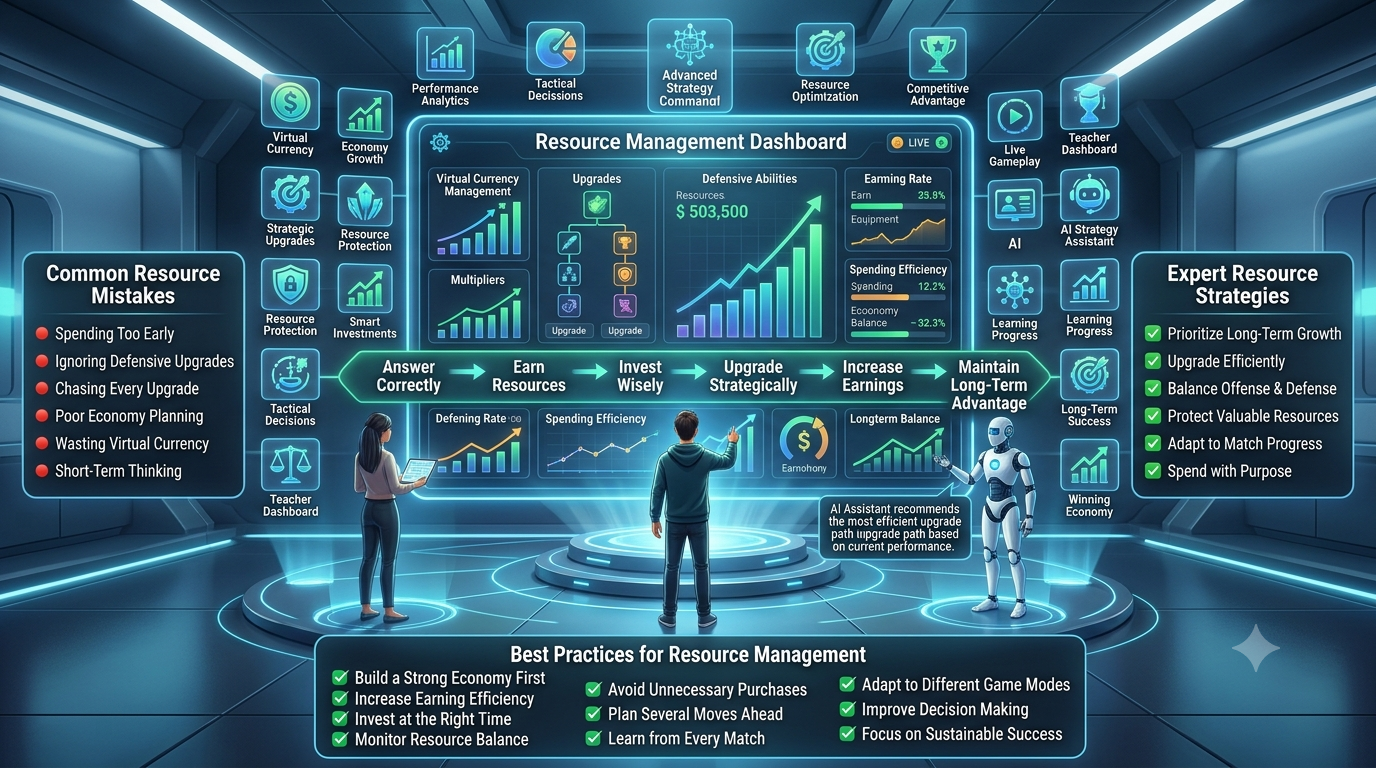
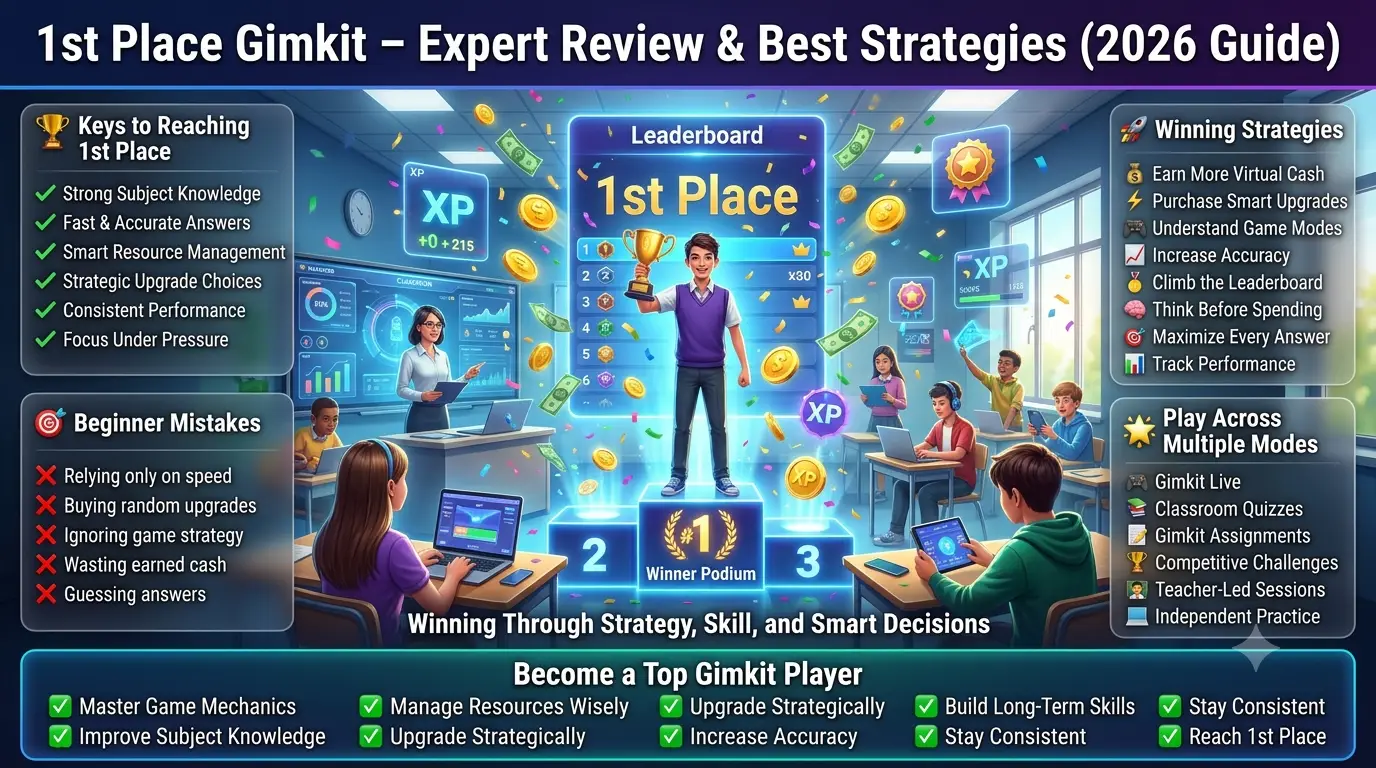
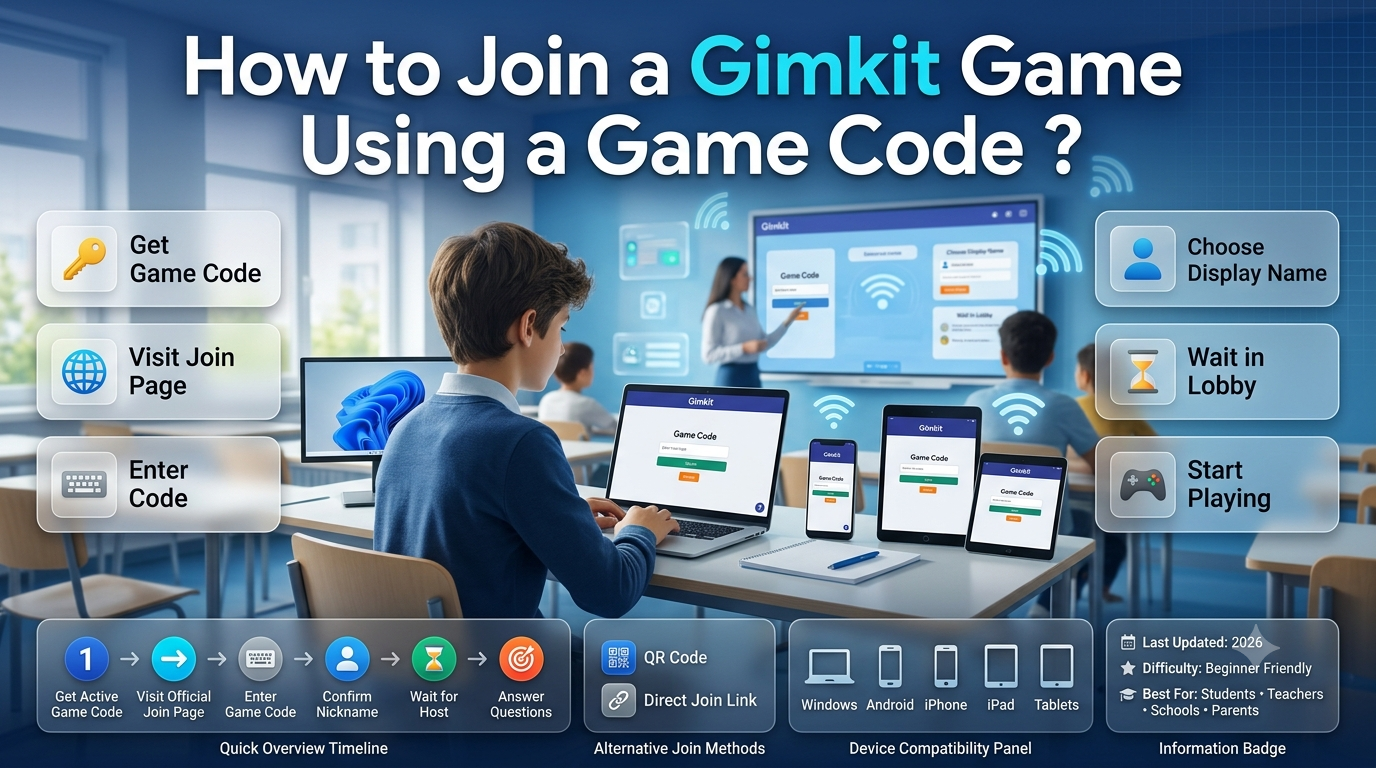
Success in Managing In-Game Resources Like an Expert in Gimkit goes far beyond answering questions correctly. While knowledge remains the foundation of every match, experienced players understand that winning consistently depends on how efficiently they earn, spend, protect, and invest their in-game resources. Whether you are competing in solo challenges or participating in multiplayer sessions, every decision affects your long-term performance.
Many beginners focus only on earning cash as quickly as possible, but expert players know that resource management is about balancing short-term gains with long-term growth. Buying upgrades too early, ignoring defensive improvements, or chasing every available opportunity can leave players struggling later in the game. Smart planning often outperforms fast clicking.
This guide explores professional resource management strategies that help players maximize efficiency across different Gimkit Games. You’ll learn how experienced competitors build stronger economies, prioritize upgrades, adapt to different Gimkit Mode options, and avoid common spending mistakes. Whether you’re using Gimkit Live in a classroom or practicing independently through the Gimkit App, mastering these techniques will improve both your scores and your overall gameplay experience.
The goal isn’t simply to earn more money—it’s to make every resource work harder throughout the entire match.
Understanding Resource Management in Gimkit
Many players think resource management only means saving money, but in Gimkit it includes much more than your cash balance. Every answer, every purchase, every upgrade, and every strategic decision influences how efficiently you progress throughout a game.
Unlike traditional quiz platforms, Gimkit Play introduces an economic system where players constantly decide whether to invest, save, defend, or expand. Good resource management creates momentum that becomes increasingly valuable as the game continues.
Instead of reacting to every situation, expert players follow a structured plan that adjusts according to the game’s pace and objectives.
Components of Effective Resource Management
Resource
Purpose
Why It Matters
Cash
Purchase upgrades
Determines long-term growth
Accuracy
Maintains income
Prevents unnecessary losses
Time
Maximizes earning opportunities
Reduces wasted actions
Upgrades
Improve efficiency
Increases future earnings
Power-ups
Create tactical advantages
Helps during competitive moments
Decision Making
Controls spending priorities
Prevents inefficient investments
Each resource interacts with the others. Improving only one area rarely produces the best results.
Resource Management Is Different in Every Game Mode
One mistake beginners make is using the same strategy across every Gimkit Mode.
Some modes reward aggressive spending because matches end quickly. Others favor long-term investment where early patience produces larger rewards later. Learning to recognize the pace of each mode allows players to make smarter purchasing decisions.
Experienced players never copy strategies blindly. Instead, they adapt based on objectives, match duration, and available upgrades.
Expert Insight
A thoughtful player need not spend virtual resources simply because a purchase is affordable. Instead, they evaluate whether an upgrade immediately increases earning potential or whether saving resources will unlock a stronger investment later.
This mindset separates experienced competitors from casual players.
Why Resource Management Matters More Than Fast Answers
A player who answers slightly slower while investing intelligently often overtakes players who spend carelessly. Resource efficiency compounds over time, creating larger earning opportunities later in the match.
Think of Gimkit like managing a small business. Every purchase should produce a return that exceeds its cost.
How Smart Investments Create Long-Term Growth
Imagine two players who earn the same amount during the opening minutes.
Player A immediately spends everything on random upgrades.
Player B purchases only upgrades that increase future income.
Initially, both appear evenly matched.
As the game continues, Player B earns significantly more from every correct answer because each purchase was chosen strategically.
This difference grows larger with every passing minute.
The strongest strategy usually lies between overspending and excessive saving.
Resource Efficiency Reduces Pressure
When your economy grows steadily, mistakes become less costly.
In modes with continuing upgrade benefits, an efficient economy may help a player recover from setbacks, but the effect depends on the actual rules.
Poorly managed economies force players into risky decisions simply to catch up.
Signs You’re Managing Resources Well
✔ Your income steadily increases throughout the game.
✔ Every purchase has a clear purpose.
✔ You rarely run out of useful upgrade options.
✔ Incorrect answers don’t completely derail your progress.
✔ Your strategy changes naturally as the game develops.
Core In-Game Resources Every Player Should Understand
Many players only focus on earning cash.
Experts recognize several valuable resources that work together to determine success.
1. Cash
Cash remains the primary economic resource throughout nearly every Gimkit Games session.
It allows players to purchase:
Income upgrades
Reward multipliers
Defensive improvements
Offensive abilities
Tactical advantages
The goal isn’t simply collecting cash.
The goal is turning today’s earnings into tomorrow’s larger earnings.
2. Time
Time is one of the most overlooked resources.
Every second spent hesitating, navigating menus, or making unnecessary purchases reduces total earning potential.
Experienced players minimize downtime by developing consistent purchasing routines.
3. Answer Accuracy
Correct answers fuel every economic system inside Gimkit Learning.
High accuracy produces:
Reliable income
Better upgrade timing
Improved streak potential
Stronger long-term consistency
Guessing carelessly often creates larger economic losses than players realize.
4. Upgrade Opportunities
Not every upgrade deserves immediate attention.
Some upgrades provide immediate value.
Others become useful only after certain milestones.
Recognizing this difference helps expert players avoid inefficient spending.
5. Strategic Flexibility
Adaptability itself becomes a valuable resource.
No two matches unfold exactly the same way.
Players who quickly adjust their investment strategy often outperform players following rigid upgrade plans.
Resource Priority Matrix
Resource
Early Game
Mid Game
Late Game
Cash
Very High
High
Medium
Accuracy
Very High
High
High
Time
High
High
Medium
Income Upgrades
Very High
High
Low
Defensive Upgrades
Low
Medium
High
Tactical Spending
Low
High
Very High
Professional Recommendation
Before every purchase, ask one simple question:
“Will this upgrade increase my earning potential enough to justify its cost?”
If the answer is uncertain, waiting one or two more purchases often leads to a stronger investment.
Building an Efficient Economy From the First Minute
The opening phase of a Gimkit match has an outsized impact on everything that follows. Decisions made in the first minute often determine how quickly your economy scales, especially in longer sessions where upgrades have more time to generate value.
Rather than chasing immediate rewards, expert players focus on creating a foundation that supports continuous growth.
Prioritize Income Before Luxury Upgrades
Income-generating upgrades usually provide the highest long-term value because they increase the amount earned from future correct answers.
Spending early currency on upgrades that do not improve your earning rate can delay your progress and make it harder to keep pace with experienced opponents.
A stronger economy gives you more flexibility later in the game when higher-cost upgrades become available.
Create a Consistent Spending Rhythm
Players can reduce unnecessary interruptions by reviewing purchase options at useful milestones rather than after every answer.
Instead, they develop a rhythm:
Earn resources for a short period.
Review available upgrades.
Purchase only the highest-value improvements.
Return to answering questions without unnecessary interruptions.
This simple routine reduces wasted time and improves overall efficiency.
Avoid Emotional Spending
A common mistake is buying upgrades simply because they become available.
Expert players remain disciplined, even when they have enough cash to purchase multiple items.
They understand that delaying one purchase may allow access to a far more impactful upgrade moments later.
Early-Game Investment Checklist
✔ Focus on upgrades that improve future income.
✔ Maintain high answer accuracy.
✔ Limit unnecessary menu navigation.
✔ Avoid panic-buying after falling behind.
✔ Stay aware of the match objective.
✔ Adapt your strategy if the game mode changes priorities.
Early-Game Decision Guide
Situation
Recommended Action
Strong earning rate
Continue investing in economy
Frequent incorrect answers
Improve accuracy before spending aggressively
Short match duration
Prioritize immediate value upgrades
Long match duration
Invest heavily in scalable income
Competitive lobby
Balance economy with defensive upgrades
Industry Best Practice
Players who consistently perform well across Gimkit Live, classroom competitions, and independent practice rarely rely on one fixed upgrade order. Instead, they build a flexible economic strategy based on the game’s objectives, available upgrades, opponent behavior, and remaining time. This adaptive approach leads to more consistent results than memorizing a single “best” strategy.
Advanced Spending Strategies That Separate Expert Players
As players gain experience, they realize that successful resource management is less about collecting the most cash and more about spending it at the right time. Efficient spending creates momentum, while poor timing can slow progress even if you answer questions correctly.
Expert players think of every purchase as an investment. Before buying an upgrade, they consider how quickly it will repay its cost and whether a better option may become available soon.
Evaluate Return on Investment (ROI)
Every upgrade has an opportunity cost. Spending resources on a low-impact improvement may delay access to an upgrade that significantly increases future earnings.
Ask yourself three questions before purchasing:
Will this increase my earning rate?
Will it help me recover resources faster?
Is there a stronger upgrade available if I wait?
Thinking in terms of ROI helps players avoid impulsive decisions.
Spend With a Purpose
Instead of buying upgrades whenever possible, create a spending objective.
Examples include:
Building a stronger income engine.
Preparing for competitive encounters.
Strengthening defenses before late-game pressure.
Saving for a high-value upgrade.
Having a goal keeps your economy organized throughout the match.
Spending Philosophy Comparison
Spending Style
Advantages
Drawbacks
Spend Immediately
Fast early progress
Can delay better upgrades
Save Everything
Access expensive upgrades
Slower short-term growth
Planned Investment
Balanced development
Requires discipline
Situational Spending
Adapts to every match
Demands experience
For most players, planned investment provides the most reliable results.
Knowing When to Save and When to Spend
Saving resources is important, but saving too long can be just as harmful as spending too quickly.
The key is recognizing when an upgrade will begin generating value.
Good Situations to Save Resources
Saving makes sense when:
A significantly stronger upgrade is almost affordable.
The current upgrades provide little benefit.
The match is entering a new phase.
Your existing economy is already producing steady income.
Strategic patience often produces better long-term rewards.
When Spending Immediately Is Better
There are also situations where waiting reduces overall efficiency.
Spend confidently when:
✔ An upgrade directly increases income.
✔ The purchase shortens future earning time.
✔ The upgrade improves survival in competitive modes.
✔ The match has limited remaining time.
Waiting too long during short matches often means the upgrade never has enough time to provide value.
Professional Recommendation
Expert players rarely ask, “Can I afford this?”
Instead, they ask,
“Will this purchase help me earn even more before the match ends?”
That simple change in thinking improves decision-making dramatically.
Creating an Upgrade Priority System
Random upgrades produce random results.
Professional players follow a priority system that changes naturally as the match develops.
Rather than memorizing exact upgrade orders, they categorize purchases according to impact.
Early Game Priorities
During the opening stage, focus on building a reliable economy.
Recommended priorities include:
Income improvements.
Reward multipliers.
Accuracy-focused gameplay.
Efficient resource generation.
Avoid spending heavily on upgrades that only provide temporary advantages.
Mid-Game Priorities
Once your economy becomes stable, begin balancing growth with protection.
Your focus should shift toward:
Maintaining income.
Improving consistency.
Countering competitive pressure.
Preparing for higher-cost upgrades.
This stage is where many matches are won or lost.
Late-Game Priorities
Late-game decisions often depend on your current position.
If leading:
Protect your advantage.
Avoid unnecessary risks.
Invest in defensive improvements where appropriate.
If behind:
Look for upgrades that provide rapid recovery.
Take calculated risks rather than random ones.
Continue answering accurately instead of rushing.
Upgrade Priority Matrix
Game Stage
Highest Priority
Medium Priority
Lowest Priority
Early
Income Growth
Reward Multipliers
Luxury Upgrades
Mid
Balanced Economy
Defense
Cosmetic Choices
Late
Situation-Based Spending
Recovery Options
Low-Value Purchases
Resource Management Across Different Gimkit Modes
Every Gimkit Mode encourages different economic behavior.
Players should adjust their strategy to the mode rather than assuming an identical approach will be effective in every match.
Fast-Paced Competitive Modes
Quick matches reward efficient early investments.
Because there is less time for upgrades to generate returns, players should:
Purchase impactful upgrades earlier.
Minimize unnecessary saving.
Maintain continuous earning momentum.
Small delays become much more expensive in shorter games.
Long-Duration Learning Sessions
Longer Gimkit Classroom activities provide more opportunities for investment growth.
In these situations:
Prioritize scalable income.
Avoid rushing purchases.
Think several minutes ahead.
Build an economy that compounds over time.
Long matches reward patience and planning.
Team-Based Activities
Resource management changes when working alongside other Gimkit Students.
Successful teams often benefit when members naturally adopt different roles.
For example:
One player focuses on steady income.
Another prioritizes competitive actions.
Others concentrate on maintaining consistent accuracy.
Balanced teamwork usually outperforms identical strategies.
Resource Strategy by Match Type
Match Type
Primary Focus
Best Economic Approach
Quick Match
Immediate impact
Spend efficiently
Long Match
Compounding growth
Invest for the future
Classroom Session
Consistency
Balanced spending
Competitive Event
Adaptability
Flexible economy
Expert Insight
Players often search for universal upgrade orders, but experienced competitors understand that the “best” strategy depends on match objectives, available upgrades, and opponent behavior. Flexibility is more valuable than memorization.
Managing Risk Without Slowing Progress
Every investment carries some degree of risk.
Buying too aggressively may leave you unable to respond later.
Playing too cautiously may prevent your economy from growing.
The objective is controlled risk.
Identify High-Risk Decisions
Examples include:
Spending all available resources at once.
Ignoring future upgrade opportunities.
Chasing opponents instead of building your economy.
Experienced players rarely reduce their balance to zero.
Maintaining a small reserve allows you to react quickly when better opportunities appear.
This flexibility becomes increasingly valuable during competitive stages.
Risk Management Checklist
✔ Keep enough resources for unexpected opportunities.
✔ Review upgrades before making purchases.
✔ Avoid emotional reactions after mistakes.
✔ Continue answering carefully under pressure.
✔ Let your economy recover naturally.
✔ Focus on long-term consistency rather than short-term excitement.
Common Resource Management Mistakes
Even skilled players occasionally fall into inefficient habits.
Learning to recognize these mistakes improves decision-making faster than simply practicing more matches.
Mistake 1: Buying Every Available Upgrade
Not every upgrade deserves immediate attention.
Choosing quality over quantity usually produces stronger results.
Mistake 2: Ignoring Match Length
Strategies that work during long Gimkit Games may fail completely in shorter sessions.
Always consider how much time remains before investing.
Mistake 3: Chasing Opponents
Watching the leaderboard constantly can encourage unnecessary spending.
Focus on strengthening your own economy instead of reacting to every opponent.
Mistake 4: Depending on “Perfect” Strategies
Many players search online for Gimkit Hacks hoping to find guaranteed upgrade orders.
In reality, adaptability consistently outperforms rigid formulas because every match develops differently.
Mistake 5: Forgetting the Learning Objective
Whether you’re using Gimkit Quiz activities or reviewing a custom Gimkit Kit, educational success still matters.
Maintaining strong answer accuracy supports both learning and economic growth.
Professional Workflow Used by Consistent Players
Experienced players often follow a repeatable process:
Begin with accurate answers to establish income.
Invest in upgrades that improve future earnings.
Review spending after reaching key milestones.
Adapt purchases to the current match situation.
Protect your economy during competitive phases.
Finish the match with efficient, purpose-driven investments.
This workflow works across many different Gimkit Activities because it emphasizes decision-making rather than memorizing a fixed upgrade order.
Five realistic resource-decision reviews
Case 1: An upgrade with too little time left. A student has a hypothetical 220-unit purchase available and estimates that it adds 11 units to each future correct answer. Only twelve likely successful responses remain. The maximum incremental return under the assumptions is 132 units, so the purchase would not recover its cost. The sensible action is to compare immediate alternatives or keep the resources for the visible objective. If the session’s end condition changes, the calculation should be revisited rather than memorized as a permanent rule.
Case 2: A cheap purchase that changes the next decision. Another player can spend 40 units to gain a modest improvement immediately. That may seem trivial, but the purchase could delay an important 200-unit option. The right question is whether the first purchase’s benefit will exceed not only its own cost but also the value of waiting. This is a useful example of opportunity cost because two affordable purchases are not automatically compatible with the same strategy.
Case 3: A team with conflicting priorities. In a cooperative mode, one student wants to explore while another wants to conserve movement for the shared mission. The group can resolve the conflict by checking the actual objective, estimating the risk of each route and deciding who will communicate the next step. There may be no cash investment at all. The resources worth managing are movement, attention, time and group coordination. A teacher can assess whether the team gave a clear reason rather than simply following the loudest player.
Case 4: An unexpectedly difficult question set. A learner assumes a high accuracy rate when evaluating a hypothetical reward increase. The next questions reveal unfamiliar concepts and the accuracy estimate drops. The previous forecast no longer applies. Instead of buying more upgrades to compensate, the learner can slow down, use feedback and update the number of expected successful answers. The educational gain is recognizing that better input data can change a decision, even when the original arithmetic was correct.
Case 5: A misleading leaderboard comparison. Two players finish with different virtual totals. One had more opportunities to answer, while the other spent time helping a team finish an objective. Their balances do not establish which student learned more. A fair reflection asks what each player understood, which resource choices supported the stated goal and what evidence would be needed for a stronger conclusion. This protects classroom participation from becoming a contest of unsupported claims.
These cases deliberately avoid asserting a secret Gimkit algorithm. The most useful resource-management habit is to state the rule of the current mode, identify a genuine constraint, compare alternatives and revise the plan when evidence changes. For a related discussion of longer-term cash planning, read building a strong economy during matches.
Frequently Asked Questions
What is the “Golden Rule” of balancing cash vs. upgrade reinvestment?
The golden rule of resource management in Gimkit is simple: keep your cash working instead of letting it sit idle, but never spend so aggressively that you lose flexibility. Expert players view cash as a tool for generating even more cash, not as a score to protect. Every purchase should increase your earning potential, improve consistency, or prepare you for an upcoming challenge.
At the beginning of a match, reinvesting resources usually provides the greatest long-term value because income-generating upgrades have more time to pay for themselves. Waiting too long to spend can slow your economic growth, while spending everything immediately may leave you unable to react when a stronger upgrade becomes available.
As the match progresses, the balance gradually shifts. Instead of reinvesting every resource, experienced players begin keeping a reserve for high-impact upgrades, defensive purchases, or unexpected opportunities. This creates flexibility without sacrificing momentum.
The best approach is to ask yourself one question before every purchase:
“Will this investment earn back more resources before the game ends?”
If the answer is yes, reinvesting is usually the right decision. If the upgrade provides little long-term benefit or the match is almost over, holding your resources may be the smarter choice.
Situation
Better Choice
Early game with few upgrades
Reinvest most earnings
Strong income already established
Mix spending with saving
Expensive upgrade almost affordable
Save temporarily
Match nearing completion
Spend only on immediate value
When should I buy “Insurance” versus upgrading my “Multiplier”?
Choosing between Insurance and a Multiplier depends entirely on your current position, risk level, and the type of match you are playing.
A Multiplier focuses on increasing the value of future correct answers. Every accurate response becomes more rewarding, allowing your economy to grow faster over time. Because of this, Multiplier upgrades generally provide greater value during the early and middle stages of longer games where there is enough time to benefit from increased earnings.
Insurance, on the other hand, is designed to reduce the impact of setbacks. It becomes more valuable when mistakes, penalties, or competitive interactions could significantly reduce your accumulated resources. Rather than increasing income directly, it protects the economy you have already built.
If your economy is still developing and you answer questions consistently, investing in the Multiplier often accelerates long-term growth. Once your resource pool becomes substantial, protecting that progress with Insurance can prevent a single mistake from undoing several minutes of efficient play.
Neither upgrade is universally better. The stronger choice depends on your current situation rather than a fixed upgrade order.
Game Situation
Better Investment
Early game with stable accuracy
Multiplier
Long educational session
Multiplier
High-value economy needing protection
Insurance
Competitive match with frequent penalties
Insurance
Recovering after mistakes
Build income first, then consider Insurance
A balanced strategy usually starts by strengthening earning potential before investing in protection as the match becomes more competitive.
How do I manage inventory limits efficiently in 2D modes like Fishtopia?
Inventory management becomes an important part of success in 2D exploration modes such as Fishtopia because limited storage can reduce overall efficiency if handled poorly.
The most effective approach is to treat inventory space as another valuable resource. Every occupied slot has an opportunity cost, meaning that keeping low-value items for too long may prevent you from collecting resources that offer greater rewards later.
Experienced players avoid filling their inventory without a plan. Instead, they periodically review what they are carrying and make room before reaching maximum capacity. This prevents interruptions during productive exploration and reduces unnecessary backtracking.
It is also helpful to recognize which resources contribute most to your current objective. If you are gathering materials for progression, prioritize those over items that provide minimal immediate value. Maintaining a focused inventory keeps gameplay efficient and allows smoother decision-making.
Good inventory management habits include:
Regularly checking available inventory space.
Prioritizing items that support current objectives.
Avoiding unnecessary collection of low-value resources.
Planning collection routes to reduce repeated travel.
Keeping enough space available for unexpected high-value finds.
Inventory Habit
Benefit
Monitor storage frequently
Prevents forced interruptions
Prioritize valuable resources
Improves overall efficiency
Remove low-priority items when necessary
Creates room for better rewards
Plan collection routes
Reduces wasted movement
Keep reserve inventory space
Allows flexible decision-making
Efficient inventory management is less about collecting everything and more about ensuring every inventory slot contributes to your overall progress.
What is the optimal time to deploy offensive power-ups for maximum resource drain?
Offensive power-ups are most effective when they disrupt an opponent’s progress rather than simply being activated as soon as they become available.
Many players waste powerful abilities by using them immediately after obtaining them. Expert players instead observe the flow of the match and wait for situations where the power-up creates the greatest strategic impact.
One effective opportunity occurs when opponents have likely invested heavily in upgrades and are generating resources at a rapid pace. Interrupting their momentum during this period can reduce the value they receive from their recent investments and force them to recover instead of continuing to expand.
Timing also matters near important turning points in a match. Using offensive abilities while opponents are attempting to build stronger economies can temporarily slow their progress and provide additional time for your own economy to grow.
Good deployment principles include:
Avoid activating offensive abilities immediately after obtaining them.
Wait until opponents have built meaningful economic momentum.
Consider the remaining match time before using high-impact abilities.
Continue focusing on your own economy instead of relying entirely on offensive play.
Timing
Potential Effect
Immediately after obtaining
Often lower overall value
During opponent momentum
Greater disruption
Mid-game economy growth
Can slow competitors effectively
Final stage of close matches
May influence final standings
The strongest offensive play is one that interrupts valuable progress rather than one that is simply used first.
How do I manage the “Mega Bonus” power-up resource without wasting it?
The Mega Bonus power-up delivers its greatest value when it is combined with periods of consistent, accurate gameplay. Simply activating it without preparation often reduces its overall effectiveness because part of its potential is lost through hesitation, incorrect answers, or inefficient decision-making.
Before using a Mega Bonus, experienced players make sure they are ready to answer questions confidently and maintain a steady pace. This preparation allows them to maximize the rewards generated during the bonus period.
Avoid activating the power-up if you expect interruptions or if you are about to stop playing temporarily. Likewise, using it immediately after a series of incorrect answers may reduce its overall benefit because your earning momentum has already slowed.
To gain the most value:
Activate it when you are focused and answering accurately.
Minimize unnecessary menu navigation during the bonus period.
Continue following your normal upgrade strategy instead of making rushed purchases.
Use the increased earnings to strengthen long-term economic growth rather than spending impulsively.
Best Practice
Why It Helps
Activate during consistent answer streaks
Maximizes bonus value
Avoid distractions while active
Maintains earning momentum
Continue accurate gameplay
Increases total rewards
Invest bonus earnings wisely
Strengthens long-term economy
Avoid panic spending
Preserves resource efficiency
Rather than treating Mega Bonus as a shortcut to victory, expert players view it as a temporary opportunity to accelerate an already efficient economy. The better your preparation before activation, the greater the overall return from the power-up.
Start with the actual mode, not a universal shopping list
A resource plan begins with the game mode visible in the host’s Mode Picker. Gimkit does not use one identical economy in every experience. Some modes connect correct answers to cash or purchases; others use energy, bait, gadgets, movement or a shared objective. An upgrade recommendation that is sensible in one environment can be meaningless in another. The official Mode Picker guidance describes mode labels and the Learn More panel, which are the first places to inspect before recommending a tactic.
A teacher should establish what a successful activity looks like before students choose a spending approach. If the purpose is vocabulary retrieval, repeated accurate responses and useful feedback matter more than a leaderboard. If the purpose is a cooperative 2D mission, resource use may be evaluated by whether the team can move, coordinate and finish the objective. Ask students to name the resource, the action that creates it, the action that consumes it and the event that ends the game. Those four observations prevent many mistaken assumptions.
For example, a learner may enter a game expecting cash upgrades but find that correct answers grant movement energy. The appropriate decision is not to search for a missing multiplier; it is to conserve movement when the path is unclear and coordinate navigation. A useful strategy is conditional: when the mode actually exposes a purchasable upgrade, compare its likely benefit with its cost; when it does not, redirect attention to the resource that the rules genuinely use.
Separate educational value from economic value
Game resources and learning evidence are different measurements. A large virtual balance may demonstrate effective play within particular rules, but it cannot establish that the learner understands every question. The same student can gain game resources through repeated familiar questions while still struggling to explain a new application. Teachers should evaluate knowledge using the response patterns and other classroom evidence available, not only the final in-game amount.
Gimkit’s official game reports documentation describes student overview, general overview and question breakdown views for eligible hosted Kits. Those views can help identify frequently missed concepts, although an answer log is not a substitute for a well-designed assessment. A useful post-game conversation asks which decision improved the team’s progress and which question exposed a misconception. Students can then explain both in their own words.
In a mathematics review, for instance, a player might efficiently spend earned resources yet repeatedly confuse unit conversion with unit multiplication. The appropriate instructional response is a short worked example and a new check question, not a lecture about earning faster. Resource strategy becomes educationally useful when it creates an opportunity for reflection rather than replacing the subject matter.
Build a resource ledger with only observable numbers
Players often describe an upgrade as profitable because the score looked larger afterward. That is not enough information to calculate a return. A defensible ledger records the cost of the purchase, the earnings or resource gain before it, the gain after it and the approximate number of remaining opportunities. It also notes changes in question difficulty or answer accuracy that could explain the difference. The aim is a useful estimate, not a scientific claim about a proprietary algorithm.
Suppose a hypothetical upgrade costs 180 units and adds an average of 12 units to each successful response. If the change truly applies to the next 20 successful responses, the incremental gross benefit would be 240 units and the net gain 60 units. The break-even point is 15 successful responses. But if only ten relevant responses remain, the same purchase would not pay for itself under those assumptions. These numbers illustrate arithmetic; they are not Gimkit’s published upgrade values.
The ledger should also record uncertainty. A student might estimate 12 more units per response from a small sample of four answers. That estimate is fragile if earnings depend on other purchases, mode rules or streaks. Rather than claiming certainty, mark the assumption and revisit it after more observations. This habit is valuable for mathematics, financial literacy and evidence evaluation.
Understand opportunity cost before purchasing
Opportunity cost means considering what a player gives up by choosing one action instead of another. Spending on an immediate convenience can delay a later purchase; saving for a large upgrade can mean losing benefits that a smaller purchase would have provided earlier. Neither approach is automatically right. The correct comparison uses the number of remaining opportunities, the effect of the upgrade and the likelihood that the player can use it.
Consider two fictional purchases. Option A costs 90 units and provides a modest immediate benefit. Option B costs 240 units and promises a larger gain per correct answer. A player with only 100 units can buy A now or save for B. If the match is almost finished, the delayed B may never become affordable. If many accurate responses remain, saving might be rational. The decision changes when the horizon changes, even if the upgrade menu stays identical.
A simple classroom exercise is to give students the same budget but different end times. Ask them to choose and defend a purchase in one minute, then reveal that the remaining time has changed. Their revised explanation should refer to opportunity cost and expected usage rather than copying the leading player’s choices. This develops flexible reasoning without suggesting a universal winning formula.
Treat remaining time as a resource
Time matters because a purchase needs an opportunity to deliver its benefit. A high-priced upgrade that increases rewards may look attractive in a long round, yet become a poor choice when the teacher is about to end the session. A player should estimate not just minutes remaining but how many meaningful actions are likely to occur. Navigation, reading, feedback and classroom interruptions all reduce the number of opportunities available.
Imagine two students who both have three minutes remaining. One is working through short recall questions and expects twenty additional attempts; the other is navigating a complicated map and expects only five. They face different resource horizons despite identical clocks. This is why a break-even calculation based only on minutes can mislead. When possible, estimate likely successful responses or objective actions instead.
Teachers can support better decisions by communicating a clear end condition. Gimkit’s official game-options guide explains that goals and mode-specific settings vary. A game may end on a target or other configured condition rather than after a fixed duration. Students should therefore check the displayed objective before treating any time estimate as guaranteed.
Account for mistakes without shaming learners
An upgrade’s value depends partly on whether the learner can use it consistently. A hypothetical bonus paid only on correct answers yields less benefit when a student is guessing under pressure. The solution is not to demand perfect accuracy. It is to recognize that deliberate reading, feedback and a manageable pace may improve both learning and the usefulness of a resource.
A student who answers 18 of 20 questions correctly at a calm pace may create a different result from someone who rushes through 30 attempts with many errors. Without the actual mode rules, it would be misleading to declare one player economically superior. Instead, calculate correct responses, examine which errors are conceptual and discuss what the player can control. An accessible classroom norm is that a mistake identifies a question to revisit, not a student to embarrass.
For an inclusive review, teachers can offer an untimed explanation prompt after a high-pressure round. Ask learners to correct one response, state the reasoning and identify whether time pressure affected their decision. This preserves the excitement of gameplay while preventing the resource economy from becoming the only measure of competence.
Plan resource decisions around a visible objective
A player can manage resources efficiently and still miss the game’s objective. In a cooperative mission, spending everything on personal convenience may leave a team without the energy or coordination needed to progress. In a cash-based contest, an expensive purchase may increase earnings but not help reach a short-term goal before the game ends. Start by writing the win condition in plain language and identifying which resources directly support it.
The official One Way Out guide describes a collaborative escape mission in which answering questions grants energy for movement and students work together through a spaceship environment. It also describes gadgets and checkpoints. This is a concrete example of why a cash-only strategy would be incomplete: successful play depends on navigation, communication and shared progress.
A classroom debrief can ask three different questions: What did the team need to accomplish? Which resource was most constrained? Which decision helped the group rather than one player? Responses should be specific to the mode that was actually played. This prevents students from treating generic competitive advice as a substitute for reading instructions.
Make team agreements about scarce resources
Shared activities can create tension when players assume that every resource should be used immediately. Before a cooperative session, teams can agree on simple roles: a navigator explains the next objective, a question checker reads carefully, and a coordinator watches the shared goal. Rotate roles so that one confident student does not control every decision. If a mode does not support those exact mechanics, use the roles as a discussion structure rather than claiming they are built-in features.
A useful agreement distinguishes between individual preferences and group necessities. Someone may want to explore an optional path, while another player believes the team should conserve movement for the main objective. Ask the group to state the benefit, cost and uncertainty of each option. A one-sentence reason for spending can reduce arguments and make later reflection easier.
For younger learners, provide a short decision frame: ‘We have ___, we need ___, so we will ___.’ For older learners, require an alternative and a reason for rejecting it. These prompts develop communication, planning and metacognition. They also keep resource discussions connected to curricular language rather than rewarding only the fastest or loudest player.
Use a pause point to prevent impulsive purchases
A brief pause before a major purchase can improve decision quality, especially when the interface encourages quick action. The pause does not need to interrupt every answer. Reserve it for purchases that consume a substantial portion of available resources, involve an unfamiliar mechanic or cannot be reversed. Ask what the upgrade does, how often its benefit will apply and what will remain afterward.
In a fictional example, a student holds 500 units and sees an upgrade costing 450. The price alone does not make it bad, but it removes most flexibility. If the benefit requires many future responses, the student should estimate whether those responses are realistic. If the purchase helps immediately with an urgent objective, the low remaining balance might be acceptable. The reasoning matters more than a blanket rule to save a fixed percentage.
Teachers can turn this into a fifteen-second classroom routine without policing every click. Before a round, model one example of a poor assumption and one example of a justified decision. Afterward, ask students to name a moment when they changed their mind. Reflection on a revised choice is often more valuable than celebrating a single large balance.
Recognize when a previous strategy has stopped working
Resource plans should be updated when conditions change. A player might discover that questions are harder than expected, that an upgrade produces less benefit than anticipated or that the game is ending sooner than planned. Continuing to spend according to an obsolete forecast is not discipline; it is ignoring new evidence. A good strategy has a trigger for reconsideration.
Useful triggers include three consecutive incorrect answers on the same concept, a change in the visible objective, a purchase that does not produce the expected effect or a team member who cannot participate. Each trigger suggests a different response. Repeated errors call for reading and feedback. A changed objective calls for a new resource priority. A confusing mechanic calls for checking the mode description. A participation problem calls for adjusting team roles.
This is a form of adaptive decision-making, not a secret exploit. Players should not assume that every mode has the same menu or that an old guide remains accurate forever. For a fuller discussion of responding to new information, see adapting your strategy during a live game. The key practice is to compare expectations with observed results before committing more resources.
Create a fair comparison between two resource choices
A useful comparison controls as many conditions as possible. If students test two hypothetical purchase plans, give both the same starting balance, the same expected number of successful answers and the same stated benefit. Then change one variable, such as the purchase cost or remaining opportunities. That isolates the reason a recommendation changes. Comparing two real students in different game modes does not provide the same clarity.
For example, compare a low-cost upgrade that adds 5 units to each of 30 successful responses with a higher-cost upgrade that adds 14 units to each of 12 responses. If the costs are 80 and 170 units respectively, their net illustrative returns are 70 and minus 2 units. But if the second upgrade can be used 30 times, its net would be 250 units. The decision flips because the opportunity horizon changes. These are teaching examples, not real Gimkit prices.
Ask learners to show their working and challenge an assumption rather than just vote for a winner. A teacher can assess whether they understand multiplication, subtraction, break-even reasoning and uncertainty. This turns a game-inspired problem into a transferable mathematics activity.
Keep upgrades and power-ups in separate categories
An upgrade and a consumable power-up may create different decision problems. A persistent improvement potentially affects many later actions, while a one-time ability may have value at a particular moment. The names, availability and effects depend on the game mode and current product version. Students should read the description shown in their actual session before deciding how to use either category.
For a persistent benefit, the central question is how many future opportunities remain. For a one-time effect, the question is whether its timing solves a real problem. An ability that looks dramatic may be wasted if used when the team is already safe or when there is no meaningful objective to influence. Conversely, waiting forever can make an otherwise useful consumable irrelevant.
The power-ups strategy guide explores that separate topic in more depth. Here the practical lesson is to avoid comparing a one-time action with a repeating benefit using only the purchase price. Compare the kind of benefit, the circumstances in which it activates and the opportunity you would give up.
Do not assume that a leaderboard proves economic mastery
A leaderboard can be exciting, but rankings often combine several factors: the game’s scoring rules, the questions encountered, speed, accuracy and mode-specific actions. The strongest resource manager may not finish first, and the winner may have benefited from familiarity with the material or a particular mechanic. That does not make the game unfair; it means a final rank is a narrower measure than many people assume.
Teachers can separate three kinds of reflection. The gameplay reflection asks whether the player understood the objective and used available resources thoughtfully. The knowledge reflection asks which questions were understood and which require another explanation. The collaboration reflection asks whether the player helped classmates participate. These categories prevent a single rank from standing in for every learning outcome.
For readers interested in the mechanics of final totals, the scoring system guide
Evaluate the cost of attention and navigation
Virtual currency is visible; attention is harder to count. Opening a menu, comparing purchases or exploring an unfamiliar area takes time and mental effort. In a fast session, excessive navigation can consume opportunities that would otherwise be used for questions or team coordination. This does not mean that all planning is wasteful. It means the value of a decision must be large enough to justify the effort required to make it.
Consider a learner who repeatedly opens an upgrade screen after every answer. If the available options have not changed, the repeated checking may add no information. A better approach is to identify a threshold in advance and check when that threshold is reached. In a different mode, however, checking the map may be essential to avoid wasting energy. The useful habit is selective attention rather than blindly minimizing clicks.
A teacher can model this by showing students how to state their next decision before beginning a short round. Afterward, ask whether the plan saved time, caused confusion or required revision. Such reflection can reveal the hidden cognitive costs of gameplay choices without pretending that the article has measured the software’s actual latency or attention demands.
Use a resource review that does not collect student identities
Resource strategy can be reviewed without storing names, emails or individual student records in a public tool. A classroom discussion can use anonymous sample numbers or aggregate observations. For example, the teacher might say that many players bought an upgrade late and ask whether there were enough remaining answers for it to pay off. Students can solve the problem without exposing anyone’s performance.
When using official reports, follow the school’s policies for access, retention and sharing. The official game report feature can contain student-level information, so it should not be copied into a public calculator. The local example calculator below is designed for hypothetical numbers only. It does not connect to Gimkit, inspect accounts or upload responses to this website.
This distinction matters because a compelling game score can tempt teachers to make broad claims about ability. Instead, use aggregate trends to decide what to reteach and private feedback to support individual learners. If a student struggles with a particular question, offer a new example and another opportunity to respond. Resource-management discussion should enhance the lesson, not turn private performance into public entertainment.
Interpret an upgrade’s payback threshold carefully
A break-even threshold is the number of future successful actions needed to recover an upgrade’s cost from its incremental benefit. If an upgrade costs 150 hypothetical units and adds 10 units per successful response, the threshold is 15 responses. At exactly 15, the incremental benefit equals the cost; the player has not yet earned a positive net gain from that upgrade alone. More than 15 successful responses would be required for a positive net under those assumptions.
This calculation is a simplified model. It assumes the incremental benefit stays constant, applies to each counted response and is not affected by another purchase or penalty. Real gameplay may violate those assumptions. If the upgrade changes the type of action, requires a sequence of events or has an effect unrelated to earnings, a simple cash payback formula is not appropriate.
The educational value lies in recognizing what the model can and cannot answer. Students can practice checking units, rounding up to whole actions and comparing two alternatives. They should also be able to say when the data are insufficient. That is a stronger form of reasoning than treating every numerical output as a prediction of victory.
Distinguish preparation from prediction
A preparation plan states what the player will check and how decisions will be made. A prediction states what will happen. The first can be useful even when the second is uncertain. For example, a student can prepare to read the mode instructions, identify the end condition and check whether a purchase affects repeated actions. None of those steps guarantees a top ranking, but all reduce preventable confusion.
A good plan includes a fallback. If the selected mode has no cash upgrades, the player should identify the actual resource and focus on the objective. If a chosen upgrade is unavailable, compare the options that are visible rather than relying on a guide’s outdated menu. If the game ends unexpectedly, use the experience to improve the next plan instead of claiming the system was broken.
Teachers can encourage students to write a short conditional rule: ‘If the benefit applies repeatedly and enough actions remain, I will estimate payback; otherwise I will prioritize the immediate objective.’ The conditional form makes the advice portable across changing modes while remaining honest about uncertainty.
A four-part post-game reflection
After a session, students can complete a brief reflection with four prompts. First, identify the mode’s objective and the resource that mattered most. Second, describe one purchase or conservation decision, including the alternative that was rejected. Third, identify one question or concept that deserves more practice. Fourth, explain one change they would make if the same activity were repeated.
These prompts are intentionally different from a generic winner’s interview. A student who did not score highly can still give an excellent explanation of trade-offs and uncertainty. A high-ranking player can discover that their decisions were based on assumptions they never checked. Both outcomes support learning. A teacher can assess the quality of reasoning with a simple rubric: specific evidence, a plausible alternative, an honest limitation and a practical next step.
The exercise also works when students cannot access the game. Present a fictional scenario with a budget, two upgrades and a fixed number of remaining questions. Ask learners to compute expected outcomes and justify their choice. This keeps the lesson accessible and prevents a technology problem from excluding someone from the reasoning activity.
Resource-management mistakes that a calculator cannot fix
A calculator can compare stated costs and expected benefits, but it cannot tell whether the underlying assumptions are true. Entering a made-up benefit per answer produces a mathematically correct result for an invented scenario, not evidence about the live game. It also cannot measure collaboration, question quality, accessibility, student stress or the value of teacher feedback. Those require observation and judgment.
Another common mistake is treating an average as a guarantee. A student who usually answers eight of ten questions correctly may have a very different result on a new topic. The calculator should therefore be used for sensitivity checks: try a conservative estimate, a typical estimate and an optimistic estimate. If the recommendation changes across plausible inputs, the decision is uncertain and may warrant a smaller commitment.
Finally, students should not confuse saving with success. Unused resources can be valuable if they preserve flexibility, but they may also represent missed opportunities when the objective requires spending. The right choice depends on what the resources can accomplish before the game ends. An explicit explanation of that trade-off is more useful than a slogan such as ‘always save’ or ‘always upgrade.’
Teacher implementation: a ten-minute resource reasoning activity
Begin with a two-minute explanation of the mode’s visible objective. In the next two minutes, give pairs a fictional budget and two upgrade options with clearly stated benefits. Ask them to calculate the break-even threshold for each and choose a plan. During a three-minute discussion, change the number of remaining successful responses and invite pairs to revise their decision. Use the final three minutes for a reflection connecting the arithmetic to the learning objective.
This activity does not require students to disclose personal game results. It can be completed on paper, in a spreadsheet or with the local calculator below. A teacher can adapt the numbers to the grade level: whole-number multiplication for younger learners, rates and uncertainty for older learners, and a short written justification for language development.
The most important assessment question is not ‘Who chose the best upgrade?’ It is ‘Which assumption makes your answer reasonable, and what new information would change it?’ That question encourages evidence-based thinking. The game context supplies motivation, while the teacher’s design supplies the academic rigor. If a session is not appropriate for the class, the same reasoning exercise can stand alone.
Interactive Resource Payback Lab
Use fictional or anonymized values to compare a proposed upgrade with the number of successful actions you expect to have left. This independent calculator does not connect to Gimkit, store student information, or know the actual mechanics of your mode.
Accuracy is applied to expected attempted actions as a simple estimate. The result is a scenario calculation, not a prediction of a real Gimkit score or a claim about any current upgrade.