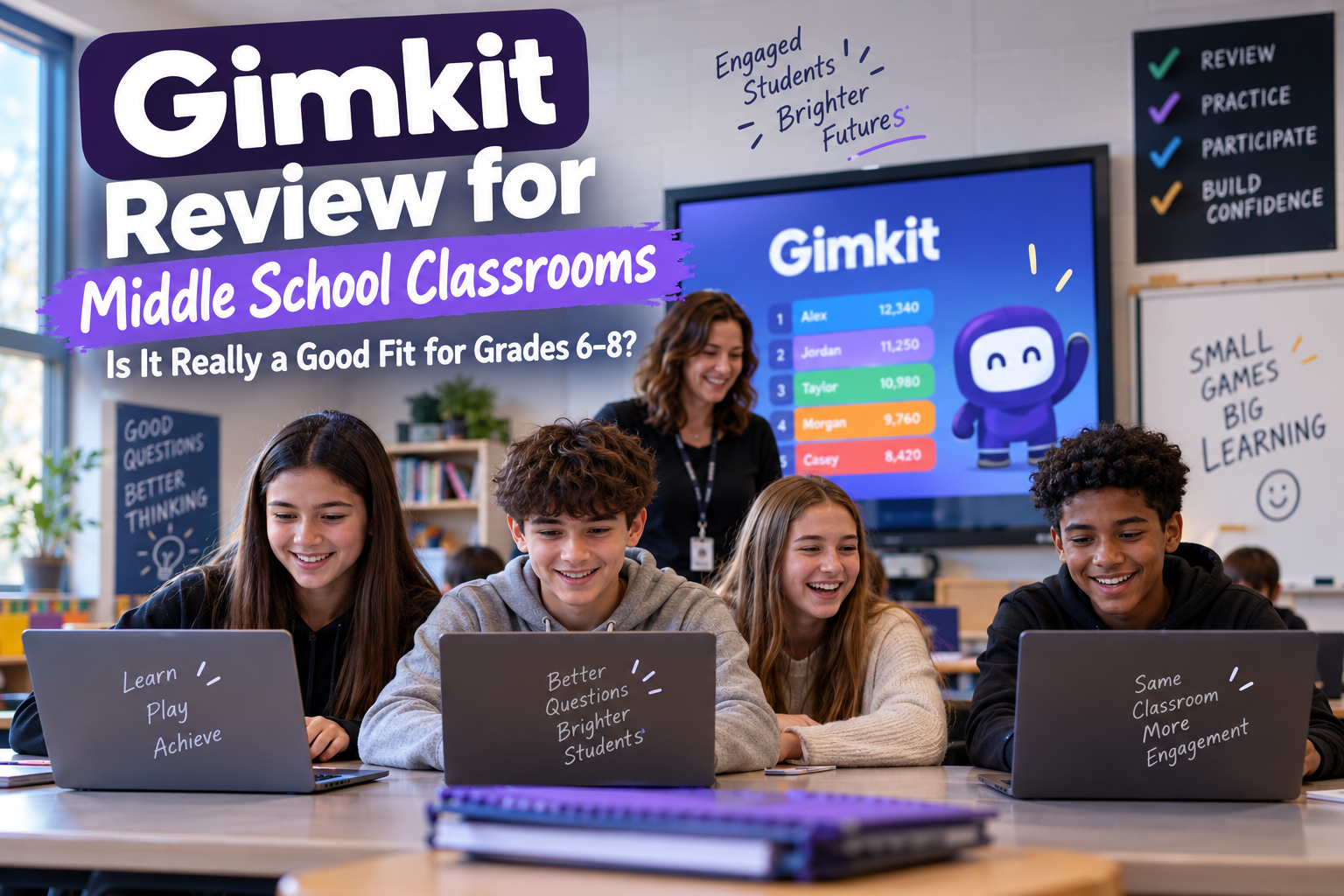
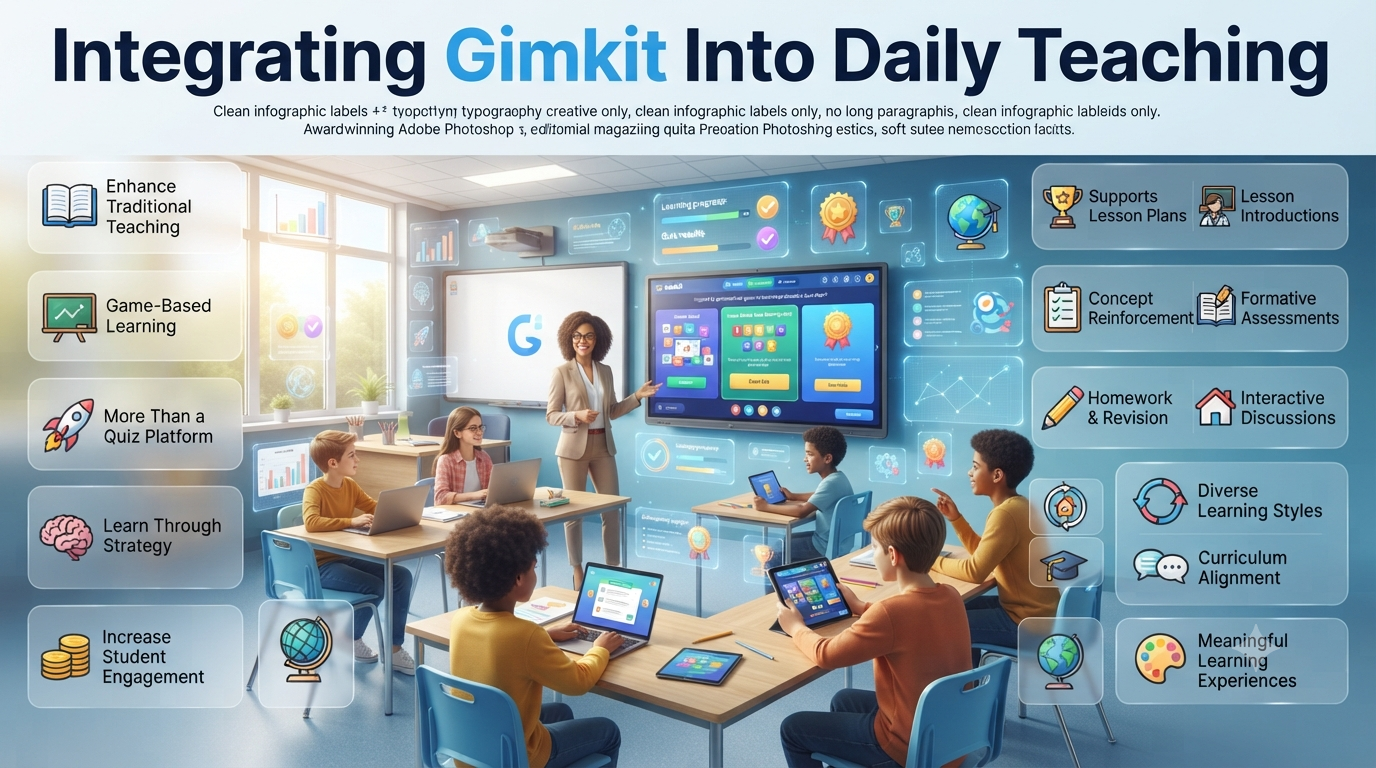
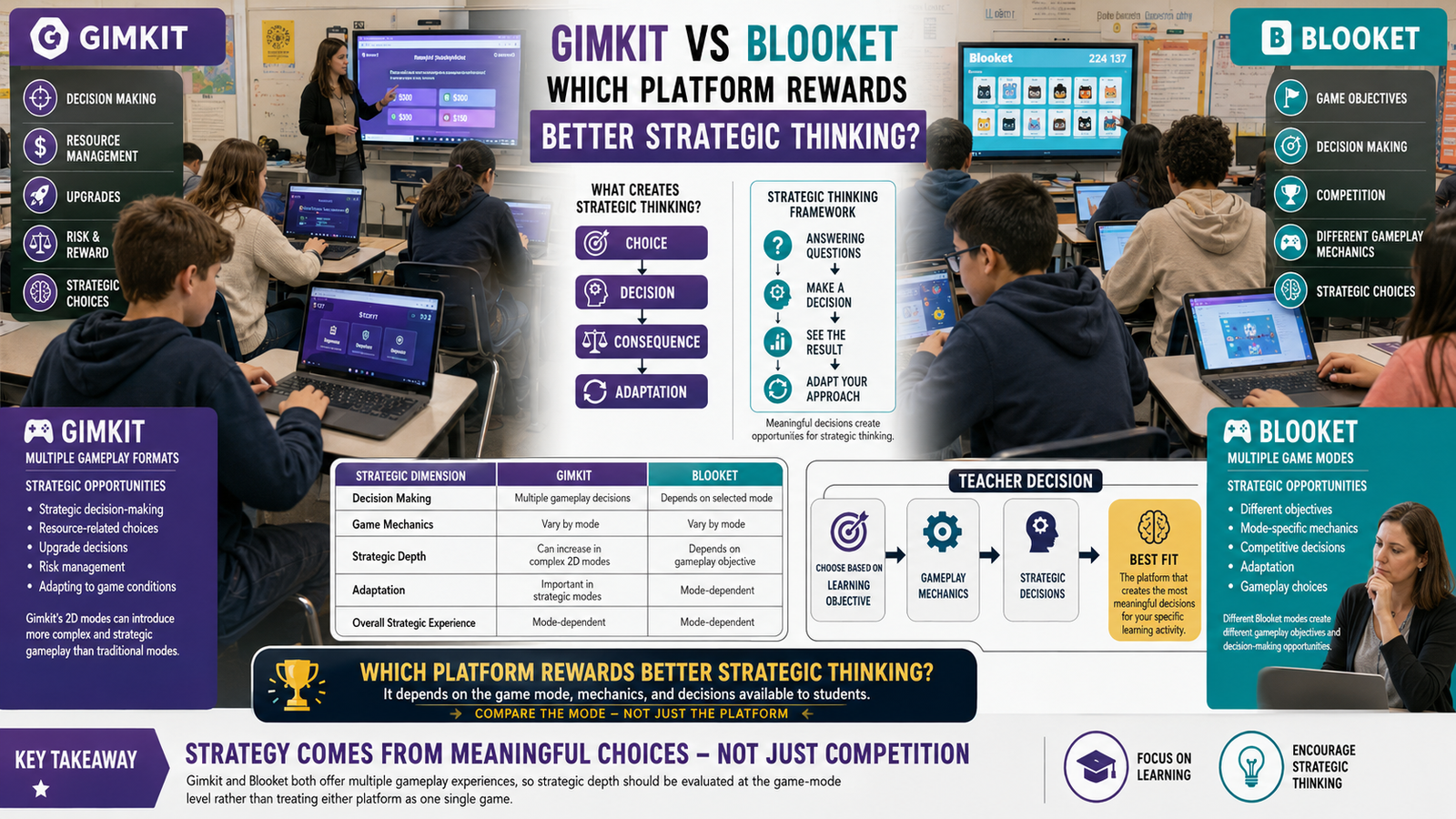
Gimkit Review for Middle School Classrooms-Middle school is one of the hardest age ranges for educational technology to get right.
Students in grades 6–8 are usually old enough to recognize immediately when a classroom activity feels childish, repetitive, or artificial. At the same time, many still respond strongly to competition, exploration, customization, visible progress, quick feedback, and social interaction.
Those characteristics make Gimkit an interesting fit for middle school.
The platform combines teacher-created question sets with game-based activities that can add movement, strategy, resource collection, cooperation, or competition around academic questions. That can make review feel less like another worksheet or standard quiz and more like an activity students actively want to join.
But enjoyment alone is not enough.
If you’re exploring a digital dashboard or online workspace, take a closer look at Questrivo Dashboard for an overview of its features and functionality.
The real question for a middle-school teacher is not:
Will students think Gimkit is fun?
The better question is:
Can Gimkit keep students involved in academic practice without allowing the game itself to become more important than the learning?
For many grades 6–8 classrooms, the answer is yes.
However, Gimkit works best when teachers use it deliberately. Its value depends heavily on the quality of the questions, the type of activity selected, the amount of time given to gameplay, the social dynamics of the class, and what happens after the game ends.
Used with a clear instructional purpose, Gimkit can be a strong middle-school review and participation tool.
Used without that purpose, it can become little more than an entertaining break.
Looking for comprehensive classroom resources and educational technology insights? Explore GimkitApp for expert guides, teaching strategies, game modes, and the latest updates to enhance student engagement.
Quick Verdict: Is Gimkit Good for Middle School?
Yes. Gimkit can be a very good fit for middle-school classrooms, especially when teachers use it for:
retrieval practice;
vocabulary review;
concept reinforcement;
formative checks;
pre-assessment review;
short active-learning sessions;
revisiting previously taught material.
Its strongest advantage for grades 6–8 is not simply that it makes questions feel like a game.
The stronger advantage is that it can change the experience surrounding those questions.
A conventional digital quiz often follows the same pattern from beginning to end:
Question → answer → result → next question.
Gimkit can place that cycle inside a broader activity where answers influence what students can do next.
That makes repeated academic practice feel less repetitive.
For middle-school students, who often become bored once they recognize a routine, that can be useful.
But the game layer should support the learning rather than replace it.
A student who is excited, moving quickly, and reacting to the game is not automatically thinking deeply about the academic material.
That distinction is important throughout this review.
Why Middle School Is a Distinct Test for Gimkit
A Gimkit review for middle school should not simply reuse the same criteria that would be used for elementary or high school.
Grades 6–8 sit in a unique developmental and instructional space.
Students are becoming more independent.
They are more aware of peer opinion.
They may become highly motivated by competition.
They may also become discouraged by visible comparison.
They are capable of more complex reasoning than younger students, but many still benefit from clear structure and short feedback cycles.
This creates a difficult balance for classroom technology.
If the activity is too simple, students may dismiss it as childish.
If it is too complicated, they may focus more on mastering the game than mastering the content.
If it is too competitive, some students may disengage.
If it is too repetitive, the novelty disappears.
Gimkit’s flexibility gives teachers some room to manage these tensions.
The same academic material can be placed inside different types of game experiences. That allows teachers to vary how students interact with the content without constantly changing the content itself.
For middle school, that can be a meaningful advantage.
Where Gimkit Fits Best in a Grades 6–8 Lesson
Gimkit is strongest when it has a clear role inside a lesson.
It should not automatically become the lesson itself.
One of its most natural uses is after students have already encountered the material.
A useful instructional sequence might look like this:
Teach → discuss → practice → retrieve through Gimkit → examine misconceptions
This structure gives the game a defined purpose.
Students are not trying to learn an entirely unfamiliar concept while also learning how the game works.
Instead, they are revisiting material they have already studied.
That makes Gimkit especially useful for review.
Imagine a seventh-grade science class studying ecosystems.
Students have already learned:
producers;
consumers;
decomposers;
populations;
communities;
food chains;
food webs.
A weak Gimkit set might ask only simple definition questions.
A stronger set could combine several kinds of thinking.
Students might be asked to identify a producer.
Then classify an example as a population or community.
Then predict what might happen if one organism in a food web disappeared.
Then identify a misconception about energy transfer.
The same academic topic is being revisited repeatedly, but the thinking required changes.
That is where Gimkit can become more educationally useful.
The game makes repetition easier to tolerate.
The questions determine whether the repetition is worthwhile.
The Most Important Middle-School Question: Game or Learning?
Gimkit’s biggest strength can also become its biggest weakness.
The game layer makes the platform appealing.
But if students become too focused on the game objective, the academic questions may begin to feel like something they must rush through in order to continue playing.
That creates a simple classroom problem:
How much of the session should be about answering questions, and how much should be about interacting with the game?
There is no universal answer.
The correct balance depends on the lesson.
A five-minute warm-up can tolerate a faster, lighter experience.
A review before an important assessment may need stronger emphasis on the academic questions.
A Friday recap may reasonably allow more room for interaction and play.
The important point is that middle-school teachers should think about this balance intentionally.
Without that decision, the most entertaining part of the activity can easily become the part students remember most.
Does Gimkit Actually Hold Middle-School Attention?
Often, yes.
One reason is that Gimkit breaks the predictability of traditional review.
Students are not simply answering one question after another with no larger purpose.
Instead, the question may affect something happening inside the activity.
That gives students another reason to continue.
For many middle-school learners, this can increase persistence.
They may answer more questions simply because they want to continue participating in the surrounding game.
That can be valuable when the academic goal requires repeated retrieval.
However, teachers should distinguish between two kinds of engagement.
Behavioral Engagement
The student is:
clicking;
moving;
reacting;
talking;
competing;
participating.
Cognitive Engagement
The student is:
thinking carefully;
retrieving information;
distinguishing concepts;
applying knowledge;
evaluating alternatives;
correcting misconceptions.
A Gimkit session can create a great deal of behavioral engagement without automatically creating cognitive engagement.
That is why a teacher should not judge success only by how loud, excited, or enthusiastic the room becomes.
A better question is:
What can students still explain or apply after the game is over?
Sixth Grade: Structure Matters More Than Complexity
Sixth grade is often a transition year.
Students may be adjusting to:
multiple teachers;
different classroom expectations;
more independent work;
more complicated schedules;
new social dynamics.
For this reason, a sixth-grade teacher should probably not make the first Gimkit session the most complex one possible.
The first objective should be establishing a routine.
Before starting, students should know:
why they are using Gimkit;
what they are expected to learn;
whether talking is allowed;
whether students can help one another;
what behavior is unacceptable;
what happens when the activity ends.
This may sound overly formal for a game.
In practice, clear expectations make future sessions much easier.
Once students understand the routine, the teacher can introduce more complex experiences gradually.
For sixth grade, simple first use is often better than maximum novelty.
Seventh Grade: Peer Dynamics Become More Important
By seventh grade, many students will understand the mechanics of a classroom game quickly.
The more important issue may become how they interact with one another.
Competition can increase participation.
It can also create:
excessive celebration;
frustration;
arguments;
teasing;
fixation on rankings;
careless guessing;
students mentally giving up when they fall behind.
This does not mean competitive activities should be avoided.
It means teachers should evaluate what competition is doing to the class.
If it makes students more attentive and more willing to participate, it is helping.
If it makes students rush, argue, or ignore the content, it is becoming counterproductive.
Middle-school competition works best when the teacher manages the social environment as carefully as the technical settings.
Eighth Grade: Question Quality Becomes More Important Than Novelty
By eighth grade, many students are experienced enough with educational games that the basic idea of “learning through a game” is no longer especially surprising.
They may understand the mechanics quickly.
That means the academic questions need to carry more of the learning experience.
A weak eighth-grade Kit might ask:
What is slope-intercept form?
A stronger question might ask students to identify which equation represents a described relationship.
A weak science question might ask:
What is photosynthesis?
A stronger one could ask students to predict how a specific environmental change would affect the process.
A weak social studies question might ask students to identify a historical figure.
A stronger one could ask which consequence most logically followed from that person’s decision.
The platform can deliver all of those questions.
It cannot determine their quality.
For eighth grade especially, teachers should evaluate Gimkit partly by what they build inside it, not only by what the game looks like.
How Gimkit Fits Middle-School Mathematics
Mathematics can be a strong fit when the learning objective benefits from repeated practice.
Possible areas include:
integers;
fractions;
ratios;
proportions;
expressions;
equations;
geometry vocabulary;
coordinates;
basic graph interpretation.
The main risk is speed.
Some students may begin prioritizing fast answers over careful reasoning because they want to progress through the game.
That can be counterproductive.
A mathematics teacher can reduce this problem by creating distractors based on real misconceptions.
For example, instead of using obviously incorrect options, the teacher can include answers that reflect common calculation mistakes.
This forces students to think more carefully.
Students may also need paper, mini-whiteboards, or another workspace for calculation.
Gimkit can provide the prompt and feedback.
It does not have to replace the mathematical reasoning process.
How Gimkit Fits Middle-School Science
Science is one of Gimkit’s more natural middle-school use cases.
Many units combine vocabulary with conceptual relationships.
Possible topics include:
cells;
ecosystems;
forces;
energy;
matter;
heredity;
weather;
Earth systems.
The danger is turning science into pure vocabulary memorization.
A stronger Kit can include questions that ask students to:
recognize a process;
identify a variable;
predict an outcome;
distinguish between similar concepts;
identify a misconception;
apply a scientific idea to a short scenario.
This keeps the fast game cycle while increasing the academic demand.
How Gimkit Fits Middle-School Social Studies
Social studies can benefit from retrieval practice, but it should not be reduced to names and dates.
Gimkit can easily review:
people;
places;
vocabulary;
events;
dates.
A stronger middle-school activity can also connect:
event and consequence;
policy and effect;
geography and historical development;
person and decision;
cause and result.
Students still need discussion, reading, and writing to develop deeper historical understanding.
Gimkit can reinforce the knowledge that supports those activities.
How Gimkit Fits English Language Arts
ELA requires more selectivity.
Gimkit can be useful for:
vocabulary;
grammar;
literary devices;
sentence revision;
identifying evidence;
short interpretation questions.
It is less naturally suited to:
sustained reading;
annotation;
long passages;
extended written analysis;
essay development.
A teacher should not force every literacy task into a fast digital format.
For ELA, Gimkit works best as a targeted practice tool rather than a complete reading environment.
How Gimkit Fits World Languages
World-language learning often requires repeated retrieval, which gives Gimkit a natural role.
Possible uses include:
vocabulary;
translation choices;
verb forms;
sentence completion;
grammatical distinctions.
The game layer can make repetition feel less monotonous.
However, language learning also requires production.
Students need opportunities to:
speak;
listen;
write;
create sentences;
communicate.
Gimkit can strengthen vocabulary and recognition without replacing those other skills.
Classroom Management Can Make or Break the Experience
A successful middle-school Gimkit session often begins before students join.
Teachers should decide:
whether students may talk;
whether they may collaborate;
whether they can help one another with questions;
whether the teacher will pause the game;
what happens if someone disrupts the activity;
how the session ends;
what students do afterward.
If these expectations are unclear, students may create their own social rules.
That can work in a mature class.
It can also create unnecessary chaos.
The most important lesson is simple:
Gimkit is not classroom management.
It is a classroom tool.
The teacher still has to design the environment in which the tool is used.
What About Students Who Do Not Like Competition?
This group matters.
When most of a class becomes visibly excited, it can be easy to assume everyone is equally engaged.
That is not always true.
Some students may dislike:
fast competition;
public comparison;
noisy environments;
complex controls;
pressure to respond quickly.
Others may understand the academic content very well but dislike the game format.
A middle-school teacher should not assume that reluctance to participate enthusiastically means lack of understanding.
The strongest approach is variety.
Use Gimkit when it fits.
Use other forms of review when they fit better.
Students should have more than one way to demonstrate learning.
The Importance of Looking Beyond the Winner
One of the easiest mistakes with game-based learning is ending the lesson when the game ends.
Students see the result.
Someone wins.
The class moves on.
That wastes useful instructional information.
A better middle-school routine is to ask:
Which questions caused the most difficulty?
Which misconception appeared repeatedly?
Which concept seemed secure?
Which topic needs another explanation?
Even a three-minute discussion after the game can change the academic value of the activity.
Instead of:
play → winner → finished
the structure becomes:
retrieve → play → inspect → correct
That is a much stronger instructional sequence.
The game creates participation.
The follow-up turns participation into usable information.
Gimkit Does Not Need to Take Over the Whole Period
One of the most practical strengths of Gimkit is that it can occupy only part of a lesson.
Imagine a 45-minute class.
Minutes 0–7: Retrieval Starter
Students answer two or three questions independently.
Minutes 7–15: Clarification
The teacher addresses a misconception or reviews a difficult concept.
Minutes 15–30: Gimkit Activity
Students participate in a focused review.
Minutes 30–36: Examine Difficult Questions
The class identifies where mistakes occurred.
Minutes 36–42: Discussion
Students explain why certain answers were correct or incorrect.
Minutes 42–45: Exit Response
Each student answers one final question without the game.
This is not a required formula.
The important principle is that Gimkit can create an active middle section without consuming the whole lesson.
That gives teachers room to combine it with:
instruction;
discussion;
reasoning;
writing;
independent work.
When Gimkit Is Particularly Useful in Middle School
Gimkit makes the strongest case for itself when the teacher can identify a specific reason for using it.
It can be particularly useful:
Before an Assessment
Students can retrieve material across a unit before a quiz or test.
After Several Teacher-Led Lessons
The activity can change the classroom rhythm without abandoning the academic topic.
During Vocabulary-Heavy Units
Repeated retrieval can make terminology practice feel less repetitive.
When Students Confuse Similar Concepts
Different question formulations can repeatedly test the distinction.
When the Teacher Wants an Active Review
Gimkit can change the pace after reading, note-taking, or direct instruction.
When Familiar Content Needs a New Practice Environment
Teachers can revisit previously taught material without presenting it through the same format every time.
The common factor is that the academic goal exists before the platform is chosen.
When Gimkit Is Probably the Wrong Tool
A positive review should also identify where Gimkit does not fit naturally.
Extended Writing
Essays, explanations, reflections, and arguments require room to develop ideas.
Close Reading
Complex texts need slow reading, annotation, rereading, and discussion.
Detailed Mathematical Reasoning
Getting a final answer does not always reveal how a student reached it.
Laboratory Skills
Knowing the correct procedure is not the same as performing it successfully.
Deep Discussion
Some learning depends on students explaining, challenging, and refining ideas aloud.
An Already Overstimulated Classroom
A highly interactive digital activity can sometimes increase the problem rather than solve it.
Gimkit does not need to perform every instructional role to be useful.
Its value becomes clearer when teachers understand what it does well and where another method is better.
Should the Student Who Wins Receive the Best Grade?
Usually, no.
A final game result should not automatically be treated as a direct measurement of academic mastery.
Depending on the activity, performance may involve:
strategy;
speed;
resource decisions;
familiarity with the mode;
movement;
other game-specific choices.
A student may understand the academic content very well without finishing first.
Another student may become highly skilled at the game mechanics.
Those are not necessarily the same achievement.
For middle school, separating game performance from academic identity can be especially helpful.
Students can enjoy the competition without believing that a leaderboard completely defines who understands the subject.
A Major Middle-School Advantage: Familiar Content Can Feel Different
Repeated practice creates a motivational problem.
Students need to revisit important material.
But they quickly recognize when they are being asked to do the same thing again.
Gimkit can change the surrounding experience while the academic content remains familiar.
This creates a useful combination:
stable learning target + changing practice environment
Students may encounter the same core concepts through different activity structures.
That gives the teacher a way to introduce novelty without constantly replacing important content with new material.
For middle school, where repetition is often necessary but boredom can appear quickly, this is a meaningful strength.
How Much Gimkit Is Too Much?
There is no universal rule that says teachers should use Gimkit a specific number of times per week.
A better test is purpose.
Before launching a game, the teacher should be able to finish this sentence:
I am using Gimkit today because…
Strong answers include:
students need retrieval practice before an assessment;
yesterday’s work revealed a misconception;
students need another opportunity to distinguish similar concepts;
the class needs an active review after several instruction-heavy lessons.
A weaker answer is:
The students asked for it.
Student preference matters.
It should not become the curriculum.
Selective use can also protect one of Gimkit’s main strengths.
If every lesson ends with the same platform, even an engaging format can eventually become routine.
Is Gimkit Appropriate for All Middle-School Learners?
Not automatically.
Students vary considerably.
Some thrive in fast interactive environments.
Others need more processing time.
Some enjoy competition.
Others prefer quieter work.
Some find game mechanics motivating.
Others find them distracting.
Teachers should therefore pay attention to more than the class average.
A successful activity should not create unnecessary barriers for a smaller group of students.
Useful questions include:
Are students getting enough time to process the questions?
Are game controls distracting some learners?
Is peer comparison creating pressure?
Are students rushing because speed feels more important than accuracy?
Is there another way to demonstrate understanding when needed?
The goal is not identical enthusiasm.
The goal is meaningful participation.
Middle-School Gimkit Scorecard
Area
Verdict
Why It Matters
Student appeal
Strong
Game-based activity can make review feel different from a normal quiz.
Retrieval practice
Strong
Students can repeatedly revisit previously taught material.
Grades 6–8 fit
Strong with structure
The age group responds well when expectations are clear.
Academic depth
Depends on question quality
The platform cannot compensate for weak questions.
Classroom management
Variable
Competition and excitement can help or hurt depending on the group.
Subject flexibility
Good
Works especially well for short-form retrieval and application.
Long-form reasoning
Limited
Extended writing and sustained analysis usually require another format.
Social dynamics
Requires teacher judgment
Middle-school peer behavior can strongly influence the experience.
Repeated use
Good if varied
Different activity structures can keep familiar content from feeling identical.
Complete instructional replacement
Poor fit
Gimkit works better as part of a broader teaching system.
The Biggest Strength of Gimkit for Middle School
Its biggest strength is not the graphics.
It is not competition.
It is not the novelty of digital gaming.
The strongest middle-school advantage is this:
Gimkit can make repeated academic practice feel different without requiring the teacher to abandon the academic material that students still need to practice.
That is valuable because middle-school learning often depends on repetition.
Students need to revisit:
vocabulary;
formulas;
concepts;
processes;
distinctions;
relationships.
The challenge is making that repetition tolerable.
Gimkit can help with that challenge.
The Biggest Limitation of Gimkit for Middle School
The same game layer that increases participation can also pull attention away from the content.
That means teachers constantly need to ask:
Are students playing in order to answer questions, or answering questions only so they can keep playing?
The distinction is subtle.
But it matters.
If the academic questions become merely an obstacle between students and the game, the instructional value can weaken.
The solution is not to remove all gameplay.
The solution is better balance.
The questions should matter enough that students have to think.
The game should be interesting enough that they want to continue.
That is the ideal relationship.
Who Should Consider Gimkit for Middle School?
Gimkit is particularly worth considering for teachers who:
regularly use retrieval practice;
teach content requiring repeated review;
want a more active alternative to ordinary quiz sessions;
have reliable device access;
can establish clear classroom expectations;
are comfortable designing thoughtful questions;
want to vary classroom pace;
are willing to discuss misconceptions after the activity.
It may be especially valuable for teachers who want variety without constantly creating completely new academic material.
Teachers whose lessons depend heavily on:
long writing;
sustained reading;
performance tasks;
deep discussion;
extended reasoning;
may find Gimkit more useful as an occasional supplement.
That is not a weakness.
It is a realistic definition of the platform’s role.
Final Verdict: Is Gimkit Worth Using in Middle School?
Yes.
For many grades 6–8 classrooms, Gimkit can be a strong supplementary learning tool.
Its appeal comes from placing academic questions inside a larger interactive experience.
That can help students stay involved in repeated practice.
But Gimkit is not automatically effective simply because students enjoy it.
A weak question remains weak inside a game.
A distracting activity remains distracting even if students are excited.
A competitive session can become counterproductive when social dynamics are ignored.
And visible enthusiasm should never be mistaken automatically for deep learning.
The strongest middle-school use of Gimkit follows one principle:
Let the game create another reason to participate. Let the questions determine what that participation is worth.
For sixth grade, that usually means beginning with structure.
For seventh grade, it means paying attention to peer dynamics.
For eighth grade, it increasingly means raising the intellectual quality of the questions.
Used this way, Gimkit does not need to become the center of the classroom.
It occupies a more useful role:
a flexible environment for turning carefully designed academic practice into an activity that many middle-school students are willing to stay involved in.
That makes Gimkit a strong option for middle-school classrooms when it is used with clear purpose, thoughtful question design, and appropriate teacher control.
Frequently Asked Questions
1. Is Gimkit suitable for sixth-grade students?
Yes. Gimkit can be suitable for sixth-grade students, particularly when teachers provide clear instructions and choose a game structure that students can understand quickly. The academic content should remain the focus, while the game mechanics provide an engaging way to practice and review material.
Teachers can begin with straightforward activities before introducing more complex strategies or settings.
2. Is Gimkit too childish for eighth graders?
Not necessarily. Eighth-grade students can still engage with Gimkit when the academic challenge is appropriate for their level. Older students may become familiar with basic gameplay quickly, so teachers can maintain interest through stronger questions involving reasoning, application, scenarios, and analysis.
The quality of the content often matters more than the apparent simplicity of the game format.
3. Is Gimkit useful for more than memorization?
Yes. Gimkit questions do not have to focus only on factual recall. Teachers can design questions around classification, application, interpretation, scenario analysis, misconception detection, and conceptual understanding.
For stronger learning activities, teachers should make the questions reflect the thinking skill they want students to practice rather than simply asking students to remember isolated facts.
Question types can target:
Recall.
Classification.
Application.
Interpretation.
Scenario-based reasoning.
Misconception identification.
Conceptual understanding.
4. Should the Gimkit winner automatically receive the highest grade?
Usually not. A game result can reflect several factors beyond academic knowledge, including response speed, strategy, risk-taking, and familiarity with the activity. Therefore, a leaderboard position should not automatically be treated as a complete measure of mastery.
Gimkit can provide useful formative evidence, but graded assessment should consider the specific learning objective and other available evidence.
A better approach is to consider:
Accuracy.
Learning objectives.
Question quality.
Patterns of mistakes.
Performance across activities.
Other assessment evidence.
5. Can Gimkit replace normal assessment, and does too much use reduce effectiveness?
Gimkit is generally better treated as a supplementary assessment and learning tool rather than a complete replacement for other assessment methods. Its question-based format works particularly well for subjects and objectives that benefit from repeated short-form practice, while extended writing, projects, practical demonstrations, and deeper reflection may require different methods.
Frequent use can also reduce its impact if every lesson follows the same pattern. When Gimkit becomes routine rather than purposeful, student attention and novelty may decline.
Use it most effectively by:
Connecting each game to a clear objective.
Varying activity formats.
Mixing gameplay with direct instruction.
Using questions that require genuine thinking.
Reviewing mistakes after the game.
Avoiding unnecessary use simply because the platform is engaging.
For the latest gaming news, expert reviews, and walkthroughs, readers can also visit IGN, one of the world’s leading gaming websites.