Practical field guide: how Gimkit resource decisions really differ
The original overview above introduces general economic concepts. The following field guide puts those concepts into mode-specific, evidence-aware practice and corrects a common oversimplification: not every Gimkit mode operates as a cash-based investment game. Use the current mode’s actual options as the source of truth.
Begin with the mode, not with a universal money formula
The phrase “Gimkit economy” describes several different systems rather than one rulebook that applies to every match. A cash-based quiz session can reward correct responses with money that players spend on improvements. A 2D experience may instead ask students to earn energy, bait, projectiles, or another mode-specific resource through questions. Those resources enable movement or actions, but they do not necessarily behave like a bank balance or compound-interest investment. Before interpreting a purchase as a smart financial decision, identify what the mode actually awards, what can be bought, and what determines the outcome. The host’s mode picker and options screen are more reliable than a strategy copied from a different mode.
Consider two classes studying identical vocabulary. One uses a conventional cash-oriented game and the other selects Fishtopia. In the first, a student might think about an upgrade’s future cash yield. In the second, bait is connected to fishing actions, and the relevant question is how effectively students convert correct answers into the ability to fish. The same vocabulary knowledge underpins both sessions, but the gameplay loops are different. A teacher who calls both “earning money” obscures what students are actually doing. The distinction matters for instruction too: if the class spends too long moving or purchasing, a mode-specific adjustment to rewards per question may restore a better balance.
A useful opening habit is to write three labels on a planning card: “question reward,” “resource use,” and “winning condition.” Fill those in from the current mode rather than memory. If you cannot explain all three, observe a short practice round before teaching strategies. This prevents advice from becoming inaccurate when the class switches modes or when Gimkit changes an interface.
Separate learning evidence from game wealth
A player can finish with a large in-game balance while misunderstanding a concept. Another may answer a smaller number of questions accurately but finish lower because they joined late, experimented with an unfamiliar control, or spent time helping a teammate. Game wealth is an outcome of a particular rule system; it is not a validated measure of mastery. Teachers should separate the entertainment metric from the instructional evidence. This distinction is especially important when students compare results publicly or assume that a leaderboard rank reflects academic ability.
For a lesson on equivalent fractions, define a content objective before the game: students should explain why two representations describe the same value. During play, the economy provides motivation and feedback, but after play the teacher asks students to justify one example without using the game. The explanation, not the cash total, is evidence of mathematical reasoning. A quick written exit response can expose misconceptions that a fast multiple-choice response conceals. If a student chooses the right option by chance, the follow-up reasoning gives a second view of understanding.
Gimkit’s official Game Reports documentation describes class, individual, and question-level report views after eligible hosted sessions. Use those reports to notice patterns, not to make high-stakes judgments from a single game. A question repeatedly missed by many learners may indicate confusing wording, missing prerequisite knowledge, or a misconception worth revisiting. Combine report patterns with classroom discussion and independent work. The economy makes the activity engaging; triangulation makes the teaching decision defensible.
Model the cash flow before recommending an upgrade
A useful financial analogy is a simplified cash-flow statement: starting balance, earnings from correct answers, spending on upgrades, and remaining balance. This is an instructional model, not a claim that every Gimkit mode exposes the same transactions. In a cash-oriented match, an upgrade can reduce the balance now in exchange for the possibility of greater earnings later. A player should ask whether enough answering opportunities remain to recover that cost. This is more informative than repeating a universal slogan such as “always upgrade early.”
Suppose an invented classroom simulation begins with 400 credits, and a hypothetical upgrade costs 300 credits while adding 20 credits per correct answer. Ignoring all other effects, a player needs fifteen additional correct answers to recover the purchase price. If only eight answering opportunities remain, the simple model predicts the upgrade will not repay itself before the session ends. If thirty remain, the purchase may have time to produce a benefit. These figures are deliberately invented for teaching arithmetic; they are not Gimkit’s live upgrade prices, earnings, or mode settings.
This model also has limits. It assumes the player can continue answering at the same rate, that every answer earns the stated incremental amount, and that no other costs or game events intervene. Real gameplay may have streak effects, penalties, mode-specific mechanics, or interruptions. Teachers can turn the exercise into a critical-thinking task: ask students to list which assumptions are unrealistic, then adjust the estimate. That conversation teaches conditional reasoning rather than encouraging students to memorize numbers that may not exist in their current mode.
Understand opportunity cost in the final minutes
Opportunity cost is the value of the next-best option a player gives up. A purchase uses resources that might otherwise remain available for another purchase, a later action, or a final objective. The relevant question is not merely “Is this upgrade useful?” but “Is it more useful than the alternative right now?” In a short round, the ability to make one more meaningful action may outweigh an improvement that needs several minutes to pay off. In a longer round, an early investment may have more opportunities to generate returns.
Imagine a student has enough simulated credits for one of two hypothetical choices: an earnings improvement that helps only after ten more correct answers, or an immediate objective-related action that would complete the team’s task. With a minute remaining, the immediate action may be rational even if the earnings improvement looks mathematically attractive in an unlimited game. With fifteen minutes remaining and no urgent objective, the conclusion could reverse. There is no universal best purchase because time and purpose are part of the decision.
A teacher can ask pairs to explain their choices using a sentence frame: “We selected X instead of Y because the remaining time, resource balance, and game objective made X more useful.” Students should be allowed to disagree if their assumptions differ. The important skill is making the assumptions visible and evaluating them against evidence. This is a richer learning opportunity than declaring that one player’s preferred upgrade sequence is objectively correct across every match.
Distinguish a bottleneck from a shortage
A shortage means a player lacks enough of a resource to act. A bottleneck is the constraint that prevents progress even when other resources are abundant. The two problems require different responses. A student may have plenty of hypothetical cash but insufficient time to answer more questions. A 2D player may have enough energy but be unfamiliar with movement controls. A team may have several active players but lack a shared plan for the objective. Simply generating more currency will not remove every constraint.
To diagnose a bottleneck, ask what would happen if the class suddenly received twice as much of its main resource. Would progress double? If not, another factor is limiting the system. Perhaps students cannot locate the objective, the questions are too difficult to answer accurately, or the class has not learned the mechanics. A teacher should address the actual constraint: provide a navigation demonstration, simplify an ambiguous prompt, offer a short practice period, or clarify roles.
This is also a safeguard against misleading economic metaphors. Not every problem in Gimkit can be solved through earning and spending. The platform combines knowledge retrieval with different forms of gameplay, and some modes emphasize cooperation, exploration, or skillful movement. A good strategy guide therefore treats resource management as one lens among several. When the bottleneck is conceptual understanding, the best intervention may be teaching the content rather than changing a game setting.
Use accuracy as a quality constraint, not a decoration
An aggressive strategy that increases answering speed while sharply reducing accuracy can undermine both learning and in-game performance. The exact relationship between correct responses and rewards depends on the mode, but guessing carelessly is rarely a sound educational goal. Students should first understand the question, then choose an answer, and only then consider whether speed improvements are appropriate. A teacher can measure how often the same misconception recurs rather than treating every response as equally informative.
For example, a student solving decimal comparisons may answer twenty questions quickly while confusing 0.8 with 0.75. Another student answers twelve carefully and can explain place value. If the first student accumulates more points through the game economy, the teacher should not interpret that result as stronger understanding. Instead, assign a short comparison task with new examples, ask each student to explain a choice, and use the responses to plan a small-group reteach.
A practical coaching sequence has three stages: accuracy with explanation, fluency without rushing, and strategic decision-making once the content is secure. Students who are still learning should not be pressured to optimize virtual earnings before they understand the material. The economy is an optional motivational layer around practice. Teachers can protect the learning goal by making thoughtful explanations and revision visible, even when the game’s scoreboard emphasizes a different outcome.
Explain the difference between rewards, reinvestment, and consumption
Economic language becomes more precise when players distinguish three types of resource use. A reward is what the mode grants for an action such as answering correctly. Reinvestment uses that reward to improve future earning or progression capacity. Consumption uses a resource for an immediate effect without necessarily increasing future income. This classification is useful as an analogy, but the actual options must be checked in the selected mode. A resource used for movement in a 2D game is not automatically equivalent to an upgrade that changes cash per answer.
Students can classify hypothetical decisions in a table: spending 200 simulated credits on a multiplier is reinvestment; spending an action token to open a gate is immediate progress; retaining a balance for later is preservation. Some actions fit more than one category, and that ambiguity is educationally useful. An improvement might increase future earning and also change what a player can do now. Rather than force every action into one label, ask students to explain the primary reason for their choice.
This vocabulary also helps teachers avoid conflating GimBucks with in-match cash. Gimkit’s Cosmetics documentation describes GimBucks as rewards associated with XP and cosmetic items, and notes that cosmetics do not provide gameplay advantages. They are a separate reward system from the resources used inside an individual match. A student buying a visual item in the cosmetics shop is not making the same kind of tactical investment as a hypothetical cash upgrade during a quiz session.
Treat a streak as a variable, not a promise
Students sometimes assume that a sequence of correct answers guarantees a particular multiplier or financial result. The danger is projecting a remembered mechanic from one game mode or version onto every other activity. A more reliable approach is to observe what the current mode actually displays, read the host settings, and distinguish the observed reward from a guess. If a mode changes the value of correct answers or penalizes mistakes, a strategy based on perfect accuracy may be fragile for students who are still practicing unfamiliar content.
Consider a hypothetical earnings model with a streak bonus. A learner expects to answer ten questions, but the probability of maintaining the streak is uncertain. The maximum theoretical earnings are not the expected earnings. A single missed answer could change the result depending on the rules. For a classroom exercise, invite students to calculate both an optimistic and a conservative outcome. Then discuss why a strategy that looks best in the optimistic case may not be best for a student who is still mastering the vocabulary.
The teacher’s responsibility is to avoid equating a streak with academic identity. A streak may encourage sustained attention, but it can also produce anxiety or encourage rushing. Make it normal to pause, read carefully, and learn from an error. Gimkit’s official Smart Repetition explanation says missed questions are prioritized for repeat exposure in live games and assignments. That feature is about practice opportunities, not a guarantee that a single streak or score proves mastery.
Plan an opening phase with a clear purpose
The opening phase of a match is when students learn the current rules, locate controls, and establish a baseline. In an unfamiliar mode, the best first action may be exploration rather than immediate optimization. A teacher can give students ninety seconds to identify what correct answers produce, where resources appear, and what ends the round. This brief orientation prevents later confusion and can be more valuable than an elaborate strategy lecture delivered before students have seen the interface.
For a familiar cash-oriented game, the opening can instead become a budgeting exercise. Ask students to state a provisional spending rule and a condition that would make them change it. One learner might plan to save until a particular hypothetical upgrade is affordable; another might invest immediately if enough time remains. Neither plan should be presented as universally correct. The students should compare what actually happens with what they expected, then explain why the model succeeded or failed.
For younger learners, keep the decision structure simple: earn, observe, choose, and review. For older students, introduce expected value, marginal gain, and opportunity cost. Both groups can work with the same game while studying different levels of reasoning. The teacher’s opening script should make clear that strategy is an experiment and that wrong predictions are useful evidence. That message supports a learning culture rather than turning early financial choices into permanent judgments about ability.
Adapt the middle phase when evidence changes
A strategy should change when the conditions supporting it change. At the midpoint, students can inspect time remaining, current resource constraints, their confidence with the questions, and the game objective. A plan based on thirty future correct answers may no longer make sense if the remaining session permits only ten. Conversely, a student who has become more accurate may be ready to take a calculated risk that was unwise during the opening. The important habit is updating the decision rather than defending an earlier choice.
In a classroom example, a pair of students initially plans to invest most of its simulated balance in earning capacity. After several minutes, the team realizes that an objective-related task, not income, is slowing progress. The pair revises its plan and explains the bottleneck to the teacher. That adjustment demonstrates systems thinking: they identified a constraint, collected new evidence, and changed their allocation. It does not require a particular Gimkit upgrade to exist in the live mode.
Teachers can build a thirty-second checkpoint into the activity: “What are we trying to achieve, what is stopping us, and what one change will we test?” Students should not need to reveal personal financial scores or compare their balances publicly. The checkpoint can be completed verbally or on a small private planning card. In this way, the economic model becomes a vehicle for metacognition rather than another competition over who can accumulate the largest number.
Make the endgame different from the opening
A strategy that is sensible with twenty minutes remaining may be poor with thirty seconds left. Near the end, players should reconsider whether a purchase can still produce a return before the game stops. The relevant time horizon is the actual remaining opportunity, not the original session length. Teachers can use this moment to illustrate sunk cost: money already spent on an earlier decision cannot be recovered by making another poor purchase merely to justify the first one.
For example, a hypothetical team buys an upgrade that it expected to repay after fifteen correct answers. The match is nearly over and the team has answered only six. The previous purchase may have been based on a reasonable but mistaken forecast. Spending its remaining balance on another long-term improvement does not make the first decision better. The team should evaluate the next action using the remaining time and current objective, even if that means abandoning the original plan.
This is also an opportunity to model emotional regulation. Students may feel frustrated when a purchase does not work as expected, especially if the leaderboard makes the result visible. Normalize post-game analysis: “Which assumption was wrong? What would you test next time?” Avoid shaming students for losing virtual resources. The purpose is to build transferable reasoning about decisions under uncertainty, not to reward only the students whose forecasts happened to be correct.
Keep individual and team economies distinct
A team-based activity may distribute responsibility across players, while an individual game puts more decisions in one student’s hands. Before advising students to pool, spend, or save resources, confirm what the selected mode actually permits. Some modes emphasize cooperative objectives without sharing a common cash account. Others may offer team options or shared progress. Calling all team games “shared economies” can create inaccurate expectations about the controls students will see.
Teachers can assign decision roles without claiming those roles exist as buttons in Gimkit. One student observes the objective, another checks the accuracy of content responses, and another records strategic choices for a short reflection. Rotate the roles so that all learners practice both the content and the reasoning. If a team has four members, ask them to agree on a criterion for a good decision before the round begins. That makes collaboration visible even when the game’s resource system is individual.
A productive debrief asks whether the team improved its coordination, not only whether it won. Did students communicate a change of plan? Did someone notice a misconception and explain it? Did the group use the game mode’s actual objective rather than pursuing an unrelated score? These observations support classroom goals such as listening, justification, and shared problem-solving. They are not automatically captured by a cash total, so the teacher should collect them through brief observation or discussion.
Use mode settings to protect question practice
Gimkit’s official Game Options and 2D Game Balance guidance explains that hosts can adjust how some 2D modes convert correct answers into resources such as energy, bait, or snowballs. This means a teacher can influence how much gameplay follows each correct response. A high reward per question may allow more movement or action between questions; a lower reward may require more question practice for the same progression. The best setting depends on the lesson objective, students’ familiarity with the mode, and the time available.
Suppose a teacher wants students to practice multiplication facts repeatedly. If the chosen 2D mode allows extensive activity after very few answers, the teacher may lower the relevant reward per question. For a lesson about collaboration and communication, the same teacher might accept a higher reward so teams have time to coordinate. Neither choice is intrinsically more educational. The key is alignment between what the game encourages and what the lesson is intended to teach.
Before making a change, verify that the setting exists for the selected mode. Do not promise a universal slider or exact reward value. Explain the change to students: “Today we want more question attempts, so the action reward will be smaller.” Afterward, check whether the class actually practiced the content and whether the change introduced frustration or accessibility problems. If it did, revise the plan rather than treating the setting as a fixed best practice.
Design a fair comparison between two strategies
A classroom can compare economic strategies without presenting the results as a controlled scientific experiment. Choose a single familiar mode, use the same question kit, keep the session length comparable, and ask groups to document one planned difference. One group may prioritize early investment; another may preserve resources longer. The teacher should acknowledge that differences in prior knowledge, reading speed, device familiarity, and random game events can affect outcomes. A single class session cannot establish a universal winning strategy.
A practical comparison worksheet has five columns: proposed strategy, predicted benefit, conditions needed, observed result, and revised explanation. For a hypothetical investment strategy, students might predict that an upgrade will repay itself if at least twenty correct-answer opportunities remain. During play, they record whether the condition was met and whether any unplanned constraint appeared. The worksheet is useful even if the game does not expose detailed transaction histories, because students can record observations and reasoning rather than pretending to have precise data.
The debrief should focus on quality of explanation. A team that loses but correctly identifies a flawed assumption may demonstrate stronger analytical thinking than a team that wins through luck without understanding why. Invite students to distinguish correlation from causation: an early upgrade and a high score occurring together do not prove that the upgrade caused the score. That distinction helps students interpret evidence in mathematics, economics, science, and everyday decision-making.
Turn the economy into a numeracy lesson
The game economy can support arithmetic and proportional reasoning when teachers explicitly frame numbers as examples rather than live product specifications. Students can calculate net change, percentage increase, break-even points, and remaining budgets. For instance, a hypothetical player begins with 600 credits, earns 250, and spends 180. The ending balance is 670 credits. If the player wants to reserve 200 credits for a later objective, only 470 are available for optional spending. This exercise makes the concept of a budget concrete.
For older students, introduce marginal return. An invented upgrade that adds 15 credits per correct answer costs 225 credits; its simple break-even point is fifteen additional correct answers. If a second upgrade costs 450 and adds only 10 more credits per answer, its marginal break-even point is forty-five answers, assuming the increment is independent and all other conditions remain constant. These are arithmetic examples, not official Gimkit prices. Students should challenge the assumptions and compare how the decision changes if the remaining number of questions is uncertain.
For younger students, replace formulas with counters or a number line. Ask them to explain what it means to spend now for a possible benefit later. For advanced learners, introduce opportunity cost and expected value using a range of plausible outcomes. In every version, the teacher should check the underlying mathematics independently of the game score. The objective is mathematical reasoning, not financial advice or mastery of a particular user interface.
Address risk and uncertainty without glorifying gambling
Some classroom game decisions involve uncertain outcomes. Teachers can discuss risk as a normal part of planning without encouraging gambling-like behavior or framing reckless spending as admirable. The distinction is between a reasoned choice with known assumptions and an impulsive attempt to recover a loss. A student who has spent too much should not be urged to take a bigger risk merely because the earlier purchase failed. That is the sunk-cost trap, and the safer response is to reconsider the remaining choices.
Use a simple invented scenario: Option A guarantees 100 classroom points; Option B gives either 200 or 0 with equal hypothetical probability. The expected value of B is also 100, but the outcomes vary. Ask students why a group might prefer the predictable option when the lesson objective requires steady progress. Then ask why a different group might choose the variable option in a low-stakes simulation. The discussion is about probability, consequences, and risk tolerance, not a claim that Gimkit offers these exact choices.
Keep all classroom activities free of real-money stakes, student payments, or personal financial disclosure. Never connect virtual earnings to grades or social status. If a particular mode creates anxiety, switch to a calmer format or use a noncompetitive practice activity. The economy metaphor should expand students’ reasoning, not create pressure to win or take unnecessary risks.
Protect students who need more processing time
A resource system tied to repeated correct answers can disadvantage learners who read slowly, use assistive technology, or are still developing language fluency. That does not mean the activity is unusable, but it does mean the teacher must plan for equitable participation. Provide a preview of the content, avoid unnecessary time pressure, and offer alternatives for demonstrating understanding. Students should be able to learn without being publicly labeled as weaker because their in-game earnings differ.
A teacher might allow students to work with a partner on a challenging vocabulary set, provide visual supports for unfamiliar terms, or select a less intense mode when the learning goal is accuracy. For students who find the interface difficult, a short navigation demonstration may reduce cognitive load. The teacher can also use practice links to preview questions without the full game mechanics, as described in Gimkit’s official Practice Mode documentation. These adjustments support access while keeping the same academic objective.
Avoid interpreting a lower balance as a motivation problem. A student may understand the content but struggle with controls, device performance, or reading speed. Use a separate check for knowledge, such as explaining a concept orally or solving a parallel problem on paper. When planning teams, rotate roles so students with different strengths can contribute. Equity is not the same as making every player finish with identical virtual currency; it means providing fair opportunities to engage and demonstrate learning.
Keep cosmetics outside tactical economy claims
Gimkit has a separate cosmetics reward system involving XP, levels, GimBucks, and cosmetic items. Official help explains that cosmetic items do not provide gameplay advantages. It is therefore misleading to tell students that purchasing a Gim, trail, or other visual item will improve their cash earnings in a match. The in-game economy and the cosmetics shop may both use reward language, but they serve different purposes. One concerns a particular activity’s mechanics; the other concerns visual personalization and progression over time.
A classroom comparison can help students see the difference. Ask whether a purchase changes how a player looks, changes the resources available during the current mode, or changes the ability to complete an objective. If it only changes appearance, classify it as cosmetic. If the answer is unclear, consult the official product documentation rather than inventing an advantage. This is particularly important for families who may confuse game rewards with paid upgrades or assume that students need to buy something to compete.
Teachers should avoid pressuring students to collect cosmetic rewards. The purpose of a school game is learning, and visual items should remain optional. When students discuss purchases, use precise terms: “cosmetic customization,” “mode-specific resource,” or “hypothetical classroom credit.” Precision reduces confusion and prevents articles about the economy from implying that all currencies are interchangeable.
Check the reliability of reports and interpretations
Gimkit reports can help teachers identify which questions deserve follow-up, but a report is not a full explanation of why a student answered as they did. A wrong answer might reflect a misconception, misreading, an accidental tap, unfamiliar vocabulary, or an interface problem. The teacher should look for patterns across questions and use a second task to verify the interpretation. This matters when the game economy encourages rapid responses: students may prioritize momentum over careful reading, creating noise in the evidence.
A practical review begins with the question breakdown. Identify one item that many students missed and inspect whether the wording is clear. Then ask students to explain the underlying idea in a new format. If the difficulty persists, plan a short reteach; if the class understands the concept when the pressure is removed, reconsider pacing or mode choice. Avoid announcing individual mistakes publicly. Student-level information should be handled according to school privacy rules and only shared with those who need it for instruction.
For a unit on scientific variables, a teacher might notice that students repeatedly confuse the independent and dependent variable. Instead of treating low earnings as the problem, the teacher models a fresh experiment and asks students to identify what changes and what is measured. The game created an opportunity to notice the gap; the teaching response closes it. This keeps the economy in its proper place as a classroom engagement mechanism rather than a substitute for professional judgment.
Plan a ten-minute mini-lesson around economic reasoning
A short lesson can make the economic analogy purposeful without requiring a full period of gameplay. In the first minute, define the content objective and show the current mode’s reward and goal. In minutes two and three, students predict how one hypothetical spending decision might affect later options. In minutes four through seven, run a brief activity or teacher demonstration. In minute eight, pause and ask students to compare their prediction with the observed result. In the final two minutes, collect one explanation of what they would change and why.
This schedule can be adapted to a longer class, but the sequence should remain clear: prediction, observation, explanation, and transfer. Students should not be required to purchase an upgrade to participate. A teacher can use a projected scenario, paper tokens, or a small group discussion when devices are unavailable. If the selected mode lacks the assumed purchase mechanic, replace the financial decision with a real resource trade-off from that mode, such as how to use a limited amount of energy or how to prioritize an objective.
Assessment should match the reasoning target. A suitable exit prompt is: “What information would you need before deciding whether to spend a resource now or save it for later?” A strong answer names time remaining, expected benefit, alternative uses, and uncertainty. The prompt works even when students did not finish first, and it transfers to budgeting, scientific planning, and everyday decision-making.
Use an after-game decision journal
A decision journal records the reasoning behind a choice before the outcome is known. This prevents hindsight bias, the tendency to believe that the winning choice was obvious after the game. Before a hypothetical investment, students write what they expect to happen and why. Afterward, they compare the forecast with the result. A good journal entry does not require a successful outcome; it requires a clear assumption and a thoughtful revision.
For example, a student writes, “I expect this earnings upgrade to help because I think there are twenty questions left and I can answer most correctly.” After the match, the student discovers that the session ended sooner than expected. The journal makes the actual error visible: the student misestimated the time horizon. That is a more useful lesson than saying simply, “The upgrade was bad.” In another case, the student might have estimated time correctly but underestimated how difficult the questions would be. Each explanation suggests a different adjustment.
Teachers can use three reflection prompts: What did I predict? Which condition mattered most? What would I do differently in a similar situation? Keep entries brief and avoid collecting sensitive student data. The aim is to cultivate flexible reasoning, not to create another lengthy administrative task. A two-minute journal can turn an entertaining session into a concrete opportunity for metacognition and formative assessment.
Compare a cash economy with a resource-action economy
A cash-oriented mode may invite players to think in terms of balances and purchases. A 2D mode may emphasize a conversion from correct answers to an action resource. These systems can both be analyzed economically, but the units and decisions differ. In a cash model, the question might be whether an upgrade improves future earnings. In a resource-action model, the question may be whether to spend scarce energy on movement now or preserve enough for a later objective. Neither question should be answered with a formula copied from the other system.
Gimkit’s official 2D Game Balance documentation offers concrete examples: Snowbrawl can award snowballs per correct answer, Fishtopia can award bait, and modes such as Tag: Domination or Capture The Flag can award energy. Those are examples of distinct resource loops. A teacher should inspect the selected mode’s options to confirm the currently available controls. If the goal is repeated practice, adjust the reward-to-question balance where supported; if the goal is collaboration, allow time for meaningful interaction after answers.
This comparison can become a systems diagram. Students draw a box for “correct answer,” an arrow to “resource,” another arrow to “action,” and a final arrow to “goal.” Then they label where a decision occurs and where a bottleneck might arise. The diagram teaches cause and effect more accurately than treating every mode as a bank account. It also helps students explain why one strategy may work well in one game and fail completely in another.
Avoid false precision in online strategy guides
An article that promises an exact best upgrade order without naming the mode, rules, time horizon, and assumptions is likely oversimplifying. Interface details and game mechanics can change, and different modes have different objectives. A credible strategy explanation should say which system it describes, identify which values are illustrative, and explain when the recommendation may fail. Numbers in a teaching calculator should never be passed off as live Gimkit data unless they have been verified against the current product.
For readers evaluating advice, ask four questions. Does the article name the mode? Does it distinguish official documentation from personal strategy? Does it explain the opportunity cost and the remaining time? Does it separate academic learning from leaderboard performance? If the answer to several questions is no, use the advice as a hypothesis rather than a rule. Test it in a low-stakes session and revise it when the observations differ.
The companion guides on this site explore power-ups and upgrade sequencing in more detail, but those topics should not be collapsed into one generic economy. Power-ups may have immediate tactical effects, while an upgrade sequence concerns the timing of future benefits. An economy guide provides the broader decision framework: resources are limited, actions have alternatives, and outcomes depend on context. Keeping those scopes distinct makes each guide more useful and reduces conflicting advice.
A practical troubleshooting checklist for weak outcomes
When a class finishes a game with disappointing results, diagnose the cause before recommending more aggressive spending. First, verify that students could join and understand the controls. Second, check whether the question kit matched the learning level. Third, inspect the mode’s reward settings and goal. Fourth, ask whether students spent most of the session answering, navigating, waiting, or managing resources. Fifth, examine question-level evidence for misconceptions. Each problem suggests a different intervention, and only some are economic.
If students repeatedly run out of a mode-specific action resource, the teacher may need to adjust the supported reward balance or clarify how the resource is earned. If students have abundant resources but fail to progress, the objective or controls may be unclear. If the class rushes through questions inaccurately, the teacher may need a calmer mode, a shorter kit, or more explicit instruction. If only a few students dominate the scoreboard, use cooperative roles and independent checks of understanding rather than assuming that low-ranked students are disengaged.
Document one change at a time when possible. After changing the mode, question difficulty, and reward rate simultaneously, it becomes difficult to know what helped. A simple teacher note—problem, change, observation, next step—is enough. The purpose of troubleshooting is to improve the next learning opportunity, not to assign blame for a virtual financial result.
Build a sustainable classroom routine
Teachers who use Gimkit repeatedly benefit from a predictable structure: prepare the kit, select a mode that fits the objective, check accessibility, explain the rules, run the activity, and review the evidence. Economic strategy can be one optional reflection within that routine. It should not consume the entire lesson or displace explicit teaching. When students understand the structure, they spend less time asking how to join or what to do and more time practicing the target content.
A weekly routine might use a short practice link on Monday, a collaborative game on Wednesday, and a question-level review on Friday. The exact schedule is illustrative, not a prescribed Gimkit workflow. The teacher can compare whether students’ explanations improve over the week, while treating virtual cash and ranks as game-specific outcomes. If a mode becomes distracting, rotate to a different activity or a paper-based check. Variety can preserve engagement without making competition the only classroom motivator.
Sustainability also means planning for practical constraints. Have a fallback if the internet fails, avoid requiring students to buy anything, and keep an alternative way to demonstrate learning. Review official help documentation when a feature appears different from the guide. An economy metaphor is most valuable when it supports clear thinking, flexible decisions, and respectful participation rather than becoming an end in itself.
A worked example with uncertain remaining questions
Suppose a fictional player can buy an upgrade for 360 credits that adds 18 credits to each later correct answer. The simple break-even count is twenty correct answers. The player does not know whether ten, twenty, or thirty correct-answer opportunities remain. If only ten remain, the incremental return is 180 credits, leaving a 180-credit shortfall. At twenty, the return equals the cost. At thirty, the incremental return is 540 credits, exceeding the cost by 180. This arithmetic ignores mistakes, other upgrades, and any rule changes.
The useful insight is not the fictional price. It is that the same purchase can be unfavorable, neutral, or favorable depending on the remaining opportunities. If the learner expects an accuracy rate of 75 percent, the number of correct answers will generally be lower than the number of questions attempted. A forecast based on thirty attempted questions would predict about twenty-two or twenty-three correct responses under a simplified constant-accuracy assumption, not thirty. Real results will vary. Students can discuss whether the model should use a conservative estimate rather than the most optimistic outcome.
Teachers can extend the task by asking students to compare two choices with different costs and marginal rewards, or by adding a fixed time limit. Ask them to identify the information they would want before committing resources. This encourages estimation, proportional reasoning, and uncertainty awareness. It also demonstrates why strategy articles should label calculator values as hypothetical instead of implying they are official game mechanics.
How to explain the economy to a new player
A newcomer needs a short, accurate explanation before any advanced analysis: answer the learning questions, notice what the current mode gives you for correct answers, use that resource toward the mode’s goal, and review what worked. Do not overwhelm beginners with compound returns or optimization formulas before they can navigate the game. If the selected mode has no cash upgrade system, do not teach a cash upgrade system. If it has a cooperative objective, explain the group goal rather than promising that the richest player wins.
One useful analogy is a backpack. Each correct answer may place a tool or resource in the backpack, depending on the mode. The student must decide when and how to use it. Some choices help immediately; others may help later; some are simply for fun. The analogy is deliberately flexible because the exact mechanics vary. Ask the learner to point to the actual resource indicator on the screen and describe its purpose. If they cannot, return to the mode instructions before discussing strategy.
A teacher can then ask a single reflection question: “What did your resource allow you to do that you could not do before?” This keeps the conversation grounded in observation. More advanced students can add a second question: “What did you give up by using it now?” Those two prompts introduce cause, effect, and opportunity cost without requiring the teacher to claim a universal set of upgrades or prices.
Final decision framework: goal, constraint, horizon, evidence
Before every meaningful resource decision, identify the goal: what does the selected mode count as success? Next identify the constraint: which resource, skill, or coordination problem is limiting progress? Then estimate the horizon: how much time or how many question opportunities remain? Finally, look at evidence: what has actually happened, and how reliable is the observation? These four questions are more durable than memorizing a particular purchase sequence.
The framework also tells students when not to optimize. If the class objective is to learn vocabulary, it may be better to stop and discuss a difficult question than to pursue a higher score. If a player is struggling with controls, a demonstration may be more useful than an upgrade. If the mode’s rules are unfamiliar, the first step is to learn them. If the evidence is weak, test a small change rather than claiming certainty. A strategy is only as good as its assumptions and the purpose it serves.
For teachers, the best outcome is not a classroom of students who all choose the same virtual investment. It is a classroom where students can explain why a choice made sense under particular conditions, recognize when the conditions changed, and revise their thinking respectfully. The Gimkit economy can support that kind of reasoning when it is treated as a context for learning rather than a universal mathematical machine.
Interactive hypothetical upgrade break-even planner
Use invented classroom values to test an investment assumption. This local calculator does not read Gimkit accounts, game reports, or student data. It assumes the additional reward is constant and applies only to future correct answers.
Verified official documentation
These official Gimkit Help articles describe the relevant features and boundaries. Their instructions may change, so check the live product before teaching a specific control.
Related guides on GimkitApp.com
For more specific questions about tactical purchases, gameplay mechanics, and classroom evidence, continue with the relevant guide rather than applying one economy formula everywhere.
Introduction
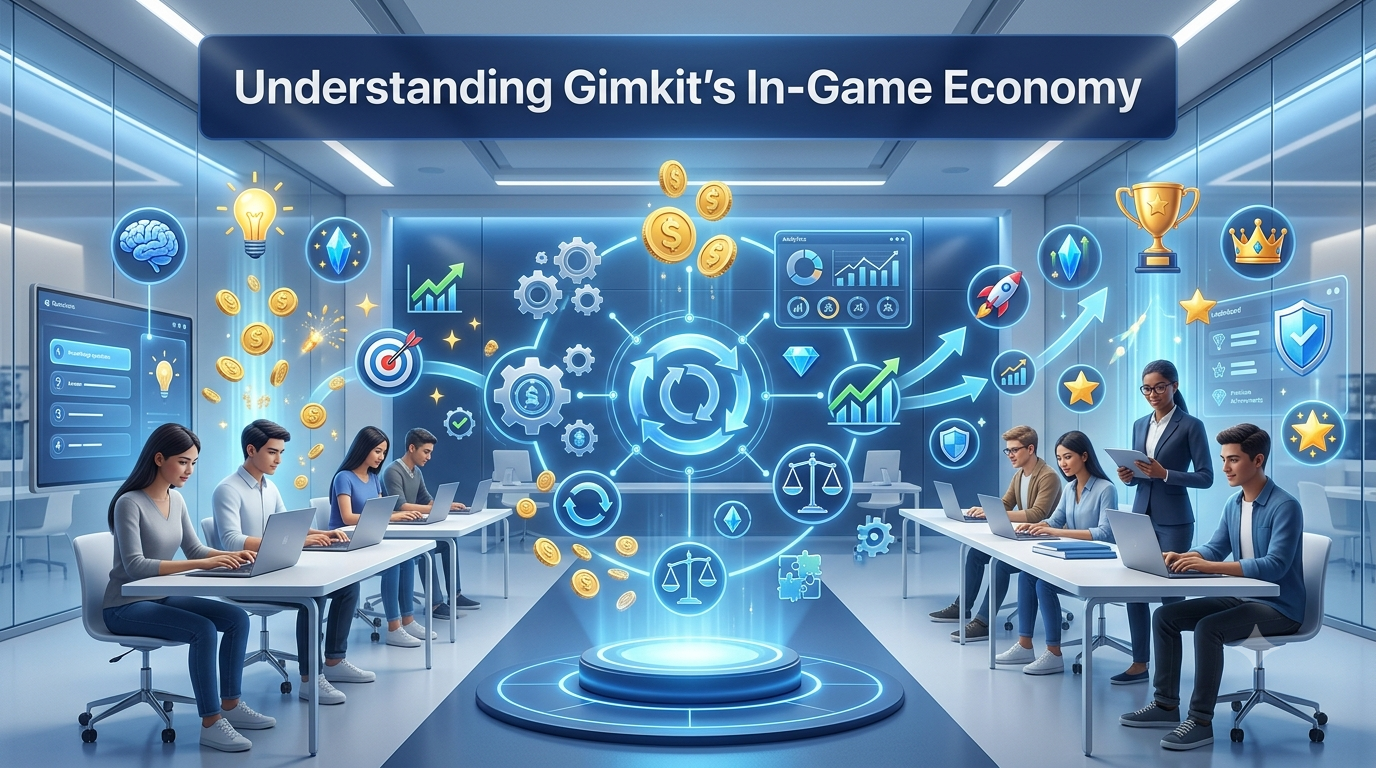
Understanding Gimkit’s In-Game Economy | Winning in Gimkit isn’t just about answering questions correctly—it’s about understanding how the game’s virtual economy operates.
What Is the Gimkit Economy?
The Gimkit economy is the complete system that controls how players earn, manage, spend, preserve, and reinvest in-game money during a match.
Every action belongs to one of five economic stages:
| Economic Stage | Purpose |
|---|---|
| Income Creation | Generating money through gameplay. |
| Resource Collection | Building available spending power. |
| Investment | Converting money into future advantages. |
| Value Generation | Increasing long-term earning efficiency. |
| Resource Preservation | Maintaining progress until the match ends. |
Thinking about these stages helps players understand that earning money is only the beginning. Success depends on how efficiently that money moves through the entire economic cycle.
Virtual Money Is a Strategic Resource, Not a Score
Many beginners treat money as if it were simply another scoreboard statistic.
Experienced players view it differently.
Money is a working resource that exists to create additional value.
Holding a large balance without using it effectively rarely produces the best results. Likewise, spending everything immediately can limit future opportunities.
The most successful players constantly ask:
- How can this resource create more value?
- Is my money working for me?
- Am I increasing future earning potential?
This investment mindset is the foundation of strong economic play.
Every Match Has Its Own Economy
One important concept that many players overlook is that every Gimkit game creates a unique economic environment.
Several factors influence that environment, including:
- Quiz length.
- Number of participants.
- Classroom rules.
- Available game mechanics.
- Overall player accuracy.
- Match objectives.
Because these conditions vary from one session to another, no two economic systems develop in exactly the same way. Learning to recognize these differences is often more valuable than memorizing fixed strategies.
Choosing the right learning platform can significantly improve classroom outcomes. Compare leading educational tools in Gimkit Comparisons & Alternatives to find the best solution for your teaching style.
Economic Efficiency Matters More Than Total Earnings

A player earning the most money at one moment isn’t always using resources most efficiently.
Economic efficiency measures how effectively your available resources are converted into future progress.
Highly efficient players generally:
- Waste fewer resources.
- Maintain smoother progression.
- Reach important milestones consistently.
- Adapt spending to changing conditions.
- Avoid unnecessary financial stagnation.
This explains why players with similar scores can experience very different levels of long-term success during a match.
For the latest gaming news, expert reviews, and walkthroughs, readers can also visit , one of the world’s leading gaming websites.
The Economy Rewards Sustainable Growth
One of Gimkit’s defining characteristics is that it encourages sustainable growth rather than isolated moments of success.
Instead of relying on one excellent decision, players gradually strengthen their overall economic position through consistent improvement.
Healthy economic growth usually demonstrates several characteristics:
- Predictable progression.
- Stable resource availability.
- Balanced investment decisions.
- Continued purchasing opportunities.
- Minimal periods of inactivity.
Building sustainable momentum often proves more reliable than chasing dramatic short-term gains.
Economic Awareness Improves Every Decision
Players who understand the in-game economy begin evaluating decisions differently.
Instead of asking:
“Can I afford this?”
they begin asking:
“Is this the best use of my current resources?”
This small shift in thinking changes how every future purchase is evaluated.
Economic awareness encourages players to:
- Compare opportunities.
- Measure long-term value.
- Reduce unnecessary spending.
- Think several decisions ahead.
- Maintain flexibility.
These habits create stronger overall gameplay regardless of the specific upgrades available.Interactive learning becomes more effective when students experience different gameplay formats. Discover engaging classroom activities in Gimkit Features & Game Modes and keep every lesson fresh.
Why This Understanding Matters
Learning Gimkit’s economic system transforms the game from a simple classroom quiz into an exercise in planning, resource management, and strategic thinking. Players who understand how virtual resources flow through a match make more informed decisions, recover more effectively from setbacks, and consistently improve their overall performance.
In the following sections, we’ll explore how money moves through the Gimkit economy, what influences economic growth, how different spending behaviors affect long-term success, and the practical financial principles that experienced players apply throughout every stage of a match.
How Money Flows Through a Gimkit Match
Every Gimkit game follows a continuous cycle of economic movement. Money doesn’t simply accumulate—it moves through different stages as players answer questions, make purchases, improve earning potential, and continue investing throughout the match.
Understanding this flow helps explain why two players with similar earnings can finish with very different results.
A simplified economic cycle looks like this:
Correct Answers
        ↓
Money Earned
        ↓
Resources Available
        ↓
Investment Decisions
        ↓
Improved Performance
        ↓
Higher Future Earnings
        ↓
Repeat Cycle
Players who keep this cycle moving smoothly generally experience more consistent progress than those whose economy frequently stalls.
The Difference Between Active and Passive Economic Growth
Not every dollar earned in Gimkit comes from the same type of activity.
The game’s economy can generally be viewed through two forms of growth.
| Growth Type | Description |
|---|---|
| Active Growth | Resources generated directly through answering questions and participating in gameplay. |
| Passive Growth | Long-term economic improvement created by previous investment decisions that continue producing value over time. |
Successful players balance both forms instead of relying entirely on one source of progress.
An economy built only on active effort often becomes unstable, while an economy supported by long-term investments usually develops more smoothly.
Economic Stability Is More Important Than Sudden Growth
Large increases in money may look impressive, but stable economic progress is usually more reliable.
Economic stability means maintaining a consistent ability to make useful decisions throughout the match.
Signs of a stable economy include:
- Regular earning opportunities.
- Consistent purchasing power.
- Few periods of inactivity.
- Predictable financial progress.
- Balanced investment timing.
Stable economies allow players to respond confidently when game conditions change.Whether you’re a beginner or an experienced educator, practical guidance makes implementation easier. Follow our Gimkit Guides & Tutorials for step-by-step instructions and classroom best practices.
Resource Availability Drives Future Opportunities

Every economic decision affects the choices available later.
Players with healthy resource availability enjoy greater flexibility because they can respond to new situations without feeling financially restricted.
Poor resource availability often leads to:
- Delayed purchases.
- Limited strategic options.
- Forced decision-making.
- Reduced adaptability.
- Slower overall progression.
Maintaining available resources doesn’t mean avoiding spending—it means ensuring your economy remains capable of supporting future decisions.
Understanding Economic Pressure
As matches progress, players naturally experience increasing economic pressure.
This pressure comes from factors such as:
- Rising upgrade costs.
- Faster opponent progression.
- Limited remaining time.
- Increasing competition.
- More complex strategic decisions.
Players who prepare for these pressures early usually make calmer, more rational financial choices than those reacting only after pressure begins to build.
💡 Pro Tip: Strong economies reduce pressure because they provide more options when important decisions appear.
Economic Balance Creates Consistent Performance
Many players unknowingly create imbalanced economies.
Examples include:
- Generating resources faster than they invest them.
- Spending resources faster than they earn them.
- Focusing heavily on one aspect of progression while neglecting others.
Balanced economies avoid these extremes.
Characteristics of balanced economic management include:
| Balanced Economy Traits | Why They Matter |
|---|---|
| Predictable income | Supports steady decision-making. |
| Controlled spending | Prevents unnecessary shortages. |
| Continuous reinvestment | Encourages long-term growth. |
| Flexible planning | Allows adaptation when conditions change. |
| Sustainable progression | Maintains performance throughout the match. |
Balance often produces more reliable outcomes than aggressive financial behavior.
Small Financial Decisions Compound Over Time
One overlooked feature of Gimkit’s economy is the cumulative effect of small decisions.
Individual choices may seem insignificant when viewed independently.
However, dozens of efficient decisions made throughout a match gradually produce a noticeable advantage.
Examples include:
- Spending resources at appropriate moments.
- Avoiding unnecessary purchases.
- Maintaining consistent financial discipline.
- Preserving flexibility.
- Evaluating every investment carefully.
Over an entire game, these small improvements often become more influential than one exceptionally successful purchase.
Every teacher benefits from proven instructional ideas that increase participation and motivation. Explore Gimkit Resources for Teachers for practical classroom-ready solutions.
Recognizing Economic Bottlenecks
An economic bottleneck occurs when progress slows because one part of your financial system can no longer support continued growth.
Common bottlenecks include:
- Resources accumulating without meaningful investment.
- Investment opportunities appearing before sufficient funds are available.
- Progress slowing despite continued correct answers.
- Financial decisions becoming increasingly limited.
Recognizing these bottlenecks early allows players to adjust their economic approach before they significantly affect overall performance.
Economic Discipline Builds Long-Term Success
The strongest Gimkit economies are not created through luck or unusually high earnings. They are built through disciplined financial management repeated over many small decisions.
Players who consistently monitor how resources flow, maintain economic balance, and recognize when adjustments are needed usually outperform those who focus only on earning more money. Over time, disciplined resource management transforms the in-game economy from a simple scoring system into a strategic advantage that supports smarter gameplay in every type of Gimkit match.
How Resource Allocation Shapes Your Entire Economy
One of the least understood aspects of Gimkit is resource allocation. Earning money is only one part of the economy—the real challenge is deciding where each dollar should go throughout the match.
Resource allocation is the process of distributing your available money across different priorities while maintaining enough flexibility to respond as the game evolves.
Players who allocate resources effectively rarely experience long periods where progress slows because every investment serves a clear purpose within their overall economic plan.
Every Purchase Has an Economic Trade-Off
In Gimkit, spending money is never an isolated action.
Every purchase automatically creates two outcomes:
- You gain the benefit of the investment.
- You give up the opportunity to spend those same resources elsewhere.
This concept is known as an economic trade-off.
Before making any purchase, experienced players naturally compare alternatives rather than evaluating only one option.
Useful questions include:
- What future opportunity will I delay?
- Is this purchase solving my biggest current limitation?
- Could these resources create greater value later?
- Does this investment improve my overall economy?
Thinking in trade-offs leads to stronger financial decisions than simply buying whatever becomes available first.
Understanding pricing and premium features helps educators make informed decisions. Read detailed comparisons and expert evaluations in Gimkit Reviews & Pricing before selecting a subscription.
Avoid Creating Idle Resources
Money that sits unused for long periods contributes very little to economic growth.
At the same time, spending every available resource immediately can leave you with no flexibility.
The objective is to maintain productive resources, meaning your money is always either:
- Supporting current performance.
- Preparing for future opportunities.
- Remaining available for important decisions.
Healthy economies rarely leave resources idle without a strategic reason.
✅ Best Practice: Resources should always have a purpose—even when you’re intentionally saving them.
Build an Economy That Can Recover From Mistakes
No player answers every question correctly.
A resilient economy is designed to continue functioning even after occasional setbacks.
Characteristics of economic resilience include:
| Economic Characteristic | Benefit |
|---|---|
| Stable earning capacity | Reduces the impact of individual mistakes. |
| Flexible resource reserves | Supports recovery after unexpected setbacks. |
| Balanced investments | Prevents dependence on one decision. |
| Consistent financial planning | Maintains long-term progression. |
Players with resilient economies usually recover faster because one mistake doesn’t disrupt their entire financial system.
Recognize the Difference Between Growth and Expansion
Although these terms sound similar, they describe different economic concepts.
Growth refers to improving the efficiency of your economy.
Expansion refers to increasing the size of your economic activity.
For example:
- Growth makes your existing economy perform better.
- Expansion increases the number of opportunities your economy can support.
Understanding this difference helps players avoid expanding too quickly before building a stable financial foundation.
Efficient Economies Minimize Financial Waste
Economic waste occurs whenever resources fail to generate meaningful progress.
Examples include:
- Delaying useful investments without reason.
- Purchasing upgrades that no longer match the current game conditions.
- Frequently replacing one financial plan with another.
- Making purchases based on emotion instead of analysis.
Reducing financial waste improves overall efficiency even if total earnings remain unchanged.
Small instructional improvements often lead to better classroom results. Discover practical teaching methods and winning techniques in Gimkit Tips & Strategies to maximize student engagement.
Economic Awareness Improves Prediction Skills
Strong players don’t simply react to the current situation—they anticipate future economic needs.
As a match develops, experienced players begin predicting:
- When they’ll need additional resources.
- Which future investments may become valuable.
- How quickly their economy is progressing.
- Whether current spending can be sustained.
- When financial priorities are likely to change.
This forward-looking approach allows them to prepare before important decisions become urgent.
Healthy Economies Maintain Continuous Activity

One characteristic shared by successful Gimkit players is continuous economic movement.
Their economy rarely experiences long periods where nothing meaningful happens.
Continuous activity usually includes:
- Regular resource generation.
- Planned investments.
- Ongoing evaluation.
- Small strategic adjustments.
- Consistent financial progress.
Rather than making one major decision and waiting, they keep improving their economy throughout the entire match.
Think Like a Resource Manager, Not Just a Player
The most advanced Gimkit players eventually stop thinking only about answering questions and begin thinking like resource managers.
Instead of viewing money as something to collect, they see it as a system that must be directed efficiently from beginning to end.
This mindset changes every financial decision because players begin evaluating value, sustainability, flexibility, and long-term efficiency instead of short-term rewards. As a result, their economy becomes more stable, their decisions become more consistent, and their overall performance improves regardless of the specific game mode or classroom activity.
Stay informed about the newest platform improvements, educational trends, and feature releases through Games Updates so you never miss important changes.
Professional recommendations for reviewing your strategy
Identify the current mode and its actual reward system before choosing a resource plan. Estimate how many opportunities remain, compare a purchase with its alternatives, and revisit the decision when the game objective or time horizon changes. Use question-level evidence and independent explanation to assess learning; never assume that a larger virtual balance proves greater subject mastery.
Frequently Asked Questions (FAQs)
1. How does the in-game economy affect your overall performance in Gimkit?
The in-game economy is the system that determines how efficiently you generate, manage, and reinvest virtual money throughout a match. Players who understand this system usually perform more consistently because they treat money as a strategic resource instead of something to collect and spend immediately.
A strong in-game economy helps players:
- Maintain steady financial growth throughout the match.
- Unlock future opportunities without unnecessary delays.
- Recover more effectively after incorrect answers or setbacks.
- Make smarter investment decisions instead of emotional purchases.
- Stay flexible when classroom conditions or game pace change.
- Build long-term advantages through continuous reinvestment.
Rather than focusing only on earning the highest amount of money, experienced players evaluate how effectively every dollar contributes to future progress. This economic mindset often produces better results than simply answering questions as quickly as possible.
2. What is the biggest economic mistake new Gimkit players make?
The most common mistake is treating every dollar as something that should be spent immediately. New players often believe that buying upgrades as soon as possible automatically leads to better performance, but this approach frequently limits future opportunities and creates an unstable economy.
Some of the biggest beginner mistakes include:
- Spending resources without a long-term objective.
- Ignoring future investment opportunities.
- Making purchases based on leaderboard pressure.
- Allowing resources to remain idle for too long without purpose.
- Changing financial plans repeatedly during the same match.
- Focusing on one area of progression while neglecting overall balance.
Successful players develop financial discipline. Every purchase has a reason, every investment supports a broader objective, and every decision contributes to maintaining a healthy economic system from the beginning of the game until the final results.
If you experience sign-in problems or game access issues, visit Gimkit Login, Join & Troubleshooting for reliable solutions and step-by-step troubleshooting guides.
3. Why is resource management more important than simply earning more money?
Generating large amounts of money doesn’t automatically create a strong economy. What matters is how efficiently those resources are converted into long-term advantages. Two players can earn similar amounts during a match yet finish with very different results because one manages resources more effectively.
Good resource management includes:
- Allocating money where it creates the greatest long-term value.
- Maintaining financial flexibility throughout the game.
- Avoiding unnecessary or low-impact spending.
- Preparing for future opportunities instead of reacting to current situations.
- Keeping the economic cycle moving without long periods of inactivity.
Players who consistently manage resources well often outperform players who simply focus on increasing their income because efficient economies continue generating value throughout the entire match.
4. Can understanding Gimkit’s economy improve strategic decision-making?
Yes. Understanding the in-game economy changes how players evaluate every decision they make. Instead of asking whether they can afford a purchase, they begin asking whether the purchase improves the overall efficiency of their economic system.
Economic thinking encourages players to:
- Compare multiple investment opportunities.
- Think several decisions ahead.
- Recognize financial trade-offs.
- Predict future resource requirements.
- Build sustainable progression instead of chasing immediate rewards.
- Adapt economic plans as match conditions change.
This approach develops stronger planning skills and helps players make logical decisions under pressure rather than reacting emotionally to temporary changes on the leaderboard.
5. How can players build a stronger in-game economy over time?
Building a strong economy is a gradual learning process rather than a single strategy. Every match provides opportunities to refine financial habits, identify inefficient spending, and improve resource allocation.
To strengthen your in-game economy over time:
- Review your financial decisions after each match.
- Identify purchases that created the greatest long-term value.
- Learn from investments that produced limited results.
- Practice maintaining balanced resource allocation.
- Develop patience before making major spending decisions.
- Build a flexible financial system that can adapt to different game modes and classroom objectives.
- Focus on consistency instead of chasing short-term gains.
As these habits become routine, players naturally develop stronger economic awareness. Over multiple matches, they begin making faster, more confident financial decisions that support sustainable growth, improve adaptability, and create a competitive advantage regardless of the classroom setting or Gimkit game mode.