Editorial note (November 2026): These are teacher-created exit-check protocols, not official named Gimkit features. They supplement, rather than replace, independent formative assessment. Timings and examples are illustrative; teacher judgment, accessibility, and school data rules come first.
What an instant exit check can and cannot tell you
An exit check is a deliberately small sample of evidence gathered near the end of a lesson. Its value is not that it produces a large score or a dramatic leaderboard. It helps the teacher decide whether to review, practice, extend, or ask a better question next time. A learner who chooses a correct answer may have guessed; a learner who chooses an incorrect answer may have misunderstood the wording rather than the concept. Therefore a Gimkit round should be paired with one independent explanation, short example, or teacher observation before important instructional decisions are made.
The official Gimkit Game Reports documentation describes student, general, and question breakdown views after a hosted Kit owned by the teacher. It does not establish that a game score is a validated diagnostic assessment, nor does it promise that every response can be interpreted as an individual learning outcome. Use question-level patterns to select what to investigate. If a class has only five minutes left, one well-written question and a brief follow-up can be more useful than ten repeated prompts.
These activities are teacher-designed routines built around available Gimkit functionality. They are not named official Gimkit features. Teachers should check the current hosting workflow and mode-specific options, since a game may not end exactly when the lesson does. Plan a deliberate stopping point and a non-digital backup. Do not require students to share private personal information, and use school-approved procedures for handling any report that identifies individual learners.
Protocol 1: One concept, three representations
Choose a single lesson objective and create three short questions that represent the same idea in different ways. For example, a fractions lesson might use a picture of equal parts, a number-line position, and a short comparison statement. A science lesson might use a diagram, a definition in context, and an example from a familiar experiment. The three questions should not simply repeat the same sentence with shuffled answer options. Each should reveal whether learners can transfer the idea across a representation.
Run the questions near the end of the session and pause before revealing an overall winner. Ask students to explain which representation was easiest to understand and why. The teacher can then offer a fresh, untimed example on paper. If most students answer the picture correctly but struggle with the number line, the next lesson may need a connection between visual and symbolic models. If the errors are scattered, the wording or reading demand may be the problem rather than the mathematics.
Keep the interpretation modest. Three questions do not prove mastery, and the number of correct answers may reflect guessing or repeated exposure. The value is in identifying a specific instructional move. The teacher can note ‘model number-line placement tomorrow’ rather than ‘the class cannot do fractions.’ This protocol works well when the lesson had one clear objective and the teacher wants a fast, actionable next step without replacing a full formative assessment.
Protocol 2: Misconception versus careless error
Write two questions that look similar but require different reasoning. In a grammar lesson, one might test subject-verb agreement in a short sentence and another in a sentence with a distracting phrase. In mathematics, one might require an exact calculation and another an estimation check. A difference in response patterns may suggest that students are applying a rule mechanically or losing track when the context changes. However, the pattern alone cannot tell the teacher whether an error was careless or conceptual.
After the Gimkit round, ask learners to write one sentence explaining the strategy they used on the harder question. Allow an anonymous paper response or a private digital form where school policy permits. The teacher sorts the explanations into a few broad categories: clear reasoning, partially correct reasoning, misconception, and unclear evidence. A student who selected the wrong option but described a correct method may need a different kind of support from someone who confidently explained an incorrect rule.
Next lesson, begin with one worked example that contrasts the two cases. Avoid calling out students by name or displaying individual errors on a public board. Use fictional examples to make the reasoning visible. The goal is to distinguish possible causes of mistakes before deciding how to reteach. A brief conversation with a student may be more informative than a detailed game statistic, especially when reading speed, device issues, or attention affected the original answer.
Protocol 3: The evidence-first history check
End a history or social studies lesson with a short source excerpt and a question about what the source directly supports. For instance, students might read a fictional diary entry and distinguish the writer’s observation from a later historian’s inference. A good distractor is plausible but unsupported, not merely absurd. Keep the excerpt short enough to read without rushing, and provide accessible text rather than relying on a tiny screenshot. If the class is learning about a sensitive event, use respectful materials approved for the age group.
After the question, invite students to underline the phrase that supports their answer. This second step is the actual exit evidence. A learner may guess the correct multiple-choice option without understanding how to cite a source. Conversely, a learner who initially chose incorrectly may identify the relevant evidence after a brief explanation. Ask for one sentence: ‘The source supports this because it says…’ and model how to avoid claims the source cannot establish.
Record the most common reasoning difficulty, such as confusing an author’s opinion with a documented event. Begin the next lesson with a contrasting source and ask whether it changes the interpretation. This is a more defensible instructional response than ranking students by speed. The Gimkit question supplies a common prompt; the short explanation reveals the thinking. A teacher can also use the subject-specific planning guide to design a fuller inquiry lesson around that skill.
Protocol 4: Vocabulary in a new sentence
Use a Kit question to check a target word in context, not just its memorized definition. If the word is ‘adapt,’ a correct option might describe changing a method after new evidence rather than simply repeating the dictionary wording. Include one distractor that reflects a common confusion. For language learners, explain any unrelated difficult vocabulary in the question so that the item measures the intended word rather than reading complexity. Where appropriate, provide an image description or a short example aloud.
After the round, ask every student to use the word in a different sentence. Students can speak, type, draw, or write depending on the learning objective and accommodations. The teacher reviews a few anonymous examples and explains why some uses fit the context better than others. If a student can select a definition but cannot use the word meaningfully, the next lesson may need modeling and guided practice rather than another speed quiz.
Do not equate the number of correct choices with language proficiency. Vocabulary knowledge includes recognition, usage, nuance, and transfer. A brief exit check can sample one of these, not all of them. The teacher should note which component was tested and select the next activity accordingly. This routine is particularly helpful in mixed-language classrooms because it creates a clear distinction between knowing a word in isolation and being able to use it in authentic communication.
Protocol 5: The worked-example repair
Prepare a fictional solution that contains one intentional error. The Gimkit question asks students to identify the first step where the reasoning goes wrong. This can work for algebra, science calculations, punctuation, or a sequence of instructions. Make the error realistic but not misleading; avoid showing several different errors when the objective is to diagnose one. Before the game, tell students that the solution is deliberately flawed and that finding the mistake is a normal part of learning.
After students respond, give pairs a minute to repair the solution. They should state what the original author might have been thinking, correct the step, and explain why the correction works. This prevents the activity from becoming a simple game of spotting a red flag. A student who identifies the wrong line but can explain a valid correction may still show useful understanding. The teacher can collect one anonymous repair and use it to open the next lesson.
The follow-up is especially important when students appear highly accurate in a multiple-choice round. Recognition can be easier than production. Ask them to solve a similar problem independently without a provided error to find. If they succeed, the teacher has stronger evidence of transfer. If they struggle, plan a brief scaffold. The process respects the difference between engagement with a game and competence with a new task.
Protocol 6: Estimate, calculate, explain
End a mathematics or science lesson with a numerical question that first requires an estimate. For example, students might estimate whether a product should be closer to 20 or 200 before computing it. The Kit question can check the order of magnitude, while the independent exit slip asks for one sentence explaining the estimate. This helps students notice implausible results and use number sense rather than memorizing a sequence of button presses.
Do not assume that the fastest correct answer reflects the strongest reasoning. A learner may use mental arithmetic efficiently, while another may need additional time or an assistive tool. Make the learning target explicit: estimation, exact calculation, or explanation. If the target is estimation, a rough but justified range may be more informative than a precise answer. If the target is calculation, provide the necessary resources and check that the question is unambiguous.
Compare the explanations rather than public scores. A common pattern might be that students can calculate but cannot judge whether the result is reasonable. In that case, the next lesson should include a short estimation routine before exact computation. The teacher can also ask learners to explain how changing one number would affect the result. This reveals flexible understanding without requiring another full game session.
Protocol 7: Claim, evidence, reasoning
Give students a short scientific claim and a small data table. The Gimkit question asks which evidence is relevant to the claim. After the round, students write a one-sentence connection between the evidence and the conclusion. This makes the exit check a miniature version of claim-evidence-reasoning without requiring a full laboratory report. The data should be invented for the activity or drawn from a permitted source, clearly labeled, and accessible in text form.
A common mistake is to reward a correct choice while ignoring the reasoning. A student might select the correct row of a table by chance. The follow-up asks why that row matters and what uncertainty remains. If the class gives plausible but incomplete explanations, model a sentence frame: ‘The data support the claim because…, although…’ For younger learners, a diagram or oral explanation may be more suitable than formal scientific language.
Use the results to plan one focused intervention: reading a table, distinguishing evidence from opinion, or explaining causation versus correlation. Do not assume that a single correct response proves scientific literacy. The teacher can revisit the same reasoning structure with a different dataset next week. The strength of the protocol is that the exit evidence is tied to a teachable process rather than a broad label such as ‘good at science.’
Protocol 8: The anonymous confidence comparison
Students may be confident and incorrect, or uncertain and correct. A short exit routine can make this visible without asking learners to reveal private feelings publicly. First, use a Gimkit question to check an academic concept. Then offer an optional private confidence prompt on paper: ‘I could explain this to a partner,’ ‘I need another example,’ or ‘I am not sure yet.’ Do not claim that Gimkit automatically records this confidence information; the second prompt is a separate teacher-designed instrument.
Keep confidence responses separate from the public leaderboard. If a student is uncertain but correct, a teacher might offer an opportunity to explain and build fluency. If a student is confident but incorrect, the teacher can use a counterexample. If many students say they need another example, the next lesson can begin with a worked model. The categories are not diagnoses or stable traits; they are momentary feedback about one task.
Students should be able to decline the reflection without penalty, and the teacher should not display names alongside confidence ratings. A short private follow-up can help learners who repeatedly feel unable to participate. The aim is to normalize uncertainty and guide instruction, not to produce a numerical self-esteem score. This is particularly useful after introducing a difficult concept where a correct multiple-choice response might conceal fragile understanding.
Protocol 9: The paired explanation handoff
Select one question that requires a short explanation, such as why a character’s decision matters or how a geometric property supports a conclusion. Let students answer the Kit question individually, then ask pairs to compare their reasoning. Each partner should have a defined opportunity to speak or contribute in writing. The listener must summarize the partner’s idea before offering a different view. This turns a quick digital response into a communication task.
Give students a simple sentence frame: ‘I chose this because…’ followed by ‘My partner noticed…’ The teacher can circulate and listen for a specific misconception. Avoid asking pairs to reveal their personal scores, and do not assume that a more confident speaker has the better answer. In a class with accessibility needs, allow typed exchanges or shared diagrams. If pairs cannot reach agreement, ask them to name the evidence they would need.
At the end, students submit one revised explanation, not a vote about which partner won. The teacher can use the revised work to identify whether discussion improved clarity. This does not prove that peer talk caused learning, but it supplies a useful next question. For more comprehensive participation planning, see the classroom participation strategies, which address multiple ways for learners to contribute.
Protocol 10: The readiness gate
Before starting a new topic, select three prerequisite concepts and write one clear question for each. For a lesson on linear equations, prerequisites might include inverse operations, integer arithmetic, and interpreting equality. For a reading unit, prerequisites might include identifying a claim, distinguishing a detail, and using context clues. The exit check should be short enough that the teacher can interpret patterns before the next lesson, not merely collect a large set of answers.
Decide in advance what each pattern would trigger. If many learners miss the inverse-operation item, begin with a worked example. If only a few struggle, offer optional targeted practice while the class moves forward. If all three items show widespread confusion, reconsider the sequence of the next lesson. These are provisional instructional decisions, not rigid cut scores. A single response may be affected by device problems, misunderstanding, or guessing.
Use a fresh independent question before assigning a student to an intervention group. Avoid labeling students as permanently ready or not ready based on a three-question game. The teacher should also consider prior work and observations. A readiness gate is most useful when it makes the next teaching step explicit, while remaining flexible enough to account for uncertainty and individual differences.
Protocol 11: The misconception sorting wall
Prepare three fictional explanations of a concept, one accurate and two reflecting different misunderstandings. The Gimkit question asks students to select the best explanation. After the round, the teacher presents the explanations anonymously and asks students to sort them into ‘supported,’ ‘partly supported,’ and ‘needs revision.’ This is not about displaying students’ real mistakes. Using fictional responses reduces embarrassment and makes it easier to discuss why an idea is attractive but incomplete.
Ask groups to improve one explanation by adding a missing condition or a counterexample. For instance, a statement about a food chain may ignore decomposers, or a claim about a historical source may confuse observation with interpretation. Students can write a revised sentence or create a diagram. The teacher records which revision was most difficult and chooses a short follow-up for the next lesson.
Do not assume that choosing the right multiple-choice option means learners can construct a strong explanation. The sorting wall deliberately adds that second layer. It also helps students practice respectful critique: they are improving an idea, not judging a person. If the class is new to this routine, model the difference between ‘This is wrong’ and ‘This explanation needs evidence about…’ before inviting independent revisions.
Protocol 12: The final question students write
Instead of ending every session with teacher-written questions, invite students to propose one new question about the lesson. Give a clear constraint: it must be answerable from the content, have a specific learning purpose, and avoid personal information. Students can suggest a multiple-choice item or a short open-ended prompt. The teacher reviews all suggestions before using them in a future Kit, so inaccurate or inappropriate questions are not published automatically.
Ask students to explain why their proposed question matters. A learner might write a superficial recall item because it is easy to compose; the teacher can show how to revise it into a question that requires application. For example, ‘What is evaporation?’ might become ‘Why would a wet surface dry faster under one condition than another?’ The revision reveals whether the student understands the objective and can identify a meaningful example.
Collect the proposals privately and choose one anonymous example for next class. The official Kit creation guide explains how educators add questions and answers. Students do not need editing access to the teacher’s account for this activity. The teacher maintains control of the material and can acknowledge the class’s contribution without identifying the student who wrote the original question.
A realistic five-minute ending sequence
At five minutes remaining, stop introducing new content. State the one concept the exit check will sample and explain that the purpose is to guide tomorrow’s lesson, not to rank people. Give students a clear route to join or continue the current Gimkit session if the mode and school setup permit. If a new live game would take too long to launch, use a prepared practice prompt or paper version instead. The time available is a constraint, not a reason to rush learners through inaccessible instructions.
During the next two minutes, ask two or three targeted questions. Avoid adding unrelated trivia merely to keep the game exciting. In the fourth minute, pause and ask students to explain one answer or complete a short transfer prompt. In the final minute, summarize one misconception and say what will happen next: ‘Tomorrow we will compare two methods’ or ‘You will try one new example independently.’ If the class needs more processing time, reduce the number of questions rather than removing the reflection.
Remember that a live game’s stopping controls and goals vary by mode. The official hosting guidance explains how to end a game early and how game goals work. Do not promise a universal one-minute timer, a particular question counter, or an automatic exit-ticket mode. A well-designed routine can be implemented with a prepared Kit and teacher facilitation, or entirely without technology when needed.
Privacy, accessibility, and a low-pressure fallback
An exit check should not expose sensitive student information. Do not place individual scores or confidence ratings on a public board, and do not export reports to personal storage without authorization. Use school-approved retention and access procedures. Students who cannot join because of device limitations, a filtered network, or an accessibility barrier should have an equivalent route to demonstrate understanding. A printed question card, oral explanation, or accessible text form can provide the same instructional evidence.
Question wording matters. Avoid tiny text, color-only cues, inaccessible images, unnecessarily complex language, and a pace that prevents students from reading. If the learning target is reasoning, the teacher should not accidentally measure only reaction time. Give students time to process and provide accommodations required by their learning plans. A learner who needs more time should not be publicly identified as the reason the class cannot finish a game.
When the digital version fails, keep the learning goal and change the format. Read the question, ask students to write a response, and use a quick show of reasoning or private collection. The next lesson can still be informed by the evidence. Teachers can consult the blended teaching guide for a wider discussion of when digital and non-digital formats complement each other.
From the exit evidence to tomorrow’s teaching
After class, sort the evidence into a small number of actionable categories. If a single misconception is common, prepare one contrasting example. If errors cluster around reading the question, simplify the wording and test the concept again. If most learners can explain the idea, plan an application task rather than repeating the same quiz. If the evidence is inconsistent, gather one more independent response before changing the lesson sequence. Avoid setting permanent ability groups based on a single game.
A simple planning note can have three columns: observation, possible explanation, and next action. For example, ‘Many students chose the denominator as the larger fraction’ is an observation; ‘they may be treating the denominator as a whole-number magnitude’ is a hypothesis; ‘use two equal-sized area models tomorrow’ is an action. This format keeps the teacher from confusing an interpretation with a fact. It also makes the next lesson responsive without creating a large data-management burden.
Use the official reports only as one source of evidence. The assessment reports guide explores question-level patterns, while the daily teaching guide places those patterns within broader instructional decisions. A teacher should be able to explain why the next activity follows from the evidence, even when the original game was brief.
Anonymous Exit-Evidence Triage Planner
Enter aggregate response counts from one short check. This local calculator suggests a next step; it does not diagnose students or store data.
Foundational exit-check explanations and original FAQs
The earlier foundational guidance is retained below for continuity. Read its broad claims alongside the updated cautions and practical protocols above; a game alone does not establish retention, confidence, or learning gains.
🔥 Introduction
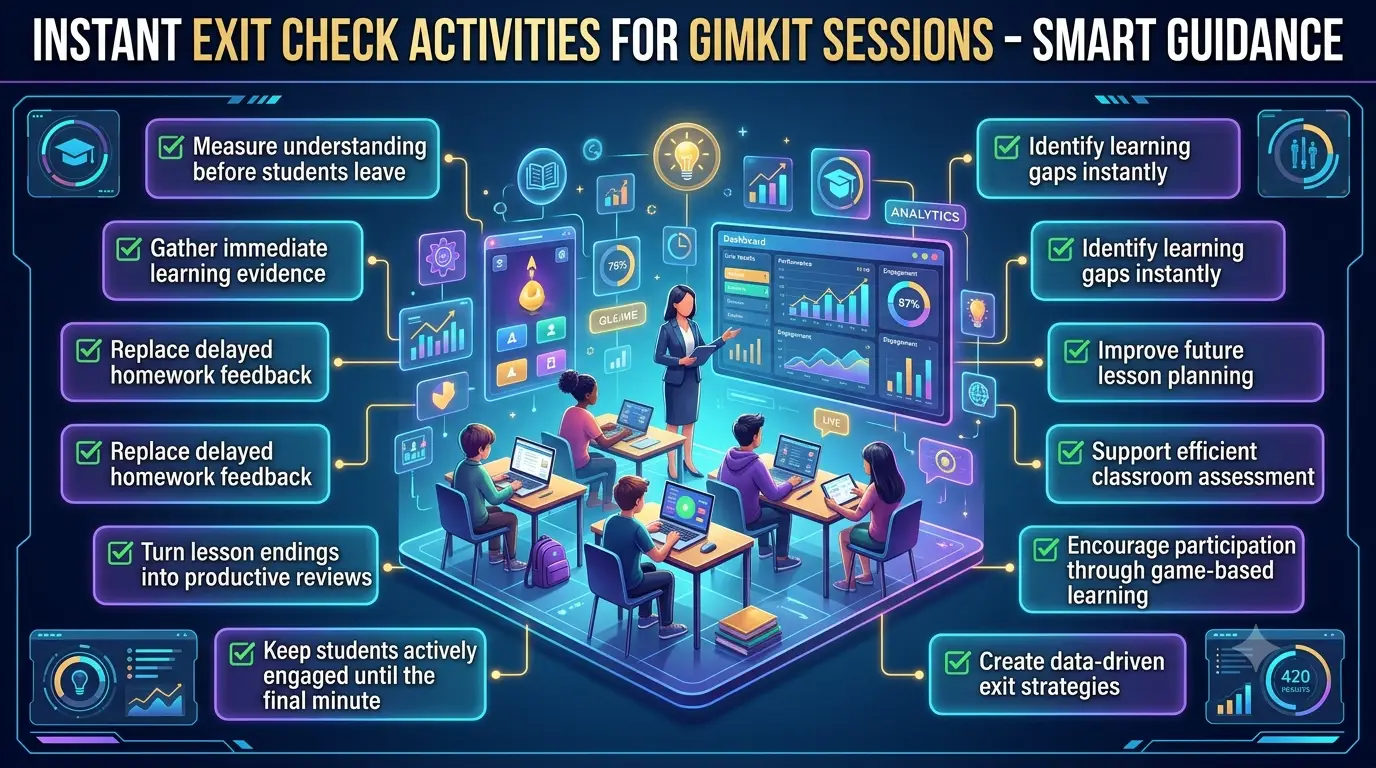
Instant Exit Check Activities for Gimkit Sessions have become increasingly valuable as teachers look for faster ways to measure understanding before students leave the classroom. Instead of waiting for homework results or formal assessments, educators can gather immediate learning evidence within minutes.
Instant Exit Check Activities for Gimkit Sessions help transform the final moments of a lesson into productive review opportunities. Rather than ending class abruptly, teachers can use targeted activities to confirm whether key concepts were actually understood.
Instant Exit Check Activities for Gimkit Sessions are especially effective because they combine quick assessment with active participation. Students remain involved until the end of the lesson while teachers collect useful feedback.
Instant Exit Check Activities for Gimkit Sessions also support better lesson planning because educators can identify learning gaps before moving on to the next topic.
Instant Exit Check Activities for Gimkit Sessions provide a practical solution for classrooms that need efficient, engaging, and data-driven exit strategies.
🎯 Why Exit Checks Matter in Modern Classrooms
Many teachers focus heavily on lesson delivery but spend less time verifying understanding before class ends.
This creates a problem because students may appear engaged while still struggling with important concepts.
A structured exit check helps teachers answer critical questions:
What did students actually learn?
Which concepts remain unclear?
Who may need additional support?
Is the class ready for the next lesson?
Using Gimkit Activities for this purpose allows educators to gather answers quickly without disrupting classroom flow.
⚙️ The Role of Fast Assessment in Learning
Immediate feedback is one of the most powerful teaching tools available.
When students receive quick opportunities to demonstrate understanding, misconceptions can be identified before they become larger learning problems.
Short review tasks through Gimkit Live sessions allow teachers to measure comprehension while the lesson is still fresh in students’ minds.
This makes classroom assessment more responsive and effective.
🧠 Concept Confidence Check
One effective exit strategy is the confidence-based review activity.
Students answer a small number of targeted questions focused on the lesson’s most important concepts.
Instead of measuring only correctness, teachers evaluate overall confidence trends and participation patterns.
Using a customized Gimkit Quiz, educators can quickly determine whether students are prepared to move forward.
📚 Key Takeaway Verification Activity
Not every lesson requires a lengthy assessment.
Sometimes the goal is simply confirming that students understood the central idea.
Teachers can create a short Gimkit Kit containing questions focused entirely on the lesson’s primary objective.
This approach provides a clear snapshot of understanding while keeping the activity brief and focused.
🎮 One-Minute Knowledge Challenge
A rapid challenge can be highly effective at the end of class.
Students are given a limited amount of time to answer review questions covering the day’s learning targets.
The activity creates urgency while helping teachers gather immediate evidence of comprehension.
Because participation happens through structured gameplay, students remain engaged even during the final minutes of the lesson.
📊 Learning Gap Detection Activity
Exit checks are not only about measuring success.
They are equally valuable for identifying areas where students continue to struggle.
Teachers can use results available through the Gimkit Dashboard to detect patterns such as:
Frequently missed questions
Misunderstood vocabulary
Weak conceptual areas
Common classroom misconceptions
These insights improve future lesson planning.
🏆 Small Group Exit Review
Some classrooms benefit from collaborative exit activities.
Students work in small groups to answer review questions before the lesson concludes.
This approach encourages discussion, peer support, and collective problem-solving while still allowing teachers to assess understanding.
Different Gimkit Mode options can support both competitive and cooperative learning environments.
📈 Exit Check Benefits for Teachers
Benefit
Classroom Impact
Immediate Feedback
Faster instructional decisions
Learning Verification
Confirms understanding
Gap Identification
Supports intervention planning
Increased Participation
More student involvement
Better Lesson Planning
Improves future instruction
💡 Why Students Respond Well to Instant Checks
Traditional exit slips can sometimes feel repetitive.
Interactive review activities create a more engaging experience because students actively participate rather than simply writing responses.
The combination of quick feedback and structured interaction helps maintain focus until the lesson officially ends.
As a result, classroom energy remains productive instead of fading during the final minutes.
🔄 Turning Lesson Endings into Learning Opportunities
Many classrooms treat the final few minutes of a lesson as transition time, but experienced educators recognize that these moments can provide some of the most valuable learning data of the day.
A well-designed exit activity helps teachers capture fresh evidence of understanding before students leave the room. Instead of relying on assumptions, educators can verify whether important concepts were actually absorbed.
This approach transforms lesson endings from passive wrap-ups into meaningful instructional checkpoints.
🎯 Priority Concept Verification Method
Not every detail from a lesson carries the same importance.
Teachers can identify the two or three most critical concepts and build a short review challenge around them. The objective is not comprehensive assessment but confirmation of essential understanding.
Using Gimkit Quiz activities for this purpose keeps students focused on the concepts that matter most while reducing unnecessary complexity.
This strategy is particularly useful before introducing a new topic that depends on prior knowledge.
🧠 Misconception Detection Before Students Leave
One of the biggest advantages of exit checks is the ability to uncover misunderstandings immediately.
Students often leave class believing they understand material when important misconceptions still exist.
A targeted activity through Gimkit Live allows teachers to identify these issues before they become larger learning obstacles.
Early correction saves valuable instructional time in future lessons.
📚 Vocabulary Mastery Exit Activity
Vocabulary-heavy subjects often require regular reinforcement.
At the end of class, teachers can present a short set of questions focused exclusively on key terms introduced during the lesson.
This approach works especially well in:
Science classes
Language courses
History lessons
Business education
Social studies
Repeated exposure helps strengthen retention and supports long-term academic success.
⚙️ Skill Application Exit Checks
Knowledge recall is important, but application is equally valuable.
Instead of asking students to remember information, teachers can create questions that require applying concepts to new situations.
Through a carefully designed Gimkit Kit, students demonstrate whether they can use what they learned rather than simply recognize correct answers.
This provides deeper insight into actual understanding.
🎮 Fast-Paced Accuracy Challenge
Some teachers prefer highly efficient end-of-class activities.
A short challenge focused on accuracy rather than speed encourages students to think carefully about their responses while still maintaining engagement.
Because students remain active until the lesson concludes, classroom momentum stays positive and productive.
This approach also reduces the tendency to disengage during final transitions.
📊 Exit Data That Supports Better Teaching
Assessment is most valuable when it influences future instruction.
Results collected through the Gimkit Dashboard can help teachers:
Plan reteaching opportunities
Adjust pacing
Identify struggling learners
Prioritize review topics
Improve future lesson design
The goal is not simply collecting data but using it to strengthen learning outcomes.
🏫 Building Consistent Classroom Routines
Students respond well to predictable learning structures.
When exit activities become a regular classroom routine, students begin expecting reflection and review before every lesson ends.
This consistency encourages accountability while helping teachers gather reliable performance information over time.
Regular use often produces stronger participation and more accurate assessment results.
🆚 Traditional Exit Slip vs Interactive Exit Check
Factor
Traditional Exit Slip
Interactive Exit Check
Participation Level
Moderate
High
Student Motivation
Variable
Strong
Feedback Speed
Slower
Immediate
Engagement
Passive
Active
Classroom Energy
Declines
Remains Positive
💡 Professional Teaching Insight
The most effective exit checks are not the longest or most complicated.
Successful teachers focus on clarity, relevance, and speed. A brief activity connected directly to lesson objectives often provides more useful information than an extensive assessment.
Interactive review systems help achieve this balance by combining engagement with instructional value.
📈 Using Exit Checks to Improve the Next Lesson
Many teachers view exit activities as a way to close a lesson, but their greatest value often appears in the next class.
The information collected during a quick review can reveal whether students are ready to move forward or whether additional reinforcement is needed. Instead of planning lessons based on assumptions, educators can make decisions based on actual classroom evidence.
This creates a more responsive teaching process where instruction adapts to student needs rather than following a fixed schedule.
🎯 The Three-Question Mastery Method
One effective strategy is limiting exit activities to only three carefully selected questions.
Rather than covering everything taught during the lesson, teachers focus on:
The most important concept
The most difficult concept
The concept students are most likely to forget
A short Gimkit Quiz built around these areas can provide surprisingly accurate insight into student understanding.
This method keeps assessment efficient while maximizing instructional value.
🧠 Readiness Check Before Starting New Topics
Every lesson builds upon previous learning.
Before moving into a new unit or concept, teachers need confidence that foundational knowledge is secure.
A quick review through Gimkit Live helps determine whether students have reached the required level of understanding.
When readiness is confirmed, teachers can proceed confidently. When gaps appear, additional support can be provided immediately.
📚 Exit Activities for Revision-Focused Classrooms
Classrooms preparing for exams often require frequent knowledge reinforcement.
In these situations, exit checks become mini-revision sessions that help students revisit important concepts regularly.
Instead of waiting until exam week, students encounter ongoing review opportunities throughout the term.
This continuous reinforcement often produces stronger retention than large-scale revision sessions conducted at the last minute.
⚙️ Measuring Understanding Instead of Completion
Many classroom activities measure whether students finished an assignment.
Exit checks should measure whether students understood the lesson.
A focused Gimkit Kit can help teachers evaluate:
Concept mastery
Application skills
Recall strength
Learning confidence
This distinction is important because completion does not always indicate comprehension.
🎮 Engagement During the Final Five Minutes
The final minutes of class often present a challenge.
Students begin preparing to leave, attention decreases, and instructional momentum fades.
Interactive review activities help maintain focus by giving students a meaningful task to complete before dismissal.
As a result, the learning process continues until the lesson officially ends.
📊 Patterns Teachers Can Track Over Time
Individual exit checks provide useful information, but long-term trends are even more valuable.
By reviewing data through the Gimkit Dashboard, teachers can monitor:
Consistent areas of difficulty
Growth in specific skills
Class-wide learning patterns
Student improvement rates
Effectiveness of instructional strategies
This ongoing analysis supports better educational decision-making.
🏫 Creating a Culture of Reflection
The strongest classrooms encourage students to think about their own learning.
Regular exit activities help learners reflect on:
What they understood
What remains confusing
Where improvement is needed
How well they achieved lesson goals
This habit strengthens student ownership of the learning process.
🆚 End-of-Lesson Guessing vs Evidence-Based Teaching
Teaching Approach
Outcome
Assuming students understood
Higher risk of learning gaps
Waiting for test results
Delayed intervention
Using regular exit checks
Immediate instructional feedback
Relying on participation alone
Incomplete understanding
Collecting learning evidence
Better teaching decisions
💡 Strategic Advantage for Teachers
Teachers often have limited time to evaluate understanding.
Exit checks provide a practical solution because they require only a few minutes while delivering meaningful instructional insights.
The combination of speed, engagement, and feedback makes them one of the most efficient assessment strategies available in modern classrooms.
🎯 Making Exit Checks More Than Simple Review
Many teachers use exit activities only to see whether students were paying attention. However, the most effective exit checks go a step further by helping educators understand how students are thinking.
A strong activity does not simply reveal correct or incorrect answers. It highlights reasoning patterns, common mistakes, and areas where students may need additional support.
This deeper insight turns a quick classroom activity into a valuable instructional tool.
🧠 The Learning Confidence Indicator Approach
Students often answer correctly while still feeling uncertain about the material.
An effective exit strategy is to combine knowledge checks with confidence measurement. Teachers can ask students to complete a short review and then reflect on how confident they feel about the topic.
Activities built through Gimkit Activities can support this process by creating opportunities for both participation and self-assessment.
This helps teachers identify hidden learning gaps that may not appear through scores alone.
📚 Topic-Specific Exit Challenges
Different subjects benefit from different exit-check formats.
For example:
Mathematics classes can focus on problem-solving accuracy.
Science lessons can verify concept understanding.
History classes can reinforce cause-and-effect relationships.
Language courses can strengthen vocabulary retention.
Using subject-focused review activities helps ensure that assessment aligns directly with learning objectives.
⚙️ Immediate Intervention Opportunities
One of the greatest benefits of instant checks is speed.
Instead of discovering learning problems days later, teachers can identify them before students leave the room.
A short Gimkit Quiz may reveal that a majority of the class misunderstood a specific concept. With this information, educators can address the issue immediately rather than allowing confusion to continue.
This proactive approach improves overall instructional efficiency.
🎮 Micro-Review Sessions That Reinforce Learning
Students rarely remember every detail from a lesson after hearing it only once.
Small review opportunities at the end of class create additional exposure to important concepts.
These micro-review sessions strengthen memory pathways and increase the likelihood that information will be retained beyond the classroom.
Over time, consistent reinforcement contributes to stronger academic performance.
📊 Using Exit Data for Smarter Planning
The best assessment information is actionable.
Data available through the Gimkit Dashboard can help teachers answer important planning questions:
Which topic needs reteaching?
Which students may require intervention?
Is the class ready for the next lesson?
What concepts should appear in future reviews?
This transforms assessment from a reporting tool into a planning resource.
🏫 Strengthening Student Accountability
Regular exit checks encourage students to remain engaged throughout the lesson because they know understanding will be measured before class ends.
This accountability often leads to:
Increased participation
Better focus
More active listening
Greater preparation
Over time, these habits contribute to stronger classroom performance.
🆚 Reactive Teaching vs Proactive Teaching
Approach
Result
Waiting for exam results
Delayed support
Reviewing only after mistakes grow
Larger learning gaps
Using instant exit checks
Faster intervention
Guessing student understanding
Less accurate decisions
Collecting daily evidence
Better instructional planning
💡 Long-Term Impact on Learning Culture
The most successful classrooms create a culture where feedback is continuous rather than occasional.
Students become accustomed to reflecting on their learning, while teachers gain regular opportunities to monitor progress.
This ongoing cycle of teaching, checking, and adjusting supports continuous improvement throughout the academic year.
🔍 Why the Last Few Minutes of Class Matter Most
Many teachers invest significant effort into lesson introductions and core instruction but underestimate the importance of how a lesson ends.
The final minutes often determine what information students remember after leaving the classroom. Without reinforcement, key concepts can fade quickly, especially when students move directly into another subject.
This is why effective educators use exit activities as learning anchors that help secure important ideas before the lesson concludes.
🧠 Memory Reinforcement Through Immediate Recall
Educational research consistently shows that immediate recall strengthens memory retention.
When students are asked to retrieve information shortly after learning it, they are more likely to remember it later.
A short review through Gimkit Learning allows students to revisit major concepts while they are still fresh, increasing the likelihood that knowledge moves into long-term memory.
This makes exit activities valuable not only for assessment but also for retention.
🎯 The Single Objective Exit Strategy
One common mistake is trying to assess too many concepts at once.
Highly effective exit checks often focus on a single learning objective rather than an entire lesson.
Teachers identify the most important takeaway and design a brief activity around it. This approach keeps students focused while providing clear evidence of understanding.
A targeted Gimkit Kit can accomplish this in just a few minutes without overwhelming learners.
📚 Identifying Hidden Learning Gaps
Not all learning difficulties are immediately visible during classroom instruction.
Some students participate actively while still misunderstanding important concepts. Others remain quiet despite understanding the material well.
Exit activities help reveal these hidden patterns by collecting responses from the entire class rather than relying on volunteer participation.
This creates a more accurate picture of overall understanding.
⚙️ Using Exit Checks to Improve Future Assessments
Teachers often spend considerable time preparing quizzes, projects, and examinations.
Exit check results can help improve these larger assessments by identifying:
Frequently misunderstood concepts
Common mistakes
Areas needing additional review
Topics requiring more instructional time
This information supports better assessment design and more effective lesson sequencing.
🎮 Quick Decision-Making for Teachers
One of the greatest strengths of instant checks is speed.
Within minutes, teachers can decide whether to:
Move forward with the next topic
Provide additional examples
Review difficult concepts
Adjust lesson pacing
Activities supported through Gimkit Activities help educators make these decisions based on evidence rather than assumptions.
This improves instructional efficiency and learning outcomes.
📊 Building a Continuous Feedback System
The strongest classrooms do not rely on occasional assessments alone.
Instead, they create a continuous cycle of:
Teaching
Practice
Feedback
Adjustment
Reinforcement
Exit activities become a key component of this process because they provide immediate insight into student progress.
Over time, this feedback loop strengthens both teaching and learning.
🏫 Encouraging Responsibility for Learning
Students benefit when they regularly reflect on their own understanding.
Consistent exit checks encourage learners to ask:
Did I understand today’s lesson?
What concept remains unclear?
What should I review later?
Where do I need improvement?
These habits help students take greater ownership of their academic growth.
🆚 End-of-Class Routine Comparison
Classroom Ending Style
Impact on Learning
Immediate dismissal
Limited reinforcement
Informal discussion
Variable feedback
Homework reminder only
Delayed understanding check
Structured exit activity
Immediate learning evidence
Interactive review session
Reinforcement + assessment
💡 Advanced Teaching Insight
The most effective teachers understand that assessment and instruction are not separate processes.
Every review activity, discussion, and exit check provides information that can improve future teaching decisions.
By gathering learning evidence regularly, educators create a more adaptive classroom where instruction responds directly to student needs.
Top Hacks
Instant Exit Check Activities for Gimkit Sessions help teachers quickly measure student understanding before the class ends. Instead of relying on traditional exit tickets, educators can use a short Gimkit session to gather immediate learning data while keeping students engaged until the final minute.
Instant Exit Check Activities for Gimkit Sessions provide a fast way to identify which concepts students have mastered and which topics may require additional review. The real-time results allow teachers to make informed instructional decisions for upcoming lessons.
Instant Exit Check Activities for Gimkit Sessions encourage every student to participate because the game-based format feels less intimidating than a formal assessment. Even reluctant learners are often willing to answer questions when they are presented as part of an interactive challenge.
Instant Exit Check Activities for Gimkit Sessions work especially well for vocabulary review because students can demonstrate their understanding of key terms within a few minutes. This quick feedback helps teachers evaluate retention before students leave the classroom.
Instant Exit Check Activities for Gimkit Sessions can be customized to focus on a single learning objective. By targeting one specific skill or concept, teachers gain a clearer picture of whether the lesson goals were successfully achieved.
Instant Exit Check Activities for Gimkit Sessions support active learning by encouraging students to reflect on what they have learned throughout the lesson. Answering review questions immediately after instruction helps reinforce important concepts.
Instant Exit Check Activities for Gimkit Sessions provide valuable performance data that can reveal common misconceptions among students. Teachers can use this information to address misunderstandings before they become larger learning gaps.
Instant Exit Check Activities for Gimkit Sessions make classroom transitions smoother because students remain focused and engaged during the final moments of class rather than becoming distracted while waiting for dismissal.
Instant Exit Check Activities for Gimkit Sessions can be used across various subjects, including mathematics, science, social studies, language arts, and foreign language instruction. Their flexibility makes them useful for nearly any educational setting.
Instant Exit Check Activities for Gimkit Sessions transform the traditional exit ticket into an engaging learning experience that combines assessment, review, and student motivation, helping teachers end each lesson with meaningful educational insights.
Instant Exit Check Activities for Gimkit Sessions allow teachers to assess student understanding within minutes, making them an efficient alternative to paper-based exit tickets that often require additional grading time.
Instant Exit Check Activities for Gimkit Sessions help students review the most important lesson points immediately after instruction, increasing the likelihood that key information will be retained and remembered later.
Instant Exit Check Activities for Gimkit Sessions create a positive classroom atmosphere because students often view the activity as a game rather than a test, reducing stress while still providing valuable assessment data.
Instant Exit Check Activities for Gimkit Sessions encourage consistent participation from all learners by giving every student an opportunity to demonstrate knowledge before leaving the classroom.
Instant Exit Check Activities for Gimkit Sessions can focus on higher-order thinking skills by including questions that require analysis, reasoning, and application rather than simple memorization.
Instant Exit Check Activities for Gimkit Sessions provide immediate feedback that helps students recognize mistakes and correct misunderstandings while the lesson is still fresh in their minds.
Instant Exit Check Activities for Gimkit Sessions support differentiated instruction because teachers can quickly identify which students need additional support and which students are ready for more advanced challenges.
Instant Exit Check Activities for Gimkit Sessions make review activities more engaging through interactive gameplay features that keep students focused during the final minutes of class.
Instant Exit Check Activities for Gimkit Sessions offer a practical way to measure learning outcomes without interrupting the natural flow of the lesson or requiring extensive preparation.
Instant Exit Check Activities for Gimkit Sessions help teachers monitor classroom progress over time by collecting performance data that can be compared across multiple lessons and units.
Instant Exit Check Activities for Gimkit Sessions are particularly effective for checking comprehension after introducing a new topic because they reveal whether students have grasped foundational concepts.
Instant Exit Check Activities for Gimkit Sessions allow educators to adjust future lesson plans based on real-time evidence rather than assumptions about student understanding.
Instant Exit Check Activities for Gimkit Sessions encourage active recall, which is one of the most effective learning techniques for strengthening memory and improving academic performance.
Instant Exit Check Activities for Gimkit Sessions can include a mix of easy, moderate, and challenging questions to provide a balanced assessment of student learning.
Instant Exit Check Activities for Gimkit Sessions help maintain student attention until the very end of class, reducing off-task behavior that often occurs during dismissal preparations.
Instant Exit Check Activities for Gimkit Sessions work well in both in-person and virtual learning environments, making them a flexible solution for modern classrooms.
Instant Exit Check Activities for Gimkit Sessions enable teachers to gather meaningful feedback without creating additional paperwork, saving valuable instructional time.
Instant Exit Check Activities for Gimkit Sessions support concept reinforcement by encouraging students to revisit important information one final time before leaving the learning environment.
Instant Exit Check Activities for Gimkit Sessions can be adapted for individual practice, team challenges, or whole-class reviews depending on the instructional goals of the teacher.
Instant Exit Check Activities for Gimkit Sessions provide a powerful combination of assessment, engagement, and learning reinforcement, making them one of the most effective ways to close a lesson while collecting actionable classroom insights.
Instant Exit Check Activities for Gimkit Sessions help teachers verify lesson effectiveness by showing whether students can apply newly learned concepts immediately after instruction has taken place.
Instant Exit Check Activities for Gimkit Sessions encourage students to stay mentally engaged until the final moments of class, preventing the loss of focus that often occurs near dismissal time.
Instant Exit Check Activities for Gimkit Sessions provide a quick snapshot of classroom performance, allowing educators to determine if a topic should be reviewed again or if the class is ready to move forward.
Instant Exit Check Activities for Gimkit Sessions support student accountability because learners know they will have an opportunity to demonstrate their understanding before leaving the classroom.
Instant Exit Check Activities for Gimkit Sessions can be designed around lesson objectives, ensuring that assessment questions directly measure the skills and knowledge taught during the session.
Instant Exit Check Activities for Gimkit Sessions increase student confidence by allowing learners to confirm their understanding through immediate participation and feedback.
Instant Exit Check Activities for Gimkit Sessions make formative assessment more enjoyable by combining educational content with interactive gameplay that captures student interest.
Instant Exit Check Activities for Gimkit Sessions help identify patterns in student responses, enabling teachers to recognize common strengths and weaknesses across the entire class.
Instant Exit Check Activities for Gimkit Sessions offer an efficient method for reinforcing critical concepts without requiring lengthy review activities or additional instructional periods.
Instant Exit Check Activities for Gimkit Sessions transform the last few minutes of a lesson into a productive learning opportunity that strengthens retention, improves engagement, and provides valuable data for future teaching decisions.
Instant Exit Check Activities for Gimkit Sessions strengthen lesson closure by turning quick reviews into meaningful learning moments that reinforce key concepts before students leave the classroom.
Instant Exit Check Activities for Gimkit Sessions help teachers measure real-time understanding more accurately, ensuring that learning gaps are identified and addressed immediately.
Instant Exit Check Activities for Gimkit Sessions improve overall classroom efficiency by combining assessment, engagement, and revision into a single short activity that supports better learning outcomes.
Most Frequently Asked Faqs
❓ What is the hidden mode in Gimkit?
Hidden Mode is a variation of the classic Gimkit economy-style gameplay. Students answer questions to earn money, but part of the game information is intentionally hidden, making strategy and decision-making more important. The mode adds unpredictability compared to standard gameplay and encourages students to think beyond simply answering questions quickly. It is considered one of Gimkit’s special or twist-based modes rather than a default beginner mode.
For classroom use, Hidden Mode works best when teachers want students to stay engaged through both content knowledge and strategic thinking.
❓ What are the pros and cons of Gimkit?
✅ Pros
High student engagement through game-based learning.
Encourages repeated practice and knowledge reinforcement.
Multiple game modes keep review sessions fresh.
Teachers receive performance reports and learning insights.
Students can join quickly using a game code without creating accounts.
❌ Cons
Some students focus more on game mechanics than learning.
Advanced modes and features require a paid subscription.
Requires internet-connected devices.
Effectiveness depends heavily on question quality and teacher implementation.
Competitive elements can occasionally distract from learning objectives.
The strongest results typically occur when teachers use Gimkit as a review and reinforcement tool rather than as the primary teaching method.
❓ Can I make a Gimkit for free?
Yes.
Teachers can create a free educator account and build their own Gimkit Kit question sets without paying. The free version, known as Gimkit Basic, allows teachers to create kits, host games, organize classes, and collect reports. However, some premium features, additional game modes, assignments, audio questions, and image uploads require Gimkit Pro.
For beginners, the free version is usually enough to learn how the platform works before deciding whether premium features are necessary.
❓ How does Gimkit Live work?
Gimkit Live is the real-time classroom version of the platform.
The process is simple:
Teacher creates or selects a kit.
Teacher chooses a game mode.
A game code or join link is generated.
Students enter the code and join.
The live session starts.
Students answer questions, earn rewards, and participate according to the selected game mode.
Teachers receive performance data when the session ends.
One reason teachers like Gimkit Live is that it combines immediate participation with real-time feedback, making it useful for review sessions, bell ringers, exit tickets, vocabulary practice, and exam preparation.
🚀 Conclusion
Instant Exit Check Activities for Gimkit Sessions demonstrate that effective classroom assessment does not need to be lengthy or complicated. By using short, focused review activities at the end of lessons, teachers can verify understanding, identify misconceptions, reinforce learning, and gather meaningful performance data before students leave the classroom.
Throughout this guide, the central theme has remained consistent: the final minutes of a lesson are valuable instructional opportunities. Whether teachers use confidence checks, mastery challenges, vocabulary reviews, readiness assessments, or targeted concept verification, these activities help transform lesson endings into productive learning experiences.
When integrated consistently, exit checks support stronger retention, smarter lesson planning, faster intervention, and a more responsive classroom environment. Rather than waiting for formal assessments to reveal learning gaps, educators can make immediate adjustments based on real-time evidence, helping students build stronger understanding one lesson at a time.