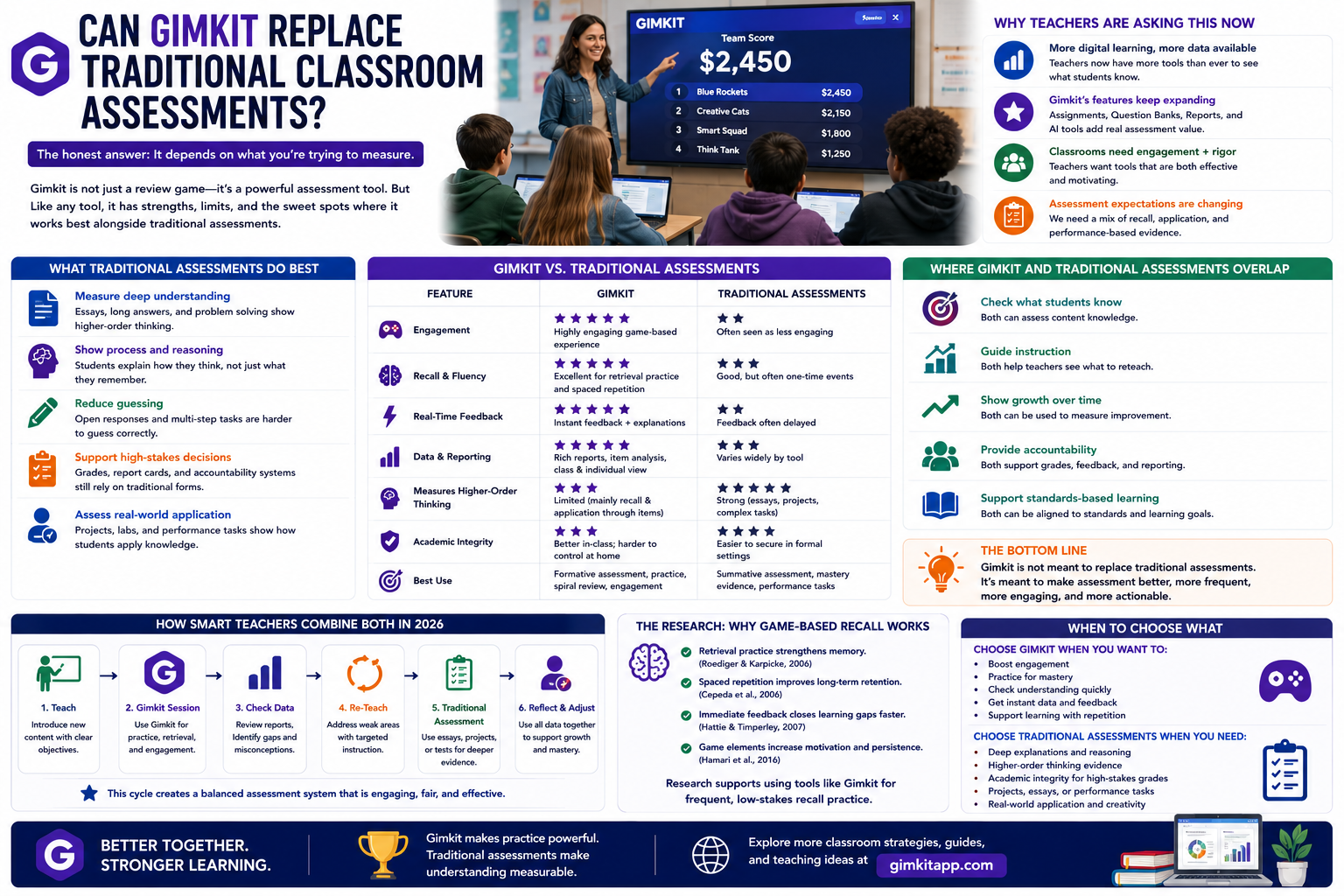
Can Gimkit Replace Traditional Classroom Assessments?Every few years, a new tool shows up in classrooms promising to make grading easier, engagement higher, and data richer than the paper quizzes teachers grew up with. Gimkit is the latest of these tools to get serious attention — not just as a review game, but as something teachers are quietly starting to lean on for actual assessment decisions. That raises a real question, not a marketing one: can Gimkit replace traditional classroom assessments, or is it better used alongside them?
This guide answers that question honestly. It walks through what traditional assessment actually does, what Gimkit is built to do, where the two genuinely overlap, where they don’t, and how experienced teachers are combining them in 2026 rather than picking one over the other. Along the way, you’ll find comparison tables, a look at the research behind why game-based recall works, and a practical framework you can apply in your own classroom starting this week.
Looking for comprehensive classroom resources and educational technology insights? Explore GimkitApp for expert guides, teaching strategies, game modes, and the latest updates to enhance student engagement.
Quick Answer: Can Gimkit Replace Traditional Assessments?
Gimkit can replace a meaningful share of formative assessment — the low-stakes checks teachers use to see if a lesson landed. It is not built to replace summative assessment — the high-stakes tests, essays, and projects that certify mastery for a grade, a transcript, or a graduation requirement. The honest, research-backed answer is: Gimkit replaces some traditional assessments, strengthens others, and should never be the only assessment tool in a teacher’s toolkit.
That single distinction — formative versus summative — is the thread that runs through this entire guide, so it’s worth understanding clearly before anything else.
Formative vs. Summative Assessment: The Distinction That Decides Everything
Before judging whether Gimkit can “replace” traditional assessment, you have to define which kind of assessment you mean. Not all classroom assessment serves the same purpose, and conflating the two types is where most of the online debate about Gimkit goes wrong.
Assessment Type
Purpose
When It Happens
Example
Stakes
Formative
Check understanding in progress, guide next steps
During a unit, daily or weekly
Exit ticket, quick quiz, warm-up review
Low — doesn’t usually count for a grade
Summative
Certify mastery at the end of learning
End of unit, semester, or course
Final exam, standardized test, term paper
High — determines a grade or credential
Traditional classrooms use both. A pop quiz on Tuesday is formative. A midterm exam is summative. Gimkit, as you’ll see, was built almost entirely for the formative side of that table — and that single fact explains nearly everything about where it succeeds and where it can’t fully take over.
What Traditional Classroom Assessment Actually Involves
“Traditional assessment” isn’t one thing. It’s a bundle of methods that schools have refined over decades because each one measures something different:
Written tests and quizzes — multiple choice, short answer, and fill-in-the-blank formats that check recall and basic application
Essays and extended writing — measure reasoning, argumentation, synthesis, and the ability to construct an original response
Projects and portfolios — evaluate sustained work, creativity, and application of skills over time
Oral assessments and presentations — test communication, real-time reasoning, and depth of understanding under questioning
Standardized tests — used for accountability, placement, and comparison across schools or states
Homework and problem sets — check independent practice and consolidation of a skill
Teacher observation and informal questioning — the ongoing, in-the-moment judgment teachers make simply by watching students work
Each of these formats exists because it captures something the others can’t. A multiple-choice quiz can’t measure how well a student constructs an argument. An essay can’t efficiently check whether 30 students know their multiplication facts. This is the baseline traditional assessment has to be measured against — not a single method, but a whole ecosystem of them.
What Gimkit Actually Is (And What It Was Built For)
Gimkit is a game-based learning platform where students answer questions to earn virtual currency (“GimBucks”), which they then spend on upgrades, power-ups, or in-game strategy elements depending on the mode being played. It was originally built by a high school student as a more strategic alternative to buzzer-style quiz games, and it has since grown into a platform schools use for review, practice, and — increasingly — light assessment.
A few features matter most when judging its assessment potential:
Live and Assignment modes. Live games run in real time with the whole class, while Assignments let students complete a Kit independently, at their own pace, from home, in class, or during free periods, with results still tracked by the teacher without the pressure of live competition.
KitCollab. This feature lets students submit their own questions for a Kit, which the teacher then approves before the game runs. It’s genuinely useful for building ownership and checking what students remember from a lesson, though even with student involvement, KitCollab still uses the same limited question formats, so it increases engagement without expanding the depth of assessment.
Auto-grading and reports. Gimkit automatically tracks completion and accuracy, which can sync to most learning management systems, and the reports section of the host dashboard functions as a genuine formative-assessment tool. The report interface breaks results into a general class-accuracy overview and a “Trouble Questions” list that flags any question missed by more than half the class — a direct, practical signal for what to re-teach the next day.
Game modes with real strategic depth. Modes like Fishtopia let students answer questions to earn resources they spend at their own pace, making it well suited to long-form, low-pressure sessions, while higher-stakes modes turn the same content into a tenser, faster-paced challenge.
Put simply: Gimkit was built to make repeated retrieval of factual and procedural knowledge feel like a game, and to hand teachers an instant readout of who understood what. That is a real, valuable form of assessment. It is also a narrower one than most people realize.
Where Gimkit Genuinely Excels as an Assessment Tool
1. It’s Built on Real Learning Science, Not Just Engagement
The single biggest reason Gimkit deserves to be taken seriously as an assessment tool — and not dismissed as “just a game” — is that its core mechanic (answer a question, get feedback, repeat) is a direct application of one of the most consistently replicated findings in cognitive psychology: the testing effect, also called retrieval practice.
Retrieval practice describes the finding that the act of recalling information from memory enhances learning and memory itself, and this effect is heavily supported by decades of research in cognitive psychology. The concept isn’t new — it was studied intermittently through the 20th century but saw a major resurgence in 2006 when foundational research demonstrated that testing is a powerful means of improving learning, not merely a way of measuring it — and interest in applying it has only grown in the years since.
Crucially, this isn’t a niche or contested finding. Classroom research shows retrieval practice is an extremely robust strategy across age groups and subject areas, and it supports higher-order thinking, not just rote memorization. A broader systematic review found that of 63 experiments examined across health professions education, 43 demonstrated a significant benefit of retrieval and distributed practice over comparison groups, and researchers have specifically suggested that educators could trial increasing the number of formative assessments as a direct method of providing students with more retrieval and distributed practice.
This matters for the Gimkit question specifically because it means the “game” isn’t just a motivational trick layered on top of learning — the repeated, low-stakes act of answering questions during a Gimkit round is functionally the same cognitive activity researchers have been validating for two decades under a different name: a practice test.
2. It Closes the Feedback Loop Faster Than Almost Any Traditional Method
Instead of waiting for a big test at the end of the week to find out whether a lesson landed, a teacher can run a ten-minute game the next day and see the results immediately, which saves time and helps catch struggling students before they fall further behind. Traditional grading — collecting papers, marking them by hand, returning them days later — simply cannot match that turnaround time, and speed matters enormously in formative assessment: feedback that arrives a week late has already lost most of its instructional value.
3. It Surfaces Class-Wide Misunderstanding With Precision
Traditional grading tells a teacher a score. It doesn’t automatically tell them which specific concept broke down for the group. Gimkit’s “Trouble Questions” report does exactly that, flagging any item more than half the class missed, which converts a vague sense of “some students struggled” into a specific, actionable re-teach target.
4. It Reduces the Anxiety Tax on Performance
A meaningful portion of what a traditional timed test measures is not just knowledge — it’s how well a student performs under pressure, silence, and a ticking clock. For many students, that pressure suppresses demonstrated knowledge below what they actually know. Gimkit’s game format, particularly in relaxed modes, removes much of that pressure while still requiring accurate recall, which can make it a more honest formative signal for anxious or test-averse students specifically.
5. It Scales Independent Practice Without Extra Grading Load
Because Assignments let students complete a Kit at their own pace with results still tracked automatically, teachers get the assessment data of an assigned practice set without the manual grading burden of a traditional worksheet — freeing time that can be redirected toward the assessments that genuinely need a human eye, like essays.
Where Gimkit Cannot Replace Traditional Assessment
None of the strengths above change the fact that Gimkit has hard structural limits, and pretending otherwise does students a disservice. Here’s where the traditional model still has to carry the weight.
1. It Cannot Assess Extended Writing, Argumentation, or Original Reasoning
Gimkit’s question formats are built around quick, gradable responses — multiple choice, short numeric or text answers. There is no mechanism for a student to construct a five-paragraph argument, defend a thesis, show multi-step mathematical proof work, or synthesize sources into an original analysis. Essays, lab reports, and research papers measure a category of thinking that a game-based recall platform structurally cannot capture, no matter how engaging the format.
2. It Cannot Serve as an Official, Accredited Summative Record
Report cards, transcripts, course credit, and graduation requirements depend on assessment methods that are standardized, auditable, and defensible — the kind of structure a formal exam or district-approved rubric provides. Gimkit scores are not designed or validated to serve as that official record, and no school district currently treats them as a substitute for state-mandated or accredited summative assessment.
3. It Doesn’t Measure Process, Only Outcome
A traditional math test that requires shown work reveals how a student arrived at an answer — where exactly their reasoning broke down. A Gimkit round shows only whether the final answer was right or wrong. For diagnosing conceptual errors in multi-step problem solving, that’s a meaningful loss of information.
4. Question Depth Is Inherently Constrained by the Format
As one review of the platform noted directly, even Gimkit’s most collaborative feature still relies on the same limited question formats, meaning it increases engagement and ownership without expanding the actual depth of assessment. Deep, open-ended, discussion-based understanding checks remain outside what the platform is built to do.
5. Access and Equity Gaps Are Real
The free version of Gimkit is fairly limited, and most of its more advanced features sit behind a paid plan — currently priced around $14.99 per month or $59.88 per year for the Pro tier that unlocks all game modes and the Assignments feature. Reviewers have flagged this directly: Gimkit’s free tier feels limited after a while, with advanced modes locked behind a subscription that can be a real barrier for smaller classrooms or individual tutors. A traditional paper quiz has no such barrier — every student can access it equally regardless of school budget, and it also lacks offline functionality, meaning any connectivity issue during class removes it as an assessment option entirely.
6. It Cannot Replace Direct Teacher Observation and Dialogue
Watching a student work through a problem, asking a follow-up question, listening to how they explain their thinking out loud — this remains one of the richest and most immediate assessment tools a teacher has, and it happens in real time in ways no digital platform replicates.
Side-by-Side Comparison: Gimkit vs. Traditional Assessment Methods
Criteria
Gimkit
Traditional Assessment
Best suited for
Formative checks, retrieval practice, review
Formative and summative, including high-stakes grading
Speed of feedback
Instant, automated
Slow to moderate (manual grading)
Depth of reasoning measured
Low to moderate
Moderate to very high (with essays, projects)
Measures process/work shown
No
Yes, in written and oral formats
Student engagement
Typically high
Varies widely
Test anxiety impact
Generally lower
Can be significant
Grading workload for teacher
Very low (automated)
Moderate to high
Official/transcript validity
Not accredited
Fully accredited
Cost to access fully
Paid subscription required for full features
Free (paper, school-provided tools)
Offline availability
No
Yes
Data granularity
High — question-level accuracy reports
Depends on teacher’s manual analysis
Suitable for essays/writing
No
Yes
Suitable for lab/practical skills
No
Yes (with rubrics, observation)
A Practical Framework: When to Use Which
Rather than treating this as an either/or decision, the most effective teachers using Gimkit in 2026 are applying a simple rule: match the tool to the stakes.
Use Gimkit when the goal is:
Checking daily or weekly understanding of a specific concept
Reviewing before a real test, not replacing it
Building retrieval practice into routine class time
Getting a fast read on which students need re-teaching
Increasing engagement in review sessions that used to feel like drudgery
Keep traditional assessment when the goal is:
Assigning an official grade that goes on a report card or transcript
Evaluating writing, argumentation, or original analysis
Measuring multi-step reasoning where the process matters as much as the answer
Meeting state or district accountability and accreditation requirements
Assessing hands-on or performance-based skills (labs, presentations, art, PE)
Ensuring every student has equal access regardless of paid-tier features or internet access
How Teachers Are Actually Blending the Two in Practice
Used well, Gimkit functions less as a standalone testing platform and more as a flexible layer for retrieval practice, formative assessment, and independent study that students genuinely enjoy engaging with. The most effective classroom rollout pattern looks something like this:
Teach the lesson using whatever traditional instructional method fits the content.
Review the Trouble Questions report immediately after, and use it to decide whether to re-teach a concept before moving on.
Assign a Gimkit Assignment for independent practice or homework, giving students repeated retrieval opportunities without adding to the teacher’s grading pile.
Administer the traditional summative assessment — the unit test, essay, or project — once the data from steps 2–4 suggests the class is actually ready.
The recommended approach for teachers new to this workflow is to start small: run one game, read the report, adjust one thing, and try again, letting the tool grow into an established practice naturally rather than replacing an entire grading system overnight.
The Research Case for Why This Hybrid Model Works Better Than Either Alone
It’s worth returning to the cognitive science briefly, because it explains why the hybrid approach — not full replacement — is the evidence-backed answer.
Researchers examining how retrieval practice holds up outside lab conditions found that although research consistently shows spacing and retrieval practice reliably improve learning, these strategies remain underused by students, in part because of false beliefs about which strategies actually work. Interestingly, learners in these studies rated retrieval-based strategies as less effective than simple re-reading, even directly after experiencing the benefit of retrieval practice for themselves — a mismatch between what feels productive and what actually is. This is a meaningful point for the Gimkit debate: a tool that makes retrieval practice feel fun and low-stakes may be solving an adoption problem, not just an engagement problem, because students and even teachers often underrate how effective frequent, low-stakes recall really is compared to a single big test.
Further research reinforces that the benefit isn’t confined to any one age group. There is a growing awareness among researchers of the need to study these strategies in real-world classroom settings, using school-appropriate materials across different age groups, rather than relying solely on lab studies with adult subjects. Studies conducted directly in primary school classrooms have found retrieval practice enhances learning regardless of whether it’s distributed evenly over time or delivered in a single block, which supports exactly the kind of frequent, informal check-ins that a tool like Gimkit is well positioned to deliver.
None of this research validates Gimkit specifically as a branded product — no controlled study has directly measured Gimkit against a traditional test for grade outcomes. But it does validate the mechanism Gimkit is built around, which is a meaningfully different and stronger claim than “students seem to enjoy it.”
Subject-by-Subject: Where Gimkit Fits Best
Subject Area
Fit for Gimkit-Style Assessment
Why
Vocabulary (any subject)
Excellent
Pure recall, ideal for retrieval practice
Math facts / procedures
Strong
Fast feedback on accuracy, though not on shown work
Science terminology & concepts
Strong
Good for concept checks before labs or deeper units
History/social studies facts
Strong
Efficient review of dates, events, causes/effects
Foreign language vocabulary
Strong
Matches well-documented flashcard-style retrieval research
Reading comprehension (basic)
Moderate
Works for factual recall, not literary analysis
Essay writing / argumentation
Poor fit
No mechanism for extended written response
Lab technique / hands-on skills
Poor fit
Requires physical observation, not question-answering
Complex multi-step math proofs
Poor fit
Doesn’t capture shown work or reasoning process
Addressing the Equity and Access Question Directly
Any honest assessment guide has to take the cost and access barrier seriously, because assessment tools that aren’t equally available to every student raise real fairness concerns. Reviewers who have used Gimkit in real classrooms consistently note that while students stay engaged longer than they do with traditional quizzes, the free plan is genuinely limited, and most of the platform’s more advanced features require a paid subscription. For a school or individual teacher without budget for the Pro tier, that means the full assessment toolkit — including some game modes and the Assignments feature — simply isn’t available, which can create uneven experiences between classrooms or districts.
There’s also the connectivity dependency: Gimkit currently has no offline mode, so any classroom with unreliable internet, or any student trying to complete an Assignment without home internet access, faces a real barrier that a printed worksheet never presents. This is one of the clearest, most practical reasons Gimkit cannot fully replace traditional assessment methods — traditional paper-based assessment remains the more universally accessible option regardless of a school’s technology budget or infrastructure.
What Gimkit’s Reporting Actually Tells You (And What It Doesn’t)
It’s worth being specific about the analytics, since “data-driven” claims get thrown around loosely in edtech marketing. Gimkit’s 2026 report interface organizes results into three views: a general class-accuracy overview for the big picture, a Trouble Questions list identifying anything more than half the class missed, and per-question breakdowns that sync to most learning management systems. This is genuinely useful, actionable data — but it’s important to understand its scope. It tells you what students got wrong. It does not tell you why, in the way a graded essay with margin comments or a one-on-one conversation would. Teachers still need to close that gap with human judgment; the report is a starting point for a conversation, not the conversation itself.
Step-by-Step: Building a Gimkit-Integrated Assessment Plan
If you’re deciding how to actually implement this in your own classroom, here’s a concrete starting sequence:
Step 1 — Audit your current assessment mix. List out what you currently use for formative checks versus summative grading. Most teachers find they’re already doing informal formative checks (cold-calling, quick polls) that Gimkit could formalize and make data-visible.
Step 2 — Identify low-stakes assessment points to convert first. Warm-ups, exit tickets, and pre-test review sessions are the safest, highest-value places to introduce Gimkit, since nothing about their grading weight changes.
Step 3 — Keep your summative structure completely untouched initially. Don’t modify how unit tests, essays, or final grades are calculated in your first term of using Gimkit. Let it prove itself as a formative layer before considering any expansion of its role.
Step 4 — Use the Trouble Questions report as a re-teach trigger, not a grade. Build a habit of checking this report the same day you run a game, and adjust the next day’s lesson accordingly.
Step 5 — Track whether summative scores actually improve. After a full unit of using Gimkit for formative review, compare traditional test outcomes to prior units. This is the real test of whether the tool is earning its place — not engagement alone, but whether it’s translating into better summative performance.
Step 6 — Reassess equity and access every term. Confirm every student has functional access — device, login, and either connectivity or an offline alternative — before treating Gimkit results as representative of the whole class.
Common Mistakes Teachers Make When Treating Gimkit as a Full Replacement
Grading Gimkit rounds like a formal test. This undermines the low-pressure design that makes retrieval practice effective in the first place, and it introduces stakes the format wasn’t built to support fairly.
Skipping traditional assessment altogether for a unit. Without a summative check, teachers lose the ability to verify deeper understanding, written reasoning, and long-term retention beyond the immediate game session.
Ignoring students without reliable devices or internet. Running Gimkit as the only review method excludes students who can’t participate fully, quietly disadvantaging them before a real test even happens.
Treating engagement as proof of learning. High energy in the room doesn’t automatically mean deep understanding — the Trouble Questions data, not the excitement level, is the actual signal to trust.
Never comparing formative data to summative outcomes. Without checking whether Gimkit-driven review actually improves test scores, teachers are flying blind on whether the tool is working.
Frequently Asked Questions
Is Gimkit considered a valid form of formal assessment?
Gimkit is well suited to formative assessment — checking understanding during learning — but it is not an accredited or validated tool for formal, gradable summative assessment. Its scores aren’t designed to appear on transcripts or satisfy district accountability requirements. Teachers can confidently use it to guide instruction and re-teaching decisions, while still relying on traditional tests, essays, and rubric-based grading for anything that needs to count toward an official grade.
Can Gimkit fully replace traditional quizzes?
For low-stakes recall quizzes — vocabulary checks, fact review, quick concept checks — Gimkit can often fully replace the traditional paper version, and its instant reporting adds value the paper quiz never had. It cannot replace quizzes that require written explanation, shown mathematical work, or open-ended reasoning, since its question formats are built for quick, gradable answers rather than extended written response.
Does Gimkit work for high-stakes exams or standardized testing?
No. Gimkit was never designed to meet the security, standardization, and validity requirements that high-stakes and standardized exams require. It has no proctoring safeguards built for formal testing conditions, and no school district currently accepts Gimkit scores as a substitute for state-mandated assessments. It belongs firmly in the practice and review category, not the certification category.
Is there research proving Gimkit improves test scores?
No controlled study has directly measured Gimkit’s branded impact on test scores. What is well established, however, is the learning mechanism it’s built on: retrieval practice, or the testing effect, which decades of cognitive psychology research show reliably improves retention and comprehension across age groups and subjects. Gimkit applies that mechanism in a game format, which is a reasonable and evidence-informed design choice, even without product-specific studies.
Is the free version of Gimkit enough for classroom assessment?
The free tier gives access to rotating game modes and basic performance reports, which is enough for occasional formative use. Reviewers consistently note it feels limited over time, since more advanced modes, the Assignments feature for independent practice, and deeper analytics sit behind the paid Pro subscription. Teachers relying heavily on Gimkit for regular assessment will likely find the paid tier necessary for full functionality.
How does Gimkit compare to Kahoot for assessment purposes?
Kahoot is generally a faster-paced, buzzer-style quiz format focused on speed and immediate competition. Gimkit adds strategic depth through its in-game economy, upgrades, and a wider range of game modes, including self-paced options that reduce competitive pressure. For assessment specifically, Gimkit’s reporting and Assignment mode give it a slight edge for structured formative use, while both remain limited to quick-answer question formats rather than deeper written assessment.
What’s the biggest risk of relying too heavily on Gimkit for assessment?
The biggest risk is mistaking engagement for understanding. A lively, high-energy Gimkit session can feel like strong evidence of learning, but the actual data that matters is question-level accuracy, not enthusiasm. Teachers who skip traditional summative checks entirely risk missing gaps in deeper reasoning, writing ability, and long-term retention that only more comprehensive assessment methods can reveal.
Should new teachers start by fully switching to Gimkit or easing into it?
Easing in is the safer and more effective approach. Start with one low-stakes formative use case, such as a weekly review game, before expanding to independent Assignments or replacing more traditional review methods. This lets you evaluate the reporting data against real outcomes before committing more of your assessment strategy to the platform.
Conclusion
Gimkit is not a replacement for traditional classroom assessment — it’s a genuinely well-designed addition to it, built on a learning mechanism with real scientific backing rather than novelty alone. It excels at formative assessment: fast feedback, engaging retrieval practice, and precise, actionable data on where a class is struggling. It cannot and should not replace the deeper, higher-stakes work that traditional assessment does — measuring extended writing, multi-step reasoning, hands-on skill, and the kind of accredited summative record schools are required to keep.
The teachers getting the most out of Gimkit aren’t the ones who threw out their old tests. They’re the ones using Gimkit to make sure students are actually ready for those tests in the first place — running quick, low-stakes retrieval rounds during the unit, reading the Trouble Questions report the same day, adjusting instruction accordingly, and then trusting the traditional summative assessment to do the job it was always built to do. That combination, not a full replacement in either direction, is what the evidence and the practical classroom experience both point to.
Can Gimkit Replace Traditional Classroom Assessments?
Review
Gimkit can be a powerful supplement to traditional classroom assessments, especially when teachers want faster feedback, stronger student participation, and a more interactive assessment experience. However, it should not completely replace conventional quizzes, written assignments, projects, or other assessment methods. Its greatest value comes from combining game-based formative assessment with traditional approaches, allowing teachers to measure both immediate understanding and deeper learning.
For the latest gaming news, expert reviews, and walkthroughs, readers can also visit IGN, one of the world’s leading gaming websites.