Introduction
Gimkit vs Blooket Which Platform Rewards Better Strategic Thinking?This expert guide cover covers your all doubts & make you experienced.
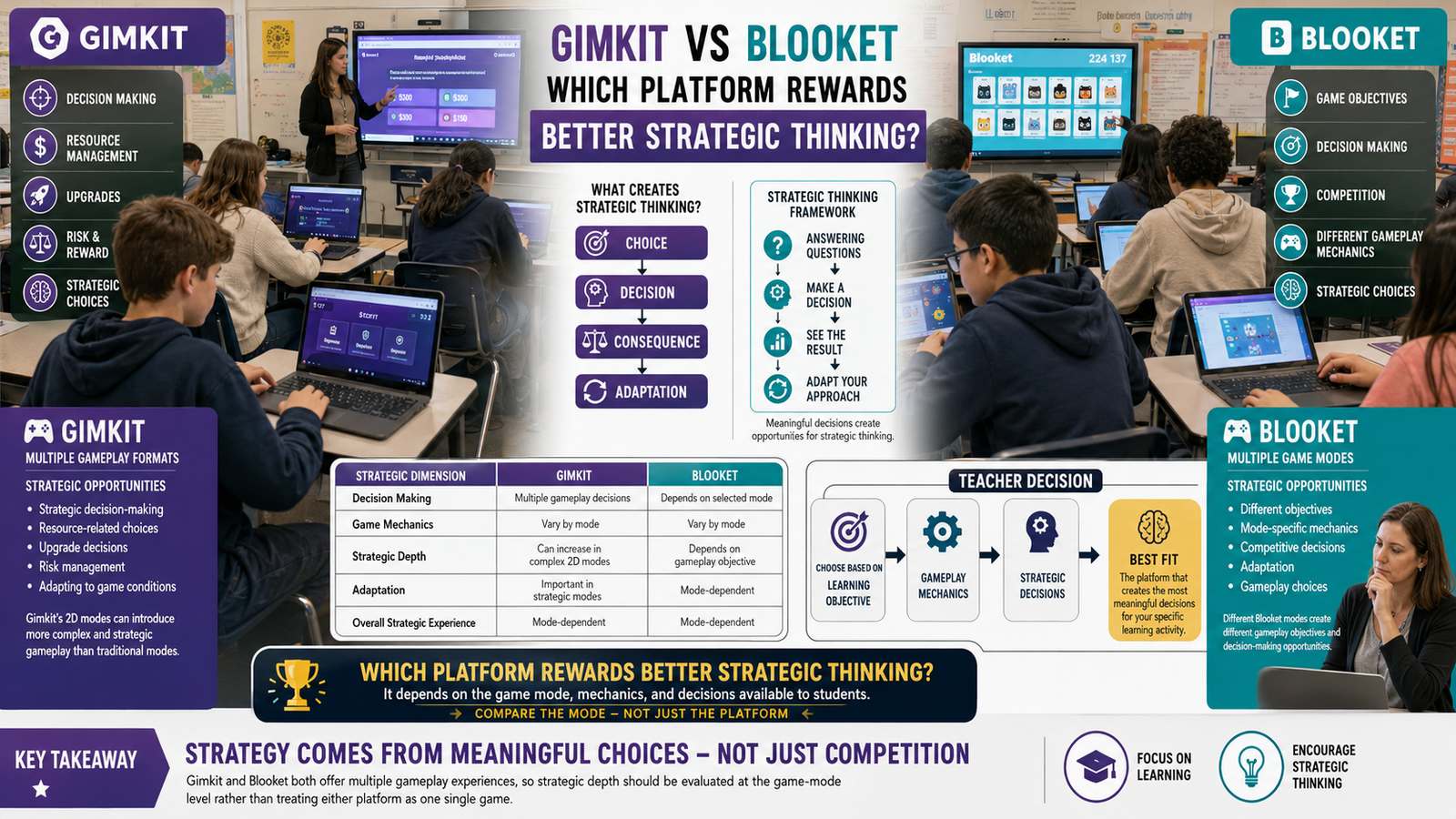
Gimkit vs Blooket is a useful comparison when the goal is not simply to make classroom review more entertaining, but to understand which platform creates more opportunities for students to think strategically.
Both platforms connect question answering with game mechanics, but they are not built around exactly the same type of gameplay. Gimkit offers traditional and 2D game modes, with its official documentation describing 2D modes as capable of being more complex and strategic than traditional modes. Blooket also provides a wide selection of game modes with different gameplay objectives and mechanics.
That means the answer cannot be reduced to “Gimkit is more strategic” or “Blooket is more strategic.”
The better comparison is:
Which platform gives students more meaningful opportunities to make decisions that affect what happens next?
This article evaluates that question without treating either platform as a single game.
- Looking for comprehensive classroom resources and educational technology insights? Explore GimkitApp for expert guides, teaching strategies, game modes, and the latest updates to enhance student engagement.
If You have interest to see more comperisions read this blog after gimkit vs blooket :
Gimkit vs Kahoot
Gimkit vs Quizizz
Gimkit vs Socrative - Gimkit vs Nearpod
- Gimkit vs 99 Math
- Gimkit vs Factile
- Gimkit vs Quizalize
- Gimkit vs Plickers
- Gimkit vs ClassPoint
Quick Answer
Blooket has a strong position when strategic thinking is built around structured game systems, while Gimkit has a strong position when strategy is embedded into interactive gameplay.
The important qualification is that game mode matters more than the platform name.
Gimkit itself uses mode labels to help teachers identify experiences that emphasize characteristics such as strategy and collaboration. Its 2D modes can include exploration, competition, teamwork, movement, and other interactive systems.
Blooket likewise offers different modes rather than one fixed gameplay system.
So this comparison will judge the platforms at three levels:
| Level | What Is Being Compared? |
|---|---|
| Platform | Overall design philosophy and available gameplay ecosystem |
| Game Mode | The specific experience students actually play |
| Strategic Opportunity | The decisions students are required to make |
This distinction prevents a common comparison mistake: judging an entire platform from one popular game mode.
What Does “Strategic Thinking” Mean in a Classroom Game?
Strategic thinking is the ability to make decisions with future consequences in mind.
In a classroom game, it can involve questions such as:
- What should I do next?
- Which option gives me the best position?
- Should I change my approach?
- What consequence could follow this decision?
- Should I prioritize one objective over another?
- How should I respond to what another player or the game is doing?
But not every game decision is automatically strategic.
A useful distinction
| Student Behavior | Primary Skill |
|---|---|
| Answering a question quickly | Speed |
| Remembering an answer | Recall |
| Clicking the correct option | Accuracy |
| Reacting immediately | Reaction |
| Choosing between meaningful alternatives | Decision-making |
| Considering future consequences | Strategic thinking |
| Changing a plan after new information | Adaptation |
| Coordinating decisions with others | Collaborative strategy |
This distinction is important throughout the comparison.
A game can be fast, competitive, difficult, and highly engaging without necessarily requiring deep strategic thinking.
The Five-Part Strategic Thinking Model
For this comparison, strategic thinking will be evaluated through five core dimensions.
| Dimension | Central Question |
|---|---|
| Decision Quality | Does the student have meaningful choices? |
| Planning | Do current decisions affect future opportunities? |
| Resource Use | Must students manage something limited or valuable? |
| Adaptation | Can changing conditions require a different approach? |
| Interaction | Do other players, teammates, or game conditions affect decisions? |
These five dimensions provide the framework for the rest of the article.
They also prevent the comparison from becoming a simple feature checklist.
Gimkit and Blooket Are Not Identical Types of Classroom Games
At the platform level, the biggest difference is the range and structure of gameplay experiences.
Gimkit allows teachers to choose from different game modes and provides a mode picker with descriptions and labels intended to help teachers match a mode to their class and desired outcome.
Its 2D modes place students inside interactive environments. Gimkit describes these modes as experiences where students explore 2D worlds, and notes that they can be more complex and strategic than traditional modes.
Blooket similarly operates through multiple game modes rather than one universal gameplay formula.
This creates an important comparison principle:
The strategic experience comes from the interaction between the question set and the selected game mode.
The platform provides the environment; the mode determines much of the actual decision structure.
Gimkit: Where Strategy Enters the Gameplay
Gimkit’s strategic potential is particularly visible in its 2D game ecosystem.
Instead of keeping students inside a simple question-and-score loop, 2D modes can place gameplay inside an environment where students move, interact, pursue objectives, or work with other players.
Gimkit’s official documentation describes 2D modes as potentially more complex and strategic than traditional modes.
Its current game-mode documentation includes experiences such as:
- One Way Out
- Don’t Look Down
- Blastball
- Snowbrawl
- and other 2D modes with different gameplay structures.
The strategic significance is not simply that these games look more interactive.
It is that the student can have additional decisions between answering a question and reaching the game objective.
Example
In One Way Out, students answer questions to gain energy, explore the ship, use gadgets, collect key cards, upgrade equipment, and work together toward a shared escape objective.
That creates a broader activity loop:
Question → Gameplay Resource → Action → Progress
Blooket: Where Strategy Enters the Gameplay
Blooket approaches the same broad educational challenge through a large collection of distinct game experiences.
The student is still answering questions, but the surrounding game system can change substantially depending on the selected mode.
That matters because strategic thinking does not come from the question itself.
It comes from what the student must decide after, around, or because of the question.
For example, a mode can make students focus primarily on:
- progression,
- competition,
- resource decisions,
- defense,
- upgrades,
- memory,
- timing,
- or other game objectives.
The important point for this article is not to declare one of these systems superior yet.
Instead:
Blooket provides multiple strategic environments, while Gimkit also provides multiple environments with a particularly strong interactive 2D component.
Why Game Mode Matters More Than the Platform Name
Imagine two teachers asking the same question:
“Which is more strategic, Gimkit or Blooket?”
They could receive different correct answers because they may be using completely different modes.
Teacher A
Wants students to make decisions inside an interactive environment with movement and teamwork.
Teacher B
Wants students to make decisions involving structured progression and game resources.
The platforms may produce different results for those two teachers.
That is why this article will not use a single platform-wide definition of strategy.
Instead, it separates:
Platform → Mode → Mechanics → Strategic Skill
This produces a much more accurate comparison.
Strategy Is Not the Same as Competition
Competition is often associated with strategy, but the two are different.
A competitive game can reward:
- speed,
- recall,
- accuracy,
- reaction time,
- luck,
- or strategy.
Only some of these require substantial planning.
| Game Characteristic | Automatically Strategic? |
|---|---|
| Leaderboard | No |
| Competition | No |
| Fast questions | No |
| Points | No |
| Rewards | No |
| Player choices | Sometimes |
| Trade-offs | Yes, usually |
| Future consequences | Strong indicator |
| Adaptation | Strong indicator |
| Resource constraints | Strong indicator |
| Opponent prediction | Strong indicator |
This is why the comparison will not use “more competitive” as a synonym for “more strategic.”
Strategy Is Not the Same as Difficulty
Another common mistake is assuming that the harder game is automatically the more strategic one.
A game can be difficult because:
- questions are difficult,
- movement is difficult,
- timing is strict,
- the game is fast,
- mistakes are heavily punished,
- or the rules are complicated.
None of those alone proves strategic depth.
Strategic difficulty is different
Strategic difficulty increases when students must evaluate competing options and deal with the consequences of their decisions.
For example:
Hard question
“Do you know the answer?”
Strategic decision
“Which option should you choose, and what could that choice mean for your next move?”
The second requires a different type of thinking.
The Role of Correct Answers
Both platforms are educational games, so the question-answering layer remains important.
The strategic comparison therefore needs to ask:
How strongly does academic performance influence the student’s ability to make successful gameplay decisions?
This creates an important educational relationship:
Knowledge → Gameplay Opportunity → Decision → Outcome
If correct answers simply increase a score, the strategic layer may remain limited.
If correct answers provide something that students must then use intelligently, the relationship becomes more complex.
Gimkit provides especially clear control over this relationship in its 2D modes. Its official game options include controls for balancing answering questions against gameplay, including how much resource students receive per correct answer in supported modes.
That makes the question-to-gameplay relationship an important part of the comparison.
Why “Better Strategy” Needs a Defined Meaning
There is no universal measurement called strategic thinking score for Gimkit or Blooket.
Therefore, saying one platform is “more strategic” without defining the criteria would be misleading.
A useful comparison needs to ask:
Does the game create meaningful choices?
If there is only one obvious action, strategic depth is limited.
Do choices have consequences?
If every option produces almost the same result, decision-making becomes less important.
Can students plan?
If the best action is always immediate, there is little need for forward planning.
Can students adapt?
If one fixed strategy works regardless of circumstances, strategic flexibility is limited.
Does the student’s knowledge affect strategic opportunity?
If academic performance and gameplay are disconnected, the educational value of the strategy system may be weaker.
These questions will form the evaluation framework for the next part.
What This Comparison Will Actually Measure
Rather than creating a generic “features” article, the comparison will evaluate the two platforms through specific strategic categories.
| Strategic Category | What We Will Examine |
|---|---|
| Decision-making | Quality and number of meaningful choices |
| Planning | Short- and long-term consequences |
| Resource management | Whether students must allocate limited resources |
| Risk | Whether decisions involve meaningful trade-offs |
| Adaptability | Whether changing conditions require new strategies |
| Competition | Whether opponents affect decision-making |
| Collaboration | Whether students must coordinate strategies |
| Positioning | Whether location or movement affects decisions |
| Progression | Whether earlier choices influence later opportunities |
| Learning connection | How academic performance feeds gameplay |
This is the comparison map, not the final judgment.
The Core Comparison Principle
The entire article can be reduced to one framework:
Strategic depth is determined by the quality of decisions students must make, not by how exciting or competitive the game looks.
That principle keeps the comparison objective.
Gimkit’s official documentation itself distinguishes between different game experiences and provides mode labels to help teachers identify characteristics such as strategy and collaboration.
Its 2D modes can also be configured to change the balance between academic answering and gameplay progression.
Blooket likewise needs to be evaluated mode by mode rather than treated as one uniform game.
Therefore, the final comparison will judge strategic mechanics, not popularity, visual style, or simple engagement.
Decision-Making: Which Platform Gives Students More Meaningful Choices?
The first test of strategic depth is simple:
Does the student have to choose between multiple actions with different consequences?
| Decision Factor | Gimkit | Blooket |
|---|---|---|
| Choice beyond answering questions | Strong in selected modes | Strong in selected modes |
| Immediate tactical choices | Very strong | Moderate–Strong |
| Economic/resource choices | Strong in selected modes | Very strong in selected modes |
| Position-based choices | Strong | Mode-dependent |
| Upgrade-related choices | Present in selected experiences | Strong in several modes |
| Long-term consequences | Mode-dependent | Mode-dependent |
| Strategic variety | High | High |
Gimkit’s 2D experiences can add another decision layer between answering questions and progressing through the game. Blooket’s different modes can similarly change what students do with the results of their answers.
Strategic difference
Gimkit tends to become strategically interesting when the environment itself creates decisions.
Blooket tends to become strategically interesting when the selected game system creates decisions around progression, resources, defense, or other objectives.
The winner therefore changes according to the decision type rather than being universal.
Planning: Who Rewards Thinking Ahead?
Planning becomes strategic when the best decision is not necessarily the one that produces the largest immediate reward.
A student may need to ask:
“What will this decision allow me to do later?”
Gimkit
In interactive modes, planning can involve:
- deciding where to move,
- determining when to pursue an objective,
- considering threats,
- coordinating with teammates,
- choosing when to act,
- preparing for what comes next.
This creates situational planning.
Blooket
In appropriate modes, planning can involve:
- saving resources,
- choosing upgrades,
- preparing defenses,
- balancing immediate and future benefits,
- determining how aggressively to progress.
This creates progression-oriented planning.
| Type of Planning | Stronger Fit |
|---|---|
| Immediate tactical planning | Gimkit |
| Movement planning | Gimkit |
| Team planning | Gimkit |
| Resource planning | Blooket |
| Upgrade planning | Blooket |
| Defensive planning | Blooket |
| Long-term progression | Blooket |
Strategic edge
Blooket has an advantage for structured long-term planning, while Gimkit is stronger when planning must happen inside an active environment.
Resource Management: Where the Biggest Difference Appears
Resource management is one of the clearest ways to distinguish strategic gameplay from simple quiz competition.
A resource becomes strategically meaningful when:
- it is limited,
- students must decide how to use it,
- different uses compete with one another,
- the decision affects future gameplay.
Gimkit
Gimkit can connect correct answers with gameplay resources, particularly in modes where students use resources to perform actions or progress.
In One Way Out, for example, students can gain energy from answering questions and use gameplay systems involving exploration, gadgets, key cards, and upgrades.
Blooket
Blooket contains modes where resource management becomes a central part of the gameplay structure.
This can create decisions such as:
Earn → Save → Spend → Upgrade → Progress
That is a classic strategic loop.
| Resource Strategy | Gimkit | Blooket |
|---|---|---|
| Resource accumulation | Strong | Very strong in selected modes |
| Spending decisions | Strong | Very strong |
| Upgrade economy | Strong | Very strong |
| Saving for future value | Mode-dependent | Strong |
| Resource optimization | Strong | Very strong |
Winner for resource-centered strategy: Blooket
This does not mean Blooket is more strategic overall. It means resource management is one of the areas where its gameplay can create particularly clear strategic choices.
Risk and Reward
Strategic players rarely have perfect information.
They often have to decide whether a possible benefit is worth the risk.
A useful strategic structure is:
Potential Gain ↔ Potential Loss
Gimkit
Risk can emerge from active gameplay.
Students may have to consider:
- whether to advance,
- whether to engage,
- whether to pursue an objective,
- whether to take a safer route,
- whether to act now or wait.
Because the environment can change while the player is acting, risk can feel immediate.
Blooket
Risk can emerge through decisions involving:
- resources,
- upgrades,
- progression,
- competitive positions,
- defensive choices,
- timing.
These risks can be more structured than purely tactical.
| Risk Type | Gimkit | Blooket |
|---|---|---|
| Immediate tactical risk | Strong | Moderate |
| Movement-related risk | Strong | Mode-dependent |
| Resource risk | Strong | Very strong |
| Upgrade risk | Strong in selected modes | Very strong in selected modes |
| Defensive risk | Mode-dependent | Strong |
| Timing risk | Strong | Strong |
Result
Gimkit has the stronger tactical-risk profile. Blooket has the stronger structured resource-risk profile.
Adaptability: Which Platform Forces Students to Change Strategy?
Planning alone is not enough.
A genuinely strategic player also knows when the original plan has stopped working.
The strategic loop becomes:
Plan → Act → Observe → Reassess → Adapt
Gimkit
This is one of Gimkit’s strongest strategic characteristics in interactive modes.
A changing environment can require students to reconsider:
- position,
- movement,
- timing,
- objectives,
- team coordination,
- immediate priorities.
The student is not necessarily following one fixed strategy from beginning to end.
Blooket
Blooket can also require adaptation when:
- resources change,
- opponents change position,
- progression changes,
- new threats appear,
- strategic circumstances shift.
However, the type of adaptation depends heavily on the selected mode.
| Adaptation Type | Stronger Fit |
|---|---|
| Real-time adaptation | Gimkit |
| Movement adaptation | Gimkit |
| Tactical reaction | Gimkit |
| Economic adaptation | Blooket |
| Resource adaptation | Blooket |
| Defensive adaptation | Blooket |
| Long-term strategy adjustment | Both |
Winner for dynamic adaptation: Gimkit
Tactical Thinking vs Strategic Thinking
This distinction is particularly important.
Tactical thinking
Focuses on:
What should I do right now?
Strategic thinking
Focuses on:
What should I do now because of what I want to achieve later?
Gimkit’s interactive modes can combine both.
A player may need to make an immediate tactical decision while still considering the larger objective.
Blooket’s resource and progression systems can push students toward longer-term strategic thinking.
| Thinking Type | Gimkit | Blooket |
|---|---|---|
| Immediate reaction | Excellent fit | Good |
| Tactical positioning | Excellent fit | Mode-dependent |
| Short-term planning | Strong | Strong |
| Long-term planning | Strong | Very strong in selected modes |
| Resource strategy | Strong | Excellent in selected modes |
This is why simply asking “Which one is more strategic?” is too broad.
Spatial Strategy and Positioning
Positioning introduces a strategic element that traditional quiz games usually do not have.
The question changes from:
“What answer should I select?”
to:
“Where should I be, and what should I do from there?”
This can involve:
- distance,
- movement,
- routes,
- obstacles,
- opponents,
- objectives,
- timing.
Gimkit
Its 2D environment gives this category a clear advantage.
Gimkit’s 2D modes place players into interactive worlds where movement and environment can become part of gameplay.
Blooket
Spatial strategy depends much more heavily on the particular mode.
Some experiences may involve positioning or defensive placement, while others focus on completely different mechanics.
Winner: Gimkit
Team Strategy and Coordination
Team strategy adds another layer because students must consider other people.
The strategic question becomes:
“What should our group do?”
rather than simply:
“What should I do?”
Effective team strategy can require:
- role allocation,
- communication,
- timing,
- shared objectives,
- resource coordination,
- supporting weaker teammates.
Gimkit has particularly strong potential here through collaborative 2D experiences.
For example, One Way Out is designed around players working together toward an escape objective, with exploration, resources, key cards, gadgets, and enemies forming part of the experience.
| Collaboration Element | Gimkit | Blooket |
|---|---|---|
| Shared objective | Strong | Mode-dependent |
| Team coordination | Strong | Moderate–Strong |
| Role-based cooperation | Strong potential | Mode-dependent |
| Individual competition | Strong | Strong |
| Cooperative problem-solving | Strong | Mode-dependent |
Winner: Gimkit
For the latest gaming news, expert reviews, and walkthroughs, readers can also visit IGN, one of the world’s leading gaming websites.
Competition: Which One Makes Competition More Strategic?
Competition itself is not strategic.
The question is what students have to do because they are competing.
Low strategic competition
“Answer faster to get more points.”
Higher strategic competition
“Decide how to use your current advantage because another player’s actions may change your future position.”
Both platforms can move toward the second type depending on the game mode.
Gimkit can create competition through active interaction and player behavior.
Blooket can create competition through progression, resources, defense, or other mode-specific systems.
Important distinction
| Competitive Structure | Strategic Value |
|---|---|
| Speed only | Low |
| Accuracy only | Low–Moderate |
| Speed + accuracy | Moderate |
| Resource competition | High |
| Position competition | High |
| Team objectives | High |
| Long-term progression competition | High |
| Opponent-dependent decisions | Very high |
So neither platform gets an automatic win simply because it has a leaderboard or competitive gameplay.
Memory + Strategy
Memory and strategy are different skills, but combining them can create an interesting cognitive challenge.
A student might need to:
Remember information → Interpret it → Use it to make a decision
Blooket includes game experiences where memory is part of the gameplay rather than simply being an academic question-answering requirement.
That can make the platform particularly useful when a teacher wants to combine:
- recall,
- recognition,
- prioritization,
- strategic choices.
Gimkit can also combine academic recall with gameplay decisions, but its strategic strength is more dependent on the mechanics of the selected mode.
Edge: Blooket for explicit memory-plus-strategy experiences
Upgrade Strategy
Upgrades create strategic depth when students have to decide:
“Which improvement should I purchase first?”
The important factor is opportunity cost.
If a student can choose only one improvement, choosing one means giving up another.
Example
| Option | Immediate Benefit | Future Potential |
|---|---|---|
| Upgrade A | High | Moderate |
| Upgrade B | Moderate | High |
| Upgrade C | Low | Very high |
Now the student must think beyond immediate rewards.
Blooket has several gameplay systems where upgrades and progression are important strategic elements.
Gimkit can also incorporate upgrades and progression in selected experiences, including interactive modes.
Winner for upgrade-centered strategy: Blooket
Defense Strategy
Defense creates another form of planning.
The student must anticipate:
“What problem might happen next?”
Rather than only reacting after the threat appears.
This introduces:
- anticipation,
- prioritization,
- positioning,
- resource allocation,
- future planning.
Blooket’s defense-oriented experiences provide a particularly direct example of this type of strategy.
Gimkit can create defensive decisions through interactive gameplay, but the strength depends on the selected mode.
Winner: Blooket for structured defense
Randomness vs Skill
One of the most important questions in educational games is how much of the result comes from strategic skill versus randomness.
A game can contain randomness without becoming strategically meaningless.
The real question is:
Can good decisions still improve the student’s chances of success?
High randomness
If outcomes are mostly determined by chance, strategic control becomes weaker.
Controlled randomness
If students can respond intelligently to random events, strategy remains important.
Skill-dominant system
If informed decisions consistently have meaningful consequences, strategic depth becomes stronger.
Both platforms contain different game systems, so randomness cannot fairly be assigned to the entire platform.
Practical comparison
| Factor | Gimkit | Blooket |
|---|---|---|
| Can randomness appear? | Yes | Yes |
| Can skill influence outcomes? | Yes | Yes |
| Is every mode equally strategic? | No | No |
| Should randomness be judged platform-wide? | No | No |
The selected mode must always be examined.
The Relationship Between Knowledge and Strategy
This is where educational gameplay becomes particularly important.
A classroom game should not create a completely separate game skill and academic skill.
Ideally:
Academic Knowledge → Better Game Decisions
The question is whether knowing more actually improves the player’s strategic options.
Gimkit
Correct answers can provide gameplay resources in supported modes, creating a direct bridge between academic performance and game progression.
Blooket
Correct answers likewise feed the gameplay systems, with the exact consequence depending on the selected mode.
The strategic difference comes from what students can do with the resulting advantage.
| Academic Result | Strategic Question |
|---|---|
| Correct answer | What opportunity did I gain? |
| Incorrect answer | What opportunity did I lose? |
| More resources | How should I use them? |
| Better position | What should I do next? |
| New upgrade | Is it worth choosing now? |
This connection is what separates a simple quiz with rewards from a more strategically layered learning game.
Which Platform Has More Strategic Variety?
This question is different from asking which platform has the deepest single strategic mode.
Variety means how many different types of strategic behavior students can experience.
| Strategy Type | Gimkit | Blooket |
|---|---|---|
| Tactical decisions | Strong | Strong |
| Movement | Strong | Mode-dependent |
| Team strategy | Strong | Mode-dependent |
| Resource management | Strong | Strong |
| Upgrades | Strong | Strong |
| Defense | Mode-dependent | Strong |
| Memory + strategy | Good | Strong |
| Economic decisions | Good–Strong | Strong |
| Exploration | Strong | Mode-dependent |
| Competitive strategy | Strong | Strong |
The platforms approach variety differently.
Gimkit’s variety becomes particularly noticeable through interactive and 2D gameplay.
Blooket’s variety becomes particularly noticeable through its collection of specialized game modes.
So the winner depends on what “variety” means.
Strategic Depth: A Better Way to Compare the Platforms
Instead of asking for one arbitrary score, strategic depth can be viewed as a combination of several factors:
Meaningful Choices
Consequences
Planning
Adaptation
Resource/Constraint Management
Interaction
The more of these elements a game combines effectively, the greater its potential strategic depth.
Strategic depth model
| Strategic Element | Gimkit | Blooket |
|---|---|---|
| Meaningful choices | High | High |
| Consequences | High in selected modes | High in selected modes |
| Planning | High | High |
| Adaptation | Very high in interactive modes | High |
| Resource management | High | Very high in selected modes |
| Interaction | Very high in 2D modes | High |
| Defense | Moderate–High | High in relevant modes |
| Spatial strategy | Very high in 2D modes | Mode-dependent |
| Long-term optimization | High | Very high in relevant modes |
These are comparative editorial judgments, not official platform scores.
The Biggest Strategic Difference
After examining the mechanics, the most useful distinction is this:
Gimkit’s strongest strategic identity
Dynamic decision-making inside an active environment.
Students may have to react to:
- position,
- movement,
- opponents,
- teammates,
- objectives,
- resources,
- changing circumstances.
Blooket’s strongest strategic identity
Structured decision-making inside specialized game systems.
Students may have to manage:
- resources,
- progression,
- upgrades,
- defense,
- memory,
- optimization,
- competitive objectives.
This distinction is more useful than simply saying one platform is “more strategic.”
Strategic Mechanics Comparison
| Strategic Mechanic | Gimkit Advantage | Blooket Advantage |
|---|---|---|
| Real-time reaction | ✅ | |
| Spatial decisions | ✅ | |
| Tactical movement | ✅ | |
| Team coordination | ✅ | |
| Dynamic adaptation | ✅ | |
| Resource optimization | ✅ | |
| Upgrade planning | ✅ | |
| Structured defense | ✅ | |
| Memory + strategy | ✅ | |
| Long-term progression | ✅ | |
| Economic-style decisions | ✅ | |
| Broad strategic mode variety | Close | ✅ |
The pattern is now much clearer:
Gimkit tends to excel when strategy is active and situational.
Blooket tends to excel when strategy is structured around progression, resources, upgrades, or specialized game mechanics.
What This Means for Strategic Learning
A student playing Gimkit may develop a different strategic habit from a student playing Blooket.
Gimkit-style strategic habit
Observe → React → Coordinate → Adapt
Blooket-style strategic habit
Assess → Allocate → Optimize → Progress
Neither sequence is inherently better.
They train different decision patterns.
A teacher interested in strategic thinking should therefore decide which kind of thinking is most relevant to the lesson.