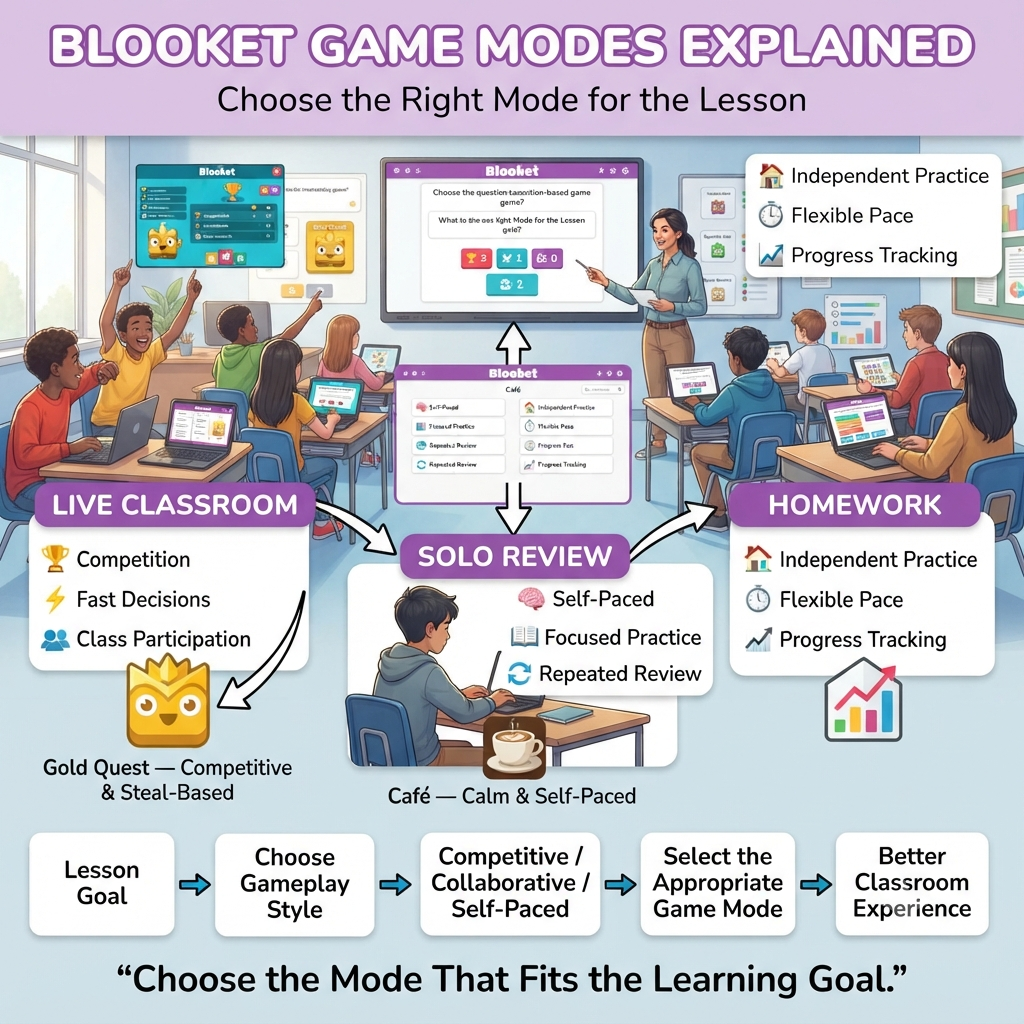
Blooket Game Modes Explained | Blooket gives teachers more than two dozen ways to turn a plain question set into a live classroom event, a quiet solo review session, or a homework assignment students actually want to finish. That range is exactly what makes the “which mode should I pick” question so common — and so easy to get wrong if you don’t understand what separates a chaotic, steal-based game like Gold Quest from a calm, self-paced one like Café.
This guide breaks down every current Blooket game mode, organized by how you can play them, what skills they reward, and which classroom situation each one actually fits. By the end, you’ll be able to look at a lesson plan and know immediately which mode serves it best — without trial and error in front of thirty students.
Looking for comprehensive classroom resources and educational technology insights? Explore GimkitApp for expert guides, teaching strategies, game modes, and the latest updates to enhance student engagement.
What Are Blooket Game Modes, Exactly?
A Blooket game mode is the “game” layer wrapped around a question set. The questions themselves stay the same no matter which mode you choose — what changes is the objective, the pacing, the visuals, and how players interact with each other. Answering a question correctly might steal gold from a rival in one mode, hire a worker in another, or simply move you one step closer to the finish line in a third.
This separation between content (the question set) and gameplay (the mode) is the reason Blooket works as well for a five-minute warm-up as it does for a 20-minute review session — you’re not writing new questions each time, you’re just changing the container those questions live in.
As of 2026, Blooket offers more than 25 game modes, split across three access categories:
Category
What It Means
Example Modes
Live Only (Hostable)
Played as a class, everyone joins with a game code
Gold Quest, Battle Royale, Classic, Racing
Solo or Homework Only
Played individually, either in class or assigned remotely
💡 Pro Tip: If you’re deciding between assigning homework or running a live session with the same question set, pick a mode from the third column first. It gives you the freedom to reuse the same set for both without re-teaching the mechanics.
How Blooket Game Modes Actually Work
Every mode runs on the same basic loop: a question appears, the player answers, and a correct answer produces some in-game reward — gold, tokens, XP, a resource, a power-up, or forward movement. What differs is what happens around that loop.
Three design elements define a mode’s personality:
Pacing — Some modes use synced prompting, where every player answers the same question at the same time (Battle Royale, Classic). Others use self-paced prompting, where each player moves through questions independently at their own speed (Gold Quest, Café, Factory).
Interaction — Competitive modes let players take resources from each other (Gold Quest, Blook Rush, Cyber Hack). Cooperative or solo modes remove that pressure entirely (Café, Crazy Kingdom, Study).
Skill emphasis — Blooket tags each mode with the cognitive skills it rewards most — speed, strategy, memory, accuracy, dexterity, or luck — which is a useful shortcut when matching a mode to a learning goal rather than just a vibe.
⭐ Expert Insight: Synced-prompting modes tend to work better for younger classes because everyone stays on the same question and no one falls dramatically behind. Self-paced modes suit older students who can handle working at their own speed without losing focus.
Live-Only Game Modes (Hostable)
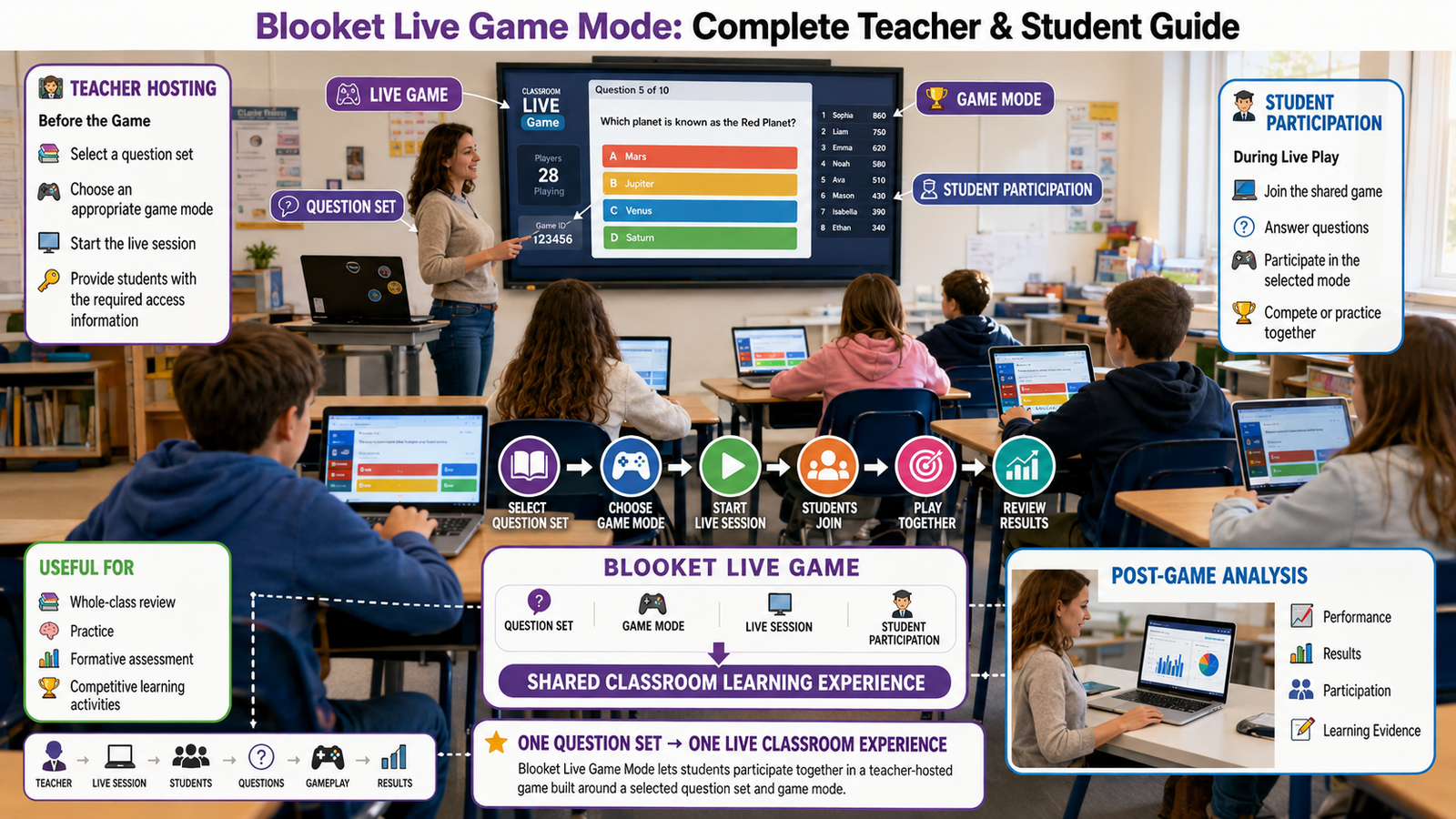
These modes only run as a hosted, real-time class session — you generate a game code, students join on their own devices, and everyone plays together.
Gold Quest
Gold Quest is widely considered Blooket’s signature mode. Players answer self-paced questions to collect gold, open chests that can multiply or wipe out their earnings, and steal gold directly from opponents. The steal mechanic is what makes it chaotic in the best way — a student who’s dominating the leaderboard can lose it all in seconds, which keeps everyone engaged until the final question.
Best for: High-energy review sessions, competitive classes, keeping disengaged students invested until the end.
⚠ Common Mistake: Running Gold Quest with a very small class (under five players) removes most of the stealing dynamic, since there simply aren’t enough targets. Save it for groups of eight or more.
Battle Royale
A synced, head-to-head elimination mode where players (or teams) face off one-on-one, and the loser of each matchup is knocked out. It rewards accuracy and speed under pressure rather than long-term strategy.
Best for: Quick, high-stakes review right before a test, when you want tension without complexity.
Classic
The original Blooket format — no theme, no resource management, just synced questions that build points and climb a leaderboard. It’s the simplest mode Blooket offers, which makes it the easiest one to introduce to a class that’s never played before.
Best for: First-time Blooket sessions, very young students, straightforward point-based review.
Racing
Players answer self-paced questions to move their vehicle toward a finish line, using power-ups picked up along the way to gain an edge. It’s fast, visual, and easy for younger students to follow without much explanation.
Best for: Elementary classrooms, short warm-ups, students who respond well to visual progress.
Blook Rush
A strategic scramble where correct answers let you take Blooks (Blooket’s collectible characters) from opponents while defending your own from being taken. It rewards a mix of speed and tactical thinking about when to attack versus when to play defensively.
Best for: Slightly older students who enjoy risk-reward decision-making layered on top of content review.
Cyber Hack
Players mine Credits by answering questions, then hack other players’ defenses to steal their stockpile. The theme leans into strategy more than pure speed, since defending your own Credits matters as much as attacking.
Best for: Middle and high school classes that enjoy a strategic, slightly higher-difficulty mode.
Deceptive Dinos
A paleontology-themed mode where players dig for fossils while watching for other players attempting to cheat the system. It combines self-paced answering with a light social-deduction element.
Best for: Classes that enjoy a bit of social gameplay layered on top of standard question-answering.
Team Modes: Coco Cabana / Cocoa Cottage, Busy Bees, Laser Tag
Several hostable modes are built specifically around team play rather than individual competition:
Coco Cabana / Cocoa Cottage (Plus): Teams collect ingredients and stir drinks to earn points together — a lower-pressure, cooperative alternative to steal-based modes.
Busy Bees (Plus): Players hire bees after answering correctly and use them to produce honey, with a mix of speed and luck driving outcomes.
Laser Tag (Plus): A fast, dexterity-driven mode where players dodge and fire lasers, best suited to students who enjoy an arcade feel alongside the quiz element.
✅ Best Practice: Team modes noticeably shift classroom dynamics — quieter students often participate more when success depends on the group rather than their individual leaderboard position.
Solo or Homework-Only Game Modes
These modes are built for independent play. Some can be completed in a single sitting during class; others are designed to be assigned as homework with a deadline.
Crazy Kingdom
A resource-management mode where players run a kingdom, respond to a variety of guest requests, and balance limited resources against the flow of correct answers. Blooket tags it as one of its more complex modes, which makes it a strong fit for advanced students who get bored with simpler formats.
Best for: Independent practice for stronger students, homework assignments with more depth.
Tower of Doom
A solo dungeon-style mode where players battle through levels using correct answers to power their character forward. Like Crazy Kingdom, it’s assignable as homework and gives students a sense of progression across multiple sessions rather than one flat scoreboard.
Best for: Longer homework assignments students can return to over several days.
Study
The most stripped-down mode on the platform — no game mechanics at all, just questions presented one at a time with instant feedback on whether the answer was correct. It exists specifically for students who want pure repetition without any game layer competing for their attention.
Best for: Test-prep cramming, students who find game mechanics distracting rather than motivating.
Pirate Pool, Plushie Panic, Zorblitz
These three solo/homework modes lean more heavily on dexterity and timing than strategy:
Pirate Pool has players aim and strike doubloons into pockets across a series of levels, answering questions to earn shots.
Plushie Panic involves aiming at capsules to free plushies, again gated by correct answers.
Zorblitz is a brick-breaking, paddle-control mode reminiscent of classic arcade games, layered on top of question answering.
📌 Quick Note: These dexterity-focused modes are useful when you want a homework option that feels more like a game and less like a worksheet — but because success depends partly on hand-eye coordination rather than just content knowledge, they’re better suited to review and engagement than to graded assessment.
Modes Available Live, Solo, and as Homework
This category is the most flexible, since the same question set and mode can move between a live class session and an independent assignment without any changes.
Café
Players run a virtual café — serving food, restocking supplies by answering questions correctly, and buying upgrades to grow the business. There’s no stealing, no elimination, and no direct competition between players, which makes it noticeably calmer than modes like Gold Quest.
Best for: Younger students, low-energy review days, anytime you want engagement without competitive pressure.
Factory
Similar in spirit to Café but faster-paced: players answer self-paced, high-frequency questions to hire workers and generate income inside a production plant. Blooket rates it as one of its more complex modes, since managing upgrades effectively takes more planning than most other formats.
Best for: Sustained review sessions where you want students answering a high volume of questions.
Tower Defense and Tower Defense 2
Players answer questions to earn resources for building and upgrading towers that defend against waves of enemies. Tower Defense 2 is the more advanced sequel, with deeper upgrade paths and a longer typical session length. Both modes reward strategic planning over raw speed, since placing and upgrading towers well matters more than answering instantly.
Best for: Students who enjoy strategy games, longer review blocks, solo practice that still feels substantial.
Fishing Frenzy
Players cast a line and answer high-frequency questions to reel in fish of varying sizes and rarities, with a strong luck element layered over the core mechanic. It’s simple to explain and works well across a wide age range.
Best for: Quick sessions, mixed-ability classes, students who enjoy an element of chance alongside skill.
Monster Brawl
Players move around a map, collect XP, and answer questions to level up abilities in order to survive. It blends dexterity — actually moving your character — with the standard question-answering loop, giving it more physical engagement than most other modes.
Best for: Kinesthetic learners, classes that respond well to a more active, hands-on feel.
For the latest gaming news, expert reviews, and walkthroughs, readers can also visit IGN, one of the world’s leading gaming websites.
Plus-Only and Seasonal Game Modes
Some modes are reserved for Blooket Plus subscribers, and a handful only appear during specific times of year.
Plus-only modes include Busy Bees, Coco Cabana/Cocoa Cottage, Laser Tag, Mini Mine, and Star Grazer. Plus subscribers also get access to larger live games — up to 300 players instead of the free 60-player cap — and sometimes see new modes before they roll out to free accounts.
Seasonal modes rotate in and out around holidays: Candy Quest around Halloween, Santa’s Workshop during the winter holidays, and Egg Hunt / Tag or Treat around spring and Halloween respectively. These are functionally similar to their year-round counterparts (Candy Quest plays almost identically to Gold Quest, for instance) but swap in a seasonal theme, which is a simple way to keep review sessions feeling fresh without changing the underlying mechanic your students already understand.
🔍 Did You Know? Because seasonal modes are time-limited, Blooket sometimes retires or reworks them between years. If a mode you used last year isn’t showing up, check the current Blooket Game Mode Previews page in the help center rather than assuming it’s a bug — availability does shift as Blooket updates its lineup.
How to Choose the Right Blooket Game Mode
Rather than picking a mode based on which one looks the most fun, work backward from what the session actually needs to accomplish.
Situation
Recommended Mode
Why
First time introducing Blooket
Classic or Racing
Simple mechanics, nothing to explain beyond “answer correctly”
High-energy competitive review
Gold Quest or Battle Royale
Steal/elimination mechanics keep tension high until the end
Calm, low-pressure review
Café
No competition, self-paced, works well for younger or anxious students
Homework assignment
Tower Defense, Factory, or Crazy Kingdom
Deep enough to sustain independent play across multiple sittings
Building teamwork
Coco Cabana, Busy Bees
Points are earned collectively rather than individually
Pure test-prep repetition
Study
No game layer to distract from content recall
Mixed-ability class
Fishing Frenzy
Luck element balances the playing field between faster and slower students
✅ Best Practice: Match the mode’s ideal player count to your actual class size before you commit. A mode designed for 8+ ideal players (like Gold Quest) will feel flat with only four students, while a solo-leaning mode like Tower Defense can still work fine live with a small group.
Common Mistakes When Choosing Blooket Modes
Using a competitive mode for a sensitive topic or struggling class. Steal-based modes like Gold Quest amplify frustration when a student is already behind on the content — a calmer mode like Café avoids adding social pressure on top of academic pressure.
Assigning a complex mode as homework without a walkthrough. Modes like Crazy Kingdom and Factory have more mechanics to learn than Classic or Racing. If students haven’t played them live first, give a short in-class demo before assigning them independently.
Ignoring the ideal player count. Every mode’s description box lists a suggested minimum and ideal player range. Running Blook Rush or Cyber Hack with too few players removes the strategic tension that makes those modes interesting in the first place.
Assuming every mode is available to every account. Plus-only modes won’t appear for free accounts, and seasonal modes disappear outside their window. If a mode is missing from your list, check whether it falls into either category before troubleshooting further.
Frequently Asked Questions
How many game modes does Blooket have?
Blooket offers more than 25 game modes across three categories: modes that can only be hosted live, modes limited to solo or homework play, and modes flexible enough to run in all three formats.
What is the most popular Blooket game mode?
Gold Quest is generally regarded as the most popular live mode, largely because of its steal-based gold mechanic and fast pacing, which keeps competitive classes engaged from start to finish.
Can students play Blooket solo without a teacher hosting?
Yes. Several modes — including Study, Tower Defense, Café, Factory, Crazy Kingdom, and Tower Defense 2 — can be played solo directly from a question set, either for independent practice or as an assigned homework task.
What’s the difference between Blooket Plus modes and free modes?
Plus-only modes (currently Busy Bees, Coco Cabana/Cocoa Cottage, Laser Tag, Mini Mine, and Star Grazer) are exclusive to Blooket Plus subscribers, who also get access to larger live games and sometimes early access to new modes before they’re released to free accounts.
Do seasonal Blooket modes come back every year?
Seasonal modes like Candy Quest, Santa’s Workshop, Egg Hunt, and Tag or Treat typically return around their associated holiday, though Blooket has reworked or retired seasonal modes in the past, so exact availability can shift from year to year.
Professional Recommendations & Expert Reviews
Blooket Game Modes Explained helps teachers understand how different modes can change the classroom learning experience.
Blooket Game Modes Explained gives students a clearer idea of what to expect before joining a game.
Blooket Game Modes Explained shows how question answering can be combined with different gameplay objectives.
Blooket Game Modes Explained helps teachers select activities that match their lesson goals.
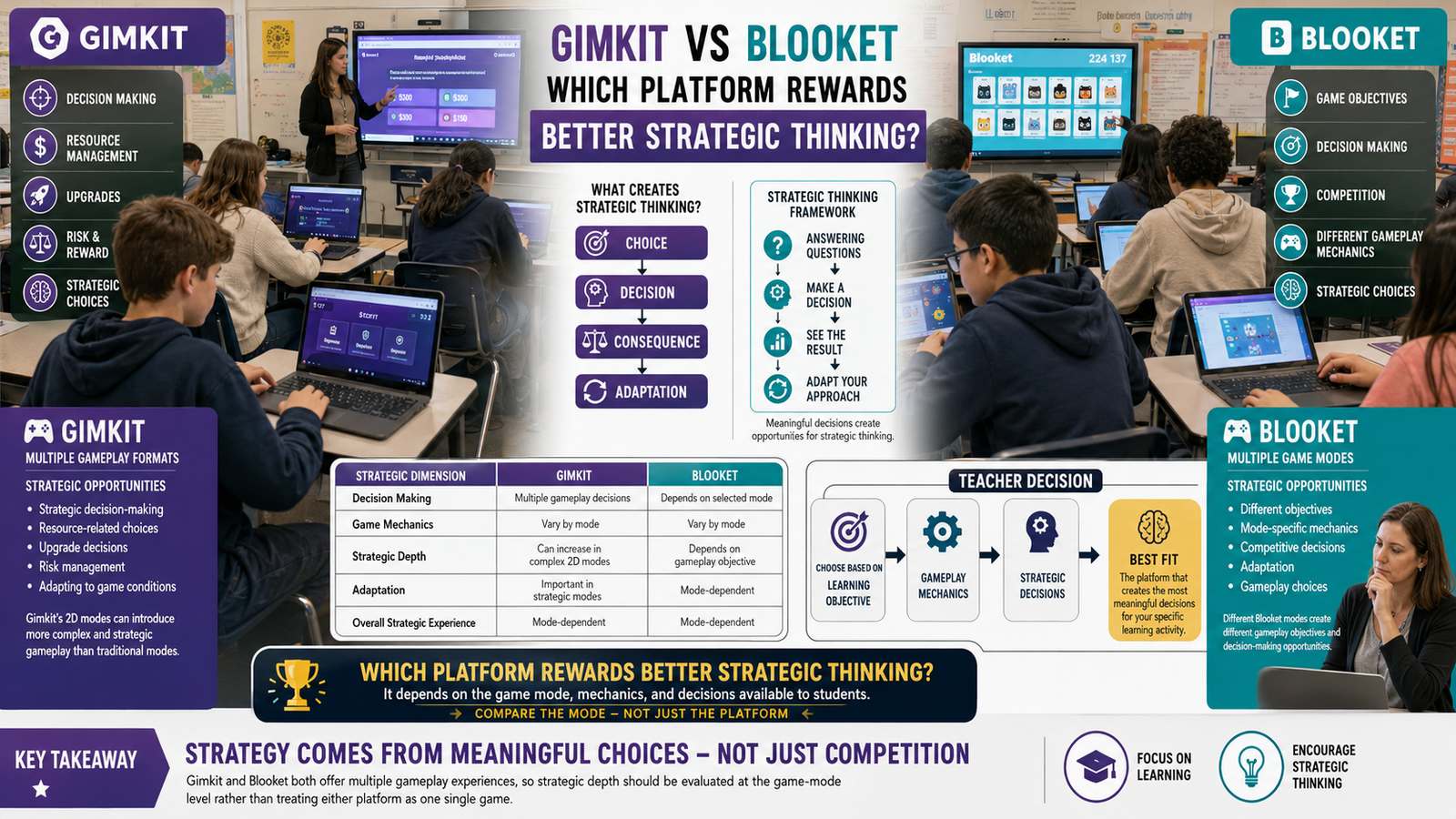
Blooket Game Modes Explained demonstrates that each mode can create a different balance between learning, competition, strategy, and participation.
Blooket Game Modes Explained makes it easier to choose an activity for review sessions.
Blooket Game Modes Explained can help teachers introduce interactive learning without making every lesson feel identical.
Blooket Game Modes Explained highlights the importance of choosing a mode according to the age and experience of students.
Blooket Game Modes Explained helps educators consider whether a lesson should emphasize individual performance or classroom competition.
Blooket Game Modes Explained shows how gameplay can make repeated question practice more engaging.
Blooket Game Modes Explained helps students understand that answering questions is only part of the overall experience.
Blooket Game Modes Explained encourages teachers to connect gameplay with specific instructional objectives.
Blooket Game Modes Explained supports more intentional use of educational games.
Blooket Game Modes Explained helps teachers vary classroom activities throughout the week.
Blooket Game Modes Explained can make revision sessions more interactive and enjoyable.
Blooket Game Modes Explained shows why game selection can influence student motivation.
Blooket Game Modes Explained helps teachers consider the amount of competition appropriate for their class.
Blooket Game Modes Explained encourages educators to think about pacing before starting a live activity.
Blooket Game Modes Explained helps students approach each game with realistic expectations.
Blooket Game Modes Explained demonstrates how different gameplay structures can support different classroom situations.
Blooket Game Modes Explained can help teachers select shorter activities when instructional time is limited.
Blooket Game Modes Explained supports longer review sessions when students need additional practice.
Blooket Game Modes Explained helps educators introduce variety without changing the underlying learning objective.
Blooket Game Modes Explained encourages students to remain engaged while reviewing familiar material.
Blooket Game Modes Explained shows how strategy-based elements can make question practice feel more dynamic.
Blooket Game Modes Explained helps teachers decide when a competitive activity is appropriate.
Blooket Game Modes Explained supports better classroom planning by matching gameplay with student needs.
Blooket Game Modes Explained encourages teachers to explain rules clearly before beginning a session.
Blooket Game Modes Explained helps reduce confusion when students encounter an unfamiliar activity.
Blooket Game Modes Explained can improve participation by giving students a clear purpose during gameplay.
Blooket Game Modes Explained highlights the value of combining educational content with engaging mechanics.
Blooket Game Modes Explained helps teachers use game-based learning as a supplement rather than a replacement for instruction.
Blooket Game Modes Explained encourages educators to review student performance after gameplay.
Blooket Game Modes Explained can help identify which activities produce stronger classroom participation.
Blooket Game Modes Explained shows that the most entertaining mode is not always the best choice for every lesson.
Blooket Game Modes Explained helps teachers consider whether students need practice, review, collaboration, or a competitive challenge.
Blooket Game Modes Explained supports flexible instruction across different subjects and grade levels.
Blooket Game Modes Explained encourages teachers to adjust activity choices as students become more familiar with game-based learning.
Blooket Game Modes Explained helps educators maintain variety while keeping academic objectives at the center.
Blooket Game Modes Explained shows how different game structures can influence attention and participation.
Blooket Game Modes Explained can help teachers avoid using the same activity repeatedly when students need a fresh challenge.
Blooket Game Modes Explained encourages thoughtful use of competition so that it remains supportive rather than distracting.
Blooket Game Modes Explained helps students become more comfortable adapting to different gameplay rules.
Blooket Game Modes Explained supports classroom routines where interactive review becomes a regular learning activity.
Blooket Game Modes Explained helps teachers decide whether students should work independently or participate in a shared competitive environment.
Blooket Game Modes Explained demonstrates how game mechanics can influence the way students interact with educational questions.
Blooket Game Modes Explained encourages educators to choose activities based on learning purpose rather than popularity alone.
Blooket Game Modes Explained can make vocabulary, facts, concepts, and revision questions more engaging.
Blooket Game Modes Explained helps teachers create more varied review experiences throughout a unit.
Blooket Game Modes Explained supports better preparation because teachers can understand the general purpose of an activity before using it.
Summary
Blooket’s game modes aren’t just cosmetic themes — each one changes the pacing, the social dynamic, and the type of thinking a session rewards. Live-only modes like Gold Quest and Battle Royale are built for real-time classroom energy, solo/homework modes like Crazy Kingdom and Study give students a way to practice independently, and flexible modes like Café and Tower Defense bridge both worlds. The fastest way to get better results from Blooket isn’t finding one “best” mode — it’s matching the mode to the goal of that specific session, whether that’s a five-minute warm-up, a calm review day, or a homework assignment students will actually want to finish.