Gimkit Dig It Up: Mine Down. Build Up. Rescue the Mayor.
Explore the distinctive 2D mining and platforming
experience set in Diggsburg. Discover why players
need energy, tools, underground materials,
building permits and a route into the sky
to reach Mayor Cole's hot-air balloon.
Independent educational resource. Not affiliated
with Gimkit. Interactive mining calculations are
fictional and do not access a real game.
THE DIGGSBURG JOURNEY
❓Answer questions to generate energy
⛏️Excavate dynamically generated terrain
💎Collect ore and improve your equipment
📜Obtain permits and build upward
🎈Reach Mayor Cole at 200 meters
01 / Mode Identity
What is Gimkit Dig It Up?
Dig It Up is a 2D Gimkit platforming mode released
on April 2, 2024. Players explore an underground
environment, mine blocks for resources and
construct a route upward in an attempt
to rescue Mayor Cole, who is trapped
in a hot-air balloon above Diggsburg.
Unlike a conventional cash leaderboard game,
Dig It Up combines movement, mining, tool progression,
resource acquisition and height-based competition.
The historical community guide says the first
player to reach Mayor Cole wins; if the game
ends before that rescue, the highest elevation
determines the winning player.
Source distinction:
The April 2024 release, Mayor Cole objective,
random terrain, NPCs, pickaxes and permits
are described by the community Gimkit Wiki.
The current official Mode Picker must be
consulted for availability and exact settings.
This page does not claim to duplicate the
live game engine.
MECHANIC 01
⛏️ Mining
Break blocks beneath the surface to
collect the materials required
for subsequent progression.
The underground environment
contains different block types.
MECHANIC 02
🗺️ Dynamic Terrain
Historical descriptions identify
procedurally generated underground
terrain, so material positions
can vary between matches.
MECHANIC 03
🔋 Energy
Energy supports participation
in the mode's movement
and mining activities.
Answering questions creates
an opportunity to replenish it.
MECHANIC 04
🪓 Pickaxe Progression
The Orehound NPC is associated
with improving the player's pickaxe.
Better equipment supports
more demanding excavation.
MECHANIC 05
📜 Building Permits
The Broker provides permits
associated with mined resources.
Permits create a dependency
between going underground
and progressing upward.
MECHANIC 06
🎈 Mayor Rescue
Mayor Cole's balloon provides
a recognizable vertical objective.
The rescue is associated
with a height of
approximately 200 meters.
02 / Excavation World
Why the game begins by digging down
Dig It Up is built around a deliberate directional
contrast. The visible end goal is high above
the ground, but important progression
resources are obtained beneath it.
Players must make decisions about excavation
before they can extend their upward route.
The underground phase
Underground exploration reveals terrain
materials that may be needed for
permits or other equipment decisions.
The positions of those materials
can change because the historical
mode uses dynamic terrain.
This makes resource discovery a
meaningful part of the experience
rather than a simple fixed shopping list.
The upward phase
Once players obtain the required
resources and permissions,
they can work toward the elevated
rescue objective by building
their route upward.
The historical competition
rewards reaching Mayor Cole,
with elevation providing a
relevant outcome when the
match ends without a rescue.
Dynamic blocks versus ordinary map scenery
Community documentation calls the mineable
terrain materials Dynamic Blocks.
Examples include dirt, sand, stone,
copper, silver, gold, rubies and diamonds.
Their appearance and discovery are part
of the mode's resource economy.
Why tools and access matter
Mining stronger materials can require more
effective equipment. Meanwhile, permits
control aspects of upward progress.
This makes excavation quality and
material inventory relevant to
the later rescue attempt.
03 / Exclusive Interactive Application
Diggsburg Excavation & Rescue Planner
Explore a compact, fictional underground grid.
Answer simulated questions to earn energy,
mine accessible blocks, collect materials,
upgrade a pickaxe, exchange ore for permits
and build toward the 200-meter rescue target.
Educational model:
The 7-column excavation grid, ore distribution,
1-energy-per-mining-hit rule, pickaxe damage,
build increments and permit requirements are
original simulation values. They do not represent
a verified export of the official Gimkit
terrain, equipment or permit systems.
⛏️ Diggsburg Expedition Studio
A two-direction progression model:
excavate down for materials,
then unlock permits and climb
toward the fictional rescue objective.
🔋 Energy20
⛏️ PickaxeBasic
📜 Permits0
🧱 Built Height0m
🎈 Rescue Target200m
1. Gather Energy
Terrain seed produces a repeatable fictional
distribution of underground materials.
Generating a new terrain restarts the
excavation scenario.
2. Excavate the Underground Grid
Select a surface tile or a tile touching
cleared terrain vertically or horizontally.
Each mining hit consumes one energy.
Stronger pickaxes can remove more durability.
When a block is completely mined,
its material enters the inventory.
Select a reachable tile to begin excavation.
3. Excavated Resources
Material inventory belongs to this local
fictional expedition. It is never
submitted to Gimkit.
4. Pickaxe Improvements
Trade collected materials for a stronger
simulated pickaxe. This illustrates why
equipment progression matters before
deeper excavation.
Basic pickaxe: 2 durability per hit.
5. Unlock Building Permits
The model requires five matching blocks
for one permit. Historical community
records document a change from ten
to five corresponding ore for permits
1–7 shortly after release; the model
simplifies permit ordering and eligibility.
6. Build Toward Mayor Cole
0 of 200 meters reached
Every modeled permit grants one
25-meter building increment.
Each increment also consumes
two energy. These are
teaching assumptions only.
Mayor Cole is waiting at the 200-meter objective.
7. Expedition Summary
Blocks excavated:0
Mining hits:0
Questions recorded:0
Permits used:0
8. Expedition Activity
No events recorded yet.
04 / Dynamic Terrain
How procedural terrain changes the mining experience
In a fixed excavation puzzle, every resource
could appear in the same location during each
attempt. A player could memorize a single route
and repeat it without re-evaluating the terrain.
Dig It Up's historical dynamic terrain
changes this relationship. According to
the community Wiki, underground materials
are procedurally generated, so their
distribution can vary from game to game.
What procedural generation means
Procedural generation is the creation
of content according to a computational
process rather than manually placing
every element into one unchanging layout.
In a mining environment, that process
can determine where terrain categories
appear and which routes become
convenient or inconvenient.
Why a seed is useful for experiments
A seeded educational model can
generate the same artificial map
whenever the same seed is used.
This allows two experiments to use
identical starting terrain while
varying another parameter,
such as pickaxe strength or energy.
The grid above uses a deterministic
pseudo-random sequence. It is not
Gimkit's disclosed map-generation
algorithm, and no claim is made
about matching official ore positions.
Access matters as much as ore quantity
A valuable resource that is difficult
to reach has a different practical
meaning from one near the surface.
The educational grid requires players
to mine connected routes.
That prevents every buried tile from
being immediately accessible.
The constraint illustrates why
excavation is a spatial decision:
players must consider the route
to a resource as well as
the resource itself.
Durability and equipment strength
Different materials can require
different amounts of mining work.
A more effective pickaxe reduces
the number of simulated hits
needed to clear tougher blocks.
The lab tracks remaining tile durability
and consumes energy on every hit.
A tile only yields its material
after enough damage has been applied.
This distinguishes partial excavation
from a successfully collected resource.
Why resource placement can influence strategy
A player seeking a certain material
may need to explore several possible
routes before finding a sufficient
quantity for their next objective.
A map with abundant early resources
can support a different progression
path from one where useful materials
are concentrated deeper underground.
The key lesson is that a resource's
usefulness depends on how it connects
to the player's next action,
not merely its rarity.
05 / Energy and Movement
Why questions and energy are part of the expedition
The historical Dig It Up guide
describes answering questions to
earn energy and using energy
during exploration.
This connects the question-answering
layer of Gimkit with the game's
mining and movement experience.
Energy as a constraint
Energy gives players a limited
capacity for activity.
When energy is depleted,
further activity may require
additional question participation.
This creates a relationship
between completing learning prompts
and making progress in the
adventure environment.
Why the simulator isolates mining energy
The model above consumes one
energy per mining hit.
It does not implement
full 2D movement physics
or reproduce the official
energy use of every action.
The narrow rule allows
the effect of equipment strength
and tile durability to remain
visible and understandable.
What stronger tools change
If a fictional block has
12 durability and the pickaxe
removes three per hit,
four hits are required.
With a pickaxe that removes
six durability per hit,
the same block requires
only two hits.
Under the simulator's rules,
the stronger tool therefore
saves two units of energy.
Why academic questions still matter
The game environment provides
a reason to answer questions,
but students still need
meaningful academic prompts.
Fast mining progress alone
does not establish that the
participant understands
the lesson subject.
Teachers should consider
question difficulty,
reasoning quality and
appropriate follow-up evidence.
06 / Permits and NPCs
The Broker, the Orehound and progression dependencies
Dig It Up is not simply a mode
where all resources can be
converted into building height
without restrictions.
Historical descriptions identify
NPCs that support particular
progression systems. Two
important names are the Broker
and the Orehound.
The Broker
The Broker is associated
with building permits.
A permit requirement encourages
players to obtain the necessary
materials before continuing
their upward progress.
The community Wiki records
an early change to permits
1–7, reducing their price
from ten units of their
corresponding Dynamic Ore
to five.
This historical change illustrates
that progression costs can be
adjusted after a mode releases.
It should not be interpreted
as a guarantee about every
current permit requirement.
The Orehound
The Orehound is described
as an NPC through which
players can upgrade
their mining tool.
Equipment improvements and
permit acquisition answer
different progression needs.
One changes mining capability;
the other supports building access.
Why progression dependencies are interesting
A dependency means
one action requires
something obtained
through another action.
Dig It Up's historical
structure makes underground
activity meaningful to
the above-ground objective.
Players who focus entirely
on upward movement can
encounter material
or permit restrictions.
The educational simulator
simplifies these dependencies
to keep every transaction
explainable.
07 / The Rescue Objective
Why Mayor Cole's balloon creates a distinct endgame
Mayor Cole's predicament
provides a narrative
purpose for Dig It Up's
mining and building systems.
Historical community documentation
describes the Mayor as stranded
at approximately 200 meters
in a hot-air balloon.
Building toward a known target
A fixed vertical target
makes progress easy to
express as a distance.
A fictional player who
has reached 75 meters
needs another 125 meters
to reach a 200-meter goal.
The simulator uses
that arithmetic directly.
Each modeled building
increment adds 25 meters,
with permits and energy
required before the
change is applied.
Rescue versus highest elevation
The historical community guide
describes an alternative outcome
when the game ends without
a completed rescue:
the player at the
highest elevation wins.
This creates two related,
but distinct, objectives.
Reaching the balloon
is a concrete completion
event; achieving a
relatively high position
can still matter
when time ends first.
Why the model does not simulate an actual race
The lab follows one
fictional expedition.
It does not generate
other players' heights
or attempt to predict
a live multiplayer ranking.
The purpose is to
explain material dependencies
and progress toward
the rescue target.
08 / Comparison
How Dig It Up differs from nearby Gimkit experiences
Experience
Primary Action
Distinct Objective
Dig It Up
Mining, resource gathering, permits, building
Reach Mayor Cole's balloon
Don't Look Down
Vertical platform jumping
Climb through platforming challenges
The Floor Is Lava
Cooperative structure purchasing
Build above rising lava
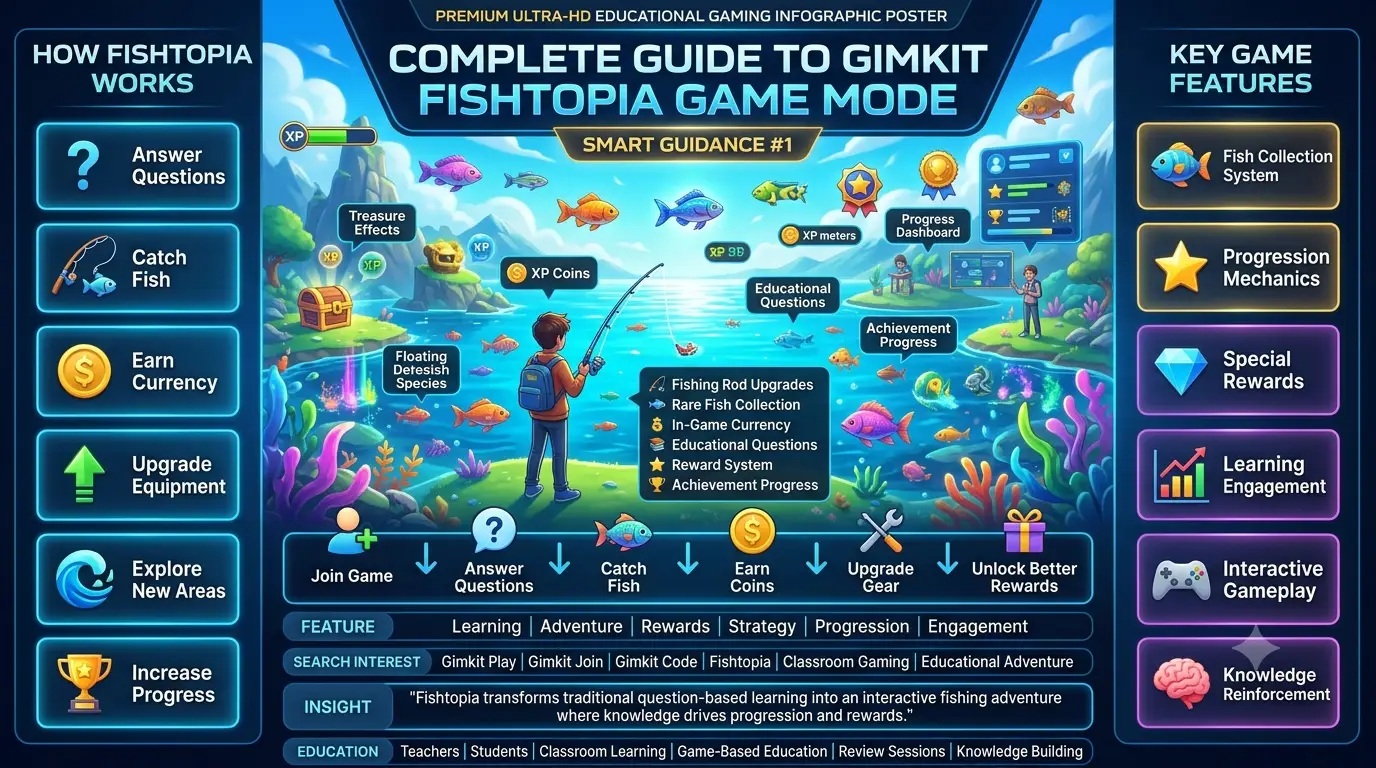
Fishtopia
Fishing and resource progression
Fishing-based game objectives
One Way Out
Cooperative exploration and escape
Complete an escape scenario
These comparisons distinguish primary gameplay
concepts rather than providing a full list of
current official mechanics or availability.
09 / Learning Applications
What excavation and progression can help illustrate
Dig It Up's structure can support
conversations about dependencies,
resource selection and
goal-directed decisions.
Sequencing
Learners can identify
which activities must
occur before another
action becomes available.
A building permit
that requires a
particular material
provides an example
of this relationship.
Spatial reasoning
An excavation route
involves positions
and connections
between adjacent spaces.
The compact grid
encourages users
to consider which
blocks must be
cleared before
another resource
can be reached.
Comparing tool effectiveness
Different pickaxe
strengths can be
expressed through
the number of
hits needed
to break
a block.
This provides
a simple
relationship among
durability, damage
and energy use.
Evaluating source reliability
The community Wiki
provides detailed
historical descriptions,
including a dated
price change.
Teachers can use
this to distinguish
historical documentation
from current
official settings.
Separating academic understanding from game success
Mining success
can depend on
exploration,
tool choice,
movement and
the game environment.
It should not
automatically be
interpreted as
a complete
measure of
subject mastery.
10 / FAQs
Gimkit Dig It Up frequently asked questions
What is Gimkit Dig It Up?
It is a 2D mining and platforming mode in which players collect underground materials and build toward an elevated rescue objective.
When did Dig It Up release?
The community Wiki records April 2, 2024 as the release date.
Who is Mayor Cole?
Mayor Cole is the Diggsburg character trapped in the hot-air balloon that players attempt to reach.
How high is Mayor Cole's balloon?
Historical community documentation places the rescue objective approximately 200 meters above the ground.
What is the basic gameplay loop?
Answer questions for energy, mine underground materials, obtain progression resources and build toward the rescue objective.
Does every match have identical underground terrain?
No. Historical descriptions identify procedurally generated terrain, with resource placement varying between matches.
What does the Broker do?
The Broker is associated with building permits that support upward progression.
What does the Orehound do?
The Orehound is associated with upgrading the player's pickaxe.
How does pickaxe rarity affect the experience?
Equipment improvements support mining progression. Exact current damage and upgrade costs should be checked against live game information.
Can players win without rescuing Mayor Cole?
Historical documentation describes highest elevation as the determining measure if no player completes the rescue before the game ends.
Did permit costs change after launch?
The community Wiki records permits 1–7 changing from ten corresponding ore to five on April 3, 2024.
Does the excavation simulator reproduce Gimkit's exact map?
No. It uses an original seven-column seeded grid and explicitly modeled mining and permit requirements.
Does Dig It Up use 2D platforming?
Yes. Historical references categorize it as a 2D platforming mode.
Is Dig It Up currently available?
Current availability and account-specific options should be checked in Gimkit's official Mode Picker.
Dig It Up connects question energy, excavation,
resource discovery, equipment and permits
to a recognizable rescue objective.
The defining challenge is the dependency
between underground work and upward progress,
not simply collecting the most cash.
Use the independent planner to explore
the sequence and Gimkit's current interface
for official gameplay details.