Gimkit Fishtopia: Complete Fishing, Bait & Strategy Guide
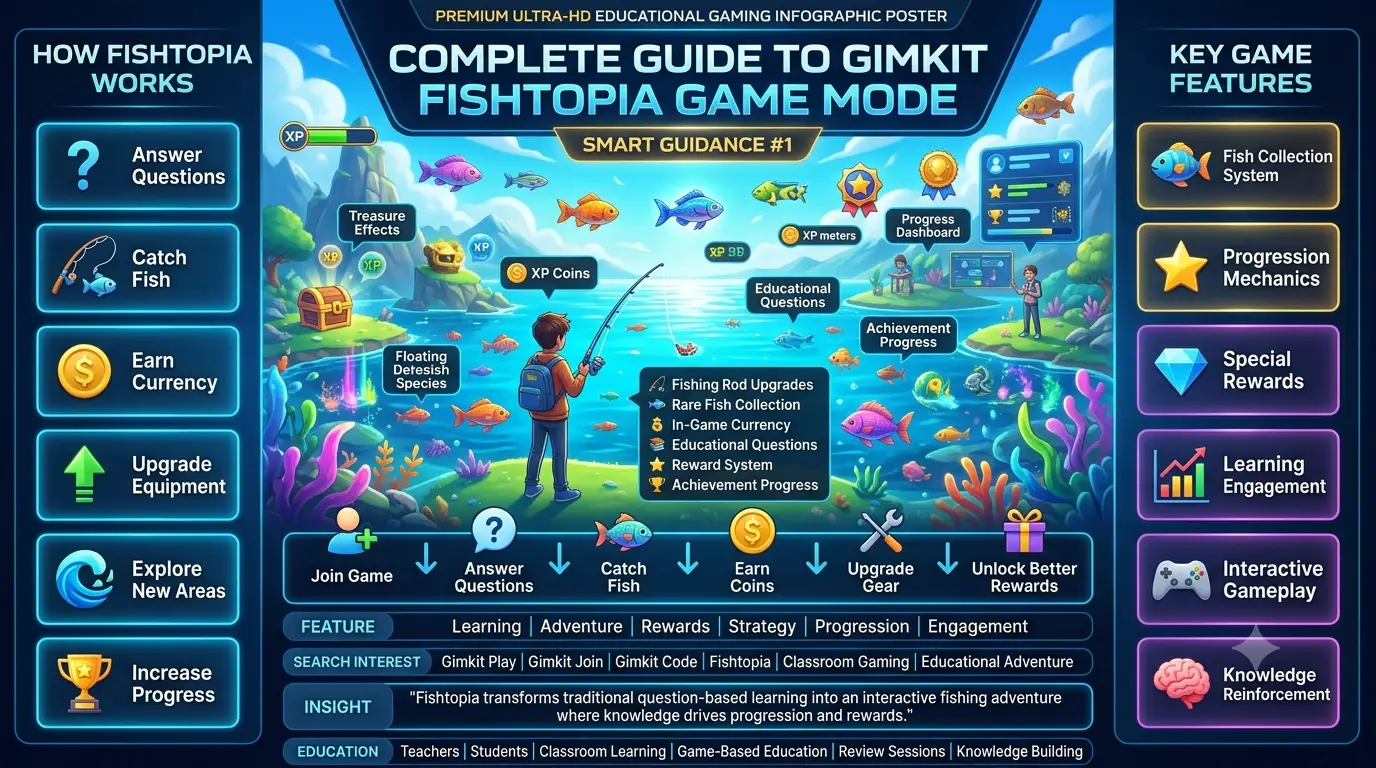
Gimkit Fishtopia turns educational question answering into a fishing adventure. Correct answers earn bait, bait enables fishing, fish can be sold for in-game cash, and that cash can support new equipment and access to additional fishing areas.
Learn how the Fishtopia loop works, what historical community guides describe about different fish and fishing destinations, why carrying capacity matters, how fishing upgrades change your options, and how to make more deliberate decisions during a round.
The exclusive Fishtopia Fishing Expedition & Economy Lab below lets you practise an independent version of the loop using fictional catches, simulated odds and community-reference examples of equipment and prices.
Official Gimkit documentation confirms bait as Fishtopia's adjustable reward per correct answer. Fish-value and destination examples require separate community-source qualification.
What is Gimkit Fishtopia and how do you play?
Fishtopia is a Gimkit 2D game mode built around fishing and progression. Players answer questions to obtain bait, use bait to catch fish near suitable water, sell their catches for cash, and make decisions about fishing gear, useful powers and access to new areas.
The basic sequence is easy to recognise, but individual decisions matter. A player needs bait before attempting catches. Their current fishing location influences the species available. Their rod affects which fish can be obtained. Their backpack determines how many fish of each type they can hold. Cash must be available before buying equipment or area access.
The educational and game components are deliberately connected. Correct responses unlock the resource used for fishing, while successful fishing creates opportunities to invest in more efficient future activity.
Gimkit officially confirms that hosts can customise the number of bait awarded per correct question in Fishtopia through its 2D game-balance controls. Therefore, guides should not claim that the same fixed number of bait is always earned in every hosted session.
Historical community references describe locations called Main Island, Purple Pond, Sandy Shores, Cosmic Cove and Lucky Lake. They also document fish types ranging from common Gray Fish to the rare GimFish, along with backpack upgrades, rod changes and specific ticket prices.
Those community records are useful for learning the mode's traditional progression, but they are not an official guarantee that every currently hosted version uses unchanged probabilities, prices or locations.
The Fishing Expedition Lab consequently separates genuine documented rules from a configurable learning model. It uses the correct resource flow and an illustrative fish economy but does not pretend to know the precise random number generator, server calculations or current live match state.
Earn bait through correct answers
Question answering supplies the Fishtopia resource needed to cast and fish. Host balance settings can change that reward.
Use bait at suitable water
The fishing area, available gear and inventory capacity affect what a player can do next.
Sell, save or reinvest
Fish become cash at the sell station, opening choices about equipment, power-ups and further areas.
Fishtopia Fishing Expedition & Economy Lab
Operate a complete fictional fishing expedition. Record correct answers to earn bait, travel to different waters, cast for fish, manage your catch, sell at the market, purchase equipment and work through an optional rare-fish berry quest.
A working fishing loop, not a static strategy calculator.
Historical community reference examples are used for illustrative fish values, upgrade prices and location names. Probabilities and simulated actions are original teaching assumptions, not current official Gimkit data.
1. Configure your fictional expedition
2. Fish at your current location
Record correct answers to earn bait, then cast your rod.
A cast consumes one bait in this independent model. The species outcome is drawn from deliberately illustrative weights. This is not a current official drop-rate engine.
Current backpack inventory
Fish stay in your backpack until sold. The community reference describes capacity per fish species, so the simulator tracks each species separately.
Current gear
Market & gear shop
Sell the fish you caught to earn simulated cash. Equipment and power prices below are historical community-guide examples, not official live-store quotes.
Fishing destinations & travel
Travel to unlocked waters. The historic reference lists permanent-access tickets for several locations and a one-use Lucky Lake ticket.
Berry collection and rare-fish path
Historical community guides describe collecting different berries in different areas, then pursuing Berry Fish and GimFish. This quest is an independent simplified model of that sequence.
Fishing and market activity
Expedition statistics
3. Export or restore your fictional fishing expedition
Browser-local state only. No real Gimkit connection, player identity, Class information, password or game code is required.
What makes this a Fishtopia-specific application?
The application models the relationship between educational answers and fishing resources rather than using a generic quiz or scheduling dashboard. The visitor records a number of assumed correct answers, and the model awards the configured bait amount. The bait is then consumed by casting, allowing the player to draw a fish from the current area.
Fish are stored by species instead of being converted into cash immediately. This creates a meaningful inventory decision: a visitor can keep fishing if capacity remains, or sell the current catch to clear space and finance another action. The backpack upgrades increase model capacity per species.
The Gear Shop includes an Expert Rod that changes illustrative catch weights. The power items have separate model effects: Bolt reduces simulated travel time, No Wait reduces the model's casting time, and Cash In adds a sale multiplier. The cash values are based on historical community descriptions, but the application's financial accounting is entirely local.
Area purchases provide additional progression. Purple Pond, Sandy Shores and Cosmic Cove are represented as continuing-access destinations. Lucky Lake uses a single-use model ticket, requiring another purchase when visiting again after leaving.
The Berry Quest adds a second dimension beyond routine fishing. The visitor collects the appropriate fictional berries at their documented historical areas, unlocks Berry Fish eligibility and then obtains the GimBerry after catching Berry Fish. Only a completed quest allows the independent model to include GimFish in its Lucky Lake catch pool.
The model offers beginner and late-game examples so visitors can explore both the first fishing cycle and the rare-fish progression without spending a long time manually repeating low-value actions.
A deterministic seed allows repeatable experiments. Undo, local autosave, activity history, inventory reports and structured exports make the application useful for understanding why particular fishing decisions change the model state.
How the Fishtopia fishing economy actually fits together
1. Correct answers are the source of fishing bait
Fishtopia's most important educational connection is the way correct question responses generate bait. A player who wants to continue fishing needs access to that resource, so answering questions remains part of the gameplay loop rather than being an unrelated activity before the game starts.
Gimkit's official 2D Game Balance documentation specifically identifies bait as the Fishtopia reward. This is more precise than describing the mode as using generic energy, a term that Gimkit uses for certain other 2D modes. A guide that confuses those resources risks teaching the wrong mode mechanics.
The quantity of bait can depend on the host's game-balance configuration. Therefore, players should not assume that a fixed amount is earned after every correct answer in every session.
In our model, visitors set bait per correct answer before recording an answer batch. This is an explicit modelling input, not a claim that the site can read the teacher's actual balance setting.
2. Bait is a resource, not a guaranteed valuable fish
Having bait gives a player the opportunity to fish. It does not establish that the next catch will be valuable, unusual or part of a rare collection.
Fishing games use varying rewards partly to make repeated catches interesting. The community documentation for Fishtopia describes fish species with different rarity levels and sell values.
That distinction creates a planning problem. A learner might accumulate a large supply of bait yet still need to choose an appropriate location and manage a limited backpack. Another player might spend time travelling to different water without having enough bait to use the area effectively.
The Fishing Lab expresses this trade-off by requiring bait before a cast and placing any successful catch into species-specific storage. One cast has an uncertain model outcome, even though the cost is known.
3. A cast connects the resource to an uncertain catch
At a fishing location, the player uses a rod and available bait to try to obtain fish. The important uncertainty is which fish appears, because different species have different values and availability conditions.
Community-maintained tables describe varying catch chances among locations and rods. Such references can help illustrate the distinction between common and rare fish, but their historical probabilities should not be silently treated as permanent official data.
The independent application draws from a weighted list specific to the selected location. Its numbers have been chosen to make the progression understandable and are fully disclosed as illustrative.
The resulting catch is not an actual Gimkit event. It is a demonstration of how the relationship between bait, probability and inventory can affect decisions during a fishing-themed economy.
4. Different fishing areas create different opportunities
Community references describe Main Island, Purple Pond, Sandy Shores, Cosmic Cove and Lucky Lake as recognisable areas in Fishtopia's traditional fishing world.
The locations are not just decorative names. They represent progression through waters associated with different catches, access costs and quest-related resources.
A beginner can understand the loop at Main Island before considering whether another area is worth the investment. As additional opportunities become available, the player must decide whether to spend cash on area access or on equipment.
The lab represents the locations using an independent destination selector rather than an imitation of Gimkit's actual map. It does not claim to reproduce exact walking distances, coordinates, movement controls or route geometry.
5. Fish remain inventory until they are sold
A caught fish has potential financial value, but it does not necessarily increase the player's available spendable cash at the instant of capture. Community explanations describe a sell station where players exchange catches for in-game money.
This creates an additional action between fishing and purchasing. A player may have valuable fish in the backpack but insufficient cash to buy a ticket until those fish are sold.
The distinction is essential when reasoning about cash flow. An item held in inventory is not identical to money that can already be spent.
The lab maintains these quantities separately. The Backpack section displays potential sale value, while the cash counter changes only after a sale or a purchase.
6. The sell station converts catches into spendable cash
Historical community references describe different sale prices for common, rare, epic, legendary and special fish. Those values help explain why some catches may be more desirable than others.
Selling also clears room in the backpack, allowing more catches to be collected. Consequently, visiting the sell station is not simply a financial action. It is an inventory-management decision.
The lab's Sell All Fish button calculates a total from the model's inventory and sample price table. If the illustrative Cash In power has been bought, the sale multiplier is applied before the amount is added to available cash.
The exact official handling of rounding and transaction details is not asserted. This page uses its own transparent calculation for the independent teaching model.
7. Cash creates a choice between spending and saving
Once a player sells fish, cash becomes available for equipment, power-ups and area access. Different purchases provide different potential advantages, so spending everything immediately is not necessarily a sensible decision.
A backpack upgrade can increase storage. A rod upgrade can change catch possibilities. A new area can offer different fish. A selling bonus can increase the value obtained from later market visits.
The best choice depends on the player's current resources, intended goals and remaining session time. There is no single purchase order guaranteed to work best under every configuration or random sequence.
The simulation allows the visitor to compare these choices by replaying a seeded action sequence and changing one decision. This is more informative than presenting one fixed strategy as a universal winning formula.
8. The fishing loop continues until the game ends
The basic cycle can repeat: answer questions, obtain bait, fish, sell catches and decide what to purchase next. A player may use later resources to explore a new location or improve efficiency.
This loop explains why Fishtopia feels different from a simple question-and-answer screen. The educational question supplies a resource that has meaning inside a larger game world.
However, a loop is not proof that learning outcomes automatically improve. Some students may focus heavily on virtual earnings, while others may use the activity to practise questions carefully.
The educational value depends on the quality of the questions, the teacher's goals and what students actually do with the feedback. The gameplay loop provides an opportunity for retrieval practice; it does not independently guarantee mastery.
Fishtopia locations, access tickets and why areas matter
9. Main Island is the starting reference point
Historical community guides describe Main Island as the initial area in Fishtopia. It provides a way to begin earning fish and cash without first purchasing access to another fishing destination.
In the independent lab, Main Island is available from the beginning. Its sample catch weights favour common fish, allowing visitors to see the basic relationship between bait consumption, small catches and early selling.
The point is not that every beginning cast must produce a Gray Fish. The player is learning how uncertain fishing rewards interact with a known resource cost.
An initial strategy may be to obtain bait, make several catches, sell them and save toward a useful early purchase. The correct next step depends on how much cash is actually available.
10. Purple Pond introduces paid area access
Purple Pond is listed in historical Fishtopia references as an additional fishing destination accessible through a ticket. A commonly documented sample price is ten units of in-game cash.
Its significance is conceptual: the player can invest a relatively small amount in a new area to gain access to a different potential mix of catches.
An area purchase may be attractive when the likely value of future fishing justifies its cost, but that evaluation depends on uncertain catches and the player's available bait.
The lab treats Purple Pond access as a continuing unlock, consistent with the historical community description. This is an independent model rule and not a live verification of the current game's shop.
11. Sandy Shores represents another progression step
Sandy Shores is described in community-maintained material as a distinct fishing destination associated with a different fish pool and higher access cost than Purple Pond.
A historical sample ticket price of eighty-five cash is frequently reported. That creates a useful comparison with the cost of early equipment upgrades.
A player who buys access too early may reach the new location without enough bait to take advantage of the fishing opportunities. Another player might choose to collect more fish in an earlier area before travelling.
The simulation requires sufficient cash to unlock Sandy Shores. It also preserves bait separately, demonstrating that travelling to a higher-value location does not create bait or fish automatically.
12. Cosmic Cove expands the range of potential catches
Cosmic Cove is another named destination in historical community accounts of Fishtopia. It is associated with access to more valuable species and quest-related exploration.
The reported ticket cost is higher than the earlier locations, making the decision to unlock it a more substantial investment in the fishing economy.
Before purchasing, a player should consider whether the remaining gameplay period offers enough opportunity to recover the cost through catches and later sales.
The lab includes Cosmic Cove as an unlockable area with a fictional catch distribution that includes more valuable species. It does not claim those weights match any current official probability table.
13. Lucky Lake is associated with advanced progression
Historical Fishtopia references describe Lucky Lake as an advanced fishing location with a high entry price and special fish-related possibilities.
The community documentation describes the ticket as one-time-use rather than a continuing-access unlock. This distinction makes the decision different from buying permanent access to an earlier destination.
If another visit requires another ticket, the player should consider whether they have sufficient bait, available backpack space and an appropriate strategy before travelling.
The simulation follows that historical model: leaving Lucky Lake ends its current visit, and returning requires another fictional ticket. This is an explicitly identified design assumption based on community documentation, not a live account or server action.
14. A more expensive area is not automatically the best immediate choice
It is tempting to assume that the most expensive destination always produces the greatest short-term result. That reasoning ignores access costs, available fishing resources and the uncertainty of each catch.
A player with only a small amount of bait may have fewer opportunities to benefit from a costly location. Someone with a full backpack may need to sell before further fishing produces useful value.
The right decision is therefore conditional rather than universal. Spending money on access changes future opportunities but does not guarantee that the investment will be recovered.
The lab makes this visible by requiring both enough money for travel and enough bait for casts. It keeps the probability model fictional rather than promising an optimal official route.
15. Ticket costs should be distinguished from fish values
A ticket is an expense paid to access a destination. A fish is inventory that can later be exchanged for cash. Treating both as if they were positive earnings produces misleading financial conclusions.
For example, a player might catch several higher-value fish after purchasing access but still have less available cash than before the purchase. The result depends on how much was spent and when the catches were sold.
The simulation records ticket purchases as spending events and fish sales as income. It does not add the estimated value of an unsold fish directly to cash.
This distinction supports a more accurate explanation of the fishing economy without requiring a general-purpose finance dashboard.
16. Travel consumes opportunity even in a simple model
Moving between fishing areas takes attention and time. A player who changes locations repeatedly may spend less of the remaining game period catching fish or answering questions.
The exact official time required to reach a location depends on the game environment and player actions. A third-party article cannot assign one universal walking time to every route and device.
The lab therefore counts fictional action minutes. Normal travel adds a model delay, while the illustrative Bolt upgrade reduces that accounting cost.
Those numbers are not measured Gimkit travel times. They are an independent way to make the opportunity cost of movement visible in the strategy exercise.
Fishtopia fish rarity, values and special catches
The species and prices in this section are taken from historical community-maintained Fishtopia references. They are included as a reference model, **not** as guaranteed current official values. The simulator uses its own illustrative weights to determine catches.
| Historically documented species | Community rarity description | Example sell value | Progression relevance |
|---|---|---|---|
| Gray Fish | Common | $1 | Early fishing baseline |
| Green Fish | Common | $2 | Small-value catch |
| Red Fish | Uncommon | $5 | Intermediate early catch |
| Blue Fish | Rare | $10 | Higher-value ordinary catch |
| Purple Fish | Rare | $20 | Additional-area progression |
| Beach Fish | Epic | $40 | Specialised fishing areas |
| Starfish | Epic | $65 | Advanced-area catch |
| Galaxy Fish | Legendary | $100 | High-value rarity |
| Berry Fish | Mysterious | $150 | Berry quest milestone |
| GimFish | Mythic | $5,000 | Exceptional rare-fish objective |
17. Common fish establish the early earning cycle
Common species help make the basic fishing system understandable. They are useful because a new player can learn the difference between catching, carrying and selling without immediately depending on an exceptional reward.
The historical reference identifies Gray Fish and Green Fish as low-value examples. Their sample sale prices are small, so collecting several of them may be needed before a significant purchase becomes affordable.
This does not make common fish useless. Early cash can support the first area ticket or equipment choice, and common catches can still help a beginner experience the full resource cycle.
The simulation starts with a fish distribution favouring common species. That provides a predictable learning progression without claiming that every real player will receive the same sequence.
18. Uncommon and rare fish change the reward potential
As players explore different waters, historical Fishtopia guides describe access to catches with greater potential sale value.
Red, Blue and Purple Fish illustrate why different destinations and equipment choices may matter. A catch worth more cash can shorten the route toward a purchase, but whether the catch appears is uncertain.
A fishing strategy should therefore balance expected possibilities with actual outcomes rather than treating every cast as a guaranteed financial return.
The Fishing Lab uses separate species values and weighted pools. Visitors can compare a series of catches at one location with a different seeded experiment elsewhere, while recognising that the probability numbers belong to the independent model.
19. Epic fish make additional locations interesting
Community descriptions place Beach Fish and Starfish among the more valuable species associated with certain fishing waters.
These catches can provide a stronger reward from an individual cast, but higher possible value should not be confused with high certainty. The species might appear only in particular areas or under particular conditions.
A player deciding whether to pursue such fish should ask what it costs to reach the area, how much bait is available and whether the rod or backpack limits the opportunity.
The lab includes Beach Fish and Starfish in selected fictional location pools. Their probability weights are illustrative and are not offered as a verified live-game table.
20. Galaxy Fish illustrates high-value uncertainty
The historical community reference lists Galaxy Fish as a valuable and relatively unusual catch. It provides a useful example of a reward whose potential value can influence a player's strategy.
However, the existence of a valuable fish does not mean that repeated fishing will guarantee it within a short period. Even under a stable hypothetical probability, random sequences can contain many ordinary catches before a rare one appears.
The difference between a possible reward and an expected result is important. A player should avoid promising a particular return after a fixed number of casts unless the game provides an explicit guarantee.
The simulator uses a seeded probability model to show that uncertainty, but its outputs cannot establish the actual odds of Galaxy Fish in Gimkit.
21. Berry Fish belongs to a special progression path
Community accounts describe Berry Fish as a special catch associated with collecting several berries before fishing in an advanced location.
This makes Berry Fish different from an ordinary reward that can be pursued solely by spending bait. The player must also complete certain exploration-related conditions.
The independent lab represents that idea with three collectible fictional berries: Blackberry, Strawberry and Raspberry. Once the model marks all three as collected, Berry Fish becomes eligible in the Lucky Lake pool.
This is a simplified quest model. It is intended to show how a game can combine area exploration and fishing eligibility rather than serve as a guarantee about current official map placement or unlocking behaviour.
22. GimFish is the famous exceptionally rare objective
Historical Fishtopia material describes the GimFish as a mythic catch with an unusually high example sale value. It is often discussed as a late-game objective because of the additional preparation and rarity involved.
Its significance goes beyond immediate cash. It represents a collecting challenge that can change how a player thinks about locations, prerequisites and spending.
Nevertheless, a rare objective should not be presented as easy or inevitable. Community references themselves describe low catch chances, and the current game may differ from historical tables.
The lab includes GimFish only after the fictional berry milestones have been completed. Its catch chance is deliberately simulated, and the tool makes no claim that a real attempt will produce the same result.
23. Rarity and economic value are related but separate
A fish can be described as rare because it is difficult to obtain, while its value reflects what a model or game assigns to selling it.
Those properties often move together, but a player should not assume that every fish with a rarity label automatically has a proportionate sale value.
The historical Fishtopia references list both rarity descriptions and cash values. They are useful as separate pieces of information: rarity influences the uncertainty of obtaining an item, while price influences its financial contribution once sold.
The lab keeps these concepts separate in its fish definitions. A catch is selected through a fictional weighted pool, then its sample price is used by the sell station.
24. A fish table cannot replace checking the current mode
Community game wikis preserve valuable observations, but they may describe earlier releases, conditions or player experiments. Details such as equipment costs, odds and special quests can be revised by the developer.
A reliable guide should make that limitation visible. It is inappropriate to label a historical fan-maintained table as the latest official probability list without independent confirmation.
This page therefore identifies the origin of its fish names and sample values. It uses official Gimkit sources for the documented bait-balancing rule and other platform-level features.
Readers preparing for a real current session should rely on what the active game displays when a value or action differs from the community reference.
Rods, backpacks, power-ups and spending decisions
| Historical community item | Example cost | Described function |
|---|---|---|
| Small Backpack | $0 | 4 fish per species |
| Medium Backpack | $20 | 8 fish per species |
| Large Backpack | $60 | 20 fish per species |
| Basic Rod | $0 | Starting fishing rod |
| Expert Rod | $75 | Changes access to different catch distributions |
| Bolt | $30 | Movement-speed improvement |
| No Wait | $40 | Reduces waiting during fishing |
| Cash In | $70 | Historical selling multiplier: 1.3× |
25. A backpack upgrade creates more storage capacity
A player who catches fish repeatedly may encounter inventory restrictions. Community documentation describes backpack upgrades that raise the number of fish of each species that can be carried.
The important detail is the unit of capacity. A limit of four per species is not the same as a limit of four fish across the entire backpack.
In a model with several fish types, species-specific capacity allows some catches to be full while other species still have available space.
The Fishing Lab tracks inventory separately for each fish. Attempting to catch a species already at capacity still consumes the bait in the fictional model, but the fish is released without being added to the backpack.
26. A larger backpack reduces some selling interruptions
When storage is small, the player may need to sell frequently to avoid wasting opportunities on full species slots. Increasing capacity can allow a larger collection of fish before visiting the market.
That benefit must be weighed against the price of the upgrade. Paying for additional storage uses cash that could otherwise support a new area or another item.
A larger backpack is not necessarily the right first purchase for every strategy. Its usefulness depends on the pattern of catches and how often the player would otherwise need to clear space.
The independent lab allows visitors to test this by changing backpack size and comparing the same seeded cast sequence. The result applies to the model, not to a guaranteed real-game outcome.
27. The Expert Rod changes which fish are possible
Historical Fishtopia guides describe an Expert Rod that changes the available fish distributions. It is therefore more meaningful than a purely decorative upgrade.
A different catch distribution may reduce the frequency of low-value species or increase opportunities for others, depending on the chosen fishing location.
The exact historical community percentages are not adopted as permanent current rules. The simulator uses its own documented weights to illustrate the concept of a gear-dependent fish pool.
Before buying a rod, players should consider whether they have access to locations where the changed distribution is useful and whether enough fishing time remains to benefit from it.
28. Bolt is an investment in movement efficiency
Community guides describe Bolt as a power-up that improves player movement speed. That can matter in an environment where players move among question stations, water, shops and travel destinations.
A faster movement speed may reduce time spent reaching an action, but the actual benefit depends on the game's map and the player's route.
The lab does not recreate Fishtopia movement physics or measure official walking distances. Instead, it reduces the fictional time charged for travel after Bolt is purchased.
This makes the economic trade-off understandable without pretending that a local button can imitate the player's real on-screen movement.
29. No Wait affects fishing turnaround
Historical community explanations describe No Wait as a power that reduces or eliminates waiting associated with fishing.
Its economic value depends on the frequency of casts and how much time the player has available. A faster cast sequence is more helpful when a player has enough bait and storage capacity to use the time saved.
In the independent simulator, each standard cast adds a fixed illustrative action duration. After No Wait is purchased, that duration is reduced.
These timing numbers are not presented as actual Gimkit measurements. They are chosen to demonstrate how an efficiency purchase may affect a resource cycle.
30. Cash In changes the value of future sales
Cash In is described in historical community material as increasing the cash obtained when selling fish. The commonly documented example is a 1.3-times multiplier.
A selling multiplier is useful when the player expects to sell enough future inventory to justify its purchase cost. It does not create additional fish or bait.
This distinction is important because the timing of a purchase can matter. Buying a selling bonus after completing nearly all intended sales provides less opportunity to recover its price.
The lab applies a 1.3-times model multiplier to subsequent sales and accounts for the upgrade cost separately. It does not assert Gimkit's exact internal rounding method.
31. Purchases compete for the same cash
One source of strategy in Fishtopia is that different useful purchases draw from a single available cash balance. Buying an area ticket may delay a rod upgrade. Purchasing a backpack may leave less money for a movement power.
There is no reason to assume the most expensive item is automatically the best purchase. The practical question is what opportunity the player wants to unlock next.
A player focused on catching special fish may value access and prerequisites, while one pursuing a short ordinary fishing cycle may prefer avoiding unnecessary spending.
The Fishing Lab prevents purchases when funds are insufficient. This makes the opportunity cost of each decision visible and keeps the model financially consistent.
32. An upgrade is not the same as a guaranteed return
The benefit of a purchase is a change in what the player can do, not a guarantee of a specific future outcome. An Expert Rod may alter fish availability, but the next catch is still uncertain. A larger backpack may increase capacity, but the player still needs bait.
A new area may have valuable fish, but reaching it does not automatically produce them. A sale multiplier requires fish to sell before it has any effect.
Understanding the difference between opportunity and guaranteed reward makes strategy advice more accurate.
The lab demonstrates these distinctions through actual state changes rather than static labels. Each purchase updates the relevant model property, while unrelated resources remain unchanged.
How to make more deliberate fishing decisions
33. Start by understanding the bait requirement
Before planning an expensive expedition, confirm that bait is available. Fishtopia's educational resource loop means questions are part of the fishing preparation process.
A player who spends time moving toward an advanced fishing destination without bait may be unable to take advantage of the location immediately.
This does not mean every player should accumulate the same huge amount of bait in advance. The useful quantity depends on the game-balance setting, the intended number of casts and the time available.
The Fishing Lab shows remaining bait independently from cash and inventory. This prevents the visitor from interpreting financial success as automatic permission to make more casts.
34. Separate answer accuracy from fishing luck
Two players might answer the same number of questions correctly yet obtain different fish collections. The difference can arise because fishing involves uncertain catch outcomes.
This is an important educational distinction. A player's final in-game cash may reflect question answering, fishing location, equipment, spending choices and chance.
Consequently, a teacher should not assume that the player with the highest cash total necessarily answered the most questions correctly.
The independent lab helps demonstrate that separation. Visitors record assumed correct answers to obtain bait, but the resulting fish depend on an additional fictional random process.
35. Do not spend all available cash without a goal
Purchasing every available item as soon as it becomes affordable is not necessarily efficient. Each expense uses cash that may be needed for a later objective.
A more deliberate approach begins with a question: is the next priority more storage, a changed fishing distribution, access to a different area or a way to increase later sale value?
The correct answer depends on the player's actual situation. A backpack may be less urgent when the inventory is nearly empty; a sale multiplier may be attractive when many future catches are expected.
The lab allows different investment choices and keeps a transaction history so the visitor can understand which decisions produced the model's current balance.
36. Sell before inventory becomes a recurring obstacle
A full species slot creates the risk that another catch of the same type cannot be stored. This makes selling an important operational action rather than an afterthought.
In the model, a visitor who reaches the capacity for a specific fish can still catch other species, but another fish of the full type will be released.
Selling clears all stored fish and converts their sample values into cash. It also creates another chance to consider upgrades or travel.
The lesson is not that a player must sell after exactly four casts. The appropriate timing depends on which species are filling the backpack and what the player intends to do next.
37. Equipment value depends on the remaining activity
A speed improvement or selling multiplier is most useful when there are future actions on which it can operate. A purchase made near the end of a session may have fewer opportunities to provide a benefit.
This principle is especially relevant when comparing an immediate cash balance with a potential efficiency gain.
The lab uses action minutes rather than a real match timer, so it cannot determine an optimal official purchase moment.
Nevertheless, visitors can compare early and late purchases within the same controlled fictional experiment to see why the number of remaining actions matters.
38. Explore only when the destination supports your goal
New fishing locations may unlock different species or quest-related resources. That makes exploration valuable when those opportunities match the player's objective.
However, changing areas without a reason can consume both cash and time. A beginner focused on understanding the basic fishing loop may not need to travel immediately.
A player pursuing the berry quest has a more specific reason to visit certain destinations.
The simulator reflects these different goals. Routine fishing can occur at accessible waters, while special quest resources require visiting the related areas before the rare-fish eligibility state changes.
39. Rare fish can be an objective without being a promise
A player may decide to pursue an exceptionally rare fish because it is an interesting challenge. That is a legitimate gaming objective, but it should not be confused with a predictable cash-generation strategy.
Rare events can require many attempts and may not occur in the remaining time. Historical drop-rate examples cannot guarantee a catch in a current session.
The lab therefore allows rare-fish experimentation but describes every probability as simulated.
A visitor can load the late-game quest example to test how the unlock conditions fit together without representing that outcome as an official prediction.
40. A deterministic experiment helps isolate one decision
Random outcomes can make strategy comparisons confusing. A player might buy a different upgrade and then obtain a much rarer fish by chance, making it difficult to identify whether the purchase actually helped.
The simulation includes a reproducible random seed. When the same starting conditions and action sequence are used, the generated catches follow the same model sequence.
This lets the visitor compare a changed purchase or travel decision under a more controlled demonstration.
The approach supports learning about cause and effect inside the independent model. It does not establish which strategy is optimal on Gimkit's undisclosed current server implementation.
The historical berry quest and the route toward GimFish
41. The berry quest introduces conditions beyond casting
The historical community description of Fishtopia contains an exploration challenge involving several berries and rare fish. This adds prerequisites that cannot be satisfied merely by accumulating more bait.
A player may need to visit particular destinations, interact with collectible objects and complete a fish-related milestone before progressing to the next step.
This creates a different form of strategy from ordinary low-value fishing. The objective depends on both resource management and completing the required sequence.
The lab represents the sequence with simple status flags. These are local learning states, not a reproduction of actual hidden map interactions or current quest scripting.
42. Blackberry is associated with Purple Pond
Historical community reference material links Blackberry with the Purple Pond area. In the described quest, visiting that area is part of collecting the prerequisites for a later special catch.
A player following the old community route should verify the collectible's current placement in the actual game because maps and interactions can change.
In the Fishing Lab, travelling to Purple Pond makes the Collect Berry action capable of marking Blackberry as obtained.
The action is intentionally simple. It teaches that location access and collection are separate conditions without pretending to replicate the real character's position, collision detection or animation.
43. Strawberry is associated with Sandy Shores
Community-maintained Fishtopia guides identify Strawberry as another item involved in the special-fish progression.
Sandy Shores is listed as the relevant area, giving a player a quest-related reason to visit the location beyond ordinary fish values.
The independent model allows the visitor to collect Strawberry after unlocking and travelling to Sandy Shores.
This progression is meaningful because it illustrates how a game can link several destinations into one longer objective. The same model also preserves cash and bait costs, preventing the collectible from being treated as a free substitute for all other preparation.
44. Raspberry is associated with Cosmic Cove
Raspberry is the third basic berry identified by the historical community route. Its association with Cosmic Cove means the player must reach another advanced area before completing the three-berry collection.
By this stage, the player may already have spent cash on earlier destinations and equipment. A quest therefore has an economic cost as well as an exploration requirement.
The Fishing Lab keeps the berries independent: collecting one does not automatically collect the others.
The visitor must unlock the appropriate destination and activate the available collection action. This makes the state transition visible rather than silently awarding quest progress.
45. The three-berry milestone changes Berry Fish eligibility
Historical community descriptions link Berry Fish eligibility to the collection of Blackberry, Strawberry and Raspberry.
This is an example of a conditional reward. Even after arriving at an area where Berry Fish is associated with fishing, a player may need to complete the prerequisite exploration first.
The independent lab checks all three fictional berry flags before including Berry Fish in the relevant model catch pool.
The result demonstrates why an unlock condition should not be confused with a guaranteed catch. Completing the prerequisites changes eligibility; the subsequent fish outcome remains uncertain.
46. Catching Berry Fish leads toward GimBerry
Community accounts describe the next milestone as catching Berry Fish and then obtaining GimBerry, a further collectible associated with the final special-fish objective.
This creates a sequence in which one rare catch becomes a prerequisite for another resource.
The model records a Berry Fish milestone when that species is actually caught within the fictional experiment. The GimBerry collection control then becomes available at Main Island.
Visitors can inspect each condition separately, making it easier to understand why simply reaching Lucky Lake is not sufficient for completing the whole historical quest path.
47. GimBerry completes the model's rare-fish prerequisites
After the fictional Berry Fish milestone is achieved, the lab allows GimBerry to be collected on Main Island.
The historical community route similarly links GimBerry with the possibility of obtaining GimFish.
The important distinction is that prerequisites and probability are different. A player may satisfy every condition required for a rare catch yet still need repeated fishing attempts before the desired species appears.
In the simulation, the GimFish is added to the Lucky Lake catch pool only when the GimBerry flag is present. Its probability remains an illustrative model weight rather than a verified current official number.
48. The rare-fish route should be treated as a challenge, not a guaranteed shortcut
An advanced objective can be interesting precisely because it requires multiple conditions and an uncertain final outcome.
A guide that promises a guaranteed GimFish after a fixed number of casts would be misleading without official evidence supporting that promise.
The historical community guides provide a possible route and useful context, but current gameplay must be checked directly.
The lab offers a late-game example because repeatedly working through early cash generation can distract from understanding the special sequence. That example starts with fictional funds and selected quest conditions purely for demonstration.
Using Fishtopia for meaningful classroom question practice
49. Question quality still determines the academic task
Fishtopia can provide a lively context for repeated question answering, but the quality of the educational experience still depends substantially on the Kit.
Clear questions aligned with a learning goal give students something useful to practise. Ambiguous wording, incorrect answer keys or irrelevant material can undermine that purpose even when the fishing game runs smoothly.
An educator should therefore review the Kit before the session and decide what knowledge or skill the questions are intended to reinforce.
This page does not duplicate the Kit editor or question-writing tools. It focuses on how the resulting correct-answer events connect to the fishing system.
50. Bait balance influences the proportion of answering and fishing
Gimkit's official 2D Game Balance article explains that hosts can customise bait earned per correct answer in Fishtopia.
A larger bait reward may allow players to spend more time interacting with the fishing side after each correct response. A smaller reward may require more correct answers to sustain the same number of fishing actions.
The precise classroom consequence depends on the selected Kit, students and the rest of the game configuration. There is no universal ideal setting for every group.
The simulation allows visitors to choose a model bait rate and see how it affects available casts. That helps explain the trade-off without claiming to determine an objectively best teaching balance.
51. Gameplay cash is not a pure measure of question accuracy
A student's final cash may reflect several factors: how many correct answers supplied bait, what fish were caught, which areas were visited, what equipment was purchased and when catches were sold.
These influences make in-game wealth an imperfect direct measure of academic accuracy. A student can make good financial decisions without necessarily answering the greatest number of questions correctly.
Educators should interpret supported game reports and question-level evidence separately when evaluating understanding.
The Fishing Lab deliberately keeps recorded correct answers, simulated catches and available cash as different fields to demonstrate why they should not be collapsed into one measure.
52. A short reflection can connect fishing choices to learning
After a Fishtopia session, a teacher may ask students to describe why they selected a location or upgrade and which question content required additional thought.
Such reflection can help learners distinguish their game strategy from the academic knowledge being reviewed.
A discussion might reveal that students focused strongly on obtaining bait but did not understand the reasoning behind a difficult question. That information can guide follow-up instruction.
The independent lab produces a transaction history that can support a similar conceptual discussion about resource decisions, without pretending to measure actual classroom performance.
53. Different learners may engage with different parts of the mode
Some students may enjoy the exploration and collection aspects of Fishtopia, while others prefer answering questions, upgrading equipment or comparing progress with peers.
That variety can provide engagement opportunities, but it also means the teacher should monitor whether the experience remains connected to the intended instructional goal.
A student who focuses heavily on movement or fishing may need a reminder to attend to the question content. Another may need additional explanation of the mode's mechanics before feeling comfortable participating.
The presence of multiple interaction types does not prove that all learners benefit equally. Classroom observations and suitable evidence remain important.
54. Fishtopia can be useful for review without replacing instruction
Question-based gameplay may provide another opportunity to retrieve previously learned information. It should not automatically be treated as a complete substitute for introducing difficult concepts, explaining reasoning or discussing misconceptions.
An educator may use the mode after instruction to encourage practice, followed by discussion of questions that caused difficulty.
The exact role of Fishtopia depends on the teaching context. Some learners may benefit from the additional motivation, while others may find the game mechanics distracting.
A reliable guide should acknowledge these possibilities rather than publish unsupported claims that one game mode always produces better retention than every traditional approach.
55. A technical problem should not be interpreted as low achievement
Because Fishtopia is a 2D live experience, device and network compatibility matter. An unreliable connection or unsupported graphics environment can affect a student's ability to participate.
Such problems are separate from whether the student understands the questions. Teachers should avoid attributing interrupted gameplay to weak academic performance without considering technical causes.
Gimkit provides official connection and compatibility guidance, including its check page for supported browser features.
The fishing simulator runs locally and cannot diagnose a real Fishtopia session. It should be used to understand mechanics, not to verify whether a particular student's device will perform correctly.
56. Historical fishing guides need current-context labels
Community-developed guides often preserve detailed observations about earlier game versions. They can be valuable for understanding traditional equipment, locations and rare-fish quests.
However, a historical reference does not automatically establish how every detail functions today. A teacher should not distribute old probability tables as guaranteed current official rules.
This article uses the community material as historical reference and identifies the independently created aspects of the Fishing Lab.
The approach helps readers learn the underlying fishing economy while avoiding false precision about current server-side probabilities or undocumented changes.
Fishtopia situations and what they really mean
| Situation | Relevant mechanic | Practical interpretation |
|---|---|---|
| No bait available | Question-to-bait resource flow | Correctly answer more questions under the current host balance setting. |
| Several fish caught but cash unchanged | Unsold inventory | Cash increases after using the appropriate selling action. |
| Backpack cannot carry another fish of one species | Species-specific storage limit | Sell inventory or consider an appropriate capacity upgrade. |
| New area remains inaccessible | Ticket or access requirement | Check the current game's actual access conditions and available funds. |
| Expert Rod purchased | Different catch possibilities | The rod changes opportunity, not guaranteed outcomes. |
| Berry Fish not appearing | Historical quest prerequisites and chance | Check applicable collectible conditions; a rare catch remains uncertain. |
| High cash but few correct answers | Fishing economics versus academic accuracy | Do not equate in-game money with question mastery. |
| 2D gameplay does not load | Browser or network compatibility | Use Gimkit's official compatibility and troubleshooting resources. |
Gimkit Fishtopia FAQs
What is Gimkit Fishtopia?
Fishtopia is a 2D Gimkit mode centred on answering questions for bait, fishing, selling catches and using cash for progression through equipment and fishing areas.
How do you get bait in Fishtopia?
Correctly answering questions provides bait. Gimkit's official 2D Game Balance documentation confirms that the host can adjust the bait reward per correct question.
Does Fishtopia use energy instead of bait?
No. The official Fishtopia-specific reward identified in Gimkit documentation is bait. Energy is used as a resource in some other 2D modes.
How much bait does one correct answer give?
The number can be customised through the host's 2D game-balance settings. It should not be described as one permanent fixed value for every session.
How do you catch fish in Fishtopia?
Players use available bait and a fishing rod near appropriate water. The species obtained depends on the game's fishing conditions.
Does every cast produce a valuable fish?
No. Fish differ in rarity and value, and a rare catch cannot be guaranteed simply by making one cast.
How do you earn cash in Fishtopia?
Historical community guides describe selling caught fish at a sell station for in-game cash.
Is Fishtopia cash the same as GimBucks?
No. The fishing mode's cash economy should be distinguished from account cosmetics and the separate GimBucks currency.
What can Fishtopia cash buy?
Community reference material describes fishing gear, power-ups and access tickets for additional areas. Current offerings should be checked in the active game.
What are the traditional Fishtopia fishing areas?
Historical community references list Main Island, Purple Pond, Sandy Shores, Cosmic Cove and Lucky Lake.
Is Main Island free to access?
Community guides describe Main Island as the starting area without a separate ticket purchase.
What is Purple Pond?
Purple Pond is a fishing destination in historical Fishtopia references, with a different catch distribution and a documented area-access ticket.
What is Sandy Shores?
Sandy Shores is another community-documented destination associated with additional fish possibilities and part of the historical berry quest.
What is Cosmic Cove?
Cosmic Cove is an advanced fishing area described in historical guides, associated with valuable catches and a quest collectible.
What is Lucky Lake?
Lucky Lake is described as a late-game fishing destination associated with uncommon and special fish. Historical community material describes a one-use entry ticket.
How do fishing rods affect catches?
Community guides describe an Expert Rod that changes catch availability or distributions. The current game must be consulted for exact live effects.
What is the Expert Rod?
It is a historically documented fishing upgrade used to access a different potential mix of fish. The sample community price is $75 in-game cash.
What does a backpack upgrade do?
Community reference descriptions indicate that upgraded backpacks increase the number of fish of each species that can be carried.
Does the Small Backpack hold only four fish total?
The historical community guide describes the default capacity as four of each fish species, not a total of four across all types.
What does Bolt do?
Historical community documentation describes Bolt as a movement-speed power-up. The independent lab illustrates this by lowering fictional travel-action time.
What does No Wait do?
No Wait is historically described as removing or reducing waiting when fishing. The lab models it through a smaller illustrative time cost per cast.
What does Cash In do?
Community sources describe Cash In as a sale bonus, historically around 1.3 times the normal fish value. The simulator applies this as its own model multiplier.
Which fish is the most valuable in the historical reference?
GimFish has the highest sample sale value in the community reference table used here, at $5,000 of in-game cash.
What is a GimFish?
GimFish is a historically documented mythic Fishtopia catch connected to a special berry-related progression path.
How do you get a GimFish?
Historical community guides describe collecting prerequisite berries, obtaining Berry Fish, collecting GimBerry and then pursuing the rare catch at Lucky Lake. This is a historical reference, not a guaranteed current method.
Can you guarantee a GimFish?
No. A rare catch remains uncertain even after any applicable prerequisites have been satisfied.
What is Berry Fish?
Berry Fish is a special catch described in community Fishtopia references as part of a collectible-berry progression path.
What berries are associated with the historic quest?
Blackberry, Strawberry, Raspberry and GimBerry are the items described in the historical community route.
Where is Blackberry traditionally found?
Community references associate Blackberry with Purple Pond. Exact current map placement should be checked in the active game.
Where is Strawberry traditionally found?
Community references associate Strawberry with Sandy Shores.
Where is Raspberry traditionally found?
Community references associate Raspberry with Cosmic Cove.
Where is GimBerry traditionally found?
Community guides describe a GimBerry collectible on Main Island that becomes relevant after the Berry Fish milestone.
Do I need Pro to play Fishtopia?
Mode access depends on Gimkit's current Featured and Pro-exclusive availability rules. Check the official Mode Picker for the session's current access category.
How many players can participate in Fishtopia?
Gimkit's documented hard cap for 2D modes is 60 players, subject to any lower applicable account or mode-access restriction.
Can teachers change the learning-to-fishing balance?
Yes. The official 2D Game Balance documentation specifically identifies bait per correct answer as a Fishtopia host setting.
Does Fishtopia automatically make questions harder?
The official documentation reviewed here does not establish a universal automatic difficulty-scaling rule tied to fishing progress or answer streaks. Such a claim should not be treated as verified.
Does a correct-answer streak always multiply bait?
Not as a universal officially documented rule in the reviewed sources. Bait earned per correct question is a host-adjustable control.
Is Fishtopia suitable for classroom revision?
It can provide an engaging context for question practice, but its educational value depends on Kit quality, learner needs and how the teacher uses the results.
Does winning Fishtopia prove academic mastery?
No. In-game cash and other results can depend on fishing luck, locations, equipment and strategy as well as question answering.
Can this page host Fishtopia?
No. The Fishing Lab is an independent educational model, not Gimkit's official hosting service.
Does the Lab use real Gimkit fish probabilities?
No. It uses illustrative weighted catches to explain the economy. It does not claim access to the current official server's random selection rules.
Why are community-reference prices shown?
They help explain the traditional progression. The page labels them as historical community examples rather than current official guaranteed prices.
How does the Lab earn bait?
Record an assumed number of correct answers, and the app multiplies that number by your configured simulated bait reward. It does not grade real Kit questions.
Can I fish with no bait in the Lab?
No. A fictional cast requires one available bait under the lab's explicit model rule.
Can I sell fish inside the Lab?
Yes. The Sell All Fish control converts carried catches into model cash using the reference prices and any purchased model selling bonus.
Can I buy upgrades in the Lab?
Yes. The model supports backpacks, an Expert Rod and several historical power-up examples when sufficient simulated cash is available.
Can I travel between fishing areas?
Yes. The Areas panel applies fictional ticket requirements and updates the current fishing location.
Why is Lucky Lake treated differently?
The lab follows the historical community description of a one-use ticket. It is a local model rule, not a current verified official shop statement.
What is the Rare-Fish Quest Example?
It loads an advanced fictional starting state so visitors can investigate berry prerequisites and rare-fish eligibility without repeatedly earning small amounts of early cash.
Can I undo a purchase or catch?
Yes. The application retains a limited local undo history of recent actions.
Can I save my expedition?
The lab attempts browser-local autosave. Data can also be exported as a JSON backup for later restoration in this independent tool.
Can I export a catch history?
Yes. Text, JSON and CSV exports are available, along with copy and print functions.
Does the Lab use real student data?
No. The simulator operates with fictional fishing resources and does not require names, Class records, game codes or login details.
Can this Lab unlock items in my real Gimkit account?
No. All cash, fish, bait, purchases and quest milestones remain inside the independent local simulator.
Is GimkitApp.com affiliated with Gimkit?
No. GimkitApp.com is an independent informational website and is not operated or endorsed by Gimkit.
Fishtopia's fishing rules are distinct from general 2D game principles
Fishtopia uses bait and fishing economics, while other Gimkit 2D modes use different resources and gameplay rules. For the broader student perspective, visit the site's Gimkit Play guide, which introduces the relationship between answering questions and actions across supported experiences.
This article stays specific to Fishtopia's fishing, historical locations, fish collection, selling, equipment and berry-related progression. Its dedicated application does not reuse the general multiplayer network simulator, beginner tutorial or knowledge quiz.
Official Fishtopia rules and historical community references
Official Gimkit material supports platform-specific rules such as the relationship between correct answers and Fishtopia bait, host-adjustable 2D balance and general 2D participation limits. Community-maintained sources supply the detailed traditional fishing-world descriptions.
The sources are deliberately separated because a historical fan-maintained fish table does not have the same authority as current official product documentation. Likewise, an independent simulator's output is evidence only about its own programmed assumptions.
Answer for bait. Fish with a plan. Understand the economy.
Fishtopia connects academic questions with fishing decisions. Learn the documented resource flow, understand the historical community progression and experiment with different choices without treating fictional odds as official game rules.
Return to Fishing Expedition Lab ↑