Gimkit Fishtopia: Fishing Economy, Bait, Gear & Island Strategy
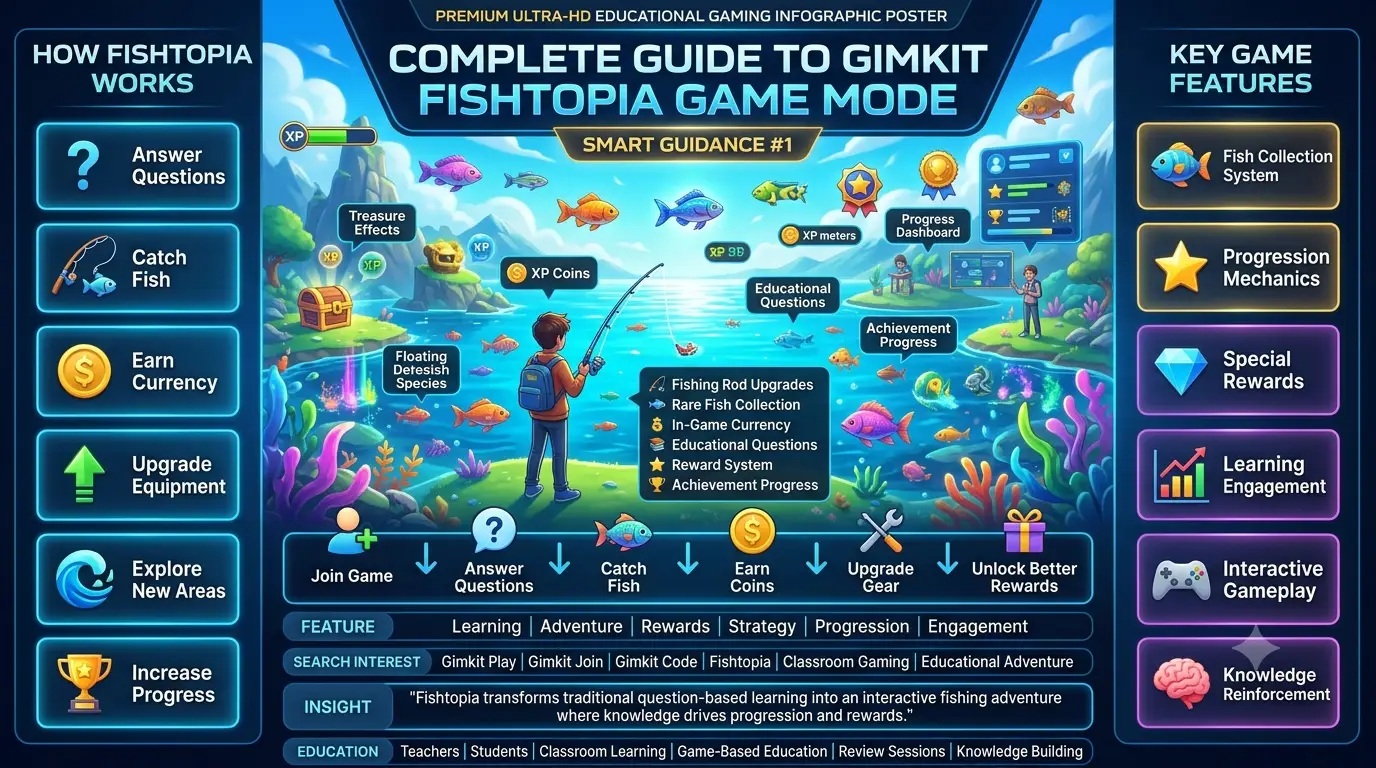
Gimkit Fishtopia turns correct answers into bait, bait into fishing attempts, and caught fish into spendable in-game cash. The challenge is not merely catching fish—it is deciding when to collect more bait, sell your inventory, invest in better gear and explore new fishing areas.
This specialist guide explains how resource constraints shape the fishing cycle. You'll learn the practical significance of backpack capacity, selling decisions, rod upgrades, cash-earning power-ups and travel between fishing locations.
Use the exclusive Bait-to-Cash Fishing Economy & Upgrade Decision Lab to build a fictional fishing run, record catches, spend on upgrades and calculate when an investment might repay its illustrative cost.
How does the Gimkit Fishtopia fishing economy work?
Fishtopia is a Gimkit 2D mode built around a fishing-and-selling economy. Players answer educational questions to obtain bait, spend bait to catch fish, then sell their catch for in-game cash. They can use that cash on equipment improvements, power-ups and access to additional fishing areas.
The officially documented part of the system includes the host's ability to change how much bait students receive per correct answer. This is a meaningful option because the amount of bait available determines how frequently players can attempt to fish without returning to the question station.
A practical Fishtopia run contains several separate resources. Bait governs opportunities to fish. Fish inventory contains the catch that has not yet been sold. Cash is available after selling, subject to purchases already made. Equipment and access options influence how a player can use those resources.
These values are not interchangeable. Having many fish does not mean that cash has already been earned from them. Having cash does not automatically supply bait. Purchasing an upgrade may improve a later part of the process but immediately reduces spendable cash.
The fishing areas and some distinctive equipment names are described in community-maintained references and independent instructional demonstrations. Those materials are useful for understanding the mode, but historical fish probabilities and shop prices should not be assumed to match the current live product.
For this reason, the interactive Lab uses explicitly illustrative prices, times, inventory limits and area ticket costs. Visitors manually choose each catch outcome instead of receiving a fabricated claim about current official drop rates.
Bait Supply
Explore how the number of bait units earned per correct answer affects fishing opportunities.
Catch & Selling
Track caught fish, storage capacity, selling proceeds and cash available for purchases.
Investment Timing
Compare upgrades and calculate whether assumed future catches can repay an illustrative cost.
Bait-to-Cash Fishing Economy & Upgrade Decision Lab
Build a hypothetical fishing session where question answers create bait, catches fill an inventory, selling converts fish to cash and purchases reduce the money available for future decisions. Examine break-even points without pretending that the Lab knows current Gimkit fish probabilities.
Every catch creates a decision about the next one.
This is an original, local economics simulator. Species names are informed by community references, while prices, travel costs and timing are adjustable teaching assumptions—not verified live-game data.
1. Configure the educational fishing scenario
2. Record question responses for bait
The simulator does not generate, answer or grade real Gimkit Kit questions. Each click records a hypothetical question event and advances its illustrative clock.
3. Record a hypothetical fishing catch
Choose the species yourself. The Lab does not claim to calculate current Fishtopia spawn probabilities, rarity chances or actual rod-dependent distributions.
Unsold fish inventory
4. Resource activity history
5. Equipment and power-up purchasing decisions
The upgrade categories reflect community-documented Fishtopia concepts. Prices and time effects below are sample teaching figures. Check actual costs and availability inside the current game.
6. Boat-ticket and fishing-area decisions
The area names are documented in historical community references. Example ticket prices, travel times and access order below are fictional assumptions used only for decision analysis.
7. Understand what a purchase changes in this model
| Category | Teaching-model effect | Not claimed |
|---|---|---|
| Backpack | Raises the example number of each fish type that can be stored. | No claim about the current live interface's exact limits. |
| Expert rod | Records an equipment upgrade in the ledger. | No invented rare-fish probability changes. |
| No Wait | Reduces fictional catch time. | No verified actual catch duration. |
| Cash In | Applies a sample 1.30× multiplier to unsold fish at sale. | No guarantee that the game currently uses this number. |
| Bolt | Reduces fictional travel time. | No copied character movement physics. |
| Area ticket | Charges example cash and changes the chosen location. | No verified current ticket price or fish-spawn table. |
8. Cash In upgrade break-even calculator
Set your own assumptions to calculate when extra sale revenue would equal an upgrade's cost. This is arithmetic for a hypothetical session, not a recommendation based on measured fish-spawn rates.
9. Inventory versus immediate cash
A stored fish represents a possible future sale. It is not cash until the selling action occurs. Buying upgrades with cash and collecting fish into a limited backpack therefore create separate constraints.
If you keep fishing while a storage limit is full, you may need to sell first or invest in additional capacity. An upgrade that allows more fish to be carried can save interruptions, but it also creates an immediate purchase cost.
The best trade-off depends on the actual game duration, travel requirements, catches and available equipment. The Lab supports comparison, not a universal optimal shopping order.
10. Fishing-economy run debrief
These exports contain independent hypothetical fishing data. They do not include official Gimkit player scores, account information or real Kit responses.
How the Fishtopia Economy Lab differs from a generic game simulator
The purpose of this tool is to track the economic consequences of individual fishing decisions. It does not simulate the 2D map, invent player movement controls, generate academic questions or recreate Fishtopia's real fishing animation.
The model contains separate records for bait, fish inventory, current cash, completed sales, equipment purchases and travel. Keeping these values apart helps explain why earning bait is not identical to earning money and why catching a valuable fish is different from selling it.
Correct-answer events add a visitor-selected bait reward, reflecting Gimkit's documented ability to configure bait earned per correct answer. Incorrect-answer events are recorded without assigning an unsupported negative bait penalty.
The visitor selects which fish was caught. This is deliberate: although historical community sources publish species and probability tables, there is no verified current official catch-probability dataset available to the Lab. Randomly inventing a drop rate and marketing it as live Gimkit behaviour would be misleading.
The inventory applies a clear sample storage limit per species. The visitor can purchase a model backpack upgrade and see how the capacity changes. The actual price and capacity should always be checked in the real game.
Fish may remain unsold until the user visits the model selling function. Selling converts each recorded catch's stored value into cash. If a fictional Cash In upgrade has been purchased, the model applies its disclosed example multiplier to the sale.
Purchases immediately reduce available cash. A rod purchase is recorded as a strategic investment but does not magically improve a simulated drop rate. The No Wait and Bolt examples affect the illustrative action clock only, without copying Gimkit's real movement or animation timings.
The Decision Desk supports separate what-if arithmetic. It calculates how many catches, at a visitor-specified average value and multiplier, would be needed to repay the selected investment cost. The calculation does not presume those catches can actually be obtained within the chosen time.
Finally, the Debrief distinguishes gross sale proceeds, cash remaining, amounts invested, fish sold, catches recorded and time used. This makes the economic sequence auditable within the fictional model while keeping actual Gimkit gameplay and student learning data outside its scope.
Understanding the fishing-to-cash gameplay loop
1. Fishtopia separates question performance from spendable cash
One important difference between Fishtopia and a simple score-based quiz is the presence of several intermediate actions. Correctly answering a question does not immediately complete the whole economic cycle. The answer generates bait, which the player uses to go fishing.
Fishing produces an item in the player's inventory. That item then needs to be sold before it becomes available cash. A player who answers many questions but never uses the bait has built one kind of resource, not completed the entire cycle.
This distinction makes timing and resource management part of the mode. Players need to decide whether to collect more bait first, visit a fishing spot, sell their catch or use earnings to improve future opportunities.
2. The question station is the beginning of the supply chain
Independent instructional demonstrations show players visiting a question-answering station to earn bait. The station connects the Kit's educational content with the fishing activity and creates the supply from which fishing attempts become possible.
This means that a player should not assume fish are caught simply by reaching the water. Fishing requires the relevant resource, and that resource comes from interacting with the learning questions.
Teachers can influence the pace of this relationship because the official 2D Game Balance documentation confirms that bait per correct question is adjustable in Fishtopia. The Lab uses that same concept while keeping its chosen reward clearly user-defined.
3. Bait is a resource rather than an account reward
Bait serves a practical in-game purpose. It supports fishing attempts, and therefore influences how often a player can move from the question station to a fishing location.
It should not be confused with account-level experience points, cosmetic rewards or GimBucks. Those systems have their own meanings within the wider Gimkit ecosystem.
The same distinction applies to energy in other 2D modes. Although a correct answer may generate energy elsewhere, Fishtopia's documented balance setting concerns bait.
The Lab therefore gives bait its own counter, separate from cash and fish. That design prevents a misleading conversion in which a question answer is treated as instant money without fishing or selling.
4. The fishing action transforms bait into an uncertain outcome
A player with bait can attempt to catch fish at a fishing location. Historical Fishtopia references describe multiple fish species with different rarity and selling characteristics.
The uncertainty of which fish appears is significant for strategy. Two players can spend similar resources yet catch different combinations of fish, resulting in different selling opportunities.
However, a reliable guide should distinguish documented concepts from unverified numerical odds. A historical community table is not necessarily the current official probability model.
For that reason, this Lab lets users select the catch manually. It demonstrates how the economic consequences differ without inventing a random mechanism and misrepresenting it as current game data.
5. Fish inventory holds value that has not yet been converted to cash
After a catch, the fish enters the player's inventory until sold. That stored fish has potential sale value, but it is not the same as immediately available purchasing power.
This creates a practical decision about when to visit the selling station. Continuing to fish may build more inventory, but the available backpack capacity can become a constraint.
Returning to sell can free storage and generate money for upgrades. The costs of travel and time depend on the real game, so a blanket rule that every player should sell after an exact number of catches would be unreliable.
The Lab makes this relationship visible by storing individual hypothetical catches and requiring an explicit Sell action.
6. Selling completes the first economic cycle
The fish-selling station converts caught fish into the in-game cash used for later decisions. Selling is therefore the point at which an inventory asset becomes spendable currency.
That conversion matters because equipment improvements and travel options may require cash rather than bait. A player who has caught valuable fish but has not sold them may still lack the money needed for a purchase.
The Lab applies that constraint directly. It does not add cash merely because a fish was recorded as caught. Only the selling action increases available cash.
This helps distinguish gross potential value from actual cash on hand during a hypothetical run.
7. Purchases reduce cash before they create any benefit
Upgrades are not free progress. A purchase reduces the cash available for other decisions, which creates a trade-off between immediate balance and the possible advantages of improved equipment.
A larger backpack might make it possible to store more fish before selling. A faster fishing option could reduce the time spent on the action. A selling multiplier could increase revenue from future sales.
But the timing matters. An upgrade purchased near the end of a short round may provide little opportunity to repay its price.
The Lab records both purchase costs and later sale proceeds, so a visitor can see why an expensive upgrade is not automatically a good decision.
8. Fishing areas create access and spending decisions
Historical community references identify several fishing areas, including Main Island, Purple Pond, Sandy Shores, Cosmic Cove and Lucky Lake. These locations are associated with different fishing opportunities and travel requirements.
The general concept is that players can spend some of their earnings to access other fishing spots. This creates a choice between continuing with currently available opportunities and paying for expansion.
A new area may offer attractive fish, but its value depends on the actual catches, remaining time and cost of reaching it.
The Lab uses the historical area names for recognition but invents its own clearly labeled ticket prices. It does not claim to reproduce current official unlock rules.
9. The same total sales can hide different strategies
Two fictional players might generate the same amount of gross fish-sale revenue while ending with different cash balances.
One may purchase a backpack and a rod, while the other keeps the money unspent. The first could be preparing for future earning opportunities, but the second currently holds more spendable cash.
This is why gross sales should not be confused with money remaining after purchases. A meaningful analysis distinguishes revenue, purchases, unsold inventory and available cash.
The Lab's debrief keeps these measures separate rather than using one number for every form of progress.
Managing bait supply without losing the learning purpose
10. Bait Per Question is an official balance control
Gimkit's Help Center identifies Fishtopia as a mode in which hosts can configure the amount of bait earned per correct question. This provides a direct way to adjust the balance between answering academic questions and performing fishing actions.
A larger reward can allow more fishing from the same number of correct responses. A smaller reward generally requires players to return to the question activity more frequently.
The correct setting depends on the selected Kit and instructional purpose. A teacher emphasizing question retrieval may choose a different balance from one introducing students to the fishing mechanic.
The Lab exposes this variable without asserting that its starting value is Gimkit's official default.
11. Question accuracy influences the supply of bait
Because correct answers produce bait, a student's familiarity with the Kit content can influence how efficiently they obtain the resource needed for fishing.
Accurate responses may allow a player to spend less time resolving question errors and more time deciding what to do with the available bait.
However, a player who accumulates bait efficiently can still make less effective spending choices. Academic accuracy and economic decisions contribute in different ways.
The Lab records hypothetical correct and incorrect responses separately. Its accuracy percentage describes only the manually entered events, not an actual student's knowledge or an official report.
12. More bait does not always mean more cash immediately
A large bait balance represents potential fishing attempts. It does not guarantee a particular catch mix or selling result.
Fish value depends on which species are caught, while spendable cash depends on subsequently selling those fish. Storage constraints may also interrupt fishing before all available bait is used.
This means that an abundant bait supply can coexist with low current cash. The player still needs to complete the rest of the fishing and selling process.
The Lab intentionally prevents bait from being converted directly into cash. That makes the model closer to the documented sequence of actions without pretending to know current catch probabilities.
13. The answer-to-fishing balance can change classroom pacing
A mode with frequent movement between questions and fishing can feel different from one where students answer a long sequence and then spend several minutes using their accumulated bait.
Both arrangements may support review, but the choice affects the rhythm of academic activity.
Teachers should consider whether students can understand the questions at the intended pace and whether the fishing interval remains appropriate for the lesson's purpose.
The Lab allows a visitor to experiment with the reward number and count the question events needed for a hypothetical set of fishing attempts. The result is conditional on the selected assumptions.
14. Incorrect answers should not be assigned imaginary bait penalties
The official balance explanation states that players receive bait for correct answers. It does not publish one universal penalty for every wrong answer in the reviewed material.
An independent tool should therefore avoid automatically subtracting an arbitrary amount of bait and presenting the result as official behaviour.
The Lab records an incorrect-answer event, advances its illustrative clock and awards no bait. This is a simplified educational convention, not a complete simulation of real question feedback.
The real question-answering interaction remains part of Gimkit, including whatever feedback and rules the current version provides.
15. A player's bait strategy should respond to inventory space
If a player's storage is already full for the fish they are attempting to collect, earning additional bait may not immediately solve the constraint.
The player may need to sell fish, obtain more capacity or adjust their activity sequence. In that situation, the immediate bottleneck is storage rather than fishing supply.
This is a broader resource-management insight: improving one part of a production cycle does not necessarily improve the whole cycle if another part remains constrained.
The Lab checks storage capacity independently from bait availability. It can therefore show a fishing action being unavailable despite a positive bait balance.
16. Exact bait needed to win cannot be predicted from the reward alone
It may be tempting to multiply a preferred number of fish by the amount of bait awarded per question and claim that the result predicts a winning strategy.
That overlooks differences in fish values, catches, equipment, movement, purchasing decisions and the actions of other players.
The official bait setting is useful information, but it does not provide an exact universal path to the highest cash total.
The Lab can determine the minimum correct-answer events required for a chosen number of one-bait fishing attempts under its own model. It does not claim that those attempts will produce a specific real-game outcome.
Fish types, backpack capacity and selling decisions
17. Different fish can have different selling values
Community-maintained Fishtopia references describe fish of different rarity and selling value. These distinctions create the game's collection appeal and can influence the economic value of fishing in different areas.
A common catch may contribute a small amount of cash, while a rarer catch may be worth substantially more. However, the existence of those categories does not establish that a particular rare fish will appear after a known number of attempts.
A reliable guide should distinguish observed or historically documented prices from verified current values.
The Lab includes a list of historically reported species names but lets users edit the illustrative sale price for every recorded catch.
18. Historical fish tables are not live probability feeds
Community wikis may provide percentage tables describing the likelihood of particular fish in particular areas, with different values for some equipment.
These tables can be helpful for understanding how players historically approached the mode. Nevertheless, they may represent an earlier version, a community inference or conditions that differ from the current game.
The Lab does not copy those percentages into a random catch generator. Such a feature could appear authoritative even when the underlying odds are not verified.
Instead, the visitor chooses a hypothetical outcome and can examine its effect on cash and storage without confusing the model with an official fish-spawn calculator.
19. Common fish may still be economically useful
A fish with a relatively low selling value can still contribute to a player's early progress if it is easy to obtain in the chosen fishing area.
Early cash may matter because it can fund an equipment purchase or area-access decision. A player does not necessarily need a rare catch before making any useful progress.
However, the value of a common-fish strategy depends on actual availability, the time spent fishing and how quickly the player can sell the catch.
The Lab supports recording multiple inexpensive fish and examining how their combined sale proceeds affect the ability to buy a hypothetical upgrade.
20. Rare catches can create large but uncertain rewards
A high-value fish can represent a much larger amount of potential sale revenue than a typical early catch.
That possibility may encourage a player to explore new areas or obtain better gear. However, the expected value of seeking rare fish requires accurate information about catch probabilities, travel costs, equipment effects and the remaining game time.
Those parameters are not all verified in current official documentation available to this page.
The Lab therefore allows rare-fish outcomes to be selected as hypothetical events but does not claim that a particular rod or zone guarantees them.
21. Backpack capacity can become a separate bottleneck
A fishing session can be interrupted when the player lacks space to store more of a particular fish. Community references describe backpacks that hold increasing numbers of fish.
Capacity matters because catching more fish before returning to sell can reduce the frequency of storage-related interruptions.
Nevertheless, a larger bag only produces practical value when storage was actually constraining the run. A player who rarely fills the smaller capacity may gain little from purchasing the upgrade.
The Lab uses a sample per-species storage capacity and checks the limit when recording a catch. Its limits are disclosed teaching parameters, not guaranteed current Gimkit settings.
22. Inventory value should be distinguished from selling proceeds
An unsold fish has a recorded potential price. It may be useful to know the combined value of everything in the bag, but that number should not be added to cash as though a sale already occurred.
Separating these values makes decisions easier to interpret. A player might have enough fish in storage to afford an upgrade after selling, yet lack the current cash required to purchase it immediately.
The Lab maintains each catch's stored example price until the Sell All action. This also allows fish caught before and after a purchase to be handled according to the model's current selling multiplier.
The result is a clear distinction between hypothetical assets and liquid currency.
23. Selling too frequently can interrupt the fishing rhythm
Visiting a selling station after every individual fish may be inefficient if the game requires meaningful travel or interaction time.
A player may be better served by collecting several fish before selling, provided that enough storage remains.
However, waiting too long can create another problem: a full bag may prevent the collection of additional fish. There is no universally correct number of catches between sales.
The Lab records a fictional selling time and allows the user to sell any stored fish. Reviewing multiple sale batches can illustrate the trade-off without claiming to calculate optimal real-game travel routes.
24. A selling multiplier changes value at the conversion stage
Community references describe a Cash In power-up that increases the amount obtained when selling fish. This type of upgrade is distinct from a rod or backpack because it changes sale proceeds rather than the number of fish that can be stored.
Its financial value depends on how much fish value is sold after the upgrade. If almost no fishing time remains, the purchase may not be recovered.
The Lab models a 1.30× sample multiplier based on historical community descriptions and applies it only when fish are sold after purchase.
It does not claim that this is the current official multiplier or that the upgrade will always be profitable.
25. Fish collection is not automatically account-level progression
The fish and cash accumulated during Fishtopia should not be confused with the broader account's cosmetic collection or progression systems.
Fish are part of the specific game mode's economic activity, while Gims, cosmetic items, account-level XP and other rewards belong to different features.
A high-value fish does not automatically mean that the player has earned equivalent account currency or can spend that fish-sale value in the cosmetic shop.
The Lab reports its cash as fictional in-game currency for the model only. It does not award GimBucks, update an account or unlock actual cosmetics.
Fishing rods, backpacks and Fishtopia power-ups
26. Equipment purchases should solve a specific constraint
An upgrade is most meaningful when it addresses something currently slowing the player's progress.
A backpack may help if storage frequently fills. A faster fishing power-up may matter if the player spends substantial time waiting for catches. A selling multiplier becomes more attractive when there is enough future inventory to sell.
Purchasing an upgrade merely because it is available can reduce cash without improving the part of the cycle that currently limits progress.
The Lab groups purchases by their economic effect so visitors can identify which constraint each option is meant to address.
27. A better rod relates to catch opportunities
Historical Fishtopia sources describe an Expert Rod intended to improve fishing opportunities for different fish categories.
A player may consider such a purchase when seeking more valuable catches, but a reliable expected-return calculation requires current catch distributions with and without the rod.
The community's historical odds should not be presented as official current figures without verification.
For that reason, the Lab records the rod purchase and its cost but deliberately does not alter a fabricated rare-fish probability. The catch remains a manually selected hypothetical outcome.
28. Backpack upgrades change the storage decision
Backpacks are associated with carrying more fish. Increasing the permitted inventory can reduce the chance that storage becomes full before the player is ready to sell.
However, additional storage capacity is valuable only if the player uses it. An expensive larger bag purchased in the final moments of a game may provide little benefit.
The Lab's example backpack levels increase the allowed count of each fish species. It refuses to record a catch when that species has reached the selected model limit.
That allows visitors to experience the constraint directly instead of reading a theoretical description that has no impact on the tool's behaviour.
29. Faster fishing can create a time advantage
Community documentation describes a No Wait power-up intended to speed up fishing.
A faster action can become useful when the player expects to make many additional fishing attempts. Its value depends on how much time it saves per action and how much of the round remains.
The Lab uses clearly invented action times and lowers its fictional catch duration after the corresponding purchase.
This models the arithmetic of time savings but does not reproduce the live animation, interaction delay or exact power-up effect.
30. Movement-speed improvements address travel time
Fishtopia includes movement among question stations, fishing spots, shops and travel locations. A speed-related power-up can therefore affect how long the player spends navigating between activities.
Community references identify a movement-speed improvement known as Bolt. Its usefulness depends on the actual layout and frequency of travel.
A player staying near one fishing spot may have different needs from someone regularly changing areas.
The Lab applies a smaller fictional travel duration when Bolt is recorded as purchased. This demonstrates the concept without making any claim about real movement speed or the map's distances.
31. Sale-value upgrades require sufficient future selling
An upgrade that increases sale proceeds needs future revenue to repay its cost. If the player makes the purchase but sells only a small amount afterward, the bonus may remain smaller than the amount spent.
This is a break-even problem. The upgrade cost is an immediate expense, while the benefit accumulates when later transactions occur.
The Decision Desk calculates the number of catches needed to recover a selected cost under fixed assumptions about average value and multiplier.
Because real catches vary, the result should be interpreted as a conditional target—not a guarantee that the player will reach it.
32. Shop prices should be checked in the current game
Community tables often preserve detailed prices for backpacks, rods and power-ups. These tables can be useful for historical discussion but may not reflect present conditions.
A reader should not treat the example prices on this page as an official and permanently current price list.
The Lab uses named sample values to make its mathematics understandable. Purchases use those disclosed values, and the Decision Desk lets visitors enter a different upgrade price when evaluating an alternative scenario.
The actual game interface remains the authoritative place to verify whether an item is available and what it costs during a particular session.
33. Early upgrades and late upgrades have different opportunities
An upgrade purchased early may have time to affect many later fishing or selling events. The same item bought shortly before the game ends may have fewer chances to produce a return.
This does not mean buying every upgrade immediately is optimal. Spending early reduces cash that could be used for travel or another purchase.
The relevant decision is whether the expected benefit during the remaining activity justifies the cost.
The Lab's time counter and spending ledger can show the consequences of purchase timing within an illustrative run, but it cannot predict current competitors' strategies or fish availability.
34. An upgrade order should reflect the current bottleneck
Players often ask for a single best order in which to buy Fishtopia upgrades.
Community discussions suggest different priorities for different round lengths, including early travel, storage increases and selling enhancements. These suggestions are experiences rather than universally validated optimization results.
A better principle is to identify the current bottleneck: insufficient bait, limited storage, low current cash, long fishing actions or travel requirements.
The Lab supports several choices without presenting one permanent optimal purchasing sequence. It encourages visitors to compare the cost of an upgrade with the benefit they expect to use.
Fishtopia islands, tickets and area-access choices
35. Main Island provides the starting context
Community-maintained Fishtopia references describe Main Island as the central starting area for the fishing economy.
Players can learn the basic question-to-bait and fishing-to-selling cycle before spending on access to additional locations.
This early phase matters because it lets players generate initial cash and decide which improvements are realistically affordable.
The Lab begins on Main Island and requires no sample ticket purchase to operate there. This reflects the general starting-area concept without reproducing the actual map, station positions or catch probabilities.
36. Purple Pond is a community-documented fishing location
Historical community references identify Purple Pond as an additional area reached after purchasing access.
Independent educational tutorials also describe buying a ticket and travelling by boat to a better fishing spot.
The economic question is whether the potential future benefits justify spending cash and travel time. That depends on the real fish available in the area and the number of fishing attempts remaining.
The Lab represents Purple Pond as an unlockable example zone with an invented ticket price. It does not attach an unverified current fish probability table to the location.
37. Sandy Shores is another historical area name
Sandy Shores appears in community descriptions of Fishtopia's fishing regions. It is associated with a different collection environment from the starting area.
A player considering travel should examine the cash needed for access, the bait currently held and the time left in the round.
A new fishing area may offer different species, but an unverified reference cannot establish its exact current earning advantage.
The Lab lets visitors make an explicit sample ticket purchase and change their chosen location. That action affects the fictional cash and time ledger without pretending to control a boat in the real game.
38. Cosmic Cove belongs to the historical location set
Community documentation lists Cosmic Cove among the locations available in Fishtopia.
The attraction of exploring a later area often involves the possibility of obtaining different or more valuable fish. However, the decision to travel should be made in relation to the current situation rather than the mere excitement of unlocking another location.
A player may need to decide whether to spend money on area access or an equipment improvement first.
The Lab models both as purchases from the same cash balance. This shows the opportunity cost of travel while withholding any unsupported promise that a particular fish will appear at Cosmic Cove.
39. Lucky Lake is associated with later fishing opportunities
Lucky Lake is another historically described Fishtopia fishing area. Community tables associate different catch possibilities with different locations.
The important planning principle is that entering a new area does not automatically mean the player has already earned a return on its ticket cost.
The player still needs enough bait, inventory space and time to fish and sell a useful catch.
The Lab treats Lucky Lake as a fictional higher-cost access decision. It does not guarantee rare-fish catches, copy official map graphics or estimate a current advantage from unverified drop rates.
40. The value of travel depends on remaining time
A ticket may be attractive near the beginning of a long session because the player can continue fishing after arriving. The same expense may offer fewer benefits when very little time remains.
This is an opportunity-cost decision. Money and time spent reaching a location cannot simultaneously be used for another investment.
The right choice depends on actual mode settings, prices and the player's circumstances.
The Lab advances an illustrative clock whenever the visitor travels. A fictional speed upgrade reduces that travel-time assumption so the effect of a speed-related purchase can be compared.
41. A zone does not have to be mathematically optimal to be useful
Players may choose a new location for exploration, enjoyment or a different fishing experience rather than solely for maximum possible cash.
Teachers may also consider student engagement and the instructional setting when selecting a mode or allowing a longer round.
Not every choice needs to optimize a single currency total. Nevertheless, when a player specifically wants to maximize earnings, the costs and expected benefits deserve attention.
The Lab focuses on the economic side of those decisions without assigning a false educational score or claiming that the most profitable hypothetical option is always the best classroom experience.
How to reason about Fishtopia upgrades and cash strategy
42. Identify the constraint before spending cash
A productive decision begins by asking what is currently limiting progress. If the player has no bait, a new backpack will not immediately enable more fishing attempts. If the bag is already full, additional bait may not solve the immediate storage problem.
Similarly, a selling multiplier has little immediate benefit if the player does not expect to sell enough fish afterward.
This approach focuses on the relationships between resources rather than a single recommended shopping order.
The Lab is constructed around separate constraints so visitors can encounter and resolve them in sequence. The simulator will not let a fish be recorded when the modeled species capacity is already reached.
43. Make sure the next action can actually be funded
Cash, bait and storage are distinct requirements for different actions. Fishing needs bait. Purchases need cash. Catching additional fish may need storage.
A player can appear wealthy in one resource while lacking another. For example, a full inventory can have substantial potential sale value but produce no purchasing power until sold.
The Lab checks the relevant condition before each action. Its purchase button refuses a transaction when insufficient hypothetical cash is available.
This makes the simulator function as a coherent economic ledger rather than a set of decorative counters that change independently of one another.
44. Compare available cash with total gross sales
Total gross sales record how much money has been received from fish-selling actions before subtracting purchases.
Available cash represents the portion still on hand. A player who spends heavily on equipment can have high gross sales and a much smaller remaining balance.
The distinction is important when reviewing whether an upgrade actually helped. An improvement may raise later earnings while still costing more than the benefit achieved during the current period.
The Lab reports these measures separately. It also records how much hypothetical cash was spent on equipment and area access.
45. Break-even is conditional on future sales
Suppose a fictional upgrade costs $70 and raises sale proceeds by 30 percent. If the average base value of each future catch is $10, the extra amount per sold catch would be $3.
In that simplified scenario, twenty-four sold catches would generate at least $72 of additional revenue, enough to exceed the $70 purchase cost.
This calculation does not prove that twenty-four catches will occur or that their average value will be $10. It also ignores constraints not entered into the arithmetic.
The Decision Desk makes those assumptions editable and displays both the break-even number and the expected net effect of a visitor-selected future catch count.
46. A higher average fish value changes the investment arithmetic
The break-even count for a sale multiplier falls when the average value per catch rises, provided that the upgrade price and multiplier remain unchanged.
This explains why a selling improvement can be more attractive in a scenario with high-value fish.
However, the ability to catch those fish is not guaranteed. A realistic decision would require trustworthy information about the actual catch distribution, equipment and fishing location.
The Lab lets the visitor test different average values but keeps the result labeled as a hypothetical comparison rather than a forecast for a live session.
47. Fishing speed and selling value solve different problems
A speed-related upgrade aims to reduce the time spent taking certain actions. A selling multiplier aims to increase revenue from completed sales.
These effects should not be treated as interchangeable. A speed improvement may allow additional fishing opportunities if enough bait and storage are available, while a sale multiplier can add value to fish already collected and later sold.
The practical benefit of either depends on the rest of the cycle.
The Lab provides one timing calculation and one revenue calculation so users can compare the types of improvement without inventing a universal common performance score.
48. Upgrade costs create opportunity costs
A cash amount spent on one upgrade is unavailable for another purchase at that moment.
Choosing between a bag, rod, sale multiplier and travel ticket therefore involves considering what the player is giving up as well as what they hope to gain.
This principle remains useful even when prices change between versions of the game. A decision can be evaluated by comparing the proposed benefit with the alternatives available for the same resources.
The Lab deducts each purchase from the current cash balance and prevents funds from being spent twice. That makes its opportunity cost visible in the remaining balance.
49. Unsold fish create a final-session consideration
An inventory full of fish is not identical to cash in the player's balance. Near the end of a timed round, the player may need to decide whether another fishing attempt is more useful than selling what has already been collected.
The correct choice depends on the real game's timing and winning conditions, which should be verified in the current mode.
The Lab's illustrative clock can show a hypothetical session ending while fish remain unsold. Its debrief reports that inventory separately rather than automatically adding the value to cash.
This teaches the importance of completing the conversion stage while avoiding a fabricated rule about exactly when the live game will finish.
50. A community strategy is evidence of experience, not an optimization proof
Players sometimes share preferred Fishtopia upgrade orders on forums. One person may favor reaching a new area quickly, while another may prioritize backpacks or fishing speed.
Such reports can be useful for generating ideas, especially when the round duration is included. They do not establish that the strategy performs best under every Kit, game setting or player skill level.
A more reliable comparison records the assumptions behind the proposed strategy and tests how a change affects the outcome.
The Lab provides that kind of transparent hypothetical analysis without presenting a community anecdote as a mathematical guarantee.
How teachers can use Fishtopia's economy without misreading learning
51. Bait rewards change the balance of questions and play
Gimkit officially allows teachers to configure the bait reward per correct answer in Fishtopia. That decision can influence how much time students spend answering questions relative to fishing.
For a rapid revision activity, an educator may want students to encounter questions frequently. Another classroom context may allow longer fishing intervals between question sessions.
Neither balance is automatically better. The teacher should consider the learners, the subject and the intended amount of practice.
The Lab's bait input makes the relationship observable through counts, but it is not an official host interface and cannot change a session's setting.
52. High cash earnings are not a complete assessment result
A player may earn substantial in-game cash by making effective purchasing, fishing and selling decisions. Another player may answer many questions correctly but earn less cash because they choose different equipment or spend time exploring.
This makes the currency total a combined gameplay outcome rather than a direct measure of academic mastery.
Teachers should therefore avoid interpreting the richest player as necessarily having the strongest understanding of the Kit.
Appropriate question-level results, classroom observation and other evidence are better suited to educational conclusions than a currency total alone.
53. Resource decisions can support mathematical discussion
Fishtopia's fishing economy presents opportunities to discuss multiplication, proportional reasoning, opportunity cost and the difference between gross revenue and money remaining after spending.
Students might consider whether a particular purchase could be recovered during the remaining time or how an increase in bait per question changes the maximum number of fishing attempts available.
These discussions should use clearly defined assumptions so learners understand which numbers are known and which are examples.
The Decision Desk provides a transparent setting for such exercises. It should not be mistaken for Gimkit's actual current price or probability tables.
54. Uncertain fish outcomes provide a lesson about expected value
A rare fish may have a high selling price, but its expected contribution depends on the likelihood of catching it.
The expected value of a fishing attempt cannot be established from the sale price alone. Probability information would also be necessary, and those probabilities might differ across locations and equipment.
The current official information verified for this page does not provide a complete modern probability table.
Instead of inventing probabilities, teachers can ask students to reason about hypothetical examples in which all assumptions are stated. The Lab supplies manually chosen outcomes and prices for exactly that purpose.
55. A resource cycle can illustrate bottlenecks
Students can understand bottlenecks by considering why increasing one resource does not always improve the entire process.
For example, adding more bait creates additional potential fishing attempts, but a full bag can prevent further catches. Increasing storage may allow more fish to be held, but a lack of bait can leave the extra capacity unused.
Selling improvements have a similar dependency: they help only when future sale value exists.
The Lab enforces these resource conditions, making it possible to demonstrate that progress depends on several linked steps rather than one permanently dominant statistic.
56. Avoid promising learning gains from engagement alone
A fishing game can capture attention and encourage repeated participation, but enjoyment does not automatically establish improved memory retention or stronger subject understanding.
An educational claim about learning effectiveness needs suitable evidence, including what students knew before and after an activity and whether any observed changes can reasonably be attributed to the experience.
The mode's economic mechanics may support motivation, yet teachers still need thoughtful question content and instructional follow-up.
This page avoids invented retention percentages, unsupported statements about every student's improvement and comparisons that portray ordinary quizzes as uniformly ineffective.
57. Use the Lab as an economic model, not a student record system
The application does not request a teacher account, student name, live game code or Class roster.
Its state is a local fictional record of answer events, catches, purchases and fish sales. It cannot provide authenticated results about what any learner did inside Gimkit.
That distinction makes the Lab suitable for explaining resource arithmetic without introducing unnecessary handling of student information.
Teachers who need real academic reports should use their approved Gimkit and school systems rather than replacing those records with a third-party simulation.
Common Fishtopia economy problems and how to interpret them
58. You reached the fishing area but have no bait
Fishing requires the resource earned through the question activity. A player who reaches a fishing location without bait should return to the relevant question station and answer questions to obtain more.
This is a supply problem, not necessarily a bug in the fishing area.
The Lab reproduces the same conceptual constraint by refusing a hypothetical catch when the bait counter is zero.
It does not bypass the real game's question requirement or create an undocumented method of obtaining bait.
59. You have caught fish but cannot afford an upgrade
Unsold fish are not yet available cash. If the player has valuable fish in the inventory but insufficient money for an item, selling may be the necessary next action.
The actual selling interface is part of the game, and the amount received depends on the fish and any relevant game effects.
The Lab separates pending inventory value from cash available for purchases. It can therefore show how selling changes affordability without inventing a credit system or allowing equipment to be bought with unsold fish.
60. Your fishing inventory reaches its capacity
A full backpack can interrupt the collection of fish even when bait remains available.
The appropriate response may involve selling part of the existing inventory or considering a capacity upgrade, subject to the real interface's options.
Whether an upgrade is worthwhile depends on its cost and how frequently the existing storage limit is being reached.
The Lab enforces its example capacity per species. It refuses an additional catch at the limit and allows the visitor to see whether selling or purchasing a larger backpack solves the fictional bottleneck.
61. You purchased equipment but cash appears lower
That is the immediate consequence of spending money on a purchase. An upgrade represents a possible later advantage, not instant additional cash.
A player should assess whether the benefit is likely to matter during the remaining fishing activity.
The Lab deducts each sample purchase price from available cash and records the spending separately. The new balance is therefore the previous balance minus the cost, even if the equipment may improve future efficiency.
The tool does not treat purchases as guaranteed profits.
62. A rare fish does not appear after many attempts
Rare catches are uncertain by definition, and historical community probabilities cannot establish what will occur in every current session.
The exact distribution can depend on the game version, area and equipment. Without verified current probabilities, an external guide should not promise a catch after a fixed number of attempts.
The Lab does not fabricate a luck meter or guaranteed rare-fish countdown. Instead, visitors manually enter the hypothetical species caught and examine the resulting economics.
This prevents the application from producing apparently precise but unsupported predictions.
63. An upgrade does not recover its cost before time runs out
A purchase can be reasonable under one set of assumptions but fail to repay itself in another.
For example, a sale-multiplier upgrade needs enough later sales for the additional revenue to exceed its cost. If the player buys it late or catches fewer fish than expected, the break-even point may never be reached.
The Decision Desk calculates this relationship using the entered values. It does not guarantee that future fish, time or opportunities will match the assumptions.
A negative modeled net effect is a property of the hypothetical scenario, not proof that the real upgrade is always a poor choice.
64. Fishtopia's 2D world does not load
Gimkit documents that its 2D modes require WebGL. If the game fails to load, the official troubleshooting guidance recommends checking a current browser, graphics acceleration and relevant administrator restrictions.
School network controls can also affect access to Gimkit's game servers. The official connectivity checks provide a more reliable starting point than assuming a specific local cause.
The Lab is an ordinary browser-based interface and does not use the original 2D game engine. Its successful operation is therefore not proof that the real game will load on the same device.
65. The Lab's price differs from the actual game
That difference is expected because the Lab's sample values are educational assumptions, not verified current official figures.
Historical community sources may contain prices that were accurate for a particular version, but that does not establish that the values remain unchanged.
The visitor can edit the sale price for a selected hypothetical catch and enter alternative assumptions in the Decision Desk.
Real purchases should always be evaluated against the current in-game shop rather than this independent example ledger.
Applying Fishtopia's resource logic to practical decisions
Example A: Several correct answers but no cash yet
Imagine a player who records five correct question answers with an illustrative reward of two bait each. The resulting bait balance is ten, assuming none has yet been spent.
The player can use that bait for hypothetical fishing attempts. However, the cash balance remains unchanged until fish are sold.
If the player catches three fish with hypothetical values of $1, $2 and $5, the unsold inventory has an example total value of $8. It is still not spendable cash.
Selling those three fish would convert the example value into cash, subject to any modeled sale multiplier. This illustrates why bait, inventory and money must be tracked separately.
Example B: A full backpack with bait remaining
Suppose the teaching model allows four fish of a particular species to be held and the visitor has already recorded four of them.
Even with several bait units remaining, a fifth fish of that species cannot be stored under the selected fictional capacity rule.
The visitor can sell the current inventory to free space or purchase a higher-capacity sample backpack if enough cash is available.
This demonstrates a storage bottleneck. It does not prove that the actual game always applies the same number of fish per species or the same backpack pricing.
Example C: An upgrade purchased before enough future sales
Assume a fictional Cash In upgrade costs $70 and applies a 1.30× sale multiplier. Suppose each future caught fish has a base value of $10.
The extra revenue per sold fish would be $3. Ten such fish would produce $30 of bonus revenue, leaving the investment $40 short of breaking even.
Twenty-four fish would produce $72 of additional revenue, narrowly exceeding the sample cost.
The result is valid only under those assumptions. It does not account for the probability of catching the fish, the time needed to obtain them or any differences in actual gameplay settings.
Example D: Choosing between new gear and a new location
Imagine a player who has enough fictional cash either to buy an equipment improvement or to purchase a ticket to another fishing area, but not both.
The equipment might address a current constraint such as slow fishing or limited inventory. The location might provide access to a different collection opportunity.
Choosing one delays or prevents the other because the same cash cannot fund both purchases.
The Lab enforces that spending constraint and records the resulting trade-off. It does not decide which option is superior without reliable assumptions about actual future catches.
Example E: The final minutes of an illustrative session
A player has unsold fish and enough bait to continue fishing. Their hypothetical clock shows little time remaining.
One option is to attempt another catch, adding potential value but consuming some remaining time. Another is to sell the existing inventory and make its value available as cash.
The correct decision in the real game depends on the current rules and situation. The example illustrates why an unsold inventory and a countdown can matter together.
The Lab ends its own scenario when the illustrative budget is reached and leaves any remaining fish visibly unsold rather than converting them automatically.
What each resource or decision actually represents
| Resource or action | Role in fishing economy | Verification caution |
|---|---|---|
| Correct answer | Supplies bait for fishing. | Host controls bait reward per question. |
| Bait | Enables fishing attempts. | Not identical to cash or cosmetic rewards. |
| Fish inventory | Stores catches before selling. | Actual storage limits require current-game verification. |
| Sell station | Converts fish into in-game cash. | Values vary by fish and possible modifiers. |
| Backpack upgrade | Addresses inventory capacity. | Sample capacities and prices are illustrative. |
| Rod improvement | Relates to fishing opportunities. | No live probability change is calculated here. |
| No Wait | Historically described fishing-speed upgrade. | Exact timing remains unverified. |
| Cash In | Historically described sale multiplier. | Sample 1.30× rate is not a live guarantee. |
| Bolt | Historically described movement improvement. | No real movement physics simulated. |
| Boat ticket | Spends cash for area access. | Example prices and access order are fictional. |
Gimkit Fishtopia FAQs
What is Gimkit Fishtopia?
Fishtopia is a Gimkit 2D fishing mode built around answering questions for bait, catching fish, selling them for cash and using earnings on equipment or new areas.
How do you get bait in Fishtopia?
Answer questions correctly at the in-game question activity. Gimkit officially documents a configurable bait-per-question reward.
Is bait the same as energy?
No. Gimkit's mode-balancing documentation identifies bait as Fishtopia's relevant question-earned resource, while some other 2D modes use energy.
Can the host change how much bait you get?
Yes. The official 2D Game Balance article explicitly says hosts can adjust bait earned per correct question in Fishtopia.
Do correct answers immediately give cash?
Not through the core fishing loop. Correct answers supply bait, fish are caught using the fishing system, and selling fish produces cash.
How do you fish in Gimkit Fishtopia?
Use earned bait at a fishing location and interact with the fishing system in the actual game.
How do you sell fish?
Visit the in-game selling station and use its selling interaction. The exact controls should be checked in the current game.
Why is my cash low despite catching fish?
Fish that have not been sold remain inventory rather than available cash.
What can Fishtopia cash buy?
Historical instructional material describes equipment, power-ups and access to additional fishing areas.
What is a fishing backpack for?
Backpack upgrades relate to the amount of fish that can be carried before selling.
Why might a backpack upgrade be useful?
It can reduce storage constraints when the player regularly fills the current capacity.
Is a bigger backpack always the best first purchase?
No. Its value depends on whether storage is limiting the current strategy and what other purchases are available.
What does an Expert Rod do?
Community Fishtopia references describe the Expert Rod as a fishing equipment upgrade associated with different catch opportunities. Current effects should be checked in-game.
Does an Expert Rod guarantee rare fish?
No reliable source establishes such a universal guarantee.
What is No Wait?
Historical community references describe No Wait as a power-up that reduces waiting during fishing.
What is Cash In?
Community descriptions identify Cash In as a power-up that increases fish-selling proceeds.
Does Cash In always use 1.30×?
That figure appears in historical community material and is used as an illustrative sample here. It is not presented as a verified current official multiplier.
What is Bolt?
Historical descriptions identify Bolt as a movement-speed improvement.
How do you unlock more fishing locations?
Independent demonstrations describe earning cash and purchasing tickets to access additional fishing areas.
What is Purple Pond?
Purple Pond is a fishing location identified in historical community Fishtopia references.
What is Sandy Shores?
Sandy Shores is another fishing area described in community documentation.
What is Cosmic Cove?
Cosmic Cove is historically documented as an additional Fishtopia fishing area.
What is Lucky Lake?
Lucky Lake is one of the areas described by community-maintained Fishtopia references.
Are the ticket prices on this page official?
No. Prices used by the Lab are explicitly fictional teaching assumptions.
Are the fish prices current?
The Lab uses editable example prices. Historical community figures should not be assumed to match the current live game.
Can you catch the same fish in every area?
Historical community tables distinguish catch opportunities across locations, but this page does not certify a current official area-to-species probability table.
What is the rarest fish in Fishtopia?
Community references describe GimFish as a highly rare catch. The page does not claim a verified current rarity percentage.
Can the Lab catch a GimFish?
You can manually select it as a fictional outcome. The Lab does not generate a real catch or award account rewards.
Does the Lab know official rare-fish drop rates?
No. It intentionally avoids pretending to have current verified probabilities.
Why does the Lab let me select the fish caught?
This prevents it from inventing random outcomes based on unsupported probability tables.
How does inventory capacity work in the Lab?
It applies an illustrative storage limit per fish species, which can increase after fictional backpack upgrades.
Can I fish without bait in the Lab?
No. A hypothetical catch requires at least one bait unit.
Does recording an incorrect answer reduce my bait?
No. The Lab assigns no invented negative bait penalty; it simply records no bait earned for that hypothetical event.
Can I sell all fish at once?
Yes. The Lab includes a Sell All action that converts its stored hypothetical catch values into available fictional cash.
Can the Lab purchase a fishing upgrade?
Yes. It deducts the illustrative cost from the local balance and records the applicable modeling effect.
Will the Lab's Expert Rod improve my catch odds?
No. Rod purchase is recorded, but no unverified fish-probability formula is applied.
Does a bigger bag increase fish selling prices?
No. In the model, backpack upgrades change capacity, not individual fish values.
What is break-even for a selling multiplier?
It is the point at which additional modeled selling revenue equals the upgrade purchase cost.
Can the Decision Desk predict the best upgrade?
No. It calculates conditional arithmetic from supplied assumptions, not a live optimized purchase order.
Can I change the assumptions?
Yes. The Decision Desk includes adjustable price, multiplier, average fish value and expected catch inputs.
Does a high fish value guarantee profit?
No. Catch likelihood, available time, selling activity and purchases influence the result.
Are gross sales the same as remaining cash?
No. Remaining cash accounts for money spent on equipment and area access.
Do fish left in the bag count as sold?
No. The Lab reports unsold inventory separately and does not automatically convert it to cash.
Can the Lab create a real Fishtopia game?
No. Real games are created through Gimkit's authenticated hosting interface.
Can I use this Lab without a Gimkit account?
Yes. The independent model works locally without signing in.
Will the Lab add GimBucks or account XP?
No. It has no connection to cosmetic rewards or account progression.
Can I save the hypothetical run?
The Lab attempts to autosave in browser-local storage and supports JSON backups.
Can I undo a purchase?
Yes. The Lab provides a local Undo action, which does not reverse any actual Gimkit purchase.
Can I export the fishing ledger?
Yes. Export options include text, event CSV, JSON, copy and print.
Does the CSV work as a Gimkit Kit import?
No. It describes a fictional economic simulation, not the official Kit question-import format.
Does the Lab use real student data?
No. It records only visitor-entered hypothetical events and choices.
Does Gimkit Fishtopia require WebGL?
Gimkit's official guidance says WebGL is required for its 2D modes.
What should I do if Fishtopia will not load?
Check the official WebGL guidance and Gimkit connection diagnostics; school administrators may need to adjust graphics or network restrictions.
Does winning the fishing economy prove academic mastery?
No. The result combines answering questions with gameplay, economic decisions and other factors.
Is this page the same as the older Fishtopia guide?
No. This page focuses on bait, inventory, cash accounting and upgrade-decision modeling, while the older site article provides a broader mode overview. Both still need coordinated SEO targeting to prevent search-intent overlap.
Is GimkitApp.com official?
No. GimkitApp.com is an independent educational reference website and is not operated or endorsed by Gimkit.
Where Fishtopia's economy fits within Gimkit
For general background on the mode, see the existing Complete Guide to Gimkit Fishtopia Game Mode. This page is intentionally more specialized: its application deals with bait accounting, inventory constraints, hypothetical purchases and financial break-even decisions.
The broader Gimkit 2D guide explains movement, map interactions and browser requirements across different 2D experiences. The Gimkit Game Modes guide covers how different activities are classified and selected.
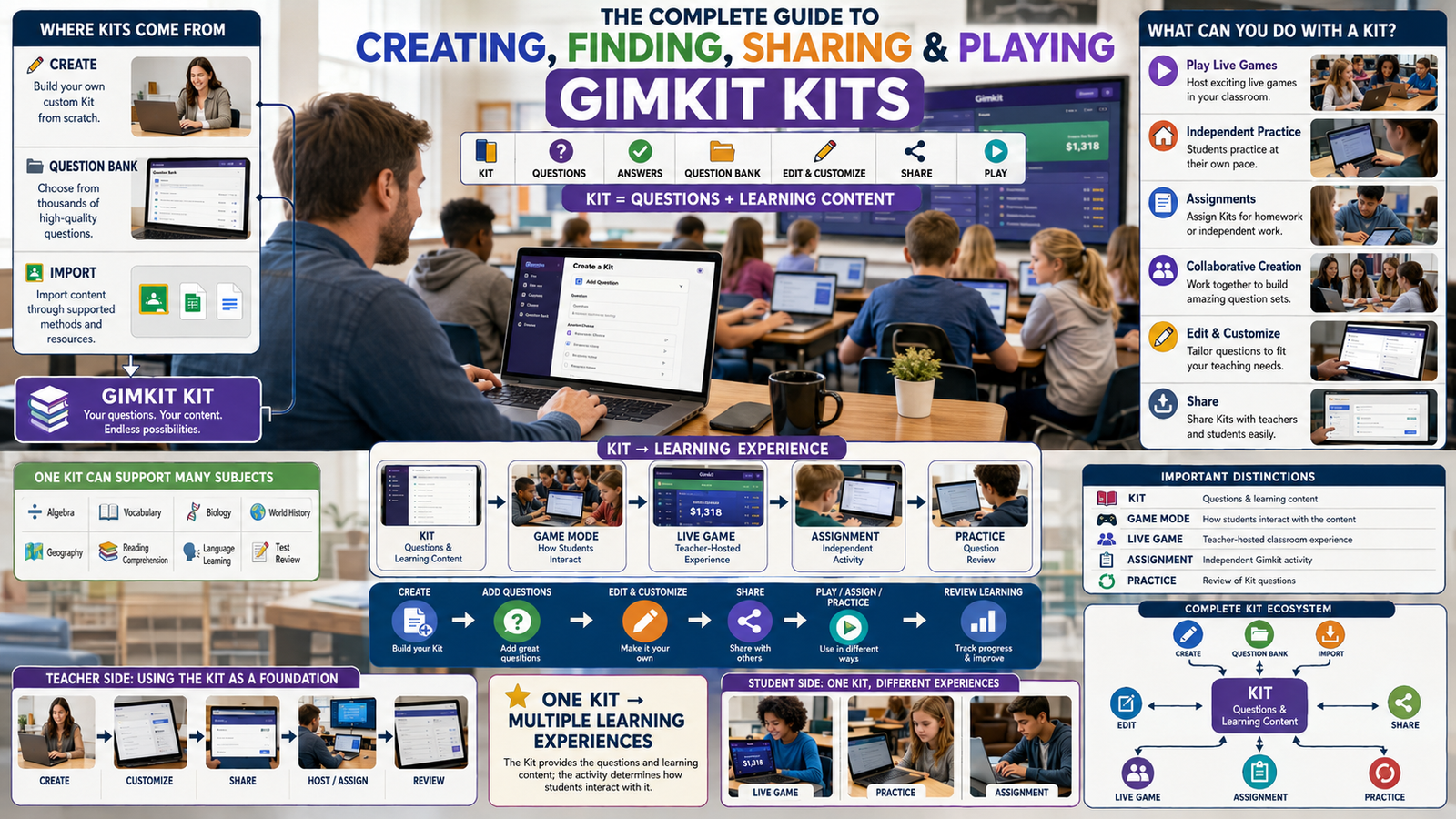
For writing the educational questions that generate bait during play, see the separate Gimkit Questions guide. Question quality and distractor review are different from the fishing economy modeled here.
Official and independently documented Fishtopia mechanics
The official Gimkit Help Center confirms that bait per correct question can be customized. Other details about fish species, historical prices, gear and fishing areas have support from independent school tutorials or community-maintained documentation, which should not be mistaken for a current official game specification.
Understand the bait. Track the fish. Evaluate the purchase.
Fishtopia's fishing economy becomes easier to reason about when bait, inventory, selling and spending are treated as distinct steps rather than one unexplained score.
Return to Fishing Economy Lab ↑