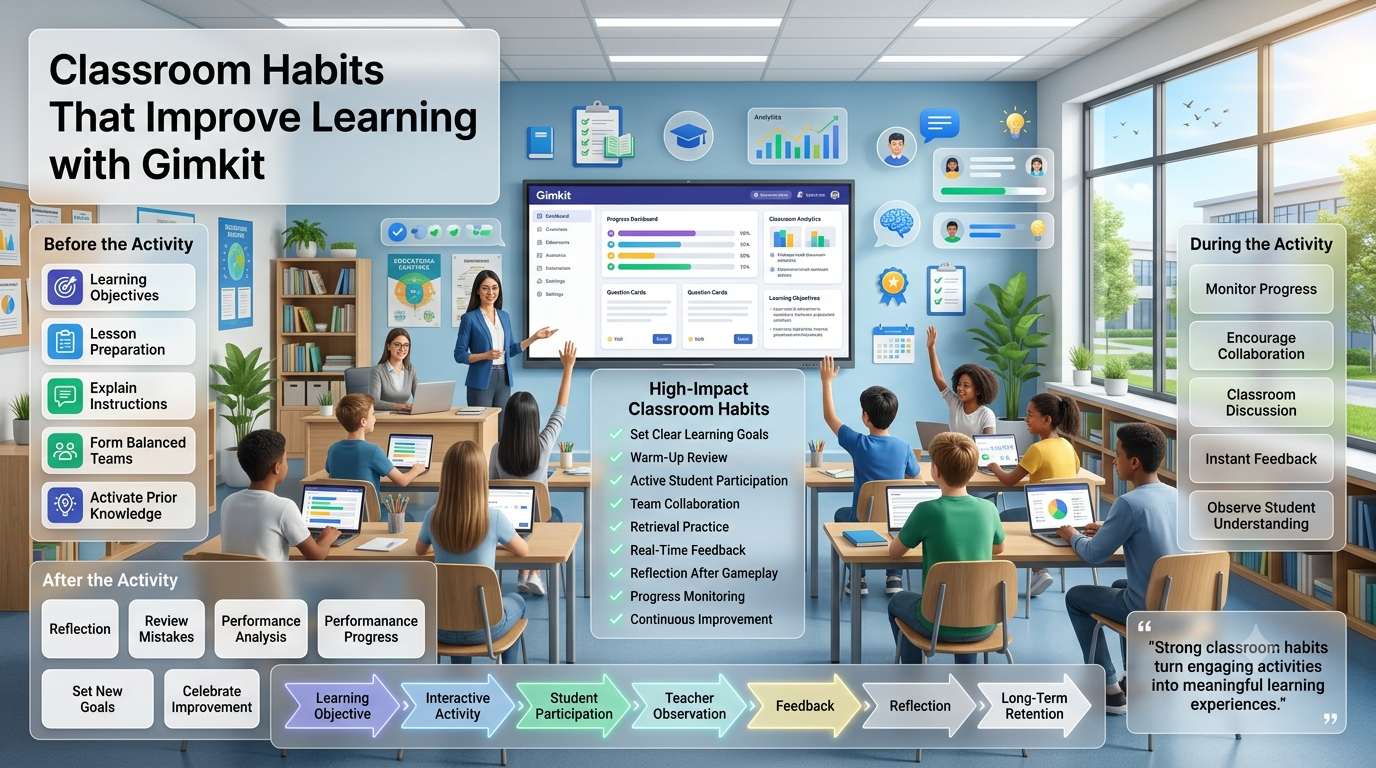
Classroom Habits That Improve Learning with Gimkit-Technology alone does not create meaningful learning outcomes. The way teachers structure classroom routines before, during, and after interactive activities often has a much greater impact than the software itself. While Gimkit provides engaging game-based learning experiences, consistent classroom habits determine whether students simply play games or develop deeper understanding, stronger retention, and lasting academic confidence.
Successful teachers don’t rely on student excitement alone to make Gimkit effective. They build consistent classroom routines that give every game a clear instructional purpose before, during, and after gameplay. Instead of treating Gimkit as just a review activity, they use it to reinforce retrieval practice, monitor student understanding, encourage collaboration, and collect real-time formative assessment data that informs future instruction.
When integrated into a structured teaching strategy, Gimkit becomes more than a classroom game & Gimkit Live learning & earning show is available for you on our athentic Gimkit Live app show —it becomes a tool for improving engagement, strengthening long-term retention, supporting differentiated learning, and promoting active participation across diverse classrooms. The habits explored in this guide reflect proven instructional practices that help educators maximize learning outcomes while maintaining academic rigor, whether teaching elementary, secondary, or higher education students.
Why Classroom Habits Matter More Than Games
The most successful classrooms are built on routines rather than occasional exciting activities. Gimkit can motivate students, but without consistent expectations, its educational impact may be limited to short-term engagement.
Effective classroom habits create structure around every learning activity. Students understand why they are playing, what they should focus on, how success will be measured, and how today’s lesson connects with future learning. Instead of seeing Gimkit as entertainment, they recognize it as an important part of the learning process.
These routines also reduce transition time, improve classroom management, increase participation, and allow teachers to spend more time supporting learning rather than explaining procedures repeatedly.
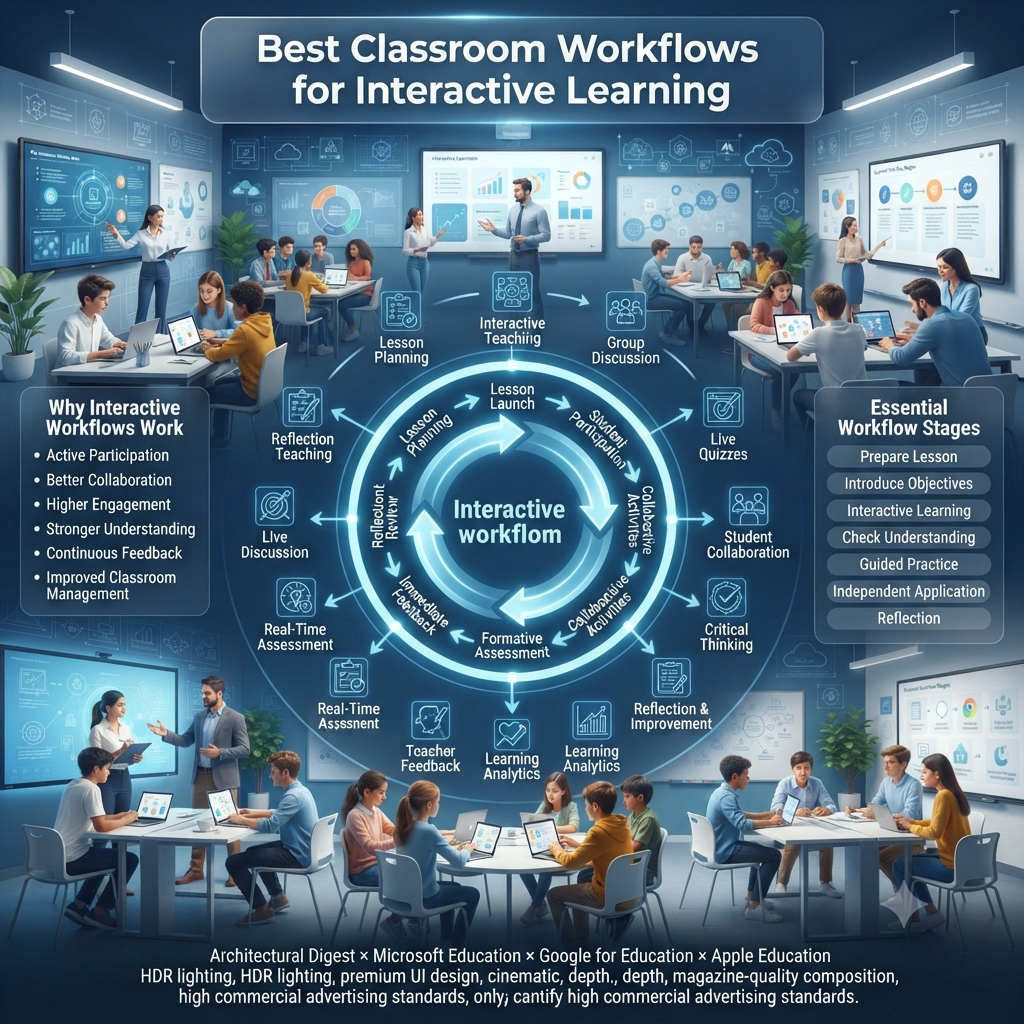
How Gimkit Fits Into Effective Learning Routines
Gimkit works best when it becomes one step within a complete instructional cycle rather than the entire lesson.
A typical learning workflow may include:
Lesson Stage
Purpose
Gimkit’s Role
Introduction
Activate prior knowledge
Warm-up review
Direct Instruction
Teach new concepts
Teacher explanation
Guided Practice
Reinforce learning
Short Gimkit session
Independent Practice
Build mastery
Homework assignment
Assessment
Measure understanding
Performance analysis
Reflection
Identify improvement areas
Discussion and feedback
This structure ensures that gameplay always supports instructional goals instead of replacing meaningful teaching.
The Science Behind Habit-Based Learning
Educational research consistently shows that repeated retrieval strengthens long-term memory more effectively than passive review. Gimkit naturally supports retrieval practice because students repeatedly recall information while answering questions.
However, the greatest learning gains occur when teachers combine gameplay with intentional classroom habits such as:
Daily review routines
Reflection exercises
Goal setting
Error correction
Spaced repetition
Student self-assessment
These habits encourage deeper processing rather than simple memorization.
Preparing Students Before Every Gimkit Session
Students perform better when they know exactly what they are expected to learn before the game begins.
Instead of saying, “Let’s play Gimkit,” consider introducing the activity with a learning objective such as:
“Today’s goal is identifying the causes of the American Revolution. As you answer questions, pay attention to why each event happened rather than simply selecting the correct option.”
This small shift changes student attention from winning points to understanding concepts.
Other effective preparation habits include:
Reviewing today’s objectives
Explaining success criteria
Predicting difficult topics
Activating prior knowledge
Answering initial questions
Creating Consistent Classroom Expectations
Consistency reduces distractions and helps students focus on learning.
Teachers should establish routines covering:
Device use
Noise levels
Respectful competition
Asking for help
Handling technical issues
Staying academically honest
When expectations remain consistent, students spend less mental energy understanding classroom procedures and more energy learning content.
Establishing Clear Learning Goals
Every Gimkit activity should answer one simple question:
What should students know or be able to do after this game?
Learning goals might include:
Mastering vocabulary
Practicing multiplication facts
Reviewing scientific processes
Identifying historical events
Strengthening reading comprehension
Specific goals allow teachers to evaluate learning instead of measuring only scores.
Building Retrieval Practice Into Daily Lessons
Retrieval practice strengthens memory by encouraging students to recall information instead of rereading notes.
Teachers can integrate Gimkit through daily routines such as:
Morning review
Five-minute warmups
Weekly cumulative quizzes
Friday knowledge checks
Homework reinforcement
Monthly revision games
Repeated retrieval over several weeks helps students remember information far longer than last-minute cramming.
Encouraging Productive Competition
Competition increases motivation when managed appropriately.
Healthy competition emphasizes:
Personal improvement
Team success
Growth mindset
Learning progress
Unhealthy competition focuses only on rankings, causing some students to lose confidence.
Teachers can reduce negative pressure by celebrating improvement, persistence, teamwork, and thoughtful problem-solving rather than only first place.
Promoting Collaboration Without Losing Accountability
Collaborative learning encourages students to explain concepts to one another, strengthening understanding through discussion.
Effective collaboration includes:
Partner problem solving
Small-group review
Team-based game modes
Peer explanation
Strategy discussions
Individual accountability should still remain important by ensuring each student answers questions independently at appropriate times.
Using Reflection After Every Game
Reflection is often the most overlooked part of game-based learning.
After completing a Gimkit session, teachers can ask questions such as:
Which questions were most difficult?
Why were those concepts confusing?
What strategies helped you answer correctly?
Which topics require additional practice?
These discussions transform game results into actionable learning plans.
Supporting Different Learning Levels
Every classroom includes students with different backgrounds, abilities, and confidence levels.
Teachers can improve inclusivity by:
Providing additional review materials
Assigning differentiated practice
Offering flexible pacing
Encouraging peer support
Monitoring struggling learners closely
Differentiated instruction ensures every student experiences appropriate challenge without unnecessary frustration.
Creating Healthy Technology Habits
Digital tools work best when students use them responsibly.
Teachers should encourage habits such as:
Staying on task
Respecting classmates
Avoiding distractions
Caring for school devices
Reporting technical problems immediately
These routines improve digital citizenship alongside academic learning.
Managing Classroom Time Efficiently
One common mistake is allowing games to consume the entire lesson.
Experienced teachers often divide lessons into smaller instructional blocks:
Mini Lesson
      ↓
Guided Practice
      ↓
Gimkit Review
      ↓
Reflection
      ↓
Exit Ticket
This workflow balances engagement with instruction.
Helping Students Learn From Mistakes
Incorrect answers provide valuable instructional opportunities.
Instead of moving on immediately, teachers should review:
Why the answer was incorrect
Common misconceptions
Correct reasoning
Similar examples
Strategies for future success
Students become more confident when mistakes are treated as learning opportunities instead of failures.
Using Student Data to Improve Instruction
Gimkit performance data can guide future teaching decisions.
Teachers may identify:
Frequently missed questions
Difficult standards
Class-wide misconceptions
Individual intervention needs
Students ready for enrichment
Using assessment data regularly creates more targeted instruction than relying solely on intuition.
Building Long-Term Learning Habits
Successful learners gradually develop independent study behaviors.
Teachers can encourage students to:
Review regularly
Track personal progress
Set weekly goals
Reflect on mistakes
Practice consistently
Ask meaningful questions
These habits extend beyond Gimkit and support lifelong learning.
Common Classroom Mistakes
Several habits reduce the educational value of game-based learning.
Expert Recommendations | 50 + Game Journalist Reviews
Teachers who consistently achieve strong learning outcomes with Gimkit usually treat it as one component of a broader instructional system rather than a standalone activity. They define learning objectives before each session, review misconceptions immediately after gameplay, and use performance data to shape upcoming lessons. Short, purposeful review sessions integrated into regular instruction generally produce better long-term retention than infrequent, lengthy game sessions.
It is also beneficial to vary classroom routines throughout the semester. Alternating between individual review, collaborative challenges, homework assignments, and reflection activities helps maintain student motivation while exposing learners to multiple ways of processing information. This balanced approach supports both engagement and academic growth.
Classroom Habits That Improve Learning with Gimkit begin with establishing clear learning objectives before every activity. Students participate more effectively when they understand what concepts they are expected to practice and why the lesson matters.
Classroom Habits That Improve Learning with Gimkit encourage consistent participation rather than occasional gameplay. Regular review sessions help reinforce important concepts and strengthen long-term knowledge retention.
Classroom Habits That Improve Learning with Gimkit emphasize reading every question carefully before answering. Prioritizing accuracy over speed improves both academic understanding and overall classroom performance.
Classroom Habits That Improve Learning with Gimkit recommend discussing challenging questions after each activity. Classroom conversations help students understand correct answers and reinforce deeper conceptual learning.
Classroom Habits That Improve Learning with Gimkit encourage students to focus on personal improvement instead of comparing themselves only with classmates on the leaderboard.
Classroom Habits That Improve Learning with Gimkit demonstrate that reviewing incorrect answers immediately helps students correct misconceptions while the lesson is still fresh in their minds.
Classroom Habits That Improve Learning with Gimkit highlight the importance of consistent classroom routines, making interactive review a predictable and valuable part of the learning process.
Classroom Habits That Improve Learning with Gimkit encourage students to set achievable academic goals, such as improving answer accuracy or mastering difficult topics over time.
Classroom Habits That Improve Learning with Gimkit recommend balancing competitive activities with collaborative learning experiences so students develop both confidence and teamwork skills.
Classroom Habits That Improve Learning with Gimkit demonstrate that thoughtful teacher guidance remains essential for connecting gameplay with meaningful curriculum objectives.
Classroom Habits That Improve Learning with Gimkit encourage students to participate actively throughout every session rather than becoming discouraged by temporary mistakes or leaderboard positions.
Classroom Habits That Improve Learning with Gimkit highlight that regular formative assessment allows teachers to identify learning gaps before they become larger academic challenges.
Classroom Habits That Improve Learning with Gimkit recommend using performance reports to adjust future lessons according to student progress and classroom needs.
Classroom Habits That Improve Learning with Gimkit encourage respectful classroom competition where students celebrate improvement, persistence, and learning rather than focusing only on winning.
Classroom Habits That Improve Learning with Gimkit demonstrate that revisiting important concepts across multiple review sessions significantly improves long-term retention and academic confidence.
Classroom Habits That Improve Learning with Gimkit highlight the value of preparing quality question sets that accurately reflect current classroom instruction and curriculum standards.
Classroom Habits That Improve Learning with Gimkit encourage students to reflect on their own performance after each activity, identifying strengths and setting goals for continued improvement.
Classroom Habits That Improve Learning with Gimkit recommend combining interactive review with classroom discussion, written practice, and teacher explanations for a balanced learning experience.
Classroom Habits That Improve Learning with Gimkit demonstrate that positive classroom habits develop gradually through consistency, meaningful feedback, and well-structured instructional planning.
Classroom Habits That Improve Learning with Gimkit ultimately show that lasting educational success comes from combining consistent participation, thoughtful lesson planning, accurate formative assessment, constructive feedback, collaborative learning, and purposeful classroom routines.
Classroom Habits That Improve Learning with Gimkit encourage students to arrive prepared by reviewing recent lessons before participating in classroom activities, leading to more confident and accurate responses.
Classroom Habits That Improve Learning with Gimkit demonstrate that short, focused review sessions often produce better learning outcomes than lengthy activities that reduce student concentration.
Classroom Habits That Improve Learning with Gimkit highlight the importance of encouraging questions during and after gameplay so students fully understand difficult concepts instead of memorizing answers.
Classroom Habits That Improve Learning with Gimkit recommend rotating game modes regularly to maintain student interest while supporting different instructional objectives throughout the semester.
Classroom Habits That Improve Learning with Gimkit encourage teachers to recognize individual progress, reinforcing continuous improvement rather than rewarding only the highest-performing students.
Classroom Habits That Improve Learning with Gimkit demonstrate that students develop stronger learning habits when classroom review becomes a consistent part of weekly instruction.
Classroom Habits That Improve Learning with Gimkit highlight that meaningful learning occurs when every activity is directly connected to current curriculum standards and classroom objectives.
Classroom Habits That Improve Learning with Gimkit recommend using classroom analytics to identify concepts requiring additional instruction before moving to more advanced topics.
Classroom Habits That Improve Learning with Gimkit encourage students to maintain a growth mindset by viewing incorrect answers as opportunities to strengthen understanding rather than as failures.
Classroom Habits That Improve Learning with Gimkit demonstrate that combining independent practice with collaborative review helps address a wider range of learning preferences.
Classroom Habits That Improve Learning with Gimkit encourage teachers to end every review session with a brief recap, reinforcing key concepts while clarifying any misunderstandings before introducing new material.
Classroom Habits That Improve Learning with Gimkit demonstrate that students remain more engaged when classroom expectations, participation guidelines, and learning objectives are communicated clearly before each activity begins.
Classroom Habits That Improve Learning with Gimkit highlight the importance of maintaining a balanced classroom environment where interactive learning complements direct instruction, independent practice, and collaborative discussions.
Classroom Habits That Improve Learning with Gimkit recommend using long-term performance trends instead of single-game results to evaluate student progress and make informed instructional decisions.
Classroom Habits That Improve Learning with Gimkit encourage students to celebrate consistent improvement, persistence, and mastery of challenging concepts, fostering confidence and a lifelong commitment to learning.
Classroom Habits That Improve Learning with Gimkit ultimately demonstrate that the most effective classrooms combine structured routines, curriculum-aligned review, continuous feedback, differentiated instruction, and active student participation.
Classroom Habits That Improve Learning with Gimkit highlight the value of regular reflection, allowing students to evaluate their progress and establish meaningful academic goals.
Classroom Habits That Improve Learning with Gimkit recommend creating a positive learning environment where participation, curiosity, and respectful collaboration are consistently encouraged.
Classroom Habits That Improve Learning with Gimkit encourage educators to update review activities regularly so classroom content remains relevant, accurate, and aligned with ongoing instruction.
Classroom Habits That Improve Learning with Gimkit demonstrate that consistent reinforcement of key concepts across multiple lessons improves both confidence and long-term knowledge retention.
Classroom Habits That Improve Learning with Gimkit ultimately confirm that successful classroom habits are built through structured routines, purposeful review, meaningful feedback, continuous formative assessment, and strong teacher guidance.
Frequently Asked Questions
What is the 80/20 rule for teachers?
The 80/20 rule, also known as the Pareto Principle, suggests that approximately 20% of teaching strategies produce 80% of student learning outcomes. While the exact percentages aren’t literal classroom measurements, the principle encourages teachers to focus on the instructional methods that consistently deliver the greatest educational impact.
Instead of trying to use every available teaching technique, successful educators prioritize activities that improve understanding, retention, and classroom participation. Research on active learning consistently shows that students remember more when they actively retrieve information, discuss concepts, solve problems, and receive immediate feedback rather than passively listening for an extended period.
Educational platforms like Gimkit often support this philosophy because they encourage retrieval practice while providing instant feedback and performance data that teachers can use to refine future lessons.
High-Impact vs Low-Impact Classroom Activities
High-Impact Practices (The Valuable 20%)
Lower-Impact Practices When Overused
Retrieval practice
Passive note copying
Classroom discussion
Long uninterrupted lectures
Immediate feedback
Delayed grading weeks later
Formative assessment
Memorizing without application
Collaborative learning
Repetitive worksheets
Active review games
Reading slides word-for-word
How teachers can apply the 80/20 rule
Identify lessons where students struggle most.
Spend more instructional time on core concepts instead of minor details.
Use formative assessment to guide future teaching.
Replace repetitive activities with active learning.
Analyze student performance regularly to improve lesson planning.
Prioritize quality of instruction over quantity of assignments.
When applied consistently, the 80/20 rule helps teachers maximize instructional time while reducing unnecessary classroom workload.
What are the pros and cons of Gimkit?
Gimkit has become one of the most popular classroom review platforms because it combines formative assessment with game-based learning. However, like any educational technology, its effectiveness depends on how teachers integrate it into instruction rather than simply how often it is used.
The platform excels at increasing participation, improving review sessions, and providing immediate learning analytics. At the same time, teachers should recognize situations where traditional instruction may be more appropriate.
Gimkit Advantages and Limitations
Advantages
Limitations
Highly engaging gameplay
Premium features require subscription
Immediate feedback
Competition may distract some students
Detailed performance reports
Not every subject fits game-based review
Supports homework assignments
Requires internet-connected devices
Multiple game modes
Can lose novelty if overused
Encourages retrieval practice
Should not replace direct instruction
Biggest educational benefits
Increases classroom participation.
Makes revision more enjoyable.
Encourages repeated knowledge retrieval.
Provides teachers with actionable assessment data.
Supports both in-person and remote learning.
Works well for individual and collaborative learning.
Potential challenges
Some students focus more on game rewards than learning.
Highly competitive learners may rush through questions.
Teachers need well-designed question sets to maximize learning.
Digital tools should complement—not replace—traditional instruction.
When balanced with discussions, projects, writing activities, and direct instruction, Gimkit becomes a valuable instructional resource rather than simply another classroom game.
What is the 10-minute rule in teaching?
The 10-minute rule suggests that students naturally begin losing attention after approximately ten minutes of continuous instruction. While attention spans vary by age and learning environment, educational research consistently recommends changing instructional activities periodically to maintain engagement.
Instead of lecturing for an entire class period, teachers introduce planned instructional transitions that reactivate student thinking.
Example of a 40-minute lesson
Time
Activity
0–10 min
Introduce new concept
10–15 min
Ask discussion questions
15–25 min
Guided practice
25–30 min
Gimkit review activity
30–40 min
Reflection and summary
Effective instructional transitions
Quick quizzes
Think-Pair-Share discussions
Polling activities
Educational games
Small-group collaboration
Problem-solving exercises
Reflection writing
Changing learning activities regularly helps students maintain concentration while improving long-term knowledge retention.
How long can a Gimkit game last?
There is no single “best” game length because the ideal duration depends on learning objectives, student age, and classroom schedule. Rather than maximizing playtime, teachers should focus on maintaining educational value throughout the activity.
Recommended Game Length
Classroom Goal
Recommended Duration
Bell-ringer review
5–8 minutes
Vocabulary practice
8–12 minutes
Daily lesson review
10–15 minutes
Unit review
15–25 minutes
Exam preparation
20–30 minutes
Special classroom events
Up to 40 minutes
Best practices
Match game length to lesson objectives.
Stop while engagement remains high.
Avoid repetitive question sets.
Reserve longer sessions for major reviews.
Include post-game discussion to reinforce learning.
The educational quality of the questions matters far more than the total number of minutes students spend playing.
How often should teachers use Gimkit in class?
Most education specialists recommend using game-based learning strategically rather than daily. Maintaining instructional variety prevents digital fatigue while preserving student excitement.
Suggested Weekly Schedule
Grade Level
Recommended Frequency
Elementary
1–2 sessions per week
Middle School
2–3 sessions per week
High School
1–3 sessions per week
Ideal classroom uses
Lesson reviews
Vocabulary reinforcement
Exit tickets
Exam preparation
Homework practice
Formative assessment
Avoid overuse by balancing with
Class discussions
Writing assignments
Laboratory activities
Reading comprehension
Project-based learning
Peer collaboration
Students remain more engaged when Gimkit is one part of a diverse instructional strategy rather than the centerpiece of every lesson.
Should every Gimkit game be graded?
No. Most educators recommend using Gimkit primarily as a formative assessment rather than a high-stakes grading tool.
Formative activities encourage students to take risks, learn from mistakes, and practice difficult concepts without worrying about damaging their final grades.
When grading makes sense
Grade Activity
Recommended?
Daily practice
No
Homework completion
Sometimes
Participation points
Yes
Unit review
Sometimes
High-stakes exam
No
Low-stakes quiz
Yes
Why many teachers avoid grading every game
Reduces student anxiety.
Encourages experimentation.
Promotes growth mindset.
Focuses attention on learning.
Creates opportunities for improvement.
The most effective classrooms combine formative review sessions with carefully designed summative assessments.
How can teachers prevent students from focusing only on winning?
Competition increases motivation, but learning should always remain the primary objective.
Teachers can create a healthier classroom culture by rewarding improvement, collaboration, and thoughtful thinking instead of only recognizing leaderboard rankings.
Strategies that keep learning first
Strategy
Educational Benefit
Discuss learning goals before playing
Sets clear expectations
Review incorrect answers afterward
Reinforces understanding
Rotate game modes
Prevents repetitive competition
Use team games
Encourages collaboration
Celebrate improvement
Builds confidence
Analyze reports together
Focuses on learning growth
Classroom tips
Praise accuracy instead of speed.
Highlight progress over rankings.
Encourage students to explain their answers.
Pause games to discuss misconceptions.
Use leaderboard results only as one measure of participation.
Students learn more effectively when success is defined by understanding rather than simply finishing first.
What should teachers do after students finish a Gimkit session?
The game itself represents only one part of the instructional process. The greatest learning gains often occur during the reflection that follows.
Post-Game Teaching Checklist
Step
Purpose
Review performance reports
Identify learning gaps
Analyze difficult questions
Correct misconceptions
Discuss common mistakes
Reinforce understanding
Group students by needs
Differentiate instruction
Assign follow-up practice
Strengthen weak areas
Reflect on lesson objectives
Improve future teaching
Recommended follow-up activities
Classroom discussion
Error analysis
Small-group instruction
Exit tickets
Additional practice
Student reflection journals
Using assessment data after gameplay transforms Gimkit from entertainment into a powerful instructional tool.
Can Gimkit support students with different ability levels?
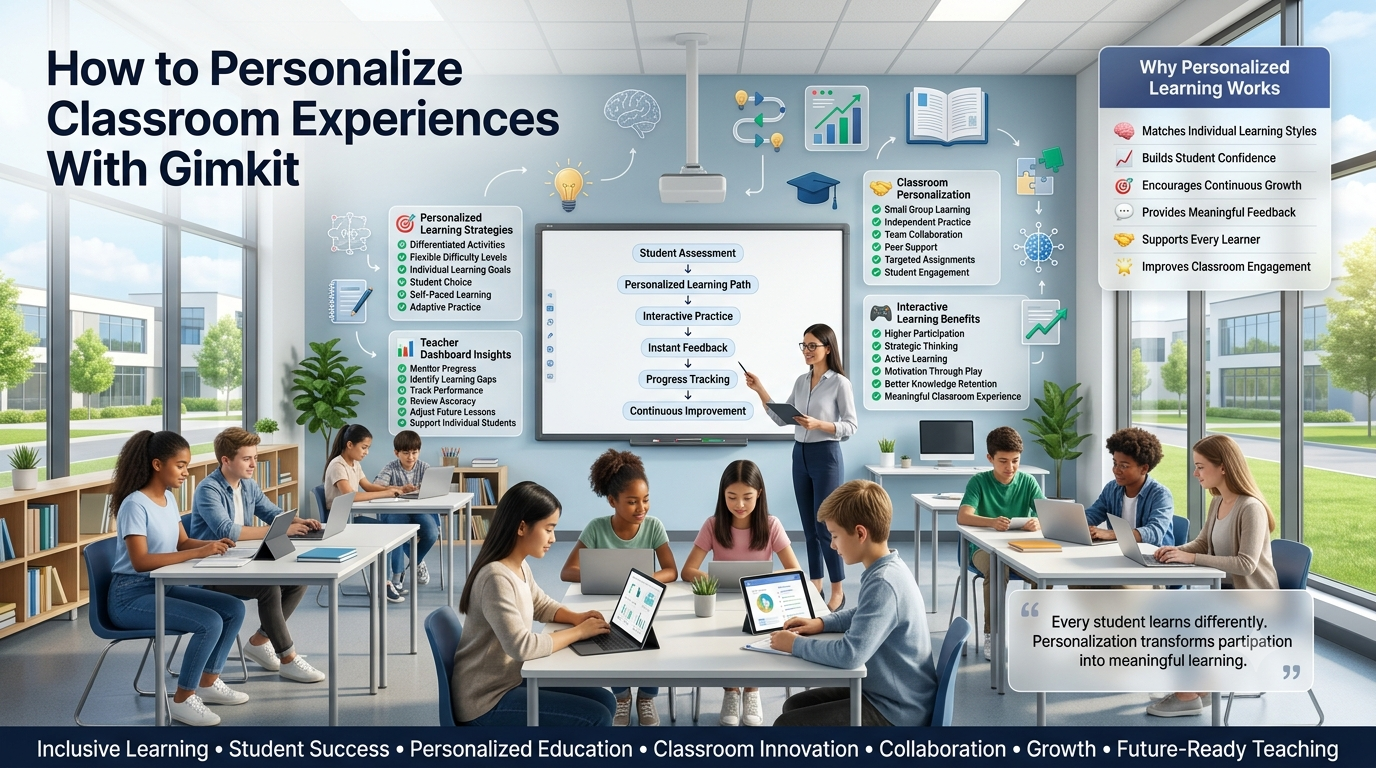
Yes. Gimkit is particularly effective in mixed-ability classrooms because it allows teachers to create differentiated learning experiences while collecting detailed performance data.
Students receive immediate feedback after every question, allowing them to recognize mistakes and improve without waiting for graded assignments.
How Gimkit supports diverse learners
Student Need
Gimkit Benefit
Struggling learners
Immediate corrective feedback
Advanced learners
Challenging question sets
English language learners
Repeated vocabulary exposure
Independent learners
Self-paced assignments
Remote learners
Flexible online access
Mixed-ability classrooms
Individual progress tracking
Differentiation strategies
Create multiple difficulty levels.
Assign personalized practice sets.
Analyze reports to identify support needs.
Combine gameplay with teacher-led instruction.
Use small-group interventions after reviewing results.
Allow repeated practice before formal assessments.
When combined with strong instructional planning, Gimkit helps teachers personalize learning while making assessment more engaging, data-driven, and inclusive for every student.
Conclusion
Strong classroom habits are the foundation of successful game-based learning. While Gimkit captures attention through interactive gameplay, long-term academic growth depends on how teachers integrate it into purposeful instructional routines. Clear objectives, consistent expectations, reflective discussions, retrieval practice, and data-informed teaching transform simple review games into powerful learning experiences.
When students regularly prepare before gameplay, engage thoughtfully during activities, and reflect afterward, they develop habits that extend well beyond a single lesson. Over time, these routines foster deeper understanding, greater confidence, stronger retention, and a classroom culture where technology enhances learning instead of distracting from it.