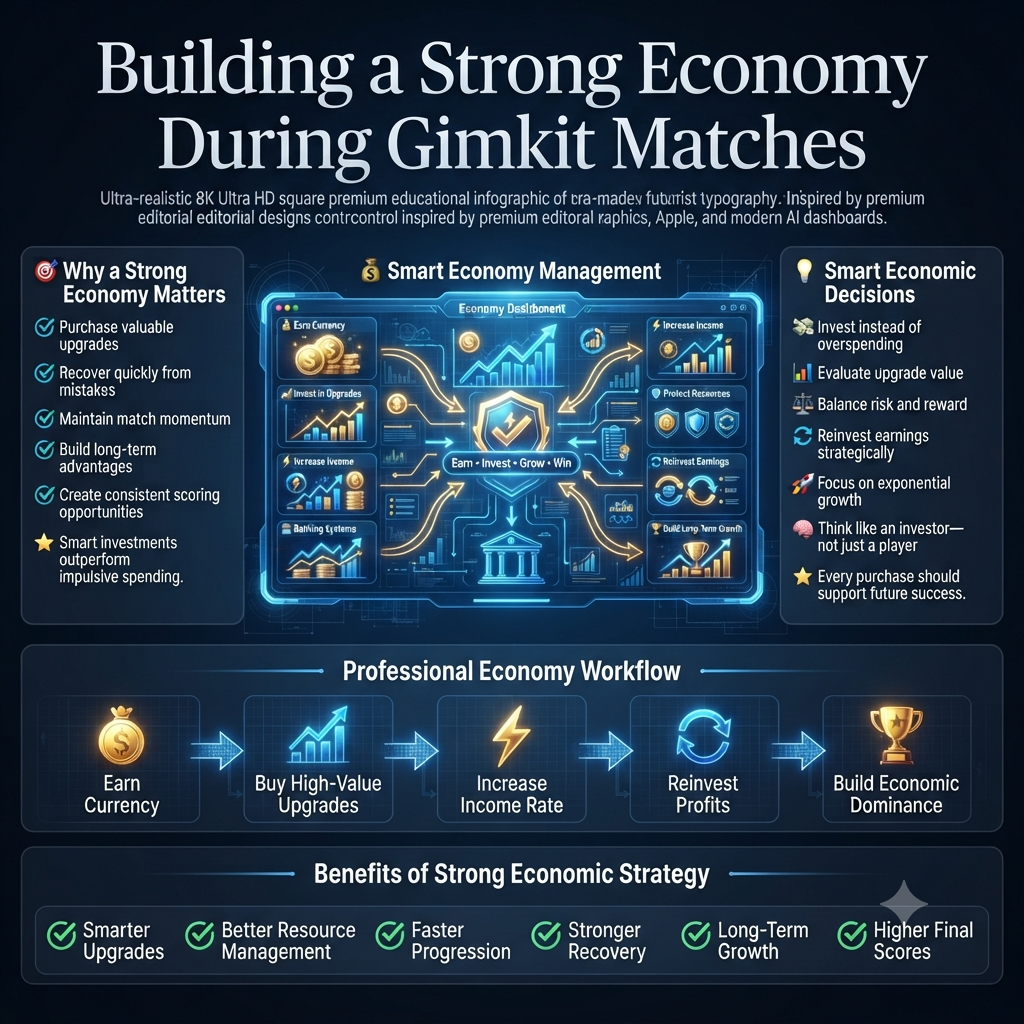
Building a Strong Economy During Matches | Winning consistently in Gimkit is rarely about answering the most questions correctly. In most competitive game modes, success depends on how effectively players build, protect, and grow their in-game economy.
A strong economy provides the resources needed to purchase upgrades, recover from setbacks, outperform opponents, and maintain momentum throughout the match.
🎯 Smart Economic Decisions
💸 Purchase Upgrades – Invest resources to strengthen your gameplay.
🔄 Recover From Setbacks – Maintain enough resources to bounce back after mistakes.
🏆 Outperform Opponents – Use smart spending to gain a competitive advantage.
⚡ Maintain Momentum – Keep your progress steady throughout the match.
Many beginners spend money as soon as they earn it, while experienced players think like investors. Every purchase is evaluated based on its potential return, every upgrade supports a broader strategy, and every decision contributes to long-term growth rather than short-term excitement.
Whether you’re playing individually, competing in teams, or participating in classroom review sessions, understanding economic strategy helps transform random gameplay into consistent performance.
Looking for comprehensive classroom resources and educational technology insights? Explore GimkitApp for expert guides, teaching strategies, game modes, and the latest updates to enhance student engagement.
💡 What Does “Economy” Mean in Gimkit?
In Gimkit, your economy refers to the complete system of earning, managing, investing, and spending your in-game cash. Rather than focusing only on how much money you currently have, a strong economy measures how efficiently you turn every correct answer into future earning potential.
Think of it as a cycle:
Correct Answers
        ↓
Earn Cash
        ↓
Invest in Upgrades
        ↓
Earn More Per Question
        ↓
Increase Total Income
        ↓
Unlock Better Opportunities
        ↓
Repeat
Players with healthy economies don’t simply accumulate money—they continuously increase the speed at which they generate it.
🧠 Why Economy Matters More Than Speed
Many new players assume the fastest answerer automatically wins. In reality, two players with similar accuracy can finish with dramatically different scores depending on how they manage their resources.
Consider this simple example:
Player A
Player B
Answers quickly
Answers steadily
Spends randomly
Invests strategically
Buys expensive upgrades immediately
Builds income first
Cash growth slows
Cash growth accelerates
Falls behind later
Dominates late game
Although Player A may lead early, Player B’s stronger economy often creates exponential growth, allowing them to overtake opponents during the middle and final stages of the match.
⭐ Expert Insight: Strong economic management becomes increasingly valuable in longer Gimkit sessions, where compound growth has more time to outperform short-term gains.
📈 Understanding the Economic Growth Cycle
Successful players recognize that every match follows an economic progression rather than a random sequence of purchases.
🌱 Stage 1: Build Initial Income
The opening minutes establish your financial foundation.
Focus on:
Answering accurately
Avoiding unnecessary risks
Generating consistent earnings
Learning the game’s pace
Early mistakes are usually recoverable, but poor spending decisions can slow your economy for the rest of the match.
🚀 Stage 2: Invest for Growth
Instead of purchasing whatever looks appealing, prioritize upgrades that increase future income.
Examples include:
Higher earnings per correct answer
Faster earning opportunities
Income multipliers
Bonus reward upgrades
Features that improve long-term efficiency
Every investment should ideally help generate more money than it costs over time.
💡 Pro Tip: Ask yourself one simple question before buying anything:
“Will this help me earn more money over the next several minutes?”
If the answer is no, it may not be the right purchase yet.
⚖ Stage 3: Balance Income and Protection
As matches become more competitive, protecting your economy becomes just as important as growing it.
A balanced player invests in:
Income generation
Defensive improvements (when applicable)
Recovery options
Strategic flexibility
Ignoring defense can erase several minutes of careful economic progress.
🏆 Stage 4: Convert Wealth Into Victory
Late-game decisions differ from early-game strategy.
Instead of maximizing future income, focus on converting your accumulated resources into:
Match-winning upgrades
Strategic advantages
Defensive stability
Final scoring opportunities
The best investment changes as the match progresses.
💰 Smart Spending vs. Random Spending
One of the biggest differences between beginners and experienced Gimkit players is intentional decision-making.
Smart Spending
Random Spending
Plans ahead
Buys immediately
Prioritizes return on investment
Chooses exciting upgrades
Supports long-term strategy
Focuses on short-term benefits
Maintains flexibility
Runs out of cash frequently
Creates steady growth
Causes inconsistent progress
Experienced players rarely spend simply because they can—they spend because the purchase strengthens their overall strategy.
📊 Prioritizing High-Value Investments
Not every upgrade contributes equally to your long-term economy.
A practical decision framework looks like this:
Priority
Investment Goal
Why It Matters
⭐⭐⭐⭐⭐
Increase earning potential
Builds long-term growth
⭐⭐⭐⭐
Improve efficiency
Generates faster returns
⭐⭐⭐
Defensive improvements
Protects existing progress
⭐⭐
Situational advantages
Useful in specific scenarios
⭐
Cosmetic or low-impact purchases
Minimal strategic value
Rather than chasing every available option, successful players identify upgrades that consistently improve earning efficiency across the entire match.
🧮 Mastering Return on Investment (ROI) in Gimkit Economy
One of the biggest mindset shifts that separates casual players from consistently successful ones is learning to think in terms of Return on Investment (ROI) instead of immediate rewards. Every coin you spend should ideally generate more value later in the match.
Simply having more money doesn’t guarantee success. What matters is how effectively your money works for you.
📌 What Is ROI?
Return on Investment (ROI) measures whether an upgrade eventually earns back more than its purchase cost.
If you answer enough questions to earn back the $500, everything earned afterward becomes pure profit. The earlier you make profitable investments, the longer they continue generating value throughout the match.
💡 Pro Tip: Upgrades with strong long-term earning potential usually provide the highest overall value when purchased early rather than near the end of a game.
⏰ Timing Matters More Than the Upgrade Itself
Even an excellent upgrade can become a poor investment if purchased too late.
Consider these situations:
Situation
Result
Purchase income upgrade early
Benefits throughout most of the match
Purchase the same upgrade near the end
Limited time to recover its cost
Delay profitable investments
Slower economic growth
Invest consistently throughout the game
Compound earning potential increases
Experienced players understand that timing and opportunity often matter more than the upgrade’s price.
⭐ Expert Insight: Many competitive matches are decided not by who buys the strongest upgrades, but by who buys the right upgrades at the right time.
📈 Build Momentum Through Compound Growth
A healthy Gimkit economy grows much like compound interest.
Each smart investment increases your ability to earn, which allows you to purchase better upgrades, creating an even faster income cycle.
The progression often looks like this:
Correct Answers
        ↓
Earn More Cash
        ↓
Purchase Better Upgrades
        ↓
Increase Income Rate
        ↓
Earn Even More Cash
        ↓
Access Stronger Advantages
        ↓
Continue Expanding Economy
Players who maintain this cycle often appear to “pull ahead” suddenly, when in reality they have been building economic momentum since the opening minutes.
⚖️ Balancing Saving and Spending
Another common misconception is that saving every coin is always the best strategy.
In reality, both overspending and over-saving can reduce your overall performance.
Spending Too Quickly ❌
Problems include:
Running out of resources
Limited flexibility
Difficulty recovering from setbacks
Missing future opportunities
Saving Too Much ❌
Problems include:
Missed earning opportunities
Slower economic growth
Falling behind opponents who invest earlier
Reduced competitive advantage
The Ideal Balance ✅
Strong players usually follow a balanced approach:
Save with a purpose.
Spend when the investment improves future earnings.
Keep enough resources available for important opportunities.
Avoid emotional purchases.
🎯 Adapting Your Economy to Different Match Situations
No two Gimkit matches develop in exactly the same way. Flexible players adjust their spending strategy based on the current game state rather than following a fixed routine.
🟢 When You’re Leading
If you’ve built an economic advantage:
Continue investing wisely.
Avoid unnecessary risks.
Protect your existing lead.
Focus on maintaining consistent income.
The objective isn’t flashy spending—it’s preserving the advantage you’ve already earned.
🟡 When You’re in the Middle of the Pack
This is where disciplined decision-making becomes crucial.
Priorities should include:
Improving earning efficiency
Avoiding panic spending
Looking for high-value investments
Maintaining steady progress
Many matches are won from this position through better economic management over time.
🔴 When You’re Behind
Being behind financially doesn’t necessarily mean the match is lost.
Instead of making desperate purchases:
Focus on answering accurately.
Invest in upgrades that improve earning potential.
Avoid wasting resources on low-impact options.
Build momentum gradually rather than chasing instant recovery.
⚠️ Common Mistake: Players who panic often spend everything immediately, making it even harder to recover.
🤝 Team Economy: Winning Together Instead of Individually
In team-based Gimkit modes, personal success and team success are closely connected.
Strong teams benefit when players:
Maintain consistent individual economies.
Avoid unnecessary losses.
Coordinate strategies when appropriate.
Focus on collective objectives rather than personal statistics.
A team with balanced economic growth is often more resilient than one relying on a single high-performing player.
📌 Quick Note: Consistency across the entire team usually creates better long-term results than one player carrying the match alone.
🚫 Common Economic Mistakes That Slow Progress
Even skilled players occasionally damage their economy through avoidable habits.
Mistake
Why It Hurts
Better Alternative
Spending immediately after every reward
Prevents strategic planning
Evaluate purchases before buying
Ignoring income-focused upgrades
Limits future earning potential
Prioritize sustainable growth
Chasing expensive upgrades too early
Reduces flexibility
Build a stable financial base first
Saving everything indefinitely
Misses valuable investment opportunities
Invest when ROI is favorable
Copying other players blindly
Different situations require different strategies
Adapt to your own match conditions
Making emotional decisions
Leads to inconsistent progress
Stay patient and follow your plan
Avoiding these mistakes alone can significantly improve long-term match performance, even without changing your answering speed or accuracy.
For the latest gaming news, expert reviews, and walkthroughs, readers can also visit IGN, one of the world’s leading gaming websites.
🏆 Advanced Economy Strategies Used by Experienced Gimkit Players
Once you’ve mastered the basics of earning and spending, the next step is learning how experienced players think several moves ahead. They don’t simply react to what is happening—they build an economic plan that adapts throughout the entire match.
The goal is no longer just making money, but making better financial decisions than your opponents.
🧠 Think Like an Investor, Not a Shopper
One of the biggest differences between beginners and advanced players is their mindset.
Beginners often ask:
“What can I buy right now?”
Experienced players ask:
“Which purchase will make every future question more valuable?”
This small shift changes every spending decision.
Instead of focusing on immediate satisfaction, advanced players prioritize upgrades that continue providing value long after they’re purchased.
💡 Pro Tip: Every coin spent should have a clear purpose. If you can’t explain why you’re making a purchase, it’s probably worth waiting.
📅 Create an Economy Plan Before the Match Starts
Although every Gimkit game unfolds differently, having a simple financial roadmap prevents impulsive decisions.
A practical strategy might look like this:
Match Phase
Primary Goal
Spending Priority
Early Game
Build consistent income
High ROI earning upgrades
Mid Game
Expand earning efficiency
Balance income and protection
Late Game
Secure the win
Match-winning strategic upgrades
Final Moments
Maximize remaining opportunities
Spend according to current objectives
Having a plan doesn’t mean following it blindly. It provides a framework that can be adjusted as the match evolves.
⚡ Avoid the “Upgrade Trap”
One of the most common mistakes is assuming that the most expensive upgrade is automatically the best.
In reality:
Expensive doesn’t always mean efficient.
Early affordability doesn’t always mean good value.
Some upgrades deliver immediate impact.
Others only become valuable in longer matches.
Before purchasing, ask yourself:
✅ Will this improve my earning rate?
✅ Will I recover the investment before the game ends?
✅ Does this purchase fit my current strategy?
If the answer is uncertain, delaying the purchase may be the smarter option.
⚠️ Common Mistake: Players often spend their entire balance on one flashy upgrade and then struggle because they lack the resources to adapt later.
🎯 Adapt Your Economy to Different Gimkit Game Modes
Different game modes reward different economic strategies. A flexible player adjusts spending priorities based on how the match is designed rather than using the same approach every time.
Game Mode Situation
Economy Focus
Long-duration matches
Prioritize long-term income growth
Fast-paced matches
Invest in upgrades that deliver quicker returns
Team competitions
Support consistent team progress and resource efficiency
Competitive classroom sessions
Balance earning potential with strategic decision-making
⭐ Expert Insight: There is no universal “best economy strategy.” The strongest approach is the one that matches the objectives and pace of the current game mode.
📊 Monitor Your Progress Throughout the Match
Building a strong economy isn’t a one-time decision—it’s an ongoing process.
Ask yourself periodically:
Is my income increasing over time?
Am I spending with a clear objective?
Have my recent purchases improved performance?
Am I recovering my investment efficiently?
Do I have enough resources for future opportunities?
These quick self-checks help identify problems before they become difficult to recover from.
🔍 Recognize Signs of a Healthy Economy
Experienced players often evaluate their progress using simple indicators rather than focusing only on total cash.
A strong economy usually includes:
📈 Steady income growth instead of random spikes.
💰 Consistent purchasing power throughout the match.
🎯 Strategic flexibility for changing situations.
🛡️ The ability to recover from setbacks without falling far behind.
⚖️ Balanced investment between growth and stability.
If these characteristics are present, your economy is likely supporting long-term success rather than temporary advantages.
✅ Best Practices Checklist for Building a Strong Economy
Use this checklist during future matches to strengthen your decision-making.
Before the Match
✔ Understand the objectives of the current game mode.
✔ Plan an initial spending strategy.
✔ Focus on consistent accuracy from the beginning.
During the Match
✔ Prioritize upgrades with long-term value.
✔ Spend intentionally instead of emotionally.
✔ Reassess your strategy as the match develops.
✔ Keep enough resources available for important opportunities.
✔ Avoid chasing every available upgrade.
Near the End
✔ Shift from building wealth to converting it into competitive advantages.
✔ Make purchases that directly support your chances of winning.
✔ Stay disciplined rather than making rushed decisions.
Professional Recommendations & Expert Reviews
Building a Strong Economy During Matches begins with earning resources through consistent correct answers.
Building a Strong Economy During Matches encourages players to spend resources with a clear strategy.
Building a Strong Economy During Matches helps maximize long-term progress instead of short-term gains.
Building a Strong Economy During Matches supports better decision-making throughout every game.
Building a Strong Economy During Matches encourages balancing earning and spending carefully.
Building a Strong Economy During Matches helps players avoid unnecessary purchases.
Building a Strong Economy During Matches supports steady growth through thoughtful planning.
Building a Strong Economy During Matches encourages prioritizing valuable upgrades.
Building a Strong Economy During Matches helps players maintain consistent resource generation.
Building a Strong Economy During Matches supports stronger performance during longer matches.
Building a Strong Economy During Matches encourages reviewing spending decisions regularly.
Building a Strong Economy During Matches helps improve overall resource efficiency.
Building a Strong Economy During Matches supports strategic gameplay from beginning to end.
Building a Strong Economy During Matches encourages players to think before making every purchase.
Building a Strong Economy During Matches helps create reliable long-term advantages.
Building a Strong Economy During Matches supports balanced resource management.
Building a Strong Economy During Matches encourages patience instead of impulsive spending.
Building a Strong Economy During Matches helps players increase earning potential steadily.
Building a Strong Economy During Matches supports smarter upgrade planning.
Building a Strong Economy During Matches encourages maximizing the value of every correct answer.
Building a Strong Economy During Matches helps players avoid wasting valuable resources.
Building a Strong Economy During Matches supports continuous economic growth throughout the game.
Building a Strong Economy During Matches encourages adapting spending strategies as conditions change.
Building a Strong Economy During Matches helps players prepare for later stages of the match.
Building a Strong Economy During Matches supports more consistent gameplay performance.
Building a Strong Economy During Matches encourages investing in long-term benefits rather than quick rewards.
Building a Strong Economy During Matches helps strengthen strategic thinking.
Building a Strong Economy During Matches supports efficient use of every available resource.
Building a Strong Economy During Matches encourages building momentum through consistent progress.
Building a Strong Economy During Matches helps players stay competitive throughout the entire game.
Building a Strong Economy During Matches supports disciplined resource management habits.
Building a Strong Economy During Matches encourages careful planning before major upgrades.
Building a Strong Economy During Matches helps improve financial efficiency within the game.
Building a Strong Economy During Matches supports better long-term match outcomes.
Building a Strong Economy During Matches encourages players to evaluate their strategy after every game.
Building a Strong Economy During Matches helps develop smarter gameplay through experience.
Building a Strong Economy During Matches supports continuous improvement in economic decision-making.
Building a Strong Economy During Matches encourages consistent resource generation over risky spending.
Building a Strong Economy During Matches helps players establish a stable foundation for success.
Building a Strong Economy During Matches demonstrates that earning consistently, spending wisely, planning upgrades carefully, adapting strategies, and managing resources efficiently create a strong in-game economy that supports lasting success in every Gimkit match.
🌟 Final Thoughts
A strong economy is the engine behind consistent success in Gimkit. While quick answers and subject knowledge remain essential, smart financial management often determines who maintains momentum from the opening questions to the final scoreboard.
Players who treat every purchase as an investment, adapt to changing match conditions, and focus on sustainable growth instead of instant rewards are far more likely to outperform opponents over time.
Mastering Gimkit’s economy isn’t about memorizing one perfect strategy—it’s about understanding how earning, investing, timing, and decision-making work together. As you gain experience, these habits become second nature, helping you make better choices in every match, regardless of the game mode or competition level.
❓Frequently Asked Questions (FAQs)
1. Why is building a strong economy important in Gimkit?
A strong economy allows you to earn more resources over time, purchase upgrades strategically, recover from setbacks, and maintain a competitive advantage throughout the match instead of relying solely on fast answers.
2. Should I spend my money as soon as I earn it?
Not always. Immediate spending can limit future opportunities. It’s generally more effective to purchase upgrades that provide long-term value and improve your earning potential rather than buying the first available option.
3. What is the biggest economy mistake beginners make?
The most common mistake is spending without a plan. Many new players purchase upgrades impulsively instead of evaluating whether those investments will generate greater rewards later in the game.
4. Does the best economy strategy change between game modes?
Yes. Longer matches usually reward long-term investment strategies, while shorter or faster-paced modes may require quicker returns. Adapting your approach to the game mode is an important part of advanced play.
5. How can I improve my economic decision-making in every match?
Focus on answering accurately, prioritize upgrades that increase future earnings, monitor your progress regularly, avoid emotional purchases, and review which investments consistently provide the greatest long-term value. Over time, these habits lead to stronger and more consistent performance.