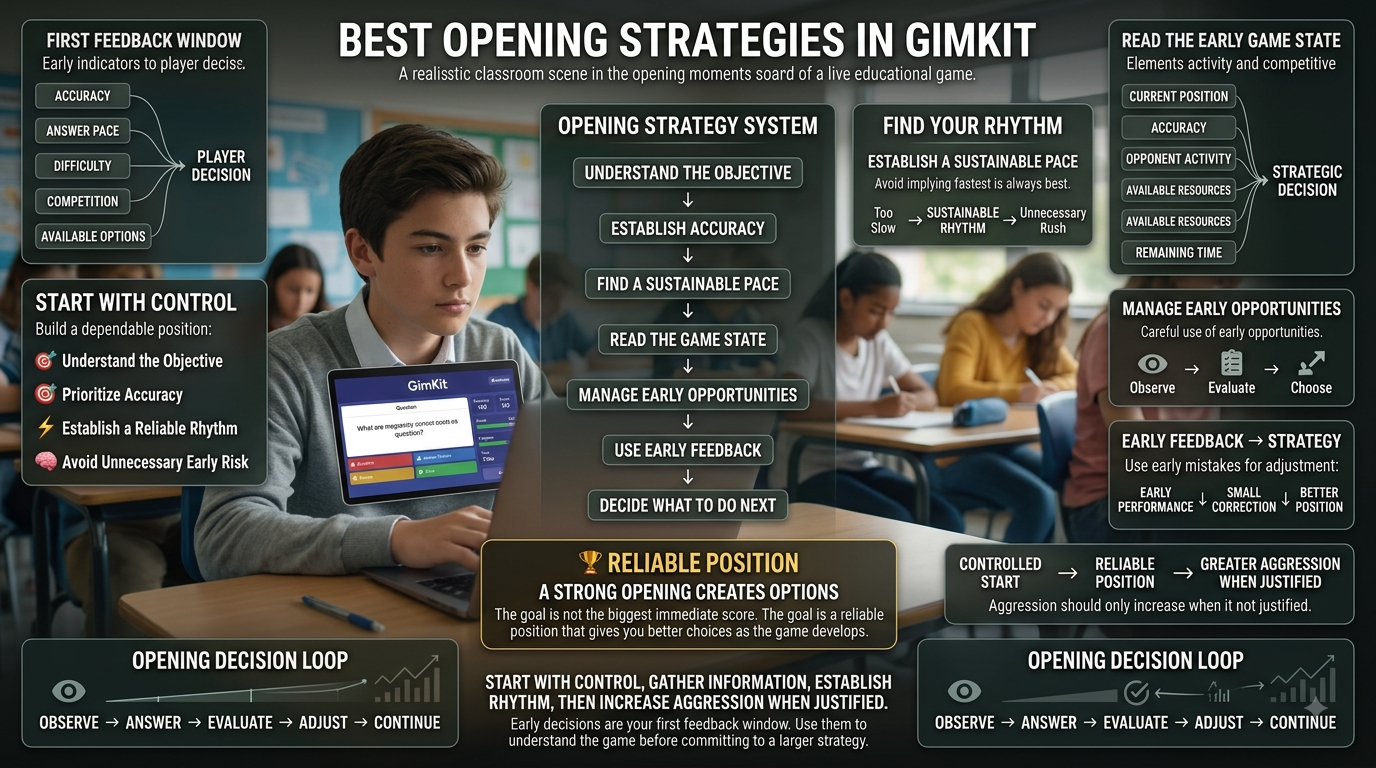
Best Opening Strategies in Gimkit | The opening phase of a Gimkit game is more than the first few questions. It is the period in which you establish your answering rhythm, understand the conditions of the game, evaluate your early performance, and decide how aggressively you should play. A strong opening does not necessarily produce the biggest immediate score. Its real purpose is to create a reliable position that gives you better options as the game develops.
The most effective opening strategy is therefore not simply answer as quickly as possible. It is a structured process: understand the objective, establish accuracy, find a sustainable pace, read the game state, manage early opportunities carefully, and use the information from the first several decisions to determine what should happen next.
This matters because the opening is also the game’s first feedback window. Early performance tells you whether your assumptions about the difficulty, pace, competition, and available strategic options were correct. A player who pays attention to that information can make small corrections before a minor weakness becomes a large disadvantage.
The central principle is simple:
Start with control, gather information, establish a reliable rhythm, and increase aggression only when the game gives you a reason to do so.
Looking for comprehensive classroom resources and educational technology insights? Explore GimkitApp for expert guides, teaching strategies, game modes, and the latest updates to enhance student engagement.
What Makes a Strong Gimkit Opening?
A strong opening accomplishes several things simultaneously:
Establishes reliable accuracy
Creates a sustainable answering rhythm
Builds useful early progress
Reveals the difficulty of the questions
Clarifies how competitive the game is
Establishes awareness of available resources
Prevents unnecessary early mistakes
Creates flexibility for later decisions
Keeps the actual learning or game objective visible
A weak opening often does the opposite. Players rush because they see others moving quickly, spend resources before understanding their value, react to every leaderboard change, or take unnecessary risks simply because the game has started.
The difference is not always visible on the scoreboard immediately.
Someone can appear to have the best opening because they accumulated points quickly, while another player is quietly building a more reliable position through higher accuracy and better decision-making. The second player may have more strategic flexibility once the middle of the game begins.
A useful way to evaluate an opening is therefore:
Accuracy + Pace + Awareness + Resource Discipline + Adaptability
These factors work together rather than independently. Extremely high speed is not useful if accuracy collapses. High accuracy is less useful if the pace is so slow that meaningful progress becomes impossible. Good resource management cannot compensate for misunderstanding the objective, and a strong initial plan loses value if the player refuses to adapt when conditions change.
Understand the Objective Before the First Question
The first strategic decision happens before gameplay begins: understand what the session is actually trying to accomplish.
Different classroom games can place different emphasis on:
Correct answers
Speed
Points
Team contribution
Completing an objective
Resource management
Learning or reviewing specific material
Maintaining consistent participation
Your opening should reflect that purpose.
If the primary purpose is learning, maximizing score at the expense of understanding can produce the wrong outcome. If the activity is competitive, efficiency and score position may matter more. If the game is being used as a review activity, identifying misconceptions may be more valuable than simply finishing first.
Before starting, ask:
What am I actually trying to accomplish?
That question prevents a common strategic error: optimizing a visible metric while ignoring the underlying objective.
Prepare Before the Game Starts
A strong opening begins before the first question appears.
Preparation reduces the amount of attention that must be spent on basic problems during gameplay. If instructions, device issues, distractions, or unfamiliar mechanics consume the first several minutes, the player is making strategic decisions before establishing a proper baseline.
Before the game begins, consider:
Understanding the instructions
Knowing the primary objective
Reviewing relevant material when appropriate
Checking that the device is ready
Making sure the connection is stable
Closing unnecessary distractions
Understanding any visible game rules
Knowing what resources or options are available
Identifying whether the session is individual or team-based
Knowing approximately how much time is available
Preparation should not become over-preparation. The purpose is simply to remove avoidable friction.
For teachers, clear instructions before the game begins can be equally important. When students understand what they are expected to accomplish, the opening becomes an opportunity to demonstrate knowledge rather than a period spent figuring out what the activity means.
Read the Game Conditions Before Choosing an Opening Approach
There is no universal opening strategy that performs equally well in every situation.
Before committing to a particular approach, consider the conditions:
Time: How long is the game?
Question difficulty: Are the questions easy, moderate, or demanding?
Competition: Is the leaderboard tightly packed or are players widely separated?
Objective: Is the focus primarily learning, review, competition, or another goal?
Resources: Are there strategic options whose value depends on timing?
Player count: Does the number of competitors change how important early positioning is?
Personal performance: Are you already answering accurately and efficiently?
These conditions determine how much risk is appropriate.
For example, a player with substantial time remaining has more opportunity to recover from a conservative opening. A player entering a short, highly competitive session may need to prioritize efficiency much earlier.
The opening should therefore begin with situational awareness, not with a memorized tactic.
Establish Accuracy Before Chasing Speed
One of the most important opening principles is to establish reliable accuracy before trying to maximize response speed.
The temptation to answer immediately is understandable. Fast responses can create visible progress and may feel like momentum. But if speed causes repeated mistakes, the apparent advantage can disappear quickly.
A more reliable sequence is:
Read → Understand → Answer → Reset → Continue
The goal is not to answer slowly. The goal is to determine how quickly you can answer without creating unnecessary errors.
Once accuracy becomes stable, speed can be increased gradually.
Consider three opening situations:
High accuracy and moderate pace
This is usually a good foundation. Increase efficiency carefully if additional speed would provide meaningful value.
High speed and falling accuracy
The opening pace is probably too aggressive. Slow down enough to recover reliable decision-making.
Low accuracy and low speed
Simply becoming faster is unlikely to solve the problem. First determine whether the issue is question comprehension, unfamiliar material, distraction, or another factor.
The strongest opening pace is not the fastest pace available. It is the fastest pace you can sustain accurately.
Pro Tip: Don’t measure your opening by how quickly you answered one question. Measure it by whether your pace remains effective across the next several decisions.
For the latest gaming news, expert reviews, and walkthroughs, readers can also visit IGN, one of the world’s leading gaming websites.
Build a Sustainable Answering Rhythm
Once accuracy is established, create a rhythm that can continue without excessive hesitation or rushing.
A practical rhythm is:
Read → Decide → Respond → Reset → Repeat
The reset matters.
After a correct answer, don’t become overconfident and rush the next question. After an incorrect answer, don’t spend too much attention replaying the mistake. Each new question provides a fresh decision.
A sustainable rhythm usually has several characteristics:
Similar decision quality from question to question
Limited unnecessary hesitation
Limited impulsive rushing
Consistent attention
Rapid recovery after mistakes
A pace that remains comfortable enough to maintain
The opening should establish this rhythm before the player begins making increasingly complex strategic decisions.
Establish Your Personal Baseline
The first several questions provide valuable information about your current performance.
Use them to establish a baseline for:
Accuracy
Response speed
Question comprehension
Consistency
Concentration
Resource use
Decision quality
This baseline gives you something to compare against later.
Suppose your first several answers are highly accurate but slower than expected. That suggests an efficiency opportunity. If your answers are fast but accuracy is already declining, additional speed is probably the wrong direction.
The purpose of a baseline is not to judge yourself after a few questions. It is to determine what kind of adjustment, if any, is justified.
Learn the Question Environment Early
The opening also reveals what kind of question environment you are dealing with.
You may discover that:
Questions are easier than expected
Questions require more reading than expected
Several concepts are unfamiliar
Similar question formats are repeating
Certain topics consistently require more thought
The difficulty changes as the game progresses
This information should influence your pace.
If questions are straightforward, greater efficiency may be reasonable. If questions require careful reasoning, forcing a rapid-answer strategy may create unnecessary errors.
The opening therefore functions as a short diagnostic period.
Instead of assuming:
“I always perform best when I prioritize speed.”
Treat that as a hypothesis:
“I’ll prioritize efficiency, then see whether the actual question environment supports that approach.”
That distinction makes the strategy responsive rather than rigid.
Don’t Chase the Leaderboard Too Early
The leaderboard is useful information, but it should not automatically control your decisions.
Early score differences can be misleading because:
Players may have different answering rhythms
A short sequence can create a temporary lead
One mistake can temporarily change positions
Some players may be testing different approaches
The game may still have substantial time remaining
If another player moves ahead early, that does not automatically mean your strategy is failing.
Instead, ask:
Is my own performance producing useful progress?
If accuracy is strong, pace is sustainable, and your strategy fits the objective, there may be no reason to change simply because another player is temporarily ahead.
The leaderboard becomes more informative when you observe patterns rather than individual movements.
Read the Leaderboard as a Trend
A single position change provides limited information.
A repeated pattern provides much more.
Pay attention to:
The size of the score gap
Whether the gap is increasing or shrinking
How quickly positions are changing
Whether the change persists
Whether your own performance changed at the same time
For example:
One player moves ahead briefly: continue monitoring.
One player repeatedly increases the gap: investigate your own performance.
The leaderboard remains tightly grouped: small efficiency improvements may become important.
Your position falls while your accuracy remains strong: determine whether your pace or resource efficiency needs improvement.
The leaderboard should function as information, not as an emotional trigger.
Distinguish a Temporary Lead From Real Momentum
A lead and momentum are not identical.
A temporary lead may result from:
A short sequence of easy questions
A lucky streak
Another player’s mistake
A brief difference in pace
A temporary resource advantage
Real momentum is more likely to appear when strong results are supported by:
Consistent accuracy
Sustainable pace
Reliable decision-making
Efficient resource use
Continued progress over time
This distinction prevents both overconfidence and unnecessary panic.
A player who takes an early lead should not assume the game is already secured. A player who falls behind should not assume the game is already lost.
The opening provides positioning, not a final result.
Use Early Progress as Information, Not Just a Score
Early progress should answer a more useful question than:
“How many points do I have?”
Ask:
“What is producing those points?”
If progress comes from accurate, repeatable performance, it may be sustainable.
If progress comes from rushing, unnecessary risk, or temporary conditions, the score may exaggerate the quality of the opening.
This distinction is especially important when evaluating a new strategy. A strategy should be judged by the quality of the process producing the result, not solely by the immediate scoreboard.
Manage Early Resources Conservatively
If a game provides resources, strategic options, upgrades, or other mechanisms that influence later decisions, avoid spending them simply because they are available.
Before using a resource, ask:
What problem does this solve?
What benefit does it provide now?
Could the same resource be more valuable later?
Does using it reduce future flexibility?
Is the current situation important enough to justify the cost?
Am I using it because it is strategically useful or simply because I have it?
Early in the game, uncertainty is usually higher. You have less information about how the session will develop, which makes preserving flexibility valuable.
This does not mean saving every resource indefinitely.
A resource that provides a clear advantage at the right moment should be used. The principle is selective timing rather than automatic conservation.
A simple framework is:
Identify → Evaluate → Compare → Use
Identify what is available.
Evaluate what it accomplishes.
Compare immediate value with potential future value.
Use it when the benefit clearly justifies the cost.
Avoid Premature Aggression
Aggression can be useful, but aggressive decisions made before understanding the game often create unnecessary problems.
Common examples include:
Rushing answers
Taking unnecessary risks
Spending resources immediately
Reacting to every leaderboard movement
Changing strategies after one mistake
Trying to erase a tiny deficit instantly
The problem is not aggression itself. The problem is aggression without evidence.
A strong opening first establishes a reliable baseline. Once you understand the conditions, you can determine whether greater risk is actually justified.
Balance Risk Against Remaining Opportunity
Risk should not be treated as simply “safe” or “aggressive.”
Think of it as a scale:
Low → Moderate → High
Early in a game, low or moderate risk is often enough because there is still time to build progress through reliable play.
Higher risk becomes more reasonable when:
A meaningful deficit develops
Enough time remains for the potential benefit to matter
The current strategy is clearly insufficient
The potential reward justifies the downside
A strategic opportunity is unlikely to remain available later
Even then, risk should be deliberate rather than random.
Fast Progress vs. Good Progress
Fast progress is immediately visible.
Good progress remains useful as the game develops.
A player may move quickly through several questions but make enough mistakes to reduce the value of that speed. Another player may appear slower while maintaining much stronger accuracy and consistency.
The opening should therefore optimize for effective progress, not maximum visible activity.
A useful question is:
“If I maintain this exact pace and decision quality for the next several minutes, will it still be working?”
If the answer is yes, the opening is probably sustainable.
If the answer is no, an adjustment should happen before the problem becomes larger.
If You Start Strong, Protect the Advantage
A strong opening should create flexibility, not overconfidence.
If you begin with accurate answers and useful progress:
Maintain your reliable rhythm
Avoid unnecessary experimentation
Monitor the score gap
Continue evaluating accuracy
Use resources deliberately
Watch for changes in competition
Stay focused on the objective
The wrong response to an early lead is:
“I’m already winning, so I can take unnecessary risks.”
The better response is:
“My current approach is working, so I’ll continue executing it carefully while monitoring for meaningful changes.”
A lead is valuable because it gives you options. Don’t waste that advantage by creating unnecessary volatility.
If You Start Slowly, Diagnose Before Reacting
A slow opening does not automatically mean the strategy is failing.
First identify the cause.
Early Problem
Better Response
Accurate but slow
Increase efficiency gradually
Several incorrect answers
Prioritize comprehension and accuracy
Distracted
Reset attention and simplify the next decision
Unfamiliar mechanics
Learn the basic system before making complex decisions
Difficult questions
Spend enough time understanding rather than forcing speed
Poor resource timing
Reevaluate when and why resources are being used
The most important question is:
Why am I behind?
The answer should determine the adjustment.
If the problem is accuracy, increasing speed is unlikely to help. If accuracy is already strong but the pace is inefficient, gradually increasing speed may be appropriate.
Avoid the Immediate Catch-Up Trap
A small early deficit often creates a psychological urge to recover immediately.
That can lead to:
Rushing
Unnecessary risk
Poor resource timing
Reduced accuracy
Constant leaderboard checking
Impulsive strategy changes
Before attempting an aggressive recovery, evaluate:
How large is the actual gap?
How much time remains?
What caused the gap?
Is your current strategy still viable?
Are there realistic opportunities to recover?
A small deficit with plenty of time remaining may require almost no strategic change.
A large deficit with substantial time remaining may justify a meaningful adjustment.
A large deficit with very little time remaining may require prioritizing only the highest-value remaining opportunities.
The size of the response should match the size and cause of the problem.
Watch for Repeated Mistakes
One mistake is data.
Repeated mistakes are a pattern.
A single incorrect answer does not necessarily justify changing your strategy. Several mistakes caused by the same underlying issue deserve attention.
Examples:
Repeated rushing → reduce pace.
Repeated misunderstanding → slow down and read more carefully.
Repeated distraction → simplify the decision process.
Repeated hesitation → identify whether uncertainty comes from knowledge, comprehension, or overthinking.
The earlier a recurring problem is detected, the smaller the correction usually needs to be.
Use Early Warning Signals
A strong opening includes continuous monitoring for signals that something needs attention.
Accuracy begins declining
You may be rushing, losing concentration, or encountering material that requires more careful reasoning.
Pace begins declining
You may be overthinking, becoming distracted, or spending too long on individual decisions.
The score gap grows consistently
Your current approach may not be producing enough progress, especially if the pattern persists rather than appearing once.
Resources are being consumed without clear benefit
Your resource strategy may need adjustment.
Frustration increases
Your emotional state may be affecting decision quality.
These signals do not automatically mean the strategy is wrong. They indicate that it is time to investigate before changing.
Adapt When You Know the Material Well
Familiarity can provide an advantage, but it can also create overconfidence.
When you know the material well:
Use that knowledge to improve efficiency
Maintain attention to question wording
Avoid automatically assuming familiar questions have obvious answers
Increase pace only when accuracy remains stable
Use your confidence to create consistency rather than unnecessary risk
The goal is not to turn familiarity into reckless speed.
It is to turn familiarity into efficient, reliable performance.
Adapt When Questions Are Difficult
Difficult questions change the value of speed.
When questions require more reasoning:
Read carefully.
Identify what is actually being asked.
Use the knowledge you have.
Eliminate clearly incorrect possibilities where appropriate.
Avoid allowing one difficult question to disrupt the entire rhythm.
Move forward once you’ve made a reasonable decision.
A difficult question should be treated as an individual challenge, not as evidence that the entire opening strategy has failed.
Adapt to a Highly Competitive Lobby
A competitive lobby can make the opening feel more urgent, but urgency should still be evidence-based.
When competition is close:
Monitor the rate of score changes
Protect accuracy
Improve efficiency where possible
Avoid reacting to every small movement
Watch for sustained gaps rather than temporary fluctuations
If another player consistently gains ground, investigate whether they are outperforming your approach or simply benefiting from a short sequence.
The correct response to competition is better information, not automatically higher risk.
Adapt When the Game Is Less Competitive
A less competitive game creates a different opportunity.
Instead of using the opening purely to maximize score, you may have more room to:
Practice difficult concepts
Improve accuracy
Learn the mechanics
Test a new approach
Focus on retention
Identify weak areas
Build confidence
This can make the opening a useful experimentation period, provided the experiment still fits the purpose of the activity.
Treat Your Opening Strategy as a Hypothesis
A strategy should be treated as a starting assumption rather than a permanent rule.
Suppose you begin with:
“I perform best when I prioritize speed.”
The first several questions provide evidence.
If the questions are straightforward and your accuracy remains high, the assumption may be supported.
If the questions require careful reading and your accuracy begins falling, the evidence suggests a different balance is needed.
The correct response is not to defend the original strategy.
It is to update it.
This creates a useful cycle:
Initial strategy → early evidence → evaluation → adjustment → new strategy
The opening is therefore both a performance phase and a learning phase.
Test One Meaningful Change at a Time
When adjusting an opening strategy, avoid changing everything simultaneously.
If you change:
Answering speed
Resource timing
Risk level
Decision process
Attention strategy
all at once, you won’t know which change helped or caused a problem.
Instead:
Change one meaningful variable → observe → evaluate → continue or modify.
For example, if accuracy is strong but pace is slow, first increase efficiency slightly. Don’t simultaneously change resource use and risk tolerance unless there is a separate reason to do so.
This makes adaptation easier to evaluate.
Opening Strategy Based on Player Goal
Not every player has the same definition of a successful opening.
Competitive goal
Prioritize:
Accuracy
Efficient pace
Score position
Resource management
Strategic awareness
Learning goal
Prioritize:
Understanding
Correct reasoning
Identifying misconceptions
Retention
Reviewing mistakes
Practice goal
Prioritize:
Building rhythm
Identifying weak areas
Testing approaches
Improving confidence
Developing consistency
The same game can therefore produce different optimal opening decisions depending on the player’s actual goal.
Opening Strategy for Individual Play
In individual play, the opening is primarily about managing your own performance.
Focus on:
Accuracy
Pace
Concentration
Resource decisions
Time
Score position
Personal weaknesses
You have fewer coordination concerns, so the feedback loop can be relatively direct:
Your performance → your decision → result → next decision.
This makes personal baseline measurement particularly useful.
Opening Strategy for Team-Based Play
Team-based gameplay introduces another layer: your best individual move may not always be the best team move.
During the opening, consider:
Team position
Shared objectives
Teammate performance
Areas already covered
Areas requiring support
Shared resources where applicable
Remaining time
If a teammate is already handling one part of the objective effectively, duplicating their effort may provide less value than supporting another area.
The opening should therefore establish not only individual rhythm but also team awareness.
Don’t Let Competition Replace the Learning Objective
In educational gameplay, competition is often a mechanism for increasing participation, not necessarily the ultimate purpose of the activity.
A player can technically optimize the scoreboard while learning very little.
If the pursuit of points begins interfering with understanding, accuracy, reflection, or meaningful participation, the strategy needs to be reconsidered.
The strongest opening is one that supports both the game and the educational purpose behind it.
A Practical Opening Routine
A simple routine prevents the opening from becoming mentally complicated.
Before the first question:
Understand the objective and game conditions.
First several questions:
Prioritize accurate understanding and establish your natural pace.
After the initial sequence:
Check accuracy, pace, progress, competition, and resources.
If performance is strong:
Maintain the approach.
If one weakness appears:
Correct that weakness specifically.
If several indicators deteriorate:
Reassess the broader strategy.
As the opening ends:
Carry the information you learned into the middle-game plan.
A quick mental check can prevent unnecessary strategic changes:
Am I answering accurately?
Is my current pace sustainable?
Is my strategy producing useful progress?
Am I using resources for a clear reason?
Has anything changed enough to justify an adjustment?
If the answers are mostly positive, continue.
If one area is weak, fix that area first.
If several areas are failing simultaneously, investigate whether the problem is strategic, technical, or related to the difficulty of the material.
Separate Strategic Problems From Technical Problems
Not every poor opening is caused by strategy.
Performance can also be affected by:
Connection problems
Device limitations
Browser issues
Input problems
Interruptions
Unclear instructions
Interface unfamiliarity
If several players experience the same technical issue, changing your gameplay strategy will not solve the underlying problem.
Before concluding that your strategy is failing, ask:
Is the problem coming from my decision-making, or is something outside the strategy affecting my performance?
This distinction prevents unnecessary strategic changes.
Opening Decisions at a Glance
Situation
Primary Priority
Recommended Mindset
Questions feel easy
Accuracy + efficiency
Build reliable momentum
Questions are difficult
Comprehension + accuracy
Don’t force speed
You start ahead
Consistency
Protect the advantage
You start slightly behind
Diagnosis + improvement
Don’t panic
Competition is extremely close
Efficiency
Watch meaningful patterns
Repeated mistakes appear
Diagnosis
Fix the underlying cause
Resources are available
Evaluation
Use selectively
Time is limited from the beginning
High-value decisions
Avoid low-value actions
Learning is the main goal
Understanding
Don’t sacrifice learning for speed
Technical problems appear
Problem identification
Fix the technical issue first
Risk Level by Opening Situation
Situation
Risk Level
Primary Focus
Strong performance and comfortable lead
Low
Protect consistency
Strong performance with close competition
Low–moderate
Improve efficiency
Small deficit
Moderate
Correct the specific weakness
Large deficit with plenty of time
Moderate–high
Consider a meaningful adjustment
Large deficit with little time
High if justified
Focus on high-value opportunities
Unclear game conditions
Low
Gather information first
Strong learning objective
Low–moderate
Protect understanding
Risk should always remain proportional to the situation.
A player who is already in a strong position has less reason to create unnecessary volatility. A player facing a large deficit may eventually need more risk, but only if enough opportunity remains for the potential benefit to matter.
Early Opening Mistakes to Avoid
Starting too aggressively
Maximum speed is not automatically maximum efficiency.
Reacting to every leaderboard change
Small early fluctuations rarely justify strategic changes.
Spending resources without a purpose
Availability does not automatically create value.
Abandoning a good strategy too quickly
One poor result is not enough evidence.
Ignoring repeated problems
A pattern deserves attention even when each individual mistake seems minor.
Overthinking every decision
Too much strategic analysis can interfere with normal answering.
Assuming an early lead guarantees success
The game still has later stages.
Assuming an early deficit means failure
There may be substantial recovery opportunity.
Forgetting the actual objective
Winning should not automatically replace learning.
Recovering From a Poor Opening
A poor opening should be treated as information rather than a final judgment.
First identify what went wrong.
It may have resulted from:
Early mistakes
Slow responses
Difficult questions
Distraction
Unfamiliar mechanics
Poor resource timing
An unsuitable opening strategy
Technical problems
Then evaluate the actual recovery potential.
Consider:
Current deficit + remaining time + available opportunities + actual performance
A small deficit with plenty of time may require almost no change.
A larger deficit with substantial time may justify a significant strategic adjustment.
A large deficit with very little time requires much more selective decision-making because there may not be enough opportunity for a broad recovery.
The critical point is to avoid reacting to the feeling of being behind. Respond to the actual game state.
Know When to Continue, Adjust, or Abandon
Every opening strategy eventually falls into one of three categories.
Continue
Continue when:
Accuracy is stable
Pace is sustainable
Progress is useful
Resources are being managed effectively
The strategy still fits the objective
Adjust
Adjust when:
Accuracy is declining
Pace is inefficient
The score gap is consistently changing
Resource use is inefficient
A weakness repeatedly appears
Conditions have changed
Abandon
Consider abandoning the approach when:
Results remain consistently poor
Conditions have changed substantially
The current strategy is no longer capable of producing the desired result
Repeated adjustments have failed
Don’t abandon a strategy because of one bad result.
Likewise, don’t continue a strategy indefinitely simply because it was successful during the first few minutes.
Transition From Opening to Mid-Game
The opening should end with more information than you had when the game started.
By this point, you should have a clearer understanding of:
Your natural answering pace
Your current accuracy
The difficulty of the material
The competitiveness of the game
The value of available resources
Your current score position
Any repeated weaknesses
Whether your initial strategy actually worked
That information becomes the foundation for the next stage.
The transition should therefore look like:
Opening plan → Early evidence → Evaluation → Strategic adjustment → Mid-game plan
Don’t carry the opening strategy into the middle simply because it was your original plan.
Carry forward what the opening taught you.
Opening, Middle, and End-Game Priorities
The three stages require different priorities.
Opening
Establish → Learn → Stabilize
Focus on:
Understanding conditions
Building rhythm
Establishing accuracy
Testing your assumptions
Preserving flexibility
Middle Game
Optimize → Adapt → Manage
Focus on:
Improving efficiency
Managing resources
Responding to competitors
Correcting weaknesses
Protecting or improving position
Final Stage
Prioritize → Execute → Protect or Recover
Focus on:
Time-sensitive opportunities
High-value decisions
Protecting an advantage
Recovering where realistically possible
Avoiding low-value actions
Using a final-stage mindset during the opening usually produces unnecessary aggression.
Why Consistency Beats Short Bursts of Speed
Consistency reduces volatility.
A player who performs reliably has fewer problems requiring emergency correction. This doesn’t mean playing slowly. It means maintaining a balance that can be repeated:
Fast enough + Accurate enough + Sustainable enough
A short burst of speed may create a temporary advantage. A sustainable combination of speed and accuracy is much more useful across an entire game.
The question is not:
“Can I answer this quickly?”
It is:
“Can I maintain this level of performance without creating unnecessary mistakes?”
Use Early Feedback Immediately
Early feedback should influence the next decision rather than being saved for the end of the game.
High accuracy + comfortable pace
Maintain the approach.
High accuracy + slow pace
Increase efficiency gradually.
High pace + declining accuracy
Reduce unnecessary rushing.
Low pace + low accuracy
Simplify the process and identify the underlying issue.
Continue monitoring and adjust only if the pattern persists.
This creates a continuous feedback loop:
Observe → Interpret → Adjust → Test → Continue
A Complete Opening Framework
A polished opening strategy can be reduced to seven stages:
Prepare
Understand the objective, instructions, environment, and available options.
Stabilize
Establish accurate answering and a sustainable pace.
Observe
Monitor performance, score position, competition, resources, time, and question difficulty.
Evaluate
Determine whether the current approach is actually producing useful progress.
Adjust
Correct the specific weakness instead of changing everything.
Preserve
Protect strategies, resources, and advantages that are already working.
Transition
Use what you learned during the opening to build the appropriate mid-game strategy.
This framework prevents two opposite mistakes:
Overreacting to information that doesn’t matter.
Underreacting to information that clearly does.
Full Summary & Expert Reviews | Professional Recommendations
Best Opening Strategies in Gimkit start with understanding the game mode and its objectives before making decisions about how aggressively to play.
Best Opening Strategies in Gimkit usually begin with a few careful actions that help you understand the pace of the match.
Best Opening Strategies in Gimkit should focus on building a strong position rather than trying to make every possible move immediately.
Best Opening Strategies in Gimkit can help players avoid wasting early opportunities on unnecessary risks.
Best Opening Strategies in Gimkit become stronger when you pay attention to how quickly your score, cash, or other resources are developing.
Best Opening Strategies in Gimkit should take the specific game mode into account because different modes can reward different approaches.
Best Opening Strategies in Gimkit can involve answering early questions carefully so that mistakes do not create an avoidable disadvantage.
Best Opening Strategies in Gimkit benefit from balancing speed with accuracy during the first part of a match.
Best Opening Strategies in Gimkit should not depend entirely on rushing because a fast but inaccurate start can create problems later.
Best Opening Strategies in Gimkit can improve when players establish a consistent rhythm before increasing their pace.
Best Opening Strategies in Gimkit involve watching the scoreboard without allowing it to distract from the questions.
Best Opening Strategies in Gimkit can help players determine whether they are ahead, behind, or close to the competition.
Best Opening Strategies in Gimkit should consider how much time remains before committing to a high-risk approach.
Best Opening Strategies in Gimkit can include building enough resources to give yourself flexibility later in the match.
Best Opening Strategies in Gimkit are often more effective when players avoid spending everything immediately.
Best Opening Strategies in Gimkit can involve prioritizing upgrades or purchases that provide useful value throughout the rest of the game.
Best Opening Strategies in Gimkit should take long-term usefulness into account instead of focusing only on immediate rewards.
Best Opening Strategies in Gimkit can help players establish an economy that supports stronger decisions later.
Best Opening Strategies in Gimkit become more important when the selected mode makes early economic decisions especially influential.
Best Opening Strategies in Gimkit can involve learning the cost and benefit of important upgrades before spending resources.
Best Opening Strategies in Gimkit should avoid purchases that look exciting but provide little practical benefit for the current situation.
Best Opening Strategies in Gimkit can change depending on whether the match rewards individual performance, survival, teamwork, or another objective.
Best Opening Strategies in Gimkit require players to recognize what actually determines success in the selected mode.
Best Opening Strategies in Gimkit can involve taking advantage of early opportunities without becoming overly aggressive.
Best Opening Strategies in Gimkit should leave room for adjustment when opponents begin showing their own strategies.
Best Opening Strategies in Gimkit become more useful when players observe the competition instead of concentrating only on their own score.
Best Opening Strategies in Gimkit can reveal whether opponents are prioritizing speed, resources, upgrades, or defensive choices.
Best Opening Strategies in Gimkit allow players to change direction when another participant begins gaining an unexpected advantage.
Best Opening Strategies in Gimkit can involve protecting an early advantage instead of constantly trying to increase it.
Best Opening Strategies in Gimkit should account for the possibility that an aggressive opponent may gain quickly but become vulnerable later.
Best Opening Strategies in Gimkit can help players remain patient when the scoreboard changes rapidly during the opening phase.
Best Opening Strategies in Gimkit should focus on decisions that have a meaningful effect rather than reacting to every small score difference.
Best Opening Strategies in Gimkit can include identifying which questions or opportunities deserve the most attention.
Best Opening Strategies in Gimkit become stronger when players recognize their own strengths and weaknesses early.
Best Opening Strategies in Gimkit can involve playing more cautiously when accuracy is currently stronger than speed.
Best Opening Strategies in Gimkit can also involve increasing pace when confidence and accuracy are both strong.
Best Opening Strategies in Gimkit should never encourage reckless answering simply to appear fast.
Best Opening Strategies in Gimkit can help players develop a reliable rhythm that supports consistent performance.
Best Opening Strategies in Gimkit are easier to execute when players understand the basic mechanics before the match begins.
Best Opening Strategies in Gimkit benefit from knowing which actions are available and what each one is intended to accomplish.
Best Opening Strategies in Gimkit can reduce hesitation because players already have a general plan for their first decisions.
Best Opening Strategies in Gimkit should still remain flexible because the actual match may develop differently from expectations.
Best Opening Strategies in Gimkit can involve keeping some resources available for unexpected opportunities.
Best Opening Strategies in Gimkit become less effective when every resource is committed before the player understands the developing match.
Best Opening Strategies in Gimkit can help players create a stronger foundation for later progression.
Best Opening Strategies in Gimkit should consider how early decisions affect the ability to make stronger purchases or choices later.
Best Opening Strategies in Gimkit can involve prioritizing consistent income or progress when the game rewards long-term development.
Best Opening Strategies in Gimkit can be more aggressive when early momentum has a meaningful strategic advantage.
Best Opening Strategies in Gimkit should avoid assuming that an early lead automatically guarantees a winning position.
Best Opening Strategies in Gimkit can help players use an early lead to create flexibility rather than simply taking unnecessary risks.
Best Opening Strategies in Gimkit can also help players recover from a weak start by keeping their resources and options under control.
Best Opening Strategies in Gimkit become especially valuable when the match has several stages and early choices influence later opportunities.
Best Opening Strategies in Gimkit should take the expected length of the match into account.
Best Opening Strategies in Gimkit can differ between a short game where immediate gains matter and a longer game where progression matters more.
Best Opening Strategies in Gimkit can involve checking whether an early purchase improves your performance enough to justify its cost.
Best Opening Strategies in Gimkit should encourage players to think about value rather than simply buying the first available option.
Best Opening Strategies in Gimkit can become more effective when players learn from previous matches and identify which early decisions produced useful results.
Best Opening Strategies in Gimkit should be adjusted when a particular opening repeatedly leads to poor resource management.
Best Opening Strategies in Gimkit can improve through reviewing mistakes instead of simply repeating the same opening every time.
Best Opening Strategies in Gimkit can include a simple mental checklist covering accuracy, resources, position, opponents, and the next useful objective.
Best Opening Strategies in Gimkit become easier when players make their first few decisions deliberately instead of reacting emotionally to the scoreboard.
Best Opening Strategies in Gimkit can help reduce panic when another player gets an early lead.
Best Opening Strategies in Gimkit should encourage players to evaluate whether the gap is actually significant before changing their entire approach.
Best Opening Strategies in Gimkit can involve staying focused on the actions that generate reliable progress rather than chasing every temporary advantage.
Best Opening Strategies in Gimkit are strongest when they combine accurate answers, sensible resource use, awareness of opponents, and appropriate pacing.
Best Opening Strategies in Gimkit can give players a useful foundation without forcing them to follow a rigid sequence throughout the entire match.
Best Opening Strategies in Gimkit should evolve naturally once players have enough information about the current game to make better decisions.
Best Opening Strategies in Gimkit can help players avoid common opening mistakes such as unnecessary spending, careless answers, and excessive rushing.
Best Opening Strategies in Gimkit are ultimately about creating options for the middle and final stages rather than trying to win everything during the first few moments.
Best Opening Strategies in Gimkit work best when players use the opening phase to establish accuracy, understand the competition, build useful resources, and prepare for the decisions that matter later.
Final Takeaway
The best opening strategy in Gimkit is not simply to answer faster than everyone else. It is to build a reliable foundation that remains useful as the game develops.
Start prepared. Understand the objective. Read the game conditions. Establish accuracy before chasing unnecessary speed. Build a sustainable rhythm. Use early questions to create a personal performance baseline. Treat the leaderboard as information rather than an instruction. Manage resources selectively. Avoid premature aggression. Watch for repeated problems. Adjust when evidence justifies an adjustment.
If you start strong, protect the advantage through consistency rather than overconfidence. If you start slowly, diagnose the cause before trying to recover. If the game is highly competitive, monitor meaningful trends instead of reacting to every movement. If learning is the primary purpose, make sure competitive optimization never replaces the learning objective.
Most importantly, treat the opening as an information-gathering and positioning phase.
The strongest players don’t enter with a strategy they refuse to change. They enter with a strategy they are prepared to test.
That sequence creates a controlled opening, gives you better information for the middle game, and prevents early decisions from unnecessarily limiting what you can do later.