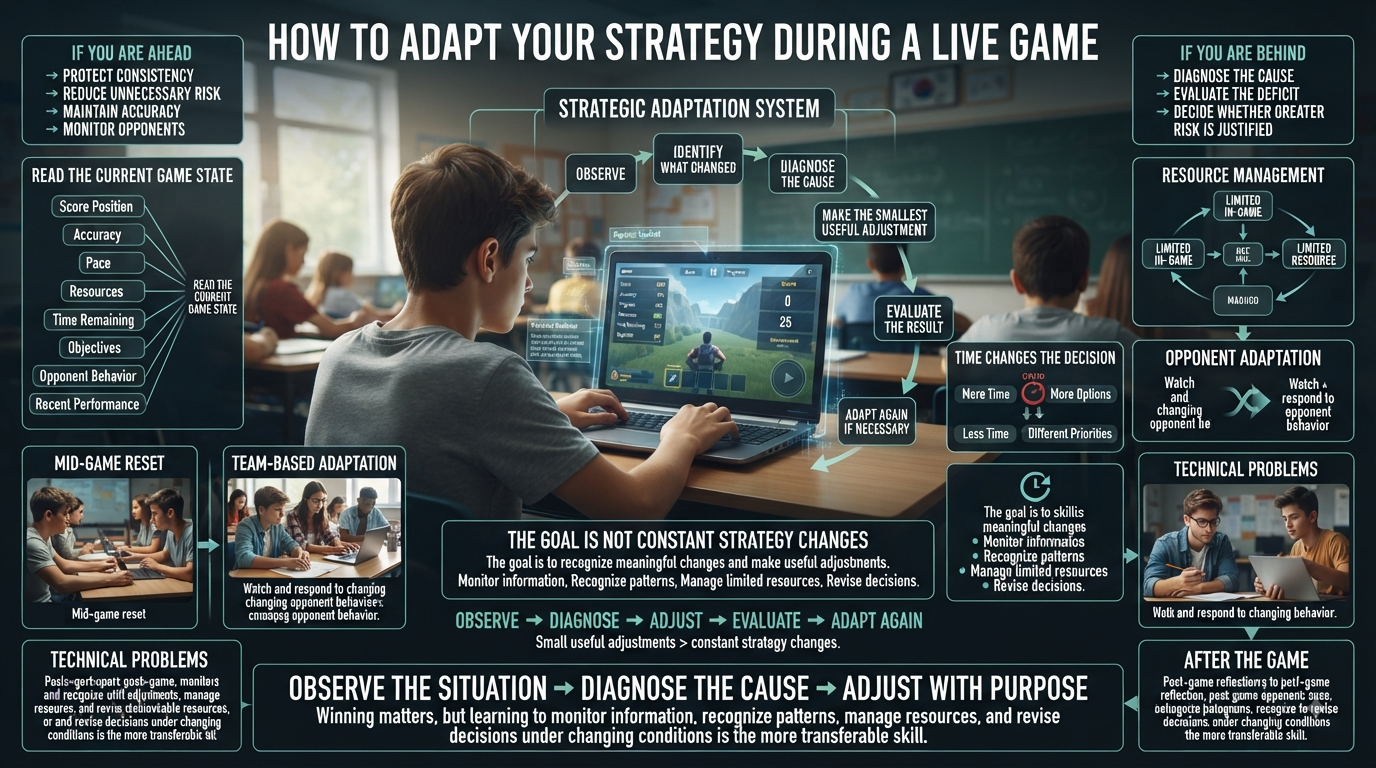
How to Adapt Your Strategy During a Live Game | A strong live-game strategy is not a fixed plan that you follow from the first question to the final second. In a fast classroom game, the score can shift, accuracy can change, resources can become more valuable, opponents can alter their approach, and the remaining time can completely change which decisions make sense.
The real skill is knowing when to continue, when to make a small adjustment, and when a larger strategic change is justified.
Effective adaptation starts with reading the current game state rather than reacting to every mistake or score change. A player who is ahead may need to protect consistency and reduce unnecessary risk, while a player who is behind may need to identify the specific cause of the deficit before deciding whether greater risk is worthwhile.
This guide explains how to adapt strategy during a live game using score position, accuracy, pace, resources, time, objectives, opponent behavior, and evidence from recent performance. It also covers risk management, team-based adaptation, technical problems, mid-game resets, decision frameworks, worked examples, and post-game reflection.
The goal is not to change strategy constantly.
Observe the situation → identify what changed → diagnose the cause → make the smallest useful adjustment → evaluate the result → adapt again when necessary.
In an educational game, the strongest strategy also keeps the learning objective in view. Winning matters, but learning to monitor information, recognize patterns, manage limited resources, and revise decisions under changing conditions is the more transferable skill.
Looking for comprehensive classroom resources and educational technology insights? Explore GimkitApp for expert guides, teaching strategies, game modes, and the latest updates to enhance student engagement.
What Strategy Adaptation Means
Strategy adaptation means changing your decisions during an active game based on new information.
That information can include:
Your current score and the gap between players or teams
Answer speed and accuracy
Available in-game resources
Remaining game time
Opponent behavior
The current objective
Recent mistakes or successful plays
Changes in the overall game state
A player who is comfortably ahead does not need to take the same risks as a player who is significantly behind with little time remaining.
The important distinction is between deliberate adaptation and emotional reaction.
The first process uses information. The second often creates additional problems.
Why a Strategy That Works Early May Stop Working Later
The beginning, middle, and final moments of a live game create different strategic conditions.
Early Game
Players usually have more time to gather information, test an approach, and establish a reliable rhythm. Score differences may still be small, so there is often little reason to take unnecessary risks.
The priority is usually:
Establishing a reliable approach
Understanding the game conditions
Protecting accuracy
Learning how available resources work
Observing emerging patterns
Mid-Game
By the middle of the game, meaningful patterns become easier to recognize. You may discover that an approach is producing consistent results, that certain mistakes are repeating, or that another player is changing how they approach the game.
The priority shifts toward:
Evaluating performance
Correcting weaknesses
Managing resources
Responding to meaningful score changes
Deciding whether the original strategy still fits
End Game
As the remaining time decreases, time becomes increasingly important. A strategy that was reasonable ten minutes earlier may no longer create enough opportunities to change the outcome.
The priority becomes:
Protecting an existing advantage
Prioritizing high-value actions
Using remaining resources deliberately
Avoiding unnecessary experimentation
Determining whether recovery is realistically possible
The underlying principle is simple:
The best decision depends on the current state of the game, not merely on the strategy you started with.
Read the Game State Before Changing Anything
Before making a major adjustment, use a quick mental framework:
Score → Accuracy → Pace → Resources → Time → Opponent Behavior → Objective
These factors should be considered together rather than in isolation.
Score
First determine your position:
Comfortable lead
Small lead
Close or tied
Small deficit
Large deficit
A small deficit may require only a minor adjustment. A large deficit may justify a more significant strategic change, particularly when enough time remains.
For the latest gaming news, expert reviews, and walkthroughs, readers can also visit IGN, one of the world’s leading gaming websites.
Accuracy
Ask whether your answers are consistently correct.
A strategy that produces a lot of activity but also produces frequent mistakes may not actually be improving your position. If accuracy falls because you’re moving too quickly, increasing speed further is unlikely to solve the problem.
Pace
Speed matters because it determines how many opportunities you can create, but pace has value only when it remains productive.
Ask:
Am I moving too slowly?
Am I rushing?
Is my current pace producing useful results?
Has my pace changed because of the game state or because of pressure?
Resources
If the game provides resources, strategic options, boosts, or other limited opportunities, consider what remains available.
Don’t use something simply because you have it.
Ask:
What does this resource accomplish?
Is this the best time to use it?
What happens if I save it?
Could its value be higher later?
Time
Time changes the value of almost every decision.
With plenty of time, gradual improvement may be enough. With very little time, the same strategy may no longer provide enough opportunities to recover.
Opponent Behavior
Look for meaningful patterns rather than trying to predict every individual move.
An opponent may:
Consistently prioritize speed
Focus on one objective
Become more conservative after gaining a lead
Use resources more frequently
Change behavior after falling behind
The purpose of watching opponents is not to copy them automatically. It is to determine whether their behavior changes your own strategic situation.
Objective
Always return to the actual objective.
A player focused only on gaining points can make poor decisions if the immediate objective requires something else. If the objective changes, the strategy should change with it.
Distinguish a Real Problem From a Temporary Fluctuation
Not every change in performance requires a strategic response.
One mistake does not necessarily mean your strategy is wrong. One successful play does not automatically prove that a new strategy is better.
Look for repeated patterns.
What You Observe
Appropriate Response
One isolated mistake
Monitor it
Several similar mistakes
Investigate the cause
Consistent improvement after an adjustment
Continue the adjustment
Performance returns to normal
Avoid unnecessary changes
Repeated decline under the same conditions
Consider a strategic change
This distinction helps separate noise from signal.
A temporary fluctuation is noise: it may disappear without intervention.
A repeated or meaningful change is signal: it provides evidence that something about your approach or the game state may need attention.
This is one of the most important parts of adaptation because changing strategy after every small fluctuation creates instability. You may end up abandoning an effective approach before you have enough information to judge it.
Make Small Adjustments Before Major Changes
Not every problem needs a complete strategy reset.
If your approach is producing reasonable results, make the smallest useful adjustment first.
Problem
First Adjustment
Answering too quickly and making avoidable mistakes
Slow down slightly and prioritize accuracy
Accurate but falling behind because pace is too slow
Increase speed while maintaining reasonable accuracy
Ahead but spending resources unnecessarily
Become more selective about resource use
Repeated mistakes of the same type
Identify the cause before changing everything
Performance is stable
Continue rather than changing unnecessarily
Small changes are easier to evaluate because you can observe their effect without introducing several new variables at once.
Expert Insight: Adaptation works best as a feedback loop — observe, adjust, evaluate, and adjust again. Changing everything at once makes it difficult to determine what actually improved or damaged performance.
Adapt Based on Performance, Not Emotion
Live games create pressure. Falling behind can make players feel that they need to act immediately, while being ahead can create overconfidence.
Neither emotional response automatically produces a better strategy.
If you fall behind, identify what actually caused the gap.
Accuracy problem: improve answer reliability.
Pace problem: examine whether you are moving efficiently.
Resource problem: change when and how resources are used.
Decision problem: reconsider the choices producing weak results.
Opponent performance: determine whether there is a realistic way to improve your own position.
This keeps adaptation analytical rather than impulsive.
A useful rule is:
Don’t ask, “How do I catch up?” first. Ask, “Why am I behind?”
The answer determines what kind of adjustment is appropriate.
Adapt to Your Position on the Scoreboard
The size of the score gap should influence the size of your response.
Position
Appropriate Strategic Response
Comfortable lead
Protect consistency and avoid unnecessary risk
Small lead
Continue monitoring and correct weaknesses
Close game
Optimize accuracy, pace, and efficiency
Small deficit
Make targeted improvements without overreacting
Large deficit with time remaining
Diagnose the cause and consider a meaningful change
Large deficit with little time remaining
Focus on the highest-value remaining actions
When You Are Ahead
The objective shifts from maximizing every possible opportunity toward protecting the advantage without becoming passive.
That can mean:
Maintaining reliable accuracy
Avoiding unnecessary risks
Monitoring the clock
Using resources deliberately
Staying focused
Watching whether the gap begins to shrink
Being ahead does not mean stopping strategic thinking. It means avoiding risks whose potential cost is greater than their likely benefit.
When You Are Slightly Behind
A small deficit rarely requires an aggressive response.
Focus on what you control:
Maintain accuracy
Improve efficiency
Avoid repeating mistakes
Use resources appropriately
Monitor whether the gap is closing
If the gap begins shrinking, there may be no reason to make a larger change.
When You Are Far Behind
A large deficit requires diagnosis before action.
Ask:
What created the gap?
Which mistakes are costing the most?
Which actions are producing the best results?
What resources remain?
How much time is available?
Is recovery realistically possible?
If substantial time remains, there may be enough opportunity to test a different approach. If only moments remain, a complete strategic overhaul may have little practical value.
“Take more risks” should never mean act randomly.
Balance Speed and Accuracy
Speed and accuracy often compete for attention.
Faster play can create more opportunities but may increase mistakes. Slower play can protect accuracy but reduce the number of opportunities available.
The correct balance depends on the current game state.
Performance Pattern
Strategic Response
High accuracy, slow pace
Increase speed gradually
High pace, falling accuracy
Slow down enough to reduce avoidable errors
Both speed and accuracy strong
Avoid unnecessary changes
Both weak
Diagnose the underlying problem before increasing speed
If both speed and accuracy are weak, simply playing faster is usually not the answer.
The underlying issue could be:
Misunderstanding the question
Lack of familiarity with the content
Distraction
Poor decision-making
Confusion about the objective
Difficulty using available resources
The goal is therefore not maximum speed.
The goal is effective performance under the current conditions.
Use a Simple Mid-Game Reset
When a strategy stops producing useful results, a short mental reset can prevent one problem from turning into a chain of poor decisions.
Stop
Don’t automatically repeat the previous decision.
Assess
Quickly check:
Score
Accuracy
Pace
Remaining time
Available resources
Current objective
Identify
Determine the main reason your position changed.
Adjust
Change one important part of your approach rather than changing everything simultaneously.
Continue
Return to the game with the new plan and observe whether it produces better results.
This is especially useful after several mistakes in a row.
A common negative cycle looks like:
Mistake → Frustration → Rushing → More Mistakes → More Frustration
The reset interrupts that cycle.
The purpose is not to spend a long time thinking during a fast game. It is to create enough mental distance to make the next decision deliberately.
Adapt to the Remaining Time
Time should influence strategy more strongly as the game progresses.
Game Stage
Strategic Focus
Plenty of time
Gather information and establish a reliable approach
Middle of game
Evaluate performance and correct weaknesses
Limited time
Prioritize the most effective actions
Final moments
Focus on the objective and highest-value decisions
Near the end, consider five things together:
Time remaining + score position + available resources + objective + recent performance
If you are in a strong position, unnecessary experimentation may create more risk than value.
If you are behind, determine honestly whether enough time remains for meaningful recovery.
The final stretch should create more clarity, not more panic.
Use a Risk Ladder Instead of a Risk Switch
Risk should not be treated as simply “safe” or “risky.”
Think of it as a ladder:
Low → Moderate → High
Start with the lowest level of risk that can realistically achieve the objective.
Increase Risk When:
The score gap is difficult to close through normal play
Enough time remains to recover
The potential benefit justifies the downside
The current strategy is clearly falling short
The objective requires a more aggressive approach
Reduce Risk When:
Your position is already strong
The current strategy is working reliably
Time is running out
The downside of failure is becoming more significant
A conservative approach is sufficient to achieve the objective
This creates a more controlled form of adaptation.
You don’t become aggressive simply because you are behind. You increase risk when the expected benefit makes the additional risk worthwhile.
Manage Resources According to the Game State
Resources have different values at different moments.
Something that seems unnecessary early may become extremely useful later. Conversely, using everything immediately can leave you with fewer options when the game becomes more difficult.
Before using a limited resource, ask:
What does this resource accomplish?
What is its value right now?
Could it be more valuable later?
What happens if I save it?
Has the game state changed enough to justify using it?
The goal is not to hoard resources indefinitely.
The goal is to use them when their expected value is worth the opportunity cost of spending them now.
A player with several options remaining may have more strategic flexibility than a player who has already spent everything, even if both players currently have similar scores.
Sometimes the Best Move Is to Observe
Adaptation does not always require immediate action.
There are situations where observation is itself a strategic decision.
For example:
The opponent has just changed behavior.
Your performance has suddenly dipped and you don’t know why.
The value of a resource is unclear.
The score changed but the underlying performance did not.
You are unsure whether a pattern is temporary or repeated.
A short period of observation can prevent a poorly informed decision.
The key is to distinguish productive observation from hesitation.
Observation is useful when it improves the information available for the next decision. It becomes unhelpful when valuable time is being lost without gaining anything useful.
Learn From Mistakes Instead of Simply Noticing Them
A mistake is useful only when it produces information that can improve the next decision.
Instead of thinking:
“I got that wrong.”
Ask:
Why did I get it wrong?
Possible causes include:
Rushing
Misreading the question
Missing relevant information
Losing focus
Misunderstanding the objective
Choosing the wrong resource
Applying an ineffective approach
The cause should determine the response.
If you rushed, slow down slightly.
If you misunderstood the question, improve comprehension before changing your overall pace.
If resource timing caused the problem, reconsider when resources are used.
If the problem was distraction, changing strategic risk may accomplish nothing.
This prevents players from treating every mistake as evidence that their entire strategy is failing.
Know When to Continue, Adjust, or Abandon
At any point during a live game, your current strategy generally belongs in one of three categories.
Continue
Continue when:
Performance is stable
Accuracy remains reliable
Your score position is acceptable
The strategy still fits the objective
No meaningful negative pattern has appeared
Adjust
Adjust when:
Performance is declining
The score gap is changing
Pace is becoming inefficient
Resource use is producing weak results
A repeated weakness has appeared
Abandon
Abandon the current approach when:
Results are consistently poor
Conditions have changed substantially
The strategy no longer fits the objective
Continuing offers little realistic benefit
Before abandoning a strategy, check whether the problem is actually strategic.
Was it one bad result or a repeated pattern?
Did the conditions really change?
Is the strategy failing, or is execution the problem?
Switching after one unlucky result creates unnecessary inconsistency. Staying with a clearly failing approach creates the opposite problem.
Good adaptation sits between those two extremes.
Read Opponent Behavior as Information
Opponent behavior can provide useful information, but it should not automatically dictate your strategy.
Watch for meaningful changes such as:
An opponent suddenly increasing speed
More frequent resource use
A shift toward a particular objective
More conservative play after gaining a lead
Increased risk-taking after falling behind
A repeated pattern of success or failure
The important question is not:
“What are they doing?”
It is:
“Does what they are doing change what I should do?”
For example, if an opponent begins gaining ground quickly, immediately becoming reckless may make your own performance worse. First determine whether the change comes from their improved performance, your own declining accuracy, a resource advantage, or a temporary fluctuation.
If their behavior creates a genuine threat, adjust deliberately. If it does not materially change your position, continuing a reliable strategy may still be the better decision.
Distinguish Strategic Problems From Technical Problems
Not every performance decline is caused by poor strategy.
In classroom games, performance can also be affected by:
Connection problems
Device limitations
Input delays
Browser or interface issues
Interruptions
Confusing instructions
Unexpected technical failures
These problems require a different response.
If several players experience difficulty at the same time, changing individual strategy may not solve the problem. The underlying technical issue needs to be identified first.
A useful distinction is:
Type of Problem
Appropriate Response
Strategy problem
Change the decision-making approach
Knowledge problem
Improve understanding or recall
Execution problem
Improve how the strategy is being carried out
Technical problem
Resolve the device, connection, or interface issue
Instruction problem
Clarify the objective or rules
This prevents players from trying to solve the wrong problem.
Avoid Strategy Drift
Strategy drift occurs when a player gradually stops following a deliberate plan without consciously deciding to change it.
For example:
Initial plan: prioritize accuracy.
Then the player falls slightly behind.
They begin answering faster.
Accuracy drops.
The lower accuracy creates more frustration.
They start taking unnecessary risks.
Eventually, they are using a completely different strategy without ever evaluating whether the change was justified.
A short checkpoint can interrupt this process:
What was my original strategy?
Why did I choose it?
What evidence caused me to change?
Has the game actually changed enough to justify that change?
Is my current approach producing better results?
If nothing meaningful has changed, there may be no reason to change strategy.
Adaptation should be intentional, not accidental.
Adaptation in Team-Based Games
Team games add another layer because an individual decision can affect everyone.
Before changing strategy, consider:
Team score
Shared objectives
Teammate performance
Remaining team resources
Remaining time
Which parts of the objective are already covered
An action that improves your individual position may not improve the team’s overall position.
For example, if one teammate is already handling one part of a shared objective effectively, duplicating that effort may provide less value than supporting another unfinished area.
Keep Team Communication Action-Oriented
When communication is available, make it brief and specific.
Weak communication:
“We’re losing!”
Useful communication:
“Focus on the remaining objective and avoid unnecessary risks.”
The second statement converts information into an actionable decision.
Team adaptation therefore requires two levels of awareness:
Individual performance → Team position → Shared strategic adjustment
Keep the Learning Objective in View
In an educational game, winning is not necessarily the only measure of success.
A player can improve their score while learning very little if the pursuit of points starts replacing the actual learning task.
This prevents players from continuing to optimize for a goal that is no longer the most important one.
Use a Decision Checkpoint Instead of Constant Monitoring
Constantly analyzing every small change can become distracting.
A better approach is to create short decision checkpoints.
At an appropriate moment, ask:
What is my current position?
What has meaningfully changed?
Is my current strategy still working?
What is the smallest useful adjustment?
When will I evaluate that adjustment?
The last question is particularly important.
An adjustment should have enough time to produce observable evidence before it is judged, unless the situation changes dramatically.
This prevents the cycle of:
Change → Immediate uncertainty → Change again → More uncertainty
Instead:
Change → Observe → Evaluate → Continue or revise
Use a Clear Information Hierarchy
Not every piece of information deserves equal attention.
When the game becomes fast or stressful, prioritize information in this order:
Objective → Time → Score Position → Performance → Resources → Opponent Behavior
The exact order can vary by game, but the principle remains the same: focus first on information that can materially change your next decision.
For example, knowing that an opponent made one successful move may matter less than knowing that only thirty seconds remain and you are significantly behind.
This prevents players from becoming distracted by interesting but strategically low-value information.
Use a Simple Real-Time Adaptation Loop
The complete process can be reduced to a repeatable loop:
Observe
   ↓
Identify the meaningful change
   ↓
Diagnose the cause
   ↓
Choose the smallest useful adjustment
   ↓
Execute
   ↓
Evaluate the result
   ↓
Continue, adjust, or abandon
Each stage has a specific purpose.
Observe: collect information without immediately reacting.
Identify: determine what actually changed.
Diagnose: determine why the change matters.
Adjust: choose a response proportionate to the problem.
Execute: apply the change consistently enough to evaluate it.
Evaluate: determine whether performance improved.
Decide: continue, make another adjustment, or abandon the approach.
This framework prevents adaptation from becoming random tactical switching.
Common Adaptation Mistakes to Avoid
Even experienced players can make poor adjustments under pressure.
Changing Strategy Too Often
If you change tactics after every small fluctuation, you never gather enough evidence to determine whether an approach works.
Chasing Every Score Change
A temporary score swing does not necessarily represent a meaningful change in performance.
Copying the Opponent
Another player’s strategy may work because of their position, resources, accuracy, or objective. It may not fit your situation.
Ignoring Time
An approach that works early can become inefficient when only a short period remains.
Ignoring Accuracy
Speed without reliable performance can create the appearance of progress while actually increasing mistakes.
Hoarding Resources Indefinitely
A resource has value because it can eventually be used. Saving everything forever can be just as inefficient as spending everything immediately.
Spending Everything Immediately
Using all available options early can eliminate valuable choices later.
Confusing Frustration With Evidence
Frustration can signal that a reset is needed, but it does not by itself prove that the strategy is wrong.
Making Several Changes at Once
If speed, risk level, resource use, and objective focus all change simultaneously, it becomes difficult to determine which change affected the result.
Quick Reference for Common Situations
Situation
First Adjustment to Try
What to Avoid
Accuracy falling
Slow down slightly
Rushing even more
Pace too slow
Improve efficiency
Sacrificing all accuracy
Small deficit
Make targeted improvements
Panicking
Large deficit with time remaining
Reassess the overall approach
Random risk-taking
Comfortable lead
Protect consistency
Unnecessary experimentation
Time running out
Prioritize high-value actions
Wasting remaining opportunities
Resources running low
Reevaluate resource value
Using everything immediately
Opponent improving
Diagnose your own weakness
Copying blindly
Repeated mistakes
Identify the underlying cause
Repeating the same approach
Technical problem
Address the technical issue
Blaming strategy
Objective changes
Rebuild priorities around the new goal
Continuing the old plan automatically
A Practical Decision Tree
Use this simplified decision tree when you need to make a fast adjustment:
Step 1: Has something meaningfully changed?
No: Continue the current approach.
Yes: Identify what changed.
Step 2: Is the current strategy still capable of reaching the objective?
Yes: Make a small adjustment if necessary.
No: Consider a larger strategic change.
Step 3: Is the problem strategic?
Yes: Adjust the strategy.
No: Determine whether the issue is knowledge, execution, technical conditions, or unclear instructions.
Step 4: Did the adjustment improve performance?
Yes: Continue.
No: Reassess the diagnosis before making another change.
This decision tree is deliberately simple. In a live game, a framework that can be remembered and applied quickly is more useful than a complicated model that requires extensive analysis.
Worked Example: A Close Game
Imagine a player builds a small lead by answering quickly.
After several rounds, however, rushed answers begin producing mistakes. The opponent starts closing the gap.
The wrong response would be to increase speed further simply because the opponent is catching up.
A better diagnosis is:
Problem: Accuracy is declining because pace is too aggressive.
Adjustment: Slow down slightly on uncertain questions while maintaining speed on high-confidence responses.
Evaluation: Watch whether accuracy improves without creating an excessive pace disadvantage.
If the gap stabilizes or begins increasing again, the adjustment is working.
The important lesson is that the original strategy was not necessarily wrong. The balance between speed and accuracy changed.
Worked Example: A Large Deficit With Time Remaining
Suppose a player falls significantly behind while substantial time remains.
The first response should not automatically be “take more risks.”
Instead:
Step 1: Identify why the deficit developed.
Step 2: Determine whether the issue is accuracy, pace, resource use, decision-making, or another factor.
Step 3: Identify the largest realistic improvement opportunity.
Step 4: Change one major element of the strategy.
Step 5: Evaluate whether the change improves the player’s position.
If accuracy is already strong but progress is too slow, improving efficiency may matter more than taking greater risks.
If repeated mistakes are creating the deficit, increasing speed would likely make the problem worse.
The size of the deficit tells you that something needs attention; it does not tell you exactly what to change.
Worked Example: Protecting a Lead
A player with a comfortable lead may become tempted to take unnecessary high-risk actions simply because they believe they can afford the consequences.
That can turn a strong position into an unstable one.
A better approach is to:
Maintain reliable accuracy
Avoid unnecessary experimentation
Use resources selectively
Monitor the score gap
Continue executing the objective
Reassess only if the position meaningfully changes
Protecting a lead is not the same as becoming passive.
It means recognizing that the value of additional risk has decreased because the current position is already strong.
Review Your Adaptation After the Game
Post-game reflection turns one match into information that can improve future decisions.
Before the Game
Ask:
What was the initial strategy?
What was it designed to achieve?
What conditions were expected?
What risks were considered acceptable?
During the Game
Review:
What changed?
When did it change?
What evidence supported the adjustment?
Was the adjustment made because of evidence or emotion?
Did the response match the size of the problem?
After the Game
Ask:
Did the adjustment improve performance?
Was the change made too early?
Was it made too late?
What would you repeat next time?
What would you change?
Was the original strategy actually the problem, or was execution the issue?
This makes adaptation a learnable skill rather than something that happens automatically.
Turn Gameplay Into Strategic Learning
Teachers can use live-game adaptation as a learning activity rather than treating strategy only as a means of winning.
After a game, ask students:
When did you first notice that your original strategy was no longer working?
What evidence did you use?
What did you change?
Why did you make that adjustment?
Did the adjustment actually help?
Were you responding to evidence or emotion?
How did the remaining time affect your decision?
What would you do differently next time?
This turns gameplay into practice for broader skills:
Monitor information → recognize patterns → manage limited resources → revise a plan → evaluate the result
Those skills can transfer beyond educational games into problem-solving, studying, project work, and other situations where conditions change over time.
Final Takeaway
Adapting during a live game is not about constantly changing tactics. It is about recognizing when the situation has genuinely changed enough to justify a different decision.
Monitor:
Score
Accuracy
Pace
Resources
Time
Objectives
Opponent behavior
Technical conditions
Then let evidence determine the response.
When ahead, protect the advantage without becoming careless.
When slightly behind, identify and correct the specific weakness creating the gap.
When far behind, determine whether enough time and opportunity remain to justify a larger change.
When time is running out, prioritize actions that still have meaningful value.
Most importantly, don’t confuse adaptation with panic.
The strongest live-game decision process is:
Observe the situation → identify what changed → diagnose the cause → make the smallest useful adjustment → evaluate the result → continue, adjust, or abandon.
In an educational setting, the final measure is broader than winning. The best strategy is one that helps students respond thoughtfully to changing information while keeping the underlying learning objective in view.
Adapt deliberately. Use evidence. Protect the objective.
Frequently Asked Questions
1. How do you know when to change your strategy during a live game?
Change your strategy when there is meaningful evidence that the current approach is no longer producing the desired result or no longer fits the game state. Look for repeated changes in accuracy, pace, score position, resource availability, remaining time, opponent behavior, or the objective. A single mistake usually does not justify a major change; a consistent pattern may.
2. Should you prioritize speed or accuracy during a live game?
Neither speed nor accuracy should always take priority. The correct balance depends on the current situation. If accuracy is high but progress is too slow, increasing pace gradually may help. If faster play is causing repeated mistakes, reducing speed can improve overall performance. The objective is not maximum speed but the best combination of accuracy, efficiency, and opportunity under the current conditions.
3. When should a player take more risks during a live game?
Greater risk can make sense when the current strategy is unlikely to achieve the objective, enough time remains to benefit from the change, and the potential gain justifies the possible downside. Being behind alone does not automatically mean that aggressive play is appropriate. The size of the deficit, remaining time, available resources, and cause of the problem should all influence the decision.
4. How can players avoid changing strategies too often?
Use evidence-based decision checkpoints instead of reacting to every score change or mistake. Before changing strategy, ask whether something meaningful has actually changed, whether the current problem is repeated, and whether the existing approach is still capable of achieving the objective. Make one significant adjustment at a time and evaluate its effect before making another change.
5. How can students learn strategy adaptation through classroom games?
Teachers can turn strategy adaptation into a deliberate learning activity by asking students to identify when their original approach stopped working, what evidence caused them to adjust, whether the adjustment improved their performance, and what they would change next time. This develops transferable skills such as monitoring information, recognizing patterns, managing resources, evaluating decisions, and adapting plans when conditions change.
Professional Recommendations & Expert Reviews
How to Adapt Your Strategy During a Live Game starts with paying attention to what is happening instead of following a fixed plan from beginning to end.
How to Adapt Your Strategy During a Live Game requires noticing when the current approach is producing good results and when it is creating problems.
How to Adapt Your Strategy During a Live Game becomes easier when you understand the objective before making quick decisions.
How to Adapt Your Strategy During a Live Game means adjusting your priorities when the game situation changes.
How to Adapt Your Strategy During a Live Game can help you respond more effectively to unexpected setbacks.
How to Adapt Your Strategy During a Live Game requires keeping track of your current position instead of focusing only on individual actions.
How to Adapt Your Strategy During a Live Game becomes more effective when you regularly reassess your progress.
How to Adapt Your Strategy During a Live Game means recognizing whether you need to play more aggressively, more carefully, or more efficiently.
How to Adapt Your Strategy During a Live Game depends on understanding the value of each available opportunity.
How to Adapt Your Strategy During a Live Game can prevent you from wasting resources on actions that no longer support your objective.
How to Adapt Your Strategy During a Live Game requires attention to timing because the best decision can change as the game progresses.
How to Adapt Your Strategy During a Live Game is easier when you avoid becoming emotionally attached to an earlier plan.
How to Adapt Your Strategy During a Live Game means treating your original strategy as a starting point rather than an unchangeable rule.
How to Adapt Your Strategy During a Live Game can involve changing priorities when new information becomes available.
How to Adapt Your Strategy During a Live Game requires distinguishing between a temporary setback and a genuine strategic problem.
How to Adapt Your Strategy During a Live Game becomes more useful when you make changes based on evidence rather than panic.
How to Adapt Your Strategy During a Live Game can help you recover when an early mistake affects your position.
How to Adapt Your Strategy During a Live Game involves deciding whether recovering lost ground is realistic or whether a different objective is more valuable.
How to Adapt Your Strategy During a Live Game can mean focusing on consistency when taking unnecessary risks would make the situation worse.
How to Adapt Your Strategy During a Live Game may also require taking calculated risks when remaining passive would leave you behind.
How to Adapt Your Strategy During a Live Game depends on understanding the relationship between risk and potential reward.
How to Adapt Your Strategy During a Live Game becomes stronger when you avoid making decisions based only on what another player just did.
How to Adapt Your Strategy During a Live Game requires considering the wider situation before reacting to individual moves.
How to Adapt Your Strategy During a Live Game can involve observing opponents to identify repeated patterns in their behavior.
How to Adapt Your Strategy During a Live Game allows you to change your approach when an opponent becomes predictable.
How to Adapt Your Strategy During a Live Game can also require changing tactics when an opponent responds intelligently to your previous approach.
How to Adapt Your Strategy During a Live Game is easier when you pay attention to changing conditions rather than assuming the game will continue in the same way.
How to Adapt Your Strategy During a Live Game can help you recognize opportunities created by other players’ mistakes.
How to Adapt Your Strategy During a Live Game also means recognizing when an apparent opportunity is actually too risky.
How to Adapt Your Strategy During a Live Game requires balancing immediate gains against longer-term objectives.
How to Adapt Your Strategy During a Live Game can involve saving resources for a more valuable opportunity later.
How to Adapt Your Strategy During a Live Game becomes easier when you know which resources are essential and which can be spent more freely.
How to Adapt Your Strategy During a Live Game requires avoiding unnecessary resource depletion early in the session.
How to Adapt Your Strategy During a Live Game can improve when you reserve flexibility for unexpected situations.
How to Adapt Your Strategy During a Live Game means keeping more than one possible response in mind when circumstances are uncertain.
How to Adapt Your Strategy During a Live Game can help prevent a single failed decision from determining the rest of the match.
How to Adapt Your Strategy During a Live Game involves learning from mistakes while avoiding repeated overcorrection.
How to Adapt Your Strategy During a Live Game can require slowing down briefly when rushed decisions are becoming inaccurate.
How to Adapt Your Strategy During a Live Game can also require faster decisions when hesitation causes valuable opportunities to disappear.
How to Adapt Your Strategy During a Live Game depends on knowing when speed matters more than perfect planning.
How to Adapt Your Strategy During a Live Game becomes easier when you identify the most important information first.
How to Adapt Your Strategy During a Live Game means avoiding distraction from minor details that do not affect the outcome.
How to Adapt Your Strategy During a Live Game can involve prioritizing actions that directly contribute to the current objective.
How to Adapt Your Strategy During a Live Game becomes more effective when you understand which actions have the greatest potential impact.
How to Adapt Your Strategy During a Live Game requires recognizing that a strategy that worked earlier may become less useful later.
How to Adapt Your Strategy During a Live Game can involve switching from an offensive approach to a defensive one when protecting an advantage becomes more important.
How to Adapt Your Strategy During a Live Game can also involve becoming more aggressive when there is limited time to recover.
How to Adapt Your Strategy During a Live Game requires understanding the current score, remaining time, available resources, and overall position.
How to Adapt Your Strategy During a Live Game can help you make better decisions when the margin between success and failure becomes smaller.
How to Adapt Your Strategy During a Live Game means considering what must happen next rather than worrying about what already happened.
How to Adapt Your Strategy During a Live Game can improve concentration by turning mistakes into information.
How to Adapt Your Strategy During a Live Game requires maintaining composure when the situation becomes unfavorable.
How to Adapt Your Strategy During a Live Game becomes difficult when frustration causes repeated impulsive decisions.
How to Adapt Your Strategy During a Live Game can improve when you briefly reassess your priorities after a major change.
How to Adapt Your Strategy During a Live Game involves recognizing momentum without assuming that momentum guarantees the final result.
How to Adapt Your Strategy During a Live Game can help you respond when another player suddenly gains an advantage.
How to Adapt Your Strategy During a Live Game requires understanding whether competing directly is worthwhile or whether another path offers better value.
How to Adapt Your Strategy During a Live Game can involve choosing efficiency over complexity when the situation becomes difficult to manage.
How to Adapt Your Strategy During a Live Game becomes stronger when you use simple decision rules under pressure.
How to Adapt Your Strategy During a Live Game can include asking whether an action improves your position, protects your advantage, or creates a useful opportunity.
How to Adapt Your Strategy During a Live Game requires flexibility because changing conditions are a normal part of competitive play.
How to Adapt Your Strategy During a Live Game can help you remain effective even when your preferred strategy stops working.
How to Adapt Your Strategy During a Live Game becomes more natural with experience because repeated situations become easier to recognize.
How to Adapt Your Strategy During a Live Game can be improved by reviewing decisions after the match and identifying which adjustments worked.
How to Adapt Your Strategy During a Live Game is not about changing plans constantly but about making purposeful adjustments when the evidence supports them.
How to Adapt Your Strategy During a Live Game ultimately requires awareness, timing, resource management, observation, emotional control, and a willingness to change direction when circumstances demand it.
How to Adapt Your Strategy During a Live Game works best when every adjustment has a clear reason behind it, allowing you to respond to changing opponents, resources, timing, and opportunities without losing sight of the main objective.
How to Adapt Your Strategy During a Live Game can involve identifying the safest useful adjustment when several possible choices are available.
How to Adapt Your Strategy During a Live Game becomes more effective when you focus on decisions you can control instead of predicting every possible move from others.
How to Adapt Your Strategy During a Live Game ultimately means staying flexible enough to recognize new opportunities while keeping your decisions connected to the conditions of the match.
Conclusion
Adapting during a live game is not about changing your strategy every time the score moves or a mistake occurs. It is about recognizing meaningful changes in the game state and responding with a decision that fits the situation.
Monitor the factors that actually influence your position: score, accuracy, pace, time, resources, objectives, opponent behavior, and technical conditions. Use repeated patterns rather than isolated events to decide whether your current approach should continue, change, or be abandoned.
When you’re ahead, protect the advantage without becoming careless. When you’re slightly behind, correct the specific weakness creating the gap. When you’re far behind, consider whether enough time and opportunity remain for a larger adjustment. And when the game enters its final moments, focus on actions that still have meaningful value.
The strongest adaptation process remains simple:
Observe → Diagnose → Adjust → Evaluate → Adapt.
In a classroom setting, this skill extends beyond winning a game. It teaches students to respond to changing information, evaluate their decisions, manage limited resources, recognize patterns, and revise their approach when evidence shows that something is no longer working.
The goal is not to play more aggressively or more cautiously at all times. The goal is to make better decisions for the situation that actually exists.
Adapt deliberately. Use evidence. Protect the objective.