Introduction
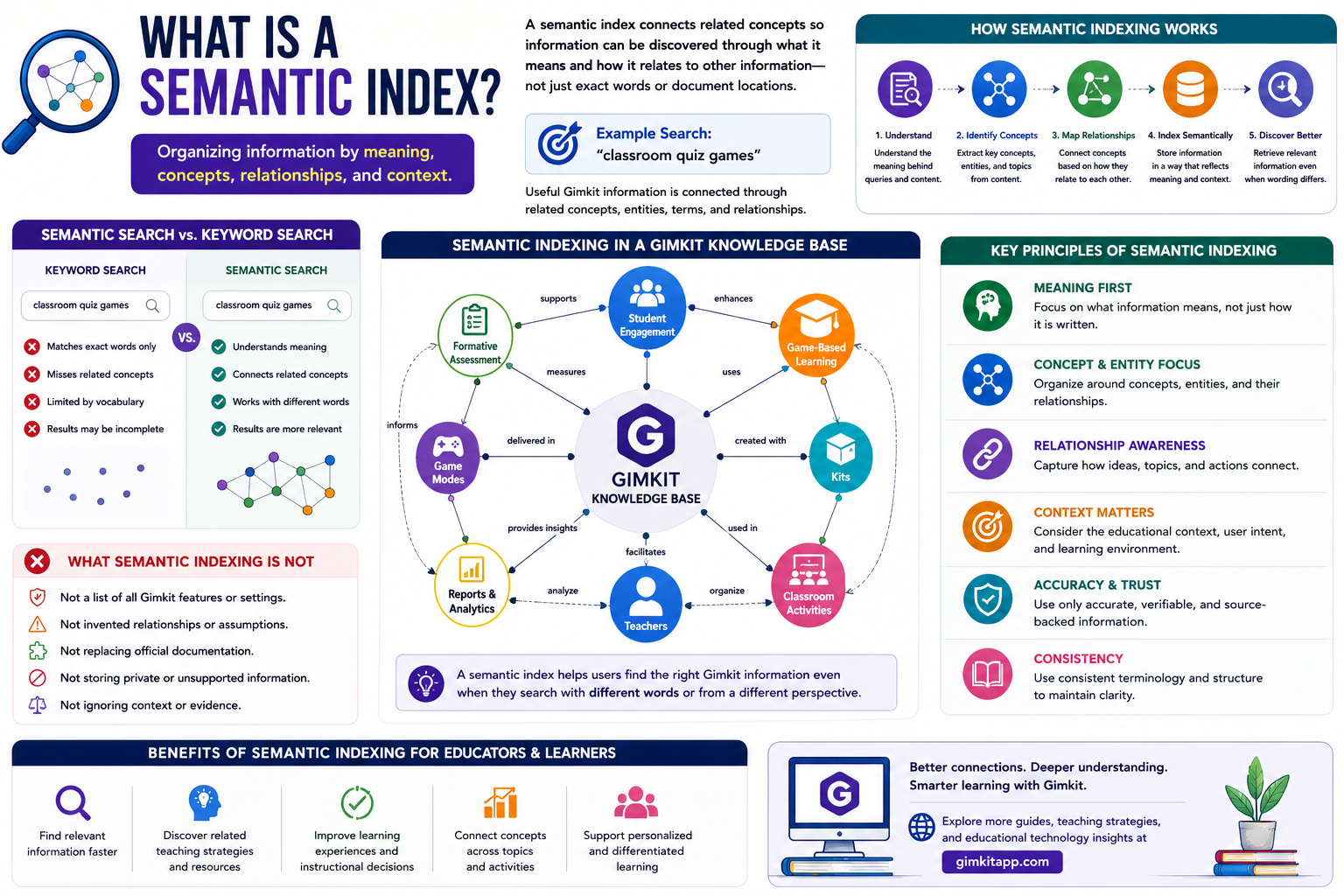
What Is a Semantic Index? A semantic index is a system for organizing information according to meaning, concepts, relationships, and context — rather than relying only on exact words or document locations. Instead of treating every page as an isolated collection of keywords, a semantic index connects related concepts so that information can be discovered through what it means and how it relates to other information.
For a Gimkit-centered knowledge base, this distinction matters because a learner or teacher may search for one phrase — say, “classroom quiz games” — while the useful information about Gimkit actually lives under several related concepts, entities, terms, and relationships (formative assessment, engagement, game-based learning, and so on). This guide walks through what semantic indexing actually is, how it differs from ordinary search and category structures, what it should avoid, and how it can be applied responsibly inside Gimkit’s knowledge base.
Looking for comprehensive classroom resources and educational technology insights? Explore GimkitApp for expert guides, teaching strategies, game modes, and the latest updates to enhance student engagement.
What “Semantic” Actually Means
The word semantic refers to meaning.
- A conventional text-oriented system primarily asks, “which documents contain this word?”
- A semantic system asks a broader question: “which information is conceptually related to what the user is looking for?”
Consider a learner searching for classroom quiz games. Related concepts might include formative assessment, student participation, retrieval practice, classroom review, game-based learning, teacher-led activities, and learner engagement. These concepts aren’t identical to the original search term, but they belong to the same knowledge neighborhood — and semantic navigation exists to make relationships like these discoverable rather than hidden behind mismatched vocabulary. For Gimkit’s knowledge base specifically, this is exactly the kind of gap the semantic layer needs to close, since a reader looking for Gimkit content rarely types “Gimkit” itself — they type what they’re trying to solve.
Semantic Index vs. Keyword Index
| Keyword-Oriented Index | Semantic Index |
|---|---|
| Focuses heavily on exact terms | Focuses on concepts and relationships |
| Finds matching text | Connects related meaning |
| Often document-centered | Knowledge-centered |
| Emphasizes lexical similarity | Emphasizes conceptual relationships |
| Asks “where does this word appear?” | Asks “what information is related?” |
| Treats pages independently | Connects pages into a knowledge structure |
- Keyword indexing isn’t obsolete — exact terms remain essential for precise retrieval (e.g., a direct search for “Gimkit”).
- Semantic indexing adds a second layer on top of that, helping a system understand how pieces of information relate to one another, not just where a particular word happens to appear.
Meaning Before Navigation
Imagine Gimkit’s knowledge base with thousands of pages. A basic navigation system might organize them by type: Articles, Guides, Tools, Games, Resources. A semantic layer adds a different dimension entirely — organizing by what things mean:
- Assessment connects to Formative Assessment, Feedback, and Retrieval Practice
- Engagement connects to Participation, Motivation, and Gamification
- Educational Technology connects to Classroom Platforms, Digital Games, and Learning Systems
The same page can belong to several of these meaningful relationships at once, without needing to be duplicated across categories.
This matters more as the site grows. A single article about Gimkit as a classroom quiz platform can legitimately relate to educational technology, game-based learning, formative assessment, student feedback, and classroom practice all at the same time. A semantic index is what allows those relationships to become part of Gimkit’s actual knowledge architecture, rather than forcing the article into exactly one category and losing its other connections.
What a Semantic Index Actually Stores
A semantic index represents several distinct kinds of information at once:
- Concepts — formative assessment, gamification, retrieval practice, collaborative learning.
- Entities — specific educational platforms (such as Gimkit), organizations, products, or named technologies.
- Attributes — an entity’s purpose, subject area, intended audience, function, or educational role (for Gimkit: classroom platform, quiz-based, game-based learning tool).
- Relationships — how concepts and entities connect: related to, used for, supports, compared with, part of, depends on, produces, measures.
- Context — the situation in which a relationship actually applies: classroom, homework, assessment, remote learning, teacher training.
Together, these components make information meaningfully connected rather than just a pile of independent keywords. A useful conceptual model links them as: concept → relationship → context → destination — for instance, formative assessment uses real-time feedback, which gets applied in classroom review, which connects onward to a related resource on Gimkit as an educational game platform. That’s a genuinely different experience from simply displaying a generic list of “related articles.”
Hierarchy and Semantics Serve Different Purposes
- A traditional menu answers “where are the site’s sections?” A menu might read Games | Guides | Education | Resources.
- Semantic navigation answers a different question: “where should I go next, based on what I’m actually trying to understand?” A semantic layer instead connects Gimkit → Classroom Review → Formative Assessment → Feedback → Learning Outcomes — a pathway that follows meaning rather than site structure.
These two systems aren’t competitors:
- Hierarchical navigation organizes information according to structure — education, under it assessment, under that formative assessment — and answers “where does this belong?”
- Semantic navigation organizes information according to relationships — formative assessment connects to feedback, which connects to retrieval practice, which connects to classroom review — and answers “what is this connected to?”
A robust knowledge architecture uses both together rather than treating one as a replacement for the other.
This is also why generic “related posts” widgets rarely count as real semantic navigation. A genuine semantic relationship needs a reason: an article on Gimkit assessment reports might legitimately connect to performance interpretation, feedback, and instructional decisions, but an unrelated game article shouldn’t be linked in just because both pages happen to contain the word “assessment.” Semantic navigation requires relationship relevance, not lexical overlap.
Relationship Strength, Direction, and Semantic Distance
- A direct relationship — formative assessment to feedback — reflects an obvious, well-established educational connection.
- An indirect relationship — formative assessment to Gimkit specifically — depends entirely on how Gimkit happens to be used in a given classroom, and shouldn’t be presented with the same confidence as a direct one.
Navigation is more useful when it prioritizes the strongest, most useful relationships instead of surfacing every possible association with equal prominence.
A closely related idea is semantic distance. Two topics can be:
- Very close (Gimkit ↔ classroom quiz)
- Related (Gimkit ↔ formative assessment)
- More distant (Gimkit ↔ educational psychology)
- Broadly connected (Gimkit ↔ education as a whole)
All of these can legitimately belong within one knowledge system, but they shouldn’t appear with equal prominence — a semantic index becomes more useful precisely when it distinguishes nearby concepts from distant ones, rather than treating the entire neighborhood as flat.
Left unchecked, this can produce semantic drift — a concept gradually expanding, step by step, until it loses its original meaning entirely.
- “Gimkit” can plausibly connect to “game-based learning,”
- which connects to “engagement,”
- which connects to “motivation,”
- which connects to “education,”
- which connects to “technology,”
- which eventually connects to “internet.”
Every individual step has some association, but the final destination is no longer useful for the question that started the chain. A strong semantic index needs relationship boundaries precisely to prevent this kind of drift — curated semantic neighborhoods that stay close enough to the original concept (Gimkit) to remain practically useful, rather than open-ended chains that technically connect but no longer help.
Why Context Changes Meaning
The same term can mean genuinely different things depending on context. The word “game” could refer to entertainment, an educational game (like Gimkit), a classroom competition, game-based learning, an assessment activity, or multiplayer learning — and the surrounding context is what determines which interpretation actually applies. This is why semantic navigation can’t rely on an isolated word; it needs term, concept, context, and relationship considered together.
Disambiguation is the process of telling apart different meanings or entities that happen to share similar names — a platform name like Gimkit that could resemble an ordinary word, another company, or an unrelated educational concept needs enough contextual information attached to it that the system can confidently identify which one is actually meant. Get this wrong, and search or navigation can quietly send a user into the wrong conceptual area entirely.
Context windows matter at the sentence level too. “Students received immediate feedback after answering a Gimkit question” and “Teachers provided feedback on the research proposal” use the identical word, but the first concerns a classroom learning interaction and the second concerns academic writing — the surrounding concepts change the interpretation, which is why semantic systems benefit from analyzing information in context rather than scoring every term in isolation.
Semantic Index vs. Search Index — and How They Work Together
- A search index primarily answers “which content should be retrieved for this query?”
- A semantic index instead represents “what concepts exist, and how are they related?”
In Gimkit’s knowledge base, these two layers interact rather than functioning in isolation: a user query passes through retrieval, then semantic understanding, surfacing relevant concepts and their related entities and relationships before producing knowledge results.
This interaction becomes especially valuable because people rarely search using perfectly structured terminology.
- A teacher might search “how can I make quiz review more interactive?”
- another searches “best classroom game for reviewing questions,”
- and a third simply types “students practice questions in a game” —
none of them typing “Gimkit” at all. These queries use completely different language but may represent overlapping underlying intent — different words can represent the same information need, and semantic organization is what connects those different expressions back to Gimkit as a relevant resource.
This capability is often called query expansion — a semantic layer broadening a search beyond its exact wording to surface classroom assessment, quiz activities, student participation, interactive learning, and formative assessment content — and, through those connections, Gimkit itself — even when none of those exact words appeared in the original query. But expansion needs boundaries. An uncontrolled chain — quiz → test → exam → evaluation → grading → education — can grow so broad that the original intent disappears entirely. The right relationship is broad enough to surface genuinely useful knowledge, but narrow enough to preserve what the user actually meant.
A mature system typically blends multiple retrieval signals rather than relying on any single one:
- Keyword match
- Semantic similarity
- Entity match
- Relationship strength
- Context
- User intent
- Content quality
All of these feed into candidate results before ranking. Exact terminology stays useful for precise searches (someone typing “Gimkit” directly), semantic retrieval helps when wording diverges, entity matching identifies Gimkit specifically among similarly named things, and context prevents unrelated interpretations from slipping in. Together these mechanisms produce more robust retrieval than any one method alone.
Modern retrieval also increasingly relies on vector representations (embeddings), where text is converted into a numerical form that allows systems to identify related content even when the exact wording differs — “interactive classroom question practice” can be recognized as related to “Gimkit-style quiz activities for reviewing concepts” despite sharing almost no vocabulary. But similarity is not the same thing as truth: two passages can be semantically close without either one being accurate, authoritative, or actually appropriate for the user’s question. Similarity doesn’t guarantee relevance, relevance doesn’t guarantee evidence, and evidence doesn’t guarantee universal applicability — a trustworthy semantic architecture for Gimkit’s content needs quality signals well beyond similarity scores alone.
Concept Extraction and Entity Recognition
One of the foundational tasks in building Gimkit’s semantic index is identifying the concepts actually represented in a piece of information, and — just as importantly — determining their roles and relationships to one another, not simply pulling out a flat list of important-sounding phrases.
- “Teachers can use Gimkit to check student understanding during a lesson” contains the concepts teacher, Gimkit, student understanding, formative assessment, and classroom activity.
- The useful semantic representation captures that the teacher uses Gimkit to support an understanding check during instruction.
That relational structure carries far more information than the keyword list it was extracted from.
Concepts and entities overlap but aren’t identical:
- A concept — formative assessment — is a general idea.
- An identifiable entity — Gimkit itself — is a named, distinct thing.
Keeping these categories separate prevents a knowledge system from treating every important phrase as the same kind of object, and it opens the door to attaching attributes to Gimkit as an entity that give it practical meaning: type, intended audience, context of use, core function, subject coverage, and how it relates to broader concepts like assessment or engagement.
Synonyms and concept variants deserve deliberate handling rather than being ignored or treated as perfectly identical. Digital learning, online learning, technology-supported learning, and technology-enhanced learning overlap substantially while still carrying contextual shades of difference — semantic indexing connects related terminology (any of which a reader might use before arriving at Gimkit) without pretending every variation means exactly the same thing, which matters enormously for natural-language search since users never follow a controlled vocabulary. Closely related is canonicalization — recognizing a preferred representation of a concept when multiple written forms exist (game-based learning, game based learning, game-based instruction) while still retaining the meaningful variants, preventing the index from fragmenting one concept into several disconnected entries.
Ontology and Taxonomy Are Not the Same Thing
This distinction is frequently blurred, but it matters.
- A taxonomy primarily organizes things into categories: Education, under it Assessment, under that Formative Assessment, under that Gimkit. It answers “where does this belong?”
- An ontology represents concepts and the relationships between them: a teacher uses Gimkit, which generates evidence, which informs an instructional decision. It answers a different question entirely — “what is this, and how does it relate to everything else?”
A semantic index benefits from both working together: taxonomy for structural placement, ontology for meaningful relationship representation.
An ontology’s value isn’t that it creates more categories — it’s that it establishes what a concept actually is, what it is not, and how it can legitimately relate to other concepts. That boundary-setting function is what keeps Gimkit’s semantic index from treating every loosely associated pair of ideas as equally valid.
Semantic Graphs, Nodes, and Edges
A semantic graph represents knowledge through connected nodes and relationships — a teacher node connects via “uses” to a Gimkit node, which connects via “produces” to a student-response node, which connects via “informs” to a feedback node. Here, nodes represent concepts or entities, edges represent relationships, and context determines when a given relationship actually applies. This graph-oriented thinking becomes especially useful once Gimkit’s content grows too interconnected for a simple folder hierarchy to represent well.
But building a graph doesn’t automatically produce good knowledge. A graph containing thousands of weak or inaccurate relationships can be considerably less useful than a much smaller graph built from carefully validated connections — semantic quality depends on relationship accuracy, not graph size, and that principle is critical for a Gimkit knowledge system that wants to remain trustworthy rather than merely large.
Weighting, Ranking, and Following User Intent
Once multiple resources connect to the same concept, they still need ordering, and the strongest semantic relationship shouldn’t automatically win if the destination doesn’t actually serve the user’s purpose. A conceptual ranking model weighs relevance, context, concept match, relationship strength, user intent, and content quality together — a highly relevant definition of Gimkit can be less useful than an implementation guide for a teacher who has already used Gimkit before.
Intent shapes the entire relevant neighborhood, not just which single result wins:
- “What is Gimkit?” signals a definition intent
- “How do teachers use Gimkit?” signals an implementation intent
- “Gimkit vs Kahoot” signals a comparison intent
All three concern the same entity, but the ideal semantic pathway differs sharply for each — a definition query should lead toward core characteristics and purpose, an implementation query toward workflow and classroom application, a comparison query toward shared characteristics, differences, and use cases. Semantic relevance has to be evaluated against what the user is actually trying to accomplish, not simply against topical similarity to the query.
This same logic extends to navigation depth:
- A beginner exploring Gimkit typically needs definition → example → application.
- An advanced user typically prefers construct → measurement → evidence → limitations → research.
Semantic architecture can support both readers from the same underlying knowledge relationships — the difference lies in navigation depth and presentation, not in maintaining two separate knowledge bases. This is often implemented as progressive disclosure: showing the most relevant concepts first, then supporting relationships, then deeper research or technical material — preserving simplicity for a first-time visitor while still allowing genuine depth for someone who wants it.
Preserving User Orientation
Discovery is only useful if a user understands where they are and why the next suggested destination matters. A strong navigation experience communicates the current concept, a related concept, the reason for the connection, and the next destination — for example: “You are exploring Gimkit as a Formative Assessment tool. Related concept: Feedback. Why: feedback is commonly used to communicate information about learner performance and guide subsequent instruction.” This single addition — an explicit reason — is arguably the strongest rule in semantic navigation design: every important connection should have an understandable reason attached to it. “Related: Feedback” tells a user almost nothing; “Feedback — explores how information about learner performance can be used during instruction” lets the user gain real knowledge before they even click.
Semantic breadcrumbs extend this same idea:
- A traditional breadcrumb shows hierarchy — Home → Education → Assessment → Gimkit — telling the user where the page technically lives.
- A semantic pathway instead shows conceptual relationship — Gimkit → Feedback → Classroom Practice — telling the user how the concept connects to other knowledge.
These aren’t competitors; a well-designed system can show both, since they answer genuinely different questions.
Relationships also ideally work in both directions where appropriate: if Gimkit relates to formative assessment, users exploring formative assessment should generally be able to find their way back to Gimkit. This turns a set of one-way content pathways into an actual connected knowledge network, rather than a collection of dead-end links.
For the latest gaming news, expert reviews, and walkthroughs, readers can also visit IGN, one of the world’s leading gaming websites.
Semantic Clusters vs. Topic Clusters
These two terms get used interchangeably, but they describe different things:
- A topic cluster is a content-architecture pattern built around a central pillar page and its supporting pages — Gimkit Guides → Feature Guides → Gimkit vs Competitor Comparisons.
- A semantic cluster is a conceptual grouping based on meaning — Gimkit ↔ Engagement ↔ Practice ↔ Feedback ↔ Assessment.
The first is primarily an information-architecture decision; the second represents genuine conceptual relationships. A strong knowledge system uses both, but shouldn’t assume that building one automatically produces the other — a well-organized Gimkit topic cluster can still lack any real semantic relationship depth underneath it.
A related danger worth naming directly is the knowledge silo: a large Gimkit knowledge base can accidentally build internally coherent but mutually disconnected categories — a Games section, an Assessment section, and a Learning Science section that each make sense internally but never actually connect to one another. Semantic architecture exists partly to prevent this, weaving separate content categories into one integrated knowledge environment rather than several isolated ones sitting side by side.
Keeping Semantic Relationships Honest: The Evidence Boundary
This is arguably the single most important distinction for a Gimkit knowledge system to maintain. A semantic index describes how information relates — it does not, by itself, establish how strongly a claim should be trusted.
- “Gimkit contains quiz questions” is a structural relationship.
- “Using Gimkit improves long-term learning” is an empirical claim that requires actual evidence and careful qualification.
Treating these two statement types identically is one of the fastest ways a semantic architecture can quietly convert an assumption into an apparent fact.
Relationships can be usefully sorted into different types — definitional, structural, functional, empirical, and contextual — and they shouldn’t all be treated with the same confidence:
- “Entity belongs to category” (Gimkit is an educational platform) is a very strong, stable kind of relationship.
- “Tool can support activity” (Gimkit can support review practice) is genuinely context-dependent.
- “Strategy improves outcome” (Gimkit improves retention) is evidence-dependent and should never be asserted with the same confidence as a simple category membership.
A semantic system that keeps these confidence levels distinct protects itself from a specific and common failure mode: presenting a mere association as though it were a demonstrated effect. Creating a relationship between Gimkit and a broader educational concept — say, connecting it to “assessment” — does not by itself make the site an authority on assessment. Authority comes from accurate definitions, credible evidence, transparent reasoning, and careful qualification elsewhere in the content; the semantic index is the architecture that organizes knowledge, not a substitute for the quality of that knowledge.
Freshness, Governance, and Ongoing Quality Control
Some knowledge is stable; some isn’t, and a semantic index needs to treat these two categories differently.
- Formative assessment as a concept is relatively durable.
- Gimkit’s specific feature set, pricing, or interface can change considerably within a year or two.
Treating both kinds of knowledge as equally permanent is a quiet but real source of outdated navigation — dynamic, entity-specific attributes about Gimkit need periodic verification in a way that stable, conceptual relationships generally don’t.
As Gimkit’s knowledge base grows, someone — or some defined editorial process — needs to actively maintain its conceptual structure:
- Terminology standards
- Entity naming rules
- Relationship definitions
- Duplicate detection
- Review of outdated relationships
- Evidence requirements for empirical claims
- Periodic quality audits
Without this kind of governance, a semantic structure drifts and becomes inconsistent simply through the accumulation of small, individually reasonable additions over time. A practical audit routine checks whether:
- Concepts are clearly bounded
- Entities (including Gimkit) are correctly identified and disambiguated
- Relationships are genuine rather than keyword-driven
- Context is being applied correctly
- Empirical claims carry appropriate evidence
- Dynamic information about Gimkit has been reviewed recently
- Each connection actually helps the reader rather than just adding to the count of internal links
Common Semantic Indexing Mistakes
| Mistake | Why It Undermines the Index |
|---|---|
| Treating keywords as concepts | A shared word doesn’t establish shared meaning |
| Connecting everything to everything | More connections can produce less useful navigation |
| Confusing similarity with equivalence | Related concepts can still be fundamentally different constructs |
| Ignoring context | The same term can represent entirely different concepts depending on setting |
| Treating associations as evidence | A relationship doesn’t establish causation or effectiveness on its own |
| Ignoring time | Dynamic, entity-specific information (like Gimkit’s features) can silently go stale |
| Building for search engines instead of readers | Optimization that isn’t grounded in genuine understanding erodes trust |
| Over-categorizing | Excessive fine-grained categories make navigation harder, not easier |
The throughline across all of these: a semantic index earns its usefulness through restraint and accuracy, not through maximizing the number of connections it can technically draw.
Applying This to a Gimkit-Centered Knowledge Environment
Inside Gimkit’s knowledge architecture, the semantic layer shouldn’t connect every Gimkit-related page to every broad educational topic simply because a loose association exists somewhere. Instead, it can establish meaningful, bounded pathways:
- Gimkit as a classroom platform connecting to interactive activity and student participation
- Gimkit as question-based learning connecting to practice and feedback
- Gimkit as educational technology connecting to game-based learning more broadly
These relationships stay useful precisely because they remain descriptive and context-aware, rather than implying unsupported educational outcomes the underlying content hasn’t actually established.
This same discipline extends to what semantic SEO should actually mean for Gimkit’s site:
- It is not “add lots of related keywords” — repeating “Gimkit, Gimkit game, Gimkit classroom, Gimkit learning” throughout a page provides no real semantic information.
- A stronger approach explains what Gimkit actually is, who uses it, what educational context it belongs to, what activities it supports, how teachers may realistically use it, what its limitations are, and how it relates to broader educational concepts — content that genuinely represents concepts, entities, relationships, context, and user intent, rather than content engineered to trigger keyword-matching.
- Internal links should follow the same rule: a link should exist because it expresses a real conceptual relationship, answering “what will the reader understand after following this that they don’t understand now?” — not because the destination page happens to share a keyword.
The same logic carries directly into generative-answer readiness (sometimes discussed as GEO). AI systems that summarize or answer from a page about Gimkit need information that can be interpreted cleanly in context — passages that clearly communicate what something is, what it does, what it relates to, under what conditions it applies, and what its limitations are. That’s supported by writing self-contained knowledge units: a definition or explanation that can be understood on its own, without depending on “as explained earlier” references to context the reader — or an AI system extracting just that passage — may not actually have. “Gimkit is a game-based classroom platform where students answer questions to earn in-game currency, used by teachers to support formative assessment and review” can stand entirely on its own, which makes it portable across search results, semantic retrieval, AI-generated answers, and internal navigation alike. The goal here isn’t to manipulate a generative system into citing the page — it’s to make the underlying information clear enough that it genuinely deserves to be cited.
Navigation vs. Discovery
These two ideas overlap but aren’t identical, and Gimkit’s semantic index serves both differently:
- Navigation assumes the user already knows roughly where they want to go — they searched for “Gimkit” specifically and want the fastest path there.
- Discovery is different: it’s the system surfacing something relevant that the user didn’t explicitly ask for, because a genuine semantic relationship connects it to what they’re already exploring.
Someone researching classroom quiz games may discover Gimkit — and retrieval practice as a related concept — purely because the semantic relationship is educationally meaningful — a connection that exact-keyword search would never have surfaced on its own, since the user never typed “Gimkit.”
Semantic relationships are particularly valuable for this second mode. A pure keyword system can only ever return what was explicitly searched for; a semantic layer can surface Gimkit as adjacent, genuinely useful knowledge the user didn’t know to ask about yet. That’s a meaningfully different kind of value than simply retrieving a faster or more accurate match for an existing query.
Semantic Compression and Consistency
A mature semantic index can represent large amounts of information through compact, reusable conceptual structures rather than repeating the same explanation across dozens of pages. Instead of re-explaining “what Gimkit is” in full on every page that touches the concept, Gimkit’s knowledge base can maintain one authoritative definition and let other pages reference it while explaining their own specific context on top of it. This reduces duplication and — just as importantly — helps the whole system stay internally consistent.
That consistency is not optional.
- If one page describes Gimkit as an ongoing instructional tool and another describes it simply as a type of test, the semantic structure becomes unreliable — a user (or an AI system reading the site) can no longer trust that “Gimkit” means the same thing everywhere it appears.
- A trustworthy semantic index depends on consistent terminology, clearly maintained definitions, controlled concept distinctions, stable entity identification, and relationships that are stated explicitly rather than left to be inferred differently by different readers.
Semantic Confidence Levels
Not every relationship in Gimkit’s semantic index deserves the same degree of certainty, and treating them as uniformly solid is a quiet but real source of misinformation. A practical way to think about this:
| Relationship Type | Example | Typical Confidence |
|---|---|---|
| Entity belongs to a category | “Gimkit is an educational platform” | Very strong |
| Concept relates to a closely adjacent concept | “Formative assessment relates to feedback” | Strong |
| Tool can support an activity | “Gimkit can support review practice” | Context-dependent |
| Strategy improves an outcome | “Gimkit improves retention” | Evidence-dependent |
| Trend will dominate future practice | “This approach will become standard” | Uncertain |
The exact implementation of confidence scoring can vary widely across systems, but the underlying principle holds regardless of technical approach: category-membership relationships can usually be asserted with near-certainty, while outcome and effectiveness claims about Gimkit need to be treated as provisional and tied back to actual evidence rather than presented with the same flat confidence as a structural fact.
Precision vs. Coverage — A Necessary Trade-off
Two competing goals shape every semantic index: coverage, or how much relevant conceptual territory the system represents, and precision, or how accurately its relationships are actually identified.
- A system optimized purely for coverage risks connecting nearly everything to everything, producing a network so dense it stops being navigable.
- A system optimized purely for precision risks representing only a narrow slice of genuinely useful relationships, missing connections a reader would have benefited from.
Neither extreme serves the reader well. The workable target is broad knowledge representation paired with accurate relationships and strong contextual relevance — and when the two goals genuinely conflict, accuracy should generally win. A missing weak relationship costs a user a secondary resource they might have found useful. A false strong relationship — say, an unsupported claim about Gimkit’s effectiveness — can actively mislead them, which is a meaningfully worse failure — especially in an educational context where readers may be relying on those relationships to make real instructional or research decisions.
A Practical Decision Model Before Exposing a Relationship
Before a relationship earns a visible place in Gimkit’s navigation, it helps to run it through a short set of checks:
| Question | If the Answer Is No |
|---|---|
| Is the relationship genuine, not just keyword overlap? | Reject it |
| Is it relevant to the concept the user is currently exploring? | Lower its priority |
| Is the surrounding context appropriate for this relationship? | Re-evaluate before showing it |
| Is the destination actually useful once the user arrives? | Reject it |
| Does it involve a factual or outcome claim? | Verify the underlying evidence before showing it |
| Could the underlying information change over time? | Flag it for periodic freshness review |
| Does showing it reduce the user’s search friction? | Deprioritize it relative to relationships that do |
This kind of structured filter is what keeps Gimkit’s semantic index from gradually accumulating hundreds of technically-defensible-but-practically-useless connections — the difference between a knowledge base that feels genuinely navigable and one that feels like an undifferentiated web of loosely related pages.
Self-Contained Knowledge Units and Answer Extraction
A particularly valuable design principle is making each major concept about Gimkit independently understandable — not dependent on “as explained earlier” references to context the reader may not actually have in front of them. A section that reads “as explained earlier, this is also important” fails the moment it’s read out of its original sequence, whether that’s a user landing on the page from a search result, or an automated system extracting just that one passage.
The alternative is straightforward: state the concept in a way that stands on its own. “Gimkit is a game-based learning platform that lets teachers turn quiz questions into a competitive classroom activity, used to support formative assessment and student engagement” is direct, self-contained, precise, and contextually clear without requiring anything else on the page to make sense of it. That kind of writing supports direct-answer retrieval — whether the “reader” is a person scanning search results or a generative system summarizing the page — because the definition doesn’t depend on surrounding scaffolding to be understood correctly.
Knowledge Navigation Should Have a Recognizable Endpoint
Semantic exploration can, in principle, continue indefinitely — every concept connects to something else, which connects to something else again. But users almost always have a practical goal in mind (like deciding whether Gimkit fits their classroom), and a good system recognizes when that goal has actually been met rather than continuing to push additional related content indefinitely. The useful progression runs from question, to answer, to understanding, to an optional stage of deeper exploration for a reader who wants it, to an eventual action or decision — not an endless chain of “you might also be interested in” prompts that never lets the user feel like they’ve arrived anywhere.
This matters because the value of Gimkit’s semantic index isn’t measured by how much content a user can be routed through. It’s measured by whether each connection actually made the knowledge easier to understand, verify, discover, or apply. A relationship that does none of those things doesn’t deserve prominence, regardless of how technically valid the underlying association might be — which is really the same governing principle behind every rule in this guide, just stated from the reader’s side of the experience rather than the architecture’s.
Semantic Paths for Different Kinds of Readers
Gimkit’s semantic index doesn’t have to route every reader through the same sequence of concepts, because different readers are usually trying to accomplish different things even when they start from the same topic:
- A learning-oriented path tends to move from definition, to core concept, to example, to application — the shape a first-time reader needs to build understanding of Gimkit from scratch.
- A research-oriented path tends to move from concept, to research, to methods, to findings, to limitations, to open research gaps — the shape someone needs when evaluating evidence about a tool like Gimkit rather than simply understanding what it is.
- A practitioner-oriented path tends to move from an educational goal, to an instructional strategy, to Gimkit specifically, to implementation guidance, to classroom outcomes — the shape a teacher needs when deciding what to actually do on Monday morning.
These three paths can draw from the exact same underlying set of concepts and relationships. What changes is the order in which they’re surfaced and which layer of depth is emphasized first. This is one of the clearest practical advantages semantic navigation has over a single fixed menu structure: a menu has to pick one organizational logic and apply it to everyone, while a semantic layer can adapt the presented pathway to what a specific reader appears to need, without maintaining separate, duplicated knowledge bases for each audience.
Temporal Layers: Separating What Changes From What Doesn’t
Educational knowledge doesn’t age uniformly, and a semantic index that treats every relationship as equally permanent will eventually accumulate quiet inaccuracies. It helps to think in terms of two distinct temporal layers:
- The first is relatively stable conceptual knowledge — the definition of formative assessment, the general relationship between practice and retention, the distinction between a taxonomy and an ontology. These relationships can usually be trusted to remain accurate for years without active maintenance.
- The second layer is dynamic, entity-specific information — Gimkit’s current feature set, its pricing model, which grade levels it markets toward, what its interface currently looks like. This layer needs a fundamentally different maintenance posture: periodic, deliberate verification rather than a write-once assumption.
A semantic index that doesn’t distinguish between these two layers tends to either over-invest in reviewing stable concepts that rarely change, or under-invest in reviewing Gimkit’s dynamic entity attributes that quietly go stale — both of which erode trustworthiness over time, just through different mechanisms. A definition of retrieval practice written five years ago is very likely still accurate today. A description of Gimkit’s specific pricing tiers written five years ago almost certainly isn’t — and a semantic index that doesn’t flag that difference risks presenting outdated commercial information with the same implied authority as a stable educational concept.
Hybrid Systems: Where Structure and Meaning Meet
In practice, very few production knowledge systems rely purely on semantic relationships or purely on rigid hierarchy — most combine several organizational layers deliberately:
- A taxonomy provides the stable backbone that tells both users and internal systems where a piece of Gimkit content formally belongs.
- An ontology-informed relationship layer sits alongside it, capturing how concepts actually relate to one another regardless of where they happen to be filed.
- A retrieval layer — combining keyword matching, entity recognition, and semantic similarity — sits on top of both, actually answering the reader’s query in the moment.
The reason this layered approach tends to outperform any single method in isolation is that each layer compensates for what the others miss:
- Pure hierarchy struggles with content that legitimately belongs in multiple places at once.
- Pure semantic similarity can surface loosely related but ultimately unhelpful matches if it isn’t constrained by structure and context.
- Pure keyword matching misses everything expressed in different words than the original content used (like a search that never says “Gimkit” by name).
A hybrid approach — hierarchy for stable placement, semantic relationships for meaningful connection, and multi-signal retrieval for actually answering a query — tends to produce a system that is both navigable in the traditional sense and genuinely discoverable in a way a purely keyword-driven site never can be.
What a Semantic Index Ultimately Buys Gimkit’s Knowledge Base
Stepping back from the individual mechanisms, the practical payoff of building a proper semantic layer is fairly concrete:
- Readers spend less time reconstructing search queries because the system already understands what related concept they probably need next.
- Content stops being siloed into disconnected categories that happen to share a website but not a knowledge structure.
- Claims about Gimkit stay easier to trace and qualify correctly, because structural relationships and evidence-based claims are kept visibly distinct rather than blurred together.
- The site becomes easier for both people and automated systems to extract clean, accurate, self-contained answers from — not because it was engineered to game any particular algorithm, but because the underlying knowledge is genuinely well organized.
That last point is worth stating plainly: a good semantic index is not a trick for ranking better. It’s a byproduct of actually understanding — and clearly representing — what Gimkit’s content is about, how its pieces relate, and where the boundaries of each claim actually sit. Everything else — better search, better navigation, better AI-answer extraction — follows from getting that underlying representation right.
Testing a Semantic Index Against Real Reader Questions
The most reliable way to check whether Gimkit’s semantic index is actually working is to stop reasoning about it abstractly and run it against real questions a reader would plausibly ask. Pick a handful of natural-language queries — not the tidy, keyword-perfect phrasing an editor might use, but the messier way an actual teacher or student would type it — and trace what the system surfaces:
- Does the first destination answer the underlying intent, or just match a surface word?
- Does the path from that first destination to a related concept make sense to someone reading it cold, without the internal reasoning that built the relationship in the first place?
- If a colleague unfamiliar with the architecture can’t tell why two connected concepts are linked, the relationship likely needs a clearer stated reason, a narrower scope, or removal altogether.
This kind of testing also surfaces gaps that abstract review misses. A concept might have every relationship it “should” have on paper, yet still fail a real query because the phrasing a reader actually uses doesn’t map cleanly onto any of the terms in the index — including never mentioning “Gimkit” directly. That’s a sign the synonym and concept-variant handling needs more coverage, not that the underlying relationships are wrong. Treating this kind of testing as a routine part of maintaining the index — rather than a one-time launch check — keeps the system honest as both the content and the way readers phrase their questions continue to evolve.
Quick-Reference Glossary
- Semantic index — a system organizing information by concepts, relationships, and context rather than exact wording alone.
- Ontology — a structured representation of concepts and the relationships between them, defining what a concept is and how it can relate to others.
- Taxonomy — a categorical structure organizing content into a hierarchy of belonging.
- Semantic graph — a network of nodes (concepts or entities) connected by edges (relationships), used to represent interconnected knowledge.
- Disambiguation — the process of distinguishing between different meanings or entities that share a similar name or term.
- Semantic drift — the gradual expansion of a concept’s connections until it loses its original, useful meaning.
- Canonicalization — selecting a preferred representation of a concept when multiple equivalent forms exist, while retaining meaningful variants.
- Embedding (vector representation) — a numerical representation of text or content used to identify related material based on meaning rather than exact wording.
- Semantic drift boundary — a deliberate limit placed on how far a relationship chain is allowed to extend before it stops being practically useful.
Professional Recommendations & Expert Reviews
Frequently Asked Questions
Is a semantic index the same thing as a knowledge graph?
They’re closely related but not identical terms. A knowledge graph is a specific technical structure emphasizing entities, relationships, and properties. A semantic index is the broader organizing layer that can use graph-style thinking — along with taxonomy, embeddings, and other techniques — to connect meaning across Gimkit’s knowledge base.
Does adding more internal links automatically improve semantic structure?
No. More links can create more navigation friction rather than less, especially when they’re added mechanically rather than because they express a real conceptual relationship. A smaller set of well-chosen, clearly explained connections is generally more useful than a large set of weak or keyword-driven ones.
How is a semantic relationship different from an evidence-based claim?
A semantic relationship describes how two concepts or entities are connected in meaning — for example, that Gimkit is used for assessment. An evidence-based claim asserts an effect or outcome — for example, that Gimkit improves retention. The first is a structural or functional statement; the second requires supporting evidence and appropriate qualification, and conflating the two risks presenting an assumption as an established fact.
Why does context matter so much for ambiguous terms?
Many common words carry multiple meanings depending on setting — “mode” in a game context differs completely from “mode” in statistics. Without contextual information, a semantic system risks connecting a user to entirely the wrong conceptual neighborhood, which is why context is treated as a core input alongside the term and concept themselves, not an optional refinement.
Should a semantic index treat every possible relationship as equally important?
No. Distinguishing direct from indirect relationships, and nearby from distant ones, is what keeps navigation useful rather than overwhelming. A system that surfaces every technically possible connection with equal prominence tends to bury the genuinely useful pathways under noise.
Can a small site benefit from semantic indexing, or is it only useful at large scale?
The core discipline — writing self-contained definitions, being explicit about why two concepts connect, and separating structural relationships from evidence-based claims — improves clarity at any size. The navigational benefits (discovery, multiple reading paths, reduced search friction) become more visible as a knowledge base grows, but the underlying habits are worth building from the start rather than retrofitted later.
How should a semantic index handle a concept that genuinely means different things in different educational contexts?
Rather than forcing one universal definition, the index should represent the term alongside its distinct contexts and link each context to its own accurate definition and relationship set. Collapsing genuinely different meanings into a single entry is a common source of the false-relationship problem discussed earlier — it’s better to maintain separate, clearly labeled entries than to blur them into one imprecise composite.
Final Synthesis
A semantic index is not simply another version of a search index, category system, or internal-link structure. It’s a conceptual layer that transforms words into concepts, concepts into entities, entities into relationships, relationships into contextual knowledge, and knowledge into navigation that a person can actually follow and understand.
The most important distinction underlying all of it: traditional navigation primarily tells a user where information is located. Semantic navigation helps explain how information is connected. For Gimkit’s educational knowledge environment, that difference becomes steadily more important as the number of concepts, resources, platforms, instructional ideas, and research topics keeps growing. The strongest semantic architecture doesn’t attempt to connect everything to everything — it builds a controlled, meaningful, evidence-aware network of knowledge in which every important relationship — including every relationship to Gimkit itself — has an actual reason to exist.