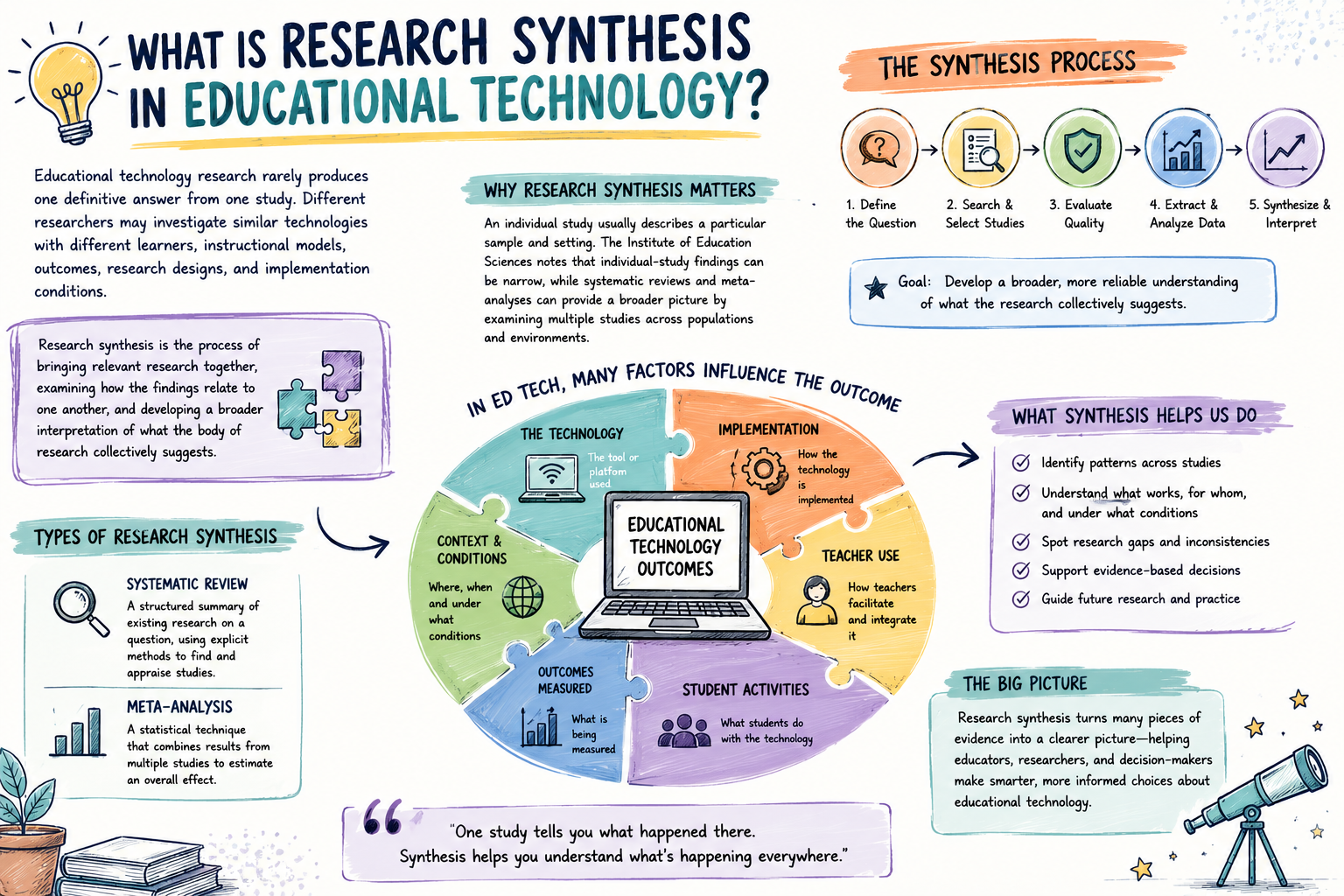
What Is Research Synthesis in Educational Technology?Educational technology research rarely produces one definitive answer from one study. Different researchers investigate similar technologies with different learners, instructional models, outcomes, research designs, and implementation conditions — and no single study can carry the weight of a field-wide conclusion. Research synthesis is the disciplined process of bringing relevant research together, examining how the findings relate to one another, and building a broader, defensible interpretation of what the body of research collectively suggests.
This matters because an individual study almost always describes one particular sample in one particular setting:
The Institute of Education Sciences (IES) notes that individual-study findings can be narrow, while systematic reviews and meta-analyses offer a broader picture by examining multiple studies across populations and environments.
In educational technology specifically, synthesis carries extra weight because the technology itself is only one part of the intervention.
How a tool is implemented, what students actually do with it, how teachers use it, what outcome gets measured, and under what conditions it’s introduced can all shift the result.
Looking for comprehensive classroom resources and educational technology insights? Explore GimkitApp for expert guides, teaching strategies, game modes, and the latest updates to enhance student engagement.
Defining Research Synthesis
Research synthesis is the systematic process of bringing together findings from multiple relevant studies and interpreting them collectively to identify broader patterns, meaningful differences, operating conditions, limitations, and unanswered questions. The operative word is collectively.
A research summary tells a reader: Study A found one result, Study B found another, Study C found a third. A synthesis goes further and asks:
Why those findings are similar or different
Whether the studies were examining the same outcome
Whether the learners were comparable
Whether the technology was used the same way
Whether the research designs diverged
What pattern emerges once everything is considered together
That’s why synthesis isn’t simply a longer literature summary — it’s a transformation:
Individual research findings → Comparison → Relationships between findings → Patterns and differences → Contextual interpretation → Synthesized understanding
The goal is to build new understanding from the relationships among existing findings, without pretending the synthesis itself proves more than the underlying research allows.
Synthesis vs. Summary — Why the Distinction Matters
This distinction defines the entire discipline.
A summary compresses information: “Study A reported improved mathematics performance. Study B reported no significant difference. Study C found stronger effects under certain implementation conditions.” That’s useful, but limited.
A synthesis asks what those findings mean together: “Across the studies, technology-supported mathematics interventions appear to produce different outcomes depending on implementation intensity, instructional design, learner characteristics, and study conditions.” That interpretation still has to be earned by the actual research base, but it gives the reader a genuinely higher-level understanding rather than a list of isolated data points.
In one line: a summary answers what did each study say? A synthesis answers what can we understand when the relevant studies are examined together?
Why “Educational Technology” Is Too Broad an Object of Study
Educational technology is unusually hard to evaluate as a single category because “technology” covers radically different interventions:
Adaptive learning systems
Intelligent tutoring
Educational games
Simulations
Virtual reality
Digital textbooks
Learning management systems
Computer-assisted instruction
Collaboration platforms
Assessment tools
AI-supported learning environments
These tools don’t necessarily work through the same mechanism — one might provide feedback, another adapts difficulty, another increases practice opportunities, another supports visualization or collaboration.
Asking “does educational technology work?” is therefore often too broad to be scientifically useful. A stronger synthesis question looks like: which technology-supported approaches appear to influence which outcomes, for which learners, through what mechanisms, and under what implementation conditions? The OECD’s 2025 review of digital technologies illustrates this complexity directly — drawing on systematic reviews, meta-analyses, and empirical studies, it concluded that access to technology alone does not guarantee educational gains, and that pedagogical implementation is what actually matters.
This is also why the object of synthesis is rarely “the technology” alone. A more realistic model of what’s actually being studied looks like:
Technology → Features & Design → Teacher Implementation → Instructional Practice → Student Interaction → Learning Activity → Measured Outcome
Two studies of the same platform can describe genuinely different interventions if one classroom used it for targeted practice with structured teacher monitoring, and another treated it as optional, unsupervised enrichment. Synthesis has to examine implementation characteristics, not just the platform’s name. The EEF’s recent EdTech review reflects this same logic, examining mechanisms and implementation characteristics rather than treating “educational technology” as one undifferentiated intervention.
Defining the Research Question and the Scope of the Synthesis
Before any studies can be meaningfully combined, the object of synthesis has to be defined precisely. “Do digital games improve learning?” is a fundamentally different — and much weaker — question than “do game-based mathematics interventions affect mathematics achievement among upper-elementary students?” The broader the question, the greater the risk of combining studies that are conceptually related but not actually comparable.
Scope is usually established across several dimensions at once:
Dimension
Example Boundary
Population
K–12 students
Subject
Mathematics
Technology
Digital learning platforms
Setting
Formal classroom environments
Outcome
Academic achievement
Study design
Quantitative and/or qualitative studies
Time period
A defined publication range
Geography
Specific regions or international
Intervention
Technology-supported instruction
The purpose of scoping isn’t to arbitrarily exclude useful research — it’s to make sure every included study actually contributes to answering the defined question.
Without a clear scope, synthesis gradually turns into an uncontrolled literature-collection exercise, and eligibility criteria need to be set before the search begins rather than adjusted afterward to fit a preferred conclusion.
A positive study shouldn’t become more relevant just because its result is attractive.
The PRISMA 2020 framework — widely used for systematic reviews — exists largely to enforce this kind of transparency: it calls for clear reporting of exactly how studies were identified, screened, included, and excluded.
Systematic Reviews: A Structured Path Through the Literature
A systematic review is one of the primary vehicles for synthesis. Its defining feature is a structured, transparent process for identifying, selecting, evaluating, and synthesizing relevant studies according to criteria set in advance. The What Works Clearinghouse describes its synthesis protocols as establishing parameters for literature searches and providing explicit criteria for identifying and prioritizing studies for inclusion. That structure reduces the risk of an informal process where a researcher simply gathers studies that happen to confirm their expectations.
A typical conceptual workflow looks like:
Research question → Review scope → Search strategy → Study identification → Screening → Eligibility criteria → Quality/standards review → Data extraction → Synthesis → Interpretation
“Systematic,” though, doesn’t mean “infallible”:
A review’s conclusions are still shaped by its search strategy, the databases it searched, its inclusion and exclusion criteria, the studies that were actually available, and how outcomes were defined.
Two systematic reviews covering seemingly similar territory can land on different conclusions simply because their scopes differed — which the IES notes explicitly.
Systematic means the process is defined and traceable, not that the output is beyond question.
Finding and Screening the Relevant Literature
A serious literature search draws on academic databases, research indexes, reference-list and citation tracking, institutional repositories, government research collections, and — where appropriate — grey literature. The goal isn’t to collect every document containing a keyword; it’s to identify research that can legitimately contribute to answering the defined question. Search volume and research relevance are not the same thing.
That search typically produces far more records than are actually usable, which is why screening exists as its own stage:
Search results → Remove duplicates → Initial screening → Detailed eligibility assessment → Eligible studies → Final included research
Screening weighs topic relevance, population, intervention, outcome, study design, and whether a record even contains enough information to be usable. Not every search result becomes evidence inside the synthesis — most get filtered out along the way, and that filtering is itself part of the reasoning that makes a synthesis defensible.
Extracting and Comparing Study Characteristics
Once relevant studies are identified, they need to be turned into something comparable. Instead of storing only each study’s headline conclusion, a rigorous synthesis extracts structured information about design, sample, population, intervention, comparator, setting, duration, outcome, measurement, implementation, findings, and limitations:
Study Dimension
Question It Answers
Population
Who participated?
Intervention
What technology or approach was examined?
Context
Where and how was it used?
Comparator
What was it compared against?
Outcome
What was measured?
Design
How was the study conducted?
Result
What did researchers observe?
Limitation
What restricts how the finding should be interpreted?
This step is what transforms a stack of disconnected papers into a set of genuinely comparable research records — the raw material synthesis actually works with.
Why Method Matters as Much as the Finding
Two studies can report the same headline conclusion while resting on very different methodological ground. One might be a randomized controlled trial; another, an observational survey. Both could report higher engagement among students using a given technology — but that doesn’t make their findings interchangeable. Research design shapes what conclusions are reasonable: a survey may reveal an association or a perception, while a well-executed experimental design can support a stronger causal claim. A responsible synthesis preserves the methodological identity of each study rather than flattening every finding into one undifferentiated pool.
This becomes especially important around correlation. Suppose students using a particular digital platform score higher. Multiple explanations are possible:
The platform genuinely contributed
Teachers using the platform also happened to use stronger instructional practices
More motivated students were more likely to adopt it voluntarily
Better-resourced schools adopted it in the first place
Students received meaningful practice outside the platform entirely
The observed relationship doesn’t automatically establish causation, and a synthesis has to keep association and causal effect clearly separated rather than letting one slide into the other.
Comparators matter just as much. A technology intervention is only meaningful relative to something else. “Technology improved scores” means something very different depending on whether the comparison was technology versus no instruction at all, or technology-plus-teaching versus equally intensive teaching without the technology. A synthesis needs to ask explicitly what each study’s technology was actually compared against, because the comparator can flip the practical meaning of an otherwise identical result.
Outcomes and the “Same Word, Different Construct” Problem
“Learning” is not one universal measurement. Research may track:
Test performance
Knowledge retention
Skill acquisition
Engagement
Motivation
Attendance
Participation
Self-efficacy
Collaboration
Satisfaction
Even teacher workload
These outcomes should never be silently treated as interchangeable. A technology can move the needle on engagement without producing any comparable effect on academic achievement, and improved short-term test performance doesn’t automatically imply durable long-term retention.
Even within one labeled outcome, measurement can vary sharply. Four studies might all claim to measure “engagement,” but one tracks time-on-task, another relies on student self-report, another counts classroom participation, and a fourth pulls raw platform activity logs. These are not the same construct wearing the same name. A sophisticated synthesis examines how an outcome was actually operationalized in each study, not merely what label the researchers attached to it — because that distinction can completely change how a body of literature should be interpreted.
Implementation and Fidelity: The Variable Hidden Inside the Technology Label
One of the biggest synthesis challenges is separating the effect of the technology from the effect of how it was implemented. The same tool, used differently, can produce genuinely different educational interventions:
Same technology → Different teacher practices → Different student activities → Different exposure → Different outcomes
A rigorous synthesis therefore asks:
How frequently the technology was used
For how long
Whether it was mandatory or optional
Whether teachers received training
Whether it was integrated into instruction or left as a stand-alone activity
Whether students worked independently or collaboratively
Whether feedback was actually built into the workflow
The platform’s name alone can’t answer any of these questions.
This connects directly to fidelity of implementation — the gap between an intervention as designed and an intervention as actually delivered. A study might be built around teachers using a technology three structured times per week, while real classrooms end up using it once a week, or as optional homework. At that point, the research question and the actual student exposure have quietly diverged, which can explain findings that otherwise look inconsistent across a body of literature.
For the latest gaming news, expert reviews, and walkthroughs, readers can also visit IGN, one of the world’s leading gaming websites.
Meta-Analysis, Narrative Synthesis, and Why They’re Not Interchangeable
Meta-analysis deserves a precise distinction from research synthesis in general — the two terms get used interchangeably, but they aren’t the same thing. Meta-analysis is a statistical approach for combining quantitative findings across multiple studies, and it sits as one branch under the broader synthesis umbrella:
When studies provide sufficiently comparable quantitative data, researchers can calculate and combine effect estimates statistically — an IES-funded project examining educational technology in K–12 mathematics used exactly this systematic-review-plus-meta-analytic approach to examine overall effects and the factors that moderated them. But not every group of studies should be combined this way. If the studies measure substantially different outcomes, populations, interventions, or underlying constructs, forcing a statistical combination can destroy meaning rather than reveal it. That’s where narrative and conceptual synthesis approaches become essential — carefully structured interpretation of relationships among findings, especially useful when studies differ too much in method, outcome, or context to be pooled into one number.
More data doesn’t automatically produce a better synthesis, either. A literature made up of many small studies using different outcome measures, different interventions, and inconsistent methodology can grow in volume without the underlying uncertainty actually shrinking. In that case, the honest synthesis conclusion is that the research base is substantial but conditional — not that a larger pile of studies has settled the question.
Heterogeneity: Understanding Why Studies Disagree
Heterogeneity refers to variation among studies or their results — and in educational technology, variation should be expected rather than treated as a red flag.
Studies differ in participants, technology, intervention intensity, teaching method, outcome, duration, research design, geography, and implementation quality.
In quantitative synthesis, heterogeneity can also refer specifically to statistical variation in estimated effects across studies.
The key principle: variation is not automatically noise. It can contain real information about when and why an intervention produces different outcomes.
Imagine ten studies split roughly 7 positive, 3 showing no meaningful effect. The tempting shortcut — “most studies were positive, so the technology works” — is not a valid synthesis:
Those studies might differ dramatically in methodological quality, sample size, design, outcome measurement, population, and implementation.
The IES is explicit that effectiveness ratings aren’t determined simply by counting students or studies; they depend on evaluation through established standards and review procedures.
A genuine synthesis asks how strong the individual studies are, how relevant and comparable their findings actually are, why their conclusions diverge, and whether the positive findings cluster around specific, identifiable conditions.
Research synthesis is structured interpretation — it is not a vote.
Moderators and Conditional Findings
In quantitative synthesis, a moderator is a characteristic associated with differences in an observed effect — grade level, subject, learner characteristics, technology type, implementation duration, instructional approach, outcome type, study design, or setting. A synthesis might investigate, for example, whether an intervention produces different effects for younger versus older learners. Moderator analysis shouldn’t be read casually, though — an apparent subgroup difference can reflect methodological noise or statistical uncertainty rather than a genuine underlying cause, which is exactly why synthesized conclusions need careful qualification rather than confident subgroup claims.
This kind of analysis is often where the most useful knowledge in a synthesis actually lives. Educational technology rarely needs to be reduced to a simple “works” or “doesn’t work” label. A more valuable synthesized statement looks like: the intervention appears more promising when used under specific instructional conditions — because it directly answers the practical question of “under what circumstances?” A useful shorthand for this layered reality:
The technology is one component inside a larger educational system, not the system itself.
Research Quality, Bias, and the Credibility of the Included Studies
Synthesis introduces its own risk: weak studies can end up shaping the overall interpretation disproportionately if their limitations aren’t accounted for. Researchers typically appraise characteristics like risk of bias, study design, sampling, measurement, attrition, analysis, and reporting quality — the exact framework varies by field, but the underlying principle holds everywhere: the credibility of a synthesis depends partly on the credibility and relevance of the studies feeding into it.
Publication bias compounds this problem at the level of the entire literature. A synthesis can only work with research that can actually be located and included, but the published, discoverable literature may not perfectly represent everything that’s been studied — findings that are notable or statistically significant tend to be more likely to get published and circulated in the first place:
All research conducted → Research available/discoverable → Published & eligible studies → Synthesis
A careful synthesis has to consider whether the visible literature might systematically differ from the full body of research that actually exists, and this is one of the strongest reasons a synthesis should avoid presenting its conclusions with more certainty than the underlying research base can support.
Source independence matters just as much as study quality:
Several sources repeating the same claim aren’t automatically several independent pieces of evidence — an original study, a news article, a blog post, and a social-media summary can look like four sources while all tracing back to a single original finding.
That finding can drift as it moves through the chain: “evidence suggests a possible association under specific conditions” can quietly become “researchers found that the technology improves learning,” and then harden further into “the technology has been proven to improve learning” — with the conclusion growing stronger at every retelling even though the original research never changed.
A rigorous synthesis traces important claims back toward the primary research whenever possible, rather than treating repeated secondary mentions as independent confirmation.
Effect Size, Statistical Significance, and Practical Importance
When quantitative studies are synthesized, the size of an observed effect matters more than a simple statistically-significant/not-significant label. A statistically detectable effect is not automatically a practically important one, and a study that fails to reach statistical significance doesn’t necessarily prove an intervention has no effect at all — sample size and measurement precision shape that outcome too. A responsible synthesis weighs direction, magnitude, uncertainty, and context together, rather than reducing every included study to a binary success/failure tag.
This connects to three genuinely distinct questions that a synthesis should keep separate:
Statistical question — was an effect detected under the study’s analytical framework?
Practical question — is the observed difference large enough to matter in real educational practice?
Educational question — does the outcome measured actually align with the purpose the technology is being considered for?
Related to this is uncertainty itself. Quantitative findings almost always come with some margin of error, and confidence intervals or similar measures communicate how precisely an effect has actually been estimated — a synthesized estimate should never be read as one exact, universal value. The wider the uncertainty band around an estimate, the more cautiously it should be interpreted, particularly when the underlying samples are small or the studies are highly variable.
Replication strengthens the picture when independent studies investigating a similar question land on compatible findings — but “same result” shouldn’t be shorthand for “automatically proven.” The relevant follow-up questions are whether the studies were genuinely comparable, independently conducted, methodologically rigorous, and measuring outcomes the same way. Quality and independence of confirmation matter more than sheer repetition.
Preserving Contradictions and the Value of Negative Findings
A trustworthy synthesis does not quietly remove inconvenient findings to make the final narrative cleaner — contradictions become objects of analysis in their own right. When Finding A, Finding B, and Finding C disagree, the productive question is why: differing context, method, population, or outcome measurement can each explain a genuine disagreement, and sometimes the disagreement really does just reflect unresolved uncertainty in the field. The synthesis has to determine which explanation is most defensible rather than papering over the gap.
A study showing no meaningful improvement is not a failed study — it can be genuinely informative, showing that:
A technology may not work under a particular implementation
A given outcome is hard to shift
An assumed mechanism doesn’t operate the way researchers expected
An intervention needs more specific conditions to succeed than originally assumed
Negative and null findings keep a synthesis from drifting into unearned optimism.
It’s worth being precise about two statements that sound similar but aren’t:
“No evidence of an effect” means the available research doesn’t provide sufficient support for concluding an effect exists — often because the literature is thin or poorly designed.
“Evidence of no effect” means research provides meaningful grounds for concluding the intervention genuinely doesn’t produce the expected effect, within defined conditions.
Collapsing that distinction is one of the fastest ways a synthesis can mislead its readers.
Mechanisms: Why Might a Technology Influence Learning At All?
A sophisticated synthesis goes beyond asking whether an intervention “worked” and asks what mechanism might plausibly explain the outcome:
Technology feature → Change in learning activity → Change in learner behavior → Change in instruction → Observed outcome
Possible mechanisms include faster feedback, increased practice volume, adaptive difficulty, better visualization, more retrieval opportunities, structured collaboration, or improved access. But a mechanism should never be treated as established just because it sounds plausible — it has to be distinguished clearly from what the research actually demonstrates. A platform can have an impressive feature without that feature being connected to any measured educational outcome: “immediate feedback exists” does not, on its own, mean “students learn more.” The reasoning chain has to stay intact — feature, use, activity, learning process, outcome — rather than letting a feature’s existence stand in for evidence of benefit.
Boundary Conditions, Applicability, and Transfer
One of the highest-value outputs of a good synthesis is identifying exactly where a finding stops being reliably applicable. A synthesis might reasonably support “potential benefit under structured classroom implementation” while offering little support for “unsupervised use across all educational settings” — and that boundary isn’t a weakness in the synthesis, it’s part of its value. A conclusion with clearly stated limits is more useful than a sweeping statement with none.
This is closely tied to the difference between a finding being credible and being applicable everywhere:
Research conducted with secondary mathematics students doesn’t automatically establish the same outcome for early-primary language learners.
Findings from a well-resourced school may not transfer cleanly to a classroom with very different technological conditions.
A synthesis needs to ask explicitly where a finding reasonably applies and where caution is warranted — and that applicability question becomes especially important across time.
Educational technology changes constantly: software, interfaces, devices, internet access, teacher practice, AI capability, and policy can all shift meaningfully within just a few years. A synthesis spanning studies conducted years apart has to treat the date and technological context of each study as substantive information, not a footnote — a historical finding shouldn’t be read as an automatic description of today’s technology environment.
From Synthesis to Practice: Implementation, Local Evaluation, and Procurement
Knowing what research suggests and successfully implementing it are two different things, connected by a practical chain:
Research → Synthesis → Interpretation → Local relevance → Implementation design → Monitoring → Local learning
A teacher reading a synthesized finding shouldn’t translate it directly into “I should use this technology.” A more professional interpretation asks:
What was actually studied
Who was studied
Under what conditions
What outcome was measured
How strong the underlying research is
What remains genuinely uncertain
Only after working through those questions should relevance to a specific classroom be considered. Research synthesis provides generalized knowledge; a classroom carries local conditions — available devices, student needs, curriculum, time, teacher expertise, accessibility, school policy, and internet reliability all still have to be weighed. Synthesis supports professional judgment; it doesn’t replace it.
This same logic extends naturally to procurement. Instead of asking “which platform is most popular?”, a research-informed technology decision asks:
What outcome the school is actually trying to improve
What evidence exists for that type of intervention
Which learner populations were studied
What implementation conditions mattered in that research
What the limitations are
What additional support would be required
What outcomes should be monitored locally once the tool is adopted
That reframing moves technology selection away from feature comparison and toward educational purpose.
Local evaluation and research synthesis are complementary, not interchangeable — synthesis can establish an informed starting point (“existing literature suggests a particular instructional approach may be promising”), while local evaluation answers a different question entirely (“what happened when our school actually tried it?”). Neither should be mistaken for the other.
Vendor-produced material deserves its own separate category here. Feature lists, success stories, adoption numbers, and testimonials can provide useful context, but they are not independent research synthesis, and a careful reader — or a careful repository — keeps vendor claims, independent research findings, and synthesized conclusions clearly separated rather than blended into one undifferentiated narrative.
Keeping a Synthesis Time-Aware
Because educational technology evolves quickly, a synthesis benefits from being treated as a living document rather than a fixed one:
Current literature → Synthesis → New research → Reassessment → Updated synthesis (repeat)
This matters most where new technologies appear rapidly, research volume grows quickly, earlier implementations become obsolete, or new evidence meaningfully changes an earlier interpretation. The point isn’t to refresh a synthesis purely for the sake of looking current — updates should happen because new relevant evidence actually strengthens, weakens, or qualifies the existing interpretation.
AI-Assisted Synthesis: What It Can and Can’t Do
AI tools can meaningfully speed up parts of the synthesis workflow — literature discovery, document classification, metadata organization, preliminary extraction, thematic grouping, draft summarization, and even flagging potential research gaps. But AI introduces its own risks:
Incorrect extraction
Misread methodology
Fabricated citations
Lost context
Overconfident phrasing
Confusion between similar studies
A tendency to smooth over genuine contradictions rather than surfacing them
AI can accelerate a synthesis workflow, but it doesn’t remove the need to verify claims against the underlying papers, which remain the authoritative source for what any individual study actually reported.
The distinction worth holding onto:
AI Summary
Research Synthesis
Condenses text
Integrates findings across studies
Can focus on wording
Focuses on findings and their relationships
Summarizes individual papers
Examines studies collectively
Can miss methodological differences
Explicitly accounts for methodology
Can repeat a source’s own claims uncritically
Tests relevance and comparability
Can sound confident by default
Should actively communicate uncertainty
Can be generated quickly
Requires structured, traceable reasoning
An AI system can produce a genuinely useful summary. A summary is not automatically a synthesis.
Three Layers of Knowledge a Synthesis Has to Keep Separate
A particularly useful mental model separates any synthesis project into three distinct layers:
Layer one is simply what an individual study reported.
Layer two is what multiple studies collectively show once they’ve been compared and integrated.
Layer three is what can reasonably be applied to a specific context, given everything the synthesis has established about scope and limitations.
Confusing these layers is one of the most common ways overclaiming creeps into educational writing — a single study’s conclusion is not automatically a synthesized conclusion, and a synthesized conclusion is not automatically a universal practical rule that applies everywhere without qualification.
A Professional Quality Checklist for Evaluating a Synthesis
Before trusting — or publishing — a synthesized conclusion, it helps to run it against a structured set of questions:
Category
Question
Scope
Is the research question precise, with population, intervention, and outcome clearly defined?
Research selection
Were relevant studies identified systematically, with defensible inclusion/exclusion decisions?
Study interpretation
Were methods, populations, implementation, and outcome measures actually compared, not just listed?
Synthesis
Were findings genuinely integrated, with contradictions preserved rather than smoothed over?
Quality
Was risk of bias considered, and were weak studies kept from dominating the overall interpretation?
Conclusions
Are the conclusions proportional to the evidence, with uncertainty and limitations stated explicitly?
Future research
Are evidence gaps identified, with a clear sense of where further research would actually help?
A synthesis earns trust not by sounding comprehensive, but by staying traceable — a reader should always be able to follow a conclusion back to the reasoning and the studies that support it.
Qualitative and Mixed-Methods Synthesis: Beyond Numbers
Not every research question about educational technology can or should be answered with a pooled effect size. When the goal is understanding how students experience a tool, how teachers adapt their practice around it, or why an implementation succeeded in one school and stalled in another, qualitative synthesis becomes the more appropriate method. This can involve thematic synthesis, where recurring themes are identified across multiple qualitative studies and compared for consistency and divergence, or meta-ethnography, which attempts to translate concepts from one study into the terms of another to build a higher-level interpretation.
Mixed-methods synthesis combines both traditions deliberately rather than treating them as competitors:
A quantitative strand might establish whether an intervention shifted a measurable outcome, while a qualitative strand explains the classroom dynamics that produced — or blocked — that shift.
Neither strand substitutes for the other.
A pooled effect size can tell a reader that an intervention moved test scores in a particular direction, but it cannot explain why teachers found the tool easy or difficult to integrate, what workarounds emerged in practice, or how students described their own experience of using it.
A synthesis that only reports the numeric result while ignoring available qualitative evidence on implementation is incomplete, even when its statistics are technically sound.
This is particularly relevant in educational technology because adoption and fidelity questions are often qualitative in nature even when the outcome being studied is quantitative. Two schools can implement the identical platform with identical fidelity metrics on paper, while qualitative accounts reveal that teachers in one school treated it as central to instruction and teachers in the other treated it as a fallback activity. Synthesizing only the numbers would miss that distinction entirely.
Reporting Standards and Why They Matter to the Reader, Not Just the Researcher
Formal reporting standards such as PRISMA 2020 for systematic reviews, or equivalent frameworks for qualitative and mixed-methods synthesis, exist to make the synthesis process auditable after the fact. A reporting standard typically requires documentation of:
The exact search strategy used
The databases searched
The number of records identified, screened, and excluded at each stage (often visualized as a flow diagram)
The criteria applied at each decision point
The methods used to assess study quality and combine findings
This level of documentation isn’t bureaucratic overhead — it’s what allows a reader, or a future researcher, to distinguish a rigorous synthesis from a persuasive-sounding narrative built around a preferred conclusion. A synthesis that reports its search strategy and inclusion decisions transparently allows a skeptical reader to ask, “would a different but equally reasonable search strategy have changed this conclusion?” A synthesis that skips this documentation removes that check entirely, and readers are left trusting the author’s judgment without any way to verify it.
For an educational technology repository or knowledge base drawing on synthesized research, this has a practical implication: claims sourced from a review that followed a recognized reporting standard should generally be treated as more traceable — not automatically more correct, but more auditable — than claims sourced from an undocumented literature scan.
Grey Literature, Preprints, and the Limits of Peer Review
Published, peer-reviewed research is not the only source of relevant evidence in a fast-moving field like educational technology. Grey literature — technical reports, dissertations, conference proceedings, government evaluations, and vendor-independent pilot studies — can contain findings that never make it into a peer-reviewed journal, sometimes because the results were null or because the study was small in scale. Excluding grey literature entirely from a synthesis can therefore reintroduce exactly the kind of publication bias that a careful synthesis is trying to guard against.
At the same time, grey literature and preprints have not been through the same quality-control process as peer-reviewed publications, so a synthesis that includes them needs a clear, separately documented standard for how their quality was assessed and how much weight they were given relative to peer-reviewed studies. Peer review itself is also an imperfect filter — it can catch major methodological flaws but does not guarantee a study’s findings will replicate, nor does it guarantee the study is relevant to a given context. Treating “peer-reviewed” as a synonym for “settled” is its own kind of overclaiming, just as treating “not peer-reviewed” as a synonym for “worthless” discards potentially valuable evidence.
Stakeholder Input and Framing the Research Question
A research question doesn’t have to originate solely from academic researchers to produce a legitimate synthesis. Teachers, school administrators, instructional designers, and even students can meaningfully shape which questions a synthesis prioritizes — which outcomes matter most in practice, which implementation conditions are realistic for a given context, and which comparisons are actually useful for a decision that needs to be made. A synthesis built entirely around questions that are convenient for existing research designs, rather than questions that matter to practitioners, risks producing technically rigorous answers to the wrong questions.
This doesn’t mean stakeholder preference should override methodological rigor — a school’s hope that a favorite platform will be validated is not a legitimate input into eligibility criteria. It does mean that framing the research question with input from the people who will actually use the synthesis tends to produce more applicable, more actionable conclusions than a purely academic framing developed in isolation.
Common Mistakes That Undermine an Educational Technology Synthesis
Mistake
What Goes Wrong
Combining incompatible outcomes into one number
Destroys meaning when studies measure different constructs under the same label
Treating vote-counting as synthesis
Ignores study quality, relevance, and comparability in favor of a simple tally
Skipping implementation and fidelity data
Attributes results to “the technology” that actually depended on how it was used
Ignoring publication bias
Overstates confidence when the visible literature skews toward positive findings
Flattening all research designs into one pool
Loses the difference between association and causal evidence
Presenting a synthesized pattern as a universal rule
Confuses layer two (synthesized pattern) with layer three (contextual application)
Failing to update as new studies emerge
Lets an outdated technology-era finding stand in for current practice
Relying entirely on AI-generated summaries without verification
Risks fabricated citations, lost nuance, and unflagged contradictions
Each of these failure modes tends to make a synthesis sound more confident while actually making it less trustworthy — which is precisely why a structured quality checklist matters more than a persuasive narrative voice.
How EdTech Synthesis Differs From Synthesis in Other Fields
Research synthesis methodology largely originated in medicine, where randomized controlled trials are relatively standardized, outcomes like mortality or symptom reduction are comparatively easy to define consistently, and blinding can often control for placebo effects. Educational technology synthesis borrows this methodology but operates under much messier conditions, and recognizing those differences prevents a synthesis from importing assumptions that don’t actually hold:
Classrooms cannot be blinded the way a drug trial can — teachers and students always know whether a technology is being used, which opens the door to expectancy effects that are difficult to fully separate from a genuine intervention effect.
Outcomes are also far less standardized: “improved health” has a narrower range of accepted measures than “improved learning,” which can be operationalized through dozens of different assessments, each capturing a different slice of what “learning” even means.
Implementation fidelity is harder to control in a classroom than in a clinical trial, because teachers necessarily adapt instruction to their own students in ways a strict trial protocol would consider a deviation.
The pace of change is far faster — a five-year-old drug is still largely the same molecule, while a five-year-old piece of educational software may have been substantially redesigned, discontinued, or replaced by a newer version entirely.
None of this means educational technology research is inherently weaker than medical research. It means synthesis methods borrowed from other fields need to be applied with an awareness of where classroom-based research genuinely can and cannot mirror clinical-trial conditions — and a synthesis that quietly assumes equivalent rigor without acknowledging these structural differences risks overstating its own certainty.
Reading a Synthesis as a Practitioner vs. as a Researcher
A researcher extending a body of literature and a teacher deciding whether to adopt a tool are reading the same synthesis for different purposes, and that difference shapes what each should pay closest attention to. A researcher is typically most interested in the evidence gaps, the moderators that shaped conditional findings, and the methodological limitations that suggest where the next study should focus. A practitioner is typically most interested in the boundary conditions — under what circumstances a finding held — and in how closely their own context resembles the conditions under which the underlying research was actually conducted.
Both readings are legitimate uses of the same synthesis, and a well-constructed synthesis should serve both audiences without forcing either one to wade through content irrelevant to their purpose. This is one reason a strong synthesis separates its findings from its interpretation clearly — a practitioner can extract the boundary conditions and applicability guidance without needing to evaluate statistical methodology in depth, while a researcher can locate the methodological detail without it being buried inside practitioner-facing recommendations.
Quick-Reference Glossary
Research synthesis — the systematic, critical integration of findings from multiple relevant studies to identify broader patterns, conditions, limitations, and gaps.
Systematic review — a synthesis conducted through a predefined, transparent, and reproducible search-and-selection process.
Meta-analysis — a statistical method for combining quantitative effect estimates across multiple comparable studies.
Narrative synthesis — a structured, non-statistical interpretation of relationships among findings, used when studies are too varied to combine numerically.
Heterogeneity — variation among studies in participants, methods, implementation, or results; can be statistical or conceptual.
Moderator — a study or population characteristic associated with differences in an observed effect across studies.
Fidelity of implementation — the degree to which an intervention was delivered as originally designed, as opposed to how it was actually experienced in practice.
Publication bias — a tendency for studies with notable or statistically significant results to be more likely to be published, distorting the visible literature.
Effect size — a measure of the magnitude of an observed difference or relationship, independent of whether it reached statistical significance.
Grey literature — research output such as technical reports, dissertations, or evaluations that has not gone through formal peer review.
Boundary condition — the specific circumstances under which a synthesized finding remains reliably applicable.
Frequently Asked Questions
Is a systematic review always more trustworthy than a narrative synthesis?
Not automatically. A systematic review is more trustworthy when its transparent process is actually followed well — a poorly scoped systematic review can still mislead. A narrative synthesis is often the more appropriate choice, not a lesser one, when the included studies are too varied in method or outcome to be meaningfully combined numerically. The right approach depends on the research question and the studies available, not a fixed hierarchy.
Does a large number of studies automatically make a synthesized conclusion more reliable?
No. A large pool of small, inconsistent, or methodologically weak studies can add volume without reducing uncertainty. What matters more is whether the studies are comparable, independently conducted, methodologically sound, and measuring the same underlying construct.
Why does implementation matter so much in educational technology synthesis specifically?
Because the technology is rarely the whole intervention. The same platform used with structured teacher integration and used as unsupervised optional practice can produce meaningfully different educational experiences, even though both would be labeled with the same technology name in a literature search.
Can AI tools replace the work of research synthesis?
AI can accelerate parts of the workflow — literature discovery, classification, and draft summarization — but it cannot substitute for the disciplined judgment required to assess study comparability, weigh methodological quality, preserve genuine contradictions, and state uncertainty honestly. An AI-generated summary should be treated as a starting point requiring verification, not a finished synthesis.
What should a reader do when a synthesis reports mixed or inconclusive findings?
Treat “mixed” or “inconclusive” as genuine information rather than a disappointing non-answer. It usually means the effect of an intervention likely depends on conditions the research hasn’t yet isolated clearly — which is itself a useful signal for what to investigate locally, and for what future research should prioritize.
Final Definition and Knowledge Boundary
Research synthesis in educational technology is the systematic, critical integration of relevant research findings to determine broader patterns, meaningful differences, operating conditions, limitations, uncertainties, and research gaps across studies investigating technology-supported education. It doesn’t stop at “what did each study find?” — it asks what can responsibly be understood when the relevant research is examined together, and pushes one step further still: under what conditions does that understanding hold, where does it become uncertain, and what should researchers or educators investigate next?
That’s the real transformation synthesis performs: Studies → Findings → Relationships → Patterns → Context → Synthesis → Knowledge gaps → Better decisions — not simply Many papers → One longer summary.
This resource is deliberately scoped to research-synthesis methodology itself — literature integration, study comparison, methodological differences, heterogeneity, contradictions, synthesis methods, patterns, conditions, uncertainty, applicability, and research gaps. It answers how researchers turn a body of separate educational-technology studies into a defensible, contextualized understanding of what the research collectively shows — a distinct question from what educational evidence is and how it should be understood in the first place, which keeps this resource from overlapping with or duplicating that earlier ground.