Gimkit vs Math Playground
Mathematical Problem Solving
or Kit-Based Gameplay?
Gimkit vs Math Playground
is a comparison between different
ways to practise mathematics.
Math Playground provides a large
collection of free K–6 mathematical
games, logic puzzles, problem-solving
challenges and visual learning
experiences, including its
Thinking Blocks activities.
Gimkit starts with a teacher-selected
question Kit, then combines
its questions with the objectives
of an available game mode.
Both involve play,
but a puzzle that requires
reasoning through constraints
produces a different experience
from a game driven by
repeated question answers.
Explore curriculum fit, math reasoning,
classroom access, subscriptions,
game reporting and the distinction
between choosing a correct answer
and constructing a valid solution.
Use our exclusive
Constraint & Strategy Reasoning Lab
to solve original number-grid puzzles,
inspect candidate values,
add arithmetic clues,
validate each mathematical rule
and record an explanation.
Independent informational website.
GimkitApp.com is not affiliated with
Math Playground LLC or Gimkit.
The reasoning laboratory is an
original application.
It does not embed, reproduce or
unlock any vendor games,
and it does not access
official accounts or classroom records.
LOGIC LAB · LOOK FOR THE NEXT CERTAIN MOVE
Four numbers. Every rule must hold.
1234341221434321
Original mathematical grid illustration.
Each row, column and 2×2 region
contains 1–4 exactly once.
MATH PLAYGROUND · PUZZLE REASONINGGIMKIT · GAME-BASED REVIEW
Direct Teaching Verdict
Math Playground for diverse
mathematical challenges;
Gimkit for reusable
question-based game practice.
The better choice depends on whether
learners need to construct a strategy,
represent a word problem,
explore a logic challenge
or practise a reviewed
question collection.
🧠
Choose Math Playground
for varied mathematical thinking
Math Playground officially lists
hundreds of K–6 math games
alongside logic puzzles,
word problems, spatial challenges,
Thinking Blocks activities
and other learning resources.
Some experiences emphasize fluency;
others ask learners to plan,
test possibilities,
recognize patterns
and revise strategies.
Best-fit question:
“Can the learner reason through
the structure of this problem,
rather than simply recall
an answer?”
🎮
Choose Gimkit
for teacher-selected
academic question review
Gimkit centers live activities
on a Kit containing questions,
with the selected mode determining
the gameplay environment.
Educators can review
suitable game reports
after supported hosted sessions.
The learning purpose depends
on question quality,
available modes
and classroom conditions.
Best-fit question:
“How can learners revisit
an existing academic question set
through a continuing game activity?”
A correct math-game answer
is not automatically proof
of independent reasoning.
A completed logic puzzle
is not automatically proof
of long-term mathematics mastery.
Choose the activity according
to what students need to demonstrate.
Three Different Types of Challenge
Retrieval, modeling
and constraint solving
are not the same task.
⚡
Retrieval and practice
Recognize a calculation,
answer a reviewed question,
or practise a taught fact.
Repetition may be appropriate
when the learner already understands
the underlying mathematical relationship.
📐
Modeling a word problem
Interpret quantities,
decide how they relate,
and use an appropriate representation.
Math Playground's Thinking Blocks
family provides examples
of visual problem modeling.
🧩
Solving constraints
Eliminate impossible moves,
compare possibilities,
identify a forced value
and explain why
a complete solution satisfies
every rule.
Exclusive Functional Problem-Solving Application
Constraint &
Strategy Reasoning Lab
Explore original 4×4 number puzzles.
Each row, column and 2×2 box
must contain 1, 2, 3 and 4
exactly once.
Add an optional two-cell sum clue,
inspect mathematically allowed candidates,
request a logical hint
and check whether your choices
satisfy all constraints.
Save an explanation,
export the puzzle
or design a different clue layout.
Independent interactive logic:
This is not a Math Playground game
and not a Gimkit Kit.
The puzzle uses a small number domain
so its reasoning can be inspected.
A valid filled grid satisfies
mathematical rules,
but the software does not observe
the learner's thought process.
Explain your reasoning in the journal
rather than treating a solved board
as a standardized achievement score.
Build a complete solution
one logical move at a time
Click an editable cell,
then choose 1–4.
Original clue cells are locked.
The board highlights rule conflicts
and explains why a selected value
may or may not be possible.
Empty cells are not wrong answers;
they are unresolved decisions.
Numbers 1–4 once per row,
once per column,
and once per 2×2 box.
An enabled sum clue
adds another requirement.
Number buttons fill the selected
editable cell.
Eraser clears it.
Selected cell
Select a square.
Candidates consider
current row, column,
2×2 box and the
optional sum constraint.
Teacher's extra clue
Optional arithmetic condition
Reasoning prompt
Which number is forced
by the existing evidence?
Can you explain
why the other candidates
would violate a rule?
Ready to reason through the board.
Design your own mathematical constraints
Transform the current board
into a custom puzzle
by selecting cells as fixed clues.
You may also add an equation
requiring two selected cells
to add to a specified value.
The solver checks whether
the resulting rule system
has no solution,
one solution,
or more than one solution.
A fixed clue must contain a number.
To create a solvable puzzle,
use a valid completed board
as a reference and choose
which numbers to reveal.
A sparse puzzle can permit
multiple completions;
that does not mean
the browser has found
an academic misconception.
Solution-count inspection
Understand the logic
behind the current candidates
This inspector tests
the mathematical validity
of the current board.
It distinguishes a contradictory
placement from an incomplete
but valid partial board.
It also checks whether the
original fixed clues
admit a unique solution.
Board constraint audit
A logical next move
A candidate is a number
compatible with the current constraints.
More than one candidate
means further reasoning is needed.
A candidate list alone does not
establish that a student understands
the deduction.
Save reasoning, not just the answer
Store a snapshot
of the current puzzle board
together with a written explanation.
The journal records
the student's or teacher's claim
without automatically grading
the quality of that reasoning.
No names or personal educational
records should be entered.
Current reasoning handoff
Preparing original reasoning example...
Feature Comparison
Gimkit vs Math Playground:
what each platform actually emphasizes
Teaching dimension
Math Playground
Gimkit
Practical interpretation
Primary structure
Math games, puzzles,
skill categories and challenges
Question Kit and selected game mode
Choose the mathematical task,
not simply the interface.
Grade range
Official focus on K–6
Teacher-selected question difficulty
Match actual reading
and gameplay requirements.
Logic problems
Dedicated logic,
spatial and strategy challenges
Depends on Kit questions
and available mode mechanics
Puzzle reasoning is not equivalent
to repeated retrieval.
Word problems
Thinking Blocks and modeling activities
Teacher-authored word-problem questions
can be used in Kits
Representation and answer selection
yield different evidence.
Timed practice
Some math games are timed,
while other puzzles are untimed
Timing depends on selected game options
Do not assume all activities
measure speed.
Free access
300+ advertised free math games;
no sign-in needed for public games
Free Basic with featured modes
Different free access models.
Paid classroom
$10/month or $60/year
public classroom plans;
other tiers available
Gimkit Pro plan
for expanded capabilities
Compare current entitlements
and classroom needs.
Student records
Public-game access without
individual sign-in;
paid plans have their own arrangements
Supported game reports
and optional class workflows
Check what data is actually
collected and available.
Teacher question sets
Primarily curated game activities
and problem collections
Reusable teacher-created Kits
Gimkit better fits a custom
reusable question collection.
01 · Understanding the Difference
Two different ways to learn
through mathematics games
The strongest Gimkit vs Math Playground
comparison begins by separating
the mathematical work
from the game environment.
Math Playground provides
a curated collection of learning activities
focused on mathematics, problem solving,
logic and spatial reasoning.
Individual experiences may involve
recognizing patterns,
manipulating objects,
planning a sequence of actions
or answering arithmetic questions.
Gimkit begins with a Kit
containing academic questions,
then uses the selected mode
to shape how question answering
contributes to game progress.
The distinction is not simply
that one website is educational
and the other is entertaining.
Both products can engage students
with interactive play.
Both can be used
for mathematical content.
But their activity structures differ
in consequential ways.
A spatial puzzle may require
exploring several possible moves
before discovering a solution.
A word-problem model
may ask students to translate
a story into a diagram.
A Gimkit Kit might instead contain
a question with an answer
that contributes to the game
when submitted correctly.
These forms of activity
generate different opportunities
for teacher observation and feedback.
A useful lesson sequence may involve
introducing a mathematical idea,
exploring a suitable problem,
discussing strategies,
and later practising related questions.
Math Playground may provide
an appropriate activity
for the exploration stage.
Gimkit may support
question-based review afterward.
Neither service guarantees
that the student will understand
the underlying idea simply
by finishing an activity.
Teachers need to examine
the task, the learner's explanation,
and the conditions under which
the answer was produced.
02 · Math Playground's Current Scope
What Math Playground offers
for K–6 classrooms in 2026
Math Playground describes
its math-games collection
as containing more than
three hundred free activities.
Its advertised range covers
addition, subtraction,
multiplication, division,
fractions, decimals, place value,
logic and pre-algebra.
The site's wider directory
includes spatial puzzles,
strategy games, word problems,
visual models, number puzzles,
coding-related challenges
and other categories.
It is therefore inaccurate
to describe Math Playground
as a simple arithmetic flashcard site.
Some activities emphasize repeated calculations,
while others require sustained reasoning.
The public math-games page
identifies K–6 as its main grade range.
It also states that free games
can be played without sign-in
and without downloading software,
in supported modern browsers.
This is relevant for classrooms
using shared devices or learning centers.
A teacher can direct students
toward an appropriate activity
without creating a separate account
for every public-game participant.
However, the lack of a student login
also changes the way
an educator should think
about persistent individual reporting.
The public site is supported
partly through advertising,
while paid plans provide
additional content
and ad-free environments.
The official terms reserve the right
to move activities,
change availability
or alter pricing.
Teachers should therefore check
whether the selected activity
remains accessible
under the current account arrangements.
An old screenshot,
third-party tutorial
or generic feature list
is not sufficient evidence
of current premium entitlements.
03 · Mathematical Problem Solving
Problem solving requires
more than obtaining a final number
Mathematical problem solving
involves recognizing what is known,
determining what is unknown,
deciding which relationships matter,
selecting a possible strategy
and checking whether the result
satisfies the original conditions.
This can involve calculations,
but calculation alone
may not be the central challenge.
A word problem can contain
simple arithmetic while requiring
substantial reasoning about
which quantities should be added,
subtracted, compared or divided.
A logic puzzle may contain
almost no difficult arithmetic
but demand careful elimination
of impossible options.
Math Playground's collection
includes activities designed
around these varied demands.
Its official About page
emphasizes problem solving,
flexible strategies,
visual models and thinking.
Some games invite experimentation;
others require students
to consider a sequence of actions
before acting.
The quality of learning
depends on whether the student
understands the relationships
the activity presents,
not only on completing
the visible game objective.
Gimkit can support problem solving
when a teacher writes
questions that require reasoning,
but not all game modes
provide the same reasoning environment.
A short multiple-choice response
might check whether the learner
recognizes a final answer
without exposing every step
of the underlying solution.
The independent reasoning laboratory
on this page therefore requires
a different type of interaction.
It allows learners
to create a partial number grid,
inspect the rules,
eliminate impossible values,
and explain why the solution
is valid.
04 · Logic and Constraints
Why logic puzzles are
an important form of mathematical play
Logic challenges often require
a learner to satisfy several rules
at the same time.
A placement that appears acceptable
under one rule
may violate another.
This forces the student
to think about the complete structure
rather than choose a locally convenient move.
The process can involve identifying patterns,
testing possibilities,
revising assumptions
and explaining contradictions.
These are useful habits
for mathematical reasoning,
although completing a particular puzzle
should not be treated as proof
of broad mathematical ability.
Math Playground's official directory
contains a large collection
of logic and spatial puzzles.
Games in these categories
differ in mechanics and objectives.
Some involve moving blocks,
others involve connecting paths,
preserving geometric properties
or discovering number relationships.
A teacher choosing one of these experiences
should preview its rules
and decide whether it matches
the current learning goal.
The same puzzle
can be useful for one class
and unnecessarily confusing for another.
Our independent laboratory
uses an original 4×4 rule grid.
Each row, column
and 2×2 box
must contain the numbers
one through four once.
The small domain
makes the relevant reasoning manageable.
A student can check
why a particular candidate
is impossible
by identifying the row,
column or box
where that number
already appears.
Optional arithmetic clues
create an additional constraint
and show how
two different mathematical conditions
can interact.
05 · Thinking Blocks
Math Playground's Thinking Blocks
helps translate word problems
into representations
Math Playground's official
word-problem collection includes
Thinking Blocks activities
for junior learners,
addition, multiplication,
fractions and ratios.
The current website describes
updated features such as
read-aloud word problems,
visual prompts,
improved models
and mobile-friendly interaction.
The purpose is different
from merely drilling a list
of arithmetic facts.
A word problem requires
the student to interpret
a verbal situation
and choose a mathematical structure
that represents it.
Consider a problem
in which one child
has seven marbles
and another has three fewer.
The important question
is not only whether
the student can calculate
seven minus three.
It is whether the student
recognizes which quantity
is the larger amount
and why the relationship
is subtractive.
A visual bar model
can communicate that structure
before the symbolic equation
is written.
The learner may then use
the model to justify
why the final answer makes sense.
Gimkit can present
word-problem questions
in a Kit.
But a selected answer alone
may not reveal
whether the student
modeled the problem correctly
or guessed from available options.
The teacher can improve the activity
by asking students
to explain their solution
outside the game
or by using
a model-first task beforehand.
This page's exclusive tool
focuses instead
on constraint reasoning,
deliberately avoiding duplication
of the visual-manipulative studio
developed for the Toy Theater comparison.
06 · Puzzles and Fluency
Timed fluency practice
and untimed reasoning
solve different problems
Some Math Playground games
emphasize speed
and repeated mathematical responses.
Others require planning,
visual recognition,
or a sequence of logical steps.
Its official math-games page
acknowledges this distinction.
A timed arithmetic activity
can be appropriate
when the learner
has already developed
a suitable understanding
and needs additional
fluent practice.
But the presence of a timer
does not automatically make
a game better at teaching reasoning.
Untimed puzzles
can provide a different environment.
A learner may study the grid,
notice an overlooked constraint,
and revisit a decision
without losing points
for taking extra time.
This can support explanation
and deliberate strategy testing.
Still, an untimed task
is not automatically more rigorous.
A puzzle that is too easy,
excessively repetitive
or unrelated to the lesson objective
may contribute little
to the current learning goal.
Gimkit's modes
have their own
timing and game mechanics.
Depending on the selected mode,
students may answer questions
while managing other
gameplay objectives.
Teachers should understand
how those objectives
affect participation
before comparing
performance across platforms.
Our constraint laboratory
has no countdown timer.
It allows students
to inspect candidates
and test a partial solution.
The intended outcome
is an explanation
of why a placement
follows from a rule,
not a fast response time.
07 · Choosing Appropriate Difficulty
Grade labels cannot replace
a careful difficulty check
Math Playground currently organizes
its educational resources
around kindergarten
through sixth grade.
These categories are helpful
starting points for teachers
and families.
However, children within
the same grade
may differ substantially
in their fluency,
reading access,
mathematical background
and familiarity
with particular puzzle interfaces.
An activity should be selected
for the learner's
current instructional needs,
not assigned automatically
from a grade label.
A logic game
with a simple
visual appearance
may require complex reasoning.
Conversely, an activity
with elaborate animation
may contain
very elementary arithmetic.
Teachers should preview
several examples
before assigning a game.
The central consideration
is what the learner
must do independently.
Can the learner understand
the rules?
Is the reading demand
appropriate?
Does the game provide
meaningful feedback
when an attempt is incorrect?
The original reasoning laboratory
uses only four digits
to reduce calculation complexity.
Its introductory example
contains more fixed clues
than the challenge preset.
That does not mean
the introductory puzzle
is appropriate
for every kindergarten student,
nor that the challenge
has a formally validated
grade classification.
The difference is
the amount of information
supplied to the solver.
A teacher can choose
how much support
to provide
and use the inspector
to see whether
the current puzzle
admits one solution
or several.
08 · Thinking About Wrong Answers
A contradiction
is more informative
when students can explain it
A digital activity
can report that
an answer is wrong
without communicating
why it is wrong.
In arithmetic practice,
a learner may need
a different calculation example.
In logic puzzles,
the problem may be
a contradiction
between constraints.
For example,
placing the digit three
into a square
can conflict with
another three
already present
in the same row.
The violation explains
why the move
cannot belong
to a valid solution.
The original lab
checks row, column
and 2×2 box uniqueness.
It highlights conflicts
in the current grid
and calculates
candidates for
the selected square.
A candidate is simply
a value that
has not been excluded
by the currently visible
local constraints.
That is different
from claiming
the candidate must
appear in a solution.
Additional constraints
or future deductions
may eliminate it.
Students should be encouraged
to articulate
the specific exclusion.
“Three cannot go here
because this column
already contains three”
provides more information
about the reasoning
than a generic statement
that the software
rejected the move.
The journal stores
a written explanation
alongside the board state.
It does not grade
that explanation automatically.
A teacher can inspect
whether the reasoning
actually follows
from the rules.
09 · Multiple Solutions
A valid solution
and a unique solution
are different claims
A puzzle may have
several different arrangements
that satisfy every rule.
A complete valid board
demonstrates that
at least one solution exists.
It does not establish
that no other solution
is possible.
To claim uniqueness,
the teacher or program
must examine
the constraints
sufficiently to rule out
other completions.
This distinction matters
when designing
teacher-authored logic puzzles.
The laboratory includes
a bounded backtracking solver
that explores valid possibilities.
It stops counting
after finding
two solutions,
because two are enough
to demonstrate non-uniqueness.
It distinguishes
zero solutions,
exactly one solution,
and at least two solutions.
A puzzle with
no solutions
may contain
contradictory fixed clues
or an impossible
arithmetic condition.
A puzzle with
multiple solutions
is not always useless.
It may support
an open-ended activity
where students compare
different valid arrangements.
However, a teacher
who expects
one specific answer
should verify
that the clues
actually force it.
This is why
our puzzle-design interface
includes solution-count inspection.
The feature is more relevant
to a logic puzzle
than a generic scoreboard
or an automatic difficulty label.
10 · Learning Through Explanation
A student explanation
can reveal
what the solution alone cannot
When a learner fills
a puzzle correctly,
the visible result
demonstrates compliance
with the rules.
It may not reveal
whether the student
used a deliberate
elimination strategy,
guessed repeatedly,
or received help.
Teachers should avoid
making stronger conclusions
than the evidence supports.
A short explanation
can help reveal
the reasoning process,
especially when the teacher
asks why
a specific number
belongs in a particular position.
A useful explanation
refers to evidence.
“The number four
must go in this cell
because the other three
numbers already occupy
its row”
describes a forced choice,
assuming the stated
configuration is accurate.
A vague answer
such as “It looked right”
does not provide
the same level
of mathematical justification.
The teacher may need
to ask a follow-up
to determine whether
the student understands
the rule.
Our journal intentionally
requires the user
to enter an explanation
before saving
a reasoning snapshot.
The explanation remains
ordinary text;
it is not passed
to a hidden grading algorithm.
The tool can verify
arithmetic and
structural consistency,
but a human
must judge the quality
of the written argument.
This distinction supports
a more responsible comparison
between puzzle solving
and question-based game play.
11 · Gimkit Kits
Custom question collections
are an important Gimkit difference
Gimkit's Kit model
allows educators
to assemble
question collections
suited to their
teaching material.
That flexibility is relevant
when the teacher
has a specific curriculum
or a set
of reviewed examples
they want
students to practise.
A Kit can be
used with different
available game modes,
changing the
surrounding activity
while keeping the
academic question content.
Math Playground
operates differently.
Its primary public experience
involves a curated catalog
of individual games,
puzzles and activities.
Teachers can choose
among resources
that fit
their students' needs.
This is not identical
to building
a reusable custom
question Kit
and selecting
how it appears
inside a broader
game environment.
The practical implication
is that teachers
should decide
how much control
they require
over the exact questions.
A Math Playground puzzle
may provide
a self-contained challenge
with a particular
progression system.
A Gimkit Kit
provides more direct control
over the question content,
while the mode governs
the play mechanics.
Neither structure
guarantees question quality
or instructional alignment.
12 · Math Playground Pricing
Free games, classroom subscriptions
and Math Playground PLUS
Math Playground publicly advertises
hundreds of free K–6 games
that can be accessed
without creating
a student account.
Its free site
is supported by advertising,
subject to its current policies.
This distinction matters:
free public access
does not imply
that every premium activity
or ad-free classroom feature
is included.
The current official subscription page
lists a Monthly Classroom plan
at ten US dollars per month
and an Annual Classroom plan
at sixty dollars per year.
It also lists
Math Playground PLUS
for classrooms
at seventy-two dollars per year.
The PLUS service
is described as
a separate focused,
ad-free learning website
with selected math games,
logic puzzles
and problem-solving activities.
Pricing and access
should be verified
at purchase.
Current family plans
are separately listed.
These include
a seven-dollar
monthly family option,
a forty-two-dollar
annual family option,
and a focused family
alternative at
forty-eight dollars per year.
The provider describes
family access as
a shared household login
subject to family-plan conditions.
A family arrangement
should not be assumed
equivalent to a
teacher's classroom account.
13 · Classroom Limits
What a classroom subscription
does and does not include
Math Playground's official support page
states that a classroom subscription
provides ad-free access
for one teacher
and their students.
It describes a maximum
of fifty students
on a classroom plan.
The teacher creates
a shared classroom username
and password.
The support page also states
that there are
no individual student logins
and no class lists
in that arrangement.
These details should inform
expectations about reporting
and classroom management.
A teacher should not assume
that a shared login
automatically produces
the same individual
student histories
as a platform
organized around
teacher-owned game reports.
The relevant Math Playground plan
may offer specific
learning features
and content access,
but those should
be confirmed
rather than inferred.
Schools and districts
may request separate quotes
for broader access.
The official subscription page
describes institutional
pricing based partly
on student counts
and the chosen offering.
A purchasing decision
should distinguish
one classroom plan
from a school license
and should consider
accessibility, privacy,
advertising policies
and device readiness.
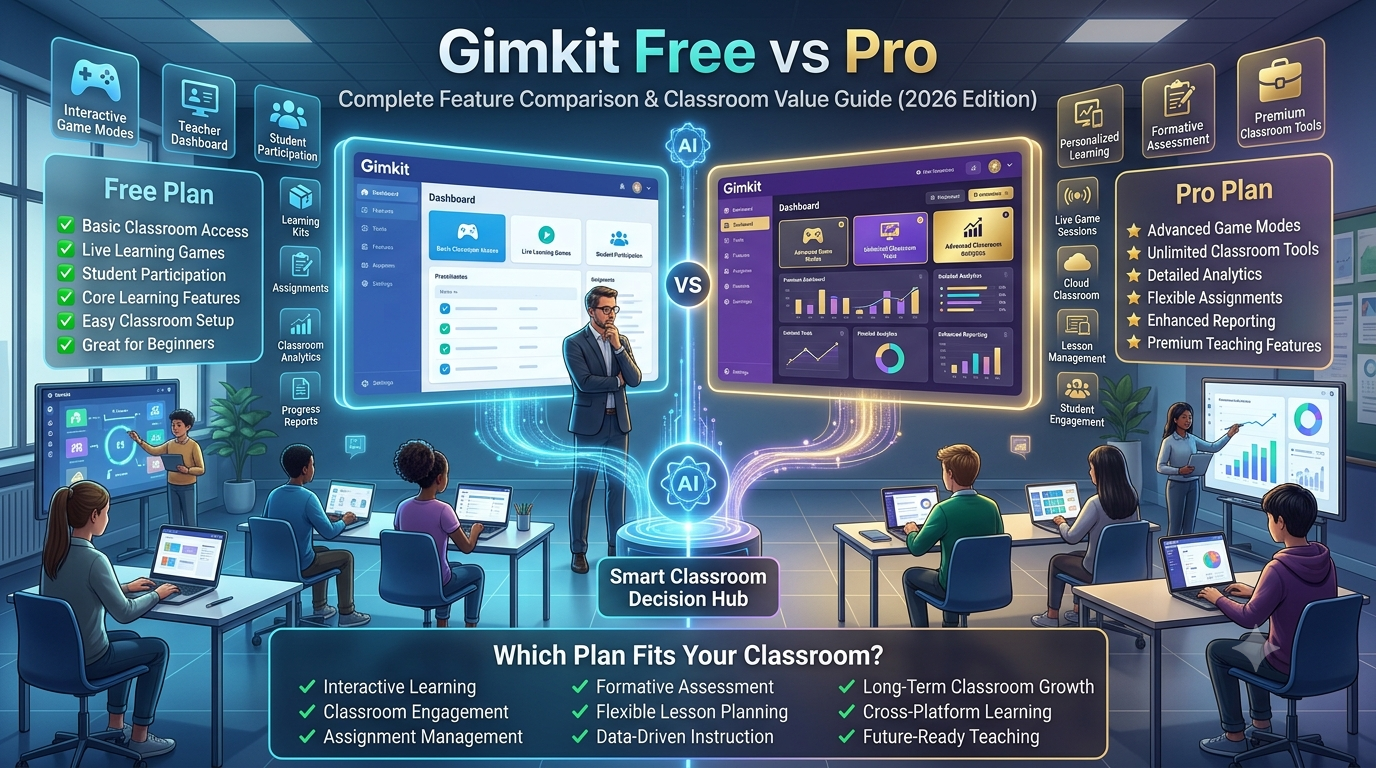
Gimkit Basic provides
free educator access
with featured game modes,
while its Pro offering
expands available modes
and selected features.
The exact mode availability
and account entitlements
should be checked
in the current
official product documentation.
The purchase is connected
to Gimkit's hosting,
Kits, modes
and assignment features.
A Math Playground subscription
is a different purchase.
It primarily changes access
to premium content
and a more focused
or ad-free experience
for eligible users.
A classroom comparing
these costs should first ask
whether students
need a curated library
of varied math challenges
or the ability
to host a teacher-selected
question Kit
in game modes.
No price alone
determines instructional quality.
A free puzzle
may provide
an excellent opportunity
for problem solving.
A paid game mode
might be engaging
but unsuitable
for a particular
academic objective.
Conversely,
a well-constructed Gimkit Kit
can support useful review.
The teacher's activity design,
feedback and
interpretation of evidence
remain central.
15 · Privacy and Student Accounts
Shared access and game reports
create different data workflows
Math Playground advertises
no-sign-in access
to its public games.
Its subscription support
also describes
shared teacher
or family logins
rather than individual
student accounts
for certain plans.
These access arrangements
may be convenient
for school devices,
but they should not
be confused
with a detailed
student-by-student
assessment system.
Gimkit documents
reports for
supported hosted Kits,
including student,
general and
question-level views.
Teachers should follow
official account guidance
and school policies
when working
with identifiable
student information.
A comparison site
cannot access
those records
merely because
it explains
how the platforms work.
This page's
interactive laboratory
runs independently
in the browser.
It does not ask
for real student names
or vendor passwords.
It can store
the fictional
or anonymous
workspace locally
and export
a reasoning report.
Local storage
is not
an approved
school records database.
Users should avoid
entering identifiable
or sensitive information.
16 · Strategy and Progression
Solving a logic challenge
differs from earning game resources
A strategy puzzle
can require
a sequence of decisions
that depend
on earlier observations.
In a constrained number grid,
one placement
can remove a candidate
from several other cells.
The solver must therefore
consider how
local decisions affect
the entire system.
A correct solution
is one where
all relevant constraints
are satisfied simultaneously.
Gimkit game modes
also involve
player decisions
and sometimes strategy.
However,
those decisions
occur within
a particular
game environment,
and the relationship
between academic answers
and game progression
depends on the mode.
A high game result
may reflect
strategic choices,
question accuracy
and other factors.
It should not
be interpreted
as identical
to reasoning
through a
mathematical constraint puzzle.
The distinction
is educationally useful.
A student
might become
adept at navigating
a game mode
while still needing
to work
on mathematical explanations.
Another may solve
complex puzzles carefully
but struggle
with quick retrieval.
The appropriate response
is to identify
the actual
learning requirement,
not declare
either learner
less capable
based on one
digital activity.
17 · Designing Good Puzzles
Clear rules matter
more than arbitrary difficulty
A well-designed puzzle
communicates
what counts
as a legal move
and what must
be true
of a finished solution.
Students need
to understand
the representation
before they can
reason confidently.
Excessively complicated
instructions may measure
reading endurance
or interface familiarity
more than the
intended mathematical skill.
The original 4×4 lab
uses three
structural rules:
row uniqueness,
column uniqueness
and 2×2 box uniqueness.
Each section
requires the numbers
one through four
exactly once.
Fixed clues
provide starting evidence.
Optional pair-sum clues
create an additional
arithmetic relationship,
but the teacher
must check that
the clue system
is actually solvable.
A puzzle with
too many clues
may leave
almost no
reasoning challenge.
A puzzle with
too few clues
may allow
numerous valid completions.
The ideal amount
of information
depends on the activity.
The solver provides
a transparent
solution-count check,
helping teachers
distinguish
a contradiction
from ambiguity.
18 · Using Hints Responsibly
A hint should support
the next reasoning step,
not disguise the answer
Digital puzzle games
often include
hint systems.
A useful hint
may draw attention
to a rule
or suggest
a promising location
to inspect.
A less useful hint
may simply reveal
the next answer
without supporting
understanding.
Teachers should
observe how
students use hints
and discuss
whether they can
explain the move afterward.
Our lab
examines the
current valid candidates.
When a cell
has one available value,
that creates
a straightforward
logical suggestion.
If no direct
single-candidate placement
is available,
the solver can identify
a compatible placement
from a valid completion,
but it labels
that result appropriately.
It does not
claim every revealed move
follows from
an elementary
single-candidate deduction.
This distinction
prevents the
software from
overstating
the reasoning
behind a hint.
A teacher can ask,
“Which rule
forces this number?”
or
“What would happen
if we tried
another candidate?”
The quality
of the answer
matters more
than the speed
with which
a hint button
is pressed.
19 · Classroom Example
A small-group lesson
built around eliminating possibilities
Imagine a teacher
working with
a small group
of students
who are beginning
to use systematic
mathematical arguments.
The teacher displays
a 4×4 grid
with several
fixed numbers.
The class reviews
the rule that
each row and column
contains
the same four digits
without repetition.
Students examine
one empty square
and identify
which values
are already
excluded.
One learner
notices that
a row contains
one, two and four.
The remaining number
must be three,
provided the
placement is consistent
with its column
and box.
Another learner
checks the column
to confirm
the deduction.
The teacher then
asks why
an alternative
number would
violate the rules.
This explanation
is the important
educational event.
The independent lab
can display
the candidate set
for the chosen square.
Its checker
highlights conflicts
if a wrong
value has
been entered.
The class can
discuss the
contradiction
and choose
a new move.
The teacher may
save the partially
solved state
with a written
argument in
the journal.
No individual
grading is required
to make
the reasoning
visible.
20 · A Two-Platform Lesson
Combining Math Playground
with Gimkit without
confusing the evidence
A teacher may begin
with a Math Playground
problem-solving activity
suitable for
the current
mathematics concept.
Students might
explore a
visual word problem,
logic puzzle
or pattern challenge.
Afterward,
the teacher leads
a discussion
about solution strategies
and asks learners
to explain
which relationships
made the answer possible.
A later Gimkit Kit
could include
carefully reviewed
questions about
the same concept.
The Kit
should not simply
reward recall
of the previous
puzzle's answer.
It should provide
suitable new examples
that test whether
learners can apply
the idea
in another context.
Teachers should also
check that
the selected Gimkit mode
is accessible
and that its
demands do not
obscure the
academic objective.
The two services
do not need
an automatic
data connection
for this approach.
The teacher can
review the puzzle
discussion
and then observe
the later
question activity
separately.
If errors persist,
another model
or explanation
may be more
appropriate
than simply
increasing the
number of questions.
This preserves
the different
functions of
reasoning tasks
and retrieval practice.
21 · Mathematical Communication
Why explanations matter
in digital learning
A student may
reach the
right answer
through reasoning,
guessing,
trial and error,
or assistance.
The final answer
alone does not
always reveal
which process
took place.
Asking for an explanation
gives the learner
a chance
to connect
the result
to a mathematical principle.
Teachers should
examine whether
the explanation
is coherent,
relevant
and supported
by the task.
Communication can
happen through
speech,
writing,
gesture,
visual representation
or a suitable
combination.
A learner's language
proficiency and
access needs
can affect
how the
reasoning is expressed.
The teacher
should avoid
confusing difficulty
with written
English
and lack
of mathematical knowledge
when those are
not the
same assessment objective.
The reasoning journal
on this page
is a compact
place to write
the argument
associated with
a board state.
It does not
judge language quality
with automatic scoring.
Instead,
it records
the original
explanation
for discussion.
A teacher
can compare
a student's
first explanation
with a later
revised one,
while avoiding
unsupported claims
about permanent mastery.
22 · Educational Accessibility
Reasoning tasks must remain
accessible to their intended learners
Interactive educational games
may require
reading,
device control,
visual discrimination
and understanding
detailed instructions.
These demands
can interfere
with measuring
the intended
mathematics skill.
A learner who
struggles with
navigation
may not have
the same opportunity
to demonstrate reasoning
as someone familiar
with the interface.
Math Playground
advertises
browser-based games
for modern
desktops,
Chromebooks,
laptops and tablets.
Many activities
are optimized
for touchscreens,
according to
its official
math-games page.
However,
individual games
can differ
in controls
and demands.
Teachers should
test the actual
selected experience
instead of assuming
every game
has identical
accessibility features.
The independent lab
uses numbered buttons
as an alternative
to drag-and-drop input.
Selected cells
can be operated
with a keyboard
and their values
are described
in accessible labels.
The interface
adapts to
smaller screens
without requiring
horizontal page movement.
These features
improve basic usability
but do not replace
a formal accessibility audit
or school-approved
learner accommodations.
23 · Reports and Results
What teachers can infer
from game reports
Gimkit's official
game-report documentation
describes
Student Overview,
General Overview
and Question Breakdown
for supported sessions.
These views
can help teachers
inspect question-level
performance
and participation.
The interpretation
should account
for the selected Kit,
mode mechanics
and whether the
activity actually
assessed the intended
mathematical knowledge.
Math Playground's
public games
generally emphasize
direct play
rather than requiring
individual account creation.
Its paid offerings
have separate
content and access
arrangements.
Teachers should
avoid assuming
that a shared
classroom login
offers the same
per-student reporting
structure as
Gimkit's documented
hosted game reports.
Our local reasoning
laboratory exports
its current board,
fixed clues,
optional arithmetic condition
and manually entered
explanations.
These exports
are not official
Math Playground
or Gimkit reports.
They do not
contain an inferred
student ability score.
Their purpose
is to help
the teacher
preserve the
mathematical reasoning
discussed during
an anonymous
or fictional
practice session.
24 · Responsible Educational Claims
Engagement and learning
are related
but not identical
An activity
can be entertaining
without supporting
the intended
learning objective.
Conversely,
a difficult
reasoning task
may be valuable
even when
it does not
produce constant
visual rewards.
Teachers should
identify
what students
are practising
and what evidence
would indicate
improvement,
rather than
using entertainment
as the sole
standard of success.
Math Playground
emphasizes purposeful play
in its official
product description.
Gimkit combines
academic questions
with interactive
gameplay mechanics.
These design choices
may support
motivation and
sustained participation
in appropriate settings.
But neither
public product description
establishes
that the service
universally produces
superior learning outcomes
for every class.
This comparison
therefore avoids
unsupported rankings
such as declaring
one provider
guaranteed better
for every learner.
It considers
the actual
mathematical action:
solving a problem,
modeling a relationship,
responding to
academic questions
or explaining
a constraint.
Those differences
are concrete
and can guide
a defensible
classroom decision.
25 · Final Recommendation
Which platform should
teachers actually choose?
Choose Math Playground
when the teaching goal
fits one of its
specialized
mathematical games,
word-problem models,
logic challenges
or spatial puzzles.
Its broad public collection
is particularly relevant
to K–6 classrooms
that want
varied mathematical experiences
without creating
an account
for every public-game user.
Review the specific
activity,
grade suitability,
subscription status
and classroom device requirements.
Choose Gimkit
when the teacher
wants to host
a reviewed
academic question Kit
within an available
game mode.
Its format can support
repeated question practice
and provides
official reports
for supported sessions.
The teacher
should make sure
the game mechanics
and question content
serve the intended
mathematics objective.
Correct game responses
should not be confused
with detailed
strategy explanations.
The independent
Constraint &
Strategy Reasoning Lab
illustrates a third,
tightly defined
learning action:
constructing a valid
solution under rules.
It checks constraints,
explores possible completions,
supports extra
arithmetic clues
and records
written reasoning.
Its purpose
is not to compete
with either
provider's complete library.
It makes visible
the important difference
between choosing
an answer
and justifying
a mathematical solution.
Use Math Playground
when students should explore
a suitable mathematical challenge.
Use Gimkit
when a reviewed question Kit
fits the classroom's
game-based practice goal.
In both cases,
examine the reasoning
behind the result.
Frequently Asked Questions
Gimkit vs Math Playground:
answers to common teacher questions
What is the main difference
between Gimkit and Math Playground?
Math Playground offers
a large curated collection
of K–6 math games,
logic puzzles
and problem-solving activities.
Gimkit hosts
teacher-selected question Kits
within game modes.
Is Math Playground free?
Math Playground officially advertises
over 300 free math games.
Its free public games
require no sign-in.
Premium and ad-free options
are separately available.
Is Math Playground
only for arithmetic facts?
No. Its current site includes
logic puzzles,
spatial reasoning,
word problems,
fractions,
decimals,
pre-algebra
and other mathematical challenges.
What grade levels
does Math Playground serve?
The official math-games collection
is described as K–6.
Teachers should still
choose a game
according to
the learner's actual skills
and the game's demands.
What are Math Playground
Thinking Blocks?
Thinking Blocks are visual
word-problem activities
covering topics
such as addition,
multiplication,
fractions and ratios.
They help learners
represent relationships.
Does Math Playground
include logic games?
Yes. The official directory
contains a substantial
logic and problem-solving category
with varied puzzle mechanics.
How much is
Math Playground Classroom?
The official current subscription page
lists $10/month
and $60/year
classroom options.
Pricing may change.
What is Math Playground PLUS?
PLUS is described
as a focused,
ad-free learning website
with math games,
logic puzzles
and problem-solving activities.
The classroom annual plan
is currently listed
at $72.
How many students
can use a classroom subscription?
Math Playground's official support page
states a maximum
of 50 students
on its classroom plan.
Check institution-specific
licensing separately.
Do Math Playground
public games need student accounts?
The official math-games page
says free public games
require no student sign-in
or downloads.
Does Math Playground
collect individual classroom results?
Public games and
shared classroom subscriptions
have different workflows
from account-based
assessment platforms.
Do not assume
a persistent per-student report
is available
for every activity.
Is Gimkit Basic free?
Yes. Gimkit Basic
provides free educator access
with featured game modes,
subject to current availability.
Does Gimkit have reports?
Yes. Official Gimkit documentation
describes student,
general and
question breakdown reports
for supported hosted Kits.
Can teachers create
custom questions in Gimkit?
Yes. Kits contain
reusable academic questions
that can be selected
for supported games.
Which is better
for logic puzzles?
Math Playground has
a dedicated collection
of logic and spatial challenges.
Gimkit is more directly
centered on
teacher-selected
question-based gameplay.
Can Gimkit teach
mathematical problem solving?
A well-designed Kit
can include
reasoning questions,
but teachers should
verify that
the response format
actually captures
the intended strategy.
Does a valid puzzle
always have one solution?
No. A constraint puzzle
can have zero,
one or several solutions.
The independent lab
checks this distinction.
What is the 4×4 logic lab?
It is an original number puzzle
in which every row,
column and 2×2 box
contains 1–4
exactly once.
Optional arithmetic clues
add further constraints.
Can I create
custom puzzle clues?
Yes. Fix or unlock
selected cells
and configure
an optional two-cell
sum equation.
The solver checks
whether the constraints
permit a valid completion.
Does the lab automatically
grade mathematical reasoning?
No. It verifies
mathematical constraints,
not the quality
of a learner's explanation.
Human review remains necessary.
Can I export puzzles?
Yes. The application supports
copy, print, TXT,
CSV and JSON exports.
JSON also supports
restoring a validated
local workspace.
Are the puzzle examples
official Math Playground games?
No. They are independently developed
teaching examples
and do not reproduce
official Math Playground
or Gimkit content.
Official Sources
Research the current features
from their providers
Product availability,
subscription prices,
premium content and
classroom policies
should be confirmed
before adoption.
Reviewed October 2026.
Math Playground and Gimkit
may revise their activities,
plan pricing
or product access.
This independent comparison
does not claim affiliation,
endorsement or access
to either provider's
internal user data.
Find the rule.
Explain the move.
Then practise.
Use problem-solving challenges
when learners need
mathematical reasoning,
and game-based questions
when purposeful review
fits the lesson.