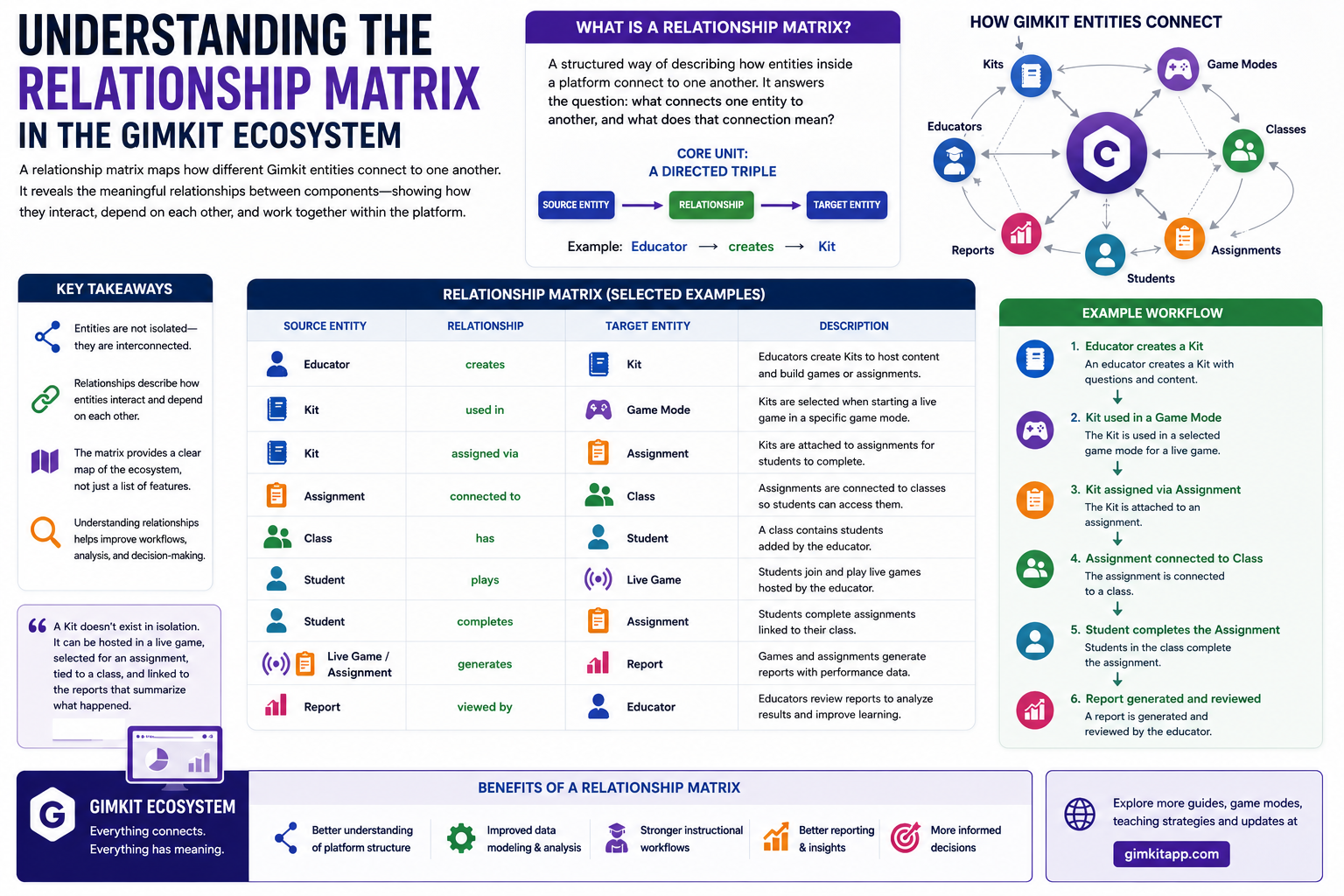
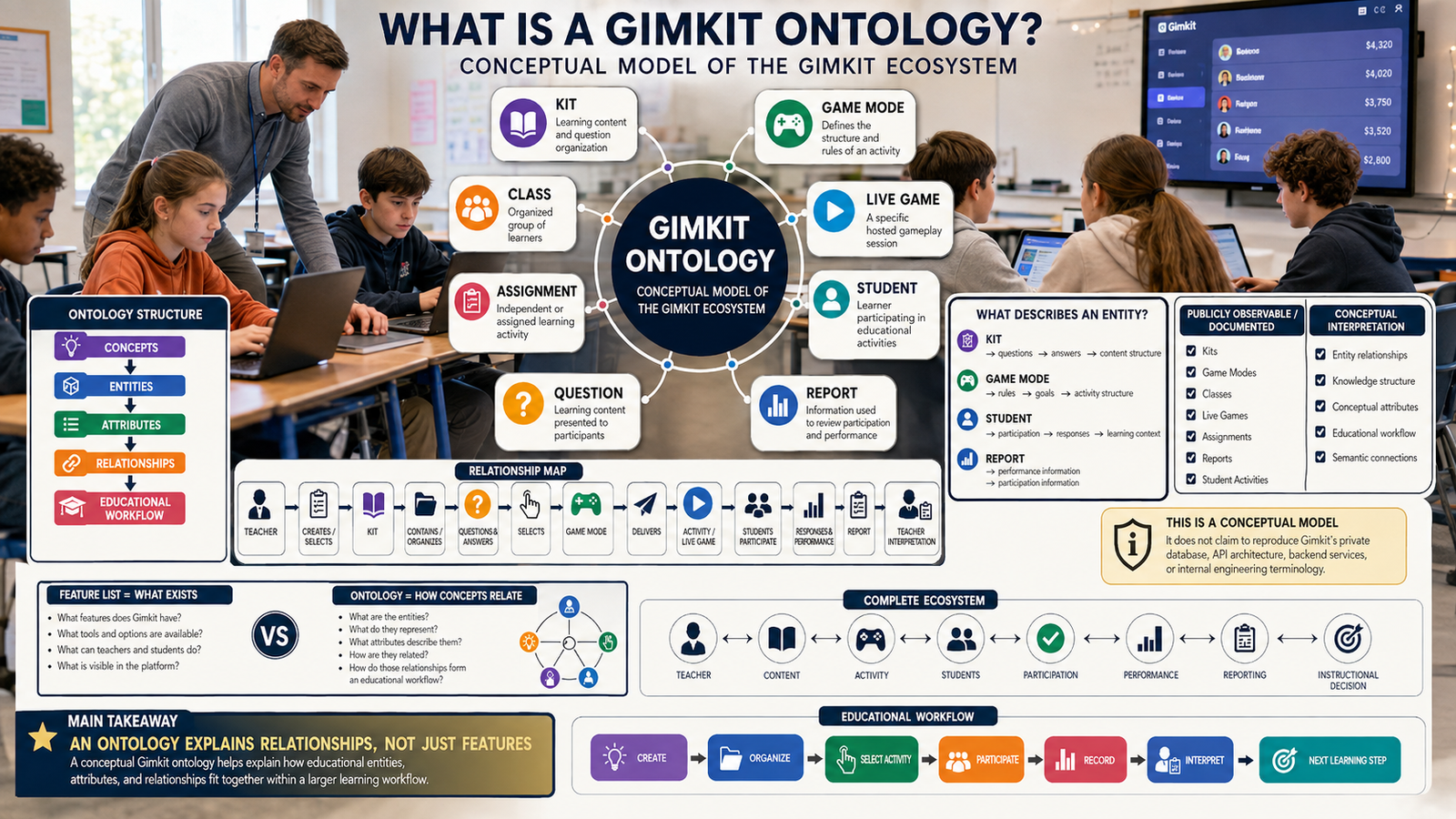
What Is a Relationship Matrix?A relationship matrix is a structured way of describing how different entities inside a platform connect to one another. Instead of treating Gimkit components — Kits, Game Modes, Classes, Assignments, Students, Reports — as isolated objects, relationship modeling asks a sharper question: what connects one entity to another, and what does that connection actually mean?
A Kit doesn’t exist in isolation. It can be hosted in a live game, selected when building an assignment, tied to a class, and eventually linked to the reports that summarize what happened. Gimkit’s help documentation describes these workflows as separate topics, but a relationship matrix pulls the connections between them into a single structure — not a list of features, but a map of how the features touch each other.
The core unit of the model is a directed triple:
SOURCE ENTITY → RELATIONSHIP → TARGET ENTITY
For example: Educator → creates → Kit. The entities are Educator and Kit; the relationship is “creates.” The matrix doesn’t just note that both exist — it records how they’re connected. Gimkit’s documentation confirms a comparable connection elsewhere: assignments can be connected to classes, and students in a connected class see that assignment on their dashboard. That’s relationship information — not a property of either object on its own.
Looking for comprehensive classroom resources and educational technology insights? Explore GimkitApp for expert guides, teaching strategies, game modes, and the latest updates to enhance student engagement.
2. Four Concepts That Are Easy to Confuse
A relationship matrix only stays useful if it’s kept separate from three neighboring ideas that are commonly folded into it by mistake.
An attribute describes a characteristic of a single entity (“Subject” describes the Kit).
A relationship connects two separate entities (“used in” links the Kit to the Assignment).
A feature is a capability of the platform as a whole, independent of any specific entity pair.
A workflow is a sequence of steps, not a connection between two fixed entities — a workflow can be built out of relationships, but a relationship isn’t automatically a workflow.
Collapsing these into one bucket is the single most common failure in Gimkit knowledge modeling. A page that calls every piece of information a “relationship” ends up as vague as a page that calls everything an “attribute.”
3. The Anatomy of a Relationship
A relationship entry that’s actually useful carries more than just two entity names and a verb. A complete relationship has seven parts:
Source entity — where the connection starts.
Target entity — where it ends.
Relationship type — the precise verb connecting them (see Section 4).
Direction — whether the statement is reversible, and if not, which way it reads correctly.
Context — the workflow or condition under which the relationship holds.
Dependency — what has to be true, or happen first, for the relationship to exist.
Evidence — what supports the claim that this connection is real (see Section 8).
Skipping any of these produces a relationship that looks complete but can’t actually be trusted or reused. “Kit — related to — Assignment” has a source and a target but nothing else; it tells a reader almost nothing. “Assignment → uses → Kit, in the assignment-creation context, because Gimkit’s assignment workflow requires selecting a Kit before configuring the rest” has all seven, and it’s immediately more useful for both a human reader and a search or recommendation system trying to understand the ecosystem.
4. Relationship Categories
Not every connection means the same thing, so a mature matrix sorts relationships into categories rather than treating every link as a generic “related to.”
Category
Expresses
Gimkit example
Creation
One entity establishes another
Educator → creates → Kit
Selection
An entity is deliberately chosen for an activity
Host → selects → Game Mode
Usage
One entity participates in another’s operation
Kit → used in → Live Game
Membership
An entity belongs to a group
Student → member of → Class
Configuration
One entity determines settings for another
Game Mode → determines available → Game Options
Participation
A person takes part in an activity
Student → participates in → Assignment
Generation
Activity produces a resulting record
Game → produces → Report
Association
Two entities are connected without one controlling the other
Assignment → connects to → Class
Dependency
One entity relies on another to function
Assignment configuration → depends on → selected Kit
These categories are analytical labels for organizing the ecosystem, not claims that Gimkit’s own documentation uses this exact taxonomy internally. Their value is that “Kit → used in → Live Game” and “Kit → used in → Assignment” both sit under Usage, while “Assignment → connects to → Class” sits under Association — which immediately tells a reader that the Kit’s involvement is functional/required in both cases, while the Class link is a looser, optional pairing that changes what becomes visible (class-based tracking) rather than what the assignment fundamentally needs to exist.
5. Direction: Why the Arrow Matters
A relationship’s direction carries meaning, and getting it backwards changes the statement’s truth value, not just its phrasing.
Educator → creates → Kit says the Educator acts on the Kit. Reverse it — Kit → creates → Educator — and the sentence becomes false. Some relationships genuinely can be read from either side without changing meaning, only emphasis: Student → member of → Class and Class → contains → Student describe the same connection from two positions, and a well-built matrix supports both query directions (“which students are in this class?” and “which class is this student in?”) without treating them as two different relationships.
The rule for telling the two apart: if reversing the sentence changes what it claims about the world, the relationship is strictly directional and only one form belongs in the matrix as the canonical statement. If reversing it only changes which entity is the subject, both directions can point to the same underlying relationship record.
6. Cardinality: How Many Entities Can Participate
Cardinality — how many entities can sit on each side of a relationship — changes how the connection should be modeled and queried.
One-to-one: one entity connects to exactly one corresponding entity within a defined context. This should only be used when a connection is genuinely constrained that way; it’s the least common cardinality in an educational platform.
One-to-many: one entity connects to several others. A Class containing multiple students is the clearest Gimkit example — Gimkit’s Classes documentation describes classes as groups of students that can be used for assignment tracking.
Many-to-many: multiple entities on each side can connect to multiple entities on the other. Students and Assignments illustrate this — many students can work on the same assignment, and a single student’s Class can involve many assignments over time.
Recording a one-to-many relationship as if it were one-to-one is a subtle but common mistake — for example, treating “Assignment → connects to → Class” as though an assignment could only ever belong to a single class-based deployment, when the underlying workflow may allow it to be reused or reassigned. Getting cardinality right up front avoids having to redesign the entire matrix later.
7. Relationship Strength
Not every connection carries equal conceptual weight, and treating them all the same flattens a matrix into noise.
Strength
Meaning
Example
Core
Essential to the workflow existing at all
Assignment → uses → Kit
Functional
Enables a meaningful platform action
Game Mode → determines → Game Options
Supporting
Helps organize or manage an activity
Class → contains → Students
Derived
Becomes meaningful only as a consequence of another relationship
Activity → produces → Results
Contextual
Relevant only under specific conditions
Assignment → connects to → Class (only matters for class-managed tracking)
An assignment cannot exist without a Kit — that’s core. Its connection to a Class is real and documented, but it’s contextual: an assignment can exist and function without ever being connected to a class, even though the connection adds valuable class-based tracking when it’s present. A matrix that doesn’t distinguish “cannot exist without this” from “gains a capability from this” will mislead anyone trying to understand which connections are load-bearing.
8. Structural Relationships vs. Events
One of the sharpest distinctions a relationship matrix can make — and one of the easiest to blur — is between a relationship that’s ongoing and one that describes something that happened once.
Structural relationship: an association that persists. Student → member of → Class remains true across many sessions, assignments, and games.
Event: something that occurred at a point in time. Student → joined → Game Session (Aug 20, 2026) describes a single occurrence, not a permanent state.
Collapsing the two produces false permanence. “Educator selects Kit” during one live-hosting session does not mean “Educator owns Kit forever” — it describes an action, not a standing relationship. The cleaner model treats events as their own layer that can reference structural relationships without being mistaken for one:
Entity → participates in → Event → affects → Entity
For example: Student → participates in → Assignment Activity → produces → Result. The result exists because of an event (the activity), not because the student structurally “has” a result the way they structurally belong to a class. Gimkit’s assignment-results system — which tracks statuses like Completed, Working On It, and Has Not Started — is fundamentally event-driven data layered on top of a structural relationship (class/assignment membership), and a matrix that conflates the two will misrepresent how the data actually behaves.
9. Relationship Chains and the Causation Trap
Individual relationships become more informative once they’re linked into a chain that mirrors an actual workflow:
Gimkit’s documented workflow supports each individual link: assignments are created from a selected Kit and mode, students work through assignments, and educators can review the resulting activity.
The trap is reading a chain as causation. If a simplified diagram shows Kit → Assignment → Results, that does not mean the Kit directly causes the Results — it means the Kit participates in an assignment that, once completed through student activity, produces results. The accurate version keeps the intermediary step explicit: Kit → participates in → Assignment → completed through → Student Activity → produces → Results. Skipping intermediaries to make a diagram shorter is a common source of unsupported claims, even when every individual link in the shortened version happens to be technically true in isolation.
10. Evidence and Confidence
Every relationship needs a documented basis, graded honestly rather than uniformly:
Evidence level
Meaning
Documented
Directly stated in official Gimkit documentation
Observed
Confirmed by using the current interface, even if not explicitly written down
Derived
A reasonable inference from documented relationships, not stated outright
Unknown
Not sufficiently supported — should never be published as if it were fact
For example, Assignment → uses → Kit is documented directly. A broader claim like Kit → contributes to → learning outcomes might be a reasonable derived interpretation, but it isn’t the same evidentiary strength and shouldn’t be labeled as if Gimkit itself made that statement. The source hierarchy that should govern which evidence wins when sources disagree, from strongest to weakest: official documentation → the current live interface → directly reproducible platform behavior → reliable secondary sources → community discussion → unverified claims.
A hard rule worth stating on its own: two entities appearing in the same workflow is not evidence of a direct relationship between them. Gimkit + Class + Report appearing together doesn’t prove Class → generates → Report; the actual documented path runs through an assignment and student activity. This kind of unearned shortcut — call it relationship hallucination — is the fastest way to make an otherwise accurate matrix untrustworthy.
11. A Canonical Relationship Vocabulary
Left unmanaged, a matrix accumulates near-synonyms for the same connection: “uses,” “works with,” “connected to,” “associated with,” “linked to,” and “operates with” might all get used for the same underlying idea across different articles. A controlled vocabulary fixes this by assigning one preferred verb per relationship type and treating the rest as search-friendly synonyms, never as separate conceptual relationships.
Canonical verb
Use when
creates
One entity establishes another
uses
One entity utilizes another to function
selects
An entity is deliberately chosen
contains
One entity groups several others
belongs to / member of
An entity is part of a group
connects to
A documented, non-essential association exists
participates in
An entity takes part in an activity
produces
An activity generates an output
configures / determines
One element sets terms for another
If three different Gimkit articles each independently describe the Assignment–Class link with a different verb, a reader (or a search system trying to build a knowledge graph from the content) has no way to know whether that’s one relationship or three. Standardizing the verb is what makes a large content library behave like a single coherent knowledge base instead of a pile of loosely related pages.
12. The Relationship Record and the Registry
Each relationship worth tracking deserves its own structured record rather than living only inside prose:
ID: RM-003
SOURCE: Assignment
RELATIONSHIP: connects to
TARGET: Class
CATEGORY: Association
STRENGTH: Contextual
EVIDENCE: Documented
LAST REVIEWED: [date]
NOTES: Enables class-based progress and results visibility;
       assignment functions without this connection, but gains
       class-level tracking when present.
At scale, individual records are collected into a registry — a single reference table that every article draws from instead of re-describing the same relationship slightly differently each time:
ID
Source
Relationship
Target
Evidence
Status
RM-001
Assignment
uses
Kit
Documented
Verified
RM-002
Assignment
uses
Game Mode
Documented
Verified
RM-003
Assignment
connects to
Class
Documented
Verified
RM-004
Class
contains
Student
Documented
Verified
RM-005
Game (live)
uses
Game Mode
Documented
Verified
RM-006
Game (live)
produces
Report
Documented
Verified
RM-007
Game Mode
determines available
Game Options
Documented
Verified
RM-008
Student
participates in
Assignment
Documented
Verified
A registry ID pays off the moment more than one article touches the same relationship — five pages that each mention “assignments connect to classes” can all point back to RM-003 instead of independently re-deriving (and possibly mis-describing) it. It also makes version tracking practical: if Gimkit changes how class connections work, only RM-003 needs review, not every article that ever mentioned it.
13. Validating a Relationship Before It’s Published
A seven-question audit catches most of the errors covered above before a relationship reaches the final matrix:
Are both entities clearly and specifically identifiable — not a vague keyword?
Is the relationship verb precise rather than a generic “related to”?
Is the relationship documented, and if not, is it honestly labeled observed or derived?
Does the direction hold up if mentally reversed?
Is the context in which the relationship applies actually defined?
Is there a hidden dependency — does this relationship only make sense after another one has already occurred?
Does the relationship add real information, or would removing it change nothing important?
A relationship that fails any of these seven questions should be revised or dropped, not published as-is with a caveat attached.
For the latest gaming news, expert reviews, and walkthroughs, readers can also visit IGN, one of the world’s leading gaming websites.
14. Common Failure Modes, in One Place
Several distinct mistakes tend to recur across relationship modeling projects. Naming them explicitly makes them easier to catch during review:
Relationship hallucination — inferring a direct connection because two entities co-occur in a workflow, without documented evidence for that specific link (Section 10).
Event-as-structure — recording a one-time action (“Educator selected this Kit today”) as if it were a permanent relationship (“Educator owns this Kit”) (Section 8).
Causation-by-diagram — compressing a multi-step chain into a two-step arrow and losing the intermediary that actually carries the causal weight (Section 9).
Navigation-as-relationship — treating “this is reachable from the Dashboard” as a conceptual connection between entities, when it’s really just an interface path that can move the next time the UI is redesigned.
Verb sprawl — using five different words for one relationship across different articles, making the same connection look like several (Section 11).
Uniform weighting — giving a load-bearing relationship (Assignment needs a Kit) the same visual and structural prominence as an optional one (Assignment can connect to a Class), so a reader can’t tell which connections are essential.
15. A Worked Matrix: Gimkit’s Three Core Workflows
Bringing the individual pieces together, here’s how the three major documented Gimkit workflows look once modeled as relationships rather than as separate feature lists.
Live gameplay
Educator → hosts → Game
Game → uses → Kit
Game → uses → Game Mode
Game Mode → determines available → Game Options
Game → produces → Report
Assignment workflow
Educator → creates → Assignment
Assignment → uses → Kit
Assignment → uses → Game Mode
Assignment → connects to → Class
Student → participates in → Assignment
Assignment Activity → produces → Results
Classroom management
Class → contains → Students
Class → tracks → Assignment Progress
Student → participates in → Assignment
Notice that the Kit and Game Mode entities each appear in more than one workflow, but with a different role each time — in live gameplay, the Game Mode is chosen for an immediate hosted session; in an assignment, it’s chosen as part of a configuration students will work through independently. This is the practical payoff of relationship modeling: it shows that the same entity can carry a different functional meaning depending on which workflow it’s currently part of, something a flat feature list can never express.
16. Using the Matrix for Content Architecture and Internal Linking
Once a registry exists, it becomes a planning tool for a content team, not just a documentation exercise. Two applications stand out.
Topical clustering. Instead of treating “Gimkit Assignments” as one article competing for one keyword, the matrix shows its natural relationship cluster: Kit, Game Mode, Class, Student, Results. Each of those connections can become its own focused article — how assignments use Kits, how class connections affect tracking, how results are produced from activity — without any of them drifting into territory another article already owns. This is a direct extension of the “each article must be 100% different from previously written articles” rule already used across this project: the registry is the mechanism that makes that rule checkable rather than a matter of memory.
Relationship-based internal linking. Pages should link to each other because a registered relationship exists between their subjects, not because they happen to share a keyword. A reader on a Gimkit Assignments page should be pointed toward a Gimkit Classes page because RM-003 documents a real functional connection between the two — that’s a stronger, more defensible linking rationale than “both pages mention Gimkit.”
17. Using the Matrix for Semantic Search and AI-Readability (GEO)
A relationship matrix has a second audience beyond human readers: search engines and AI systems that are trying to build their own understanding of how a topic’s pieces fit together (often called GEO, or generative-engine optimization, alongside traditional SEO).
A flat keyword list — “Gimkit, Kit, Assignment, Class, Report” — tells a retrieval system that these terms co-occur, but not how they relate. A registry-backed article can instead answer relationship-shaped queries directly, because the connections are already explicit rather than implied:
How does a Kit relate to an assignment? → RM-001, “Assignment uses Kit.”
How are students connected to Gimkit assignments? → RM-008, “Student participates in Assignment.”
Does connecting an assignment to a class change anything? → RM-003, with its documented “enables class-based tracking” consequence.
Content built on top of a validated registry answers these questions with the same precision every time it’s asked, across every article that touches the relationship — which is exactly the kind of consistency that improves how confidently an AI system or search engine can extract and reuse the underlying facts.
18. Relationship Matrix vs. Attribute Database vs. Workflow Diagram
These three knowledge structures are often needed together on the same project, so it helps to see them side by side rather than treat them as competing formats.
Attribute Database
Relationship Matrix
Workflow Diagram
Core question
What describes this entity?
How does this entity connect to another?
What happens, and in what order?
Unit of record
Entity → Attribute → Value
Source → Relationship → Target
Step 1 → Step 2 → Step 3
Best for
Describing one thing well
Explaining how the ecosystem fits together
Explaining a user-facing process
Example
Kit → Subject → Science
Kit → used in → Assignment
Select Kit → Select Mode → Configure → Start
Common misuse
Treating every visible word as an attribute
Assuming co-occurrence means connection
Confusing UI sequence with entity structure
None of the three replaces the others. A single well-documented Gimkit topic typically needs all three: an attribute record for what the entity is, a relationship record for what it connects to, and a workflow diagram for how a user actually moves through it.
19. Quick-Reference Mistake Checklist
Before publishing a relationship-based article, a fast pass through this list catches most remaining issues:
Every relationship has a source, target, and precise verb — never just “related to.”
Direction has been checked by mentally reversing the statement.
Cardinality (one-to-one / one-to-many / many-to-many) matches the actual documented workflow.
Structural relationships and one-time events are recorded as separate categories.
No relationship exists solely because two entities appeared in the same paragraph.
Every relationship carries an evidence label (documented / observed / derived / unknown).
No two entries in the registry describe the same connection with different verbs.
Core relationships are visually or structurally distinguished from optional/contextual ones.
Relationship — a directed, typed connection between two entities.
Cardinality — how many entities can sit on each side of a relationship (1:1, 1:many, many:many).
Structural relationship — an ongoing association (membership, ownership-style links).
Event — a one-time occurrence recorded as data, not a permanent relationship.
Registry — the master table of validated, ID-tagged relationships an article library draws from.
Relationship hallucination — inferring a direct connection from mere co-occurrence, without documented support.
Frequently Asked Questions
Is a relationship matrix the same as a sitemap or navigation structure?
No. A navigation structure answers “where can the user click next,” which is an interface concern and can change with any redesign. A relationship matrix answers “how are these entities conceptually connected,” which stays stable even when the interface around it changes.
Does every relationship need its own registry entry?
Only the ones that recur across more than one piece of content, or that a reader is likely to ask about directly. A one-off, purely illustrative connection used in a single article doesn’t need a permanent ID — the registry is for relationships worth being consistent about.
How is “connects to” different from “uses” in this model?
“Uses” typically marks a core, functional dependency — the entity needs the other to operate (an Assignment needs a Kit). “Connects to” typically marks an association that adds a capability without being required for the first entity to function at all (an Assignment can work without a Class connection, but gains class-based tracking when connected).
Can a relationship matrix ever describe Gimkit’s actual database schema?
No, and it shouldn’t try to. It represents documented and observable platform behavior — not Gimkit’s internal technical architecture, which isn’t publicly disclosed. Claims about private database tables, internal APIs, or backend structure fall outside what a responsible relationship matrix can support.
What’s the fastest way to tell if a relationship belongs in the matrix?
Ask whether removing it would make the ecosystem harder to understand, query, or explain accurately. If nothing meaningful is lost by deleting it, it’s likely noise rather than a genuine relationship worth tracking.
Final Takeaway
A reliable Gimkit relationship matrix isn’t a claim about how the platform secretly stores its data — it’s a disciplined model of documented, evidence-backed connections between meaningful entities. Its value comes from precision, not volume: an entity has to be identifiable, a relationship has to carry a defined verb and direction, its context and dependencies have to be known, and its evidence has to be traceable and kept current. A registry of twenty accurate, well-categorized relationships is worth more than two hundred vague associations — and it’s that discipline, not the size of the diagram, that turns relationship modeling into a durable foundation for understanding Gimkit as a connected system rather than a list of separate features.