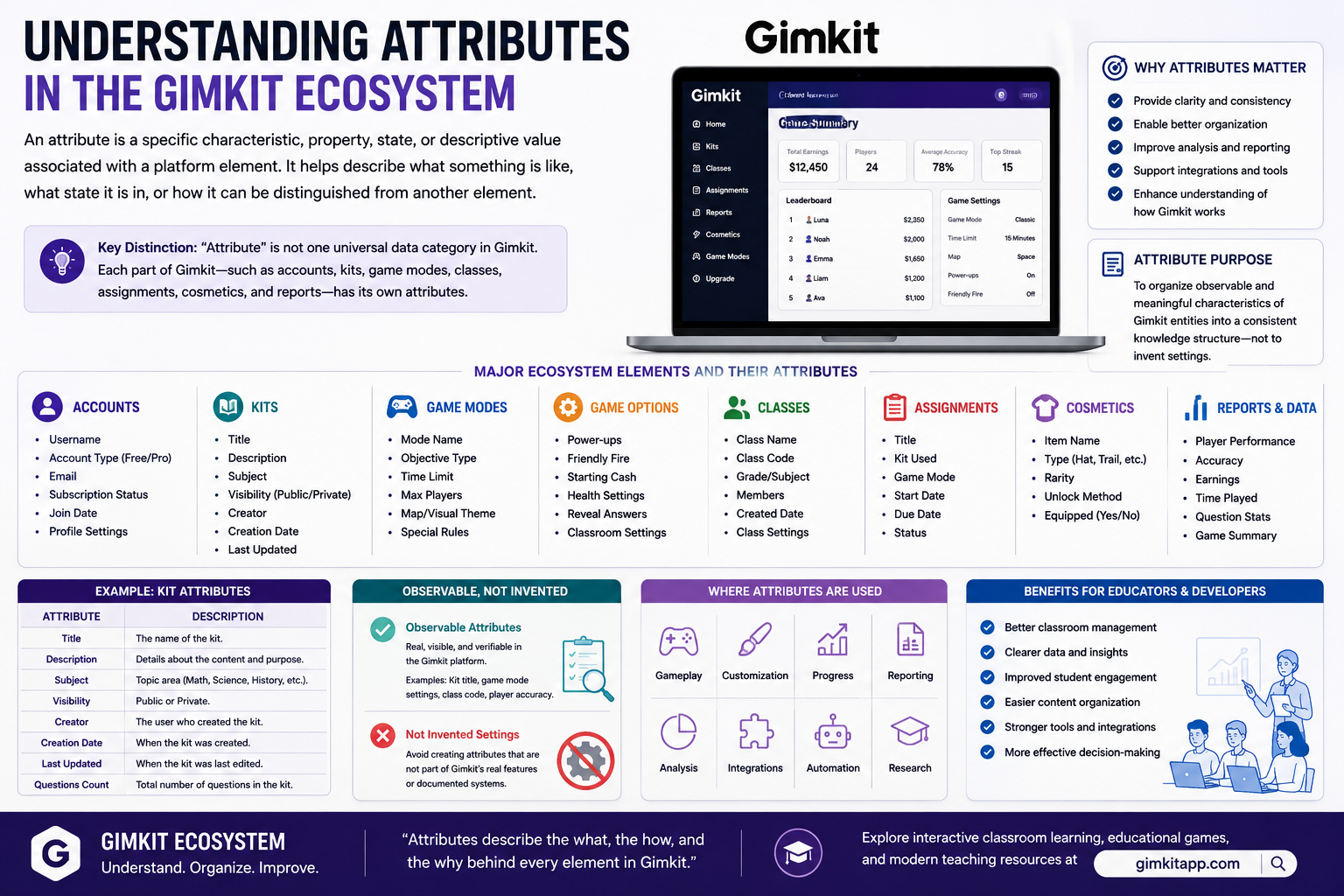
What Is an Attribute in the Gimkit Ecosystem? In the Gimkit ecosystem, an attribute is a characteristic, property, state, or descriptive value associated with a platform element — an account, a Kit, a game mode, a class, an assignment, or a report. It is the information that tells you what something is like, what state it is in, or how it differs from another element.
Gimkit’s own help documentation does not present “attribute” as one universal, platform-wide data field. Instead, it documents separate systems — accounts, Kits, game modes, game options, classes, assignments, cosmetics, and reports — each with its own characteristics. “Attribute” is therefore a knowledge-organization concept, not a claim about an official Gimkit database category.
The simplest way to understand it is a three-part relationship:
Entity → Attribute → Value
For example, Gimkit’s Mode Picker shows Mode Labels that help educators understand a game mode’s character — labels such as “Calming,” “Strategic,” or “Collaborative.” Here, the game mode is the entity, the mode label is the attribute, and “Strategic” is the value.
Concept
Meaning
Gimkit example
Entity
The thing being described
A game mode
Attribute
The characteristic describing it
A mode label
Value
The specific information for that characteristic
“Strategic”
This separation matters because an attribute is never the same thing as the object it describes — a game mode is not an attribute, and “Strategic” is not the entity. The attribute is the descriptive link between the two, and it only means something once you know which entity it belongs to (“Account → Type → Educator” and “Game Mode → Label → Strategic” both pair a property with a value, but they describe completely different things).
Looking for comprehensive classroom resources and educational technology insights? Explore GimkitApp for expert guides, teaching strategies, game modes, and the latest updates to enhance student engagement.
2. Attribute vs. Feature vs. Entity
A feature is something the platform provides or lets a user do. An attribute describes a characteristic of something. These are easy to blur, so it helps to separate the two questions they answer:
Feature-oriented thinking: “What can Gimkit do?”
Attribute-oriented thinking: “What characteristics describe this Gimkit component?”
Gimkit’s Game Reports system is a useful case study. Reports are a feature — they provide class and individual data after a hosted Kit is completed, viewable during or after the game through views such as Student Overview, General Overview, and Question Breakdown. In an attribute-oriented model, the report system itself is an entity, and “the kinds of views it offers” is an attribute of that entity. The feature question tells you the system exists; the attribute question tells you how to describe it once you’re using it.
3. The Four Kinds of Attributes
Not every attribute serves the same purpose. Sorting characteristics by what they tell you about an entity keeps a knowledge model from treating everything the same way.
Identity attributes distinguish one entity from another. Gimkit’s Kit-creation flow asks for a name, language, and subject when a Kit is created — the name is what lets you tell one Kit apart from every other Kit a teacher owns.
Configuration attributes describe how something is set up, and can be changed deliberately by the user. Game options are the clearest example: Gimkit separates standard options (like game goals and class connection) from mode-specific options that vary depending on which mode is selected.
Descriptive attributes explain what an entity is like, for interpretation rather than identification — Mode Labels (“Strategic,” “Calming,” “Collaborative”) are the textbook case.
State attributes describe a condition that changes over time and don’t define what the entity permanently is. Gimkit’s XP and leveling system, tied to activity in 2D game modes, is a state attribute: XP increases through qualifying actions and contributes to a player’s level, but the category “current level” stays the same even as its value keeps moving.
Type
Answers
Example
Typically changes?
Identity
How is this told apart from others?
Kit name
Rarely
Configuration
What can the user adjust?
Game options
Per session, by choice
Descriptive
What is this entity like?
Mode Label
Rarely
State
What condition is it in right now?
Player XP/level
Continuously, through activity
4. Context Changes What an Attribute Means
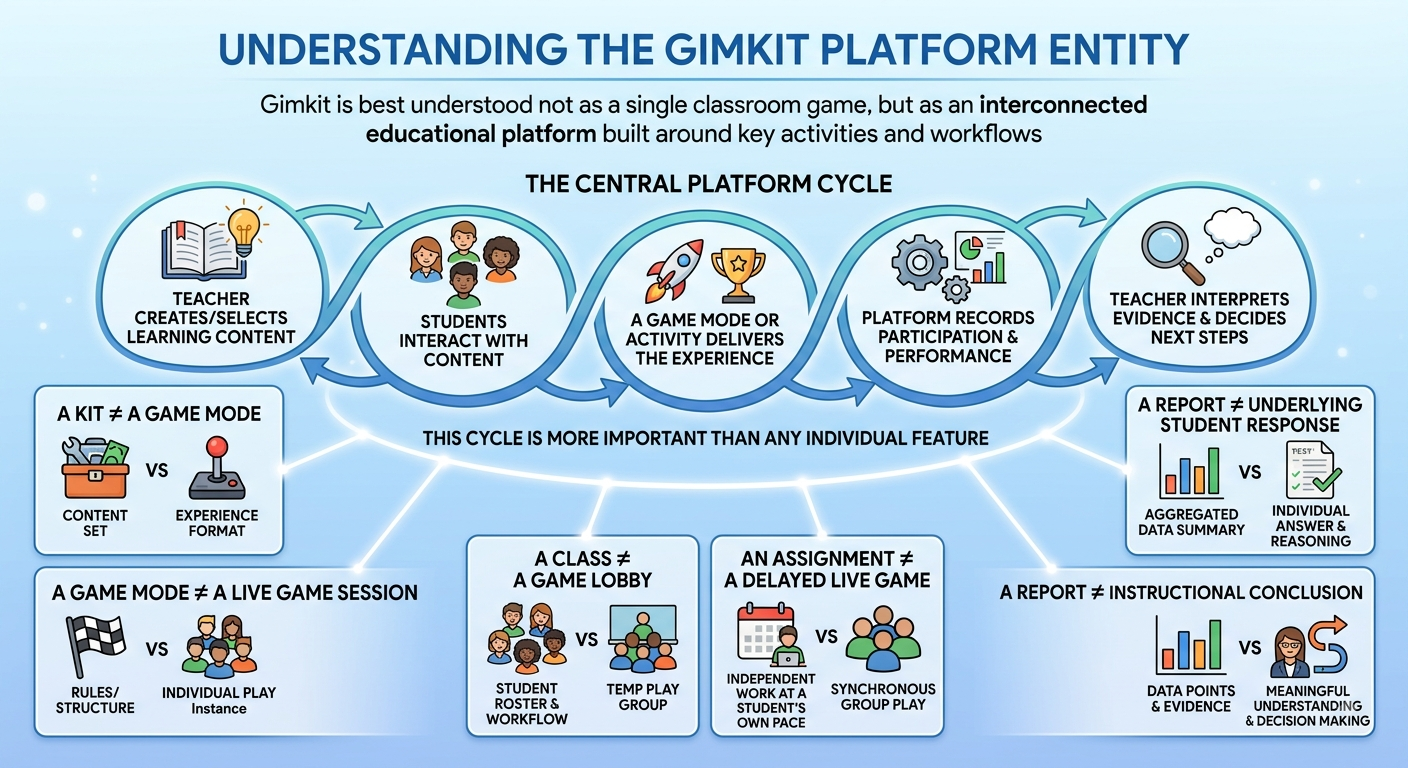
An attribute is rarely useful in isolation — it has to be read against the stage of the entity’s lifecycle it’s currently in. A Kit is a good example of how one entity moves through several contexts without becoming a different entity:
DEFINED → AVAILABLE → CONFIGURED → USED → CHANGED → RECORDED
Creation context — when an educator builds a Kit, the relevant characteristics are content-related: name, language, subject, and questions.
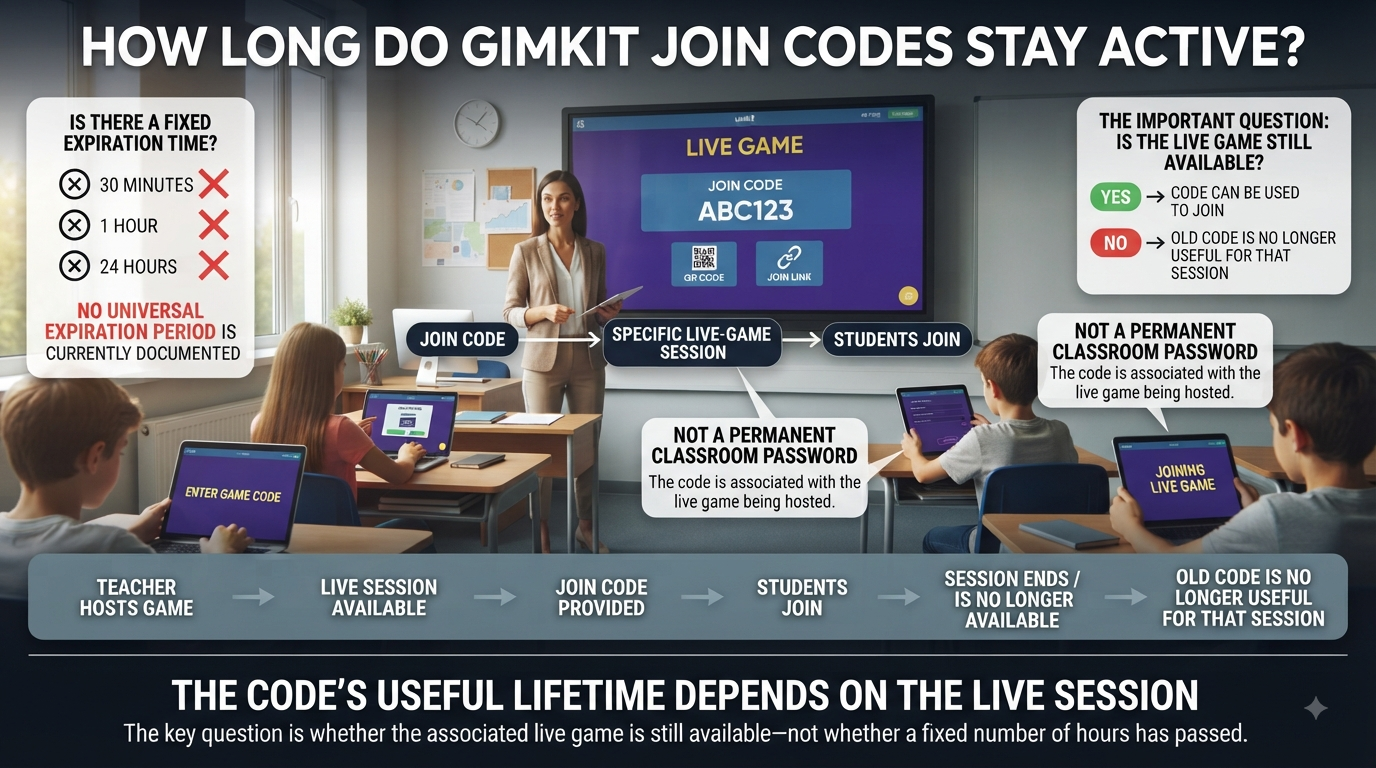
Hosting context — once that Kit enters a live game, Gimkit’s current hosting flow moves through selecting a game mode, configuring game options, sharing the join code, and starting the game. The Kit hasn’t changed; the characteristics that matter to the host have.
Evaluation context — after the game or assignment ends, result-related characteristics (scores, completion status, report data) become relevant.
The same principle applies to game options across different modes: two Kits played in different modes can expose different configurable options, even though the underlying content is identical. A weak record would treat that option as if it were a permanent property of the Kit (“Kit → Game Option → X”); the accurate version treats it as something the mode contributes (“Kit → used with → Game Mode → supports → Mode-Specific Option”). Not confusing what belongs to the entity with what becomes available because of how it’s being used is one of the more common failure points in a Gimkit knowledge model.
5. How Attributes Relate to Each Other
Relationships between entities don’t all have the same shape, and some information describes a relationship rather than a single entity — a distinction that’s easy to lose.
One-to-one: an account has one account type (Educator or Student) at a given time.
One-to-many: a single Kit carries several identity attributes at once — name, language, and subject together.
Contextual (one-to-many-configurations): the same Kit can be used in a live game context (mode + game options) and, separately, in an assignment context (mode + assignment options, including a cash goal and an optional question goal) — two different configurations of the same underlying entity.
Classes illustrate the relational case directly. A Class lets an educator manage names in live games, track assignment progress, and review completions across students — which means a Class doesn’t just have its own attributes, it also sits inside relationships:
Class → Student Membership → Assignment → Progress → Results
“Student has completed Assignment” is a relationship/state between two entities, not a permanent attribute of either one. Gimkit’s assignment results view reflects this directly, letting educators filter by status (Completed, Working On It, Has Not Started) and by class. Recording that completion status as though it were a fixed property of the student, rather than a state tied to a specific assignment, is the kind of category error that makes a knowledge model messy over time.
6. Building an Evidence-Based Record
A trustworthy attribute entry needs a source trail, not just a term and a value. A practical record template:
Field
Purpose
Entity
What’s being documented
Attribute name
The characteristic
Description
Its meaning, in plain language
Observed value
The value or category recorded
Source
Where it was verified
Confidence
Verified / Observed / Interpretive / Unverified
Last checked
Date of verification
Confidence levels keep interpretation from quietly turning into “fact” as a database grows:
Verified — directly stated in official Gimkit documentation (e.g., Educator and Student as the two account types).
Observed — confirmed by using the current interface, even if not explicitly documented.
Interpretive — a reasonable analytical grouping created to organize information (e.g., grouping game options under “configuration attributes”).
Unverified — insufficiently supported, and should never be published as if it were fact.
Source hierarchy, from strongest to weakest: official Gimkit documentation → the current interface → directly reproducible platform behavior → reliable secondary documentation → community discussion → unverified claims. Lower tiers can point toward something worth checking, but they shouldn’t override direct official evidence — this matters especially for anything that changes often, since an outdated tutorial can describe a workflow Gimkit has since redesigned.
Because interface details shift, a durable record separates what the characteristic means from where it currently appears on screen — a renamed button or a moved menu item shouldn’t force the underlying concept to be rewritten.
7. Validating and Maintaining an Attribute
Before an entry goes into the final knowledge base, run it through a single validation pass:
Identify — name the exact entity being described.
Define — write a one-sentence definition a beginner could follow.
Verify — check it against the strongest available source.
Classify — official terminology, observed behavior, or analytical classification? Never present the third as the first.
Contextualize — record the stage or workflow where it applies.
Timestamp — note when it was last checked, so a future review knows exactly what to re-verify instead of rebuilding the whole record.
For ongoing maintenance, not every attribute needs the same review schedule. High-volatility information — available modes, subscription capabilities, interface options, limits, newly introduced functionality — deserves frequent re-checking. Low-volatility information — core terminology, broad entity relationships, foundational concepts like the Entity-Attribute-Value model itself — stays useful far longer without review. Sorting entries by volatility, rather than reviewing everything on the same calendar, is what makes long-term maintenance realistic.
8. Two Habits That Damage an Attribute Database
Attribute inflation is treating every visible word as a formal characteristic. A page can mention “Game Mode,” “Classroom,” “Teacher,” “Dashboard,” and “Play” without any of those single words deserving its own database entry. The test: if removing a characteristic would make the entity materially harder to identify, compare, or understand, it belongs in the model. If nothing meaningful is lost, it’s noise.
Duplicate attributes under different names happen when the same concept gets recorded twice — “Account Category” and “Account Type,” for instance. The fix is a canonical vocabulary: pick one preferred term per concept, and log alternates and search variations underneath it rather than as separate entries.
Canonical Attribute
   ├── Official terminology
   ├── Common wording
   ├── Search variation
   └── Editorial synonym
9. A Consolidated Reference: Attributes by Gimkit System
Pulling the individual examples together into one reference table makes the model easier to apply in practice:
Student membership, name management, progress tracking
Relational
Reports
Report
Student Overview, General Overview, Question Breakdown views
Historical
Cosmetics/Progression
Player
XP, level
State
Reading a system through this table answers the four questions that matter most before writing about it: which entity owns the characteristic, what kind of attribute it is, whether it’s stable or likely to change, and which official source backs it up.
For the latest gaming news, expert reviews, and walkthroughs, readers can also visit IGN, one of the world’s leading gaming websites.
10. Putting Attribute Thinking to Work
For educators, the practical payoff isn’t database terminology — it’s a faster way to evaluate a mode or Kit before class: what is this like (descriptive), what can I adjust (configuration), and what will I get back afterward (historical/report data)? Running through those three questions during mode selection takes less time than trial-and-error hosting.
For content and SEO teams, the model doubles as an editorial planning tool. Before drafting a new Gimkit article, check which entity it covers, which of its attributes are officially documented versus analytically grouped, and which of those attributes are high-volatility (worth flagging for a re-check before publishing) versus stable. This is also the fastest way to catch entity drift — an article that starts on Game Modes and quietly wanders into Game Options or Assignments without ever declaring the shift.
For anyone auditing platform changes over time, the Entity → Attribute → Value → Context structure gives a fixed frame to compare against. When Gimkit updates a workflow (its live-hosting documentation, for instance, carries a public “last updated” date), only the value or context fields in the affected records need review — the entity and attribute definitions underneath usually don’t need to be rebuilt.
Frequently Asked Questions
1. Is “attribute” an official Gimkit term?
No. “Attribute” is better understood as an analytical term rather than an official Gimkit platform category. Gimkit publicly documents concepts such as Kits, accounts, game modes, and reports, but that does not establish “attribute” as a formal platform-wide terminology.
Using the term can still be useful when building a conceptual model because it provides a consistent way to describe characteristics belonging to different Gimkit entities.
For example:
A Kit can have a name.
A Game Mode can have a description.
An account can have associated information.
A game can have configuration characteristics.
These can be described as attributes in an analytical model.
2. How is an attribute different from a setting?
A setting is a specific type of configurable attribute, while “attribute” is the broader concept. A setting is something a user or host can actively configure, whereas an attribute can simply describe a characteristic of an entity without being changeable during setup.
For example, a game option selected by a host can be treated as a setting, while the name of a Kit can be treated as an attribute.
The distinction is:
Attribute: A characteristic of an entity.
Setting: A configurable characteristic.
All settings can be attributes, but not all attributes are settings.
3. Can an attribute belong to more than one entity?
Normally, an attribute describes the entity to which it belongs. When information exists specifically because two entities are connected, it is usually better represented as a relationship rather than as a fixed attribute of either entity.
For example, a student’s completion status for an assignment describes the student’s relationship with that particular assignment. It is therefore more accurately understood as relationship-specific information rather than a permanent property of the student or assignment.
Think of it this way:
Entity: Student.
Entity: Assignment.
Relationship: Student completes Assignment.
Relationship information: Completion status.
4. Why does confidence level matter in a Gimkit knowledge model?
Confidence levels help distinguish between information that is officially documented, directly observed, or conceptually inferred. Something can appear reasonable or be technically plausible without being confirmed by Gimkit’s public documentation.
Making that distinction prevents an interpretation from gradually being repeated as though it were an official platform fact.
Useful confidence categories can include:
Verified: Supported by authoritative documentation.
Observed: Directly visible or reproducible in the platform.
Interpretive: A reasoned conceptual interpretation.
Uncertain: Insufficient evidence to establish the claim.
5. Does this attribute model describe Gimkit’s actual backend database?
No. A conceptual attribute model should not be presented as Gimkit’s internal database schema or backend architecture. It is constructed from publicly documented information, observable platform behavior, and carefully identified interpretations.
Gimkit’s public information about infrastructure or third-party services does not necessarily reveal how its internal database is structured. Therefore, a responsible model should remain at the level supported by available evidence rather than inventing undocumented technical details.
The model should be treated as:
A conceptual representation.
Based on public or observable information.
Useful for organizing Gimkit concepts.
Separate from the proprietary backend.
Not evidence of Gimkit’s actual internal schema.
Final Takeaway
An attribute database for Gimkit is strongest when it stops asking only “what attributes does Gimkit have?” and starts asking a fuller set of questions for every entry: which entity is this, what does the characteristic mean, where does it apply, what evidence backs it, can it change, and what else does it connect to? Answered consistently — and without mixing documented fact with analytical shorthand — that discipline is what turns a list of platform terms into a durable, reusable knowledge system.