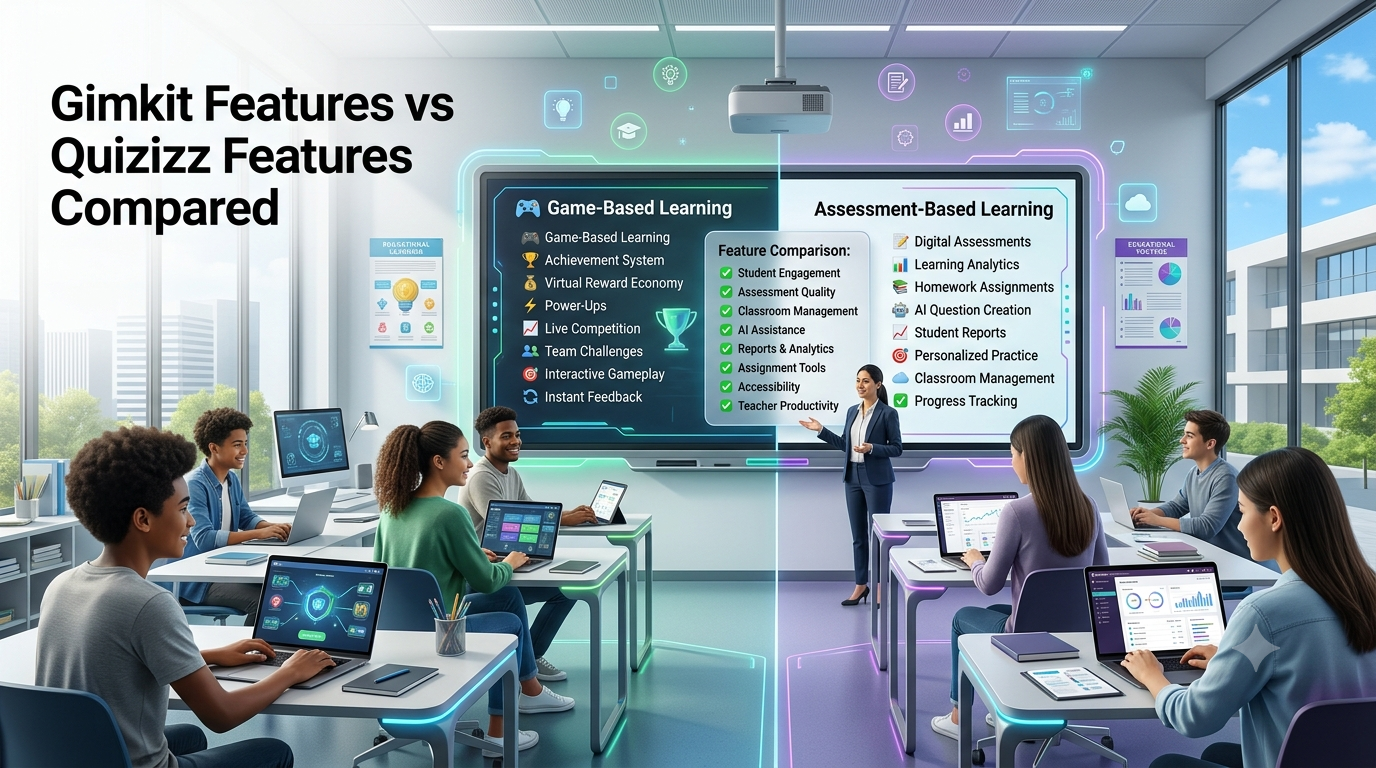
A Gimkit vs 99math comparison looks straightforward at first glance — both are live, game-based classroom tools where correct answers matter. But the two platforms are solving different-sized problems.
99math exists for one subject. Gimkit exists for every subject. That single fact changes almost everything else about how the two platforms are built, how a teacher uses them, and which one actually belongs in a given classroom moment. This guide goes past that first impression to cover the details that actually decide a purchase or adoption call: grade coverage, pricing, student accounts, setup time, and what each platform’s data actually tells a teacher.
Looking for comprehensive classroom resources and educational technology insights? Explore GimkitApp for expert guides, teaching strategies, game modes, and the latest updates to enhance student engagement.
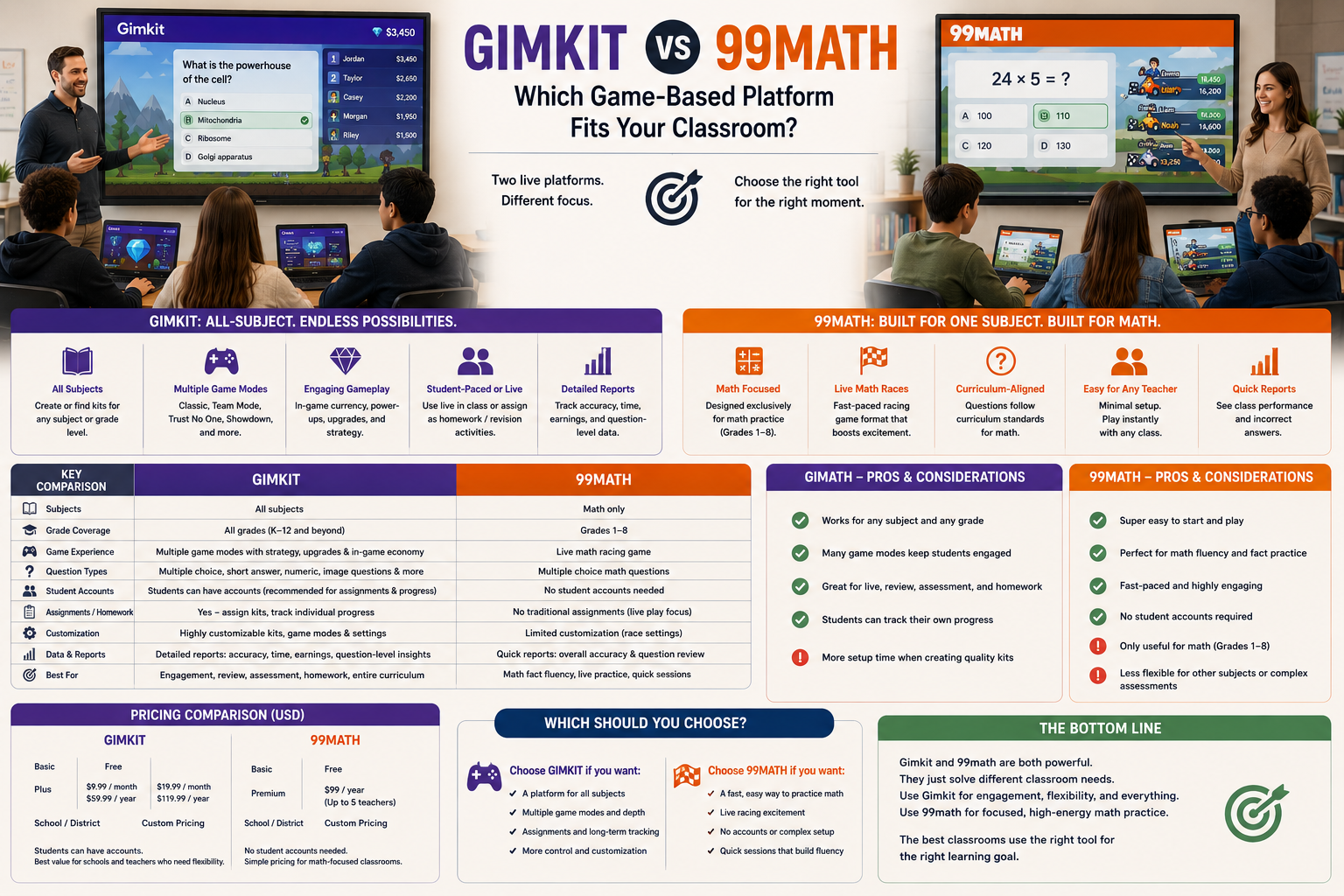
Gimkit vs 99math at a Glance
Teaching function
Gimkit
99math
Subject scope
Any subject
Math only
Grade range
Not subject-restricted; any grade band a Kit is built for
Roughly grades 1–8 (some listings cite K–12)
Content source
Custom or imported Kits
Built-in math skill sets (1,000+ skills) + custom problems
Core mechanic
Answer → game resource → progress
Answer → speed-based battle score
Session length
Flexible, can run long
Typically short, fast-paced rounds (2–5 minutes)
Student identity
Points, currency, upgrades
Avatars, characters, cosmetic rewards
Student accounts
Join code, roster optional
No student accounts required to join
Competitive format
Multiple modes, some cooperative
Live Battles, largely competitive
Free tier
Basic: unlimited students, ~3 rotating game modes
Free: live games, homework mode, basic analytics
Paid tier
Pro: roughly $60/year, unlocks full mode catalog
99math Pro: adds advanced analytics, more topic sets
Best conceptual fit
“Practice anything, in a game”
“Drill math facts, fast”
That scope difference — one subject versus unlimited subjects — is the real starting point for this comparison, but the details below explain why that scope difference actually matters in a classroom rather than just on paper.
99math’s Entire Identity Is Speed and Fluency
99math was built around a specific instructional problem: students need to retrieve basic math facts quickly and automatically, not just correctly.
Its core experience, Live Battles, puts students head-to-head answering a stream of math problems as fast as they can. Each round typically lasts two to five minutes, which keeps the format usable as a genuine warm-up rather than a full activity block. The platform tracks not just whether an answer was right, but how quickly students are producing correct answers over time — which is the actual definition of fluency in most math curricula.
That focus shows up everywhere in the platform:
Problem sets are organized by math skill and grade band, spanning addition, subtraction, multiplication, division, fractions, decimals, and introductory algebra across roughly grades 1 through 8
Students can practice independently between live sessions through a homework/assignment mode
Avatars and in-game currency reward consistent correct answers, not exploration or strategy
The teacher dashboard is built to show accuracy and speed trends over time, not general subject mastery
Students join with a session code at any device with a browser — no app install and no student account required on their end, which also keeps the platform’s data footprint small
99math isn’t trying to be a full classroom platform. It’s trying to be extremely good at one narrow, well-defined job — and the no-account, code-to-join setup is a real part of why teachers can launch it in under a minute.
Gimkit’s Identity Is Breadth, Not Speed
Gimkit takes the opposite approach. It doesn’t assume the subject is math, and it doesn’t assume speed is the goal.
A Gimkit Kit can hold vocabulary words, historical dates, science vocabulary, grammar rules, or math problems — the platform doesn’t care what the content is, because its game modes are built around the mechanic of turning any correct answer into a game resource.
Some Gimkit modes do reward speed and reflexes. Others reward strategy, resource management, or collaboration far more than raw answering speed. Gimkit runs roughly thirteen active 2D game modes on top of its classic format — top-down modes like a fishing-economy game where correct answers buy bait and unlock new areas, and side-view platformer modes where students climb or navigate while answering. That range is the point — a teacher choosing Gimkit is choosing a practice engine that can be pointed at almost any content and reshaped through game settings.
So while 99math asks “how fast and accurate is this student at math facts,” Gimkit asks “what’s the best game structure for practicing whatever this class needs right now.”
Live Battles vs Game Modes: Two Different Competitive Models
It helps to compare the two platforms’ signature experiences directly.
99math’s Live Battle is a fast, round-based math sprint. Students answer a rapid sequence of problems, the platform tracks correct answers per minute, and a leaderboard updates in real time based on speed and accuracy together. The entire round is usually a few minutes long, and the format doesn’t change much between sessions — it’s built to be run again and again as a warm-up or fluency drill. That repeatability is a feature, not a limitation: a format that stays consistent is easier for young students to jump into without re-learning rules every time.
Gimkit’s game modes are structurally different from each other, not just re-skinned versions of the same loop. In a mode like a farming or economy-style game, correct answers earn in-game currency that students spend on upgrades, which changes their earning rate going forward. In a 2D exploration mode, correct answers earn energy used to move through a shared environment toward a goal. Some modes are individual, some are team-based, and some are explicitly cooperative rather than competitive — a genuine social-deduction mode even layers a hidden-role mechanic on top of question-answering.
That means 99math has one very sharp tool. Gimkit has a toolbox, and the teacher picks which tool fits the moment.
Independent Practice: A Genuine 99math Strength
One area where 99math is particularly well suited is low-stakes, self-directed practice between live sessions.
Because its content is pre-organized by math skill and grade level across more than a thousand individual skills, a student can jump into independent practice on a specific skill without a teacher needing to build anything first. That lowers the setup cost for quick, targeted fluency practice — a student struggling with subtraction facts can specifically drill subtraction without a teacher assembling a custom set first. The homework/assignment mode carries the same no-account, code-based simplicity as its live sessions.
Gimkit’s independent practice runs through Assignments, but it depends on a Kit that already exists — either one the teacher built, imported (from Quizlet or CSV, among other sources), or found through the Question Bank. There’s more flexibility in what that Kit can contain, but there’s also more setup required before a student can start, since Gimkit doesn’t ship with a built-in library of leveled math skills the way 99math does.
Classroom Size and Session Pacing
99math’s fast-round format is designed to work well in short bursts — a five-minute warm-up before a math lesson, or a quick fluency check between activities. Its structure doesn’t really ask a class to commit fifteen or twenty minutes to a single sustained activity; it’s built to be repeated in short cycles.
Gimkit is comfortable at both ends of that spectrum. A teacher can run a short, fast-paced round in a mode built for speed, or let a longer game mode run for a full class period when the goal is extended review rather than a quick check. That flexibility comes at a cost, though — a longer Gimkit session usually needs more teacher setup and pacing decisions than simply launching another 99math round.
Pricing: What Free Actually Gets You
Both platforms lead with a free tier, but the free tier draws the line in a different place.
99math’s core features — live games, homework mode, and basic analytics — are free for teachers and free for students to join, with no student accounts required. The paid 99math Pro tier adds advanced analytics, a wider range of topic sets, and extra teacher controls for a deeper view of student progress over time. Because the core competitive and practice experience is free, most of what makes 99math useful day-to-day doesn’t require upgrading.
Gimkit’s free Basic plan is unlimited on student count but restricts access to most of its 2D game modes and detailed reporting — only a small rotating selection of modes is available without a subscription. Gimkit Pro runs roughly $60 a year on the annual plan and unlocks the full mode catalog, Assignments, larger kit imports, and detailed reports.
The practical difference: a teacher can get real day-to-day value out of 99math’s free tier alone, while getting the most out of Gimkit — specifically its variety of game modes — usually means eventually paying for Pro.
Reporting: Fluency Trends vs Question-Level Performance
The two platforms’ reports reflect what each one is actually measuring.
99math’s reporting is built around fluency over time — how a student’s speed and accuracy on specific math skills changes across multiple sessions. That’s genuinely useful for tracking whether targeted fact practice is working, because the platform is comparing a student against their own past performance on the same type of problem.
Gimkit’s reporting reflects performance within a specific Kit or game session — which questions were missed, how a student or class performed on that particular content, and how a game session went. It’s not designed to track long-term fluency trends on a single narrow skill the way 99math is, because Gimkit’s content changes from Kit to Kit rather than following a fixed skill progression.
Student Privacy and Setup Overhead
This is a practical difference that rarely shows up in feature comparisons but matters to schools with strict data policies.
99math students join sessions with a code and don’t need individual accounts, which keeps its data footprint small and setup close to instant — a real advantage for schools with tight student-data or COPPA-related requirements, and for teachers who want zero administrative overhead before a quick warm-up.
Gimkit supports both quick join-code access and rostered classes, which gives a teacher more structure — persistent class lists, individual assignment tracking, longer-term reporting per student — at the cost of a bit more setup the first time a class is configured.
Where 99math Falls Short of Gimkit
The tradeoff for 99math’s sharp focus is real: it can’t be the platform for anything outside math. A teacher can’t repurpose it for a vocabulary review, a history quiz, or a science unit test — because it isn’t built to hold that kind of content in the first place.
It also can’t offer the variety of game structures Gimkit provides. Every 99math session is fundamentally a speed-based battle; there’s no equivalent to Gimkit’s cooperative exploration modes, resource-management mechanics, or team-strategy formats.
Where Gimkit Falls Short of 99math
Gimkit’s tradeoff is setup and specificity. Because it isn’t purpose-built for math fluency, a teacher who wants targeted, leveled math-fact practice has to build or find that content themselves rather than pulling from a ready-made, grade-organized library of over a thousand skills the way 99math provides out of the box.
Gimkit also doesn’t track long-term fluency metrics the way 99math does. Its reports are tied to individual Kits and sessions, not a running measure of how quickly a student is improving on a specific skill across weeks. And where 99math’s core experience is fully usable for free, Gimkit’s most distinctive feature — its full library of game modes — sits mostly behind a paid Pro subscription.
When 99math Is the More Practical Choice
99math tends to fit best when the actual classroom need is:
Fast, repeatable math-fact fluency practice
A short warm-up or transition activity that doesn’t need setup
Tracking speed and accuracy trends on a specific math skill over time
Independent practice that’s already organized by grade and skill level
Minimal student data collection, with no accounts required to join
Getting full core functionality without needing to pay
When Gimkit Is the More Practical Choice
Gimkit tends to fit best when the actual classroom need is:
Practicing any subject, not specifically math facts
A longer, sustained review session rather than a quick drill
Variety in game structure — cooperative, strategic, or exploratory modes
Reusing or building custom content beyond a fixed skill library
Persistent class rosters and per-student assignment tracking over time
For the latest gaming news, expert reviews, and walkthroughs, readers can also visit IGN, one of the world’s leading gaming websites.
The Real Question to Ask
The question that actually settles a Gimkit vs 99math decision isn’t “which one is more fun.” It’s:
Do I need fast, repeatable fluency practice in one subject, or flexible game-based practice across whatever content I’m teaching?
If it’s the first, 99math’s narrow, speed-focused design is built exactly for that. If it’s the second, Gimkit’s broader toolbox is the better fit. Some math teachers end up using both — 99math for quick daily fact fluency, Gimkit for deeper review sessions on math or other subjects — because the two tools aren’t actually competing for the same five minutes of class time.
Frequently Asked Questions
Is 99math only for math, or can it be used for other subjects?
99math is built specifically around math skills and problems, organized by grade band across roughly grades 1 through 8, and it doesn’t support building content sets for other subjects. Gimkit is the more flexible option if a teacher needs the same platform to cover math, vocabulary, science, or any other subject rather than staying limited to one.
Which platform is better for a quick warm-up activity?
99math is generally the stronger fit for a short, repeatable warm-up because its Live Battle format is designed to launch quickly using pre-built, grade-organized math content, and students don’t need accounts to join. Gimkit can also be used for short activities, but it typically requires a Kit to already exist, which adds a setup step 99math’s built-in library avoids.
Does Gimkit track fluency the way 99math does?
Not in the same way. 99math is specifically built to measure speed and accuracy trends on a given math skill across multiple sessions over time. Gimkit’s reporting is tied to individual Kits and game sessions, showing performance within that specific activity rather than a running fluency measurement on one narrow skill.
Can 99math support cooperative or team-based games like Gimkit?
99math’s core format, Live Battles, is primarily an individual, competitive, speed-based experience rather than a cooperative one. Gimkit offers a wider range of structures, including modes built around teams, shared objectives, and cooperative play, which gives teachers more options when the instructional goal is collaboration rather than pure competition.
Which platform is free to use?
Both have free tiers, but they draw the line differently. 99math’s core experience — live games, homework mode, and basic analytics — is free for teachers, with an optional Pro tier for advanced analytics and more topic sets. Gimkit’s free Basic plan has no student cap but locks most of its game-mode variety behind the paid Pro tier, so getting the platform’s signature feature set usually means upgrading.
Should a math teacher use both platforms?
Many math teachers do, since the two tools serve different moments in a lesson. 99math works well as a fast, low-setup fluency drill used regularly, while Gimkit fits longer review sessions that need more variety in game structure or need to combine math with other content. Used together, they cover different needs rather than duplicating the same one.
Final Verdict
Gimkit vs 99math ultimately comes down to scope. 99math is a sharply focused math-fluency tool built for speed, repetition, skill-specific tracking, and a free core experience that needs no student accounts. Gimkit is a broader, subject-agnostic practice engine built for flexibility and variety in how practice happens, with most of that variety concentrated in a paid tier.
Choose 99math when the goal is fast, targeted math-fact fluency with minimal setup and minimal cost. Choose Gimkit when the goal is flexible, game-based practice across any subject or a longer sustained session. The two aren’t really rivals — they’re built for different-sized jobs.