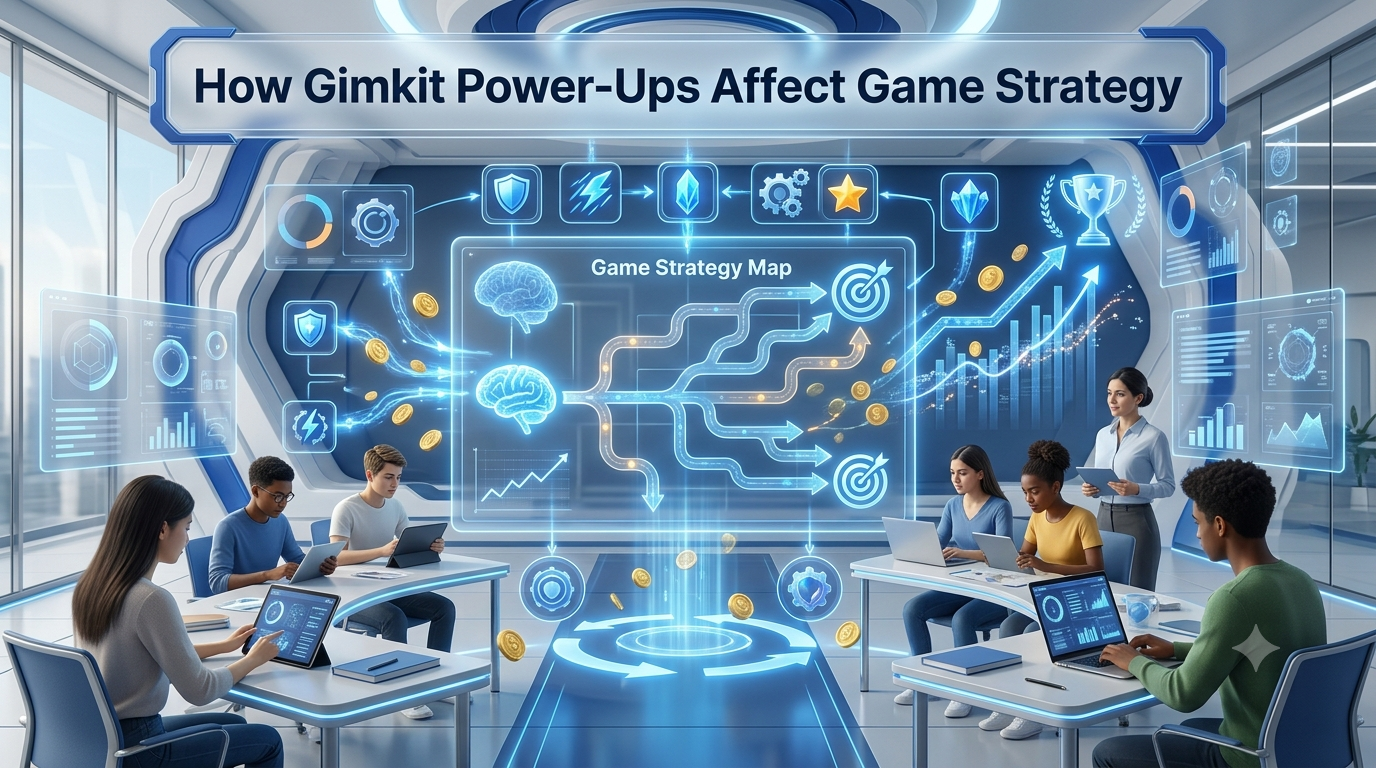
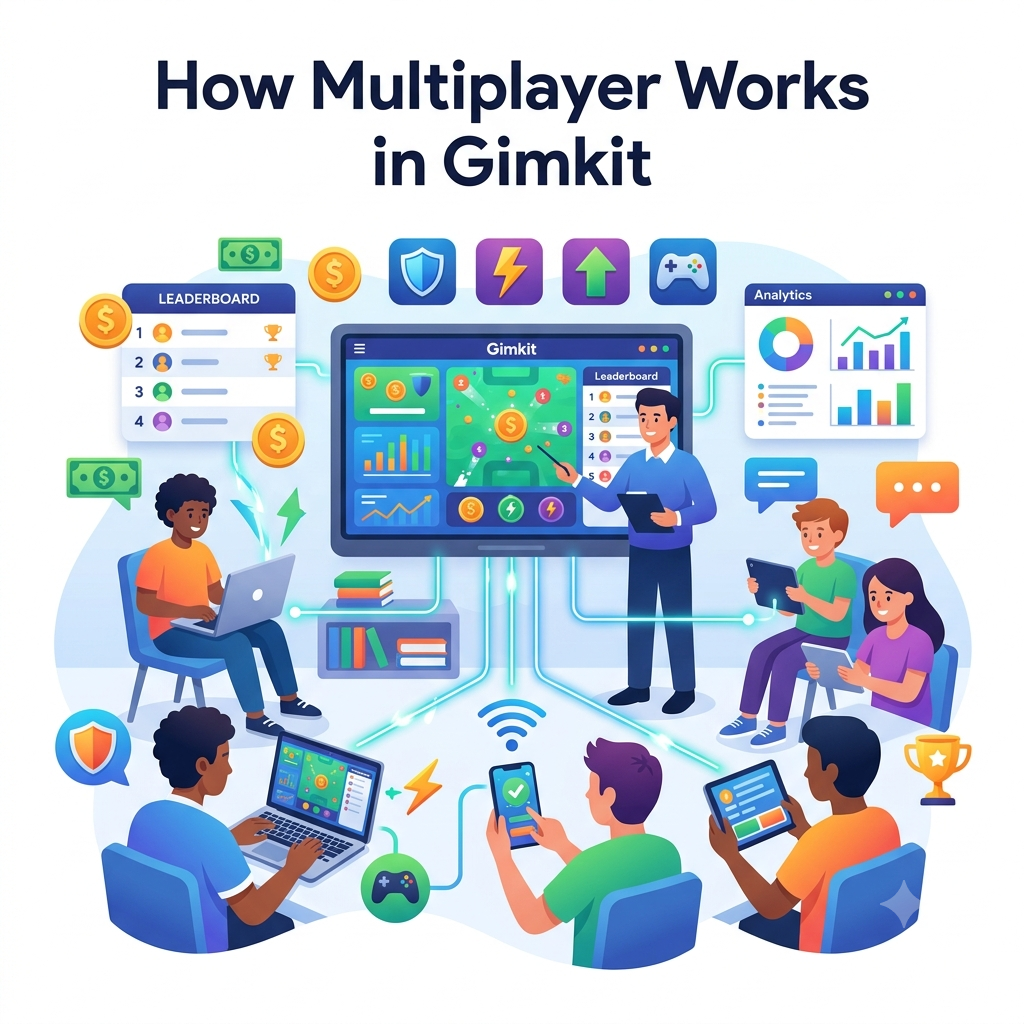
How Gimkit Power-Ups Affect Game Strategy | Go Beyond Increasing Your Score – Power-ups do much more than boost points; they influence every strategic decision you make throughout a Gimkit match.
🧠 Strategy Can Outperform Knowledge Alone – Two players with the same subject knowledge can finish in completely different positions simply because they manage their upgrades differently.
🚀 Build a Long-Term Game Plan – Experienced players don’t treat power-ups as isolated bonuses. Instead, they use them to create a strategy that evolves from the opening seconds of the game to the final leaderboard.
📈 Adapt Throughout the Match – Smart power-up choices help players adjust their approach as the game progresses, maximizing their chances of success.
Unlike a guide that explains what each power-up does, this section focuses on how power-ups influence gameplay, decision-making, player behavior, and match outcomes. Understanding these strategic effects helps you make smarter choices regardless of which game mode you’re playing.
Looking for comprehensive classroom resources and educational technology insights? Explore GimkitApp for expert guides, teaching strategies, game modes, and the latest updates to enhance student engagement.
Strategy Begins Before the First Upgrade
Many players believe strategy starts when they purchase their first power-up. In reality, it begins before spending any in-game money.
The opening phase of a Gimkit match is about gathering information rather than rushing into upgrades. Strong players observe the pace of the game, question difficulty, leaderboard movement, and earning speed before committing to a long-term plan.
During the first few minutes, ask yourself:
Are questions easy or challenging?
Is the game likely to end quickly?
Are opponents earning money rapidly?
Will aggressive or defensive play be more effective?
These early observations often determine which strategy will remain effective throughout the match.
💡 Pro Tip: Treat the opening of every Gimkit game like a scouting phase. The better you understand the environment, the better your upgrade decisions will be later.
Power-Ups Create Different Play Styles
Power-ups don’t just improve performance—they encourage completely different ways of playing the game.
Some players focus on building a strong economy, while others prioritize staying safe or disrupting opponents. These choices naturally create unique play styles that evolve as the match progresses.
Play Style
Strategic Focus
Typical Behavior
Investor
Long-term income growth
Buys economy upgrades early
Aggressor
Slowing opponents
Uses offensive abilities at key moments
Defender
Protecting progress
Prioritizes defensive upgrades
Balanced Player
Adapting to changing conditions
Mixes offense, defense, and economy
Opportunist
Reacting to the leaderboard
Changes strategy based on current standings
No single play style is always superior. The strongest approach depends on the classroom objective, game mode, and remaining time.
Every Upgrade Changes Future Decisions
One overlooked aspect of Gimkit strategy is that each purchase affects every decision that follows.
For example, investing heavily in income early may delay your ability to buy defensive upgrades. On the other hand, spending too much on protection can slow your economic growth.
This creates a chain reaction where one decision influences the next several minutes of gameplay.
Instead of asking, “Is this power-up good?” experienced players ask:
What opportunities will this purchase create?
What options will it limit?
How will it affect my next upgrade?
Will this decision still be valuable later in the match?
Thinking several moves ahead separates strategic players from reactive ones.
Choosing the right learning platform can significantly improve classroom outcomes. Compare leading educational tools in Gimkit Comparisons & Alternatives to find the best solution for your teaching style.
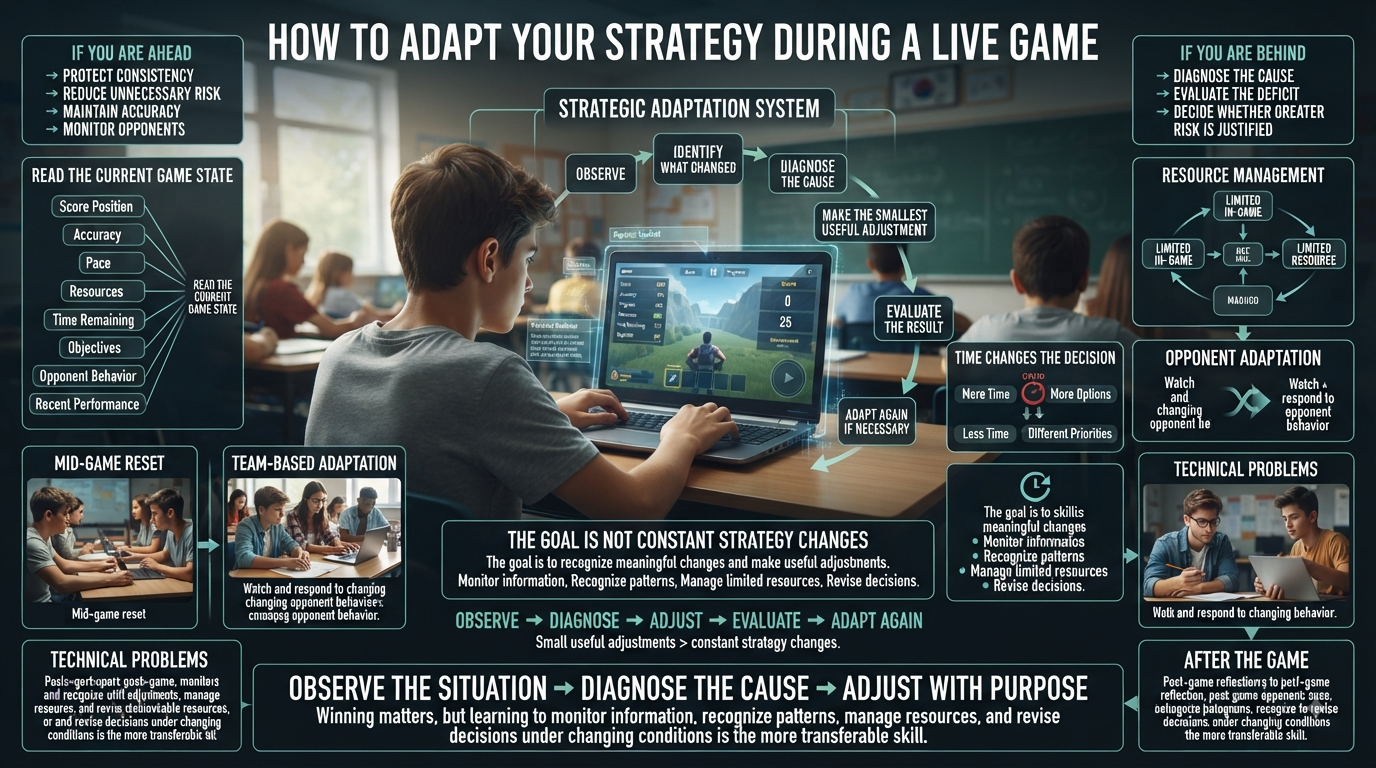
Strategy Changes as the Match Progresses
A premium educational gaming illustration showing how successful players adjust their power-up strategy throughout every stage of a Gimkit match, from early resource building to late-game tactical decisions.
Effective players rarely use the same approach from start to finish.
A Gimkit match naturally progresses through several strategic phases.
Early Game
The focus is usually on building a stable foundation. Players aim to generate resources while avoiding unnecessary risks.
Middle Game
As earnings increase, strategy becomes more flexible. Players begin responding to leaderboard changes, adjusting investments, and preparing for stronger competition.
Late Game
During the final minutes, maximizing every decision becomes more important than long-term growth. Players often shift toward upgrades that provide immediate value or protect their current position.
Recognizing these transitions helps prevent using an early-game strategy when the match has already entered its closing stages.
Power-Ups Reward Decision Quality More Than Speed
Many new players assume faster answering automatically leads to victory.
While speed is helpful, Gimkit often rewards players who make better strategic decisions instead of simply answering the greatest number of questions.
For example:
A player who answers quickly but spends inefficiently may lose momentum.
A player with slightly fewer answers but stronger investments may earn significantly more over time.
This balance between knowledge and resource management is one of Gimkit’s defining characteristics.
Reading the Leaderboard Influences Strategy
The leaderboard isn’t just a ranking—it provides valuable strategic information.
Experienced players use it to decide whether they should:
Continue expanding their economy.
Protect an existing lead.
Take calculated risks.
Shift toward offensive gameplay.
Save resources for the final stretch.
Ignoring the leaderboard often leads to missed opportunities or poorly timed upgrades.
⭐ Expert Insight: Don’t check the leaderboard only to see your position. Use it to understand how the entire match is evolving.
Timing Is Often More Important Than Power
A powerful upgrade purchased at the wrong moment may contribute less than a modest upgrade purchased at exactly the right time.
Good timing depends on factors such as:
Remaining game time.
Current earnings.
Opponent activity.
Available upgrade options.
Classroom objectives.
Instead of asking, “Which power-up is strongest?” ask, “Which power-up is most valuable right now?”
This mindset leads to far better strategic decisions.
Interactive learning becomes more effective when students experience different gameplay formats. Discover engaging classroom activities in Gimkit Features & Game Modes and keep every lesson fresh.
Risk Management Is Part of Every Strategy
Every investment carries some degree of risk.
For example:
Spending everything immediately may leave you unable to respond to unexpected situations.
Saving too much may reduce your overall earning potential.
Investing in offense may weaken your economy.
Focusing only on defense may limit future growth.
Successful players continuously balance these trade-offs instead of committing entirely to one approach.
Adaptability Wins More Games Than Fixed Strategies
Many players search for the perfect upgrade order.
The reality is that Gimkit rewards adaptability more than memorization.
Situations that may require changing your strategy include:
Difficult question sets.
Unexpected leaderboard changes.
Shorter-than-expected matches.
Different classroom rules.
New game mode mechanics.
Changes introduced in platform updates.
The ability to adjust your plan often matters more than following a predefined upgrade sequence.
For the latest gaming news, expert reviews, and walkthroughs, readers can also visit IGN, one of the world’s leading gaming websites.
Classroom Objectives Can Change the Best Strategy
Teachers use Gimkit for different educational purposes, and these goals influence which strategies are most effective.
Classroom Goal
Strategic Priority
Knowledge Review
Accuracy and consistency
Exam Preparation
Careful reading and efficient earning
Team Collaboration
Supporting group objectives
Friendly Competition
Balanced upgrades and steady progress
Fast Warm-Up Activity
Immediate value over long-term investment
Understanding the teacher’s objective helps students choose strategies that align with the purpose of the activity instead of focusing only on winning.
Learning Habits Influence Strategic Success
Power-ups reward more than gameplay mechanics—they reinforce productive learning habits.
Students who consistently:
Read questions carefully,
Avoid random guessing,
Learn from previous mistakes,
Stay focused throughout the match,
Adapt after setbacks,
often perform better than players who rely entirely on aggressive upgrade choices.
This makes Gimkit valuable not only as a review platform but also as a tool for developing critical thinking and decision-making skills.
Common Strategic Mistakes
Even experienced players occasionally fall into predictable strategic traps.
Some of the most common include:
Following the same upgrade path every game.
Ignoring changes in game pace.
Overreacting to temporary leaderboard positions.
Chasing opponents instead of improving personal efficiency.
Forgetting to adjust strategy near the end of the match.
Prioritizing expensive upgrades without a long-term plan.
Making emotional decisions after losing a lead.
Recognizing these mistakes is often the first step toward improving overall performance.
Developing Your Own Strategy
Rather than copying another player’s build, focus on understanding why certain decisions work.
After each match, review questions such as:
Which upgrades provided the greatest value?
Did I invest too early or too late?
At what point did my strategy become ineffective?
What would I change in the next game?
Which decisions produced the biggest improvement?
Reflecting on these questions helps develop a strategy that fits your own playing style and classroom environment.
How Power-Ups Shape Player Decisions During a Match
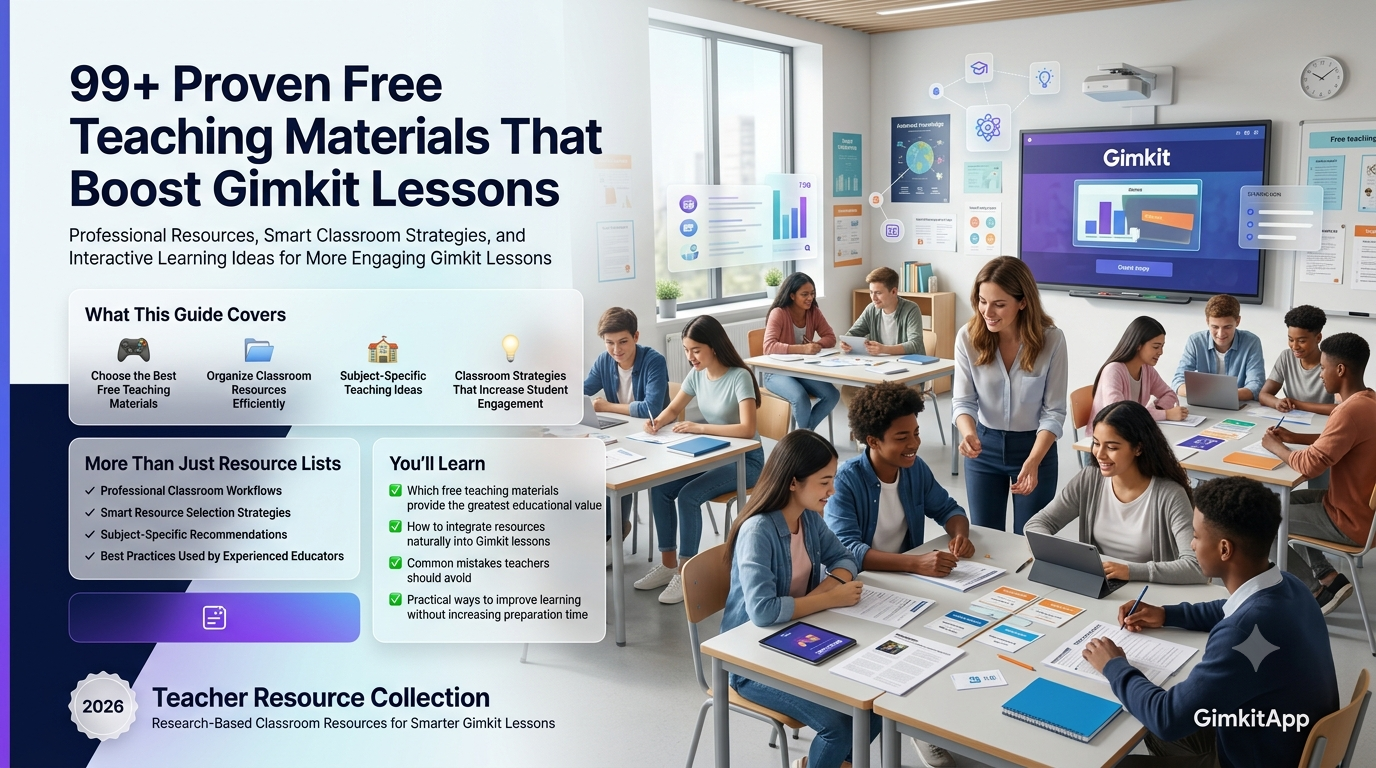
A premium educational gaming illustration showing how power-up choices influence player decisions, match momentum, and long-term strategy throughout a competitive Gimkit session.
Most players think power-ups only improve performance, but their biggest influence is actually on decision-making. Every purchase changes how a player approaches the rest of the game. Instead of simply answering questions, players begin evaluating risk, timing, available resources, and future opportunities. As the match progresses, the focus shifts from “Which question should I answer next?” to “Which decision gives me the greatest advantage over the next several minutes?” This strategic layer is what separates Gimkit from traditional classroom quiz platforms.
Power-Ups Change the Pace of the Game
One of the less obvious effects of power-ups is how they influence the overall pace of a match. Early upgrades often encourage steady growth, while later upgrades can dramatically accelerate or slow a player’s progress depending on the situation.
For example, players who invest in long-term growth usually experience gradual but consistent improvement throughout the game. Others may intentionally delay spending until they can purchase a more impactful upgrade, creating sudden shifts in leaderboard positions. These changing tempos make every match feel dynamic rather than predictable.
Unlike static quiz games where scores increase at a similar rate, Gimkit allows players to influence their own progression speed through strategic investments.
Whether you’re a beginner or an experienced educator, practical guidance makes implementation easier. Follow our Gimkit Guides & Tutorials for step-by-step instructions and classroom best practices.
Momentum Can Be More Valuable Than a High Score
A common mistake is focusing only on the current leaderboard.
Experienced players often pay more attention to momentum than raw score.
Momentum refers to how quickly your performance is improving. A player climbing the leaderboard steadily may become a much greater threat than someone who reached first place early but has stopped growing.
Signs of positive momentum include:
Consistently increasing earnings.
Unlocking upgrades at regular intervals.
Recovering quickly after mistakes.
Maintaining efficient decision-making.
Strong momentum often predicts future success better than temporary leaderboard positions.
⭐ Expert Insight: Winning isn’t always about leading from the beginning. Many successful players build momentum quietly before making a strong finish.
If you experience sign-in problems or game access issues, visit Gimkit Login, Join & Troubleshooting for reliable solutions and step-by-step troubleshooting guides.
Strategic Flexibility Outperforms Fixed Plans
Many beginners enter a game with a predetermined upgrade path and follow it regardless of what happens.
Experienced players rarely do this.
Instead, they adjust continuously based on new information.
Situations that may require changing strategy include:
Match Situation
Strategic Adjustment
Questions become more difficult
Slow down and prioritize accuracy.
Opponents gain a large lead
Consider higher-risk decisions to close the gap.
Game time is reduced
Focus on immediate value instead of long-term growth.
Leaderboard remains close
Preserve flexibility for the final minutes.
Unexpected penalties appear
Shift toward protecting existing progress.
Adaptability is often the deciding factor in competitive matches.
Different Players Create Different Strategic Environments
No two Gimkit classrooms play exactly the same way.
The behavior of other players directly influences which strategies are most effective.
For example:
A highly competitive class encourages faster strategic decisions.
Smaller groups often reward patient resource management.
Team-based activities require cooperation instead of individual optimization.
Because every classroom develops its own playing style, experienced players learn to adapt to their environment rather than relying on a single formula.
Recognizing Turning Points During a Match
Every Gimkit game contains moments where a single decision has a greater impact than usual.
These turning points often occur when:
A player reaches an important earning milestone.
Several competitors are close together on the leaderboard.
Match time begins running low.
Resource differences become significant.
New strategic opportunities appear.
Recognizing these moments allows players to act before their opponents do rather than simply reacting afterward.
Strategy Is Built on Information, Not Guesswork
Strong players constantly gather information throughout the game.
Instead of making random upgrade decisions, they observe:
Their earning rate.
Upgrade availability.
Remaining game time.
Relative leaderboard movement.
Question difficulty.
Personal accuracy trends.
Each observation improves future decisions.
The more information a player collects, the more confident and efficient their strategy becomes.
Strengthen learning with engaging assessments and interactive activities available in our Quiz Resources collection, designed for teachers and students alike.
Balancing Short-Term Rewards with Long-Term Goals
Every purchase involves a trade-off between immediate benefits and future opportunities.
Some decisions provide instant advantages, while others require patience before producing noticeable results.
Successful players learn to balance both approaches.
Decision Type
Immediate Benefit
Long-Term Impact
Short-term investment
Quick improvement
Limited future growth
Long-term investment
Slower initial progress
Greater overall efficiency
Balanced investment
Moderate immediate gains
Sustainable performance
Understanding this balance helps players avoid spending too aggressively or saving excessively.
Every teacher benefits from proven instructional ideas that increase participation and motivation. Explore Gimkit Resources for Teachers for practical classroom-ready solutions.
Developing Strategic Confidence
The best Gimkit players don’t rely on luck. They build confidence through repeated practice and thoughtful analysis of their decisions.
After each game, ask yourself:
Which decision improved my position the most?
Where did I lose momentum?
Did I react too slowly to changing conditions?
Which upgrades fit my playing style?
What would I change next time?
Over time, this habit transforms every match into a learning experience. Rather than memorizing a fixed strategy, you’ll develop the ability to make smarter decisions in any game mode, against any group of players, and under changing classroom conditions. This continuous improvement is what ultimately turns an average player into a consistently successful one.
The Psychology Behind Smart Power-Up Decisions
Success in Gimkit isn’t determined solely by correct answers—it is also influenced by how players think under pressure. Every upgrade decision involves psychology. Players must decide whether to spend now or wait, protect current progress or chase bigger rewards, and respond calmly when opponents gain an advantage. Understanding these mental habits often has a greater impact than simply knowing what each power-up does.
Students who remain patient usually make more consistent decisions than those who react emotionally after every leaderboard update.
Avoiding “Panic Spending”
One of the most common strategic mistakes occurs when players buy upgrades simply because they feel they are falling behind.
This reaction, often called panic spending, usually leads to inefficient resource management.
Typical signs include:
Purchasing the first available upgrade without evaluating its value.
Spending all available money immediately after losing a leaderboard position.
Changing strategy every few seconds.
Copying another player’s approach without understanding why.
Instead of solving the problem, panic spending often delays future opportunities because players no longer have enough resources to make better investments later.
💡 Pro Tip: If your strategy changes every time the leaderboard moves, you’re reacting emotionally rather than strategically.
Creating Pressure Without Direct Competition
Experienced players understand that strategy isn’t always about attacking opponents.
Sometimes, simply improving your own efficiency creates enough pressure to force competitors into making poor decisions.
When opponents notice someone climbing the leaderboard consistently, they often begin taking unnecessary risks, rushing through questions, or abandoning their original strategy.
This indirect pressure can become a powerful advantage because your competitors start making mistakes without you needing to interact with them directly.
Recognizing When Your Strategy Stops Working
A strategy that performs well during one stage of the game may become ineffective later.
Warning signs include:
Your leaderboard position remains unchanged despite continued effort.
Opponents begin earning resources faster than you.
Upgrade costs increase while your income remains stable.
Your decisions no longer create noticeable improvements.
When these patterns appear, it’s usually time to reassess your approach instead of continuing with the same plan.
Recovering After Falling Behind
Every player experiences difficult matches.
What separates experienced players from beginners is how they respond after losing momentum.
Effective recovery strategies include:
Staying focused on accuracy rather than rushing.
Looking for opportunities to rebuild efficiency.
Avoiding emotional decisions.
Accepting short-term setbacks while planning for later improvements.
Continuing to evaluate changing match conditions.
Many leaderboard comebacks happen because one player remains disciplined while others become impatient.
A single excellent upgrade rarely wins an entire Gimkit match.
Consistent decision-making usually produces better results than occasional moments of brilliance.
Players who repeatedly make solid choices throughout the game often outperform those who rely on one risky strategy.
Consistency means:
Spending with a purpose.
Reading questions carefully.
Monitoring progress regularly.
Adjusting only when necessary.
Maintaining focus until the game ends.
This disciplined approach reduces mistakes and creates reliable long-term performance.
Understanding pricing and premium features helps educators make informed decisions. Read detailed comparisons and expert evaluations in Gimkit Reviews & Pricing before selecting a subscription.
Building a Strategy Around Your Strengths
Every student approaches Gimkit differently.
Some answer questions very quickly, while others achieve higher accuracy by taking extra time.
Instead of copying another player’s strategy, build one around your own strengths.
Player Strength
Strategic Focus
Fast answering
Maximize earning opportunities while maintaining accuracy.
High accuracy
Build strategies that reward consistency over speed.
Strong decision-making
Adapt continuously throughout the match.
Careful planning
Focus on sustainable long-term growth.
Competitive mindset
Respond strategically rather than emotionally.
The best strategy is usually the one that complements your natural playing style rather than forcing you into unfamiliar habits.
How Classroom Dynamics Influence Strategic Choices
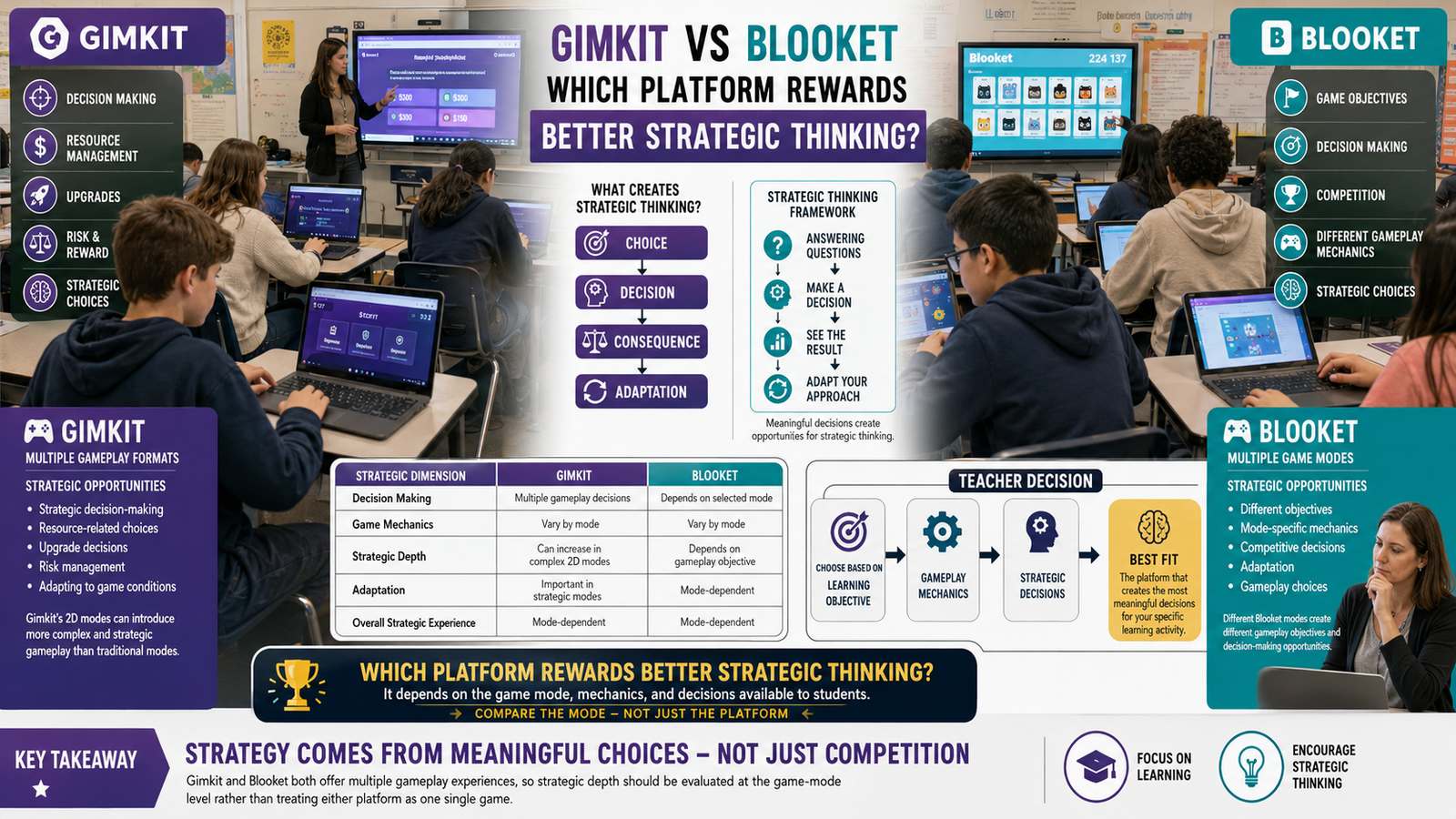
A premium educational gaming illustration showing how classroom environment, teamwork, and post-game reflection influence strategic decision-making during competitive learning activities.
Power-up decisions don’t happen in isolation—they’re affected by the learning environment.
For example:
A quiet classroom often allows students to think more carefully before answering.
Fast-paced competitions encourage quicker decisions but may increase mistakes.
Collaborative classroom discussions before a game often improve overall accuracy.
Friendly competition tends to produce more balanced strategies than highly stressful environments.
Teachers who vary classroom activities help students experience different strategic situations, improving both gameplay and critical thinking.
Using Reflection to Improve Future Matches
Every completed Gimkit session provides valuable feedback.
Instead of immediately starting another game, take a moment to evaluate your performance.
Useful reflection questions include:
Which decisions helped me the most?
Which purchases produced little value?
Did I remain flexible when conditions changed?
How often did I react instead of planning ahead?
What pattern can I improve in my next match?
Regular self-evaluation transforms each game into a learning opportunity, helping players refine their strategy over time rather than relying on trial and error alone.
Small instructional improvements often lead to better classroom results. Discover practical teaching methods and winning techniques in Gimkit Tips & Strategies to maximize student engagement.
From Tactical Choices to Strategic Thinking
The most advanced Gimkit players eventually stop thinking about individual upgrades and begin thinking about systems.
Instead of viewing each purchase as a separate action, they understand how every decision connects to future opportunities, overall efficiency, and long-term match objectives. This systems-based mindset helps them stay composed under pressure, adapt to changing classroom conditions, and make informed choices throughout the game.
Ultimately, power-ups are not just gameplay features—they are tools that teach planning, resource management, adaptability, and critical thinking. Players who master these broader strategic skills often perform better not only in Gimkit but also in other educational games and problem-solving activities that reward thoughtful decision-making.
Stay informed about the newest platform improvements, educational trends, and feature releases through Games Updates so you never miss important changes.
Professional Recommendations & Expert Reviews
How Gimkit Power-Ups Affect Game Strategy begins with choosing upgrades that match your overall game plan.
How Gimkit Power-Ups Affect Game Strategy helps players make smarter decisions throughout every match.
How Gimkit Power-Ups Affect Game Strategy shows that upgrade timing can influence final results.
How Gimkit Power-Ups Affect Game Strategy encourages planning instead of spending resources randomly.
How Gimkit Power-Ups Affect Game Strategy helps balance immediate rewards with long-term advantages.
How Gimkit Power-Ups Affect Game Strategy improves gameplay by encouraging thoughtful resource management.
How Gimkit Power-Ups Affect Game Strategy demonstrates the value of adapting to changing situations.
How Gimkit Power-Ups Affect Game Strategy helps players create more consistent winning strategies.
How Gimkit Power-Ups Affect Game Strategy encourages selecting upgrades with a clear purpose.
How Gimkit Power-Ups Affect Game Strategy rewards players who think several moves ahead.
How Gimkit Power-Ups Affect Game Strategy helps maximize the value of every correct answer.
How Gimkit Power-Ups Affect Game Strategy encourages steady progress instead of rushed decisions.
How Gimkit Power-Ups Affect Game Strategy strengthens long-term performance through smart investments.
How Gimkit Power-Ups Affect Game Strategy helps players avoid wasting valuable in-game resources.
How Gimkit Power-Ups Affect Game Strategy encourages building momentum throughout the match.
How Gimkit Power-Ups Affect Game Strategy improves efficiency by supporting better upgrade priorities.
How Gimkit Power-Ups Affect Game Strategy rewards players who remain patient under pressure.
How Gimkit Power-Ups Affect Game Strategy helps players recognize valuable upgrade opportunities.
How Gimkit Power-Ups Affect Game Strategy encourages flexible thinking during competitive gameplay.
How Gimkit Power-Ups Affect Game Strategy improves consistency through careful planning.
How Gimkit Power-Ups Affect Game Strategy helps players adjust tactics as matches evolve.
How Gimkit Power-Ups Affect Game Strategy encourages focusing on sustainable growth throughout the game.
How Gimkit Power-Ups Affect Game Strategy supports stronger decision-making during important moments.
How Gimkit Power-Ups Affect Game Strategy rewards players who understand upgrade combinations.
How Gimkit Power-Ups Affect Game Strategy helps improve performance with efficient resource allocation.
How Gimkit Power-Ups Affect Game Strategy encourages strategic thinking over quick reactions.
How Gimkit Power-Ups Affect Game Strategy helps players maintain competitive advantages longer.
How Gimkit Power-Ups Affect Game Strategy improves gameplay through smarter upgrade sequencing.
How Gimkit Power-Ups Affect Game Strategy encourages evaluating every purchase carefully.
How Gimkit Power-Ups Affect Game Strategy helps reduce costly gameplay mistakes.
How Gimkit Power-Ups Affect Game Strategy rewards players who adapt to different game modes.
How Gimkit Power-Ups Affect Game Strategy improves results by strengthening long-term planning.
How Gimkit Power-Ups Affect Game Strategy encourages efficient spending from beginning to end.
How Gimkit Power-Ups Affect Game Strategy helps players identify the most impactful upgrades.
How Gimkit Power-Ups Affect Game Strategy strengthens confidence through informed decisions.
How Gimkit Power-Ups Affect Game Strategy encourages careful observation before making upgrades.
How Gimkit Power-Ups Affect Game Strategy improves gameplay by reducing unnecessary risks.
How Gimkit Power-Ups Affect Game Strategy helps players remain competitive in challenging matches.
How Gimkit Power-Ups Affect Game Strategy encourages consistent learning through practical experience.
How Gimkit Power-Ups Affect Game Strategy strengthens overall performance with disciplined planning.
How Gimkit Power-Ups Affect Game Strategy helps players refine personal gameplay styles.
How Gimkit Power-Ups Affect Game Strategy encourages balancing offense with resource growth.
How Gimkit Power-Ups Affect Game Strategy rewards players who understand changing priorities.
How Gimkit Power-Ups Affect Game Strategy helps create reliable strategies for different situations.
How Gimkit Power-Ups Affect Game Strategy encourages making every upgrade contribute to your objective.
Frequently Asked Questions (FAQs)
1. How do power-ups influence long-term success in Gimkit?
Power-ups affect long-term success by shaping the quality of your decisions throughout the match rather than simply increasing your score. Players who choose upgrades that match the game’s pace, question difficulty, and remaining time usually perform more consistently than those who purchase upgrades randomly. Good strategic decisions create steady progress, while poor timing can slow future growth. Over multiple matches, learning when to invest, adapt, and change direction becomes more valuable than memorizing one upgrade order. Long-term improvement comes from combining subject knowledge with flexible decision-making instead of relying on individual power-ups alone.
2. Why do experienced Gimkit players change their strategy during a game?
Experienced players understand that every Gimkit match develops differently. Factors such as question difficulty, classroom competition, remaining game time, and leaderboard movement constantly change the best course of action. A strategy that works during the opening minutes may become ineffective later if opponents begin earning faster or classroom conditions change. Rather than following a fixed plan, skilled players evaluate new information throughout the match and adjust their decisions accordingly. This adaptability helps them remain competitive even when unexpected situations occur.
3. Does strategy matter more than answering questions quickly in Gimkit?
Speed can be helpful, but strategy often has a greater impact over the course of an entire match. Players who answer every question quickly but make poor upgrade decisions may lose to someone who answers more carefully while managing resources efficiently. Strategic thinking involves balancing accuracy, timing, and future planning instead of focusing only on immediate points. In longer games especially, smart decision-making usually produces more consistent results than speed alone because every choice influences future opportunities and overall progression.
4. How can students improve their decision-making while using power-ups?
Students can improve by treating each match as an opportunity to learn rather than simply trying to finish first. Before purchasing any upgrade, it’s helpful to consider how it will affect future decisions instead of focusing only on immediate rewards. After each game, reviewing which choices produced the best results helps identify strengths and weaknesses. Over time, recognizing patterns, avoiding emotional decisions, and adapting to different classroom situations naturally improve strategic thinking. This reflective approach builds skills that extend beyond Gimkit and supports better problem-solving in other learning activities.
5. What is the biggest strategic mistake players make with Gimkit power-ups?
One of the most common mistakes is making decisions based on emotion instead of analysis. Players often panic when they fall behind, spend resources without a clear purpose, or continue following a strategy that is no longer effective. Another frequent error is focusing only on the current leaderboard while ignoring long-term opportunities to improve performance. Successful players remain patient, evaluate changing conditions, and adjust their approach when necessary instead of reacting impulsively. Consistent decision-making almost always produces better results than chasing short-term advantages