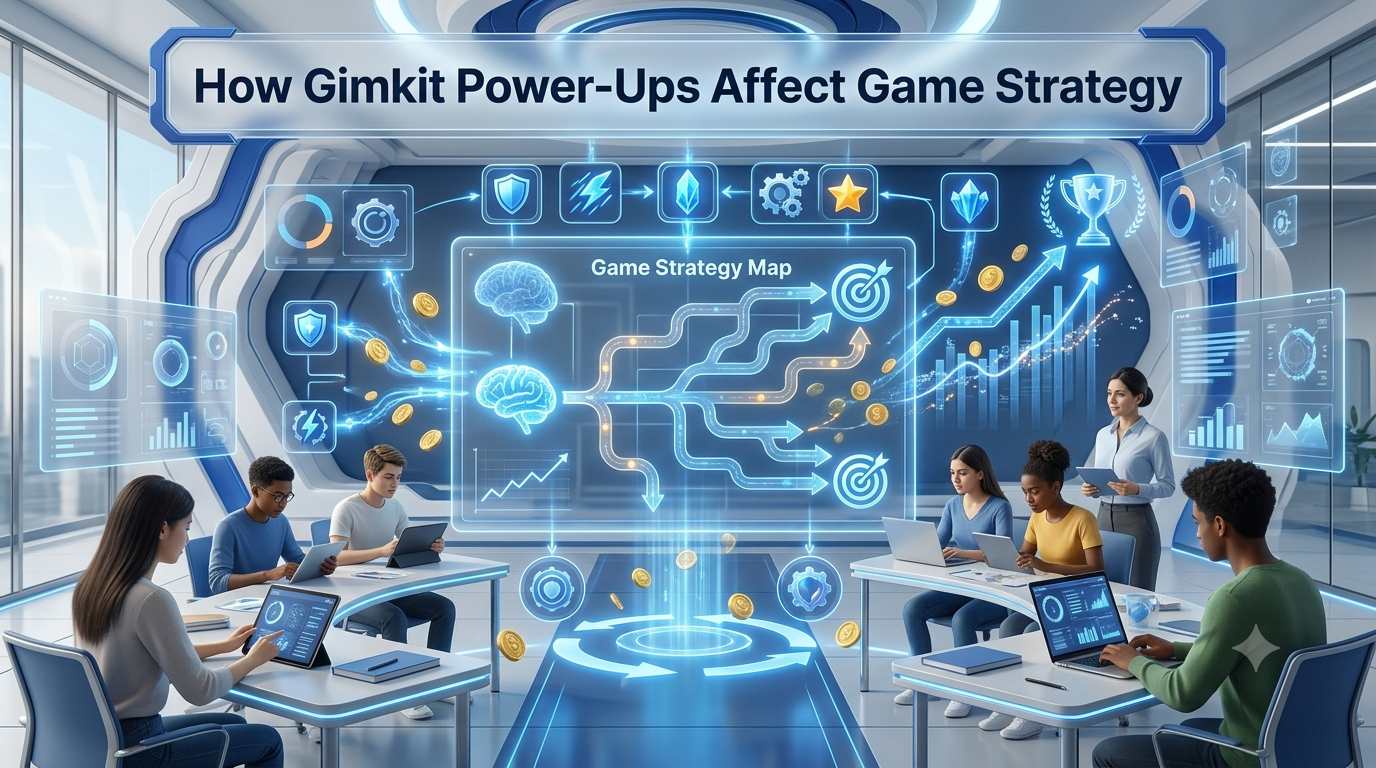
How Gimkit Power-Ups Affect Game Strategy | Go Beyond Increasing Your Score – Power-ups do much more than boost points; they influence every strategic decision you make throughout a Gimkit match.
🧠 Strategy Can Outperform Knowledge Alone – Two players with the same subject knowledge can finish in completely different positions simply because they manage their upgrades differently.
🚀 Build a Long-Term Game Plan – Experienced players don’t treat power-ups as isolated bonuses. Instead, they use them to create a strategy that evolves from the opening seconds of the game to the final leaderboard.
📈 Adapt Throughout the Match – Smart power-up choices help players adjust their approach as the game progresses, maximizing their chances of success.
Unlike a guide that explains what each power-up does, this section focuses on how power-ups influence gameplay, decision-making, player behavior, and match outcomes. Understanding these strategic effects helps you make smarter choices regardless of which game mode you’re playing.
Looking for comprehensive classroom resources and educational technology insights? Explore GimkitApp for expert guides, teaching strategies, game modes, and the latest updates to enhance student engagement.
Strategy Begins Before the First Upgrade
Many players believe strategy starts when they purchase their first power-up. In reality, it begins before spending any in-game money.
The opening phase of a Gimkit match is about gathering information rather than rushing into upgrades. Strong players observe the pace of the game, question difficulty, leaderboard movement, and earning speed before committing to a long-term plan.
During the first few minutes, ask yourself:
Are questions easy or challenging?
Is the game likely to end quickly?
Are opponents earning money rapidly?
Will aggressive or defensive play be more effective?
These early observations often determine which strategy will remain effective throughout the match.
💡 Pro Tip: Treat the opening of every Gimkit game like a scouting phase. The better you understand the environment, the better your upgrade decisions will be later.
Power-Ups Create Different Play Styles
Power-ups don’t just improve performance—they encourage completely different ways of playing the game.
Some players focus on building a strong economy, while others prioritize staying safe or disrupting opponents. These choices naturally create unique play styles that evolve as the match progresses.
Play Style
Strategic Focus
Typical Behavior
Investor
Long-term income growth
Buys economy upgrades early
Aggressor
Slowing opponents
Uses offensive abilities at key moments
Defender
Protecting progress
Prioritizes defensive upgrades
Balanced Player
Adapting to changing conditions
Mixes offense, defense, and economy
Opportunist
Reacting to the leaderboard
Changes strategy based on current standings
No single play style is always superior. The strongest approach depends on the classroom objective, game mode, and remaining time.
Every Upgrade Changes Future Decisions
One overlooked aspect of Gimkit strategy is that each purchase affects every decision that follows.
For example, investing heavily in income early may delay your ability to buy defensive upgrades. On the other hand, spending too much on protection can slow your economic growth.
This creates a chain reaction where one decision influences the next several minutes of gameplay.
Instead of asking, “Is this power-up good?” experienced players ask:
What opportunities will this purchase create?
What options will it limit?
How will it affect my next upgrade?
Will this decision still be valuable later in the match?
Thinking several moves ahead separates strategic players from reactive ones.
Choosing the right learning platform can significantly improve classroom outcomes. Compare leading educational tools in Gimkit Comparisons & Alternatives to find the best solution for your teaching style.
Strategy Changes as the Match Progresses
A premium educational gaming illustration showing how successful players adjust their power-up strategy throughout every stage of a Gimkit match, from early resource building to late-game tactical decisions.
Effective players rarely use the same approach from start to finish.
A Gimkit match naturally progresses through several strategic phases.
Early Game
The focus is usually on building a stable foundation. Players aim to generate resources while avoiding unnecessary risks.
Middle Game
As earnings increase, strategy becomes more flexible. Players begin responding to leaderboard changes, adjusting investments, and preparing for stronger competition.
Late Game
During the final minutes, maximizing every decision becomes more important than long-term growth. Players often shift toward upgrades that provide immediate value or protect their current position.
Recognizing these transitions helps prevent using an early-game strategy when the match has already entered its closing stages.
Power-Ups Reward Decision Quality More Than Speed
Many new players assume faster answering automatically leads to victory.
While speed is helpful, Gimkit often rewards players who make better strategic decisions instead of simply answering the greatest number of questions.
For example:
A player who answers quickly but spends inefficiently may lose momentum.
A player with slightly fewer answers but stronger investments may earn significantly more over time.
This balance between knowledge and resource management is one of Gimkit’s defining characteristics.
Reading the Leaderboard Influences Strategy
The leaderboard isn’t just a ranking—it provides valuable strategic information.
Experienced players use it to decide whether they should:
Continue expanding their economy.
Protect an existing lead.
Take calculated risks.
Shift toward offensive gameplay.
Save resources for the final stretch.
Ignoring the leaderboard often leads to missed opportunities or poorly timed upgrades.
⭐ Expert Insight: Don’t check the leaderboard only to see your position. Use it to understand how the entire match is evolving.
Timing Is Often More Important Than Power
A powerful upgrade purchased at the wrong moment may contribute less than a modest upgrade purchased at exactly the right time.
Good timing depends on factors such as:
Remaining game time.
Current earnings.
Opponent activity.
Available upgrade options.
Classroom objectives.
Instead of asking, “Which power-up is strongest?” ask, “Which power-up is most valuable right now?”
This mindset leads to far better strategic decisions.
Interactive learning becomes more effective when students experience different gameplay formats. Discover engaging classroom activities in Gimkit Features & Game Modes and keep every lesson fresh.
Risk Management Is Part of Every Strategy
Every investment carries some degree of risk.
For example:
Spending everything immediately may leave you unable to respond to unexpected situations.
Saving too much may reduce your overall earning potential.
Investing in offense may weaken your economy.
Focusing only on defense may limit future growth.
Successful players continuously balance these trade-offs instead of committing entirely to one approach.
Adaptability Wins More Games Than Fixed Strategies
Many players search for the perfect upgrade order.
The reality is that Gimkit rewards adaptability more than memorization.
Situations that may require changing your strategy include:
Difficult question sets.
Unexpected leaderboard changes.
Shorter-than-expected matches.
Different classroom rules.
New game mode mechanics.
Changes introduced in platform updates.
The ability to adjust your plan often matters more than following a predefined upgrade sequence.
For the latest gaming news, expert reviews, and walkthroughs, readers can also visit official documentation, one of the world’s leading gaming websites.
Classroom Objectives Can Change the Best Strategy
Teachers use Gimkit for different educational purposes, and these goals influence which strategies are most effective.
Classroom Goal
Strategic Priority
Knowledge Review
Accuracy and consistency
Exam Preparation
Careful reading and efficient earning
Team Collaboration
Supporting group objectives
Friendly Competition
Balanced upgrades and steady progress
Fast Warm-Up Activity
Immediate value over long-term investment
Understanding the teacher’s objective helps students choose strategies that align with the purpose of the activity instead of focusing only on winning.
Learning Habits Influence Strategic Success
Power-ups reward more than gameplay mechanics—they reinforce productive learning habits.
Students who consistently:
Read questions carefully,
Avoid random guessing,
Learn from previous mistakes,
Stay focused throughout the match,
Adapt after setbacks,
often perform better than players who rely entirely on aggressive upgrade choices.
This makes Gimkit valuable not only as a review platform but also as a tool for developing critical thinking and decision-making skills.
Common Strategic Mistakes
Even experienced players occasionally fall into predictable strategic traps.
Some of the most common include:
Following the same upgrade path every game.
Ignoring changes in game pace.
Overreacting to temporary leaderboard positions.
Chasing opponents instead of improving personal efficiency.
Forgetting to adjust strategy near the end of the match.
Prioritizing expensive upgrades without a long-term plan.
Making emotional decisions after losing a lead.
Recognizing these mistakes is often the first step toward improving overall performance.
Developing Your Own Strategy
Rather than copying another player’s build, focus on understanding why certain decisions work.
After each match, review questions such as:
Which upgrades provided the greatest value?
Did I invest too early or too late?
At what point did my strategy become ineffective?
What would I change in the next game?
Which decisions produced the biggest improvement?
Reflecting on these questions helps develop a strategy that fits your own playing style and classroom environment.
How Power-Ups Shape Player Decisions During a Match
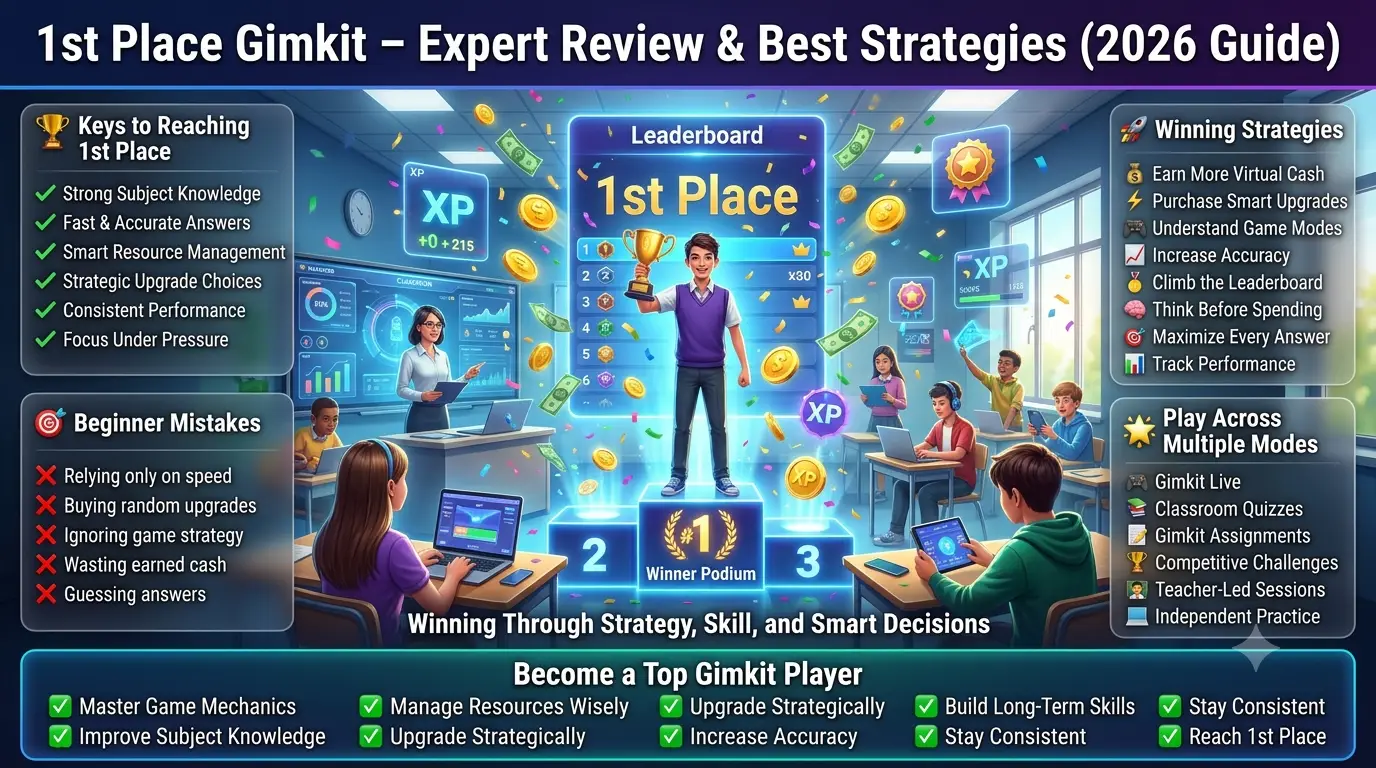
A premium educational gaming illustration showing how power-up choices influence player decisions, match momentum, and long-term strategy throughout a competitive Gimkit session.
Most players think power-ups only improve performance, but their biggest influence is actually on decision-making. Every purchase changes how a player approaches the rest of the game. Instead of simply answering questions, players begin evaluating risk, timing, available resources, and future opportunities. As the match progresses, the focus shifts from “Which question should I answer next?” to “Which decision gives me the greatest advantage over the next several minutes?” This strategic layer is what separates Gimkit from traditional classroom quiz platforms.
Power-Ups Change the Pace of the Game
One of the less obvious effects of power-ups is how they influence the overall pace of a match. Early upgrades often encourage steady growth, while later upgrades can dramatically accelerate or slow a player’s progress depending on the situation.
For example, players who invest in long-term growth usually experience gradual but consistent improvement throughout the game. Others may intentionally delay spending until they can purchase a more impactful upgrade, creating sudden shifts in leaderboard positions. These changing tempos make every match feel dynamic rather than predictable.
Unlike static quiz games where scores increase at a similar rate, Gimkit allows players to influence their own progression speed through strategic investments.
Whether you’re a beginner or an experienced educator, practical guidance makes implementation easier. Follow our Gimkit Guides & Tutorials for step-by-step instructions and classroom best practices.
Momentum Can Be More Valuable Than a High Score
A common mistake is focusing only on the current leaderboard.
Experienced players often pay more attention to momentum than raw score.
Momentum refers to how quickly your performance is improving. A player climbing the leaderboard steadily may become a much greater threat than someone who reached first place early but has stopped growing.
Signs of positive momentum include:
Consistently increasing earnings.
Unlocking upgrades at regular intervals.
Recovering quickly after mistakes.
Maintaining efficient decision-making.
Strong momentum often predicts future success better than temporary leaderboard positions.
⭐ Expert Insight: Winning isn’t always about leading from the beginning. Many successful players build momentum quietly before making a strong finish.
If you experience sign-in problems or game access issues, visit Gimkit Login, Join & Troubleshooting for reliable solutions and step-by-step troubleshooting guides.
Strategic Flexibility Outperforms Fixed Plans
Many beginners enter a game with a predetermined upgrade path and follow it regardless of what happens.
Experienced players rarely do this.
Instead, they adjust continuously based on new information.
Situations that may require changing strategy include:
Match Situation
Strategic Adjustment
Questions become more difficult
Slow down and prioritize accuracy.
Opponents gain a large lead
Consider higher-risk decisions to close the gap.
Game time is reduced
Focus on immediate value instead of long-term growth.
Leaderboard remains close
Preserve flexibility for the final minutes.
Unexpected penalties appear
Shift toward protecting existing progress.
Adaptability is often the deciding factor in competitive matches.
Different Players Create Different Strategic Environments
No two Gimkit classrooms play exactly the same way.
The behavior of other players directly influences which strategies are most effective.
For example:
A highly competitive class encourages faster strategic decisions.
Smaller groups often reward patient resource management.
Team-based activities require cooperation instead of individual optimization.
Because every classroom develops its own playing style, experienced players learn to adapt to their environment rather than relying on a single formula.
Recognizing Turning Points During a Match
Every Gimkit game contains moments where a single decision has a greater impact than usual.
These turning points often occur when:
A player reaches an important earning milestone.
Several competitors are close together on the leaderboard.
Match time begins running low.
Resource differences become significant.
New strategic opportunities appear.
Recognizing these moments allows players to act before their opponents do rather than simply reacting afterward.
Strategy Is Built on Information, Not Guesswork
Strong players constantly gather information throughout the game.
Instead of making random upgrade decisions, they observe:
Their earning rate.
Upgrade availability.
Remaining game time.
Relative leaderboard movement.
Question difficulty.
Personal accuracy trends.
Each observation improves future decisions.
The more information a player collects, the more confident and efficient their strategy becomes.
Strengthen learning with engaging assessments and interactive activities available in our Quiz Resources collection, designed for teachers and students alike.
Balancing Short-Term Rewards with Long-Term Goals
Every purchase involves a trade-off between immediate benefits and future opportunities.
Some decisions provide instant advantages, while others require patience before producing noticeable results.
Successful players learn to balance both approaches.
Decision Type
Immediate Benefit
Long-Term Impact
Short-term investment
Quick improvement
Limited future growth
Long-term investment
Slower initial progress
Greater overall efficiency
Balanced investment
Moderate immediate gains
Sustainable performance
Understanding this balance helps players avoid spending too aggressively or saving excessively.
Every teacher benefits from proven instructional ideas that increase participation and motivation. Explore Gimkit Resources for Teachers for practical classroom-ready solutions.
Developing Strategic Confidence
The best Gimkit players don’t rely on luck. They build confidence through repeated practice and thoughtful analysis of their decisions.
After each game, ask yourself:
Which decision improved my position the most?
Where did I lose momentum?
Did I react too slowly to changing conditions?
Which upgrades fit my playing style?
What would I change next time?
Over time, this habit transforms every match into a learning experience. Rather than memorizing a fixed strategy, you’ll develop the ability to make smarter decisions in any game mode, against any group of players, and under changing classroom conditions. This continuous improvement is what ultimately turns an average player into a consistently successful one.
The Psychology Behind Smart Power-Up Decisions
Success in Gimkit isn’t determined solely by correct answers—it is also influenced by how players think under pressure. Every upgrade decision involves psychology. Players must decide whether to spend now or wait, protect current progress or chase bigger rewards, and respond calmly when opponents gain an advantage. Understanding these mental habits often has a greater impact than simply knowing what each power-up does.
Students who remain patient usually make more consistent decisions than those who react emotionally after every leaderboard update.
Avoiding “Panic Spending”
One of the most common strategic mistakes occurs when players buy upgrades simply because they feel they are falling behind.
This reaction, often called panic spending, usually leads to inefficient resource management.
Typical signs include:
Purchasing the first available upgrade without evaluating its value.
Spending all available money immediately after losing a leaderboard position.
Changing strategy every few seconds.
Copying another player’s approach without understanding why.
Instead of solving the problem, panic spending often delays future opportunities because players no longer have enough resources to make better investments later.
💡 Pro Tip: If your strategy changes every time the leaderboard moves, you’re reacting emotionally rather than strategically.
Creating Pressure Without Direct Competition
Experienced players understand that strategy isn’t always about attacking opponents.
Sometimes, simply improving your own efficiency creates enough pressure to force competitors into making poor decisions.
When opponents notice someone climbing the leaderboard consistently, they often begin taking unnecessary risks, rushing through questions, or abandoning their original strategy.
This indirect pressure can become a powerful advantage because your competitors start making mistakes without you needing to interact with them directly.
Recognizing When Your Strategy Stops Working
A strategy that performs well during one stage of the game may become ineffective later.
Warning signs include:
Your leaderboard position remains unchanged despite continued effort.
Opponents begin earning resources faster than you.
Upgrade costs increase while your income remains stable.
Your decisions no longer create noticeable improvements.
When these patterns appear, it’s usually time to reassess your approach instead of continuing with the same plan.
Recovering After Falling Behind
Every player experiences difficult matches.
What separates experienced players from beginners is how they respond after losing momentum.
Effective recovery strategies include:
Staying focused on accuracy rather than rushing.
Looking for opportunities to rebuild efficiency.
Avoiding emotional decisions.
Accepting short-term setbacks while planning for later improvements.
Continuing to evaluate changing match conditions.
Many leaderboard comebacks happen because one player remains disciplined while others become impatient.
A single excellent upgrade rarely wins an entire Gimkit match.
Consistent decision-making usually produces better results than occasional moments of brilliance.
Players who repeatedly make solid choices throughout the game often outperform those who rely on one risky strategy.
Consistency means:
Spending with a purpose.
Reading questions carefully.
Monitoring progress regularly.
Adjusting only when necessary.
Maintaining focus until the game ends.
This disciplined approach reduces mistakes and creates reliable long-term performance.
Understanding pricing and premium features helps educators make informed decisions. Read detailed comparisons and expert evaluations in Gimkit Reviews & Pricing before selecting a subscription.
Building a Strategy Around Your Strengths
Every student approaches Gimkit differently.
Some answer questions very quickly, while others achieve higher accuracy by taking extra time.
Instead of copying another player’s strategy, build one around your own strengths.
Player Strength
Strategic Focus
Fast answering
Maximize earning opportunities while maintaining accuracy.
High accuracy
Build strategies that reward consistency over speed.
Strong decision-making
Adapt continuously throughout the match.
Careful planning
Focus on sustainable long-term growth.
Competitive mindset
Respond strategically rather than emotionally.
The best strategy is usually the one that complements your natural playing style rather than forcing you into unfamiliar habits.
How Classroom Dynamics Influence Strategic Choices
A premium educational gaming illustration showing how classroom environment, teamwork, and post-game reflection influence strategic decision-making during competitive learning activities.
Power-up decisions don’t happen in isolation—they’re affected by the learning environment.
For example:
A quiet classroom often allows students to think more carefully before answering.
Fast-paced competitions encourage quicker decisions but may increase mistakes.
Collaborative classroom discussions before a game often improve overall accuracy.
Friendly competition tends to produce more balanced strategies than highly stressful environments.
Teachers who vary classroom activities help students experience different strategic situations, improving both gameplay and critical thinking.
Using Reflection to Improve Future Matches
Every completed Gimkit session provides valuable feedback.
Instead of immediately starting another game, take a moment to evaluate your performance.
Useful reflection questions include:
Which decisions helped me the most?
Which purchases produced little value?
Did I remain flexible when conditions changed?
How often did I react instead of planning ahead?
What pattern can I improve in my next match?
Regular self-evaluation transforms each game into a learning opportunity, helping players refine their strategy over time rather than relying on trial and error alone.
Small instructional improvements often lead to better classroom results. Discover practical teaching methods and winning techniques in Gimkit Tips & Strategies to maximize student engagement.
From Tactical Choices to Strategic Thinking
The most advanced Gimkit players eventually stop thinking about individual upgrades and begin thinking about systems.
Instead of viewing each purchase as a separate action, they understand how every decision connects to future opportunities, overall efficiency, and long-term match objectives. This systems-based mindset helps them stay composed under pressure, adapt to changing classroom conditions, and make informed choices throughout the game.
Ultimately, power-ups are not just gameplay features—they are tools that teach planning, resource management, adaptability, and critical thinking. Players who master these broader strategic skills often perform better not only in Gimkit but also in other educational games and problem-solving activities that reward thoughtful decision-making.
Stay informed about the newest platform improvements, educational trends, and feature releases through Games Updates so you never miss important changes.
Professional Recommendations & Expert Reviews
How Gimkit Power-Ups Affect Game Strategy begins with choosing upgrades that match your overall game plan.
How Gimkit Power-Ups Affect Game Strategy helps players make smarter decisions throughout every match.
How Gimkit Power-Ups Affect Game Strategy shows that upgrade timing can influence final results.
How Gimkit Power-Ups Affect Game Strategy encourages planning instead of spending resources randomly.
How Gimkit Power-Ups Affect Game Strategy helps balance immediate rewards with long-term advantages.
How Gimkit Power-Ups Affect Game Strategy improves gameplay by encouraging thoughtful resource management.
How Gimkit Power-Ups Affect Game Strategy demonstrates the value of adapting to changing situations.
How Gimkit Power-Ups Affect Game Strategy helps players create more consistent winning strategies.
How Gimkit Power-Ups Affect Game Strategy encourages selecting upgrades with a clear purpose.
How Gimkit Power-Ups Affect Game Strategy rewards players who think several moves ahead.
How Gimkit Power-Ups Affect Game Strategy helps maximize the value of every correct answer.
How Gimkit Power-Ups Affect Game Strategy encourages steady progress instead of rushed decisions.
How Gimkit Power-Ups Affect Game Strategy strengthens long-term performance through smart investments.
How Gimkit Power-Ups Affect Game Strategy helps players avoid wasting valuable in-game resources.
How Gimkit Power-Ups Affect Game Strategy encourages building momentum throughout the match.
How Gimkit Power-Ups Affect Game Strategy improves efficiency by supporting better upgrade priorities.
How Gimkit Power-Ups Affect Game Strategy rewards players who remain patient under pressure.
How Gimkit Power-Ups Affect Game Strategy helps players recognize valuable upgrade opportunities.
How Gimkit Power-Ups Affect Game Strategy encourages flexible thinking during competitive gameplay.
How Gimkit Power-Ups Affect Game Strategy improves consistency through careful planning.
How Gimkit Power-Ups Affect Game Strategy helps players adjust tactics as matches evolve.
How Gimkit Power-Ups Affect Game Strategy encourages focusing on sustainable growth throughout the game.
How Gimkit Power-Ups Affect Game Strategy supports stronger decision-making during important moments.
How Gimkit Power-Ups Affect Game Strategy rewards players who understand upgrade combinations.
How Gimkit Power-Ups Affect Game Strategy helps improve performance with efficient resource allocation.
How Gimkit Power-Ups Affect Game Strategy encourages strategic thinking over quick reactions.
How Gimkit Power-Ups Affect Game Strategy helps players maintain competitive advantages longer.
How Gimkit Power-Ups Affect Game Strategy improves gameplay through smarter upgrade sequencing.
How Gimkit Power-Ups Affect Game Strategy encourages evaluating every purchase carefully.
How Gimkit Power-Ups Affect Game Strategy helps reduce costly gameplay mistakes.
How Gimkit Power-Ups Affect Game Strategy rewards players who adapt to different game modes.
How Gimkit Power-Ups Affect Game Strategy improves results by strengthening long-term planning.
How Gimkit Power-Ups Affect Game Strategy encourages efficient spending from beginning to end.
How Gimkit Power-Ups Affect Game Strategy helps players identify the most impactful upgrades.
How Gimkit Power-Ups Affect Game Strategy strengthens confidence through informed decisions.
How Gimkit Power-Ups Affect Game Strategy encourages careful observation before making upgrades.
How Gimkit Power-Ups Affect Game Strategy improves gameplay by reducing unnecessary risks.
How Gimkit Power-Ups Affect Game Strategy helps players remain competitive in challenging matches.
How Gimkit Power-Ups Affect Game Strategy encourages consistent learning through practical experience.
How Gimkit Power-Ups Affect Game Strategy strengthens overall performance with disciplined planning.
How Gimkit Power-Ups Affect Game Strategy helps players refine personal gameplay styles.
How Gimkit Power-Ups Affect Game Strategy encourages balancing offense with resource growth.
How Gimkit Power-Ups Affect Game Strategy rewards players who understand changing priorities.
How Gimkit Power-Ups Affect Game Strategy helps create reliable strategies for different situations.
How Gimkit Power-Ups Affect Game Strategy encourages making every upgrade contribute to your objective.
Important: power-ups are mode-specific, not universal
Updated editorial guidance, November 2026. Gimkit’s official Mode Picker guidance confirms that modes have different mechanics and labels. A traditional cash-and-upgrade example should never be presented as a feature of every 2D mode. The calculations below are hypothetical classroom models, not current official prices, odds or guaranteed tactics. For named mechanics, consult the linked official mode pages. This article analyzes how choices change strategy; the separate power-up reference guide addresses item terminology and historical examples.
Mode-specific strategy laboratory
Power-ups can affect a match by changing resource supply, risk exposure, movement options, team coordination or the remaining time available to benefit from an investment. The following cases distinguish those mechanisms and give students testable reasoning prompts instead of a universal winning formula.
1. Mode selection comes before optimization
A purchase that makes sense in one format may be meaningless in another. The first strategic question is therefore not which power-up to buy, but which mode the host selected and what that mode actually rewards. In a cash-oriented format, answer accuracy, income and spending can interact. In Snowbrawl, correct answers supply snowballs, and players may encounter Shield Cans and Med Packs at vending machines. In Don’t Look Down, questions supply energy for movement, and the objective is reaching the top. Those are different economies, not three versions of one universal upgrade shop. A player who imports a cash multiplier plan into a platforming race will misread the task. Before play, inspect the mode description and host options. During play, identify the resource that limits progress, whether cash, movement energy, projectiles, time, team coordination or knowledge of the map. Optimize that constraint instead of chasing a familiar purchase. This distinction also protects teachers from teaching a single “winning formula” as though it applies to every kit and game format.
2. A useful baseline before a purchase
The cleanest way to judge an upgrade is to record a short baseline rather than trust a dramatic leaderboard jump. Imagine a mode that awards hypothetical coins for correct answers. During the first minute, a learner answers six questions, five correctly, and earns 500 coins. Their observed rate is 500 coins per minute, but that rate is uncertain because the sample is small. If a proposed purchase costs 1,000 coins and increases earnings by 100 coins per minute, it needs about ten minutes to recover its cost, assuming the effect is stable. If only four minutes remain, the purchase cannot pay for itself on those assumptions. This is a teaching example, not an assertion about any current Gimkit upgrade price. Recheck the baseline after a change in question difficulty, device lag, interruptions or the game objective. For students, the central habit is explaining the assumptions aloud: what is measured, what is estimated, what might change, and what result would overturn the decision. This makes the calculation a reasoning exercise rather than a claim that a game is fully predictable.
3. The accuracy-adjusted earning problem
An apparent multiplier can be less valuable than it looks when students answer too quickly. Suppose a learner can attempt ten questions per minute with 60 percent accuracy, while another attempts eight with 90 percent accuracy. If each correct answer were worth 100 hypothetical points and incorrect answers had no penalty, the first produces an expected 600 points per minute and the second 720. If errors subtract points or interrupt movement, the advantage of accuracy can be larger. This example is intentionally independent of any mode-specific payout table. Teachers can use it to ask why “faster” and “better” are not synonyms. A sensible player observes whether a purchase changes the reward for correct answers, the cost of mistakes, the ability to attempt questions, or none of these. They should also distinguish short-term lucky streaks from repeatable accuracy. A three-question sample is not enough to decide that a strategy has improved. When the class is studying content rather than economics, slowing down to reason through distractors may be the best move even if it lowers the visible game score.
4. A late purchase with too little runway
A high-value upgrade can become a poor decision near the end of a match. Consider a hypothetical investment costing 800 coins that produces 80 additional coins per minute. With twelve minutes left, the simple additional return is 960 coins, leaving a nominal surplus of 160. With three minutes left, it returns only 240, producing a shortfall of 560. The arithmetic changes if the purchase has resale value, changes a multiplier, unlocks another action, or affects a win condition; those features must be checked rather than assumed. Students should also consider that the displayed time limit may not be the only ending condition. Some activities end when a team or individual reaches an objective, so the practical remaining time can be shorter than the clock suggests. The transferable rule is to value a purchase by its remaining opportunities to work. A teacher can pause a demonstration before the last minute and ask students to compare two choices with explicit assumptions. The goal is not to prescribe a particular upgrade but to practice decision-making under a deadline.
5. When a defensive action changes the equation
Protection is valuable only if there is a relevant risk to protect against. In Snowbrawl, official instructions describe Shield Cans and Med Packs as items that can be purchased at vending machines. That is concrete evidence for that mode, not proof that the same items exist in Classic or every other format. A defensive purchase should be assessed against the chance of being knocked out, the cost of interruption, and the time needed to replenish resources. If a player is rarely targeted, stockpiling protection can displace more useful activity. If the player is carrying a crucial team role and is repeatedly knocked out, protection may have a larger indirect effect than its immediate price suggests. For classroom discussion, compare two players with different risk exposure rather than declare that “defense always wins.” Also note that aggressive mechanics can distract from the underlying questions. A teacher may prefer a less confrontational mode for an anxious group, and that choice is educationally valid even when a more competitive mode offers a richer tactical environment.
6. Offensive choices and their hidden opportunity cost
An action that disrupts an opponent can feel powerful while still reducing your own learning and earning opportunities. Imagine that a hypothetical offensive action takes fifteen seconds to plan and execute. At an observed pace of one accurate answer every ten seconds, that action displaces roughly one or two question attempts. It may be worthwhile if it changes a team objective, but it is not free merely because its displayed currency price is low. In a mode with projectiles, aiming and positioning consume attention. In a cash-based game, waiting for the right moment can be better than purchasing the first available offensive option. Students can estimate opportunity cost by asking what they could have done with the same time and attention. This framing also creates a healthy classroom conversation about competition: interrupting a peer is not evidence of superior understanding of the subject matter. Teachers should avoid equating knockouts, rank or wealth with learning gains. Follow-up questions and error analysis remain more direct evidence of what a learner understands.
7. Uncertain opponents and robust decisions
Players often assume every rival has the same goal, speed and knowledge. In reality, opponents may be practicing unfamiliar material, using different devices, sharing a team role or focusing on exploration. A strategy that works only when everyone behaves identically is fragile. A robust decision performs reasonably across several plausible situations. For example, instead of assuming a rival will spend all their currency immediately, consider three scenarios: they save, they buy an early upgrade, or they switch to a defensive approach. Ask whether your own purchase is still defensible in each case. This is not an invitation to track individual students publicly. It is a classroom exercise in uncertainty, not surveillance. Students can compare outcomes with anonymous fictional profiles and learn to update plans without making judgments about classmates. If the mode rewards a collective objective, anticipating what teammates need may be more valuable than predicting what opponents will do. The broader lesson is that uncertainty should lead to flexible planning rather than confident claims about other people’s intentions.
8. Team roles and shared resources
A cooperative mode changes the unit of analysis from the individual score to the group’s objective. One Way Out, for example, asks players to escape a spaceship together; official instructions describe earning energy through questions, collecting key cards, obtaining improved gadgets and coordinating movement. A player who optimizes only personal cash may neglect a teammate waiting at a gate. The right question becomes which action moves the whole group toward escape. Teams can assign temporary roles such as navigator, question specialist, communicator and resource checker, then rotate those roles so no student becomes permanently excluded from answering. If a teammate is stuck, the group may gain more by helping than by racing ahead. Teachers can use a quick debrief to ask which decisions were collaborative, which created bottlenecks and how the group responded to incomplete information. The gameplay is a setting for practicing coordination; it does not automatically prove improved teamwork. Observe the conversations and task completion to evaluate that claim.
9. Separating movement energy from currency
In 2D formats, resources can serve very different functions. Don’t Look Down uses correct answers to provide energy for movement and jumping. Blastball uses answers to supply blasts that move a ball toward a goal. One Way Out uses energy for exploration and gadgets for encounters. Calling every one of these resources a “power-up” hides the mechanism that matters. If a player runs out of movement energy, they need to answer questions; buying an imagined income upgrade would not address the bottleneck. If a Blastball team is missing shots, simply increasing the number of blasts may not fix poor aiming or communication. Teachers can make the distinction concrete by asking students to classify each action as generating resources, conserving resources, improving accuracy, controlling risk or advancing the win condition. That classification is more portable than memorizing a list of named upgrades. It also prevents an SEO article from giving false universal instructions. Always verify the actual options on the selected mode’s Game Options screen before recommending a setting.
10. A decision tree for short games
For a short session, the first branch is whether the activity ends by time or by reaching a target. If it ends by time, estimate how many question opportunities remain. If it ends by a target, estimate how quickly that target could be reached by any player or team. Next ask whether a purchase has an immediate effect or requires repeated future actions. A one-time tactical action may still matter near the end; a slow income investment often will not. Third, check whether the student is answering accurately enough to benefit from the purchase. Finally, ask whether a simpler alternative exists, such as reviewing a misunderstood question, moving to a better position or coordinating with a teammate. A teacher can model the tree using a two-minute hypothetical round and have students explain the branch they chose. Avoid presenting the tree as an automated winning algorithm. It is a transparent way to make assumptions visible and to connect game decisions to general skills such as estimation, prioritization and recognizing constraints.
11. A decision tree for long games
Longer activities create room for compounding, but they also increase uncertainty. The opening decision should emphasize the resource that grows through repeated correct actions. The middle phase should recheck whether that resource is still the limiting factor. The closing phase should shift attention to the actual objective. In a hypothetical cash format, an early multiplier may become worthwhile if the player can answer many more questions before the finish. In a collaborative exploration mode, an improved gadget may matter only after the team has reached a particular area. Students should not commit to an entire sequence before seeing the map, question difficulty and group behavior. An effective plan includes checkpoints: after five minutes, after a failed attempt, after an objective changes, and before the final push. At each checkpoint, compare what happened with the original assumption. Teachers can have groups write a one-sentence revision rather than celebrate only the final rank. That short reflection turns strategic flexibility into observable learning behavior.
12. Why the leaderboard is a weak learning metric
A leaderboard measures performance under the rules of a particular game. It does not isolate understanding, effort, prior knowledge, device access or the value of a specific upgrade. A student may lead because they already knew the questions, while another makes a larger conceptual gain but finishes lower. An upgrade can increase visible earnings without improving answer quality. Teachers should therefore treat rank as engagement feedback rather than a direct grade. Official Gimkit game reports provide class and individual views, including a question breakdown, when a teacher hosts a kit they own. Those reports are more informative for diagnosing which items caused difficulty, although even they need careful interpretation. A useful follow-up is to ask each student to explain one missed question and one strategic choice. Compare the explanations with a later low-stakes check. If the learner can now reason correctly without a game prompt, that is stronger evidence of progress than a single high score. This distinction is especially important when competitive modes reward nonacademic actions.
13. Question difficulty as a changing constraint
Not all question sets are equally demanding. A class reviewing familiar vocabulary may answer quickly, while the same students solving multistep equations may need more time and working space. The apparent return on an upgrade can therefore change across subjects even when the game mechanics stay constant. A player who earned resources quickly during a simple opening should not assume the same rate will continue through a harder sequence. Teachers can make this explicit by comparing two hypothetical rounds with the same rewards but different average time per correct response. Ask whether the “best” purchase changes when accuracy falls or question time doubles. The correct answer depends on the objective and assumptions. A useful classroom design is to pair the game with an explanation task: students briefly justify an answer, identify a misconception, or check a worked solution. This may reduce the number of rapid attempts but increase the quality of practice. Strategy is meaningful only in relation to what the lesson is trying to teach.
14. Accessibility can change what counts as optimal
A fast interaction that feels easy to one learner may be inaccessible to another. Motor demands, visual clutter, time pressure, sound effects and reading load can change the effective cost of a gameplay action. For example, a mode requiring precise movement and aiming may not be the best choice for a group whose goal is reading comprehension. Teachers should check device controls, input methods, classroom accommodations and alternatives before choosing a competitive format. Allowing a student to answer with a partner, use a noncompetitive practice link, or demonstrate understanding in another format can be more equitable than demanding identical gameplay. Official Gimkit practice mode is especially useful as a separate, simple question-and-answer experience without game mechanics, modes or due dates. It should not be described as a place to test live power-up combinations. An inclusive strategy guide acknowledges that a student may rationally prioritize comfort, accuracy and participation over a leaderboard position. The best educational outcome is not always the maximum virtual reward.
15. How to test a hypothesis without overclaiming
Suppose a student predicts that saving resources until the midpoint will improve their result. One match cannot prove the claim because questions, opponents, mistakes and chance may differ. A better small-scale classroom investigation defines the prediction in advance, uses comparable question sets where possible, and records both answer accuracy and final outcome. Repeat across several short rounds if time permits. Students should note what they controlled and what remained different, such as player familiarity or a changing mode setting. Avoid publishing individual classmates’ scores or collecting unnecessary identifying data. A simple anonymous table with strategy, estimated remaining time, correct-answer rate and result is enough to support discussion. The teacher can ask whether the evidence supports the prediction, contradicts it or remains inconclusive. The answer “we do not know yet” is a valid result. This is a stronger learning exercise than pretending a calculator has discovered a universal strategy from a handful of inputs.
16. The risk of overfitting one successful match
A strategy can look unbeatable because it happened to work once. Imagine that a learner bought a costly upgrade just before a lucky run of easy questions. The observed win does not show that the upgrade caused the win. Perhaps the learner would have finished first without buying it. Perhaps the next kit will contain more difficult questions. Perhaps a different mode removes that purchase entirely. To avoid overfitting, ask whether the logic still holds when the answer rate is lower, the match is shorter or the objective changes. Run a simple sensitivity check with optimistic, typical and cautious assumptions. If the purchase is worthwhile only under the most optimistic case, label it risky. If it remains useful under all three, it is more robust. Teachers can link this reasoning to scientific modeling and financial literacy while emphasizing that the figures are invented classroom examples. Students should learn to challenge their own favorite tactic instead of defending it solely because it once produced a win.
17. A fair way to discuss competition
Competitive mechanics can increase excitement for some learners while discouraging others. Teachers can reduce unnecessary pressure by setting expectations before the match: the purpose is retrieval practice, everyone may make mistakes, and a visible rank is not a statement about intelligence. If the game offers a team objective, explain what constructive communication sounds like. If the class is anxious about elimination, consider a calmer mode or a different activity. Avoid requiring students to announce personal scores or justify poor performance in front of peers. During debrief, celebrate evidence of reasoning, helpful collaboration and willingness to revise a mistaken answer. A learner who helped a teammate navigate or who corrected a misconception may have met the lesson goal even without winning. Power-up strategy should be framed as an optional layer of decision-making, not as a prerequisite for belonging. This approach makes a game more useful to a broader range of students and avoids exaggerating the educational value of competitive features.
18. Host options can alter the strategic environment
Teachers have control over several conditions before a live session begins. Gimkit’s official hosting guidance describes selecting a kit, choosing a mode, adjusting game options and sharing a join link or code. Options vary by mode. A time limit, goal setting, late-join behavior or mode-specific resource rate can materially change how useful a purchase or tactic will be. For example, the official Blastball guide notes that a host can adjust blasts per question. Lowering that value can require more correct answers to sustain the same number of blasts. In Don’t Look Down, energy per question affects how frequently a learner needs to answer before moving. These examples show why an article cannot prescribe one “optimal” upgrade order across all sessions. Teachers should record the mode and key settings when comparing outcomes across lessons. If those settings change, treat the result as a new context rather than a direct test of a previous strategy. This is both more accurate and more respectful of the teacher’s instructional choices.
19. Interpreting a loss without blaming a player
After a disappointing match, it is tempting to say that the learner chose the wrong power-up. That conclusion may be premature. The student may have misunderstood a question, encountered connection trouble, joined late, or faced a mode they had never used. Start by separating gameplay outcomes from learning evidence. Ask which question types caused hesitation, which decisions were made with incomplete information, and whether a change in plan would plausibly have helped. Use the official game report when available, but do not interpret it as a complete record of every cognitive process. A supportive debrief invites the student to identify one controllable adjustment for next time: read carefully, test a purchase assumption, ask for clarification, coordinate earlier, or use practice mode before a difficult live activity. The aim is to develop better judgment and subject understanding. Losing a game is not a diagnosis of weak academic ability, and winning is not proof that every answer was understood.
20. An educator’s five-minute debrief
A brief reflection can turn a game with many tactical decisions into a useful formative assessment. In minute one, students identify the mode’s actual win condition and name the resource they managed. In minute two, they describe one purchase, movement choice or team decision and what they expected it to accomplish. In minute three, they compare the expectation with the outcome, noting any uncertainty. In minute four, they select a content question they initially missed or found difficult and explain the correct reasoning. In minute five, they write one change they would test in a future round. Teachers can review responses for misconceptions without ranking the students. If a learner had no available power-ups, that itself is a valuable observation: the mode may have used movement, projectiles or teamwork instead of a traditional shop. This debrief is intentionally short enough to fit after a live activity, and it connects strategy to evidence rather than treating every in-game action as a learning outcome.
21. Three distinct forms of value
A resource can have direct, indirect or instructional value. Direct value changes the immediate ability to act, such as providing a usable projectile or restoring a relevant resource in a particular mode. Indirect value changes future options, such as unlocking a path or reducing a recurring constraint. Instructional value comes from the reasoning a student practices while making the decision, even if the in-game choice does not produce a win. These categories should not be collapsed into a single “best upgrade” score. A defensive item may have little direct effect when nobody is attacking, but discussing its opportunity cost can still be an effective mathematics exercise. A collaborative gadget may advance the team’s objective without increasing an individual’s leaderboard position. A teacher can ask students to place decisions in one or more categories and justify their choices. This supports comparison, explanation and revision. The categories are an editorial analysis framework, not labels claimed to appear inside Gimkit’s interface.
22. A practical strategy log for students
A useful strategy log has five columns: mode and objective, decision, expected benefit, actual observation and next adjustment. Keep entries short. One sample row might say: “Snowbrawl; purchased protection; expected fewer interruptions; was knocked out less often during this round; test again with similar conditions.” Another might say: “Don’t Look Down; paused to answer more questions; expected more movement energy; completed an additional section; check whether accuracy stayed stable.” Neither row proves causation. The value comes from making assumptions explicit and inviting a second observation. Teachers can anonymize logs before sharing patterns with the class. Do not collect more personal data than the lesson requires, and avoid treating logs as permanent behavioral profiles. If the class has only five minutes, ask for a single decision and one sentence of reflection. The goal is a repeatable habit of observation and explanation, not an elaborate spreadsheet that takes more time than the learning activity itself.
23. When the best upgrade is no upgrade
Sometimes the strongest choice is to preserve resources, practice a difficult question or help a teammate. A purchase is not automatically valuable because it is available. In a short match, the remaining opportunities may be too few to recover the cost. In a cooperative mode, an individual purchase may not address the group’s immediate obstacle. In a precision-based challenge, another attempt at the movement sequence may matter more than any economic action. Students should ask three questions before buying: What specific problem does this solve? How will I know it worked? What am I giving up to use it? If the answers are unclear, waiting can be rational. This does not mean avoiding all risk. It means matching risk to evidence and objective. Teachers can use the “no purchase” option in hypothetical calculations to show that decision-making includes restraint. It also makes the lesson less dependent on the current availability of particular Gimkit features, which may change as modes and settings evolve.
Interactive strategy sandbox: payback under uncertainty
This local calculator models a hypothetical purchase. It does not access Gimkit accounts or use real game prices. Enter the cost, extra earnings per minute and remaining minutes to compare three assumptions: cautious (70% of expected gain), expected and optimistic (130%). It shows the break-even time and estimated net outcome, helping students explain when a decision is sensitive to uncertainty.
Enter assumptions and calculate.
Interpretation: positive estimated net value is not a guaranteed win. It ignores mistakes, changing objectives, opponents and mode-specific rules. Compare the result with the no-purchase baseline of zero incremental net coins.
Continue with related, separate questions: upgrade order considers sequencing; in-game economy explains resource flow; live adaptation covers changing plans; resource management examines scarcity; and winning patterns should be interpreted cautiously. The examples here remain hypothetical unless a specific official mode page confirms a mechanic.
Frequently Asked Questions (FAQs)
1. How do power-ups influence long-term success in Gimkit?
Power-ups affect long-term success by shaping the quality of your decisions throughout the match rather than simply increasing your score. Players who choose upgrades that match the game’s pace, question difficulty, and remaining time usually perform more consistently than those who purchase upgrades randomly. Good strategic decisions create steady progress, while poor timing can slow future growth. Over multiple matches, learning when to invest, adapt, and change direction becomes more valuable than memorizing one upgrade order. Long-term improvement comes from combining subject knowledge with flexible decision-making instead of relying on individual power-ups alone.
2. Why do experienced Gimkit players change their strategy during a game?
Experienced players understand that every Gimkit match develops differently. Factors such as question difficulty, classroom competition, remaining game time, and leaderboard movement constantly change the best course of action. A strategy that works during the opening minutes may become ineffective later if opponents begin earning faster or classroom conditions change. Rather than following a fixed plan, skilled players evaluate new information throughout the match and adjust their decisions accordingly. This adaptability helps them remain competitive even when unexpected situations occur.
3. Does strategy matter more than answering questions quickly in Gimkit?
Speed can be helpful, but strategy often has a greater impact over the course of an entire match. Players who answer every question quickly but make poor upgrade decisions may lose to someone who answers more carefully while managing resources efficiently. Strategic thinking involves balancing accuracy, timing, and future planning instead of focusing only on immediate points. In longer games especially, smart decision-making usually produces more consistent results than speed alone because every choice influences future opportunities and overall progression.
4. How can students improve their decision-making while using power-ups?
Students can improve by treating each match as an opportunity to learn rather than simply trying to finish first. Before purchasing any upgrade, it’s helpful to consider how it will affect future decisions instead of focusing only on immediate rewards. After each game, reviewing which choices produced the best results helps identify strengths and weaknesses. Over time, recognizing patterns, avoiding emotional decisions, and adapting to different classroom situations naturally improve strategic thinking. This reflective approach builds skills that extend beyond Gimkit and supports better problem-solving in other learning activities.
5. What is the biggest strategic mistake players make with Gimkit power-ups?
One of the most common mistakes is making decisions based on emotion instead of analysis. Players often panic when they fall behind, spend resources without a clear purpose, or continue following a strategy that is no longer effective. Another frequent error is focusing only on the current leaderboard while ignoring long-term opportunities to improve performance. Successful players remain patient, evaluate changing conditions, and adjust their approach when necessary instead of reacting impulsively. Consistent decision-making almost always produces better results than chasing short-term advantages