Gimkit Games: Explore Gameplay Variety & Build an Experience Collection
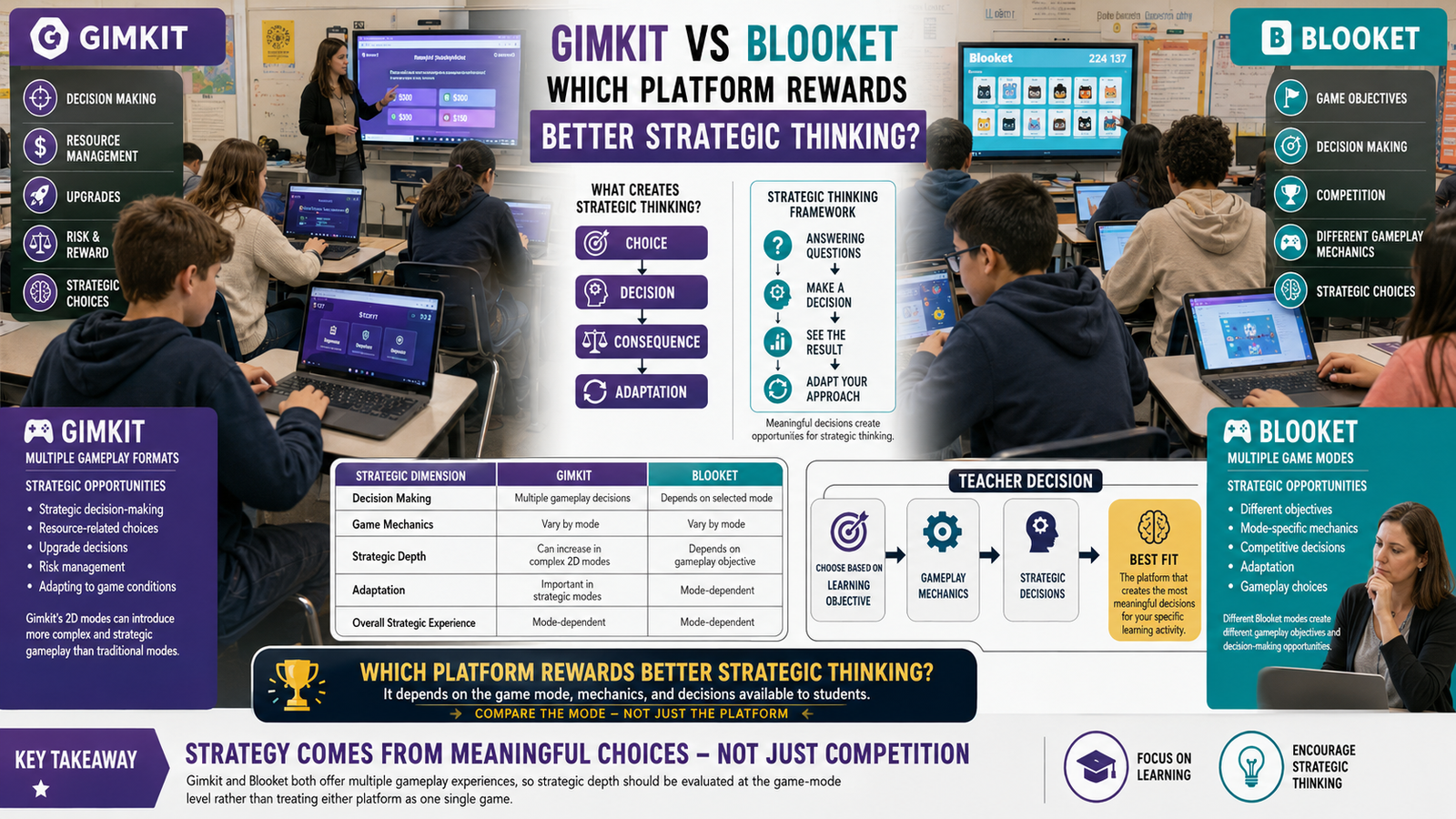
Gimkit games are not a single repeated classroom activity. They form a changing collection of experiences in which question-based learning interacts with different styles of strategy, exploration, cooperation, competition and creative play.
Explore how multiple Gimkit game experiences differ as a collection, why variety matters, how gameplay repetition changes the experience, and how to organise a balanced series without confusing it with one game's rules or the official Mode Picker.
Conceptual gameplay families rather than a live catalogue of currently available modes.
01
Resource & decision playAnswering supports economic or strategic choices
02
Exploration & movementSpatial experiences introduce navigation and discovery
03
Cooperative objectivesShared tasks and group interdependence
04
Social & action experiencesDifferent interaction intensity and play rhythms
Original illustrative classification, not an official Gimkit menu, gameplay screenshot or promise of current mode availability.
Direct Answer
What are Gimkit games?
Gimkit games are the different interactive experiences available within Gimkit's game-based learning environment. A reusable set of questions can support multiple eligible gameplay formats, while each experience changes how learners interact with the task, with one another, and with the surrounding game mechanics.
The plural term is important. A single Gimkit game is one particular activity governed by its own selected rules, objectives and outcome conditions. Gimkit games, considered together, are a repertoire of possible experiences. Looking at that repertoire involves comparing forms of interaction, recognising meaningful differences between experiences, understanding how variety affects familiarity, and organising more than one gameplay encounter into a coherent collection.
Gimkit's official Help Center explains that modes create different experiences and that educators can encounter descriptions and labels in the Mode Picker. Some experiences use traditional question-and-resource interaction, while documented 2D experiences involve moving characters called Gims through game environments. Available modes and free featured selections can change, so no static independent page should promise that every historical or named game is available at every moment.
This guide uses an original analytical framework to study gameplay variety. Its experience families are explanatory groupings, not a claim that Gimkit officially publishes the same taxonomy. Detailed mechanics for individual named modes, precise Mode Picker navigation, competitive tactics and single-game winner calculations remain outside this article's scope.
Independent source policy: GimkitApp.com is not operated or endorsed by Gimkit. Official gameplay takes place on Gimkit's own services. The application on this page creates hypothetical collections of gameplay experiences; it does not launch games, connect to accounts or determine current mode availability.
01 / COLLECTION
Understand the repertoire
Study why multiple games offer different experiences rather than treating them as interchangeable versions of a single activity.
02 / VARIETY
Compare dimensions
Explore differences in gameplay attention, interaction intensity, collaboration, novelty and experience transitions.
03 / COMPOSITION
Create an experience series
Arrange conceptual gameplay families into a sequence, examine diversity and identify repetition without pretending to host a real game.
Part One — Gameplay Repertoire
Understanding Gimkit games as a collection
1. A collection of games answers a different question from one game
When a reader asks about one Gimkit game, they are usually concerned with a particular activity: what its rules mean, which objectives govern that event, and how an outcome should be understood. When the question changes to Gimkit games in the plural, the unit of analysis changes. The reader is examining a collection of possible experiences rather than investigating the result of a single occurrence.
This distinction is more than grammar. A repertoire can contain games with very different rhythms and expectations. One experience may place attention primarily on repeated question answering and resource decisions. Another may involve spatial navigation or group coordination. Another might create a faster, more competitive environment. A single outcome model cannot describe all of these equally well because the collection contains several styles of interaction.
The purpose of a collection guide is therefore to explain relationships across experiences. It asks what makes two games meaningfully different, how players recognise familiar and unfamiliar interaction patterns, how experience variety can be described without assuming that more complexity is always better, and how a series of activities can avoid becoming a repetitive sequence.
This article does not duplicate the independent single-game Outcome Logic Lab. It never accepts player scores, applies a final-winner rule or attempts to establish which participant won a match. Its original application operates at the collection level: multiple declared experience types, their order, their variation and the pattern created by that order.
2. A repertoire is not a permanent list of active games
A published list of named Gimkit modes can be useful as historical reference, but it should not automatically be treated as an authoritative current availability list. Gimkit's official documentation describes featured and Pro-exclusive mode access, including changes to the featured selection. Some named experiences may also be historical, updated, rotated or restricted at particular times.
A repertoire is a broader concept than a snapshot of what is immediately selectable. It can describe types of experiences, design principles and patterns shared by several games even when the current Mode Picker shows a changing selection. This makes the concept especially useful for educational reference writing, because an explanation of meaningful variation need not depend on a frozen list of product names.
At the same time, a conceptual repertoire must not be confused with an official catalogue. The descriptions used in this guide are editorial lenses for studying gameplay experience. They do not certify that Gimkit currently offers one selectable mode for each category, or that every category has a corresponding named feature in the official interface.
A reader seeking the precise current list should inspect the actual official Mode Picker and Gimkit's current Help Center. This page instead studies the experience differences that make a collection interesting: how play changes across categories, what players may need to learn when a format changes, and why variation should be described carefully rather than reduced to the total number of game titles.
3. Reusable questions can support different gameplay experiences
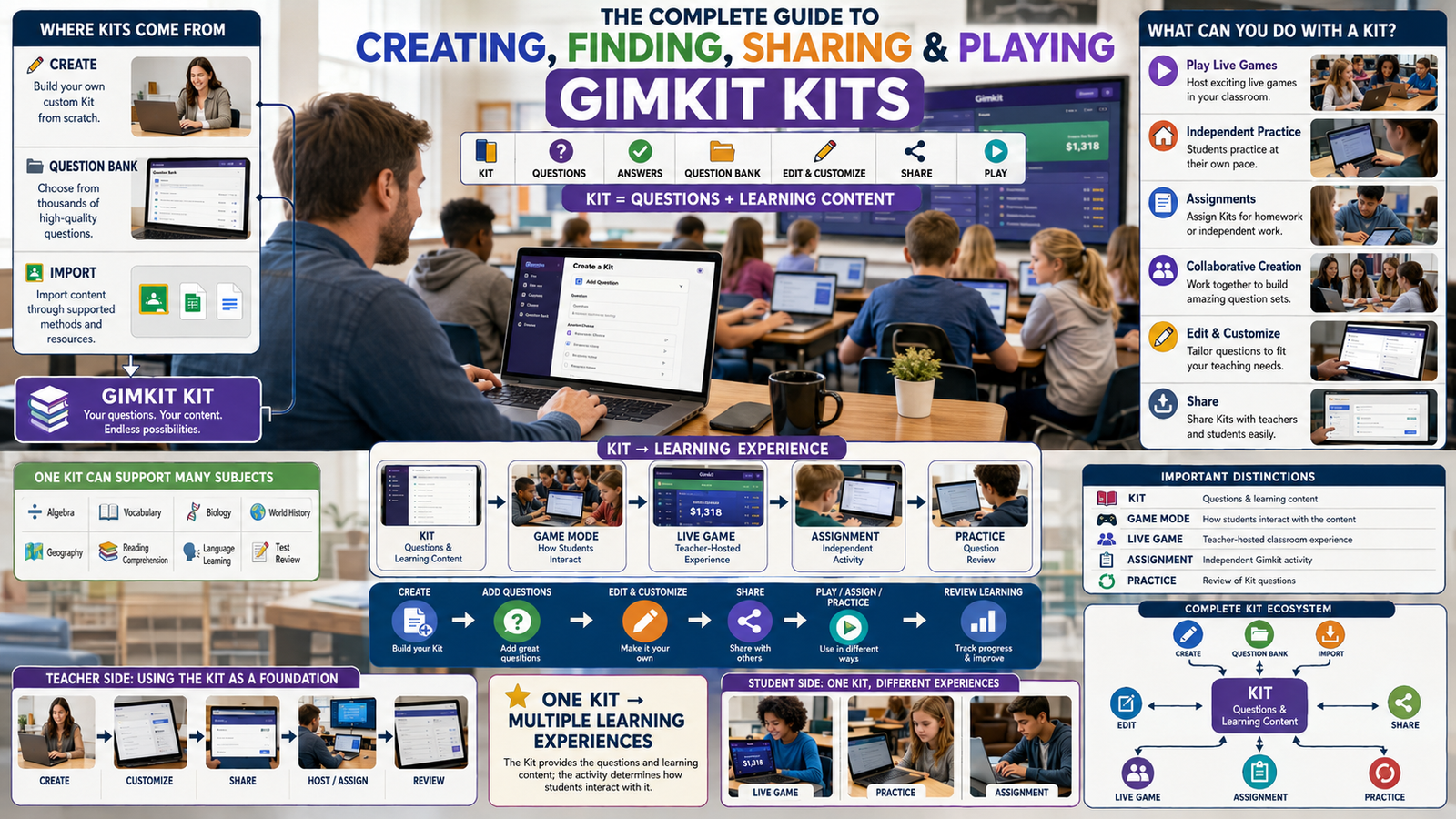
Official Gimkit hosting documentation describes choosing a Kit and then selecting a game mode. That relationship establishes a useful conceptual point: the educational question material and the gameplay experience are distinguishable. The same eligible question content can be placed into different activity structures without being rewritten solely to create a different visual environment.
For a collection, this means that variety need not come only from changing the academic subject. Different experiences can ask players to work with familiar material while responding to a new kind of interaction. A set of questions may remain recognisable even as the game shifts from an answer-focused rhythm toward spatial movement or shared objectives, subject to each mode's actual support and available settings.
This separation is useful for analysing novelty. If both the questions and the gameplay format change at once, the experience introduces several kinds of unfamiliarity. If the question material remains familiar, changes in the surrounding gameplay become easier to notice. This is an analytical distinction, not a guarantee that any particular mode produces a given learning result.
The full procedures for creating Kits, importing questions and selecting mode-specific settings are reserved for their own articles. Here the concern is comparative experience: how a collection can contain different forms of participation around related content, and why those forms should not be collapsed into one general description of “taking a quiz.”
4. Counting games is not the same as understanding variety
People often ask how many games Gimkit has. An exact total can be difficult to state responsibly because modes and featured access may change over time. More importantly, a number by itself reveals little about the differences among experiences. A catalogue containing several closely related formats may offer less meaningful contrast than a smaller collection whose activities demand substantially different interactions.
There are several possible counting conventions. A publisher might count every named mode, count only currently selectable modes, include historical releases, exclude limited events or treat variations of an underlying format as separate experiences. Those choices produce different totals. Without defining the counting rule and date, a confident figure can be misleading.
This article therefore concentrates on functional diversity. It examines the kinds of attention, coordination, movement, decision-making and social interaction a group of games can invite. These differences are more informative than treating the size of the library as a direct measure of educational quality.
The Experience Series Studio also follows this principle. It reports how many distinct conceptual families appear in a user-created sequence rather than presenting an invented count of official Gimkit modes. That result concerns the independent collection model. It is not a claim about Gimkit's total published games.
5. What makes two game experiences genuinely different?
Two games can have different titles and visual themes while still demanding similar kinds of behaviour. Conversely, two experiences may use related visual elements but create very different patterns of attention. Meaningful difference therefore requires more than a comparison of colours, characters or promotional descriptions.
One useful distinction is the action enabled by successful question answering. In some experiences, progress may be expressed through resources and decisions. In documented 2D modes, correct answers can support different resources associated with movement or gameplay actions. The nature of the subsequent decision influences what the experience feels like, even when the questions themselves remain academically comparable.
Another distinction concerns relationships among participants. Some formats place most attention on an individual's own decisions. Others rely more heavily on coordination, shared goals, opposition or social interpretation. The level of real-time movement, the degree of interaction, the amount of explanation required and the familiarity of the interface can also vary.
These dimensions help explain gameplay variety without reproducing an individual mode's mechanics or strategy guide. The reader can recognise a difference between a resource-centred experience and a spatial one while leaving the detailed objectives, controls and current status of named games to their dedicated pages.
6. A game's theme is not always its most important distinction
Visual themes contribute to how games are perceived. A snowy landscape, a spaceship, a farm or a colourful arena may create a distinctive atmosphere. But appearance alone does not explain what participants must attend to or which decisions define the experience. A theme is one layer of a game, while the interaction structure is another.
This matters when readers compare collections based only on screenshots. Two modes may look equally exciting yet differ greatly in pace or cooperation. A calm-looking scene may still contain complex strategic decisions. An action-oriented scene may involve repeated academic questions that remain central to progression. The surface appearance cannot substitute for checking the actual mode description.
Gimkit's official Mode Picker offers descriptions and labels to help users understand relevant differences. Those labels are a better source of current product-specific information than a third-party assumption based on illustrations. The analytical categories used in this page are deliberately more general and should not be mistaken for an official classification.
For collection design, theme can be documented as a characteristic, but the more consequential questions concern variety of action, attention and social interaction. A sequence of visually different games may still feel repetitive if each requires essentially the same behaviour. Genuine contrast should be identified at the experience level.
7. The difference between familiarity and repetition
Familiarity can make an experience approachable because participants recognise its general structure and know what kinds of actions to expect. Repetition occurs when similar structures appear again and again. The two concepts overlap, but their value depends on the purpose of the collection.
Repeated formats may allow participants to focus on question content without constantly learning new game conventions. That can be useful when the gameplay format is intended to provide a predictable setting. Yet a long sequence of nearly identical experiences can also reduce the sense of variation that people expect from a collection of games.
Novelty introduces a different trade-off. A new interaction style may create fresh interest, but it also requires participants to orient themselves to unfamiliar rules or movement conventions. If a collection changes too many dimensions at once, the novelty of the gameplay can compete for attention with the educational material.
There is no universal ratio of familiar and unfamiliar games that suits every audience. The useful analytical question is whether the pattern of repetition is intentional. The Experience Series Studio therefore detects repeated conceptual families and abrupt transitions without declaring either one automatically good or bad. The interpretation belongs to the purpose of the proposed collection.
8. A collection can have an identity without a fixed game order
Several experiences can be grouped together because they share a broad character, even when there is no official sequence in which they must be played. A collection might emphasise exploration, cooperation, strategic decision-making or contrasting activity intensities. This shared characteristic helps people understand the repertoire without inventing a publisher-defined order.
The order becomes important when a user deliberately constructs a series. Moving from one familiar experience into a very different interaction style changes the relationship between the two activities. Placing several high-energy experiences consecutively creates another pattern. Alternating between calm and intense categories produces still another rhythm.
These are properties of the proposed series rather than claims about hidden game mechanics. An independent sequence designer can accurately report that two neighbouring cards belong to the same declared family or that their user-assigned intensity labels differ. It cannot infer official game outcomes or guarantee the emotional response of a particular classroom.
That distinction allows the collection to be studied as a composition. The Experience Series Studio uses sequence position as a meaningful variable, unlike a catalogue that merely lists titles alphabetically. Changing the order changes the analysis even when the underlying experience cards remain identical.
Part Two — Conceptual Experience Families
Six useful lenses for exploring Gimkit gameplay variety
The following families are original editorial groupings. They are not an official Gimkit category list, and membership should never be used to claim that a named historical mode is currently available. Their purpose is to explain broad contrasts across a changing collection of games.
9. Answer-first and resource-oriented experiences
Some Gimkit experiences are easiest to understand through a recurring relationship between answering questions and making resource-related decisions. The academic question remains a recurring source of progress, while the game adds a surrounding layer of accumulation, purchasing, trade-offs or strategic choice. The exact resources and rules vary by supported mode and should not be generalised into one universal formula.
From a collection perspective, the defining feature of this family is the attention given to choices after an answer. Players may experience a rhythm of recalling information, gaining a usable resource and deciding what to do next. That rhythm is different from a spatial exploration format in which movement and environmental positioning occupy more of the player's attention.
Resource-oriented experiences can feel familiar because their decisions are often visible as values or available actions. However, the simplicity of their appearance does not mean the underlying strategy is identical across named games. A different upgrade structure, objective or available option may substantially alter behaviour. Those details belong to the individual-mode documentation rather than to this comparative framework.
In the Experience Series Studio, the Resource Strategy family is a conceptual label. Choosing it does not enable an official resource simulator, predict cash earnings or evaluate an individual player's strategy. It simply records that the proposed experience emphasises resource-centred decisions relative to the other family types in the collection.
10. Spatial exploration and discovery experiences
Gimkit's official Help Center documents 2D game modes in which players explore environments using characters known as Gims. This provides a clear basis for distinguishing spatial experiences from traditional question-focused interfaces. The specific relationship between correct answers, resources and movement depends on the selected supported mode.
Spatial experiences introduce an additional kind of attention. Participants may need to interpret their position, recognise environmental features or navigate toward an objective. The surrounding space becomes part of the activity rather than merely a visual background behind questions.
As a collection category, exploration can provide contrast with answer-first play. A transition into spatial interaction changes what participants have to observe. It may also change the amount of explanation required before the activity feels familiar. These are reasonable design considerations, not claims that all spatial modes are harder or more educationally effective.
A broad exploration family should not erase differences among individual named games. Movement through a landscape, travel toward a destination and searching an environment may produce distinct experiences. Detailed maps, controls, items and tactics belong to the individual mode pages. This article uses the general spatial dimension only to explain how a repertoire can contain qualitatively different kinds of play.
11. Cooperative objective experiences
Cooperative experiences are characterised by the importance of a shared task. Participants are not merely placed in the same room; their actions can contribute to a common objective. Gimkit's official documentation describes cooperative gameplay in particular modes, but the exact goals and mechanisms are specific to those experiences.
From the viewpoint of a collection, cooperation changes the social structure of play. Instead of concentrating exclusively on an individual's standing, participants may need to think about their contribution to a larger activity. Shared progress can create a different sense of achievement from individual competition, even where both experiences use academic questions.
Cooperation also introduces the possibility of uneven contributions, coordination challenges or differing roles. Those considerations should not be interpreted as fixed disadvantages of cooperative games. They simply show that group interaction adds another dimension beyond the question content and the visual theme.
In a sequence of experiences, a cooperative category can introduce contrast after a more individual format. The specific order might make a collection feel more varied, but no universally correct sequence follows from that observation. The studio records the change in declared interaction family. It does not create real teams, assign roles or operate a multiplayer environment.
12. Social inference and information-based interaction
Some game experiences make interpretation of other participants' actions important. Their distinctive quality is not necessarily rapid movement or resource accumulation, but the need to reason about information in a social setting. Gimkit has documented named modes involving investigation and social interaction, although their detailed rules belong to specialist mode references.
This category introduces a different kind of mental task into a collection. Participants may pay attention to statements, patterns of behaviour or what others appear to know. The experience can therefore differ sharply from a format where progress is mainly expressed through individual question responses or movement through an environment.
Social inference may demand more communication and may create a different level of interpersonal tension from other families. It is important not to assume that every group finds that style comfortable or that the presence of inference automatically measures deep academic reasoning. The game and the educational task still need to be considered separately.
The Experience Series Studio treats Social Inference as an optional conceptual family with no recreated voting system, hidden-role generator or imitation of Gimkit's official mode. Its role is to help users describe contrast across a repertoire. Actual social-game rules and tactics remain exclusive to their dedicated guides.
13. Action and fast-response experiences
Action-oriented game experiences introduce movement, immediate response or interaction with dynamic events. Some documented Gimkit 2D modes feature projectiles, competitive positioning or other fast-moving elements. Their precise mechanics differ and should be verified individually rather than generalised from the label “action game.”
At the collection level, action is useful as a category because it changes the rhythm of attention. Participants may divide their focus between question answering and events occurring elsewhere in the game environment. This creates a different subjective pace from experiences dominated by slower resource decisions or social discussion.
High visual or interaction intensity should not be mistaken for better learning. A fast-paced game may feel exciting, but educational benefit cannot be inferred from excitement alone. Likewise, a lower-intensity format should not be dismissed as less engaging. The relevant distinction is the kind of participation demanded, not an overall quality ranking.
The studio allows users to mark an experience's declared intensity independently of its family. This is intentional: not every action-oriented activity needs to be labelled equally intense, and no conceptual grouping perfectly predicts how an individual person will perceive a specific game. The application describes the proposed collection, not participants' actual physiological or emotional responses.
14. Creative and expressive experience patterns
Creative expression introduces a different relationship between the participant and the activity. Instead of concentrating only on answering, navigating or competing, an experience may involve making, interpreting or communicating something. Gimkit has named experiences associated with creative forms of play, but this page does not reproduce their mechanics or claim that every such experience is permanently available.
For the purpose of a repertoire, creativity is useful because it illustrates that variation is not limited to how quickly people respond. Different experiences can ask participants to produce or interpret information in ways that change the social and cognitive character of play.
The creative label should nevertheless be applied carefully. A visually colourful activity is not automatically creative in the same sense as an experience involving participant expression. Similarly, the fact that an activity requires choices does not mean it offers unrestricted creation. The type of expression matters more than the aesthetic style.
This family also must remain separate from Gimkit Creative, the product environment for making custom interactive maps. The present article discusses the experiential quality of a collection. It does not provide a map editor, device-placement interface, scripting environment or tutorial for constructing an official custom game.
15. Why families should remain flexible rather than rigid boxes
An individual game experience can combine several characteristics. A spatial game may involve cooperation, and a resource-oriented game may include competitive decisions. That overlap does not make the conceptual family framework invalid. It means the categories are lenses rather than mutually exclusive scientific classifications.
For clarity, the Experience Series Studio assigns one primary family to each card. That choice makes sequence analysis transparent and reproducible. It does not assert that the experience has no secondary qualities. A user who wants to describe an additional characteristic can record it in the card's optional note.
Rigid classification creates two problems. First, it can encourage readers to treat unofficial labels as product facts. Second, it can hide meaningful differences within a category. The present framework avoids both problems by identifying its families as independent editorial descriptions and reserving detailed mechanics for official Help articles and dedicated mode pages.
The more useful question is not whether a game belongs perfectly to a single category. It is whether the category captures the difference the reader is trying to understand. For experience-series composition, one dominant label can make repetition and contrast visible without pretending that the underlying design is simple.
16. Traditional and 2D experiences as a broad distinction
Gimkit's Help Center explicitly distinguishes 2D game modes from traditional formats. In 2D modes, participants navigate worlds with Gims, while traditional experiences do not necessarily rely on the same spatial presentation. This is one of the clearest documented high-level distinctions available for explaining why Gimkit games can feel different.
However, a traditional-versus-2D distinction should not be stretched into an assertion that all traditional modes have identical goals or that every 2D mode requires the same actions. Gimkit's official Game Options documentation explains that mode-specific settings can differ considerably. A common visual presentation does not create a universal game rule.
The distinction is also insufficient as a complete description of a repertoire. Two spatial modes can produce very different experiences, and two non-spatial games can differ in their treatment of resources or group interaction. Understanding a collection therefore benefits from several overlapping dimensions rather than a single binary label.
The studio's family selection is not a replacement for the official Mode Picker's presentation of traditional and 2D modes. It is a higher-level composition tool intended to examine the relationship between several hypothetical experiences without duplicating an official catalogue.
Part Three — Experience Dimensions
How to analyse meaningful variety across multiple Gimkit games
17. Interaction intensity across a collection
Interaction intensity describes how demanding or rapidly changing a proposed experience feels in terms of participation. It is not a fixed official Gimkit statistic. A lower-intensity card might represent an experience with a comparatively predictable rhythm, while a higher-intensity card represents one with more immediate actions or frequent shifts of attention.
The important collection-level property is the pattern of these labels over several experiences. Three consecutive high-intensity cards create one kind of sequence. A gradual movement from low to medium to high creates another. Alternating sharply between low and high produces frequent contrasts that some participants might notice more strongly.
These patterns can be described numerically without pretending to predict learning outcomes. The studio counts adjacent high-intensity pairs and abrupt low-to-high transitions according to the user's declared labels. Such counts are transparent features of the collection. They are not measures of student stress, classroom suitability or instructional effectiveness.
This distinction keeps the application separate from the Classroom Fit & Evidence Lab. Rather than deciding whether a particular class is ready for Gimkit, it examines the structure of a hypothetical collection already chosen by the user. The analysis is descriptive and comparative, not a readiness verdict.
18. Social arrangement and the experience of participation
Different gameplay experiences can make different demands on how participants relate to one another. A primarily individual format may involve separate decisions within a shared event. A cooperative experience may involve a common objective. Social inference can depend on discussion or interpretation of other participants. Competitive action may introduce direct interaction of another kind.
These distinctions matter when describing a repertoire because they change the nature of participation even if the academic question material remains similar. A sequence containing several independently focused experiences will have a different social profile from one dominated by group interaction.
The studio does not create real teams or infer the actual social effects of a game. Instead, each experience card uses a conceptual family that suggests a dominant kind of interaction. The purpose field can identify whether the user intends that card to provide familiarity, contrast, variety or another editorial function in the series.
Users should avoid treating family labels as guarantees. An individual's experience of a game depends on many factors beyond the abstract category. A responsible collection analysis recognises these limitations while still providing language for meaningful differences.
19. Cognitive attention is distributed differently across games
Question-based gameplay involves academic information, but the surrounding interactive environment can require additional attention. Resource-centred play may involve decisions about future actions. Spatial experiences may involve navigating the environment. Social inference may involve interpreting statements and behaviour. These are different attention patterns rather than evidence that one family teaches more effectively than another.
A collection therefore offers variation not only in imagery but in the types of activity participants must follow. Switching between families may require the reader or player to understand different conventions. A sequence that changes attention demands frequently can feel different from one that stays within a familiar interaction pattern.
The relevant concern is not to assign a numerical cognitive-load value to every Gimkit mode without research. Such scores would be speculative. Instead, the guide uses qualitative descriptions and an explicit conceptual model. The application counts family transitions and allows short explanatory notes, leaving actual learner behaviour outside its claimed capability.
This also prevents the page from becoming a generic learning-outcome evaluator. Its analysis concerns the composition of a gameplay repertoire. Questions about measured academic achievement, student accuracy and educational intervention effects belong to separate research and assessment resources.
20. Novelty as a relationship between experiences
Novelty is often treated as an inherent property of a game, but it also depends on what came before. A family can feel unfamiliar when first encountered and familiar after repeated exposure. A collection therefore creates novelty partly through the order in which different kinds of play appear.
The same three families can form different sequences. Placing two related experiences together emphasises continuity before a later contrast. Alternating among three families increases the frequency of transitions. Grouping similar cards into blocks produces fewer transitions, even though the total variety of families remains unchanged.
The studio distinguishes family diversity from transition frequency for precisely this reason. A collection can contain several distinct families but few transitions if each family occupies a block. Another sequence with the same cards can alternate repeatedly. The two arrangements have the same inventory but different structural rhythms.
Neither arrangement should be labelled universally superior. The purpose of the descriptive tool is to make the difference visible. Choosing whether continuity or contrast is preferable requires information about the actual intended audience and use case, which the application does not invent or claim to evaluate.
21. Repetition density and the risk of an accidental pattern
Repetition density concerns how often neighbouring experiences belong to the same conceptual family. If several resource-oriented cards appear consecutively, the collection has a local cluster. If each card belongs to a different family, there are fewer identical adjacent pairs. These are simple structural observations that can be calculated exactly from the declared sequence.
A repeated-family cluster is not automatically a mistake. It may be intentional, particularly when familiarity is important or when several related variations are being explored. The problem occurs when repetition is accidental and the collection was intended to provide contrast.
The studio counts consecutive same-family pairs and displays their positions. This allows users to see whether the arrangement matches their own stated purpose. Moving a card changes the count immediately after analysis, demonstrating that sequence order—not only the number of cards—matters.
The tool deliberately avoids turning repetition density into a fabricated quality score. It does not claim that a sequence with zero repeated pairs is academically better than a sequence with two. It simply makes the pattern measurable within the local model and gives the user an accurate description of what was entered.
22. Transition cost as a conceptual issue
Changing from one kind of game experience to another can introduce a need to understand different conventions. A participant familiar with an answer-first resource format may encounter new movement expectations in a spatial experience. A group accustomed to individual decisions may need to interpret collective objectives in a cooperative one.
This does not mean that every transition is difficult. Familiar participants may adapt quickly, and some experiences may share enough conventions that the change feels natural. The relevant analytical point is that transitions differ in character, not that a precise numerical cost is known in advance.
The Experience Series Studio reports family changes and intensity jumps rather than claiming to measure seconds of instruction or minutes of lost gameplay. The user can add a short note explaining why a transition is deliberate. This produces a descriptive design record without turning the tool into an operational host timetable.
Separating transition structure from scheduling is another important content boundary. The Host Control Room already owns run clocks, opening procedures and closeout records. Page 09 studies the relationship between experiences in a collection, not the mechanics of running a live session.
23. Collection breadth and local sequence balance
Breadth describes how many different conceptual families appear in a selected collection. A five-card series containing one family has low family breadth, while a five-card series using four different families has higher breadth. This count can be useful for describing the diversity of the proposed repertoire.
Breadth alone does not describe the order. Four distinct families could appear in one uninterrupted series of changes or in a sequence containing repeated blocks. The number of unique families therefore needs to be read alongside adjacency and intensity patterns.
The studio calculates distinct families and repeated adjacent pairs as separate measurements. It also reports how many different declared purposes appear in the collection. These values are not combined into one hidden score because different users may value different patterns. A transparency-first tool is more useful when readers can see exactly what each count means.
A broad collection also need not be the best collection. A deliberate narrow series can explore variation within one general family. The choice of breadth should reflect the purpose of the repertoire rather than an arbitrary target number.
24. A diverse collection can still have a coherent identity
Variety and coherence are not opposites. A collection can include different forms of gameplay while retaining a recognisable purpose. The connecting element might be the intention to compare different interaction styles, explore how question material behaves across formats or examine the contrast between familiar and unfamiliar experiences.
A coherent collection does not require every game to look alike. Nor does it require each experience to be as different as possible. Instead, the relationship among cards should be understandable. The user should be able to explain why those experiences belong together and what makes their order meaningful.
The studio's optional notes help express that relationship. A note can describe why a particular card follows another or which experience dimension it introduces. Notes are authored by the user rather than generated as unsupported claims by the application.
This approach also keeps the page different from an official mode recommendation engine. The tool is not trying to determine the single best game for a given class. It helps a reader represent and inspect an intentionally constructed collection, with the official Mode Picker remaining authoritative for actual available choices.
Page 09 Exclusive Application
Gimkit Games Experience Series Studio
Create a collection of conceptual gameplay experiences, change their order, inspect family diversity and experience transitions, and export a structured series brief. The studio uses independently defined family labels rather than pretending to list or launch currently available official modes.
INDEPENDENT COLLECTION COMPOSER
Build a series. See the pattern.
Editable experience cards, transparent collection metrics, presets, reorder controls, undo and local exports—all within a single original application.
Create 1–8 conceptual experiences. Use the up/down controls to change their order. These are experience categories, not actual Gimkit game sessions, official Mode Picker options, scheduled lessons or playable simulations.
Collection pattern analysis
0Experience cards
0Distinct families
0Adjacent repeats
0Family transitions
Declared sequence pattern
Portable experience series brief
All analysis is based on your own card selections. The studio does not inspect live gameplay, rate learners, calculate academic effectiveness, schedule official sessions, or recommend an authenticated Gimkit mode. Changes are held in this page session until exported.
How the Experience Series Studio works
Each experience card has four meaningful pieces of information: a dominant conceptual family, a declared interaction intensity, a purpose within the collection and an optional short note. These fields describe the user's intended composition rather than the detailed rules of a real Gimkit mode.
The family controls determine broad variety. A sequence using Resource Strategy, Spatial Exploration and Cooperative Objective contains three distinct families. Repeating Resource Strategy later does not introduce a fourth family, but its position may alter the number of neighbouring repeats and family transitions.
The intensity control is independent of family. This permits the user to describe different experiences within the same broad category without asserting that every action game or cooperative activity has one fixed intensity. The analysis counts adjacent high-intensity pairs and sharp low-to-high changes using those manually selected labels.
The purpose field records why a card belongs to the collection. Options such as establish familiarity, introduce contrast, explore a different interaction, connect earlier experiences and close the series help users describe the internal structure. These are editorial roles, not official Gimkit settings or scheduled instructional phases.
The studio supports reordering because a collection is more than a set of titles. Placing similar experiences beside one another creates a different rhythm from distributing them throughout the series. Undo records recent edits so users can experiment without losing the immediate previous arrangement.
Copy and export produce descriptions of the collection and the transparent counts derived from it. CSV preserves the individual cards, while JSON preserves the series as structured data. None of the exports creates a Gimkit game, imports content into an account or represents official availability. The user remains responsible for comparing conceptual ideas with currently supported official modes.
Part Four — Collection Composition
How experience sequencing changes a collection of games
25. A collection's sequence creates its own rhythm
The order of several experiences contributes to the way the collection is understood. A list of games arranged alphabetically presents an inventory. A deliberately composed sequence presents relationships: continuity, contrast, return, escalation or variation. These relationships can be studied without reproducing the operational procedures for hosting individual sessions.
Consider three broad experience labels: resource decisions, spatial exploration and social inference. Placing the spatial category between the others creates a different progression from beginning and ending with two related resource-oriented cards. The content of each card remains unchanged; the difference comes from adjacency.
This kind of ordering is descriptive rather than predictive. It does not prove that one sequence will create a better classroom atmosphere or higher academic achievement. It explains the structural pattern created by a set of choices. The user can then decide whether that pattern reflects the purpose of the collection.
The studio makes adjacency visible through transition counts and repeated-family indicators. A collection can have the same number of distinct families before and after reordering while producing different transition statistics. That feature is central to the tool's unique purpose.
26. Opening with familiarity creates one type of series
A series may begin with a familiar kind of experience to establish a recognisable interaction before introducing something different. This is a compositional choice, not a claim that any specific Gimkit mode should always be played first. The meaning of familiarity depends on what the intended users already recognise.
The opening card can be marked as establishing familiarity in the studio. That label records the user's intention. It does not establish that the actual audience finds the selected format easy, nor does it measure readiness or accessibility.
A collection with a familiar opening may then introduce a contrasting family. This creates a visible shift in the repertoire. Alternatively, the opening may be deliberately unusual to foreground novelty. Both arrangements can be coherent when the purpose is clear.
The important distinction is that an experience-series designer considers the relationship between cards, while a mode-selection guide focuses on a particular choice. The present tool preserves this boundary: it does not select one official mode for a learner or provide a host's step-by-step operating checklist.
27. Contrast can be gradual or abrupt
A gradual sequence changes experience qualities in smaller steps. For example, a user might label successive cards low, medium and high intensity. An abrupt transition occurs when neighbouring cards jump directly between low and high. These patterns can be detected from the declared values without any hidden behavioural model.
An abrupt change is not automatically undesirable. It may be intentional when a collection is designed to demonstrate strongly contrasting types of play. Likewise, a gradual change is not inherently superior. A series using the same intensity throughout can still contain substantial variation in social arrangement or attention demands.
The studio counts low-to-high jumps and reports them separately from repeated families. This matters because two cards can belong to different families while having similar declared intensity. Conversely, two cards within the same family can have different intensity labels.
Treating these dimensions independently produces a clearer collection analysis. It avoids implying that one concept, such as visual movement, completely determines how every participant will experience a game. The values describe the user's model, not measured real-world intensity.
28. Alternation and clustering communicate different intentions
Alternation occurs when a collection repeatedly switches between families. Clustering occurs when related experiences are placed next to one another. A series alternating Resource Strategy and Spatial Exploration creates a visibly different pattern from a series containing a block of resource experiences followed by a block of spatial ones.
The two arrangements can have identical family counts and identical numbers of cards. Their transition frequency, however, differs. This is why a collection cannot be fully described by its inventory alone. The position of each experience contributes information about the intended structure.
Clustering can make relationships within a family more apparent, while alternation can emphasise contrast. Those are interpretive possibilities rather than experimentally proven outcomes for every group. The application does not assign success scores to either arrangement.
A user can test the distinction by loading a preset, moving a card and analysing the result again. The family diversity count may stay constant while adjacent repeats and transitions change. That immediate, transparent calculation is a genuinely functional part of the application rather than a decorative animation.
29. The importance of a purposeful return
A sequence may return to an earlier family after introducing other kinds of experiences. This creates a different form of repetition from simply placing the same category twice in succession. A return can make the collection feel cyclical or provide a point of comparison between earlier and later positions.
The studio does not interpret such a return as a repeated error. Its adjacent-repeat count only increases when two neighbouring cards share a family. A family appearing again after other categories increases frequency without necessarily increasing adjacent repetition.
This distinction is useful because the total number of occurrences and their arrangement are separate properties. A collection may repeat one family several times while distributing it across the series. Another may use the same number of occurrences in one uninterrupted cluster.
The qualitative meaning of the return belongs to the user's purpose. It might be intended to reinforce familiarity or highlight a contrast with intervening experiences. The application leaves that explanation in the user's optional notes rather than inventing motivations for the chosen order.
30. A collection can be narrow by design
Not every collection needs to include all six conceptual families. A narrow series may deliberately examine variation within resource-oriented play or compare several experiences with similar social structures. It would be misleading to declare such a collection ineffective merely because its family count is low.
A narrow repertoire may make subtle distinctions easier to describe. The user's purpose might be to compare different examples of a familiar interaction category rather than to survey the full range of possible gameplay. In that case, broad family diversity is not the central objective.
The studio reports distinct families without transforming that number into a universal quality grade. A low count is a descriptive fact about the chosen cards. A higher count is also a descriptive fact. Neither one establishes whether the collection achieved an educational goal.
This restraint is important because an independent website cannot derive instructional effectiveness from the categories alone. The composition tool exists to explain structure and support deliberate organisation, not to duplicate the existing classroom-feasibility evaluator.
31. A collection can be broad without becoming coherent
Breadth introduces more different experience families, but it does not automatically explain why those experiences belong together. A collection containing several unrelated categories may demonstrate variety while lacking an identifiable conceptual thread.
The purpose field helps address this limitation. Users can describe one card as establishing familiarity, another as introducing contrast and another as closing the series. These roles create an interpretive structure that does not depend on claiming any hidden game effect.
The optional notes can also describe the relationship between neighbouring experiences. For instance, a note may say that the next category introduces spatial interaction after resource-centred play. Such statements are transparent editorial intentions rather than platform-generated recommendations.
The result is a more informative collection brief. Instead of simply listing several game types, the export records what the user planned and how the sequence is arranged. This remains distinct from the official selection workflow, where the user chooses an actual currently available mode for a specific activity.
32. Why a sequence model should avoid fabricated effectiveness scores
A polished interface can easily give users an unjustified sense of precision. A percentage labelled “collection effectiveness” would look authoritative, but it would require evidence connecting the entered categories to a defined outcome. The Experience Series Studio does not possess such evidence.
The tool therefore reports transparent counts instead of a composite quality score. It can count cards, distinct families, repeated adjacent pairs and family changes. It can identify declared low-to-high intensity jumps. These calculations are directly determined by the entered data.
A reader can audit the result by examining the cards. Nothing depends on a secret weighting system, invented learner profile or supposed access to real Gimkit gameplay. If two cards share the same family, the adjacency count follows an explicit rule. If the user changes the order, the reported pattern changes accordingly.
This is an appropriate form of technical honesty. The application offers real functionality within its declared scope without pretending to evaluate student learning, predict enjoyment or determine the best possible sequence for an unknown audience.
Part Five — Original Collection Scenarios
Distinct ways a Gimkit games collection can be organised
The following scenarios are hypothetical compositions of broad experience categories. They are not reports of real classrooms, recommendations for particular named modes, or proof that the described collections improve learning.
33. A three-family contrast collection
An independent writer wants to demonstrate that Gimkit games can be studied through more than one type of interaction. The writer creates a conceptual collection containing Resource Strategy, Spatial Exploration and Cooperative Objective. The sequence is intended to make differences between economic decisions, navigation and shared progress visible.
The collection contains three cards and three distinct families. Because every neighbouring pair differs, its adjacent same-family count is zero and its family transition count is two. These values follow from the card arrangement, not from hidden gameplay observations.
The writer might assign a low intensity to the first experience, medium to the second and medium to the third. That creates no direct low-to-high jump, even though the conceptual families change. This distinction illustrates why variety and intensity are not the same thing.
The series is useful as an editorial illustration of contrast. It does not establish that any current official mode matches every description or that the order is ideal for a particular class. Its strength is that the comparative purpose is explicit.
34. A familiar-family cluster followed by exploration
A collection begins with two Resource Strategy cards and then moves to Spatial Exploration. The first two cards create an adjacent same-family pair. The final card introduces a family transition. In the independent model, this pattern differs from a sequence that alternates among three distinct families.
The arrangement might be chosen to describe continuity before contrast. The first part keeps the conceptual focus on resource-related decisions, while the later part introduces spatial interaction. That interpretation should be treated as the author's intention rather than a prediction of how people will feel.
Moving the exploration card into the middle creates a different sequence. If the resource family appears on both ends, there are no adjacent identical-family pairs, even though Resource Strategy still appears twice. The inventory is unchanged but the local repetition pattern is different.
This scenario demonstrates why reordering is a meaningful tool function. A simple directory would list the same three items without analysing their adjacency. The Experience Series Studio makes that relationship visible.
35. A collection built around contrasting social interaction
A researcher preparing a conceptual comparison selects Answer-first Resource Play, Cooperative Objective and Social Inference. The chosen families illustrate increasingly different relationships between individual actions and group interaction.
The collection is not an official recommendation for a social studies lesson or a specific class size. It is a framework for describing how the social dimension of gameplay can differ. The first card may be characterised by individual decisions, the second by shared objectives and the third by social interpretation.
The user can record a different purpose for each card. One might establish a baseline experience, another introduce a contrasting interaction and the last explore another form of group engagement. These are editorial roles in the hypothetical series, not settings available inside Gimkit.
The result is a collection whose coherence comes from the social comparison rather than from a single gameplay mechanic. Detailed rules for individual modes remain outside the scope of the example.
36. An intensity staircase without a change in family
A sequence contains three experience cards from the same conceptual family, but the user assigns low, medium and high intensity respectively. The distinct-family count is one and the adjacent-repeat count is two. The intensity pattern nevertheless changes gradually.
This example demonstrates that family diversity and intensity diversity are separate variables. A narrow repertoire can still contain differences in the way the author characterises each experience. The tool reports both dimensions rather than collapsing them into one score.
If the user changes the order to low, high and medium, the family statistics remain unchanged. However, the first transition becomes an abrupt low-to-high shift. The intensity-jump count changes according to the transparent rule implemented in the application.
The scenario is a mathematical description of manually assigned labels. It does not claim that real Gimkit modes have official intensity ratings or that the sequence will generate a measurable change in learner concentration.
37. A return-to-origin collection
A four-card series begins with Resource Strategy, moves through Spatial Exploration and Cooperative Objective, and returns to Resource Strategy. The opening and closing cards share a family, but they are not adjacent.
The sequence contains three distinct families and three transitions. It has no adjacent same-family pair. The repetition of Resource Strategy creates a return pattern rather than a local cluster.
A writer might use this composition to explain how an experience collection can return to a familiar idea after contrasting other forms of play. The purpose of that return would be described in an optional note. The application does not invent a psychological response or claim that the return produces educational transfer.
This distinction is important for interpreting repetition. Two occurrences of the same family do not automatically mean that the series lacks variety. Their positions influence the pattern, and that pattern can be described accurately without declaring the collection universally successful.
38. A high-energy block and a calmer ending
A hypothetical collection begins with two high-intensity action-oriented cards and finishes with a low-intensity resource-oriented experience. The studio records one adjacent high-intensity pair. The transition into the final low-intensity card is an abrupt intensity change.
These observations might interest somebody studying the rhythm of the repertoire. The pair of high-intensity cards forms a cluster, while the ending introduces contrast. Whether such an arrangement is desirable depends on the intended purpose and audience, neither of which can be established from the card labels alone.
The example also shows why an intensity warning should not be treated as a prohibition. The application explains that consecutive high-intensity labels exist. It does not tell the user that the sequence must be changed or that it violates an official Gimkit requirement.
A responsible description can identify the pattern, explain the declared assumptions and leave the final editorial decision to the user. This is the difference between a transparent composition analyser and a fake optimisation engine.
39. A deliberately narrow resource-experience study
An analyst wants to compare several resource-centred experiences rather than survey the full range of Gimkit gameplay. The proposed collection contains four Resource Strategy cards, each with a separate note describing the distinction the analyst hopes to investigate.
The tool reports one distinct family and three adjacent repeats. Those values are not a verdict that the collection is poor. They correctly describe a narrow study. The user's purpose may be to highlight variation within one broad interaction category rather than to maximise diversity.
This example is useful because it prevents misuse of collection metrics. A high count of different families is not automatically required. A deliberately narrow collection may be coherent if the reason for its narrowness is explicit.
The studio's notes allow the analyst to preserve those reasons without creating or simulating official gameplay mechanics. The underlying series remains a conceptual composition rather than an authentic list of four active Gimkit modes.
40. A six-family survey collection
A writer creates one card for each of the six conceptual families: resource strategy, spatial exploration, cooperative objectives, social inference, action competition and creative expression. The purpose is broad illustration rather than intensive study of any one family.
The resulting series has six cards and six distinct families. If every card is different from its neighbour, the transition count is five and the adjacent same-family count is zero. These are predictable properties of the chosen arrangement.
The conceptual breadth makes the collection suitable for discussing high-level variation. It does not establish that every family has an equally accessible current official counterpart or that a particular audience should experience all six in one sitting.
The writer should avoid turning the family labels into an official game-mode inventory. The purpose of the survey is to explain possibilities for describing different experiences, with individual named modes and their current support addressed through official documentation elsewhere.
41. A series that changes only its descriptive purpose
A three-card collection keeps the same family and intensity throughout but assigns a different purpose to each card. The first establishes familiarity, the second explores variation and the third closes the collection. In the model, family and intensity remain constant while the declared compositional roles change.
The application can report the number of distinct purposes without inventing a corresponding change in gameplay mechanics. This shows that editorial organisation has its own structure even when the experience categories are stable.
A user may have a valid reason to preserve a familiar gameplay format while changing how the collection is presented or interpreted. The present page does not convert those reasons into learning-evidence scores or claims about students.
The scenario is a reminder that collection design involves more than maximising variety. Purpose, continuity and explanation can all matter, but their value must be judged against the intended use rather than a fabricated numerical benchmark.
42. Two collections with the same inventory but different order
Collection A contains Resource Strategy, Resource Strategy, Spatial Exploration and Cooperative Objective. Collection B contains Resource Strategy, Spatial Exploration, Resource Strategy and Cooperative Objective. Both contain four cards and three distinct families.
Collection A has one adjacent same-family pair. Collection B has none. Collection A has two family transitions, while Collection B has three. The difference arises entirely from position. No card has been added, deleted or reclassified.
This is one of the clearest demonstrations of why a collection-level tool should allow reordering. A fixed catalogue cannot expose these relationships because it treats the items primarily as an inventory. A sequence composer treats adjacency as meaningful information.
Neither arrangement is automatically better. The relevant choice depends on whether the user intends to cluster related experiences or emphasise contrast. The tool reports the difference, and its text export preserves the actual order so the reasoning remains transparent.
Part Six — Accurate Reference & Boundaries
How to discuss Gimkit games without inventing product facts
43. Official availability is not established by an independent collection
The Experience Series Studio contains editorial categories, not a synchronized list of selectable official Gimkit modes. A user can compose a hypothetical series using those categories even if the current Mode Picker does not contain a matching named experience for every slot.
Official Gimkit documentation describes featured and Pro-exclusive mode access. Free featured selections can rotate, and the actual available modes should be confirmed on the official platform. A static independent guide cannot responsibly promise uninterrupted access to a historical mode or a particular paid entitlement without current verification.
The tool therefore does not display invented “Available now” badges, permanent release lists or live account-based eligibility indicators. It does not ask the user to log in or enter subscription credentials. These omissions are essential to keeping the application truthful about its capabilities.
A conceptual collection is still useful. It enables the reader to examine meaningful contrasts and sequence patterns without requiring a false claim of live integration. The correct next step for actual gameplay is to consult Gimkit's current official interface.
44. Player limits are mode- and account-dependent facts
Gimkit's official player-maximums documentation distinguishes limits for live games and 2D modes, while also describing restrictions associated with different account conditions. These limits affect actual hosting, but they should not be transformed into a universal promise that every game always accepts the same number of participants.
The general distinction matters for a collection because a hypothetical series may include different kinds of experiences. A publisher who presents the whole repertoire as though every mode had identical operational limits would erase an important product condition.
This article avoids calculating real session capacity in the series studio. Such a calculation would depend on the actual selected mode, current account conditions and applicable official restrictions. That is a different operational problem from the design of an experience collection.
When accuracy requires a concrete limit, the appropriate reference is the official Help Center. A conceptual family label should never be used to infer an exact allowed player count for a live game that has not been selected.
45. Different game options do not create one universal experience formula
Gimkit's official Game Options guidance describes standard options alongside settings that vary by mode. The existence of shared hosting concepts does not mean that every game's resources, goals or interactions can be reduced to one universal formula.
A collection analysis should therefore work with sufficiently broad experience characteristics while remaining clear about their limitations. It may describe a spatial family as distinct from a resource-centred one without claiming that every spatial game uses the same resource or objective.
The studio deliberately does not model individual mode-specific options. It does not predict the effect of changing resource rewards, choose an official game goal or reproduce a mode's balance controls. Those operations belong to the corresponding mode and hosting documentation.
This boundary protects both topical distinctness and factual accuracy. Page 09 can study the structure of a repertoire without competing with the detailed mode pages assigned to other URLs.
46. Historical modes should be represented as historical when appropriate
A mode that appeared in Gimkit at an earlier point may remain important to the history of the game's repertoire. Historical experiences can illustrate how gameplay variety has developed, but their previous existence does not establish permanent current availability.
Independent writers should distinguish documented historical releases, currently selectable experiences and conceptual families. These categories answer different questions. A historical mode is a product-specific subject. A current mode is an availability claim. A conceptual family is an editorial classification intended to support comparison.
The Experience Series Studio only creates the third kind of object. It neither verifies historical release dates nor confirms live selectable modes. This makes it useful as a neutral design tool while avoiding a misleading catalogue presented as current inventory.
The detailed history of named modes belongs to their own specialist articles, where release and support information can be checked individually. Page 09 retains only the high-level distinction necessary to explain a changing collection.
47. An exciting game collection is not proof of learning
Different games can offer varied forms of participation, but the existence of that variety does not automatically establish improved academic results. A collection can be entertaining, visually diverse or socially engaging without providing sufficient evidence about what a learner understands.
This distinction is essential because gameplay variety and educational outcomes are different constructs. The Experience Series Studio analyses the sequence of conceptual game families. It does not collect student answers, calculate mastery, produce classroom readiness ratings or compare assessment results.
A user may choose a sequence for its intended experiential contrast. That can be described accurately as an editorial design choice without claiming that the sequence will raise test scores or guarantee motivation. Stronger educational claims would require appropriate research and evidence beyond the local collection data.
The page therefore maintains a narrow but useful scope: understand games as a repertoire, identify meaningful experience dimensions and represent their arrangement transparently. It does not replace the separate educational evidence and learning-science resources.
48. Why the studio does not recommend a single best game
Selecting one mode for a specific live activity is a different problem from composing a collection of experiences. Gimkit already provides a Mode Picker with descriptions and labels that help users understand available options. An independent “best mode” recommender would risk duplicating that dedicated workflow and the site's own future Game Modes article.
The Experience Series Studio therefore begins after the user has chosen conceptual families. It does not rank official modes, perform account entitlement checks or give a definitive recommendation for a particular class. Instead, it reveals the structural consequences of the user's own arrangement.
This makes the application substantively different from the existing Classroom Fit Lab and the single-game Outcome Logic Lab. It neither grades readiness nor interprets a winner. It describes family diversity, sequence repetition, intensity transitions and editorial purposes across several hypothetical experiences.
The distinctness is functional, not cosmetic. Its data model is an ordered collection of experience cards rather than one game, one class or one session. Its outputs are collection statistics and a portable series composition, not an official gameplay action.
49. Maintaining an accurate guide to a changing repertoire
Game collections change as publishers develop new experiences, revise existing mechanics or rotate availability. An accurate reference should preserve stable conceptual distinctions while updating product-specific claims when the official information changes.
This requires care with dates. A recent article title does not prove that every named mode mentioned inside it is currently supported. Screenshots may show older interfaces, and promotional descriptions may remain online after a selection changes.
The best maintenance practice for this page is to verify official statements about mode categories, featured access and technical conditions through Gimkit's own Help Center. The independent family taxonomy should remain clearly identified as editorial, not silently transformed into an asserted official classification.
The studio is intentionally insulated from changing named-mode inventories. Because it works with broad conceptual dimensions, it remains useful without claiming to query an official API. If a new type of experience becomes relevant, its relationship to the existing categories can be explained transparently rather than forcing historical claims into current status.
50. The central distinction behind a meaningful game collection
A Gimkit games collection is not defined solely by the number of names in a list. It can be studied through the diversity of participation, the kinds of interaction involved and the relationships among successive experiences. These properties reveal more about the collection's structure than a raw inventory count.
At the same time, an analytical framework must remain separate from official product facts. Gimkit's Help Center establishes that different modes create different experiences and that selected modes can carry different labels, options and access conditions. The exact current inventory belongs to Gimkit's official interface.
The Experience Series Studio applies an independent composition model to this broad reality. It calculates only quantities that follow from the user's declared card data, preserves sequence order and allows the results to be exported. It does not fabricate modes, launch gameplay, reproduce an official interface or guarantee educational results.
The lasting value of the plural topic is therefore relational: understanding how several experiences differ and what the arrangement of those experiences communicates. That is a distinct question from defining the result of one game, selecting one official mode or managing a live session.
Reference principle: The quality of a gameplay collection cannot be reduced to its game count. Describe meaningful interaction differences, keep conceptual categories separate from official mode availability, and analyse sequence structure without inventing performance or learning claims.
Collection terminology reference
Concept
Meaning
Boundary
Gameplay repertoire
A range of different experience types considered together.
Not a guaranteed current mode list.
Experience family
A broad editorial classification of interaction style.
Not necessarily an official Gimkit category.
Experience card
One conceptual item in a proposed collection.
Not an actual hosted game.
Collection breadth
Number of distinct declared families.
Not a quality or effectiveness score.
Family transition
Neighbouring cards assigned different families.
Not a measured setup time.
Adjacent repetition
Neighbouring cards sharing a family.
Not automatically a design mistake.
Intensity label
User-declared low, medium or high interaction intensity.
Not an official mode rating.
Intensity jump
Neighbouring low/high labels changing directly.
Not a psychological stress measurement.
Collection purpose
Why a card belongs in the proposed series.
Not an official game setting.
Historical mode
An experience documented in a previous product period.
Not automatically available today.
Mode Picker
Gimkit's official interface for selecting supported modes.
Not reproduced by this page.
Collection brief
A portable description of the user's series.
Not an official game record or assignment.
Specialist FAQs
Frequently asked questions about Gimkit games as a collection
What is the difference between Gimkit Game and Gimkit Games?
Gimkit Game in the singular refers to one defined activity with its own rules, progress, ending condition and outcome. Gimkit Games in the plural refers to the wider repertoire of different experiences. This article studies differences among several gameplay formats, collection diversity and sequence relationships. It does not calculate results for an individual match.
Is the Gimkit games collection the same as the Mode Picker?
No. The official Mode Picker is Gimkit's product interface for browsing and selecting currently available modes. The independent collection framework on this page describes broad gameplay experiences and their relationships. It is not a substitute for official mode discovery, current availability checking or account entitlement information.
How many Gimkit games are available?
The answer depends on the date, what is being counted and the official selection currently shown. Featured modes can rotate, and historical titles should not automatically be counted as currently playable. For a present-tense inventory, consult Gimkit's official Mode Picker rather than relying on a static unverified total.
Are all Gimkit games based on identical rules?
No. Gimkit's official documentation describes different modes with different objectives and mode-specific options. Some documented experiences involve 2D movement, while others use different interactions. A collection can therefore contain several meaningful forms of play without assuming one universal rule or scoring formula.
Can a single Kit support different game experiences?
Official hosting guidance describes choosing a Kit and then selecting a game mode. That separation means question content and gameplay format are distinct. The exact eligibility and settings depend on the current supported mode, so this should not be interpreted as a promise that every Kit works identically in every possible experience.
What is an experience family?
An experience family is a broad analytical label describing a dominant interaction style, such as resource strategy, spatial exploration or cooperative objectives. The families in this guide are original editorial categories. They are not represented as the official Gimkit taxonomy or as guaranteed selectable modes.
Why does this page not list every game's detailed mechanics?
Individual named games have their own distinct mechanics, histories, rules and strategies. Those subjects belong to dedicated mode articles. This page instead explains how multiple experiences differ as a repertoire, how variety can be described and how a collection's order changes its structure.
Is a collection with more families automatically better?
No. Distinct-family count describes breadth, not quality. A deliberately narrow collection may be useful for examining differences within one family, while a broader series may be useful for illustrating contrast. The studio reports transparent counts without declaring one arrangement universally superior.
What does adjacent repetition mean in the tool?
Adjacent repetition occurs when two neighbouring experience cards share the same declared family. The studio counts those neighbouring pairs. Repetition may be deliberate and does not automatically mean a collection is ineffective or uninteresting.
What is a family transition?
A family transition occurs when neighbouring cards are assigned different conceptual families. A sequence of three different families has two transitions. Reordering can change the count without changing the total number of cards or the number of distinct families.
What is an intensity jump?
An intensity jump is a direct change between user-declared low and high intensity on neighbouring cards. It is an exact property of the entered labels, not a measured emotional response or an official rating of any real Gimkit mode.
Can the studio launch the selected Gimkit games?
No. The studio does not select authenticated modes, host sessions or send information to Gimkit. It is an independent collection-composition application. Its cards represent hypothetical experience categories, and its exports contain only user-entered local information.
Can the studio calculate the best collection for a classroom?
No. It does not evaluate classroom readiness, student performance, accessibility conditions or educational outcomes. It reports sequence structure. Any judgement about a specific classroom needs appropriate information and belongs to a different educational decision process.
Why are the six families conceptual rather than official?
A broad analytical framework can help explain experience variation without pretending to replace Gimkit's product categories. The official Mode Picker contains its own descriptions and labels. The families on this page are explicitly identified as independent interpretations designed for comparative analysis.
Can one game experience combine multiple family characteristics?
Yes. A real mode may combine spatial interaction with cooperation or resource decisions with competition. The studio assigns one dominant family per card for clear sequence calculations, while the optional note can describe secondary characteristics. This modelling choice is not a claim that actual games fit rigid categories.
Does experience variety guarantee better learning?
No. Variety describes differences in gameplay, not verified academic achievement. Whether a particular activity supports learning depends on evidence outside the collection model. The studio does not generate student results, performance ratings or claims of measurable educational improvement.
Why can two series have the same families but different results?
Their order can differ. The number of distinct families may remain constant while adjacent repeats and transitions change. This is why the studio analyses sequence structure rather than merely counting the selected card categories.
What does the Undo button restore?
Undo restores the previous local editing snapshot, including the experience cards and their order. It does not restore any official gameplay or WordPress content. The application keeps a limited in-memory edit history for experimenting with collection composition.
What information is included in a collection export?
The text brief includes the collection title, individual experience cards, their family, declared intensity, purpose, notes and the derived structural counts. CSV and JSON provide corresponding structured data. These files are independent compositions, not official Gimkit session records.
Are the studio's presets real Gimkit lesson templates?
No. Presets are example arrangements of the studio's conceptual family labels. They demonstrate how a sequence can change when cards and intensities are varied. They do not select current official modes or prescribe a guaranteed instructional method.
Are all 2D games alike?
No. Official Gimkit documentation identifies 2D experiences through character-based exploration, but their actual objectives, resources and interactions can differ. A broad 2D label is useful for orientation but is insufficient as a full description of every named mode.
Can historical games be included in a conceptual discussion?
Yes, provided their historical status is accurately identified. Previous releases can help explain changes to a repertoire. They should not be advertised as permanently playable or currently featured without official verification.
How is this page different from Gimkit Game Modes?
The dedicated Game Modes article owns official mode classification, Mode Picker understanding and actual mode-selection questions. This Gimkit Games article studies the plural repertoire as a composition: meaningful experience dimensions, contrast, repetition, sequence patterns and an independent collection designer.
What is the main takeaway about Gimkit games?
The value of a repertoire is not established by the number of names alone. Understanding gameplay variety requires attention to the different interactions games offer and to the relationships among experiences. A collection can be analysed transparently without inventing current availability, official mechanics or educational effectiveness.
Further Reading
Related questions that belong to separate resources
A gameplay repertoire can be studied independently of broader weekly lesson planning. Readers who need to coordinate different digital activities across a teaching week can consult the existing
guide to weekly lesson planning with interactive games.
That resource addresses a broader planning problem rather than the collection-level experience metrics developed here.
Readers comparing the variety of Gimkit and another educational game platform may find the
Blooket versus Gimkit comparison
useful. A cross-platform comparison asks a different question from organising conceptual experience families within the Gimkit repertoire.
For a more general discussion of collaborative participation across educational games, the published
team-based gameplay reference
covers cooperation as its own topic. This article does not reproduce the full theory or practice of team-based activity design.
Official Product Documentation
Gimkit sources supporting the product facts
These official Help Center references establish broad mode variety, 2D experiences, the Mode Picker, game options and current-access conditions. The experience families, sequence model and studio remain independent explanatory constructs rather than officially supplied Gimkit features.
Publication transparency: GimkitApp.com is an independent informational website and is not operated, authorised or endorsed by Gimkit. This page does not reproduce Gimkit's official games, mode-selection interface or private software. Current gameplay and subscription access remain entirely on the official platform.
Explore the variety. Understand the collection.
Gimkit games are best understood as a range of experiences rather than a fixed number of interchangeable activities. Study their contrasts, describe their relationships and keep current official availability separate from independent conceptual analysis.