The best 99math math games are not necessarily the activities students find the fastest, easiest, or most competitive. The strongest choice is the one that gives students the mathematics they actually need to practice next.
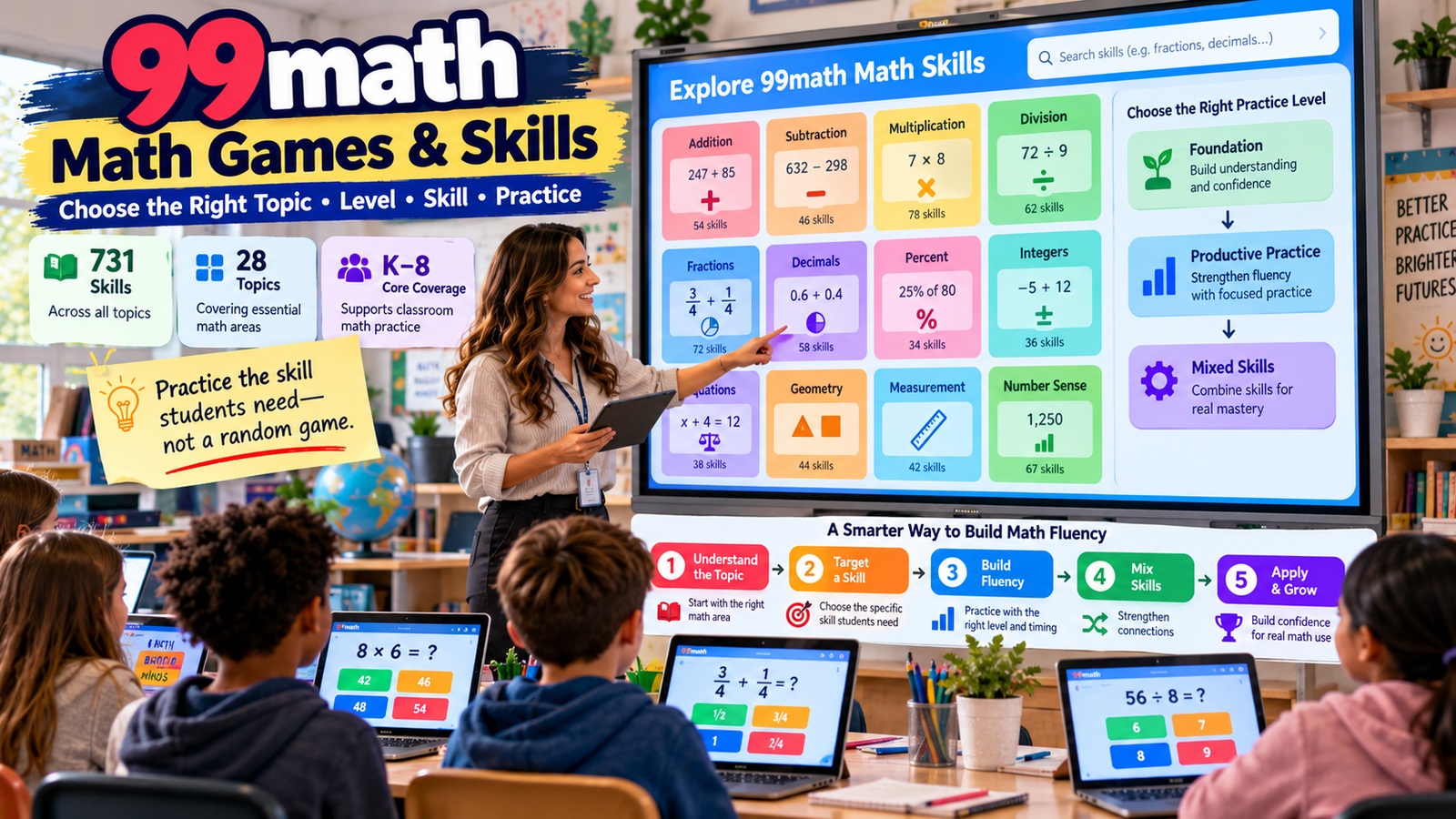
That distinction matters because 99math currently offers much more than basic multiplication practice. Its official public site lists 731 skills across 28 mathematics topics and describes its curriculum as aligned across kindergarten through grade 8. The platform currently includes areas ranging from basic addition and subtraction to fractions, decimals, mixed operations, equations, geometry, measurement, percentages, exponents, and integers. 99math
99math also describes itself as a fluency-focused math platform. Teachers can select a grade level or math-facts category, choose a specific skill, adjust a practice activity, and let the system generate problems around that mathematical target. 99math Support
That makes the most important question much more useful than “Which game should we play?”
The better question is:
What mathematical skill should become easier, more accurate, or more automatic after students complete this practice?
A teacher who chooses content randomly may still create an engaging activity.
A teacher who deliberately matches the practice to students’ mathematical readiness can turn the same activity into a much stronger instructional tool.
This guide is entirely about making that choice well.
Gimkit App offers practical guides, resources, and tips for teachers and students exploring interactive learning and educational games.
What “99math Math Games” Actually Means
It helps to separate two layers of the platform.
The first is the game experience. This is the interactive environment students see while practicing.
The second is the mathematical content. This is what students are actually solving.
The same type of classroom activity can therefore be used to practice very different mathematics.
Students might work on:
addition;
subtraction;
multiplication;
division;
fractions;
decimal operations;
percentages;
integer operations;
equations;
measurement;
geometry;
number sense.
99math’s current site explains this simply: teachers select facts or topics and the platform generates the problems. 99math
From an instructional perspective, that means the teacher is not merely choosing entertainment.
The teacher is choosing a practice target.
And in most cases, the quality of that target matters more than the visual game layer surrounding it.
The Current 99math Math Library
At the time of this article’s verification, 99math publicly lists 731 skills distributed across 28 topics. 99math
The current public topic library includes the following areas:
Topic
Current listed skills
Addition
55
Subtraction
47
Multiplication
57
Division
38
Number patterns
25
Comparing and ordering
12
Fractions
46
Time
30
Money
15
Rounding
3
Number sense
63
Mixed operations
54
Equations
21
Geometry
16
Units of measurement
34
Decimals
39
Fractions + and −
10
Addition and subtraction
8
Decimal + and −
25
Decimal × and ÷
20
Decimal number sense
37
Decimal conversions
18
Fractions × and ÷
8
Percent
9
Exponents
12
Number sequences
3
Decimal mixed operations
6
Integers
20
These counts describe the current library and may change as 99math updates its content.
The more evergreen lesson is not memorizing how many skills exist.
It is understanding what kind of mathematical need each topic can serve.
What Grades Does 99math Cover?
99math’s current main site describes its curriculum as aligned across grades K–8. Its support documentation describes the platform primarily as designed for grades 1–8. 99math
Those two descriptions point to the same practical conclusion:
99math is primarily an elementary and middle-school fluency platform.
Older students may still benefit from particular foundational topics when those skills remain relevant to more advanced work.
For example, a high-school student may still need stronger fluency with:
fractions;
decimal operations;
percentages;
integers;
exponents;
basic equations.
The important question for an older learner should therefore not simply be:
“Is 99math a high-school program?”
A more useful question is:
“Does 99math contain the prerequisite fluency skill this student needs?”
That keeps expectations realistic.
Fluency Practice Is Not the Same as First-Time Instruction
99math identifies itself as fluency-focused. 99math Support
That distinction should guide how its math games are used.
Fluency practice is strongest when students already have enough understanding to know what the mathematics means.
Consider multiplication.
If a student understands multiplication but takes a long time to recall familiar facts, repeated practice can help.
If the student does not understand what multiplication represents, faster repetition is unlikely to solve the actual problem.
The same principle applies to fractions, decimals, equations, integers, and other topics.
Student need
Better instructional response
Concept is unfamiliar
Teach the concept
Concept is understood but recall is slow
Fluency practice
Student knows method but makes occasional errors
Targeted practice
Procedure itself is misunderstood
Correct the procedure first
Skill is already accurate and fast
Progress to broader or harder work
A digital activity should support the mathematical need.
It should not determine what the need is.
The Most Important Skill-Selection Question
Before choosing any 99math content, ask:
What specific mathematical behavior should improve because of this practice?
That is much stronger than saying:
“We’re working on fractions.”
Fractions could involve:
understanding fraction magnitude;
recognizing equivalent fractions;
comparing fractions;
adding fractions;
subtracting fractions;
multiplying fractions;
dividing fractions.
Likewise, “decimals” could refer to:
place value;
comparison;
addition;
subtraction;
multiplication;
division;
conversions;
mixed operations.
A broad unit name is not yet a precise practice target.
The stronger selection is narrow enough that teacher and student both know what improvement should look like.
Choose the Smallest Skill That Solves the Actual Problem
When students struggle, teachers sometimes respond by assigning an entire topic.
That can hide the real weakness.
Suppose a student appears weak at multiplication.
The actual problem might be:
only the 7-times table;
facts above 5;
confusion between multiplication and addition;
slow recall despite good understanding;
multi-digit multiplication rather than basic facts.
These problems should not automatically receive identical practice.
99math’s current Group Practice workflow lets the teacher begin with a broader grade or math-facts area and then select a specific skill. 99math Support
That supports a valuable principle:
If the weakness is narrow, start narrow.
Narrow practice can reduce unnecessary cognitive load and make improvement easier to observe.
When Broader Practice Becomes Better
Narrow practice is useful while a skill is developing.
But students should not remain permanently inside predictable patterns.
Broader practice becomes valuable when students need to decide among several familiar procedures.
Suppose a student can already perform:
addition;
subtraction;
multiplication;
division
individually.
Mixed practice can now require something extra:
recognizing which operation is needed.
99math currently lists Mixed operations as one of its larger topic areas, with 54 listed skills. 99math
This leads to a useful progression:
Isolate to build → mix to test flexible retrieval.
Mixing skills too early can create confusion.
Mixing them after the individual skills become stable can strengthen flexibility.
Single-Skill Practice vs. Mixed-Skill Practice
These are not competing philosophies.
They serve different stages.
Single-skill practice works best when students are:
building fluency;
correcting a narrow weakness;
developing confidence;
practicing a newly learned procedure;
stabilizing one fact family.
Mixed practice becomes more useful when students are:
already reasonably accurate;
ready to distinguish among operations;
reviewing several related skills;
developing flexible retrieval.
99math’s current Premium documentation says enhanced group practice can include multiple skills in one game. 99math Support
Because plan features can change, always verify current access before building a long-term classroom process around that specific feature.
The instructional principle does not change:
Do not mix several unstable skills and expect the mixture itself to create mastery.
Addition: Build Fluency After Meaning
Addition currently has 55 listed skills in 99math’s public library. 99math
For beginning learners, the foundation is understanding what addition represents.
Students need to recognize that quantities are being combined, increased, or related.
Once that meaning exists, fluency practice can make common combinations easier to retrieve.
A useful progression may move through:
small facts → related facts → wider number ranges → combined addition/subtraction → more complex applications
The important part is not following one universal sequence.
It is knowing why the selected practice comes next.
Older students can also benefit from basic addition fluency when weak recall consumes attention needed for harder mathematics.
Foundational practice is not limited to younger students.
Subtraction: Diagnose Before Repeating
99math currently lists 47 subtraction skills. 99math
A student struggling with subtraction may have several very different problems.
The student might:
count backward inefficiently;
have weak number relationships;
misunderstand place value;
struggle with regrouping;
confuse subtraction with comparison;
simply lack fluent fact recall.
Repeated questions can help only when they target the correct issue.
If the student knows the procedure but recalls facts slowly, fluency work makes sense.
If the student does not understand the numerical relationship, the teacher may need to return to conceptual instruction.
Practice becomes valuable after the reason for the difficulty is understood.
Multiplication: More Than “Know Your Tables”
Multiplication currently has 57 listed skills in the 99math library. 99math
It is one of the most obvious places to use a fluency platform, but even multiplication should not be treated as one giant skill.
A student might need:
×2 facts;
×5 facts;
×7 facts;
mixed multiplication facts;
multiplication over a particular number range;
more complex multiplication procedures.
If only one fact family is unstable, practicing every multiplication fact may be inefficient.
Target the unstable area first.
Once those facts become more reliable, broaden the practice.
A sensible progression is often:
specific facts → mixed facts → related division → broader application
That is more instructionally useful than simply increasing the total number of questions.
Rounding may have a small current skill count, but it supports important reasoning.
Students use rounding to:
estimate;
judge reasonableness;
simplify calculations;
approximate quantities.
Practice should therefore reinforce number magnitude.
If students learn only a mechanical rounding rule without understanding whether a number is closer to one benchmark or another, fluency can become shallow.
Addition and Subtraction Together
99math currently lists 8 combined Addition and subtraction skills beyond its larger separate operation categories. 99math
Combined practice can be useful after both operations are independently stable.
The student now must:
read carefully;
recognize the operation;
retrieve the correct method;
solve.
That small switch increases cognitive flexibility.
This is why combined practice belongs later in progression than isolated practice for many learners.
Grade-Level Filters Are Navigation Tools, Not Ability Labels
99math’s teacher workflow allows educators to choose grade-level content or Math facts before selecting individual skills. 99math Support
Grade levels are useful for navigation.
They should not become rigid assumptions about what every student needs.
A sixth-grade student might need fourth-grade multiplication fluency.
A third-grade student might already be ready for more advanced numerical work.
Students in intervention programs often have prerequisite gaps that do not match their chronological grade.
Use grade level to locate content.
Use mathematical readiness to choose content.
Grade Placement and Skill Readiness Are Different Things
Two students can sit in the same classroom and need completely different fluency practice.
Student A may struggle with multiplication facts.
Student B may be fluent with multiplication but weak in decimal place value.
Student C may already be ready for mixed operations.
Assigning exactly the same practice only because all three are in grade 5 may not be efficient.
A stronger approach asks:
What knowledge is currently limiting each student’s next mathematical step?
Article #5 will address how reports can help identify these weaknesses.
This article owns what happens after the need is identified:
select practice that targets it accurately.
Build Practice Around Prerequisites
Many mathematical difficulties are actually prerequisite difficulties.
A useful mental map is:
Visible struggle
Prerequisite worth checking
Division
Multiplication relationships
Percent
Fractions and decimals
Fraction operations
Fraction meaning and equivalence
Decimal operations
Decimal place value
Equations
Equality and inverse operations
Mixed operations
Individual operation fluency
Integers
Number-line and sign understanding
Measurement conversions
Unit relationships
This table is not a diagnosis of every learner.
It is a reminder that harder content sits on top of earlier content.
Sometimes the fastest path forward is strengthening the layer underneath.
Do Not Automatically Choose the Hardest Skill
A difficult activity can look rigorous without being productive.
If a skill is far beyond student readiness, the result may be:
guessing;
frustration;
low accuracy;
disengagement;
weak learning.
Likewise, content that is much too easy can create:
boredom;
automatic clicking;
little growth.
The best practice often sits in the middle.
Students should recognize the mathematics but still need to retrieve, think, or correct occasional errors.
That is a productive fluency zone.
A Better Difficulty Framework
Think about practice in four levels.
Level
What student performance looks like
Recommended response
Too easy
Almost automatic
Progress
Productive
Mostly correct with some effort
Continue practicing
Fragile
Frequent errors but partial understanding
Narrow/support
Not ready
Guessing or conceptual confusion
Teach first
Avoid using one rigid accuracy percentage as a universal rule.
The same score can mean different things depending on topic, student, and task complexity.
Use evidence plus professional judgment.
Repetition Helps Only When Students Repeat Correct Mathematics
Repetition itself is neutral.
If students repeatedly use a correct strategy, fluency can strengthen.
If they repeatedly use a misconception, repetition can make that misconception more familiar.
The better sequence is:
Understand → practice correctly → repeat → broaden → apply
not:
repeat until the answer somehow improves.
Game-based practice makes repetition easier to deliver.
The teacher still needs to ensure that the thing being repeated is mathematically useful.
When to Move Students Beyond One Skill
Students may be ready to progress when performance becomes:
accurate;
reasonably efficient;
stable;
less dependent on prompting;
successful across more than one attempt.
Then move toward:
related skills;
broader practice;
mixed retrieval;
application.
Do not keep students on a comfortable skill indefinitely simply because they produce high scores.
Fluency is supposed to free students to do more mathematics.
When to Return to an Earlier Skill
Progress is not always linear.
More advanced work can reveal an earlier weakness.
A student beginning fractions may reveal weak multiplication facts.
Percentage work may expose weak decimal understanding.
Algebraic work may expose integer difficulties.
Returning to foundational practice is not failure.
It is targeted repair.
The large 99math library can be useful precisely because teachers can revisit an earlier prerequisite without abandoning current instruction completely.
Check Whether Practice Transfers Beyond 99math
Success inside one interface is valuable, but mathematics must ultimately work outside that interface.
After repeated fluency practice, check whether students can use the skill in:
written problems;
mental math;
word problems;
classroom discussion;
multi-step work;
reasoning tasks.
If multiplication facts are becoming fluent, students should experience less difficulty using multiplication inside fractions, area, or problem solving.
Transfer is one of the best reasons to build fluency.
The game is not the final destination.
Choosing Content for Whole-Class Live Practice
Article #2 already explains how to set up Group Practice, so this section focuses only on what mathematical content belongs there.
Choose one whole-class target when most students share the same need.
Examples include:
a prerequisite the whole class needs today;
a recently learned fact family;
review before a new lesson;
a common fluency weakness;
a skill needed for upcoming work.
Whole-class practice is weaker when students’ needs are extremely different.
A single topic may then be:
too easy for some;
productive for some;
far too difficult for others.
That is when more targeted practice becomes useful.
Choosing Content for Individual Practice
99math currently offers individual practice and assignments, and its public site describes the individual experience as self-paced practice around skills students need. 99math
From a content perspective, individual practice is particularly useful when students do not share the same fluency target.
For example:
Student A: multiplication Student B: decimal place value Student C: fraction comparison
Putting all three into one identical activity may be administratively easy but instructionally weak.
Targeted practice allows the content to follow the student need.
Small-Group Practice
Small groups can bridge whole-class and individual practice.
A teacher might organize students around:
multiplication fluency;
division relationships;
fraction foundations;
decimal operations.
The goal should not be permanently labeling students.
Groups should change as needs change.
The instructional advantage is precision.
The teacher can target one mathematical bottleneck without forcing the whole class into that same practice.
Using 99math for Intervention
99math can be useful in intervention when the teacher knows exactly what needs fluency development.
A strong intervention cycle looks like:
identify weakness → teach missing concept if necessary → assign narrow practice → check improvement → reconnect to grade-level work
The goal is not to keep intervention students inside easier content forever.
The goal is to repair the foundation quickly enough that they can participate more successfully in current mathematics.
99math’s current skill library provides broad K–8-oriented coverage that can support this targeted work. 99math
Using 99math for Enrichment
Advanced students should not automatically receive “more questions.”
If students already demonstrate fluent mastery, another hundred easy items may add little value.
Better next steps can include:
mixing previously isolated skills;
moving into a related harder topic;
practicing more advanced fluency;
applying the skill to richer problems outside 99math.
Enrichment means increasing mathematical demand.
It does not simply mean increasing volume.
Choosing a Warm-Up Skill
99math’s current public site specifically presents Lesson warm-up as one classroom use case. 99math
A good warm-up skill should:
already be familiar;
connect with upcoming work;
activate relevant knowledge;
fit a short time window.
Suppose today’s lesson uses multiplication inside area problems.
A multiplication fluency warm-up could prepare students.
Introducing a completely unfamiliar fraction procedure would not serve the same purpose.
Warm-ups should wake up existing knowledge.
They should not unexpectedly become first-time instruction.
Choosing End-of-Lesson Practice
99math also currently presents End of lesson practice as a classroom use. 99math
The content choice here serves a different purpose.
At the end of the lesson, ask:
What should students retrieve one more time before they leave?
That could be:
today’s newly practiced skill;
an important prerequisite;
one fluency element embedded in the lesson.
The goal is consolidation.
The activity should reinforce what the lesson made meaningful.
Choosing Skills for Rotation Stations
99math currently lists Rotation station among its suggested classroom uses. 99math
Station practice works best when students can use the selected content with limited direct teacher assistance.
If students constantly need explanations, the skill is not yet independent enough for that station.
A strong station target is:
already taught;
appropriately challenging;
narrow enough to practice independently;
useful enough to justify repetition.
The teacher may then work more intensively with another group while 99math handles the fluency repetition.
Choosing Homework or Home-Practice Skills
99math currently includes home practice as part of its product. 99math
Home practice should be selected especially carefully because immediate teacher support may not be available.
Choose work that students can reasonably understand independently.
Avoid using home fluency practice to introduce difficult concepts for the first time.
A good home target is:
familiar;
purposeful;
appropriately difficult;
connected to current learning.
Homework should strengthen classroom learning rather than make students teach themselves an unfamiliar mathematical procedure.
Choosing Skills for Review
Review should not become random content accumulation.
If the upcoming assessment focuses on fractions, decimals, and percentages, the review should reflect those relationships.
If students need cumulative retrieval across several areas, mixed practice may be useful.
If one prerequisite is the main problem, targeted review may be stronger.
The best review asks:
Which knowledge must students retrieve successfully during the upcoming work?
Then practice that knowledge.
Spiral Review
99math’s broad library can also support spiral review.
A spiral returns to important earlier skills over time.
Good candidates include skills that:
support future units;
students tend to forget;
remain foundational;
have become less automatic.
Spiral review should still be deliberate.
Random topic switching is not the same as a coherent spiral.
Each returning skill should have a reason to return.
Test Preparation
Test preparation is often weakened by focusing only on the number of practice questions.
A better approach asks which foundational fluency skills are consuming too much student attention.
For example:
weak multiplication can make fraction work slower;
weak place value can interfere with decimal reasoning;
weak integer operations can interfere with algebra.
Strengthening those bottlenecks may help students approach complex tasks with more mental capacity available.
99math can support the fluency layer of test preparation.
It should not replace:
reasoning;
multi-step problems;
mathematical reading;
explanation;
constructed response.
The “One Skill, One Reason” Rule
Before selecting practice, complete this sentence:
We are practicing ______ because ______.
For example:
We are practicing ×7 facts because slow recall is interfering with multi-digit multiplication.
We are practicing decimal comparison because students understand operations but continue to misread place value.
We are practicing mixed operations because students are accurate with each operation separately and now need to choose among them.
If the reason is simply:
“Because it’s available,”
the practice is probably not yet intentional enough.
The “Next Skill” Rule
Before starting the practice, know what success leads to.
Ask:
If students master this, what is the next mathematical step?
Examples:
Multiplication facts → division relationships
Decimal place value → decimal operations
Fraction equivalence → comparison or operations
Individual operations → mixed operations
This prevents students from becoming permanently fluent at one isolated activity without progressing mathematically.
The “Back-Up Skill” Rule
Also know what to do when students are not ready.
Ask:
Which prerequisite should we revisit?
For division, perhaps multiplication.
For percent, perhaps fractions or decimals.
For mixed operations, perhaps separate operation practice.
For equations, perhaps equality or inverse operations.
Having a back-up target makes differentiation faster.
You do not need to improvise after the activity reveals a problem.
Build Skill Ladders
A skill ladder is a connected sequence of practice targets.
If students perform only when the exact practice pattern is predictable, the skill may still be context-dependent.
Broaden gradually.
Use Student Confidence as Information, Not Proof
Students often describe themselves broadly.
“I’m bad at fractions.”
“Multiplication is easy.”
Those statements can be useful clues.
They are not precise diagnoses.
The student who says “fractions are hard” may only struggle with equivalence.
The student who says “multiplication is easy” may hesitate on several fact families.
Practice should target observed need rather than broad identity labels.
A Complete 99math Skill-Selection Framework
Before assigning practice, answer five questions.
Question
Purpose
What mathematics has already been taught?
Confirms readiness for fluency practice
What exact skill remains slow, inaccurate, or fragile?
Identifies the target
Should practice be isolated or mixed?
Controls complexity
Is a prerequisite actually causing the problem?
Prevents practicing the wrong layer
What should come next after improvement?
Creates progression
If those five questions have clear answers, the practice is probably purposeful.
A Simple Decision Framework
Students understand the skill but are slow
Use focused fluency practice.
Students are fast but inaccurate
Correct the method and emphasize accuracy.
Students are confused
Teach first.
Students are fast and accurate
Progress.
Students perform inconsistently
Check prerequisites and question types.
Students succeed only when one operation is predictable
Introduce mixed retrieval when ready.
This is far more useful than automatically assigning additional questions after every weak result.
Common Content-Selection Mistakes
Avoid choosing a 99math activity simply because:
it is first in the menu;
students requested it;
another teacher uses it;
it is labeled for the students’ grade;
it produces impressive high scores;
it looks difficult;
you have extra time to fill.
Every selected math game should have a mathematical reason.
The technology should follow the instruction.
Avoid Over-Practicing Basic Facts
Math fact fluency is useful because it can free mental resources for more complex work.
That is the real goal.
Multiplication facts can support:
fractions;
area;
ratios;
multi-step problems.
Addition fluency can support:
mental calculation;
measurement;
larger arithmetic.
Students should not spend their entire mathematics experience becoming faster at isolated facts.
Facts are a foundation.
They are not the entire building.
Build an Evergreen Practice Plan
Interfaces change.
Product plans change.
Skill counts can change.
Sound mathematics instruction is more durable.
Build your 99math practice system around principles such as:
Meaning before automaticity.
Prerequisite before dependent skill.
Narrow before mixed.
Accuracy before speed.
Progress after mastery.
Transfer beyond the game.
These principles will remain useful even if the platform’s interface looks different next year.
Example Practice Progression
Stage
Practice
Main purpose
1
Narrow foundational skill
Repair or build
2
Related skill family
Connect knowledge
3
Broader/mixed practice
Develop flexibility
4
Non-game application
Check transfer
5
Later spiral review
Maintain fluency
This is not an official 99math sequence.
It is a durable instructional framework for using the platform purposefully.
Frequently Asked Questions About 99math Math Games
How many skills does 99math currently have?
At the time of verification, 99math’s official public site lists 731 skills across 28 topics. The current library covers addition, subtraction, multiplication, division, number sense, fractions, decimals, equations, geometry, measurement, percentages, integers, exponents, and other related areas. 99math
Teachers should treat 731 as a current product count rather than a permanent number because digital curricula can expand or be reorganized. The more important long-term question is whether 99math contains the specific fluency target a student needs. Hundreds of available skills are useful only when practice is chosen intentionally. A large catalog should give teachers flexibility, not become a checklist students are expected to complete from beginning to end.
What grades is 99math designed for?
99math’s current homepage describes its curriculum as aligned from kindergarten through grade 8, while its support documentation describes the platform as designed primarily for grades 1–8. 99math
That makes elementary and middle school its core use range. Older students may still benefit from specific foundational skills when those weaknesses interfere with more advanced mathematics. For example, high-school students sometimes need additional fluency with fractions, percentages, integers, decimals, or exponents. Rather than asking whether the platform provides a complete high-school curriculum, check whether its available skill library addresses the specific prerequisite students need.
Is 99math only for multiplication and basic math facts?
No. Multiplication and other math facts are prominent uses, but the current library is substantially broader. It includes fractions, decimals, number sense, geometry, measurement, equations, percent, exponents, integers, mixed operations, time, money, and other topic families. 99math
However, 99math still describes itself as a fluency-focused platform. 99math Support That means broad content coverage should not be confused with replacing full mathematics instruction. Teachers still need conceptual explanations, modeling, reasoning, discussion, written work, and problem solving. Use 99math where repeated retrieval and practice are the appropriate instructional job.
How should I choose a 99math skill?
Begin with the mathematical need, not the menu. Identify what students already understand and what specific fact, procedure, relationship, or prerequisite remains slow or inaccurate. Then choose the narrowest available skill that addresses that weakness.
99math’s current teacher workflow supports this approach by letting teachers select a grade level or Math facts category and then choose a specific skill. 99math Support If multiplication is broadly weak but only ×7 and ×8 facts are unstable, targeted work may be more efficient than every multiplication fact. Once the narrow skill becomes dependable, broaden the practice.
Should students practice one skill or several at once?
Use isolated practice while students are building fluency or correcting a specific weakness. Mixed practice becomes more useful after the component skills are reasonably stable and students need to decide among several familiar strategies.
99math’s current Premium documentation says enhanced Group Practice can mix multiple skills in one game. 99math Support Feature availability may change, but the instructional rule remains useful regardless of subscription: isolate to build; mix to develop flexible retrieval. Combining several weak skills too early can obscure the problem because teachers can no longer tell whether errors come from one specific operation, prerequisite, or switching between operations.
What should I do when 99math practice is too easy?
Treat easy performance as evidence that students may be ready to progress. If students answer accurately, quickly, and consistently with very little retrieval effort, continuing the same activity indefinitely is unlikely to provide much new learning.
Move to a related next-step skill, mixed practice, a more advanced form of the operation, or mathematical application outside the game. For example, fluent multiplication facts might lead to division relationships or more complex multiplication. Fluency should reduce the cognitive burden of foundational mathematics so students can move into richer work. Mastery is a reason to progress—not a reason to repeat the exact same activity forever.
What should I do when a 99math skill is too difficult?
First determine whether the difficulty comes from weak fluency or missing understanding. If students are guessing, cannot explain what to do, or repeatedly make the same conceptual mistake, more rapid questions are unlikely to fix the underlying issue.
Identify the prerequisite. Division problems may reflect weak multiplication relationships. Percent difficulty may trace back to fractions or decimals. Decimal-operation errors may actually be place-value errors. Teach the missing idea or procedure first. Then return to targeted fluency practice once students have a correct mathematical method to repeat. The right response to difficulty is not automatically more questions.
Is 99math good for multiplication practice?
Yes. Multiplication is currently one of the platform’s larger topic areas, with 57 skills listed on the official public site. 99math
The strongest multiplication practice is targeted. Some students need a particular fact family, others need mixed fact retrieval, and others are ready to connect multiplication with division. Avoid assuming every learner needs the entire multiplication catalog at once. Start with the smallest weakness that matters, stabilize it, then broaden the practice. If students do not yet understand multiplication conceptually, teach the meaning first. Fluency practice should automate correct mathematical relationships rather than replace conceptual understanding.
Is 99math useful for fractions and decimals?
Yes. Both areas are currently represented through multiple topic families. Fractions include general fraction skills plus separate addition/subtraction and multiplication/division categories. Decimal content includes general decimals, decimal number sense, operations, conversions, and mixed operations. 99math
That separation is valuable because “struggling with decimals” can mean very different things. A student who misreads place value needs different practice from a student who understands magnitude but struggles with multiplication. Likewise, fraction comparison and fraction multiplication are different instructional targets. Use the smallest category that matches the actual weakness rather than assigning an entire broad topic automatically.
Can 99math support intervention?
It can support intervention when the teacher has identified a fluency need that matches the available skill library. A strong intervention sequence is to locate the prerequisite weakness, provide direct instruction when necessary, assign focused practice, check whether performance changes, and then reconnect the student to grade-level work.
99math’s current K–8-oriented library and individual-practice system can provide repeated opportunities to work on targeted mathematics. 99math However, the platform should support the intervention plan rather than become the intervention itself. Conceptual misunderstandings still require explicit teaching, models, feedback, and mathematical reasoning.
Can advanced students benefit from 99math?
Yes, provided the content continues to challenge an actual mathematical need. Advanced students do not benefit from unlimited repetitions of already automatic material simply because their scores are high.
When a skill is mastered, move toward mixed retrieval, a related harder topic, or deeper mathematical application outside the platform. 99math can also serve as a brief fluency warm-up before students move into richer problem solving. The goal is not keeping every student inside the platform for the same amount of time. The goal is using the platform where repeated fluency practice adds value.
Should 99math replace worksheets or direct instruction?
No single practice format should replace every other form of mathematics learning. 99math describes itself as a fluency-focused platform and currently supports live group, individual, and home practice. 99math Support
That makes it useful when students need repetition, retrieval, and fluency development. Other learning objectives require different formats. Students may need to explain reasoning, draw models, solve multi-step problems, use manipulatives, discuss strategies, or learn a concept through teacher modeling. Choose the format that fits the learning objective. A strong classroom does not ask one digital tool to perform every instructional job.
When are students ready for mixed skills?
Students are more ready for mixed practice when individual component skills are already reasonably accurate and familiar. The challenge can then shift from performing one known operation to deciding which operation or strategy applies.
For example, students who are fluent separately with addition and subtraction may benefit from combined practice. Students who understand several decimal procedures may be ready for decimal mixed operations. If each individual skill is still unstable, mixing them may simply create additional confusion. Build fluency in the parts first; then use mixed practice to test flexible retrieval.
Which 99math topic should teachers choose first?
There is no universal first topic. Start with the mathematical skill whose improvement would remove the most important current bottleneck.
For one class, that might be multiplication facts. For another, decimal number sense. For another, fraction equivalence or integer operations. 99math provides the available content; the students’ mathematical needs determine what deserves attention. 99math
A useful rule is: one skill, one reason. Teachers should be able to explain why the selected practice matters now and what mathematical step should follow once students improve.
Final Takeaway
The strongest 99math math games are not chosen because they are the most colorful, difficult, competitive, or popular.
They are chosen because they target the right mathematical need.
At the time of verification, 99math lists 731 skills across 28 topic families and describes its curriculum as aligned across grades K–8. 99math
That breadth gives teachers options.
But options become valuable only through good selection.
Start narrow when the weakness is narrow.
Check prerequisites before increasing difficulty.
Teach conceptual understanding before asking students to automate it.
Use isolated practice to build stability.
Use mixed practice when students are ready for flexible retrieval.
Move forward when content becomes too easy.
Return to foundations when advanced work reveals an earlier weakness.
Use grade level to navigate—not to define a student’s mathematical limits.
And always ask whether fluency developed inside the game transfers into mathematics outside the game.
The most effective 99math practice plan is therefore not a tour through hundreds of available skills.
It is a connected sequence of deliberately selected mathematical targets, each chosen because it helps students become ready for the next important thing they need to learn.