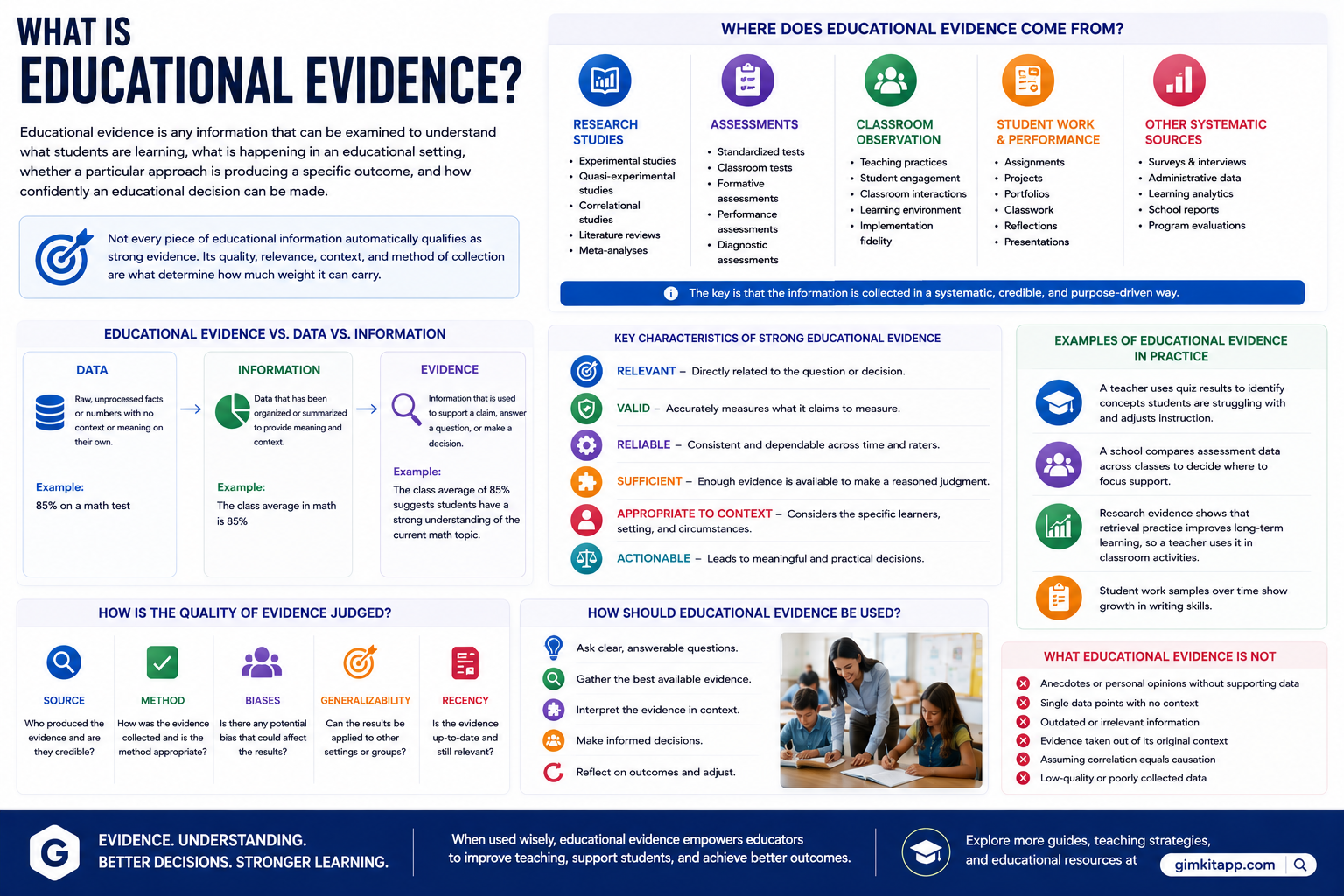
What Is Educational Evidence? Educational evidence is any information that can be examined to understand what students are learning, what is happening inside an educational setting, whether a particular approach is producing a specific outcome, and how confidently an educational decision can be made. It can come from research studies, assessments, classroom observation, student work, or other systematic sources — but not every piece of educational information automatically qualifies as strong evidence. Its quality, relevance, context, and method of collection are what determine how much weight it can carry.
This guide breaks the concept down from first principles: what evidence actually is, how it differs from data and information, where it comes from, how its quality is judged, and how it should (and shouldn’t) be used to make real educational decisions.
Learn more about interactive classroom learning, educational games, and modern teaching resources through Gimkit Live Learning & Earning Show.
1. Defining Educational Evidence
At its simplest, educational evidence is information used to support, challenge, or refine a claim about teaching, learning, students, or educational practice. That definition is deliberately broader than “research.” In education, the word evidence can refer to information gathered directly inside a classroom — such as assessment results or teacher observations — as well as findings produced through formal, systematic research. The Education Endowment Foundation (EEF) draws this distinction explicitly, since the term gets used in more than one way across the field.
This matters because educators are constantly making claims that need something to stand on:
Students have understood a concept.
A particular student is struggling with a specific skill.
A teaching strategy appears to be helping.
A group needs additional instruction.
An intervention seems to be improving outcomes.
A practice is “supported by research.”
Evidence gives those claims something that can actually be examined, rather than leaving them dependent on assumption or gut feeling.
Evidence is not simply “something that happened.” Suppose a teacher notices students became more engaged after introducing a game-based review activity. That observation is potentially useful — but on its own it doesn’t prove the game caused better learning. The topic could have been easier that day, the activity could have been novel rather than effective, the questions could have been simpler, or engagement could have risen without any real gain in understanding. This is one of the central principles of evidence-based education: evidence must always be interpreted in relation to the specific claim it’s being used to support. The same observation can be strong evidence for one question and completely insufficient for another.
2. Data, Information, and Evidence Are Three Different Things
These words get used interchangeably in everyday conversation, but they describe distinct stages of understanding:
Data are the raw recorded observations, measurements, responses, or results.
Information is data that has been organized or interpreted so it communicates something meaningful.
Evidence is information considered in relation to a specific claim, question, or decision, and judged sufficiently relevant and credible to help support that reasoning.
The relationship can be visualized as a pipeline:
Observation → Data → Interpreted Information → Evidence for a Specific Question → Educational Decision
Not every dataset automatically travels through every stage — context and quality determine whether information can actually support a conclusion.
A worked example. A teacher runs a 10-question review with 25 students. The raw tally — 18 students answered Question 7 correctly — is data. Restated as a percentage — 72% answered Question 7 correctly, versus only 36% on Question 8 — is now interpretable information. When the teacher looks closer and realizes Question 8 tested a prerequisite that was never taught clearly, the numbers become evidence relevant to an instructional decision: the class may need targeted reteaching on that prerequisite. Even here, the teacher should resist stretching one result into an oversized conclusion like “students can’t understand this topic.” The evidence only supports the narrower, more precise statement. That gap — between what evidence actually supports and what someone wants to conclude from it — sits at the center of responsible educational reasoning.
3. The Dimensions That Determine Evidence Quality
Not all evidence carries equal weight, and there’s no single formula for scoring it. Instead, useful evidence is judged across several dimensions at once:
Dimension
Key Question
Relevance
Does it actually relate to the question being asked?
Quality
Was it collected or produced using a credible method?
Reliability
Would the measurement or process produce reasonably consistent results?
Validity
Does it meaningfully measure what it’s intended to measure?
Context
Under what conditions was the evidence produced?
Transparency
Can its origin and limitations be understood?
Consistency
Do other relevant sources point in a similar direction?
Applicability
Does it reasonably transfer to the learners or setting under consideration?
Different questions call for different kinds of evidence weighted differently across these dimensions. A teacher trying to understand why one student is struggling needs detailed student work and observation. A school deciding whether to adopt a new intervention needs a broader research base. A researcher testing whether an intervention causes an outcome needs a much higher bar of methodological scrutiny. The Institute of Education Sciences’ What Works Clearinghouse (WWC) illustrates this principle directly: it applies formal study-review standards and differentiated evidence ratings rather than treating every study as equally informative.
4. Where Educational Evidence Comes From
Educational evidence is never limited to a single channel. UNESCO’s research on evidence use in education describes several distinct forms, with research evidence as one major category alongside evidence generated inside schools through everyday practice.
Research evidence comes from systematic investigations designed to answer specific questions — individual empirical studies, systematic reviews, evidence syntheses, qualitative and quantitative research, mixed-methods work, and implementation research. It helps educators understand whether an approach has demonstrated effects, under what circumstances, and for which populations — but the EEF is clear that research evidence varies widely in reliability and needs to be examined, not accepted just because it carries the “research” label.
Assessment evidence comes from formative checks, quizzes, written work, projects, performance tasks, and structured assessments. It’s especially useful when the question concerns what a learner can currently demonstrate — but a score should never be treated as a complete picture of learning. What the assessment measures, how it’s administered, and how the result gets interpreted all shape its value.
Observational evidence comes from what teachers notice directly: repeated misconceptions, difficulty following a process, shifts in participation, or patterns in how students interact. Observation can surface things a numerical score misses entirely, but it’s also shaped by the observer’s interpretation, so it benefits from clear criteria, documentation, and corroboration from other sources.
Student work — a written explanation, a solved problem, a project, a presentation — reveals how a student is thinking, not just whether the final answer was correct. Two students can land on the same correct answer through very different reasoning paths, which is exactly why this evidence type matters.
Practice-based evidence emerges from the act of implementation itself: how an intervention was rolled out, how students actually responded, what barriers appeared, and whether the expected outcomes showed up. This kind of evidence is valuable for understanding delivery, but it isn’t automatically equivalent to rigorous causal research — its value depends entirely on the question being asked and how systematically it was gathered.
5. Reliability and Validity Are Not the Same Question
These two terms get conflated constantly, but they answer different things.
Reliability asks: can I depend on this measurement being reasonably consistent?
Validity asks: does this measurement actually support the interpretation I’m making from it?
Imagine a short quiz that produces almost the same score pattern every time it’s given — that consistency suggests reliability. But if the quiz doesn’t actually measure the intended learning objective, that consistency doesn’t make it valid for that purpose. Consistent measurement is not automatically meaningful measurement. Educational evidence becomes far more useful once both questions are asked together, rather than treating a single number as self-explanatory.
6. Relevance and Context Change What Evidence Can Support
Strong evidence can still be the wrong evidence for a given question. The OECD’s work on evidence use in education stresses that evidence needs to be matched to the specific decision and setting — findings about “what works on average” can have limited relevance to a particular classroom.
Consider a study that tests an intervention with a particular age group, subject, and outcome measure. A school then wants to apply the finding to a different age group, subject, and implementation model. The original study can still be informative, but it shouldn’t be assumed to transfer perfectly. This is why responsible evidence use asks two separate questions: is this evidence credible? and, just as importantly, is this evidence relevant to the decision in front of us? The second question is the one most often skipped.
Context reaches further than relevance alone. Learning happens inside a specific combination of learners, teachers, curriculum, instruction, resources, classroom conditions, technology, and institutional expectations — and the same intervention can behave differently once any of those variables shift. That doesn’t make evidence useless outside its original setting; it means transferring a finding requires deliberate reasoning rather than a direct copy-paste: Research finding → Relevance check → Local conditions → Implementation decision → Monitoring.
7. Why One Signal Is Rarely the Whole Story
A single low quiz score could mean the student lacks the required knowledge, misread the question, made an avoidable slip, wasn’t given adequate preparation, or actually understands the concept but can’t yet apply it independently. The score is still useful — it’s just one piece of the picture, not the complete explanation.
Triangulation — examining a question through more than one source, method, or perspective — reduces the risk of making a major decision off one incomplete signal. If a teacher suspects a shared misconception, assessment data showing a repeated wrong answer, student work showing the same flawed reasoning, and classroom discussion echoing the same misunderstanding together form a much stronger case than any one signal alone. Triangulation isn’t a guarantee of truth, though — multiple sources can still share the same underlying bias or measurement flaw. Its real value is stronger reasoning, not manufactured certainty.
8. Evidence Is Not the Same Thing as Proof
In most educational questions, evidence doesn’t establish absolute truth — it changes how strongly a claim can reasonably be supported. Take the claim “students who use this activity always learn more.” A single classroom observation falls far short of supporting that. Even a well-designed study wouldn’t justify the word “always.” A more defensible version — “the available evidence suggests this activity may improve a specific outcome under certain conditions” — isn’t a weaker claim; it’s a more accurate one, because it reflects what the evidence can genuinely support.
The WWC demonstrates this same discipline through its rating system, distinguishing findings that meet its standards without reservations from those that meet standards with reservations, or don’t meet the applicable standards at all — rather than treating every study as equally persuasive.
9. Primary Evidence vs. Synthesized Evidence
Primary evidence comes directly from one original study, assessment, observation, or experiment. Synthesized evidence — systematic reviews, meta-analyses, evidence syntheses, practice guides — combines findings across multiple sources.
A single study can be genuinely important, but its conclusions are bounded by its own sample, setting, and design. The WWC notes that individual studies often apply narrowly to their particular population, while systematic reviews and meta-analyses can offer a broader view by pooling multiple studies together. That doesn’t make a synthesis automatically correct, either — its usefulness depends on which studies it included, its search strategy, its inclusion criteria, and the quality of the underlying evidence it drew from. Two reviews covering similar territory can reach different conclusions simply because they used different scopes. The practical lesson: don’t stop at “is there a study?” — ask “what does the broader body of relevant evidence show?”
10. Research Design Determines What Kind of Inference Is Possible
Different designs answer different kinds of questions. Randomized controlled trials, quasi-experimental designs, longitudinal and correlational studies, qualitative research, case studies, and surveys each carry a different level of causal certainty. A causal question (“does this intervention cause better outcomes?”) requires far stronger causal identification than a descriptive one (“what does this look like in practice?”). A question about student experience may need evidence built to capture perspective and meaning, not just numeric scores. A question about implementation needs evidence about what actually happened during delivery, not just the intended design.
Research design should shape what conclusions are reasonable — it should never function as a badge of automatic authority.
11. Statistical Significance Isn’t the Same as Educational Importance
A statistically significant result doesn’t automatically mean an effect is large, practically useful, or relevant to every classroom. Interpreting it well means also weighing effect size, precision, practical significance, the population studied, implementation conditions, and cost. “Statistically detectable” and “educationally transformative” are not the same conclusion. The reverse also holds: a non-significant result doesn’t automatically prove an intervention has no value — sample size, measurement quality, and estimated effect size all factor into that judgment too.
12. Naming the Strength of Evidence Honestly
A trustworthy evidence source shouldn’t force every claim into a true/false binary. A more accurate structure distinguishes:
Evidence Status
Meaning
Well supported
Multiple credible sources provide substantial support
Supported with conditions
Evidence supports the claim under specified circumstances
Promising
Early or limited evidence suggests potential
Mixed
Credible evidence points in different directions
Insufficient
Available evidence isn’t adequate for a confident conclusion
Contradicted
Stronger relevant evidence challenges the claim
Context-dependent
The answer changes substantially by setting or population
Unknown
Reliable evidence is currently unavailable
Recording negative and mixed evidence honestly — not just findings that confirm a preferred conclusion — is what keeps an evidence base trustworthy. “Not enough evidence yet” is a fundamentally different statement from “evidence that it doesn’t work,” and collapsing that distinction is one of the fastest ways to mislead readers.
For the latest gaming news, expert reviews, and walkthroughs, readers can also visit IGN, one of the world’s leading gaming websites.
13. Common Ways Evidence Gets Misused
Mistake
Why It’s a Problem
Better Approach
Treating correlation as causation
Two things co-occurring doesn’t mean one caused the other
Look for evidence actually designed to test causal questions before making causal claims
Generalizing too far
A result from one population or setting may not transfer everywhere
Check who participated, what was implemented, and what outcome was measured
Ignoring contradictory evidence
Cherry-picking supportive findings distorts the overall picture
Deliberately look for evidence that challenges or qualifies the claim, not just evidence that confirms it
Treating numbers as automatically objective
Measurement design, data quality, and interpretation still shape any number
Ask what the number represents — and what it can’t tell you
Confusing engagement with learning
Being active or enthusiastic isn’t the same as demonstrating mastery
Separate participation signals from actual evidence of learning
Treating one assessment as the full picture
A single score rarely captures every dimension of learning
Use the assessment for the specific question it was designed to answer, then supplement it
Assuming “evidence-based” means guaranteed
Evidence raises confidence; it doesn’t create certainty
Describe strength and limitations honestly instead of making absolute claims
14. Evidence of Activity vs. Evidence of Learning
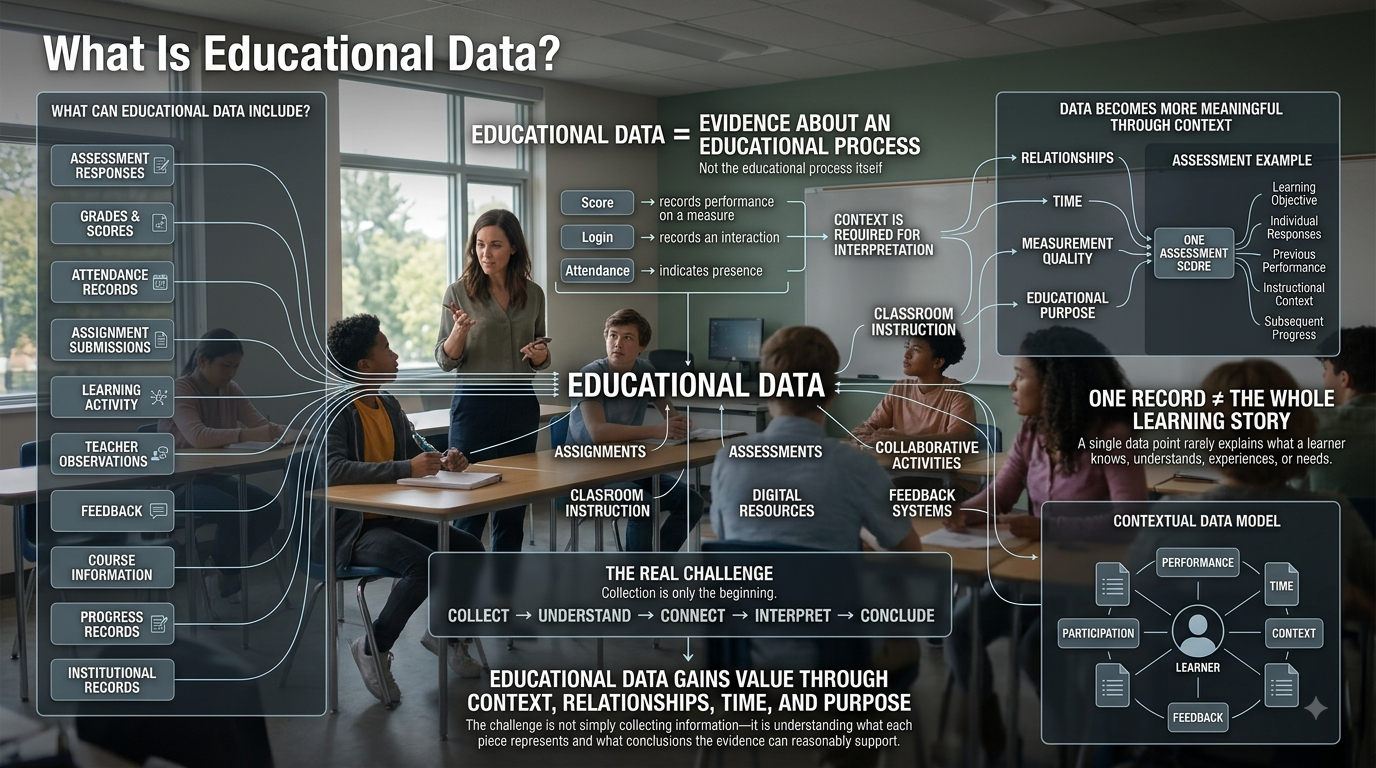
This distinction matters most in digital and game-based learning environments, including platforms like Gimkit, where activity data is easy to generate and easy to over-interpret.
A platform can record joins, responses, attempts, completions, timing, and scores. These are genuinely useful signals — but the presence of data doesn’t automatically create an educational conclusion. High participation doesn’t automatically equal high learning. A high score doesn’t automatically equal deep understanding. Fast completion doesn’t automatically equal mastery. Repeated attempts don’t automatically signal a persistent misunderstanding — they might just as easily reflect a student practicing deliberately.
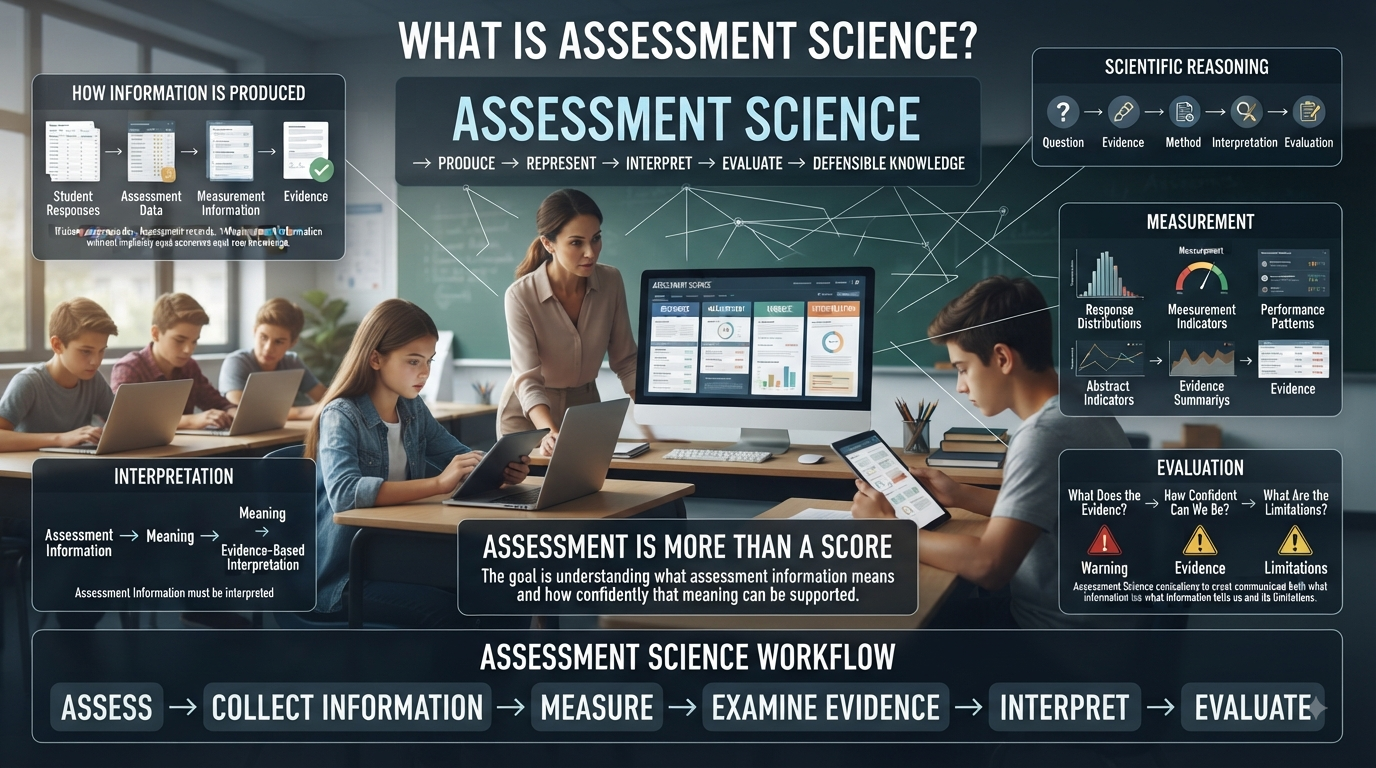
The meaning of any signal depends on the task, the measurement, the learner, and the intended learning outcome. Following the chain Learning Objective → Appropriate Measure → Observed Result → Interpretation keeps a metric from silently sliding into a claim it was never designed to support. If the measurement doesn’t align with the stated objective, even a perfectly accurate measurement offers weak evidence for a learning claim. This is exactly why assessment validity and evidence interpretation can’t be separated from each other in a game-based or digital classroom tool.
15. Evidence-Based vs. Evidence-Informed Practice
Evidence-based learning refers broadly to practice guided by credible evidence rather than assumption, tradition, or isolated impression. But “evidence-based” doesn’t mean “research says this will work for every student.” Outcomes still depend on learner characteristics, prior knowledge, instructional implementation, classroom environment, teacher expertise, and cultural or institutional context. The IES itself notes that more evidence is often needed to understand which practices work, for whom, and under what conditions.
That’s why the field increasingly favors the phrase evidence-informed over evidence-based. Evidence-based thinking asks, “what does the available evidence tell us?” Evidence-informed thinking adds a second question: “how should this evidence influence this decision, in this context?” A practical model:
Research Evidence + Local/Student Evidence + Professional Expertise + Learner Needs & Context → Better-Informed Educational Decision
The exact balance shifts by decision. A teacher responding to one student’s misconception may lean heavily on classroom evidence and professional expertise. A school weighing a major intervention may need to examine a much broader research base. A policymaker may need to weigh effectiveness, implementation cost, equity, and scalability all at once.
16. Where Professional Judgment Fits In
Professional judgment doesn’t compete with evidence — used well, evidence gives it a stronger foundation. A teacher combining research knowledge, knowledge of their specific learners, classroom-level evidence, curriculum requirements, and implementation realities can make a decision that is both informed and appropriately contextual. Research rarely enters real decision-making in isolation; professional knowledge and institutional conditions shape how it gets applied. The goal was never to remove human judgment from the process — it’s to make that judgment better informed, more transparent, and easier to examine after the fact.
17. A Practical Five-Question Evidence Test
Before treating any piece of information as evidence for a decision, ask:
Question
What It Checks
What exactly is the claim?
Prevents vague conclusions
What evidence supports it?
Identifies the actual basis for the claim
How was that evidence produced?
Examines method and quality
What are its limitations?
Prevents overinterpretation
Does it apply to this learner or context?
Tests relevance and transferability
Applied to a real example — students answering fewer questions correctly after a lesson doesn’t automatically prove “the teaching method failed.” A responsible review would ask whether the assessment matched the learning objective, whether the questions were appropriately difficult, whether prerequisite knowledge was in place, whether the lesson was delivered as intended, and whether other evidence shows the same pattern. Only after working through those questions can the result meaningfully inform the next instructional decision.
18. What a High-Quality Evidence Record Should Contain
A useful evidence entry — whether in a research repository, a school’s internal notes, or a platform’s data documentation — is far more than a claim and a link. A robust record can include:
Claim — what is being asserted
Question — what educational question it addresses
Evidence type — research, assessment, observation, student work, or implementation evidence
Source and date — where it came from and when it was produced
Population and context — who was studied, and under what conditions
Method and outcome — how the evidence was generated, and what was actually measured
Finding and strength — what the evidence showed, and how confidently that can be stated
Limitations — what should not be inferred from it
Applicability — where the finding might reasonably apply
Contradictory evidence — whether credible findings challenge it
Current interpretation — the most defensible conclusion given everything above
This structure is what turns a simple fact list into an actual knowledge system — one where a reader can trace any claim back to where it came from and judge for themselves how much weight it deserves.
19. The Evidence-to-Decision Cycle
Educational evidence works best as a continuous loop, not a one-time lookup:
Define the question → Identify the claim → Find relevant evidence → Appraise quality → Check context and relevance → Compare sources → Interpret with appropriate confidence → Make an informed decision → Implement → Monitor outcomes → Collect new evidence → (repeat)
Every implementation generates new observations, and those observations feed back into the next round of decisions. That’s what makes evidence use an adaptive process rather than a static reference check performed once and then forgotten.
20. Quick-Reference Glossary
Data — raw recorded observations, measurements, or results, prior to interpretation.
Evidence — information judged relevant and credible enough to support, challenge, or refine a specific claim.
Reliability — the consistency of a measurement or process across repeated use.
Validity — whether a measurement actually captures what it claims to measure.
Triangulation — checking a claim against multiple independent sources or methods.
Effect size — a measure of how large an observed difference or relationship actually is, separate from whether it’s statistically significant.
Systematic review — a structured synthesis of multiple studies on the same question, using defined inclusion criteria.
Evidence gap — an area where existing evidence is too thin, narrow, or conflicting to support a confident conclusion.
Evidence-informed practice — decision-making that combines research evidence with professional judgment, local evidence, and context, rather than applying research mechanically.
Professional Recommendations & Expert Reviews
What Is Educational Evidence? It is information that gives teachers a reasonable basis for understanding what students know, can do, or are still learning.
What Is Educational Evidence? A test result is one example, but evidence can also come from classwork, projects, discussions, observations, and student explanations.
What Is Educational Evidence? Its main purpose is to support a judgment about learning rather than simply record an activity.
What Is Educational Evidence? A student’s written answer can provide evidence because it shows how that student understands a particular concept.
What Is Educational Evidence? A student’s explanation can sometimes be more informative than a correct answer because it reveals the reasoning behind the response.
What Is Educational Evidence? Classroom observation can provide useful evidence when a teacher watches how students apply a skill during an activity.
What Is Educational Evidence? Homework can provide evidence of practice and understanding, although completed homework alone does not always prove independent mastery.
What Is Educational Evidence? Projects can provide broader evidence because they may require students to combine several skills at once.
What Is Educational Evidence? Quizzes can provide quick evidence about specific areas of knowledge and are often useful for identifying topics that need review.
What Is Educational Evidence? A single quiz score should not normally be treated as a complete picture of a student’s ability.
What Is Educational Evidence? Stronger judgments usually come from several pieces of evidence that point toward the same conclusion.
What Is Educational Evidence? Consistency matters because repeated evidence can make a conclusion more reliable than one isolated result.
What Is Educational Evidence? Context matters because the same result can mean different things under different learning conditions.
What Is Educational Evidence? A student performing poorly once may have made an unusual mistake, misunderstood the instructions, or faced a temporary difficulty.
What Is Educational Evidence? Teachers therefore need to consider the circumstances surrounding the evidence before making important decisions.
What Is Educational Evidence? Formative assessment provides evidence during learning and can help teachers decide what to explain or practice next.
What Is Educational Evidence? Summative assessment provides evidence after a period of instruction and is often used to evaluate overall achievement.
What Is Educational Evidence? Informal classroom conversations can also reveal understanding that may not appear in a formal test.
What Is Educational Evidence? Student questions are valuable because they can reveal confusion, curiosity, or gaps in understanding.
What Is Educational Evidence? Mistakes can provide evidence too, particularly when the same type of mistake appears repeatedly.
What Is Educational Evidence? Repeated errors can point teachers toward a specific misconception that needs attention.
What Is Educational Evidence? Correct answers become more meaningful when students can explain how they reached them.
What Is Educational Evidence? Participation can provide useful information about engagement, but participation alone should not be treated as proof of academic understanding.
What Is Educational Evidence? Attendance is relevant educational information, but being present in class does not necessarily demonstrate learning.
What Is Educational Evidence? Digital learning activity can provide additional information about how students interact with educational materials.
What Is Educational Evidence? Digital records should still be interpreted carefully because activity levels do not automatically equal learning.
What Is Educational Evidence? Student reflections can provide insight into how learners perceive their own progress and difficulties.
What Is Educational Evidence? Peer feedback can contribute useful information, especially during collaborative projects, although it should be considered alongside other evidence.
What Is Educational Evidence? Teacher feedback can become evidence when it is based on specific observations of student work or performance.
What Is Educational Evidence? The most useful evidence is connected to a clear learning objective.
What Is Educational Evidence? If the objective is problem-solving, the evidence should show how well students can actually solve problems rather than only recall definitions.
What Is Educational Evidence? Matching the evidence to the objective makes assessment more meaningful.
What Is Educational Evidence? Poorly matched evidence can give teachers an inaccurate impression of student learning.
What Is Educational Evidence? A well-designed question can reveal more about understanding than a large number of simple recall questions.
What Is Educational Evidence? Quality is therefore more important than simply collecting large amounts of information.
What Is Educational Evidence? Useful evidence should be accurate enough, relevant to the learning goal, and collected in a way that allows fair interpretation.
What Is Educational Evidence? It should not be collected simply because technology makes the information easy to record.
What Is Educational Evidence? Teachers need to ask what a particular piece of information actually tells them before using it.
What Is Educational Evidence? Privacy is also important because educational records can contain information about individual students.
What Is Educational Evidence? Responsible use means limiting access and handling student information appropriately.
What Is Educational Evidence? Evidence can help teachers adjust instruction when students demonstrate unexpected strengths or difficulties.
What Is Educational Evidence? It can show when a class is ready to move forward or when additional practice is needed.
What Is Educational Evidence? It can also help teachers identify students who may benefit from additional support.
What Is Educational Evidence? The best instructional decisions usually come from interpreting evidence rather than simply collecting it.
What Is Educational Evidence? Students can benefit when evidence is shared as useful feedback rather than used only to produce grades.
What Is Educational Evidence? Clear feedback can help learners understand what they are doing well and what they should improve.
What Is Educational Evidence? It can also help students recognize progress that may not be obvious from a single grade.
What Is Educational Evidence? Educational evidence is strongest when it leads to a practical understanding of what should happen next.
What Is Educational Evidence? It is not just data stored in a system; it is information interpreted in relation to a learning question.
What Is Educational Evidence? Overall, it means credible information about student learning that teachers and educators can use to understand progress, identify needs, evaluate instruction, and make better educational decisions.
Frequently Asked Questions
Is classroom observation weaker evidence than research?
Not automatically. Strength depends on the question being asked. Observation can be excellent evidence for understanding one student’s immediate misconception, while being far too narrow to support a claim about how a method performs across thousands of classrooms. The right evidence type depends on the decision it needs to inform, not on a fixed hierarchy.
Does “evidence-based” mean a practice is guaranteed to work?
No. Evidence raises confidence in a claim; it doesn’t create certainty. Even well-designed research is bounded by its sample, setting, and measured outcomes, and results can vary once implementation, learner characteristics, or context change.
Why does activity data on a learning platform need careful interpretation?
Because participation, completion, and speed are not the same thing as learning. A student can be highly active without demonstrating mastery of the intended objective, so platform data needs to be tied back to a defined learning outcome before it’s treated as evidence of learning rather than evidence of activity.
What’s the difference between an evidence gap and negative evidence?
An evidence gap means too little research exists to draw a confident conclusion either way. Negative evidence means credible studies were conducted and the results didn’t support the expected outcome. Treating a gap as if it were negative evidence — or vice versa — is a common and misleading error.
Can one strong study settle an educational question?
Rarely on its own. A single study is bounded by its sample, setting, and implementation conditions. Confidence tends to build through consistent findings across multiple studies, populations, and contexts — which is exactly what systematic reviews and meta-analyses are designed to assess.
Final Takeaway
Educational evidence is a disciplined bridge between raw information and justified educational understanding. Data tells us what was recorded. Research tells us what was investigated. Assessment shows what a learner demonstrated. Observation reveals what happened in practice. Student work exposes reasoning. None of these becomes evidence, though, until it’s connected to a defined question, evaluated for quality, interpreted within its context, and used with an honest level of confidence.
That is the standard worth holding any evidence-based claim to: don’t just collect facts — trace them to their source, evaluate their quality, place them in context, separate evidence from interpretation, preserve genuine uncertainty, and never claim more than the evidence can actually support.